The work and perspectives of local music collection custodians play a vital role in understanding this relationship. A better understanding of the role of local music collections as contributors to identity will be of great value in a wide range of cultural, media and historical studies. There are parallels between the challenges and professional needs of collecting local heritage and collecting local music.
Epstein, “On Collecting Materials for Local Music Histories,” notes: Quarterly Journal of the Music Library Association 24, no. Hathaway, “Developing a State Archive of Local Music Materials,” notes: Quarterly Journal of the Music Library Association 45, No. Carolyn Doi, “Local Music Collections in Cultural Heritage Institutions: A Qualitative Systematic Review,” Fontes Artis Musicae 65, no.
Participants were asked to indicate which formats were included in local music collections (fig. 1). We asked participants where and how they provide access to local music collections and how they are preserved. When asked if local music collections have been catalogued, participants responded that some sort of cataloging has been done.
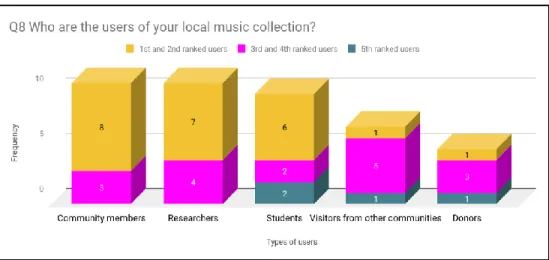
We asked participants to identify the users of their local music collections and describe the ways in which the collections are used. We asked participants how they manage promotion and outreach for their local music collection. The survey results show that music is collected locally in various types of libraries across Canada.
We propose a more comprehensive approach to community outreach in order to collect local music. Therefore, there is no way of knowing the number of local music collection managers who did not receive the invitation to participate. These interviews will focus less on professional practices and more on the role and consequences of local music collections and collectors within the community.
There are parallels between the complexity of local music collecting practices and the discourse on music scene scholarship. About collecting material for local music histories.” Notes: Quarterly of the Music Library Association 24, no. Developing a State Archive of Local Musical Materials.” Notes: Quarterly of the Music Library Association 45, no.
In other news: The importance of Canadian media sources in an analysis of the local music collection literature. Review CAML / Revue de l'ACBM 46, no.

Survey Questionnaire, English
The data will be stored on password-protected computer files at the Social Sciences Research Lab, University of Saskatchewan. The data from Part 1 (collection scope and collection practices) of this study will be archived through the University of Alberta Dataverse, a service that helps researchers publish, analyze, distribute and preserve their data and datasets. https://dataverse.library.ualberta.ca/dvn/). The data will be available to the public and may be used by other researchers in the future.
If you wish to withdraw, please contact one of the researchers to remove your information from the study results. The results of this study will be presented at the 2018 Canadian Music Library Association Annual Meeting in Regina, SK. If you have questions about your rights or how the survey should be conducted, you can call. This office is independent of researchers.
Sounds of Home: Exploring Local Music Collections and Collecting in Canada Q1 Does your library manage one or more collections of local or regional music?*. For the purposes of this research, local music collections are defined as library collections where the scope includes a delineated geographic area (eg town, city, neighborhood, province, territory, region, etc.). Q8 Who are the users of your local music collection(s). ranked from most frequent to least frequent users.
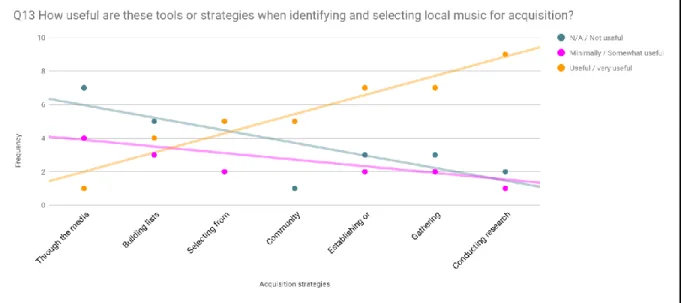
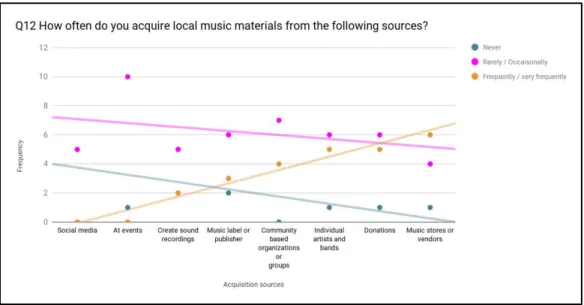
CAMLREVIEW /REVUE DE L'ACBM 47, NO.1 (APRIL / AVRIL 2019) PAGE 39 Q12 How often do you obtain local music material from the following sources. Question 13 How helpful have the following tools or strategies been in identifying and selecting local music for acquisition. CAMLREVIEW /REVUE DE L'ACBM 47, NO.1 (APRIL / AVRIL 2019) PAGE 40 Q15 What strategies are important when acquiring local music material. rank in order of importance, from most important to least important.
Q18 What steps have been taken to physically preserve the materials in the local music collection(s)? Q19 What steps have been taken to digitally preserve the materials in the local music collection(s)? Q20 Is there anything else you would like to add about local music collections or collecting?
Survey Questionnaire, French
Nous utiliserons les données recueillies dans la deuxième partie de l'étude (Prochaines étapes) pour déterminer où se trouvent les collections musicales locales au Canada et pour identifier les participants au projet de recherche, dans le but de les interviewer et de visiter leurs bibliothèques. Sons familiers : étudier les collections et collectionner la musique locale au Canada Q1 Votre bibliothèque contient-elle une ou plusieurs collections de musique locale ou régionale*. Aux fins de ce projet de recherche, les collections musicales locales sont définies comme provenant d'une région géographique particulière (par exemple, ville, quartier, province, territoire, etc.).
V6. Comment vos utilisateurs accèdent-ils actuellement à vos collections musicales ? cochez toutes les cases qui s'appliquent). Q7a Si vous avez répondu à la question 7 en indiquant que vos collections musicales sont partiellement ou entièrement cataloguées, les métadonnées sont-elles utilisées pour indiquer que les éléments catalogués font partie d'une « collection musicale locale ». Q7b Comment les métadonnées sont-elles utilisées pour indiquer que les éléments font partie d'une collection musicale locale.
Q9 Dans quel but vos utilisateurs utilisent-ils votre ou vos collections musicales ? veuillez cocher toutes les cases pertinentes). Q10 Comment votre(vos) collection(s) musicale(s) locale(s) sont-elles promues. veuillez cocher toutes les cases pertinentes). Pratiques de collecte Q11 De nouveaux éléments ont-ils été ajoutés à votre (vos) collection(s) musicale(s).
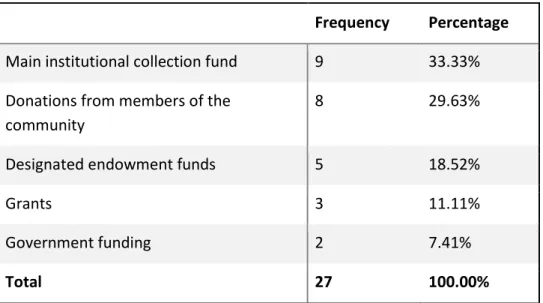
Q13 Les outils suivants vous ont-ils été utiles pour identifier et sélectionner les collections musicales locales à acquérir ? Parcourez la gamme de magasins de musique ou de détaillants. Recueillez les suggestions (par exemple des employés, des étudiants, des clients). Q14 Comment financez-vous l'acquisition de nouvelles collections musicales locales (veuillez cocher toutes les réponses qui s'appliquent).
Q15 Quelles stratégies vous importent le plus lorsqu'il s'agit d'acquérir des objets liés à une collection de musique locale. Organiser des activités visant à découvrir les musiques locales et à enrichir les collections. Q16 Où votre ou vos collections musicales sont-elles stockées dans votre entreprise ? veuillez cocher toutes les cases pertinentes).