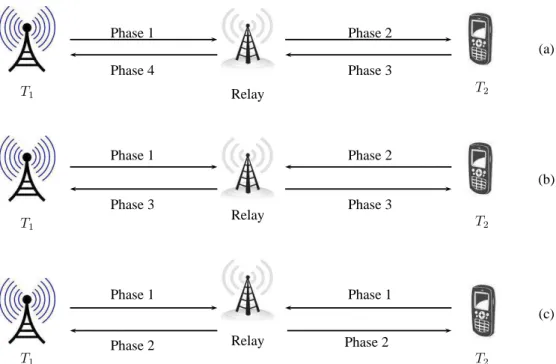
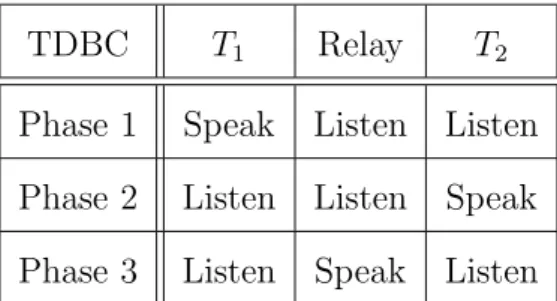
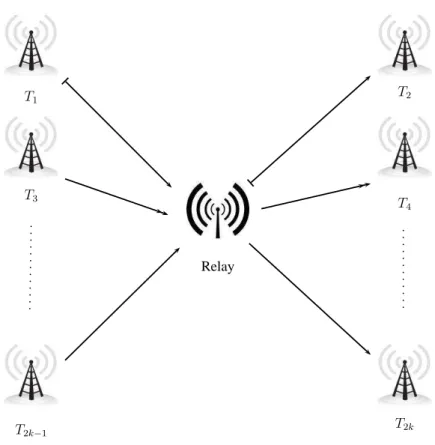
Then, these solutions are exploited to compare the performance of the underlying TDBC-based approach with that of the MABC-based technique developed in [1]. Interestingly, in the absence of a direct link between the two transceivers, we show that when the QoS constraints are imposed to satisfy certain given uncoded error probabilities (or equivalently to satisfy certain signal-to-noise ratio constraints) ), these two schemes close in terms of the minimum total transmit power.
Introduction
Wireless Networks
- Diversity
- Cooperation Diversity
- Two Way Communications
- Two-Way Relay Networks
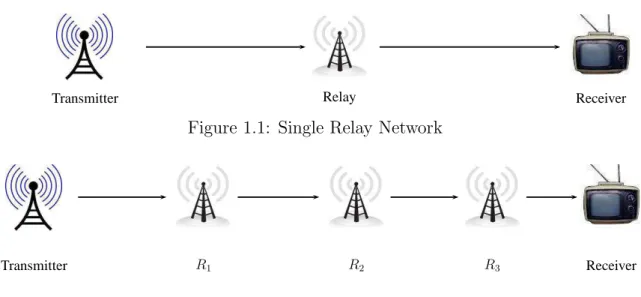
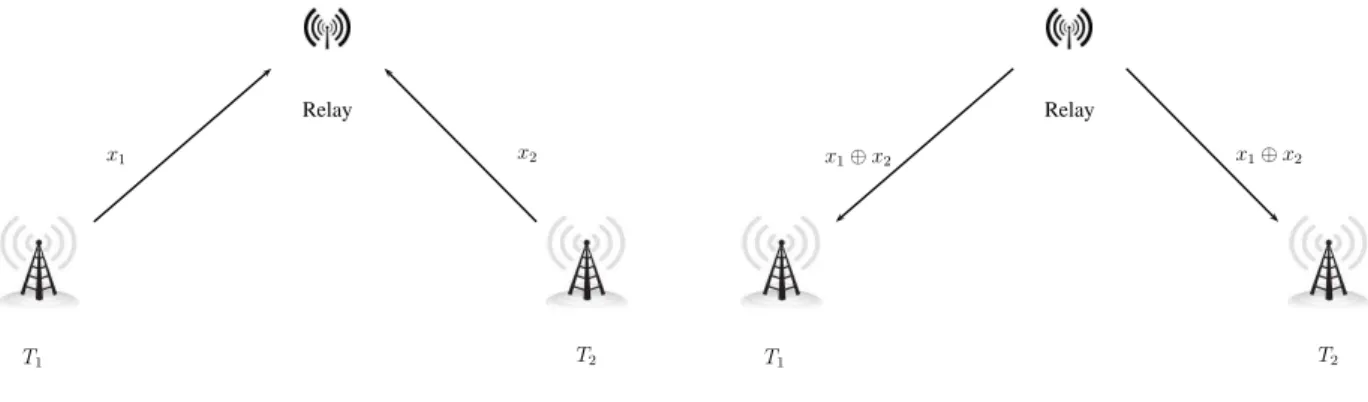
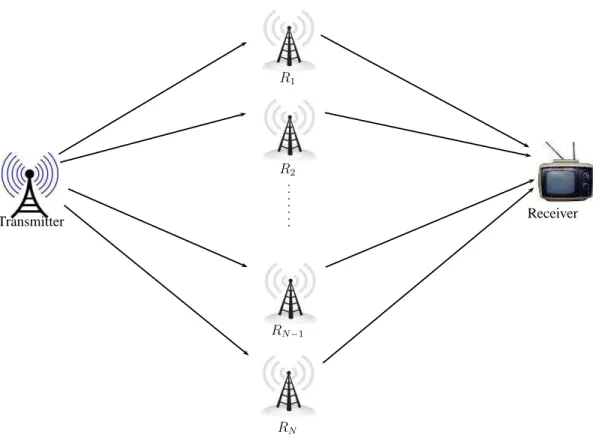
Amplify and Forward scenario (AF): In this technique, relays retransmit a scaled version of the received signal. In this type of communication, two transceivers want to exchange their data using the relays.
Motivation
However, in the MABC approach, such direct link communication is not possible since the two transmitters transmit and receive simultaneously. These advantages include additional degrees of freedom, as well as the possibility of benefiting from the availability of a direct connection between two transmitters.
Objective
Methodology
Thesis Organization
It is a paradigm shift for a fourth-generation wireless system that provides high data transfer rates to all nodes in the system. Furthermore, this technique is predicted to be an important aspect for fifth generation wireless systems [16].
A Brief Survey of Relaying Methods
- DF Method
- CF Method
- FF Method
- AF Method
Moreover, they determine the closed form of a tight upper and lower bound for the average symbol error probability of the MAC at the relay. Then the problem of optimal power allocation subject to the total power constraint was determined using the SOCP.
MIMO and OFDM Relaying Channels
- MIMO Networks
- AF in OFDM-based Networks
Power management is instrumental in effectively using CSI feedback from transceivers to relay, resulting in superior performance matching the corresponding upper limits in certain cases in the absence of a direct link between the transceivers. In the presence of a direct link, it is known that DF does not suffer from a diversity loss when the multiplexing gain is high, which is a significant enrichment over the unidirectional relay dynamic DF protocol. The best DMT is achieved when each transceiver transmits partial CSI to the other nodes in the system, enabling them to use their transmission resources.
This method maximizes the Frobenius standards of the channel and the simulations compare this method with the other existing transmission strategy for the bidirectional relay networks with MIMO AF relay. It is shown that during the iteration of the algorithms, the updates of the relay beamforming matrix and the source beamforming matrices are polished by solving a series of quadratic programs. They then propose a new AF scenario in the cooperative spatial multiplexing systems, where the virtual antenna arrays formed by the sources of the available antennas use analog non-generative terminals.
This scheme was based on a MABC scenario where in the MAC phase the OFDMA is used for support of multiple streams, and in the broadcast link OFDM/SDMA with linear process is used to increase the system output. It has been shown that the proposed method that requires one-dimensional search in the executable powers benefits from the low complexity compared to the double-decomposition method that requires the three-dimensional search space.
Cooperative Techniques for Multiple Relays
- Distributed Space-Time Coding (DSTC)
- Relay Selection Technique
- Distributed Beamforming
It is shown that the optimal power allocation that minimizes the conditional pairwise error probability of the worst link can be cast as a generalized linear fractional program, which can be efficiently solved using the Dinkelback-type procedure upon availability of instantaneous CSI on the relays. . It has also been proven that the optimal power allocation will activate a maximum of two relays if the sum power of the relay terminals is limited. Authors show that solving the optimal power allocation across relays to minimize the average conditional pairwise error probability of the destination nodes is a generalized linear fractional programming problem.
An approximation of the block error rate of the networks with two relays and some current. They also show that the opportunistic relaying protocol can improve the performance of the systems. The orthogonal and non-orthogonal subspace projection are exploited to present the structure of the optimal relay beamforming.
Simulations provide a comparison of the performance for the optimal relay beamforming and the suboptimal beamforming, and the benefit of the optimal power allocation is investigated. If sufficient degrees of freedom are available to decode the received signal at the nodes, network coding can increase the efficiency of the communication systems [79].
MABC and TDBC Comparison
- Beamforming for MABC scheme
- Beamforming for TDBC scheme
The optimal transmission strategy and capacity range of the two-way relay networks were investigated in [88]. Literature Review 37 difference between the achievable rate region of this algorithm and the cut-set upper bound of the system. Reference [1] shows that this optimization problem has a unique solution; and for the symmetric QoS constraints, the power allocated to the relays is equal to the sum of the power allocated to the two transceivers in the optimum case.
It is assumed that all nodes are equipped with a single antenna and operate in half-duplex mode. The overall throughput of a cognitive bidirectional relay network has been shown to increase with this beamforming approach. It is assumed that all nodes operate in half-duplex mode and the system operates in the MABC protocol.
The authors derive a closed form of the optimal beamforming matrix, which minimizes the weighted MSE subject to the power constraint on the relay. Literature Review 46 Assuming that all added sounds at relays and transceivers are white with variance 1, the SNRs at the transceivers are expressed as.
![Figure 2.3: Proposed protocols in [3]](https://thumb-us.123doks.com/thumbv2/9docorg/12455237.0/48.892.143.733.333.799/figure-2-3-proposed-protocols-in-3.webp)
Data Modeling
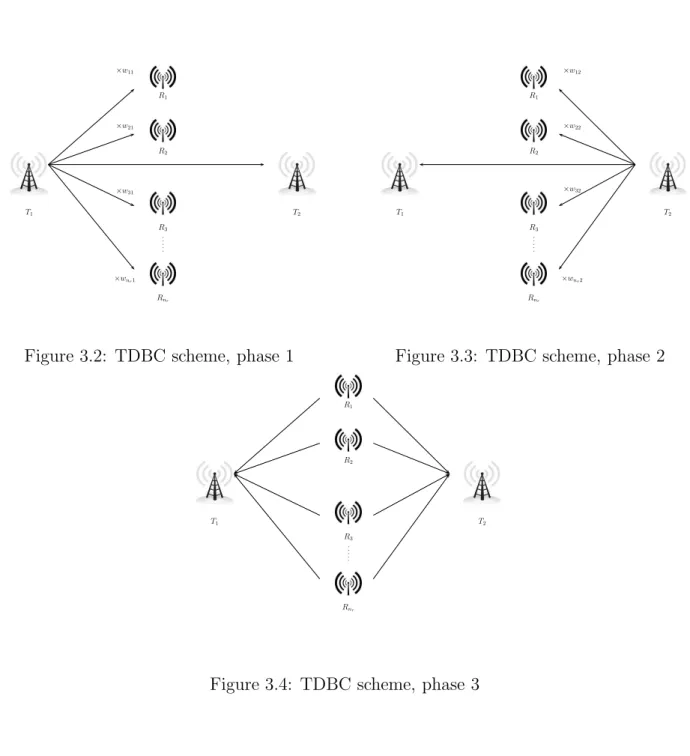
Methodology 52 notations, the vectors of the signals received by the relays in time slots 1 and 2 can be written respectively as. In the third time slot, the i-th relay multiplies the signals, received in the first and second time slots, with complex weights wi1∗ and w∗i2, respectively, and then sends this new signal to both transceivers. It is worth noting that the first term in (3.6) is known as the self-interference since it depends on the signal s1 transmitted by Transceiver 1 during the first time slot.
Given the fact that s1,p1 and f1 are known to transceiver 1 and that the weight vectors w1 will be calculated at this transceiver, the first term in (3.6) is known to transceiver 1. Therefore, this term can be subtracted from y1 and the residual signal can be used of Transceiver 1 to detect the information symbols2. Similarly, the second term in (3.7) can be subtracted from y2 and the remaining signal can be used by transceiver 2 to extract the information symbol s1.
In this case, during the first time slot, when Transceiver 1 transmits its information symbol, s1 to all relays, Transceiver 2 also receives a signal containing this information symbol. Similarly, in the second time slot, Transceiver 2 sends its information symbol, s2 to all relays and to Transceiver 1.
Total Power Minimization
There is one more aspect of the TDBC method that needs to be considered. Here we use the data models in (3.12) and (3.13) to design our TDBC-based two-way network beamformers in the presence of the direct connection between the two transceivers. To do so, we note that the correlation matrix of the noise vector ¯ν1 is given by .
Therefore, the total power minimization problem in the presence of the direct connection is given by It is worth mentioning that, as one would expect, the presence of the direct link results in higher received SNR at both transceivers. This means that the phase of the ith input ofwj must match the phase.
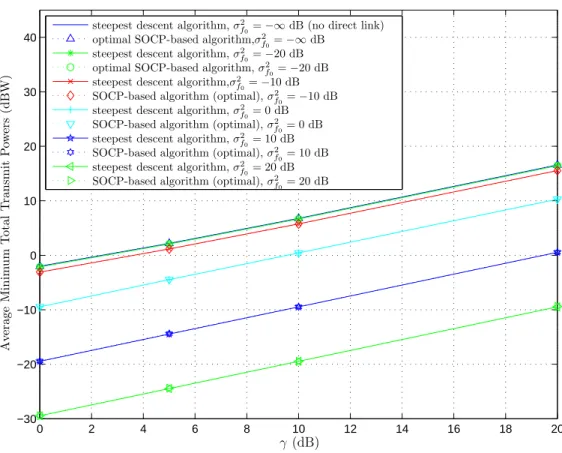
Method 61 for the ith entry of h, which is equal to the aggregated phase of the channel coefficients from the ith relay to the two transceivers. 3.34). Nevertheless, we use this method to benchmark the performance of the steepest descent method used to solve (3.34).
Assessment
4.3, where we plotted the average values of the minimum total transmit power against the corresponding speeds. 4.4, 4.5 and 4.6 compare the performance of the MABC-based method with that of the TDBC-based network beamformer for the cases where the direct connection exists and its quality, measured by σf20, varies from -20 to 20 dB. As these figures show, the TDBC approach can outperform the MABC technique if the quality of the direct connection is strong enough compared to the quality of the relay-transceiver connections.
This is due to the fact that the MABC-based approach cannot benefit from the availability of the direct link between the two transceivers, while the TDBC method can optimally benefit from such a direct link. Interestingly, as the quality of the direct link improves, the TDBC-based method starts to outperform the MABC-based approach for a wider range of data rates. However, for low values of data rate, the TDBC-based method has a lower minimum total transmission power due to the fact that this method can benefit from the existence of the direct link between the two transceivers.
For any required data rate, the TDBC-based method also outperforms its MABC-based counterpart for large values of the quality of the direct link. This figure shows that as the quality of the direct channel improves, the optimal values of p1 and p2 approach the corresponding maximum values.
Conclusion
Future Work
Grami, "Optimal distributed beamforming for two-way relay networks," IEEE Transactions on Signal Processing, vol. Shin, "Reliable amplify-and-forward two-way relay networks," in International Conference on Wireless Communications Signal Processing (WCSP), 41 . November] ——, “Amplify-and-send bidirectional relay networks: Error exponents and resource allocation,” IEEE Transactions on Communications, vol.
McKay, “Power allocation strategies for distributed spatiotemporal codes in bidirectional relay networks,” IEEE Transactions on Signal Processing, vol. McKay, “An optimal distributed spatiotemporal coding strategy for bidirectional relay networks,” in IEEE Wireless Communications and Networking Conference (WCNC), Apr. Jing, “Relay selection scheme for bidirectional relay for gain-and-forward networks,” in International Conference on Wireless Communications Signal Processing (WCSP), Nov.
Yang, “Distributed beamforming for bidirectional boost-and-forward relay in cooperative networks,” in 12th IEEE International Conference on Communications Technology (ICCT), Nov. Cui, “On design of cooperative beamforming for bidirectional relay networks,” IEEE Transactions on Signal Processing, vol.
![Figure 1.5: Shannon two-way channel [2]](https://thumb-us.123doks.com/thumbv2/9docorg/12455237.0/22.892.159.741.135.268/figure-1-5-shannon-two-way-channel-2.webp)
![Figure 1.6: Shannon Achievable Rate Region [2]](https://thumb-us.123doks.com/thumbv2/9docorg/12455237.0/22.892.349.585.337.525/figure-1-6-shannon-achievable-rate-region-2.webp)