This research project examines how Section 37 agreements have been used to secure spaces for cultural production and dissemination in the city of Toronto. The study concludes that land use planners must reinvent their approaches to cultural planning and proactively use planning tools to support Toronto's creative urban goals.
Introduction
As such, the City of Toronto, with more than 600 Section 37 agreements written or implemented, can be described as either the most prolific or notorious user of the planning tool. Despite mounting criticism of Article 37, Toronto's arts and culture community is one sector that has consistently expressed its enthusiasm for the policy.
Context and issues
An overview of Section 37
Although the Urban Planning and Real Estate Services departments are responsible for determining the value of the s. Moore's (2013a, 2013b) study provides one of the most comprehensive analyzes of the city of Toronto's use of emails.
Cultural planning in Ontario and Toronto
However, despite its promise, cultural planning does not feature prominently in the policy framework governing land use planning in Ontario. The 2002 Official Plan outlined arts, culture and heritage as central components of Toronto's intensification; and the Culture Plan responded in turn with a push to include cultural planning goals alongside other planning activities.
The intersection of Section 37 and cultural planning in Toronto
As such, workers and supporters of the cultural sector are often expected to devote a tremendous amount of unpaid and uncommitted energy to government relations. For the City's Culture Department, s.37 is "a catalytic tool for cultural infrastructure development" (Toronto, 2014a, p. 2) which has been actively promoted in consultations with the public and the cultural sector. 37 is not a panacea: the funding is limited to capital facilities and cannot meet the needs of the cultural sector in terms of operating funds, programming or staffing requirements.
37 agreements to be a more effective tool for cultural planning, greater integration of Culture Department staff in rezoning and development review is essential (Millward, 2013). As such, the Millward Report recommends that planners and councilors consider the geographical boundary when negotiating s. This not only complicates the traditional understanding of the geographical connection, but also creates the possibility that several council members should be involved in the negotiation in order to best represent the catchment area.
Similarly, new cultural infrastructure can serve not only the local community, but also cultural sector workers from across Toronto and potentially a wider range of cultural consumers across the GTA. As such, analyzes of local community needs may not accurately reflect the purpose of a new cultural facility.
Study directions
Similarly, despite the requirement that developments qualify as good planning prior to the provision of s. There is an inherent contradiction between the good planning requirement and the responsibilities assumed by municipal cultural planners: a primary reason for investing in culture – whether through grants, loans or the provision of space – is to correct against the market's failure to provide public goods. such as art and culture. 37 was used to ensure cultural benefits and the relationship that the agreements had with the needs of the cultural sector.
This report was developed for the city and as such its focus is on municipal policies and. There is an opportunity to supplement this study with further research on the experiences of cultural groups who care about these new community benefits. 37 as part of larger capital campaigns, in order to better understand who and what is supported to build new cultural spaces.
Performing arts facilities serve as a particularly revealing research topic because they impose significant capital demands compared to the requirements of other art forms. Finally, the paper will consider the implications of these findings as the City of Toronto and the cultural sector seek to realize the visions set out in the 2003 and 2011 cultural plans, with particular regard to the.
Methods
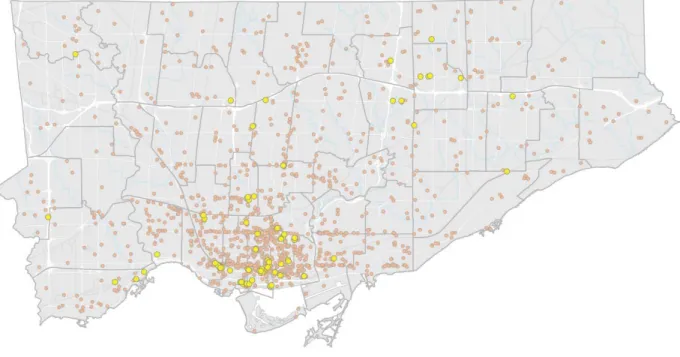
As such, the locations of developments that contributed to public art were excluded from the mapping. Asset mapping is regularly conducted by cultural planners (Grodach, 2013; Kovacs, 2011), but this exercise is especially important in the context of Toronto. Through GIS mapping, two performing arts facilities were identified for further qualitative and quantitative analysis to develop a richer understanding of how cultural organizations interact with s.
Qualitative content analysis of zoning bylaws and staff reports was conducted for each performing arts development to better understand the planning context in which s. Similarly, this phase used conventional content analysis so that observation was the first part of the process and coding occurred during the analysis based on the content of the data ( Neuman & Robson, 2012). As such, semi-structured qualitative interviews were conducted with key stakeholders from the performing arts facilities and/or the developers providing the community benefits.
Finally, the interviews were supplemented by a short financial survey completed by representatives of the performing arts facilities. However, due to time and resource constraints, neither Crow's Theater nor the developer they worked with could participate in the research study.
Research limitations
Research findings
Cultural benefits secured
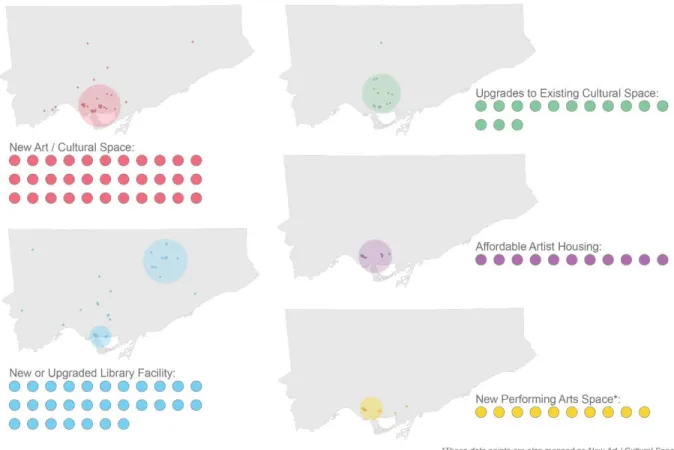
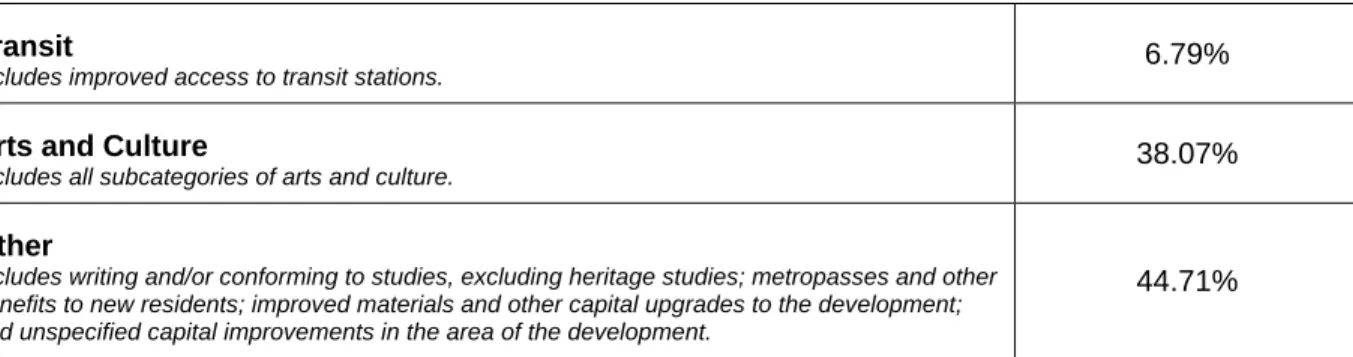
Involves writing and/or adapting studies other than heritage studies; metropass and other benefits for new residents; improved materials and other capital upgrades of the development;. and unspecified capital improvements in the development area. Although art and culture are fairly well represented among all the benefits listed in the 37 agreements, the scope of benefits in the art and culture category is not evenly distributed:. 37 agreements, in addition to providing a visual, contributed only to a limited extent to the growth of the cultural sector.
However, the impact of insured facilities may be more substantial than their low occurrence rate suggests. 37 is used, the location of developments naming cultural benefits are mapped alongside the location of cultural facilities recognized by the City's Culture Division. The 37 cultural benefits are not widely distributed: the 80 developments that name cultural benefits are located in only 22 of Toronto's 44 wards.
37 databases were compared with the findings of the City's Making Space for Culture (MSFC). Although three Artscape properties qualified as prospective case studies, only one property was selected for this project because the value of multiple explorations from the same nonprofit is limited.
Case studies
The WQWT is a designated regeneration area in the Toronto Official Plan and located within the boundaries of the Garrison Common North Secondary Plan. A 2007 staff report outlining a proposed OPA would have laid out a vision for WQWT in which "the use of. The company was not an obvious choice to manage community assets: at the time the WQWT redevelopment began, the Theater Center was largely invisible outside the art environment.
The sandbox is located on the podium of the Cinema Tower, a street-level commercial condominium developed by Daniels Corporation. Artscape Sandbox is located in a regeneration area designated by the Toronto Official Plan and falls within the boundaries of the King-Spadina Secondary Plan. The first iteration of the King-Spadina Secondary Plan was implemented in 1996 in response to the decline of the manufacturing industry in the area.
Content analysis of the King-Spadina secondary plan and bylaws related to the Artscape Sandbox revealed limited references to arts and cultural activity. The project's vision for Sandbox evolved as a reflection of the three main parties to the deal.

Case studies: emergent themes
37 matches in the City of Toronto database identify community spaces operated by the Toronto Arts Council4. 37, the TAC has determined that taking on the management of these spaces would be a 'mission creep' - after all, the TAC is a subsidy granting body and not a property manager (S. Wright, personal communication, February 24, 2016). As in the case of Artscape Sandbox, the type of space that can be secured via s.
Artscape has historically taken on great responsibility in creating and curating new spaces for arts and culture in Toronto. The process is complex and the model used in one case is unlikely to be reproduced elsewhere in the city. This integration is evident in a number of current Department of Culture priority projects, indicating that great progress has been made since the controversial development process in the WQWT.
For example, a potential community hub project within the Garrison Common North Secondary Plan area is cited as an example of proactive and effective collaboration between the City Planning and Culture Division (L. Martin, personal communication, March 4, 2016). The Culture Division has been involved in the South Niagara planning strategy and in the growing enthusiasm to see Destructor transformed into a community or cultural center.
Future directions
These findings suggest that the ties between city hall and underserved communities are not strong. It is unrealistic to place the burden of cultural infrastructure development on communities that may not have the capacity, resources or networks needed to ensure these projects are successful.
Reinvent the relationship between land use and cultural planning
37 agreements and/or the cultural sector may be less inclined to pursue cultural projects as community benefits. Although both the City Planning Strategic Plan (Toronto, 2013b) and the Cultural Plan for the Creative City (Toronto, 2003) advocate greater inter-departmental collaboration, the portfolios of City Planning and Economic Development and Culture are largely discrete. While the cultural plans build on the policy vision set out in the official plan, it is difficult to ascertain the extent to which they are components of development review, and whether planners are required to take them into account when making land use planning decisions .
Furthermore, the recommendations in the cultural plans are largely targeted at the culture division's employees, with a focus on internal changes instead of proposing new behavior for other departments. 37 is an area planning tool; it has also played an enormously important role in catalyzing and financing new culture. 37 continues to be a unique source of municipal funding for new cultural capital projects, then land use planners will have an enormous influence on the continued health and vitality of the cultural sector.
Toronto's planning documents take an instrumental approach to the cultural sector, relying on creative assets for both community development goals and to enhance the city's global competitiveness. Art and culture are therefore no less essential than parks, schools and community services – infrastructure for which land use planners are currently reserving space as cities grow and intensify.
Make proactive use of existing planning tools
Close the research gaps
Concluding thoughts
Retrieved from http://artscapediy.org/Creative-Placemaking- Toolbox/How-Can-I-Use-Planning-Tools-and-Incentives/Section-37.aspx. Retrieved from the Legislature of Ontario website: http://www.ontla.on.ca/web/bills/bills_detail.do?BillID=3176. Retrieved from http://www.toronto.ca/legdocs/mmis/2014/ed/bgrd/backgroundfile-69084.pdf City of Toronto.
Onttrek van http://www.cbc.ca/news/canada/toronto/john-tory-wants- full-review-of-section-37-contributions-1.2905379. Onttrek van http://www.cbc.ca/news/canada/toronto/etobicoke-residents-say- neighbourhood-lost-out-on-100k-in-negotiations-with-condo-developer-.
Appendices
Bibliography