A LOOK AT HOW A COMPLETE STREET PROJECT IS DEFINED AND INFLUENCED WITHIN THE GREAT GOLDEN HORSE. Although the concepts and overall objectives of a Complete Street are increasingly recognized in the field of transportation planning, there is a degree of ambiguity in defining such projects through existing built infrastructure.
INTRODUCTION
Understanding what a Complete Street looks like at the project level can further this movement. In particular, it will investigate the following research questions: (1) How is a Complete Street defined at the project level.
A LOOK AT THE COMPLETE STREETS CONCEPT
SHARED STREETS
These experiments were primarily used on quiet residential streets, where urban planning and landscaping techniques were intended to make drivers feel like they were driving in a garden, forcing them to pay attention and consider other street users ( Ben-Joseph, 1995). . Although these initial concepts were intended for quiet residential ROWs, their intent to break down the barriers between roadway and public space has begun to materialize.
THE COMPLETE STREETS MOVEMENT
Today, many urban arteries in the US (and Canada by comparison) are severely lacking. The Complete Streets movement was created to challenge the automobile-focused paradigm and bring recognition and importance to other transportation choices that go beyond the private vehicle.
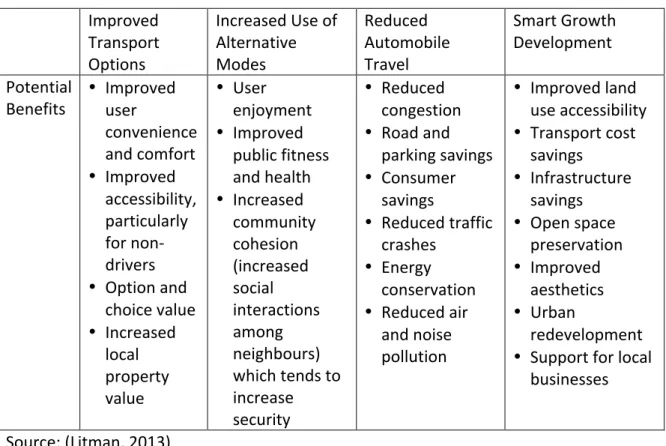
BENEFITS
While these potential benefits for Complete Roads are numerous and expected to positively impact the immediate environment as well as the surrounding region (Burden et. al., 2011), the evidence linking a Complete Road to these purported benefits is rare. Moreover, at a more conceptual level, there is a lack of understanding about the infrastructural components (or what combination of components) might be needed to effectively deliver these potential benefits.
THE DESIGN OF A STREET
2010) considers the definition of a Complete Street (as given by the National Complete Streets Coalition (2010)), and recognizes that while most examples will have the same guiding principles in their design and creation, each should be the same. Although a rural Complete Street will differ in physical form compared to an urban Complete Street, the overall guiding principles of the movement should provide the two examples with a “common denominator”: prioritizing safety over convenience for all who use the ROW (Smith, 2010, 13). Today, the street is beginning to re-emerge in the planning community as it is recognized to play an important role in the social, physical, functional and economic fabric of the city (Burden et al., 2011).
The Complete Streets movement has worked to prioritize pedestrians, cyclists, active transit users within the public ROW by shifting the focus away from the automobile (McCann, 2013).
METHODS
TELEPHONE INTERVIEW WITH LOCAL EXPERTS
In total, 27 surveys were completed with each participant asked to identify one example of a Complete Street project that existed in their municipality.
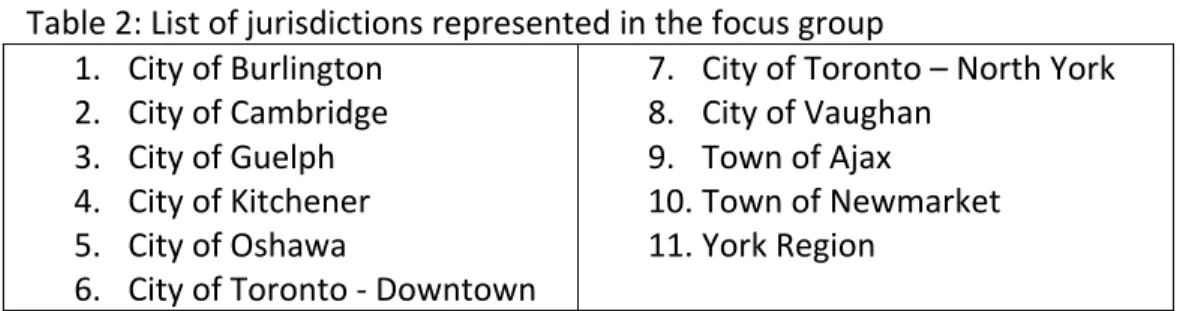
THE FOCUS GROUP
COMPLETE STREETS: THE AMBIGUOUS DEFINITION
Others pointed out that the term “whole street” could not determine the needs of the community and which components or plans would actually truly benefit the surrounding land uses and the people who used the given ROW. This general awareness of who (or where) the street was supposed to serve was an important factor identified by experts as the reason they were resistant to its use. Finally, the group concluded that the term may not be useful in defining an individual project.
Similar to McCann's (2013) theory of the Complete Streets movement, the experts felt that the term was more than a concept and an overall strategy to. This resonates with McCann's (2013) position that Complete Streets should not be focused on a single project design, but rather on the entire movement away from car-centric street designs and towards safe, accessible and multimodal ROWs. They felt that the Complete Streets concept was still something that was not well understood and that defining a Complete Street based on a project's built form was difficult to do based on the overall vagueness of the term.
The information gathered from these interviews prompted us to further investigate what other transportation professionals thought of the term “Complete Street,” how it can be defined at ground level, and what factors influence how a street is physically constructed.
DEFINING A COMPLETE STREET
CONTEXTS THAT INFLUENCE A COMPLETE STREET
- Surrounding Land Uses
- Roadway Typologies and Street Hierarchy
- The Age of ROWs and their Existing Widths
- Quality of Roadway Infrastructure
The final context sensitivity identified as influencing how a Complete Street project is defined was the quality of the infrastructure. The group believed that due to the different quality levels of the street's elements, the definition of a complete street depends on how well its infrastructure parts are delivered to each intended user. Surrounding land use was the first contextual issue identified as strongly influencing the definition of a complete street at the project or street level.
Because of this significant change, the definition of a complete path at ground level will change significantly. The position that a specific road serves in the overall hierarchy of a city's network will also affect how a complete road is defined. These considerations will result in different combinations of Complete Path elements and will also ultimately affect how a Complete Path is defined at ground level.
The age of the site and especially the age of the street (including the built form on it) is another context-dependent characteristic that can influence how the whole street project will look.
PLANNING PROCESSES THAT INFLUENCE A COMPLETE STREET
Form, Function and Feel
After going through the processes and considerations of what other feelings the ROW should provide to the public, the street planner/designer can begin to consider what physical components help create those desired feelings or perceptions. Street function identification is another component of the planning process that helps further influence and define the entire street. As already mentioned, this function can be determined through the context dependence of road typologies and location in the entire street hierarchical network.
By determining the street's intended function the planner can begin to visualize the priorities of the street where the design considerations can begin to take shape. Understanding the function of a street brings attention to the user and travel mode priorities, which ultimately leads to the physical road deviations that are often required. The consideration of street form was the third component of the planning process that could influence a Complete Street's definition.
Although appropriate urban forms will ultimately be sourced through a municipality's urban design guidelines, the focus group pointed out that it was crucial to go through this planning process to understand.
Age, Mode, and Ability
These processes and ways of defining a complete ROW help us look beyond what has been physically implemented on the street, as well as understand the quality standard each component has been delivered to. As identified in the contextual issues, we are beginning to understand that not all components can be delivered to the highest and best quality, as some criteria may also directly conflict with others. This is where planners and engineers of a ROW must make appropriate tradeoffs based on the street's intended purpose, function, and user priority.
An example provided by the focus group was that an objective of a Complete Street might be to reduce the turning radii at a ROW intersection (to slow motor vehicle turning speed to allow for a safer pedestrian crossing) . However, if this consideration is in direct conflict with other ROW functional uses (i.e., it is a primary route used for emergency response vehicles), then those reduced turning radii may not be possible to implement. A problem with defining a Complete Street by its physical elements is that we are not aware of why a street project lacks certain components (e.g. bike lane, turning curbs, traffic-calming measures) and why some elements are built while others do not .
By understanding the processes of planning and designing ROWs, we may be able to define a complete street based on the elements that have been considered rather than those that have been implemented.
CONCLUSION
The focus group suggested that a Complete Street could be defined based on how a street is created rather than what it looks like. In other words; can we begin to define a Complete Street project based on the planning and design processes and considerations. By considering these initial processes, we can gain an understanding of which Complete Street ideals were revised but perhaps not necessarily built due to other limiting factors (e.g.
If these aspects are properly planned (regardless of the design deviations made in the final product), then perhaps we can call the project a Complete Street. Similar to the first planning process, the focus group suggested that if the initial planning stages of a street are considered to cater for all ages, modes and abilities. regardless of what design trade-offs were necessary), then it can also be a complete street. For example, if all users (i.e. walkers, cyclists, public transport users and drivers) are considered during the design phases, but selected ROW elements are not included in the final road design (due to improving the overall safety and comfort of .. pedestrians and cyclists), the final product can in fact be considered a Complete Street.
More research could be done in this regard to understand what other planning processes Complete Street projects are built through, and how.
IMPLICATIONS FOR POLICY AND PRACTICE
The findings in this report confirm the importance of defining and measuring Complete Streets based on community needs, surrounding land use, and considering the overall scope of the project (AARP Government Affairs, State Advocacy & Strategy Integration, Seskin, Kite, Searfoss, 2015). In this context, this larger research paper has contributed to transportation planning policy and practice by providing insight into how the Complete Street project is defined and impacted, particularly in the Greater Golden Horseshoe region. The results of this research will enable planners within (and outside) the region to be aware of how the built form of an entire street project can change in different contexts.
The findings presented in this research also highlight that the definition of a Complete Street project can be informed and influenced not only by the appearance of the street, but also by how it is planned and implemented. Expected benefits for planning practitioners include improved understanding of the complexities of a 'full road' and context-related and planning process considerations that need to be taken into account when planning for one. The Complete Streets movement is still a relatively new concept in the fields of urban transportation planning in the GGH region and more broadly in Canada.
Complete Street Survey Responses from the 27 Growth Centres