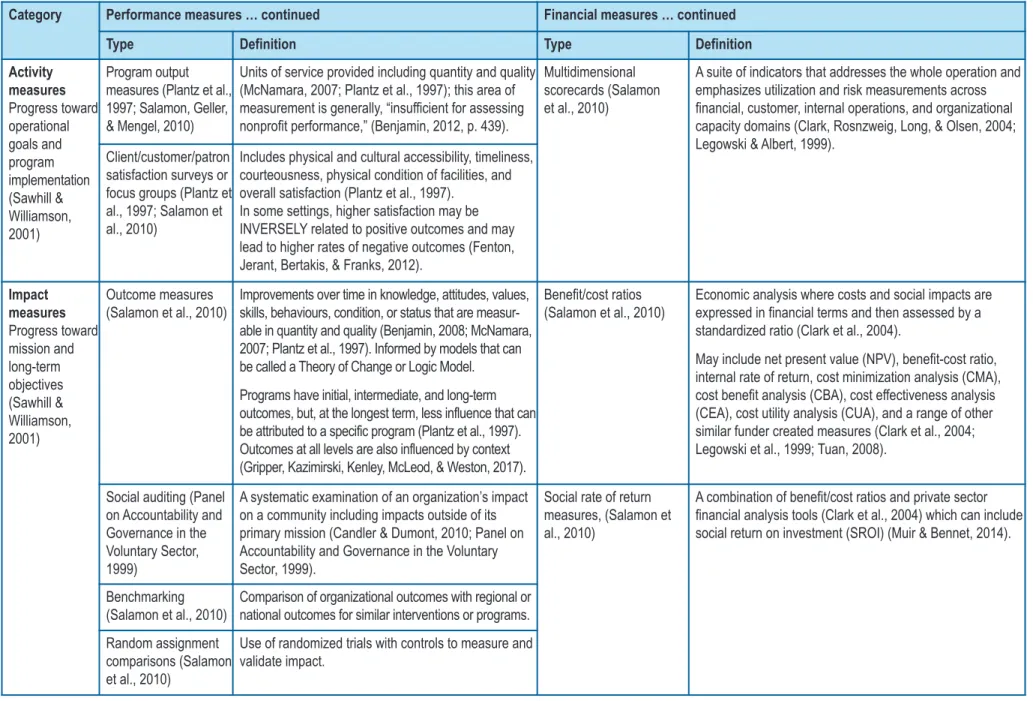
Demographic characteristics, information about the client's problem or status prior to service (Plantz et al., 1997). Includes physical and cultural accessibility, timeliness, courtesy, physical condition of facilities and overall satisfaction (Plantz et al., 1997). Programs have initial, intermediate and long-term outcomes, but in the longer term less influence that can be attributed to a specific program (Plantz et al., 1997).
In Canada, organizations with larger revenues were more likely to conduct evaluations (Hall et al., 2003).

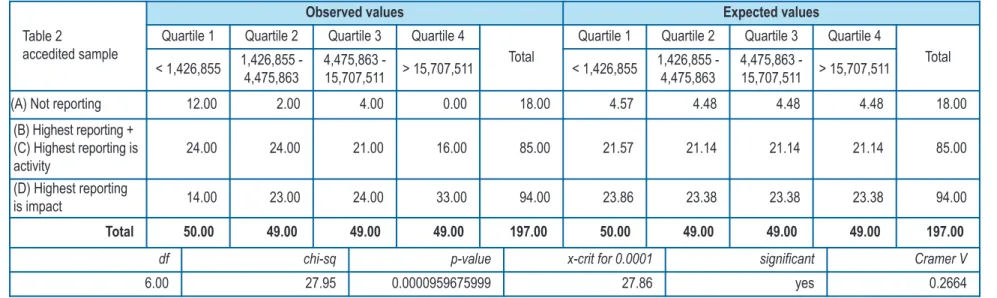
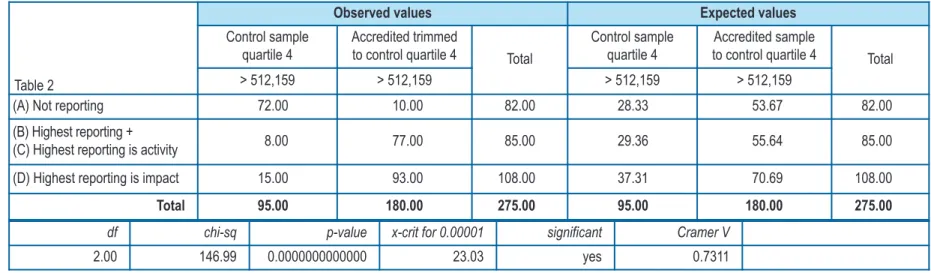
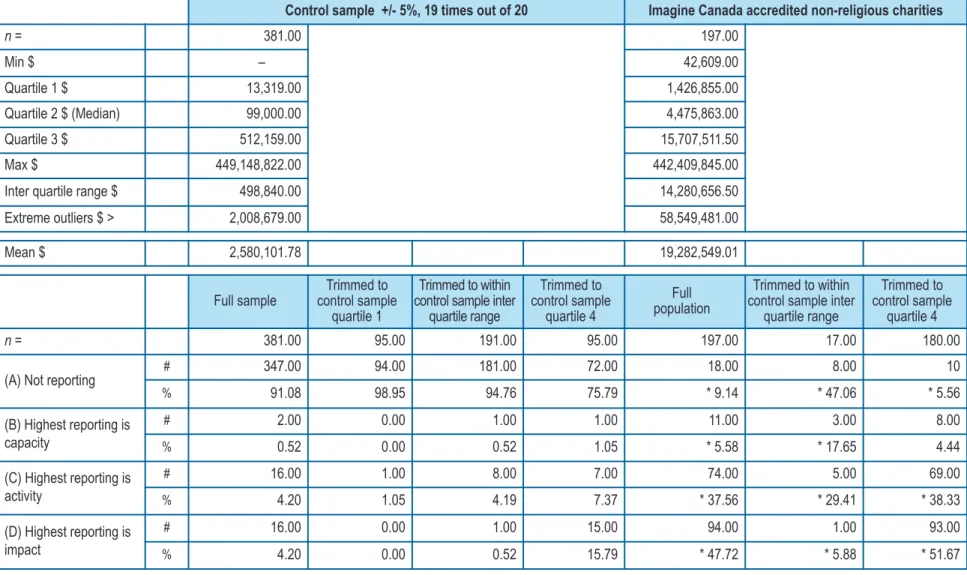
Imagine Canada accreditation will correlate with a greater public disclosure of program impact through annual reports than occurs among Canadian non-religious charities in general
First, organizations accredited by Imagine Canada (2014) are required to produce and post annual reports on their website according to the B10 standard. Canadian charities have shown that an annual report is the easiest place to share their impact measurement results (Panel on Accountability and Governance in the Voluntary Sector, 1999). Those accredited by Imagine Canada have demonstrated a capacity and interest in improving their governance and management practices, regardless of their size (the smallest accredited charity had an annual income of less than $45,000 in 2015).
In addition, organizations are more likely to report positive results, which may lead to public underreporting of impact measurement activities that are neutral or negative.
Imagine Canada accreditation will correlate with rates of public disclosure of program impact that are less than the rates of impact measurement found in earlier self-reported studies
Within accredited organizations, larger size, as measured by annual revenue, will correlate with more rigorously measuring and publicly disclosing program impact
This is a rejection of Barbara Legowski and Terry Albert's (1999) classification of donor base diversity, sustainability, and growth as outcomes in fundraising organizations in light of more recent writing that would classify these as measures of organizational capacity (Sawhill et al., 2001) and states, for example, that "the effectiveness of [foundations] depends mainly on the performance of grantees". Imagine that Canada's accreditation would be associated with greater public disclosure of program impact through annual reports than occurs among Canadian non-religious charities in general. Chi-square test for the correlation of Imagine Canada accreditation with public reporting controlling for organization size.
Imagine that Canada accreditation would correlate with rates of public disclosure of program impact that are less than the rates of impact measurement found in earlier self-reported studies.
Shared Platforms as Innovative Support for Small Nonprofit Organizations: Toronto Case Study Evidence
Ray Dart Trent University
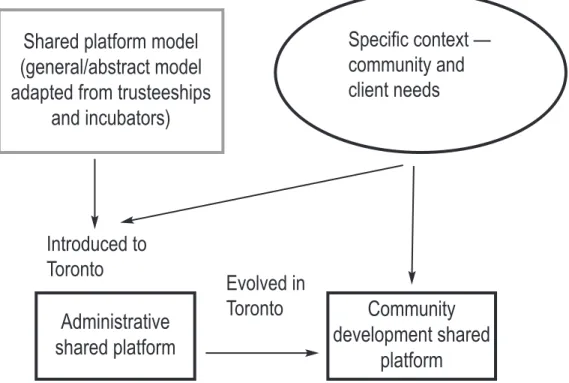
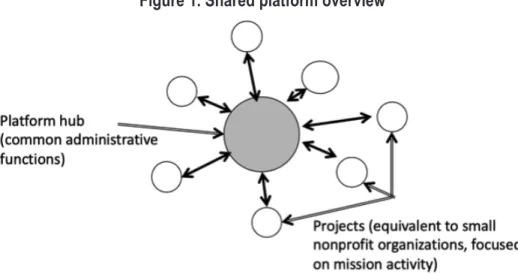
This article examines the structure, function, adaptation, and emergence of the shared platform structure after it was introduced to the nonprofit community in Toronto, Canada. Together, these conceptual backgrounds help to focus on the most salient features of the shared platform narrative. The particular variations of the model demonstrated in ASP and CDSP are described in Table 1 and developed through eight separate categories.
Data from the interviews broadly indicate that the ASP's task is to support relatively professionalised. The thick description of the ASP model in this section came from a single example in the Toronto SP community. The division of labor between the platform hub and the project in ASP is unconventional outside the SP community.
These differences in the nature of CDSP projects provided direct contrasts to what they perceived as the ASP's more traditional nonprofit organizational models. One of the practitioners of a CDSP reported that “[ASP A] has been really great in terms of networking and just giving us opportunities to get better exposure [to the idea of the SP] as a social innovation” (interviewee C). This article provides descriptions of the structure and function of two different types of shared platforms.
Most of ASP's projects were those that, in a different context, would have. Anatomy of the Nonprofit Starvation Cycle: Analysis of Declining Overhead Ratios in the Nonprofit Sector.
Perceptions of the Physical and Social Neighbourhood Environment and Youth Volunteerism: Canada’s Capital Region
Sean Pearce & Elizabeth Kristjansson University of Ottawa
Satisfaction with neighbourhood amenities
After running the model, null parameter estimates were found for direct paths from safety and environmental problems to formal volunteering (z= -1.58 and 0.20, respectively) and to informal volunteering (z= -1.24 and -1.04, respectively). To consider more parsimonious models, direct paths were eliminated (i.e., the paths were constrained to zero) from neighborhood problems to volunteer outcomes (Model 3). Lower perceived neighborhood safety problems related to greater satisfaction with neighborhood amenities (β = 0.33, p< .05), while lower perceived environmental problems were associated with stronger neighborhood cohesion (β = 0.19, p< .05).
H1 was not fully supported because only neighborhood cohesion subsequently predicted higher informal and formal volunteering intensity (β = 0.17 and 0.14, respectively), while satisfaction with neighborhood amenities had a direct path to informal volunteering (β = 0.14, p<.05). but not formal volunteering (β = 0.03, p> .05). Neighborhood cohesion partially mediated the path from satisfaction with amenities to informal volunteering (β = 0.05, SE CI but not formal volunteering, so H2 was not fully supported.
Satisfaction with neighbourhood attractiveness
People who experience greater accessibility and availability of social services may experience a stronger sense of social cohesion because these services act as channels for socialization (Völker et al., 2007). Similarly, positive perceptions of the built environment (e.g., aesthetics) have been linked to place attachment and social cohesion (e.g., Arnberger & Eder, 2012; de Vries, van Dillen, Groenewegen, & Spreeuwenberg 2013; Litt, Schmiege, Hale, Buchenau, & Sancar, 2015). In this sample, perceived safety problems may not have been severe enough to affect feelings of social cohesion.
Community initiatives and programs should focus on approaches to creating social cohesion among community members (eg, meet and greet events) to bring people together, perhaps motivating them to volunteer in community activities . Informal volunteering usually involves acquaintances with whom people can be related (Stürmer, Siem, Snyder, & Kropp, 2006; Wilhelm & Bekkers, 2010). This study investigated how neighborhood factors such as social cohesion can predict volunteering, while these relationships are often bidirectional.
Future studies should also consider objective neighborhood measures (eg, census) and their relationship to youth volunteering. A strong sense of belonging in rural areas promotes solidarity and social cohesion, and this can translate into helpful behaviour. Nonprofit organizations and community stakeholders should also support strategies that strengthen social cohesion in the broader environment when trying to recruit youth volunteers, because a high sense of community belonging can increase youth's propensity to engage in philanthropic actions.
This not only benefits the individual, but can benefit entire neighborhoods through a continuous flow of social capital, where strong social cohesion can foster greater participation, supporting, strengthening and revitalizing communities. What we know about social cohesion: The research perspective of the federal government's social cohesion research network.

Volunteering as Meaning-Making in the Transition to Retirement
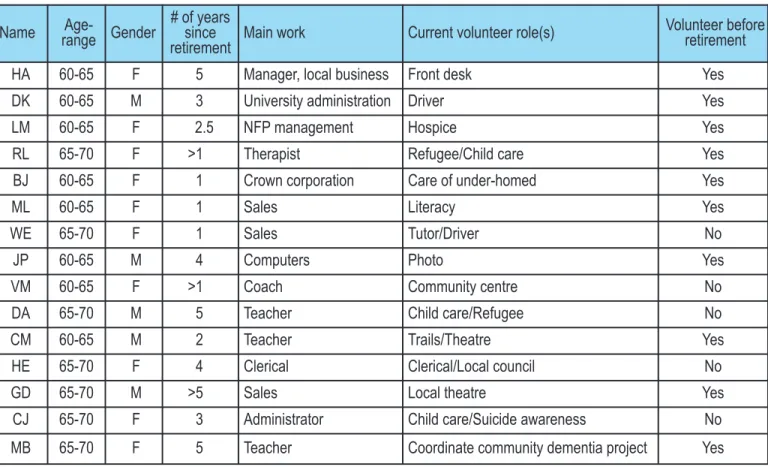
The construct of meaning making (Davis, Nolen-Hoeksema, & Larson, 1998) provides a useful lens for understanding choices related to and the impact of volunteering in community-based nonprofit organizations by older adults. As such, the aim of the study was to understand how older adults made meaning through volunteering during the transition from paid work to retirement, and how this affected the nature of their volunteer involvement. The central research question that guided the study was: what role does the volunteering experience play in meaning-making during the transition to retirement among older adults.
This section reviews key facts about volunteering experiences for older adults to build a foundation for the further review of meaning making in this population. Among others, Neal Krause (2015) investigated how involvement in religious organizations is an important factor in the motivation of older adults to volunteer in religious settings and beyond. The research on the topic of health and well-being in voluntary work is extensive, and it generally shows the positive effects of voluntary work on the retirement life of older adults.
At a primary level, volunteer roles were related to ensuring that older adults have meaning in their lives. Volunteering therefore fostered older adults' desire to continue to grow by challenging themselves and maintaining their mental abilities in the process (Komp et al., 2012). This pattern was consistent across the study sample and provides an interesting additional layer to how meaning-making can be thought about in the volunteering decisions of these transitioning older adults.
Findings from the current study illustrate the key ways older adults find meaning in volunteering during the transition to retirement. Older adults were also able to give meaning to the time and energy they spent volunteering by making a difference in their communities and in the lives of other individuals. To volunteer or not to volunteer: the influence of individual characteristics, resources, and social factors on older adults' likelihood of volunteering.
Participation and retention of older adults in school-based volunteer activities: The role of school climate.
Compte rendu / Book Review
Il reconnaît les savoirs des agriculteurs haïtiens et la place des femmes dans la démarche d’économie circulaire. Il présente les cuisines collectives et les cantines scolaires comme des terrains de formation expérimentale et des laboratoires pour la sécurité alimentaire. Certains volets sont particulièrement éloquents, notamment la place des femmes rurales dans la famille haïtienne et la capacité des femmes à développer une économie sociale et solidaire.
La troisième partie pose des questions importantes sur les conditions de l'innovation dans l'économie sociale et solidaire en Haïti. Cette partie examine également de manière critique certaines pratiques des agences gouvernementales dans l’élaboration des politiques publiques. Enfin, les auteurs réfléchissent au rôle des universités et des organisations de l'économie sociale et solidaire dans le processus de développement local.
En conclusion, ce qui m'a le plus frappé dans cette lecture, c'est l'ampleur de la tâche accomplie, avec si peu de moyens. Une note de bas de page souligne ceci : « La contribution volontaire des membres de l'équipe de recherche aura largement dépassé la valeur de 100 000 $ en travail rémunéré. Les effets du sous-financement gouvernemental en termes de collaboration sont énormes, mais trop souvent ignorés.
J'admire l'engagement des bénévoles et de tous ceux qui s'engagent dans la coopération, mais soyons conscients de l'ampleur de la tâche et de l'effort de solidarité internationale qui nous reste à faire. Exigeons un meilleur soutien des pouvoirs publics aux efforts des citoyens qui souhaitent s’engager dans la coopération internationale.