
The scope of the review focused on the cost, effectiveness and efficiency of services provided to support seriously injured workers. Flexibility within SIP policies allows staff to make decisions to service the needs of injured workers.
Scope and approach
The program's organizational structure is adequate to support service delivery, including matching resources and skills to program needs. Identify related risks (including emerging risks), problems, gaps and challenges and make recommendations on opportunities to strengthen the program; and.
Scope and approach (cont’d)
Plan and kick-
Conduct stakeholder interviews
Perform inter- jurisdictional
Review criteria and attributes
Expense management processes align with program objectives and enable cost efficiencies (e.g., spend by workflow and management of vendor contracts, where applicable). Entitlement decisions are consistent, fair, cost-effective, timely, and aligned with program objectives to achieve expected outcomes for the program and injured workers.
Review criteria and attributes (cont’d)
Some Improvements Needed • Limited management attention is warranted to assist with overall efficiency and/or effectiveness within the specific area. Significant improvements required • Continuous management attention is needed to strengthen the overall efficiency and/or effectiveness within the specific area.
Value for money review conclusion
Based on the results of the VFM review, the SIP demonstrated value for money. The VFM review identified 23 summary recommendations across nine themes, which, if implemented, would improve the SIP's performance against the review criteria and attributes assessed to deliver greater value for money and outcomes for WSIB.
Observations and recommendations
- Definition and eligibility
- Performance measures
- Financial management
- Policies, processes, and
- People
- External service provider
- Strategy and objectives
- Strategy and objectives
- Definition and eligibility criteria
- Financial management
- Performance measures
- Policies, processes, and procedures
- Data analytics
- Technology
- External service provider network
The following pages describe the 31 detailed recommendations that support the 23 summary recommendations in the Executive Summary.
Observations and recommendations (cont’d)
- Strategy and objectives (cont’d)
- Definition and eligibility criteria (cont’d)
- Financial management (cont’d)
- Performance measures (cont’d)
- Policies, processes, and procedures (cont’d)
- Data analytics (cont’d)
- Technology (cont’d)
- People (cont’d)
- External service provider network (cont’d)
SIP has a strong internal culture focused on improving the quality of life of injured workers. Quality of life is used as an assessment tool to determine the eligibility of injured workers for services and benefits. There is variation among the jurisdictions reviewed regarding the presence of a specific program for seriously injured workers.
Injured workers are broadly stratified by work stream, based on the severity and timing of the injury. Reinstate customer satisfaction surveys to ensure that the needs of injured workers are being met by the services and benefits provided by SIP. Review performance measures to support seriously injured workers in relation to the renewed strategic direction of the SIP.
Telehealth and digital technologies are not used for communication between injured workers and third-party providers.
Appendices
Appendix A
Cost management processes are in place and implemented to support appropriate expenditure forecasting and trending, reporting, review and analysis. Cost management processes are aligned with program objectives and enable cost efficiency (eg, costs by work flow; vendor contract management where applicable). Adequate training and development processes are established and implemented to enable effective and ongoing performance management.
Eligibility decisions are consistent, fair, cost-effective, timely, and consistent with program objectives to achieve expected outcomes for the program and workers. Evaluation procedures are in place to improve the level, cost and quality of services.
Appendix B
Financial Management
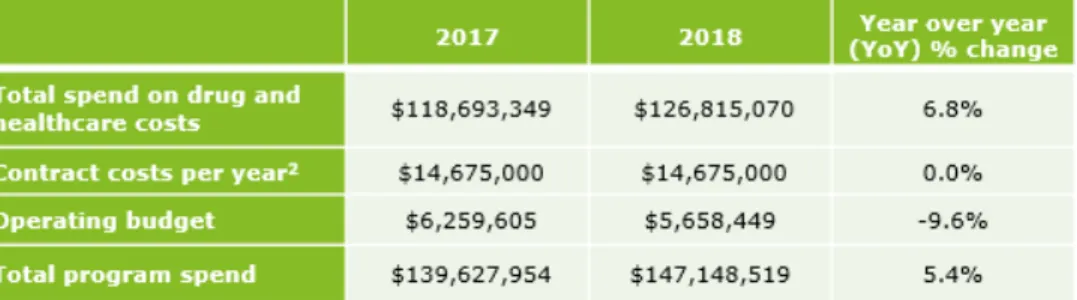
Develop a plan to improve accessibility and visibility into an integrated view of SIP financial data for ongoing proactive financial management. Reexamine coding practices to deaggregate SIP and MSIP spending data for improved visibility into SIP-specific operating costs; centralize reporting of total SIP spending (eg operating costs, drug and healthcare spending and external provider costs);. Ensure visibility of spending trends by spending category, by work stream and by claim segmentation (e.g. to align with future claim segmentation for eligibility criteria as indicated in section 5.2 Definition and eligibility criteria); and,.
Align with internal and/or industry-based comparators against which the SIP will monitor its spend trends, both with respect to operational spend and benefit spend spend to support improved proactive forecasting and resource allocation.
Performance Measures
Collaborate with WSIB's Operational Policy Branch to enable policy review and refresh to improve current challenges and further support decision making and services. As appropriate, engage key stakeholders (eg, injured workers, employers and WSIB staff) as part of the consultation; and. Develop a formal process to periodically reassess the needs related to services and benefits received during the lifetime of the injured employee.
Review and improve practice guidelines to improve the case management process, consistency in decision-making and reduce the risk of inequitable access to services and benefits for injured persons. Engage with WSIB Quality Assurance services through the Quality Assurance & Advisory Branch to support the ongoing consistency of decisions in line with policies and expectations for fair and equitable distribution of services and benefits across claims.
Data Analytics
Continue to establish appropriate guidelines and review processes to ensure that outside service providers are implementing technology-enabled care for injured workers. Considerations during the review and refresh should include exploring additional opportunities for outsourcing service providers. Continue to establish appropriate guidelines and review processes to ensure that external service providers are optimizing the use of technology-enabled care for workers.
The review process may include a periodic audit of outside service providers to assess their ability to provide services and/or goods to meet the needs of injured workers. The performance of key external service providers as reported by injured workers, their relatives and WSIB staff.
Appendix C Interviewees
Staff and management including subject matter sources from the following business areas within WSIB were interviewed for the VFM review. Staff and management including subject resources from outside WSIB were interviewed for the VFM review. Shirley Price Clinic Manager, West Park Healthcare Amputation and Prosthetics Specialty Program Matthew Lam, Clinical Coordinator, West Park Healthcare Amputation and Prosthetics Specialty Program Cathy Irwin, Senior Manager, Rehabilitation Institute of Toronto, University Health Network.
Appendix D
Canadian jurisdictions were limited to the information provided through a SIP-specific information request. The cross-jurisdictional benchmarking approach involves a review of material from interviews conducted by WSIB (for Canadian comparators), a combination of documentation review and interviews with one to three representatives from each of the three remaining organizations. The information gathered from the cross-jurisdictional comparison is limited to publicly available information and information provided to Deloitte during interviews.
The information provided by the representative of each of the organizations is based on the knowledge and willingness of the interviews and is valid at the time of the interjurisdictional comparison. The organizations that participated in the interjurisdictional comparison have different mandates that may differ from WSIB's mandate.
Canadian Comparators and Veterans Affairs Canada
Rating – What is the severity or extent of the disability and its impact on your quality of life. Critical Injury Benefit is a lump sum payment that recognizes the immediate consequences of the most severe and traumatic service-connected injuries or illnesses. The amount of the allowance will be based on a grade that reflects the nature of the member's disability.
Immediately: “Immediately” means, for the purposes of serious injury benefits, that medical evidence demonstrates that the serious impairment and serious interference with the quality of life, although not necessarily permanent, continued from the time of the sudden and single incident. Once the appropriate level of quality of life has been determined and the medical impairment assessment of the condition or conditions listed in brackets has been identified, the final calculation of the quality of life assessment is determined.
The injured worker's employer's workers' compensation insurance agent administers the weekly payment and all other forms of compensation. Eligibility and assessment criteria for workers' compensation insurance and subsequent payment of benefits depend on an injured worker's Whole Person Impairment (WPI) score. Once accepted into the Workers Care Program, case managers will coordinate the injured worker's treatment and care needs.
The MyPlan tool is used by the case management team to create a personalized plan for services and interventions, as well as the injured worker's goals. Source: https://www.icare.nsw.gov.au/injured-or-ill-people/motor-accident-injuries/families-and-carers/.
Ohio’s Bureau of Worker’s Compensation
RNs from the catastrophic program and from the MCO jointly conduct a case conference for an initial review of the claim to determine the injured worker's needs and begin discharge planning. We keep some injured workers who have suffered burns (depending on the severity) in the program, and we transfer those injured workers who have suffered amputations to less intensive case management within the MCO. The MCO receives the initial medical information and the MCO RN and Catastrophic RN within the BWC will conduct a chart review within the Catastrophic Program to determine eligibility.
It compares the MCO's success in returning injured workers to the job with a statewide average score. Retention – A deduction from an MCO's payment to force the MCO to comply with a contractual term.
The Swiss National Insurance Fund
The management segment will handle cases with reintegration problems (RP) and are unlikely to return to reintegration as a result of the insured event. The Case Management segment will differentiate between groups of employees based on whether they can return to work and the number of days missed from work. The Case Management segment consists of a specialized Case Manager to initiate treatment and determine appropriate benefits for the injured worker.
SUVA employs a medical adviser who is responsible for ensuring that the providers provide the necessary treatment to the injured party. Augmented and Virtual Reality: SUVA has leveraged augmented and virtual reality in their "SUVA City 2.0" initiative to anticipate hazards on the road.
Appendix E
Information about Deloitte’s services
Deloitte's services do not constitute an engagement to provide audit, compilation, review or attestation services as described in statements of professional standards issued by Chartered Professional Accountants Canada ("CPA Canada") or any other regulatory body. WSIB will not seek an opinion from Deloitte, and Deloitte will not provide any such opinion, on the application of accounting principles in relation to this engagement. In addition, management agrees not to represent to any third party that it has received such an opinion from Deloitte.
WSIB further agrees that reports or other materials issued or prepared by Deloitte will not be used by, disseminated, quoted, disclosed or disseminated to, nor will any such reports or other materials be referred to, any person who is not a member of the WSIB project team. Reports or other materials provided to WSIB are for internal use only and may not be provided to third parties without the prior written consent of Deloitte, unless required by law or court order.
