
4d11fbc73cbb7a4b15f12381b15dd88b
247
0
0
Texto completo
(2) Doctoral Dissertation. Bioinspired Non-Heme Iron Catalysts for Challenging Oxidative Transformations: Mechanistic Studies and Catalytic Applications on Selective Alkane Hydroxylation and Alkene cis-Dihydroxylation. IRENE PRAT CASELLAS April 2013. Programa de Doctorat en Ciències Experimentals i Sostenibilitat. Directed by: Dr. Miquel Costas Salgueiro Dr. Xavi Ribas Salamaña. Memòria presentada per a optar al títol de Doctora per la Universitat de Girona..
(3)
(4) Els sotasignants Dr. Miquel Costas Salgueiro, Professor Titular del Departament de Química de la Universitat de Girona i Dr. Xavi Ribas Salamaña, Professor Agregat del Departament de Química de la Universitat de Girona,. CERTIFIQUEN que la memòria que porta per títol “Bioinspired Non-Heme Iron Catalysts for Challenging Oxidative Transformations: Mechanistic Studies and Catalytic Applications on Selective Alkane Hydroxylation and Alkene cis-Dihydroxylation” que presenta la Irene Prat Casellas per a l’obtenció del títol de doctora, ha estat realitzat sota la seva direcció i que compleix els requeriments per poder optar a Menció Internacional.. I, perquè així consti i tingui els efectes oportuns, signen aquest document.. Dr. Miquel Costas Salgueiro. Girona, 22 d’abril del 2013.. Dr. Xavi Ribas Salamaña.
(5)
(6) A la meva família i a en Lluís.
(7)
(8) AGRAÏMENTS M’és difícil pensar que ja han passat més de quatre anys des de que vaig començar el doctorat, mirant enrere em venen un munt de records a la memòria i tots ells són fantàstics. S’acaba una etapa que sé de segur que no oblidaré i recordaré sempre amb un gran somriure, moltes persones han format part d’ella i han contribuït a la realització d’aquesta tesi. Amb aquestes quatre ratlles m’agradaria agrair a tothom que ho ha fet possible. No puc començar d’altra manera que donant les gràcies els meus directors de tesi, en Miquel i en Xavi, per donar-me l’oportunitat de formar part del seu grup de recerca, per introduir-me en el món de la investigació i per totes les hores que m’han dedicat. En Miquel per la seva passió per la química que és inesgotable, per tenir sempre l’esperança que els resultats és poden millorar i per treure el màxim fruit de tots els meus treballs. En Xavi per fernos tocar de peus a terra quan ha estat necessari, per solucionar tots els problemes logístics i per estar en tot moment pendent de tot. A tothom que forma i ha format part del Qbis: l’Anna per tota la seva ajuda, tan en els inicis de la tesi com ara per acabar d’enllestir alguns treballs. En Julio que sempre té una resposta a totes les preguntes i l’hi desitjo tota la sort del món amb l’starting grant. A la Laura que juntament amb l’Anna han sigut la meva referència en l’oxidació d’alcans i alquens. L’Alicia i l’Isaac que se’ls troba molt a faltar i els hi desitjo molta sort amb la seva recerca. La Mercè amb la qual he compartit més estones durant el doctorat, tan en el laboratori com en congressos i ara fins i tot en classes d’anglès, molta sort. En Zoel i l’Olaf que fan que les hores de despatx siguin més entretingudes, explicant bajanades i fent-nos passar una bona estona. En Ferran que a vegades sembla que no hi és però sempre té l’orella connectada per dir-hi la seva. Els del coure que és van independitzar,... a la Cristina que habitualment comentem que sense ella s’està més tranquil, però també trobem a faltar el seu punt de vista femení. En Marc, bon company tant de carrera com de doctorat, tot i que de tant en tant difama falses històries sobre mi. En Joan i els seus gens nòrdics, que és capaç d’anar en màniga curta tot l’hivern. L’Imma amb les seves super ofertes, un gran fitxatge sens dubte. La Mireia que té la capacitat d’encomanar la seva felicitat allà on va. No em puc oblidar dels del 13, Arnau els dinars serien molt avorrits sense les teves històries. Gerard, sempre amunt i avall. En David, que no ha aconseguit encomanar-me la seva passió per les columnes, però crec que n’he aprés força i la Raquel que ha d’estar carregada de paciència per aguantar aquests 3 homes..
(9) Finalment, a tots els que esteu fent el màster i els que començareu el doctorat aquest any molta sort amb la recerca futura: Teresa, Carlota, Oriol, Carla, Mònica, Jordi, Isma, Ming i la Clàudia. A tots els becaris de química, tant de la facultat com del parc, pels sopars i els bons moments junts. Al professor Josep Maria Luis, la Dra. Mireia Güell i la Verònica Postils per la seva col·laboració amb els estudis computacionals. També vull agrair a tots els directors d’estada que han estat molt atents amb mi i m’han donat un cop de mà amb la recerca quan ho he necessitat. El professor Leroy Cronin de l’University of Glasgow per donar-me l’oportunitat de formar part del seu grup i la Dra. Jennifer Mathieson per totes les hores treballant conjuntament per tal de que sortissin els experiments. El professor Matthias Beller i a la Dra. Kathrin Junge per l’estada al LeibnizInstitut für Katalyse i pels seus savis consells que van fer que el treball arribes a bon port. Finalment, el professor Martin Albrecht de l’University College of Dublin per l’entrega en la meva recerca i a tots els membres del seu grup que hem van acollir molt bé i hem van portar a nombrosos pubs Irlandesos. Fora de l’àmbit de química voldria agrair a tota la meva colla, que tot i que els sopars i festes de dissabte a la nit s’han convertit en sopars-berenars de diumenge, la vostra companyia és la mateixa de sempre. A les cinc nenes més precioses de Bordils (jo inclosa) que tot i que cada cop costa més trobar dies per trobar-nos, sé que sempre hi sou. El Club Handbol Bordils i en especial a l’equip del meu germà que m’heu fet vibrar en incomptables partits d’handbol. A totes les nenes de volei, les que formeu part de l’equip i les que hi heu anat passant durant tots aquests anys, que sou més que simples companyes i que espero que els sopars i festes no s’acabin. A l’equip, molta força per afrontar la recta final de la temporada i poder aconseguir la permanència tant preuada, com ja sabem som un equip de primera! En Jordi de la Laia per donar el toc artístic a la portada de la tesi, moltes gràcies. Finalment agrair a la meva família que sempre tenen una estona per escoltar les meves preocupacions i neguits i per les seves paraules càlides i reconfortants. Al meu germà, tot i que es fa difícil de veure sempre té un somriure i una abraçada per mi, i li desitjo molta sort amb el projecte final de carrera. En Lluís, el meu company de viatge que aguanta totes les meves rabietes i mals humors sense queixar-se, no em cansaré mai de donar-te les gràcies per tot el que fas per mi.. Moltes gràcies a tots, Irene.
(10) GRAPHICAL ABSTRACT Summary (p. 1). Full List of Publications (p. 4). Glossary of Abbreviations (p. 6). Full List of Figures, Tables and Schemes (p. 8). Acknowledgements (p. 13). Chapter I. General Introduction (p. 15).. Chapter II. Main Objectives (p. 67).. Chapter III. Assessing the impact of electronic tuning of the ligand in the spin state and catalytic oxidation ability of the Fe(Pytacn) family of complexes (p. 71). Class I: Electronic effects. Class II: Steric effects. Class I: Low-intermediate spin species tuned by electronic effects -CO2Et. -NO2. 0. H. -Me 1. Class II: High spin species. -OMe -NMe2. -Cl. 2. eff. 3. -Cl. -F ,-Me. -Me. 4. 5. Chapter IV. The mechanism of stereospecific C-H oxidation by Fe(Pytacn) complexes. Bioinspired non-heme iron catalysts containing cis-labile exchangeable sites (p. 95). -substituent electronic influence. H -substituent steric influence. 45-83% 18O-labeled. CH3 1-11% 18O-labeled.
(11) Chapter V. An iron catalyst for oxidation of alkyl C-H bonds showing enhanced selectivity for methylenic sites (p. 113).. Chapter VI. Fe(Pytacn)-catalyzed cis-dihydroxylation of olefins with hydrogen peroxide (p. 121).. Chapter VII. Observation of Fe(V)=O using variable-temperature mass spectrometry and its enzyme-like C–H and C=C oxidation reactions (p. 133).. Chapter VIII. Results and Discussion (p. 141).. Chapter IX. General Conclusions (p. 175).. ANNEX (p. 181)..
(12) TABLE OF CONTENTS Summary ....................................................................................................................................... 1 Resum ............................................................................................................................................ 2 Resumen........................................................................................................................................ 3 Ful List of Publications ................................................................................................................... 4 Glossary of Abbreviations ............................................................................................................. 6 List of Figures ................................................................................................................................ 8 List of Tables .................................................................................................................................. 9 List of Schemes ............................................................................................................................ 10 Acknowledgements ..................................................................................................................... 13. CHAPTER I. GENERAL INTRODUCTION .............................................................................................. 15 I.1. Advances in alkane and alkene oxidation reactions ............................................................. 17 I.1.1. Alkane oxidations ........................................................................................................... 17 I.1.2. Alkene oxidations ........................................................................................................... 18 I.1.3. Metalloenzymes and model compounds ....................................................................... 19 I.2. Biological role of iron enzymes ............................................................................................. 20 I.2.1. Iron proteins involved in oxygen activation ................................................................... 21 I.2.1.1. Cytochrome P450 .................................................................................................... 22 I.2.1.2. Rieske Oxygenases .................................................................................................. 24 I.2.2. High-valent iron-oxo species detected in biological systems ........................................ 27 I.3. Catalytic applications by bioinspired non-heme iron complexes ......................................... 28 I.3.1. Alkane oxidation............................................................................................................. 28 I.3.1.1. Hydroxylation .......................................................................................................... 28 I.3.1.2. Desaturation ............................................................................................................ 36 I.3.2. Alkene oxidation............................................................................................................. 37 I.3.2.1. Epoxidation.............................................................................................................. 37 I.3.2.2. cis-Dihydroxylation .................................................................................................. 42 I.3.2.2.1. Iron(II) complexes based on N4 ligands ............................................................ 42.
(13) I.3.2.2.2. Iron(II) complexes based on N,N,O ligands ...................................................... 46 I.4. Mechanistic aspects in catalytic oxidations reactions mediated by bioinspired non-heme iron complexes ............................................................................................................................ 47 I.4.1. Mechanistic probes ........................................................................................................ 48 I.4.2. Intermediates on catalytic oxidations reactions ............................................................ 50 I.4.2.1. High-valent iron-oxo species involved in catalytic cycles of oxidation ................... 50 I.4.2.1.1. High-valent iron-oxo intermediates for olefin oxidation ................................. 52 I.4.2.1.2. High-valent iron-oxo intermediates for alkane oxidation ................................ 56 I.4.2.2. Spectroscopic evidence of high-valent iron-oxo species ........................................ 58 I.5. References ............................................................................................................................. 61. CHAPTER II. MAIN OBJECTIVES ....................................................................................................... 67. CHAPTER III. ASSESSING THE IMPACT OF ELECTRONIC TUNING OF THE LIGAND IN THE SPIN STATE AND CATALYTIC OXIDATION ABILITY OF THE FE (PYTACN) FAMILY OF COMPLEXES . ......................................... 71. CHAPTER IV. THE MECHANISM OF STEREOSPECIFIC C-H OXIDATION BY FE(PYTACN) COMPLEXES. BIOINSPIRED NON-HEME IRON CATALYSTS CONTAINING CIS-LABILE EXCHANGEABLE SITES ...................... 95. CHAPTER V. AN IRON CATALYST FOR OXIDATION OF ALKYL C-H BONDS SHOWING ENHANCED SELECTIVITY FOR METHYLENIC SITES .................................................................................................................. 113. CHAPTER VI. FE(PYTACN)-CATALYZED CIS-DIHYDROXYLATION OF OLEFINS WITH HYDROGEN PEROXIDE . 121. CHAPTER VII. OBSERVATION OF FE(V)=O USING VARIABLE -TEMPERATURE MASS SPECTROMETRY AND ITS ENZYME -LIKE C–H AND C=C OXIDATION REACTIONS ........................................................................ 133. CHAPTER VIII. RESULTS AND DISCUSSION ...................................................................................... 141 VIII. 1. Assessing the impact of electronic tuning of the ligand in the spin state and catalytic oxidation ability of the Fe(Pytacn) family of complexes ........................................................... 144.
(14) VIII.1.1. Structure-dependent electronic and magnetic properties ...................................... 145 VIII.1.2. Performance in catalysis .......................................................................................... 149 VIII.2. The mechanism of stereospecific C-H oxidation by Fe(Pytacn) complexes. Bioinspired non-heme iron centers containing cis-labile exchangeable sites ............................................. 152 VIII.3. An iron catalyst for oxidation of alkyl C-H bonds showing enhanced selectivity for methylenic sites ........................................................................................................................ 158 VIII.4. Fe(Pytacn)-catalyzed cis-dihydroxylation of olefins with hydrogen peroxide ................ 163 VIII.4.1. Substrate scope........................................................................................................ 165 VIII.4.2. cis-Dihydroxylation mechanism ............................................................................... 168 VIII.5. Observation of Fe(V)=O using variable-temperature mass spectrometry and its enzymelike C–H and C=C oxidation reactions ....................................................................................... 169 VIII.6. References ...................................................................................................................... 174. CHAPTER IX. GENERAL CONCLUSIONS ........................................................................................... 175. ANNEX ...................................................................................................................................... 181 A.1. Supporting Information Chapter III.................................................................................... 183 A.2. Supporting Information Chapter IV ................................................................................... 205 A.3. Supporting Information Chapter V .................................................................................... 211 A.4. Supporting Information Chapter VI ................................................................................... 223 A.5. Supporting Information Chapter VII .................................................................................. 241. SUPPLEMENTARY DIGITAL INFORMATION. . pdf file of the manuscript. . cif files for each crystal structure presented in this thesis.
(15)
(16) SUMMARY Discovery of systems that could catalyze the efficient and selective oxidation of hydrocarbons under mild conditions is still a challenge for organic chemistry. Some natural metalloenzymes can perform this oxidative chemistry with a high regio- and stereoselectivity; one of the most versatile families of enzymes is Rieske oxygenases, which contain a non-heme iron center and can catalyze the hydroxylation of alkanes and the cis-dihydroxylation of arenes, among others. In this thesis we focus on the synthesis of low molecular weight iron complexes mainly as functional models of the active center of these enzymes. In the first place, we describe a family of iron complexes based on a tetradentate ligand containing a triazacyclononane macrocycle covalently attached to a methylpyridine arm. In a systematic manner, different electronic and steric substituents have been introduced in and positions of the pyridine ring. All complexes are spectroscopically and structurally characterized, showing different electronic properties in the iron center depending on the pyridine substituents. Moreover, the whole family of complexes catalyzes the hydroxylation of alkanes and the epoxidation and cis-dihydroxylation of alkenes using hydrogen peroxide as oxidant. Oxidation of alkanes and alkenes mediated by this family of complexes are studied by means of isotopic labeling experiments and product analysis in order to determine the oxidation mechanism by which these complexes operate. These experiments, in combination with DFT calculations, point towards a FeV(O)(OH) as the active species for both oxidation reactions. Preliminary oxidation results indicated that the catalyst with a methyl group in the position of the pyridine is the most efficient for catalyzing both reactions, alkane hydroxylation and alkene cis-dihydroxylation, in a preparative scale. In order to demonstrate its potential as a synthetic tool, a wide range of substrates incorporating several functional groups are oxidized. In the final part of this thesis, we employ variable temperature mass spectrometry to identify key intermediates involved in the catalytic cycle of these oxidation reactions. By mixing the complex with hydrogen peroxide at -40 °C we observe the generation of FeV(O)(OH) species. Isotopic labeling experiments shows that in the FeV(O)(OH) species one oxygen atom comes from water and the other from hydrogen peroxide. Also, the reaction of this species with an olefin proves that it is a catalytic intermediate. This is the first time such highly reactive intermediate has been observed under catalytic conditions. 1.
(17) RESUM Descobrir uns sistemes que siguin capaços de catalitzar l’oxidació d’hidrocarburs de manera eficaç, selectiva i en condicions suaus és encara un repte per la química orgànica. Alguns metal·loenzims naturals poden dur a terme aquesta química oxidativa amb una alta regio- i estereoselectivitat; una de les famílies d’enzims més versàtils són les oxigenases de Rieske, les quals contenen un centre de ferro no-hemo i poden catalitzar la hidroxilació d’alcans i la cis-dihidroxilació d’arens, entre d’altres. En aquesta tesi ens centrarem en la síntesis de complexos de baix pes molecular que imitin aspectes estructurals i funcionals del centre actiu d’aquests enzims. En primer lloc, descrivim una família de complexos de ferro basats en uns lligands tetradentats que contenen el macrocicle de triazaciclononà enllaçat covalentment a un braç de piridina. De manera sistemàtica, s’introdueixen substituents amb diferents propietats electròniques i estèriques en les posicions i de l’anell de piridina. Tots els complexos es caracteritzen estructuralment i espectroscòpicament, indicant que les propietats electròniques del centre metàl·lic depenen dels substituents de la piridina. A més, tots els complexos són capaços de catalitzar la hidroxilació d’alcans i l’epoxidació i cis-dihidroxilació d’alquens utilitzant peròxid d’hidrogen com a oxidant. L’oxidació d’alcans i alquens duta a terme per aquesta família de complexos s’estudia mitjançant experiments de marcatge isotòpic i anàlisis de productes per tal de determinar el mecanisme d’oxidació pel qual actuen. Aquest experiments conjuntament amb càlculs de DFT indiquen que la espècie activa capaç de catalitzar les dos reaccions d’oxidació és un FeV(O)(OH). Els resultats preliminars d’oxidació indiquen que el catalitzador amb un metil a la posició de la piridina és el millor per catalitzar les dos reaccions, tant la hidroxilació d’alcans com la cis-dihidroxilació d’alquens en escala sintètica. Per tal de demostrar els seu potencial a nivell sintètic s’ha dut a terme l’oxidació d’una gran quantitat de substrats, els quals incorporen diferents grups funcionals. En la part final de la tesi, utilitzem l’espectrometria de masses a temperatura variable per tal de identificar intermedis involucrats en el cicle catalític d’oxidació. Mesclant el complex amb peròxid d’hidrogen a -40 °C s’observa la formació de l’espècie FeV(O)(OH). Experiments de marcatge isotòpic mostren que en l’espècie FeV(O)(OH) un àtom d’oxigen prové de l’aigua i l’altre del peròxid d’hidrogen. A part, la reacció d’aquesta espècie amb una olefina indica que es tracte d’un intermedi catalític. Aquest és el primer cop que s’han observat intermedis tant reactius utilitzant condicions catalítiques. 2.
(18) RESUMEN Descubrir unos sistemas capaces de catalizar la oxidación de hidrocarburos de forma eficaz, selectiva y utilizando condiciones suaves es aún un reto para la química orgánica. Algunos metaloenzimas naturales pueden realizar esta química oxidativa con una alta regio- i estereoselectividad; una de las familias de enzimas más versátiles es las oxigenasas de Rieske, que contienen un centro de hierro no-hemo y pueden catalizar la hidroxilación de alcanos y la cis-dihidroxilación de alquenos. En esta tesis nos centraremos en la síntesis de complejos de hierro de bajo peso molecular que imiten la estructura i la función del centro activo de estos enzimas. En primer lugar, describimos la síntesis de una familia de complejos de hierro basados en un ligando tetradentado que contiene un macrociclo de triazaciclononano covalentemente enlazado a una piridina. De manera sistemática, se introducen sustituyentes con distintas propiedades electrónicas y estéricas en la posición y del anillo de piridina. Todos los complejos se caracterizan estructuralmente i espectroscópicamente, indicando que las propiedades electrónicas del centro metálico dependen de los sustituyentes del anillo de piridina. A demás, todos los complejos son capaces de catalizar la hidroxilación de alcanos i la epoxidación i cis-dihidroxilación de alquenos utilizando peróxido de hidrogeno como oxidante. La oxidación de alcanos i alquenos mediante esta familia de complejos se estudia utilizando experimentos de marcaje isotópico i análisis de productos con el fin de determinar el mecanismo de oxidación. Estos experimentos conjuntamente con cálculos de DFT indican que la especie activa capaz de catalizar ambas oxidaciones es un FeV(O)(OH). Los resultados preliminares de oxidación indican que el catalizador con un metilo en la posición de la piridina es el mejor para catalizar las dos reacciones, la hidroxilación de alcanos y la cis-dihydroxilación de alquenos en escala sintética. Con el fin de demostrar su potencial a nivel sintético se ha estudiado la oxidación de una gran variedad de sustratos, los cuales incorporan distintos grupos funcionales. En la parte final de la tesis, utilizamos la espectrometría de masas a temperatura variable con el fin de identificar intermedios involucrados en el ciclo catalítico de oxidación. Mezclando el complejo con peróxido de hidrogeno a -40 °C se observa la formación de la especie FeV(O)(OH). Experimentos de marcaje isotópico muestran que la especie FeV(O)(OH) contiene un átomo de oxigeno que proviene del agua y el otro del peróxido de hidrogeno. Además, la reacción de esta especie con una olefina indica que se trata de un intermedio catalítico. Esta es la primera vez que se observa un intermedio tan reactivo utilizando condiciones catalíticas. 3.
(19) FULL LIST OF PUBLICATIONS This thesis is based on a compendium of the followed publications:. Chapter III 1. Assessing the Impact of Electronic Tuning of the Ligand in the Spin State and Catalytic Oxidation Ability of the FeII(Pytacn) family of complexes. Prat, I.; Company, A.; Corona, T.; Ribas, X.; Costas, M. Submitted to Inorganic Chemistry in 2013.. Chapter IV 2. The Mechanism of Stereospecific C-H Oxidation by Fe(Pytacn) Complexes. Bioinspired Non-Heme Iron Catalysts Containing cis-Labile Exchangeable Sites. Prat, I.; Company, A.; Postils, V.; Ribas, X.; Que, L. Jr.; Luis, J. M.; Costas, M. Accepted in Chemistry a European Journal in 2013. DOI: 0.1002/chem.201300110.. Chapter V 3. An Iron Catalyst for Oxidation of Alkyl C-H Bonds Showing Enhanced Selectivity for Methylenic Sites. Prat,I.; Gómez, L.; Canta, M.; Ribas, X.; Costas, M. Chemistry a European Journal 2013, 19(6), 1908-1913.. Chapter VI 4. Fe(Pytacn)-Catalyzed cis-Dihydroxylation of Olefins with Hydrogen Peroxide. Prat, I.; Font, D.; Company, A.; Junge, K.; Ribas, X.; Beller, M.; Costas, M. Advanced Synthesis and Catalysis 2013, 355, 947-956.. Chapter VII 5. Observation of Fe(V)=O using variable-temperature mass spectrometry and its enzyme-like C–H and C=C oxidation reactions. Prat, I.; Mathieson, J. S. ; Güell, M.; Ribas, X.; Luis, J. M.; Cronin, L.; Costas, M. Nature Chemistry 2011, 3, 788-793.. All these papers have been published, accepted to be published or submitted to journals that belong to the first quartile according to JCR.. 4.
(20) Contributions in other publications not included in this thesis: 6. Modeling the cis-Oxo-Labile Binding Site Motif of Non-Heme Iron Oxygenases: Water Exchange and Oxidation Reactivity of a Non-Heme Iron(IV)-Oxo Compound Bearing a Tripodal Tetradentate Ligand. Company, A.; Prat, I.; Frisch, J. R.; Mas Ballesté R.; Güell M.; Juhász, G.; Ribas, X.; Münck, E.; M. Luis, J.; Que Jr. L.; Costas, M. Chemistry a European Journal 2011, 17, 1622-1634.. 7. Iron Catalyzed C-H Hydroxylation and Olefin cis-Dihydroxylation with a Single Electron Oxidant and Water as Oxygen Atom Source. Garcia-Bosch, I.; Codolà, Z.; Prat, I.; Ribas, X.; Lloret-Fillol, J.; Costas, M. Chemistry a European Journal 2012, 18, 13269 – 13273. 8. EPR Detection of Fe(V)=O Active Species in Nonheme Iron-Catalyzed Oxidations. Lyakin, O.; Prat, I.; Bryliakov, KP.; Costas, M.; Talsi, EP. Catalysis Communications, 2012, 29, 105-108. 9. Regioselective oxidation of non activated alkyl C-H bonds with structurally elaborated non heme iron catalyst. Gómez, L.; Canta, M.; Font, D.; Prat, I.; Ribas, X.; Costas, M. Journal of Organic Chemistry. 2013, 78, 1421−1433. 10. Electronic Effects on Single Site Iron Catalysts for Water Oxidation. Codolà, Z.; GarciaBosch, I.; Acuña, F.; Prat, I.; Luis, J.M.; Costas, M.; Lloret-Fillol, J. Accepted in Chemistry a European Journal in 2013. DOI: 10.1002/chem.201301112.. 5.
(21) GLOSSARY OF ABBREVIATIONS 2º: Secondary. 3º: Tertiary. A/K: Alcohol/Ketone ratio. AcOEt: Ethyl acetate. AcOH: Acetic acid. AcOOH: Peracetic acid. Asp: Asparagine. BBP: 2,6-bis(N-methylbenzimidazol-2-yl)pyridine. Bn-tpen: N-benzyl-N,N′,N′-tris(2-pyridylmethyl)-1,2-diaminoethane. bpmcn: N,N’-dimethyl-N,N’-bis(2-pyridylmethyl)cyclohexane-trans-1,2-diamine. bpmen: N,N′-dimethyl-N,N′-bis(2-pyridylmethyl)ethane-1,2-diamine. Bpka: 3-(dipyridin-2-yl-methyl)-1,5,7-trimethyl-2,4-dioxo-3-azabicyclo[3.3.1]nonane-7carboxylic acid. bqen: bis(quinolyl)-diamine. t Bu: tert-butyl. C6H12: Cyclohexane. C6D12: Cyclohexane-D12. Cat.: Catalyst. CF3SO3: OTf : Trifluoromethanesulfonate anion. CH3CN: Acetonitrile. cis-1,2-DMCH: cis-1,2-dimethylcyclohexane. Cpd I: Compound I, active species for the cytochrome P450. Conv.: Conversion. CSI-MS: Cold-spray-ionization mass spectrometry. CV: Cyclic voltammetry. cyclam: 1,4,8,11-tetraazacyclotetradecane. Cyt P450: Cytochrome P450. D/E: syn-Diol/Epoxide ratio. DFT: Density functional theory. dpaq: 2-[bis(pyridin-2-ylmethyl)]amino-N-quinolin-8-yl-acetamidate. syn-diol: cis-dihydroxylation product in alkene oxidation. DMSO: Dimethyl sulfoxide. E1/2: Electrochemical potential. ee: Enantiomeric excess. Eq.: Equation. Equiv.: Equivalents. EPR: Electron paramagnetic resonance. ESI-MS: Electro-spray-ionization mass spectrometry. GC: Gas chromatography. Glu: Glutamine. H2O2: Hydrogen peroxide. His: Histidine. HS: High spin. 6.
(22) Kcal: Kilocalorie. KIE: Kinetic isotope effect. L: Ligand. L-N3(OCH3)2: (6-bis[1-(2-methylanisolylimino)ethyl]pyridine). LS: Low spin. mcpp: N,N’-dimethyl-N,N’-bis(((R)-4,5-pinenepyridin-2-yl)methyl)cyclohexane-1,2-diamine. min: Minutes. sMMO: soluble methane monooxygenase. N4Py: N,N-bis(2-pyridylmethyl)-N-(bis-2-pyridylmethyl)amine. NAD(P)H: Nicotinamide adenine dinucleotide (phosphate). NaOCl: Sodium hypochlorite. NDO: Naphthalene 1,2-dioxygenase. NMR: Nuclear magnetic resonance. N3O2-L: 1-carboxymethyl-4,7-dimethyl-1,4,7-triazacyclononane. [Ox]: Oxidant. P4H: Prolyl 4-hydroxylase. pdp: N,N’-bis(2-pyridylmethyl)2,2’-bipyridine. Ph-DPAH: di-(2-pyridyl)methyl)benzamide. PhIO: Iodosylbenzene. PhSMe: Thioanisole. PPh3: Triphenylphosphine. PrL1: 3,3-bis(1-methylimidazol-2-yl)propionate. py: Pyridine. c-Py2NMe2: N,N′-dimethyl-2,11-diaza[3.3](2,6)pyridinophane. PyMAC: 2,7,12-trimethyl-3,7,11,17-tetra-azabicyclo[11.3.1] heptadeca-1(17),13,15-triene. Py(ProPh2OH)2: 2,6-Bis[[(S)-2-(diphenylhydroxymethyl)-1-pyrrolidinyl]methyl]pyridine. Pytacn: 1-(2'-pyridylmethyl)-4,7-dimethyl-1,4,7-triazacyclononane. RC: Retention of configuration in the oxidation of the tertiary C-H bonds of cis-1,2dimethylcyclohexane. r.t.: Room temperature. SCE: Saturated calomelans electrode. Tacn: 1,4,7-triazacyclononane. TauD: Taurine/α-ketoglutarate dioxygenase. TBHP: tert-butyl hydroperoxide. THF: Tetrahydrofurane. TN: Turnover number. TMC: 1,4,8,11-tetramethyl-1,4,8,11-tetraazacyclotetradecane tpa: tris(2-pyridylmethyl)amine. tpoen = N-(2-pyridylmethoxyethyl)-N,N-bis(2-pyridylmethyl)amine. Triflate: Trifluoromethanesulfonate. TyrH: Tyrosine hydroxylase. UV-Vis: Ultraviolet-Visible. VT-MS: Variable-temperature mass spectrometry. μeff: Effective magnetic moment.. 7.
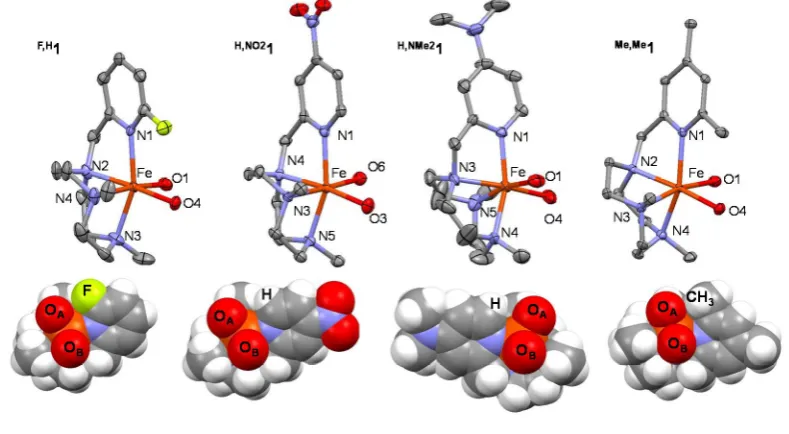
(23) LIST OF FIGURES Figure I.1. Bioinspired approach from metal active site of enzymes to designed functional models. The depicted functional model is inspired in the active site of Rieske Oxygenase enzymes. .......... 20 Figure I.2. The active site of cytochrome P450-camphor from Pseudomonas putida. The C-H bond ready for cleavage is highlighted in green. ...................................................................................... 22 Figure I.3. Active center of Naphthalene Dioxygenase. The only crystallographically characterized O 2 complex of a mononuclear non-heme iron enzyme containing a 2-His-1-carboxylate facial triad.43.................................................................................................................................. 25 Figure I.4. Some of the iron(IV)-oxo complexes synthetized. ................................................................. 58 Figure I.5. Schematic representation of H4-TAML ligand (left). Geometry-optimized structure of [FeV(O)(H4-TAML)]- as obtained from DFT calculations (right). ............................................... 59 Figure I.6. Iron(II) complexes studied by EPR spectroscopy after mixing with oxidant agents. ................ 60 Figure I.7. a) ESI-MS detection of an iron(V) bis-oxo. b) CSI-MS analysis to detect an iron(V)-oxo with a pentadentate ligand. ............................................................................................................ 60 Figure II.1. Iron complexes employed in this thesis ............................................................................... 70 Figure VIII.1. Schematic representation of complex [FeII(CF3SO3)2(pdp)] and -[FeII(CF3SO3)2(mcpp)]... 159 Figure VIII.2. Ball and stick diagram of the X-ray structures of [FeII(CF3SO3)2(pdp)] (left), and Me,H1 (right). Triflate and water ligands have been omitted, leaving only the oxygen atom attached to the iron centre. Colour code; iron (orange), oxygen (red), nitrogen (blue), carbon (gray) and hydrogen (white). ............................................................................................................... 162 Figure VIII.3. Full mass spectra after mixing catalyst H,H1 with 100 equiv. of H2O2. ............................... 170 Figure VIII.4. Graph showing the decomposition of P/O species (486.1 m/z) when the temperature is increased from -40°C to 20°C. ............................................................................................. 170 Figure VIII.5. Full mass spectra after mixing catalyst H,H1 with 10 equiv. of H2O2 and adding 100 equiv. of cis-cyclooctene. .................................................................................................................. 172 Figure VIII.6. DFT Gibbs energy profile of the reaction between the iron(V)-oxo-hydroxo species O with trans-2-butene to form the hydrogenglycolate species H. TS = transition state.................... 173. 8.
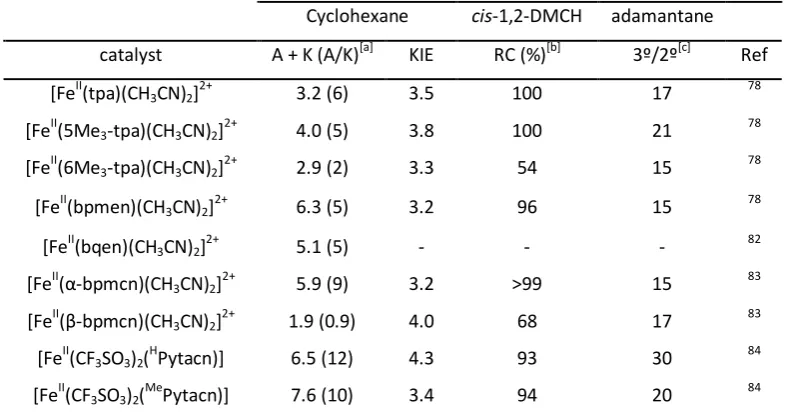
(24) LIST OF TABLES Table I.1. Iron proteins involved in oxidative reactions. 8, 17, 23 ................................................................ 21 Table I.2. Oxidation of alkanes by tetradentate iron(II) complexes, ligands represented in Scheme I.9. . 31 Table VIII.1. Selected physical data for R,R’2. ........................................................................................ 148 Table VIII.2. Oxidation of cyclohexane and cis-cyclooctene with H2O2 using complexes [FeII(CF3SO3)2(R,R’Pytacn)] (R,R’1) as catalysts.[a] Results for H,H1 and Me,H1 have been previously reported.6, 13 ....................................................................................................................... 150 Table VIII. 3. Alkane hydroxylation reactions catalyzed by R,R’1. Results for H,H1 and Me,H1 have been previosly reported.6, 14 ........................................................................................................ 153 Table VIII.4. Oxidation of cis-4-methylcyclohexyl pivalate by the family of complexes R,R’1. ................. 159 Table VIII.5. Oxidation of cis-4-methylcyclohexyl pivalate by different catalysts. [a] .............................. 160 Table VIII.6. Oxidation of cis-cyclooctene with the optimitzation conditions for the catalysts R,R’1. ...... 164 Table VIII.7. Substrate scope using the optimized conditions and Me,H1 as catalyst.[a]........................... 165 Table VIII.8. Catalysis using two iterative catalytic oxidations.............................................................. 168. 9.
(25) LIST OF SCHEMES Scheme I.1. Important oxidation reactions. .......................................................................................... 17 Scheme I.2. Oxidation reactions catalyzed by Cyt P450. ........................................................................ 22 Scheme I.3. Proposed catalytic mechanism for alkane hydroxylation performed by Cyt P450. ............... 23 Scheme I.4. Postulated “oxygen rebound” mechanism for alkane hydroxylation in Cyt P450. ................ 24 Scheme I.5. a) Schematic representation of the 2-His-1-carboxylate facial triad in the active center of the supperfamily Rieske Oxygenases. b) Active center of 1,2-naphthalene dioxygenase (NDO) enzyme and its oxidative reaction towards naphthalene. ................................................... 25 Scheme I.6. Catalytic cycle proposed for Rieske Oxygenases, showing the cis-dihydroxylation of naphthalene. ..................................................................................................................... 26 Scheme I.7. Structures of high-valent intermediates detected in natural enzymes. ............................... 27 Scheme I.8. Cyclohexane oxidation catalyzed by Reedijk system.75 ....................................................... 29 Scheme I.9. Schematic representation of the most important tetradentate ligands used to prepare mononuclear iron(II) complexes that could perform the oxidation of alkanes. .................... 30 Scheme I.10. Alkane hydroxylation catalyzed by [FeII(CF3SO3)2(Me,RPytacn)] complexes. Catalyst:H2O2:cyclohexane = 1:100:1000. ........................................................................... 32 Scheme I.11. Alkane hydroxylation using [FeII(pdp)(CH3CN)2](SbF6)2. A: Substrate electronic effects on site selectivity in hydroxylation of multiple 3°C–H bonds. B: Selective hydroxylation based on steric effects. ..................................................................................................................... 33 Scheme I.12. Directed hydroxylation of C-H bounds by acid group and subsequently lactonitzation catalyzed by [FeII(pdp)(CH3CN)2](SbF6)2. ............................................................................. 33 Scheme I.13. Selective hydroxylation of (+)-artemisin by [FeII(pdp)(CH3CN)2](SbF6)2. By recycling the starting material twice the diasteriometrically pure product was afforded in 54% yield. ..... 34 Scheme I.14. The combination of steric and electronic effects allows the selective oxidation of II methylene group by the [Fe (pdp)(CH3CN)2](SbF6)2. ........................................................... 34 II Scheme I.15. [Fe (CF3SO3)2((S,S,R)-mcpp)] complex described by Gomez and co-workers, and results in catalytic C-H oxidation reactions. ....................................................................................... 35 Scheme I.16. Selective oxidation of cis-4-methylcyclohexyl-1-pivalate by [FeIII(dpaq)(H2O)]2+ complex. . 36 Scheme I.17. Proposed mechanism for both, hydroxylation and dehydrogenation catalyst by complex [FeII(pdp)(CH3CN)2](SbF6)2. ................................................................................................. 37 Scheme I.18. Catalysts structures identified from the combinatorial screening by studying the epoxidation activity in front of trans--methylstyrene. Grey balls stand for the polystyrene support.............................................................................................................................. 38 Scheme I.19. Epoxidation of 1-decene catalyzed by [FeII(bpmen)(CH3CN)2](SbF6)2 complex. .................. 38 Scheme I.20. Schematic representation of some relevant iron catalysts for olefin oxidation. a) Dimeric phenanthroline based complex reported by Stack. b) Chiral dimeric complex reported by Menage. c) Chiral iron sexipyridine reported by Kwong. d) Iron(II) bis-terpyridine complex described by Che. .............................................................................................................. 39 Scheme I.21. In situ generated asymmetric catalyst for stereoselective olefin epoxidation. ................... 40 Scheme I.22. In situ generated catalyst which performs epoxidation of a high rang of olefins................ 40 Scheme I.23. Best results obtained in the epoxidation of trans-stilbene using 5-chloro-1-methylimidazole ligand. ............................................................................................................................... 41 Scheme I.24. Iron(II) complexes employed for the enantioselective epoxidation of ,β-enones by Sun. 41 Scheme I.25. Bipyrrolidine base iron(II) complex catalyze the asymmetric epoxidation of various olefins in the presence of a carboxylic acid. ................................................................................... 42. 10.
(26) Scheme I.26. Representation of ligands used to prepared mononuclear iron(II) complexes to perform olefin oxidation along with the coordination they adopt around the metal center. Oxidation of cis-cyclooctene with H2O2 catalyzed by the different iron(II) complexes. Catalytic conditions, catalyst:H2O2:cis-cyclooctene = 1:10:1000. E+D = Turnover number (TN, mols of product / mols of catalyst), E = epoxide, D = syn-diol. D/E = (mols of D / mols of E) [a] 50 equiv of H2O2 instead of 10. [b] 1-octene was used as a substrate instated of cis-cyclooctene. [c] 500 equiv of cis-cyclooctene were used......................................................................... 43 Scheme I.27. Asymmetric cis-dihydroxylation using -[FeII(CF3SO3)2(6Me2-pdp)] complex, obtaining syndiol product in 97% ee. ...................................................................................................... 44 Scheme I.28. Catalysts capable of performing oxidation of alkenes with high ratio diol/epoxide. .......... 45 Scheme I.29. Large-scale catalysis performed by [FeIII(Cl)2(c-Py2NMe2)]+............................................... 46 Scheme I.30. A: Active site of a Rieske Oxygenases, naphthalene 1,2-dioxygenase B: Complex with PhDPAH ligand described by Que, and used as a mimic of Rieske Oxygenase active center. C: Complex with Bpka ligand. ................................................................................................. 47 Scheme I.31. Competition between protio- and deuteroalkanes. .......................................................... 48 Scheme I.32. Oxidation of adamantane. ............................................................................................... 48 Scheme I.33. Radical reaction giving equimolar amounts of alcohol and ketone. ................................... 49 Scheme I.34. Isomers obtained in the tertiary alcohol oxidation of cis-1,2-dimethylcyclohexane. .......... 49 Scheme I.35. “Oxo-hydroxo tautomerism”. This process mediates the incorporation of oxygen from labeled water into the oxidized products. .......................................................................... 50 Scheme I.36. Proposed formation of the iron(III)-hydroperoxo species and its possible evolution to more powerful high-valent iron-oxo species................................................................................ 52 Scheme I.37. Proposed formation of mononuclear high-valent iron-oxo intermedites via O-O heterolytic cleavage. ........................................................................................................................... 52 Scheme I.38. Examples of class A and Class B catalysts.......................................................................... 53 Scheme I.39. Proposed mechanisms for olefin epoxidation and cis-dihydroxylation by class A and class B catalysts. ........................................................................................................................... 54 Scheme I.40. A) Olefine oxidation mechanism, the same FeV(O)(OH) species is capable of catalyzing the epoxidation and the cis-dihydroxylation. B) Proposed mechanisms for iron-catalyzed oxidation in presence of carboxylic acid. ............................................................................ 54 Scheme I.41. Proposed mechanism for the oxidation of olefins. ............................................................ 55 Scheme I.42. FeII/FeIV mechanism postulated for alkene oxidation reactions catalyzed by iron bispidine complexes. ........................................................................................................................ 56 V Scheme I.43. Mechanism of alkane hydroxylation by Fe (O)(OH) via oxo-hydroxo tautomerism. Percentage of water incorporation depends on which tautomer catalyzes the oxidation reaction. ............................................................................................................................ 57 Scheme I.44. Proposed rebound mechanism for alkane hydroxylation by [FeII(CF3SO3)2(Me,HPytacn)]. .... 58 Scheme VIII.1. Ligands and complexes employed in this thesis............................................................ 144 Scheme VIII.2. Table: Spin state and eff of R,R’2 complexes at 298K in acetonitrile. Graphic: H,R’ Representation of the effective magnetic moment of 2 in front of the Hammett constants (p). [a] Compounds R,R’2 were prepared by dissolving the bis-triflato complexes R,R’1 in CH3CN or CD3CN. ............................................................................................................. 146 Scheme VIII.3. a) Representation of the effective magnetic moment of H,H2, F,H2, H,NO22 and H,NMe22 as a function of temperature. The effective magnetic moment was measured in a CD 3CN solution Me,H using the Evans’ method. b) X-Ray structure of 2SbF6 at 100K. The table shows the FeNpy, the average Fe-Ntacn and the average Fe-Nacn bond lengths for each of the three molecules (A, B and C) that form the unit cell at a given temperature (100 K, 150 K, 170 K and 300 K). Hydrogen atoms have been omitted for clarity. ............................................. 147. 11.
(27) Scheme VIII.4. Water assisted mechanism to explain the oxidation of olefins by mononuclear non-heme iron catalysts. .................................................................................................................. 151 Scheme VIII.5. Proposed mechanism for alkene oxidation, where the fast equilibrium between the two tautomers is represented................................................................................................. 152 Scheme VIII.6. Origen of oxygen atoms in the oxidation of cyclohexane. Blue: Percentage of oxygen incorporated from water, measured for all catalysts R,R’1. Red: Percentage of oxygen incorporated from hydrogen peroxide, measured for catalysts, H,H1, H,Me1, Me,H1, Me,Me1 and F,H 1. ................................................................................................................................. 153 Scheme VIII.7. Percentage of oxygen from water incorporation into alcohol products obtained in the oxidation of alkanes catalyzed by complexes R,R’1 in presence of 1000 equiv. of H218O. ..... 154 Scheme VIII.8. Schematic representation of complexes [FeII(tpa)(CH3CN)2]2+ and [FeII(bpmen)(CH3CN)2]2+. ........................................................................................................................................ 155 Scheme VIII.9. A common iron(V)-oxo-hydroxo species as the active species in C-H hydroxylation and C=C cis-dihydroxylation as postulated for [FeII(tpa)(CH3CN)2]2+ and [FeII(bpmen)(CH3CN)2]2+ catalysts. ......................................................................................................................... 155 Scheme VIII.10. Mechanism of cyclohexane hydroxylation that arises from DFT calculations considering the different isomers of catalyst H,H1 (left) and Me,H1 (right). ............................................. 156 Scheme VIII.11. Concerted process mechanisms for the hydroxylation of cyclohexane by O................ 156 Scheme VIII.12. Space fillling diagrams for complexes H,H1 and Me,H1 showing the steric protection of the bulky group in the position of the pyridine ring. Triflate groups have been omitted for clarity. ............................................................................................................................. 158 Scheme VIII.13. Oxidation of different substrates by complex Me,H1 (yields measured by GC). ............. 161 Scheme VIII.14. Oxidation of trans-dimethylcyclohexane and trans-decalin by complex Me,H1 ( yields measured by GC). ............................................................................................................ 162 Scheme VIII.15. Regioselective C-H oxidation reactions catalyzed by [FeII(CF3SO3)2(pdp)], [FeII(CF3SO3)2(mcpp)] and Me,H1. [a] Cat:H2O2:substrate:AcOH 3:360:100:150. [b] Cat:H2O2:substrate:AcOH 3:200:100:150. [c] GC yield. ..................................................... 163 Me,H Scheme VIII.16. Catalytic oxidation of 3-pentenoic acid by catalyst 1. [a] Isolated yield. ................ 166 Scheme VIII.17. Catalytic oxidation of trans-trans-cis-1,5,9-cyclododecatriene. [a] Isolated yield. ....... 166 Scheme VIII.18. Catalytic oxidation of (2E,6Z)-nona-2,6-dienyl acetate. .............................................. 167 Scheme VIII.19. Catalytic oxidation of the natural product cis-jasmone. .............................................. 167 Scheme VIII.20. Mechanisms and shift of mass spectral peaks when the corresponding combination of H218O or H218O2 are used to form the FeV(O)(OH) species.................................................. 171 18 18 Scheme VIII.21. Mechanisms and shift of mass spectral peaks when H2 O and H2 O2 are used to give the hydrogenglycolates H and the glycolates G. ............................................................... 172. 12.
(28) ACKNOWLEDGEMENTS This work would not have been possible without the following collaborations: . Serveis Tècnics de Recerca from Universitat de Girona for technical support.. . Dr. Josep Mª Luis, Dra. Mireia Güell and Verònica Postils from Institut de Química Computacional i Catàlisis of Universitat de Girona for DFT calculations.. . Prof. Dr. Leroy Cronin and Dra. Jennifer Mathieson from University of Glasgow for hosting a scientific visit and the collaborative work in development of variabletemperature mass spectrometry experiments.. . Prof. Dr. Mathias Beller and Dr. Kathrin Junge from Leibniz-Institut für Katalyse e. V. for hosting a scientific visit and the collaborative work in development of iron(II) catalysts to perform cis-dihydroxylation reactions.. . COST Action D40 for financial support of the short stay in the University of Glasgow.. . MEC of Spain for financial support through project CTQ2009-08464/BQU and for the PhD Grant AP2008-01626. Generalitat de Catalunya for project 2009 SGR-637. European Research Foundation for ERC-2009-Starting Grant 239910.. 13.
(29)
(30) CHAPTER I.. GENERAL INTRODUCTION. 15.
(31)
(32) C HAPTER I. GENERAL INTRODUCTION. I. GENERAL INTRODUCTION I.1. Advances in alkane and alkene oxidation reactions The development of sustainable chemical methods for the selective oxidation of alkanes and alkenes is an important scientific goal with technological significance. The hydroxylation of alkanes and the cis-dihydroxylation and epoxidation of alkenes are important reactions because they allow the transformation of simple hydrocarbons into useful products for chemical synthesis (Scheme I.1).1-3 Despite the large amount of research in this field over the last century, the development of systems that could perform this chemistry with high levels of activity, selectivity and efficiency are still a challenge. An additional objective of these novel methodologies is that they must be environmentally friendly, preferentially relying on non-toxic reagents and catalytic methods with large atom economy, operating under mild conditions. Regarding oxidation reactions, the use of dioxygen and hydrogen peroxide as oxidants is preferred for their atom-economy and lack of toxicity.4. Scheme I.1. Important oxidation reactions.. I.1.1. Alkane oxidations The functionalization of hydrocarbons in a sustainable manner is one of the main challenges for chemists. Their abundance in nature as natural gas or crude oil makes them the most convenient chemical feedstock. The oxidation of hydrocarbons is one of the most interesting reactions, first, because the introduction of an oxygen atom introduces functionality in these molecules, increasing their value as reagents for further chemical transformation. In second place, because oxidized alkane moieties are ubiquitous constituents of organic molecules with biological interest, and thus are chemical structures that are interesting per se. However, these reactions are fundamentally difficult due to the low reactivity of alkyl C-H bonds, and therefore, they are often disregarded as synthetic tools.5. 17.
(33) C HAPTER I Currently available methodologies involve highly reactive-oxidizing reagents, high temperatures and long-time reactions in order to overcome this lack of reactivity. 6 These harsh conditions introduce drawbacks in terms of chemo- and regioselectivity, essential to produce synthetically valuable products. Moreover, since most functional groups do not tolerate these harsh oxidative conditions,7 selective oxidation often requires the use of protectiondeprotection strategies, giving large amounts of waste. An important step forward is the development of one-step oxidation methodologies, allowing the oxidation of C-H bonds in the later stage of the synthetic sequences in the presence of different functional groups and with high regio- and stereoselectivity. Natural systems, such as iron enzymes, are capable of perform this chemistry with high selectivity and efficiency. The design of metal based catalysts that mimic the natural enzymes is a challenging strategy that may allow for performing the selective oxidation of C-H bond in a predictive way and with short reaction times.8. I.1.2. Alkene oxidations Olefins are one of the most versatile starting materials and their oxidation leads to various value-added products such as epoxides, syn-diols, alcohols, aldehydes or ketones. All of these products are important building blocks for the production of bulk and fine chemicals. Epoxides are high useful intermediates to elaborate more complex products in organic synthesis. Current industrial epoxidation methods include the chlorohydrin process (for the preparation of ethylene and propylene oxide) and peracids as the most common reagents employed in fine chemistry. For economical and environmental reasons, molecular oxygen or hydrogen peroxide are the preferred oxidants.3 Another important class of product obtained in the oxidation of olefins are syn-diols. syn-Diols have a wide range of applications, for example, ethylene and propylene glycol are produced in large scale, due to their importance as polyesters monomers and as antifreeze agents. Moreover, chiral 1,2-syn-diol products are used as reaction intermediates in the synthesis of pharmaceuticals.9 Currently, diols are synthetized by a two-step sequence consisting of the epoxidation of an alkene with a peracid, hydroperoxide, or oxygen followed by hydrolysis of the resulting epoxide. The dihydroxylation process comprises a more atom-efficient and shorter route to the desired product. Typically these reactions are performed using high valent osmium, ruthenium or manganese catalysts. Over the last century, numerous synthetic approaches based mainly on osmium-catalysis have been described, and nowadays these systems are the. 18.
(34) GENERAL INTRODUCTION most reliable and efficient approach for the synthesis of syn-1,2-diol.10, 11 Furthermore, the discovery by Sharpless of catalytic systems that can perform asymmetric dihydroxylation expanded the synthetic applications of osmium-catalysis.12, 13 However, osmium reagents have some important drawbacks, in particular their cost and toxicity. In response, several alternative methods for alkene oxidation have been investigated. Of those, the combination of hydrogen peroxide with non-toxic and inexpensive metal catalysts constitutes an ideal system for these oxidation reactions.14. I.1.3. Metalloenzymes and model compounds The problem of selectivity in the oxidation of non-activated C-H bonds and C=C under mild conditions had been solved successfully by Nature in the course of evolution through the use of metalloenzymes. Metalloenzymes, utilize metals as the cofactors to catalyze a diverse array of biochemical reactions. Even though metal ions only account for less than 1% of the total protein weight, they are essential for the enzyme activity. Moreover, the metal ions have the ability to exist in multiple oxidation states and different geometries, and these characteristics are vital to promote complex biochemical transformations and participate in highly specialized biological functions such as oxygen activation. 15 Metal ions in metalloproteins are usually coordinated by nitrogen, oxygen or sulfur atoms belonging to amino acids in the polypeptide chain of the protein. The nature of the metal and of the aminoacid residues, the coordination geometry of the metal center, the relative disposition of the metal in the case of polymetallic systems and the three-dimensional configuration are crucial properties for the reactivity of the metalloprotein. All these factors determine the ability of the metal ion to stabilize different reaction intermediates, sometimes with distinct oxidation states, and they can also alter the shape of the active site that controls the accessibility, and the trajectories of the substrate approaching to the metal active center. One of the interests in bioinorganic chemistry is the structural and spectroscopic characterization of the metalloproteins active site, and the study of their reactivity. Only very few successful examples of enzyme redesign in order to modify the active center have been reported recently, showing the possibility of changing the inherent catalytic activity of the enzyme.16 However, due to the time-consuming and inherent difficulty of working with proteins, because of its high molecular weight and the complicated process of purification, synthetic model chemistry (bioinspired studies) constitutes an attractive approach for gaining knowledge about the protein chemistry. The aim of these systems is to mimic the reactivity of 19.
(35) C HAPTER I the natural enzyme in catalyzed transformations by using synthetic low-molecular weight compounds, and provide mechanistic, structural and spectroscopic data for comparison with the biological system (Figure I.1).17 The model chemistry is based in the design of suitable ligands to generate functional models with first row metal capable of achieving the same catalytic reactivity of the enzyme.. Active site. Mimic the structure and the function of the metalloenzyme. Metalloenzyme. Functional model. Figure I.1. Bioinspired approach from metal active site of enzymes to designed functional models. The depicted functional model is inspired in the active site of Rieske Oxygenase enzymes.. In this thesis, we use simple synthetic model complexes to reproduce the basic aspects of the oxidation reactivity of Rieske Oxygenase enzymes. With these models we study the mechanism of catalytic oxidation reactions of alkanes and alkenes, and specifically, we developed catalysts for the hydroxylation of alkanes and the cis-dihydroxylation of alkenes under preparative scale conditions.. I.2. Biological role of iron enzymes Iron is the element of choice for many essential biological transformations, because of its abundance in the earth, its inherent electronic properties and its accessible redox potentials. Iron-containing enzymes participate in biological oxidations and in oxygen transport, among others. For instance, it can be found in the active center of oxidases, hydrogenases, reductases, dehydrogenases and oxygenases.18 Iron is the fourth most common element in the earth’s crust, and can exist in a wide range of oxidation states, although the most common are FeII and FeIII. In order to explain some enzymatic process taking place in biological systems, higher and lower oxidation states, such as FeIV, FeV and FeI have been postulated.17 Indeed, recently FeIV=O intermediate species in 20.
(36) GENERAL INTRODUCTION natural systems have been characterized and described as catalytic intermediates in oxidative processes.19-22 Due to its versatility, iron is present in a wide range of metalloenzymes in different configurations such as heme systems with porphyrin ligands, iron-sulfur clusters and nonheme systems (with mononuclear and dinuclear centers).. I.2.1. Iron proteins involved in oxygen activation In Nature, a large amount of iron proteins are implicated in oxidation processes via O2 activation. They can be classified in three different groups depending on their active site: heme oxygenases, mononuclear non-heme, and dinuclear non-heme oxygenases. The most representative iron proteins that take part in oxidative processes and the reactions they catalyze are showed in Table I.1. In this introduction, only two systems will be explained in detail, the cytrochrome P450 and Rieske Oxygenases. Both constitute relevant and paradigmatic examples of heme and mononuclear non-heme iron enzymes and moreover they are directly related to the work presented in this thesis. Table I.1. Iron proteins involved in oxidative reactions.8, 17, 23. 21.
(37) C HAPTER I. I.2.1.1. Cytochrome P450 Cytochrome P450 (Cyt P450) enzymes constitute a large family of heme proteins, which are present in all forms of life; plants, bacterial and mammals.24-26 These enzymes take part in a large variety of vital processes, like drug metabolism, biosynthesis of steroids, and detoxification of xenobiotic substances. They are one of the most studied and best known oxidation metalloenzymes. Cyt P450 carries out the oxidation of non-activated organic substrates, such as hydroxylation of aliphatic C-H bonds, and the epoxidation of C=C bonds with high regioselectivity and steroselectivity. They can also catalyze N-, S- and O-dealkylation, Noxidation, sulfoxidation and dehalogenation reactions, indicating that these families of enzymes are highly efficient and versatile. For these oxidations, P450 enzymes use molecular O2 as oxidant and oxygen source and they act as monooxygenases. They insert one oxygen atom into a wide variety of biologic substrates, concomitantly with a two-electron reduction of the other oxygen atom to form a water molecule (Scheme I.2).15. Scheme I.2. Oxidation reactions catalyzed by Cyt P450.. In the last two decades, mechanistic information was obtained from several X-ray crystal structures, for instance the water-soluble Cyt P450-camphor adduct (Figure I.2).27 The active site consists of an iron porphyrin (heme group) attached to the protein through coordination of a cysteine residue at one of the axial positions of the metal. The other axial position is occupied by a water molecule.. Fe S. Figure I.2. The active site of Cyt P450-camphor from Pseudomonas putida. The C-H bond ready for cleavage is highlighted in green.. 22.
(38) GENERAL INTRODUCTION The oxygen activation mechanism of Cyt P450 family is considered the paradigm for O2-activation at a mononuclear iron center. Nowadays, the principal features of the catalytic cycle of Cyt P450 are well-established.26, 27 As shown in Scheme I.3, the initial step consists in the binding of the substrate at the active site, causing extrusion of the water ligand. The five coordinate iron site changes its spin state and increases the FeIII/FeII oxidation potential, triggering injection of one electron from an electronic transport chain, causing the oneelectron reduction of the iron center (B). The binding of molecular oxygen to the FeII center generates a ferric-superoxide complex, which rapidly traps one electron and one proton to afford the iron(III)-hydroperoxo complex (C, Cpd 0). This species undergoes proton assisted OO heterolytic bond cleavage to generate a high-valent oxo-FeIV-porphyryl radical cation (Cpd I) and a water molecule (D). In C-H oxidation reactions, the oxygen atom is transferred to the nearby substrate by a two-step process known as the “oxygen rebound”.28 For a given alkene, the oxo ligand is transferred in a nearly concerted manner to the olefin, thus stereospecifically forming epoxides. Finally, dissociation of the product completes the catalytic cycle. Direct cycling between the resting state (A) and the high-valent oxidant species (D) can be performed by using oxidants such as hydro and alkylperoxides, NaOCl, PhIO or peracids. This shortcut is known as the “peroxide shunt” (Scheme I.3) and it receives use in catalysis.29 The intermediate species is postulated to be an iron(IV)-oxo porphyrin radical cation.30 Model studies using synthetic porphyrin analogs provide evidences for the identification of the active species in the catalytic cycle and new strategies for elucidating the oxidation mechanism of biological processes.31-34. Scheme I.3. Proposed catalytic mechanism for alkane hydroxylation performed by Cyt P450.. 23.
(39) C HAPTER I The mechanism by which C-H bonds are oxidized by Cpd I of P450 is known as the “oxygen rebound” mechanism. This consists in a hydrogen-atom abstraction from the substrate by the iron-oxo species to give an iron(IV)-hydroxo and a alkyl radical, followed by the “rebound” to form a new C-O bond and recovering the iron(III) resting state (Scheme I.4).35, 36. Scheme I.4. Postulated “oxygen rebound” mechanism for alkane hydroxylation in Cyt P450.. It is important to consider that although a carbon centered radical is formed in these reactions, radical traps do not affect the reaction so it is thought as a very short-lived intermediate that does not leave the radical cage. Since this carbon centered radical does not freely diffuse into solution, its stereochemistry is retained.. I.2.1.2. Rieske Oxygenases Great advances have been made in the last 20 years in the study of mononuclear nonheme iron enzymes due to the large number of crystal structures now available, and also the development of sophisticated spectroscopic techniques to study paramagnetic metal ions.8 Rieske Oxygenases are specially efficient and versatile iron enzymes, their biotechnological interest resides on their capacity to catalyze stereo- and enantioselective cisdihydroxylation of arenes and olefins.37-39 This novel transformation is not observed in any other enzymatic system, and also remains a challenge for synthetic organic chemistry.40, 41 In natural processes, these enzymes are important because the cis-dihydroxylation of arenes constitutes the first step in the biodegradation of persistent pollutants such as aromatic molecules and leads the formation of catechols which are further degraded by intradiol- and extradiol-cleaving catechol dioxygenases.42 Moreover, these enzymes can also catalyze benzylic hydroxylation, desaturation, sulfoxidation, and O- and N-dealkylation.37 The capacity to catalyze this wide range of oxidative transformations indicates that Rieske Oxygenases may be even more versatile than the P450 superfamily. A common structural motif is found in the superfamily of Rieske Oxygenases, which consists of an active site with an iron center coordinated to three protein residues, two Histidines (His) and one Aspartate (Asp) or Glutamate (Glu). This structural motif is known as 24.
(40) GENERAL INTRODUCTION the 2-His-1-carboxylate facial triad (Scheme I.5, a).43 The protein residues occupy one face of an octahedron, leaving three free sites on the opposite face for the coordination of substrate, O2 or water molecules.. Scheme I.5. a) Schematic representation of the 2-His-1-carboxylate facial triad in the active center of the supperfamily Rieske Oxygenases. b) Active center of 1,2-naphthalene dioxygenase (NDO) enzyme and its oxidative reaction towards naphthalene.. One of the most studied Rieske Oxygenase enzyme is naphthalene 1,2-dioxygenase (NDO) from the bacteria Pseudomonas putida (Scheme I.5, b), which was crystallographically characterized in 1998.44 The crystallographically determined structure shows that the enzyme contains two metal centers; an oxygenase component that consists in a mononuclear iron center where O2 activation and substrate cis-dihydroxylation takes place, and a reductase component that consists in a Rieske-type Fe2S2 cluster, and delivers electrons from NAD(P)H to the oxygenase center in a controlled way (Figure I.3). The structure of the active center is representative of other cis-dihydroxylation enzymes, such as benzoate 1,2-dioxygenase,45 toluene 2,3-dioxygenase,46 benzene dioxygenase47 and phthalate dioxygenase.48. Fe. oxygenase component non-heme iron center coordinated to the 2-His-1-carboxylate facial triad. Fe. Fe. reductase component Fe2-S2 Rieske center. Figure I.3. Active center of Naphtalene Dioxygenase. The only crystallographically characterized O 2 complex of a mononuclear non-heme iron enzyme containing a 2-His-1-carboxylate facial triad.. 43. 25.
(41) C HAPTER I Mechanistic studies on enzymes belonging to the Rieske Oxygenase family have been made in order to propose a catalytic cycle for these enzymes (Scheme I.6). The cycle starts when the iron center, in its reduced state (A) binds the arene substrate (B). The enzyme readily reacts with O2 followed by electron transfer from the reductase component to generate the iron(III)-peroxo complex (C). This intermediate (C) has been trapped, and characterized by time-resolved cryo-crystallographic studies on frozen crystals on NDO exposed to O2. These studies indicate that the peroxo ligand binds in a side-on configuration (Figure I.3).43, 49 At this stage, two possible paths can take place: a) the direct interaction of the peroxide species with the substrate to generated the species (E) or b) O-O bond cleavage to generate the FeV=O complex (D), prior to substrate attack. Some labeling experiments have been undertaken in order to know which is the oxidant species; since peroxide type of species do not exchange their O-atoms with water, the observation that oxygen atoms from H 218O can be incorporated into the syn-diol product (3-10%)45 constitutes a strong argument that the reaction species is an iron-oxo intermediate.. Scheme I.6. Catalytic cycle proposed for Rieske Oxygenases, showing the cis-dihydroxylation of naphthalene.. NDO enzymes can perform the catalytic oxidation when H2O2 is used as oxidant in the same way as the “peroxide shunt” found in Cyt P450.50 In general, the evidence suggests that a common mechanism is operating in Cyt P450 and Rieske Oxygenase enzymes and indicate that high-valent iron-oxo species are the responsible of the oxidation reaction. 26.
Figure


+7


![Table 7. Oxidation of cyclohexane and catalysts.cis-cyclooctene with H2O2 using complexes [Fe(OTf)2(R,R’Pytacn)] (R,R’1) as [a]](https://thumb-us.123doks.com/thumbv2/123dok_es/5234498.95551/100.595.105.492.173.563/table-oxidation-cyclohexane-catalysts-cyclooctene-using-complexes-pytacn.webp)
![Figure VIII.1. Schematic representation of complex [FeII(CF3SO3)2(pdp)] and -[FeII(CF3SO3)2(mcpp)]](https://thumb-us.123doks.com/thumbv2/123dok_es/5234498.95551/144.595.145.452.556.760/figure-viii-schematic-representation-complex-feii-feii-mcpp.webp)
![Table VIII.5. Oxidation of cis-4-methylcyclohexyl pivalate by different catalysts.[a]](https://thumb-us.123doks.com/thumbv2/123dok_es/5234498.95551/145.595.201.397.323.465/table-viii-oxidation-cis-methylcyclohexyl-pivalate-different-catalysts.webp)
![Table VIII.7. Substrate scope using the optimized conditions and Me,H1 as catalyst.[a]](https://thumb-us.123doks.com/thumbv2/123dok_es/5234498.95551/150.595.136.460.514.717/table-viii-substrate-scope-using-optimized-conditions-catalyst.webp)
Documento similar
set-up with the portable Raman and the gas cell for measurements are presented in Fig. a) Scheme of the experimental set-up used for detection of CWA vapours. b) Digital
No obstante, como esta enfermedad afecta a cada persona de manera diferente, no todas las opciones de cuidado y tratamiento pueden ser apropiadas para cada individuo.. La forma
Calculations performed using a DFT method including the B3LYP functional give similar results to PMP2 employing the 6-31+ + G共p,d兲 basis set for the pyrimidine bases, whereas the
The low-lying singlet and triplet vertical transitions have been computed, using the optimal HF geometry for the ground state of the ATR molecule obtained with the D95Vd basis set..
For the optimisation of [1] + and [1-dmad] + with the PBE0 functional and various basis set systems, summary of mean unsigned errors (MUEs) with respect to their X- ray
These data serve as a basis for obtaining other parameters and representations of the signal, such as the harmonic model, the vibrato model, the spectral envelope and the
Figure 4.12, shows the area values calculated by each subject within the selected window, and in Figure 4.13, the differences in the mean of the Granger causality areas calculated
Total position spread tensor for the di fferent hydrogen chains divided by the number of atoms at FCI level and the minimal basis set STO-12G.. On the contrary, for distances below
