
Essays on Networks in Economics: Pairwise Influences and Communication Processes
160
0
0
Texto completo
(2) A la Marta, perquè tenint-la al costat tot és una mica més fàcil. A la meva àvia, Soledad, que ha sigut per mi com una segona mare. A la meva mare, Francesca. Perquè a ella li dec tot.. 2.
(3) Contents Preface. iii. Acknowledgements. vi. PART I Pairwise In uences. 1. 1 Pairwise In uences and Bargaining Among the Many 1.1 Introduction 1.2 Bilateral In uences and Network Externalities 1.3 The Set of Pareto Allocations 1.4 Bargaining and In uences 1.5 Nonparticipants and the Bargaining Outcome 1.6 -economies. 1.7 The Effect of Network Changes on Welfare and Consumption 1.8 Discussion 1.9 Conclusion 1.10 Proofs. 2 2 9 14 20 27 30 33 36 38 39. 2 On Pairwise In uence Models: Networks and Ef ciency 2.1 Introduction 2.2 Related Literature 2.3 The Baseline Model and Some Examples 2.4 The General Case: Group In uence 2.5 The General Case: Ef ciency, A Matter of Prestige 2.6 A Simple Case: -homogeneous Networks 2.7 Conclusion 2.8 Proofs 2.9 Grouping people into cycles. 46 46 48 50 54 61 63 67 69 76. 3 Spatial Spillovers and Local Public Goods. 80. i.
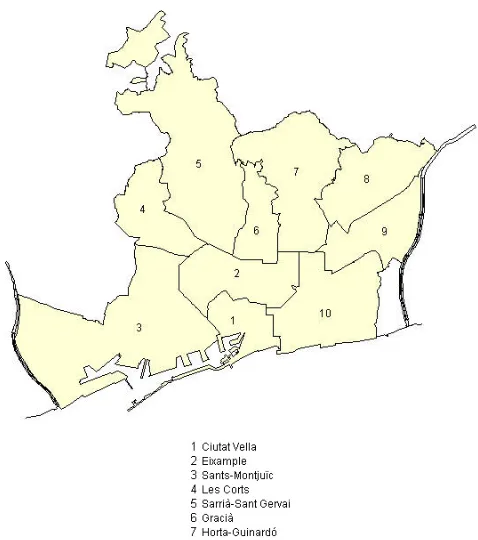
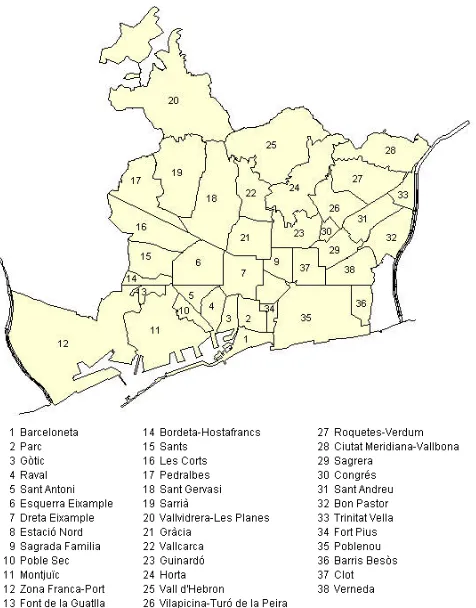
(4) ii. Contents 3.1 3.2 3.3 3.4 3.5. Introduction On the optimal division of a city On the governance of local public goods Conclusions Proofs. PART II Communication Processes. 80 82 86 92 94 97. 4 Communication Processes: Knowledge and Decisions 4.1 Introduction 4.2 Related Literature 4.3 The game 4.4 High-order beliefs and the knowledge index 4.5 Equilibrium 4.6 Welfare 4.7 Discussion 4.8 Proofs. 98 98 100 102 104 107 109 112 113. 5 On Optimal Communication Networks 5.1 Introduction 5.2 Related Literature 5.3 A network communication process 5.4 On the Optimal Communication Structure 5.5 Extensions 5.6 Conclusion 5.7 Proofs. 122 122 124 125 128 134 137 138. Bibliography. 145.
(5) Preface This thesis addresses two different questions. First, the economic consequences of pairwise in uences, understood as externalities which intensity and sign depend on the pair of agents considered. Second, the effects of different communication processes in small groups, and its consequences for the optimal inner network structure of informal organizations. In the rst chapter “Pairwise In uences and Bargaining Among the Many” we analyze how pairwise in uences affect the nature and solution of distributional con ict. In a model with pairwise in uences the utility of each agent is heterogeneously in uenced by the utility of other agents in the economy. In particular, there are two dimensions of heterogeneity: who in uences whom, and the strength of any of such pairwise dependent in uence. The pattern of bilateral in uences takes the form of a weighted and directed network. This kind of models can encompass, for example, spatial externalities or social preferences. In the analysis of distributional con ict, in which agents have to divide some available resource among them, pairwise in uences affect the nature of this con ict, since if the externalities they represent are negative the con ict is strengthened while if these externalities are positive the con ict is diluted. In a limit situation, there can exist a complete alignement of preferences for a uniquely determined allocation. In this last case, distributional con ict simply vanishes. Our aim in this chapter is to analyze the family of economies with pairwise in uences in which there exists full distributional con ict and how the solution to this con ict maps the heterogeneous pattern of pairwise in uences to shares and utilities obtained. In particular, we use the Nash bargaining solution as the solution to distributional con ict. Our results rely on network centrality indexes that measure each agent's prominence due to his position in the in uences structure. The chapter “On Pairwise In uence Models: Networks and Ef ciency” extends the analysis of the indirect effects of direct pairwise in uences and how these indirect effects determine the set of ef cient allocations in such kind of models. The results in this chapter are developed in a social preferences framework but they immediately apply to more general setups with externalities. First, we provide a complete analysis of the mapping from pairwise in uences to network externalities, that account for all levels of indirect effects generated by the pattern of in uences. Then, we provide a complete characterization of the set of Pareto ef cient allocations for almost every economy with pairwise in uences in terms of prestige measures derived from the literature on social network analysis. We illustrate these results with the use of two different network designs, the circle and the star, that express two polar cases on the set of possible structural pattern iii.
(6) iv. Preface. of in uences. The chapter "Spatial Spillovers and Local Public Goods" is a rst attempt to analyze some issues related to the effects of spatial spillovers in urban structure and the provision of local public goods under the light of pairwise in uence models. Many public services that are distributed all along the city do not arrive in the same way to all its citizens. Hence, public services are not always pure public goods. Suppose that this services are distributed among the different neighbourhoods in which the city is divided. Then it is probably neither true that the effect of local public services is bounded to the neighbourhood level. Instead, some of these effects can extend and spill over to other neighbourhoods. The intensity of these spatial externalities probably depends on the geography and on socioeconomic characteristics of the city. The con ict that arises between neighbourhoods to obtain larger shares of the available public services when spatial externalities exist is analyzed theoretically in the rst chapter of this thesis. Different divisions of the city into neighbourhoods determine different patterns of spatial externalities. These externalities are internalized in the solution to the con ict. Hence, a natural question emerges: which is the division of the city that involves larger returns in terms of social welfare of all citizens once we take into account the pattern of spatial externalities that this division entails? We do not provide a complete answer to this question. We simply illustrate, with the use of some data of Barcelona, how the tools we have previously developed provide a satisfactory benchmark in which to inscribe this analysis. Beyond that rst topic, the second part of the chapter provides a public good provision game with spatial spillovers, that we analyze with some detail. Neighbourhoods choose how much they want to contribute to the provision of public services that later on are assigned to them with the use of the Nash bargaining solution. The results in this chapter are nonconclusive, but they sketch some directions for future research in which the models and tools developed in previous chapters can show useful. In the chapter “Communication Processes: Knowledge and Decisions”, in joint work with my advisor Antoni Calvó-Armengol, we introduce a model of communication in informal organizations. We envision an organization as a team in which each member faces an individual decision problem and a common coordination problem. The decision problem expresses the desire of all individuals to choose actions that are close to the optimal, and unknown, task that should be ideally implemented. The coordination problem expresses the needs of the organization to align the actions of all its members. Each member has some private information on the real state of the world. We analyze how different communication processes of this private information impact the optimal actions of each member. Each one of these decentralized information-sharing schemes determines the way in which each member constructs his beliefs on the task to be.
(7) Preface. v. performed, as well as what others belief is the optimal task to be performed, and the beliefs on beliefs on beliefs, and so one and so forth. The analysis provides a new concept, the knowledge index, that sums up in an idiosyncratic value these higher order beliefs for each possible communication process. Given any information structure derived from a communication process, the game has a unique Bayesian equilibrium. The equilibrium action of each agent is linear in the communication report each agent obtains, and this report is, precisely, weighted by the knowledge index. The uniqueness and linearity properties of the Bayesian equilibrium allow for clear welfare implications in our analysis. We perform some comparative statics on the different parameters that determine the relative strength of the individual decision versus the coordination problem, the informativeness of private signals, and the particular characteristics of the communication process, namely accuracies and correlations of nal communication reports. The last chapter, “On Optimal Communication Networks,” also in joint work with professor Antoni Calvó-Armengol, builds on the model and results developed in the previous chapter to study a family of networked communication processes. We obtain a partial order on the set of possible networks: adding communication possibilities always increases accuracy of the task forecast, but a negative counterpart can arise if new links do not close triangles in the original network because the coordination problem can be exacerbated. Our analysis also shows that when there is one unique round of communication, and there is a xed supply of possible links, the optimal geometric arrangement of these links maximizes a network span index, a measure of network irregularity. Instead, when the number of possible communication rounds increases, the process becomes a model with persuasion bias in which the optimal network is regular. We obtain therefore, for a wide set of parameters, a polarization result in terms of the number of available rounds to communicate. In some sense both parts of this thesis are complementary. Both are interested in externalities, but the source of these externalities are of a different nature in each one: in the rst part, we deal with heterogeneous payoff externalities; in the second part we deal with heterogeneous informational externalities. Hence, we can phrase the essence of the interests of this thesis in understanding how pairwise dependent externalities affect economic outcomes and behavior..
(8) Acknowledgements Vull començar donant les gràcies a en Xavier Martinez de Albèniz per donarme a coneixer el món de l'economia teòrica i animar-me a provar d'aplicar al International Doctorate in Economic Analysis. I have found in the IDEA doctoral program a fantastic environment to learn and to discuss about economics. All the courses have been stimulating and the faculty has permanently shown an endlessly motivation to help all the students to nd our own way and to improve as researchers. I have been very fortunate to have had the opportunity to be part of this project. I have bene ted from the comments of so many different people about my research that the list would be never ending and unfairly incomplete. I want to thank all of them. Salvador Barberà i Clara Ponsatí mereixen menció apart. Els seus comentaris en versions prèvies d'alguns dels capítols d'aquesta tesis m'han sigut de molt de pro t, i vull apro tar aquesta ocasió per agraïr una vegada més tot el seu suport durant el procés de job market. Vull agraïr a l'Àngels, a la Sira i, especialment, a la Mercè la seva continuada disponibilitat i paciència per resoldre tots els dubtes logístics que se m'han pogut arribar a plantejar durant aquests anys. Tot el que he tingut de pesat m'ho han tornat amb simpatia. During all this period I have had the opportunity to meet a lot of interesting and friendly people of which I have learned a lot and with which I have had some very nice moments. This includes all the students of the doctoral program, as well as some visiting students and the nice people I met during my stay in Toulouse. This made these years a rewarding experience from a more personal perspective. I thank them all for that. Mil gràcies a l'Albert Botella, l'Albert Clop, la Carme, l'Eduard, l'Elisenda, l'Estrella, el Fran, la Grushenka, el Julio, la Laura, el Marc, la Mireia, la Miriam, el Pere, el Ricard i el Sergio per ser una font inesgotable de bons moments, indispensables per mantenir el cap fresc i els ànims renovats. La Marta ha sigut el meu suport més important durant aquests cinc anys, i ha mostrat una increïble paciència amb els meus altibaixos. La meva mare sempre ha encertat amb el seu consell, i li agraeixo in nitament la seva obstinació en procurar-me uns bons estudis. La meva àvia m'ha mostrat sempre el més gran dels afectes, i si la bibliogra a d'aquesta tesi és tant llarga potser és perque ja de ben petit ella em va enganxar l'hàbit de la lectura compulsiva. Vull agraïr a la meva família, el meu cosí Joan, el meu tiet Pep, la meva tieta Roser, la Montse, vi.
(9) Acknowledgements. vii. el Fructuós, la Rosario, la Modesta, la Maria i el Ramon el seu interès continuat pel desenvolupament d'aquesta tesi doctoral. El meu darrer agraïment, no per això menys intens, ans el contrari, és pel meu mentor, en Toni. Tant des d'una perspectiva professional com personal, mereix tot el meu respecte. Els seus comentaris i consells respecte la primera part d'aquesta tesi han sigut determinants per tal que prengués la forma actual i la seva contribució és evident en la segona part. És un plaer fer recerca amb algú que mostra tanta curiositat i resolució com ell. La seva disponibilitat ha superat tot límit. La seva comprensió i encoratjament, mostrats amb la paraula adequada en cada moment, han permès que aquest viatge arribés a bon port. Tot el saber que m'ha transmès romandrà de manera perdurable en el meu record. Gràcies Toni..
(10) PART I Pairwise In uences.
(11) Chapter 1 Pairwise In uences and Bargaining Among the Many 1.1. Introduction. In uence in outcomes and behavior across individuals is pervasive in many social and economic settings. This in uence can take many forms. It can be centralized, and result from a common in uence of the environment. Else, it can be decentralized and supported by more local interactions. At its most disaggregated level, in uence is mediated by pairwise interactions. The collection of such pairwise interactions can display a rich pattern that might overall in uence the resulting individual outcomes. Cross in uences can be an important issue if we deal with distributional con ict. Consider a xed resource to be divided among a set of individuals. Any possible division of this resource has a direct effect on individual outcomes. In addition to this direct effect, there can also be an indirect effect mediated by the possible interactions that might arise across some pairs of individuals. Through the chains of interactions present inside the group, these indirect effects can spread all over the population. When individuals agree collectively on the division of this common resource, all these in uence effects have to be internalized adequately. The pattern of direct pairwise in uences can thus play a crucial role in the solution of the distributional con ict. When considering disaggregate pairwise in uences, there are two different possible sources of heterogeneity in its underlying structure: the geometry of interactions, that expresses who in uences whom, and the magnitude of each one of these in uences. The aim of this paper is to analyze how the whole structure. 2.
(12) 1.1 Introduction. 3. of such pairwise in uences affects the bargaining outcomes. Consider for example the case of urban crime. Crime patterns on city's neighbourhoods are interlaced and there are several reasons why this is so. First, the division of cities into different neighbourhoods is merely an administrative issue. Criminals do not doubt in crossing the street and move from a neighbourhood to another to commit their activities. Hence, if no natural barrier imposes dif culties on this movement, this is a natural source of interdependence in crime rates across neighbourhoods. This is very much related with the so called Modi able Area Unit Problem (M.A.U.P.) highlighted in the literature of spatial statistics in geographic information science. Different groupings into neighbourhoods lead to variability in statistical results. When aggregating for crime rates it is unlikely that there exists a univocal relation between neighbourhood characteristics and crime outcomes. Furthermore, the embeddedness of individuals into social networks that might spread over the city, impacts also criminal behavior. Some individuals might imitate the behavior of their contacts in their network of acquaintances (see Glaeser et al., 1996). Some others might infer (maybe erroneous) information on the bene t on committing crime (see Sah, 1993). Hence, criminal behavior suffers a contagion effect inherent to the social environment. This social osmosis process also induces spatial in uence in crime rates. When the major has to decide on how to distribute resources to ght urban crime, and when a representative of each neighborhood asks for part of these resources, we come up with a distributive con ict with in uences on crime rates across pairs of neighborhoods. Our analysis sheds light on how the particular neighborhood geography and the pattern of in uences across neighbourhoods are internalized in the nal assignment. The environment. There are two dimensions of heterogeneity in the model. On the one hand, the particular geometry of bilateral in uences. Not everybody necessarily exerts an in uence on every other agent. The pattern of direct bilateral in uences determines who exerts an externality on whom and how in uences spread indirectly through the economy. On the other hand, the magnitude of each bilateral in uence is pairwise dependent. The magnitude of an in uence relation depends on exactly which agent exerts this in uence and which agent receives it. Direct in uences generate indirect network effects. We call network externalities the sum of all these indirect effects. These are direct externalities derived from the assignment of resources, and measure how the level of consumption, not the utility, of an agent affects another agent's utility. Each pattern of pairwise in uences determines a unique pattern of network externalities. To better understand the spread of in uences through direct bilateral in u-.
(13) 4. Chapter 1 Pairwise In uences and Bargaining Among the Many. ences we reinterpret at some points in the paper the model in terms of networks. The network links an agent to another whenever the second agent exerts a direct externality on the rst one. Externalities spread then through the links of the network. We can keep track of all indirect in uences generated from bilateral in uences through paths and cycles in the associated network. The network metaphor is adequate in this setting due to asymmetric pairwise bilateral in uences. Connections with well-known notions from social network analysis, such as centrality measures, arise as natural tools for the network reinterpretation of the model. Direct bilateral in uences within a nite set of agents are modeled with the use of a linear model that encompasses the possibility of positive and negative in uences as well as asymmetric in uences within pairs of agents. The model is characterized by a matrix that collects the possibly different levels of bilateral in uences for each possible pair of agents, the primitives of the model. A unit of a divisible resource has to be distributed among the agents of the economy. The utility that an agent obtains comes from the share of the resource that receives and also from the utility of agents that exert an in uence on him, which enters his utility function proportionally to the intensity of the direct in uence each of these other agents exert on him. In the example on crime, whenever direct in uences exist among crime rates in different neighbourhooods, the assignment of a part of the resources against urban crime does not only have a direct effect on this neighbourhood. Its effects also spill over the rest of neighbourhoods in an heterogeneous manner. Hence, when the different neighbourhoods are engaged in dispute for these resources, and they understand that these spillover effects exist, they show heterogeneous preferences on possible assignments. Even if probably each neighbourhood would prefer to receive all the resource, if they realize they have to achieve an agreement with the rest of neighbourhoods, they would prefer that those neighbourhoods that overall exert a larger spillover effect on it receive more resources than those that exert less. A linear structure of in uence is assumed for tractability. It ensures for, almost, every economy with in uences the existence of a unique solution to the system relating utilities. This solution provides the utility in terms of the allocation, instead of in terms of others' utilities. Hence, solving the model means to characterize the effect the share of the resource an agent receives changes others' welfare, and it internalizes the indirect effects bilateral in uences generate. Still another assumption has to be argued. We suppose constant returns to the share of the resource received. This is an strong assumption. Probably the returns to direct investment on ghting against crime in a neighborhood are not constant..
(14) 1.1 Introduction. 5. However, assuming constant returns, in uences become the unique underlying force that yield to differences in the results. In general, the introduction of concavities due to other reasons not related to in uences would distort the analysis of the effect of in uences on the bargaining outcome. When distributional con ict exists, the bargaining outcome is given by the Nash bargaining solution. With its use we ensure a unique well-de ned outcome after the resolution of the con ict. Of course, this choice comes at a cost. By using a cooperative solution we abstract from institutional or environmental restrictions that can play a role during the bargaining process. These institutional restrictions are generally introduced de ning a particular non-cooperative bargaining game that takes them into account. Then each particular application should be followed by a different non-cooperative game that speci es its particularities. This way we would lose some of the general conclusions that a more stylized model can give as general features of somewhat different situations. Results. We restrict our analysis to the more interesting case of regular economies. Regular economies are such that any allocation that exhausts resources is Pareto ef cient. In regular economies, the Pareto frontier is non-degenerate. For such economies, we characterize completely the Nash bargaining solution, providing closed-form expressions for the utilities and shares obtained. The reason for which we restrict to regular economies is the following. In non regular economies the Pareto frontier is degenerate. This is so because the in uence exerted by some given agent on others is much bigger than the in uence he receives in return. Ef ciency might require then that this agent receives all the resources available. If an individual in a group is so much loved by anybody else compared with other possible affective relations, which means that the in uence this agent has on others' utility is very large, it could be ef cient to give him all the resource. Similarly, there might exists intermediate situations in which only some agents are allowed to receive a share of the resource for ef ciency reasons. While our methods and analysis could be extended to such nonregular situations, we focus on the analysis of regular economies in which the pattern of in uences excludes de facto some agents from the course for some part of the resources. We rst characterize regular economies. This characterization is twofold. First, regular economies are characterized by an upper bound on the aggregate level of bilateral in uences every agent exerts on others. In terms of direct bilateral in uences, we obtain a bound on the maximal level of aggregate direct in uences an agent can exert. The economy is regular if and only if no agent exceeds this bound. Second, regular economies are characterized by conditions.
(15) 6. Chapter 1 Pairwise In uences and Bargaining Among the Many. on the pattern of network externalities. More precisely, an economy is regular if and only if all agents are equally central in the network structure of in uences. The relevant measure of network centrality is the Katz-Bonacich centrality index, pervasively used in the sociology literature, and that also arises naturally in other economic settings. We next provide a constructive procedure to characterize the Nash bargaining solution. It is important to note that even if the economy is regular and, hence, the distributional con ict involves all agents in the economy, this does not exclude the possibility that some agents obtain nally no share of the resource. Externalities do not directly solve the bargaining problem but this does not mean that they can not be suf ciently asymmetric such that, after internalizing all in uences, the Nash bargaining solution assigns nothing to some of the agents. A geometric procedure is presented to check if the solution for a particular economy is interior, meaning all agents obtain a positive fraction of the resource, and to characterize the solution in this case. We also devote part of our work to the analysis of -economies. In these economies all existent pairwise in uences have intensity equal to , and whenever an agent exerts an in uence on another, this other agent also exerts an in uence on the rst one. One of the two dimensions of heterogeneity in the model, the possibly different levels of externality intensities across individuals, is kept to a minimum. The main source of heterogeneity is the geometry of the pattern of pairwise in uences. An analysis in depth of this family of economies gives a better picture of how the particular arrangement of pairwise relations, irrespective of the intensities of these, impacts on bargaining outcomes. In particular, utility is directly related with the number of connections an agent has. Those agents that receive and exert more in uences are also rewarded with larger utility levels. However, this monotonicity does not necessarily translates into receiving larger fractions of the resource. Finally, we also study how changes on the pattern of in uences distort the Nash bargaining outcome. We analyze how changes in the levels of bilateral in uences change the bargaining result. Furthermore, we also discuss how our framework can be used to describe and analyze situations in which some agents that are not involved in the bargaining game can affect the bargaining outcome. Applications. Besides the example on urban crime, our model is exible enough to encompass other possible applications. Consider for example government spending. When deciding how to divide the public budget within government departments a possible concern for the.
(16) 1.1 Introduction. 7. ministers is to take into account that outcomes related to responsibilities of one department can affect outcomes related to other departments. The result of the bargaining process should then depend on these in uences generated across departments. The department of social affairs might exert a positive externality on the department of education. If more resources are spent on social affairs, such as ameliorating life conditions in specially poor regions, this can translate into larger school attendance rates in this regions and hence an improvement in aggregate level of education of the country, a subject under the domain of the education department. Moreover, this effect on citizens' education can translate into an increase on the understanding of good and healthy habits that might imply an increase on life expectancy in the country, a fundamental issue for the health department. Observe that the outcome improvement on health comes indirectly from an increase of resources for social affairs. This increase on resources improves the outcome for social affairs which through a direct in uence improves the outcome on education, which improves the outcome on health. This is another example of indirect in uences that spread due to network effects. In this setup our analysis sheds some light on how the pattern of in uences across different departments maps into government bargaining agreements. Another possible application is in the eld of social preferences.1 Following the line of seminal work from Becker (1974), altruism and envy can be interpreted as in uences of a very particular kind, with its source coming from psychological reasons. An agent is altruist for another if he is better off when the other is better off. Hence, this second agent is exerting a positive in uence on the rst one. Inversely, an agent is envious for another agent if he is worst off when the other is better off, and in this case the in uence the second agent exerts on the rst is negative. Our work applies then to the analysis of a bargaining game in the presence of pure altruism and envy effects, where the pattern of altruism and envy is variable in intensity across pairs of agents. Related Literature. Our model bears a formal resemblance with previous work on interdependent utilities by Bergstrom (1999) and Bramoullé (2001). Bramoullé also interprets this type of systems in terms of weighted and directed networks, but focuses on some qualitative features of the mapping from bilat1. See Fehr and Schmidt (2002) and Sobel (2005) for very comprehensive surveys of the theoretical literature and empirical evidence on social preferences. Levine uses a linear model similar to the one we develope in our work to analyze experimental results for some classes of games. Roth (1995) is a survey of experimental evidence of social preferences in bargaining games..
(17) 8. Chapter 1 Pairwise In uences and Bargaining Among the Many. eral in uences to network externalities.2 Here instead, we analyze the mapping from bilateral in uences to Nash bargaining utilities and agreed shares, providing closed-form expressions for both. A strategic model on status in networks that generates similar interdependency systems is provided in Rogers (2005). Rogers analyzes a network formation game in which agents with heterogeneous skills can choose with whom they want to contact and with which intensities they want that this contact is made. Hence, the pattern of in uences is endogenously chosen. We analyze instead situations in which the structure of pairwise in uences can not easily be affected by individual strategic decisions. For example, in the urban crime example no neighbourhood can do much to delimit in uences among them, since these are largely determined by private decisions and actions of the population, which is an issue out of their control. A similar comment applies on the example on interdepartmental in uences in a government. Also, altruism and envy are not only the result of strategic decisions but the effect of the embeddedness of individuals on a social environment they can not determine and control. The model also resembles input-output models of linear economies (Leontief, 1951, Gale, 1960). However, input-output models only allow for positive bilateral in uences, while here we do not impose sign restrictions of any sort. Of course, we also deal with different issues. Some papers have analyzed multilateral bargaining with externalities from a non-cooperative viewpoint. Jehiel and Moldovanu (1995a, 1995b) consider a setup where one seller bargains with n potential buyers to decide which of them obtains the unit of an indivisible good. The acquisition of the good by one of the agents can exert a positive or negative externality on others. They analyze how the bargaining outcome is affected by this allocative externality. In a political economy context, Calvert and Dietz (2004) explore how the introduction of externalities in a 3-agent economy alters the conclusions of the Baron and Ferejohn (1989) non-cooperative game of legislative bargaining. See Duggan (2004) for conditions about existence of equilibria in the n agents version of the Baron and Ferejohn game with externalities. While our cooperative approach is less sensitive to possible particularities in the bargaining process, such as the particular mechanisms by which buyers and sellers bargain or the existence of a voting rule (the majority rule in BaronFerejohn models) in legislative bargaining, it allows for a general and tractable analysis of multilateral bargaining with one unique outcome prediction and an heterogeneous pattern of externalities. 2 For a complementary approach to this mapping and a general characterization of Pareto ef ciency in such a setup, see de Martí (2006)..
(18) 1.2 Bilateral In uences and Network Externalities. 9. Our work also borrows from the very active literature on networks in economics. However, we do not deal with the formation of social and economic networks, maybe the more extensively studied issue in the eld, but on games played in a xed network.3 Other authors have also explored the interrelation of network structure and bargaining outcomes (see Calvó-Armengol, 2001, and Corominas-Bosch, 2004 ). The approach in these papers is different in many respects. Just to mention a few, bargaining is not among the many and the network represents communication restrictions and delimits the possible pairs of agents that can trade. The Katz-Bonacich centrality measure was rst de ned by Katz (1953) and later on developed by Bonacich (1987). It is one of the more relevant centrality measures studied in the active eld of social network analysis.4 Another game played in a network, in this case not a bargaining game, where this centrality measure naturally arises is Ballester et al. (2006). Agents play a game with pairwise dependent strategic complementarities. In the unique equilibrium of the game each agent action is proportional to his Katz-Bonacich centrality index measured on this network of complementarities.. 1.2. Bilateral In uences and Network Externalities. 1.2.1 Modelling Bilateral In uences In this section we propose a simple framework that allows to model positive and negative allocative in uences across individuals. Suppose that there is an amount of a certain resource to be distributed within a group of n individuals, N = f1; : : : ; ng. Let ci be the consumption of agent i 2 N . Let bij 2 R be the magnitude of the in uence agent j exerts on agent i. Then, an increase of one unit of welfare for agent j induces an increase of bij units of welfare for agent i. Given a pro le c = (c1 ; : : : ; cn ), the utility an agent obtains , ui (c), is equal to X ui (c) = ci + bij uj (c) i = 1; : : : ; n (1.1) j6=i. This set of equations forms what we call the bilateral in uences system. Note that the relation in this system is from outcomes to outcome. In terms of the urban crime example, bij represents how the crime rate , not the share of public budget received, in neighborhood j affects the crime rate in 3 See Jackson (2005) for a very extensive survey of the eld of networks in economics, and for an exhaustive list of references about games played in networks, including bargaining games. 4 For an exhaustive survey of this literature see Wasserman and Faust(1994)..
(19) 10. Chapter 1 Pairwise In uences and Bargaining Among the Many. neighborhood i. Pn Due to linearity, we can x the sum of consumption levels to i=1 ci to be equal to 1. Hence, we can interpret ci as the share of the resource received by agent i. De ning bii = 0 for all i 2 N , we gather all the bij in a matrix B of bilateral in uences. An economy is completely characterized by its matrix of bilateral in uences. For a given economy B, we can obtain from the structural system of bilateral in uences to a reduced-form system where the utility of each agent can be directly expressed in terms of the shares pro le, eliminating the dependency on other's utility. The bilateral in uence system in matrix form is equal to (1.2). u (c) = c + B u (c) Hence, if I is the identity matrix, whenever (I reduced-form system. u (c) = (I. B). 1. B) c. 1. exists we obtain the (1.3). The rst result we provide is a genericity result. An economy is characterized by n (n 1) real values. Therefore, there is a one-to-one mapping from economies to elements of Rn(n 1) . From this point of view, the set of economies 1 in Rn(n 1) for which (I B) does not exist has (Lebesgue) measure zero. 1 This implies that for almost every economy B, the associated matrix (I B) exists (and, of course, is unique) and the next result then follows. Proposition 1 For almost every economy B the associated reduced-form system is uniquely characterized. In words, given a structural system of bilateral in uences there is no indeterminacy in the obtaining of the associated reduced-form expression, except for a negligible set of economies.5 1 Let E (B) = (I B) . Each entry eij (B) expresses the magnitude of how the utility increases, if the entry is positive, or decrease, if the entry is negative, when the level of consumption of agent j increases. We call E the matrix of network externalities. An explanation for the choice of this name follows. 5 See Bramoullé(2001) for structural models of a similar nature for which indeterminacy in the determination of the associated reduced-form system arises..
(20) 1.2 Bilateral In uences and Network Externalities. 11. 1.2.2 From Bilateral In uences to Network Externalities Any economy B can be naturally represented by a network. A network is formed by a set of nodes and a set of links that express a relation between the pair of nodes linked. While this is an abstract object, it is a useful metaphor to represent many varied situations in applied settings. In particular, in our case this metaphor can be applied to make nodes represent the agents involved in the structural system of bilateral in uences, and make links represent the pattern of bilateral in uences exerted across pairs of agents. A link in such an in uence network is weighted, each link has an associated value that represents the strength of the in uence this link represents, as well as a particular direction, since the in uence agent i exerts on j does not necessarily coincides in strength with the in uence agent j exerts on agent i, and hence we have to distinguish the link from i to j and the link from j to i. Different conventions could be adopted to express the mapping from economies to networks. We adopt the following one. We say that there is a link from agent i to agent j whenever j exerts a, positive or negative, in uence on i, and the weight for this link is then equal to the coef cient bij 2 R of the structural system of bilateral in uences. Since in our model there is no self-in uence we do not allow for self-loops, links from an agent to itself. The set links that begin in i point to the agents that in uence agent i. Observe the weighted and directed nature of the network de ned in this way: since we have not imposed any restriction on the possible values of the coef cients in the structural in uence system, the weight of a link can take any real value; also, since we have not imposed symmetry on the levels of bilateral in uence, it is possible that there exist both a link from i to j and another one from j to i and that their respective weights differ. Even more, it is possible that there exist a link from i to j while there is no link from j to i. A weighted and directed network is de ned by an adjacency matrix, where the entry (i; j) in this matrix is equal to the weight of the link from i to j . This weight equals the level of bilateral in uence j exerts on i. Hence, given an economy B the adjacency matrix of its associated network, in the way we have de ned this network, is also B. The following equality applies. E (B) = (I. B). 1. (1.4).
(21) 12. Chapter 1 Pairwise In uences and Bargaining Among the Many. Whenever B is a contraction6 we have that. (I. B). 1. =. +1 X. Bk. (1.5). k=0. If j exerts an in uence on i with weight bij and k exerts an in uence on j with weight bjk , k exerts an indirect in uence on i with weight equal to bij bjk . The [2] matrix B2 keeps track of these second order network in uences. The entry bik of B2 computes the sum of weights of all paths of length two from i to k .7 More generally, for any l 1 the matrix Bl keeps track of the l-order net[l] work in uences: each entry bik equals the sum of weights of all paths of length l from i to k . Therefore, whenever the expression in equation (1.1) is valid, the entry eij (B) of E (B) is the sum of weights of all paths from j to i in the network represented by the economy/adjacency matrix B. The matrix E (B) computes the sum of indirect (network) effects that the pattern of bilateral in uences generates. This sum of indirect effects of any order is what we denote network externalities, and this is why we call matrix E (B) the matrix of network externalities. Each entry eij (B) represents by how much the consumption of agent j affects the utility of agent i not only through the direct bilateral in uence agent j exerts on i, represented by bij , but also through the indirect in uences resulting of all possible indirect network connections from j to i. The following example, borrowed from Bramoullé (2001), is useful to understand how important are indirect network effects for the analysis of the mapping from allocations to utilities de ned in the reduced-form system. Example 1. There are three agents, N = f1; 2; 3g, and the structural system 6 The matrix B is a contraction if and only if all its eigenvalues have norm smaller than 1. This will be the case for example for the set of regular economies, that we de ne later, if bilateral in uences are positive. 7 A path between i and j in network G is a sequence of agents i1 ; : : : ; iK of N, where an agent can appear several times in this sequence, such that ik ik+1 is a link of G for every k 2 1; : : : ; K 1, with i1 = i and iK = j . The length of such a path is equal to K 1, the number of links that form the path. In words, a path in g is an indirect connection from agent i to agent j through linked agents in B. We de ne the weight of a path i1 ; : : : ; iK of G as the product gi 1 i 2 giK 1 iK . This weight is different than zero because of the de nition of path. A path such that i = j is called a cycle..
(22) 1.2 Bilateral In uences and Network Externalities. 13. of bilateral in uences relating them is. u1 (c) = c1 + b12 u2 (c) + b13 u3 (c) u2 (c) = c2 + b23 u3 (c) u3 (c) = c3 where b12 and b13 are positive but b23 is negative. This means that both agent 2 and 3 exert a positive direct in uence on agent 1, probably with different intensities, while agent 3 exerts a negative in uence on agent 2. Besides, the values for these direct bilateral in uences are b21 , b13 and b23 . The network that represents this situation is t J J b J 13 J ^t -J. 1 b12 2. t. b23. 3. Figure 1. and the 3. 3 bilateral in uences matrix is 0. 1 0 b12 b13 B = @ 0 0 b23 A 0 0 0 Hence, the 3 to. 3 matrix of network externalities, E (B) = (I. B) 1 , is equal. 0. 1 1 b12 b13 + b12 b23 A b23 E (B) = @ 0 1 0 0 1 Observe that in this case we can easily compute the matrices of indirect network.
(23) 14. Chapter 1 Pairwise In uences and Bargaining Among the Many. effects, Gk for k. 2. The matrices of higher order network effects are 0 1 0 0 b12 b23 0 A B2 = @ 0 0 0 0 0 0 1 0 0 0 k @ 0 0 0 A B = f or every k 3 0 0 0. Therefore, E (B) = I + B + B2 . The expressions of utilities in terms of consumption are therefore. U1 (c) = c1 + b12 c2 + (b13 + b12 b23 ) c3 U2 (c) = c2 + b23 c3 U3 (c) = c3 The weight of the network externality agent 3 exerts on agent 1, e13 = b13 + b12 b23 , depends on the intensities of bilateral in uences. In particular, if b12 b23 > b13 the externality is negative, even if the direct bilateral in uence b13 is positive. A tension arises because even if agent 3 exerts a direct positive in uence on agent 1, the negative in uence agent 3 exerts on agent 2 also has an indirect (network) effect on agent 1 due to the indirect path from 3 to 1 through agent 2. This negative in uence is internalized in the reduced-form system related to network externalities and makes it possible that e13 is negative if the bilateral negative in uence 3 exerts on 2 is large enough. We omit the dependence of E on B when no confusion is possible.. 1.3. The Set of Pareto Allocations. 1.3.1 Characterization From now on we will consider that there is a certain amount of a resource that, without loss of generality, we normalize to one. Before turning to the study of distributional con ict and how agents in an economy agree to divide this unit of resource among them, we have to make a clari cation about the set of Pareto ef cient allocations in an economy with in uences. Externalities can have severe consequences on which allocations can be Pareto ef cient. Our aim in this section is to characterize the set of economies for which distributional con ict is particularly strong..
(24) 1.3 The Set of Pareto Allocations. 15. Before providing an example of the peculiar situations that can arise in economies with in uences we describe the utility possibility set for any economy B, that we denote UPS (B). GivenP an economy B, and for any feasible allocation, we have n (i) (i) that u (c) = E c = is the i-th column vector of the i=1 ci e , where e matrix of network externalities.P Since an allocation c is feasible if and only if ci 0 for every i 2 N and ni=1 ci 1, we can conclude that the utility possibility set for the economy de ned by B is the convex hull of the columns of the matrix of network externalities E plus the zero vector, that is. UPS (B) = co e(1) ; : : : ; e(n) ; 0 This implies that the utility possibility set for any economy B is a simplex, and therefore it is a convex and compact set. Example 2. Consider the economy represented by the following network. 1s. 3=2 1=2. s2. Figure 2 The 2. 2 matrix of bilateral in uences is. B=. 0 3=2 1=2 0. It follows that the matrix of network externalities for this economy is equal to. E (B) =. 4 6 2 4. 4 6 and e(2) = and the utility possibility set for this 2 4 economy is the convex hull of these two vectors and the zero vector. We can Here e(1) =.
(25) 16. Chapter 1 Pairwise In uences and Bargaining Among the Many. depict UPS (B). u2. 6. s(u1 ; u2 ). 4 2. -. 4. 6. u1. Figure 3 It turns out that the unique ef cient allocation in this economy is (u1 ; u2 ), that corresponds to (c1 ; c2 ) = (0; 1).8 At the unique Pareto ef cient allocation agent 2 receives all the resource. This is so because the magnitude of the externality agent 2 exerts on agent 1 is much larger than the one of the externality agent 1 exerts on agent 2. The effect of an increase in the level of consumption of agent 2 is then larger in agent's 1 utility than the effect of an increase in his own level of consumption. When considering such kind of situations the implications on the solution to the Nash bargaining problem is immediate. Since the Nash bargaining solution has to be Pareto ef cient and there is a unique Pareto ef cient allocation, the Nash bargaining problem is trivially solved. We will disregard the kind of economies that we have just described. Indeed, we will concentrate from now on in the completely opposite kind of situations. We will only consider economies where any allocation that exhausts available resources is Pareto ef cient. When this happens we say that the economy is regular.9 The assumption of a regular economy ensures there is a nontrivial bargaining problem and there exists competition among all agents to obtain some share of the unit of resources. The next result provides a complete characterization of regular economies in 8 Recall that we have normalized the total amount of resources to one. This is, of course, without lose of generality because of linearity. 9 Observe that this is not the unique other possible situation. It could be that only a subset of agents should consume for an allocation to be Pareto ef cient. In the next chapter we provide a generic characterization of all possible situations in terms of endogenous centrality measures derived from the position of each agent in the network of bilateral in uences..
(26) 1.3 The Set of Pareto Allocations. 17. terms of the matrix of network externalities. Before stating it we de ne a useful notion for the analysis in the rest of the paper. De nition We say that an n-dimensional vector P is a strict system of n weights if and only if i > 0 for every i 2 N and i=1 i = 1. Now we provide the rst characterization result of regular economies.. Proposition 2 An economy B is regular if and only if there exists a unique strict system of weights and a positive constant > 0 such that e(i) (B) = for every i 2 N . The previous result characterizes regularity through the matrix of network externalities. Each element of column e(i) expresses how large is the network externality agent i exerts on each agent. When we compute the weighted average of these elements we obtain a single value that expresses an overall measure of network externalities exerted by agent i. Hence, Proposition 2 says that regularity amounts to nd normalized weights, which are unique and depend on the economy we are analyzing, such that this overall measure of network externalities each agent exerts is positive and equal for all agents. It is also possible to provide a characterization of regular economies in terms of the primitives of the economy, i.e. the matrix B of bilateral in uences. Proposition 3 A necessary and suf cient condition for an economy B to be regular is that n X. j=1;j6=i. bji < 1 f or every i 2 N. This result provides a simple and direct way to check if an economy is regular, and it helps us to understand better which are the network forces that induce regularity. It states that regularity amounts to requiring Pn that the aggregate level of bilateral in uences each agent exerts on others, j=1;j6=i bji , is not too large, in fact not larger than 1. For example, consider an economy where all agents are connected to each other and the level of bilateral in uence across any pair of individuals is equal to certain value . In this case the necessary and suf cient condition for such kind of economy to be regular is that < n 1 1 . this condition is satis ed if < 0, and only if bilateral in uences are positive the condition bounds . This is quite natural. When in uences exerted are negative, distributional con ict.
(27) 18. Chapter 1 Pairwise In uences and Bargaining Among the Many. naturally arises because each agent wants the rest of the economy to receive the smallest possible share. Any allocation that exhausts resources is in this case Pareto ef cient. Instead, when in uences are positive and suf ciently large each agent would prefer that other agents receive all the resource since this would increase more his utility than receiving himself part of it, and the Pareto frontier might degenerate to a single point. Consider a regular economy B. Then we can compute easily its associated strict system of weights and constant from Proposition 2.10 Pn Let B be a regular economy. De ne i = 1 j=1;j6=i bji , i 2 N , and Pn 1 = i=1 i . Then, = and i = i for all i 2 N . The value of i is negatively related to the level of aggregate bilateral inuences agent i exerts. Hence, i is smaller the larger this aggregate level of bilateral in uences is. The next section studies more in detail how these constants relate to the particular network structure of in uences, and we provide interpretations for them. 1.3.2 Ef ciency and Network Centrality We can provide an alternative interpretation to the ef ciency characterization in Proposition 2. To this end, we have to introduce some terminology derived from the literature on social networks. Given a network we can try to measure the prominence of each agent due to her position in the network. There are several variables that can determine the prominence of an actor in a network. Furthermore, the de nition of prominence may depend on the setting we are studying. It is not the same if we deal with directed or undirected networks, or with weighted or unweighted networks. Hence, there is not in the social network analysis literature a unique standard de nition of prominence. The more usual concept to analyze prominence in networks is centrality. It is fairly natural to associate prominence with connectivity and this is what centrality measures do. In the case of weighted and directed networks, as the ones we are considering in our analysis, a rough measure of centrality i would be the P of agent 11 sum of weights of the links that point to agent i, Si = j6=i bji . This measure is called the degree centrality of agent i: In terms of our structural in uence model, Si measures the aggregate level of in uence that emanates from agent i. 10. The proof of Lemma 1 is contained in the proof of Proposition 3. This is an inner-centrality measure. Alternatively, we could de ne an outer-centrality measure by the sum of weights of the links that start in agent i. Since, as we will show in a moment, in our analysis the relevant centrality measure is an inner measure, we avoid this possible distinction in the text.. 11.
(28) 1.3 The Set of Pareto Allocations. 19. Note that i = 1 Si , which is a positive quantity whenever the economy B is regular, is then a complementary degree centrality index for agent i. Its value is smaller the largest is the degree centrality measure Si . Therefore, i is also a complementary centrality index, since it is a renormalization of i to make the sum of the indices for all agents to add up to one. While this degree centrality is informative of some kind of prominence derived by the way in uences vary across pairs, it does not capture the value of how these in uences spread indirectly along chains of bilateral in uences. Remember that, as we have explained before, given an economy B we have that for any l 1 the matrix Bl keeps track of the l-order network externalities: [l] each entry bij equals the sum of weights of all paths of length l from i to j . Hence, to construct a more elaborate centrality measure we might include these indirect network effects subsumed in the sequence of matrices Bl l 1 . A natural way is to consider a decay factor 2 (0; 1] and weight the l-order network effects by l . This is the Katz-Bonacich centrality measure. The (unweighted) Katz-Bonacich inner-centrality12 measure vector, (B; ) is de ned as: !t 1 X l l (B; ) = B 1 l=0. Whenever this vector is well-de ned we can rewrite it as:. (B; ) = (I. B). 1 t. 1. A variation of this measure, called the weighted Katz-Bonacich centrality measure, is the following. Let be an strict system of weights. Then the -weighted Katz-Bonacich centrality measure, (B; ), is given by the following formula:. (B; ) = (I. B). 1 t. In the unweighted Katz-Bonacich centrality measure all agents count the same when considering the sum of network effects generated by each one of them. In the -weighted Katz-Bonacich centrality measure the network effects generated by agent i are counted with weight i . Some agents count more than others when aggregating the whole matrix of network effects E (B). 12. It is an inner measure of centrality because it measures weights of paths and cycles that end on each agent. An outer-centrality measure could be de ned without transposing in the following equation..
(29) 20. Chapter 1 Pairwise In uences and Bargaining Among the Many. After this digression into the realm of social and economic networks, we can reinterpret the condition of proposition 3 making use of weighted Katz-Bonacich centrality measures. The condition is equivalent to say that there exists a unique strict system of weights such that. (I. B). 1 t. = 1. with being a positive constant. The reader can immediately recognize the weighted Katz-Bonacich centrality measure, with = 1, in the left handside of the last equation. Hence the regularity condition says that there exists a vector of weights for which the weighted Katz-Bonacich centrality measure is equal, and positive, for all agents. This individual index measures the aggregate level of network in uence effects that i generates. These are represented by the paths on the network that nish on i, and this is exactly what the Katz-Bonacich centrality index takes into account. Two comments are in order. First, observe that our model generates endogenously the unique system of weights for which this centrality condition is satis ed. This is Proposition 3. Second, the decay factor is equal to 1, and hence direct and indirect in uences count the same to compute this measure of prominence. Hence, we can rewrite proposition 2 as follows Proposition 2' The economy B is regular if and only if there exists a unique strict system of weights and a constant > 0 such that i. (B; 1) =. f or all i 2 N. A general characterization, not only for regular economies, of Pareto ef ciency in economies with pairwise in uences by means of centrality measures can be in the next chapter.. 1.4. Bargaining and In uences. 1.4.1 The Bargaining Problem and its Solution From now on, we consider only regular economies with in uences. We turn to the study of distributional con ict for these economies. We consider the classical and widely used Nash bargaining solution (Nash, 1950). Following this seminal work we de ne an n-person bargaining problem as a duple hX; di, where X Rn is a convex and compact set that expresses the utility possibility set in the economy, and d 2 X is the disagreement point, that expresses the utilities each agent would obtain in case they are not able to.
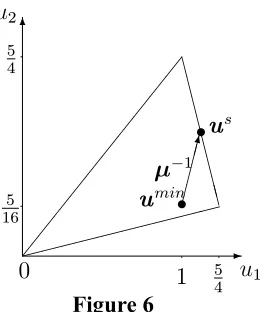
(30) 1.4 Bargaining and In uences. 21. reach an agreement. The disagreement point has to satisfy the following dominance condition: there exists v 2 X such that v strictly Pareto dominates d, i.e. vi > di for every i 2 N . The (symmetric)13 Nash bargaining solution xS = xS1 ; : : : ; xSn to hX; di is the solution to the following maximization problem. max x2X. n Y. (xi. di ). i=1. Due to convexity of the utility possibility set X and strict convexity of the objective function this problem has a unique solution. We want to analyze this Nash bargaining solution in the case the utility possibility set X is induced from a regular economy with in uences. Observe this is possible since as we mentioned before UPS (B) is convex and compact for any economy B. min Given an economy B, let umin = (umin 1 ; : : : ; un ) be the utility vector min where each entry ui is equal to the minimal utility agent i can obtain within the set of ef cient allocations of economy B.14 Since we assume that the economy is regular, from Proposition 2 we know that there exist only one strict system of weights and one positive constant such that e(i) = for every i 2 N . Given a disagreement point d we relabel agents from 1 to n such that min min dn ). Finally, let d1 ) 1 (u n (un (0). =. 1 ( n. d). and let (j). =. 1 n. j. d. j X k=1. l. umin k. dk. !. for any j 2 f1; : : : ; n 1g. Now we have all the necessary ingredients to characterize the Nash bargaining solution for any regular economy with in uences. This is done in the following result. Proposition 4 Consider a regular economy B. Then, there exists j 2 f0; : : : ; n 13. To simplify the analysis we only consider the symmetric Nash bargaining solution. The analysis for asymmetric Nash bargaining solutions with heterogeneous bargaining power is completely analogous. 14 In fact, umin = min fei1 (B) ; : : : ; ein (B)g, so this vector of minimal utilities can easily be i derived from the group in uence matrix.. 1g.
(31) 22. Chapter 1 Pairwise In uences and Bargaining Among the Many. such that the utility vector associated with the Nash bargaining solution, uS , is. uSi = umin i. if i. j. and. uSi = di +. (j). 1. if i > j. i. The Nash bargaining solution allocation is equal to cS = (I. B) uS .. This result characterizes the utilities and levels of consumption of the Nash bargaining solution for any regular economy. In particular, it characterizes corner, partially corner and interior solutions. For an individual i that obtains positive gains, uSi di > 0, these gains are inversely proportional to i . If both i and j obtain positive gains we have that P 1 bkj uSi di Pk6=j = (1.6) S 1 uj dj k6=i bki. The relative gains of agent i with respect to those of agent j uniquely depend on the level of aggregate in uence exerted by agent i and agent j . In particular, the largest is the magnitude of aggregate in uence that emanates from agent i compared with those that emanate from agent j , the largest the relative gains of i with respect to j . Aggregate in uence levels determine relative gains for those agents that obtain positive gains. This does not mean that these levels form the unique relevant information from the structural in uence model to characterize the Nash bargaining solution. The minimal utilities pro le, umin , and therefore the multiplier (j) , can not be expressed in terms of the aggregate in uence levels. Indeed, minimal utilities internalize all levels of network in uence effects, since umin i equals the minimal entry in i's row of matrix E(B). In non-interior solutions where some agents obtain no gains from bargaining the information from the matrix of network externalities is fundamental for the characterization of the Nash bargaining outcome. The multiplier (j) represents the remaining surplus, the remaining value of the available unit of resources in terms of utilities, once we subtract the minimal utilities some of the agents obtain (agents k j ). The rest of this remaining value is shared proportionally to the inverse of entries of . Example 3. The analysis of the following two economies illustrate the characterization we have just provided in a 2-agents setting. Economy (a) is such.
(32) 1.4 Bargaining and In uences. 23. that b12 = 4=5 and b21 = 1=4 while economy (b) is such that b12 = b21 = 1=2. The matrices of network externalities for each economy are. E(a) =. 5=4 1 5=16 5=4. 4=3 2=3 2=3 4=3. E(b) =. The utility possibility set with the respective Nash bargaining solution depicted, when the disagreement point is d = 0, in both cases are. u2. su = m C C C C C C CC. 6. S. 5 4. 5 16. u2 (2). 6. 4 3. @. @ suS @ @ @. 2 3. -. 0. 1 (a). 5 4. -. u1. 0 Figure 4. 2 3. (b). 4 3. u1. In example (a) we obtain a corner solution. One agent receives all the resource as the solution to the distributional con ict. We have that 1 = 3=4, = 19=20. The associated constant and strict system 2 = 1=5, and therefore of weights from Proposition 2 are = 20=19 and 1 = 15=19, 2 = 4=19. The minimal utility each agent can obtain in a Pareto ef cient allocation is umin =1 1 and umin = 5=16 . In this case the j from proposition 4 equals 1 , and the 2 (1) multiplier is = 5=19. In the solution, agent 1 receives nothing and agent 2 receives all the resource. Agent 1 obtains his minimal utility, us1 = 1, while 5 19 = 54 , that equals his maximal agent 2, instead, obtains uS2 = (1) 1 = 19 4 2 possible utility within the set of ef cient allocation. In example (b) we obtain an interior solution. Both agents obtain a utility within their minimal and maximal utility. In this case, we have that 1 = 2 = 1=2,and therefore = 1. The associated constant and strict system of weights from proposition 2 are therefore = 1 and 1 = 1=2, 2 = 1=2. The minimal utility each agent can obtain in an ef cient situation is umin = umin = 2=3. We 1 2 get that the j from proposition 4 equals 0 and the multiplier is (0) = 1. Hence,.
(33) 24. Chapter 1 Pairwise In uences and Bargaining Among the Many. each agent obtains a utility equal to us1 = us2 = 1.4.2 1.4.2.1. (0) 1 i. = 2.. Discussion A Geometric Characterization. We can provide a graphical approach of how the Nash bargaining solution is obtained in the case of an interior solution. A similar kind of interpretation can be given for corner and semi-corner solutions but then the analysis is more involved. In proposition 4 we have obtained a complete characterization of the Nash bargaining solution, both in terms of utilities and shares received. In particular a fundamental ingredient for this characterization is the unique strict system of 1 weights from proposition 2. Call the vector with entries the inverses of 1 the entries of , i.e. i = 1= i . If the Nash bargaining solution is interior, the vector of utilities agents obtain is equal to the disagreement point plus a positive 1 multiple of vector . From this construction we can derive a geometric procedure to deduce when the Nash bargaining solution is interior given a particular economy B. We present it with the use of the two previous examples. 1 We depict again the utility possibility sets and the vectors and for each 15 example.. u2. s C C. 6. 5 4. 1 5 16. u2. 6. 4 3. C. C C. @. @ @. : C. @ @. 2 3. CC. 1. -. -. 0. 1 (a). 5 4. u1. 0 Figure 5. 2 3. (b). 4 3. u1. In a regular economy the vector is orthogonal to the Pareto frontier in the utility 1 possibility set.16 We have depicted the vector in the point (0; 0) because this 15. We have rescaled both vectors for convenience. This does not affect at all the reasoning. The conditions on Proposition 2 determine a hyperplane with orthogonal vector . The utility possibility set is a subset of this hyperplane.. 16.
(34) 1.4 Bargaining and In uences. 25. is the disagreement point. 1 In the rst example, since the vector lies outside the utility possibility set, no multiple can intercept the Pareto frontier. Therefore, the solution can not be interior. 1 In the second example, the vector lies inside the interior of the utility possibility set and then the Nash bargaining solution can be obtained by multiplying the vector by a positive scalar until it touches a point of the Pareto frontier. This point is the Nash solution utility vector. Just to clarify that this geometric procedure is valid for any possible disagreement point, and not only for the case in which d = 0, we show here how it applies also for the rst economy in the case that d = umin .. u2. 6. 5 4. C. C. C s Csu C 1 C mins CC u. 5 16. -. 0. 1 Figure 6. 5 4. u1. 1 We locate the vector , that does not change with the change of disagreement point since it only depends on the matrix B, in the point umin = (1; 5=16). 1 The point where a positive rescaling of touches the Pareto frontier coincides with the Nash bargaining solution utilities pro le, us .. 1.4.2.2. The Disagreement Point. As stressed in Binmore et al. (1996), the choice of a particular disagreement point entails also some of the features of the bargaining process when considering the Nash bargaining solution. In our case two different possible disagreement points emerge as the more natural choices. The rst one is the choice of d = 0. This would be the natural choice when in the bargaining situation there are time concerns. In this case, agents know that an agreement could be in nitely delayed and therefore that they could obtain no.
(35) 26. Chapter 1 Pairwise In uences and Bargaining Among the Many. utility at all. This time concerns are modelled by means of the choice of the zero vector as the disagreement point. Another possibility is to choose d = umin , that is that di coincides with the minimal utility agent i can obtain in an ef cient situation, umin . In a regular i economy, this vector of minimal utilities satis es the property of domination that the disagreement point has to satisfy. Observe that this disagreement point derives endogenously from the pattern of in uences expressed by matrix B. It might be a natural selection when considering situations in which no time concerns exist. When Pareto ef ciency is a requirement of the solution to the distributional con ict, as it is in the case of the Nash bargaining solution, agent i might make recognize the rest of members in the economy that he should not obtain less than umin . i Hence, while our cooperative approach can not capture all of the features of particular applications, some of these features can be incorporated into the model, not by changing utilities but directly through the choice of the disagreement point. Next result provides conditions under which we can ensure that the Nash bargaining solution is interior, meaning that all agents receive some share of the resource, for the two disagreement points we have just highlighted. Corollary 1 The Nash bargaining solution is always interior when d = umin . The Nash bargaining solution is interior when d = 0 if and only if for all i 2 N. X j6=i. bij. i. <1. (1.7). j. This condition resembles the condition for regularity stated in Proposition 3. However, it is different in two aspects. First, the set of pairwise in uences that appear are in this case the ones that i receives, instead of those that i exerts. Second, these bilateral in uences are weighted by the quotient P 1 k6=i bki i = P j 1 k6=i bkj. For example, inP the case that P all bilateral in uences are positive this quotient is larger than 1 if k6=i bkj > k6=i bki . The in uence j exerts on i is weighted by larger values in condition (1.7) if j exerts a larger aggregate level of direct in uences on others than i. Observe that this quotient was also present when computing relative pro ts obtained from bargaining across pairs of individuals..
(36) 1.5 Nonparticipants and the Bargaining Outcome. 27. When we x a disagreement point d such that for some agent umin > di i we also impose a value to the minimal gains that this agent is going to obtain from the bargaining situation. This value is equal to umin di . It might be i possible that these minimal gains from bargaining can not be reconciled with the conditions imposed on relative gains across individuals in (1.6) when agents obtain a positive share of the resource. The conditions in Corollary 1 exactly account for this fact, and provide the expressions that ensure that this tension does not arises. To better understand that interiority condition when d = 0, we analyze in more depth the case of two agent economies. Given an economy. B=. 0 b12 b21 0. the values of 1 and 2 are 1 = 1 b21 and 2 = 1 b21 . Given the regularity condition, this two values are positive. The conditions for interiority expressed in the previous corollary are in this case,. 1 1 1 1. b12 > b12 b21 b21 > b21 b12. The following reasoning helps understand when we lose interiority. Fix a value b21 < 1. If b12 = b21 the conditions reduce to 1 > b12 and 1 > b21 which are trivially satis ed because of regularity. When we increase b12 the second condition is still satis ed since the left-hand side increases. But the left-hand side of the rst condition increases while the right hand side of this same condition increases. If we increase b12 enough it is possible that this rst condition is not satis ed for the parameters. It becomes too dif cult to control for both conditions. Agent 2 exerts a larger in uence on agent 1 than the in uence agent 1 exerts on agent 2. If this difference is suf ciently asymmetric, and this asymmetry is measured by the two conditions above, then one of the agents receives all the resource, even if the economy is regular.. 1.5. Nonparticipants and the Bargaining Outcome. Until now, we have considered that all agents in the economy are involved in the bargaining problem. However, our model also provides a framework to study what would happen if some agents in the economy do not participate in the.
(37) 28. Chapter 1 Pairwise In uences and Bargaining Among the Many. bargaining problem but care for some of the agents that indeed participate. The following example shows in a simple economy how we can use the tools we have developed so far to clarify the effect of agents that do not participate in the bargaining problem. It is very close to the example developed in Kalai (1977). Example 4. Consider the economy with three agents represented by the following network. 1. s. 1=2 s 1=2 2. -s. 3. Figure 7 where is a positive constant. Suppose only agents 1 and 2 are engaged in a bargaining problem. How does the introduction of agent 3 into the model17 perturbs the bargaining outcome respect to the situation when we consider agent 1 and 2 in isolation? The solution to the bargaining problem without the presence of agent 3 is cS = (1=2; 1=2), as we have previously described. If we take care of the existence of agent 3 we could proceed as follows. The matrix of bilateral in uences is 0 1 0 1=2 0 A B = @ 1=2 0 0 0. Hence, the matrix of network externalities when considering the 3 agents is 0 1 2 1 1=2 =2 4 @ 1=2 A 1 E (B) = 3 4 2 =2 3=4. Each entry eij of this matrix represents the network externality magnitude agent j exerts on agent i if we consider the pattern of bilateral in uences within all agents in the economy, included agent 3. Now, we could solve for the bargaining problem as we did previously in this section considering the submatrix E1;2 obtained eliminating from E (B) the third row and column. E1;2 (B) = 17. 4 3 4. 2. 1 2. 1=2. 1=2 1. In the social preferences interpretation we can interpret agent 3 as a relative of agent 2..
(38) 1.5 Nonparticipants and the Bargaining Outcome. 29. to characterize the Nash bargaining solution for the bargaining problem that involves only agent 1 and 2, but taking care of the initial levels of interdependence of the three agents in the economy. In particular the allocation that solves this problem is. cS =. 1 1 2 1. 4 2. 2. ; 2. 1 1 2 1 2. 2 2. Observe the change in the pattern of consumption. If is positive and suf ciently small then cS1 < 1=2 and cS2 > 1=2. Bilateral in uences agents 2 and 3 exert on each other alters the bargaining power of agent 2 with respect to agent 1, and agent 2 obtains a larger share of the budget. This methodology can be generalized to any number of agents. If the economy is formed by n1 + n2 agents and only the rst n1 of them are engaged into a bargaining problem, rst we have to compute the matrix of network externalities E (B) for the economy as a whole, i.e. considering all the n1 + n2 agents. Then, we solve the bargaining problem using the submatrix formed by the rst n1 rows and columns, E1 (B), as if this last matrix was the matrix of network externalities of this (sub-)economy. In this way we internalize all the network effects generated by the structural in uence pattern into the bargaining problem played by the rst n1 individuals, when considering all agents in the economy. The next proposition provides a characterization of the matrix E1 (B) for such a situation. Let B11 be the matrix of bilateral in uences across participants, B22 be the matrix of bilateral in uences across nonparticipants, B12 be the matrix of bilateral in uences from nonparticipants to participants, and B21 be the matrix of bilateral in uences from participants to nonparticipants. Proposition 5 If n = n1 + n2 , with 1 < n1 < n being the number of members of the economy that participate in the bargaining game, then. E1 = In1. B11. B12 (In2. B22 ). 1. B21. 1. This matrix has a natural interpretation. Observe that it is equivalent to the matrix of network externalities that we would obtain if the economy had only the n1 agents that are involved in the distributive con ict and the matrix of bilateral 1 1 in uences were B11 + B12 (In2 B22 ) B21 . Matrix (In2 B22 ) equals the matrix of network externalities if only nonparticipants were in the economy, E (B22 ). Hence, this new associated matrix of bilateral in uences across participants accounts on the feedback effect, derived from in uence exerted by participants on nonparticipants and viceversa, of network externalities exerted.
Figure



+6



Documento similar
In the previous sections we have shown how astronomical alignments and solar hierophanies – with a common interest in the solstices − were substantiated in the
While Russian nostalgia for the late-socialism of the Brezhnev era began only after the clear-cut rupture of 1991, nostalgia for the 1970s seems to have emerged in Algeria
The proposed solution is an extension to the IETF standard network mobility support protocol and relies on the communication through multiple geographically distributed Home Agents
Abstract— Network slicing is considered one of the main pillars of the upcoming 5G networks. Indeed, the ability to slice a mobile network and tailor each slice to the needs of
The proposed solution is an extension to the IETF standard network mobility support protocol and relies on the communication through multiple geographically
It is distinguished two ways of efficiency measurement: in the direct method, the input and output power are measured directly, as the expression (2); and the indirect
Government policy varies between nations and this guidance sets out the need for balanced decision-making about ways of working, and the ongoing safety considerations
No obstante, como esta enfermedad afecta a cada persona de manera diferente, no todas las opciones de cuidado y tratamiento pueden ser apropiadas para cada individuo.. La forma
