
Environmental evaluation of the cork sector in Southern Europe (Catalonia)
266
0
0
Texto completo
(2)
(3) <<Del suro i del porc, se n'aprofita tot>> Frase tradicional catalana.
(4)
(5) The present thesis entitled Environmental evaluation of the cork sector in Southern Europe (Catalonia) has been carried out at the Institute of Environmental Science and Technology (ICTA) at Universitat Autònoma de Barcelona (UAB) under the supervision of Dr. Joan Rieradevall and Dr. Xavier Gabarrell, both from the ICTA and the Department of Chemical Engineering at the UAB. Bellaterra (Cerdanyola del Vallès), July 2011. Xavier Gabarrell Durany. Joan Rieradevall Pons.
(6)
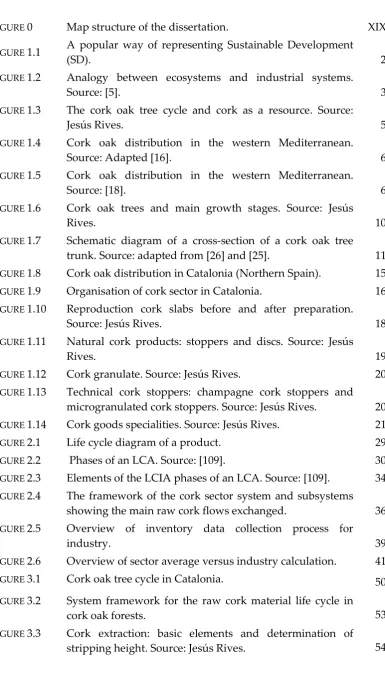
(7) Contents Figures Equations. I IV. Tables. V. List of acronyms, abbreviations and notation. IX. Acknowledgments. XI. Summary Preface Structure of the dissertation. XIII XVII XIX. Part I. INTRODUCTION TO THE DISSERTATION 1. Introduction. 2. 1.1. Overview of cork resource. 4. 1.1.1. Cork oak forest. 5. 1.1.2. The cork oak tree. 9. 1.1.3. Cork bark. 11. 1.1.4. Cork as a raw material. 12. 1.2. Overview of the cork sector in Catalonia. 15. 1.2.1. Forestry cork sector. 16. 1.2.2. Industry cork sector. 18. 1.2.3. Regional cork institutions. 22. 1.3. Justification of the dissertation. 23. 1.4. Objectives of the dissertation. 25. 2. Methodology 2.1. Life cycle assessment. 28 29. 2.1.1. Definition of goal and scope. 31. 2.1.2. Inventory analysis. 31. 2.1.3. Impact assessment. 32. 2.1.4. Interpretation. 34. 2.2. The cork sector and environmental studies. 35. 2.3. Overview of the system and subsystems under study. 36. 2.4. Fieldwork: data collection processes. 37. 2.4.1. Inventory of data collection. 38. 2.4.2. Life Cycle Impact Assessment (LCIA). 41.
(8) Part II. ENVIRONMENTAL ASSESSMENT OF CORK OAK FORESTRY MANAGEMENT IN CATALONIA 3. Environmental analysis of raw cork extraction in cork oak forests in Southern Europe (Catalonia – Spain). 46. Abstract. 46. Keywords. 46. 3.1. Introduction. 47. 3.2. Cork oak agro-forestry systems. 49. 3.2.1. Cork oak forests in Catalonia 3.3. Methodology. 49 51. 3.3.1. Scope and goal definition. 51. 3.3.2. Functional Unit (FU). 51. 3.3.3. Description of the system. 52. 3.3.4. Boundaries of the system and other considerations. 55. 3.3.5. Life cycle inventory (LCI). 56. 3.3.6. Quality data and software. 57. 3.4. Results and discussion. 58. 3.4.1. Inventory data associated with a tonne of raw cork material (FU) in Catalonia. 58. 3.4.2. Impact assessment associated with the forestry extraction of a tonne of raw cork material in Catalonia.. 61. 3.4.3. Carbon dioxide balance associated with a tonne of raw cork material. 64. 3.4.4. Sensitivity analysis. 66. 3.5. Conclusions. 69. Part III. ENVIRONMENTAL ASSESSMENT OF THE CORK INDUSTRIAL SECTOR IN CATALONIA 4. Environmental analysis of the production of natural cork stoppers in Southern Europe (Catalonia – Spain). 74. Abstract. 74. Keywords. 74. 4.1. Introduction. 75. 4.2. Methodology. 77. 4.2.1. Goal and scope definition 4.3. Results and discussion. 77 84. 4.3.1. Inventory data of natural cork stopper production in Southern Europe (Catalonia – Spain). 84. 4.3.2. Impact assessment of the production of natural cork stoppers in Southern Europe (Catalonia – Spain). 85.
(9) 4.3.3. Impact assessment of the production of natural cork stoppers by stages in Southern Europe (Catalonia – Spain). 87. 4.3.4. Influence of the transport from the forest: location of the companies. 93. 4.4. Conclusions 5. Environmental analysis of cork granulate production in Southern Europe (Catalonia – Spain). 96 100. Abstract. 100. Keywords. 100. 5.1. Introduction. 101. 5.2. Cork sector: wastes and by-products. 102. 5.3. Justification and research objectives. 103. 5.4. Methodology. 104. 5.4.1. Goal and scope definition. 104. 5.4.2. System description. 105. 5.4.3. Considerations. 107. 5.4.4. Quality and data origin. 107. 5.4.5. Allocation procedure. 108. 5.4.6. Software and LCA methodology. 109. 5.5. Results and discussion. 109. 5.5.1. Cork sector organisation approach. 109. 5.5.2. Life Cycle Inventory of white and black granulate production (LCI). 111. 5.5.3. Impact assessment of white cork granulate production. 112. 5.5.4. Impact assessment of black cork granulate production. 114. 5.5.5. Sensitivity analysis. 116. 5.6. Conclusions 6. Environmental analysis of the production of champagne cork stoppers. 120 124. Abstract. 124. Keywords. 124. 6.1. Background, scope and aim. 125. 6.2. Goal and scope definition. 127. 6.2.1. Objectives. 127. 6.2.2. Functional Unit. 128. 6.2.3. Description of the system under study. 129. 6.2.4. Boundaries of the system. 130. 6.2.5. Life cycle inventory (LCI). 131. 6.2.6. Quality data and software. 132. 6.2.7. Allocation procedure and considerations. 134.
(10) 6.3. Results and discussion. 136. 6.3.1. Inventory data of champagne cork stoppers production. 136. 6.3.2. Environmental impact assessment of champagne cork stoppers. 140. 6.3.3. Environmental impact assessment of the production of champagne cork stoppers by stages. 141. 6.3.4. Sensitivity analysis of cork dust utilisation as biomass. 146. 6.4. Conclusions. 148. Part IV. INTEGRATED EVALUATION OF THE CORK SECTOR AND IMPROVEMENTS FROM AN INDUSTRIAL ECOLOGY PERSPECTIVE 7. Environmental analysis of the cork sector in Southern Europe (Catalonia – Spain) from an industrial ecology perspective. 154. Abstract. 154. Keywords. 154. 7.1. Introduction. 155. 7.2. Methodology. 156. 7.2.1. Definition of goal and scope. 157. 7.2.2. Life cycle inventory (LCI). 160. 7.2.3. Life cycle impact assessment (LCIA). 161. 7.2.4. Interpretation. 161. 7.3. Results. 161. 7.3.1. Impact assessment of the production of natural cork stoppers (cradle-to-grave). 162. 7.3.2. Impact assessment of the production of cork granulate (cradle-to-gate). 163. 7.3.3. Impact assessment of the production of the champagne cork stopper (cradle-to-grave). 166. 7.3.4. Integrated impact assessment of an initial tonne of raw cork material converted into their most typical products (integrated FU). 168. 7.3.5. Carbon dioxide balance of the cork sector and cork products. 169. 7.3.6. Regional Climate Change mitigation by cork sector. 171. 7.3.7. Sensitivity analysis of the allocation rules established. 172. 7.4. Discussion. 172. 7.5. Conclusions. 177.
(11) Part V. CONCLUSIONS AND FUTURE RESEARCH 8. Conclusions and future research 8.1. Conclusions. 182 182. 8.1.1. Methodological aspects. 182. 8.1.2. Cork subsectors aspects. 184. 8.1.3. Integrated cork sector evaluation. 187. 8.1.4. Cork sector global improvement proposals. 189. 8.2. Future research. 191. References. 193. Annex I. Questionnaires. 209. AI.1. Cork oak forest management questionnaire. 210. AI.2. Natural cork stopper questionnaire. 216.
(12)
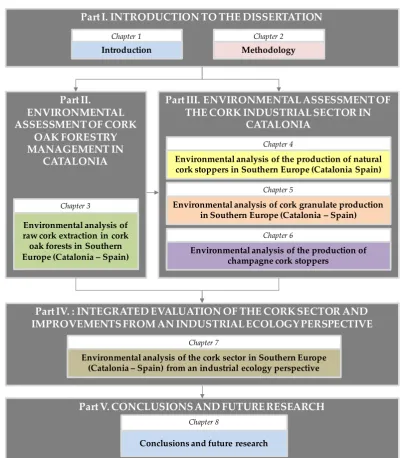
(13) Figures FIGURE 0. Map structure of the dissertation.. FIGURE 1.1. A popular way of representing Sustainable Development (SD).. 2. Analogy between ecosystems and industrial systems. Source: [5].. 3. FIGURE 1.3. The cork oak tree cycle and cork as a resource. Source: Jesús Rives.. 5. FIGURE 1.4. Cork oak distribution in the western Mediterranean. Source: Adapted [16].. 6. Cork oak distribution in the western Mediterranean. Source: [18].. 6. FIGURE 1.6. Cork oak trees and main growth stages. Source: Jesús Rives.. 10. FIGURE 1.7. Schematic diagram of a cross-section of a cork oak tree trunk. Source: adapted from [26] and [25].. 11. FIGURE 1.8. Cork oak distribution in Catalonia (Northern Spain).. 15. FIGURE 1.9. Organisation of cork sector in Catalonia.. 16. FIGURE 1.10. Reproduction cork slabs before and after preparation. Source: Jesús Rives.. 18. FIGURE 1.11. Natural cork products: stoppers and discs. Source: Jesús Rives.. 19. FIGURE 1.12. Cork granulate. Source: Jesús Rives.. 20. FIGURE 1.13. Technical cork stoppers: champagne cork stoppers and microgranulated cork stoppers. Source: Jesús Rives.. 20. FIGURE 1.14. Cork goods specialities. Source: Jesús Rives.. 21. FIGURE 2.1. Life cycle diagram of a product.. 29. FIGURE 2.2. Phases of an LCA. Source: [109].. 30. FIGURE 2.3. Elements of the LCIA phases of an LCA. Source: [109].. 34. FIGURE 2.4. The framework of the cork sector system and subsystems showing the main raw cork flows exchanged.. 36. Overview of inventory data collection process for industry.. 39. FIGURE 2.6. Overview of sector average versus industry calculation.. 41. FIGURE 3.1. Cork oak tree cycle in Catalonia.. 50. FIGURE 3.2. System framework for the raw cork material life cycle in cork oak forests.. 53. FIGURE 3.3. Cork extraction: basic elements and determination of stripping height. Source: Jesús Rives.. 54. FIGURE 1.2. FIGURE 1.5. FIGURE 2.5. XIX. I.
(14) FIGURE 3.4. Environmental impact assessment of raw cork material extraction by forestry stages in Catalonia.. 62. FIGURE 3.5. Environmental impact assessment of the cork stripping stage associated with raw cork material extraction in Catalonia.. 63. Environmental impact assessment of the shrub clearance and road maintenance stage associated with raw cork material extraction in Catalonia.. 63. General system framework of the life cycle of the industrial production of natural cork stoppers: stages and production processes considered.. 78. Environmental impact assessment of natural cork stoppers in Southern Europe (Catalonia – Spain) by production stages.. 87. Environmental impact of the preparation stage of cork slabs by production processes in Southern Europe (Catalonia – Spain).. 90. Environmental impact of the manufacturing stage of natural cork stopper production in Southern Europe (Catalonia – Spain).. 91. Differences in the environmental impact of the manufacturing stage of natural cork stoppers depending on the producer company.. 91. Environmental impact of the finishing stage of natural cork stopper production in Southern Europe (Catalonia – Spain).. 92. Differences in the environmental impact of the finishing stage of natural cork stoppers depending on the producer company.. 93. Sensitivity analysis of the transport of raw cork from the forest for the GWP category considering the results (reference data), and 3 different distances of the locations of the forests.. 93. Differences in the main system of the LCA of the transport stage considering the results (reference data) and 3 different distances of the locations of the forests.. 95. Definition and boundaries of the white cork granulate production system studied including the main processes involved.. 105. Definition and boundaries of the black cork granulate production system studied including the main processes involved.. 107. Approach to the cork sector organisation in Catalonia: estimation of cork flows exchanges between subsystems.. 110. FIGURE 3.6. FIGURE 4.1. FIGURE 4.2. FIGURE 4.3. FIGURE 4.4. FIGURE 4.5. FIGURE 4.6. FIGURE 4.7. FIGURE 4.8. FIGURE 4.9. FIGURE 5.1. FIGURE 5.2. FIGURE 5.3. II.
(15) (Percentages were calculated from an initial 1000 kg of raw cork in the forest). FIGURE 5.4. Environmental impact assessment of white cork granulate production in the studied companies by operations.. 114. FIGURE 5.5. Environmental impact assessment of black cork granulate production in the studied companies by operations.. 116. FIGURE 5.6. Sensitivity analysis of the transport for white cork granulate. The variation of relative results when considering a scenario involving long distance transport by road (3000 km).. 120. Cork products: variety of cork stoppers depending on the type of cork used and the combination of intermediate products.. 126. General system framework of the life cycle of the industrial production of champagne cork stoppers: stages and production processes considered.. 129. Raw cork flows balance to produce one million champagne cork stoppers weighing a total of 9,000 kg (FU).. 137. FIGURE 6.4. Environmental impact assessment of champagne cork stoppers by production stages.. 141. FIGURE 6.5. Environmental impact of the disc manufacture stage by production operations.. 142. FIGURE 6.6. Environmental impact of the cork granulate manufacture stage by production operations.. 143. FIGURE 6.7. Environmental impact of the champagne cork stopper manufacture stage by production operations.. 144. FIGURE 6.8. Environmental impact of the champagne cork stopper finishing stage by production operations.. 146. FIGURE 7.1. Cork sector integrated system under study.. 158. FIGURE 7.2. Environmental impact assessment of natural cork stoppers in production stages considering the entire life-cycle of the product.. 163. Environmental impact assessment of champagne cork stopper by production stages considering a cradle-to-gate system.. 167. Carbon dioxide balance of cork sector in Catalonia, according to the percentage of each product from a tonne of raw cork material.. 170. Cork sector potential flows interconnection.. 173. FIGURE 6.1. FIGURE 6.2. FIGURE 6.3. FIGURE 7.3. FIGURE 7.4. FIGURE 7.5. III.
(16) Equations EQUATION 1.1 EQUATION 3.1. IV. Stripping height determination according to debarking coefficient (DC) and circumference at breast height (CBH).. 12. Overall carbon dioxide balance considering the cork oak forest fixation, the emission generated during cork extraction, and the carbon contained in the cork products.. 65.
(17) Tables TABLE 1.1. Cork oak tree basic environmental conditions.. TABLE 1.2. Main properties of cork as a raw material. Source: Adapted from [25, 62, 63].. 13. TABLE 1.3. Raw cork materials from the cork oak tree. Source: Adapted from [25] and [64].. 14. TABLE 1.4. The main characteristics of the two cork exploitation models: silviculture model and forest model. Source: Adapted from: [17, 20, 23, 42, 67] .. 17. TABLE 2.1. Sustainable assessment tools available: representative examples. Sources: [92, 94-108].. 28. TABLE 2.2. Example of an inventory table for an LCA study.. 32. TABLE 2.3. Previous environmental studies of the cork sector.. 35. TABLE 2.4. Summary of data sources.. 38. TABLE 2.5. Specific questionnaires for data collection.. 38. TABLE 2.6. Information demanded in specific questionnaires.. 40. TABLE 2.7. Mid-point impact categories considered during the dissertation. Source: [138, 148].. 42. TABLE 3.1. Worldwide cork oak area and raw cork production by country. Source: [18].. 48. TABLE 3.2. Information headings requested in the cork oak forest management questionnaire used during the data collection phase.. 56. TABLE 3.3. Data characterizing the five cork oak exploitations in the experiment.. 58. TABLE 3.4. Inventory data for collecting a tonne of raw cork (FU) from the cork oak forests of Catalonia.. 60. TABLE 3.5. Total environmental impact associated with one tonne of raw cork extracted from cork oak forest in Catalonia considering an average production yield of 150 kg of cork/ha/year.. 61. TABLE 3.6. Sensitivity analysis of the effect on potential environmental impacts of lower and higher cork production per hectare and year.. 66. TABLE 3.7. Distribution of environmental impacts between coproducts (reproduction cork and cork by-products) according to different factors: study reference data, importance of the material, mass balance, and economic price.. 68. Example of a questionnaire-table useful to collect data about (a) the specific process of transport by vehicle from. 81. TABLE 4.1. 7. V.
(18) the forest stage and (b) the surface treatment operation in the finishing stage. Summary of the data used from Ecoinvent 1.2 for the environmental analysis of natural cork stopper production.. 83. Inventory data to produce the FU (one million natural cork stoppers) in Southern Europe (Catalonia – Spain): main input flows.. 85. Total environmental impact of natural cork stopper production in Southern Europe (Catalonia - Spain) and range of variability between different producers.. 86. Environmental impact assessment of the preparation, manufacture and finishing stages and substages in Southern Europe (Catalonia – Spain).. 89. TABLE 5.1. Prices and values analysis of cork raw materials in the forest in 2008. Source: prices based on [18].. 103. TABLE 5.2. Inventory data to produce the Functional Unit (FU): a tonne of granulate.. 111. TABLE 5.3. Potential environmental impacts associated to a tonne of white cork granulate production in the studied companies in Catalonia (Northern Spain).. 113. TABLE 5.4. Potential environmental impacts associated to a tonne of black cork granulate production in the studied companies in Catalonia (Northern Spain).. 115. TABLE 5.5. Potential environmental impacts of the production of a tonne of white cork granulate, considering three different scenarios of wastes origin (percentage results fixing scenario 1 as 100.0%). 117. Potential environmental impacts of the production of a tonne of white cork granulate, considering four different scenarios of wastes transport (percentage results fixing scenario 1 as 100.0%). 119. TABLE 6.1. Inventory data to produce one million champagne cork stoppers (FU).. 139. TABLE 6.2. Total environmental impact of champagne cork stopper production and range of variability between different producers.. 140. Environmental impact caused during champagne cork stopper manufacturing stage and range of variability between different producers.. 145. TABLE 6.4. Sensitivity analysis of the use of cork dusts as renewable fuel in the system.. 147. TABLE 7.1. Description of systems under study and their main. 158. TABLE 4.2. TABLE 4.3. TABLE 4.4. TABLE 4.5. TABLE 5.6. TABLE 6.3. VI.
(19) characteristics. Environmental impact assessment of natural cork stoppers considering only the industrial production system and the entire life-cycle.. 161. Environmental impact assessment of white cork granulate considering only the industrial production system and the cradle-to-gate life-cycle.. 163. Environmental impact assessment of black cork granulate considering only the industrial production system and the cradle-to-gate life-cycle.. 164. Environmental impact assessment of champagne cork stoppers considering only the industrial production system and the entire life-cycle.. 166. Environmental impact assessment of an initial tonne of raw cork material converted into their most representative products.. 168. Carbon dioxide balance associated to an initial tonne of raw cork material converted into their most representative products. 169. TABLE 7.8. Carbon dioxide balance of natural cork stoppers and champagne cork stoppers.. 170. TABLE 7.9. Sensitivity analysis of allocation rules established in the environmental analysis of cork products: environmental burdens established according to mass balance.. 172. TABLE 7.10A. Environmental strategies for cork sector improvement. 175. TABLE 7.10B. Environmental strategies for cork sector improvement. 176. TABLE AI.1. Basic information for questionnaire fulfilment. 209. TABLE 7.2. TABLE 7.3. TABLE 7.4. TABLE 7.5. TABLE 7.6. TABLE 7.7. VII.
(20) VIII.
(21) List of acronyms, abbreviations and notation 1.4 DB eq.. 1.4 dichlorobenzene equivalent emissions. ADP. abiotic depletion potential. AECORK. Association of Cork Companies of Catalonia. AP. acidification potential. APCOR. Portuguese Cork Association. BAT. best available techniques. BUWAL. Swiss Agency for the Environment, Forests and Landscape. C2H4 eq.. ethylene equivalent emissions. CBA. cost-benefit analysis. CBH. circumference at breast height. CDTI. Centre for the Development of Industrial Technology. CED. cumulative energy demand. CFC. Catalan Association of Forest Owners. CFC11 eq.. trichlorofluoromethane equivalent emissions. CM. checklist method. CML. Institute of Environmental Sciences (Leiden). CO2. carbon dioxide. CO2 eq.. carbon dioxide equivalent emissions. COD. chemical oxygen demand. DC. debarking coefficient. DMC. direct material consumption. DMI. direct material input. EA. energy analysis. EF. ecological footprint. EIA. environmental impact assessment. EIP. eco-industrial park. ELCD. European Reference Life Cycle Database. EMPA. Swiss Federal Laboratories for Materials Testing and Research. EP. eutrophication potential. ERA. environmental risk assessment. FAETP. freshwater aquatic ecotoxicity potential. FSC. Forest Stewardship Council. FU. functional unit. GWP. global warming potential. HDPE. polyethylene. HNVF. High Nature Value Farmlands. HTP. human toxicity potential. IX.
(22) X. ICSuro. Catalan Cork Institute. ICTA. Institute of Environmental Science and Technology. IE. industrial ecology. IKP. Institute for Polymer Testing and Polymer Science (University of Stuttgart). ILCD. International Reference Life Cycle Data System. IOA. input-output analysis. ISO. International Standardisation Organisation. LCA. life cycle assessment. LCC. life cycle costing. LCCA. life cycle cost analysis. LCECA. life cycle environmental cost analysis. LCI. life cycle inventory. LCIA. life cycle impact assessment. LCWE. life cycle working environment. MAETP. marine aquatic ecotoxicity potential. MEFA. material and energy flow analysis. MFA. material flow accounting. MFCA. material flow cost accounting. MIPS. material intensity per unit service. ODP. ozone layer depletion potential. PEFC. Programme for the Endorsement of Forest Certification. PO43- eq.. phosphate equivalent emissions. POCP. photochemical ozone creation potential. RAD. radioactive radiation. Sb eq.. antimony equivalent emissions. SD. sustainable development. SEA. strategic environmental assessment. SEEA. system of economic and environmental accounts. SETAC. Society of Environmental Toxicology and Chemistry. SFA. substance flow analysis. SH. stripping height. SLCA. social life cycle assessment. SO2 eq.. sulphur dioxide equivalent emissions. SosteniPrA. Sustainability and Environmental Prevention. TCA. trichloroanisoles. TETP. terrestric ecotoxicity potential. TMR. total material requirement. UAB. Universitat Autònoma de Barcelona. UNEP. United Nations Environment Programme.
(23) Acknowledgments The authors would like to thank the ICSuro, AECORK, CFC, for their essential support. We would also like to thank the Spanish Ministry for Industry, Tourism and Trade for the financial support in the CENIT project DEMETER (“Desarrollo de Estrategias y Métodos Vitícolas y Enológicos frente al Cambio Climático - SA 72”), and the “ECOTECH SUDOE, soe2/P2/E377: LCA and Ecodesign International Network for Environmental Innovation” project.. Des de l’octubre de 2007 he tingut la fortuna de fer recerca sobre la gestió de residus i sobre el sector surer a Catalunya des d’una perspectiva ambiental. Gràcies a aquests treballs he pogut compartir molts moments amb moltes persones de diferents àmbits que m’ha suposat un gran benefici acadèmic, professional i, sobretot, personal. Estic molt agraït a totes les persones que han contribuït de manera directa o indirecta tant en la tesi com en la meva formació. En especial, he d’agrair l’oportunitat que em van donar els meus directors de tesi, Joan Rieradevall i Xavier Gabarrell, per a desenvolupar aquesta recerca. No voldria oblidar-me de tota la gent de l’Institut Català del Suro, que m’ha ajudat tant durant tot aquest temps, i molt especialment l’Ivan Fernández, que ha estat clau en el desenvolupament de la tesi i m’ha donat suport durant tot el projecte Cenit-Demeter. També vull esmentar totes les empreses que han participat activament en el projecte, a les finques forestals i al Consorci Forestal de Catalunya, sense els quals no hauria pogut aconseguir l’objectiu plantejat. Espero que la meva tesi sigui només el primer pas d’un llarg camí del sector surer cap a la sostenibilitat i el medi ambient. A més, voldria donar un agraïment molt sincer a tots els companys del grup de recerca SosteniPrA per donar-me suport, força i coratge durant tot aquest temps, així com per fer-me passar tantes estones divertides i inoblidables. Aquesta tesi tampoc no hauria estat possible sense cadascun de vosaltres i, en especial, sense la Júlia amb qui he compartit més estones, reflexions i discussions científiques durant el doctorat, i el Ramon, amb el qual he compartit molts moments els darrers 10 anys. Finalment, voldria donar les gràcies a tots els companys i amics que m’han acompanyat durant tots aquests anys, i d’una manera molt especial vull agrair a la meva família, la peça transcendental de la meva vida, tot el seu suport incondicional en els bons i mals moments. A la meva mare, a les meves germanes, al meu cosí, a la meva tieta, als meus tiets i cunyats i, molt especialment, al meu Avi i la meva Iaia, que són els millors del món! També, al Francesc que ja fa molts anys que està al meu costat incondicionalment. Com veieu, mai no podria haver fet aquesta tesi sense el suport explícit de moltíssima gent, que amb el pas dels anys ha contribuït a formar el meu caràcter decidit, tossut i enfadós que tant em caracteritza. Gràcies a tots!. XI.
(24) XII.
(25) Summary Cork is a natural, renewable material, and is typically Mediterranean in the sense that this area, in particular the Iberian Peninsula, is home to the majority of cork oak forests and, therefore, most cork extraction activity. Cork is used to make many products, but in Catalonia the industry of making closures for wine and cava bottles, which are products of high added value, is especially important. Worldwide, 10% of wine stoppers and 60% of cava stoppers are made in Catalonia. The lack of environmental data for the cork sector, together with competition from new products made with non-renewable materials, like synthetic or aluminium stoppers, are among the main reasons why the sector has decided to move in the direction of sustainability. Life Cycle Analysis (LCA) is a tool used to assess the environmental impacts of products and systems throughout their life. This tool, used widely in other industrial sectors, is applied for the first time to the Catalan cork sector in this thesis, by analysing the sector both globally and by subsystems. The weaknesses of the sector’s various subsystems have been detected, and proposals made regarding measures to favour cleaner production methods and key strategies to reduce the environmental impacts of cork products. Furthermore, the integrated analysis of the sector can lead to establishing global strategies for improvement based on industrial ecology, which will allow the sector to continue its advance towards sustainability. The results indicate that cork is a low-impact material that, as well as generating many products, contributes towards fixing Carbon dioxide. For every tonne of cork transformed into products 14.3 t of CO2 are fixed, so it can be said that the cork sector plays its part in the fight against climate change. This thesis is the first step towards sustainability taken by the sector, and it would be good to continue working along these lines, and also on other research that will be crucial in the future. Some of the areas that need investigation are: new potential cork products, with a greater added value, a pilot study of higherimpact operations, for which there could be various technological alternatives, and CO2 fixation associated with cork oaks.. XIII.
(26) Resum El suro és un material natural, renovable i típicament Mediterrani, ja que la majoria de l’extracció de suro i, per tant, dels boscos d’alzina surera, se situa en aquesta àrea, i molt especialment a la península Ibèrica. El suro s’utilitza per a fabricar nombrosos productes, però a Catalunya destaca molt especialment la indústria de taps per a vins i caves, que són productes d’alt valor afegit. A escala mundial el 10 % dels taps de vi i el 60 % dels taps de cava són produïts a Catalunya. La manca de dades ambientals del sector surer, juntament amb l’aparició de competidors amb nous productes fets amb materials no renovables com els taps sintètics o d’alumini, han estat algunes de les principals justificacions perquè el sector hagi decidit avançar cap a la sostenibilitat. L'anàlisi de cicle de vida (ACV) és una eina utilitzada per a avaluar els impactes ambientals de productes i sistemes al llarg de la seva vida. Aquesta eina ambiental, que s’ha utilitzat àmpliament en altres sectors industrials, s’empra per primer cop en el sector surer a Catalunya en la present tesi, l’objectiu de la qual ha estat l’avaluació ambiental del sector surer mitjançant l’anàlisi del sector, tant globalment com també per subsistemes. S’han determinat els punts febles dels diferents subsistemes del sector, de manera que es proposen mesures de producció més netes com a estratègies clau per a disminuir els impactes ambientals associats a cadascun dels productes de suro. A més, l’anàlisi del sector integrat permet establir estratègies globals de millora del sector des d’una perspectiva de l’ecologia industrial que permetran que el sector continuï avançant cap a la sostenibilitat. Els resultats indiquen que el suro és un material amb un impacte ambiental baix que, a més de generar nombrosos productes, contribueix a fixar diòxid de carboni. Concretament, per cada tona de suro transformat en productes es fixen 14.3 t de CO2, i per tant es pot afirmar que el sector del suro contribueix en la lluita contra el canvi climàtic. Aquesta tesi ha estat el primer pas del sector cap a la sostenibilitat i s’hauria de continuar treballant en aquesta línia, així com en altres investigacions que seran claus en el futur. Alguns dels aspectes que convé investigar són els potencials nous productes de suro, amb un valor afegit més alt, l’estudi pilot de les operacions més impactants per a les quals hi poden haver diferents alternatives tecnològiques i l’aprofundiment en el coneixement sobre la fixació de CO2 associada a l’alzina surera.. XIV.
(27) Resumen El corcho es un material natural, renovable y típicamente Mediterráneo, ya que la mayoría de la extracción de corcho y, por lo tanto, de los bosques de alcornoque, se sitúa en esta área, y muy especialmente en la península Ibérica. El corcho se utiliza para fabricar numerosos productos, pero en Cataluña destaca muy especialmente la industria de tapones para vinos y cavas, que son productos de alto valor añadido. A escala mundial, el 10% de los tapones de vino y el 60% de los tapones de cava son producidos en Cataluña. La falta de datos ambientales del sector corchero, junto con la aparición de competidores con nuevos productos fabricados con materiales no renovables, como los tapones sintéticos o de aluminio, han sido algunas de las principales justificaciones para que el sector haya decidido avanzar hacia la sostenibilidad. El análisis de ciclo de vida (ACV) es una herramienta utilizada para evaluar los impactos ambientales de productos y sistemas a lo largo de su vida. Esta herramienta ambiental, que se ha utilizado sobradamente en otros sectores industriales, se utiliza por primera vez en el sector corchero en Cataluña en la presente tesis, el objetivo de la cual ha sido la evaluación ambiental del sector del corcho mediante el análisis del sector, tanto globalmente como también por subsistemas. Se han determinado los puntos débiles de los diferentes subsistemas del sector, de modo que se proponen medidas de producción más limpias como estrategias clave para disminuir los impactos ambientales asociados a cada uno de los productos de corcho. Además, el análisis del sector integrado permite establecer estrategias globales de mejora del sector desde una perspectiva de la ecología industrial que permitirán que el sector continúe avanzando hacia la sostenibilidad. Los resultados indican que el corcho es un material con un impacto ambiental bajo que, además de generar numerosos productos, contribuye a fijar dióxido de carbono. Concretamente, por cada tonelada de corcho transformado en productos se fijan 14.3 t de CO2, por lo que se puede afirmar que el sector del corcho contribuye en la lucha contra el cambio climático. Esta tesis ha sido el primer paso del sector hacia la sostenibilidad y se tendría que continuar trabajando en esta línea, así como en otras investigaciones que serán claves en el futuro. Algunos de los aspectos que conviene investigar son los potenciales nuevos productos hechos de corcho, con un valor añadido más alto, el estudio piloto de las operaciones más impactantes para las que puede haber diferentes alternativas tecnológicas y la profundización en el conocimiento sobre la fijación de CO2 asociada al alcornoque.. XV.
(28) XVI.
(29) Preface This doctoral thesis was developed within the research group SosteniPrA (Sustainability and Environmental Prevention) at the Institute of Environmental Science and Technology (ICTA) of the Universitat Autònoma de Barcelona (UAB) from December 2008 to May 2011. Previously, from October 2007 to December 2008, a master research thesis about waste collection systems was also carried out in the SosteniPrA group in order to access doctorate studies. This dissertation analyses the cork sector in Catalonia (Northern Spain) from an environmental perspective. The research attempts to highlight the environmental benefits of cork as a material; but goes further and seeks to quantify and analyze the environmental impacts associated with the material and its main products in Catalonia and to propose strategies to improve production from a sustainability point of view. The doctoral thesis was based on the methodology and results developed during the following project: •. Desarrollo de Estrategias y Métodos vitícolas y Enológicos frente al cambio climático. Aplicación de nuevas Tecnologías que mejoren la Eficiencia de los procesos Resultantes – Subproyecto SA 7.2: Evaluación ambiental del sector del vino mediante el análisis de ciclo de vida (ACV) del tapón de corcho y el tapón de cava. 2008-2011. A project by Cenit-Demeter funded by the Centre for the Development of Industrial Technology (CDTI) part of the Ministry of Science and Innovation. The Project was coordinated by AECORK (the cork industry business association) and had the participation of the Catalan Cork Institute and was developed by the Universitat Autònoma de Barcelona (ICTA - Institute of Environmental Science and Technology).. The dissertation is mainly based on the following papers either published or under review in peer-reviewed indexed journals: •. Rives, J., Fernandez-Rodriguez, I., Rieradevall, J., Gabarrell, X. Environmental analysis of the production of natural cork stoppers in southern Europe (Catalonia - Spain). Journal of Cleaner Production, 2011. 19(2-3): p. 259-271.. •. Rives, J., Gabarrell, X., Fernandez-Rodriguez, I., Rieradevall, J., Environmental analysis of cork granulates production in southern Europe (Catalonia - Spain). Submitted on January 2011 to Resources, Conservation and Recycling.. •. Rives, J., Fernandez-Rodriguez, I., Rieradevall, J., Gabarrell, X. Environmental analysis of the production of champagne cork stoppers in southern Europe (Catalonia - Spain). Submitted on March 2011 to Journal of Cleaner Production.. •. Rives, J., Fernandez-Rodriguez, I., Rieradevall, J., Gabarrell, X. Environmental analysis of the raw cork extraction in cork oak forests in Southern Europe (Catalonia – Spain). Submitted on May 2011 to Journal of Environmental Management. XVII.
(30) •. Rives, J., Fernandez-Rodriguez, I., Rieradevall, J., Gabarrell, X. Environmental analysis of the cork sector in Southern Europe (Catalonia – Spain) from an industrial ecology perspective. Submitted on June 2011 to Environmental Science & Technology.. Moreover, the following oral communications and posters presented to congresses and conferences also form part of this doctoral thesis: •. Rives J, Fernandez-Rodriguez I, Gabarrell X, Rieradevall J. Environmental evaluation by means of LCA of a renewable material product: the natural cork stopper. 2010. Oral communication. International Conference on Ecobalance. Tokyo (Japan).. •. Rives J, Gabarrell X, Rieradevall J. 2010. Life cycle assessment of natural cork stoppers production in Catalonia. Oral communication. II International Conference on Wine ecological, sustainable and climate change (Ecososteniblewine). Vilafranca del Penedès (Barcelona – Spain).. •. Gabarrell X, Rives J, Fernandez-Rodriguez I, Rieradevall J. 2010. Life cycle assessment of the industrial production of natural cork stoppers for still wine Poster. II International Conference on Wine ecological, sustainable and climate change (Ecososteniblewine). Vilafranca del Penedès (Barcelona – Spain).. •. Rives J, Fernandez-Rodriguez I, Rieradevall J, Gabarrell X. Carbon footprint associated to the production of natural cork stoppers. 2011. Oral communication. 4th edition of the International Life Cycle Assessment Conference in Latin-America (CILCA). Coatzoalcos (Mexico).. •. Rives J, Fernandez-Rodriguez I, Rieradevall J, Gabarrell X. Environmental evaluation by means of LCA of champagne cork stopper production. 2011. Poster. Life Cycle Management International Conference (LCM). Berlin (Germany).. Apart from this, during the dissertation period the following paper in a peerreviewed journal was published: •. XVIII. Rives J, Rieradevall J, Gabarrell X. LCA comparison of container systems in municipal solid waste management. Waste Management, 2010. 30: p. 949-957..
(31) Structure of the dissertation The structure of the dissertation is organised into five main parts and eight chapters. For clarity, the structure of the doctoral thesis is further outlined in Figure 0. This flow chart can be used throughout the reading of this manuscript as a dissertation map. Part I. INTRODUCTION TO THE DISSERTATION Chapter 1. Chapter 2. Introduction. Methodology. Part II. ENVIRONMENTAL ASSESSMENT OF CORK OAK FORESTRY MANAGEMENT IN CATALONIA. Part III. ENVIRONMENTAL ASSESSMENT OF THE CORK INDUSTRIAL SECTOR IN CATALONIA Chapter 4. Environmental analysis of the production of natural cork stoppers in Southern Europe (Catalonia Spain) Chapter 5. Chapter 3. Environmental analysis of raw cork extraction in cork oak forests in Southern Europe (Catalonia – Spain). Environmental analysis of cork granulate production in Southern Europe (Catalonia – Spain) Chapter 6. Environmental analysis of the production of champagne cork stoppers. Part IV. : INTEGRATED EVALUATION OF THE CORK SECTOR AND IMPROVEMENTS FROM AN INDUSTRIAL ECOLOGY PERSPECTIVE Chapter 7. Environmental analysis of the cork sector in Southern Europe (Catalonia – Spain) from an industrial ecology perspective. Part V. CONCLUSIONS AND FUTURE RESEARCH Chapter 8. Conclusions and future research. Figure 0. Map structure of the dissertation.. XIX.
(32) Part I. Introduction to dissertation Part I is composed of two chapters. Chapter 1 contextualises cork as a natural, renewable and local raw material of Mediterranean areas, and Catalonia in particular. In addition, this chapter describes the cork sector divided into two sub-sectors: forestry and industry. This is because both will be assessed separately during the dissertation due to a difference in scope and approach. At the end of this chapter, the justification and objectives of this dissertation are explained. Chapter 2 describes the methodology followed during the dissertation, especially the systems under study, the life cycle assessment (LCA) environmental tool, and the fieldwork carried out to characterise and collect data for the environmental assessment of the systems.. Part II. Environmental assessment of cork oak forestry management in Catalonia Part II is composed of Chapter 3 [Environmental analysis of the raw cork extraction in cork oak forests in Southern Europe (Catalonia – Spain)]. This chapter first briefly introduces cork oak forests, and then the system under study and a description of the approach to the specific methodology employed. Following this we show the results of the environmental impacts associated to the management of cork oak forests to extract raw cork material and a carbon dioxide balance is performed. Finally, the conclusions of the chapter are presented.. Part III. Environmental assessment of the cork industrial sector in Catalonia Part III focuses on the environmental evaluation of three products made basically of cork. Chapter 4 [Environmental analysis of the production of natural cork stoppers in Southern Europe (Catalonia – Spain)] presents the evaluation of a product composed completely by solid cork: the natural cork stopper for still wine. It quantifies the total potential environmental impacts caused during their production and assesses the stages and operations of the production that most contribute to these impacts. Chapter 5 [Environmental analysis of cork granulate production in Southern Europe (Catalonia – Spain)] presents the environmental evaluation of an intermediate product: cork granulate. This intermediate product generated after certain processes of cork trituration and mixed with glues generates agglomerated cork products. There are two types of granulates: white cork granulate used mainly to produce technical stoppers for health and safety purposes, and the black cork granulate used for innumerable other applications. Chapter 6 [Environmental analysis of the production of champagne cork stoppers] realises the evaluation of champagne cork stoppers production from an environmental perspective. This type of stopper is a combination of products analysed in chapter 4 and chapter 5, because it is formed by two natural cork discs made of solid cork and a granulated-agglomerated body made of triturated particles. The champagne cork stopper is a product very typical of Catalonia, as 60% of worldwide production is concentrated in this region. This occurs because of the production of cava in the same region and because of champagne production in nearby France. XX.
(33) Part IV: Integrated evaluation of the cork sector and improvements from an industrial ecology perspective Part IV contains Chapter 7 [Environmental analysis of the cork sector in Southern Europe (Catalonia – Spain) from an industrial ecology perspective] which attempts to integrate the results of the forestry and industry systems for the products analysed in Part III. There is a discussion about allocation procedures in the systems and about carbon fixation associated with cork products. Finally, potential future strategies for environmentally improvements are proposed for all the systems studied at different levels from an industrial ecology perspective.. Part V. Conclusions and Future research Part V includes Chapter 8 and provides the general conclusions of the dissertation and proposes future fields of research associated with the cork sector. [Note: Each chapter from 3 to 7 presents an article –either published or under review-. For this reason, an abstract and a list of keywords are presented at the beginning of the chapter, followed by the main body of the article].. XXI.
(34)
(35) PART. I. INTRODUCTION TO THE DISSERTATION. Chapter 1: Introduction. Chapter 2: Methodology.
(36)
(37) Chapter 1. INTRODUCTION Chapter 1 introduces cork oak trees, cork oak forests and cork as a raw material Then it shows where in the world cork is found: mainly in the Iberian Peninsula, and in Catalonia in particular. Before that, to justify the dissertation and explain its objectives, the cork sector is introduced and divided in two parts: the forestry and industry sectors. This chapter is structured as follows: •. Overview of the cork resource.. •. Overview of the cork sector in Catalonia.. •. Justification to the dissertation.. •. Objectives of the dissertation..
(38) Part I. Introduction to the dissertation. 1. Introduction Changes that are occurring in the global economy, manifested in globalisation and technological change, are causing society to be increasingly conscience of the importance of reducing the impacts of man’s activities. For this reason, new challenges are being faced to move towards sustainability in different areas and on different levels. According to the Brundtland Commission of the United Nations on 20 March 1987, sustainable development (SD) is “development that meets the needs of the present without compromising the ability of future generations to meet their own needs” [1]. SD is usually presented as the intersection between environment, society and economy, which are conceived of as being separate but connected entities (Figure 1.1) [2].. Economy. Environment. Social. Sustainable development. Figure 1.1. A popular way of representing Sustainable Development (SD). Source: [3].. The term industrial ecology (IE) refers to a set of tools, principles, and perspectives borrowed and adapted from ecology for the analysis of industrial systems including their impacts on society and the environment of the systems' material, energy, and information flows [4, 5]. IE explores the following assumption: the industrial system can be seen as a certain kind of ecosystem [6, 7]. Figure 1.2 presents an analogy between ecosystem and industrial systems. IE perspectives can help to optimise systems because the approach is focused on holistic strategies for prevention and planning of more environmentally sensitive industrial development, and not on the perspective of 'end-of-pipe' pollution control methods [8]. In this sense, IE tries to move from a linear to a closed-loop system in all the realms of human production and consumption. In this and other ways the world can move closer to an ecological model in its dynamics [9].. 2.
(39) Part I. Introduction to the dissertation. Unlimited resources. Ecosystem component. Unlimited waste. (a) Linear materials flows in a “type I” ecology. Ecosystem component. Energy & limited resources. Limited waste Ecosystem component. Ecosystem component. (b) Quasi-cyclic materials flows in a “type II” ecology Ecosystem component. Energy. Limited waste Ecosystem component. Ecosystem component. (c) Cyclic material flows in a “type III” ecology Figure 1.2. Analogy between ecosystems and industrial systems. Source: [5].. Cleaner production would be that productive activity that uses preventive environmental strategies and techniques to reduce the amount of pollutants and hazardous substances to avoid risks for both humans and their environment [10]. Cleaner production is achieved by applying experience, renewing technology and changing attitudes. That is to maximize energy efficiency, save raw materials and reduce maximum levels of contamination, which often means being more competitive [11]. The cork sector is a traditional part of the economy in south-western Mediterranean areas such as Catalonia (Northern Spain). This sector already contributes to sustainability by making products with cork; a material of organic origin that is renewable and local. In addition to this, the cork sector in Catalonia would like to move towards economic, social and especially environmental sustainability by generating new knowledge, and improving its current productive systems by employing cleaner production strategies. The cork sector perceives the environment as something inherent to its raw material, but besides,. 3.
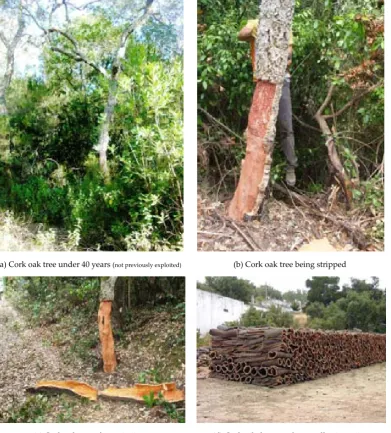
(40) Part I. Introduction to the dissertation. it is continuously trying to improve on an environmental level. In order to accomplish this objective, it is necessary to get to know the area more extensively, as well as carry out studies and provide data that could enable the development of strategic decisions to improve existing systems from the industrial ecology perspective. At the moment, different actors of the cork sector in Catalonia such as the Catalan Cork Institute (ICSuro) [12], the Association of Cork Companies of Catalonia (AECORK) [13] and more than 10 cork enterprises and 5 cork forest owners are involved in a research project that would be the first step towards sustainability in the sector. The four-year project CENIT-DEMETER (2008-2011), “Desarrollo de Estrategias y Métodos vitícolas y Enológicos frente al cambio climático”, and its sub-activity 7.2, associated to the environmental evaluation of the cork sector try to support criteria and data for the future strategic development of the sector. Additionally, many of the cork companies are starting to think about implementing strategic tools for this purpose such as ecodesign, ecoinnovation, cleaner production and even carbon footprint ecolabel implementation.. 1.1. Overview of cork resource The next section presents an overview of cork oak forests, the cork oak tree and cork as a resource. First, cork oak forests and the cork oak tree will be introduced explaining some of their unique characteristics and emphasising the environmental roles that this tree has. Following this, cork will be introduced briefly focusing on its physical and chemical composition, the types of raw cork materials that can be obtained from the tree and pointing out some of the products that are being produced with cork. Several photographs of cork and the cork oak tree (Quercus Suber L.) cycle are shown in figure 1.3.. 4.
(41) Part I. Introduction to the dissertation. (a) Cork oak tree under 40 years (not previously exploited). (b) Cork oak tree being stripped. (c) Cork oak tree after stripping. (d) Cork piled up at a forest collection point. Figure 1.3. The cork oak tree cycle and cork as a resource. Source: Jesús Rives.. 1.1.1. Cork oak forest The first cork oak trees occurred millions of years ago. It is thought that during the Pleistocene (around 1.8 million years ago) the geographical distribution of the cork oak and its genetic diversity was influenced causing the species to be located in areas with a more benign climate. More specifically, cork oak forests got their present distribution areas 10 thousand years ago [14]. Since then, these forests are typical of the Western Mediterranean region, occurring spontaneously in the territories that can be observed in figure 1.4 due to their adaptation to the geographical area and, of course, the environmental conditions [15]. Table 1.1 shows some basic environmental parameters related to cork oak forests.. 5.
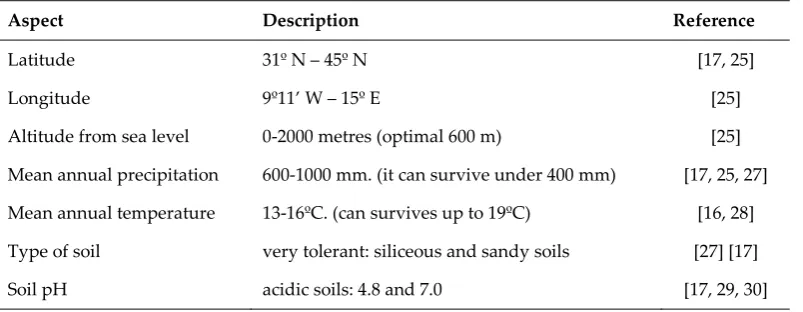
(42) Part I. Introduction to the dissertation. PORTUGAL. Corsica Catalonia. Sardinia Balearic Islands. Sicily. Figure 1.4. Cork oak distribution in the western Mediterranean. Source: Adapted [16].. The real area of the distribution of cork oak forests is not known exactly, but worldwide it is estimated that it occupies a surface of between 2.3 - 2.4 million hectares, and that about 300,000 - 374,000 tonnes of raw cork is extracted yearly [17]. This uncertainty is understandable because data was estimated from the individual registers of different countries, with their respective methodologies and with different year references. Furthermore, as cork is a natural resource, to obtain quality data requires a great deal of fieldwork to analyse a lot of territory or the development of mathematical models. Accounting with basic quality data about the Mediterranean cork sector is fundamental in order to carry out good future research and enable strategic planning. World cork oak surface (ha) Portugal. 4%. 4%. 4%. 2% 6% 1% 4%. Spain Algeria. World cork yearly production (t). 33%. 5%. 15%. Morocco. 52%. France 30% Tunisia Italy. 18% 22%. Figure 1.5. Cork oak distribution in the western Mediterranean. Source: [18].. 6.
(43) Part I. Introduction to the dissertation. Cork oak forests are concentrated in 7 countries (Figure 1.5), and 88% of their surface area is located in Portugal (33%), Spain (22%), Algeria (18%) and Morocco (15%). The production of cork is mainly concentrated in Portugal (52%) and Spain (30%). On the other hand, analysing the worldwide cork production annually it can be observed that the Iberian Peninsula concentres 82% of this production: Portugal (52%) and Spain (30%) [18]. In spite of the considerable world surface area in Algeria and Morocco only 5% and 4% of cork is produced in these countries respectively. This fact could be because cork oak forests in North Africa are quite young relative to the forests in the Iberian Peninsula as many of them was planted under a forestation programme established by the French colonial administration when the area was under their control [19]. Besides, this low numbers could also be consequence of no recent inventories having been carried out [17]. Table 1.1. Cork oak tree basic environmental conditions. Aspect. Description. Reference. Latitude. 31º N – 45º N. Longitude. 9º11’ W – 15º E. [25]. Altitude from sea level. 0-2000 metres (optimal 600 m). [25]. Mean annual precipitation. 600-1000 mm. (it can survive under 400 mm). Mean annual temperature. 13-16ºC. (can survives up to 19ºC). [16, 28]. Type of soil. very tolerant: siliceous and sandy soils. [27] [17]. Soil pH. acidic soils: 4.8 and 7.0. [17, 25]. [17, 25, 27]. [17, 29, 30]. In 2009, Portugal accounted with more than 800 companies comprising more than 12,000 workers involved in the cork sector [18], while more than 330 companies and 3,500 workers were involved in Spain [20]. Geographical localisation of cork industry is obviously linked to the area were the cork raw material is extracted and for this reason the cork industry sector is mainly concentrated in the Iberian Peninsula. In Portugal the industry is concentrated mainly in the north-western region; especially in the Aveiro district, while raw cork material extraction is mainly concentrated in the central-south region; Alentejo region produces 72% of the resource [18]. A similar trend is observed for Spain, where the industry is mainly located in the north-eastern region (Catalonia), while the south of the country, the regions of Andalusia and Extremadura concentrate most cork extraction; 85% [21]. In Spain, the concentration of cork industry in Catalonia is a consequence of, first, the development of the parallel development of wine and champagne production in France [22]. The concentration of cork extraction in southern Spain could be for different reasons, but one of them is most likely the more frequent period of cork extraction in the south because of better environmental conditions [15]: in. 7.
(44) Part I. Introduction to the dissertation. Catalonia cork is extracted from trees every 12-14 years [23], while in Andalusia and Extremadura the period is around 9-10 years [24]. The development of cork oak forests has been attempted in other regions of the planet such as California, Uruguay, Australia, Bulgaria and Japan, but the difficulty of seed conservation, the field establishment of young plants, slow growth and the long life cycle, never allowed for more than a few stands and scattered trees [25, 26]. It is estimated that diversity of species in Spain is about 85,000 taxons [31]. Cork oak is an endemic tree species in the western Mediterranean. Cork oak forests are considered High Nature Value Farmlands (HNVF) [32] and are included in Annex I of the European Union Habitats Directive (92/43/CEE) [33]. These forests are especially valuable for their high degree of biodiversity [31, 34], and because cork extraction has positive benefits for biodiversity and it is compatible with the maintenance of the great ornithological value of cork oak forests [35]. Cork oak forests also have a relevant role to play against desertification and for soil conservation. This aspect is fundamental for the future viability of these ecosystems. The soil is richer in organic matter and is characterised for having better infiltration, water storage, nutrient retention, aeration and root growth capacities. The cork oak leaves are renewed yearly, this means that old leaves, fruits, small branches and animal excrement accumulates and decomposes in the soil returning nutrients and organic matter to the system [14]. By promoting the infiltration of rain and preventing soil erosion, cork oak forests also contribute to hydrology cycle regulation [14, 36]. The profitability of cork oak forests requires correct management to guarantee the persistence of the species, biodiversity and productivity, at the same time as other ecological, economical and social benefits are obtained which impact society. Forest management plays a key role influencing the thickness and quality of raw cork: optimal cork oak management should be oriented towards the periodical removal of cork according to established legislation; in addition this would contribute to the sustainable management of these forests [37]. Treatments reducing stand density stimulate vegetative activity and production of cork slabs with thickness suitable for industrial processing [37]. Most of the present cork oak forests appeared from mid 19th century due to the increasing value of cork, as well as the demand for cork stoppers [14]. These forests provide multiple economic activities, such as livestock grazing, hunting, mushroom collection and honey production, but most of their economic value derives from cork extraction [16, 38]. Besides the extraction of cork and other goods, these forests afford other services to society such as private amenities and public recreation opportunities [39], and providing numerous indirect environmental services: wildlife habitat, soil erosion prevention, carbon storage, hydrology regulation, etc. Without the cork incomes, these forests would collapse economically, causing serious ecological and social consequences [40] such as the substitution of this ecosystem by others that while more lucrative would cause the loss of regional employment [41].. 8.
(45) Part I. Introduction to the dissertation. If the forests are managed adequately cork production can be guaranteed for the future. Nowadays, there are different certification labels of sustainable forest management. Certification is a process of forest management evaluation used as an assurance of quality. Specifically, it indicates that the certified product was made under an established set of criteria and indicators aimed at promoting sustainable forest management [42]. The criteria for verification describe social, economic and ecological aspects to preserve the forests for present and future generations. The certification processes are realised by independent, non-profit and non-governmental organisations that have established a globally recognised system of independent forest certification and product labelling to help consumers identify products from responsibly managed forests. Several sustainable forest management certification schemes have been developed, but nowadays the certification of the Forest Stewardship Council (FSC) [43] and the Programme for the Endorsement of Forest Certification (PEFC) [44] are becoming the most extended and widely implemented for cork oak forests. Currently, in Portugal there are approximately 15,000 hectares of cork oak forests certified by FSC, 2% of the total surface area; and forestry associations have estimated that they are due to reach 150,000 ha in the near future [14]. In Spain, there are 26,000 ha certified by FSC [45] and 15,572 ha by PEFC [46]: this means that 8% of the total Spanish surface area is certified.. 1.1.2. The cork oak tree The cork oak tree (Quercus Suber L.) is a native, endemic and evergreen species, from the Fagaceae family, that grows in western Mediterranean schlerophyllous forests. It is usually between 18-20 metres tall, with a broad, round-topped head and a glossy green colour [47]. The leaves are 4 to 7 cm long, weakly lobed or coarsely toothed, dark green above, paler below, with the leaf margins often down-curved [48]. The acorns are 2 to 3 cm long, in a deep cup fringed with elongated scales. Cork oak trees can survive for centuries [48]; between 250-350 years [17]. This species is special because it is has an thick outer bark formed by a continuous layer of suberised cells that constitute the external envelope of the stem and branches [49] known commonly as cork, that is a natural, renewable raw material and local to Mediterranean areas. Figure 1.6 presents several images of cork oak trees and their main growth stages. The cork oak tree has the capacity to survive a scarcity of water during summer, and is well adapted to this condition by reducing its transpiration and accounting with a system of deep roots that allow it to obtain water from the subsoil [14, 50]. The cork oak tree is expected to be severely affected by climate change due to the increased intensity and duration of the drought periods expected for this region [51] and especially because of its high sensitivity to drought in the initial stages of its development [36].. 9.
(46) Part I. Introduction to the dissertation. (a) Cork oak acorns. (b) Cork oak tree germinated. (c) Cork oak tree with non-extracted virgin cork. (d) Cork oak tree exploited during summer. (< 40 years). (e) Cork oak trees bark re-growth. (f) Old cork oak trees exploited. Figure 1.6. Cork oak trees and main growth stages. Source: Jesús Rives.. Another important fact that characterises the cork oak tree is its resistance to fire. In fact, it is thought that the outer bark of the tree could have been an evolutionary adaptation to a Mediterranean climate where fire was an important ecological factor [14]. After a fire, while many of the other tree species merely regenerate from seeds or resprout from the base of the tree; the cork oak branches, protected by cork, quickly regrow and recompose the tree canopy [52]. This is a clear advantage compared to other species that after a fire return to an initial. 10.
(47) Part I. Introduction to the dissertation. stage of development [14]. Cork extraction is a key factor determining post-fire cork oak survival: unstripped trees present the highest survival rates, while the trees that have been recently stripped are the most susceptible to die if a forest fire occurs [53, 54].. 1.1.3. Cork bark The cork oak has two meristemic tissues: the cambium that is usual in all forest plants that produce xylem inside and phloem outside, and the phellogen or cork cambium that generates the phelloderm inside and the periderm outside [25]. Thanks to this particularity, the cork oak’s bark is composed of two parts: an inner bark called phloem, and an outer bark called periderm [26]. Unlike the inner bark, the outer bark is not vital to the tree’s survival, and can be removed periodically without causing damage to the tree because the inner bark has the capacity of develop a new outer bark [14]. The outer bark separates the living cells of the plant from the outside environment [26]. The phellogen die after cork removal but a rapid formation of a traumatic new phellogen takes place. This response of the tree is repeated whenever necessary, and this is the reason for a feasible and sustainable exploitation of the cork oak tree for its cork [16]. After each bark stripping a new phellogen is differentiated within the secondary phloem and at each season of growth a new cork-ring is added to the regenerated phellem [15]. Figure 1.7 presents a schematic diagram of a cross-section of cork oak tree trunk.. WOOD. Phelloderm Phellogen. (cork cambium). Phellem (cork). BARK. Xylem. PERIDERM. Phloem. OUTER BARK. INNER BARK. Cambium. Figure 1.7. Schematic diagram of a cross-section of a cork oak tree trunk. Source: adapted from [26] and [25].. 11.
(48) Part I. Introduction to the dissertation. The suberised bark seems to be an adaptation to environmental conditions to protect the tree from the heat and dry winds of the Mediterranean summer [47]. When cork is extracted, at the end of spring and during summer, it is fundamental that the phellogen cells responsible for cork production maintain their activity and continue dividing themselves, and it is also essential that the tree’s tissues stay hydrated , especially in the dry Mediterranean summer [14]. Cork-ring widths of cork oak trees have proved to be very sensitive to year-toyear climatic variability; this is especially true because of the high sensitivity of the phellogen to climatic factors such as monthly rainfall and mean temperature. [15]. The outer bark has special characteristics of development, regularity, growth intensity and longevity that singularise this species [26]. The periodical extraction of cork not affect the radial growth of the tree [55]. The stripping height (SH) is the distance between the floor and the maximum height that can be stripped. This distance is determined by a specific debarking coefficient (DC) and the circumference at breast height (CBH) [56]. Equation 1.1 presents how SH must be calculated. According to the DC, for a cork oak tree that is exploited for the first time only the double of its circumference at breast height can be extracted. SH = DC x CBH - For first cork extraction, DC cannot be over 2 (CBH must at least above 65 cm ≈ 20 cm of diameter). - For second cork extraction, DC cannot be over 2.5 - For successive cork extractions, DC cannot be over 3.. Equation 1.1. Stripping height determination according to debarking coefficient (DC) and circumference at breast height (CBH).. 1.1.4. Cork as a raw material As a resource extracted directly from a tree, cork is a natural raw material, and the periodical regeneration of the tree [57], makes cork a renewable resource. Cork is composed of dead cells with walls that are impermeable due to a chemical compound known as suberin which is responsible for the unique and remarkable properties of cork [58]. In fact, all trees produce layers of suberised cells to protect themselves, but only the cork oak tree has the capacity to regenerate its outer bark by adding annual rings of cork [14]. The main components of cork are 40% suberin, 22% lignin, 20% polysaccharides (hemicelluloses and cellulose), 15% extractives (waxes and polyphenols), and 1% ash [59, 60]. The elemental chemical composition of cork is 67% carbon, 23% oxygen, 8% hydrogen and 2% nitrogen [25]. The unique chemical and physical properties of this raw material include its low density, low permeability to liquids and gases, elasticity, compressibility, resilience, chemical inertness, good heat and acoustic insulating properties, resistance to microbial growth and an ability to adhere to a glass surface [60, 61]. Table 1.2 shows some of the particular properties of the cork raw material.. 12.
(49) Part I. Introduction to the dissertation. Table 1.2. Main properties of cork as a raw material. Source: Adapted from [25, 62, 63]. Property. Description. Density. 120–200 kg m-3.. Humidity. At 20ºC and 65% relative humidity of the environment, the cork humidity is about 6% because of the low density of the material and the high quantity of gases contained in its cells.. Specific weight. Very low: the average is 0.18 g cm-3, but it ranges from 0.12-0.24 g cm-3.. Impermeability. Very impermeable. It absorbs less than 18-20% of the water fact that favours the conservation of the material and its avoidance of rot.. Floatability. Very high. The high quantity of air in the cells and their permeability make cork an excellent floating.. Compressible. Very high. A natural cork stopper of 24 mm in length can be compressed to 16 mm.. Flexibility and elasticity. The limit of elasticity is approximately 5 kg cm-2.. Resilience. It is a material resistant to elasticity for years.. Odour and flavour. Neutral. For this reason, it can be used for packaging food products.. Heat conductivity (λ). 0.040–0.045 Wm-1K-1.. Thermal diffusivity (α). 1·10-7–1.5·10-7 m2s-1.. Flammability. It is very difficult to ignite and poorly combustible because it needs a lot of oxygen to burn. However, cork dust can be used as a combustible in boilers.. Acoustic isolating. It is very absorbent of sound for low and medium frequencies.. Percussion insulating. Good insulating properties for acoustic percussion; for this reason it can be used in laminate flooring.. Vibration insulating. Excellent to cushion vibrations.. Electrical insulating. Excellent electric insulator.. Heat of combustion. Between 6,500-7,000 kcal kg-1 (similar to vegetal coal).. Durability. Very high. Cork is difficult to alter.. Oxidation. Does not rust due to the action of air or humidity.. Malleability. Easily workable, especially if the cork has been previously boiled.. Friction. Good resistance to movement and friction.. Up till now, it has called cork a unique type of raw material obtained from the cork oak. However, the term cork is generic and includes different raw materials that present similar characteristics but have some differences between them. Usually, cork is removed from the tree as single pieces of cork commonly called cork slabs. Table 1.3 presents the different raw cork materials:. 13.
(50) Part I. Introduction to the dissertation. Table 1.3. Raw cork materials from the cork oak tree. Source: Adapted from [25] and [64]. Type of cork. Description. Virgin cork. The first-generation cork produced by the original phellogen, which is stripped from the cork oak when the tree is 25-40 years old depending on the region where the forest is located. The back of the cork, the outer part of the raw material, is very rough and presents deep cracks, while the belly, the inner part, is very irregular.. Second cork. Reproduction cork. Virgin winter cork. Fragments of reproduction cork. Cork with defects. Second cork is the cork extracted after virgin cork. This is between 8-14 years later, again depending on the region where the forest is located. Second cork contains deep fractures, and it is of better quality than virgin cork but is still irregular.. This is the third and subsequent cork to be extracted. It has a more regular cellular structure and higher quality and is the preferred raw material for the cork industry. After obtaining virgin cork and second cork, all the cork produced by the tree will be called reproduction cork. However the best reproduction cork is obtained from the forth stripping. The reproduction cork can be obtained more than 10 times during the lifespan of the tree.. This raw cork material is obtained during winter from dead trees or branches that were pruned. This resource is the consequence of forest management during winter, and represents a very low quantity compared with virgin, second and reproduction cork.. This type of cork is the same than reproduction cork but in little pieces of under 400 cm2. These fragments are also collected and destined to be triturated.. This type of raw cork includes that cork that presents irregularities because of various causes such as insect activity, bird activity, because the phellogen of the tree was damaged in a previous stripping by axes, and so on.. Fired cork Sometimes fired cork is also collected and sold at a very low price for insulation applications.. 14.
(51) Part I. Introduction to the dissertation. Besides the classification by type of raw cork material, cork slabs are classified by quality categories. This is specially carried out for reproduction cork which is the raw material used to make products out of solid cork [60]. The remaining cork raw materials: virgin cork, second cork, virgin winter cork, fragments of reproduction cork, cork with defects and fired cork are granulated and then agglomerated before becoming a product. This group of cork resources will be known during this dissertation under the generic term cork by-products. These raw materials are unavoidable and in spite of their low economic value compared with reproduction cork they are also a very useful material [65]. In 2009, reproduction cork had a price 5.6 times higher than cork by-products [18].. 1.2. Overview of the cork sector in Catalonia Catalonia is a nationality, constituted as one of the seventeen autonomous regions (known as communities) of Spain. It is situated in the north-eastern part of the Iberian Peninsula bordering France and Andorra in the north, and occupying 32,114 km2. From the second half of the 18th century, the extraction of cork and its subsequent transformation into many products has been a traditional craft activity in Catalonia. Over time, little workshops became industrial plants, and currently a specific cork cluster is developing in this area [21]. In fact, the sector does not extend throughout the region as it is located in a particular area: the north-east of Catalonia, between the Costa Brava and the Catalan Pyrenees.. Cork oak. Figure 1.8. Cork oak distribution in Catalonia (Northern Spain).. The cork industry originated in Catalonia as small craft workshops that manufactured cork stoppers mainly exported to France, where there was a significant production of wine and champagne [21]. In the second half of the 19th century the production started to be industrialised. Later, in the late 19th century and during the first quarter of the 20th century, the Catalan cork industry reached its heyday coinciding with the start of the local cava industry, which acts as a large fostering sector. The large volume of production allowed for high levels of mechanisation and a highly competitive position. During World War II, the industry suffered a decline in international demand, but later when the crisis 15.
Figure

![Figure 1.2. Analogy between ecosystems and industrial systems. Source: [5].](https://thumb-us.123doks.com/thumbv2/123dok_es/5267812.96825/39.595.137.466.144.485/figure-analogy-ecosystems-industrial-systems-source.webp)
+7
![Figure 1.5. Cork oak distribution in the western Mediterranean. Source: [18].](https://thumb-us.123doks.com/thumbv2/123dok_es/5267812.96825/42.595.89.480.74.375/figure-cork-oak-distribution-western-mediterranean-source.webp)

![Figure 1.7. Schematic diagram of a cross-section of a cork oak tree trunk. Source: adapted from [26] and [25]](https://thumb-us.123doks.com/thumbv2/123dok_es/5267812.96825/47.595.117.511.408.657/figure-schematic-diagram-cross-section-trunk-source-adapted.webp)
![Table 1.2. Main properties of cork as a raw material. Source: Adapted from [25, 62, 63]](https://thumb-us.123doks.com/thumbv2/123dok_es/5267812.96825/49.595.109.516.84.626/table-main-properties-cork-raw-material-source-adapted.webp)
Documento similar
As regards to the influence of reuse activities within the company, those companies analyzed in this field consider that this activity has supposed the opening and maintaining
In a similar light to Chapter 1, Chapter 5 begins by highlighting the shortcomings of mainstream accounts concerning the origins and development of Catalan nationalism, and
De hecho, sus miem- bros sintieron la solicitud del Conde de Malladas como una ofensa que atentaba direc- tamente contra la propia institución del Ayuntamiento y contra los
The implementation of the methodological protocol is considered part of the program evaluation process, essential in any organization that is dedicated to training
Although not all direct payments and aids presented above are related or attributable to dairy, their impact (in percentage of the milk whereas all
In the “big picture” perspective of the recent years that we have described in Brazil, Spain, Portugal and Puerto Rico there are some similarities and important differences,
The anti-Itoiz Dam movement is one of the most popular environmental movements in the history of Spain. A significant part of this popularity can be
16 It is especially noteworthy that there were guilds of journeymen (though not from the maritime cargo-handling guilds). The relevance of this fact is the
