534
BIBLIOGRAPHY
[Flinn fe Alexander, 1982] Flinn, Mark V. fe Alexander, Richard D. (1982), Culture Theory: The Developing Synthesis from Biology, Human Ecology, vol. 10, no. 3, 383400.
[Fodor, 1983] Fodor, Jerry A. (1983), The Modularity of Mind, MIT Press, Cambridge.
[Forrester, 1973] Forrester, Jay W. (1973), World Dynamics, WrightAllen Press, Cambridge.
[Frazier, 1988] Frazier, Lyn (1988), Grammar and Language Processing, in Newmeyer, Frederick J. (1988) (éd.), Linguistic Theory: Ex tensions and Implications, Linguistics: The Cambridge Survey, Cambridge University Press, Cambridge, vol. II, 1534.
[Freilich, 1977] Freilich, Morris (1977), The Meaning of 'SocioCultural', in Bernardi, Bernardo (ed.) (1977), The Concept and Dynamics of
Culture, Mouton Publishers, The Hague, 89101.
[Freund et al., 1995] Freund, Rudolf, Pàun, Gheorghe, Procopiuc, Cecilia Magdalena fe Procopiuc, Octavian (1995), Parallel Communi cating Grammar Systems with ContextSensitive Components, in Pàun, Gheorghe (ed.) (1995), Artificial Life: Grammatical Models, Black Sea University Press, Bucharest, 166174.
[Frohlich & Luff, 1990] Frohlich, David & Luff, Paul (1990), Applying the Technology of Conversation to the Technology for Conversation, in Luff, Paul, Gilbert, Nigel fe Frohlich, David (eds.) (1990), Computers and Conversation, Academic Press, London, 187220. [Gabora, 1995] Gabora, Liane (1995), Même and Variations: A Computa
tional Model of Cultural Evolution, in Nadel, L. fe Stein, D.L. (eds.) (1995), Lectures in Complex Systems, Addison Wesley. USA. http://www.vtib.ac.be/CLEA/liane/MAV/mav.html
UNIVERSITAT ROVIRA I VIRGILI
GRAMMAR SYSTEMS: A FORMAL-LANGUAGE-THEORETIC FRAMEWORK FOR LINGUISTICS AND CULTURAL EVOLUTION Maria Dolores Jiménez López
BIBLIOGRAPHY
535[Gabora, 1996] Gabora, Liane (1996), Culture, Evolution and Compu tation, in Proceedings of the Second Online Workshop on Evolutionary Computation, 912. http://www.biole.nuee.nagoya u.ac.jp/wec2/papers/files/gabora.txt
[Gabora, 1997] Gabora, Liane (1997), The Origin and Evolution of Culture and Creativity, Journal of MemeticsEvolutionary Models of In formation Transmission, vol.1, Issue 1, 2957.
littp://www.cpm.mmu.ac.uk/jomernit/voll/gabora_l.html [Garfield, 1987] Garfield, Jay L. (ed.) (1987), Modularity in Knowledge Rep
resentation and NaturalLanguage Understanding, MIT Press, Cambridge.
[Gazdar & Hellish, 1989] Gazdar, Gerald & Mellish, Chris (1989), Natural Language Processing in PROLOG, AddisonWesley Publishing Company, USA.
[Gazdar &; Pullum, 1987] Gazdar, Gerald & Pullum, Geoffrey, Computation ally Relevant Properties of Natural Languages an their Gram mars, in Savitch, Walter J., Bach, Emmon, Marsh, William & SafranNaveh, Gila (eds.) (1987), The Formal Complexity of Nat ural Language, Kluwer Academic Publishers, Dordrech, 387437. [Gazdar et al., 1985] Gazdar, Gerald, Klein, Ewan, Pullum, Geoffrey & Sag, Ivan (1985), Generalized Phrase Structure Grammar, Blackwell, Oxford.
536
BIBLIOGRAPHY
[Gibbs & Mueller, 1990] Gibbs, Raymond & Mueller, Rachel A.G. (1990), Conversation as Coordinated, Cooperative Interaction, in Zachary, Wayne W., Robertson, Scott P. & Black, John B. (eds.) (1990), Cognition, Computation, and Cooperation, Ablex, New Jersey, 95114.
[Givon, 1989] Givon, Talmy (1989), Mind, Code and Context. Essays in Prag matics, Lawrence Erlbaun Publishers, London.
[Goldberg, 1983] Goldberg, Julia A. (1983), A Move toward Describing Con versational Coherence, in Craig, Robert fe Tracy, Karen (eds.) (1983), Conversational Coherence. Form, Structure, and Strat egy, Sage Publications, California, 2545.
[Good, 1990] Good, David (1990), Repair and Cooperation in Conversation, in Luff, Paul, Gilbert, Nigel & Frohlich, David (eds.) (1990), Computers and Conversation, Academic Press, London, 133150. [Goodenough, 1966] Goodenougll, Ward H. (1966), Cultural Anthropology and Linguistics, in Hymes, Dell (ed.) (1966), Language in Culture & Society, Harper fe Row and John Weatherhill, Japan, 3639. [Goodenough, 1970] Goodenough, Ward H. (1970), Description & Compa
ration in Cultural Anthropology, Cambridge University Press, Cambridge.
[Goodenough, 1981] Goodenough, Ward H. (1981), Culture, Language, and Society, The Benjamins/Cummings Publishing Company, Menlo Park.
[Gould, 1997a] Gould, Stephen Jay (1997), Darwinian Fundamentalism, The New York Review of Books, http://www.nybooks.com/nyrev
UNIVERSITAT ROVIRA I VIRGILI
GRAMMAR SYSTEMS: A FORMAL-LANGUAGE-THEORETIC FRAMEWORK FOR LINGUISTICS AND CULTURAL EVOLUTION Maria Dolores Jiménez López
BIBLIOGRAPHY
537
[Gould, 1997b] Gould, Stephen Jay (1997), The Pleasures of Pluralism, The New York Review of Books, http://www.nybooks.com/nyrev [Grau, Sabah &; Vilnat, 1994] Grau, Brigitte, Sabah, Gerard & Vilnat, Anne
(1994), Control in ManMachine Dialogue, Think, vol. 3, 3255. [Graubard, 1985] Graubard, Mark (1985), The Biological Foundation of Cul
ture, Journal of Social Biological Structures, 8, 109128.
[Grice, 1975] Grice, H.P. (1975), Logic and Conversation, in Davis, Steven (ed.) (1991), Pragmatics. A Reader, Oxford University Press, New York, 305315.
[Grishman, 1986] Grishman, Ralph (1986), Computational Linguistics, Cam bridge University Press, Cambridge.
[Grosz & Sidner, 1987] Grosz, Barbara J. & Sidner, Candace L. (1987), At tention, Intentions and the Structure of Discourse, in Nagao, Makoto (1987), Language and Artificial Intelligence, Elsevier Science Publishers B.V., NorthHolland, 332.
[Haas, 1996] Haas, Jonathan (1996), A Brief History of Cultural Evolution: Stages, Agents and Tinkering, Research Report, 960525, Santa Fe Institute.
[Hagen, 1996] Hagen, J.J. (1996), Virtual Structures in Sociocultural Sys tems, in Trappl, Robert (éd.), Cybernetics and Systems'96, Aus trian Society for Cybernetics Studies, Vienna, vol. 2, 699703. [Harnish & Farmer, 1984] Harnish, Robert M. & Farmer, Ann K. (1984),
538
BIBLIOGRAPHY[Harris fe Campbell, 1995] Harris, Alice C. & Campbell, Lyle (1995), Histor ical Syntax in CrossLinguistic Perspective, Cambridge Univer sity Press, Cambridge.
[Hausser, 1989] Hausser, Roland (1989), Computation of Language. An Essay on Syntax, Semantics and Pragmatics in Natural ManMachine Communication, SpringerVerlag, Berlin.
[Heritage, 1989] Heritage, John (1989), Current Developments in Conversa tion Analysis, in Roger, Derek fe Bull, Peter (1989), Conver sation: An Interdisciplinary Perspective, Multilingual Matters LTD, Clevedon, 2147.
[Heverkate, 1984] Heverkate, Henk (1984), Speech Acts, Speakers, and Hear ers. Reference and Referential Strategies in Spanish, John Ben jamins Publishing Company, Amsterdam.
[Heverkate, Hengeveld & Mulder, 1993] Heverkate, Henk, Hengeveld, Kees fe Mulder, Gijs (1993), Aproximaciones Pragmalingüísticas al Español, Diálogos Hispánicos, no. 12, Rodopi, Amsterdam.
_)
[Heverkate, Mulder fe Fraile Maldonado, 1998] Heverkate, Henk, Mulder, Gijs fe Fraile Maldonado, Carolina (1998), La Pragmá tica Lingüística del Español. Recientes Desarrollos, Diálogos Hispánicos, 110. 22, Rodopi, Amsterdam.
[Higginbotham, 1987] Higginbotham, James (1987), English is not a Context Free Language, in Savitch, Walter J., Bach, Emmon, Marsh, William fe SafraiiNaveh, Gila (eds.) (1987), The Formal Com plexity of Natural Language, Kluwer Academic Publishers, Dor drech, 335348.
[Hofstadter, 1979] Hofstadter, Douglas R. (1979), Godel, Escher, Bach: an Eternal Golden Braid, Basic Books Inc., New York.
UNIVERSITAT ROVIRA I VIRGILI
GRAMMAR SYSTEMS: A FORMAL-LANGUAGE-THEORETIC FRAMEWORK FOR LINGUISTICS AND CULTURAL EVOLUTION Maria Dolores Jiménez López
BIBLIOGRAPHY
539
[Hoijer, 1966] Hoijer, Harry (1966), Linguistic and Cultural Change, in Hymes, Dell (ed.) (1966), Language in Culture & Society, Harper & Row and John Weatherhill, Japan, 455466.
[Holland, 1992] Holland, John H. (1992), Adaptation in Natural and Artificial Systems, MIT Press, Cambridge.
[Holmes, 1992] Holmes, Janet (1992), An Introduction to Sociolingüístics, Longman, USA.
[Horn, 1988] Horn, Laurence R. (1988), Pragmatic Theory, in Newmeyer, Frederick J. (1988) (éd.), Linguistic Theory: Foundations, Lin guistics: The Cambridge Survey, Cambridge University Press, Cambridge, vol. I, 113145.
[Hovy, 1990] Hovy, Eduard H. (1990), Pragmatics and Natural Language Generation, Artificial Intelligence, vol. 43, no. 2, 153197. [Hutchins & Hazlehurst, 1992] Hutchins, Edwin fe Hazlehurst, Brian (1992),
Learning in the Cultural Process, in Langton, Christopher, Tay lor, Charles, Farmer, J. Doyne & Rasmussen, Steen (eds.), Artifi cial Life II. Proceedings of the Workshop on Artificial Life, Santa Fe Institute Studies in the Science of Complexity, Proceedings Volume X, AddisonWesley Publishers, USA, 689706.
[Hie & Salomaa, 1996] Ilie, Lucían & Salomaa, Arto (1996), On Regular Characterizations of Languages by Grammar Systems, Acta Cy bernetica, vol. 12, no. 4, 411425.
[Ingold, 1986] Ingold, Tim (1986), Evolution and Social Life, Cambridge Uni versity Press, Cambridge.
540
BIBLIOGRAPHY
[Jackendoff, 1997] JackendoíF, Ray (1997), The Architecture of Language Fac ulty, MIT Press, Cambridge.
[Jacobbs & Jackson, 1983] Jacobbs, Scott fe Jackson, Sally (1983), Speech Acts in Conversation. Rational Aspects of Pragmatic Coherence, in Craig, Robert & Tracy, Karen (eds.) (1983), Conversational Coherence, Form, Structure, and Strategy, Sage Publications, California, 4766.
[Jefferson, 1987] Jefferson, Gail (1987), On Exposed and Embedded Correc tion in Conversation, in Button, Graham & Lee, John R.E. (eds.) (1987), Talk and Social Organization, Multilingual Matters LTD, Clevedon, 86100.
[JimenezLopez, 1996] JiménezLópez, M. Dolores (1996), Sistemas de Gramáticas y Lenguajes Naturales: Ideas Intuitivas al Respecto, in MartínVide, Carlos (éd.), Lenguajes Naturales y Lenguajes Formales XII, PPU, Barcelona, 223236.
[JiménezLópez, 1997] JiménezLópez, M. Dolores (1997), Sistemas de Gramáticas: Ideas Básicas y Posibles Aplicaciones, in de Molina Redondo, J.A. fe Luque Duran, J.D. (eds.), Estudios de Lingüística General, III, Método, Granada, 213224.
[JiménezLópez, 1999] Jiménez López, M. Dolores, Cultural EcoGrammar Systems: Agents between Choice and Imposition. A Preview, in Tatai, Gábor fe Gulyás, László (eds.) (1999), Agents Everywhere, Springer, Budapest, 181187.
[JiménezLópez, to appear] JiménezLópez, M. Dolores, Linguistic Grammar Systems: A Grammar Systems Approach for Natural Language, to appear.
UNIVERSITAT ROVIRA I VIRGILI
GRAMMAR SYSTEMS: A FORMAL-LANGUAGE-THEORETIC FRAMEWORK FOR LINGUISTICS AND CULTURAL EVOLUTION Maria Dolores Jiménez López
BIBLIOGRAPHY
541[JiménezLópez & MartínVide, 1997] JimenezLopez, M. Dolores & Martin Vide, Carlos (1997), Grammar Systems for the Description of Certain Natural Language Facts, in Pâun, Gheorghe fe Salomaa, Arto (eds.) (1997), New Trends in Formal Languages. Control, Cooperation, and Combinatorics, LNCS 1218, Springer, Berlin, 288298.
[Jokinen, 1996] Jokinen, Kristiina (1996), Goal Formulation Based on Com municative Principles, in COLING'96. Proceedings of the 16th International Conference on Computational Linguistics, Copen hagen, vol. 2, 598603.
[Jònsson, 1991] Jònsson, Arne (1991), A Natural Language Shell and Tools for Customizing the Dialogue in Natural Language Interfaces, Research Report, LiTHIDAR91 10, Linkòping University, Sweden.
[Jònsson, 1995a] Jònsson, Arne (1995), A Dialogue Manager for Natural Lan guage Interfaces, in Proceedings of the Pacific Association for Computational Linguistics, Second Conference, The University of Queensland, Brisbane, Australia.
[Jònsson, 19951)] Jònsson, Arne (1995), Dialogue Actions for Natural Lan guage Interfaces, in Proceedings of IJCAI95, Montreal.
542
BIBLIOGRAPHY
[Joshi, 1987] Joshi, Aravind K. (1987), An Introduction to TreeAdjoining Grammars, in ManasterRamer, Alexis (ed.) (1987), Mathemat ics of Language, John Benjamins Publishing Company, Amster dam, 87114.
[Kamp fe Reyle, 1993] Kamp, Hans fe Reyle, Uwe (1993), From Discourse to Logic, Kluwer Academic Publishers, Dordrecht.
[KarmiloffSmith, 1992] KarmiloffSmith, Annette (1992), Beyond Modular ity. A Developemental Perspective on Cognitive Science, MIT Press, Cambridge.
[Kasher, 1991] Kasher, Asa (1991), Pragmatics and the Modularity of Mind, in Davis, Steven (ed.) (1991), Pragmatics. A Reader, Oxford University Press, New York, 567582.
[Kathman, 1995] Kathman, David (1995), Control in Autolexical Syntax, in Schiller, Eric, Steinberg, Elisa fe Need, Barbara (eds.) (1995), Autolexical Theory. Ideas and Methods, Trends in Linguistics, Studies and Monographs 85, Mouton de Gruyter, Berlin, 103 129.
[Kelemen, 1991] Kelemen, Jozef (ed.) (1991), Grammar Systems and Colonies, Computer Science Preprint no. CS491, Faculty of Mathematics and Physics, Comenius University, Bratislava. [Kelemen, 1992a] Kelemen, Jozef (ed.) (1992), Grammar Systems and
Colonies II, Computer Science Preprint no. CS292, Faculty of Mathematics and Physics, Comenius University, Bratislava. [Kelemen, 1992b] Kelemen, Jozef (1992), GrammarTheoretic Models in
Multiagent Systems, in Kelemen, Jozef (éd.), Grammar Systems and Colonies II, Computer Science Preprint no. CS292, Faculty
UNIVERSITAT ROVIRA I VIRGILI
GRAMMAR SYSTEMS: A FORMAL-LANGUAGE-THEORETIC FRAMEWORK FOR LINGUISTICS AND CULTURAL EVOLUTION Maria Dolores Jiménez López
BIBLIOGRAPHY
543of Mathematics and Physics, Comenius University, Bratislava, 522.
[Kelemen, 1993a] Kelemen, Jozef (ed.) (1993), Grammar Systems and Colonies III, Computer Science Preprint no. CS193, Faculty of Mathematics and Physics, Comenius University, Bratislava. [Kelemen, 1993b] Kelemen, Jozef (1993), Multiagent Symbol System Systems
and BehaviorBased Robotics, in Kelemen, Jozef (éd.), Grammar Systems and Colonies III, Computer Science Preprint no. CSl 93, Faculty of Mathematics and Physics, Comenius University, Bratislava, 2136.
[Kelemen, 1995] Kelemen, Jozef (1995), Artificial Life: Describing LifeLike Behaviors in Computational Frameworks, in Páun, Gheorghe (ed.) (1995), Artificial Life: Grammatical Models, Black Sea Uni versity Press, Bucharest, 121.
[Kelemen, 1998] Kelemen, Jozef (1998), Colonies A Theory of Reactive Agents, in Kelemenová, Alica (éd.), Proceedings on the MFCS'98 Satellite Workshop on Grammar Systems, Silesian University, Faculty of Philosophy and Sciences, Institute of Computer Sci ence, Opava, Czech Republic, 738.
544
BIBLIOGRAPHY
[Kelemen & Patín, 1991] Kelemen, Jdzef & P aun, Gheorghe (1991), Gen erative Paradigm in Study of Complex Symbol Systems, in Kelemen, Jozef (éd.), Grammar Systems and Colonies, Com puter Science Preprint no. CS491, Faculty of Mathematics and Physics, Comenius University, Bratislava, 3348.
[Kelemenova, 1998] Kelemenova, Alica (ed.) (1998), Proceedings on the MFCS'98 Satellite Workshop on Grammar Systems, Silesian University, Faculty of Philosophy and Sciences, Institute of Com puter Science, Opava, Czech Republic.
[Kelemenova, 1999] Kelemenova, Alica (ed.) (1999), Determinism in Eco Grammar Systems, Grammars, Special Issue on Grammar Sys tems, vol. 1, no. 3, 183191.
[Kelemenova fc CsuhajVarjú, 1992] Kelemenova, Alica & CsuhajVarjú, Erzsébet (1992), Grammar Systems with Very Simple Compo nents, in Kelemen, Jozef (éd.), Grammar Systems and Colonies II, Computer Science Preprint no. CS292, Faculty of Mathe matics and Physics, Comenius University, Bratislava, 4952. [Kelemenova fe CsuhajVarjú, 1993] Kelemenova, Alica & CsuhajVarjú,
Erzsébet (1993), Languages of Colonies, in Kelemen, Jozef (éd.), Grammar Systems and Colonies III, Computer Science Preprint no. CSl93, Faculty of Mathematics and Physics, Comenius Uni versity, Bratislava, 3750.
[Kelemenova fe CsuhajVarjú, 1994] Kelemenova, Alica & CsuhajVarjú, Erzsébet (1994), On the Power of Colonies, in Masami, Ito fe Jurgensen, Helmut (eds.), Words, Languages and Combinatorics II, World Scientific, Singapore, 222233.
UNIVERSITAT ROVIRA I VIRGILI
GRAMMAR SYSTEMS: A FORMAL-LANGUAGE-THEORETIC FRAMEWORK FOR LINGUISTICS AND CULTURAL EVOLUTION Maria Dolores Jiménez López
BIBLIOGRAPHY 545
[Korta & Larrazabal, 1993] Korta, Kepa fc Larrazabal Jesús M. (1993), Di alogue as Action, in Korta, Kepa & Larrazabal Jesús M. (eds.), Semantics and Pragmatics of Natural Language: Logical and Computational Aspects, Proceedings of the DonostiaToulouse 1993 Workshop, ILCLI, San Sebastián, 723.
[Kraus, 1997] Kraus, Sarit (1997), Negotiation and Cooperation in Multi Agent Environments, Artificial Intelligence, 94, 7997.
[Labov, 1994] Labov, William (1994), Principles of Linguistic Change. Inter nal Factors, Blackwell, Cambridge.
[Langton, 1989] Langton, Christopher G. (1989), Artificial Life, in Langton, Chistopher G. (éd.) (1989), Artificial Life, AddisonWesley, Cal ifornia, 147.
[Lass, 1980] Lass, Roger (1980), On Explaining Language Change, Cambridge University Press, Cambridge.
[Law, 1997] Law, Paul (1997), On Some Syntactic Properties of Word Structure and Modular Grammars, in Sciullo, AnnaMaria di (ed.) (1997), Projections and Interface Conditions. Essays on Modularity, Oxford University Press, Oxford, 2851.
[Lee, 1987] Lee, John, R.E. (1987), Talking Organization, in Button, Gra ham & Lee, John R.E. (eds.) (1987), Talk and Social Organiza tion, Multilingual Matters LTD, Clevedon, 1953.
[Leech, 1983] Leech, Geoffrey N. (1983), Principles of Pragmatics, Longman, London.
546
BIBLIOGRAPHY
of Language. Readings in the Philosophy of Language, Prentice Hall, Inc. New Jersey, 579603.
[LeVine, 1984] LeVine, Robert A. (1984), Properties of Culture. An Ethno graphic View, in Shweder, Richard A. fe LeVine, Robert A. (eds.) (1984), Culture Theory. Essays on Mind, Self, and Emotion, Cambridge University Press, Cambridge, 6787.
[Levinson, 1983] Levinson, Stephen C. (1983), Pragmatics, Cambridge Uni versity Press, Cambridge.
[Lieberman, 1984] Lieberman, Philip (1984), The Biology and Evolution of Language, Harvard University Press, Cambridge.
[Lightfoot, 1999] Lightfoot, David (1999), The Development of Language. Ac quisition, Change, and Evolution, Blackwell, Oxford.
[Lopreato, 1984] Lopreato, Joseph (1984), Human Nature and Biocultural Evolution, Allen & Unwin, London.
[Luff, Gilbert & Frohlich, 1990] Luff, Paul, Gilbert, Nigel & Frohlich, David (eds.) (1990), Computers and Conversation, Academic Press, London.
[Luger, 1995] Luger, George F. (éd.) (1995), Computation & Intelligence. Collected Readings, MIT Press, Cambridge.
[Lumsden & Wilson, 1985] Lumsden, Charles J. fe Wilson, Edward 0. (1985), The Relation Between Biological and Cultural Evolu tion, Journal of Social Biological Structures, 8, 343359.
[Maître & Laasri, 1990] Maitre, Brigitte & Laasri, Hassan (1990), Cooperat ing Expert ProblemSolving in Blackboard Systems: Atome Case Study, in Demazeau, Yves & Muller, JeanPierre (eds.) (1990),
UNIVERSITAT ROVIRA I VIRGILI
GRAMMAR SYSTEMS: A FORMAL-LANGUAGE-THEORETIC FRAMEWORK FOR LINGUISTICS AND CULTURAL EVOLUTION Maria Dolores Jiménez López
BIBLIOGRAPHY
547
Decentralized AI, Elsevier Science Publishers, NorthHolland, 251263.
[ManasterRamer, 1987] ManasterRamer, Alexis (ed.) (1987), Mathematics of Language, John Benjamins Publishing Company, Amsterdam. [Marr, 1982] Marr, David (1982), Vision, W.H. Freeman, New York.
[MarslenWilson & Komisarjevsky, 1987] Marslen Wilson, William
fe Komisarjevsky Tyler, Lorraine (1987), Against Modularity, in Garfield, Jay L. (ed.) (1987), Modularity in Knowledge Represen tation and NaturalLanguage Understanding, MIT Press, Cam bridge, 3762.
[MartinVide, 1996] MartinVide, Carlos (1996), Natural Language Under standing: A New Challenge for Grammar Systems, Acta Cyber
netica, vol. 12, no. 4, 461 472.
[MartinVide & Páun, 1998a] MartínVide, Carlos fe Pàun, Gheorghe (1998), New Topics in Colonies Theory, in Kelemenová, Alica (éd.), Proceedings on the MFCS'98 Satellite Workshop on Gram mar Systems, Silesian University, Faculty of Philosophy and Sci ences, Institute of Computer Science, Opava, Czech Republic, 3951.
[MartinVide & Páun, 1998b] MartínVide, Carlos & Páun, Gheorghe (1998), PM Colonies, Computers and Artificial Intelligence, vol. 17, no. 6, 553582.
548
BIBLIOGRAPHY
[Mateescu, 1995] Mateescu, Alexandra (1995), A Survey of Teams in Coop erating Distributed Grammar Systems, in Pàun, Gheorghe (éd.) (1995), Artificial Life: Grammatical Models, Black Sea Univer sity Press, Bucharest, 137 151.
[Maynard Smith & Warren, 1982] Maynard Smith, John fe Warren, N. (1982), Models of Cultural and Genetic Change, Evolution, vol. 36, no. 3, 620627.
[McMahon, 1994] McMahon, April M.S. (1996), Understanding Language Change, Cambridge University Press, Cambridge.
[Meersman fe Rozenberg, 1978] Meersman, Robert fe Rozenberg, Grzegorz (1978), Cooperating Grammar Systems, in Winkowsld, J. (ed.) (1978), Mathematical Foundations of Computer Science, LNCS 64, SpringerVerlag, Berlin, 364373.
[Merlo, 1995] Merlo, Paola (1995), Modularity and Information Content Classes in PrincipleBased Parsing, Computational Linguisitics, vol. 21, no. 4, 515541.
[Miceli, Cesta fe Rizzo, 1995] Miceli, Maria, Cesta, Amadeo fe Rizzo, Paola (1995), Distributed Artificial Intelligence from a SocioCognitive Standpoint: Looking at Reasons for Interaction, AI & Society, no. 9, 287320.
[Mihalache, 1994a] Mihalache, Valeria (1994), Matrix Grammars versus Par allel Communicating Grammar Systems, in Pâun, Gheorghe (ed.) (1994), Mathematical Aspects of Natural and Formal Lan guages, World Scientific, London, 293318.
[Mihalache, 1994b] Mihalache, Valeria (1994), Programmed Grammar Sys tems, in Rozenberg, Grzegorz fe Salomaa, Arto (eds.) (1994),
UNIVERSITAT ROVIRA I VIRGILI
GRAMMAR SYSTEMS: A FORMAL-LANGUAGE-THEORETIC FRAMEWORK FOR LINGUISTICS AND CULTURAL EVOLUTION Maria Dolores Jiménez López
BIBLIOGRAPHY
549
Developments in Language Theory. At the Crossroads of Math ematics, Computer Science and Biology, World Scientific, Lon don, 430437.
[Mihalache, 1995] Mihalache, Valeria (1995), General Artificial Intelligent Systems as EcoGrammar Systems, in P àun, Gheorghe (éd.) (1995), Artificial Life: Grammatical Models, Black Sea Univer sity Press, Bucharest, 245259.
[Mihalache, 1996] Mihalache, Valeria (1996), PC Grammar Systems with Separated Alphabets, Acta Cybernetica, vol. 12, no. 4, 397409. [Mihalache, 1998a] Mihalache, Valeria (1998), Cooperation, Communication,
Control, Investigations on Grammar Systems, TUGS Disserta tions, no. 9, Turku Center for Computer Science, Finland. [Mihalache, 1998b] Mihalache, Valeria (1998), Grammars Systems: A Coop
erating Distributed Framework for the Syntax of Natural Lan guages, presented at the Workshop on Mathematical Linguistics, The Pennsylvania State University, USA.
[Mihalache, 1998c] Mihalache, Valeria (1998), Variants of Parallel Communi cating Grammar Systems, in MartinVide, Carlos (ed.) (1998), Mathematical and Computational Analysis of Natural Language, SFSL 45, John Benjamins Publishing Company, Amsterdam, 83 93.
550
BIBLIOGRAPHY
[Miller, 1985] Miller, J. (1985), Semantics and Syntax. Parallels and Connec tions, Cambridge University Press, Cambridge.
[Milroy & Milroy, 1985] Milroy, James & Milroy, Lesley (1985), Linguistic Change, Social Network and Speaker Innovation, Journal of Lin guistics, 21, 339384.
[Minsky, 1985] Minsky, Marvin (1985), The Society of Mind, Simon and Schuster, New York.
[Mitrana, Páun fe Ro/enberg, 1994] Mitrana, Victor, Pâun, Gheorghe fe Rozenberg, Grzegorz (1994), Structuring Grammar Systems by Priorities and Hierarchies, Acta Cybernetica, vol. 11, no. 3, 189 204.
[Moses & Tennenholtz, 1995] Moses, Yoram :fe Tennenholtz, Moshe (1995), Artificial Social Systems, Computers and Artificial Systems, vol. 14, no. 6, 533562.
[Moulin, Rousseau &; Lapalme, 1994] Moulin, Bernard, Rousseau, Daniel & Lapalme, Guy (1994), A MultiAgent Approach for Modelling Conversations, in AI'94 Natural Language Processing. Proceed ings of the Fourtheenth International Avignon Conference, Paris, vol. 3, 3550.
[Nii, 1989] Nii, H. Penny (1989), Blackboard Systems, in Barr, Avron, Co hen, Paul R. & Feigenbaum, Edward A. (eds.) (1989), The Hand book of Artificial Intelligence, AddisonWesley Publishing Com pany, USA, vol. IV, 382.
[Nijholt, 1988] Nijholt, Anton (1988), Computers and Languages. Theory and Practice, Elsevier Science Publishers, NorthHolland.
UNIVERSITAT ROVIRA I VIRGILI
GRAMMAR SYSTEMS: A FORMAL-LANGUAGE-THEORETIC FRAMEWORK FOR LINGUISTICS AND CULTURAL EVOLUTION Maria Dolores Jiménez López
BIBLIOGRAPHY
551
[Nijholt, 1993] Nijholt, Anton (1993), Natural Language Parsing: an Intro duction, in Sikkel, Klaas fe Nijholt, Anton (eds.), Parsing Nat ural Language, TWLT6, Twente Workshop on Language Tech nology, University of Twente, The Netherlands, 122.
[Nijholt, 1994] Nijholt, Anton (1994), Parallelism and Language Processing, in Asher, R.E. (ed.in chief) (1994), The Encyclopedia of Lan guage and Linguistics, Pergamon Press, Oxford, vol. 6, 2935 2941.
[Norman & Thomas, 1990] Norman, Michael & Thomas, Peter (1990), The Very Idea. Informing HCI Design from Conversation Analysis, in Luff, Paul, Gilbert, Nigel & Frohlich, David (eds.) (1990), Computers and Conversation, Academic Press, London, 5165. [Ortner, 1983] Ortner, Donald J.:(ed.) (1983), How Humans Adapt. A Bio
cultural Odyssey, Smithsonian Institution Press, Washington. [Partee, Meulen fe Wall, 1993] Partee, Barbará H., Meulen, Alice ter & Wall,
Robert E. (1993), Mathematical Methods in Linguistics, Kluwer Academic Publishers, Dordrecht.
[Páun, 1995a] Pàun, Gheorghe (éd.) (1995), Artificial Life: Grammatical Models, Black Sea University Press, Bucharest.
[Páun, 1995b] Páun, Gheorghe (1995), Generating Languages in a Dis tributed Way: Grammar Systems, in MartinVide, Carlos (éd.), Lenguajes Naturales y Lenguajes Formales XI, PPU, Barcelona, 4567.
552
BÍBLIOGRAPfíY
[Paun, 1995d] Pâun, Gheorghe (1995), Parallel Communicating Grammar Systems. A Survey, in MartinVide, Carlos (éd.), Lenguajes Nat urales y Lenguajes Formales XI, PPUj Barcelona, 257283. [Páun, 1996a] Páun, Gheorghe (1996), PC Grammar Systems: Recent Re
sults, Open Problems, Acta Cybernetics, vol. 12, no. 4, 381395. [Páun, 1996b] Páun, Gheorghe (1996), PC Grammar Systems and Natural
Languages, private communication.
[Paun & Salomaa, 1997] Páun, Gheorghe fe Salomaa, Arto (eds.) (1997), New Trends in Formal Languages. Control, Cooperation, and Combinatorics, LNCS 1218, Springer, Berlin.
[Páun fe Sântean, 1989] Páun, Gheorghe & Sântean, Lila (1989), Parallel Communicating Grammar Systems: The Regular Case, Annals of the University of Bucharest, MathematicsInformatics Series, 38,5563.
[Peters, 1987] Peters, Stanley (1987), What is Mathematical Linguistics?, in Savitch, Walter «T., Bach, Emmon, Marsh, William fe Safran Naveh, Gila (eds.) (1987), The Formal Complexity of Natural Language, Kluwer Academic Publishers, Dordrech, 118.
[Pullum & Gazdar, 1987] Pullum, Geoffrey K. & Gazdar, Gerald (1987), Natural Languages and ContextFree Languages, in Savitch, Walter J., Bach, Emmon, Marsh, William & SafranNaveh, Gila (eds.) (1987), The Formal Complexity of Natural Language, Kluwer Academic Publishers, Dordrech, 138182.
[Pullum & Zwicky, 1988] Pullum, Geoffrey K. & Zwicky, Arnold M. (1988), The SyntaxPhonology Interface, in Newmeyer, Frederick J. (1988) (éd.), Linguistic Theory: Foundations, Linguistics: The
UNIVERSITAT ROVIRA I VIRGILI
GRAMMAR SYSTEMS: A FORMAL-LANGUAGE-THEORETIC FRAMEWORK FOR LINGUISTICS AND CULTURAL EVOLUTION Maria Dolores Jiménez López
BIBLIOGRAPHY
553
Cambridge Survey, Cambridge University Press, Cambridge, vol. I, 255280.
[Ranch & Carr, 1983] Ranch, Irmengard & Carr, Gerald F. (1983), Language Change, Indiana University Press, Bloomington.
[Reichman, 1985] Reichman, Rachel (1985), Getting Computers to Talk Like You and Me. Discourse Context, Focus, and Semantics (An ATN Model), MIT Press, Cambridge.
[Renfrew & Cooke, 1979] Renfrew, Colin & Cooke, Kenneth L. (eds.) (1979), Transformations. Mathematical Approaches to Culture Change, Academic Press, New York.
[Révész, 1983] Révész, Gyôrgy (1983), Introduction to Formal Languages, Dover Publications, New York.
[Reynolds, 1994] Reynolds, Robert G. (1994), An Introduction to Cultural Algorithms, in Sebald, Anthony V. & Fogel, Lawrence J. (eds.), Proceedings of the Third Annual Conference on Evolutionary Programming, World Scientific, New Jersey, 131139.
[Reynolds, Brown & Abinoja, 1994] Reynolds, Robert G., Brown, Willie fe Abinoja, Eddie 0. (1994), Guiding Parallel BiDirectional Search Using Cultural Algorithms, in Sebald, Anthony V. fe Fogel, Lawrence J. (eds.), Proceedings of the Third Annual Confer ence on Evolutionary Programming, World Scientific, New Jer sey, 167174.
554
BIBLIOGRAPHY
[Reynolds, 1984] Reynolds, V. (1984), The Relationship between Biological and Cultural Evolution, Journal of Human Evolution, 13, 7179. [Robinson, 1990] Robinson, Hugh (1990), Towards a Sociology of Human Computer Interaction. A Software Engineer's Perspective, in Luff, Paul, Gilbert, Nigel & Frohlich, David (eds.) (1990), Com puters and Conversation, Academic Press, London, 3949. [Roger fe Bull, 1989] Roger, Derek fe Bull, Peter (1989), Conversation: An
Interdisciplinary Perspective, Multilingual Matters LTD, Cleve don.
[Rounds, ManasterRamer & Friedman, 1987] Rounds, William C.,
ManasterRamer, Alexis fe Friedman, Joyce (1987), Finding Natural Languages a Home in: Formal Language Theory, in ManasterRamer, Alexis (ed.) (1987), Mathematics of Language, John Benjamins Publishing Company, Amsterdam, 349359. [Rozenberg fe Salomaa, 1997] Rozenberg, Grzegorz & Salomaa, Arto (eds.)
(1997), Handbook of Formal Languages, SpringerVerlag, Berlin. [Rumelhart fe McClelland, 1986] Rumerlhart, D.E. fe McClelland, J.L. (1986), Parallel Distributed Processing: Explorations in the Mi crostructure of Cognition, MIT Press, Cambridge.
[Sabah, 1997a] Sabah, Gérard (1997), The Fundamental Role of Pragmat ics in Natural Language Understanding and its Implications for Modular, Cognitively Motivated Architectures, in Black, B. fe Bunt, Harry (eds.) (1997), Studies in Computational Pragmat ics: Abduction, Belief, and Context, University College Press, London.
UNIVERSITAT ROVIRA I VIRGILI
GRAMMAR SYSTEMS: A FORMAL-LANGUAGE-THEORETIC FRAMEWORK FOR LINGUISTICS AND CULTURAL EVOLUTION Maria Dolores Jiménez López
BIBLIOGRAPHY 555
[Sabah, 1997b] Sabah, Gerard (1997), The 'Sketchboard': A Dynamic Inter pretative Memory and its Use for Spoken Language Understand ing, in'Actes Eurospeech'97, Rhodes, vol. 2/5, 617620.
[Sacks, 1992] Sacks, Harvey (1992), Lectures on Conversation, Blackwell, Ox ford, 2 vols, (edited by Gail Jefferson).
[Sacks, Schegloff & Jefferson, 1974] Sacks, Harvey, Schegloff, Emanuel A. fe Jefferson, Gail (1974), A Simplest Systematics for the Organiza tion of TurnTaking for Conversation, Language, vol. 50, no. 4, 696735.
[Sadock, 1985] Sadock, Jerrold M. (1985), Autolexical Syntax. A Proposal for the Treatment of Noun Incorporation and Similar Phenomena, Natural Language and Linguistic Theory, 3, 379439.
[Sadock, 1991] Sadock, Jerrold M. (1991), Autolexical Syntax. A Theory of Parallel Grammatical Representations, University of Chicago Press, Chicago.
[Sadock, 1994] Sadock, Jerrold M. (1994), Autolexical Syntax, in Asher, R.E. (ed.inchief) (1994), The Encyclopedia of Language and Linguis tics, Pergamon Press, Oxford, vol. 1, 279283.
[Sadock, 1995] Sadock, Jerrold M. (1995), Some Pleasures and Pitfalls of Autolexical Syntax, in Schiller, Eric, Steinberg, Elisa & Need, Barbara (eds.) (1995), Autolexical Theory. Ideas and Methods, Trends in Linguistics, Studies and Monographs 85, Mouton de Gruyter, Berlin, 189205.
556
BIBLIOGRAPHY
[Sakai, Yagisawa & Fujita, 1996] Sakai, Keiichi, Yagisawa, Tsuyoshi & Fu jita, Minoru (1996), A CDROM Retrieval System with Mul tiple Dialogue Agents, in COLING'96. The 16th International Conference on Computational Linguistics, Copenhagen, vol. 1, 400405.
[Salomaa, 1973] Salomaa, Arto (1973), Formal Languages, Academic Press, New York.
[Sanders, 1983] Sanders, Robert E. (1983), Tools for Cohering Discourse and their Strategic Utilization. Markers of Structural Connections and Meaning Relations, in Craig, Robert & Tracy, Karen (eds.) (1983), Conversational Coherence. Form, Structure, and Strat
egy, Sage Publications, California, 6780.
[Savitch, 1987] Savitch, Walter J. (1987), ContextSensitive Grammar and Natural Language Syntax, in Savitch, Walter J., Bach, Emmon, Marsh, William fc SafranNaveh, Gila (eds.) (1987), The Formal Complexity of Natural Language, Kluwer Academic Publishers, Dordrech, 358368.
[Savitch et al., 1987] Savitch, Walter J., Bach, Emmon, Marsh, William fe SafranNaveh, Gila (eds.) (1987), The Formal Complexity of Nat ural Language, Kluwer Academic Publishers, Dordrech.
[Schegloff & Sacks, 1973] Schegloff, Emanuel A. & Sacks, Harvey (1973), Opening up Closings, Semiótica, no. 8, 289327.
[Schiffrin, 1988] SchifFrin, Deborah (1988), Conversation Analysis, in Newmeyer, Frederick J. (1988) (éd.), Language: The Socio Cultural Context, Linguistics: The Cambridge Survey, Cam bridge University Press, Cambridge, vol. IV, 251276.
UNIVERSITAT ROVIRA I VIRGILI
GRAMMAR SYSTEMS: A FORMAL-LANGUAGE-THEORETIC FRAMEWORK FOR LINGUISTICS AND CULTURAL EVOLUTION Maria Dolores Jiménez López
BIBLIOGRAPHY
557
[Schiller, Steinberg & Need, 1995] Schiller, Eric, Steinberg, Elisa & Need, Barbara (eds.) (1995), Autolexical Theory. Ideas and Methods, Trends in Linguistics, Studies and Monographs 85, Mouton de Gruyter, Berlin.
[SchliebenLange, 1975] SchliebenLange, Brigitte (1975), Pragmática Lingüística, Spanish version by Elena Bonbin, Gredos, Madrid, 1987.
[Schneider, 1995] Schneider, Robinson H. (1995), Toward a TriModular Analysis of ly Adverbs, in Schiller, Eric, Steinberg, Elisa & Need, Barbara (eds.) (1995), Autolexical Theory. Ideas and Methods, Trends in Linguistics, Studies and Monographs 85, Mouton de Gruyter, Berlin, 207239.
[Sciullo, 1997] Sciullo, AnnaMaria di (ed.) (1997), Projections and Interface Conditions. Essays on Modularity, Oxford University Press, Ox ford.
[Searle, 1969] Searle, John R. (1969), Speech Acts. An Essay in the Philoso phy of Language, Cambridge University Press, Cambridge, 1997. [Sharrock & Anderson, 1987] Sharrock, Wes fe Anderson, Bob (1987), Epi logue: The Definition of Alternatives: Some Sources of Confu sion in Interdisciplinary Discussion, in Button, Graham & Lee, John R.E. (eds.) (1987), Talk and Social Organization, Multilin gual Matters LTD, Clevedon, 290321.
558
BIBLIOGRAPHY
[Shoham fe Tennenholtz, 1995] Shoham, Yoav fe Tennenholtz, Moshe (1995),
On Social Laws for Artificial Agent Societies: OffLine Design,
Artificial Intelligence, 73, 231252.
[Shoham fe Tennenholtz, 1997] Shoham, Yoav fe Tennenholtz, Moshe (1997),
On the Emergence of Social Conventions: Modeling, Analysis,
and Simulations, Artificial Intelligence, 94, 139166.
[Shweder & LeVine, 1984] Shweder, Richard A. fe LeVine, Robert A. (eds.)
(1984), Culture Theory. Essays on Mind, Self, and Emotion,
Cambridge University Press, Cambridge.
[Simon, 1981] Simon, Herbert A. (1981), The Sciences of the Artificial, MIT
Press, Cambridge.
[Smith, 1991] Smith, George W. (1991), Computers and Human Languages,
Oxford University Press, New York.
[Stefanini & Warren, 1996] Stefanini, MarieHélène & Warren, Karine
(1996), A Distributed Architecture for Text Analysis in French:
An Application to Complex Linguistic Phenomena, in COL
ING'96. Proceedings of the 16th International Conference on
Computational Linguistics, Copenhagen, vol. 2, 11511154.
[Stein, 1997] Stein, Lynn Andrea (1997), Postmodular Systems: Architec
tural Principles for Cognitive Robotics, Cybernetics and Sys
tems: An International Journal, 28, 471487.
[Steiner fe Veltman, 1988] Steiner, Erich H. fe Veltman, Robert (eds.) (1988),
Pragmatics, Discourse and Text. Some SystemicallyInspired Ap
proaches, Pinter Publishers, London.
[Stillings, 1987] Stillings, Neil (1987), Modularity and Naturalism in Theories
of Vision, in Garfield, Jay L. (ed.) (1987), Modularity in Knowl
UNIVERSITAT ROVIRA I VIRGILI
GRAMMAR SYSTEMS: A FORMAL-LANGUAGE-THEORETIC FRAMEWORK FOR LINGUISTICS AND CULTURAL EVOLUTION Maria Dolores Jiménez López
BIBLIOGRAPHY 559
edge Representation and NaturalLanguage Understanding, MIT Press, Cambridge, 383401.
[Stonier, 1992] Stonier, Tom (1992), Beyond Information. The Natural His tory of Intelligence, SpringerVerlag, London.
[Stump, 1995] Stump, Gregory T. (1995), Two Types of Mismatch between Morphology and Semantics, in Schiller, Eric, Steinberg, Elisa & Need, Barbara (eds.) (1995), Autolexical Theory. Ideas and Methods, Trends in Linguistics, Studies and Monographs 85, Mouton de Gruyter, Berlin, 291318.
[Suchman, 1990] Suchman, Lucy A. (1990), What is HumanMachine Inter action?, in Zachary, Wayne W., Robertson, Scott P. fe Black, John B. (eds.) (1990), Cognition, Computation, and Coopera tion, Ablex, New Jersey, 2555.
[Tennenholtz, 1995] Tennenholtz, Moshe (1995), On Computational Social Laws for Dynamic NonHomogeneous Social Structures, Journal of Experimental and Theoretical Artificial Intelligence, 7, 379 390.
[Tennenholtz, 1996] Tennenholtz, Moshe (1996), On Stable Social Laws and Qualitative Equilibria, Artificial Intelligence Journal, vol. 102. [Tennenholtz, 1997] Tennenholtz, Moshe (1997), The OffLine Design and
OnLine Evolution of Social Laws, in Plander, Ivan (éd.), Artifi cial Intelligence and InformationControl Systems of Robots'97, World Scientific, Singapore, 6778.
560
BIBLIOGRAPHY
[Van Valin, 1993] Van Valin, Robert D. (ed.) (1993), Advances in Role and Reference Grammar, John Benjamins Publishing Company, Am sterdam.
[Vaszil, 1998] Vaszil, Gyôrgy (1998), Communication in Parallel Communi cating L Systems, in Kelemenová, Alica (éd.), Proceedings on the MFCS"98 Satellite Workshop on Grammar Systems, Silesian University, Faculty of Philosophy and Sciences, Institute of Com puter Science, Opava, Czech Republic, 139147.
[Vaszil, 1999] Vaszil, Gyôrgy (1999), Communication in Parallel Communi cating Lindenmayer Systems, Grammars, Special Issue on Gram mar Systems, vol. 1, no. 3, 255270.
[Vermeersch, 1977] Vermeersch, Etienne (1977), An Analysis of the Concept of Culture, in Bernardi, Bernardo (ed.) (1977), The Concept and Dynamics of Culture, Mouton Publishers, The Hague, 973. [Ward, 1997] Ward, Nigel (1997), Responsiveness in Dialog and Priorities for
Language Research, Cybernetics and Systems, 28, 521533. [Wardhaugh, 1985] Wardhaugh, Ronald (1985), How Conversation Works,
Blackwell, Oxford.
[Weinberg, 1987] Weinberg, Amy (1987), Modularity in the Syntactic Parser, in Garfield, Jay L. (ed.) (1987), Modularity m Knowledge Rep resentation and NaturalLanguage Understanding, MIT Press, Cambridge, 259276.
[Wilson & Sperber, 1991] Wilson, Deirdre & Sperber, Dan, Pragmatics and Modularity, in Davis, Steven (ed.) (1991), Pragmatics. A Reader, Oxford University Press, New York, 583594.
UNIVERSITAT ROVIRA I VIRGILI
GRAMMAR SYSTEMS: A FORMAL-LANGUAGE-THEORETIC FRAMEWORK FOR LINGUISTICS AND CULTURAL EVOLUTION Maria Dolores Jiménez López
BIBLIOGRAPHY 561
[Wilson, 1987] Wilson, John (1987), Negotiation and Breakdown in Speech Event Construction, in Reilly, R.G. (ed.) (1987), Communication Failure in Dialogue and Discourse, Elsevier Science Publishers B.V., NorthHolland, 341360.
[Winter, 1984] Winter, K.W. de (1984), Biological and Cultural Evolution: Different Manifestations of the Same Principle. A Systems The oretical Approach, Journal of Human Evolution, 13, 6170. [Wood, 1987] Wood, Derick (1987), Theory of Computation, John Wiley &
Sons, Singapore.
[Woodbury, 1995] Woodbury, Anthony C. (1995), On Restricting the Role of Morphology in Autolexical Syntax, in Schiller, Eric, Steinberg, Elisa & Need, Barbara (eds.) (1995), Autolexical Theory. Ideas and Methods, Trends in Linguistics, Studies and Monographs 85, Mouton de Gruyter, Berlin, 319363.
[Wooffitt, 1990] Wooffitt, Robin (1990), On the Analysis of Interaction. An Introduction to Conversation Analysis, in Luff, Paul, Gilbert, Nigel & Frohlich, David (eds.) (1990), Computers and Conver sation, Academic Press, London, 738.
[Yamada, 1990] Yamada, Jeni E. (1990), LAURA. A Case of the Modularity of Language, MIT Press, Cambridge.
[Zachary, 1990] Zachary, Wayne W. (1990), Describing Cooperation, in Zachary, Wayne W., Robertson, Scott P. & Black, John B. (eds.) (1990), Cognition, Computation, and Cooperation, Ablex, New Jersey, 115120.
562
BIBLIOGRAPHY
tural Algorithms, Evolutionary Computation, vol. 5, no. 2, 181 211.
UNIVERSITAT ROVIRA I VIRGILI
GRAMMAR SYSTEMS: A FORMAL-LANGUAGE-THEORETIC FRAMEWORK FOR LINGUISTICS AND CULTURAL EVOLUTION Maria Dolores Jiménez López
564
ÍJVDEX OF SUBJECTS
constraintbasedapproach, 113,114.
Constructive Dialogue Model, 223.
contextspacegrammar, 222.
conversation
action view, 198, 199, 234, 260,
266, 342.as basic setting, 194196.
closings, 307308. See also Con
versational Grammar Sys
tems.
coherence, 212, 223, 261, SOS
SOS, 310, 315, 329, 340, 347.See also Conversational Gram
mar Systems.
formal account, 304.
descriptive models, 305.
generative models, 305.
strategic account, 304.
context, 195,198,199, 203,211,
222, 223, 228, 230232, 236,
239244,249,251,252,254
256, 258, 261, 262268, 270
273,275,276,278,279,289,
290, 292, 298, 300302, 305,
309, 313, 314, 317, 340, 342.See also Conversational Gram
mar Systems.
cognitive, 231, 232, 243.
linguistic, 231, 243.
physical, 231, 243.
semantic, 230, 231, 243.
social, 231, 232, 243.
corrections, 338340.
definition, 201204.
features, 207209.
speakers, 198, 249250. See also
Conversational Grammar Sys
tems.
units, 204207.
Conversation Analysis, 212214, 219,
221, 234, 282.Conversational Grammar Systems
action, 245247, 252, 254, 255,
262266.
active agent, 267269, 272, 273,
284, 290, 293295, 309311,
332, 335.adjacency pairs, 300303, 329.
closings, 308317.
coherence, 305307.
context, 244249.
derivation modes, 284, 287, 293
295, 330,.331, 335, 343, 347.
dynamism and emergence, 276
279.evolution step, 271.
formal definitions, 318326.
internal control, 289, 291, 292,
294,295,329,330,331,333,
334, 343, 347.
UNIVERSITAT ROVIRA I VIRGILI
GRAMMAR SYSTEMS: A FORMAL-LANGUAGE-THEORETIC FRAMEWORK FOR LINGUISTICS AND CULTURAL EVOLUTION Maria Dolores Jiménez López
566
ÍNDEX OF SUBJECTS
intentionplanbased approach, 219. structural approach, 219. dialogue obligations, 299303, 347. discourse expectations, 298, 300303. discourse grammar, 221, 223. Distributed Artificial Intelligence, 20, 21, 22.distribution, 20, 65, 7881, 86, 97,
98, 101, 103, 128, 139, 146,
184, 185.
in text analysis, 80. DIT, 220, 229234, 243, 260, 262. DualInheritance Theory, 378. EcoGrammar Systems, 21, 5260, 86, 146, 193, 198, 199, 235 237, 255,.272, 341344, 356, 359, 365, 467, 475, 477,487, 514. See also Conversational Grammar Systems. EcoRewriting Systems, 193, 237, 341, 350. emergent functionality, 20, 86. Ethnomethodology, 200, 211, 212. evolution rates of, 360, 400402, 406, 465. Evolutionary Computation, 356, 360, 364, 401. Formal Language Theory, 1, 2, 7, 15, 19, 21, 61, 87, 95, 193, 235,238,311,408,432,433, 467, 470. geneculture interaction, 358, 376 380. GeneCulture Transmission Model, 379. Generative Grammar, 107, 108, 111, 112,114,116,118,120,133. genetic mediation, 395, 466. GPSG, 160. grammar Chomsky grammar, 16. contextfree, 16. contextsensitive, 16. purecontextfree, 17. regular, 16. semiconditional, 17. grammatically, 104, 108, 117118, 142.HPSG, 160.
hierarchically, 104, 107, 110111,
121,126,128,138,481,482.
See also Linguistic Gram
mar Systems.
homomorphism, 16.
interaction, 24, 53, 58, 65, 72, 73,
76, 80, 8187, 97, 98, 101
UNIVERSITAT ROVIRA I VIRGILI
GRAMMAR SYSTEMS: A FORMAL-LANGUAGE-THEORETIC FRAMEWORK FOR LINGUISTICS AND CULTURAL EVOLUTION Maria Dolores Jiménez López
INDEX OF SUBJECTS
567
103,111,121,122,128,139, 152,196,198,199, 206,473 475, 480482, 484. in Linguistic Grammar Systems, See Linguistic Grammar Sys tems. morphology & syntax, 149. syntax & phonology, 149. syntax & semantics, 150152. interactive pressures, 298.568
INDEX OF SUBJECTS
Modular Grammar, 73, 115, 120.
modularity, 21, 65, 86, 97, 98, 101,
104,121,122,126,128,137,
139. ¿tee also Linguistic Gram
mar Systems,
external, 71.
in Cognitive Science, 6672.
in phonology, 147.
in Linguistics, 7275.
in morphology, 147.
in NLP, 7576.
in pragmatics, 147.
in semantics, 147.
in syntax, 146, 147.
internal, 72.
Representational Modularity, 70
71, 128.monostratalism, 113.
Montague Grammar, 113.
MultiAgent Systems, 1921, 53, 61.
in conversation, 220, 225229,
342.Natural Language Processing
blackboard models, 83.
connectionist network, 84.
hierarchical systems, 83.
interleaved processing, 151.
parallel models, 82.
serial models, 82.
tandem processing, 152.
Networks of Language Processors,
61, 62.noncontextfree structures
crossserialdependencies, 89, 92
94.multipleagreements, 89, 9192.
reduplication, 8991.
Parallel Distributed Processing, 82.
parallelism, 20, 22, 25, 36, 37, 39,
65, 8185, 87, 97, 98, 101,
104, 121, 126, 128,139. See
also Linguistic Grammar Sys
tems.
pattern, 48.
PCGS, 22, 36, 3944, 53, 60, 62, 85,
141, 143145, 148, 152,153,
155,183,185,509.
with communication by command,
4652, 513.
with gsm, 158.
with prefix communication, 156.
with renaming, 4446, 158, 186,
511.with separated alphabets, 145,
146, 185.preference organization, 298, 300,
301.prefix, 16.
UNIVERSITAT ROVIRA I VIRGILI
GRAMMAR SYSTEMS: A FORMAL-LANGUAGE-THEORETIC FRAMEWORK FOR LINGUISTICS AND CULTURAL EVOLUTION Maria Dolores Jiménez López
INDEX OF SUBJECTS
569
proper prefix, 16.
reactive pressures, 243, 298, 300 303, 347.
redundancy, 108, 109, 116117, 127, 128.
Relational Grammar, 160.
Role and Reference Grammar, 160. sequence, 15.
set, 15.
social laws, 416418, 424, 452, 466. Society of mind, 80.
speech act, 195, 215218, 223, 224, 233, 260, 262.
illocutionary act, 216, 233. locutionary act, 216, 233. perlocutionary act, 216.
substitution, 16, 104, 108, 112, 114, 138, 142.
subsumption architectures, 61, 86. suffix, 16.
proper suffix, 16.
syntactocentrism, 104, 107, 108110, 124, 128, 137, 481, 482. See also Linguistic Grammar Sys tems.
TALISMAN, 80.
turntaking system, 242, 261, 279
283,296,297,315,329,334,
337, 340. See also Conver sational Grammar Systems, unification, 114, 135, 138.
word, 15.
Index
Ahinoja, E.O., 361. Abraham, S., 23. Ahrenherg, L., 223. Aitchison, J., 446, 447. Alexander, R.D., 380. Allen, D., 202. Allen, J., 75, 150, 219, 224, 225, 229, 241. Allwood, J., 202, 299. Altman, G., 76. Anderson, B., 262, 279. Arhid, M.A., 70. Atanasiu, A., 23. Austin, J.L., 215218. Back, T., 360. Baker, M.C., 149. Banik, I., 61. Bargatzky, Th., 374, 390. BarHillel, Y., 89, 94. Béais, K.L., 388. ter Beek, M., 38, 506. Belew, R.K.,401, 402. Belin, A., 401. Bernardi, B., 403, 404. Bever, T.G., 446. Bordihn, H., 27, 350. Boyd, R., 361, 369, 370, 372, 378, 383, 385, 386, 389, 390,392. Brenzinger, M., 446. Bresnan, J., 89, 94. Brooks, R.A., 61, 86. Brown, W., 361. Bunt, H., 220, 229234, 242246, 260 262, 298, 339, 345. Button, G., 212, 214. Campbell, L., 446, 447. Carletta, J., 205. Carr, G.F., 446. CavalliSforza, L.L., 361, 365, 372, 383,386,388,390,391,401, 403. Chelliah, S.L., 128. Chi^u, A., 45. Chomsky, N., 6973, 88, 108, 109, 112, 116, 160.570
UNIVERSITAT ROVIRA I VIRGILI
GRAMMAR SYSTEMS: A FORMAL-LANGUAGE-THEORETIC FRAMEWORK FOR LINGUISTICS AND CULTURAL EVOLUTION Maria Dolores Jiménez López
572
INDEX OF NAMES
Gessler, N., 364.
Gibbs, R., 196, 197, 203, 240.
Goldberg, J.A., 305.
Goodenough, W.H., 371, 372, 391,
414, 445, 448, 461, 468.Grau, B., 80, 220, 227, 228.
Graubard, M., 403.
Grice, H.P., 197, 215, 217, 218.
Grosz, B.J., 219, 220, 223, 231, 250.
Guy, R.F., 202.Haas, J., 403.
Hammel, U., 360.
Harnish, R.M., 74.
Harris, A.C., 446, 447.
Hazlehurst, B., 371.
Heritage, J., 212, 213, 253.
Higginbotham, J., 89.
Hoijer, H., 446, 448.
Holmes, J., 447.
Holzer, M., 60.
Horn, L.R., 147.
Hutchins, E., 371.
Irigold, T., 404.
Jackendoff, R., 6971, 74, 85, 104,
107110, 113115, 119, 128,
129, 131134, 136140, 147,
154, 159, 160, 184.Jackson, S., 203, 204.
Jacobbs, S., 203, 204.
Jefferson, G., 195, 205, 208, 212,
280, 281, 283, 288, 338.Jokinen, K., 219, 223.
Jònsson, A., 219, 222, 223.
Joshi, A., 96.
Kamp, H., 231.
KarmiloffSmith, A., 77.
Kasner, A., 147.
Kathman, D., 128.
Keesing, R.M., 369.
Kelemen, J., 7, 27, 46, 53, 54, 60,
61, 513.Kelemenova, A., 53, 54, 60, 61.
Kelso, A.J., 388.
Kluchholm, C., 368.
Komisarjevsky, L., 76, 77.
Korta, K., 262.
Kroeber, A.L., 368.
Labov, W., 446.
Lamarck, 384.
Langendoen, D.T., 446.
Langton, C.G., 53, 364.
Lapalme, G., 203, 220, 225, 227.
Larrazabal, J.M., 262.
Lass, R., 446, 448.
Law, P., 149.Lee, J.R.E., 239, 279.
Leech, G.N., 241.
UNIVERSITAT ROVIRA I VIRGILI
GRAMMAR SYSTEMS: A FORMAL-LANGUAGE-THEORETIC FRAMEWORK FOR LINGUISTICS AND CULTURAL EVOLUTION Maria Dolores Jiménez López
574
INDEX OF NAMES
Rozenberg, G., 15, 21, 23, 25, 27, 36, 38, 44, 52, 60, 62, 97, 149, 489, 505.Rumelhart, D.E., 82.
Sabah, G., 75, 80, 220, 227, 228. Sacks, H., 195, 205, 208, 212, 252, 253,280,281,283,288,296, 297, 302304, 336. Sadock, J.M., 7375, 85, 104, 107, 110, 111, 113,116,117,119 127, 137, 139, 160. Sakai, K., 227. Salomaa, A., 15, 61, 62. S antean, L., 39. Savitch, W.J., 88. Schegloff, E., 195, 205, 208, 212, 280,281,283,288,296,297, 302, 303. Schiffrin, D., 195. Schiller, E., 119. Schneider, R.H., 128. Schwefel, H.P., 360. Sciullo, A.M., 73. Searle, J.R., 198, 215218, 253, 259. Shamir, E., 89, 94. Sharrock, W., 262, 279. Shieber, S.M., 89, 92. Shoham, Y., 416, 418. Sidner, C.L., 219, 220, 223, 231, 250. Simon, H.A., 19. Smith, G.W., 81, 150152. Sperber, D., 147. Stefanini, M.H., 80. Stein, L.A., 76. Steinberg, E., 119. Stillings, N., 66. Stonier, T., 373, 398, 401. Stump, G.T., 128. Tennenholtz, M., 391, 414, 416418. Thomas, P., 214. Thurée, A., 223. Tracy, K., 304. Tylor, E.B., 368. VanValin, R.D.,160, 161. Vaszil, Gy., 63. Vermeersch, E., 368, 369, 403. Vilnat, A., 80, 220, 227, 228. Wall, R.E., 113. Wardhaugh, R., 195, 197, 201, 203, 241, 253. Warren, K., 393. Weinberg/A., 147. Wilson, D., 147. Wilson, E., 379. Wilson, J., 203.UNIVERSITAT ROVIRA I VIRGILI
GRAMMAR SYSTEMS: A FORMAL-LANGUAGE-THEORETIC FRAMEWORK FOR LINGUISTICS AND CULTURAL EVOLUTION Maria Dolores Jiménez López
INDEX OF NAMES
Wood, D., 15.
Woodbury, A.C., 128. Wooffitt, R., 212. Yagisawa, T., 227. Zannoni, E., 361. Zwicky, A.M., 149, 150.
List of Figures
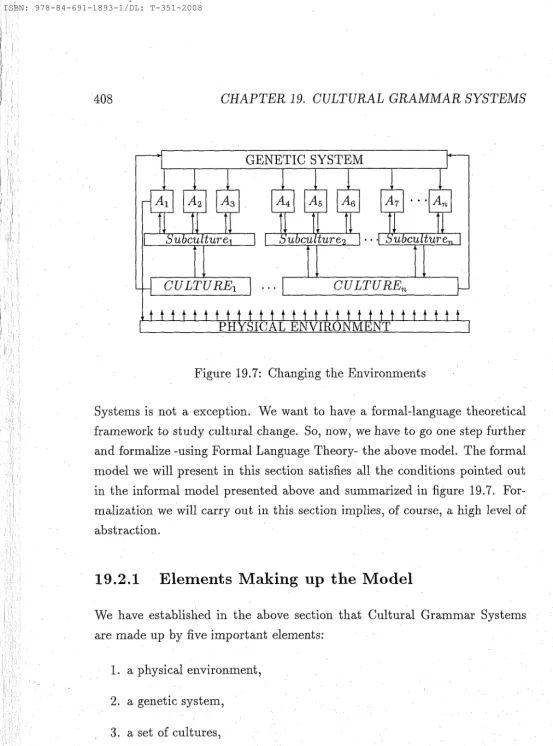
0.1 Overview of Parts 10 2.1 EcoGrammar System 55 6.1 Autolexical Syntax 122 6.2 The Tripartite Parallel Architecture 130 7.1 Linguistic Grammar System 162 13.1 Conversational Grammar Systems: Context 247 13.2 Conversational Grammar Systems: Speakers 257 13.3 Conversational Grammar System 260 13.4 Conversational Grammar Systems 327 19.1 Cultures and Genetic System: Separate Environments 388 19.2 Adding the Environment 389 19.3 Subcultures . 392 19.4 Cultural Influence on Biology 395 19.5 Genetic Influence on Culture 396 19.6 Influences on Agents 400 19.7 Changing the Environments . . . ' . 408 19.8 Cultural Grammar System 441 21.1 Future Relationships in Cultural Grammar Systems . . . . 469
577
UNIVERSITAT ROVIRA I VIRGILI
GRAMMAR SYSTEMS: A FORMAL-LANGUAGE-THEORETIC FRAMEWORK FOR LINGUISTICS AND CULTURAL EVOLUTION Maria Dolores Jiménez López
List of Figures
0.1 Overview of Parts 10 2.1 EcoGrammar System , 55 6.1 Autolexical Syntax 122 6.2 The Tripartite Parallel Architecture 130 7.1 Linguistic Grammar System . 162 13.1 Conversational Grammar Systems: Context 247 13.2 Conversational Grammar Systems: Speakers 257 13.3 Conversational Grammar System 260 13.4 Conversational Grammar Systems 327 19.1 Cultures and Genetic System: Separate Environments 388 19.2 Adding the Environment 389 19.3 Subcultures 392 19.4 Cultural Influence on Biology 395 19.5 Genetic Influence on Culture . 3 9 6 19.6 Influences on Agents 400 19.7 Changing the Environments . . . 408 19.8 Cultural Grammar System 441 21.1 Future Relationships in Cultural Grammar Systems . . . . 469
434
CHAPTER 19. CULTURAL GRAMMAR SYSTEMS
• evolution is represented by derivation steps performed by pure context
free rules in a OL fashion;
• each agent belongs to exactly one subcultural system and one cultural
system;
• relation of cultural system with its subcultural systems is the following:
the string representing state of cultural system contains as a subword
the concatenation of strings representing its subcultural system, where
subcultural states are concatenated in the order of growing indices.
Definition 19.3.1
By a Cultural Grammar System of degree n, where n > 1,
(CGsystem, for short) we mean an n + 2tuple
S = (E, G,
where
— VE is an alphabet,
— PE is a complete finite set of contextfree rules overVg,
G=(V
G,P
G],
— Va is an alphabet,
P
G= pi U P
G, where
(i) PG, is a complete finite set of pure contextfree rules over al
phabet VQ and,
UNIVERSITAT ROVIRA I VIRGILI
GRAMMAR SYSTEMS: A FORMAL-LANGUAGE-THEORETIC FRAMEWORK FOR LINGUISTICS AND CULTURAL EVOLUTION Maria Dolores Jiménez López
19.3. BRINGING TOGETHER PICTURE & DEFINITIONS
435
(ii) PQ, is a finite set of rules where each rule is of the form e*i,. ..,«„ :
where on € V¿., 1 < i < n, and A —> v is a pure contextfree rule over VG
where
KÍ r 5
Aijk = (Vijh) Pijk,
1 < i < n, 1 < j < r¿, 1 <
fe< 5,j,
where* Vijk is the alphabet of the agent,
* Pijk is a complete finite set of pure contextfree rules over al
phabet Vijk, ;
* Rfjf. is a finite set of pure contextfree rules over alphabet VE, * Ríjk zs a fin^e set of pure contextfree rules over alphabet Vc1,,
E". .
* R^jk is a finite set of pure contextfree rules over alphabet Va,,
*
* x x
436
CHAPTER 19. CULTURAL GRAMMAR SYSTEMS
• E represents the environment. VE is the alphabet of environmental string and P% is the set of evolution rules of E.
• G formalizes genetic system, VG is its alphabet, and PG is the set of evo lution rules. PQ contains basic evolution rules, while PQ describes how cultural systems can constrain genetic evolution. Since PQ is complete, cultural influence is a weak one.
• Cj represents ith cultural system with subcultural system K^,..., Ktr..
• KÍJ is jth subcultural system of cultural system d with agents AÍJI, . . . , AÍJS{J .
• Aijk is fcth agent of subcultural system KÍJ and cultural system (7»; Vijk is the alphabet of fcth agent; P^j, is the set of evolution rules of the agent; Rjjjk is a set of rules that describe actions which can be performed
by the agent on the environment; R^k is a set of rules that describe
action rules that can be used by the agent in order to modify current state of cultural system GÍ] RÍJ'¿ are action rules that agent can use to modify current state of subcultural system] tfyk determines, according to current states of environment and genetic system, which rules can be used at that moment in agent evolution] </>^fc determines, according agent current state, the set of action rules from which agent can choose one to apply on environmental state at that moment; $jk determines,
according to current states of agent, cultural system C¿, and subcultural system KÍJ , the set of action rules from which agent can select one to perform an action on cultural system C¿; «j^J? determines, according to current states of agent, cultural system Ci, and subcultural system KÍJ, the set of action rules from which agent can select one to perform an action on subcultural system KÍJ.
The above definition provides a static description of Cultural Grammar System. Its dynamics is done by changing its states.
UNIVERSITAT ROVIRA I VIRGILI
GRAMMAR SYSTEMS: A FORMAL-LANGUAGE-THEORETIC FRAMEWORK FOR LINGUISTICS AND CULTURAL EVOLUTION Maria Dolores Jiménez López
19.3. BRINGING TOGETHER PICTURE & DEFINITIONS
437Definition 19.3.2 Let S = (E, G, Cít..., Cn)} n > 1, le a Cultural Gram
mar System as in Definition 19.3.1.
By a state aofSwe mean a 5tuple of arrays
a = (Ms, Ma, M
A,M
K, M
c),
where
ME = (WE), where WE € V¿ is the current state of environment, MG = (WG)I where WQ G VQ is the current state of genetic system, • MA = (7»jfc), 1 < i < n, 1 < j < r¿, 1 < k < s{j, where 7^ 6 V*jk is
the current state of agent A¿^,
• MK = (A'¿)> 1 < i < n, 1 < j < r¿, where fy e V£. is the current state of subcultural system KJJ or the state of the (ij}—th subculture,
• MO — (a,), 1 < i < n, where a, 6 V£. is the current state of cultural system d or the state of the ith culture, and for every i, 1 < i < n, AlA'2 • • • A>¿ is a substring of ai.
Observe that the state of a cultural system contains as a subword the concatenation of states of its subcultural systems
In the following definition we define how Cultural Grammar System changes its states. Since subcultural systems determine the state of their cultural system, change of cultural system state follows change of state of its corre sponding subcultural systems.