Global instability in the elliptic restricted three body
problem
Thesis presented to obtain the Ph. D. in Applied Mathematics by
Universitat Polit`ecnica de Catalunya
Abraham De la Rosa Ibarra
Supervisors: Tere M. Seara and Amadeu Delshams
Contents
Introduction 3
1 Main results 5
1.1 Preliminars . . . 5
1.2 Changes of coordinates and setting of the problem . . . 6
1.2.1 McGehee coordinates . . . 7
1.3 Invariant manifolds . . . 8
1.3.1 The limit caseµ= 0 . . . 8
1.3.2 The caseµ6= 0 . . . 10
1.4 Melnikov potential for the parabolic orbits . . . 10
1.5 Global diffusion . . . 17
1.5.1 e0G0=λ≪1 . . . 17
1.5.2 Strategy for diffusion . . . 30
1.5.3 e0G0=λ,λreal positive . . . 31
2 Estimation of the Melnikov Potential 34 2.1 e0G0≪1 . . . 40
2.2 e0G0=λ,λreal positive . . . 53
Appendices 70 A Change to complex integral 71 B Proofs of Propositions 2.1, 2.3, 2.4, 2.21 W function 79 B.1 Proof of Proposition 2.1 . . . 79
B.2 Proof of proposition 2.3 . . . 81
B.3 Proof of propositions 2.4 and 2.21 . . . 82
B.4 FunctionW . . . 90
Acknowledgements
I would like to express my deep gratitude to Professors Tere M. Seara and Amadeu Delshams, my research supervisors, for their patient guidance, encouragement and support during all the process my Ph. D. needed, I am very grateful.
To every member of the examination panel I want to express my gratitude, Professors: Carles Sim`o, Marian Gidea, Regina Mart´ınez, Pau Martin, Marcel Gu`ardia, Imma Baldom`a and Ernest Fontich.
I would also like to thank all Professors that form the Dynamical Systems Group of the UPC and extend my thanks to Professors at UB, altogether, have contributed to my formation as well as other young researchers, that have become my friends. Thank you Marina for helping me when I needed.
My sincere gratitude to all the administrative staff of the Department of Applied Mathematics I, thank you Ester and Hilda. Also, at the faculty of Mathematics and Statistics, thank you Raquel and Carme, for your patience and help during all these years.
I am grateful with the UPC for the grant “FPI-UPC Recerca” that was given to me, it made possible for me to do the Ph. D.
Introduction
Celestial mechanics has been a continuous source of inspiration of the main problems arising in dynamical systems. Particularly, the phenomenon of chaos and the existence of homoclinic orbits appears for the first time in the memory of Poincar´e about the stability of the three body problem [Hen90], where the first exponentially small splitting of separatrices was computed.
In this memory we deal with the elliptic restricted three body problem (ERTBP) which appears in a natural way to study global instability, since it has two and a half degrees of freedom. The global instability, commonly known as diffusion, or better said, Arnold diffusion, from the pioneer work of Arnold in 1964 [Arn64], has been studied in the ERTBP in several settings, or more precisely, in several zones of the phase space. Capinsky & Zgliczynski have studied the instability in this problem, close to librations points in [CZ11] following previous work of Llibre & Sim´o [LS80b] and Llibre, Martinez & Sim´o [LMS85] for the existence of transversal homoclinic orbits in the classical circular restricted three body problem (CRTBP), as well as Bolotin close to collision [Bol06], Xia has studied micro-diffusion in the ERTBP [Xia93]. Recently, diffusion along mean motion resonances in the ERTBP model for Sun-Jupiter-asteroid systems has been proven by Fejoz, Guardia, Kaloshin & Rold´an in [FGKR14]
In the last years, there have bee several mechanisms used to prove diffusion, like variational and geometrical methods. This memory is based on the application of geometrical methods, which are based on the existence of a scattering map associated to a normally hyperbolic invariant manifold (NHIM) in the phase space [DdlLS08, DGdlLS08]. In such cases, both the inner dynamics inside the NHIM as well as the outer dynamics provided by the scattering map, are combined to design diffusing pseudo-trajectories, consisting on invariant tori plus their transversal heteroclinic connections, that is, transition chains in Arnold’s language.
In this memory we deal with the existence of diffusion orbits of the ERTBP whose angular momentum increases. Those orbits correspond to motions where the comet moves far from the primaries and comes back many times, increasing at each turn its angular momentum by a small amount.
The ERTBP is a Hamiltonian system of two and a half degrees of freedom. The so-called manifold of infinity can be seen, after a suitable change of variables provided by McGehee in [McG73], as a three dimensional invariant manifold in the extended phase space which behaves topologically as a NHIM, although it is of parabolic type. This means that the rate of approach and departure from it along its invariant manifolds is polynomial in time, instead of exponential-like as happens in a standard NHIM. On the other hand, the inner dynamics is very simple, since it is formed by a two-parameter family of 2π-periodic orbits in the 5D extended phase space which correspond to constant solutions in the 4D phase space. As a consequence, the stable and unstable manifold of the infinity manifold are union of the stable and unstable manifolds of its periodic orbits, and as long as these manifolds intersect along transversal heteroclinic orbits, the scattering map can be defined. Unfortunately, since the inner dynamics of the infinity manifold is so simple, the classical mechanisms of diffusion, consisting of combining the inner and outer dynamics, do not work here. Instead, as a novelty, we will be able to find two different scattering maps which will be combined in a suitable way to provide orbits whose angular momentum increases.
which was later corrected and carried out formally for the ERTBP in [MP94]. In both works, one can realize the massive amount of computations required.
In Chapter 2 of this memory, we provide a rigorous computation of the so-called Melnikov potential, with asymptotics and rigorous bounds for the errors for some range of the parameters
µ(mass parameter),e0 (eccentricity of the primaries) andG0 (angular momentum of the comet). More precisely, the results presented here, are valid forG0big enough,e0G0bounded andµsmall enough.
In Chapter 1, the problem is introduced, as well as the main geometrical objects which play a role in the diffusion mechanism. Particularly, the infinity manifold, its stable and unstable manifolds and the two independent scattering maps as well as the asymptotic formulas for them. The combination of both of them lead to theorem 1.15 fore0G0 =λsmall, and theorem 1.16 for
e0G0=λfinite, at the end of the chapter.
Chapter 1
Main results
1.1
Preliminars
As in the classical setting of the restricted three body problem, consider a particle with zero mass that moves in the plane generated by the dynamics of two point masses calledprimaries. It is a well known fact that the primaries move over an ellipse with a focus in the center of mass and with certain eccentricity that we will call e0. If we fix a coordinate reference system with the origin at the center of mass and call q1 and q2 the position of the primaries, then under the classical assumptions regarding time units, distance and masses normalization, the motion of the third particle whose position we will callqis given by
d2q
dt2 =
(1−µ)(q1(t, e0)−q)
|q1(t, e0)−q|3 +
µ(q2(t, e0)−q)
|q2(t, e0)−q|3 (1.1) where 1−µis the mass of the particle atq1 andµthe mass of the particle atq2. If we introduce the conjugate momentap=dq/dtand the self-potential function (see [MHO09, p. 28])
Uµ(q, t;e0) =
1−µ
|q−q1(t, e0)|+
µ
|q−q2(t, e0)| (1.2)
This equation can be rewritten as a Hamiltonian system with Hamiltonian
Hµ(q, p, t;e0) =
p2
2 −Uµ(q, t;e0). (1.3) This is a time-periodic Hamiltonian of two and a half degrees of freedom.
By the first Kepler law the distance between the primaries (see [Win41, p. 194-195]) is given by
r0(t) = 1−e 2 0 1 +e0cosf
(1.4)
wheref is the so calledtrue anomaly (see [Win41, p. 203], [MP94, p. 303]), which satisfies
df dt =
(1 +e0cosf)2 (1−e2
0)3/2
. (1.5)
or also by
r0(t) = 1−e0cosE (1.6) in terms of theeccentric anomaly E, given by the Kepler equation (see [Win41, p. 195])
1.2
Changes of coordinates and setting of the problem
Because of the nature of the problem we are dealing with, it will be better to perform a polar-simplectic change of variables, to the Hamiltonian (1.3) sayX =rcosα (1.8a)
Y =rsinα (1.8b)
whereq= (X, Y). Now, we look for conjugate momentaPrandPαso that the change
(X, Y, PX, PY) ϕ
−→ (r, α, Pr, Pα) (1.9)
is canonical. Following [Gol65], we get:
PX=Prcosα−
Pα
r sinα (1.10a)
PY =Prsinα−
Pα
r cosα. (1.10b)
In this way, the change of variables (1.10) is simplectic and the equations of motion in the new coordinates are the associated to the Hamiltonian
H∗
µ=Hµ(ϕ(Q), t;e0)
that we will write as
Hµ∗(r, α, Pr, Pα, t;e0) =P
2
r
2 +
P2
α
2r2 −Uµ∗(r, α, t;e0) (1.11)
andU∗
µ defined by
Uµ∗(r, α, t;e0) =Uµ(rcosα, rsinα, t;e0). (1.12)
In this notation, the primaries are
q2=q2(t, e0) =−rJ(t, e0)(cosf(t, e0),sinf(t, e0)) (1.13a)
q1=q1(t, e0) = rS(t, e0)(cosf(t, e0),sinf(t, e0)). (1.13b)
where
rJ(t, e0) = (1−µ)r0(t), rS(t, e0) =µr0(t)
and
|q−q2|2 =r2+ 2(1−µ)r0(t)rcos(α−f) + (1−µ)2[r0(t)]2,
|q−q1|2 =r2− 2µ[r0(t)]rcos(α−f) +µ2[r0(t)]2. From now on we will write
G=Pα, y =Pr.
and then Hamiltonian (1.11) reads
Hµ∗(r, α, y, G, t;e0) =
y2 2 +
G2
2r2 −Uµ∗(r, α, t;e0)
withU∗
1.2.1
McGehee coordinates
To study the behavior of orbits near infinity, we make to the Hamiltonian equations of Hamiltonian
H∗
µ(r, α, y, G, t;e0) the non-canonical change of variables:
r= 2
x2 (1.14)
to we get the so calledMcGehee coordinates (see [MP94] y [McG73]). Defining
Uµ(x, α, t;e0) =Uµ∗(2/x2, α, t;e0) (1.15)
the equations associated to (1.11) become: ˙
x=−14x3y y˙ =1 8G
2x6
−x
3 4
∂Uµ
∂x (1.16a)
˙
α= 1 4x
4G G˙ =∂Uµ
∂α (1.16b)
where
Uµ(x, α, t;e0) =
x2 2
1 −µ σ1 +
µ σ2
(1.17) and
σ2
1 = 1−z1x2cos(α−f) + 1 4z
2
1x4, z1=µr0(t),
σ2
2 = 1 +z2x2cos(α−f) + 1 4z
2
2x4, z2= (1−µ)r0(t),
It is important to notice that f is present in these equations, and then, becomes necessary to add the equation for f given in (1.5) in order to have the complete description of the dynamics. Equations (1.16) were obtained in [MP94].
Hamiltonian structure
Proposition 1.1(quasi-Hamiltonian structure). IfHµ is defined by
Hµ(x, α, y, G, t;e0) =
y2 2 +
x4G2
8 − Uµ(x, α, t;e0), (1.18) andU is given in (1.17), the equations (1.16) can be written as
˙
x=−x 3 4
∂Hµ
∂y
˙
y=−x 3 4
−∂∂xHµ
(1.19a)
˙
α= ∂Hµ
∂G G˙ =−
∂Hµ
∂α (1.19b)
Therefore, equations (1.19) are in fact Hamiltonian with symplectic (non-canonical) form as-sociated:
ω(z)(u,v) =uTJ−Tv (1.20) whereJ =JDwithD= diag(−x3/4,1,
−x3/4,1) andJ the symplectic matrix
J =
0 I2
−I2 0
.
As in the classical theory we can write equations (1.19) in terms of the Poisson bracket
{{f, g}}(z) =∇f(z)TJ ∇g(z) =−x
3 4
∂f ∂x
∂g ∂y−
∂f ∂y
∂g ∂x
!
+∂f
∂α ∂g ∂G−
∂f ∂G
∂G
1.3
Invariant manifolds
In order to analyze the structure of system (1.19), we will writeHµ given in (1.18) as
Hµ(x, α, y, G, t;e0) =H0(x, y, G) +µUµ∗(x, α, t;e0) (1.22)
or equivalently we writeUµ in (1.18) as
Uµ(x, α, t;e0) =U0(x) +µUµ∗(x, α, t;e0) =
x2 2 +µU
∗
µ(x, α, t;e0) (1.23)
and then study the dynamics as a perturbation of the limit caseµ= 0. From (1.23),
U∗
0(x, α, t;e0) = lim
µ→0 1
µ
Uµ(x, α, t;e0)−
x2 2
= x
2
4 +x4r2
0+ 4x2r0cos(α−f) 1/2 +
x2 2
2
r0cos(α−f)−
x2
2 (1.24)
1.3.1
The limit case
µ
= 0
In this case, the Hamiltonian given in (1.18) becomes
H0(x, α, y, G) =y 2 2 +
x4G2
8 − U0(x) =y
2 2 +
x4G2 8 −
x2
2 (1.25)
As the system is autonomousH0is a first integral. Moreover,H0 is independent ofe0 andα. The equations associated to Hamiltonian (1.25) are
˙
x=−1 4x
3y y˙= 1
8G 2x6
−14x4 (1.26a) ˙
α= 1 4x
4G G˙ = 0 (1.26b)
where it is clear thatGis a conserved quantity.
The level curves ofH0 are represented in Figure 1.1 forGfixed andH0=h.
x y
h= 0
h >0
[image:9.595.89.206.529.713.2]h <0
Figure 1.1: Level curves ofH0
First, the phase space is given by (x, α, y, G)∈R×T×R2.
From equations (1.26) it is clear that
E ={z= (x, α, y, G)∈R×T×R×R+; x= 0} (1.27)
is the set of equilibrium points of the system. Moreover, for any fixedα0∈T, G0∈R,
Λα0,G0={(0, α0,0, G0)}
is a parabolic critical point with stable and unstable 1-dimensional invariant manifolds:
γα0,G0 = W
u(Λ
α0,G0) =W
s(Λ α0,G0) =
z= (x, α0, y, G0), H0(x, y, G0) = 0, α=α0−G0
Z
H0=0
x ydx
In a natural way, we define the 2-dimensional manifold Λ∞=
[
α0,G0
Λα0,G0,
which is a “normally parabolic” invariant manifold with stable and unstable 3-dimensional invariant manifolds
γ=Wu(Λ∞) =Ws(Λ∞)
={z= (x, α, y, G), H0(x, y, G) = 0}.
As we will deal with a periodic in time Hamiltonian, let us work in the extended phase space ˜
z= (z, s) = (x, α, y, G, s)∈R×T×R2×T
just by adding the equation ˙s= 1 to the systems (1.19) and (1.26). Now we are going to write the extended version of the invariant sets we have defined so far. For anyα0∈T, G0∈R, the set
˜
Λα0,G0 ={z˜= (0, α0,0, G0, s0), s0∈T} (1.28) is a 2π-periodic orbit with motion determined by ˙s= 1.
The manifold ˜
γα0,G0 =W
u(˜Λ
α0,G0) =W
s(˜Λ α0,G0) =
z= (x, α0, y, G0, s0), s0∈T, H0(x, y, G0) = 0, α=α0−G0
Z
H0=0
x ydx
.
is a 2-dimensional homoclinic manifold to the periodic orbit ˜Λα0,G0. On the other hand we can construct the 3-dimensional invariant manifold
˜ Λ∞=
[
α0,G0 ˜
Λα0,G0 ={(0, α0,0, G0, s0),(α0, G0, s0)∈T×R×T}. (1.29)
As the motion for points in ˜Λ∞is given by the dynamics on each ˜Λα0,G0, taking ˜
x0= ˜x0(α0, G0, s0) = (0, α0,0, G0, s0)∈Λ˜∞≃R×T2
the inner dynamics on ˜Λ∞(see [DdlLS06]) is trivial: ˜
φt,0(˜x0) = (0, α0,0, G0, s0+t) = ˜x0(α0, G0, s0+t)∈Λ˜∞. (1.30)
The 4-dimensional stable and unstable manifolds of ˜Λ∞ coincide along the 4-dimensional ho-moclinic invariant manifold
˜
γ = Wu(˜Λ∞) =Ws(˜Λ∞)
= {(x, α, y, G, s),(α, G, s)∈T×R×T, H0(x, α, y, G) = 0} (1.31)
It is possible to parameterize ˜γα0,G0 by the solutions of the Hamiltonian flow contained in
H0= 0 in some timeτ satisfying (see [MP94] )
dt dτ =
2G x2.
So that, the homoclinic solution to the periodic orbit ˜Λα0,G0 of the system (1.26) can be written as
xh(t;G0) = ˜xh(τ;G0) (1.32a)
yh(t;G0) = ˜yh(τ;G0) (1.32c)
Gh(t;G0) =G0 (1.32d) whereα0 andG0are free parameters and the relation
t= G 3 0 2
τ+τ 3 3
(1.33) holds. The equations (1.32) are explicitly, inτ-time, given by
˜
xh(τ;G0) =
2
G0(1 +τ2)1/2, α˜h(τ) = 2 arctan(τ), y˜h(τ;G0) = 2τ
G0(1 +τ2). (1.34) With this in mind, we have that taking
˜
z0=˜z0(ν, α0, G0, s0) = (z0(ν, α0, G0), s0)
= (xh(ν;G0), αh(ν;α0, G0), yh(ν;G0), G0, s0)∈˜γ (1.35) we can write
˜
γα0,G0 ={˜z0= (xh(ν;G0), αh(ν;α0, G0), yh(ν;G0), G0, s0), ν∈R, s0∈T}. Finally ˜γ can be seen as a union of homoclinic orbits to ˜Λ∞(homoclinic manifold).
˜
γ= [
α0,G0 ˜
γα0,G0
and then we can parameterize the 4-dimensional homoclinic manifold as ˜
γ=W(˜Λ∞) ={(xh(ν;G0), αh(ν;α0, G0), yh(ν;G0), G0, s0), ν ∈R, G0∈R,(α0, s0)∈T2}. (1.36) and the motion in ˜γ is given by
˜
φt,0(˜z0) = (xh(ν+t;G0), αh(ν+t;α0, G0), yh(ν+t;G0), G0, s0+t)∈˜γ.
1.3.2
The case
µ
6
= 0
In the general case, we should note some things regarding the manifolds defined in section 1.3.1. First of all the setEremains invariant and, therefore, so does ˜Λ∞, being again a “normally parabolic invariant manifold”, and the periodic orbits ˜Λα0,G0 persist. The inner dynamics on ˜Λ∞, that is the flow restricted to it is also trivial
(α0, G0, s0)→(α0, G0, s0+t). (1.37)
1.4
Melnikov potential for the parabolic orbits
From [McG73] we know thatWs
µ(˜Λ∞) andWµu(˜Λ∞) exist forµsmall enough and are 4-dimensional
in the extended space. The classical geometric Melnikov method to find the first order approxima-tion to the distance between the perturbed manifolds will work in this case because both manifolds have co-dimension one, and then, a normal vector to ˜γwill intersectWu
µ(˜Λ∞) andWµs(˜Λ∞) forµ
small enough.
Let us take˜z0= (z0, s0) = (z0(ν, α0, G0), s0)∈γ˜as in (1.35). Now, we have to construct points inWs
µ(˜Λ∞) andWµu(˜Λ∞) to measure the distance between them. It is clear from the definition of
˜
γthat
is orthogonal to ˜γ=Wu(˜Λ∞) =Ws(˜Λ∞) and then if the normal bundle is defined by
N(˜z0) ={˜z0+σv, σ∈R} we have that there exist unique points˜zu,sµ = (zu,s
µ , s0) such that
{˜zu,sµ }=Wµu,s(˜Λ∞) ∩N(˜z0). (1.38)
The distance we want to compute is the signed magnitude given by
d(˜z0, µ) =H0(˜zµu)− H0(˜zsµ). (1.39) Define (see [DdlLS06])
L(α0, G0, t0;e0) =
Z ∞ −∞U
∗
0(xh(s;G0), αh(s;α0, G0), s+t0;e0)ds (1.40) which is a convergent integral because of formulas (1.32)-(1.34), and
U∗
0(x, α, s;e0) =O(x2) as x→ ∞
Proposition 1.2. Given (α0, G0, s0)∈T×R+×Tassume that the function
ν∈R−→ L(α0, G0, s0−ν;e0)∈R (1.41)
has a non-degenerate critical pointν∗ = ν∗(α
0, G0, s0;e0). Then for 0 < µ small enough, there exists a locally unique point
˜
z∗=˜z∗(ν∗, α0, G0, s0;µ)∈Wµs(˜Λ∞)⋔Wµu(˜Λ∞)
of the form
˜z∗=˜z∗0+O(µ) where ˜z∗
0 = (xh(ν∗;G0), αh(ν∗;α0, G0), yh(ν∗;G0), G0, s0) ∈ ˜γ. Also, there exist unique points ˜z±= (0, α±,0, G±, s0) = (0, α0,0, G0, s0) +O(µ)∈Λ˜∞ such that
φt,µ(˜z∗)−φt,µ(˜z±)→0 fort→ ±∞ (1.42)
Then, we have
G+−G−=µ
∂L ∂α0
(α0, G0, s0−ν∗(α0, G0, s0)) +O(µ2).
Proof. From equation (1.35) we know that any point˜z0∈γ˜ have the form ˜
z0=˜z0(ν, α0, G0, s0). As we have seen in (1.38)
˜
zµu,s= (˜zu,sµ , s0)∈Wµu,s(˜Λ∞)∩N(˜z0).
We are looking for˜z0 such that ˜zsµ=˜zuµ. From this, there must exist points˜z± = (˜z±, s0)∈Λ˜∞
such that
φt,µ(˜zs,uµ )−φt,µ(˜z±)−−−−→t
→±∞ 0, (1.43)
moreoverφt,µ(˜zs,uµ )−φt,0(˜z0) = O(µ) (see [McG73]). Since H0 does not depend on time, by the chain rule we have that
d
dtH0(φt,µ(˜z
s,u
SinceH0= 0 in ˜Λ∞, using (1.43) and the trivial dynamics on ˜Λ∞we obtain
H0(˜zs,uµ ) =−µ
Z ±∞
0 {{H
0,Uµ∗}}(φs,µ(˜zs,uµ ))ds.
Finally, using Taylor’s series inµ,
H0(˜zuµ)− H0(˜zsµ) =µ
Z ∞ −∞{{H
0,U0∗}}(φt,0(˜z0))dt+O(µ2)
=µ
Z ∞ −∞{{H
0,U0∗}}(xh(ν+t;G0), αh(ν+t;α0, G0), yh(ν+t;G0), G0, s0+t)dt+O(µ2) On the other hand, from (1.40),
L(α0, G0, t0;e0) =
Z ∞ −∞U
∗
0(xh(s−t0;G0), αh(s−t0;α0, G0), s;e0)ds and then
∂L
∂t0
(α0, G0, t0;e0) =−
Z ∞
−∞{{U ∗
0,H0}}(xh(s−t0;G0), αh(s−t0;α0, G0), yh(s−t0;G0), G0, s)ds =
Z ∞ −∞{{H
0,U0∗}}(xh(s−t0;G0), αh(s−t0;α0, G0), yh(s−t0;G0), G0, s)ds so that
∂L ∂t0
(α0, G0, s0−ν;e0) =
Z ∞ −∞{{H
0,U0∗}}(xh(s−s0+ν;G0), αh(s−s0+ν;α0, G0), yh(s−s0+ν;G0), G0, s)ds =
Z ∞ −∞{{H
0,U0∗}}(xh(t+ν;G0), αh(t+ν;α0, G0), yh(t+ν;G0), G0, s0+t)dt and therefore
d(˜z0, µ) =H0(˜zuµ)− H0(˜zsµ) =µ
∂L
∂t0(α0, G0, s0−ν;e0) +O(µ 2)
Now, it is clear by the implicit function theorem, forµsmall enough, that a non degenerate critical valueν∗of the function (1.41) gives rise to homoclinic points to ˜Λ
∞where the manifoldsWµs(˜Λ∞)
andWu
µ(˜Λ∞) intersect transversally that have the desired form˜z∗=˜z∗0+O(µ).
Consider now the solution of the system (1.19) represented by φt,µ(˜z∗). Moreover, by the
fundamental theorem of calculus and the definition (1.18) we have
G+−G− =−
Z ∞ −∞
∂Hµ
∂α (φt,µ(˜z
∗))dt=Z ∞ −∞
∂Uµ
∂α (φt,µ(˜z
∗))dt
=µ
Z ∞ −∞
∂U∗
0
∂α (φt,0(˜z
∗
0))dt+O(µ2) =µ
Z ∞ −∞
∂U∗
0
∂α (xh(ν
∗+t;G0), α
h(ν∗+t;α0, G0), yh(ν∗+t;G0), G0, s0+t)dt+O(µ2) =µ∂L
∂α(α0, G0, s0−ν
∗;e0) +O(µ2).
Once we have found a critical pointν∗ of (1.41) we define the reduced Poincar´e function (see
[DdlLS06])
L∗(α
The scattering map
The scattering mapS is defined from the manifold ˜Λ∞(defined in (1.29)) to itself. Take˜z−,˜z+∈ ˜
Λ∞, then
Sµ(˜z−) =˜z+
if there exist˜z∗∈Wu
µ(˜Λ∞)⋔Wµs(˜Λ∞) such that
φt,µ(˜z∗)−φt,µ(˜z±)→0 fort→ ±∞. (1.45)
In the caseµ= 0 we have that ˜γ=Wu(˜Λ
∞) =Ws(˜Λ∞) implies that the scattering mapS0is the identity. Indeed, for a generic point
˜
x0= (0, α0,0, G0, s0)∈Λ˜∞
we haveS0(˜x0) = ˜x0. To see this, take
˜z0= (xh(ν;G0), αh(ν;α0), yh(ν;G0), G0, s0)∈γ˜ then by equations (1.32), (1.33) and (1.34)
φt,0(˜z0)−φt,0(˜x0) =
(xh(t+ν;G0), αh(t+ν;α0), yh(t+ν;G0), G0, t+s0)−(0, α0,0, G0, t+s0)−−−−→
t→±∞ 0
wich proves thatS0=Id.
The next proposition gives an approximation of the scattering map in the general caseµ6= 0 Proposition 1.3. The scattering mapSµ associated to the non degenerate critical pointν∗of the
function defined in (1.41) is given by (0, α−,0, G−, s−)7−→0, α−+µ∂L∗
∂G(α−, G−;e0) +O(µ
2),0, G
−−µ
∂L∗
∂α (α−, G−;e0) +O(µ
2), s
−
whereL∗ is the Poincar´e reduced function introduced in (1.44).
Proof. By hypothesis we have a non degenerate critical point ν∗ of (1.41), by using definition
(1.44) the proposition 1.2 gives the correspondence we look for betweenG− andG+. Finally, the
equation
α+−α− =−µ
∂L∗
∂G(α0, G0, t
∗
0) +O(µ2)
is a direct consequence of the fact thatL∗ is symplectic, as shown in [DdlLS08].
Since we know that for all time,
φt,µ(˜z∗) =φt,0(˜z∗0) +O(µ),
denotingG(φt,µ(˜z∗)) andα(φt,µ(˜z∗)) theGandαcoordinate ofφt,µ(˜z∗) we have
G± = lim
t→±∞G(φt,µ(˜z ∗)) =G
0+O(µ)
α±= limt
→±∞α(φt,µ(˜z ∗)) =α
0+O(µ).
Using thatG−=G0+O(µ) andα− =α0+O(µ) we get the required formula which completes the proof.
Next proposition concerns the circular casee0= 0
Proposition 1.4. Ife0= 0 andν∗=ν∗(α0, G0, s0)∈Ris such that∂L/∂t0(α0, G0, s0−ν∗; 0) = 0 then
∂L
∂α0(α0, G0, s0−ν
∗; 0) = 0,
that is
∂L∗
Proof. From the equation (1.40) we have that 0 = ∂L
∂t0
(α0, G0, s0−ν∗;e0) =
Z ∞ −∞
∂U∗
0
∂t (xh(s;G0), αh(s;α0, G0), yh(s;G0), G0, s+s0−ν
∗;e0)ds. (1.46)
on the other hand, in the circular casee0 = 0, formulas (1.4) and (1.6) giver0= 1 and f =t in the self potential (1.17), so thatUµ only depends onαand t through the combinationα−t and
therefore
∂U∗
µ
∂α (x, α, t; 0) =− ∂U∗
µ
∂t (x, α, t; 0).
Then equation (1.46) reads
0 = ∂L
∂t0(α0, G0, s0−ν
∗; 0)
=−
Z ∞ −∞
∂U∗
0
∂α (xh(s;G0), αh(s;α0, G0), yh(s;G0), G0, s+s0−ν
∗; 0)ds
=−∂α∂L
0(α0, G0, s0−ν
∗;e0) (by equation (1.32b) and the chain rule).
By this proposition, if there exists a heteroclinc connection in the circular case, between two periodic orbits ˜Λα−,G− and ˜Λα+,G+ in ˜Λ∞introduced in (1.28),G+=G−+O(µ
2) by proposition 1.3. But indeedG+=G− in the circular case, since there exists the first integral provided by the
Jacobi constantCJ = Hµ+Gand as Hµ = 0 on ˜Λα−,G− and ˜Λα+,G+, G+ =G−. Therefore in the circular case there is no possibility to find diffusive orbits studying the intersection ofWs
µ(˜Λ∞)
andWu
µ(˜Λ∞) since by proposition 1.3 the angular momentum remains constant.
From the definition ofL given in (1.40) and equation (1.24) we get
L(α0, G0, t0;e0) =
Z ∞ −∞
"
x2
h
4 +x4
h[r0(t)]2+ 4xh2[r0(t)] cos(αh−f)
1/2
+x 2
h
2
2
[r0(t)] cos(αh−f)−x
2
h
2
#
dt (1.47)
wherexhandαhare coordinates of the homoclinic orbit defined in (1.32) whereasr0andf defined in (1.4) and (1.5) and are evaluated att+t0.
The computation of Melnikov potential (1.47) will be done in chapter 2. Such computation will be done in two different ways, corresponding to whether the parameterλ=e0G0 is small or not. The next two theorems correspond to these two cases.
Theorem 1.5. If G0 ≥ 32, e0G0 < 1/8, then there exists a positive constant K such that the
Melnikov potential Lgiven by (1.47)satisfies
L=L0(α0)−cos(t0−α0)
r
π
8G
−1/2 0 e−
G30 3
1 + ˜E1
−cos(t0−2α0)3
√
2πe0G30/2e−
G30 3
1 + ˜E2
+ 2ℜ{E˜3(α0)eit0
}+ ˜E4(t0, α0)
with
|E˜1| ≤K(G−01+e20)
|E˜3(α0)| ≤Ke−G 3 0
3 (1 +e0)4G−7/2 0 +e20G
5/2
0 +e0G−03/2
|E˜4(t0, α0)| ≤KG30/2e−G 3 0 4 9
for some positive constantK and
L0(α0)−L0,0= 15
8 πe0G
−5
0 cos(α0) + ˜F1+ ˜F2
where
|F˜1| ≤Se0G−09
|F˜2| ≤Se20G−05
for some positive constantS. And
L0,0= π 2G
−3
0 +F1+F4
with
|F1| ≤SG−07
|F4| ≤SG−03e20 Theorem 1.6. Letλ be a real positive constant andc≥1. If
G0≥max{(3c)2/3,32,8λ−1,3λ1/3, λ4},
then there exists a positive constant K, depending on λ, such that if e0G0 = λ, the Melnikov
potentialLgiven by (2.7)satisfy
L=L0(α0) + cos(t0−α0)
r
π
8G
−1/2 0 e−G
3
0/3(1 + ˜E1)
−e−G
3 0
3 4√2πλ−1G1/2 0 ℜ
(
e−λe−iα0 A 1−A
h 2A
±2ipA(A−1)J1(±2i
p
A(A−1))
−J0(±2ipA(A−1))i+A
eit0(1 +
R1(α0))
)
+R3(α0, G0, t0)
with
A=λ 2e
−iα0
A A−1 =
λ2
−2λe−iα0
λ2−4λcosα 0+ 4
A(A−1) =−λ2e−iα0
1−λ2e−iα0
.
and
|E˜1| ≤K(G0−1+λ2G−02)
|R1(α0)| ≤KG−01
|R3(α0, G0, t0)| ≤KG30/2e−
G3 0 4 9,
L0(α0)−L0,0=−15 8 πe0G
−5
0 cos(α0) + ˜F1+ ˜F2
with
|F˜2| ≤Ke20G−05,
and
L0,0= π 2G
−3
0 +F1+F4
with
|F1| ≤KG−07
|F4| ≤KG−03e20
The functionsJ0(z)andJ1(z)are the Bessel’s functions of the first kind [AS65] and whose expan-sion aroundz= 0is given by
Jn(z) =
∞
X
m=0
(−1)m
m!Γ(m+n+ 1)
z
2
2m+n
Corollary 1.7. If λ=e0G0 is small, theorem 1.6 recovers the asymptotic expression found for the Melnikov potentialLin theorem 1.5.
Proof. The first two terms in the expression forLin both theorems 1.5 and 1.6, coincides. From the definition ofAwe have that A=O(λ) and alsoA(A−1) =O(λ), therefore looking for asymptotics forλsmall is equivalent to look for asymptotics forAsmall. Using the asymptotics for the Bessel’s functionsJ0and J1, given in theorem 1.6 we have
eλe−iα0 = e−2A= 1−2A+O(A2)
J1(±2ipA(A−1)) =±ipA(A−1) +O([A(A−1)]3/2)
J0(±2ipA(A−1)) = 1 +A2−A+O([A(A−1)]2)
A
1−A =A+O(A
2)
therefore, we can write the third term as follows and get the asymptotic forλsmall
−e−G 3 0
3 4√2πλ−1G1/2 0 ℜ
(
e−λe−iα0 A 1−A
h 2A
±2ipA(A−1)J1(±2i
p
A(A−1))
−J0(±2ipA(A−1))i+A
eit0(1 +
R1(α0))
)
=−e−G 3 0
3 4√2πλ−1G1/2 0 ℜ
(
e−2A A 1−A
2A
±2ipA(A−1)J1(±2i
p
A(A−1))
−J0(±2ipA(A−1)) + (1−A)e2A
eit0(1 +
R1(α0))
)
=−e−G 3 0
3 4√2πλ−1G1/2 0 ℜ
(
e−2A A 1−A
A+O(A2)−1−A2+A+O(A2)
+ (1−A)e2A
eit0(1 +
R1(α0))
)
= (∗)
since
(1−A)e2A= 1−A+ (1−A)2A+ (1−A)O(A2) = 1−A+ 2A−2A2+O(A2) = 1 +A+O(A2) we have
(∗) =−e−G 3 0
3 4√2πλ−1G1/2 0 ℜ
(
e−2A A 1−A
3A+O(A2)
eit0(1 +
R1(α0))
also, it is clear from the given asymptotics that e−2A A
1−A =A+O(A
2) and then
(∗) =−e−G 3 0
3 4√2πλ−1G1/2 0 ℜ
(
3A2+O(A3)
eit0(1 +
R1(α0))
)
and, from its definitionA2= (λ2/4)e−2iα0 we have (∗) =−e−G
3 0
3 4√2πλ−1G1/2 0 ℜ
(
3 4λ
2ei(t0−2α0)+O(A3)
(1 +R1(α0))
)
=−e−G 3 0
3 4√2πλ−1G1/2 0 ℜ
(
3 4λ
2ei(t0−2α0)+O(λ2)(λ+
R1(α0))
)
=−e−G 3 0 3 3√2πe
0G30/2cos(t0−2α0)
h
1 +ℜnO(λ)(G01/2λ+R1(α0))
oi
=−e−G
3 0 3 3√2πe
0G30/2cos(t0−2α0)
h
1 +Oe0G30/2(e0G0+G−03/2)
i
which is exactly the second term in the expression for the Melnikov potentialLgiven in theorem 1.5.
1.5
Global diffusion
1.5.1
e0G0
=
λ
≪
1
To prove diffusion in the case λ0 =e0G0 ≪ 1 we will use propositions 1.2 and 1.3 to construct a suitable scattering map using the computation of the Melnikov potential given in theorem 1.5. From this theorem, we will introduce the next notation. The Melnikov potential is given by
L(α0, G0, t0;e0) =L0,0+L0(α0, G0;e0) +L1(α0, G0, t0;e0) +E(α0, G0, t0;e0) (1.48) whereL0,0is given in theorem 1.5 as
L0,0=
π
2G
−3
0 +F1 (1.49)
with
F1=F1(G0;e0) =O(e20G−03+G−07) (1.50) and,
L0(α0, G0;e0) =− 15
8 πe0G
−5
0 cos(α0) +F(α0, G0;e0) (1.51)
L1(α0, G0, t0;e0) = cos(t0−α0)
r
π
8G
−1/2 0 e−
G30 3
1 + ˜E1
−cos(t0−2α0)3
√
2πe0G30/2e−
G30 3
1 + ˜E2
+2ℜ{E˜3(α0)eit0
}
(1.52) ˜
E1, ˜E2 and ˜E3 are bounded in theorem 1.5 and
E(α0, G0, t0;e0) =O(G30/2e−G 3 0 4
9) (1.53)
Lemma 1.8. LetL1be defined in (1.52) andp= 12e0G20= 12λG0. IfP2= 1−2pcosα0+p26= 0, then
L1(α0, G0, t0;e0) =
r
π
8G
−1/2 0 e−
G30
3 B cos(t
0−α0−θ) whereθ=θ(α0, G0;e0)∈(−π, π] andB =B(α0, G0;e0) satisfy
B2=P2+ ˜B
tanθ= psinα0+ℑ( ˜B1) 1−pcosα0
1 +O ℜ( ˜B1)
1−pcosα0
with
|B˜| ≤K[G−01+e0G0(1 +p+p2)]
|B˜1| ≤K[G0−1+e0G0(1 +p)]
Proof. From the definition ofL1 given in (1.52) we can write, definingp= 12e0G20
L1=
r
π
8G
−1/2 0 e−
G3 0 3
h
cos(t0−α0)(1 + ˜E1)−pcos(t0−2α0)(1 + ˜E2) +ℜ{Eb3(α0)eit0}
i
where
b
E3(α0) =
r
8
πG
1/2 0 e
G30
3 2 ˜E3(α0) and then, by the bounds in theorem 1.5 we have
|Eb3(α0)| ≤K(1 +e0)4G0−3+e20G30+e0G−01
,
so
L1=
r
π
8G
−1/2 0 e−
G30 3
h
ℜ ei(t0−α0)(1 + ˜E1)
−pℜ ei(t0−2α0)(1 + ˜E2) +
ℜ{Eb3(α0)eit0
}i
=
r
π
8G
−1/2 0 e−
G3 0 3 ℜ
ei(t0−α0) 1 + ˜E
1−p(1 + ˜E2)e−iα0+Eb3(α0)eiα0
if we write now
1 + ˜E1−p(1 + ˜E2)e−iα0+Eb3(α0)eiα0 =Be−iθ (1.55) we have that
L1=
r
π
8G
−1/2 0 e−
G30 3 Bℜ
ei(t0−α0−θ) =
r
π
8G
−1/2 0 e−
G30 3 Bcos(t
0−α0−θ). Let us findB andθ. From equation (1.55), we have
Be−iθ= 1−pe−iα0+ ˜B
1 (1.56)
where
˜
B1= ˜E1−pE˜2e−iα0+Eb3(α0)eiα0
|B˜1| ≤K[G0−1+e0G0(1 +p)]. Therefore
B2=|1−pe−iα0
|2+ ˜B where ˜B= (1−pe−iα0) ˜B
B2= 1
−p(e−iα0+ eiα0) +p2+ ˜B = 1−2pcosα0+p2+ ˜B
=P2+ ˜B (1.57)
assuming that 1−pcosα06= 0 we can see that ˜B1/(1−pcosα0) is always small and therefore from (1.56)
tanθ= psinα0+ℑ( ˜B1) 1−pcosα0+ℜ( ˜B1) = psinα0+ℑ( ˜B1)
1−pcosα0
1 +O ℜ( ˜B1)
1−pcosα0
Remark 1.9. Under the assumptions of lemma 1.8, ifp= 1 and cosα0 =−1 the angleθ is not well defined, but this case corresponds toB= 0.
By proposition 1.2 we need to find critical points of the function t0 7−→ L(α0, G0, t0;e0), to this end we will check thatt0 7−→ L(α0, G0, t0;e0) is acosine-like function, that is, with a non-degenerate maximum (minimum) and no other critical points. By equation (1.48) and the bound (1.53), forG0big enough, the critical points in the variablet0are well approximated by the critical points of the functionLand therefore will be close tot0−α0−θ= 0, π(mod2π) thanks to lemma 1.8. For this purpose, we introduce
L∗1=L∗1(α0, G0;e0) =
r
π
8G
−1/2 0 e−
G3 0
3 B (1.58)
whereB =B(α0, G0;e0) is given in lemma 1.8. With this notation the functionL1 of lemma 1.8 can be written as
L1(α0, G0, t0;e0) =L∗1(α0, G0;e0) cos(t0−α0−θ). (1.59) First a technical lemma.
Lemma 1.10. LetEbe the error function defined by (1.48) andL∗
1be defined in (1.58). IfG0≫1,
e0G0≪1 and
16K(G−01+e0G0)< κ2<
1−π 2 16
2
for|p−1| ≥1 orα0∈[κ,2π−κ]. Then
h∂E
∂t0
2 +∂
2
E
∂t2 0
2i
/(L∗1)2< 2K
κ2 G 4 0e−G
3 0 2 9
Proof. Since the Melnikov potential L defined in (1.47) and rewritten in (1.48) is 2π-periodic in
t0we have that except for a constant∂E/∂t0 and∂2E/∂t20have similar bounds to the bound ofE, given indirectly in (1.53), therefore for some positive constantK
h∂E
∂t0
2 +∂
2
E
∂t2 0
2i
/(L∗1)2< K
G3 0e−G
3 0 8 9
G−01B2e−G3 0 2 3
= K
B2G 4 0e−G
3 0 2 9
it remains to show that 1/B2can be bounded by 2/κ2. From the expression forB2 given in (1.57) and the triangle inequality we have
Letκ∈(0,1) andω = 1−κ,σ=κ+ 1. We have three different cases; if p≥σ >1, p≤ω <1 andω < p < σ. We know from lemma 1.8 that
|B˜| ≤K[G−01+e0G0(1 +p+p2)] (1.61) then, whenp≥σ= 1 +κ >1 we have that
p p−1 ≤
1 +κ κ
and then, from (1.61) that
|B˜| ≤4Ke0G0p2≤Ke0G0
(p−1)2 2 2
1 +κ
κ
2
if we now choose
κ2≥16Ke0G0 (1.62)
we have
|B˜| ≤ (p−1)
2 2 and then from (1.60)
B2≥ (p−1)
2 2 or equivalently
1
B2 ≤ 2 (p−1)2 ≤
2
κ2. Whenp≤ω= 1−κ <1, from (1.61) that
|B˜| ≤3K[G−01+e0G0] if we now choose
κ2≥6K(G−01+e0G0) (1.63) we have
|B˜| ≤ κ
2 2 and then from (1.60)
B2
≥(p−1)2
−κ
2 2 ≥
κ2 2 or equivalently
1
B2 ≤ 2
κ2. When 1−κ=ω < p < σ= 1 +κ, from (1.61) we have
|B˜| ≤7K[G0−1+e0G0]. (1.64) The functionP2 in (1.57) can be written as
P2(p) = (p−cosα0)2+ (1−cos2α0)≥0 or more conveniently as
P2= (p
−1)2+ 2p(1
−cosα0)≥2p(1−cosα0)≥2(1−κ)(1−cosα0).
Restrictingα0 to the interval [κ,2π−κ] so that
if we choose
16K(G−01+e0G0)< κ2<
1−π 2 16
2
(1.65) we have from (1.60) and (1.64) that
B2≥2π 2 16
8
π2κ 2
−κ
2 2 =
κ2 2 or equivalently
1
B2 ≤ 2
κ2.
Summarizing, for any κ verifying condition (1.65) one has that 1/B2
≤ 2/κ2 if
|p−1| ≥ 1 or
α0∈[κ,2π−κ].
Proposition 1.11. Let L be the Melnikov potential given in (1.48) and G0, e0, α0 and κas in lemma 1.10. Thent07−→ L(α0, G0, t0;e0) is acosine-like function, and its the critical point are given by
t∗
0,±=t∗0,±(α0, G0;e0) =ϕ∗±+α0+θ and
ϕ∗± =O(G20e−G 3 0/9)
Proof. We look for critical points oft07−→ L(α0, G0, t0;e0)
∂L ∂t0
= ∂L1
∂t0 + ∂E
∂t0
= 0 (1.66)
or equivalently, using the formula given in equation (1.102),
sin(ϕ) =f(ϕ) := 1
L∗
1
∂E ∂t0
(ϕ=t0−α0−θ). (1.67)
By lemma (1.10), forG0 large enough, we have that|f| ≪1 and thenϕ=±π/2 are not solutions of sinϕ=f(ϕ). So, on (−π/2,3π/2) we have
ϕ= arcsinf(ϕ) ϕ∈(−π/2, π/2)
ϕ=π−arcsinf(ϕ) ϕ∈(π/2,3π/2) Since|f|<1,g(ϕ) = arcsinf(ϕ) maps [−π/2, π/2] into itself and
g′(ϕ) =p f′(ϕ)
1−f(ϕ)2
thereforeg′2<1 is equivalent tof2+f′2<1 which is a direct consequence of lemma 1.10. So, g is a contraction and then there exists a uniqueϕ∗
−∈(−π/2, π/2) solution ofϕ=g(ϕ). To prove
that it is non degenerate we need to see that
∂L2
∂t2 0
= ∂ 2L
1
∂t2 0
+∂ 2E
∂t2 0 6
= 0.
To see this we will see that
∂2
E
∂t2 0
2
<∂
2
L1
∂t2 0
2 = (L∗
1)2cos2ϕ (1.68) but from (1.67)
cos2ϕ= 1− 1 (L∗
1)2
∂E
∂t0
equation (1.68) is equivalent to
∂E
∂t0
2 +∂
2E
∂t2 0
2
<(L∗
1)2, which is true. By the same lemma 1.10,
|ϕ∗−|=|arcsinf(ϕ∗−)|=OG
2 0
κ e
−G3 0/9
, (1.69)
and consequentlyt∗0,−=ϕ∗−+α0+θ is a non degenerate solution of (1.66). Analogously we can solve
ϕ=π−arcsinf(ϕ) = ˜g(ϕ)
showing that ˜g sends (π/2,3π/2) to itself and is a contraction proving the existence of a non degenerate fix pointϕ∗
+∈(π/2,3π/2). Moreover
|ϕ∗+−π|=|arcsin ˜g(ϕ∗+)|=O
G2 0
κ e
−G3 0/9
. (1.70)
Consequentlyt∗
0,+=ϕ∗++α0+θis another non degenerate solution of (1.66). This concludes the proof.
From proposition 1.11 we know that there existt∗
0,− andt∗0,+, non degenerate critical points of
t07−→ L(α0, G0, t0;e0). Therefore, we can define two different reduced Poincar´e functions (1.44)
L∗
±(α0, G0;e0) =L(α0, G0, t∗0,±;e0)
=L0,0(G0;e0) +L0(α0, G0;e0) +L1∗(α0, G0;e0) cos(t∗0,±−α0−θ)
+E(α0, G0, t∗0,±;e0).
By Taylor’s theorem
cos(t∗0,−−α0−θ) = cos(0) +O(|ϕ∗−|2) = 1 +O(G40e−G 3 0 2 9) cos(t∗0,+−α0−θ) = cos(π) +O(|ϕ∗+−π|2) =−1 +O(G40e−G
3 0 2 9)
so that
L∗
±(α0, G0;e0) =L0,0(G0;e0) +L0(α0, G0;e0)± L∗1(α0, G0;e0) cos(t0∗,±−α0−θ) +E± (1.71)
where
E± =±L∗1O(G40e−G 3 0 2
9) +E, (1.72)
and by the bound ofE given in (1.53), the definition ofL∗
1and the definition ofB given in lemma 1.8 we have that
|E±| ≤KG30/2e−4G3 0/9
1 + e−G3 0/9G2
0(1 +p)2
≤KG70/2e−5G3
0/9(1 +p)2 the last inequality holds forG0large enough, but in any case is exponentially smaller.
L0,0,L0 andE are given in (1.49), (1.51) and (1.53). Writing downL0,0andL0we have
L∗±=
π
2G
−3
0 +F1(G0, e0)−15 8 πe0G
−5
0 cosα0+F(α0, G0;e0)± L∗1+E± (1.73)
From the expression for the scattering map given in proposition 1.3 we can define two different scattering maps, given by
S±(α0, G0, s0) =
α0+µ
∂L∗ ±
∂G(α0, G0;e0) +O(µ
2), G 0−µ
∂L∗ ±
∂α (α0, G0;e0) +O(µ
2), s 0
These two scattering maps are different since they depend on the two reduced Poincar´e-Melnikov potentialsL∗
±. As it was proved in [DdlLS08] the scattering mapsS±follow closely the level curves
of the HamiltoniansL∗
±. More precisely, up to O(µ2) terms, it is given by the time −µ map of
the Hamiltonian flow of Hamiltonians L∗
±. Because of this, we want to show that the foliations
of L∗
± = constant are different, since this will imply that the scattering maps S± are different.
Even more, we will design a mechanism in which we will determine the places in the planeα0G0 where we will change from one scattering map to the other, obtaining trajectories with increasing angular momentumG.
In lemma 1.13 we will give the elements to construct a strategy to find a heteroclinc chain of periodic orbits in ˜Λ∞ with increasing angular momentum, but first a technical lemma.
Lemma 1.12. LetL∗
± be defined by (1.71),B by lemma 1.8 andp= 12e0G20. IfG0, e0, α0 and
κare as in lemma 1.10. Then we have
{L∗+,L∗−}= −L ∗
1
B2
3πpsinα0
G4 0
"
1−25 4
e0G0
G3 0
cosα0− 5 48
P2
G0
h
1 + 1 2G3
0−
−cosα0+p
P2 ·
24e0G0
G2 0
i#
+EJ
where
EJ=O
G0−5+e0G0−3+e20G30+pe20G40 1 +p(e0G0+G−06)
G−01/2e−G 3 0/3 +O G0(1 +p)e−G30/9+G−1
0
G10/2e−G 3 0 4 9
Proof. Using expression (1.71) and using the properties of the Poisson brackets we have that
{L∗
+,L∗−}= 2{L∗1, L0,0+L0}+ 2{E, L0,0+L0}. (1.75) WhereL∗
1 is given in (1.58), L0,0 in (1.49) and L0 in (1.51). From the definition of the Poisson bracket
{L∗
1, L0,0+L0}=
∂L∗
1
∂α0
∂ ∂G0
(L0,0+L0)−
∂L∗
1
∂G0
∂ ∂α0
(L0,0+L0) (1.76) to compute the partial derivatives in the above formula we will need to compute the partial derivatives with respect toα0 andG0ofB given in lemma 1.8 as
B2=P2+ ˜B= 1−2pcosα0+p2+ ˜B wherep= 12e0G20 and ˜B =O(G−01+e0G0(1 +p+p2)), then
∂B ∂G0
= 1 2
1
p
P2+ ˜B
∂P2
∂G0 + ∂B˜
∂G0
(1.77a)
∂B ∂α0 =
1 2
1
p
P2+ ˜B
∂P2
∂α0 +
∂B˜ ∂α0
(1.77b)
Also,
∂P2
∂G0
=−2 cosα0 ∂p
∂G0
+ 2p ∂p ∂G0 = (−2 cosα0+ 2p)
2p G0
(1.78a)
∂P2
∂α0
= 2psinα0, (1.78b)
substituting equations (1.78) in equations (1.77) we can write
∂L∗
1
∂α0 =
r
π
8G
−1/2 0 e−
G3 0/3∂B
=
r
π
8G
−1/2 0 e−G
3 0/3
2psinα0+ ∂ ˜
B ∂α0 2pP2+ ˜B = L∗1
P2+ ˜B
psinα0+ 1 2
∂B˜ ∂α0
(1.79)
∂L∗
1 ∂G0 = r π 8G
−1/2 0 e−G
3 0/3
h −2G1
0 +G20
B+ 1 2B
(−2 cosα0+ 2p) 2p G0
+ ∂B˜
∂G0
i
=L∗1
h −2G1
0 +G20
+ 1
P2+ ˜B
(−cosα0+p) 2p G0
+1 2
∂B˜ ∂G0
i
= L∗1
P2+ ˜B
h
(−cosα0+p) 2p G0 −
1
2G0 +G2
0
P2
−2G1
0 +G2
0
˜
B+1 2
∂B˜ ∂G0
i
(1.80) and
∂
∂α0(L0,0+L0) = 15
8πe0G
−5
0 sinα0+ ∂F
∂α0 (1.81)
∂ ∂G0
(L0,0+L0) =− 3 2 π G4 0 +75 8 π G6 0
e0cosα0+
∂ ∂G0
(F1+F) (1.82) substituting equations (1.79), (1.80), (1.81) and (1.82), in the expression for the Poisson bracket given in (1.76) we obtain
2{L∗1, L0,0+L0}= L
∗
1
P2+ ˜B(psinα0)
−G3π4
0 +75 4 π G6 0
e0cosα0
+Q1
−154 πe0G−05sinα0
L∗
1
P2+ ˜B
h
(−cosα0+p)2p
G0 −
1
2G0 +G 2 0
P2i+Q2 (1.83) where
Q1= L
∗
1
P2+ ˜B
h
−32Gπ4 0 − 75 8 π G6 0
e0cosα0
∂B˜
∂α0 + 2 ∂
∂G0
(F1+F)
psinα0+ 1 2
∂B˜ ∂α0
i
(1.84)
Q2= L
∗
1
P2+ ˜B
"
15 4 πe0G
−5 0 sinα0
h 1
2G0 +G2
0
˜
B−1
2
∂B˜ ∂G0
i −2∂F
∂α0
·h(−cosα0+p) 2p G0 −
1
2G0 +G20
P2− 1
2G0 +G20
˜
B+1 2
∂B˜ ∂G0
i#
(1.85)
factorizing we have from (1.83)
2{L∗1, L0,0+L0}= −L
∗
1
P2+ ˜B
3πpsinα0
G4 0
"
1−25 4
1
G2 0
e0cosα0
+ 5 48 1 G3 0 h
(−cosα0+p)2p
G0 −
1
2G0 +G20
P2i
#
+Q1+Q2
= −L
∗
1
P2+ ˜B
3πpsinα0
G4 0
"
1−254 e0GG30 0
cosα0− 5 48
P2 G0
·h1 + 1 2G3
0 −
−cosα0+p
P2 ·
24e0G0
G2 0
i#
+Q1+Q2 (1.86) (1.87) To find the size ofQ1 andQ2 we have to bound
L∗
1
P2+ ˜B =
r
π
8 1
BG
−1/2 0 e−G
so, we have to bound 1/B by a positive constant, or equivalently 1/B2, which has been done in the proof of lemma 1.10. Therefore
L∗
1
P2+ ˜B =O
1
κG
−1/2 0 e−G
3 0/3
,
then using the bounds forF1andFgiven in (1.50) and (1.54) and the bound for ˜Bgiven in lemma 1.8 we have from equations (1.84) and (1.85) that
Q1=O
(G−05+e0G−03+e02G30+pe20G40(1 +pe0G0))
1
κG
−1/2 0 e−G
3 0/3
Q2=O
(e0G−04+e20G− 2
0 (1 +p+p2))
1
κG
−1/2 0 e−G
3 0/3
and then
Q1+Q2=O
G0−5+e0G0−3+e20G30+pe20G40 1 +p(e0G0+G−06)
1
κG
−1/2 0 e−G
3
0/3. (1.88) Now we want to know the size of{E, L0,0+L0}. From the computations for the partial derivatives ofL0,0+L0given in equations (1.81) and (1.82) and the size of the errorsF1andFgiven in (1.50) and (1.54) we have
∂ ∂α0
(L0,0+L0) =O(e0G−05)
∂
∂G0(L0,0+L0) =O(G
−4 0 ).
The size ofEis computed in the proof of part (b) of lemma 1.13, and is given in equation (1.95), and therefore
∂E ∂α0 =O
G10/2e−G 3 0 4 9 G3
0(1 +p)e−G 3 0/9+G
0
∂E ∂G0
=OG10/2e−G 3 0 4 9 G5
0(1 +p)e−G 3 0/9+G3
0
with this sizes we can conclude that
{E, L0,0+L0}=O
G10/2e−G30 4
9 G0(1 +p)e−G 3
0/9+G−1 0
substituting (1.86) in (1.75) and settingEJ= 2{E, L0,0+L0}+Q1+Q2we get the desired result.
Lemma 1.13. LetL∗
± be defined in (1.73), andp= 12e0G20. Then (a) Any curve L∗
±(α0, G0;e0) = l is a closed curve of the form G = g±(α0, l), α0 ∈ [0,2π],
g±(0, l) = g±(2π, l) which is cosine-like: it has a unique non-degenerate maximum for α0 close toπand a non-degenerate minimum forα0close to 0.
(b) Thetotal variation of L∗
±(·, G0;e0) (i. e. the difference between its maximum value and
its minimum value) is given by ∆L∗
± = ∆L0±∆L∗1±∆E where
∆L0= 215πe0 8G5
0 + ∆F
∆L∗1=
r
π
8G
−1/2 0 e−G
3 0/3
hq
(p+ 1)2+ ˜B 0−
q
(p−1)2+ ˜B
π
∆E=OG10/2e−G 3 0 4 9 G3
0(1 +p)e−G 3 0/9+G
0 and
∆F =O(e20G0−5, e0G−09) ˜
Bπ,B˜0=O(G0−1+e0G0(1 +p+p2)) (c) L∗
+ and L∗− are functionally independent except for three curves, two of them close to the
straight lines α0 = 0 and α0 =π and a third one cosine-like wheneverG0 =O(e−02/3) and close to the curve
p=
r
D(1−cosα0) +3 4D
2−1 (1.89)
whereD= 2p48G0/5.
Proof. (a) From the expression forL∗
±given in (1.73) we have thatl=L∗±(α0, G0;e0) is equivalent to
l= π 2G3
0
1 + ˜F1−
15e0cosα0 4G2
0
+ ˜F(α0, G0;e0)±
r
1 2πG
5/2 0 e−G
3
0/3B+ ˜E
±(α0, G0, t0;e0)
(1.90)
where
˜
F1= 2G3
0
π F1=O(e
2
0+G−04) ˜
F(α0, G0;e0) = 2G 3 0
π F=O(e
2
0G−02+e0G−06) ˜
E±(α0, G0, t0;e0) = 2G3
0
π
L∗1O(G40e−G 3 0 2 9) +E
= 2G 3 0
π
L∗1O(G40e−G 3 0 2
9) +O(G3/2 0 e−G
3 0 4 9)
andF1, F and E are given in (1.50), (1.54) and (1.53), respectively. The actual size of ˜E± will
depend on the bound ofB which in its turn depends onp. From lemma 1.8 it is not difficult to see that
|B| ≤
(
K ifp≤1
Kp ifp >1 and by (1.58), and using thatp= 12e0G20,
|L∗
1| ≤
(
KG−01/2e−G 3
0/3 ifp≤1
Ke0G30/2e−G 3
0/3 ifp >1 (1.91) with this we conclude that
˜
E=
(
O(G130 /2e−G 3 0 5
9) +O(G9/2 0 e−G
3 0 4
9) ifp≤1
O(e0G170 /2e−G 3 0 5
9) +O(G9/2 0 e−G
3 0 4
9) if p >1 We can rewrite (1.90) as
G0=
π
2l
1/3
ζ−15e0cosα0
4G2 0
+ ˜F(α0, G0;e0)±
r
1 2πG
5/2 0 e−G
3
0/3B+ ˜E
±(α0, G0, t0;e0)
1/3
=g(α0, l) (1.92)
whereζ= 1 + ˜F1=O(1). This expression, implies
l= ζπ 2G3
0
1 +O(e0
G2 0
or equivalently
G0=
ζπ
2l
1/3
1 +O(e0
G2 0
)1/3=ζπ 2l
1/3
1 +O(e0
G2 0
)=ζπ 2l
1/3
1 +O(e0l2/3)
using this expression we can actually know a good estimation of the curveG0=g(α0, l) substituting it in (1.92) Now, when ˜E = 0, g is clearly a cosine-like with a non-degenerate maximum close to
α0 = 0 and a non-degenerate minimum close to α0 =π since its second term is larger than the third and fourth terms. When we also take into a account the fifth term, in the expression of g
involving ˜E, since this term is much smaller than the other ones, an argument very similar to the one used in the proof of proposition 1.11 implies thatg is cosine-like with non-degenerate critical points close to 0 andπ.
(b) From expression (1.73), we are going to analyze every term inα0. The term
L0,0=
π
2G
−3 0 +F1
gets canceled since its constant with respect toα0. From its definition given in (1.51) we have
L0=−15 8 πe0G
−5
0 cosα0+F(α0, G0;e0),
the dominant term is a cosine inα0, and then its maximum and minimum areα0= 0, π, so ∆L0= 2
15πe0 8G5
0
+ ∆F (1.93)
where
∆F =F(0, G0;e0)− F(π, G0;e0) =O(e20G−05, e0G−09). Now, from the definition ofL∗
1 given in (1.58), the maximum and minimum are determined byB. Since the square root is a monotone function, it is enough to analyze whenB2 have its critical points. From lemma 1.8 we know thatB2=P2+ ˜B, and from the bound of ˜B, sincee
0G0is small it is enough to look for the critical points of
P2= 1−2pcosα0+p2 which again are attained wheneverα0= 0, π. Therefore
∆L∗1=
r
π
8G
−1/2 0 e−G
3 0/3
hq
(p+ 1)2+ ˜B
π−
q
(p−1)2+ ˜B 0
i
(1.94) where
˜
Bπ,B˜0=O(G0−1+e0G0(1 +p+p2)). Finally, from the definition ofE given in (1.72) and the size ofL∗
1 given in (1.91) we have that
E=
(
O(G70/2e−G3 0 5
9) +O(G3/2 0 e−G
3 0 4
9) ifp≤1
O(e0G110 /2e−G 3 0 5
9) +O(G3/2 0 e−G
3 0 4
9) if p >1 this can be written as
E=OG10/2e−G 3 0 4 9 G3
0(1 +p)e−G 3 0/9+G
0
(1.95) in any case,Eis much more smaller that any term inL∗
±implying that the maximum and minimum
ofL∗
± are reached wheneverα0= 0, π, concluding then the desired result. (c) To see thatL∗
+(α0, G0;e0) andL∗−(α0, G0;e0) are functionally independent we will analyze detJ(L∗
+,L∗−). Since
detJ(L∗
+,L∗−) ={L∗+,L∗−}
we can use lemma 1.12, to conclude that, if the factor outside the brackets in the formula for
{L∗
α0= 0, π. We have excluded this values ofα0 to bound the error in the formula of{L∗+,L∗−}given
in lemma 1.12, and before in lemma 1.10.
Using the dominant term inside the brackets of the formula for detJ(L∗
+,L∗−) we have
detJ(L∗+,L∗−)∼ L ∗
1
B2
−3πpsinα0
G4 0
d
where
d= 1− 5 48
P2
G0
this implies that, beside the curvesα0= 0 andα0=πthe Jacobian can be asymptotically zero if
d= 0. In what follows we will see that this gives a curve cosine-like in the planeα0G0. From the definition ofdwe have thatd= 0 only if
P2= 1−2pcosα0+p2∼G0 this is not possible ifp≤1, and ifp >1, we have thatP2
∼p2 and then,d will be equal to zero only if
p2∼G0 or equivalently if
G0∼e−02/3. From the definition ofP2is easy to see that,
(p−1)2
≤P2
≤(p+ 1)2 this implies that
1−485G
0(p+ 1) 2
≤d≤1−485G
0(p−1) 2
from this, is easy to see that if
0<1−485 (p+ 1)2 or 1−485 (p−1)2<0 thend6= 0, or equivalently if
p−
r
48G0 5
≥1 thend6= 0. Therefored= 0 in the region
p−
r
48G0 5
≤1.
It is convenient then, to introduce
w=p− r
48G0 5 which satisfies|w| ≤1. Writingdin wwe have
d=−485 G1
0
h
(1 +w)2+D(c+w)i
wherec= cosα0 andD= 2
p
48G0/5. Thend= 0 if
c=−1
D(1 +w)
2
−w (1.96)
- When c = 1 so that α0 = 0 we have that equation (1.96) is equivalent to the quadratic equation
w2+w(2 +D) + 1 +D= 0
whose solutions arew=−1 orw=−1−D, since|w| ≤1 only the first solution has sense. - When c =−1 so that α0 =π we have that equation (1.96) is equivalent to the quadratic
equation
w2+ (2 +D)w+ 1
−D= 0 whose solutions are
w±=−1−12
D∓pD2+ 8D. Clearly D+√D2+ 8D ≫ 1, therefore w
− < −1 and then do not satisfy our condition
|w| ≤1. A straight forward computation shows that
−4< D−pD2+ 8D <0 therefore|w+|<1.
- When−1< c <1 we have to analyze the behavior ofcas a function ofw. Taking derivative of (1.96) we have
c′(w) =−2
D(1 +w)−1
if we look for critical points ofc(w) and considerc′(w) = 0 we find that
w∗=−D 2 −1
is the only critical point and is smaller than−1. Actually this critical point is a maximum ofc(w) since
c′′(w) =−2
D <0.
Sincec(w) is a parabola we have that forw∈[−1,1],c(w) is a decreasing function, and since
c(w+) =−1 if we considerw > w+ we will have thatc(w)<−1 and because there are noα0 such that cosα0<−1 we conclude that in that cased6= 0. Therefore, the only way to have
d= 0 is to considerw∈[−1, w+]. So, wheneverc∈(−1,1) there exist anw∈(−1, w+) such that
cosα0=− 1
D(1 +w)
2
−w
which means that there are two different values ofα0 that maked= 0. Coming back top, we have seen that there is a curve contained in the region
p−
r
48G0 5
≤1
with equation given by (1.96). Rewriting this equation using thatc= cosα0 andD= 2
p
48G0/5 we have
cosα0= 1
D(1 +p− D
2) 2
−p+D 2 or equivalently
p=
r
D(1−cosα0) +3 4D
2−1
which is clearly a cosine-like function in terms of (α0, p). In the variables (G0, α0) it is also a cosine-like function sincep= 12e0G20 is an increasing function ofG0.
Remark 1.14. The difference between total variation ofL∗
+andL∗− is strictly positive but
expo-nentially small. In fact
∆L∗+−∆L∗−= 2∆L∗1+ 2∆E=O(G− 1/2 0 e−G
1.5.2
Strategy for diffusion
We will describe the strategy to construct a chain of heteroclinic connections to the manifold ˜Λ∞ defined in (1.29) using the results in lemma 1.13.
Let us take a point in ˜Λ∞ in which the reduced Poincar´e functionsL∗± are functionally
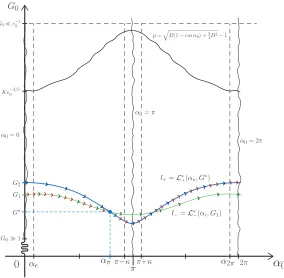
[image:31.595.166.450.189.468.2]inde-pendent. From part (c) of lemma 1.13 α0 should be different from 0 or π and not in the curve given in (1.89). In figure 1.3 is shown schematically the curves in the plane α0G0 that we will avoid in the following procedure.
Figure 1.2: Zone of diffusion
Take (α0 =αǫ, G0 =G1) and apply successively the scattering mapS− defined in (1.74), its
trajectory will follow the level curvel− =L∗
−(αǫ, G1) up to certain α0=απ close to πwhere G0 takes the valueG∗. At this moment, we shift to the scattering map S
+ defined as well in (1.74). From applying S+ successively, we will get points along the level curve l+ =L∗+(απ, G∗) up to
α0 =α2π close to 2π= 0(mod2π) where G0 takes the value G2 with G2 > G1, by remark 1.14, we know thatG2−G1 =O(e−G
3
0/3). Continuing in this way, we can travel along all the allowed diffusion zoneG1< G0≪1/e0avoiding always to shift from one scattering map to another, in a point of the curve given in (1.89) wheneverG0=O(e−02/3). Using part (a) and (c) of lemma 1.13 we get figure 1.3. The red arrows represent the trajectory that changes from one scattering map to the other.
Inside the domain 1≪G0≪1/e0 we can obtain diffusion orbits along arbitrary paths, except those which intersect the small regions described in lemma 1.10 and the curves given in lemma 1.13. This mechanism given by the application of scattering maps produce indeed pseudo-orbits, that is, heteroclinc connections between different periodic orbits ˜Λα0,G0 in ˜Λ∞which are commonly known as transition chains after Arnold’s pioneering work [Arn64]. The existence of true orbits of the system which follow closely these transition chains relies on shadowing methods, which are standard for partially hyperbolic periodic orbits (the so-called whiskered tori in the literature) lying on a normally hyperbolic invariant manifold (NHIM). Such shadowing methods are equally applicable in our case, where we have an invariant manifold ˜Λ∞ which is only topologically equivalent to a
Figure 1.3: Mechanism for diffusion
With all these elements, we can now state our main results Theorem 1.15. LetG∗
1< G∗2 large enough ande0 small enough. More precisely1≪G∗1< G∗2≪ 1/e0 andµ > 0 small enough. Then, for any G1, G2 ∈(G∗1, G∗2) there exists a trajectory of the
ERTBP such thatG(0)< G1,G(T)> G2 for someT >0.
1.5.3
e0G0
=
λ
,
λ
real positive
To prove diffusion in the casee0G0=λ, forλafixed positive number, we use propositions 1.2 and 1.3 as in section 1.5.1 to compute the scattering map. Nevertheless, we will use the computation of the Melnikov potential given in theorem 1.6, which gives a more involved expression of the scattering map in terms of the Bessel functionsJ0 andJ1. Since the complete computations of the scattering maps are very cumbersome, it will not be possible to provide simple conditions, as in the caseλ≪1, to guarantee the existence of diffusion on the complete zoneA/e0≤G0 ≤B/e0. Thus, in this section, we will see the same mechanism used in section 1.5.1 can be straight forwardly applied, up to some technical conditions that can be checked analytically or numerically.
The Melnikov potential is now given by the same formula (1.48), that is
L(α0, G0, t0;e0) =L0,0(G0) +L0(α0, G0) +L1(α0, G0, t0) +E(α0, G0, t0) (1.97) whereL0,0is the same function as in equation (1.48) and is given by
L0,0(G0) =
π
2G
−3
0 +F1 (1.98)
with
F1=F1(G0) =O(λ2G−05+G− 7
0 ) =O(G− 5
0 ) (1.99)
L0(α0, G0) is also the same function as in equation (1.48) and is given by
L0(α0, G0) =− 15
8 πλG
−6