
Introduction
The structure of a stand is the result of the interac-tion between different factors such as species compo-sition, site quality and disturbance (Oliver and Larson, 1996). These factors have different effects on the establishment, survival and growth of trees in the first stages influencing the subsequent development of the stands (Harper et al., 2006). The spatial pattern of trees determines competitive relationships that are stronger between neighbour trees leading to a decrease in growth of plants located close to each other and in ca-ses where competition is strong enough, an increase in mortality. Species that regenerate in association with
nurse plants, or parent trees, usually present a clumped distribution (Hou et al., 2004) and positive spatial associations. On the other hand, density-dependent mortality may lead to regular spatial patterns (Peet and Christensen, 1987). Depending on the tolerance of species to the shortage of resources, individuals in competitive disadvantage might die or grow slowly. In short, facilitation and competition influence spatial patterns that reflect the interaction between two spe-cies or between different cohorts of the same spespe-cies (Rejmánek and Leps¢, 1996).
However, spatial pattern of trees can also be affected by factors other than biotic interactions during stand development. Edaphic factors such as soil moisture
Stand dynamics, spatial pattern and site quality
in
Austrocedrus chilensis
forests in Patagonia, Argentina
S. L. Burns*, J. F. Goya, M. F. Arturi, P. F. Yapura and C. A. Perez
LISEA (Laboratorio de Investigación de Sistemas Ecológicos y Ambientales). Facultad de Ciencias Agrarias y Forestales - Facultad de Ciencias Naturales y Museo - UNLP. C/ Diagonal 113, 469.
1900 La Plata (Buenos Aires), Argentina
Abstract
Aim of study: The objective of this study was to analyze the stand structure and spatial pattern of two A. chilensis stands with contrasting soil conditions and different site qualities in order to explore if these differences lead to pat-terns similar to the ones observed under different precipitation conditions.
Area of study: The study was carried out in two stands located near the city of El Bolsón (41° 56’S - 71° 33’ W), Rio Negro, Argentina.
Material and methods: We evaluated age difference between canopy strata (upper and lower) in two stands with dif-ferent site qualities by means of a Mann-Whitney test. Dead individuals by diameter class were compared by means of a chi square test. Spatial distribution pattern was analyzed using the pair-correlation function and the mark-corre-lation function.
Main results: Both sites exhibited a random spatial distribution of A. chilensisbut different processes seem to un-derlie the patterns. In the low-quality site facilitation and continuous establishment led to a transient clumped spatial pattern. Mortality mediated by competition occurred mainly on small trees resulting in the current random pattern. On the other hand, spatial pattern in the high-quality site does not reflect a facilitation mediated recruitment. The up-per strata established synchronously and subsequent regeneration was episodic.
Research highlights: The results show that the differences in site quality may lead to different establishment spa-tial patterns, showing the importance of facilitation processes in sites with drier soil conditions and lower quality, al-though results may be site specific, due to the lack of replications.
Key words: spatial analysis; regeneration; mortality; competition; facilitation.
* Corresponding author: [email protected] Received: 29-02-12. Accepted: 29-04-13.
can affect the spatial distribution of plants (Harper et al., 2006) as well as recruitment processes because regeneration patterns might vary depending on site characteristics and associated species (Veblen et al., 1995). The same species, growing under different site conditions might present different spatial patterns and age distributions. Stands developed under the same temperature and precipitation conditions, but on soils with differences in fertility and water retention capa-city present different dominant heights interpreted as differences in site quality (Goya et al., 1998). Few stu-dies have compared the effect of site conditions on the spatial pattern (Getzin et al., 2008).
Point pattern analysis of fully mapped plant loca-tions using tree-trunk position has been demonstrated to be a useful approach to explore spatial plant dyna-mics (Getzin and Wiegand, 2007). The random morta-lity hypothesis can be used to detect competition, if individuals in a community are equal in death probabi-lity, the second-order characteristics of the spatial patterns would remain unchanged (Getzin et al., 2006). Opposite to this hypothesis, elevated death rates among neighbouring trees are expected due to competition.
Austrocedrus chilensis(D. Don) Pic.Serm. & Bizzarri (Cupressaceae) forms dense monospecific or mixed forests in north Patagonia after f ires. Most stands originated after fires between 1890 and 1920 (Veblen et al., 2004) in periods of great droughts. In relatively mesic sites, A. chilensis seedlings establish rapidly after fires forming dense forests from surviving trees (Veblen and Lorenz, 1987). Seedlings establish near shrubs or parent trees (Arturi et al., 2001) because their partial shade avoids damage due to high tempera-tures and water stress (Urretavizcaya et al., 2006). Kitzberger et al.(2000) suggested that the trend of spatial association between seedlings and other plants might be stronger in moderately dry years while in humid years regeneration does not require nurse plants and in very dry years no regeneration is observed. In humid periods, competitive processes between A. chilensis seedlings and shrubs might predominate over facilitation processes (Kitzberger et al.,2000).
A. chilensis forests develop on soils with contrasting textures which determine different water retention capacities and different site qualities. According to the relationship between water availability and incidence of the facilitation proposed by Kitzberger et al.(2000), in poorer quality sites and on drier soils, recruitment of A. chilensis is expected to be more dependent on nurse plants than on sites of better quality.
In addition, in low quality sites competition processes are expected to be less important and therefore con-tinuous recruitment is expected. In better quality sites, where competition with other species is more impor-tant, recruitment is expected to be characterized by small scale gaps and differentiated cohorts (Veblen et al., 2004). Thus, upper and lower tree strata in the high quality site should exhibit greater age differentiation than in the low quality site.
The objective of this study was to analyze the stand structure and spatial pattern of two A. chilensisstands with contrasting soil conditions and different site quali-ties in order to explore if these differences lead to patterns similar to the ones observed under different precipita-tion condiprecipita-tions. According to previous studies we spe-cif ically hypothesize that (1) facilitation processes predominate in low quality sites promoting a more clumped A. chilensisspatial pattern than in high quality sites, both in the upper (dominant and codominant trees) and the lower (intermediate and suppressed) strata. (2) Moreover, as a consequence of facilitation, a stronger positive spatial association between the upper and the lower strata is expected in the lower quality site than in the higher quality site. (3) Competition pro-cesses also force diameters of nearby trees on high quality sites to be smaller than those expected under a random distribution of tree sizes. This association is expected to be weak or null in the low quality site due to lower competitive interactions. (4) Similarly, dead trees tend to predominate among small and close trees. (5) Another expected consequence of competition in-duced mortality is a higher frequency of small dead trees in the high quality site. (6) The age class structure in the high quality site is expected to be bimodal due to relatively rapid regeneration followed by a later start of gap phase replacement. In contrast, the age class structure between the upper and lower strata for the low quality site is expected to be more similar due to the relatively continuous recruitment period and conti-nual vertical differentiation because of weaker compe-tition.
Material and methods
Study area
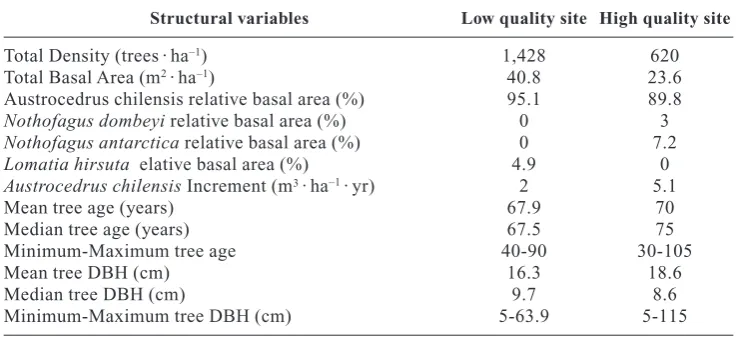
city of El Bolsón (41° 56’ S-71° 33’ W), Rio Negro province, Argentina, with altitudes ranging between 300 and 600 m a.s.l. A. chilensis is the dominant spe-cies in both stands with more than 70% of basal area (Table 1). Species richness is higher in HQ [A. chilen-sis, Nothofagus dombeyi(Mirb.) Blume (coihue), No-thofagus antarctica(Forst.) Oerst. (ñire)] than in LQ [A. chilensis andLomatia hirsuta(Lam.) Diels]. Den-sity and basal area are higher in LQ while mean annual increment is higher in HQ (Table 1). Sites were selec-ted to allow a contrast of moisture regimes due to soil conditions under the same climatic influences.
The area has a mean annual temperature of 9.38ºC and total annual precipitation ranging from 800 to 1,000 mm, concentrated in autumn and winter (April-September) (Cordon et al., 1993). In the growing sea-son (October-March) monthly potential evapotranspi-ration ranges from 55 to 100 mm month–1, precipitation
ranges from 20 to 50 mm month–1and mean
tempera-ture ranges from 10 to 15°C (SMN, 1981). In the dor-mant season (April-September) monthly potential evapotranspiration ranges from 10 to 35 mm month–1,
precipitation ranges from 30 to 190 mm month–1and
mean temperature ranges from 3 to 8.5°C (SMN, 1981), indicating a surplus of precipitation in the dormant season and an important deficit in the growing season. Soils are derived from holocenic piroclastic deposits classified as Udivitrand (Buamscha et al., 1998). In HQ soils are well drained, with good effective depth and with presence of allophane or imogolite which improve their hydric conditions. These soils reach the end of the dry season with good water availability. In LQ, on the other hand, soils are coarsely textured with high water inf iltration rates. These soils enter the
beginning of the dry season with low water contents (Gobbi and Schlichter, 1998, Goya et al., 1998).
This region was strongly affected by f ires at the beginning of the twentieth century. These fires were started to open land for grazing and agriculture, so most of the forests of this region were affected by this type of disturbance (Willis, 1914). Since this date fires decreased and allowed current stands to establish (Veblen and Lorenz, 1987).
In each study site stands without signs of recent intervention were selected. In each stand a permanent plot of 2,500 m2(50×50 m) was established in the
summer of 1994. In each plot all individuals > 5 cm dbh (diameter at breast height or 1.3 m) were marked, measured and stem mapped. For each individual: the species, dbh and crown-class position (dominant or upper strata and suppressed or lower strata) were deter-mined. About 40% of the trees in each plot were ran-domly selected and cored at 35 cm from the base in order to determine their ages. Samples were conditio-ned according to Stokes and Smiley (1968), dated and growth ring widths were measured with stereoscopic microscope using equipment to measure increments (TA-System Ring Measurement). Dating and sample mea-sures were verified with computer program COFECHA (Holmes, 1983). Samples were analyzed according to canopy position.
All individuals < 5 cm of dbh were censused in height (m) categories: I = 0.5 – 1.0 m; II = 1.0 – 2.0 m and III > 2.0 m and < 5 cm dbh in 36 circular plots of 360, 540 and 900 m2for the categories I, II and III,
[image:3.595.113.482.544.713.2]respectively. The plots were located on an equally spaced square grid. In addition 100 randomly selec-ted individuals < 5 cm dbh were harvesselec-ted, height and
Table 1.Forest structure of the low and high quality sites
Structural variables Low quality site High quality site
Total Density (trees · ha–1) 1,428 620
Total Basal Area (m2· ha–1) 40.8 23.6
Austrocedrus chilensis relative basal area (%) 95.1 89.8
Nothofagus dombeyi relative basal area (%) 0 3
Nothofagus antarctica relative basal area (%) 0 7.2
Lomatia hirsuta elative basal area (%) 4.9 0
Austrocedrus chilensis Increment (m3· ha–1· yr) 2 5.1
Mean tree age (years) 67.9 70
Median tree age (years) 67.5 75
Minimum-Maximum tree age 40-90 30-105
Mean tree DBH (cm) 16.3 18.6
Median tree DBH (cm) 9.7 8.6
diameter at base were measured and age was deter-mined.
Statistical analysis
Significant differences in several attributes between these two stands were tested. The major driving mecha-nism is intended to be their site quality differences; however, many other factors may be confounded with site quality due to the lack of replication. So, diffe-rences may be due to site quality, but secondarily to other contributing factors.
Testing Hypothesis 1 and 2
Spatial distribution pattern was analyzed using the pair-correlation function g(r), which is a distance-dependent correlation function for completely mapped point patterns (Wiegand and Moloney, 2004). Based on inter- tree distances, the g function describes clum-ping and regularity of one class of trees (univariate) at a given radius r, using a standardized density. Under complete spatial randomness (CSR), g(r) = 1, g(r) > 1 indicates aggregation, while g(r) < 1 indicates regu-larity (Getzin et al., 2011). The unvariate version can be transformed into a bivariate version in order to analyze the spatial relationship between two different classes of trees; in this case the two patterns were de-f ined according to the canopy position (upper and lower strata). The null model used was complete spatial randomness (CSR).
Testing Hypothesis 3
In order to analyze if there is a density-dependent size reduction, dbh was used as a “mark” in a mark-correlation function (MCF). The MCF is similar to the pair-correlation function g(r) but investigates the size-correlation and not only the distance-size-correlation at radius r (Getzin et al., 2011). This analysis allows us to detect intra-specific competition processes between individuals of A. chilensis. The bivariate version of the MCF was performed using species as patterns in order to study interspecific relationship between A. chilensis (pattern 1) and other species (pattern 2). Under compe-tition we would expect that plants which are located close to each other should be on average smaller than the population average (Getzin et al., 2011).
Testing Hypothesis 4
To investigate if mortality is independent of the neighbour trees the random mortality hypothesis was tested. This hypothesis assumes dead trees are indepen-dently and randomly distributed relative to live trees. Under strong competition effects we would expect that trees with fewer neighbours would have greater chan-ces of survival (Getzin et al., 2006). The random mor-tality hypothesis was tested using the univariate ran-dom labelling as null model.
Signif icance departure from the null models was tested using the 5thlowest and 5thhighest of 199 Monte
Carlo simulations to generate 95% simulation envelo-pes. We used a moving window with a radius of R = 10 m. Hence deviation from the null model can only be interpreted up to 10 meters. For these analyses the soft-ware Programita (Wiegand and Moloney, 2004) was used.
Testing Hypothesis 5
Relative frequency of dead individuals by diameter class, defined as lower class (> 5 cm dbh, < 20 cm dbh) and upper class (> 20 cm dbh) were compared by means of a chi-square test. For both sites most trees smaller than 20 cm dbh were younger than 70 yr and belonged to the lower strata which was expected to be more strongly affected by competition.
Testing Hypothesis 6
Median age by strata in each stand was compared by means of a Mann-Whitney test. Upper (ul) and lower (ll) 95% conf idence limits of the median age were calculated taking 1000 random samples of equal size as the original sample.
Results
Spatial distribution pattern
50
40
30
20
10
0
50
40
30
20
10
0
0 10 20 30 40 50 0 10 20 30 40 50
HQ LQ
Y (m)
[image:5.595.66.529.84.267.2]Y (m)
Figure 1.Map of the two study plots showing the spatial distribution of trees differentiated by strata. Upper strata white dots, Lo-wer strata grey dots and Dead trees black triangles.
14 12 10 8 6 4 2 0
14 12 10 8 6 4 2 0
0 5 10 15 20 25 0 5 10 15 20 25
g(r) g(r)
Lower strata Lower strata
6
4
2
0
6
4
2
0
0 5 10 15 20 25 0 5 10 15 20 25
g(r) g(r)
Upper strata Upper strata
HQ LQ
a)
c)
b)
d)
4
3
2
1
0
4
3
2
1
0
0 5 10 15 20 25 0 5 10 15 20 25
g
12(r)
g
12(r)
Scale r (m) Scale r (m)
Bivariate analysis Bivariate analysis
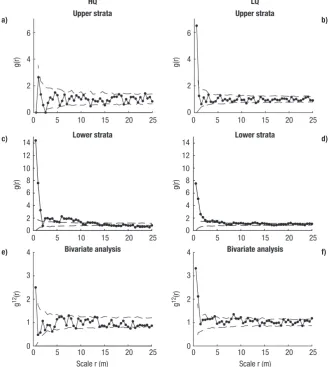
Figure 2.Univariate spatial pattern analyses of the upper strata (a, b), the lower strata (c, d) and bivariate analysis of the lower stra-ta around the upper strastra-ta (e, f) in HQ (high-quality) and LQ (low-quality) plots. (g(r) = black dotted line; 95% upper and lower confidence limits = grey dashed lines based on the null hypothesis of complete spatial randomness).
[image:5.595.131.462.310.678.2]the bivariate distribution of spatial independence of the lower strata and the upper strata could not be rejec-ted in both sites (Fig. 2).
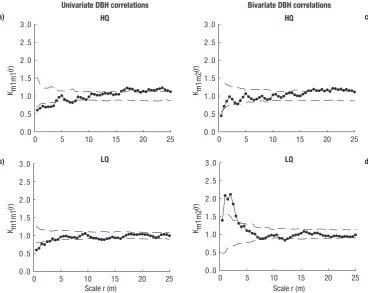
The mark correlation function using dbh of A. chi-lensisas a mark showed that in HQ intra-specific com-petition was significant up to 3 m and up to 4 m in LQ. This means that plants located close to each other were on average smaller than the population average. The bivariate analysis showed no relationship between A. chilensisand other species in HQ. However, in LQ a strong association of A. chilensiswith other species was detected up to 3.5 m (Fig. 3).
In LQ the random mortality hypothesis was rejected due to clustering at spatial scales up to 1.5 m while in HQ it could not be rejected (Fig. 4).
Stand structure
The relative frequency distribution of dead indivi-duals was different between sites (Pearson chi-square 17.50, p< 0.0001, degrees of freedom: 1). In LQ the greatest frequency of dead individuals was observed
in the lower diameter class (less than 20 cm dbh), while in HQ the frequency of dead trees was similar in the different diameter classes.
Median age of upper and lower strata was 77.5 (ll: 75, ul: 85) and 45 (ll: 45, ul: 55) years respectively in HQ and 75 (ll: 70, ul: 80) and 60 (ll: 55, ul: 65) years respectively in LQ. Age frequency distribution indica-ted a bimodal irregular structure in HQ (U = 61.5, p< 0.0001, degrees of freedom: 57) while in LQ the distribution corresponded with a typical inverted j of an irregular stand (U = 289, p< 0.0003, degrees of free-dom: 80) (Fig. 5).
In HQ 70% of individuals < 5 cm dbh belonged to the age classes of less than 40 years while in LQ 72% of the individuals belonged to the age class between 40 and 50 years (Fig. 5).
Discussion
Our results suggest that site quality differences partially resemble the plant patterns expected under contrasting rainfall regimes. However, a warning must
0 5 10 15 20 25 0 .0
0 .5 1 .0 1 .5 2 .0 2 .5 3 .0
0 5 10 15 20 25 0 .0
0 .5 1 .0 1 .5 2 .0 2 .5 3 .0
Scale r (m) Scale r (m)
LQ LQ
Km1m1
(r)
Km1m2
(r)
0 5 10 15 20 25 0 .0
0 .5 1 .0 1 .5 2 .0 2 .5 3 .0
0 5 10 15 20 25 0 .0
0 .5 1 .0 1 .5 2 .0 2 .5 3 .0
HQ HQ
Km1m1
(r)
Km1m2
(r)
[image:6.595.115.484.84.377.2]Univariate DBH correlations Bivariate DBH correlations
Figure 3.Univariate mark-correlation function with dbh (diameter at breast height) (a, b) and bivariate mark-correlation function
with dbh between A. chilensis and other arboreal species (c, d) in HQ (high-quality) and LQ (low-quality) plots. 95% upper and
lower confidence limits = grey dashed lines based on the null hypothesis of complete spatial randomness. a)
b)
c)
be made about the lack of replications so results may be site specific rather than related with site differences. The mark correlation function using dbh as a mark showed intraspecific competition effects in both stands. However when the relationship with other species was analyzed using the bivariate function no association between A. chilensisand other species was found in the high-quality site but a positive association up to 3.5 m was detected in the low-quality site. This associa-tion could be explained by facilitaassocia-tion processes. Pre-vious studies showed that facilitation processes in this species increased in importance as precipitation de-creased along a geographic gradient (Kitzberger et al., 2000).
The pair correlation function showed no departure from complete spatial randomness of the upper strata in both stands; however the lower strata were aggre-gated up to 9.5 m in the high-quality site and only up to 6 m in the low-quality site. These results differ from the expected patterns of more aggregation in the low-quality site as a consequence of facilitation mediated recruit-ment. Mortality due to competition may have lead to a less aggregated pattern than the expected in the low-qua-lity site. This agrees with the high frequency of dead trees in the lower diameter class which is compatible with a mortality pattern associated with intraspecific competi-tion. On the other hand, in the high-quality site this concentration of dead trees in the lower diameter class
0 5 10 15 20 25 0 5 10 15 20 25
10
0
–10
–20
–30
–40 20
10
0
–10
–20
–30
–40 20
g21
(r)-g
22
(r)
g21
(r)-g
22
(r)
HQ LQ
[image:7.595.74.532.85.268.2]Scale r (m) Scale r (m)
Figure 4.Bivariate random labelling [g21(r)-g22(r)] to asses if mortality was a random process in HQ (high-quality) and LQ (low-quality) plots. 95% upper and lower confidence limits = grey dashed lines based on the null hypothesis of random mortality.
10 20 30 40 50 60 70 80 90 100 110
0 2 4 6 8 10 12
0 5 10 15 20 25 30 35
10 20 30 40 50 60 70 80 90 100 110
0 2 4 6 8 10 12 14
16 25
20
15
10
5
0
N (trees)
N (saplings)
Age classes (years)
HQ LQ
[image:7.595.64.539.501.684.2]was not detected indicating a weaker relationship bet-ween mortality and intraspecific competition than in the low-quality site. This is also shown by the spatial analysis of the random mortality hypothesis which could not be rejected in the high-quality site but indicated non-random mortality of trees up to 1.5 m in the low-quality site.
The analysis of the age structure showed that in the high-quality site the upper strata established in an initial stage after disturbance with discontinuous sub-sequent recruitment. This process yielded a low density A. chilensisstand in which discontinuous regeneration is still observed. In the low-quality site upper and lower strata did not exhibit sharply differentiated age distri-butions as a consequence of a continuous regeneration. The high density of A. chilensis has prevented much of any regeneration over the 40 years prior to sampling. In the high-quality site younger individuals between 0.5 and 1.5 m height established 20 years ago. How-ever, Arturi et al. (2001) found that it takes up to 25 years for individuals to reach 0.5 m height suggesting that recruitment is still occurring.
In conclusion, both sites exhibit a random spatial distribution of A. chilensisbut different processes seem to cause these patterns. In the low-quality site facilita-tion and continuous establishment led to a transient clumped spatial pattern. Mortality mediated by compe-tition occurred mainly on small trees clustered around larger trees resulting in the current random pattern. On the other hand, stand structure in the high-quality does not reflect a facilitation mediated recruitment of A. chilensis. The upper strata established synchronously and subsequent regeneration was episodic, probably due to competition with non arboreal vegetation as found by Veblen et al.(1992) in mesic sites. Theories suggest that under more stressful conditions facilita-tion processes become more important and when con-ditions are more favourable competition processes pre-dominate (Bertness and Callaway, 1994). Thus, the differences in forest structure between the studied sites resemble those found between stands developed under different moisture regimes. Dry sites are characterized by regeneration patterns mediated by facilitation while interspecific competition could be a more important factor affecting regeneration in mesic sites.
Acknowledgements
This research was supported by funding from the Universidad Nacional de La Plata and from the
Inter-national Foundation for Science (IFS). We thank Mar-celo Rey (Servicio Forestal Andino) and Campo Fores-tal General San Martín (INTA) for technical assis-tance. We also thank students from FCAyF-UNLP for f ield assistance. We would also like to thank the anonymous reviewers for their helpful and construc-tive comments.
References
Arturi MF, Ferrando JJ, Goya JF, Yapura PF, Frangi JL, 2001. Tendencias espaciales de la regeneración de Austrocedrus chilensis en relación con el dosel arbóreo. Ecol Austral 11: 31-38.
Bertness MD, Callaway R, 1994. Positive interactions in communities. Tree 9: 191-193.
Buamscha G, Gobbi M, Mazzarino MJ, Laos F, 1998. Indi-cators of nitrogen conservation in Austrocedrus chilensis forests along a moisture gradient in Argentina. Forest Ecol Manag 112: 253-261.
Cordon V, Forquera JC, Gastiazoro J, Barros V, Schmidt I, 1993. Estudio microclimatico del área cordillerana del Sudoeste de la Pcia. de Río Negro. Cartas de precipi-tación. Facultad de Ciencias Agrarias, Cinco Saltos, Río Negro, Argentina.
Getzin S, Wiegand K, 2007. Asymmetric tree growth at the stand level: random crown patterns and the response to slope. Forest Ecol Manag 242: 165-174.
Getzin S, Dean C, He F, Trofymow JA, Wiegand K, Wiegand T, 2006. Spatial patterns and competition of tree species in a Douglas-f ir chronosequence on Vancouver Island. Ecography 29: 671-682.
Getzin S, Wiegand K, Schumacher J, Gougeon FA, 2008. Scale-dependent competition at the stand level assessed from crown areas. Forest Ecol Manag 255: 2478-2485.
Getzin S, Worbes M, Wiegand T, Wiegand K, 2011. Size dominance regulates tree spacing more than competition within height classes in tropical Cameroon. J Trop Ecol 27: 93-102.
Gobbi M, Schlichter T, 1998. Survival of Austrocedrus chi-lensis seedlings in relation to microsite conditions and forest thinning. Forest Ecol Manag 111: 137-146. Goya JF, Yapura PF, Ferrando JJ, Barrera MD, Arturi MF,
1998. Crecimiento individual y de rodales de Austroce-drus chilensis en El Bolsón, Río Negro, Argentina. Revista de la Facultad de Ciencias Agrarias y Forestales 103: 149-155.
Harper KA, Bergeron Y, Drapeau P, Gauthier S, De Grandpré RL, 2006. Changes in spatial pattern of trees and snags during structural development in Picea mariana boreal forests. J Veg Sci 17: 625-636.
Hou JH, Mi XC, Liu CR, Ma KP, 2004. Spatial patterns and associations in a Quercus-Betula forest in northern China. J Veg Sci 15: 407-414.
Kitzberger T, Steinaker DF, Veblen TT, 2000. Effects of cli-matic variability on facilitation of tree establishment in northern Patagonia. Ecology 81: 1914-1924.
Oliver CD, Larson BC, 1996. Forest Stand Dynamics. John Wiley & Sons, New York.
Peet RK, Christensen NL, 1987. Competition and tree death. Bioscience 37: 586-595.
Rejmánek M, Leps¢ J, 1996. Negative associations can re-veal interspecific competition and reversal of competitive hierarchies during succession. Oikos 76: 161-168. Servicio Meteorologico Nacional, 1981. Estadisticas
climatologicas 1971-1980. Serie B Nº35 Servicio Meteo-rológico Nacional, Buenos Aires, Argentina.
Stockes M, Smiley T, 1968. An introduction to tree-ring da-ting. University of Chicago Press, Chicago. 73 pp. Urretavizcaya MF, Defossé GE, Gonda HE, 2006.
Short-term effects of fire on plant cover and soil conditions in two Austrocedrus chilensis(cypress) forests in Patagonia, Argentina. Ann For Sci 63: 63-71.
Veblen TT, Lorenz DC, 1987. Post-fire stand development of Austrocedrus-Nothofagus forests in northern Patagonia. Vegetatio 71: 113-126.
Veblen TT, Kitzberger T, Lara A, 1992. Disturbance and forest dynamics along a transect from Andean rain forest to Patagonian shrubland. J Veg Sci 3: 507-520.
Veblen TT, Burns B, Kitzberger T, Lara A, Villalba R, 1995. The Ecology of the Conifers of Southern South America. In: Ecology of the southern conifers (Enright N, Hill R, eds). Melbourne University Press, Carlton, Victoria, Aus-tralia. pp: 120-142.
Veblen TT, Kitzberger T, Villalba R, 2004. Nuevos paradig-mas en ecología y su influencia sobre el conocimiento de la dinámica de los bosques del sur de Argentina y Chile. In: Ecología y manejo de bosques de Argentina (Arturi MF, Frangi JL, Goya JF, eds). Editorial de la Universidad Nacional de La Plata, La Plata, Argentina. pp: 1-48. Wiegand T, Moloney KA, 2004. Rings, circles, and
![Figure 4. Bivariate random labelling [g21(r)-g22(r)] to asses if mortality was a random process in HQ (high-quality) and LQ (low-quality) plots](https://thumb-us.123doks.com/thumbv2/123dok_es/4881887.70536/7.595.64.539.501.684/figure-bivariate-random-labelling-mortality-process-quality-quality.webp)
