1
PRACTICES AND PERCEPTIONS FROM BA DEGREE OF MODERN LANGUAGES TEACHERS AT PONTIFICIA UNIVERSIDAD JAVERIANA IN
REGARD TO THE USE OF LITERATURE IN THEIR EFL CLASSROOMS
Trabajo de grado para optar por el título de
Licenciada en Lenguas Modernas
Nathalie Schmidt Torres
PONTIFICIA UNIVERSIDAD JAVERIANA
FACULTAD DE COMUNICACIÓN Y LENGUAJE
LICENCIATURA EN LENGUAS MODERNAS
2
ABSTRACT
This investigation originates from the need of the English area of the BA Degree of Modern Languages (BADML) at Pontificia Universidad Javeriana (PUJ) to start informing the practices that the BADML English teachers display regarding the use of literature in their classes.
Taking into account that students from BADML at PUJ need to be acquainted with the target language and the context from where such language comes from. This investigation besides taking a look on what the theory said about the use of literary material in an EFL class, gathers as well practices and perceptions of BADML English teachers at PUJ about the use of literature as a tool in their EFL classes. This qualitative research explores the topic through, first, a survey conducted with the students of three courses of Low Advanced English of the BADML at the PUJ. Then, interviews were conducted with the English area coordinator, reading program coordinator and BADML English teachers from different levels. Finally, through the use of tables those practices and perceptions were confronted with what the theory said regarding the use of literature in the EFL classroom so that tendencies could be identified.
The gathering of this information, both theory and experiences, showed two sides of a problem. While the surveys conducted with students showed an interest towards the inclusion of literature in the EFL classes, interviews conducted with teachers showed that the majority of them were not able to work on literature during their classes because of time-content matters.
3
ACKNOLEDGMENTS
First of all I would like to thank God for giving me the opportunity to fulfill my dream of being an English teacher. Second, I would like to thank my parents for all the support they have given me throughout the years and for being there when I felt that I couldn’t give more.
4 CONTENT TABLE
ILLUSTRATION INDEX ... 7
1. INTRODUCTION ... 8
2. CONTEXT ... 9
3. PROBLEM ... 12
4. JUSTIFICATION ... 13
5. QUESTION ... 14
6. OBJECTIVES ... 14
6.1. MAIN OBJECTIVE ... 14
6.2. SPECIFIC OBJECTIVES ... 14
7. PRECEDENTS (Previous Studies) ... 15
8. THEORETICAL FRAMEWORK ... 23
8.1. Use of Literature in the EFL Class ... 23
8.1.1. Teacher’s relation with literature ... 24
8.1.2. Literature and language ... 24
8.1.3. Engagement with literature in the EFL classroom... 25
8.1.4. Selection of texts ... 26
8.1.5. Methodologies for the use of literature inside an EFL class ... 27
8.1.6. Response towards literature ... 32
8.1.7. The need of historical background when reading literature ... 32
8.1.8. Literature, communication and understanding of other cultures ... 33
8.1.9. Reading and the other language skills ... 33
8.1.10. Reading as a highly skillful ability ... 34
5
8.3. Learning Styles ... 39
8.4. Learning Strategies ... 45
8.5. Age ... 50
9. METHODOLOGICAL FRAMEWORK ... 56
9.1. Type of Investigation ... 56
9.2. Instruments ... 57
9.3. Population ... 58
10. ANALYSIS AND RESULTS ... 60
10.1. Use of Literature in the EFL Class ... 60
10.1.1. Teachers’ relation with literature ... 60
10.1.2. Literature and language... 61
10.1.3. Engagement with literature in the EFL class ... 62
10.1.4. Selection of texts ... 63
10.1.5. Methodologies for the use of literature inside an EFL class ... 64
10.1.6. Response towards literature ... 65
10.1.7. The need of historical background when reading ... 66
10.1.8. Literature, communication and understanding of other cultures ... 67
10.1.9. Reading literature and other language skills ... 68
10.1.10. Reading as highly skillful ability ... 69
10.2. Multiple Intelligences ... 70
10.3. Learning Styles and Strategies ... 72
10.4. Important Considerations ... 77
11. CONCLUSIONS ... 79
6
13. LIMITATIONS ... 81
14. Bibliografía... 83
15. APPENDICES ... 86
15.1. APPENDIX 1 ... 86
15.2. APPENDIX 2 ... 87
15.3. APPENDIX 3 ... 88
15.4. APPENDIX 4 ... 89
15.5. APPENDIX 5 ... 90
7
ILLUSTRATION INDEX
Tabla 1Long's model for using literature in an EFL classroom Taken from: Carter &
Brumfit, Third impression 1991, page 55 ... 29
Tabla 2 Gardner’s first seven intelligences ... 37
Tabla 3 Gardner's three subsequent intelligences ... 38
Tabla 4 Oxford 1994 ... 41
Tabla 5 Oxford 2003 ... 41
Tabla 6 Oxford 1994 and 2003 ... 44
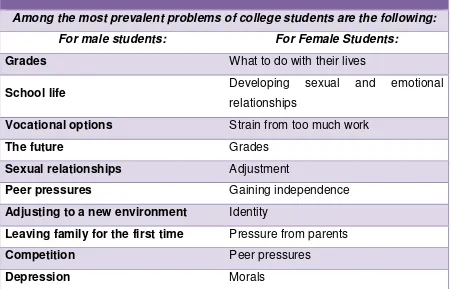
Tabla 7 College student’s problems Source: Feldaman (1997) page 471. Original Source: Wechsler, Rohman, &Solomon (1981) ... 54
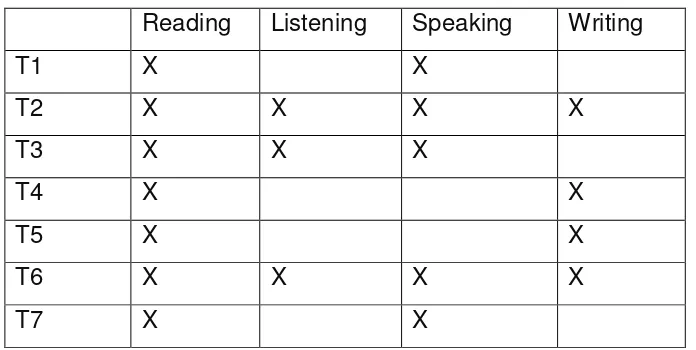
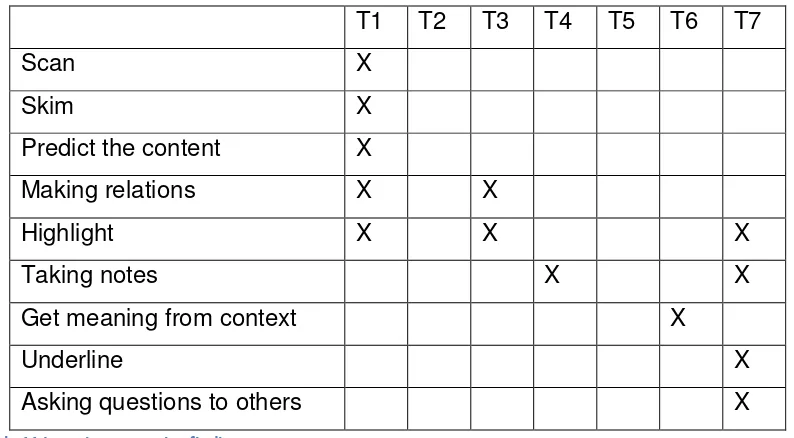
Tabla 8 Language skills used by BADML English teachers ... 68
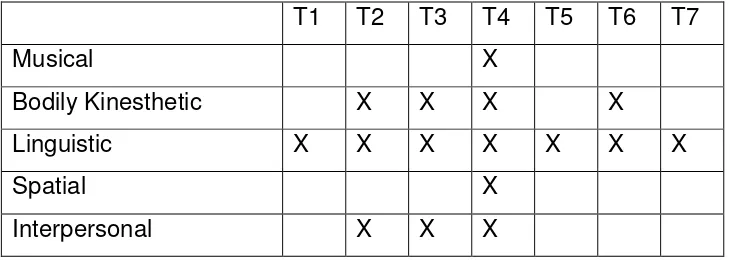
Tabla 9 Multiple intelligences findings ... 71
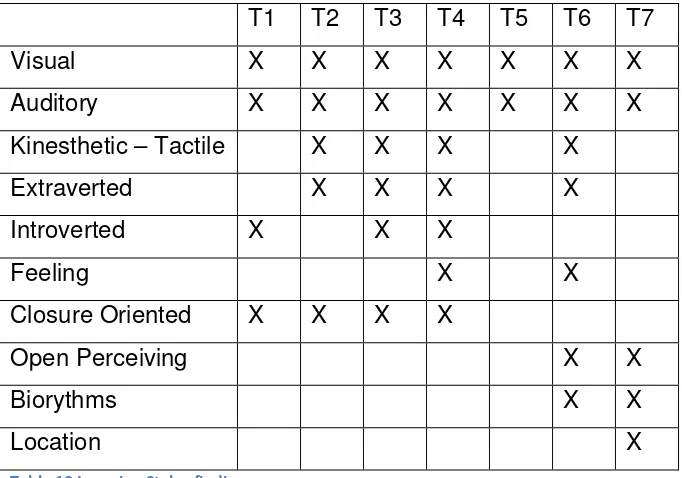
Tabla 10 Learning Styles findings ... 73
8
1. INTRODUCTION
The purpose of this work is to get acquainted with the practices and perceptions BADML English teachers have towards the use of literature in their classes and to gather information from authors who have worked with the use of literature inside an EFL class such as Bassnett & Grundy (1993), Carter & Brumfit (1991), Gómez (2012) and Stern (1992), to mention a few. Finally, this investigation will contrast both perspectives (theory and practice) to find out if teachers have been using the same strategies and methodologies that the theory proposes, or if they have incorporated in their classes new ideas that seem to work and suit their students’ needs.
9
2. CONTEXT
The BA Degree in Modern Languages (BADML) at the Pontificia Universidad Javeriana (PUJ) is a program which offers students formation in languages and pedagogy, being English the main language with a program made up of seven levels.
Recently, more exactly 2013, the BA Degree in Modern Languages started to consider the idea of using literature as part of the material all levels should be able to use as part of the language formation, with no specific number of hours to be dedicated to the it. In the past, however, there had been some experiences to introduce literature, but that was only experienced in the last level of English called Low Advanced English.
In order to collect information for this investigation context, the researcher interviewed the former director of the program, in 2012, to find out how literature has been used in the BA Degree in Modern Languages program throughout the years, particularly in the English classes. In the interview the former director of the program explained that the BADML is focused to meet the needs of a market, and so the BADML program offered a holistic academic training with philosophy, history and literature because the market requested holistic professionals.
Then, as the market changed, it demanded professionals in language teaching for administrative roles. As a consequence, philosophy, history and literature started to become less and less important for the market, and in response to those demands, the PUJ BADML program started to focus more on subjects dealing with administrative and economic fields.
10
subjects dealing with administrative and economic fields, and shifted to a program which attempts to help students improve their communicative competence.
One of the elements that the PUJ BADML English teachers have started to perceive a need to reincorporate literature in the program to reinforce language formation in their English classes, so as to help strengthen BADML students communicative competence.
The reincorporation of literature in the PUJ BADML program led the researcher to a second interview, in 2014 with the person in charge of starting organizing the new literature reading program for the BADML EFL classes.
In the first semester of 2013 new literature reading program for the BADML EFL classes was being introduced at an experimental stage. In the second semester 2013, the English area wanted to see which books were being used at each English level, and also started to make contacts with some editorials to know what they could offer in their stock for the reincorporation of literature in the PUJ BADML program.
Additionally, PUJ BADML English teachers started sharing reading strategies they knew and actually used in their practice when using literature in BADML EFL classes. That exercise showed that some of the teachers were not using literature at all, or were just doing comprehension quizzes.
11
In that same interview, the researcher learnt that the new literature reading program for the BADML EFL classes mainly aims for the classics of literature, since they are seen as the exponents of a culture so that they are considered “must reads” by the BADML English area teachers. Texts were also selected based on their genre, author, and the period of time in which they were written and published.
12
3. PROBLEM
In the BA Degree of Modern Languages (BADML) at the Pontificia Universidad Javeriana (PUJ) teachers and students have realized that there is a need for a literature component in the BADML English classes.
A preliminary survey, conducted on the second semester of 2013, showed that although 47% of the students in Low Advanced English (last level of English in the BADML) do not like to read, 100% think it is important to have a literary component inside the English classes. This latent need has been acknowledged by the English area and therefore a reading program was created. Although, it has been working since 2013, the English area wants to know what the actual practices of BADML English teachers, in relation to the use of literature, are. The English area wants to know what texts are teachers working on, if literary material is used and most important how the BADML English teachers are managing it. Moreover, they want to know the methodologies and strategies used inside the BADML English classes to teach literature.
13
4. JUSTIFICATION
The importance of this investigation lies in the fact that it is a first step towards a formal inform about BADML English teachers’ practices in regards to the use of literature in their classes. As well is a contribution to the intention of building a much more profitable reading program for all levels of English.
This present investigation will gather practices from seven BADML English teachers who are working with literature to find out how they are managing literature inside their classes, how the interaction between the literary texts, teachers and students is, what classrooms situations do teachers encounter when working with literature and, which positive or negative perceptions they have about the literary use in an EFL classroom.
Practices of teachers will then be contrasted with what the theory says about the use of literary material. This study has no intention of criticizing practices, but to offer a much broader way to the use of literature in an EFL classroom, since theory may lack from actual experience from literature, as the empirical use of literature may not have the necessary guidelines. This investigation wants practices and theory to dialogue in order to come up with a much effective and profitable way to address the literature used in the BADML English classes.
14
5. QUESTION
Since the English area has decided to incorporate a literature reading plan in the English classes, and there is the need to collect information about the practices and perceptions that English teachers at BADML have in regard to literature, the following research question has been posed by the researcher for the present investigation.
What practices and perceptions do BADML English teachers at PUJ have towards the use of literature in the BADML English classes?
6. OBJECTIVES
In order to answer the research question posed above the researcher has determined the objectives below.
6.1. MAIN OBJECTIVE
Characterize the practices and perceptions that BADML English teachers at the PUJ hold regarding the use of literature in their BADML EFL classes.
6.2. SPECIFIC OBJECTIVES
• Describe the practices regarding the use of literature that BADML English teachers have inside their BADML EFL classes.
• Describe the perceptions regarding the use of literature that BADML English teachers have inside their BADML EFL classes.
15
7. PRECEDENTS (PREVIOUS STUDIES)
In this chapter the reader will be acquainted with eight different investigations that have lighten this present research with different aspects such as methodologies for the use of literature in an EFL classroom, instruments for the methodological framework, enhance of language skills (speaking, listening, writing and reading) through the use of literature or reading materials, and some other aspects regarding the use of literature in the language teaching which will be discussed forward.
Luis Fernando Gómez (2012)
This author made an investigation titled Fostering Intercultural Communicative Competence through Reading Authentic Literary Texts in an Advanced Colombian
EFL Classroom: A Constructive Perspective.
The author was concerned about the lack of authentic material inside the EFL classes, and how its introduction would result in fostering the intercultural communicative competence. In order to evidence the benefits of the use of literature, Gómez (2012) proposes the incorporation of authentic literary material in the classes instead of textbooks because the language contained in such textbooks differs from the language students are going to face in real life, and they contain a limited array of cultural information.” Gómez (2012, p. 50)
Gómez (2012) continues his investigation explaining the relevance of using different types of texts because they offer learners the opportunity for the negotiation of meaning and the encounter with cultural representations.”
16
The four approaches exhibited by Gómez (2012) are: Inquiry-based Approach which refers to learners who ask and answer questions in order to share personal
views and ideas regarding literary texts, while they negotiate meaning and get involved in critical explorations and in constructions of knowledge.
Dialogic Approach was proposed by Bakhtin in 1984 and consists in building dialogues by working in small groups followed by whole-class discussion where the meaning of some important aspect of the book is discussed (the title, an important event in the narration, cultural aspects, etc.). The main purpose of this approach is to “enrich their personal views as they compared ideas about the literary texts with others’ ideas.” (Gómez, 2012, p.59)
The Transactional Approach conceives the use of literature inside the classroom as: “[…] a communicative interaction between the reader and the text” (Gómez, 2012, Pg. 54) where students could relate what happened in the text with their own experiences
The Content-based Approach views language learning divided in two types of knowledge: content and language. Interaction with authentic literary texts could result into interesting classroom situations which teachers can take advantage to improve the language level of students.
These four approaches are relevant to the present investigation since they show how approaches for EFL teaching can be used when working with literary material inside an EFL class.
Ariztizábal and Vargas (2012)
These authors made a research for their master degree on education titled Aproximación fenomonológica a la tertulia literaria y sus implicaciones didácticas.
17
They proposed two different concepts: literature and pedagogical literature. While the first would be considered more objective since it is a part of a discipline, the second will be more subjective since is the teacher the one who is taking intentional decisions towards the learners.
The concept of pedagogical literature that these authors present applies to this present research since BADML English teachers are the ones taking decisions in relation to literary material and activities held in class, as the interviews with the coordinator of the reading program showed.
Finally, Aristizábal and Vargas (2012) critique the use of adaptations because they tend to lose what the author intended in his work.
This investigation shows the importance of using authentic material inside the BADML EFL classes were students are exposed to real language, but further than that they are exposed to the actual intention of a writer.
Silva and Rodríguez (2013)
Wrote a study titled “El docente como mediador en el proceso transaccional de lectura de textos literarios en la clase de L2: un estudio de caso multicaso en los
Colegios Fundación Gimnasio los Portales y Colegio Colombo-Hebreo de Bogotá”.
The main objective of the research was to characterize the pedagogical practices in which literature is integrated in the L2 classes of two different schools. They researched upon different methods the practices of six teachers, three of them in each school.
18
The authors mentioned the relation there is between literature and strategies, which this investigation explores.
Furthermore, Silva and Rodríguez (2013) concluded that with the use of challenging and experiential activities, students were more motivated to participate in class and to read the book. In addition students were able to explore creative aspects which led them to use their critical thinking.
This investigation is relevant because they were able to see how practices of EFL teachers affect the language learning process; as well they talk about the use of reading strategies in teachers’ practices when using literature.
Rodriguez and Silva’s (2013) investigation is similar to the present investigation in terms that both have an interest to explore and describe, through interviews conducted with teachers, what happens inside an EFL classroom in regard to literature use. The authors evidenced that the use of interviews was relevant when doing a description of a certain phenomenon, therefore this present investigation will use the same instrument.
Dayana González (2009)
This author did a research titled “Estrategias de aprendizaje para el desarrollo de la producción oral en la Licenciatura en Lenguas Modernas de la Pontificia
Universidad Javeriana”.
The main objective of the investigation was to verify the use of learning styles and strategies inside the English classes of the BADML. Though this investigation does not work on the use of literature it provides valuable information in terms of learning styles and strategies inside the English BADML classes.
19
The study showed that memory strategies were the least used by students while the social skills were higher. Besides, it brings to the table an issue which is not much considered which is the age since most students in the study were teenagers, and she relates the age with the strategies used.
Lastly, the use of tables was present in González’s (2009) investigation as a tool to summarize information in a visual way, this strategy will be applied in this present investigation in order to present results in a much clear way.
Nancy Agray (2000)
This author did an investigation titled Cuentos Cortos suramericanos en la enseñanza de ELE. The study is based in the relation between language and literature to teach a foreign language, in her case Spanish to non-native speakers living in Colombia, with the three levels of Spanish offered by the “Centro Latinoamericano” for foreigners in the year 2000.
Agray’s (2000) work proposes a complementary material for the three levels of Spanish. This material consists on authentic literature, specifically short stories, as a tool to teach a language and to improve the four language skills.
Finally, Agray (2000) evidences that literature is a great tool for language teaching since it benefits the communicative competence. In terms of the use of short stories she argues that they can be systemically used inside a classroom and are a great introduction into reading literature
20
Murat Hismanoglu (2005)
This author wrote a paper titled Teaching English through literature which appeared in the Journal of Language and Linguistic Studies. The author presents literature as a useful tool for language teaching in ESL and EFL classes.
HIsmanoglu (2005) presents ten reasons supporting the use of literature inside an EFL class and why it is considered a “potent resource in the language classroom.” HIsmanoglu (2005, Pg. 55). The first four reasons were taken by Collie and Slater (1990 cited in Hismanoglu 2005), the other six reasons were taken by Maley (1989 cited in Hismanoglu 2005):
• Valuable authentic Material • Cultural Enrichment
• Personal Involvement • Universality
• Non-triviality
• Personal Relevance • Variety
• Interest
• Economy and suggestive power • Ambiguity
These reasons are relevant to this present investigation since they provide criteria for the selections of texts. In addition, they are powerful reasons to use literature inside an EFL class because they show that everyone is able to read and relate to literature.
21
After presenting these reasons, the author continues to explain how the material should be selected in order for students to get the best of it. He says that the selection process “should take into account: need, motivation, interests, cultural background and language level” (Hismanoglu 2005, Pg. 57). In relation to the selection of texts, these are criteria that must be taken into account to make an appropriate selection.
Hismanoglu (2005) offers an explanation about how literature can contribute to the other language skills (writing, speaking and listening), as well as a proposal of aspects that each type of literature genre offers to students which can be seen in appendix number 5 and number 6 respectively. Though these explanations are no part of the main objective of this present research, I find them useful for the EFL teacher who reads this investigation and wants to know how the reading of a literary text can enhance other language skills or get acquainted with different literary styles and the benefits they could have for students.
Sonia Rocío Ríos and Ana Milena Valcárcel (2005)
These two authors made and investigation titled “Reading: A meaningful way to promote learning English in High school. Though this investigation does not deal
with literature, it offers useful conceptions of what is reading, selecting texts, and
implementing them inside an EFL classroom.”
22
The authors emphasize that one way of motivating students is to give them material that relates to their personal experiences and reality. “If the reading material is elaborated taking into account the learners’ interests, age, likes and level we can guarantee at the least the learners’ attention.” (2005, Pg. 63)
As Ríos and Valcárcel (2005) mentioned the importance of knowing student’s likes, age and interests which shows the importance of describing the population BADML English teachers work with.
Finally, the authors were able to see that other skills were reinforced as well; speaking was promoted by reading aloud, discussing in class or just by the student participation. Listening was practiced when learners had to listen to the teachers or listen to each other, also tapes and videos were used in order to motivate the class. Finally, writing was practiced because the authors proposed reading guides which had writing exercises.
To sum up, the authors concluded that in order to promote any type of reading in a language class the teacher has to be aware of the needs and likes of students. Likewise, learners need to be motivated to read and the best way to do so is to let them know what the specific intention of reading is, what are they expected to do and lastly, relate the reading to their life and context.
23
8. THEORETICAL FRAMEWORK
8.1. Use of Literature in the EFL Class
The principal matter of this investigation is to see how literature is being used by BADML English teachers inside their classes. It has to be kept in mind that right now literature is just being introduced as language reinforcement rather than an actual topic inside the classes. Each teacher has to present the books the English area demands, but they have the possibility to use the literary material in their classes or not, as the reading program coordinator told this study.
Thus, this investigation will present different theorists who have worked around literature inside the EFL classroom for many years. Many of them consider it is one of the resources a student can use to learn a language.
Brumfit (In Brumfit and Carter 1991) talks about the use of literature inside an EFL class. He declares that teachers have to develop the literary awareness of the students, but since working in a foreign language is much more difficult he suggests using approaches of the modern tongue language teaching. Meaning that EFL teachers have to examine how students learned to read in their mother tongue in order to use those strategies to make easier the EFL teaching. The author proposes to use literary material in modern tongue because it “will not only exploit understanding of the language, but will relate to other aesthetic work, art and music for example.” (Brumfit in Brumfit and Carter, Pg. 186)
Bassnett and Grundy (1993) point out that literature is a key point on the language learning and that any person who is learning English moves into it.
24 8.1.1. Teacher’s relation with literature
Brumfit and Carter (1991) assume that teachers dealing with literature in their language classes “will be acquainted or will have had direct experience of practical criticism in relation to the interpretation of literary works” (Brumfit and Carter, 1991, Pg. 2), meaning that teachers should have a relation with literature before teaching it.
As Brumfit and Carter (1991) proposed is important that teachers have information about the contents they are working with. If the content is literature they should have training in using or teaching literature in the EFL class in order for their classes to be more profitable.
8.1.2. Literature and language
There has always been a relation between literature and language as the first one could not exist without the second one. The following is a collection of considerations different authors have about this relation.
Brumfit and Carter (1991) mention that the importance of literature inside an ESL / EFL is that a “literary text is made from language and its primary focus for analysis will be the patterns made by language” (1991, Pg. 2). Thus, more than teaching just how to read, literature can be used to study the language itself.
In regard to the learners and how they deal with literature Brumfit & Carter (1991) mention that a non-native speaker will not approach literature in the same way a native speaker does, therefore teachers should encourage students to increase their command of approaching in different levels. Then, Brumfit and Carter (1991) affirm that analysis and discussion of literary texts inside an EFL classroom will help the learning and understanding of the language.
25
Brumfit and Carter 1991, Pg 179). Therefore, instead just learning a standard language, literature offers the opportunity to see different varieties of structures. Trengrove (in Brumfit and Carter 1991) continues with the previous idea mentioning that “discussion of the process of interpretative reading requires reference to many features of the English language system” (1991, Pg. 68).
Littlewood (in Carter and Brumfit 1991) explains that literature has no difference with any other ‘linguistic performance’ since it is the result of the use of different linguistic structures in order to create communication. Meaning, that literature is another way to communicate to another person through the use of language. The main purpose of this author is to show that literature is a usage of the language and therefore it should be studied in a language classroom as any other representation of the linguistic aspects of a language.
Finally, Gómez (2012) argues that literature gives the opportunity to explore how language takes place in a context. As well, he explains the relevance of using such materials which is to expose students to language which has not been modified to fulfill teaching needs (adjusting texts to present certain structures, summarizing texts to meet the level of students, etc.), making students acquainted with real language.
8.1.3. Engagement with literature in the EFL classroom
EFL practices that include literature there should be a previous engagement of students with the literary material, so as to motivate and give them the tools to understand the book in a more holistic way. The theorists presented below expose their considerations about engagement with literature.
26
from the process of discussion and analysis in a fairly random way”. (1991, Pg. 22) These authors critique that teachers usually repeat the same things generation after generation, and do not work on getting students achieving a better reading comprehension.
Short and Candlin (in Brumfi and Carter 1991) base the engagement on a need of historical background, as important for students’ motivation. They explain that without previous knowledge of the book, students would not be able to make any connections between what they are reading in the literary material and the social, historical or political context, resulting in the missing of information to understand what the author intended.
Gómez (2012) in his investigation reveals that when the teacher applies the Inquiry-based approach by posing questions before students start reading, they read focusing on those questions, and then they feel more confident to participate more actively in class discussions.
Ríos and Valcárcel (2005) proposed that, in order to motivate students and engage students into reading, teachers should give students reading materials to which their own personal experiences and reality could be easily related. The authors mention that, for example, literature can give students the opportunity to relate to certain characters, and therefore, they can get more personally involved with the literary material. As a result, a much meaningful relation between the reader and the literary material can occur.
8.1.4. Selection of texts
27
Brumfit and Carter (1991) mention that the actual practice does not focus on the actual needs of the learners and those teachers usually select the classics, which the tradition (understood as literary tradition) asks them to use, or they follow their own likes and interests. They also mention that most of the time the selection of texts lacks from proper guidelines of what is needed.
Brumfit (in Carter and Brumfit 1991) to help clarify those guideline gives six criteria in order to select texts1:
Linguistic level of the students. Cultural level
Length
Pedagogical role (make linkages between previous read books or contemporary events).
Genre representation (all different genres should be available inside a classroom)
Classic status which refers to the use of classic literature.
In Gómez’s (2012) investigation one of the conclusions is that literary materials should be authentic because textbooks offer limited language material, which is fixed in order to fulfil language forms which need to be taught; these textbooks do not create an immersion of students in the actual language.
Finally, Ríos and Valcárcel (2005) say that as well as needs and likes, teachers should consider the capability of students to understand the texts they present. Furthermore they present the age as a criteria to select texts inside the EFL classroom.
8.1.5. Methodologies for the use of literature inside an EFL class
.
1This criteria was taken literally from Literature and Language Teaching. Brumfit
28
One of the main issues EFL teachers encounter when working with literature inside their classes is the lack of a methodology to work with it. They have to struggle to arrange activities or to find things that suit students’ needs. Below some models of methodologies and activities that different authors have created will be exposed. Long (in Brumfit and Carter 1991) claims that there is not a consistent methodology when teaching literature to non-native speakers. Meaning that teachers do not have guidelines to know how this process should be made, mostly they replicate what they have experienced as literature or language learners.
29
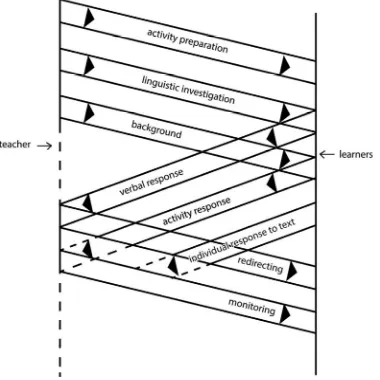
Tabla 1Long's model for using literature in an EFL classroom Taken from:
Carter & Brumfit, Third impression 1991, page 55
1. The teacher initiates by preparing an activity regarding the literary material, followed by a linguistic investigation, which is the actual teaching having always the book as a reference and with the use of it the teacher could ask questions to the students. Finally, the teacher brings the background of the author and the text; this will get the student acquainted with the book, the linguistic aspect and the historical, social, political, etc. background.
[image:29.612.86.466.107.487.2]30
planned for the class and lastly an individual response to the text depending on their experience.
3. It comes back to teacher which has redirect student to their mistakes in the verbal response to make them aware of them. And monitor the activity response and the individual response to the text.
As well as Long (in Brumfit and Carter 1991), Carter (in Brumfit and Carter 1991) offers a methodology with a series of activities that can be done inside an EFL class. Carter (in Brumfit and Carter 1991) shows that although there is not a strict way to use literature, models can be created and teachers can choose one to make their classes more profitable.
Carter (in Brumfit and Carter 1991) presents another methodology in order to integrate language teaching with literature teaching. The activities are not aimed to teach literature, but to find opportunities to teach language through the work with literary material.
a. Prediction: what comes next?
i. Invite students to predict the title after reading the story
ii. Predict what the story is going to be about after reading the first paragraph
iii. If the book has an open end students can predict what might happen after
b. Cloze procedure
i. The teacher should delete some words in the story being careful with the amount of which are deleted, this in order to produce two responses in the students:
31
2. As with structural prediction, such ‘lexical’ prediction can lead to the kind of individual and group involvement with the text as well as to the kind of oral language practice which are not usually engendered by exposition from the teacher. Pg 113
c. Summary: what’s it all about
The author here presents some characteristics a good summary should have:
i. In order to focus in the overall point or meaning of the story. ii. Imposed word limit, syntactic re-.structuring
iii. Selection of what it is important.
iv. Attention focus on how it is narrated as well on what it is narrated
d. Forum: debating opposing viewpoints.
i. Small-group based activity. The whole exercise is a stimuli to oral language work through role play and can be prepared for accordingly. Pg 115
e. Guided re-writing
i. Re-write the first part of texts because there is where most of the information is, an also is where the learner pays more attention and more details are captured.
ii. Ask questions that are not automatically answered by the text. The author states that if teachers use models, they are “ useful, finally, in so far as they enable students to generalize across a range of texts and to move beyond an interpretation of a single text […] and appreciate and use the language associated with different discourse types” Carter (in Brumfit and Carter 1991).
32
authors have said about the lack of a methodology in order to teach literature in an EFL class, in terms that each person learns to read in a different way.
8.1.6. Response towards literature
Long (in Brumfit and Carter 1991) introduces the concept of ´response’ which he defines as: “classroom interaction between teacher and learners.” (1991, Pg. 43) He says that in every class there should be a response, positive or negative because both will create interesting classroom situations. This means that any experience students have with literature inside an EFL classroom will be valid and will result in the development of interesting activities.
The author mentions as well that traditional practice used to consider a way of teaching literature in which the teacher had all the knowledge and no response was invited from students because it may cause an interruption in the language teaching. Therefore, Long (in Carter and Brumfit 1991) proposes a teaching strategy in which by the input teacher gives, students are able to respond in three different ways, and then the teacher can monitor.
8.1.7. The need of historical background when reading literature
Trengrove (in Carter and Brumfit 1991) sustains that students need to have historical background information to understand the texts. Students will need to know the context of the place where the book was written since colloquial language or social rules of the country might be on the book, and without that information students will not understand many aspects of it.
33
“overstressed and mistaught”. (Candlin in Carter and Brumfit, 1991, Pg. 90) This happens because most course books present general statements about the culture and they usually tend to create misconceptions and judgments about it.
Short and Candlin in order to overcome this mistaught culture propose two things. The first one is that the participants involved in a classroom (teacher and students) should have knowledge of the particular social situation of the material they are working on. The second one is that the teacher has to present small-scale social facts which refer to traditions, laws, behaviors and certain characteristics of the place where the story is narrated. This will help students to understand better the texts, since many times texts refer to certain aspects of a culture.
8.1.8. Literature, communication and understanding of other cultures
Gómez (2012) says that teachers are aware that language should result in students who are able to communicate with people from different cultures and understand their culture. This happens through fostering the Intercultural Communicative Competence. This author shows how literature gives students the opportunity to see different cultures since it portrays how different people from different cultures behave. Through these behaviors and interactions between characters students are able to find about traditions that take place in the target culture.
8.1.9. Reading and the other language skills
34
speaking skill by sharing and their writing skill by working on written material about the book.
On the other hand, Hismanoglu (2005) offers in his study a wide range of activities that can be performed inside an EFL classroom to work with different literary genres while potentiating abilities. These activities can be seen in Appendix number 5.
8.1.10. Reading as a highly skillful ability
Bassnet and Grundy (1993) refer to literature in language learning as “the greatest skill a language user can demonstrate”. (Bassnet and Grundy, 1993, Pg. 7) They say that when teaching literature “we are actually teaching a highly skillful language usage” (1993, Pg. 7)., which demands students to use many processes in order to figure out the intention of the author since reading literature is more than recognizing the words and understanding grammar structures .
Finally, the authors provide an analogy between a writer and a craftsman “when we read literary texts we can study the ways in which a craftsman can shape language and make it richer and more powerful” (1993, Pg. 7). Meaning that when teachers deal with literature they are doing more than just teaching language, they are showing their students how those structures implied in the language as well in literature can do.
8.2. Multiple Intelligences
35
Another important fact to include the theory of multiple intelligences is that Hoffman et al. (2000) affirm that during early adulthood it is impossible to define just one intelligence, because it depends on the activities each individual makes. Hence, the use of multiple intelligences theory would be beneficial for the practices of BADML English teachers since it considers different ways to approach students, specifically the ones BADML English teachers’ practices are addressed to.
The author of this theory is Howard Gardner who based his study on the actual intelligence, which he defines as the ability to perform a certain task or solve a problem in a cultural or determined community. Whereas, in his later study he says that intelligences are psychobiological components of a human being that help him to create cultural solutions or products in a society (Gardner, 1999).
Following this idea Gardner presents a theory in which there is not just one intelligence but seven, which give each individual unique characteristics to participate in a community.
Gardner is not the only scholar who has worked around the issue of intelligence and making a criticism to Piaget. Sir Ken Robinson is a British scholar who has been proposing a reformulation of education. In a conference he gave, titled How schools kill creativity, he says that inside the academic environments math and
language are always on top, followed by science and in a last place, almost forgotten rest the arts. He assures that the academy only educates the heads of students. Then, he follows this talk by giving three characteristics about intelligence which are the following: intelligence is diverse, dynamic and distinct.
36
Gardner (1993) builds a theory aside from the traditional perspectives and proposes seven intelligences which he says people are born with because they are a biological disposition which has to be potentiated since the first years.
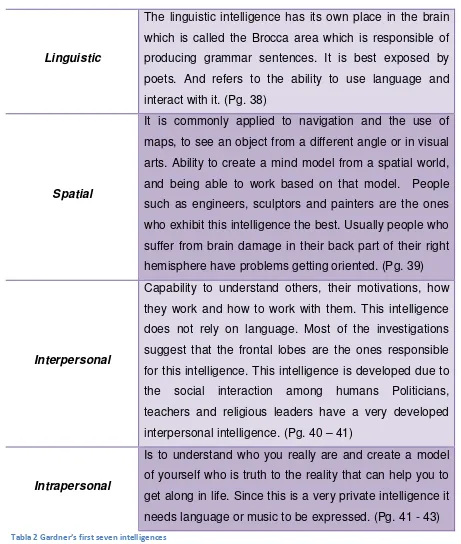
The intelligences that Gardner (1993) proposed are described in the following chart2:
Intelligence Description
Musical
Though this intelligence is not located in a specific area of the brain, most of its connections happen on the right hemisphere. The ability to sing, play musical instruments, and compose music. (Pg. 35)
Bodily-Kinesthetic
It is located on the motor cortex and each side of the brain is responsible for controlling the parts of the body on the opposite side. Is the ability to solve problems using the body or parts from it. However, equations cannot be solved by using the body, emotions can be expressed through dance or you can create new products/inventions with it. Dancers and artisans show a total developed intelligence. (Pg. 36 - 37)
Logical - Mathematical
Refers to solving mathematic and logic problems, as well as to the scientific ability. People with a high level of this intelligence are able to solve problems in a quicker way than others. This intelligence has a nonverbal nature in which the solution of a problem is often built before it is articulated. This intelligence is the one that appears on the IQ tests and Jean Piaget is one of the biggest researchers of this intelligence. (Pg. 37 - 38)
2
37 Linguistic
The linguistic intelligence has its own place in the brain which is called the Brocca area which is responsible of producing grammar sentences. It is best exposed by poets. And refers to the ability to use language and interact with it. (Pg. 38)
Spatial
It is commonly applied to navigation and the use of maps, to see an object from a different angle or in visual arts. Ability to create a mind model from a spatial world, and being able to work based on that model. People such as engineers, sculptors and painters are the ones who exhibit this intelligence the best. Usually people who suffer from brain damage in their back part of their right hemisphere have problems getting oriented. (Pg. 39)
Interpersonal
Capability to understand others, their motivations, how they work and how to work with them. This intelligence does not rely on language. Most of the investigations suggest that the frontal lobes are the ones responsible for this intelligence. This intelligence is developed due to the social interaction among humans Politicians, teachers and religious leaders have a very developed interpersonal intelligence. (Pg. 40 – 41)
Intrapersonal
[image:37.612.74.535.97.641.2]Is to understand who you really are and create a model of yourself who is truth to the reality that can help you to get along in life. Since this is a very private intelligence it needs language or music to be expressed. (Pg. 41 - 43) Tabla 2 Gardner’s first seven intelligences
38
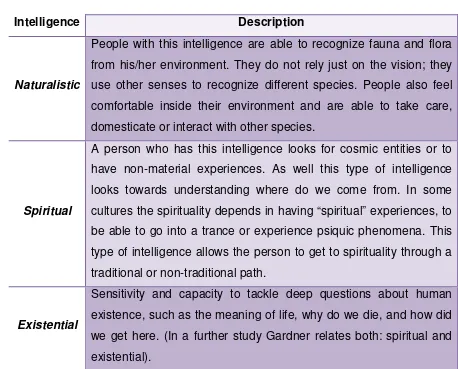
intelligences (see Table 3), and broadening the concept of intelligence as mentioned before.
Intelligence Description
Naturalistic
People with this intelligence are able to recognize fauna and flora from his/her environment. They do not rely just on the vision; they use other senses to recognize different species. People also feel comfortable inside their environment and are able to take care, domesticate or interact with other species.
Spiritual
A person who has this intelligence looks for cosmic entities or to have non-material experiences. As well this type of intelligence looks towards understanding where do we come from. In some cultures the spirituality depends in having “spiritual” experiences, to be able to go into a trance or experience psiquic phenomena. This type of intelligence allows the person to get to spirituality through a traditional or non-traditional path.
Existential
[image:38.612.71.529.143.512.2]Sensitivity and capacity to tackle deep questions about human existence, such as the meaning of life, why do we die, and how did we get here. (In a further study Gardner relates both: spiritual and existential).
Tabla 3 Gardner's three subsequent intelligences
39 8.3. Learning Styles
Researchers as Ríos and Valcárcel (2005) mentioned that strategies are important in the practices of EFL teachers when dealing with reading, and other such as Trengrove (in Brumfit and Carter 1991), and Brumfit (in Brumfit and Carter 1991) mentioned that strategies help teachers to use literature inside an EFL classroom. Therefore, it is important to bring to the table the theory of learning styles and strategies since it is a theory created specifically for an EFL / ESL context which encompasses the four skills of language learning.
Rebecca Oxford is a scholar who has deeply investigated about how does language learning occur, she has devoted several studies into discovering what are the specific characteristics and elements learners use to learn the target language they are studying. The author was the first to build a theory regarding learning styles and strategies in which she establishes a difference among them. Styles refer to “the general approaches […] that students use in acquiring a new language or in learning any other subject” (Oxford R. , Language learning styles and strategies: an overview, 2003), while strategies are, in general terms, specific actions each person takes in order to retain information.
Oxford clarifies in her work: ‘Language Learning Styles and Strategies: an Overview’ (2003) that styles and strategies apply to students who are learning
either a second language or a foreign language.
“Language learning styles and strategies are among the main factors that
help determine how –and how well –our students learn a second or foreign
language. A second language is a language studied in a setting where that
language is the main vehicle of everyday communication and where
abundant input exists in that language. A foreign language is a language
studied in an environment where it is not the primary vehicle for daily
40
As the purpose of this investigation is to get acquainted with what is being done inside the English classes of the BA Degree in Modern Languages at the Pontificia Universidad Javeriana; the theory of Oxford is relevant in regard to what is being done with literature inside en English EFL classroom, and witness whether the teacher is taking into account the different personalities of his/her students to motivate them into literature.
41
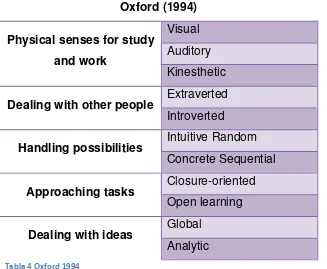
Oxford (1994)
Physical senses for study and work
Visual Auditory Kinesthetic
Dealing with other people Extraverted
Introverted
Handling possibilities Intuitive Random
Concrete Sequential
Approaching tasks Closure-oriented
Open learning
Dealing with ideas Global
[image:41.792.385.727.102.457.2]Analytic Tabla 4 Oxford 1994
Oxford (2003)
Sensory preferences
Visual Auditory
Kinesthetic (Movement-oriented)
Tactile (Touch-oriented)
Personality types
Extraverted vs. Introverted Intuitive random vs. Sensing sequential
Thinking vs. Feeling
Closure-oriented/judging vs. Open/perceiving
Desired degree of generality
Global or Holistic Analytic
Biological Differences
[image:41.792.66.393.121.390.2]42
Sensory Preferences
Visual Learners who learn through visual
means as books, video or graphics.
Auditory Learners who learn through listening and speaking activities as debates.
Kinesthetic (movement oriented)
Learners who learn by doing actual things as building models or moving around the room. They prefer classes in which they can move.
Tactile (touch oriented)
Personality Types
Extraverted vs. Introverted Extraverted learners feel more comfortable working in groups, having debates, playing games or having simulations inside the classroom. They tend to build a lot of relationships, few are deep but mostly they are not. While introverted learners prefer to have more independent and autonomous learning; they feel more comfortable working in groups if they know well the people with whom they are working with. The relations they build are few but deep.
Intuitive random vs. Sensing sequential
43
Thinking vs. Feeling Thinking learners usually want to be perceived as competent but they do not praise easily. Also, they are very straightforward even if they hurt people’s feelings. Feeling learners value their classmates; they tend to be very respectful with others and like to be respected as well. Also They show empathy through words.
Closure-oriented/judging vs. Open/perceiving
Closure oriented learners prefer working with deadlines and plan ahead of doing, they also like specific tasks. They are constantly looking for clarity as soon as possible. Open/perceiving learners do not like deadlines and enjoy discovery learning which is “picking information in an unstructured way.”
(Oxford R. L., 1994)
They view their learning process as an enjoyable activity rather than just tasks.
Desired degree of generality
Global or holistic Learners who like to find the main idea, predicting what will happen and avoid breaking ideas into parts. They like to interact.
Analytic Learners who prefer details and
44
communicative activities.
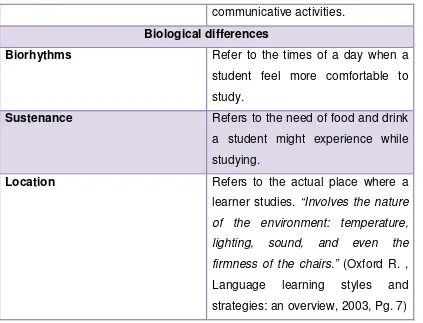
Biological differences
Biorhythms Refer to the times of a day when a student feel more comfortable to study.
Sustenance Refers to the need of food and drink a student might experience while studying.
Location Refers to the actual place where a learner studies. “Involves the nature of the environment: temperature,
lighting, sound, and even the
firmness of the chairs.” (Oxford R. ,
[image:44.612.80.503.102.425.2]Language learning styles and strategies: an overview, 2003, Pg. 7) Tabla 6 Oxford 1994 and 2003
Learning styles present a different perspective to standardized education, where the teacher is able to identify the different personalities there are inside a classroom. As they get to know their students better, they can present in a much effective way a demanding topic as literature is. Learning styles provide the opportunity to create new material that will suit the needs of different students. Working with learning styles is not a matter of doing in one class material for all the different learning styles, but throughout the semester to be able to face literature with different activities that involve all students, instead of just presenting the literature as something that will be just read and evaluated.
45
with different literature activities that can be done with respect to the strategies Oxford (2003) proposes.
8.4. Learning Strategies
As mentioned before, strategies are important matters when teachers are dealing with literature inside an EFL class. Most of the time they make easier the teachers’ practices since they offer different ways to approach EFL content, such as literature.
Oxford (1990) proposes a set of strategies which are the specific actions each student takes to learn better the language. She divides them in two groups. Direct ones which “directly involve the target language [and] require mental processing of the language” (Oxford R., 1990, pg. 37) and indirect ones that “support and manage language learning without directly involving the target language.” (Oxford
R.,1990, pg. 135)
The following is the list of direct strategies Oxford presents in her works. Only direct strategies are presented since they are more conscious actions than indirect strategies. Some activities to foster strategies while using literature in the EFL class are explained below The examples of activities given were proposed by the author of this investigation, though the names of each strategy were taken literally from Oxford’s works.
Direct Strategies
Memory Strategies
Creating Mental Linkages
46
• Associating/elaborating: relating new knowledge to content that is already in the memory. “Associations can be between two things, such as bread and butter.” (Oxford, 1990, pg. 41)
• Placing new words into a context: refers to the use of these new words in a conversation or a written text.
Applying Images and Sounds
• Using imagery: relating language information to a visual context, either in the mind or an actual drawing. When teaching literature, teachers can use paintings of the same period of time and country to show how this two were related. In example when reading Wuthering Heights, teacher can show students the painting Wanderer above the Sea of Fog and make students relate what they are reading with the image.
• Semantic mapping using keywords: This refers mainly to learners who are more visual since the main purpose of this strategy is to arrange words with lines or arrows.
• Representing sounds in memory: this strategy can be best developed with auditory students because the idea is to remember the word and its meaning by the sound it makes. When reading literature, reading out loud would be very useful to promote this strategy.
Reviewing Well
• Structured Reviewing: This strategy refers to a type of reviewing known as “spiraling” as the student goes back to what he has learned. It is divided in periods of reviewing: “10 minutes after the initial learning, then 20 minutes later, an hour or two later, a day later, 2 days later, a week later and so on.
Employing Action
47
• Using mechanical techniques: This strategy makes the process of learning tangible, with techniques such as using cards with the words students are learning which are organized in one stack as “new knowledge”, but then when learners already know the information they put those cards in a new stack, making visual the learning process.
Cognitive Strategies
Practicing
• Repeating: when using literature specifically poems or plays this a great strategy to use with auditory students.
• Formally practicing with sounds and writing systems: as the above strategy this would be a useful tool with auditory students, as well as with linguistic students who will enjoy writing the new words.
• Recognizing and using formulas and patterns: this is mainly a grammar strategy which refers to the tenses formulas (I eat, I ate, I am eating, etc.)
• Recombining: this strategy refers to the creation of sentences from phrases.
• Practicing naturalistically: This strategy would be mainly use a literature class, in which learners will be practicing what they have already learned from the language in an authentic way. In the case of literature books will be the tool they use.
Receiving and Sending Messages
• Getting the idea quickly: This, as well as other strategies, is well applied in a literature class because it refers to can or skim a text in order to get the main idea quickly.
48 Analyzing and Reasoning
• Reasoning deductively: top-down strategy, from general to specific. • Analyzing expressions: determining the meaning of new expressions
in target language. Using morals of fables, learners can guess what they mean.
• Analyzing contrastively (across languages): “comparing elements such as sounds, vocabulary and grammar […] to determine similarities and differences.” (Oxford, 1990, Pg. 46)
• Translating: this is a strategy that in a literature class can be used to compare how different editions, from different countries, have changed the words, and see if maybe the meaning has been changed. Also, it will help learners when they are working with ancient literature to have the opportunity to see in their own language what they are reading.
• Transferring: “directly applying knowledge of words, concepts, or structures from one language to another.” (Oxford, 1990, Pg. 47) Creating Structure for Input and Output
• Taking notes
• Summarizing: see for further information on strategies to make summaries Ronald Carter – Linguistic Models, Language and Literariness: Study strategies in the teaching of literature to foreign students.
• Highlighting
Compensation Strategies
Guessing intelligently
49
French to Spanish. In the expression association sans but lucrative the learner is able to identify the words (association and lucrative) both in English and Spanish. The word sans is similar to sin, and the final word but can be taken through context, since we use almost the same expression in Spanish: asociación sin ánimo de lucro.
• Using other clues: this other clues refer to non-linguistic clues that learners use in order to guess the meaning of written or auditory material. They might come from different sources such as “knowledge of the context, situation, text structure, personal relationships, topic, or ‘general knowledge’.” (Oxford, 1990, Pg. 49 - 50)
Overcoming limitations in speaking and writing
• Switching to the mother tongue: using the mother tongue when learners do not know the word. For example: I am feliz. Or “adding word ending from the new language onto words from the mother tongue”. (Oxford, 1990, Pg. 50)
• Getting help: asking for help by hesitating or by asking directly. • Using mime or gesture
• Avoiding communication partially or totally
• Selecting the topic: learners select the topic of a conversation in order to feel comfortable with it.
• Adjusting or approximating the message: “saying something slightly different that means almost the same thing.” (Oxford, 1990, Pg. 50) • Coining words: “making up new words” (Oxford, 1990, Pg. 50)
50 8.5. Age
The last section of this theoretical framework has to do with one of the topics mentioned by the authors which is the age. Though many times it is not considered, when selecting texts is important to know the student’s likes and interests, as well as their age. In the following section it will be exposed how the age directly affects the likes, the perceptions of the world and the interest of the individuals. Adolescence and early adulthood will be exposed since a survey conducted in the last three levels of Low Advanced English showed that the population’s age varies between 17 and 26 years old. It is important to know the population because BADML English teachers’ practices are addressed to it.
Adolescence
The adolescence is a period considered to take place between 12 years until 19 or 20 years. According to Piaget (1994), in this stage humans develop formal thought which is a thought that presents a major difficulty than the concrete thought, presented throughout childhood. It is seen as a thought of second order; this was explained by Piaget (1994) as the ability to think beyond the things that a person can see. In other words, this means to abstract think or think in hypothesis rather than the actual propositions of language; to think in ideas, rather than things. Following the previous idea, Piaget (1994) describes also the affective development of adolescents, in which they use this ‘hypothetic – deductive’ thought to make a living plan. This explains why adolescents think the most in changing the world. Most of them are uncomfortable with the actual society hence they create discussion groups in which they share their ideas with peers (Feldman, 1997), and so, very often, adolescents look for spots of time to share with their friends and classmates which is the most important part of their affective development.
51
not a clear reason for this as indicated by Feldman (1997). He suggests, on the contrary, that this decline might be due to the way in which teachers grade students, as they grade older students more stringently, though students remain in the same stage of cognitive development as the younger ones.
Following the previous concepts of schooling, Philip Rice (2000) proposes that during adolescence teachers should allow students to participate in discussion groups and to have a social exchange with their classmates. He also suggests that for potentiating the formal thought students should have the opportunity to have discussions to solve problems or science experiments. Teachers should be willing to give feedback and to help and motivate students in their learning.
Although adolescents tend to share their ideas and time with their peers, Elkind (cited by Feldman, 1997) and Piaget 1994 introduce the concept of adolescent egocentrism in which adolescents view the world from their own point of view, meaning that all the ideas they create have as a main character themselves. This leads, then, to what Feldman (1997) described as personal fables, in which some adolescents believe that what they experience is unique and no other person shares what they have been through, also this gives them the idea that they are immune to everything.
52
Hoffman et al. (1996) propose that the adolescence is the period where all the abilities coordinate themselves and this allows as mentioned before by other theorists to think about the future and create hypothesis.
Early adulthood
The early adulthood takes place between 19 or 20 years until 40 years. This stage was first suggested by Gisela Labouvie-Vief in 1990, who continued Piaget’s study about development stages by considering a new cognitive stage which is called the postformal thought defined as follows
“(A) thinking that employs metaphors, confronts society’s paradoxes, and
involves a more subjective understanding […] Such thinking is more flexible;
it allows for interpretative processes and reflects the fact that reasons
behind events in the real world are subtle, painted in shades of gray rather
than in black-and-white.” (Feldman, 1997, pg. 457)
This means that early adults are not just thinking about themselves, and are not criticizing the society they live in just for the sake of criticizing it. They have already found their place in the world, and know that everything has two or more sides. In contrast with adolescents, young adults already know who they are and are willing to take advantage of that for their living plans. That is why Feldman (1997) proposes that at this time, young adults are enjoying the best of their physical, emotional and intellectual abilities.