Conversation Analysis of EFL Classroom Interaction: An approximation to understanding Teacher Talk
ELVIS GUSTAVO BELTRÁN VALENZUELA LUISA FERNANDA SUÁREZ RAMÓN
PONTIFICIA UNIVERSIDAD JAVERIANA FACULTAD DE COMUNICACIÓN Y LENGUAJE
LICENCIATURA EN LENGUAS MODERNAS BOGOTÁ, D.C.
Conversation Analysis of EFL Classroom Interaction: An Approximation to Understandig teacher Talk
ELVIS GUSTAVO BELTRÁN VALENZUELA LUISA FERNANDA SUAREZ RAMÓN
Degree project submitted in order to opt for the Degree of “Licenciados en Lenguas Modernas”
Mentor:
ALVARO H. QUINTERO P.
PONTIFICIA UNIVERSIDAD JAVERIANA FACULTAD DE COMUNICACIÓN Y LENGUAJE
LICENCIATURA EN LENGUAS MODERNAS BOGOTÁ, D.C.
Comments
_____________________
_____________________
_____________________
_____________________
_____________________
_____________________
______________________
Juror
_____________________
Juror
Acknowledgements
We would like to express our gratitude to:
- God who was the one who guided us throughout this project and helped us do the correct things.
- Our families because they were always there, supporting and helping in all that we needed in order to continue, especially our mothers, Aura Maria Valenzuela and Gilma T. Ramón.
- Our advisor Alvaro Quintero, who helped us in the making of this project and for his guidance and useful ideas to build and make sense of this investigation.
- Sandra Ramos, who from the beginning let us observe her English lessons and gave us the necessary information for the development of this research, and in general to Normal Superior Distrital Maria Montessori school for giving us its help and cooperation to get there.
- Universidad Distrital’s students, who in a polite and kind way answered some surveys that helped us delimit our final topic.
- Magda Rodriguez who helped us check and correct our study giving her ideas and time in a nicely way.
WARNING
Abstract
The main objective of this study is to analyze and describe the classroom talk that exists between the participants of a foreign language classroom. This description is made with the use of the methodology of conversation analysis (CA) now that it offers tools to analyze and categorize the talk produced during the lessons. The transcriptions made of twelve sessions, which were videotaped during the years 2006 and 2007, will be used to identify the characteristics and organization of the interaction between the teacher and the students during the English lessons.
Taking into account that, in a foreign language classroom, there exist different factors that can be discernible and studied, we focused our attention on what characterizes an EFL teacher’s talk in a preview - view – review classroom, and on constructs like classroom interaction, turn taking, turn allocation, and two particular speech acts that called our attention during the observation of the classes. Those speech acts are: clarification request and confirmation check. Bearing in mind that these two aspects are the result of an inspection to the use of the PVR method by a bilingual teacher in a non-bilingual context, we made the decision to observe both of them.
The analysis done to this English course might be used as a recommendation for teachers to keep in mind the importance of giving more opportunities to students to interact and for teachers to consider their pedagogical teaching weaknesses.
Resumen
El objetivo principal de este estudio es analizar y describir la conversación del salón de clases que existe entre los participantes de un salón de lengua extranjera. Esta descripción es realizada con la metodología de Análisis de la Conversación (CA) puesto que éste ofrece las herramientas para analizar y categorizar el dialogo producido durante las clases. La transcripción de doce clases, que fueron video grabadas durante los años 2006 y 2007, serán utilizadas para identificar las características y la organización de la interacción entre la profesora y los estudiantes durante las sesiones de inglés.
Teniendo en cuenta que en un salón de lengua extranjera existen diferentes factores que pueden ser evidenciados y estudiados, nosotros nos enfocamos en lo que caracteriza el habla de un profesor de lengua extranjera en un saló donde se ve el PVR y en conceptos como interacción en el salón de clases, turnos de intervención, asignación de turnos y dos actos de habla que llamaron nuestra atención en particular: aclaración solicitada y confirmación revisada. Teniendo presente que estos dos aspectos son el resultado de una inspección del uso del método PVR por una profesora bilingüe en un contexto no bilingüe, nosotros tomamos la decisión de observar los dos.
El análisis realizado a este curso de inglés podría ser usado como una recomendación para los profesores para que tengan en cuenta la importancia de dar más oportunidades a los estudiantes de interactuar y para los mismos profesores de considerar sus debilidades pedagógicas en la enseñanza.
Table of Contents
Abstract
Introduction 01
Justification 04
Literature review 06
Interaction 07
Teacher Talk 16
Turn Allocation 18
Student Talk 19
Turn Taking 21
Speech Acts 22
Clarification Request 24
Confirmation Check 25
Research design 29
Problem statement 29
Research objective 32
Type of study 32
Profile of participants and Setting 34
Methodology 34
Data Collection Instruments& procedures 35
Type of data 39
Data analysis 43
Clarification request 45
Conclusions 59
Implications for further pedagogical and research practice 61
References
List of illustrations
List of Annexes
Students’ Consent Notes 64
Introduction
The purpose of this research is to study the interaction between the pupils and the teacher of some foreign language classroom lessons. This survey first started as an intention to comprehend and witness the application of a modern method that an English teacher used in her lessons in a 6th grade context of a public school in Bogotá. This method called Preview - View - Review (PVR) works alternating the mother tongue – in this case Spanish – and the foreign language – English – in order to get a better understanding of the last one through the first one. For us as researches and student-teachers, finding this strategy was a motivation to continue with the study, but we wanted to advance and investigate more not just the method, but also other events that happen in the classroom. As a result, we went to a complete and deep analysis of the relationships and communication that both participants had and, at the same time, of the method being used by the teacher.
This decision of observing the relation between participants emerged as a result of monitoring the student’s behavior and our curiosity to see how learners were being affected by the teacher’s pedagogical strategies, like asking questions. That is why the investigation includes categories such as teacher and student talk, that involve turn taking and turn allocation, actions related to the speech acts in which we find clarification request and confirmation check to determine if there is real conversation that involved the participants (teacher and students).
In the same way, the study takes into consideration the area in the literature that is conversation analysis, which involves the interaction that teacher and students have when analyzing their own conversations and relations in each lesson.
Then this study is carried out from some data analyses done to a few paragraphs taken from a video recording transcription of twelve EFL lessons. Data analysis was done using some approaches recommended in the conversation analysis structure to interpret the data gathered (Lerner 2004).
In such a way, the two speech acts, clarification request and confirmation check, were highlighted. These two speech acts were selected after analyzing the actions that the teacher made in class through the video recordings, such as repeating more than once questions in order to get a correct answer, correcting in an indirect way what was said incorrectly, confirming that what was said was good or to prove if the topic of the lesson was understood paraphrasing or repeating with a different tone of voice and at the same time to observe the students’ actions in front of the lesson, like students’ and teacher’s participation.
Moreover, the careful reading that we did to some other investigations made by other students from our university and some other universities, were taken into account for complementing the necessary information for our study and for making it easier to understand different processes and terminologies used in this kind of research study.
Justification
The interaction and the communication that occur in a classroom can be managed in different ways depending on the context and the participants that are involved. In this interaction we can perceive the relationships that happen between teacher and students and the way the teacher controls the class and encourage a students to participate and work in class. Sometimes, teachers prefer to apply new strategies in order to change traditional methodologies and to experience new techniques with the learners to see their process, but the results are not always the expected ones because that interaction that is supposed to exist is more remarkable for one of the participants, in this case the teacher. According to this, we want, with this study, to understand what a classroom conversation practice like, what is involved and what the events that occur in there are.
In our study, as have mentioned before, the original purpose was to describe the steps through which the PVR method was going to be applied with the students and its different characteristics. However, since we became more interested in the type of relations that were coming out between the two agents of the classroom, we decided to observe the classroom interaction of the group. That interest arose because of the analysis of the recorded classes: the details that we noticed in them and the multiple events that we found interesting and useful to study. That is why this research is important because, through the examination of the participants’ behavior (teacher and students) towards each other, we can consider that a method like the PVR when applied to a new pedagogical agenda which is, when the teacher uses it on her lessons, has to involve the human interactions that are still vital for a good learning process.
behavior and attitudes in this case the teacher. That will be observed in the data analysis where, by making use of clarification request and confirmation check, will conclude the kind of teacher talk that is present.
Some of the possible benefits that can be accounted for in this investigation are: to observe the possible faults that we might not want to repeat as future teachers. In some way, we will offer a kind of guide for the readers of this document. Also, this study will help us redefine our own view of the concept bilingualism that we took into account in a previous study as a consequence of looking closer at the talk in a specific setting (sixth grade classroom in the analysis of interaction).
Literature Review
Our research project took into account some pertinent concepts such as classroom interaction, teacher talk, student talk, turn allocation, turn taking, speech acts and finally, clarification request and confirmation check to support what we studied in sixth grade English sessions that were video taped during the years 2007 and 2008 in the public school Escuela Normal Superior Maria Montessori.
In this part of our research we are going to discuss the topics and the characteristics that contribute to the analysis of conversation in our study. Although we based ourselves on some authors who discussed this topic, which are represented throughout our research, Tsui (1995) was the one that we took into account the most for the study because his definitions and examples were manageable for us in the initiation in studying classroom talk.
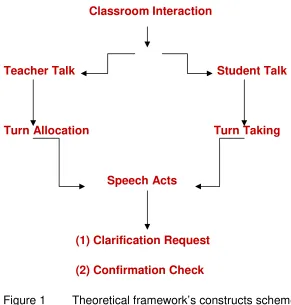
The following diagram shows a more detailed structure of the order and sequence with which we will discuss the concepts in this chapter.
Classroom Interaction
Teacher Talk Student Talk
Turn Allocation Turn Taking
Speech Acts
(1) Clarification Request
[image:17.595.148.439.417.722.2](2) Confirmation Check
Before beginning to explain the characteristics and subdivisions of classroom interaction that make part of our theoretical research scheme presented above, we will begin by remaking important aspects that Tsui (1995) mentions in his book Introducing Classroom Interaction, which gives a complete definition and relation between most of the terms that we worked on, and that make part of the classroom interaction as well. With this theory we could understand and realize how classroom interaction is composed and how this concept contributes to our study. Also, it mentions a real definition of a classroom as a point to start clarifying and introducing our study in an organized and clear way. For instance, Tsui explains the features that we can find in a classroom and the participants that act together in there, giving a better idea about what classroom interaction is composed of.
Interaction
We, as novice teacher researchers, have noticed the role that teachers and students play in the classroom and the relationships that can take place in it. Each of them has a purpose and a specific function, and it is relevant to take into account that in interaction, specifically the classroom interaction, the classroom‘s nature be fundamental. According to Tsui (1995. p 1) “The classroom can be defined as a place where more than two people get together for the purpose of learning, with one having the role of teacher.” In this interaction there is one who is in charge of establishing the topic for conversation (teacher) and who most of the time encourages the interlocutor to participate (student); the teacher, may have some expectations and ideas about the lesson. Nevertheless, there is uncertainty about what the teacher wants to achieve and what actually could happen. According to Malamah-Thomas (1987) the idea of having a lucrative session, involves the way this one is planned, so when the lesson is well prepared it becomes a fruitful one.
only as teachers who transmit knowledge, but also as students who receive and internalize that information. Now well, if both teacher and student take advantage of such lessons, there might be a significant and satisfactory class.
On the other hand, there are some aspects that can affect the classroom interaction in a negative way, so what the teacher and students expect does not occur. A fact that could influence the classroom interaction would be the learner’s attitude or motivation towards the session. Therefore, if students adopt the attitude not to participate in the activities intended by the teacher to give the lecture, they might lose the opportunity to learn a new concept offered by the teacher, and at the same time, the teacher might feel disappointed of the students’ behavior and little interest in learning.
Another fact that could impact in the classroom interaction might be the context in which the lesson is developed (school), the resources to develop the lesson (tools), and the teacher’s preparation of the class, which is the strategy used by the teacher to catch students’ attention. Keeping in mind that conversation is the mere study of talk in interaction between two or more people, in our case the teacher and the students’ talk; there would be important communication to transmit in this case knowledge, and for sharing and learning from the other person.
In the classroom interaction there are two important features, teacher talk and pupil talk as Flanders (quoted in Malamah Thomas 1987) says. Founded in our interests such establishing and relating the concepts that the diagram presented at the beginning of this chapter involves, we will take into account these two categories that then they will be illustrated in the sub-sections of teacher talk and student talk in our theoretical framework.
and when the expected goals are accomplished. Thus, when the teacher works on a specific issue during the whole class and the students understand the theme and take part in its discussion, it is when learning occurs through classroom interaction.
By contrast, a possibility of no interaction between the two participants is because, most of the times, the language used by the teacher during the practice is not as understandable as she thinks, so the student’s learning and interaction can be affected. Wells (quoted in Tsui, 1995) did a study where he compared student’s mother tongue language both at home and at school, and he found that students did not speak at school as much as they did at home. Instead, they tried to use simple words and sentences as well as make fewer questions, simply because the teacher was the one who talked the most, the one who chose the topic that was going to be discussed and the one who placed most of the questions and demands. As a result, students acted in a passive role of answering questions and carrying out teacher’s instructions.
Wells says that while parents included meanings in children’s words, teachers developed meanings that they introduced in the conversations and they expected students to follow their line of thinking. It means that the teacher would not go directly to the result of a situation or to the meaning of a word by simply giving the definition of it to the learner, but instead she would rather have them think and analyze what the result of that situation could be by making use of their own means and capacities.
students only use the target language in the classroom, the content and interaction that are used in that moment are central.
On the other hand, there are two types of learning, the conscious and the unconscious one. The first one is when the teacher says something explicitly and asks students to practice it, and the unconscious one is when the teacher or students just mention an anecdote or an experience expressing their own ideas. Here we can highlight the importance of the language in a context in order to have an active participation by students and the teacher.
According to Tsui (1995 p.7) in classroom interaction we can find different aspects such as teacher talk, input and interaction, student talk and classroom observation. Each of these aspects comprises some pertinent sub-divisions that give a clearer definition of their function in the classroom interaction.
The first one, teacher talk, has a specific characteristic in the classroom that is discernible through the constant use of questions. This feature, question, is used by the teacher in almost every part of the class in order to check students’ understanding. Together with the examination of learner’s knowledge, it is used for analyzing the way students can put in practice the new information. There are different types of questions such as open, close, display and referential ones that are used depending on the flow of the lesson and the students’ needs. The questions asked to the class are useful because they provide students with practice and help them use the target language for communication. From this point of view, questions have a significant value in classroom interaction.
Considering this aspect, we can say that, as observers of the 604 classroom interaction, we were able to witness the different techniques that the teacher used in order to explain the several topics in the easiest way to the students; so they could understand them faster and more accurately. Some of the following characteristics that Brown and Amstrong mentioned in their study (quoted in Tsui 1995, p. 31) are the techniques used by the teacher in the classroom.
Higher levels of cognitive demand
More linked statements referred to as “key”, leading to a solution to the problem, each of which is understood by the students
More framing statements outlining the sections of the explanation
More focusing statements highlighting the essential features
More frequent use of examples, audiovisual aids
More theoretical questions as attention-getters
These characteristics make emphasis on the way the teacher begins to prompts questions to students in a more complex structure. So that, the students start to use more compounded words that require a higher level of language use. Nevertheless, at the same the teacher starts to demand students an upper use of the language she would need to use more sophisticated tools for increasing their understanding and making their learning process easier.
response” (Tsui 1995, p. 42). According to this, in each classroom the teacher is the one who can approve or not what a student has just said in order to expand students’ foreign language knowledge. So for example, if a student gives an answer to a question made by the teacher and this one does not reply anything back to the student (e.g. “good” or “try it again”), the learner might believe that what he uttered is somehow incorrect. But, in addition to such correction the teacher should be aware of how to do it, so the student will not get a negative evaluation and it would not affect his/her learning process.
Considering this last remark there are two kinds of feedback that have place in the classroom. One in which the teacher gives negative comments and affects the student’s process, creating frustration and decreasing student’s participation; and the second one where the opposite occurs. The teacher gives positive comments and encourages the students to participate and create a good atmosphere in the classroom.
After having examined the teacher talk concept, which is the first aspect that makes part of classroom interaction, we move to the second feature proposed by Tsui, that also makes part of this general theory; this is input and interaction.
This issue is also significant to the teacher talk theory because it is related to the way teachers modify their participation so that the students can understand easier and better. For example, in their speeches, the teacher should try to do it in the best way like speaking slow, reducing contractions, using more standard pronunciation and very articulated enunciation, so it can be easier for the student to follow. Related to syntax, teachers are likely to use simple and short sentences, in terms of basic vocabulary with simple structures. Besides, they modify the way they ask questions in order to get the students’ attention, the most common of which is repetition.
occurs in the classroom in order to understand the teaching and learning processes that take place. These are some common teacher’s behaviors:
* Accepts feeling: it talks about the manner the teacher has to talk to the student in a positive or negative way.
* Praises or encourages: such as making jokes in order to liberate tension
* Accepts ideas of students: develop students’ ideas
* Asks questions: ask questions related to the content to get student’s answers
* Lecturing: giving opinions, ideas, and explanations
* Directions: commands or orders that students should accomplish
Based on those aspects, we could say that in each English class that we observed from our investigation, we could evidence some definitions that interaction deals with. Very often we could see how students told jokes to each other related to some mistakes they did during their participation. Sometimes the mispronunciation of a word was a reason for laughing on both sides, teacher and students’. In certain classes the teacher took into consideration the students ideas and tried to add more information or paraphrase what they were trying to say, in order not to reject their suggestions and possibly demoralize them. Moreover, one remarkable feature that we could perceived in the classroom was the one related to the orders the teacher constantly gave to the learners directions. Most of the times the students were required to change places, to cooperate in the role plays and behave during the lessons. So in that way the interaction between the teacher and the students was, in some way, represented in our study.
During their participation, learners can produce not very comprehensible ideas and the teacher asks questions in order to confirm if what they said was what she understood. It is possible that the relationship between the teacher and the students improve a little as a result of the interest the students get in what is being explained by the former.
Also, the topic that is established could be a main factor for catching students’ attention to the subject. Finally, the teacher would achieve the goal of, on one hand, making students understand the topic that is being worked in the classroom and, on the other, having real attention from the students, as well as, an improvement of the relationship between them and the teacher.
Following the structure proposed by Tsui in order to define classroom interaction, the next topic to be observed will be student talk. As Malamah-Thomas proposes (1987), the talk of the student is observable from three general points of view: pupil talk response, initiation, and silence. The first one is the reaction of the student regarding the teacher’s question. This is initiated by the tutor at the moment of settling an open question to the students in order to get their participation. Consequently, the response of a student depends on the structures settled by the teacher during the lecture. Furthermore, the talk of a student can be initiated by themselves with the purpose of expressing their own perceptions and interests. Here the students have freedom to express their thoughts and demands making detailed questions to his/her educator. The last point set by Malamah-Thomas is silence, which covers other types of verbal behavior or lack of it done by the teacher or the student. This last feature simply describes “the pauses, short periods of silence and confusion in which communication cannot be understood by the observer.” (p. 21)
learner not only learn to talk throughout time, but also they talk in order to learn. A reason for this idea is that apprentices are curious people who are interested in understanding the world that surrounds them and the different circumstances they experience through daily life. Also, he mentions that student talk is affected by the school context itself, now that before getting into school children tend to talk more.
Then, in the examination done by Tsui and Malamah-Thomas related to student talk gives us a clearer appreciation of the goal the teacher of our investigation was trying to achieve every time she “forced” students to talk during the lessons. This identifies the intention of the students when they spoke through the class and the reasons why, sometimes, they had to participate in such conversations. But, thanks to these attempts from students to try to express their ideas and try to take part in discussions is that the observation of the clarification request and confirmation check speech acts could be observed in our study.
Finally, classroom observation is the last characteristic of classroom interaction proposed by Tsui (1995). This is basically related to the observation of the class in terms of describing what goes on in a particular lesson. It is to give a systematic analysis of an outstanding phase of classroom interaction of the lesson; by systematic analysis we understand to give a detailed observation of the class, where the observer monitors the interaction of the group with the use of some parameters that he expects the partakers to accomplish. This examination can be done at the same time the interaction occurs or it can be derived from data recorded on video, audio or simply through the observation of the transcripts done of classroom discourse. Thus, the procedure that we went through at the time of analyzing the transcripts completed from the twelve video-taped classes during our study is what has been identified by Tsui as classroom observation. Therefore, we considered it pertinent to mention this fourth structure of classroom interaction presented by this author.
behavior of the teacher. Then, we will proceed to clarify the student talk issue and the aspect of turn taking behavior of the student. Subsequently, we will present a little discussion on speech acts and then we will show two of them that were used for our analysis, they are clarification request and confirmation check.
Teacher talk
One of the central features to talk about in classroom communication and interaction is teacher talk. As we know, the teacher is the one who shares knowledge and interacts with the students in order to make a good environment. Teacher talk, according to Malamah-Thomas (1987), is divided into aspects that are presented in the lessons. The first characteristic is when teachers accept feelings. In this way they have to clarify an attitude or feeling to the students in a positive manner. The next one is related to praises or encouragement. It is when a student does something like telling jokes or when she has a good behavior in order to release the tension off the classroom. Then is when the teacher accepts or uses students’ ideas, when he or she extends what the student says. Asking questions is another aspect to describe. Teachers have to ask something related to the content that she is teaching with the purpose of getting the answer from students related to the topic. With lecturing, teachers must give facts or opinions about any topic, so expressing ideas and giving explanations are useful techniques.
ideas must be rephrased and reorganized by the teacher. Repeat student’s
response exactly, after they participate. This can happen in a pattern drill. Asking questions, where answers are expected, also asking cultural question, like questions of the target people or country, or personalize, asking students personal question about their lives, making a relation between the lesson’s topic and their own experiences.
The second group is the direct influence, giving information or opinions or just asking rhetorical questions. Correcting without rejecting, tell the students what was the mistake without saying negative words. Discussing culture and civilization,it is related to talking about facts, culture and people in order to develop an interesting topic. Modeling, it means giving examples to students or mini dialogues to show them the pronunciations of the words. Orientation, in this part the teachers tell the instructions that students have to follow giving also a preview about what they are going to do. Personalize about self, it is important to take into account students’ anecdotes or tell something that involves him/her. Carry out routine tasks, for instance tasks like taking attendance, test papers, or making announcements related to class’ activities. Give directions and direct pattern drills, these two activities talk about the instructions the students follow, such as directions, commands, or statements in which they have to repeat or transform something. Criticize student’s behavior and response, when the student is not doing well teacher must show dissatisfaction through anger, annoyance, as well as when they make mistakes.
to them. Also, she oriented them for some activities that they had to do and at the same time she criticized students’ behavior in order to make them analyze their attitudes in the class. Finally, one of the most remarkable things and one of the most important for the English class following the method was the repetition. If the teacher said something in the FL she repeated many times for students to understand and follow the pronunciation.
Teacher talk is the moment in which teachers have the opportunity to communicate and to interact with students, by giving instructions, commands, explanations, feedback, etc as functions of a teacher. Now, we can reflect these aspects (direct and indirect influence) in each class that we observed, taking into account the teacher’s presence and performance with her sixth grade students. As we could see, the characteristics that build teacher talk were almost always used as a continuous progress of a class and as a process that teacher and students were facing in each English class.
So, if we focus on the important role that teacher has in an EFL classroom, we can identify aspects that affect (positively) the progress of the lesson and the interaction between teacher-student.
Finally, we find giving directions or commands from the teacher so the students can fulfill them. In this case teachers give some statements to change student’s behavior from a negative to a positive model and especially explaining why the teacher is doing that. As we could see, teacher talk deals with significant features such as making questions, taking students’ ideas and praising what they say, which take part in any classroom and which involve all the participants of the lesson. Thus, teacher talk becomes one of the most remarkable topics in our study from which we take into consideration others like turn allocation, student talk and turn taking that support and complement this teacher talk.
Turn allocation
to the whole class. The former can be used by nominating or by using gestures, according to Allwright and Bailey (quoted in Tsui, 1995); it is called personal solicit. The latter can be done by asking the question and looking round the class; it is called general solicit. This is found in the classroom when the teacher starts with general solicitors and then when nobody answers or takes the turn, she resorts to a personal solicit in order to keep the interaction and to progress with the lesson. The intention of some teachers in doing that is to get students’ attention because if teachers start with personal solicits, only that person who is nominated is going to answer the question or to follow the instruction. In some situations teachers use general solicitors when they do not receive any response from a personal solicit with the intention of releasing the pressure of that nominated student.
Solicits in this case have more functions, not only for checking students’ knowledge but also are used for two purposes. The first one as a classroom management device and the second one is to use them to organize the lesson or to introduce a new topic. Taking into account this kind of technique or strategy that teachers use in the classroom, we can say that through the sixth grade English classes we noticed how the teacher used that in order to interact with the students and to catch their attention. Besides, she introduced new topics using this pattern as a useful tool to make the class speak and participate.
On the other have, we have the description of the involvement of the students in the interaction that occurs in the classroom that is student talk.
Student talk
In this part, we will briefly retake the definitions given by Malamah-Thomas referred to pupil talk: response and initiation, and we will try to mirror them in the interactions that took place in the sixth grade lessons.
The specific one highlights the way the student answers to the teacher in a predefined structure where he is given a limited range of vocabulary to do so. Sometimes during the observation of the classroom, we perceived that the students had to use the words given previously by the teacher in order to respond to her question. However, what the learner was actually doing was repetition in order to memorize the structure. Two points of view that can be added to this specific aspect is that through the constant repetition of a structure the students could begin to get familiar with it and understand when to make use of them for being able to interact with the teacher and classmates.
Next, the second trait of response is choral where there is an equal response by the complete class or part of them. In this choral response, the teacher would ask students to practice the pronunciation of a phrase or word in order to improve students’ familiarity with the new terms. The teacher of this research would do this “choral” practice to urge students to pronounce correctly and promote participation. Finally, the last attribute of response is reading texts orally where students read aloud to the whole class. This strategy of reading aloud is basically checking students’ pronunciation and making corrections.
Moving on in the interaction diagram that we first proposed in this chapter, we will switch to the turn taking definition that helps understand the student talk issue.
Turn taking
In classroom interaction as we could see before, there are many features that are involved in a lesson and that the participants must take into consideration. Turn taking is done by students’ behavior; it is divided in solicited turns and unsolicited turns. One example of the first one is when the teacher is looking for an answer to a question; students answer the question when they are nominated to do so or when they take the initiative to answer. An unsolicited turn is when the student initiates a contribution. When the turns are always initiated, they are called self-selected. A turn taking behavior that teachers are not aware is private turns taken by students. One example of this situation is found in Allwright’s study (quoted in Tsui. 1995) where he found that one of the learners that were considered indifferent and uninterested in the language lesson by the teacher took private turns that were unnoticed. The student just practiced the target language with himself and did not share with the teacher or his classmates. For that reason, for the teachers it is important to take into account if the students take private turns that are comfortable to the student to make his turn public. Based on this theory and on this study, we can say that this kind of exercise or situation that is presented in a classroom could be seen in the sixth grade, where just few students showed interest and enthusiasm participating in the class or when the teacher just nominated some of them in order to get the answer that she was looking for. Also, we saw some of the students who preferred those private turns because they were
shy or were scared to be shown in public.
definition of clarification request and confirmation check that are considered to be speech acts.
Speech acts
When we speak any language we make some acts according to rules, in other words we make actions with words. A successful communication is made when speakers also share knowledge, beliefs and assumptions or when they add some rules of cooperative interaction. According to Celce-Murcia and Olshtain (2000, p.24) language works not only as a way to exchange thoughts and ideas, but also to perform social actions or functions. For this reason, these social actions are called speech acts and as Escandell (1993) says they are acts that speakers perform when they make words. According to Searle quoted in Escandell (1993), speak a language is taking part in a behavioral form conducted by rules. Learning to dominate a language is learning to dominate those rules.
In the research project of Aranza and Sánchez (2004), Searle says that a speech act is the emission of a sentence done in the appropriate conditions, is the minimum unit of the linguistic communication. The use of the language is ruled by principles, with these rules there are specific attitudes from the participants (the speakers) For instance, in an EFL classroom we can perceive the different acts that are in the communication, the teacher’s speech and the students’ speech, each one has a specific function and purpose depending on the objective of the lesson or the interest of the participants. In the sixth grade classroom, the teacher and the students made different speech acts that are characterized not only for the intention of each one, but also for the context.
there is a relation between that research and the one we made, because in the sixth grade, we realized how the teacher, being the bilingual, in order to progress with the lesson she answered what she was asking for. Also, as Araujo (1997) added in her conclusions, the teacher as the authority in the classroom, most of the times was focused on speaking alone more than dialoguing with the students about certain topic. In this case, we can mention how in the sixth grade lessons the teacher spoke sometimes to herself, it means only her speech was in the lesson, the reasons could be in order to make a clear explanation of the topic, as the students were not bilingual, or advance in the lesson to another topic. As a result, in this issue the teacher’s speech was remarkable and noticeable.
The speech acts are performed in a situation that gives contextual elements that help interpret the speaker’s intention, in this way contextual and social information make it possible for speakers to interpret each other’s intentions. When speech acts are uttered this can have locutionary meaning, based on the meaning of the linguistic expressions, for example “I am hungry” that describes the speaker’s state. At the same time it takes an illocutionary force when it acts as a request and has an intention, in the same example “please give me some food”. Also, when a speech act has perlocutionary force, it refers to the effect that the act has on the addressee. Thus, each speech act has these three dimensions: locutionary meaning, illocutionary force and perlocutionary effect.
Searle quoted in Celce-Murcia and Olshtain (2000) classifies the speech acts according to how they affect the social interaction between speaker and hearers in five different types of speech acts: declaratives, representatives, expressive, directives and commissives.
- Declaratives or performatives: are speech acts that change the world as a result of having been performed.
- Expressives: are the most important speech acts for learners of a second language, these ones express psychological states of the speaker or the hearer. Like apologizing, complaining and congratulating.
- Directives: are speech acts that enable speakers to impose some action on the hearer. With the directives the speaker expresses what she wants and then expects the hearer to comply. For instance, commands, orders and requests.
- Commissives: are speech acts that enable speakers to commit themselves to future actions, such as promises and refusals.
Taking into account this explanation of speech acts, we can say that in any communicative act we use them depending on the intention that we have at moment of express our ideas and thoughts. Now that the three dimensions of which a speech act is composed are basically the locutionary meaning, illocutionary force and perlocutionary effect, we will proceed to observe these characteristics through the analysis of the confirmation check and clarification request strategies.
Clarification request
is working on. So, through questioning she could proof two aspects: one to see if students really understand the theme of the lesson and second to perceive if they are following her ideas.
Tsui (1995 p.66) mentions that clarification request is used when the speaker needs help in understanding what the previous speaker has said. A common way of asking for clarification is “What do you mean?” For instance:
C: Do you get satisfaction, though?
B: Yes. I reckon you get more satisfaction as you go up the scale as well.
C: (laughs) What do you mean, the money scale?
B: No, the job, the job (Tsui, 1995. p.66)
In this example C asks for clarification of the word scale, that he interprets as the money scale, and B clarifies that he is referring to the job scale.
Following up with the concepts that are shown in the diagram at the beginning of this chapter, we will conclude by explaining the last construct that makes part of our literature review.
Confirmation check
NS: What time did you finish? (question)
NS: Ten (answer)
NS: When did you finish? (question)
NNS: Um? [Uh? sic] (Repetition request)
NS: When did you finish? (Repetition)
NNS: Ten o’clock. (answer)
NS: Ten o’clock? (confirmation check) Tsui (1995 p.65)
NNS: Yeah
Sometimes students try to communicate their ideas and be understood by the receptor (teacher), but as a result of not having enough vocabulary nor dominating the grammatical structures correctly, very often their messages are not fully understandable. In this kind of situations the teacher’s role play is to make an effort to understand the student’s ideas and through confirmation check give proof of a real understanding or not of the student’s message. In this example we can see how this situation is presented given by Fajardo (2008 p.13)
S6: French, and sometimes when I have er a big time I er pass my my holidays on
er climb (pronounced [kllmb])
T: yes, you spend your holidays emm practicing exercise, you mean climbing up
and down the mountains?
There is other kind of situations where the teacher uses the two techniques, clarification request and confirmation check, as a way to understand and clarify student’s ideas. For example: the teacher asks students what their dogs do when they are happy. (Tsui, 1995 p.66) (Author’s data).
T: Pauline
S: He /wæts/ the chair
S: He wets, wets the chair.
T: Wets? He makes them all wet? S: Yes
T: Oh!
In this example we can see how the teacher asks the student to clarify what she means by “wags the chair” then the student clarifies her previous utterance, and then the teacher paraphrases her answer and asks for confirmation.
Thus, with the extracts taken out from the transcriptions in our investigation, we could perceive how the teacher had to repeat herself some of the information to make students understand the content and make them take action in the classroom. Also, we observed how the teacher paraphrased what students wanted to say, in other words to make the message understandable. In our case and for the research project, we made emphasis in these categories because they are related to interaction and they are highlighted in the transcriptions of the sixth grade English Classes.
Through the presentation of this literature review we could establish some key concepts in order to move forward in our investigation. The two main aspects of our literature review were Clarification request and confirmation check, now that they were the aspects directly observed and examined in the research.
In our next chapter we will describe the research project of our study, where we will reveal the process carried out for collecting data and making the selection of the elements over which we analyzed the needed information in order to make the description expected in this study.
Research Design Problem Statement
Conversation is the way through which people communicate ideas and opinions. In a conversation there should be at least two people who agree, disagree or place views on a delineated topic to discuss about. When people communicate ideas, they can understand each other’s perspective. The objective of dialoguing with another person can include different purposes such as argue about a defined problem or simply transmit ideas and feelings. Also, the objective of conversation can be designated to construct knowledge on an equal basis which is mediated by language. That is what basically happens in the classroom context between the teacher and the students, but that sometimes might not take place because of some factors that could appear in these contexts and that we are, fundamentally, trying to point out in this investigation.
We could analyze that the students who participated in our study, learn different concepts from different subjects (mathematics, social science, English, arts, etc) that they are offered by the teachers day by day in the school context. Now, from our perception, one can deduce that students spend most of their daily time in the school and the great majority of the knowledge they acquire during their learning process is, mostly, determined by the teachers’ pedagogical strategies used during the lessons. Cummins (2000).
In these segments where the students and the teacher converse, discuss, agree and disagree on concepts and, beyond that, the students participate and the teacher makes the necessary amendments, is when classroom interaction is observable. In addition, a teacher sometimes might get a hand of some strategies for teaching his classes, probably as a way to vary the methodology and encourage students partaking which involves them more in the class development.
and Freeman (2001) called Preview-View-review (PVR). It called our attention for two main aspects: the first one was to observe the way the teacher taught the foreign language bringing into play the use of the mother tongue when necessary, and second was to see how the teacher was applying the method to a non-bilingual population, which would be more demanding to accomplish. Now that we wanted to observe in detail the use of the method during the sessions, we video-taped them and we made a journal of every single class.
The employment of the PVR method basically consists of using the mother tongue to contextualize students on what is going to be discussed throughout the lesson. It is, to show the students the topic that they are going to work on during the class but explained in Spanish. The teacher would do it through the use of a reading or by asking questions to them related to the topic. That is more known as a warming-up the teacher makes at the beginning of a lesson. Then she dictates the class in the foreign language trying not to make use of the mother tongue at all. Finally, the teacher makes a revision of the main ideas and formulates questions to the students in her mother tongue to check students understanding of the theme Freeman and Freeman (2001). In this first study we kept in mind some key concepts such as: bilingualism, code switching, translation and the PVR method itself. These issues led us to focus on the role of the teacher in the PVR method implementation as related to her interaction with her students.
who would participate or not. In other words the teacher is the one who dominates the lesson.
This thinking was, in someway, what we perceived in the teacher of our study. She considered herself as the person with the main role in the classroom interaction that occurred in the group. In that way she would allocate turns to the students all through the lessons, getting them to participate on the established topic. One example of that is when the students were participating in the spelling contest and she decided whose turn it should be allowed to.
Consequently students would answer in English to her requirements in the way she determined, but probably without knowing or having a clear picture of what was going on in the lesson or the reason why they had to give such answer. Perhaps, the students simply gave the answer just to accomplish teacher’s desire to make them participate during the lesson. Then, the students would give the same answer the teacher said before in a repetitive way, most likely without understanding its meaning. That behavior was observable in the students now that they simply wanted to follow directions and they didn’t understand if what they had said was a factual error or not; or if what they uttered was not the expected answer the teacher was waiting for, no matter how grammatically correct the sentence was. (Tsui 1995)
Thus, taking into account these aspects we wanted to go deeper in the analysis of the relationship of the classroom’s participants. We decided to center more our attention on the sort of interaction that was going on in the classroom between the teacher and the students. Then, following our desire, we wanted to make the transcripts of the videotaped lessons in order to understand the kind of interaction that there was.
Subsequently, we shared the transcripts with others, such as student-teachers from Universidad Distrital, in order to identify issues that could be found in the classroom talk. We obtained feedback on some possible topics among the topics that raised interest in us. We can mention meaning negotiation, teacher talk and in general classroom interaction. As we read their comments and perceptions, we narrowed the general topic of classroom interaction to the topic of clarification request and confirmation check.
These are two kinds of speech acts that involve the teacher´s talk in order to ask for clarification about a specific topic before mentioned or confirmation, in order to assure what the student said before, that was presented in the lessons and that belong to classroom interaction. ( Malamah- Thomas 1987)
This statement of the problem leads us to pose the following question:
What characterizes an EFL teacher’s talk in a preview - view – review classroom?
Research objective
• To analyze and categorize the discourse produced in a foreign language classroom (English) by the students and their teacher of a sixth grade context of the “Escuela Normal Superior Maria Montessori” in Bogota city.
Type of Study
experience. Qualitative study has as objective to inquire and understand the quality of the naturally occurring actions or activities in human life- situations (Vera p.1) In this case the students group from sixth grade of the Normal Superior Distrital Maria Montessori School.
In this research there is a holistic description, it means the opportunity to analyze in detail a particular activity, in our study the conversation and interaction between teacher-students. In this qualitative study we are interested in knowing how the dynamics of classroom talk occurs. In this kind of investigation there are two types the participative observation and non participative, in our case in this research there is the non participative observation, it means the one in which the researchers just observe and make a register of the lessons. We just made notes and observed in detail the process of the English classes, the interaction that there were in the classes between teacher and students and in general the events that occurred into the classroom.
According to Strauss and Corbin (1996 p.11-12) there are three main components of a qualitative research, the first one is the data which can come from diverse sources, for instance, interviews, documents, films, and observations and records as the ones that we used in our study. The second, the procedures, they are used in order to organize and interpret the data. These procedures can be conceptualizing and reducing data, elaborating categories and relating in a sequence of prepositional statements. And the last one is related to written and verbal reports.
Profile of participants and Setting
This study took place at the “Escuela Normal Superior Maria Montessori” in the city of Bogotá. The group of people that took part in this study were both a female teacher and a group of thirty-eight students of a class called -course 604-. Their ages ranged from eleven to twelve years old. The videotaping of the classroom sessions started after the third session.
The teacher that was in charge of giving the English lessons to the students was a skilled confident person, whose methodology motivated students to take part in the different topics she proposed through the classes. We as observers, witnessed some of the strategies that she used, not only for making herself understood on the lessons’ topic, but also to catch students attention and encourage them to participate during the lessons.
Methodology
The methodology that was applied to this research was the Conversation Analysis (CA), now that it gives us the option to identify separately the different aspects that compose the talk between their participants. This field of research is a useful element that helps to gather and analyze information, so the observers can understand the way talk is organized. As Have (2004, p.25) suggests “…Conversation Analysis is a tactic that offers to ethno methodology a set of sharp instruments which bring to the fore detailed features of the production of social order”. According to Sacks et al. (as cited in Lerner, 2004) the possibility to analyze conversational materials, such as transcripts, gives the option to proof the existence of a structure that categorizes the turns of each speaker and it permits to observe the design of statements that are incorporated in those turns.
the Conversation Analysis is that it would allow us to understand more the actions performed by the teacher and her students in the classroom.
Data Collection Instruments and Procedures
After we mentioned the purpose of Conversational Analysis and having understood its procedure of study, the first step that we decided to take was to begin to video tape the English lessons. As Heritage and Atkinson (quoted in Have 2004) “the availability of a taped record enables repeated and detailed examination of particular events in interaction and hence greatly enhances the range and precision of the observations that can be made.” The decision of video taping was made with the intention of adapting the seven steps for Conversation Analysis proposed according by Have (2004).
A total of twelve sessions that oscillate between 30 and 90 minutes each, were video-taped during the years 2006 and 2007. The decision of videotaping these classes was based on two principal interests that we as investigators had at the very beginning of our research. First, we were curious about the method that the teacher was trying to implement with the students during the English classes called Preview – View – Review (PVR) Freeman and Freeman (2001); now that it involves the use of both Spanish and English for foreign language learning. And second we were trying to analyze the interaction that was having place between the teacher and her students during the lessons.
In order to move forward in our investigation, the idea of video taping the twelve sessions was because we considered that the process of observing and analyzing the data was easy and fast through the recordings. In addition, a video recording gives the opportunity to observe many different aspects since the session starts until it finishes, taking into account the details that there are in there, the specific situations between teacher- student or student-student, or special moments that occur during a foreign language classroom.
Recordings give the possibility for the investigators to switch from one object that can be studied again and again and put on display for others; so in that way the analyzers can get access to the details of turn-taking and sequencing practices, which are relevant information in CA studies (Have 2004). Now keeping in mind that recordings are always selective, we determined to focus our attention on just two particular features: clarification request and confirmation check.
Then, after making the decision of which specific topics were going to be analyzed, we proceeded to transcribe the twelve sessions. According to Lerner (2004) the implementation of some strategies such as transcripts that belong to conversation analysis (CA) would show to the investigators or, what’s more, would make it easier to understand the nature of the different actions that the students carry out during the classroom that we just consider to be part of their natural language behavior. At this respect Have (2004 p.43) notes that “a transcription is a ´translation´ of the oral language used in the interaction, as heard and understood by the transcribers, into the written version of that language.”
In our study the two aspects, clarification request and confirmation check, were seen only from its verbal point of view that the students and the teacher produced. Even though some non-linguistic aspects were identified in the transcriptions and somehow were a kind of help for having a clear understanding of the interactions between the teacher and her pupils, we were not going to define these aspects in our project. However, transcriptions included symbols that represented linguistic (words, expressions and interjections) and non-linguistic facts (gestures and body language.) That is why we decided to choose our own set of conventions that fitted the most with the research project we were working on. Some of these conventions were taken from the “Conversation analysis studies from the first generation” book written by Lerner G. H. Lerner and “An Introduction to Discourse Analysis. Theory and Method”. Wirtten by Gee, J.P.
The third step established by Have is episode selection, where the researchers choose a specific part of the transcriptions that will identify on its majority the rest of them. It means one or some specific verbal episodes can be used to illustrate the organization of the talk produced by the participants. Also, the researches selected some episodes under valid criteria. This is with the intention of being more precise and functional. The condition for choosing one of these sections of any of the transcriptions, twelve in our case, was that it had to describe one of the aspects the investigators have decided to focus their attention on. More specifically, the segments that were selected in our investigation were either clarification request or confirmation check or probably both of them. Thus, our investigation examined seven extracts from the transcriptions created, so the data obtained from them could represent a specific strategy of our research.
the topic. This is what we did in our research by the time we found the specific episodes for the data analysis.
One strategy that was used for detecting the episodes in the transcripts was color-coding. According to Strauss and Corbin (1996, p. 101) Coding is just… “the analytic process in which concepts are identified and their properties and dimensions are discovered in data”. This process of color-coding is one of the handiest strategies for discovering such aspects among the amount of information that there is in the transcriptions. Not only because it is a clear help for the visual search among the data, but also because it is a quick reference that the researchers can make use of. That is why color coding was used as a tool of investigation and analysis in this research.
In addition to this color coding process there was a second strategy, the socialization strategy. In this, we took into account different points of view and opinions from some other observers of the transcripts. So, socialization refers to the process of interaction between one person (in this case the researchers) who acquires the beliefs, ideas, opinions, attitudes, and language characteristic of one group (U. Distrital students). This process is done, with the purpose of establishing and creating a good examination about the study (interaction in the classroom). These observers were some students from the Universidad Distrital Francisco Jose de Caldas in Bogotá. The target of this strategy was to have a second opinion about certain possible aspects that could have been taken out of the transcripts and matched in the conversation analysis approach. This socialization strategy was made on August 26th and 29th on the year 2008. As a result of this socialization, we were able to have a clearer picture of what could be the possible aspects to observe in the transcriptions. This are confirmation check and clarification request.
with the color-coding process will be examined in detail and defined by the researchers with, of course, data backgrounds support. This would be the fifth step presented in the research recommended by Have in explaining the interpretations.
The sixth step was identifying the same aspects through the color coding strategy but with subsequent utterances so it could be compared between the same fragments. That would be a stage in the investigation that could allow us to confirm and double check the information that was gathered. So the main objective of this aspect was simply compare the segments among themselves, identified in the study, and observes the similarities that exist there.
The last step proposed by Have is to try to establish a comparison between the fragments that have been drawn from the texts or transcripts but now confronting one episode with another that occur in different exchanges. In that case our investigation will analyze and compare one transcription, of a single class, with another one so we can observe the little differences and most common aspects of the class. The aim of this last step is to again, observe the changes and similarities of the data that was identified but in different contexts and different instances.
Type of Data
As mentioned before, in this research project the type of data that we took into account were some of the conversations that we took out from the transcripts of the English sessions of the sixth grade, in order to analyze the two main objectives clarification request and confirmation check.
as Malamah- Thomas says (1987 p. vii) “the classroom interaction serves as enabling function: its only purpose is to provide learning”, and this learning that is transmitted has to involve many aspects that not only the teacher but also the students have into consideration.
For instance, one important aspect to remark is the turn allocation and turn taking that is done by the teacher and the students and that are also identified in the research as type of data, Tsui (1995 p. 73) says that the former, that is exemplified by the teacher, assigns turns in tow ways nominating who is going to speak or asking to the whole class. These two strategies were shown in our data, specially the general solicit as Allwright and Bailey (quoted in Tsui 1995) call it because the teacher assumed that as the student were not bilingual, was better to ask to the whole class in order to get any answer. In some cases there was not answer by the students so the teacher had to re –ask, making some movements (body language) to make her understand by the learners. As in the classroom few people understood what the teacher said in English, the teacher tried to ask to them because she could get the correct answer give by them. This is what Tsui calls Motivation for turn-allocation; it means what teachers do or the motivation that they had to ask.