
Collaborative Inquiry as a Way to Promote Elementary Students´ Reflections in the EFL Classroom
113
0
0
Texto completo
(2) COLLABORATIVE INQUIRY IN THE EFL CLASSROOM. 2. Collaborative Inquiry as a way to promote elementary students´ reflections in the EFL classroom. Ana Janneth Gómez Gutiérrez. Universidad Distrital Francisco José de Caldas School of Science and Education Master in Applied Linguistics to TEFL Bogotá, D.C., Colombia 2016.
(3) COLLABORATIVE INQUIRY IN THE EFL CLASSROOM Collaborative Inquiry as a way to promote elementary students´ reflections in the EFL classroom. Ana Janneth Gómez Gutiérrez. Thesis Submitted in Partial Fulfillment Of the Requirements for the Degree of M.A. in Applied Linguistics to the Teaching of English as a Foreign Language. Thesis Director Amparo Clavijo Olarte, PhD. Universidad Distrital Francisco José de Caldas School of Science and Education Master in Applied Linguistics to TEFL Bogotá, D.C., Colombia 2016. 3.
(4) COLLABORATIVE INQUIRY IN THE EFL CLASSROOM. NOTE OF ATTENDANCE. Thesis Director: Amparo Clavijo Olarte, PhD. Juror. ________________________________________. Pilar Méndez Rivera. Juror. _________________________________________ Eliana Garzón Mendez. 4.
(5) COLLABORATIVE INQUIRY IN THE EFL CLASSROOM. Acuerdo 19 de 1988 del Consejo Superior Universitario Artículo 177: “La Universidad Distrital Francisco José de Caldas no será responsable por las ideas expuestas en esta tesis”.. 5.
(6) COLLABORATIVE INQUIRY IN THE EFL CLASSROOM. 6. Dedication. To my beloved daughters Gabriela and Anamaría, my adored husband Gerardo Andrés and my dear parents Ana and Libardo..
(7) COLLABORATIVE INQUIRY IN THE EFL CLASSROOM. 7. Acknowledgements. It was a pleasure for me to be advised by one of the best professors in the Master program, Doctor Amparo Clavijo Olarte, who has been a strong academic and personal support during this process. Her wise guidance has helped me to understand how to be a better teacher, how to use my community as part of my teaching. She has taught me to value my profession to enjoy this research as one of the most important experiences in my professional development path.. To all the professors in the master program my eternal gratitude, for their great professionalism and for helping me to be a better teacher and researcher. A very special acknowledgment to my Jurors Pilar Méndez and Eliana Garzón, for their great support and suggestions that helped me to enrich and complement this document. Thanks to all those valuable contributions to my professional life. my professional life is not going to be the same after this master program.
(8) COLLABORATIVE INQUIRY IN THE EFL CLASSROOM. 8. Abstract This qualitative action research study approaches an inquiry based learning process in which fifth graders work collaboratively by examining a local topic (school snack) from their school context, from many different perspectives of their interest. The collaborative inquiry was a way to promote elementary students’ reflections in the EFL classroom. The EFL curriculum was organized around students’ communities and realities as relevant resources for language learning. The school snack was the topic selected by students for inquiry and language learning. Lessons were organized around students’ knowledge about the daily snack and what they wanted to learn about the topic. Exploring together issues related to the school snack, students wrote reflections, interviewed school administrators and the people in charge of bringing, serving and providing the school snack daily. They also searched for information in different sources to document their inquiries. Data were collected through reflective journal entries written by students, a book about the learning experiences in inquiry groups and the researcher´s field notes. Findings report that through a classroom project, fifth graders developed inquiry skills and literacies (digital, visual, oral, written) while learning together and improving their social competences through collaboration. Learning is about developing competencies for life and using language to learn to think and to express oneself. Inquiring in the language classroom evidenced the use of language (Spanish and English) as the means to learn about meaningful content beyond mere English grammar lessons. Inquiring collaboratively led to individual reflections about the challenges of working together and school coexistence as the way all the members of a scholar community relate to each other. Key words: Collaborative Inquiry, EFL Classroom, CBP, coexistence.
(9) COLLABORATIVE INQUIRY IN THE EFL CLASSROOM. 9. Table of contents. List of Figures ................................................................................................................................ 12 List of Images ................................................................................................................................. 13 List of Appendixes ......................................................................................................................... 15 Chapter 1 ........................................................................................................................................ 16 Introduction ................................................................................................................................ 16 Statement of the Problem ........................................................................................................... 16 Research Question ...................................................................................................................... 19 Research Objectives.................................................................................................................... 19 Rationale ..................................................................................................................................... 20 Chapter 2 ........................................................................................................................................ 22 Literature review ............................................................................................................................ 22 Community Based Pedagogy...................................................................................................... 22 Coexistence ................................................................................................................................. 24 Collaborative Inquiry .................................................................................................................. 26 Translanguaging ......................................................................................................................... 31 Chapter 3 ........................................................................................................................................ 34 Research Design ............................................................................................................................. 34.
(10) COLLABORATIVE INQUIRY IN THE EFL CLASSROOM. 10. Type of Study ............................................................................................................................. 34 The Context ................................................................................................................................ 37 The Participants .......................................................................................................................... 37 The Data Collection Instruments ................................................................................................ 38 Role of the Researcher ................................................................................................................ 39 Ethical Considerations ................................................................................................................ 40 Chapter 4 ........................................................................................................................................ 41 Instructional Design ..................................................................................................................... 41 Vision of curriculum................................................................................................................... 42 Vision of language ...................................................................................................................... 44 Vision of learning ....................................................................................................................... 44 Vision of classroom .................................................................................................................... 45 Description of the pedagogical intervention ............................................................................... 46 Chapter 5 ........................................................................................................................................ 57 Data analysis and Findings ............................................................................................................. 57 Procedures for Data organization and analysis .......................................................................... 57 Categories ................................................................................................................................... 60 Recognizing Group Work Assets in Collaborative Inquiry .................................................... 61 Experiencing School Coexistence in Collaborative Work ...................................................... 71 Translanguaging in the oral and written texts of fifth graders as inquirers ............................ 79.
(11) COLLABORATIVE INQUIRY IN THE EFL CLASSROOM. 11. Chapter 6 ........................................................................................................................................ 87 Conclusions and Pedagogical Implications .................................................................................... 87 Implications ................................................................................................................................ 90 Limitations .................................................................................................................................. 90 Further Research ......................................................................................................................... 91 References ...................................................................................................................................... 93 Appendixes ................................................................................................................................... 100.
(12) COLLABORATIVE INQUIRY IN THE EFL CLASSROOM. 12. List of Figures. Figure 1.The spiral of knowing. Wells (2002,201) ........................................................................ 44 Figure 2. Basic Competences Standards for fifth Grade of Elementary School proposed by Colombian Ministry of Education that were taken into consideration in the pedagogical implementation. .............................................................................................................................. 46 Figure 3. First Codes Network Atlas.ti. Expressing Different Types of Learnings ....................... 58 Figure 4. First Category. Recognizing Group Work Assets in Collaborative Inquiry ................... 59 Figure 5. Second Category. Experiencing School Coexistence through Collaborative Work ....... 59 Figure 6. Third Category. Translanguaging in the oral and written speech about coexistence ..... 60.
(13) COLLABORATIVE INQUIRY IN THE EFL CLASSROOM. 13. List of Images Image 1. Authoring Cycle by Kathy Short ..................................................................................... 28 Image 2. Research Cycles Based on Somekh (1993) cited in Burns (1999) .................................. 35 Image 3. Children working in groups ............................................................................................. 48 Image 4. School snack .................................................................................................................... 49 Image 5. Children watching Sid the Science Kid´s episode at the “Ludoteca” of the school ........ 50 Image 6 Worksheets samples ......................................................................................................... 51 Image 7. Children following inquiry process ................................................................................. 53 Image 8. Children organizing inquiry findings .............................................................................. 54 Image 9. Children presenting their books ...................................................................................... 55 Image 10. Atlas Ti sample.............................................................................................................. 58 Image 11. Data source 1 From Students´ Reflections on September 2nd 2015 ............................. 62 Image 12 . Data Source 2: From students’ Artifacts. Book About the experience ........................ 63 Image 13. Data Source 3: From students’ Artifacts. Book About the experience ......................... 64 Image 14. Data Source 3: From students’ Artifacts. Book About the experience ......................... 65 Image 15. Data source 4 From Students´ Reflections on May 20th 2015...................................... 66 Image 16. Data Source 6: From students’ Artifacts. Book About the experience ......................... 67 Image 17. Data source 8: From Students´ Reflections on September 9th. 2015 ......................... 69. Image 18. Data source 9: From Students´ Reflections on September 2nd. 2015 ........................ 69. Image 19. Data source 11: From Students´ Reflections on August 28th. 2015 ......................... 72. Image 20. Data source 12: From Students´ Reflections on August 21th 2015 ............................. 72 Image 21. Data source 13: From Students´ Reflections on September 16 th 2015....................... 73 Image 22. Data source 16: From Students´ Reflections on September 16th 2015 ....................... 74.
(14) COLLABORATIVE INQUIRY IN THE EFL CLASSROOM. 14. Image 23. Data source 17: From Students´ Reflections on September 23rd. 2015 ...................... 74 Image 24. Data source 18: From Students´ Reflections on September 2nd 2015 ......................... 75 Image 25. Data Source 20: From students ‘Artifacts. Book About the experience ....................... 76 Image 26. Data source 21: From Students´ Reflections on August 19th 2015 ............................. 77 Image 27. Data source 22: From Students´ Reflections on September 9th 2015 .......................... 77 Image 28. Data source 23: From Students´ Reflections on September 21st 2015 ........................ 77 Image 29. Data Source 25: From students’ Artifacts. Book About the experience ....................... 79 Image 30. Data Source 28: From students’ Artifacts. Book About the experience ....................... 81 Image 31. Data Source 30: From students’ Artifacts. Book About the experience ....................... 83 Image 32. Data Source 31: From students’ Artifacts. Book About the experience ....................... 83 Image 33. Data Source 32: From students’ Artifacts. Book About the experience ....................... 84.
(15) COLLABORATIVE INQUIRY IN THE EFL CLASSROOM. 15. List of Appendixes. Appendix 1. Questionnaire to Colleagues .................................................................................... 100 Appendix 2. Consent Form .......................................................................................................... 101 Appendix 3. Field Notes Format .................................................................................................. 102 Appendix 4. Students´ Journals Samples ..................................................................................... 103 Appendix 5. Students ‘Artifacts ................................................................................................... 104 Appendix 6. School Snack Vocabulary worksheet ...................................................................... 105 Appendix 7. Guiding worksheet on writing the boog about the experience ................................ 106 Appendix 8. Pedagogical Intervention Chart ............................................................................... 107.
(16) COLLABORATIVE INQUIRY IN THE EFL CLASSROOM. 16. Chapter 1 Introduction. This action research deals with the implementation of inquiry based learning in the EFL classroom in an attempt to promote reflections between students about the way they coexist inside the classroom, while they were learning about different issues with a transdisciplinary view of education. The current chapter presents the purpose and goal of this research study; the statement of the problem: how and why this study took place, the research questions, objectives and the rationale. This research approaches a collaborative inquiry process in which fifth graders worked collaboratively in the EFL classes by examining a local aspect from their context (school snack in this case) and by writing reflections about the challenges of working together during the inquiry process. Those reflections let them experience school coexistence in group work and use language (English and Spanish) to express themselves. The pedagogical intervention proposed doing inquiry about a topic of their interest in the language classroom in which language is used as an instrument to gather, organize and report findings. Learning through inquiry is learning about life, science, how to be better human beings, how to use language to express oneself.. Statement of the Problem The EFL classroom in a public school is full of many different characteristics that make it special: the large number of students, the low socio economic conditions of the students, and the lack of resources, regularly the grammar-focused methodologies for TEFL, among others. Those.
(17) COLLABORATIVE INQUIRY IN THE EFL CLASSROOM. 17. situations urge the teacher – educator, to consider a broader vision of teaching that goes beyond the linguistic aspect. Thus, the learning situation becomes an opportunity for students to participate in engaging in inquiry processes in the language classroom. In that sense, this project also represents the possibility of experiencing the language classroom as a place where peaceful coexistence is central to the curriculum. The language classes allow the students to reflect about coexistence (understood as the peaceful way to relate to each other) as one of the pillars of the citizenship competences proposed by the Ministry of Education. Coexistence is addressed at Colegio Codema by means of developing activities oriented to acknowledge the Manual de Convivencia (Community Hand Book) as the most important set of rules to be known by the students. The elementary school students are asked to know the community handbook in order to understand the way they are expected to behave. Knowing the community handbook rules seemed to be insufficient for students. Thus, a permanent pedagogical plan needs to be put in place by teachers and the academic community to promote peaceful coexistence in the classrooms and for students to concentrate on having better academic opportunities to succeed in their learning process. To explore students´ coexistence values, I administered a questionnaire (See Appendix 1) to my colleagues in the elementary school in July 2014, in order to confirm the relationship between difficult coexistence situations and learning processes. When asking them about the different aspects they consider that affected their learning process inside the classroom, their answers showed students’ relationships are a determining factor for the learning processes. “cuando los niños experimentan situaciones en las que su entorno escolar está afectado por situaciones en las que ellos dañan la convivencia o son víctimas de otros afectando dicha convivencia; sus procesos de aprendizaje entran en conflicto, ya que comienza una lucha entre querer y poder aprender, entre lo que puedo y lo que los otros me dejan hacer o decir”. (Liliana Castro, 5th grade teacher).
(18) COLLABORATIVE INQUIRY IN THE EFL CLASSROOM. 18. Moreover, the way students coexist in the classroom and their feelings is expressed in the following excerpts; they were taken from an informal interview in the classroom on September 2014 with fourth grade elementary students. The excerpts show how children were concerned about different situations that do not let them have the type of investment they could have in the different classes.. “uy teacher, es muy feo cuando no dejan escuchar porque se ponen a hablar o jugar, yo aveces no sé qué toca hacer y pues claro no me dejan aprender” Fourth Grade student # 1. “pues teacher cuando esos niños se ponen hacer bullying, osea teacher a burlarse de cuando uno habla, eso mejor uno no participar, yo sé que usted nos dice que uno aprende a hablar hablando, pero para que se burlen, eso uno mejor no participar, pues uno no aprende, pero tampoco se burlan de uno” (Fourth Grade student #2).. Going beyond the presence of those situations that affect the peaceful coexistence in the classroom as part of the daily life at school, the questionnaire to my colleagues and the interview to students also showed that pedagogical practices seemed not to do much about the promotion of peaceful practices inside the classroom or the reflection about the current relational practices between students as a resource for the change of attitudes. “lamentablemente hemos reducido el tema de convivencia al “conocimiento” del manual de convivencia, lo que resulta insuficiente pues los niños no se están apropiando de prácticas pacificas de convivencia, pues dicha convivencia se traduce en reglas por cumplir y no hay reflexión alguna de lo que significa convivir en un aula de clase” (P.R., 2nd grade teacher) “pues teacher pues la convivencia tiene que ver con portarnos bien y no hacer cosas que no estén en el manual de convivencia” (Fourth Grade student # 5). “aqi en el colegio las cosas de conviencia que hacemos es como cuando en la clase de sociales leemos el manual de convivencia y hacemos un resumen, yo no creo que eso tenga que ver con la clase de inglés” (Fourth Grade student # 10).. In conclusion, the problematic situation tackled in this research, is related to the pedagogical practices that in English language teaching and in the other content area classes do not promote reflection among students. In other words, the research addressed a pedagogical.
(19) COLLABORATIVE INQUIRY IN THE EFL CLASSROOM. 19. proposal that leads students´ reflections about the way they relate to each other and build a peaceful coexistence while developing language learning process. It is important to recognize that more than saying that there are coexistence problems during the language classes with children, teachers have a considerable responsibility about how their teaching practices engage or not students in meaningful learning activities. After understanding that, as a teacher, I am an agent of change and one of my roles is to help students have better environments for the FL learning process, I decided to carry out a research project that could be meaningful for the students and for me as a teacher researcher that served the purposes of the institution contributing to the PEI´s (Institutional Educative Project) ideas about students who reflect on their society. The goal of this research study was to lead fifth grade students into a collaborative inquiry, so that they could reflect about the way they relate to each other in a collaborative work and write reflective paragraphs in English. For that purpose, I posed the following questions and objectives: Research Question What types of reflections about school coexistence are unveiled when elementary students do collaborative inquiry in the EFL classroom? Research Objectives •. To characterize the different reflections about school coexistence that students experience when doing collaborative inquiry in the EFL classroom.. •. To analyze the possible influence of collaborative inquiry on students´ relationships..
(20) COLLABORATIVE INQUIRY IN THE EFL CLASSROOM. 20. Rationale Language classes from a post structuralist view need to go beyond the mere linguistic aspects of language, understanding language as the greatest way humans have to share ideas. Elementary school students at Colegio Codema are lacking the reflection about their life at school, not because they are not able to do it, but because it is not part of the prescriptive curriculum. They are used to the set of rules presented in the community handbook and the citizenship competences established by MEN. They are not used to be asked about the way they live their coexistence at the school and how that coexistence hinders or fosters the learning processes in their school life. The promotion of pedagogical practices that allow children to do collaborative work through inquiry can foster reflections about being together in a society. Those contributions in terms of pedagogical practices are in a way an input to the curriculum for the development of citizenship competencies in the classroom (Ramos, Nieto, & Chaux, 2007). Implementing an inquiry curriculum that permitted students participation and reflections about their coexistence had a positive impact on students´ language learning process due to the fact that they used English Language as a means to express their reflections. The school also learned about the content of students´ reflections by reading the books they created and launched in the school library. Reflections about school coexistence in the classroom are a great contribution to the citizenship competences proposed by MEN (2003), in the sense that to be competent is not only a matter of following a set of rules but also understanding the importance of being together and how those attitudes in an inquiry project in a language classroom could be reproduced in other contexts. Moreover, this research study can help to understand Pennycook´s (2007) ideas about language as a local practice, in which language is permeated by social, cultural and political.
(21) COLLABORATIVE INQUIRY IN THE EFL CLASSROOM. 21. aspects. Language in Pennycook’s (2007:2) words is viewed “as an activity rather than a structure, as something we do rather than a system we draw on, as a material part of social and cultural life rather than an abstract entity”. From that perspective the research assumes a socio cultural perspective in which Community based pedagogies, collaborative inquiry, coexistence and Translanguaging, became the core concepts for the theoretical support that are presented in the following chapter, as a way to frame the ideas developed along the research..
(22) COLLABORATIVE INQUIRY IN THE EFL CLASSROOM. 22. Chapter 2 Literature review. This literature review deals with the main constructs that theoretically support this research. In the first part, I present Community Based Pedagogy as the framework in which all the pedagogical implementation is supported. Afterwards, and taking into consideration the problem addressed through the study, the concepts of coexistence and collaborative inquiry are exposed. Finally, the concept of Translanguaging helps explain students´ language productions resulting from their collaborative inquiries in which English and Spanish are both used to make meaning. Community Based Pedagogy Being a teacher in a public school necessarily implies acknowledging the surrounding context of your students. That acknowledgement in which the teacher and the students are invited to take into consideration the community as a source for knowledge is called Community Based Pedagogies (CBP). Medina, Ramirez and Clavijo (2015) proposed CBP as an approach to read critically the community in which looking into the problematic situations of the community and proposing alternatives for transformation are the two big p e r s p e c t i v e s to be addressed. CBP proposes teachers and learners to go and inquire in the community in order to establish connections between the curriculum and the sources available in the surroundings. Clavijo (2014) argues that CBP is a set of practices that permeated the curriculum, giving understandings about the communities in which the school and the students are embedded. The sources taken from the local context the community represents are starting.
(23) COLLABORATIVE INQUIRY IN THE EFL CLASSROOM points. for. teaching. and. learning. 23. that enrich the language curriculum (Clavijo and. Sharkey, 2011). The previous statements were taken into consideration when reflecting about pedagogical practices in the EFL classroom that involve the students´ contributions in curricular construction. The understanding of language as a means of knowledge acquisition and sharingled me to consider CBP as the most appropriate approach to establish meaningful connections between the students´ sources from their communities and their learning. Johnston and Davis’ (2008) ideas about the community as source for learning give strong support to this idea. “Students learn best when learning connects strongly with communities and practice beyond the classroom [by interacting with] local and boarder communities and community practices” (p. 353). “There are different ways to approach the knowledge the community can provide, each community brings a unique combination of assets” (Kretzman and McKnight, 1993). In that search for resources that connect to the curriculum, it is important to understand, according to Somerville (2010), that places can be a source for learning. There is a strong relationship between the place and its stories and between people and the place, which implies that there several entities to learn and to discover about the places a community has. In the particular case of Codema School, where I work and my students are immersed, there are different situations related to the school coexistence that are affecting somehow the learning processes the students have for example, when a student do not want to participate in class because is afraid of their classmates’ reactions and for that reason. Coexistence appears as an issue to be addressed in the language classes..
(24) COLLABORATIVE INQUIRY IN THE EFL CLASSROOM. 24. The great value of CBP as an approach to bring students´ worlds into the language classroomrecalls the idea of Dewey (1997) about inquiry in the curriculum, in which the curriculum is seen as a “based upon a philosophy of experience” (p. 27), a curriculum that empowers students and teachers, language teaching implies the acknowledgement of the social aspect of language learning, which directly connects to the following construct, coexistence, as a very important issue in the language classroom context. The way students coexist and the experiences they have about it can bring sources for the language classroom. Coexistence The concept of coexistence is understood as the way the people relate to each other and understand the conflict as part of their daily life; from the perspective of the citizenship competences proposed by the Colombian Ministry of Education in order to address an education that is intended to form citizens in peaceful environments. Citizenship competences have been recently studied as they are considered an important part of children education at school. The issue has been approached from different perspectives, since citizenship itself has different ways of understanding. The studies selected here start with citizenship as understood by Mockus (2004), as the way people (children in this case) are active part of the society, being aware of the others as part of the surrounding world. In other words, the way a person, related to the state and to the members of the society, give strong importance to the good relations with others based on principles like respect, confidence, solidarity, autonomy and diversity. The term is broadly defined in conflictive settings and supposes the acknowledgement of the others and its differences. Berns and Fitzduff (2007) state that “coexistence describes societies in which diversity is embraced for its positive potential, equality is actively pursued,.
(25) COLLABORATIVE INQUIRY IN THE EFL CLASSROOM. 25. interdependence between different groups is recognized, and the use of weapons to address conflicts is increasingly obsolete” (p. 2). In that sense, it is important to say that this research addressed the issue not from a remedial perspective in which children need to be taught about how to coexist, but from a relational perspective in which any contribution to the peaceful coexistence in the language classroom could be helpful to provide better learning conditions for the children. In order to expand the view of the concept of coexistence in educational settings, I present some studies that have addressed the issue. The first local study important to mention here is one that is currently being carried out at the school where I work by Cabra, Gonzalez, & Gomez (2014) about citizenship competences with children at school. This study is based on the behavior children are expected to have in different contexts inside and outside the school. The project has two main stages in which, at first, students are taught through workshops and games, about the different behaviors a “good” citizen is supposed to have. The second stage intends to place students in different contexts (parks, theatres stadium, between others) and see how they have learnt about how to behave there. This study is important to the current research in the sense that it focuses on developing citizenship competences as integral to children education. It also provides reasons to say that it is not enough to work with the behaviors they are supposed to have when being in a place, but also it is necessary to reflect about the specific citizenship competences to enhance their leaning processes. A study carried out by Bello (2011) at the university level intended to analyze the discourses about citizenship that emerged in these students throughout a process of critical reflection building in the EFL classroom. This study is valuable for my proposal in the sense that it gives understanding of the local ways of working with citizenship and how to address.
(26) COLLABORATIVE INQUIRY IN THE EFL CLASSROOM. 26. this issue in EFL contexts, based on the local policies given by the Ministry of Education. The study suggests that language is a great means for expressing ideas about social issues and citizenship competences, which opens the door to consider the idea of addressing this theme from the language classroom. Other two related studies about citizenship competences here in Colombia are studies carried out by Chaux, Nieto, & Ramos (2007) and Chaux & Velasquez (2005) that support the work with citizenship competences in different institutions all over the country. The studies are in a way the compilation of different experiences around the country in which the citizenship competences are an important aspect in the integral education of individuals. These studies gave me a theoretical and pedagogical framework of the issue of citizenship in schools. The previous studies provide understanding about the ways to address the issues in the language classroom. From there, collaborative inquiry appears as a way to approach the students´ context from the English classes. Collaborative Inquiry Inquiry based learning is presented as a way to engage students in meaningful learning in the EFL classroom, in which learning language goes beyond linguistic structures and classes focused on personal and social knowledge. Collaborative inquiry implies the recognition and adoption of Vygotsky’s ideas about cognition, in which it is understood how knowledge is constructed and displayed by social and material contexts(Lee and Smagornsky, 2000). In collaborative inquiry, the learning is mediated between a person and others and their cultural artifacts. It involves the understanding of the social context as knowledgeable and the learning as the result of the interactions(Lee and Smagornsky, 2000). It also implies to challenge the.
(27) COLLABORATIVE INQUIRY IN THE EFL CLASSROOM. 27. students by stating real questions so that they could focus their attention on accomplishment the answers. Learning occurs “because the making requires the students to extend his/her understanding in action” (Wells, 2000, p. 64). A key aspect in collaborative learning environments is that, “knowledge is created and recreated between the students in the sense they bring their experience and the information they gather from the different sources inside and outside the community with the common objective of obtaining results for their inquiries” (Wells, 2000, p. 64). Inquiry becomes a form of curriculum, as proposed by Short and Burke (2001), who states that curriculum as an inquiry is more powerful when teachers and students come together with their experiences, interests and knowledge. This vision of curriculum understands the content as the core of meaningful learning, taking into consideration that content comes from their community and their inquiry about it. According to (Dewey, 1938). Language becomes the instrument through which that content is gathered, shared, and created, The possibility of inquiring as a curricular practice encourage students to get involved, talk to each other and gain strong understandings of the inquired issue. Collaboration and reflection become the means through what learning is produced. This perspective allows students to go beyond just gathering and reporting information. This is a conscious system in which students wonder all the time, when being engaged in informal interactions and conversations Short and Burke (2001). In order to follow that path, Short et al. (1996) propose the authoring cycle (p. 262), as a flexible way to get students through the inquiry process of meaning making. Here, reading and writing become more meaningful because the cycle encourages students to think as scientists in order to acquire a new view of a topic or issue..
(28) COLLABORATIVE INQUIRY IN THE EFL CLASSROOM. 28. Image 1. Authoring Cycle by Short (1996). Different studies have been carried out about curriculum as inquiry; for example, Mendieta´s (2009) described the outcomes in the implementation of inquiry-based approach in the EFL classroom. The study revealed the importance of collaboration when inquiring and sharing from their own reality. Collaboration is relevant in my research in the sense that children are immersed in a collaborative culture of inquiry. Another relevant issue of this study is the exposure students had to sources in both L1 and L2, which allowed them to develop an insightful inquiry process; helping the researcher to understand the role of inquiry as a collaborative activity that promotes learning beyond the language. In order to continue with the understanding of the different approaches to inquiry based learning, the following studies: Perez (2013), Melo (2014), and Rincon (2014) have developed research in which inquiry is used to promote social awareness between the students. The three researchers explored different social issues with their students by creating.
(29) COLLABORATIVE INQUIRY IN THE EFL CLASSROOM. 29. inquiry communities in which language was the means for searching and reporting information for the inquiries. In the three studies, the EFL classroom turns into a place for reflection in which the literacy processes were understood as practices to grow as citizens, critical thinkers and learners. The previous studies were developed in different levels of education (high school and university) with the shared purpose of guiding students into reflections on their near contexts and social situations by means of inquiry; in that sense, the studies presented constitute an alternative for students to observe, analyze, and propose reflections about social issues that occur in their own environment. Moving to the elementary school levels of education, there is a very interesting study by Ghiso (2009) in which the main purposes were to examine what to be a writer in first grade means and how the teacher orchestrated writing invitations to examine how students interact with such invitations and how the teacher and the students talk about writing. The study presents as powerful findings the critical stances children can get as a result of inquiry as a meaningful exercise before facing writing and the importance of giving time to children within the inquiry process to spin their own ideas. Which is powerfully relevant for the study in the sense this study was develop with elementary school students. The study presents a vision of literacy in which writing appears as an instrument for expressing ideas (from the inquiry process) and not as a plane activity. Other research studies’ findings suggest that inquiry is an opportunity not only for learning about language but for learning through language, as presented by Pineda (2007), whose conclusions suggest, on one hand, the great amount of language features learned from the inquiry process when searching, organizing and presenting the information. On the other.
(30) COLLABORATIVE INQUIRY IN THE EFL CLASSROOM. 30. hand, they suggest the quality of learning outcomes from the inquiry process itself and from the inquired aspects. Collaborative inquiry processes enable students to learn about content through reading, writing and oral experiences with language inside and outside the classroom. Thus, language learning occurs while they learn to think about social issues and to interact with texts while constructing meaningful inquiry experiences. Possibly the study that is closer to the current research is Parra (2012), whose main purpose was to analyze students´ interactions while working in inquiry based learning activities. The findings in the study suggest that inquiry is a great opportunity to promote collaboration, group support and conflict resolution; Parra´s result of the use of inquiry processes with students to promote conflict resolution supports my decision to address coexistence in EFL learning through classroom projects. Students immersed in projects, as presented in the findings of the study, have the opportunity to narrate and reflect about different circumstances they live during the inquiry process. To sum up, the different studies suggest inquiry is a great opportunity for learners and teachers in the EFL classroom to interact while learning about language, and different social and cultural issues related to the particular inquiries. The tendency in the majority of the studies is to promote awareness about social issues as the result of inquiries. Similarly, the current project proposes to raise students´ awareness on social issues related to coexistence in school and citizenship competences as the result of children reflection. In that complex process of being inquired, language plays a very important role in EFL contexts; for that reason, it is necessary to have a great understanding about the way students use and construct language in order to be used to gather and to report the learning from the specific topic they are inquiring about and the way the feel and behave during the process. In that sense,.
(31) COLLABORATIVE INQUIRY IN THE EFL CLASSROOM Translanguaging is presented as an alternative to reflect about which language learners use among them when inquiring and learning foreign languages. Translanguaging According to Garcia (2009), Translanguaging is an approach about the understanding of language, bilingualism and the education of bilinguals. It considers the language practices of bilinguals not as two autonomous language systems as has been seen, but both languages as one linguistic repertoire with features that has been socially constructed. Language is not a simple system of structures that is independent of human actions with others. Consequently, language refers to simultaneous processes of continuous becoming of selves and language practices. The bases of this concept comes from the acknowledgement of L1 as a tool for L2 learning. Meyer (2008) states that the L1 provides scaffolding and lowers the affective filters students could have when learning a language. That scaffolding is one aspect to be taken into consideration when working in elementary beginning levels of EFL language settings of instruction in the public sector, with only 1 hour per week of instruction. In this respect, the process needs to be gradual and let the students understand and be aware of the differences of both languages as suggested by Morahan (2007). A social perspective in language teaching implies the revision of the use of L1 as a very important aspect during the learning process, in which L1 allows students to work within the zone of proximal development proposed by Vygotsky in the sense that they use L1 “when doing pair work to construct solutions to linguistic tasks and evaluate written language” (Morahan, 2007).. 31.
(32) COLLABORATIVE INQUIRY IN THE EFL CLASSROOM. 32. The idea of using L1 and L2 in the language classroom has been understood from different perspectives through the years. From the linguistic view the use of both language learning settings was named code switching. Codeswitching implies, according to Cook (2001),as cited in Meyer (2008), that students substitute vocabulary from their L1. They “gradually phased out as students become more proficient in L2” (p. 152). The understanding of the use of two languages (L1 and L2) in a language learning setting has evolved into a more social conscious perspective, as the one presented by Garcia (2009), when proposing the term translanguaging as an alternative to understand and approach the bilingual process of learners. Garcia and Wei (2014) also stress that the concept of translanguaging differs from the notions of bilingualism in the 20th century which states that the acting of a language in a highly technological globalized world. Translanguaging is the understanding of language practices that use the different features previously acquired from different histories of individuals. It recognizes different discursive practices in which bilinguals engage in order to make sense of their bilingual world. It implies a creative process that is owned by the people’s way to act in the interactions. Translanguaging could occur in written and oral speeches, Garcia and Wei (2014) say that the written use of translanguaging happens when the writers want to make sense of what they are intending to express, themselves and their audience. The same takes place in oral productions, when the speakers use words in their mother tongue in order to clarify what is intended to be said. Additionally, this approach allows the idea of multimodality in which the speakers employ, create and interpret different types of linguistic sources to communicate across contexts and participants. According to Pahl and Rowsell (2006), that multimodality, refers to that type of communication which is done through a mixture of gestures, oral.
(33) COLLABORATIVE INQUIRY IN THE EFL CLASSROOM. 33. performance, artistic, linguistic, digital and / or electronic sources. In other words, the speakers or writers have the opportunity to use all the sources available in order to make sense of their speeches. Translanguaging supposes a creative action that is instinctive and its understanding helps linguists to be more open, democratic and socially relevant. Garcia and Wei (2014) argue that it provides deeper insights about how human beings think and why they think the way they do it. The constructs presented above, constitute the spine through which the research was thought and developed. The concepts presented address a socio cultural perspective in which language classroom and learning open the boundaries of the classroom and go to the community to look for sources to feed the language curriculum. The classroom became the perfect place to do inquiry and learn about content while using language to do it. That sociocultural perspective allows the acknowledgement of the challenges in language learning and places translanguaging as a manner to understand the process in which language is not content but the means to talk about content. In this regard, an action research design is presented in the next chapter, it is the most suitable way to approach to socio cultural views of language learning by establishing cycles to evaluate and acknowledge the different particularities the research has..
(34) COLLABORATIVE INQUIRY IN THE EFL CLASSROOM. 34. Chapter 3 Research Design. This chapter presents the research design I followed and it describes each one of the cycles implemented in the action research study. Additionally, I present the context where the study was carried out, the group of elementary students who participated in the implementation during the academic year 2015, the data collection instruments, the role of the researcher, and the ethical considerations. Type of Study This research was framed within a qualitative type of study from Merriam´s (2002) perspective, who understood the meaning, in general terms, as socially constructed by individuals. The constructions are the result of people´s world and experiences. This aspect is relevant for this project due to the fact that the participants inquire about a daily life issue at school constructing their understanding and reflections about the way they relate to each other. “Qualitative studies also emphasize on the collection of wide data with extensive explanations and details on the context and participants exploring naturalistic cultural settings” (Burns, 1999:23). The previous idea constitutes a central part of this research, so that the collected data provide explanations and details of the way school coexistence (the way the students relate to each other) is lived and shaped during the inquiry process the students follow. It followed an action research design as the most suitable to carry out classroom research in concordance with the inquiry process students follow. Action research “applies a systematic process of investigating practical issues or concerns which arise within a particular social context..
(35) COLLABORATIVE INQUIRY IN THE EFL CLASSROOM. 35. This process is undertaken with a view to involve the collaboration of the participants in that context” (Burns, 1999, p. 31). Her idea supports the characteristics of the inquiry participant and researcher develop during the research study with the collaboration and the understanding of the social context as the pillar of the whole process. As action research supposes cycles to accomplish the aims of the research, this study develops three cycles in which the students and the researcher plan, act, observe and reflect in order to make decisions about the process and the steps to follow in each cycle. The graphic illustrating each cycle is provided below. Image 2. Research Cycles Based on Somekh (1993) cited in Burns (1999). Cycle 1. Exploring a daily life issue at school. During this cycle the pedagogical activities were focused on exploring a particular issue that is part of the students’ daily life at school, in this case the school snack. During the planning and acting stages of the cycle, different workshops were developed in order to encourage students to focus their attention on particular aspects related to the observable features of the school snack such as content, messages in.
(36) COLLABORATIVE INQUIRY IN THE EFL CLASSROOM. 36. packages, and moments of socialization. The observation stage of the first cycle provided data to carry out four workshops on different topics such as content of the snack, vocabulary related to food, messages for consumers in the packages and moments of socialization around the school snack. Reflections were made around language aspects needed to be taken into account for the next cycle and about possible questions to guide students´ inquiry in the second cycle. Cycle 2. Inquiry process based on the exploratory cycle. During this cycle the planning stage was concentrated on paying specific attention to the outcomes of the exploratory stage in order to develop an inquiry process. Based on the question for inquiry selected in the exploratory cycle, students inquired collaboratively about the specific issue related to the snack in order to learn to do inquiry. The inquiry process implied searching for information, reading different sources, interviewing people to expand their views on the information collected, and presenting preliminary findings of inquiry to class. Different pedagogical activities were conducted to brainstorm ideas, dialogue, ask and construct questions around the selected issues in order to develop an inquiry plan. Cycle 3. Sharing inquiry outcomes. During the last cycle students carried out pedagogical activities that prepared them to write the report of the inquiry outcomes. The teaching activities were focused on helping students outline, edit, draft, revise and finally present a descriptive text to the teacher. The teacher provided feedback for a final revision to later be sent to an editorial committee invited to select the best pieces in order to be published on the school newspaper. Each cycle allowed the researcher and the participants to reflect upon the process of inquiry they carried out. Reflective Journals are kept by participants and they were expected to write a journal entry for homework after every class. The researcher´s reflections were also.
(37) COLLABORATIVE INQUIRY IN THE EFL CLASSROOM. 37. registered on the field notes format after each class for the purposes of evaluating if adjustments are to be made in the pedagogical part. The Context The research was carried out in Codema I.E.D, a public school located in the south west area of the city in the Kennedy district. The school was founded in 2007 after being donated to the district by Codema (Cooperativa de Maestros). The school receives 2500 students daily, distributed in two shifts (morning and afternoon). There are three educational levels; elementary, basic and high school in the academic modality. The institution´s educational project promotes the construction of critical thinkers, justice and a tolerant society. In terms of language classes, the students have 3 hours per week in basic and high school educational levels, while in elementary, first to fifth graders are taught one hour per week. The Participants Participants of this research were a group of 36 fifth grade elementary students, whose age is between 10 and 12 years old. The group is composed by 17 girls and 19 boys. As they are children a consent form was sent to their parents (see appendix # 2) in order to obtain their permission to gather their artifacts, their journals and to take pictures and videos of the classes. The information was used for the purposes of the research study and the names were kept confidential. The criterion for selecting this group of students was a purposeful sampling, which according to Marshall (1996) “is the most common sampling technique. The researcher a c t i ve l y selects the most productive sample to answer the research question” (p. 523). This group was chosen because it is one of the groups that was assigned to me last year and because.
(38) COLLABORATIVE INQUIRY IN THE EFL CLASSROOM. 38. the coordinator of the elementary school allowed me to teach two hours per week (instead of one regular class) to this group in order to carry out the project. The Data Collection Instruments The data collection instruments through which I collected data in order to answer the question were: field notes, students´ journals and students´ artifacts. Field notes is an observational instrument that according to Burns (1999), includes “descriptions and accounts of observed events, including non-verbal information, physical settings, groups’ structures, interactions between participants” (p. 87). In order to record information about how students relate with each other (coexistence) and how they develop citizenship competences during my pedagogical intervention, I designed a format that includes: observer´s name, research question, research objectives, date time, grade, participants (grade), and number of participants, special physical or environmental conditions, observations and comments (See appendix # 3). Students’ journals as Burns (1999) proposes are “a set of personal notes. A log of events rich in personal sentiments and even confessions. Entries are usually made on daily basis, or at regular interval” (p. 89); in this case, students´ journals record the different reactions and opinions about the experience of coexistence in the different activities proposed during the pedagogical intervention in terms of collaborative work. The journal format included the name of the activity, the description of the activity and two guiding questions for the reflections about that each day´s work. The first question was how they felt about working with others in the activity and the second question was about how they lived the coexistence that day. It is important to mention that the questions and the answers in the journals were in Spanish taking into account the emerging proficiency level of English of the.
(39) COLLABORATIVE INQUIRY IN THE EFL CLASSROOM. 39. students and the idea is to obtain realistic feelings and impressions the children have during the process (See Appendix # 4). Finally, the artifacts from Norum´s (2008) perspective “can provide historical, demographic, and (sometimes) personal information about a culture, society, or people. Insights into how people lived, what they valued and believed, their ideas and assumptions, and their knowledge and opinions are revealed in artifacts” (p. 23). For the purposes of this research students´ artifacts are understood as the different materials (workshops, billboards, brochures, descriptive texts, etc.) they produced during the pedagogical intervention (See appendix # 5). The validation process of these instruments was done through expert review, in which my tutor suggested me some changes and improvements of them. The other validation consisted on piloting the instruments in which many changes emerged in terms of the proper language input to include in the workshops, more specific prompts to guide students´ reflections in the journal in order to gather relevant data to answer the question and to accomplish the research objectives. Role of the Researcher Considering that besides being the researcher I am the English teacher of the participants, my role was participant – observer, which according to O´Brien (1998), involves being a planner, leader, catalyzer, facilitator, teacher, designer, listener, observer, synthesizer and reporter during the whole process. In other words, I am an active part of the whole procedure, as well as the participants. Consequently, I understand doing research as a rigorous endeavor in order to interpret and analyze the data from the instruments, trying to avoid personal biases when analyzing the information and informing the participants about the results of the research; all that within ethical considerations..
(40) COLLABORATIVE INQUIRY IN THE EFL CLASSROOM. 40. Ethical Considerations The aspects I have considered deliberately as ethical considerations for this research are consent form from parents, consent form from Elementary section coordinator, presentation of the project to the participants at the beginning and reporting the results of the study to the school. Using children´s fictional names when reporting findings and maintaining confidentiality when needed. As stated by Burns (1999), ethical considerations are one of the most important parts of the research, as those considerations allow the researcher to make sensitive decisions in terms of the way the process is carried out and the findings are reported. The cycles in action research allowed the researcher and participants to re - shape the research in each cycle and opened the door to think about a pedagogical intervention in which reflection takes a very important role. The following chapter presents the detailed description of the pedagogical ideas that support the learning process that was developed during the research. Those learning activities, as presented in chapter 2, are supported on a sociocultural perspective in which community based pedagogies with an inquiry based approach lead the students to a learning process in which they used language to learn about the topics they were interested in. Fifth graders became inquirers and users of English to report what they found in their inquiries. Using inquiry and CBP as approaches to teaching permitted me as a teacher researcher to go beyond the traditional linguistic vision of language teaching..
(41) COLLABORATIVE INQUIRY IN THE EFL CLASSROOM. 41. Chapter 4 Instructional Design In this chapter, I explain the pedagogical implementation I carried out during an academic year with fifth grade students. It contains the vision of curriculum, language, learning and classroom that frame the inquiry based pedagogy approach that was assumed. In addition, there is a description of the different activities developed with the participants. The relevance of this chapter lies on the detailed explanation of the pedagogical moments and activities that were carried out during the academic year in order to respond to the interests and questions posed by students about the school snack. Although the project was planned for a semester, the actual implementation took almost a year due to local political situations for teachers that went on strike. Adjustments to curricular activities that became central for students understanding of topics related with nutrition and recycling, for example, took additional class sessions in the chemistry laboratory and learning how to do interviews. These learning moments were significant for students´ understanding of the inquiry process. As mentioned in chapter 1, this study intended to characterize the different reflections about school coexistence that students experienced when doing collaborative inquiry in the EFL classroom and to analyze the possible influence of collaborative inquiry on students´ relationships. To do so, six phases were developed, based on the Inquiry Cycle proposed by Short (2001): Getting together, building from the known, taking time to find questions for inquiry, gaining new perspectives, attending the Difference and sharing what was learned. Along those phases the students wrote and expressed reflections about the process they were developing..
(42) COLLABORATIVE INQUIRY IN THE EFL CLASSROOM. 42. In order to explain the scope of the instructional implementation framed within community based pedagogies I present the visions of curriculum, language, learning and classroom that show how inquiry projects help relate contents in the English class with other content areas of the curriculum in meaningful ways for students (see appendix # 7). Vision of curriculum Based on the ideas of Short and Burke (1991), this proposal is framed within the idea of authoring cycle as a mode of curriculum in which curriculum is co-constructed between students and teacher. This type of curricular model takes life experiences as a source of knowledge. The cycle supposes an exploration of the surrounding reality, a construction of meaning, a reflection and a sharing of the findings. “The curriculum must be always connected to as well as go forward from students´ life experiences” (Short and Burke, 1991, p. 35). Curriculum is seen as an active and changeable entity of the school life. Thus, curriculum is not seen as static and already done, but as a constant inquiry; an inquiry in which the main objective is not only to find answers to questions, but to make those questions significant assets for learning (Short and Burke, 1996, p. 32). That curricular view was developed in the research, since students decided which was significant for them. They and I co- constructed learning by making significant choices. They were the experts in their surroundings, and I was the expert in language teaching. So, we joined efforts and created a curricular proposal in which language was learnt through the community exploration. Language came from the community source and served as a means to talk about that community. That vision of the curriculum is illustrated through the idea of Wells (1995), who states that when the curriculum is approached from the perspective of inquiry the teacher and the.
(43) COLLABORATIVE INQUIRY IN THE EFL CLASSROOM. 43. students reflected together about the different moment they lived during the collaborative inquiry process, which is one of the most important aspects of the research. “Students talk about what they have learned, their accounts… make reference to some of the process in which they are engaged” (Wells, 1995, p. 248). This curricular orientation is valuable in the sense that is a great motivator to engage the students with a topic that allows them to have different types of learnings. (Wells 2007, 242). This type of curriculum increases students understanding about problem solving by engaging in dialogues that contemplate aspects from inside and outside the classroom (Wells 2002, 199). Inquiry as a curricular orientation for learning and could be understood from Well´s (2002) diagram in which a complex spiral is represented in order to explain the way the curriculum is developed in an inquiry oriented process. “Each cycle starts with the understanding of individual past experiences that participants bring to the problem situation; to this is then added new information that is either searched for or made available by the teacher, text or the situation and the activity which they are engaged” (Wells, 2002, p. 201). In other words, the inquiry oriented curriculum allows experiences of the students plus the information they gather from their inquiry, to be part of the knowledge building and have new understandings..
(44) COLLABORATIVE INQUIRY IN THE EFL CLASSROOM. 44. Figure 1.The spiral of knowing. Wells (2002, p. 201). Vision of language Taking into account that language is not only a linguistic system, but also a way to reproduce the way people see, understand and represent the world, this study supports the vision of language as Tudor (2001) explains, Language as a culture and ideology. That is to say that, it is through language (English and Spanish) that students will show their reflections about coexistence and that coexistence is permeated by the vision they as community have, which is a cultural construction and a built ideology. Tudor (2001) also states in this vision of language that “community will… interact dynamically with the attitudes and aspirations of the learners” (p. 73); which could help the children to understand their coexistence behaviors and could help them to build their reflections and understand that they are part of a community and that their reflections not only help them as individual learners but also that they can help each other to learn. Vision of learning The pedagogical plan in which the learner is the center of the process and an inquiry based approach is used, could be seen from Tudor´s (2001) view about experiential learning and its principles. The children during the research were also researchers and thanks to that, they learnt about different issues while performing the inquiry process. This view is closely related to the experiential learning principles Tudor (2001) states: learning by doing, holistic practice, the use of authentic materials, the use of collaborative models of learning and the experience in context. Students learnt by doing inquiry and the learning was not only one, and not only about language, but about the topic of inquiry, collaboration, peaceful ways of coexistence and many different things. In this principle, language promotes learning according to Tudor (2001, p. 78),.
(45) COLLABORATIVE INQUIRY IN THE EFL CLASSROOM. 45. because it is a means for understanding and learning about the world. That understanding takes us to a holistic view of learning in which the multidimensional nature of language is understood (Tudor, 2001, p. 81). As different learnings are expected in an inquiry process, the use of authentic material becomes a very important aspect in the sense that students go to the different sources to find information needed for their inquiries. Those materials provide real language and meaningful models of language use. In their contact with different materials and their funds of knowledge, students developed inquiry in a collaborative environment, the students were grouped in inquiry groups in which learning activities includes collaboration among learners towards a shared goal. Experiential learning is a great opportunity to frame learner´s broader experience of language and of learning process (Tudor, 2001). Vision of classroom The type of classroom that best complement the pedagogical implementation, is definitely a classroom as community of inquirers, thinkers and learners, based on the ideas of Short, Harste, and Burke (1996). The classroom becomes the perfect place to construct the knowledge through inquiry, allowing the students to develop a scientific thinking in which questioning is the basis of the learning. The classroom is more than the physical place is the opportunity to develop thinking and learning while questions about their surroundings. The classroom as a community for doing inquiry promotes the collaborative cooperation for learning, thinking and producing. Experiences, thoughts and knowledge are shared within the community. Hence, Short and Burke (1991) provide understanding about the implications of a community for inquiry: “Together we form a.
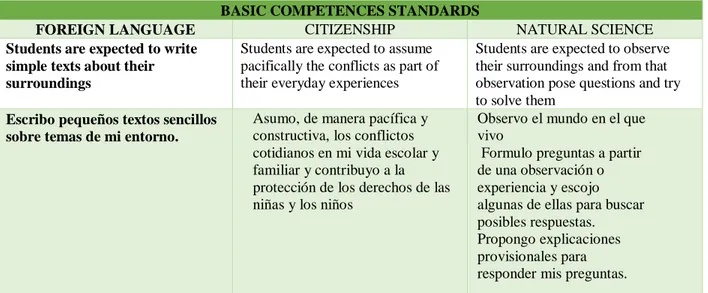
(46) COLLABORATIVE INQUIRY IN THE EFL CLASSROOM. 46. community, ready to receive others' thoughts and to share our own. We confer with each other, comparing and contrasting t h e options w h i c h the intentionality o f individual members has made available to the group” (p. 19). Which implies that, when a group of people get together with a common objective, they become a community; that community is able to value each member´s contributions. Description of the pedagogical intervention Taking into account the CBP approach and the visions of curriculum, language, learning and classroom for the pedagogical implementation, an inquiry model was used to lead students into reflections about the way they relate to each other. It is important to mention that basic standards and competences for fifth grade from foreign language (2006), natural science (2006) and citizenship (2004) stated by the Colombian Ministry of Education were used to inform the curricular activities proposed. Thus, students´ inquiries are viewed as addressing issues that relate to different subjects. Additionally, the collaborative nature of the inquiry process required that citizenship competences were developed. (See table below). BASIC COMPETENCES STANDARDS CITIZENSHIP NATURAL SCIENCE FOREIGN LANGUAGE Students are expected to assume Students are expected to observe Students are expected to write pacifically the conflicts as part of their surroundings and from that simple texts about their their everyday experiences observation pose questions and try surroundings to solve them Asumo, de manera pacífica y Observo el mundo en el que Escribo pequeños textos sencillos constructiva, los conflictos vivo sobre temas de mi entorno. cotidianos en mi vida escolar y Formulo preguntas a partir familiar y contribuyo a la de una observación o protección de los derechos de las experiencia y escojo niñas y los niños algunas de ellas para buscar posibles respuestas. Propongo explicaciones provisionales para responder mis preguntas. Figure 2. Basic Competences Standards for fifth Grade of Elementary School proposed by Colombian Ministry of Education that were taken into consideration in the pedagogical implementation..
(47) COLLABORATIVE INQUIRY IN THE EFL CLASSROOM. 47. Taking into consideration the previous standards, the different phases of the implementation presented the way they were developed. The phase of scope was an adaptation from Short´s (1996) authoring cycle, as an inquiry based learning model to follow. First, students got together; the lineal and individualistic structure of the classroom was broken into small groups established by them. During the three phases (each class we met), students were asked to write reflections about what was happening within their groups. Those reflections were written in Spanish so that the children could easily express themselves. They used their English notebooks as journals for those reflections. At the beginning of the process they were asked to do the reflections as homework, but some children forgot to do it; so, in agreement with the children, we decided to write the reflections in class, for that purpose there were given the last 10 or 15 minutes of the class to write their individual reflections. In this initial phase they established the criteria to be part of a group, taking into consideration they had to work the whole academic year in this group and they had to achieve different goals as a group. They also created their own group norms and strategies to be successful during the process. The image bellow shows how children organized their work in groups of 3 to 5 students. They decided who they wanted to work with and the rules inside the group in order to achieve their learning goals..
(48) COLLABORATIVE INQUIRY IN THE EFL CLASSROOM. 48. Image 3. Children working in groups. The second stage was called Building from the known, in which students explored their own context and decided to inquire about the school snack as a very important aspect at school, considering that they are daily given this food as snack and in some cases it is the only food some children eat a day. For them the school snack is one of the most important reasons for going to school every morning, and that is why they decided to get more information about it through an inquiry process. It is important to mention that, as my concern was about the coexistence in the classroom and the intention was to shift the class into a more socio cultural view of language learning, the idea I had about the project, was that the children inquired about the coexistence in the classroom and school. But as the project work supposed that students should select the topic for inquiry from their interest, the students were given the opportunity to made that decision. In the exploration within this phase about the most relevant aspect in their daily life at school, school snack appeared as the most important one. This stage was explorative, children in their groups, gave contributions and ideas to the whole class about the possible things to inquire about the school snack. The phase also implies to build new vocabulary in English about the food and the different related elements to the school.
Figure
Documento similar
