FACULTAD de FILOSOFÍA Y LETRAS
DEPARTAMENTO de FILOLOGÍA INGLESA
Grado en Estudios Ingleses
TRABAJO DE FIN DE GRADO
“CHALLENGING GENDER STEREOTYPES?
AN ANALYSIS
OF VERB PROCESSES IN NEWSPAPERS ARTICLES
ABOUT WOODY ALLEN SEXUAL-
ABUSE ALLEGATION”
Beatriz Caraballo Moral
Tutor: Laura Filardo Llamas
ABSTRACT
Media have an enormous impact on society not only because they are a great source of information but also because it deal with that information from different perspectives. That is why analyzing language in newspapers uncovers what is behind news. One of the consequences of using specific language in newspaper is the reproduction of social inequality. By analyzing articles about Woody Allen sexual-abuse allegation, we will consider gender stereotypes in the media. In this dissertation, we will carry out an analysis of language in newspaper following Critical Discourse Analysis principles, focusing on two linguistic elements: transitivity and the representation of participants. The purpose is to see how language in media portrays women and men.
Key words: Critical Discourse Analysis, gender stereotypes, media, transitivity,
participants.
RESUMEN
Los medios de comunicación tienen un impacto enorme en la sociedad no solo como fuente de información sino también por las distintas perspectivas que ofrecen al presentar dicha información. Por ello, analizar en lenguaje periodístico revela qué hay detrás de una noticia. Una de las consecuencias de usar un determinado lenguaje es la reproducción de la desigualdad social. Analizando artículos sobre los presuntos casos de abuso sexual de Woody Allen, consideraremos los estereotipos de género en los medios de comunicación. En este trabajo, llevaremos a cabo un análisis del lenguaje periodístico siguiendo los principios del Análisis Crítico del Discurso, centrándonos en dos elementos: la transitividad y la representación de los participantes. El objetivo es ver cómo en lenguaje periodístico retrata a las mujeres y a los hombres.
Palabras Claves: Análisis Crítico del Discurso, estereotipos de género, medios de
Content Table
1. Introduction………..7
2. Literature Review……….8
3. Methodology………... 13
4. Analysis………...17
5. Conclusion………... 26
6. Bibliography………... 28
1.INTRODUCTION
Recent social movements have started to visualize violence against women in well- known enterprises. Such is the case of MeToo Movement, which started to demand sexual abuse by the producer Harvey Weinstein and which focuses on ending sexual violence. Its founder, Tarana Burker, is trying to raise awareness of the pervasiveness of some cases of sexual abuse that are not usually on the focus of attention because of the power of the people involved. Similar to the case of Harvey Weinsten, thanks to MeToo, other sexual abuse cases have came to light, such as the Woody Allen sexual abuse allegation by her daughter, Dylan Farrow.
It has been argued that media have a great impact on society (Wood, 1994). In
fact, “media are the most pervasive and one of the most powerful” influences on how we view certain topics. When it comes to the representation of genders, it perpetuates
“unrealistic, stereotypical and limiting perceptions” (Wood, 1994: 231). Newspapers
are a medium of communication that may reinforce the reproduction of social inequality which underlies gender-based stereotypes. Three specific topics in the media are argued to contribute to social inequality: the underrepresentation of women, the portrayal of men and women in stereotypical ways and the normalization of violence against women (1994:231). Even though we can find many news about this topic, in this dissertation, we will focus on Woody Allen sexual- abuse allegations by Dylan Farrow as represented in two American newspapers: The New York Times and The Washington
Post.
prevent suffering. Even though the accusation had been already forgotten, in 2014 Dylan Farrow published an open letter in 2014 in The New York Times and afterwards in 2017 in Los Angeles Times. This last time, the case became more important due to the recent sexual abuse accusations that were made regarding the producer Harvey Weinstein. From that moment on, several opinion editorials have been published in many newspapers, such as The New York Times or The Washington Post.
In order to do the analysis of these newspaper articles, we will take into account some approaches, such as Critical Discourse Analysis, that have been proposed along the years so that we can better understand what the role of language is in the reproduction of social inequality. In particular, we will study the phenomenon of transitivity as well as verbal processes, considering the participants of each of the processes. Therefore, we hypothesize that newspaper language portrays women and men in stereotypical ways and, consequently, contributes to the reproduction of social inequality. We will focus on the representation of participants and the verb processes they tend to go with in the reproduction of news about sexual abuse allegations.
This dissertation is aimed at identifying syntactical patterns in newspaper articles and their role in the reproduction of relations of power. This paper will be divided into three main sections. In the first one, we review previous studies on CDA, gender and transitivity. In the second part, we describe the methodology we have followed both for doing the analysis and compiling the corpus. The third section consists on the description of the results. Finally, some conclusions will be provided.
2. LITERATURE REVIEW
According to Van Dijk (1993), CDA presupposes a relationship between discourse, power and dominance where the role played by the discourse analyst is crucial to understand the way all these elements interact within an instance of discourse. The aim is to determine what structures and strategies are used in order to reproduce these relations of power and dominance.
instance of discourse based on the way propositions work: how they are structured, combined and sequenced. Second, an instance of discourse could be also interpreted as a discursive practice that takes into consideration the social conditions within which a text is produced and consumed. The last stage explains how an instance of discourse works as a social practice. This part of the analysis aims at describing ideologies and social
relations of power within a particular social and cultural context. “Power” is understood as an exercise from which “those ones who benefit from the circumstances are placed in a
preferred position to defend and promote their vested interests” (Richardson, 2007: 31).
“Ideology”, on the contrary, is explained as ways of thinking in which “historically
transient exploitative forms of social organization are represented as eternal, natural or
rational” (2007:34).
Following the same study, Fairclough describes newspapers as a product of specific people surrounded by specific social circumstances and which hence have social effects. He states that there are tendencies in the production of news which reproduce implicit ideologies (1995: 54). Some authors, such as Richardson (2007), have followed the CDA approach for analyzing newspapers since it provides an interpretation of the meaning of the text which is, as it has already been mentioned, constructed through the interaction between the producer, the text and the consumer. Following them, in this dissertation, news are the textual element that is analyzed in order to reveal connections between language, power and ideology (Fairclough, 1989:5).
whose interest is maintaining unequal power relations. Third, it is important to reckon the complexity of gender and power relations. The fourth of the perspectives assumes discourse as one of the elements of social practice and focuses on how gender ideology and gendered relations of power are reproduced and contested in discourse. Finally, what Lazar proposes is the critical reflexivity in FCDA about their own feminist theorists and practices. It is important to consider that FCDA is not necessarily a neutral-stand critical analysis as it is also aimed at the constitution of feminist theory and practice.
The analysis of the reproduction of power relations and ideology in discourse has been carried out relying on different linguistic schools. The grounding of this analysis is to study which structures in discourse contribute to social inequality. As mentioned above, the first stage in the analysis should be the description of the instance of discourse. In order to do this description, we need to consider some authors who focus their study on textual description. Halliday (2004) has defined the clause as a grammatical unit within the text with three lines of meaning, known also as distinct functions of a clause. One of them is the experimental line of meaning1 which defines the clause as a figure, i.e. as a mode of reflection on the variation and flow of events. All figures are built up by processes where some participants are involved and where some circumstances might attend to it (2004:170). These elements can be grammatically distinguished: process are verbal groups, participants are represented through nominal groups and circumstances through adverbials or prepositional phrases.
On the one hand, Halliday (2004:171) distinguishes different types of processes. All these processes types are related to a particular domain of experience and are gathered in a grammatical system known as transitivy. The study of transitivity helps to understand “what people are depicted as doing and refers to whom does what to whom” (Machin and Mayr, 2012:104). Within this set, there are three process which distinguish between the outer experience of the participants and the inner experience of them. The
1 According to Halliday (2004), the clause “is a multifunctional construct consisting of three
multifunctional lines of meaning” (2004:168); the textual line which presents the message; the
grammatical categories which answer to this distinction are material process clauses and mental processes clauses, respectively, as we can see in the examples below:
[1]The boy kicked the ball.
[2]The boy wanted to kick the ball.
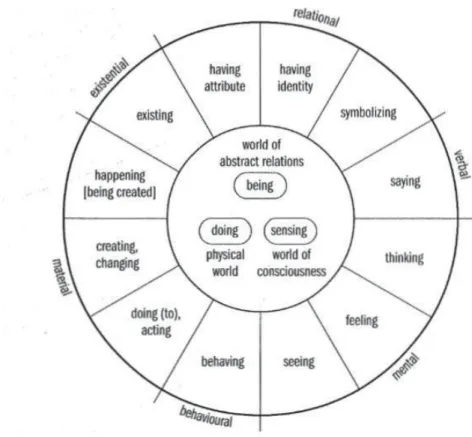
In line with this, there is an additional process relating one outer experience to an inner experience which is known as relational process (e.g. she is mad). However, there are some categories that cannot be identified as any of the mentioned processes. They are behavioral, verbal and existential processes. Behavioral processes represent the outer demonstration of a process of consciousness, in other words, the manifestation in the outer world of an inner experience (e.g. she was crying). Verbal processes represent symbolic relationships stated through the form of language (e.g. I talked to Monica).
Existential processes are related to any process of existence expressed through “to be”, “to exist” and “to happen” (e.g. there was an incident). The following figure summarizes these processes.
The textual analysis in CDA involves the study of the participants within the clause. Theo van Leeuwen (2008) provides a well-known classification of the participants involved in these processes. Also known, as social actors, participants can be categorized following sociological labels, based on the social interpretation of the use of certain linguistic realizations. Among others, he proposes different ways of representing social actors. In one of them, he distinguishes between two role allocations
which relate grammatical roles with the social actor’s role in social practices. They are
not presented in the same way when they are represented as the active force in an activity -activation- than when they are represented as conforming forces, known as passivation. Another way to represent social actors is based on processes called indetermination and differentiation. When they are represented as unspecified individuals or groups, we are talking about indetermination, whereas differentiation
“explicitly differentiates an individual social actor or group of social actors from a similar actor or group” (2008:40).
Although not referred to in Van Leuween, Halliday (2004) also deals with the third of the elements of a clause, which are the circumstances. Circumstantial elements interact within the clause freely in all types of processes since they are not obligatory but rather optional elements. They are represented in adverbial groups or prepositional phrases. However, there are some combinations that are more frequent than others. For example, circumstances of matter are fairly common with mental and verbal clauses (2004:260).
The second stage in traditional CDA approaches is the interpretation of an textual description of the instance of discourse. Some scholars have also proposed an explanation of the effect that instances of discourses have on readers. Jeffries (2010) deals with the strands of meanings which are related to the verbal element of a clause
(2010:38). She uses Halliday’s transitivity in order to distinguish the different choices
to use a verb, and she refers to them as predicators. Given the following example it is true that the police and security services can engage in surveillance in any event
argument has been already mentioned and accepted as true and therefore, the reader would not doubt about the truthfulness of that argument. Jeffries uses this example, among others, to introduce certain tools that would help the critical analyst to understand how the use of language in text can reproduce ideologies and power relations.
In the case of the reproduction of power relations and ideologies through media, we have followed Julia T. Wood (1994) analysis of media to understand its influence on
the representation of men and women. She claims that “media continue to present both
women and men in stereotyped ways that limit our perceptions of human possibilities”
(1994: 232). While women are portrayed as “pretty, deferential, focused on home, family and caring for others” and “subordinate to men and cast as victims” (1994: 233), men are portrayed as “active, powerful, sexually aggressive and largely uninvolved in
human relationships” (1994: 232). In other words, stereotypical women are passive and sensitive whilst stereotypical men are dominant and active. She also claims that “media
reiterate cultural image of women as dependent, ornamental objects whose primary
functions are to look good, please men and stay quietly” (1994: 233). Furthermore, the
media does not only reiterate these stereotypes but also normalize violence against women. Exposing sexual violence against women in the media promotes its tolerance and acceptance not only by men but also by women. In fact, Wood argues that rape is most common in countries that have ideologies of male supremacy and dominance, which are promoted by the media, among others.
Taking into account all the studies mentioned above, we will analyze texts from newspapers in order to understand how specific representations of the participants and verb processes interact within a clause in order to reproduce men and women stereotypes in the media.
3. METHODOLOGY
Washington Post. The analysis of the texts has been done based on a combination of quantitative and qualitative approaches, as we will explain below.
The analysis of the articles is based on a text compilation. The first step is the selection of the news pieces. These news pieces are newspaper articles which are related to Woody Allen sexual assault of her daughter Dylan Farrow when she was a kid. With this in mind, other selection criteria have been established including the date, the length and the section to which the articles belong. First, regarding the date, the range between 2017 and 2018 has been the one chosen for the analysis because they are the years when the case of sexual assault came to light again in the public sphere. Second, it is also important to consider the section of the newspaper in which the piece was found. All of them are opinion columns where writers and journalists are allowed to give their point of view. Finally, all the articles are between 800 and 1500 words of length, not including the title and the foot of pictures. Once all of the articles were selected and downloaded from the digital version of the newspaper, they were converted into txt-files so that the corpus compilation software could work with them. Taking this criterion in mind, we have selected 5 articles from each newspaper.
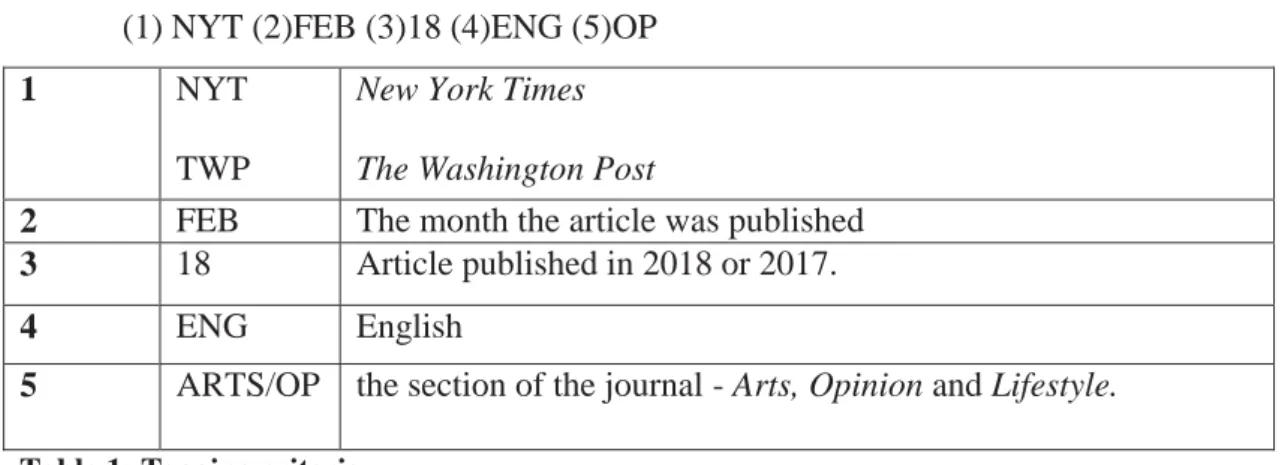
The third step in the corpus compilation has been the tagging. All files have been named after their specific features, including characteristics, such as the date, the newspaper, the section of the newspaper, the language and the number of the file. This criterion has been chosen so that each of the files could be more easily identified. The caption used is as follows:
(1) NYT (2)FEB (3)18 (4)ENG (5)OP
1 NYT
TWP
New York Times
The Washington Post
2 FEB The month the article was published
3 18 Article published in 2018 or 2017.
4 ENG English
5 ARTS/OP the section of the journal - Arts, Opinion and Lifestyle.
In order to do the quantitative analysis, one programme has been used. Antconc is a programme which allows the analysis of electronic texts so that certain patterns in language can be found and studied. A word list was created before starting the analysis. In this word list, words were ordered depending on their frequency. This list was revised and edited by removing functional words that tend to appear in the first
positions but were of no interest for our analysis. This was done with the tool “stop list”.
Once the word list was obtained, concordances were looked for. Concordances
are “an alphabetical list of the words (especially the important ones) present in a text or texts” (Oxford Dictionary), so that we could see the co-text where the words appeared. Five specific terms were selected because of their relation to the main participants in the case. One of the participants of the articles is the presumed abuser, the well-known film director Woody Allen, while the presumed victim is her daughter, Dylan Farrow. Therefore, as potential subjects of the sentences within the articles, the personal
pronouns “she” and “he” were two of the terms selected. On the other hand, the accusative pronouns “her” and “him” have also been selected for the study. The proper name “Woody Allen” is another selected term as well as the name “Dylan Farrow”. In
this respect, it is important to say that the name of the film director appears in three
different ways. There are references to him as “Woody Allen”, “Allen” and “Mr. Allen”
but the three of them will be analyzed all together.
Once the terms were selected, the results had to be categorized. The concordance of every term highlights the two following words and the previous one. This criterion allows seeing the co-text of the terms so that, in the case of the subjects as well as in the case of the objects, the verbs used could be studied. Consequently, those concordances where the terms were neither a subject nor an direct object in the clause were discarded since the focus of the study is to analyze the role of the participants directly involved in the different verb processes.
followed two approaches. On the one hand, the representation of the participants of the
clause has been analyzed following Van Leuween’s (2008) representation of social
actors. Although he proposes a broader and complex classification of this representation, we will focus on the processes of indetermination and differentiation, which deal with the identity and anonymity of social actors in clauses. Even though he
claims that “indetermination is typically realized by indefinite pronouns” (2008:39), we
will see how these two process occur in a text through the use of personal pronouns and proper names. On the other hand, the representation of participants has been also dependent on the role they are given in a clause (2008: 260). They are known as activation and passivitation. When a social actor has an active role in the process in a clause, activation occurs. On the contrary, when the social actor has a passive role,
which means that “they receive the end of it” (2008:33), we talk about the process of
passivitation. If we relate the roles of the social actors to the verb processes, we will see
that, for instance, the active role in material clauses would be given to “the actor” while in mental clauses it would be given to “the senser” (2008:33).
The textual analysis is also based on the analysis of verb processes. As it has been mentioned before, Halliday (2004) proposes six different verb processes. In
material clauses, the participant is the one who carries out an action of “doing” in the
external world. Mental clauses relate the participants with their inner experience so
these processes “take place” in the participant’s consciousness. Relational clauses also
model the inner and the outer experience of the participants but they construe the
experience through “being” rather through “doing or “sensing”. In the less defined
processes, we find more problems to identify the role of the participants. Behavioral
clauses present the participants as conscious beings but carrying out process of “doing”.
Figure 2: Process types, their meanings and characteristic participants (Halliday, 2004:260).
We will see a classification of the data so that we can understand better the representation of the participants and the verb processes used in both newspapers. Considering Wood (1994) analysis of media portrayals of men and woman, we will relate the linguistic elements studied to them and we will explain how language may reinforce these stereotypes.
4. ANALYSIS
The following results show the frequency of the terms together with the verbs they tend to go with. In this section, we will see an analysis of the results taking into account two different perspectives. First, they are categorized and interpreted according
to Van Leuween’s (2008) classification of the participants. Second, we will see a classification of verbs following Halliday’s verb processes (2004). Some of the results
are represented in different tables depending on the newspapers they are taken from. It is important to highlight that, even though all the references to Woody Allen
Allen” or “Allen.” Likewise, references to Dylan Farrow are similarly shaped with the
names of “Dylan Farrow,” “Dylan” and “Farrow.” However, it is worth mentioning that
the surname of Farrow does not always refer to Dylan but also to other members of the family or the family itself. These references are not part of our analysis and, therefore, are not represented in table 2. This first table presents the frequency of each of the references to the participants. These percentages are based on the total amount of frequencies of the references depending on the sex and they are presented in decreasing order. This means that they are calculated, in the case of the references to Dylan Farrow, out of 210 while, in the case of Woody Allen, out of 170.
Table 2:Frequency of the terms.
As it can be seen in table 2, personal pronouns have the highest frequencies and occupy the first position. Even though personal pronouns are not typically understood as realizations of the process of indetermination, it is not the same to refer to participants through personal pronouns than through their proper names. Referring to participants through their proper names or a variation of them makes an explicit differentiation between them and the rest of the participants in a clause. For instance, in the following example, the identity of Woody Allen is explicitly differentiated from the identity of Dylan Farrow, whom we cannot identify without reading the whole text.
FEMALE MALE
Word Frequency Frequency Word
She 56.6% 48.8% He
Dylan Farrow 16.6% 22.9% Allen
Her 14.7% 12.3% Woody Allen
Dylan 7.16% 10% Mr. Allen
[3]And as #MeToo Movement has gained momentous, she has tweeted about
Allen and called out specific actors.2 [011TWPJAN18ENGLIFE]
Both participants are mostly referred to by using personal pronouns which, as it has been explained, make their identities more difficult to detect. However, there is a distinction between the two of them when it comes to proper names. There are variations of the proper names of both participants which are worth mentioning. While in the case of Dylan Farrow it is indeed her proper name the second most frequent used, in the case of Woody Allen his surname is the second reference most used. Both uses imply a process of differentiation as both references explicitly differentiate both
individual participants from the others. Nonetheless, to use a surname “Allen” instead
of using the whole proper name makes this differentiation even more explicit since the writer is using an informal reference to Woody Allen and is also assuming his identity, something that does not happen in the case of the female participants. In contrast, we can see the reference of “Dylan Farrow” as a use of a more formal language. In fact, the use of her surname, even though it is not always referring to her, is the last in the rank in table 2. This contrast between the references to both sexes is reinforced when we analyze the reference of “Mr. Allen.” Although it is not one of the most used ones, these two references does not happen when talking about Dylan Farrow. When we use formal treatment when referring or talking to people, we are not only using formal language but also making explicit relations of power and authority. In this case, Woody
Allen is given a position of authority through the use of “Mr. Allen” while Dylan
Farrow never occupies that position. In the example below, we can see the use of these two different references:
[4] The charge that Mr. Allen molested Dylan Farrow surfaced in 1992
[…].[003NYTJAN18ENGOP]
Consequently, we can say that the representation of both participants work in similar ways when dealing with personal pronouns. However, we should point at the formal treatment that Woody Allen receives in some cases in contrast to Dylan Farrow,
whose references belong to formal language and not to formal treatment.
When dealing with transitivity uses, we have considered the participants together with the verb processes. It is important to remind that, in this section, we will analyze verbs in active voice while, in the last one, we will focus on the passive voice. In relation to Van Leuween (2008), all these verbs follow the activation process that, as it has been mentioned, occurs when participants “are represented as the dynamic active
force in an activity” (2008: 33). In addition, as it has been already explained in the
methodology, we have discarded the proper names that do not function in the sentence as either a subject or direct object since other syntactic uses do not refer to participants directly involved in the process of the sentence. Likewise, we have not considered the
pronouns “her” and “him” when they function as possessive determiners. Antconc does not allow us to make a distinction in the search of the terms depending on its function in the sentence so the exclusion has been done manually, reading sentence by sentence and analyzing their function in each of them.
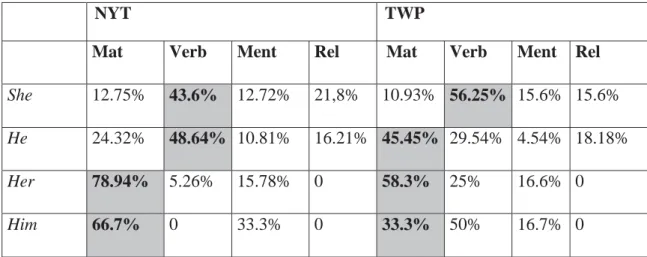
The classification of the proper names together with the personal pronouns has been carried out taking into consideration the newspaper they appear in and the process type they go with. As we have seen in figure 1, behavioral processes are related to the
verb “to behave” and existential ones, to the verb “to exist.” None of these processes are represented in the tables because, on the one hand, no instances have been found of
“to behave” with any of the participants and, on the other hand, existential processes do
NYT TWP
Mat Verb Ment Rel Mat Verb Ment Rel
She 12.75% 43.6% 12.72% 21,8% 10.93% 56.25% 15.6% 15.6%
He 24.32% 48.64% 10.81% 16.21% 45.45% 29.54% 4.54% 18.18%
Her 78.94% 5.26% 15.78% 0 58.3% 25% 16.6% 0
Him 66.7% 0 33.3% 0 33.3% 50% 16.7% 0
Table 3: Classification of the participants according to verb processes.
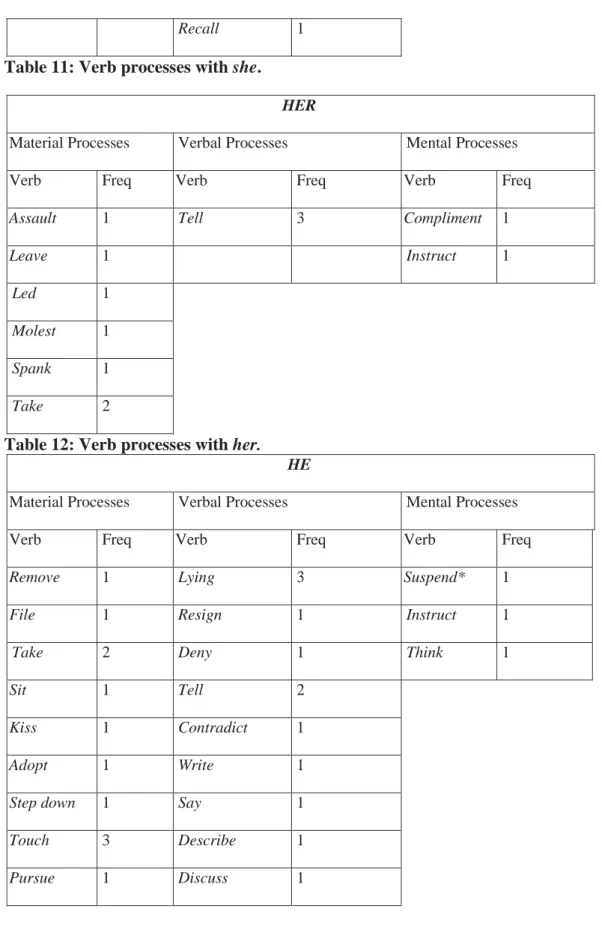
If we look at table 3, we see that the verb processes that predominate with the
term “she” are verbal clauses, following by relational clauses and finally by material clauses. The less frequent ones are the mental clauses. We can say that the girl is mostly depicted as a sayer, which means that her predominant role in the articles is the speaker. As the news talk about the accusation made by Dylan Farrow, it is understandable that
she is mostly referred to as the person who “accuses”, as we can see in the following
example:
[5] She accused him of putting his thumb in her mouth […]. [007TWPDEC17ENGART]
However, this also means that the news are focused on the accusation as the fact important to inform about and not about what the accusation implies: what has happened to her or what her role is in the events. The feminine nominative pronoun also appears together with relational verbs, that is to say, with the verb “to be” so we can say that other focus of the news is the description of Dylan Farrow, as it can be seen in the next example:
[6] When she was 7 […] Allen instructed her to play with her brother
[…].[011TWPJAN18ENGLIFE]
slight difference between these two processes with the mental clauses being more frequent. We can draw from the results that the less frequent depiction of the girl is as a
“doer.” She feels, she is and she says more than she does, which maintains the
stereotype of a woman as passive and sensitive. Besides, as her role is that of the accuser, we can say that she is also depicted as the victim, which is also a stereotype of woman in media.
With regards the representation of Woody Allen, the term “he” primarily
appears with material and verbal processes. He is, therefore, depicted as a doer and as a sayer. Even though he has been the defendant, the news focus on what he has said about it and not on the facts of the accusation. It is interesting to see that there is an important difference between The Washington Post and The New York Times regarding verbal and material processes. While example 7 places more value on him as a doer, example 8 depicts him mostly as a sayer.
[7]He touched women inappropriately. [007TWPDEC17ENGART]
[8]He reiterated what he had said at the time. [006NYTFEB18ENGOP]
The less frequent verb processes considering the masculine nominative pronoun are the relational and mental ones. We can say thus that Allen is presented as a doer than a senser. This means that, again, the masculine stereotypes are fomented as an active participant.
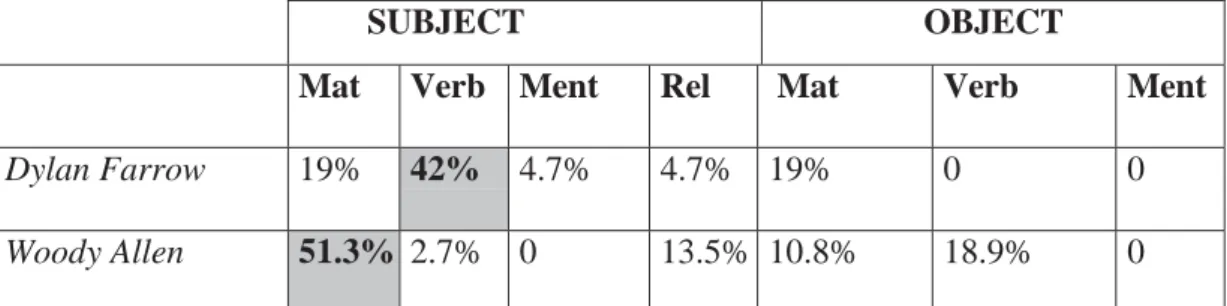
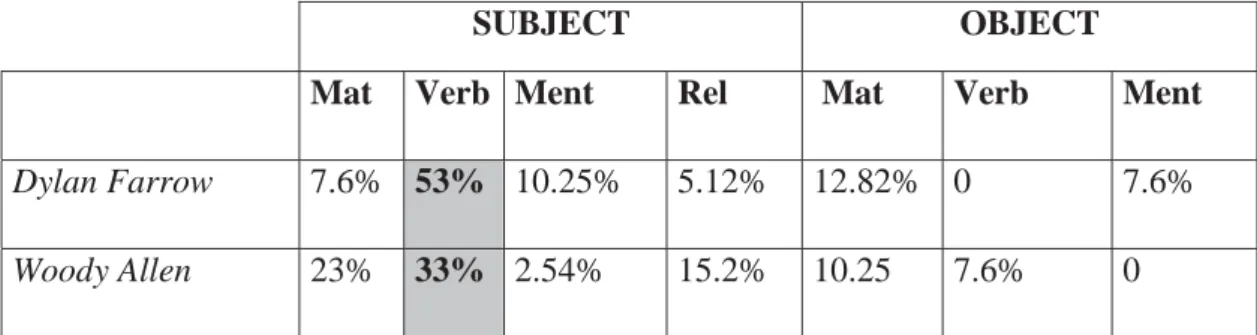
When it comes to the proper names, the classification varies since they can function as either subject or direct objects. Besides, in order to see the results clearly, the classification in this case has also considered the newspaper they appear in.
SUBJECT OBJECT
Mat Verb Ment Rel Mat Verb Ment
Dylan Farrow 19% 42% 4.7% 4.7% 19% 0 0
Woody Allen 51.3% 2.7% 0 13.5% 10.8% 18.9% 0
SUBJECT OBJECT
Mat Verb Ment Rel Mat Verb Ment
Dylan Farrow 7.6% 53% 10.25% 5.12% 12.82% 0 7.6%
Woody Allen 23% 33% 2.54% 15.2% 10.25 7.6% 0
Table 5:Classification of the participants according to verb processes in The Washington Post.
Considering the participant Dylan Farrow and the verb processes, it is noticeable that in both newspapers, the most frequent ones are the verbal clauses. Similarly to the
pronoun “she,” the participant is depicted mainly as the “accuser”. In relation to verbal
clauses, there is a difference between both newspapers. While The New York Times
focuses on her as a doer, The Washington Post focuses on her capacity of feeling, as the second most frequent process are the mental processes. We can say thus that the focus of the news pieces, again, is on the fact that she has made an accusation and not on what it implies. In example 9, we can see that the use of this verb and a depiction of a woman as a sayer. Even though we have seen that women in the media are typically represented
as “stay[ing] quietly on the periphery of life” (Wood, 2: 33), this stereotype is not
completely reinforced. Nonetheless, we can see that Dylan Farrow is portrayed as a victim since her exclusive role as speaker is that of accuser.
[9] Dylan Farrow speaks out on her allegations against Woody Allen. [011TWPJANENGLIFE]
stereotypes in media are once more represented. The man is active, aggressive and dominant and he is not portrayed as a sensitive or passive.
[10] […] Mr. Allen sexually abused her by touching her genitalia […]
[004NYTSEP18ENGART]
[11] The two actors spoke out after Dylan Farrow appeared in an emotional interview. [010TWPJAN18ENGMOR]
This is also interesting because it implies a difference in the reproduction of the accusation in both newspapers. As we have seen in table 4 and 5, The New York Times
focuses on Woody Allen as the participant who carries out actions and hardly speaks while,
in The Washington Post, he is represented mostly as the sayer but also as a doer and a
senser. This might happen because of ideological reasons of both newspapers.
Therefore, we can conclude that men stereotypes are reinforced in both newspapers as his role in the processes implies actions which are related to dominance as we have seen in example 10. On the contrary, women stereotypes follow the same line as the pronouns
“she”, as her predominant role is that one of an “accuser” which is linked to subordination
or, if we consider the new, the victim of an aggression.
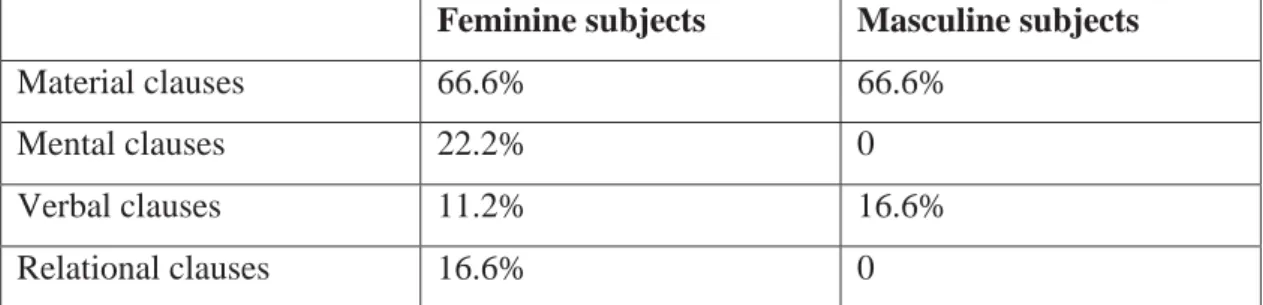
Feminine subjects Masculine subjects
Material clauses 66.6% 66.6% Mental clauses 22.2% 0 Verbal clauses 11.2% 16.6% Relational clauses 16.6% 0 Table 6: Verb processes in passive clauses.
As we can see, in both cases, the highest frequency corresponds to material processes. If we take a look at examples 12 and 13, even though both verbs deal with outer experiences of the participants, one of them implies physical action while the other one does not. Once again, we see the woman represented as a victim and as sex object.
[4] In a separate statement, Dylan Farrow reasserted that she had been
molested by Mr. Allen[…]. [004NYTSEP18ENGARTS]
[5] He has denied the allegation and was never charged
[…]. [008TWPSEP18ENGMOR]
On the contrary, the man is not the receiver of a physical action but rather the receiver of a legal action done in the “outer world”. The fact that passive roles are mostly given to the woman than to the man is related to female and male stereotypes in the media. Women take more passive roles than men, which reinforce their representation as passive and subordinated forces in a clause.
that are currently taking place in our days, such the Spanish well-known case of “La
Manada”. If we take a look of current newspapers, we will read headlines such as “La
víctima de la Manada: Gracias por no haberme dejado sola,”3 where, once again and without digging too much, we see the women described as the victim.
5. CONCLUSION
The analysis of these articles shows that language in the newspapers selected for this dissertation reinforces stereotypical portrayals of men and women when it comes to news about violence against women. By applying the CDA approach proposed by Fairclough (1995) and studied linguistic elements defined by Halliday (2004) and Van Leuween (2008), we have carried out an analysis of news pieces. Specific linguistic elements have been studied in order to depict the participants in men and women stereotypes suggested by Julia T. Wood (1994).
Following Van Leuween’s (2008) representation of participants, we have seen
that
while Dylan Farrow is depicted as the passive participant, Woody Allen is mostly portrayed as an active one. Considering Halliday classification of verb processes (2004), there is a contrast between both participants: while feminine subjects are mostly followed by verbal processes, masculine subjects are followed by any of the verb processes studied. On the contrary, we can say that Dylan Farrow says, feels and hardly does while Woody Allen does and says far more than he feels. Besides, references to Woody Allen vary in contrast to those one referring to Dylan Farrow, who is not given any power or authority in the texts. It is important also to say that, in this analysis, there are significant differences between both newspapers when they represent both participants. While The New York Times portrays Woody Allen as a “sayer”, The
Washington Post portrays him as a “doer,” something that does not happen when it
comes to the representation of Dylan Farrow, who is mostly represented as the sayer. In news about a presumed case of sexual aggression, we have shown that instead of focusing of what the aggression has been about, the important topic is what it has been
3
said about it and the reactions to it. In other words, readers perceive how women feel
and “claim” how men treat them while, when it comes to men, readers see what they say about it and what they do.
BIBLIOGRAPHY
Fairclough, N. Language and Power. Edinburgh: Pearson Education Limited, 1989. Fairclough, N. Critical discourse analysis. London: Longman, 1995.
Halliday, M. A. K. An Introduction to Functional Grammar. Ed. Christian M. I. M. Mathiessen. Third Edition. New York: Hodder Education. 2004.
Jeffries, Lesley. Critical Stylistics: the Power of English. Palgrave Macmillan, 2010. Lazar, Michelle M. «Politizing Gender in Discourse: Feminist Critical Discourse
Analysis as Political Perspective and Praxis.» Feminist Critical Discourse Analysis.
Gender, Power and Ideology in Discourse. Ed. Michelle M. Lazar. New York:
Palgrave Macmillan, 2008.
Machin, David and Andrea Mayr. How to do Critical Discourse Analysis. SAGE Publications, 2012.
Van Dijk, Teun A. “Principles of Critical Discourse Analysis.” Discourse & Society, vol. 4, no. 2, Apr. 1993, pp. 249–283.
Van Leeuwen, Theo. Discourse and Practice: New Tools for Critical Discourse
Analysis. New York: Oxford University Press, 2008.
Wood, Julia T. “Gendered Lives: Communication, Gender, and Culture.” Gendered
Media: The Influence of Media on Views of Gender. Belmont, Calif: Wadsworth
Pub, 1994. pp. 231-244.
Richardson, John E. Analysing Newspapers: an Approach from Critical Discourse
Analysis. Palgrave Macmillan, 2007.
Valdés, Isabel. “La Víctima De La Manada: ‘Gracias Por No Haberme Dejado Sola.’”
7.APPENDIX
THE NEW YORK TIMES ARTICLES
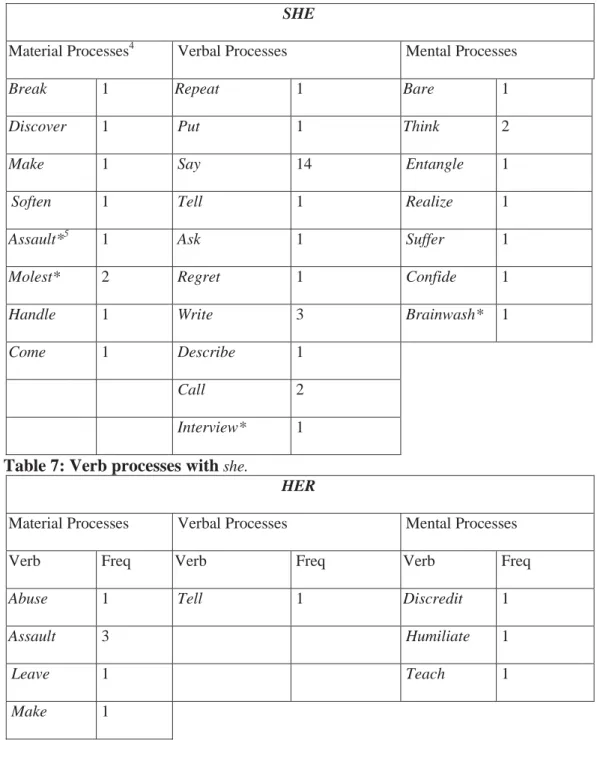
SHE
Material Processes4 Verbal Processes Mental Processes
Break 1 Repeat 1 Bare 1
Discover 1 Put 1 Think 2
Make 1 Say 14 Entangle 1
Soften 1 Tell 1 Realize 1
Assault*5 1 Ask 1 Suffer 1
Molest* 2 Regret 1 Confide 1
Handle 1 Write 3 Brainwash* 1
Come 1 Describe 1
Call 2
Interview* 1
Table 7: Verb processes withshe.
HER
Material Processes Verbal Processes Mental Processes
Verb Freq Verb Freq Verb Freq
Abuse 1 Tell 1 Discredit 1
Assault 3 Humiliate 1
Leave 1 Teach 1
Make 1
Marry 1
Molest 1
Slap 3
Spank 1
Take 1
Throw 1
Tip 1
Table 8: Verb processes with her.
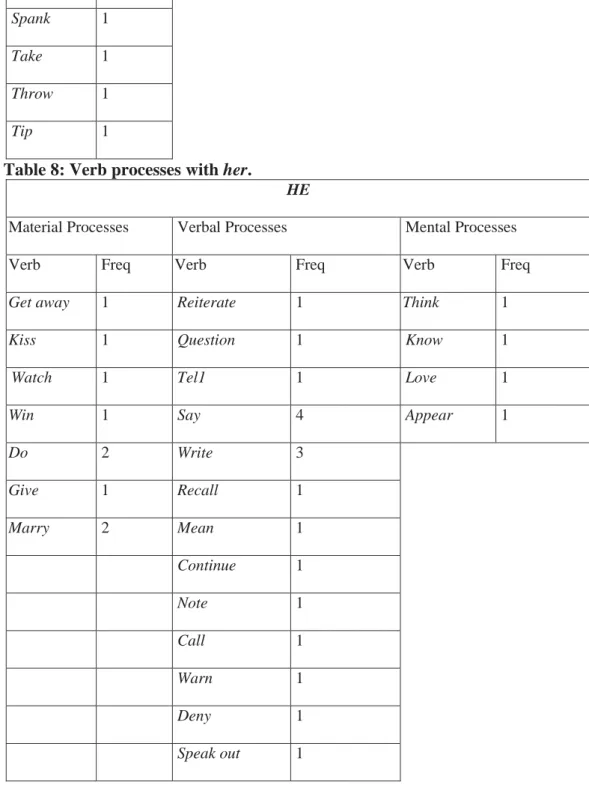
HE
Material Processes Verbal Processes Mental Processes
Verb Freq Verb Freq Verb Freq
Get away 1 Reiterate 1 Think 1
Kiss 1 Question 1 Know 1
Watch 1 Tel1 1 Love 1
Win 1 Say 4 Appear 1
Do 2 Write 3
Give 1 Recall 1
Marry 2 Mean 1
Continue 1
Note 1
Call 1
Warn 1
Deny 1
Table 9: Verb processes with he.
HIM
Material Processes Mental Processes
Verb Freq Verb Freq
Slap 1 Brainwash 1
Cast 1
Table 10: Verb processes with him.
THE WASHINGTON POST ARTICLES
SHE
Material Processes Verbal Processes Mental Processes
Break 1 Ask 1 Believe 1
Meet 2 Detail 1 Wish 1
Put out 1 Add 1 Consider 1
Touch* 1 Write 5 Want 1
Marry 1 Say 9 Admire 1
Send 1 Tell 6 Know 1
Accuse 2 Feel 2
Continue 2 Hate 1
Tweet 1
Respond 1
Explain 1
Speak 1
Allege 1
Recall 1
Table 11: Verb processes with she.
HER
Material Processes Verbal Processes Mental Processes
Verb Freq Verb Freq Verb Freq
Assault 1 Tell 3 Compliment 1
Leave 1 Instruct 1
Led 1
Molest 1
Spank 1
Take 2
Table 12: Verb processes with her.
HE
Material Processes Verbal Processes Mental Processes
Verb Freq Verb Freq Verb Freq
Remove 1 Lying 3 Suspend* 1
File 1 Resign 1 Instruct 1
Take 2 Deny 1 Think 1
Sit 1 Tell 2
Kiss 1 Contradict 1
Adopt 1 Write 1
Step down 1 Say 1
Touch 3 Describe 1
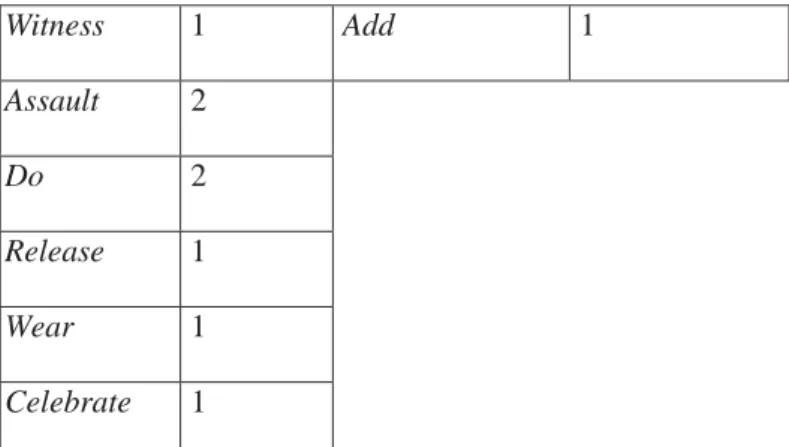
Witness 1 Add 1
Assault 2
Do 2
Release 1
Wear 1
Celebrate 1
Table 13: Verb processes with he.
HIM
Material Processes Mental Processes Verbal Processes
Verb Freq Verb Freq Verb Freq
Award 1 Believe 1 Accuse 1
See 1 Hate 1
Respect 1