LÓPEZ, M.; YÁÑEZ, A.; GOMES DA COSTA, S.; AVELLÀ, L., (Coord.). Actas del Congreso Internacional de Eficiencia Energética y Edificación Histórica / Proceedings of the International Conference on Energy Efficiency and Historic Buildings (Madrid, 29-30 Sep. 2014). Madrid: Fundación de Casas Históricas y Singulares y Fundación Ars Civilis, 2014. ISBN: 978-84-617-3440-5
Edited by
Fundación de Casas Históricas y Singulares Fundación Ars Civilis
Coordinated by
Mónica López Sánchez. Fundación Ars Civilis
Ana Yáñez Vega. Fundación de Casas Históricas y Singulares Sofia Gomes da Costa. Fundación de Casas Históricas y Singulares Lourdes Avellà Delgado. Fundación Ars Civilis
© Copyright
More contents on http://energyheritage.wordpress.com/
- 5 -
T
Ta
ab
bl
le
e
of
o
f
c
co
on
nt
te
en
nt
ts
s
PRESENTACIÓN ... 11
Eficiencia energética y edificación histórica: un reto del presente... 13
-Cristina Gutiérrez-Cortines y Mónica López Sánchez. Fundación Ars Civilis Eficiencia energética y edificación histórica: un reto del futuro ... 14
-Ana Yáñez Vega. Fundación de Casas Históricas y Singulares Committees ... 15
Programme ... 16
-Governance, management, participation and mediation...- 21 -
SUSTAINABLE ENERGY ACTION FOR WORLD HERITAGE MANAGEMENT ... 22
-RONCHINI, C.; POLETTO, D. ENERGY EFFICIENCY AND URBAN RENEWAL OF A UNESCO-LISTED HISTORICAL CENTER: THE CASE OF PORTO ... 38
-SANTOS, Á.; VALENÇA, P.; SEQUEIRA, J. HISTORICAL HERITAGE: FROM ENERGY CONSUMER TO ENERGY PRODUCER. THE CASE STUDY OF THE ‘ALBERGO DEI POVERI’ OF GENOA, ITALY ... 45
-FRANCO, G.; GUERRINI, M.; CARTESEGNA, M. IMPROVING ENERGY EFFICIENCY IN HISTORIC CORNISH BUILDINGS – GRANT FUNDING, MONITORING AND GUIDANCE ... 61
-RICHARDS, A. ENERGY EFFICIENCY AND BUILDINGS WITH HERITAGE VALUES: REFLECTION, CONFLICTS AND SOLUTIONS ... 75
-GIANCOLA, E.; HERAS, M. R. PROPUESTA METODOLÓGICA PARA LA REHABILITACIÓN SOSTENIBLE DEL PATRIMONIO CONTEXTUAL EDIFICADO. EL CASO DEL CENTRO HISTÓRICO DE LA CIUDAD DE MÉRIDA, YUCATÁN / Methodological proposal for the sustainable rehabilitation of context heritage building. The case of the historic downtown of Merida, Yucatan ... 82
More contents on http://energyheritage.wordpress.com/
- 6 -
Traditional and technological knowledge: concepts, techniques, practices, uses,
materials, methodologies ...- 99 -
SUSTAINABLE REFURBISHMENT OF HISTORIC BUILDINGS: RISKS, SOLUTIONS AND
BEST PRACTICE ... 100
-HEATH, N.
EFICIENCIA ENERGÉTICA Y VALORES PATRIMONIALES. LECCIONES DE UNA
INVESTIGACIÓN Y UN SEMINARIO / Energy efficiency and heritage values. Lessons of
a Research and a Seminar ... 110
-GONZÁLEZ MORENO-NAVARRO, J. L.
ARCHITECTURAL INTEGRATION OF PHOTOVOLTAIC SYSTEMS IN HISTORIC DISTRICTS.
THE CASE STUDY OF SANTIAGO DE COMPOSTELA ... 118
-LUCCHI, E.; GAREGNANI, G.; MATURI, L.; MOSER, D.
HISTORIC BUILDING ENERGY ASSESSMENT BY MEANS OF SIMULATION TECHNIQUES ... 135
-SOUTULLO, S.; ENRIQUEZ, R.; FERRER, J. A.; HERAS, M. R.
DESIGN OF A CONTROL SYSTEM FOR THE ENERGY CONSUMPTION IN A WALL-HEATED
CHURCH: SANTA MARIA ODIGITRIA IN ROME ... 145
-MANFREDI, C.; FRATERNALI, D.; ALBERICI, A.
EXEMPLARY ENERGETICAL REFURBISHMENT OF THE GERMAN ACADEMY IN ROME
"VILLA MASSIMO" ... 160
-ENDRES, E.; SANTUCCI, D.
SISTEMA MÓVIL INTEGRADO PARA LA REHABILITACIÓN ENERGÉTICA DE EDIFICIOS: LÁSER 3D, TERMOGRAFÍA, FOTOGRAFÍA, SENSORES AMBIENTALES Y BIM / Integrated mobile system for building energy rehabilitation: 3D laser, termography, fotography,
environmental sensors and BIM ... 169
-SÁNCHEZ VILLANUEVA, C.; FILGUEIRA LAGO, A.; ROCA BERNÁRDEZ, D.; ARMESTO GONZÁLEZ, J.; DÍAZ VILARIÑO, L.; LAGÜELA LÓPEZ, S.; RODRÍGUEZ VIJANDA, M.; NÚÑEZ SUÁREZ, J.; MARTÍNEZ GÓMEZ, R.
CONSECUENCIAS CONSTRUCTIVAS Y ENERGÉTICAS DE UNA MALA PRÁCTICA. ARQUITECTURAS DESOLLADAS / Energy and constructive consequences of a bad
practice. Skinned architectures ... 186
-DE LUXÁN GARCÍA -DE DIEGO, M.; GÓMEZ MUÑOZ, G.; BARBERO BARRERA, M.; ROMÁN LÓPEZ, E.
EL BIENESTAR TÉRMICO MÁS ALLÁ DE LAS EXIGENCIAS NORMATIVAS. DOS CASOS. DOS ENFOQUES / Thermal comfort beyond legislation. Two examples. Two
approaches ... 201
-DOTOR, A.; ONECHA, B.; GONZÁLEZ, J. L.
LA MONITORIZACIÓN Y SIMULACIÓN HIGROTÉRMICA COMO HERRAMIENTA PARA LA MEJORA DEL CONFORT, PRESERVACIÓN Y AHORRO ENERGÉTICO DE ESPACIOS
PATRIMONIALES. EL CASO DE LA IGLESIA DE SAN FRANCISCO DE ASIS, MORÓN DE LA FRONTERA / Measurement and hygrothermal simulation model, a tool to enhance thermal comfort, preservation and saving energy of heritage site. Case study: the
church of San Francisco of Asís in Morón de la Frontera ... 210
More contents on http://energyheritage.wordpress.com/
- 7 -
TERESE3: HERRAMIENTA INFORMÁTICA PARA LA EFICIENCIA ENERGÉTICA MEDIANTE LA SIMULACIÓN CALIBRADA DE EDIFICIOS / TERESE3: informatic tool for the energetic
efficiency through the calibrated simulation of buildings ... 226
-GRANADA, E.; EGUÍA, P.; MARTÍNEZ, R.; NÚÑEZ, J.; RODRÍGUEZ, M.
EFICIENCIA ENERGÉTICA Y ANÁLISIS TÉRMICO PARA SISTEMAS DE AIRE
CENTRALIZADO: UN CASO DE ESTUDIO / Energy Efficiency and thermal analysis for
centralized air heating systems: a case study ... 238
-MARTÍNEZ-GARRIDO, M. I.; GOMEZ-HERAS, M.; FORT, R.; VARAS-MURIEL, M. J.
ANALISIS ENERGETICO DEL MUSEO DE HISTORIA DE VALENCIA MEDIANTE DISTINTAS HERRAMIENTAS DE SIMULACIÓN / Energy assessment of the History Museum of
Valencia using various simulation tools ... 249
-TORT-AUSINA, I.; VIVANCOS, J.L.; MARTÍNEZ-MOLINA, A.; MENDOZA, C. M.
APROVECHAMIENTO SOLAR PASIVO EN LA RETÍCULA URBANA DE LA CIUDAD HISTÓRICA. EL CASO DE CÁDIZ / Passive solar gains in the urban grid of the historic
city. The case study of Cadiz ... 257
-SÁNCHEZ-MONTAÑÉS, B.; RUBIO-BELLIDO, C.; PULIDO-ARCAS, J. A.
TECHNICAL SYSTEM HISTORY AND HERITAGE: A CASE STUDY OF A THERMAL POWER
STATION IN ITALY ... 275
-PRETELLI, M.; FABBRI, K.
ANALISIS ENERGÉTICO Y PROPUESTAS DE MEJORA DE UNA CASA EN REQUENA MEDIANTE PROGRAMAS DE SIMULACIÓN / Energy analysis and improvement
proposal of a house in Requena (Spain) using simulation software ... 281
-TORT-AUSINA, I.; VIVANCOS, J.L.; MARTÍNEZ-MOLINA, A.; MENDOZA, C. M.
UNA REVISIÓN DE PUBLICACIONES EN EDIFICIOS DESDE EL ASPECTO ENERGÉTICO / A
review of papers in buildings from the energetic perspective ... 292
-TORT-AUSINA, I.; MARTÍNEZ-MOLINA, A.; VIVANCOS, J.L.
MORTEROS MIXTOS DE CAL Y CEMENTO CON CARACTERÍSTICAS TÉRMICAS Y ACÚSTICAS MEJORADAS PARA REHABILITACIÓN / Lime-cement mixture with
improved thermal and acoustic characteristics for rehabilitation ... 303
-PALOMAR, I.; BARLUENGA, G.; PUENTES, J.
NEAR ZERO ENERGY HISTORIC BUILDING. TOOLS AND CRITERIA FOR ECOCOMPATIBLE
AND ECOEFFICIENT CONSERVATION ... 318
-BAIANI, S.
INTEGRANDO RENOVABLES EN LA CIUDAD HEREDADA: GEOTERMIA URBANA /
Integrating renewable in the inherited city: urban geothermal ... 329
-SACRISTÁN DE MIGUEL, M. J.
ANÁLISIS Y PROPUESTAS DE MEJORA DE LA EFICIENCIA ENERGÉTICA DE UN EDIFICIO HISTÓRICO DE CARTAGENA: ANTIGUO PALACIO DEL MARQUÉS DE CASA-TILLY / Analysis and proposals for improving the energy efficiency of a historical building in
Cartagena: the former Palace of the Marquis of CasaTilly ... 344
-COLLADO ESPEJO, P. E.; MAESTRE DE SAN JUAN ESCOLAR, C.
REHABILITACIÓN ENERGÉTICA DE EDIFICIOS DE VIVIENDAS BAJO EL PLAN ESPECIAL DE PROTECCIÓN DEL PATRIMONIO URBANÍSTICO CONSTRUIDO EN DONOSTIA-SAN SEBASTIÁN / Building energy retrofit of dwellings under the special plan of urban
More contents on http://energyheritage.wordpress.com/
- 8 -
MARTÍN, A.; MILLÁN, J. A.; HIDALGO, J. M.; IRIBAR, E.
IS TEMPERIERUNG ENERGY EFFICIENT? THE APPLICATION OF AN OLD-NEW HEATING
SYSTEM TO HERITAGE BUILDINGS ... 366
-DEL CURTO, D.; LUCIANI, A.; MANFREDI, C.; VALISI, L.
TERMOGRAFÍA INFRARROJA Y EDIFICIOS HISTÓRICOS ... 380
-MELGOSA, S.
SIMULATION MODEL CALIBRATION IN THE CONTEXT OF REAL USE HISTORIC
BUILDINGS ... 388
-ENRÍQUEZ, R.; JIMÉNEZ, M.J.; HERAS, M.R.
THE THERMOPHYSICAL CHARACTERIZATION OF TECHNICAL ELEMENTS IN THE
HISTORIC ARCHITECTURE: EXPERIENCES IN PALERMO ... 397
-GENOVA, E.; FATTA, G.
ENERGY EVALUATION OF THE HVAC SYSTEM BASED ON SOLAR ENERGY AND
BIOMASS OF THE CEDER RENOVATED BUILDING ... 407
-DÍAZ ANGULO, J. A.; FERRER, J. A.; HERAS, M. H.
Legal and technical regulation and historic buildings ... - 419 -
OLD BUILDING, NEW BOILERS: THE FUTURE OF HERITAGE IN AN ERA OF ENERGY
EFFICIENCY ... 420
-JANS, E.; ICOMOS, M.; KOPIEVSKY, S.; AIRHA, M.
HISTORIC WINDOWS: CONSERVATION OR REPLACEMENT. WHAT'S THE MOST
SUSTAINABLE INTERVENTION? LEGISLATIVE SITUATION, CASE STUDIES AND CURRENT
RESEARCHES ... 432
-PRACCHI, V.; RAT, N.; VERZEROLI, A.
ENERGY RETROFIT OF A HISTORIC BUILDING IN A UNESCO WORLD HERITAGE SITE: AN
INTEGRATED COST OPTIMALITY AND ENVIRONMENTAL ASSESSMENT... 450
-TADEU, S.; RODRIGUES, C.; -TADEU, A.; FREIRE, F.; SIMÕES, N.
PARQUE EDIFICADO O PATRIMONIO EDIFICADO: LA PROTECCIÓN FRENTE A LA INTERVENCIÓN ENERGÉTICA. EL CASO DEL BARRIO DE GROS DE SAN SEBASTIÁN / Built Park or Built Heritage: Protection against energy intervention. The case of Gros
district of San Sebastian ... 464
-URANGA, E. J.; ETXEPARE, L.
SIMULTANEOUS HERITAGE COMFORT INDEX (SHCI): QUICK SCAN AIMED AT THE SIMULTANEOUS INDOOR ENVIRONMENTAL COMFORT EVALUATION FOR PEOPLE AND ARTWORKS IN HERITAGE BUILDINGS ... 478
-LITTI, G.; FABBRI, K.; AUDENAERT, A.; BRAET, J.
PROBLEMÁTICA DE LA POSIBLE CERTIFICACIÓN ENERGÉTICA CON CE3X DEL
PATRIMONIO ARQUITECTÓNICO: EL CASO DEL ALMUDÍN DE VALENCIA / Difficulties found in the possible energy certification of heritage by using the CE3X software: the
case of El Almudín of Valencia ... 495
-CUARTERO-CASAS, E.; TORT-AUSINA, I.; MONFORT-I-SIGNES, J.; OLIVER-FAUBEL, E. I.
PROTOCOL FOR CHARACTERIZING AND OPTIMIZING THE ENERGY CONSUMPTION IN
PUBLIC BUILDINGS: CASE STUDY OF POZUELO DE ALARCÓN MUNICIPALITY ... 506
More contents on http://energyheritage.wordpress.com/
- 9 -
Promotion, training, education ... - 513 -
THE WORK OF THE SUSTAINABLE TRADITIONAL BUILDINGS ALLIANCE AND AN
INTRODUCTION TO THE GUIDANCE WHEEL FOR RETROFIT ... 514
-MAY, N.; RYE, C.; GRIFFITHS, N.
TRAINING OF EXPERTS FOR ENERGY RETROFIT AT THE FRAUNHOFER CENTRE FOR THE ENERGY-SAVING RENOVATION OF OLD BUILDINGS AND THE PRESERVATION OF
MONUMENTS AT BENEDIKTBEUERN ... 528
-KILIAN, R.; KRUS, M.
SPECIALIZED ENERGY CONSULTANTS FOR ARCHITECTURAL HERITAGE ... 535
-DE BOUW, M.; DUBOIS, S.; HERINCKX, S.; VANHELLEMONT, Y.
RENERPATH: METODOLOGÍA DE REHABILITACIÓN ENERGÉTICA DE EDIFICIOS PATRIMONIALES / RENERPATH: Methodology for Energy Rehabilitation of Heritage
Buildings ... 543
-PERÁN, J. R. ; MARTÍN LERONES, P.; BUJEDO, L. A.; OLMEDO, D.; SAMANIEGO, J.; GAUBO, F.; FRECHOSO, F.; ZALAMA, E.; GÓMEZ-GARCÍA BERMEJO, J.; MARTÍN, D.; FRANCISCO, V.; CUNHA, F.; BAIO, A.; XAVIER, G.; DOMÍNGUEZ, P.; GETINO, R.; SÁNCHEZ, J. C.; PASTOR, E.
LEVANTAMIENTOS ARQUITECTÓNICOS EN EL MEDIO RURAL / Architectural surveys in
rural areas ... 553
-HIDALGO, J.M.; MILLÁN, J. A.; MARTÍN, A.; IRIBAR, E.; FLORES, I.; ZUBILLAGA, I.
More contents on https://energyheritage.wordpress.com/
- 118 -
A
A
R
R
C
C
H
H
I
I
T
T
E
E
C
C
T
T
U
U
R
R
A
A
L
L
I
I
N
N
T
T
E
E
G
G
R
R
A
A
T
T
I
I
O
O
N
N
O
O
F
F
P
P
H
H
O
O
T
T
O
O
V
V
O
O
L
L
T
T
A
A
I
I
C
C
S
S
Y
Y
S
S
T
T
E
E
M
M
S
S
I
I
N
N
H
H
I
I
S
S
T
T
O
O
R
R
I
I
C
C
D
D
I
I
S
S
T
T
R
R
I
I
C
C
T
T
S
S
.
.
T
T
H
H
E
E
C
C
A
A
S
S
E
E
S
S
T
T
U
U
D
D
Y
Y
O
O
F
F
S
S
A
A
N
N
T
T
I
I
A
A
G
G
O
O
D
D
E
E
C
C
O
O
M
M
P
P
O
O
S
S
T
T
E
E
L
L
A
A
LUCCHI, E.; GAREGNANI, G.; MATURI, L.; MOSER, D.
LUCCHI, E.: EURAC Research, Bolzano/Bozen – Italy GAREGNANI, G.: EURAC Research, Bolzano/Bozen - Italy MATURI, L.: EURAC Research, Bolzano/Bozen - Italy MOSER, D.: EURAC Research, Bolzano/Bozen - Italy
ABSTRACT
Historical buildings are often energy inefficient. Renewable energy sources can be implemented in the refurbishment projects in order to cover the high-energy consumption with sustainable sources. The paper presents the results obtained in the FP7 Project EFFESUS on the architectural integration of PV systems in the historic city center of Santiago de Compostela. In this case, one of the most challenging issue was the preservation of the original form and value of the historic district, considering the rules of local legislations and policies. According to these rules, the building stock has been classified in specific levels of constraint in order to define the compatible retrofit interventions for each level. The study has been supported by historical analysis, visual tests and heritage information of the Santiago GIS Data System. From these data the roof surfaces - where the installation of PV system is deemed compatible with conservation constraints - has been estimated. This study showed few degrees of freedom for the PV installation with traditional systems. On the other hand, in a historic building there are many possibilities for integrating PV systems without altering the original aspect and considering the aesthetics, physical and mechanical compatibility. The approaches developed in others European and international projects are investigated (e.g. 3ENCULT; IEA-PVPS Task 7; IEA-SHC Task 41; SuRHiB; FP7 SolarDesign, PVACCEPT) to define correct suggestions and recommendations for preserving (and in some case enhancing) the cultural value of historic districts and buildings. Next, the solar energy irradiance and irradiation maps of a specific area have been calculated, starting from the Digital Surface Model, with the module r.sun of GRASS, an open source Geographic Information System (GIS) software. From these data, the PV potential of the district has been carried out assuming a PV efficiency of 15% and 25% of losses in electricity production. The daily production data has been calculated only on filtered roofs (heritage constraints and suitable insolation level) and summed up to compare it with the consumption profile. PV production could then cover 73% of electricity needs of the district. The GIS software GRASS has been especially useful because permits to not only manage and analyze spatial data but to interpret and understand their relationships or patterns and to combine several spatial datasets obtained in this research, i.e. PV potential and historical building data.
Key words: energy efficiency, historic buildings, heritage constrains, renewable energy sources, PV systems, solar energy irradiance, irradiation maps, PV potential, Geographic Information System
1. INTRODUCTION
More contents on https://energyheritage.wordpress.com/
- 119 -
critical because they have an appearance, which is not always coherent with the historical building in terms of aesthetics, colours, shapes, dimensions and surface designs. On the other hand, the market offers building integrated photovoltaic (BiPV) products suitable for the application in the historical buildings without altering the original integrity or harming the aesthetics or the cultural value. Also, several best practices [7], guidelines [1; 3; 12; 14; 15; 17; 18; 19], and solar plans (i.e. Mainbernheim, Nuremberg and Bamberg in Germany) demonstrate that PV systems could be integrated successfully in the historic context. Because of the distinctive character of the context where historical buildings are present, the installation of PV systems is only possible when the specific project has the aim to minimize physical and visual impacts. This means maintaining and enhancing the historic features and appearance, selecting reversible and compatible technologies, increasing the economic value and avoiding any kind of damage. At the same time, criteria for a successful solar design are driven by PV systems performances and economics. An accurate integration design could lead to an improved PV performance and consequently to an enhanced economics value. In fact, typical problems which affect BiPV performance such as not optimal orientation, partial shading, high PV operating temperature, could be avoided by adopting best practice design rules such as correct module wiring, use of fake modules where needed and PV module retro-ventilation.
2. METHODOLOGY
The paper presents the results obtained in the FP7 Project EFFESUS on the feasibility of the architectural integration of PV systems in the historic city center [6]. The study focuses on a specific area of Santiago de Compostela, which is representative of the typical urban morphology and construction typology. One of the most challenging issue was the preservation of the original shape and value of the district, considering the rules of local legislations and policies. For this reason, a strong multidisciplinary exchange has been developed among building physics, conservation, restoration, urban planning, solar design, and energy management. This reiterative procedure validated the process and guaranteed quality outcomes. The evaluating method consists of different phases:
• Historical analysis of urban and architectonic development of the city centre;
• Identification of constrains and restrictions for the RES integration in the urban policies;
• Assessment of architectonic, historic and aesthetics values of the area; • Analysis of the solar energy potential;
• Calculation of PV production and load match; • PV architectural integration criteria
More contents on https://energyheritage.wordpress.com/
- 120 -
from the Digital Surface Model, with the module r.sun of GRASS, an open source Geographic Information System (GIS) software. From these data, the PV potential of the district has been carried out assuming a PV efficiency of 15% (typical efficiency of silicon polycrystalline modules and future high performing CIGS modules) and 25% of losses in electricity production (performance of PV system is assessed using the parameter Performance Ratio, PR. Typical PR of BIPV systems is around 0.75 which corresponds to 25% losses). The PV potential of the whole district is then calculated by integrating the production curves from the various filtered roofs and it can be compare to the electricity load profile in order to estimate the RES share. These data are essential to define the design criteria for the integration of PV systems in the historical buildings, balancing both the needs of historic preservations and solar design.
3. HISTORICAL ANALYSIS
The historical analysis is very important to understand the original urban concept and the building consistency of the entire urban area. Particularly, the historical evolution, the urban rules, the aesthetic aspects, the heritage features and the spatial relationship among different buildings (i.e. proportion, dimensions, scale, distances, and so on) has been analysed in depth. The main features, the historic materials, the specific constrains and the presence of potential damage has been also indicated for each heritage building. The study has been supported by literature, visual tests and conservative data of the Santiago GIS Data System.
Santiago de Compostela, located in the northwest of Spain, is an ancient city, with very high historic, social and religious values. The city has become a major pilgrimage route in Europe since the discovery of St. James’s tomb in 9th Century. Destroyed by the Muslims at the end of 10th Century, the old town was completely rebuilt in 11th Century with a medieval style, in order to attest the “Reconquista” of the Christianity. The old town consisted of many narrow unpaved streets with different orientations and many interconnections. The traditional wooden courthouses with arbours were lined up continuously along these streets. During the Centuries, the urban scenario changed considerably: civil and religious architectural elements of the middle Ages were also integrated into urban fabric with valuable traces of Romanesque, Renaissance, Gothic, Baroque, Industrial and Modernistic styles. The urban development in 20th Century foresaw the construction of “satellite towns” in the outskirts, without any link with the downtown. So, the historic settlement faced with the problem of depopulation and demographic change. UNESCO declared the Old Town of Santiago “World Heritage Site” in 1985 in order to preserve and enhance its mediaeval history and its spiritual significance. After the UNESCO’s declaration, the Santiago de Compostela City Council promoted the creation of a Technical Office (Consorcio de Santiago) to be in charge of designing and developing a specific rehabilitation program for the historic city centre, both from the architectonic and social point of view [20]. In 1989 the “Plan General de Ordenación Urbana” was approved, a practical program with operators and resources devoted to guarantee the presence of residential houses in the historic center. This, consequentially, pointed out the need for the protection of buildings [2]. For this reason, the Municipality approved the “Plan especial de protección e rehabilitación da cidade histórica” (1997) that addressed the preservation, and the restructuration of the old town [3]. The plan defined a comprehensive rehabilitation program, prioritizing the following issues:
• Conservation of the environment and of the built heritage;
• Preservation of housing and improvement of the residents’ living conditions; • Consolidation of the urban activities;
More contents on https://energyheritage.wordpress.com/
- 121 -
• Revitalization of the historical city center with compatible functions.
4. HERITAGE CONSTRAINS AND RESTRICTIONS
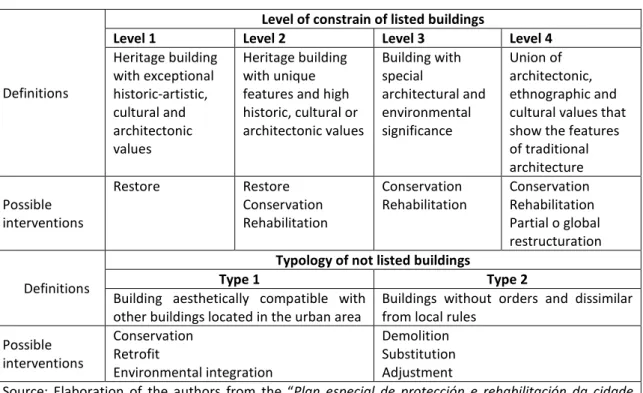
The “Plan especial” classifies the ancient buildings in two categories: listed and not. The firsts are divided in four levels of protection, related to heritage, architectonic and environmental values (Level 1, 2, 3 and 4). The seconds are divided in two categories in compliance or not with the urban image of the city center (Type 1 and 2). The definitions and the possible interventions for each category of constrain are showed below (Table 1).
Table 1: Classification of the historical buildings in the heritage regulation
Definitions
Level of constrain of listed buildings
Level 1 Level 2 Level 3 Level 4
Heritage building with exceptional historic-artistic, cultural and architectonic values Heritage building with unique features and high historic, cultural or architectonic values Building with special architectural and environmental significance Union of architectonic, ethnographic and cultural values that show the features of traditional architecture
Possible interventions
Restore Restore
Conservation Rehabilitation Conservation Rehabilitation Conservation Rehabilitation Partial o global restructuration
Definitions
Typology of not listed buildings
Type 1 Type 2
Building aesthetically compatible with other buildings located in the urban area
Buildings without orders and dissimilar from local rules
Possible interventions Conservation Retrofit Environmental integration Demolition Substitution Adjustment
Source: Elaboration of the authors from the “Plan especial de protección e rehabilitación da cidade histórica”, 1997
Listed buildings are compatible only with the following types of intervention:
• Restore refers to the intervention realized in monumental buildings in order to reaching general conservation, replacement or reconstruction of the original architecture typology;
• Conservation refers to the interventions that aim to preserve the condition of health, security and aesthetics without altering the structure, the layout and the formal characteristics of the buildings;
• Rehabilitation refers to an improvement of functional conditions and habitability of the building. In this case the alteration of internal layout is allowed and the conservation of the architectonic elements must be guarantee (facade, entrance, stairs, and so on);
More contents on https://energyheritage.wordpress.com/
- 122 -
Depending from the consistency and the conservation of the listed building, different type of interventions are permitted. Particularly, on buildings damaged or ruined, a global restructuration is permitted. Each level of protection has an individual ordinance regarding facades, interiors, roofs and staircases. Initially, the possibility of using solar systems in the historical roofs has been investigated (Table 2).
Table 2: Rules for the intervention on the historic roofs Eaves and cornices
Aesthetics The vision of the front or the top of the structural elements of the roof is forbidden The proportion and the modular design of existing roofs must be maintained Materials The new frames must be conform to traditional buildings (stone and concrete)
Roofs
Aesthetics
The volume and the shape of the roofs must be similar to the existing roofs The roof must be sloped, with well-defined height (similar to historical buildings) The inclination of the slope must be 20-28°
Materials
The roofing materials must be conform to traditional building: - Curve Arabic tile (for traditional buildings);
- Copper roofing (for buildings with contemporary forms); - Other materials (only for extension or new part).
Windows in the roofs
Aesthetics The dormers must be realized only for new construction or building extensions The height must not exceed the inclined plane of the pitch of the roof
Materials The frame must have a colour conforming to the historical ones and must be barely visible
Source: Elaboration of the authors from the “Plan especial de protección e rehabilitación da cidade histórica”, 1997
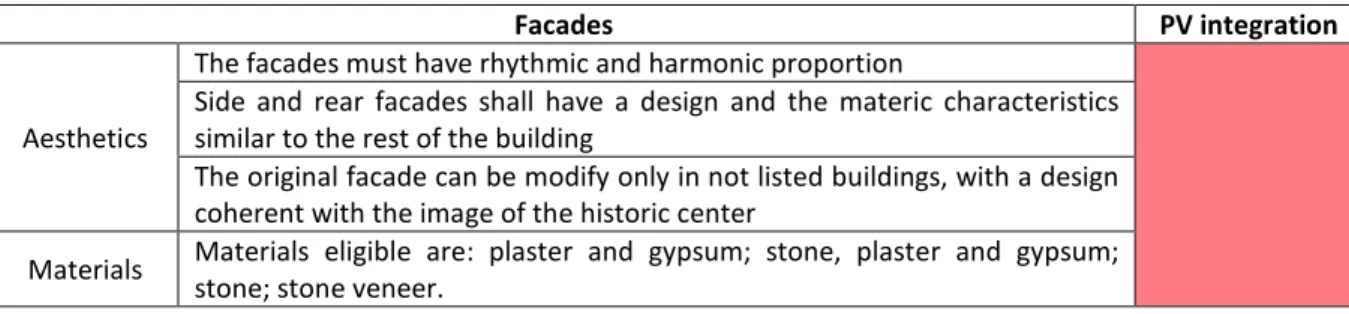
This situation seems to let few degrees of freedom for the intervention on original roofs or their re-construction integrating PV components. On the other hand, there are many possibilities for the application of solar system in the roof without altering or harming the original aspect and also considering aesthetics, physical and mechanical integration (e.g. solar-brick can be directly installed on the roof surface respecting the small structure of the roof bricks, solar tiles can replace traditional tiles keeping the same colour, shape and pattern, flexible PV modules can be integrated on metal laminates fully respecting the roofing system shape and surface). Several research projects [22; 24; 26; 27] have already demonstrated the expression potentiality of PV modules highlighting that many innovative BiPV products are available on the market [25]. The great availability of PV products designed for building integration, enhances the possibility to use these systems also in sensitive and heritage contexts, opening new challenges for architects, designers and also for decision makers. So, the possibility of using solar systems in other parts of the historic buildings was explored (Table 3).
Table 3: Rules for the intervention on the historic facade, doors, windows, canopies, and signs
Facades PV integration
Aesthetics
The facades must have rhythmic and harmonic proportion
Side and rear facades shall have a design and the materic characteristics similar to the rest of the building
The original facade can be modify only in not listed buildings, with a design coherent with the image of the historic center
More contents on https://energyheritage.wordpress.com/
- 123 -
Doors and windows
AesthetIcs
Doors and windows must have an organic design
Only in modern glass The doors cannot conceal the walls
The galleries must have a rhythm and size in accordance with the rest of the facade
Materials
Materials must have the same colour of that of the windows The doors must be realized in painted wood
The materials eligible for the windows frames are wood painted, lacquered or enamelled metal
Canopies Aesthetics
and materials
In general, the canopies are not allowed
The canopies can be made with traditional shapes, colours and materials, only after official authorization
Advertising signs
Aesthetics The colours shall be in accordance with the colour scheme of the facade Materials Materials eligible are: glass, painted wood, plates of metal printed, acrylic
and stone, aluminium, steel or brilliant materials = Partially allowed = Not allowed
Source: Elaboration of the authors from the “Plan especial de protección e rehabilitación da cidade histórica”, 1997
In this case, the degrees of freedom for the RES integration are few. However, it is possible to think of specific projects characterized by a high degree of integration among RES integration and the historical value of the historic city centre or the heritage building, which considers at the same time the matters related to aesthetics and material compatibility.
5. ASSESSMENT OF HERITAGE VALUES OF THE AREA
After the analysis of the local legislations and policies on cultural heritage preservation [3; 4; 19], the study focused on a specific buildings block located between Rúa do Vilar and Rúa Nova (Figure 1). The area includes 41 edifices with different architectonical style, constructive typology, materials and heritage values [4]. Generally, the buildings located in Rúa do Vilar have mediaeval origins: they are narrower and smaller (wide 4-7 m; depth 7-10 m). The houses in Rúa Nova have baroque origins: they are wider (wide 4-7 m; deep 12-15 m), with a large internal patio that in the past was used as garden. In both cases, the buildings have three or four floors [13; 20]. The highest level often was cantilever over the ground floor, creating arcades on the street [6].
More contents on https://energyheritage.wordpress.com/
- 124 -
Figure 1: The analysed building block (Source: Elaboration of the Authors from Google maps photo of
Santiago city center)
Figure 2: An example of the typical gallerias in the building block
In the building block, the following analyses have been carried out:
• Identification of specific levels of constrain and possible energy retrofit; • Individualization of roofs with damage problems;
• Estimation of roof surfaces where the installation of PV systems is compatible with the historic heritage;
• Definition of suggestions and recommendations for the integration of RES in the historic city centre.
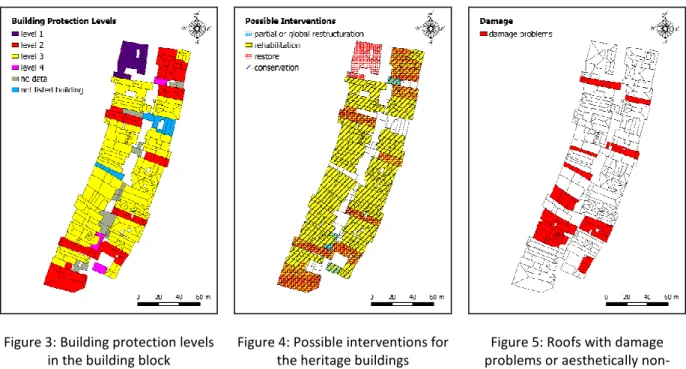
The buildings stock includes: 1 building listed as level 1 (Casa do Dean); 8 buildings listed as level 2; 32 buildings listed as Level 3 (19 in Rúa do Vilar and 13 in Rúa Nova), 6 building listed as Level 4 and 3 uncatalogued buildings (Figure 3) (Santiago GIS Data System, 2014). For each building the different possibility of intervention has been investigated (Figure 4). Next the roofs with damage problems due to the advanced state of decay, lack of safety conditions or aesthetics non-compliance compared to other buildings has been shown. The data on damages descripted in the “Plan especial” have been confronted with visual tests performed on site (Figure 5).
More contents on https://energyheritage.wordpress.com/
- 125 -
Figure 3: Building protection levels in the building block
Figure 4: Possible interventions for the heritage buildings
Figure 5: Roofs with damage problems or aesthetically
non-complained
6. ANALYSIS OF THE SOLAR ENERGY POTENTIAL
In order to compute solar irradiation and irradiance mean values and to relate this information to a geo-database with buildings information the following methodology has been applied:
• Validation of buildings data-base;
• Computation of solar irradiation and irradiance values on grid cell;
• Computation of statistical values for each pitch of the roofs in the database. • This data-base is the input for computing the photovoltaic potential.
Firstly, the geo-database of existing buildings (http://sip.consorciodesantiago.org) has been modified and integrated using google satellite information (Figure 6).
More contents on https://energyheritage.wordpress.com/
- 126 -
Figure 6: Sketch of the pitch slope in the area
Figure 7: Solar irradiance values [W m -2], 20th July at 10 a.m.
The reliability of the results depends on the input data quality. In this case, only general information regarding atmospheric and geographical conditions has been obtained, in particular the input data were:
• Digital Surface Model 1m2/px derived from LIDAR survey (2013);
• Digital Terrain Model resolution 65 m2/px STRM 2001 [10] to consider the shadowing effect of the surrounding area;
• Linke turbity factor for each month (Table 4).
Table 4: Linke turbity during the year
Jan Feb Mar Apr May Jun Jul Aug Sep Oct Nov Dec
3.5 4.1 3.6 4.2 5.0 5.0 4.6 4.7 4.9 4.2 3.9 2.9
Resources:
http://www.soda-is.com/eng/services/service_invoke/gui.php?xml_descript=soda_tl.xml#parameters
The direct (beam) and global solar irradiation raster maps for given days, latitude and surface were computed by using the module r.sun. The model does not consider the spatial and time variation of the clouds. In fact, no spatial distributed coefficients that reduce the clear-sky radiation are available. The shadowing effect of the topography is incorporated by using rasters of the horizon height constructed with the module r.horizon.
More contents on https://energyheritage.wordpress.com/
- 127 -
Secondly, daily sums of solar radiation [Wh m-2 day-1] were computed. The solar radiation maps for a given day were obtained by integrating the relevant irradiance between sunrise and sunset times for that day. From this data, the monthly [kWh m-2 month-1] and annual [kWh m-2 year-1] sums of solar irradiation were obtained by computing the average values for each roof. The annual sums of solar irradiation has been reported (Figure 9).
Figure 8: Average values of global solar irradiance [W/m2] for the roofs,
20th July at 10 a.m. (local time)
Figure 9: Annual sums of solar irradiation [Wh/m2/year]
Finally, in Figure 10 three different months, January, July and October, are shown.
Figure 10: Monthly sums of solar irradiation [Wh/m-2/month]
7. PV PRODUCTION AND LOAD MATCH
More contents on https://energyheritage.wordpress.com/
- 128 -
calculation of the PV potential of the district was carried out assuming a typical silicon crystalline PV module efficiency of 15% (future PV modules specific for BiPV applications based on thin film technologies such as CIGS will also show similar efficiencies). The nominal power (Pn) (defined as the power at Standard Test Conditions (STC), 25oC, 1000 W/m2) per roof was calculated as:
where A is the area of the roof, η is the efficiency of the modules at STC, GSTC is the reference irradiance at STC (1 kW/m2).
The yearly insolation values (defined as the incoming energy from the sun on the tilted surface over one year), were used as filters for roofs suitability for PV installations. The yearly final yield is defined as the electricity production per installed kWp over one year:
where PR is the Performance Ratio and includes all losses (for this work we have considered a typical PR for building integrated systems of PR=0.75 corresponding to 25% losses), H is the insolation and Yr is the relative yield defined as H/GSTC. The electricity production will be:
The threshold for PV suitability was selected as 1000 kWh/kWp (calculated from the insolation values using a performance ratio PR of 0.75). In fact, only roofs with an energy yield above this value make sense from an economic point of view. This aspect is subject to changes depending on installation prices and the presence of incentives. A second filter was applied: only level 3, level 4, and not listed buildings were selected for the calculations.
More contents on https://energyheritage.wordpress.com/
- 129 -
Figure 11: Production is from filtered roofs, consumption for the whole district. The efficiency of the virtual storage system was considered of 100%. Left: a week in January. Right: A week in July.
The unlimited virtual storage solution was proposed as an alternative to the typical strategy of “fit and forget” where the plants are installed without considering the energy system as a whole and that can cause problems on the grid level.
8. PV ARCHITECTURAL INTEGRATION CRITERIA
The terms “building integrated photovoltaic” (BiPV) refers to the concept of integrating PV elements into the building envelope, establishing a symbiotic relationship between the architectural design, functional properties and economic regenerative energy conversion. BiPVs have some advantages compared to non-integrated systems, primarily because there is no need for allocation of additional land and furthermore they allow distributed energy generation, close to the energy consumption site. Moreover, the on-site electricity production can reduce the total building material costs and achieve significant savings in terms of the mounting costs.
Some BiPV products allow a deep integration into the building envelope, also replacing traditional parts, such as roof or facade elements. Thus, they serve as “building” material and power generator simultaneously. In the framework of International Energy Agency project IEA-PVPS Task 7 “Photovoltaic power systems in the built environment” [22] several architectural criteria have been defined for BiPV formal integration quality:
• Naturally integrated: the PV system is a natural part of the building and without PV, the building would be lacking something - the PV system completes the building;
• Architecturally pleasing: based on a good design, the PV system adds eye-catching features to the architecture;
• Good composition: the colour and texture of the PV system is in harmony with the other materials;
• Grid, harmony and composition: the sizing of the PV system matches the sizing and grid of the building;
• Contextuality: the total image of a building is in harmony with the PV system (e.g. for historic buildings);
More contents on https://energyheritage.wordpress.com/
- 130 -
• Innovative new design: the PV system adds a value to building because is an innovative technology in the field of architecture, asking for innovative, creative, thinking of architects.
Another more recent International Energy Agency project, named IEA-SHC Task 41 “Solar Energy and Architecture” [24], focused on the architectural quality of building integrated solar energy systems. It defined the “architectural integration quality” as the result of a controlled and coherent integration of the solar collectors simultaneously from all points of view, functional, constructive, and formal (aesthetic) [15].
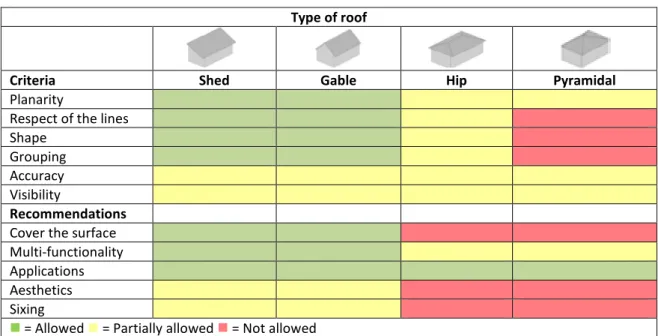
These criteria play an important role also in a historic context. From these principles, the research “Sustainable Renovation of Historical Buildings” (SuRHiB) developed a specific architectural guideline for the integration of solar technologies in historical roofs [17; 18; 19]. The research proposed the following criteria for the integration of PV panels (Table 6):
• Planarity and respect of the lines: to consider orientation and inclination of the roof; • Shape: to put the PV panels in a uniform shape;
• Grouping: to install the panels in groups of many components, reducing the spaces among the panels;
• Accuracy: to avoid the installation of PV panels out of the borders of the roof;
• Visibility: to integrate the PV modules in order to improve the total appearance of the building.
Also, several recommendations for the retrofit are presented (Table 5).
Table 5: Criteria and recommendations for the insertion of PV systems in historical roofs Type of roof
Criteria Shed Gable Hip Pyramidal
Planarity
Respect of the lines Shape
Grouping Accuracy Visibility
Recommendations Cover the surface Multi-functionality Applications Aesthetics Sixing
= Allowed = Partially allowed = Not allowed
Source: Elaboration of the authors from the “Research SuRHiB – Sustainable Renovation of Historical Buildings” [17]
More contents on https://energyheritage.wordpress.com/
- 131 -
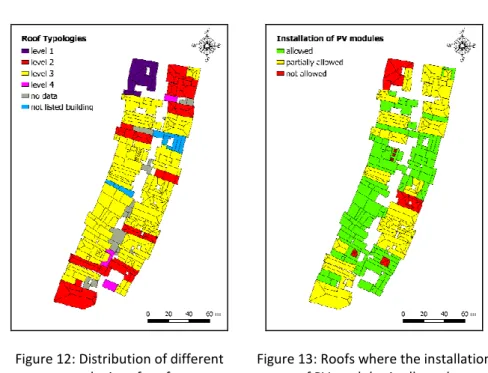
• 8 shed roofs, with a total area of 478 m2;
• 92 gable roofs (with double slope), with a total area of 6.324 m2; • 69 hip roofs (with four pitches), with a total area of 3.645 m2; • 31 pyramidal roofs, with a total area of 531 m2.
Figure 12: Distribution of different typologies of roofs
Figure 13: Roofs where the installation of PV modules is allowed
The total area with the intervention is allowed or partially allowed is 10.487 m2 (Level 3 and 4 and not listed buildings with shed, gable and hip roofs). The cost effective roofs area is 2.909 m2. The daily production data was then calculated only on these filtered roofs. The total Pn is of around 436 kWp for a yearly electricity production of around 470 MWh. PV production could then cover 68% of electricity needs of the district. The results of this analysis are showed below (Figure 14c).
It is also possible to localize the PV in alternative spaces, less visible than roof from public place, as gardens, internal facades or auxiliary buildings (i.e. sheds, garages and canopies). This decentralized solution permit to avoid the negative impact on the appearance not only from the public space of the city, but also the long-range effect of the surrounding hills and mountains. Specific guidelines on the compatibility of solar systems in historical buildings [1; 12], also in these case, suggest the optical integration that can be obtained by the use of same colours, shapes, dimensions and planarity with the level of the facade.
More contents on https://energyheritage.wordpress.com/
- 132 -
Figure 14: On the left hand side: roofs with annual final yield > 1000 kWh/kWp. Central part: roofs filtered by constrain levels. On the right hand side: roofs filtered by constrain levels and typology
9. CONCLUSIONS
The work shows that the integration of PV systems in the historic center is feasible, guarantying the preservation and maintaining the values and the aesthetical characteristics of the buildings. Obviously, this requires a multi-disciplinary project, careful to ensure the compatibility, the reversibility and the integration of the intervention. In the historic area considered, is particularly significant that, even putting a number of constraints always very restrictive, the PV production could then cover 68% of the electric consumption. Despite this, a large portion of the potential for PV integration in existing buildings remains unused. The reason for scarce application of BIPV components could be ascribed to several factors, such as economic reasons, lack of knowledge among decision makers and architects, general reluctance to “new” technologies and architectural/aesthetic aspects. An international survey conducted in the framework of Task 41 project [26] highlights that one of the main barriers is the lack of knowledge among decision makers, developers and clients, due to a lack of awareness of the existing possibilities offered by the PV technology in terms of formal flexibility.
To facilitate the use of this technology in historic buildings, several elements should be strengthened. First of all, working with preservation professionals (local authorities, professionals, agencies and historical organizations) is an important step in the design phase because they have an important role in identifying the heritage features and values. Another important point is the involvement of local government and authorities that can realize specific guidelines for helping the designer in the historic evaluation and also in solar design. The formation of the designers and decision makers on the technical and formal possibilities of PV systems is another important element to boost the penetration of solar design in sensitive contexts.
10. ACKNOWLEDGMENTS
More contents on https://energyheritage.wordpress.com/
- 133 -
author’s views and the European Union is not liable for any use that may be made of the information contained. We also would like to thank Patricia Liñares Méndez for the information on the constructive materials and the traditional technologies used in the historic city center of Santiago de Compostela and Fraunhofer Institutfor the production data. Finally, we would thank to Tecnalia for facilitating in the framework of the EFFESUS project the Digital Surface Model 1m2/px derived from LIDAR survey.
11. REFERENCES
[1]. Bayerisches Landesamt für Denkmalpflege (2012), Solarenergie und Denkmalpflege, München: Bayerisches Landesamt.
[2]. Concello de Santiago, Revision do Plan Xeneral de Ordenacion Municipal de Santiago de Compostela, Retrieved from http://www.santiagodecompostela.org.
[3]. Concello de Santiago (1997), Plan especial de protección e rehabilitación da cidade histórica, Concello de Santiago: Santiago de Compostela.
[4]. Consorcio de Santiago (2014), GIS data System, Retrieved from http://sip.consorciodesantiago.org/SIPWeb
[5]. 3ENCULT Project, Efficient Energy for EU Cultural Heritage”, www.3encult.eu.
[6]. EFFESUS Project Energy Efficiency for EU Historic Districts' Sustainability, (2014), Deliverable D3.1: Historic district geographical information system. GIS for energy supply and demand, Internal Report. [7]. Haas, F. (2013), Solar Energy Conservation of Monuments. A Contradiction?, in 8th Energy Forum on
Advanced Building Skins, 5-6 November 2013, pp. 189-194, Bressanone: Energy Forum.
[8]. Hersener, J.-L. & Meier, U. (1999). er. Energetisch nutzbares Biomassepotential in der Schweiz sowie im Stand der Nutzung in ausgewählten EU-Staaten und den USA. Zürich: Bundesamtes für Energie. [9]. Hofierka, J., & Suri, M. (2002), The solar radiation model for Open source GIS: implementation and
applications, International GRASS users conference in Trento, Trento: September 2002. [10]. Jarvis, A., Reuter, H., Nelson, A. & Guevara, E. (2008). Hole-filled seamless SRTM data V4.
Washington: International Centre for Tropical Agriculture (CIAT). Retrieved from http://srtm.csi.cgiar.org
[11]. Jordan, U. & Vajen, K. (2003). Realistic Domestic Hot-Water Profiles in Different Time Scales. Kassel: Universität Kassel.
[12]. Kandt, A. et alii (2011), Implementing Solar PV Projects on Historic Buildings and in Historic Districts, Golden: National Renewable Energy Laboratory.
[13]. Liñares Méndez, P. (2012). Sustainable refurbishment of historic housing in Santiago de Compostela. PhD Thesis, Madrid: Universidad Politécnica de Madrid.
[14]. Minosi V., & Zanzani S. (2013), Tutela Monumentale, Tutela Paesaggistica ed Efficienza Energetica, in Lucchi E., & Pracchi V., Efficienza energetica e patrimonio costruito, Sant’Arcangelo di Romagna: Maggioli Editore.
[15]. Munari Probst, M.C., Roecker, C. (2012), Solar energy systems in architecture: integration criteria and guidelines, IEA SHC Task 41 Solar energy and architecture.
[16]. Negash, D. (2009). Gebäudetypologie der Stadt Wolfhagen und Dachflächenpotentiale für die Solarenergienutzung unter Anwendung von ArcGIS. Kassel: Universität Kassel.
More contents on https://energyheritage.wordpress.com/
- 134 -
[18]. Polo López, C., & Frontini F. (2014), Energy Efficiency and Renewable Solar Energy Integration in Heritage Historic Buildings, in Energy Procedia, n. 48, pp. 1493-1502, Amsterdam: Elsevier.
[19]. ENEA (2012), Fotovoltaico e preesistente-spunti di discussione sull’impiego del fotovoltaico nelle cittá e nel paesaggio, ENEA conference, 22 marzo 2012: Napoli: Enea.
[20]. Ramos Guallart, J. et alii (2002), La gestión de la rehabilitación. La rehabilitación de Santiago, Concello de Santiago: Santiago de Compostela.
[21]. Ramos Guallart, J. et alii (2002), A arquitectura histórica y os criterios de rehabilitación. A rehabilitación de Santiago, Concello de Santiago: Santiago de Compostela.
[22]. Shoen T., Prasad D., & Ruoss D. (2001), Task 7 of the IEA PV Power Systems Program Achievements and outlook, Retrieved from www.iea-pvps.org.
[23]. Suri M., & Hofierka J., (2004) A New GIS-based Solar Radiation Model and Its Application for Photovoltaic Assessments, Transactions in GIS, 8(2), 175-190.
[24]. Wall M., Windeleff J., & Lien A.G. (2008), IEA Task 41-Solar Energy and Architecture-Annex Plan, International Energy Agency, Retrieved from http://members.ieashc.org.
[25]. PVACCEPT, Research Project Solar Energy - Strengthening the acceptability of Photovoltaics through innovative Design, www.pvaccept.de/pvaccept/eng/index.htm.
[26]. IEA Task 41 database on innovative solar products for building integration, http://leso2.epfl.ch/solar/index.php.
More contents on https://energyheritage.wordpress.com/
![Figure 7: Solar irradiance values [W m - -2 ], 20 th July at 10 a.m.](https://thumb-us.123doks.com/thumbv2/123dok_es/6473917.217762/17.892.233.696.186.565/figure-solar-irradiance-values-w-m-th-july.webp)
![Figure 8: Average values of global solar irradiance [W/m 2 ] for the roofs,](https://thumb-us.123doks.com/thumbv2/123dok_es/6473917.217762/18.892.236.694.305.623/figure-average-values-global-solar-irradiance-w-roofs.webp)