Liver-specific case fatality due to
chronic hepatitis C virus infection: a systematic review
Shelagh M. Szabo,* Jennifer C. Samp,** David R. Walker,** Suzanne Lane,*
Stephanie K. Cline,** Katherine L. Gooch,** Ricardo Jimenez-Mendez,*** Adrian R. Levy*
,****
* ICON Epidemiology, Vancouver BC Canada.
** AbbVie Global Health Economics and Outcomes Research, Abbott Park, IL USA. *** University of British Columbia, Vancouver BC Canada.
**** Department of Community Health and Epidemiology, Dalhousie University, Halifax NS Canada.
ABSTRACT
Despite reports that mortality is increasing, overall case fatality due to hepatitis C virus (HCV) is thought to be low. Given the variability in published rates, we aimed to synthesize estimates of liver-specific case fata-lity and all-cause mortafata-lity in chronic HCV according to follow-up duration, sustained viral response (SVR) to treatment, and liver disease severity. A systematic review was conducted of studies published in English from 2003 to 2013, reporting liver-specific case fatality estimates from HCV-infected samples. Thirty-five eli-gible articles were identified; 26 also presented estimates of all-cause mortality. Among community-based samples, liver-specific case fatality ranged from 0.3% over 5.7 years to 9.2% over 8.2 years of follow-up; and of all-cause mortality, from 4.0% over 5.7 years, to 23.0% over 8.2 years of follow-up. Estimates were higher among clinic-based samples and those with more severe liver disease. Among treated patients achieving SVR, liver-specific case fatality was low: up to 1.4% over 11.5 years of follow-up among samples with any se-verity of liver disease. Estimates were higher among those without SVR: up to 14.0% over 10 years of follow-up among samples with any severity of liver disease, and higher still among samples with more severe liver disease. The proportion of deaths attributable to liver-specific causes ranged from 55 to 85% among those with severe liver disease. Published estimates of fatality are high among certain populations of chronic HCV patients, with liver-specific causes being an important contributor. Understanding current HCV morta-lity rates is important for quantifying the total burden of HCV disease.
Key words. Mortality. HCV. Evidence synthesis.
Correspondence and reprint request: Adrian R. Levy, Ph.D.
Department of Community Health and Epidemiology, Dalhousie University #425-5790 University Avenue Halifax, NS, B3H 1V7, Canada.
Tel.: 902-494-3860. Fax: 902-494-1597 E-mail: [email protected]
Manuscript received: December 20, 2014. Manuscript accepted: March 15, 2015.
INTRODUCTION
The number of deaths due to chronic hepatitis C
virus (HCV) infection is on the rise: recent
esti-mates from the United States (US) have
demonstrat-ed a 1.5-fold increase in mortality between 1999 and
2007.
1However, most deaths attributed to HCV
oc-cur among those with end-stage liver disease,
1the
progression to which occurs over a long period of
time.
2As a result, chronic HCV-related case fatality,
defined as the number of condition-specific deaths
from the total population of those afflicted,
3is
gen-erally considered to be low.
4,5Although early
esti-mates from the World Health Organization
suggested that 5 to 7% of those with HCV will die at
some point due to the condition,
6and HCV is a key
causal factor in 366,000 deaths annually, globally,
7a robust synthesis of contemporary estimates is
lacking. This is particularly important given the
changing epidemiology of HCV, and the potential
impact of emerging therapies.
8,9Published estimates of case fatality in HCV
demon-strate substantial variability, due to both
patient-spe-cific, and methodological factors. Estimates of case
fatality can be impacted by study design, the sampling
methodology and frame (i.e., if selection occurred from
HCV clinics or the community), disease severity or
du-ration, and causes of death considered.
10-12This
case fatality due to HCV is ‘low’. Despite challenges in
synthesizing the evidence, understanding the case
fa-tality rate due to HCV is important, as even a small
apparent increase in the rate could translate into a
substantially higher numbers of deaths due to the high
prevalence of HCV. Additionally, understanding the
importance of liver-specific causes in contributing to
all-cause mortality in HCV, would help contextualize
how risk factors and other comorbidities impact an
in-dividual’s likelihood of death.
The objectives of this study were to synthesize
and compare reported estimates of liver-specific case
fatality and all-cause mortality in HCV, according
to time since study enrolment, treatment response,
baseline liver disease severity, and sampling frame.
Findings from this synthesis will allow a better
un-derstanding of the true mortality risk among those
with chronic HCV.
MATERIAL AND METHODS
A systematic review was conducted of studies
re-porting on estimates of liver-specific case fatality in
HCV, indexed in EMBASE and Medline. Case
fatali-ty estimates were stratified according to duration of
follow up, baseline liver disease severity, sampling
frame (community- or clinic-based), and treatment
response (i.e., whether a sustained viral response
(SVR) was achieved). We considered all-cause
liver-specific estimates of case fatality, but did not
syn-thesize estimates within individual liver
disease-related fatality categories, as the
categoriza-tions of those varied between studies. Estimates of
all-cause mortality were also identified and
synthe-sized, where available.
Search strategy and
study selection
A customized search strategy was developed
us-ing a combination of index and free terms, and study
design filters, to identify studies reporting on
liver-specific case fatality in HCV (Appendix 1-4).
Inclusion criteria were developed to identify:
• Peer-reviewed original articles published in
Eng-lish from 2003 to 2013 (the most recent ten years
at the time of the search).
• Randomized studies reporting on long-term
mor-tality outcomes; or, observational studies
enroll-ing either a population-based sample, or a
clinic-based sample of consecutively-selected
pa-tients; and
• Articles presenting liver-specific case fatality
esti-mates over a specified duration of time, with or
without estimates of all-cause mortality, among
individuals with chronic HCV.
Studies were excluded if:
• They selected individuals on the basis of an HCV
risk factor that would modify the case fatality
rate (such as human immunodeficiency virus
(HIV) infection or injection drug use); or
• Results were from a duplicate publication or
sample.
Studies reporting results according to
person-years of follow up were tabulated separately
(Appen-dix 1-4). Two independent investigators reviewed the
title, abstract, and full-text of potential articles; and
reached consensus before confirming final study
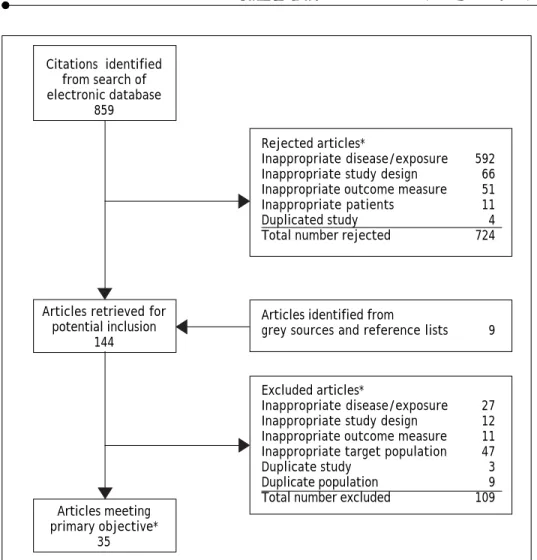
in-clusion (Figure 1).
Data extraction and evidence synthesis
Following best practices published elsewhere,
4du-plicate data extraction into a customized Microsoft®
Excel® form was performed. Extracted data included
baseline characteristics, liver-specific case fatality or
all-cause mortality according to duration of
follow-up, and whether the sample was selected based on
HCV liver disease severity. Case fatality was defined
as the number of deaths due to liver disease, and
all-cause mortality as the number of deaths due to any
cause.
3Two separate measures of death were
ex-tracted, depending upon how the data were
present-ed in the original article:
• The proportion of the sample that died over a
mean or median follow up time, or
• The cumulative number of deaths, extracted at
the one-, two-, and five-year time points, using
Engauge Digitizer v2.14.
Although the first measure was more frequently
reported, the second measure was included because
it provides estimates over various durations of
fol-low up that can be easily compared between studies
with similar inclusion criteria.
Figure 1. Flow diagram indica-ting inclusion and exclusion of the articles identified in the systema-tic review.
were classified as having ‘HCV with severe liver
dis-ease’ when the sample was selected based on the
presence of any cirrhosis, hepatocellular carcinoma,
or other unspecified severe liver disease.
Estimates of liver-specific case fatality or
all-cause mortality were plotted according to the
dura-tion of follow-up, and stratified according to severity
of HCV and treatment response. For studies
report-ing on both liver-specific case fatality and all-cause
mortality, the proportion of mortality attributable
to HCV was calculated. This calculation was
re-stricted to estimates presented by time since
enrol-ment, and of known treatment status.
RESULTS
Thirty-five of 859 articles identified in the
system-atic search presented estimates of liver-specific case
fatality (Figure 1);
7-4226 (72%) also estimated
all-cause mortality.
12-37Half of the studies included
samples selected based on severity of liver disease;
eleven provided estimates specific to cirrhosis, and
three provided estimates specific to transplanted
pa-tients.
28,35,37One article was included in the ‘HCV
with severe liver disease’ category where 27% of the
cohort had advanced hepatic fibrosis (Ishak score
4), while the remaining members of the cohort had
cirrhotic disease.
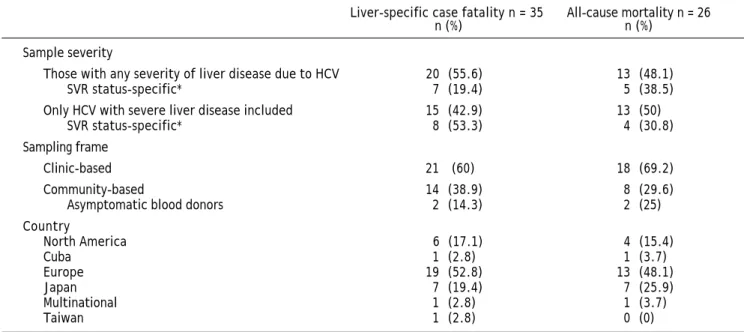
36Half of the studies presented
es-timates specific to European populations, and more
than half (n = 22) sampled from HCV clinics (Table
1). All studies that included only patients with
se-vere liver disease were clinic (rather than
communi-ty) based samples.
As expected, liver-specific case fatality and
all-cause mortality estimates were higher in studies
with longer duration of follow-up (Figure 2). Among
studies including patients with any severity of liver
disease, estimates of liver-specific case fatality from
community-based samples (n = 12) ranged
from 0.3% over 5.7 years
14to 9.2% over 8.2 years of
Citations identified from search of electronic database
859
Rejected articles*
Inappropriate disease/exposure 592
Inappropriate study design 66
Inappropriate outcome measure 51
Inappropriate patients 11
Duplicated study 4
Total number rejected 724
Articles retrieved for potential inclusion
144
Articles meeting primary objective*
35
Excluded articles*
Inappropriate disease/exposure 27
Inappropriate study design 12
Inappropriate outcome measure 11
Inappropriate target population 47
Duplicate study 3
Duplicate population 9
Total number excluded 109
Articles identified from
grey sources and reference lists 9
Figure 2. Estimates of case fatality and mortality according to follow up time and severity of HCV: A. Liver-specific case
fata-lity among those with any severity of liver disease due to HCV. B. All-cause mortality among those with any severity of liver
di-sease due to HCV. C. Liver-specific case fatality among those with HCV with severe liver disease. D. All-cause mortality among
those with HCV with severe liver disease. * The one estimate of liver-specific case fatality and all-cause mortality among those with severe liver disease at 8.4 years of follow-up, was based on a study sample where 27% of the cohort had advanced hepatic fi-brosis (Ishak score 4), and the remaining members of the cohort had cirrhosis.
A B
C D
Table 1. Characteristics of the 36 studies included in the systematic review.
Liver-specific case fatality n = 35 All-cause mortality n = 26
n (%) n (%)
Sample severity
Those with any severity of liver disease due to HCV 20 (55.6) 13 (48.1)
SVR status-specific* 7 (19.4) 5 (38.5)
Only HCV with severe liver disease included 15 (42.9) 13 (50)
SVR status-specific* 8 (53.3) 4 (30.8)
Sampling frame
Clinic-based 21 (60) 18 (69.2)
Community-based 14 (38.9) 8 (29.6)
Asymptomatic blood donors 2 (14.3) 2 (25)
Country
North America 6 (17.1) 4 (15.4)
Cuba 1 (2.8) 1 (3.7)
Europe 19 (52.8) 13 (48.1)
Japan 7 (19.4) 7 (25.9)
Multinational 1 (2.8) 1 (3.7)
Taiwan 1 (2.8) 0 (0)
* Some studies provided both overall, and SVR-specific, estimates.
Liver-specific case-fatality (%)
40
30
20
10
0
SVR-, age 40-60 years SVR-, age > 60 years SVR+, age 40-60 years SVR+, age > 60 years
0 5 10 15 20
Mean/median follow-up period (years); patients with any severity of liver disease due to HCV
All-cause mortality (%)
40
30
20
10
0
SVR-, age 40-60 years SVR-, age > 60 years SVR+, age 40-60 years SVR+, age > 60 years
0 5 10 15 20
Mean/median follow-up period (years); patients with any severity of liver disease due to HCV
Liver-specific case-fatality (%)
40
30
20
10
0
Unspecified SVR-, age 40-60 years Unspecified SVR+, age 40-60 years Cirrhosis SVR-, age 40-60 years Cirrhosis SVR+, age 40-60 years Transplant SVR-, age 40-60 years Transplant SVR+, age 40-60 years
0 5 10 15 20
Mean/median follow-up period (years); patients with any severity of liver disease due to HCV
All-cause mortality (%)
40
30
20
10
0
Unspecified SVR-, age 40-60 years Unspecified SVR+, age 40-60 years Cirrhosis SVR-, age 40-60 years Cirrhosis SVR+, age 40-60 years
0 5 10 15 20
follow up (Figure 2A).
21Estimates from clinic-based
samples (n = 5) were higher, ranging from 2.7%
over 3.9 years
22to 21.2% over 11.5 years of follow
up.
23As expected, estimates of all-cause mortality
from the same studies were higher (Figure 2B). The
proportion of all-cause mortality accounted for by
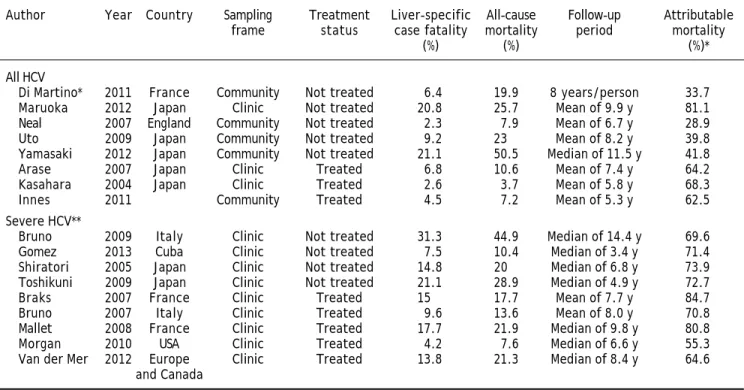
liv-er-specific causes ranged from 28.9 to 81.1% in
stud-ies with patients of any severity (Table 2).
Estimates of liver-specific and all-cause mortality
were higher among patients with severe liver disease
at baseline (Figure 2). Liver-specific case fatality
among samples of patients with severe liver disease
ranged from 4.2% over 6.5 years
31to 31.3% over 14.4
years of follow up.
26The highest liver-specific case
fa-tality estimate of 40.2% over 1.1 years of follow up
was observed in the one study of individuals with
de-compensated cirrhosis (Figure 2C).
32All-cause
mor-tality estimates were up to 44.9% over 14.4 years of
follow up among individuals with non-specific severe
liver disease or cirrhosis,
2620.0% over 3.5 years
among those who had had a liver transplant,
28,35and
46.8% over 1.1 years of follow up among those with
decompensated cirrhosis.
32The proportion of
mortali-ty attributable to liver-specific causes was generally
higher among samples with more severe liver disease
(55.3 to 84.5%) (Table 2).
Both liver-specific case fatality and all-cause
mor-tality were relatively constant and low among those
who achieved an SVR (Figure 3), independent of liver
disease severity. Among those with any severity of
liver disease that achieved SVR, the highest estimate
of liver-specific case fatality was 1.4% over 11.5
years;
19all-cause mortality was 12.5% over
11.5 years.
23Among those with severe liver disease
that acheved SVR, liver-specific case fatality reached
2.9% over 3.5 years;
37and all-cause mortality reached
11.4% over 9.8 years.
30Liver-specific case fatality and
all-cause mortality were higher and increased with
time among those who did not achieve an SVR
(Fig-ure 3). Among those with any severity of liver
dis-ease, liver-specific case fatality was up to 14.0%, and
all-cause mortality up to 20.8%, over 10 years of
fol-low-up.
19The effect was more dramatic among
pa-tients with severe liver disease, where liver-specific
case fatality was up to 22.4% over 7.7 years, and
all-cause mortality, up to 27.9% over 9.8 years.
30The
proportion of mortality attributable to liver-specific
causes was approximately twice as high among those
who failed to achieve an SVR (56.8%), relative to
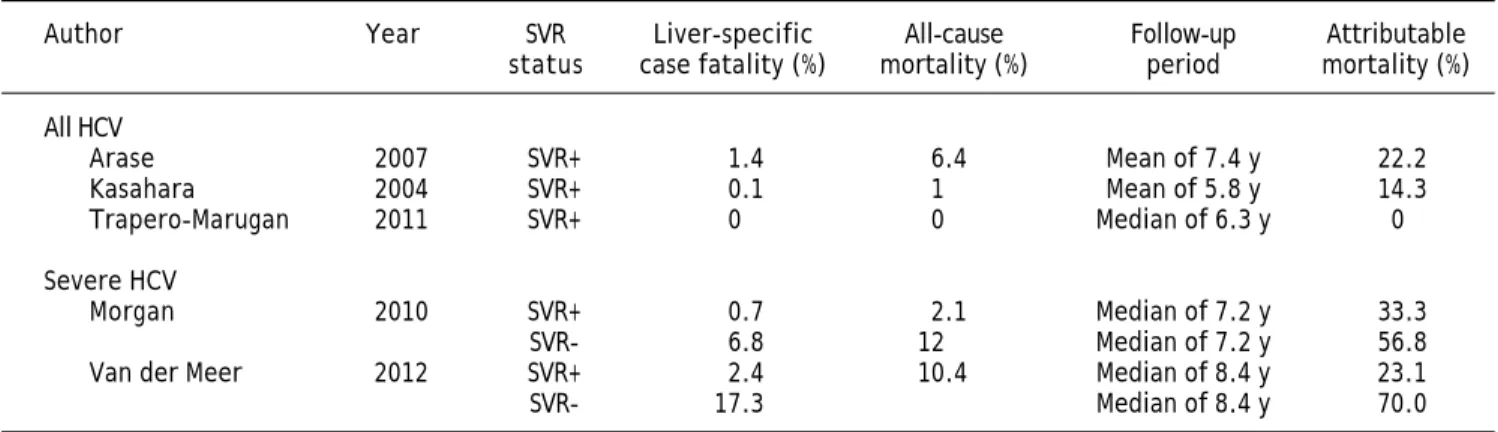
those achieving an SVR (33.3%) (Table 3).
Estimates of the cumulative incidence of
liver-specific case fatality among samples of any severity
Table 2. Proportion of all-cause mortality attributable to liver-specific case fatality (according to time since enrolment), from samples according to selection criteria for HCV severity and treatment status.
Author Year Country Sampling Treatment Liver-specific All-cause Follow-up Attributable
frame status case fatality mortality period mortality
(%) (%) (%)*
All HCV
Di Martino* 2011 France Community Not treated 6.4 19.9 8 years/person 33.7
Maruoka 2012 Japan Clinic Not treated 20.8 25.7 Mean of 9.9 y 81.1
Neal 2007 England Community Not treated 2.3 7.9 Mean of 6.7 y 28.9
Uto 2009 Japan Community Not treated 9.2 23 Mean of 8.2 y 39.8
Yamasaki 2012 Japan Community Not treated 21.1 50.5 Median of 11.5 y 41.8
Arase 2007 Japan Clinic Treated 6.8 10.6 Mean of 7.4 y 64.2
Kasahara 2004 Japan Clinic Treated 2.6 3.7 Mean of 5.8 y 68.3
Innes 2011 Community Treated 4.5 7.2 Mean of 5.3 y 62.5
Severe HCV**
Bruno 2009 Italy Clinic Not treated 31.3 44.9 Median of 14.4 y 69.6
Gomez 2013 Cuba Clinic Not treated 7.5 10.4 Median of 3.4 y 71.4
Shiratori 2005 Japan Clinic Not treated 14.8 20 Median of 6.8 y 73.9
Toshikuni 2009 Japan Clinic Not treated 21.1 28.9 Median of 4.9 y 72.7
Braks 2007 France Clinic Treated 15 17.7 Mean of 7.7 y 84.7
Bruno 2007 Italy Clinic Treated 9.6 13.6 Mean of 8.0 y 70.8
Mallet 2008 France Clinic Treated 17.7 21.9 Median of 9.8 y 80.8
Morgan 2010 USA Clinic Treated 4.2 7.6 Median of 6.6 y 55.3
Van der Mer 2012 Europe Clinic Treated 13.8 21.3 Median of 8.4 y 64.6
and Canada
A B
C D
Figure 3. Estimates of liver-specific case fatality and all-cause mortality according to follow up time and response to
treat-ment: A. Liver-specific case fatality among those with any severity of liver disease due to HCV. B. All-cause mortality among
those with any severity of liver disease due to HCV. C. Liver-specific case fatality among those with HCV with severe liver
disea-se. D. All-cause mortality among those with HCV with severe liver disease. * The one estimate of liver-specific case fatality and
all-cause mortality among those with severe liver disease at 8.4 years of follow-up, was based on a study sample where 27% of the cohort had advanced hepatic fibrosis (Ishak score 4), and the remaining members of the cohort had cirrhosis.
Table 3. Proportion of all-cause mortality attributable to liver-specific case fatality (according to time since enrolment), from samples according to selection criteria for HCV severity and response status.
Author Year SVR Liver-specific All-cause Follow-up Attributable
status case fatality (%) mortality (%) period mortality (%)
All HCV
Arase 2007 SVR+ 1.4 6.4 Mean of 7.4 y 22.2
Kasahara 2004 SVR+ 0.1 1 Mean of 5.8 y 14.3
Trapero-Marugan 2011 SVR+ 0 0 Median of 6.3 y 0
Severe HCV
Morgan 2010 SVR+ 0.7 2.1 Median of 7.2 y 33.3
SVR- 6.8 12 Median of 7.2 y 56.8
Van der Meer 2012 SVR+ 2.4 10.4 Median of 8.4 y 23.1
SVR- 17.3 Median of 8.4 y 70.0
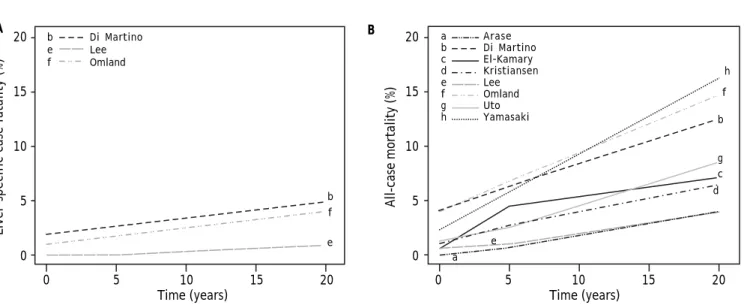
liver disease (n = 3) demonstrated the risk of death
due to HCV was not low. Estimates reached 5% case
fatality by 5 years since diagnosis (in a study of
treatment naïve individuals) (Figure 4A).
12Eight
studies reported on cumulative all-cause mortality
among those with any severity of liver disease, and
Liver-specific case-fatality (%)
40
30
20
10
0
0 5 10 15 20
Mean/median follow-up period (years); patients with any severity of liver disease due to HCV
SVR-SVR+
All cause mortality (%)
40
30
20
10
0
0 5 10 15 20
Mean/median follow-up period (years); patients with any severity of liver disease due to HCV
SVR-SVR+
Liver-specific
case-fatality (%)
40
30
20
10
0
0 5 10 15 20
Mean/median follow-up period (years); patients with severe liver disease due to HCV
Unspecified SVR-Unspecified SVR+ Cirrhosis SVR-Cirrhosis SVR+ Transplant SVR-Transplant SVR+
All cause mortality (%)
40
30
20
10
0
0 5 10 15 20
Mean/median follow-up period (years); patients with severe liver disease due to HCV
estimates ranged from 3.9% among a
community-based sample of mixed treatment status,
38to 16.3%
in a clinic-based treatment-naïve sample,
23over 5
years (Figure 4B). Although no studies reported
cu-mulative liver-specific deaths among samples with
severe liver disease, cumulative all-cause mortality
at 5 years was: 15.0% (among liver transplant
pa-tients),
3916.2% (cirrhosis),
34and 53.4%
(decompen-sated cirrhosis).
32DISCUSSION
Recent reports suggest that deaths due to HCV are
on the rise,
1likely due to more patients progressing
to severe liver disease;
40hepatocellular carcinoma
and cirrhosis are now leading causes of death
global-ly.
41Nonetheless, because of the slowly progressive
nature of HCV, the overall case fatality rate, and
re-sultant mortality rate, is believed to be low.
4,5Case
fatality in the US is approximately 0.7%, given the
estimated 2.3 million persons infected,
42and there
are 16,000 HCV-related deaths annually.
1Global
mortality data also suggest that case fatality rates
– although higher than in the US – are still low;
there are approximately 366,000 deaths annually,
7out of 180 million cases of HCV globally,
43which
equates to a case fatality of approximately 2%.
This critical systematic review of the literature
suggests that previous estimates of chronic
HCV-re-lated case fatality are underestimated; case fatality
rates from population- and community-based studies
can be dramatically higher than 1-2%.
1,7,43Even
among community-based samples of individuals with
all severities of HCV, case fatality reached 10% over
ten years of follow-up;
21and estimates from
clinic-based samples were more than 20% over the same
pe-riod.
23Fatalities occurred in up to one-third of
individuals with severe liver disease due to HCV over
15 years of follow-up,
26and were higher still among
those with decompensated cirrhosis.
32Higher
esti-mates among those who have progressed to more
se-vere liver disease highlight the importance of
delaying disease progression to decreasing mortality.
Comparing HCV-specific mortality estimates with
the general population quantifies the excess risk of
death, from both liver-related and non-HCV-related
causes. In a Swedish study, the standardized
mor-tality ratio (SMR; comparing individuals with HCV
and the general population) was estimated at 5.8 for
all-cause death and 35.5 for liver-specific death.
16SMR estimates from a Norwegian study were
compa-rable at 6.7 for all-cause death and 41.0 for
liver-specific death.
18Similar comparisons of mortality
from the US, Taiwan, and England suggest at least
a two to three-fold excess risk of all-cause death
among those with HCV.
11,13,38Despite the
impor-tance of liver-specific case fatality, the increased risk
of all-cause mortality highlights that non-hepatic
causes of death are also important concerns for
indi-viduals with chronic HCV infection.
Estimating the proportion of deaths due to
liver-specific causes is a useful measure for understanding
the HCV burden and quantifying the potential
sur-vival benefit of achieving SVR. Our findings
compli-ment those of a recent review that demonstrated that
SVR decreases liver-specific case fatality in
uncompli-Figure 4. Cumulative incidence of liver-specific and all-cause deaths, among samples with any severity of liver disease due to HCV.
A B
Liver-specific case fatality (%)
20
15
10
5
0
0 5 10 15 20
Time (years)
b Di Martino
e Lee
f Omland
a Arase
b Di Martino c El-Kamary d Kristiansen
e Lee
f Omland
g Uto
h Yamasaki
All-case mortality (%)
20
15
10
5
0
0 5 10 15 20
Time (years)
b f
e
h
f
b
g c d
cated chronic HCV,
10by considering patients with
more severe liver disease at baseline, and the
contri-bution of liver-specific death to all-cause mortality.
We found that liver-specific causes accounted for the
majority of deaths among those with chronic HCV,
and, to an even greater extent, among those with
se-vere liver disease. The extent to which specific
non-liver-related causes contribute to all-cause mortality
in HCV varies depending on the age of the patients
and the distribution of other risk factors for deaths.
44Describing the proportion of all-cause mortality due
to liver-specific causes may help to facilitate
compari-sons of mortality estimates across studies.
Strengths of the study included the
comprehen-sive approach to this evidence synthesis, including
articles from different geographic areas, study
de-signs, and sampling strategies. We included studies
that reported no deaths and individuals with all
stages of liver disease, to avoid bias in the fatality
rates. Multiple types of case fatality measures were
considered to take a broad view in understanding
the impact of chronic HCV on case fatality. Finally,
samples were required to be population-based or
consecutively selected, to collect estimates from
studies of higher methodological rigor in their
sam-pling strategy.
The study also suffered from a number of
limita-tions. First, we were limited by the quality of the
design and extent of reporting of the original
ar-ticles. Studies typically reported basic demographic
and clinical characteristics of the sample, but other
mortality risk factor data were infrequently
presented. As such, we were unable to tease out
the impact of specific contributors to liver-specific
case fatality (i.e. alcohol abuse) from the impact of
the underlying HCV infection. We attempted to
control for this by excluding articles that selected
patients based on the presence of other risk factors
for mortality (i.e. HIV infection). Heterogeneity in
study designs and samples prevented
meta-analy-sis;
45,46we also chose not to annualize reported
es-timates of case fatality.
10Instead, the time horizon
presented in the original articles was retained, to
avoid assuming a constant hazard of death. The
in-clusion of Kaplan-Meier curves, or age- and
sex-specific rates, in future publications of mortality in
HCV would facilitate comparisons of data across
studies and present a more accurate portrayal of
the risks of death.
Second, due to a lack of data availability, we were
unable to stratify results by time since infection.
In-stead, we considered the impact of baseline liver
dis-ease severity on case fatality as a proxy. Third,
there was variability in the measures of
liver-specif-ic case fatality and the categorizations of causes of
death between studies. To address this, we did not
compare between individual liver disease categories
and, instead, focused on aggregated measures of
liv-er-related case fatality. Finally, as studies were
se-lected for inclusion based on presenting liver-specific
case fatality estimates, the findings for all-cause
mortality may not be reflective of all studies
report-ing on overall deaths in chronic HCV.
HCV case fatality rates may vary, depending on
a number of clinical and methodological factors.
Despite this, these estimates highlight that case
fatality among those with chronic HCV may have
been underestimated, and liver-specific causes of
death are an important contributor to mortality in
HCV.
ABBREVIATIONS
•
HCV:
hepatitis C virus.
•
SVR:
sustained viral response.
•
US:
United States.
FINANCIAL SUPPORT
This study was sponsored by AbbVie. The design,
analysis, and financial support of this study were
provided by AbbVie. AbbVie participated in the
in-terpretation of data, review, and approval of the
presentation.
DISCLOSURES
Jennifer C. Samp and David Walker are AbbVie
employees and may hold AbbVie stock or options.
Stephanie Cline and Katherine Gooch were
employ-ees of AbbVie at the time of the conduct of this
study.
Suzanne Lane is an employee of ICON plc. At the
time of this work, Shelagh Szabo was an employee
of ICON plc.
Ricardo Jimenez-Mendez and Adrian Levy are
paid consultants to ICON plc.
REFERENCES
1. Ly KN, Xing J, Klevens RM, Jiles RB, Ward JW, Holmberg SD. The increasing burden of mortality from viral hepatitis in the United States between 1999 and 2007. Ann Intern
Med 2012; 156: 271-8.
2. Thein H-H, Yi Q, Dore GJ, Krahn MD. Estimation of Stage-Specific Fibrosis Progression Rates in Chronic Hepatitis C Virus Infection: A Meta-Analysis and Meta-Regression.
3. Porta M. A Dictionary of Epidemiology. 5th Ed. New York: Oxford University Press Ubc; 2008.
4. Uhanova J, Tate RB, Tataryn DJ, Minuk GY. A population-based study of the epidemiology of hepatitis C in a North American population. J Hepatol 2012; 57: 736-42. 5. Minami T, Kishikawa T, Sato M, Tateishi R, Yoshida H,
Koike K. Meta-analysis: mortality and serious adverse events of peginterferon plus ribavirin therapy for chro-nic hepatitis C. J Gastroenterol 2013; 48: 254-68. 6. World Health Organization. Global Alert and Response:
Hepatitis C. 2013. Available from: URL: http:// www.who.int/csr/disease/hepatitis/whocdscsrlyo2003/ en/index4.html
7. Perz JF, Armstrong GL, Farrington LA, Hutin YJ, Bell BP. The contributions of hepatitis B virus and hepatitis C vi-rus infections to cirrhosis and primary liver cancer worldwide. J Hepatol 2006; 45: 529-38.
8. Ditah I, Ditah F, Devaki P, Ewelukwa O, Ditah C, Njei B, Luma HN, et al. The changing epidemiology of hepatitis C virus infection in the United States: National Health and Nutrition Examination Survey 2001 through 2010. J
He-patol 2014; 60: 691-8.
9. Esteban JI, Sauleda S, Quer J. The changing epidemiology of hepatitis C virus infection in Europe. J Hepatol 2008; 48: 148-62.
10. Singal AG, Volk ML, Jensen D, Di Bisceglie AM, Schoenfeld PS. A sustained viral response is associated with reduced liver-related morbidity and mortality in patients with hepatitis C virus. Clin Gastroenterol Hepatol 2010; 8: 280-8, 288. 11. El-Kamary SS, Jhaveri R, Shardell MD. All-cause,
liver-rela-ted, and non-liver-related mortality among hcv-infected individuals in the general US population. Clinical
Infectio-us Diseases 2011; 53: 15.
12. Di Martino V, Crouzet J, Hillon P, Thevenot T, Minello A, Monnet E. Long-term outcome of chronic hepatitis C in a population-based cohort and impact of antiviral thera-py: a propensity-adjusted analysis. J Viral Hepat 2011; 18: 493-505.
13. Guiltinan AM, Kaidarova Z, Custer B, Orland J, Strollo A, Cyrus S, Busch MP, et al. Increased all-cause, liver, and cardiac mortality among hepatitis C virus-seropositive blood donors. Am J Epidemiol 2008; 167: 743-50. 14. Allison RD, Conry-Cantilena C, Koziol D, Schechterly C,
Ness P, Gibble J, Kleiner DE, et al. A 25-year study of the clinical and histologic outcomes of hepatitis C virus infec-tion and its modes of transmission in a cohort of initially asymptomatic blood donors. J Infect Dis 2012; 206: 01. 15. Arase Y, Ikeda K, Suzuki F, Suzuki Y, Saitoh S, Kobayashi
M, Akuta N, et al. Long-term outcome after interferon therapy in elderly patients with chronic hepatitis C.
In-tervirology 2007; 50: 16-23.
16. Duberg A-S, Torner A, Davisdottir L, Aleman S, Blaxhult A, Svensson A, Hultcrantz R, et al. Cause of death in indivi-duals with chronic HBV and/or HCV infection, a natio-nwide community-based register study. J Viral Hepatitis 2008; 15: 538-50.
17. Kasahara A, Tanaka H, Okanoue T, Imai Y, Tsubouchi H, Yoshioka K, Kawata S, et al. Interferon treatment improves survival in chronic hepatitis C patients showing biochemi-cal as well as virologibiochemi-cal responses by preventing liver-rela-ted death. J Viral Hepatitis 2004; 11; 148-56.
18. Kristiansen MG, Lochen M-L, Gutteberg TJ, Mortensen L, Eriksen BO, Florholmen J. Total and cause-specific morta-lity rates in a prospective study of community-acquired hepatitis C virus infection in northern Norway. J Viral
Hepatitis 2011; 18; 237-44.
19. Maruoka D, Imazeki F, Arai M, Kanda T, Fujiwara K, Yoko-suka O. Long-term cohort study of chronic hepatitis C ac-cording to interferon efficacy. J Gastroenterol Hepatol 2012; 27; 291-9.
20. Neal KR, Trent Hepatitis CSG, Ramsay S, Thomson BJ, Irving WL. Excess mortality rates in a cohort of patients infected with the hepatitis C virus: a prospective study. Gut 2007; 56: 1098-104.
21. Uto H, Stuver SO, Hayashi K, Kumagai K, Sasaki F, Kanmura S, Numata M, et al. Increased rate of death related to pre-sence of viremia among hepatitis C virus antibody-positive subjects in a community-based cohort study. Hepatology
(Baltimore, Md) 2009; 50; 393-9.
22. Vergniol J, Foucher J, Terrebonne E, Bernard PH, le BB, Me-rrouche W, Couzigou P, et al. Noninvasive tests for fibrosis and liver stiffness predict 5-year outcomes of patients with chronic hepatitis C. Gastroenterology 1979; 140: 1970-9. 23. Yamasaki K, Tomohiro M, Nagao Y, Sata M, Shimoda T,
Hira-se K, Shirahama S. Effects and outcomes of interferon treatment in Japanese hepatitis C patients. BMC
Gastroen-terology 2012; 12: 139.
24. Trapero-Marugan M, Mendoza J, Chaparro M, Gonzalez-Mo-reno L, MoGonzalez-Mo-reno-Monteagudo JA, Borque MJ, MoGonzalez-Mo-reno-Otero R. Long-term outcome of chronic hepatitis c patients with sustained virological response to peginterferon plus ribavi-rin. World J Gastroenterol 2011; 17; 493-8.
25. Braks RE, Ganne-Carrie N, Fontaine H, Paries J, Grando-Le-maire V, Beaugrand M, Pol S, et al. Effect of sustained viro-logical response on long-term clinical outcome in 113 patients with compensated hepatitis C-related cirrhosis treated by interferon alpha and ribavirin. World J
Gas-troenterol 2007; 13: 5648-53.
26. Bruno S, Zuin M, Crosignani A, Rossi S, Zadra F, Roffi L, Bor-zio M, et al. Predicting mortality risk in patients with com-pensated HCV-induced cirrhosis: a long-term prospective study. Am J Gastroenterol 2009; 104; 1147-58.
27. Bruno S, Stroffolini T, Colombo M, Bollani S, Benvegnu L, Ma-zzella G, Ascione A, et al. Sustained virological response to interferon-alpha is associated with improved outcome in HCV-related cirrhosis: a retrospective study. Hepatology 2007; 45: 579-87.
28. Duarte-Rojo A, Veldt BJ, Goldstein DD, Tillman HL, Watt KD, Heimbach JK, McHutchison JG, et al. The course of post-transplant hepatitis c infection: Comparative impact of do-nor and recipient source of the favorable IL28B genotype and other variables. Transplantation 2012; 94: 27.
29. Gomez EV, Rodriguez YS, Bertot LC, Gonzalez AT, Perez YM, Soler EA, Garcia AY, et al. The natural history of com-pensated HCV-related cirrhosis: A prospective long-term study. J Hepatol 2013; 58: 434-44.
30. Mallet V, Gilgenkrantz H, Serpaggi J, Verkarre V, Vallet-Pi-chard A, Fontaine H, Pol S. Brief communication: the relatio-nship of regression of cirrhosis to outcome in chronic hepatitis C. Ann Intern Med 2008; 149: 399-403.
31. Morgan TR, Ghany MG, Kim H-Y, Snow KK, Shiffman ML, De Santo JL, Lee WM, et al. Outcome of sustained virological responders with histologically advanced chronic hepatitis C. Hepatology 2010; 52: 833-44.
32. Pineda JA, Romero-Gomez M, Diaz-Garcia F, Giron-Gonzalez JA, Montero JL, Torre-Cisneros J, Andrade RJ, et al. HIV coinfection shortens the survival of patients with hepatitis C virus-related decompensated cirrhosis. Hepatology 2005; 41: 779-89.
carci-noma development and improved survival. Annals of
Inter-nal Medicine 2005; 142: 105-14.
34. Toshikuni N, Izumi A, Nishino K, Inada N, Sakanoue R, Ya-mato R, Suehiro M, et al. Comparison of outcomes bet-ween patients with alcoholic cirrhosis and those with hepatitis C virus-related cirrhosis. J Gastroenterology &
Hepatology 2009; 24: 1276-83.
35. Picciotto FP, Tritto G, Lanza AG, Addario L, De LM, Di Cos-tanzo GG, Lampasi F, et al. Sustained virological response to antiviral therapy reduces mortality in HCV reinfection after liver transplantation. J Hepatol 2007; 46: 459-65. 36. van der Meer AJ, Veldt BJ, Feld JJ, Wedemeyer H, Dufour
JF, Lammert F, Duarte-Rojo A, et al. Association between sustained virological response and all-cause mortality among patients with chronic hepatitis C and advanced he-patic fibrosis. JAMA 2012; 308: 2584-93.
37. Cardoso A-C, Moucari R, Figueiredo-Mendes C, Ripault M-P, Giuily N, Castelnau C, Boyer N, et al. Impact of pegin-terferon and ribavirin therapy on hepatocellular carcinoma: Incidence and survival in hepatitis C patients with advanced fibrosis. J Hepatol 2010; 52: 652-7. 38. Lee M-H, Yang H-I, Lu S-N, Jen C-L, You S-L, Wang L-Y,
Wang C-H, et al. Chronic hepatitis C virus infection in-creases mortality from hepatic and extrahepatic diseases: A community-based long-term prospective study. J Infect
Dis 2012; 206: 15.
39. Pacholczyk M, Lagiewska B, Lisik W, Tronina O, Wasiak D, Cieciura T, Chmura A. Liver transplantation for HCV cirrhosis; cautious optimism after 10 years of experien-ce. Ann Transplant 2012; 17: 5-10.
40. Thomas DL. Global control of hepatitis C: where challenge meets opportunity. Nat Med 2013; 19: 850-8.
41. Murphy SL, Xu J, Kochanek KD. Deaths: Final Data for 2010. National Vital Statistics Report 2013; 61; 1-117. 42. Kabiri M, Jazwinski AB, Roberts MS, Schaefer AJ, Chhatwal
J. The changing burden of hepatitis C virus infection in the United States: model-based predictions. Ann Intern
Med 2014; 161: 170-80.
43. Hanafiah M, Groeger J, Flaxman AD, Wiersma ST. Global Epidemiology of Hepatitis C Virus Infection: New Estima-tes of Age-Specific Antibody to HCV Seroprevalence.
He-patology 2013; 57: 1333-42.
44. Nelson KE. The impact of chronic hepatitis C virus infec-tion on mortality. J Infect Dis 2012; 206: 461-3.
45. Egger M, Smith G, Schneider M. Systematic reviews of observational studies. In: Egger M, Smith G, Altman D (eds.). Systematic Reviews in Health Care: Meta-analysis in Context. London: BMJ Publishing Group; 2010, p. 211-7. 46. Colditz GA, Burdick E, Mosteller F. Heterogeneity in meta-analysis of data from epidemiologic studies: a commentary.
Appendix 1. Search strategy.
Database: Embase <1996 to 2013 Week 29>, Ovid MEDLINE(R) In-Process & Other Non-Indexed Citations and Ovid MEDLINE(R) <1946 to Present>
Search Strategy:
1. exp hepatitis C/ or hepatitis c.mp. or hepatitis c virus/ (148811). 2. (CHC or hep C or HCV).ab,ti. (92224).
3. exp mortality/ (755904). 4. 1 or 2 (160527).
5. 4 and 3 (6339). 6. Clinical study/ (40632).
7. Case control study.mp. (153527). 8. Family study/ (7319).
9. Longitudinal study/ (140898). 10. Retrospective study/ (771989). 11. Prospective study/ (580619).
12. Randomized controlled trials/ (129382). 13. 11 not 12 (575312).
14. Cohort analysis/ (313242).
15. (Cohort adj (study or studies)).mp. (307142). 16. (Case control adj (study or studies)).tw. (124249). 17. (follow up adj (study or studies)).tw. (65221). 18. (observational adj (study or studies)).tw. (97222). 19. (epidemiologic$ adj (study or studies)).tw. (114580). 20. (cross sectional adj (study or studies)).tw. (136156). 21. or/6-10,13-20 (2182035).
22. 21 use emef (963701).
23. Epidemiologic studies/(65528). 24. exp case control studies/(725866). 25. exp cohort studies/(1481507). 26. Case control.tw. (152702).
27. (cohort adj (study or studies)).tw. (179247). 28. Cohort analy$.tw. (7562).
29. (Follow up adj (study or studies)).tw. (65221). 30. (observational adj (study or studies)).tw. (97222). 31. Longitudinal.tw. (264568).
32. Retrospective.tw. (572109). 33. Cross sectional.tw. (332108). 34. Cross-sectional studies/ (267148). 35. or/23-34 (2795840).
36. 35 use prmz (1859318). 37. 22 or 36 (2823019). 38. 5 and 37 (1791).
39. exp animal/ not human/ (5994864). 40. 38 not 39 (1790).
41. limit 40 to yr=”2003 -Current” (1411). 42. limit 41 to english language (1352). 43. limit 42 to “review” (77).
44. 42 not 43 (1275). 45. 44 use emef (828).
46. limit 45 to (conference abstract or conference paper or conference proceeding or “conference review”) [Limit not valid in Ovid MEDLINE(R),Ovid MEDLINE(R) In-Process; records were retained] (252).
47. 44 not 46 (1023).
Appendix 2. Estimates from studies reporting on liver-specific and all-cause deaths per 1,000 person-years, according the seve-rity of HCV.
Deaths per 1,000 person-years
Author Year Country Sampling Duration of Liver (Range) All-cause deaths
Frame follow up specific deaths (Range)
All HCV
Bedogni 2008 Italy Community Median 8.4 years 8.1 (NR) 19.8 (13.0-30.0)
Bellentani 2010 Italy Community Median 8.4 years 0.3 (NR)
El-Kamary 2011 USA Community Median 14.3 years 4.4 (1.5-12.9) 16.5 (10.5-26.0)
Grebely 2011 Canada Community 9,365 person-years 1.8 (0.9-3.3) 19.2 (16.5-22.2)
Lee 2012 Taiwan Community Mean 16.2 years 4.9 (NR) 15.4 (NR)
Omland 2010 Denmark Community 8 years 5.2 (NR) 25.4 (NR)
Walter 2011 Australia Community Median 7.6 years 1.6 (NR) 7.8 (NR)
HCV with severe liver disease
Cardoso 2010 France Clinic Median 3.5 years 17.1(NR) NR (NR)
Appendix 3. Estimates of case fatality and mortality according to follow up time, severity of HCV, and age at diagnosis.
A B
C D
A. Liver-specific case fatality among those with any severity of liver disease due to HCV. B. All-cause mortality among those with any severity of liver disease due to HCV. C. Liver-specific case fatality among those with HCV with severe liver disease. D. All-cause mortality among those with HCV with severe liver disease. * The one estima-te of liver-specific case fatality and all-cause mortality among those with severe liver disease at 8.4 years of fo-llow-up, was based on a study sample where 27% of the cohort had advanced hepatic fibrosis (Ishak score 4), and the remaining members of the cohort had cirrhosis.
U: Unspecified. Cc: Compensated cirrhosis. Dc: Decompensated cirrhosis. cT: Cirrhosis and transplant. Liver-specific case-fatality (%)
60
50
40
30
20
10
0
0 5 10 15 20
Mean/median follow-up period (years); patients with any severity of liver disease due to HCV
All-cause mortality (%)
60
50
40
30
20
10
0
Clinic, age 40-60 years Community, age 40-60 years Clinic, age > 60 years Community, age > 60 years
0 5 10 15 20
Mean/median follow-up period (years); patients with any severity of liver disease due to HCV
Clinic, age 40-60 years Community, age 40-60 years Clinic, age > 60 years Community, age > 60 years
Liver-specific case-fatality (%)
60
50
40
30
20
10
0
0 5 10 15 20
Mean/median follow-up period (years); patients with any severity of liver disease due to HCV
All-cause mortality (%)
60
50
40
30
20
10
0
0 5 10 15 20
Mean/median follow-up period (years); patients with severe liver disease due to HCV
U, age 40-60 years Cc, age 40-60 years Cc, age > 60 years Dc, age > 60 years
Appendix 4. Estimates of liver-specific case fatality and all-cause mortality according to follow up time, response to treatment, and age.
A B
C D
A. liver-specific case fatality among those with any severity of liver disease due to HCV. B. All-cause mortality among those with any severity of liver disease due to HCV. C. Liver-specific case fatality among those with HCV with severe liver disease. D. All-cause mortality among those with HCV with severe liver disease. * The one estima-te of liver-specific case fatality and all-cause mortality among those with severe liver disease at 8.4 years of fo-llow-up, was based on a study sample where 27% of the cohort had advanced hepatic fibrosis (Ishak score 4), and the remaining members of the cohort had cirrhosis.
Liver-specific case-fatality (%)
60
50
40
30
20
10
0
0 5 10 15 20
Mean/median follow-up period (years); patients with any severity of liver disease due to HCV
All-cause mortality (%)
60
50
40
30
20
10
0
0 5 10 15 20
Mean/median follow-up period (years); patients with any severity of liver disease due to HCV
Liver-specific case-fatality (%)
60
50
40
30
20
10
0
0 5 10 15 20
Mean/median follow-up period (years); patients with any severity of liver disease due to HCV
All-cause mortality (%)
60
50
40
30
20
10
0
0 5 10 15 20
Mean/median follow-up period (years); patients with severe liver disease due to HCV Clinic
Community
Unspecified
Compensated cirrhosis Decompensated cirrhosis Transplant
Unspecified
Compensated cirrhosis Decompensated cirrhosis Cirrhosis and transplant Clinic