Otras secciones de este sitio:
! ! ! !
! Índice de este número !
! ! !
! Más revistas !
! ! !
! Búsqueda
Others sections in this web site:
! ! ! !
! Contents of this number !
! ! !
! More journals !
! ! ! ! Search
Artículo:
Drug induced liver injury secondary to interferon-beta (IFN-b) in multiple sclerosis
Copyright © 2006: Mexican Association of Hepatology
ANNALS OF HEPATOLOGY
Number 1 January-March 2 0 0 6
Volume 5
MG
edigraphic.com
Annals of Hepatology 2006; 5(1): January-March: 56-59
Annals of Hepatology
Abstract
Post marketing studies of Interferon-βββββ (IFNβββββ) therapy in multiple sclerosis (MS) have demonstrated surpris-ingly high rates of hepatotoxicity. Grade 3 hepatotoxici-ty (AST and ALT > 5 to 20 upper limit normal) or high-er has been obshigh-erved in as many as 1.4% of MS patients on IFNβββββ. Wereport three cases of IFNβββββ induced hepati-tis in MS and discuss the pathology findings and possi-ble mechanisms of drug-induced liver injury.
Key words: Liver, interferon-beta (IFN-βββββ), multiple sclerosis, liver injury.
Post marketing studies of Interferon-β (IFNβ) therapy in multiple sclerosis (MS) have demonstrated surprisingly high rates of hepatotoxicity. Grade 3 hepatotoxicity (AST and ALT > 5 to 20 upper limit normal) or higher has been observed in as many as 1.4% of MS patients on IFNβ.1 We present three cases of IFNβ induced hepatitis and discuss the possible mechanisms of drug-induced liver injury.
Case 1
A 37 year old woman with MS presented with general malaise, pruritis and jaundice ten months after starting IFNβ-1a (Avonex 30µg IM once weekly). Laboratory tests demonstrated elevated aminotransferases with AST 695 IU/mL, ALT 1,031 IU/mL and total bilirubin of 11.9 mg/dL. Viral serology for hepatitis viruses was negative. Anti-nuclear antibody (ANA) and anti-smooth muscle an-tibody (ASMA) were weakly positive, at a titer of 1:40 and 1:20, respectively. Serum IgG was 1,370 mg/dL (700-1,600 mg/dL). A liver biopsy revealed mild hepatitis without plasma cells, granulomas or bile duct damage
1Departments of Gastroenterology.
2Pathology.
3Neurology.
Beth Israel Deaconess Hospital, Harvard Medical School, Boston, MA.
Address for correspondence: V. Byrnes M.D.
E-mail: [email protected]
Manuscript received and accepted: 10 January, 2006.
Case Report
Drug induced liver injury secondary to
interferon-beta (IFN-
βββββ
) in multiple sclerosis
V. Byrnes;1 N. Afdhal;1 T. Challies;2 P.E. Greenstein3
(Figure 1A). The patient continued on IFNβ therapy with
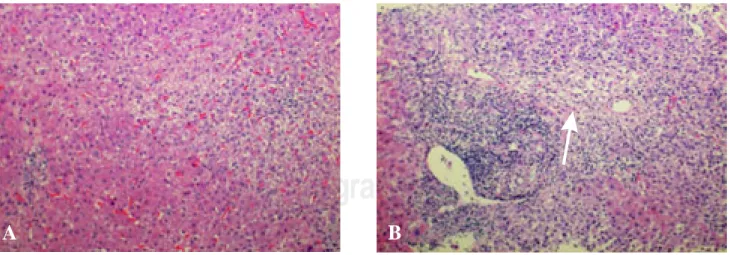
normalization of aminotransferases within eight weeks. She had persistently normal aminotransferases until nine months later when IFNβ (Avonex) was switched to IFNβ -1a (Rebif, 22 µg subcutaneous TIW, cumulative dose of 110 µg) for worsening MS. Ten days after starting Rebif she again developed malaise, right upper quadrant pain and jaundice. ALT was 397 IU/mL and AST 287 IU/mL. Viral serology was negative, ANA was 1:80, and ASMA was 1:40, serum IgG 1,827 mg/dL. Other medications in-cluded citalopram, topiramate, baclofen, diazepam, and the oral contraceptive pill. All medications were discon-tinued on the day of presentation without improvement of clinical symptoms Aminotransferases continued to rise and peaked at day 14 following discontinuation of Rebif, (ALT 1,292 IU/mL and AST 1,019 IU/mL). A liver biop-sy demonstrated submassive hepatic necrosis with severe portal and lobular inflammation. Necrosis and architectur-al collapse was most marked in the periportarchitectur-al and centriv-enular regions (Figure 1B). IFNβ- a was not restarted and the liver enzymes normalized within eight weeks, (AST 20 IU/mL, ALT 11 IU/mL). All other medications were reintroduced sequentially without adverse effect.
Ten months later she was given a trial of intravenous gammaglobulin (IVIG) at a dose of 400 mg/kg/day for 3 consecutive days, in an effort to halt MS progression. Within two weeks the AST was 99 IU/mL, ALT was 145 IU/mL and increased to a peak of 536 IU/mL and 755 IU/ mL, respectively. This was accompanied by a rise in PT to 13.8 seconds (INR 1.3). Repeat viral and autoimmune se-rology was unchanged from before. A liver biopsy dem-onstrated similar features to the previous one, with sub-massive hepatic necrosis, confluent areas of hepatocyte loss and bridging necrosis.
On this occasion the patient was treated with oral pred-nisone 60 mg daily and had a rapid improvement in her aminotransferases. Azathioprine 75 mg (1.5 mg/kg) was subsequently added. Two years later the patient is main-tained on Azathioprine monotherapy with persistently nor-mal AST and ALT (17 IU/mL and 22 IU/mL, respectively).
Case 2
V Byrnes et al. Drug induced liver injury secondary to interferon-beta in multiple sclerosis 57
edigraphic.com
:rop odarobale FDPVC ed AS, cidemihparG
arap
acidémoiB arutaretiL :cihpargideM
sustraídode-m.e.d.i.g.r.a.p.h.i.c
sustraídode-m.e.d.i.g.r.a.p.h.i.c cihpargidemedodabor
Baseline aminotransferases were normal. Following a cu-mulative dose of 70.4 µg of IFNβ-1a (8 doses) the patient developed low grade fever and was noted to have ALT 230 IU/mL and AST 81 IU/mL. Concomitant medications included ibuprofen 400-800 mg daily for the week prior to presentation and levothryoxine for longstanding hy-pothyroidism. All medications were stopped at this time point. The AST and ALT increased to a peak of ALT 914 IU/mL and AST 301 IU/mL, 21 days following cessation of therapy. Viral and autoimmune serology was negative and serum IgG was 1,109 mg/dL. A liver biopsy was per-formed one week after the peak abnormal aminotrans-ferases revealing moderate lobular inflammation with centrivenular hepatocyte drop out and prominent pigment filled Kupfer cells indicative of a healing acute hepatitis injury (Figure 2). The patient was commenced on pred-nisone 60 mg for 2 weeks followed by a taper to 0 mg over 4 weeks and had a rapid improvement of her ami-notransferases.
Case 3
A 30 yr old female was started on IFN-β 1a (Rebif) 8.8 µg subcutaneously TIW for newly diagnosed MS. After two weeks the dose was increased to 22 µg TIW and two weeks later the dose was further increased to 44 µg TIW. The patient had baseline liver aminotransferases, which were normal (ALT 20 IU/mL, AST 19 IU/mL). Two weeks into therapy with Rebif, ALT increased to 37 IU/ mL and AST 30 IU/mL. These remained within normal range until week nine of treatment when her ALT in-creased to 108 IU/mL and her AST to 94 IU/mL. This pa-tient was not taking any concomitant medication. At this time Rebif was discontinued but the patient had ongoing hepatitis with a peak in ALT of 235 IU/mL and AST of 139 IU/mL, 21 days after stopping Rebif. Her ANA was positive at 1:160 and her ASMA was positive at 1:20, with a normal IgG 1,020 mg/dL. Her baseline ANA titer
was 1:640. Six weeks later her AST was still elevated at 87 IU/mL and her ALT 137 IU/mL. A liver biopsy was performed which showed moderate lobular mononuclear inflammation with apoptosis and focal pericentral col-lapse consistent with drug induced hepatitis (Figure 3).
Discussion
These three cases represent the upper end of the spectrum of liver injury reported in MS patients treated with type I in-terferons. Post marketing studies have reported de novo ALT elevations in as many as 37% of MS treated with IFN-βs.1,2 Elevations in aminotransferases are graded according to the WHO classification and are as follows: grade 0 within nor-mal limits, grade 1 > upper limit nornor-mal (ULN) to 2.5 times ULN, grade 2 > 2.5 times ULN-5 times ULN, grade 3 >5 times ULN-20 times ULN, grade 4 >20 times ULN.
Grade 4 hepatotoxicity was observed in the first two cases presented with grade 3 hepatotoxicity, in the re-maining case. The mechanism of IFNβ induced hepato-toxicity in MS patients is largely unknown. As with any drug, IFNβ can cause liver injury as a result of an idiosyn-cratic reaction, a hypersensitivity reaction or it may in-deed induce autoimmune reaction in an already suscepti-ble host. It is likely that the liver injury in the last two pa-tients was due to an idiosyncratic reaction. Such reactions typically occur within weeks of initial exposure to IFNβ and may continue to evolve even after drug withdrawal, as was the case in these patients. Moreover the use of con-comitant medication especially ibuprofen increases the likelihood of IFNβ induced hepatotoxicity.3
While the first patient’s presentation is consistent with an idiosyncratic reaction, it is somewhat atypical for same. She had three distinct episodes of severe hepatitis with three different drugs (Avonex, Rebif and IVIG). Her initial episode of hepatitis occurred following ten months of expo-sure to IFNβ. Interestingly, this episode of hepatitis re-solved despite ongoing treatment with the offending agent.
Figure 1A. H&E (4X) stain of the initial liver biopsy showing minimal portal inflammation while the second biopsy. 1B. (10X) demonstrates cen-trivenular hepatic necrosis (arrow) and mononuclear cell inflammation with collapse.
MG
edigraphic.com
Resolution of IFNβ induced hepatitis has been reported incases of less severe hepatotoxicity (68% of grade 1 and 48% of grade 2), and likely occurs due to the presence of an adaptive phenotype.2,4,5 However, the subsequent in-crease in the dose and frequency of IFNβ (when switched to Rebif) may have overwhelmed the suppressor or attenu-ator mechanisms involved in adaptation, and caused sub-massive hepatic necrosis. Genetic factors resulting in en-zyme defects or alterations in the major-histocompatabili-ty-complex (MHC) class I and II cell receptors may increase an individual’s susceptibility to liver injury from multiple drugs and could account for the recurrent hepato-toxicity in this patient following exposure to IVIG.5
IFNβ and IVIG are both immunogenic and it is also possible that exposure to these agents induced an autoim-mune hepatocellular injury in this patient. Induction of autoimmune hepatitis due to IFNβ has been described.6 Unfortunately, the presence of ANA and ASMA alone is
Figure 2A. H& E (4X) image of portal triad with inflammation (arrow) and centrivenular hemorrhage and, 2B. (10x) image demonstrating hepato-cellular drop-out and lipofuschin-laden Kupffer cells, (arrow) indicative of acute resolving hepatitis.
A
A
B
B
Figure 3A. H& E (10X) image demonstrating increased mononuclear cell inflammation in left upper quadrant with apoptotic hepatocyte (arrow). 3B. (40X) demonstrates a paucity of hepatocytes indicative of pericentral collapse with numerous lipofuschin-laden Kupffer cells (arrow).
A
A
B
B
insufficient evidence for induction of autoimmunity. ANA and ASMA have been observed in 45% of MS pa-tients prior to initiating IFNβ and levels of both these au-toantibodies fluctuate during the course of treatment.7
While experience with immuno-modulatory therapy in MS patients is accumulating, we advocate close monitor-ing of aminotransferases before, and at regular intervals during treatment. In patients with prior evidence of drug induced hepatic injury, care should be taken when switch-ing from one IFNβ to another, or from one disease-modi-fying drug to another. Immediate discontinuation of the offending drug in moderate to severe hepatitis could prove to be life saving.
Acknowledgement
Uni-V Byrnes et al. Drug induced liver injury secondary to interferon-beta in multiple sclerosis 59
edigraphic.com
versity of Texas Southwestern Medical School, Dallas, forhis helpful comments.
References
1. Tremlett HL, Yoshida EM, Oger J. Liver injury associated with the beta-interferons for MS: a comparison between the three products. Neurology 2004; 62: 628-631.
2. Tremlett HL, Oger J. Elevated aminotransferases during treatment with interferon-beta for multiple sclerosis: actions and outcomes. Mult Scler 2004; 10: 298-301.
3. Francis GS, Grumser Y, Alteri E, Micaleff A, O’Brien F, Alsop J, Stam Moraga M, et al. Hepatic reactions during treatment of
mul-tiple sclerosis with interferon-beta-1a: incidence and clinical signifi-cance. Drug Saf 2003; 26: 815-827.
4. Jaeschke H, Gores GJ, Cederbaum AI, Hinson JA, Pessayre D, Lemasters JJ. Mechanisms of hepatotoxicity. Toxicol Sci 2002; 65: 166-176.
5. Lee WM. Drug-induced hepatotoxicity. N Engl J Med 2003; 349: 474-485.
6. Durelli L, Bongioanni MR, Ferrero B, Oggero A, Marzano A, Rizzetto M. Interferon treatment for multiple sclerosis: autoimmune compli-cations may be lethal. Neurology 1998; 50: 570-571.