R E S E A R C H A R T I C L E
Open Access
Estimation of the burden of cardiovascular
disease attributable to modifiable risk factors and
cost-effectiveness analysis of preventative
interventions to reduce this burden in Argentina
Adolfo Rubinstein
1,2*, Lisandro Colantonio
1, Ariel Bardach
1,3, Joaquín Caporale
1,4, Sebastián García Martí
1,2,
Karin Kopitowski
2, Andrea Alcaraz
1, Luz Gibbons
1, Federico Augustovski
1,2, Andrés Pichón-Rivière
1Abstract
Background:Cardiovascular disease (CVD) is the primary cause of mortality and morbidity in Argentina
representing 34.2% of deaths and 12.6% of potential years of life lost (PYLL). The aim of the study was to estimate the burden of acute coronary heart disease (CHD) and stroke and the cost-effectiveness of preventative
population-based and clinical interventions.
Methods:An epidemiological model was built incorporating prevalence and distribution of high blood pressure, high cholesterol, hyperglycemia, overweight and obesity, smoking, and physical inactivity, obtained from the Argentine Survey of Risk Factors dataset. Population Attributable Fraction (PAF) of each risk factor was estimated using relative risks from international sources. Total fatal and non-fatal events, PYLL and Disability Adjusted Life Years (DALY) were estimated. Costs of event were calculated from local utilization databases and expressed in international dollars (I$). Incremental cost-effectiveness ratios (ICER) were estimated for six interventions: reducing salt in bread, mass media campaign to promote tobacco cessation, pharmacological therapy of high blood pressure, pharmacological therapy of high cholesterol, tobacco cessation therapy with bupropion, and a multidrug strategy for people with an estimated absolute risk > 20% in 10 years.
Results:An estimated total of 611,635 DALY was lost due to acute CHD and stroke for 2005. Modifiable risk factors explained 71.1% of DALY and more than 80% of events. Two interventions were cost-saving: lowering salt intake in the population through reducing salt in bread and multidrug therapy targeted to persons with an absolute risk above 20% in 10 years; three interventions had very acceptable ICERs: drug therapy for high blood pressure in hypertensive patients not yet undergoing treatment (I$ 2,908 per DALY saved), mass media campaign to promote tobacco cessation amongst smokers (I$ 3,186 per DALY saved), and lowering cholesterol with statin drug therapy (I$ 14,432 per DALY saved); and one intervention was not found to be cost-effective: tobacco cessation with bupropion (I$ 59,433 per DALY saved)
Conclusions:Most of the interventions selected were cost-saving or very cost-effective. This study aims to inform policy makers on resource-allocation decisions to reduce the burden of CVD in Argentina.
Background
Chronic diseases are increasing in developing countries and cardiovascular diseases account for 17.7 million
annual deaths around the world, constituting 11% of esti-mates for the global burden of disease. It is estimated that mortality due to coronary heart disease (CHD) and stroke will increase by approximately 145% among men and women from 1990 to 2020 in Latin America, com-pared with a 28% increase for women and a 50% increase for men over the same period in developed countries [1]. * Correspondence: [email protected]
1Institute for Clinical Effectiveness and Health Policy (IECS), Buenos Aires,
Argentina
Full list of author information is available at the end of the article
In Argentina, chronic non-communicable diseases account for more than 50% of the overall morbidity and mortality. In fact, the age-adjusted mortality rate of car-diovascular disease, including CHD and stroke was 206.4 per 100,000 (265.4 for men and 161.8 for women), representing 34.2% of deaths and 12.6% of years of potential life lost [2]. Adjusted mortality rates for non-communicable diseases, as well as Potential Years of Life Lost (PYLL) have declined steadily since 1987, while mortality rates of communicable, maternal, perina-tal and nutritional conditions have remained relatively constant in the same 20-year period. Still, the adjusted rate for non-communicable chronic diseases has been five to six times the rate of communicable diseases in Argentina, and the absolute number of deaths is increas-ing due to the increasincreas-ingly elderly population [3].
In common with many other Latin American coun-tries, Argentina falls into an intermediate mortality group where the main risk factors for disease are hyper-tension, an elevated body mass index (BMI), alcohol abuse and smoking [4]. Elevated BMI is due to excess calories and insufficient activity, and a large proportion of hypertension is due to these same lifestyle risks in addition to a poor diet quality. Primary data describing the prevalence and distribution of cardiovascular risk factors in Argentina has recently been obtained through two different population-based sources: the 2005 Minis-try of Health National Risk Factor Survey [5]; and the Cardiovascular Risk Factor Multiple Evaluation in Latin America (CARMELA) [6]. There is strong evidence that a 50% reduction in cardiovascular deaths can be attribu-table to the reduction of just three modifiable risk fac-tors, namely tobacco use, high blood pressure and elevated cholesterol [7]. In Latin America, the majority of cardiovascular risk could be explained by tobacco use, abnormal lipids, abdominal obesity and high blood pressure as shown in the recently published INTER-HEART Latin American study [8]. Most cardiovascular diseases are preventable and there is evidence that sup-ports the effectiveness of interventions to reduce the burden of cardiovascular disease through strategies that reduce risk factors. Unfortunately, strategies to manage cardiovascular conditions have been largely developed for high-income countries which may not be affordable to most of the developing world [9,10]. Although there has been widespread recognition of the benefit of cost-effectiveness evaluation to inform national health sys-tems of priority settings, its potential has not been rea-lized in the vast majority of countries, including Argentina [11]. Nevertheless, cost-effective interventions to prevent cardiovascular disease in developing countries do exist, but have not been widely applied. Specifically, population and community-based interventions appear to be highly cost-effective when they reach large
populations, address high mortality and morbidity dis-eases, and include multi-level integrated efforts. Inter-ventions targeting individuals, especially high cardiovascular risk subjects, are also cost-effective but usually require clinical involvement and more resources. Moreover, recent studies have consistently shown the cost-effectiveness of interventions that lower the burden of cardiovascular disease in developing countries [12-14].
The aims of this study were 1) to develop an analytical model to estimate the burden of acute CHD and stroke attributable to modifiable cardiovascular disease risk fac-tors in Argentina, 2) to explore the costs of major cardi-ovascular events, and 3) to calculate the cost-effectiveness of different population-based and clinical interventions in order to inform local policy makers on resource-allocation priority setting.
Methods
We conducted a population-level comparative risk assessment for seven modifiable cardiovascular risk fac-tors to be included in a model to assess their impact on major cardiovascular events: acute myocardial infarction (AMI), other non-infarction ischemic events and stroke. We also estimated the individual and aggregate effect of population-based and clinical interventions that might modify the risks associated to these risk factors. These interventions are supported by evidence in the literature for clinical efficacy and population effectiveness esti-mates that take into account detection and patient com-pliance. Cardiovascular risk factors and interventions were modeled for the adult population over 35 years old since they are the usual target for most clinical interven-tions. Finally, cardiovascular events, Disability Adjusted Life Years (DALY) and interventions costs were derived.
Selection of Risk Factors
We selected specific risk factors that fulfilled the follow-ing criteria: (1) Sufficient evidence was available on the presence and magnitude of likely causal association with CHD and stroke from high-quality epidemiological stu-dies, (2) available interventions existed to modify asso-ciated risk, (3) data on risk factor prevalence was available from the First Argentinean Survey of Risk Fac-tors (FASRF) or other nationally representative surveys not subjected to selection bias.
The seven modifiable risk factors selected were: 1) high blood pressure (HBP), 2) high cholesterol, 3) over-weight and obesity, 4) elevated fasting glucose level and type-2 diabetes mellitus, 4) tobacco smoking, 5) physical inactivity,
this measure for further analysis. Other specific indivi-dual dietary factors that would meet criteria for causal effects, such as intake of trans fat, low marine omega-3 (seafood), and low polyunsaturated fat (exchanged for saturated fat) were also excluded because of lack of reli-able data on their respective prevalences, after a thor-ough search of local surveys.
Data Sources
Risk Factors exposure
We obtained risk factor prevalence and distribution for each individual enrolled in the FASRF is a nationally representative survey including 41,393 subjects from all districts of the country sampled through a probabilistic multi-stage process [5]. The prevalence of risk factors was obtained from self-reports obtained during an in-person interview that was subsequently validated with direct mea-sures in one district. For those subjects who reported not to have ever measured her/his blood pressure (11.94%), serum cholesterol (43.25%) or glycemia (23.49%) we con-sidered them as not having the risk factor in the survey. As this assumption could have underestimated their pre-valence and population-attributable risk, we developed a logistic regression model to estimate the odds and prob-abilities for a subject with a certain demographic and risk factor profile to have an abnormal value in each of these three risk factors. These new set of risk factors prevalence were used as an alternative scenario in the sensitivity ana-lysis. STATA v8.0 was used to run these models.
Etiological effects of risk factors on disease-specific mortality
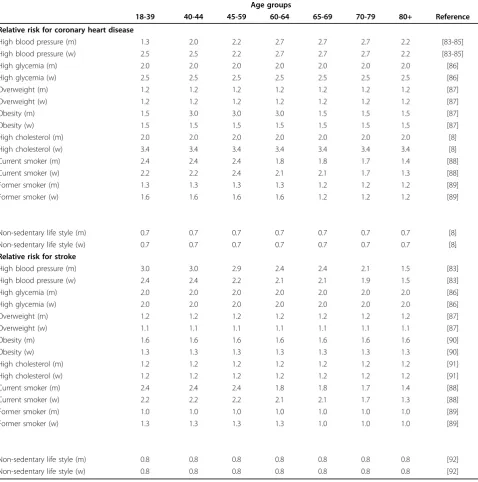
We obtained the relative risk for CHD and stroke attri-butable to each risk factor for each exposure category (since all risks were measured in categories in the FASRF), based on published observational studies, sys-tematic reviews or meta-analyses of epidemiological stu-dies. In previous observational studies used for effect sizes, the majority had adjusted for potential confound-ing factors. Each relative risk used in our analysis repre-sents the best judgment of the evidence for the effect of risk factor exposure on disease-specific mortality. The etiological effect sizes along different age-strata and gen-der are shown in Table 1.
Disease-specific deaths
The number of deaths by CHD (ICD-10 codes I20×, I24× and I25× for non-infarction ischemic events and I21× and I22× for AMI) and stroke (ICD-10 codes I60-I61, I63-I64) were obtained from the National Directorate of Health Statistics of the Argentine Ministry of Health [15].
Estimating mortality and disability attributable to risk factors
For each risk factor and for each disease causally asso-ciated with its exposure, we computed the proportional
reduction in disease-specific deaths that would occur if risk factor prevalence had been reduced to zero. This is known as the population-attributable risk (PAR) and measures the total effects of a risk factor (direct as well as mediated through other factors). In order to estimate the PAR of each risk factor, we developed an epidemio-logical simulation model in Microsoft Excel(r), contain-ing the prevalence and distribution of risk factors according to each age and sex strata as observed in the FASRF [5]. In this way, this matrix of 41,392 registries from the FASRF, representing the Argentine population, was split into all possible combinations of risk factors. Additional risk for each combination was assumed to be the product (multiplication) of the relative risk of the risk factors involved [16]. Finally, the baseline absolute risks for both fatal and non-fatal events for people with-out any of the selected risk factors were derived consid-ering the overall risk, prevalence and additional risk associated to each combination. The global risk of death (across all combinations and age groups) was calibrated against the overall number of deaths due to CHD and stroke corresponding to Argentina in the year 2005 [15]. Finally, the number of non-fatal events for each death from CHD and stroke was extrapolated using the lethal-ity rate from the Public Hospital registry corresponding to the year 2000 [17].
In addition to the estimation of the prevalence of cardiovascular risk factors and their associated relative risk, the spreadsheet contained the cost and disutility associated with each event in order to obtain a deter-ministic estimate of the burden of disease, expressed in DALY and overall costs. A DALY is a summary mea-sure that combines years of life lost due to premature death and years of life lived with disability [18]. One DALY can be thought of as one lost year of healthy life. DALYs were calculated based on the model devel-oped by Murray et al. [9].
The duration of disability was estimated by using the software DISMOD II [19]. Disability weights were obtained from two Australian studies on burden of dis-ease [20,21]. For the calculation of years of life lost due to premature death, we used a life expectancy at birth of 80 and 82.5 for men and women, respectively, as recommended for global comparisons in the Global Bur-den of Disease study [9]. Finally, years of life lost due to premature death were obtained from National death registries and years of life lived with disability were obtained by multiplying the estimated number of non-fatal events by each disability weight, for each age gen-der strata [19].
absolute risk by the product of the relative risks involved in each combination stratum, assuming a relative risk equal to 1 for the index risk factor, weighted by its respective prevalence. Overall deaths, non fatal events, DALY and costs between the estimation for Argentina in 2005 and the new estimation without the index risk fac-tor, was assumed to be the PAR attributable to that parti-cular risk factor. We programmed a macro using Python
[image:4.595.59.538.102.585.2]language [22], in which we performed 1,000 iterations of the prevalence for each combination of risk factors assuming a binomial distribution. Therefore, a new abso-lute risk was obtained in each iteration, and new estima-tions of total deaths, non fatal events, DALY and costs were obtained. Finally, we used the empirical PAR distri-bution to estimate the 95% confidence interval (95%CI) using the percentile method.
Table 1 List of relative risks included into the model
Age groups
18-39 40-44 45-59 60-64 65-69 70-79 80+ Reference
Relative risk for coronary heart disease
High blood pressure (m) 1.3 2.0 2.2 2.7 2.7 2.7 2.2 [83-85]
High blood pressure (w) 2.5 2.5 2.2 2.7 2.7 2.7 2.2 [83-85]
High glycemia (m) 2.0 2.0 2.0 2.0 2.0 2.0 2.0 [86]
High glycemia (w) 2.5 2.5 2.5 2.5 2.5 2.5 2.5 [86]
Overweight (m) 1.2 1.2 1.2 1.2 1.2 1.2 1.2 [87]
Overweight (w) 1.2 1.2 1.2 1.2 1.2 1.2 1.2 [87]
Obesity (m) 1.5 3.0 3.0 3.0 1.5 1.5 1.5 [87]
Obesity (w) 1.5 1.5 1.5 1.5 1.5 1.5 1.5 [87]
High cholesterol (m) 2.0 2.0 2.0 2.0 2.0 2.0 2.0 [8]
High cholesterol (w) 3.4 3.4 3.4 3.4 3.4 3.4 3.4 [8]
Current smoker (m) 2.4 2.4 2.4 1.8 1.8 1.7 1.4 [88]
Current smoker (w) 2.2 2.2 2.4 2.1 2.1 1.7 1.3 [88]
Former smoker (m) 1.3 1.3 1.3 1.3 1.2 1.2 1.2 [89]
Former smoker (w) 1.6 1.6 1.6 1.6 1.2 1.2 1.2 [89]
Non-sedentary life style (m) 0.7 0.7 0.7 0.7 0.7 0.7 0.7 [8]
Non-sedentary life style (w) 0.7 0.7 0.7 0.7 0.7 0.7 0.7 [8]
Relative risk for stroke
High blood pressure (m) 3.0 3.0 2.9 2.4 2.4 2.1 1.5 [83]
High blood pressure (w) 2.4 2.4 2.2 2.1 2.1 1.9 1.5 [83]
High glycemia (m) 2.0 2.0 2.0 2.0 2.0 2.0 2.0 [86]
High glycemia (w) 2.0 2.0 2.0 2.0 2.0 2.0 2.0 [86]
Overweight (m) 1.2 1.2 1.2 1.2 1.2 1.2 1.2 [87]
Overweight (w) 1.1 1.1 1.1 1.1 1.1 1.1 1.1 [87]
Obesity (m) 1.6 1.6 1.6 1.6 1.6 1.6 1.6 [90]
Obesity (w) 1.3 1.3 1.3 1.3 1.3 1.3 1.3 [90]
High cholesterol (m) 1.2 1.2 1.2 1.2 1.2 1.2 1.2 [91]
High cholesterol (w) 1.2 1.2 1.2 1.2 1.2 1.2 1.2 [91]
Current smoker (m) 2.4 2.4 2.4 1.8 1.8 1.7 1.4 [88]
Current smoker (w) 2.2 2.2 2.2 2.1 2.1 1.7 1.3 [88]
Former smoker (m) 1.0 1.0 1.0 1.0 1.0 1.0 1.0 [89]
Former smoker (w) 1.3 1.3 1.3 1.3 1.0 1.0 1.0 [89]
Non-sedentary life style (m) 0.8 0.8 0.8 0.8 0.8 0.8 0.8 [92]
Non-sedentary life style (w) 0.8 0.8 0.8 0.8 0.8 0.8 0.8 [92]
Definition and Selection of Interventions
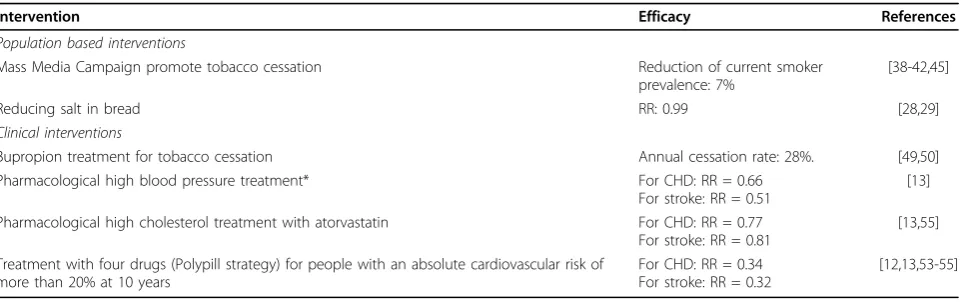
Different population-based and clinical interventions to reduce cardiovascular disease burden were explored con-sidering not only the evidence of efficacy and effectiveness [23] but also the feasibility to be implemented in Argen-tina. Relative risk reductions of the interventions were adjusted by population effectiveness measures taking into account target population coverage as well as patient com-pliance. All interventions have a time horizon of 5 years after which maximum population effectiveness is assumed. The evidence about population effectiveness of mass media campaign targeted to the promotion of physical activity [24-27], salt reduction in food [28,29], control of overweight and obesity [30-35], and promotion of healthy habits [36,37] was non-conclusive, and hence these inter-ventions were not included in the model. On the other hand, evidence on the effectiveness of media campaigns against smoking was generally strong and local programs had already been implemented [38-42]. Efficacy of inter-ventions were modeled as a relative risk reduction or by a reduction on risk factor prevalence. Effect sizes and joint effect of interventions used in the analysis were based on systematic reviews of randomized trials and meta-analysis, when possible. Intervention effects with their correspond-ing relative risks estimates are shown in Table 2.
Population based-interventions
Lowering salt intake in the population through redu-cing salt in breadA program involving the cooperation between the Government, consumer associations and the Bakery Chambers in an effort to reduce 1 gram of salt per 100 grams of bread. Argentina has an average individual consumption of 12 grams of salt per day, 3.4 grams coming from bread. Local experiences showed that it is possible to reduce the amount of salt in bread without being detected as less palatable. At present, there is a pilot training program implemented in
selected cities in Argentina to make bakers reduce salt in bread by using special salt dispensers [43]. This inter-vention could imply a population-wide reduction of 1.33 mmHg of systolic blood pressure per person and 1% of the PAR of CHD and stroke [28,29,44].
Mass Media Campaign to promote tobacco cessation
This program of the National Ministry of Health involves an annual campaign through four TV spots, six radio spots and written material in major newspapers, magazines and public spaces. Costs were retrieved from data from previous campaigns of the National Ministry of Health. This intervention would reduce the preva-lence of smoking by 7% [38-42,45].
Individual (clinical) interventions
Treatment of high blood pressure Interventions
[image:5.595.59.540.553.704.2]involved lifestyle change promotion and pharmacological therapy to achieve blood pressure control (SBP/DBP less than 140/90). Target population was composed of adults over 35 years old with the diagnosis of high blood pres-sure and no treatment (over 1.3 millions of Argentine population representing 8.2% people older than 35 years old), estimating for this intervention a relative risk reduction of 44% for CHD and 49% for stroke [13]. We assumed that 40% of the population would take one drug, 40% two drugs and 20% three or more drugs. The drugs and daily doses evaluated were hydrochlorothia-zide (25 mg), atenolol (50 mg), enalapril (10 mg), and amlodipine (10 mg), and the treatment mix was 50% of the population taking thiazides, 20% atenolol, 20% angiotensin-converting enzyme inhibitor and 10% amlo-dipine [46]. The same efficacy for each drug category was also assumed. Analysis indicated that these inter-ventions, with a 50% rate of disease detection and 50% drug compliance as indicated by the Canadian Hyper-tension Guidelines [47], would reduce PAR of cardiovas-cular disease and stroke by 8%.
Table 2 Effectiveness of selected interventions
Intervention Efficacy References
Population based interventions
Mass Media Campaign promote tobacco cessation Reduction of current smoker prevalence: 7%
[38-42,45]
Reducing salt in bread RR: 0.99 [28,29]
Clinical interventions
Bupropion treatment for tobacco cessation Annual cessation rate: 28%. [49,50] Pharmacological high blood pressure treatment* For CHD: RR = 0.66
For stroke: RR = 0.51
[13]
Pharmacological high cholesterol treatment with atorvastatin For CHD: RR = 0.77 For stroke: RR = 0.81
[13,55]
Treatment with four drugs (Polypill strategy) for people with an absolute cardiovascular risk of more than 20% at 10 years
For CHD: RR = 0.34 For stroke: RR = 0.32
[12,13,53-55]
CHD: Coronary Heart Disease, RR: relative risk.
Treatment of high cholesterol This intervention involved promotion of low-cholesterol diet and use of statins (atorvastatin 10 mg, 20 mg and 40 mg for 50%, 40% and 10% of the target population, respectively), according to local estimates and assumptions. Target population was adults over 35 years old with high choles-terol and no treatment (almost one million people repre-senting 5.2% of people older than 35 years old). Achieving a cholesterol target of less than 240 mg/dl, (6.2 mm/l) would provide an estimated reduction of 8% of the PAR of CHD and stroke with a 50% detection and 50% drug compliance rate according to ATP III [48].
Tobacco cessation therapy Motivational interventions from health professionals and drug therapy with bupro-pion for a 2-month period (300 mg per day) would result in an estimated reduction of 4% of the PAR of CHD and stroke [49]. In most studies with bupropion for tobacco cessation, the annual quitting rate of smo-kers was 28% vs. 12%, as compared to placebo [50,51]. According to a recent national survey of tobacco preva-lence, only 11% of total smokers in Argentina were will-ing to quit smokwill-ing and therefore were considered the target population for this intervention [52]. According to these estimates, the spontaneous annual cessation rate would be 1.32% (12% of the 11% of smokers willing to quit) that would raise to 3.08% with bupropion (28% × 11%), since we would expect a prevalence reduction of 1.76% (3.08%-1.32%).
Treatment based on a population absolute risk approach (Polypill strategy)Since the“Polypill”is not yet in Argentine markets, we designed a pharmacologi-cal therapy with 4 pills (hydrochlorothiazide 25 mg, ena-lapril 10 mg, atorvastatin 10 mg and aspirin 100 mg), prescribed to people older than 35 years old with an estimated combined risk of a cardiovascular event over the next decade above 20%, based on the data from the FASRF. This intervention would imply a relative risk reduction of CHD of 66% (RR = 0.34) and of stroke of 68% (RR = 0.32) [12,13,53-55].
Assuming that at least 50% of the target population is reached by the intervention, a 50% patient compliance rate with treatment for this group, and 70% of provider compliance due to a presumed raised awareness of risks for both subjects, the Polypill strategy would result in a population effectiveness of 17,5%. Relative risks for CHD and stroke for individuals from this high-risk sub-group were estimated by using the beta coefficients from the Framingham Heart Study [16].
Estimating costs of acute cardiovascular events and interventions
Costs of acute events
Cost categories (i.e. inpatient hospital days, doctor visits, tests, drugs and ancillary services, and diagnostic and
therapeutic procedures) for AMI, other non-infarction ischemic events such as unstable angina and stroke were first identified. For each event the quantities and unit prices of inputs were retrieved from hospital databases and other local sources [56-66], as well as expert opi-nion when necessary. The quantities of each input iden-tified were assessed and multiplied by the unit price of each item to obtain the unit cost of each resource. Finally, the total cost of the acute event resulted from the addition of all of the identified consumed resources in each category.
Costs of interventions
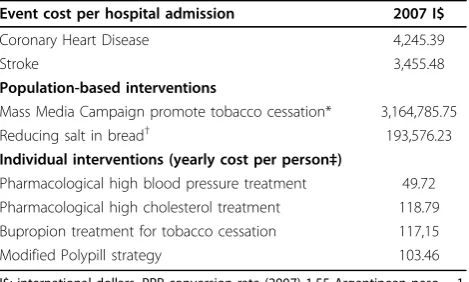
Costs included program-level expenses associated with management of the interventions (i.e. administration, training and information, dissemination by multiple media sources) and patient-level costs (i.e. primary care visits, ancillary tests and drugs). The quantities of each input required were assessed and multiplied by the unit price of each input for the 5 year intervention imple-mentation period. The quantity of patient-level resource inputs for each intervention (i.e. inpatient hospital days, doctor visits, tests, drugs) were identified from local or international published data if available or expert opi-nion should the former not be available. Costs of drugs were calculated using a mix of blood pressure lowering drugs composed of 50% hydrochlorothiazide, 20% ateno-lol, 20% enalapril and 10% amlodipine, according to a published local study [46]. Cost of blood pressure lower-ing drugs, atorvastatin and bupropion as well as other input costs and expense data were extracted from local sources [65-67]. Other cost data were obtained from the Health Care Costs Database from the Institute of Clini-cal Effectiveness and Health Policy [62]. A list of costs and sources of the interventions and selected health events is depicted in Table 3.
into international dollars using the Purchase Power Par-ity conversion rate AR$ 1.55 = 1 I$ [68]. The discount-ing of long term costs was performed at a 3% rate.
Perspective
Since Argentina’s healthcare system consists of a multi-tier system divided in three large sectors: public, social security and private, we incorporated the perspective of the whole Argentine healthcare system as a purchaser of health services.
Calculating cost-effectiveness of interventions
Cost-effectiveness analysis considers the costs and effects of adding new interventions to current practice or the cost of replacing an existing intervention with another targeting the same condition. In order to esti-mate the reduction in disease burden related to the reduction of cardiovascular disease, we built a model to predict the burden associated with specific diseases or risk factors to develop disease. We calculated the effect of interventions in our model, assuming that all reduced the relative risk associated with the presence of each cardiovascular risk factor. In the case the effect of the intervention was a reduction of the prevalence (i.e.: tobacco cessation), a new relative risk was estimated as a proportional combination of the relative risk asso-ciated with the risk factor (for the proportion of people that were still smokers) and the relative risk of those that no longer had that risk factor (i.e.: former smokers). Finally, the model translated these changes into a new estimation of cardiovascular events, overall costs and DALY lost, specific for age and sex. This estimation was
then compared to the estimation without the interven-tion. In addition, the annual cost of the intervention was imputed for the year analyzed. For each intervention, the Incremental Cost-Effectiveness Ratio (ICER) of the interventions compared to no intervention was mea-sured as cost per averted DALY. Effect sizes and joint effect of interventions used in the analysis were based on systematic reviews of randomized trials and meta-analysis, when possible.
To translate changes in the risk of age and sex specific cardiovascular disease events into changes in population health quantified in terms of DALY, we used a standard methodology described elsewhere [69].
There is no universal criterion that defines a threshold cost-effectiveness ratio, above which an intervention would not be considered cost-effective. We chose to use guidelines specifically intended for international compar-isons, as proposed by the Commission on Macroeco-nomics and Health, which defines interventions with an ICER that is less than three times Gross Domestic Pro-duct per capita as a“cost-effective” intervention and as
“very cost-effective” if ICER is less than the GDP per capita [70,71]. Argentina’s GDP per person in 2007 was estimated in I$ 13,255.09 [72].
Uncertainty and sensitivity analysis
We also did a probabilistic, multivariate sensitivity ana-lysis using Monte Carlo simulation [73,74] of 1,000 ran-domly selected sets of variables, to assess the effects of uncertainty in the prevalence of risk factors, population attributable risk and effect sizes of interventions. In addition, an undiscounted scenario was considered for costs and DALY, and a non age-weighted scenario was also analyzed for DALY.
Results
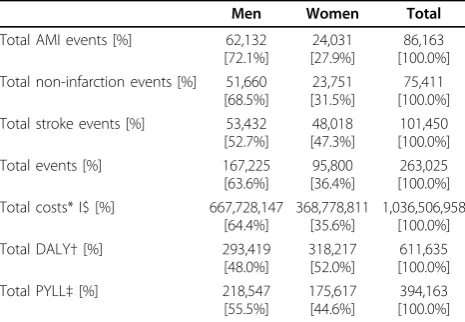
We estimated a lethality rate of 11.9% in men and 18% in women; and 17.4% in men and 18.9% in women, for CHD and stroke, respectively [17]. According to these estimates, about 263,025 annual acute CHD and stroke events would be expected, representing an annual cost of I$ 1,036,506,958. More than 60% of total events and costs are accounted by men. Table 4 shows the estima-tion of the overall number of annual cardiovascular events in Argentina, burden of disease and costs of events. As observed, more than 600,000 DALYs and almost 400,000 YPLL were lost in 2005 due to CHD and stroke.
Burden of Disease attributable to modifiable cardiovascular Risk Factors
[image:7.595.57.292.111.252.2]Population attributable risks, costs of events and DALY lost to cardiovascular disease for the overall risk factors and for each single modifiable risk factor selected, can
Table 3 Interventions and related health events summary costs
Event cost per hospital admission 2007 I$
Coronary Heart Disease 4,245.39
Stroke 3,455.48
Population-based interventions
Mass Media Campaign promote tobacco cessation* 3,164,785.75 Reducing salt in bread†
193,576.23 Individual interventions (yearly cost per person‡)
Pharmacological high blood pressure treatment 49.72 Pharmacological high cholesterol treatment 118.79 Bupropion treatment for tobacco cessation 117,15
Modified Polypill strategy 103.46
I$: international dollars. PPP conversion rate (2007) 1.55 Argentinean peso = 1 I$,
* Ten years duration of campaign, with discounting (3% annual rate).
†Assuming 54 meeting of 30 bakers each (around 800-600 bakers), with discounting (3% annual rate).
‡Includes health center visits, drug and lab test costs. Programmatic costs were not included (I$ 1,194,067.52).
be seen in Tables 5 and 6, respectively. All risk factors together explained 75% of fatal and non-fatal acute CHD and stroke events, 82,4% of acute CHD events (84.0% in women) and 62.4% of strokes (66,6% in men). Similarly, modifiable risk factors explained 75,5% of costs of acute events and 70.7% of DALY lost. The most important single risk factor was high BP, explaining 37% of all CHD and strokes and one-third of all DALY lost in 2005. The rest of the risk factors have similar attribu-table burden in term of CV events, ranging between 13,9% (high glycemia) to 18,1% (physical inactivity). (see Table 6).
Cost-effectiveness of selected interventions
Table 7 summarizes the results of economic evaluation of the 6 distinct interventions giving their total annual
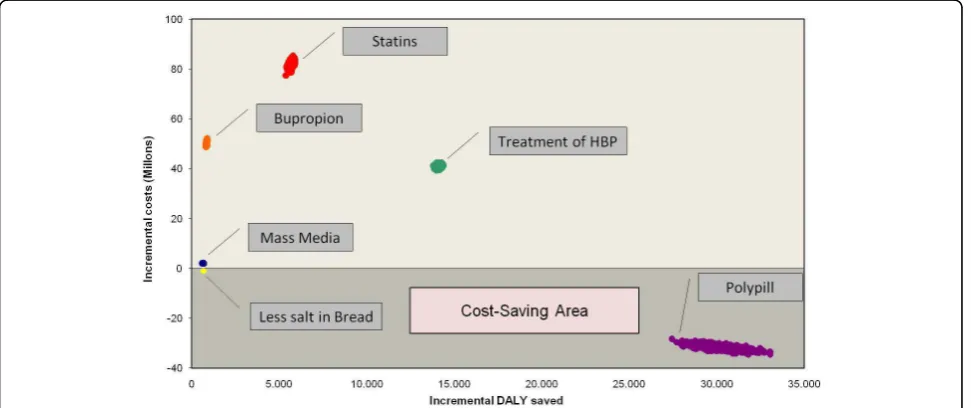
costs and costs per beneficiary, health effects in terms of DALY averted (non age-weighted and 3% discounted), percent of DALY saved due to cardiovascular disease and average cost-effectiveness ratio for each in I$ per DALY averted. Two interventions were cost-saving: low-ering salt intake in the population through reducing salt in bread and treatment targeted to persons with an absolute risk above 20% in 10 years (modified polypill strategy). Moreover, the implementation of the polypill strategy was also associated with almost a 2% decrease in DALY lost to cardiovascular disease. On the other hand, the impact of reducing salt in bread was more limited (0.11% of decrease of DALY lost) due in part to the lower extension and magnitude of this intervention. Two interventions had very acceptable ICER: 1) drug therapy for high blood pressure in hypertensive patients not yet under going treatment with an ICER of I$ 2,908 per DALY saved and an annual reduction of 2.3% of cardiovascular disease burden; and 2) mass media cam-paign to promote tobacco cessation amongst smokers, with an ICER of I$ 3,186 per DALY saved (0.11% of car-diovascular disease burden). An additional intervention, lowering cholesterol with statins (I$ 14,432 per DALY saved), was considered cost-effective according to the guidelines mentioned above. Finally, one intervention, tobacco cessation with bupropion (I$ 59,433 per DALY saved) was not found to be cost-effective. This is in part because bupropion is much more expensive than blood pressure lowering drugs and also because, as it is not currently covered in the public sector, the government does not usually exert its purchasing power to get lower prices. Following local surveys, we assumed that only 11% of the population of smokers would be willing to quit smoking each year and consequently start on a pro-gram, the population impact of tobacco cessation ther-apy was much smaller than expected.
[image:8.595.57.290.111.272.2]Figure 1 shows the ICER of the six distinct interven-tions along the cost effectiveness plane with their
Table 4 Estimation of total cases, costs and burden of disease of acute CHD and stroke
Men Women Total
[image:8.595.56.539.570.682.2]Total AMI events [%] 62,132 [72.1%]
24,031 [27.9%]
86,163 [100.0%] Total non-infarction events [%] 51,660
[68.5%]
23,751 [31.5%]
75,411 [100.0%] Total stroke events [%] 53,432
[52.7%]
48,018 [47.3%]
101,450 [100.0%] Total events [%] 167,225
[63.6%]
95,800 [36.4%]
263,025 [100.0%] Total costs* I$ [%] 667,728,147
[64.4%]
368,778,811 [35.6%]
1,036,506,958 [100.0%] Total DALY†[%] 293,419
[48.0%]
318,217 [52.0%]
611,635 [100.0%] Total PYLL‡[%] 218,547
[55.5%]
175,617 [44.6%]
394,163 [100.0%]
95%CI: 95% confidence interval, AMI: acute myocardial infarction, DALY: disability-adjusted life years, I$: international dollars, PYLL: Potential Years of Life Lost.
* Only direct medical costs by hospitalization were considered. Costs are measured in 2007 international dollars (I$).
†With discounting (3% annual rate), without age weight.
‡With discounting (3% annual rate).
Table 5 Proportional Burden of Disease and costs attributable to all cardiovascular risk factors potentially modifiable
Population-attributable Fraction% (95%CI)
Men Women Total
Total AMI events (both fatal and non-fatal) 81.8 (81.3-82.2) 84.1 (82.8-85.0) 82.4 (81.9-82.8) Total non-infarction events (both fatal and non-fatal) 81.5 (80.9-82.0) 83.5 (81.9-84.7) 82.1 (81.5-82.6) Total stroke events (both fatal and non-fatal) 66.6 (65.7-67.4) 57.6 (56.4-58.8) 62.4 (61.6-63.1) Total events (both fatal and non-fatal) 76.8 (76.2-77.4) 70.7 (69.4-71.7) 74.6 (74.0-75.1)
Total costs* 77.5 (76.9-78.0) 72.0 (70.7-73.1) 75.5 (75.0-76.0)
Total DALY†
76.0 (75.5-76.4) 65.8 (65.0-66.5) 70.7 (70.2-71.1) Total PYLL‡
76.5 (75.9-76.9) 69.6 (68.6-70.5) 73.4 (72.9-73.9)
Results of 1,000 iterations, both sexes.
95%CI: 95% confidence interval, AMI: acute myocardial infarction, DALY: disability-adjusted life years, PYLL: Potential Years of Life Lost. * Only direct medical costs by hospitalization were considered.
†With discounting (3% annual rate), without age weight.
respective probability distribution. The shaded area cor-responds to the cost-saving interventions.
Sensitivity Analyses
We examined the effect of a change in the PAR estimate of the overall risk factors selected along a reasonable range of probabilities, by creating alternative scenarios with different prevalence and distributions of risk fac-tors. We also explored undiscounted and age-weighted DALY as compared to the base case scenario with DALY discounted at 3 percent and non age-weighted.
In all circumstances, the ranking as well as the magni-tude of each intervention remained the same. Finally, the results of the probabilistic sensitivity analyses to estimate the uncertainty surrounding the central esti-mates of each intervention is expressed through the 95% CI showed in Table 7.
Discussion
[image:9.595.57.540.99.537.2]Our study analyzed the FASRF at individual level to esti-mate the burden of cardiovascular disease in Argentina attributable to modifiable risk factors in order to
Table 6 Proportional Burden of Disease and costs attributable to each cardiovascular risk factor potentially modifiable
Population-attributable Fraction% (95%CI)
Both sexes Tobacco use Overweight
and Obesity
High Blood pressure
High cholesterol
High glycemia Physical inactivity
Total AMI events (both fatal and non-fatal)
22.5 (22.2 - 22.8) 20.9 (20.4 - 21.3) 38.5 (37.9 - 39.1) 25.1 (24.4 - 25.8) 13.9 (13.2 - 14.5) 20.9 (20.6 - 21.2)
Total non-infarction events (both fatal and non-fatal)
18.5 (18.1 - 18.8) 18.6 (18.2 - 19.0) 40.9 (40.1 - 41.5) 26.2 (25.2 - 27.0) 14.8 (14.0 - 15.6) 21.6 (21.2 - 22.0)
Total stroke events (both fatal and non-fatal)
10.8 (10.5 - 11.2) 11.7 (11.3 - 12.0) 32.7 (32.0 - 33.3) 5.8 (5.6 - 6.1) 13.2 (12.3 - 14.0) 13.0 (12.7 - 13.3)
Total events (both fatal and non-fatal)
16.9 (16.5 - 17.2) 16.7 (16.3 - 17.0) 37.0 (36.3 - 37.5) 18.0 (17.4 - 18.5) 13.9 (13.1 - 14.6) 18.1 (17.7 - 18.3)
Total costs* 17.3 (17.0 - 17.6) 17.1 (16.7 - 17.4) 37.3 (36.6 - 37.9) 18.9 (18.3 - 19.5) 13.9 (13.2 - 14.7) 18.4 (18.1 - 18.7) Total DALY†
16.1 (15.7 - 16.4) 13.8 (13.5 - 14.0) 36.6 (36.1 - 37.0) 13.4 (13.0 - 13.7) 13.6 (13.0 - 14.2) 15.5 (15.2 - 15.7) Total PYLL‡
16.6 (16.3 - 16.9) 15.1 (14.8 - 15.4) 37.5 (36.9 - 38.0) 16.6 (16.1 - 17.1) 13.9 (13.2 - 14.6) 16.9 (16.6 - 17.1)
Men Tobacco use Overweight
and Obesity
High Blood pressure
High cholesterol
High glycemia Physical inactivity Total AMI events (both
fatal and non-fatal)
26.7 (26.2 - 27.1) 24.7 (24.1 - 25.2) 37.0 (36.4 - 37.6) 19.0 (18.3 - 19.6) 12.4 (11.8 - 13.0) 20.2 (19.8 - 20.6)
Total non-infarction events (both fatal and non-fatal)
23.1 (22.6 - 23.5) 22.3 (21.8 - 22.8) 40.1 (39.3 - 40.8) 19.3 (18.6 - 20.0) 13.5 (12.8 - 14.2) 20.6 (20.2 - 21.2)
Total stroke events (both fatal and non-fatal)
14.2 (13.7 - 14.7) 16.7 (16.0 - 17.3) 35.2 (34.3 - 36.0) 5.2 (4.9 - 5.5) 13.5 (12.6 - 14.4) 12.2 (11.7 - 12.6)
Total events (both fatal and non-fatal)
21.6 (21.1 - 22.0) 21.4 (20.9 - 21.9) 37.4 (36.7 - 38.1) 14.7 (14.1 - 15.2) 13.1 (12.4 - 13.8) 17.8 (17.4 - 18.2)
Total costs* 22.0 (21.6 - 22.5) 21.7 (21.2 - 22.2) 37.6 (36.8 - 38.2) 15.2 (14.7 - 15.8) 13.1 (12.4 - 13.8) 18.1 (17.7 - 18.6) Total DALY†
22.1 (21.6 - 22.6) 20.5 (20.1 - 20.9) 38.7 (38.1 - 39.3) 12.1 (11.7 - 12.6) 13.0 (12.3 - 13.7) 15.6 (15.3 - 16.0) Total PYLL‡
21.6 (21.1 - 22.1) 20.7 (20.2 - 21.1) 38.7 (38.1 - 39.3) 13.4 (12.9 - 13.8) 13.1 (12.4 - 13.8) 16.5 (16.2 - 16.9)
Women Tobacco use Overweight
and Obesity
High Blood pressure
High cholesterol
High glycemia Physical inactivity Total AMI events (both
fatal and non-fatal)
11.9 (11.5 - 12.3) 11.0 (10.5 - 11.6) 42.4 (41.1 - 43.5) 41.0 (39.2 - 42.7) 17.7 (16.2 - 19.1) 22.6 (22.2 - 23.1)
Total non-infarction events (both fatal and non-fatal)
8.5 (8.0 - 9.0) 10.5 (9.9 - 11.2) 42.5 (40.7 - 44.0) 41.1 (38.4 - 43.1) 17.7 (15.8 - 19.6) 23.7 (23.1 - 24.2)
Total stroke events (both fatal and non-fatal)
7.1 (6.8 - 7.6) 6.1 (5.8 - 6.5) 29.9 (28.9 - 30.8) 6.6 (6.1 - 7.1) 12.8 (11.5 - 14.2) 14.0 (13.6 - 14.3)
Total events (both fatal and non-fatal)
8.6 (8.3 - 9.1) 8.4 (8.0 - 8.9) 36.2 (34.9 - 37.3) 23.8 (22.4 - 24.9) 15.2 (13.8 - 16.8) 18.6 (18.1 - 19.0)
Total costs* 8.8 (8.4 - 9.3) 8.7 (8.2 - 9.7) 36.8 (35.5 - 37.9) 25.5 (24.1 - 26.7) 15.5 (14.0 - 17.0) 19.0 (18.6 - 19.5) Total DALY†
10.5 (10.1 - 10.9) 7.6 (7.3 - 7.9) 34.5 (33.8 - 35.2) 14.5 (13.9 - 15.1) 14.1 (13.2 - 15.1) 15.3 (15.0 - 15.6) Total PYLL‡
10.4 (10.0 - 10.8) 8.3 (7.9 - 8.7) 36.0 (35.0 - 36.9) 20.7 (19.7 - 21.6) 14.8 (13.6 - 16.0) 17.3 (16.9 - 17.6)
Results of 1000 iterations, basal case, both sexes.
95%CI: 95% confidence interval, AMI: acute myocardial infarction, DALY: disability-adjusted life years, PYLL: Potential Years of Life Lost. * Only direct medical costs by hospitalization were considered.
†With discounting (3% annual rate), without age weight.
model the impact of some preventive interventions to reducing this burden, as well as estimating their cost-effectiveness. Based on our data, the PAR of all the risk factors analyzed explained more than 75% of the acute CHD events and strokes in men and women. Only high blood pressure explained more than one-third of the events while each one of the other risk
[image:10.595.63.538.99.345.2]factors explained between 14% and 18%. WHO recently addressed the importance of chronic disease prevention as a neglected health issue in LMIC; achievement of the global goal to reduce chronic dis-ease death rates by 2% every year would avert 36 mil-lion deaths between 2005 and 2015 [75,76]. Achieving this target would also save almost 10% of the expected
Table 7 Cost effectiveness analysis of selected interventions
Intervention Total costs Net Total costs * DALY saved† Percent of
DALY saved
ICER per DALY saved‡
I$ I$ DALY (95%CI) % (95%CI) I$ (95%CI)
Reducing salt in bread 193,576.23 -946,580.87 672.80 0.11% -1,406.93
(-) (-) (-) (-) (-)
Treatment targeted to persons with an absolute risk above 20% in 10 years (polypill strategy
23,489,613.55 -2,979,727.10 12,108.15 1.98% -246.45
(22,002,839.35 -24,877,996.13)
(-3,663,248.39--2,301,924.52)
(11,396.45-12,752.71)
(1.86% -2.09%)
(307.74 --189.68) Pharmacological therapy for high blood pressure 62,251,491.82 41,014,269.81 14,100.16 2.31% 2,908.86
(61,201,512.65 -63,303,292.70)
(40,070,763.64 -42,021,481.43)
(13,919.53 -14,275.31)
(2.28% -2.33%)
(2,841.81 -2,977.48) Mass Media Campaign to promote tobacco cessation 3,164,785.75 2,053,674.53 644.73 0.11% 3,186.71
(-) (2,012,812.78 -2,090,361.57)
(624.52 -666.90)
(0.10% -0.11%)
(3,024.42 -3,337.92) Pharmacological therapy of high cholesterol 92,751,189.47 81,762,199.07 5,666.16 0.93% 14,431.46
(90,559,448.95 -94,981,610.94)
(79,775,242.39 -83,805,632.99)
(5,507.87 -5,824.03)
(0.90% -0.95%)
(14,077.55 -14,809.92)
Therapy with Bupropion for 51,778,301.95 50,318,932.00 846.80 0.14% 59,433.02
tobacco cessation (50,792,163.89
-52,752,733.57)
(49,372,843.67 -51,286,965.18)
(820.26 -875.93)
(0.13% -0.14%)
(57,819.14 -60,906.25)
95%CI: 95% confidence interval, I$: international dollars - PPP conversion rate (2007) 1.55 Argentinean peso = 1 I$, DALY: disability adjusted life years, ICER: incremental cost-effectiveness ratio. The ICERs express the results of 1,000 iterations.
* Net Total costs are calculated as Total costs minus the corresponding averted event costs. All costs are measured in 2007 International dollars (I$).
‡Derived from bootstrapping techniques.
[image:10.595.57.543.509.713.2]loss in national income in these settings [7]. Consider-ing the growConsider-ing burden of cardiovascular disease and costs in developing countries, especially for transitional countries like Argentina, this study is critical to pro-vide local decision-makers with information about car-diovascular disease burden. Furthermore, by comparing the relative costs and health effects of interventions for preventing cardiovascular disease, we can focus policy debate concerning the trade-offs or opportunity costs of financing one intervention over another.
Establishing the cost-effectiveness of preventive inter-ventions for cardiovascular disease in developing coun-try contexts is not straightforward, due to both the paucity of existing evidence, and because there is no universally agreed threshold for considering the cost-effectiveness of an intervention to be ‘too high’ or
‘right’. What is acceptable to health and finance deci-sion-makers depends largely on the country context. The Disease Control Priorities Project (DCPP), has iden-tified several chronic disease interventions as cost-effective at a cost of below US$1,000 per DALY [77]. However, the affordability of interventions will vary significantly across countries, even among a group of interventions believed to be cost-effective in the global sense. More-over, sensitivity analysis done as part of the cost effec-tiveness analysis modeling for the DCPP showed that the cost-effectiveness of public education campaigns at the population level could be very good or far less favorable depending on how much it cost to reach peo-ple using a reasonable range of costs. In addition, even a very inexpensive intervention might not be worth implementing if it targets a chronic disease with low prevalence in a given country or region.
In an earlier analysis, Murray et al. [12] modeled selected population-based and individual health inter-ventions to lower high blood pressure and high choles-terol in the epidemiological contexts of developing countries. The authors found that all interventions were highly cost-effective in the sub-region of the Americas to which Argentina belongs.
More recently, Asaria et al., assessed the financial costs and health effects of a voluntary reduction in the salt content of processed foods by manufacturers plus a mass media campaign to encourage dietary change in 23 selected low and middle income countries, including Argentina. They estimated that a 15% reduction in diet-ary salt intake in Argentina would save 60,000 lives over the period 2006-2015 at a cost of US$ 0.14 per capita (equivalent to AR$ 16.7 million for a population of Argentina (38 millions in 2005) [38].
As compared to these previous studies [12,38], our intervention to decrease salt intake in bread was cost-saving, although both our health impact and cost esti-mates were appreciably lower than those summarized
above, partly because we only included a series of one-off meetings with bread makers from large cities, and also because we used a lower effect size.
In regards to the intervention oriented to reduce high blood pressure and high cholesterol our ICER were remarkably higher than those reported by Murray et al. [12]. The causes of this apparent discrepancy are two-fold: firstly, the counterfactual scenario designed by Murray, based on the WHO-CHOICE methodology [71] entails lifting the constraints of the current mix of ventions, using a null scenario of no costs and no inter-ventions as a starting point, as opposed to our assumption that almost half of Argentine population were already receiving treatment; based on the data of the FASRF; and secondly, our cost estimates are consid-erably higher, which reflects the fact that key interven-tion resource inputs in Argentina (including human resources, secondary care and drugs) are much more expensive than the regional average. The addition of individual-level interventions with a multi-drug regimen on the basis of opportunistic contact with the health service, as reported by Gaziano et al. [78], has been esti-mated at US$ 2.93 per capita in a country like Argen-tina, but would save a further 50,000 lives over a 10-year period.
Our analyses have shown that the multidrug regimen of four highly effective drugs (polypill strategy, with an annual cost of I$ 101 or I$ 32 per capita in 2007) could lead to cost-saving prevention and treatment for sub-jects with an absolute risk above 20% in 10 years, with 2% of reduction in DALY lost to cardiovascular disease even considering a population effectiveness of less than 20% the potential targeted population. Other treatment cutpoints for this intervention, where ICERs would likely be far higher, were not evaluated, including subjects with lesser CV risk or subjects over age 55 as originally proposed by Wald and Law (53), The study of Gaziano et al about the cost-effectiveness of the Polypill regimen [13] modeled an ICER of less than US$ 900 for a similar risk population in the Latin American region.
Buenos Aires, in which we used a counterfactual sce-nario of no costs and no interventions, most of our interventions were very cost-effective [81]. Should we have used a counterfactual scenario based on what the public health sector was actually spending on the care of cardiovascular disease we would have obtained much lower ICER or even cost-saving interventions like we have found in this study.
In addition, the potential budget impact of the imple-mentation of the four cost saving or cost-effective inter-ventions mentioned above was in the range of I$ 194 million in 2005. This expenditure would be partly offset by the savings obtained through avoided cardiovascular acute events. Moreover, the financing of these interven-tions, even considering low population effectiveness according to our conservative scenario, could reduce at least 7% the cardiovascular disease burden with its con-sequent health, economic and social impact.
Some limitations of the present work are important to be acknowledged. 1), the risk factors included in the model were limited to those that were specifically addressed in the national survey as they were specifi-cally defined. In this regard, concerning the intake of fruits and vegetables, we were bound to the two defined options as posed in the specific question of the survey: more or less than five servings a week (rather than more or less than five servings a day), which is clearly inappropriate based on WHO recommendations [82]. This limitation prompted us to exclude this risk factor for further analysis. Other risk factors related to diet such as trans fat, low marine omega-3, and low polyun-saturated fat were also excluded due to lack of popula-tion based data stressing the importance of obtaining future national-level data on these and other dietary risk factors for future analysis; 2) since the prevalence of risk factors was obtained from self-reports of partici-pants and not from direct measures, they were defined dichotomously or categorically (as having or not having the risk factor) for the calculation of the PAR. This implies that the risk of a particular risk factor behaves like an “all or none” phenomenon, which is obviously not true given the continuous nature of this risk in all of the selected risk factors. In this regard, estimating the theoretical minimum risk exposure distribution would be a more appropriate method should this had been possible; 3) we have just modeled interventions that either had been tested in pilot studies (i.e.: reducing salt in bread) or were considered key data to model the intervention (i.e.: just 11% of total smokers in Argentina as potential quitters to model the impact of tobacco cessation with bupropion); 4), we did nor model poten-tial side effects of the multidrug intervention. Ignoring side effects in the analysis could overestimate the ICER of the polypill strategy. 5) our study does not assume
any benefit from the pharmacological interventions in the population that is already receiving treatment, as if they were appropriately controlled, which is not true. No matter that this is aligned with our conservative estimates, the ICER of high blood pressure or high cho-lesterol therapy look less attractive in terms of reduc-tion of disease burden or cost-effectiveness; 6) as in all modeling studies, our study synthesized data from many sources and used several assumptions in the design of the model. As real life decision making tools, these types of model-based studies are explicit analyses to help health priority setting, and are not a “search of the ultimate truth"; and 7) some inputs, as it is also com-monplace in modeling studies, were derived from inter-national sources. This was done mainly with relative measures such as relative risks of different cardiovascu-lar risk factors, or relative effects of interventions, which on the other hand, are widely thought to be more gen-eralizable from setting to setting.
Conclusions
Overall, evidence exists to conclude that there are important clinical as well as economic consequences of cardiovascular disease, consequences that are not only important to the individual and his/her family but also to the economy at large. At the same time, there are severe gaps in the evidence that call for more research into the avoidable burden of cardiovascular disease, in particular for developing countries. Despite the increas-ing burden of cardiovascular disease in Argentina, rank-ing first over the last decades as a cause of mortality and morbidity, national health programs and policies are still focused on interventions aimed to tackle commu-nicable diseases or perinatal or childhood conditions, overlooking actions and programs targeted to lifestyle and nutritional changes in the population at large or pharmacological interventions to reduce cardiovascular disease burden in high risk people.
In conclusion, most of the interventions selected were cost-saving or very cost-effective according to WHO standards. Moreover, the financing of these interven-tions could reduce at least 5% the cardiovascular disease burden with its consequent health, economic and social impact. This study aims to inform policy makers on resource-allocation decisions to reduce the burden of CVD, especially for middle-income developing countries like Argentina.
Abbreviations
Acknowledgements
We would like to thank Daniel Comandé, our librarian, for his invaluable contribution to this work.
Lisandro Colantonio is Fogarty International Clinical Research Fellow 2009-2010 through the International Clinical Research Fellows Program at Vanderbilt Institute for Global Health, Vanderbilt University in Nashville, TN (R24 TW007988).
Author details
1Institute for Clinical Effectiveness and Health Policy (IECS), Buenos Aires,
Argentina.2Division of Family and Community Medicine, Hospital Italiano de
Buenos Aires, Buenos Aires, Argentina.3Programa de Prevención del Infarto
en Argentina (PROPIA), Universidad Nacional de La Plata, Buenos Aires, Argentina.4Centro de Endocrinología Experimental y Aplicada (CENEXA),
Universidad Nacional de La Plata, Buenos Aires, Argentina.
Authors’contributions
AR conceived the study, coordinated the teamwork and participated in its design and analysis. He also led the writing of the manuscript. LC carried out the modeling in Excel and Python, and participated in literature search and drafting of the manuscript. AB participated in the literature search, carried out the assessment of measures of effect for conditions and risk factors, and for effectiveness of interventions. AA and KK also participated in the literature search and abstraction of measures of effects. APR and SGM participated in the design of the study and made substantial statistical contributions. LG participated in the modeling design in Python. JC took responsibility for assessing economic disease impacts and costing of the interventions, and helped in the cost effectiveness analysis. FA made substantial contributions in the CEA. All authors read and approved the final manuscript.
Competing interests
This study was funded by an independent grant from the Comision“Salud
Investiga”of the Argentine Ministry of Health (Becas Carrillo-Oñativia). The authors declare that they have no competing interests.
Received: 14 January 2010 Accepted: 20 October 2010 Published: 20 October 2010
References
1. Yusuf S, Hawken S, Ounpuu S, Dans T, Avezum A, Lanas F, McQueen M, Budaj A, Pais P, Varigos J, Lisheng L:Effect of potentially modifiable risk factors associated with myocardial infarction in 52 countries (the INTERHEART study): case-control study.Lancet2004,364:937-952. 2. Argentina: indicadores básicos 2008. Buenos Aires, Argentina: Ministerio
de Salud 2009.
3. Ministerio de Salud de la Nación, Dirección de Prevención y Protección de la Salud:Boletín de Vigilancia. Enfermedades No Transmisibles y Factores de Riesgo.Buenos Aires: Ministerio de Salud de la Nación, Dirección de Prevención y Protección de la Salud 2009.
4. Lopez AD, Mathers CD, Ezzati M, Jamison DT, Murray CJ:Global and regional burden of disease and risk factors, 2001: systematic analysis of population health data.Lancet2006,367:1747-1757.
5. Primera Encuesta Nacional de Factores de Riesgo: Buenos Aires: Ministerio de Salud y Ambiente de la Nación, First 2006.
6. Schargrodsky H, Hernandez-Hernandez R, Champagne BM, Silva H, Vinueza R, Silva Aycaguer LC, Touboul PJ, Boissonnet CP, Escobedo J, Pellegrini F,et al:CARMELA: assessment of cardiovascular risk in seven Latin American cities.Am J Med2008,121:58-65.
7. Abegunde DO, Mathers CD, Adam T, Ortegon M, Strong K:The burden and costs of chronic diseases in low-income and middle-income countries.Lancet2007,370:1929-1938.
8. Lanas F, Avezum A, Bautista LE, Diaz R, Luna M, Islam S, Yusuf S:Risk factors for acute myocardial infarction in Latin America: the INTERHEART Latin American study.Circulation2007,115:1067-1074.
9. Murray CJL, Lopez AD:The global burden of disease: a comprehensive assessment of mortality and disability from diseases, injuries, and risk factors in 1990 and projected to 2020.Cambridge, MA: Harvard University Press 1996.
10. The World Health report:Reducing Risks, Promoting Healthy Life.Geneva: World Health Organization 2002.
11. Rubinstein A, Belizan M, Discacciati V:Are economic evaluations and health technology assessments increasingly demanded in times of rationing health services? The case of the Argentine financial crisis.
International journal of technology assessment in health care2007, 23:169-176.
12. Murray CJ, Lauer JA, Hutubessy RC, Niessen L, Tomijima N, Rodgers A, Lawes CM, Evans DB:Effectiveness and costs of interventions to lower systolic blood pressure and cholesterol: a global and regional analysis on reduction of cardiovascular-disease risk.Lancet2003,361:717-725. 13. Gaziano TA, Opie LH, Weinstein MC:Cardiovascular disease prevention
with a multidrug regimen in the developing world: a cost-effectiveness analysis.Lancet2006,368:679-686.
14. Nissinen A, Berrios X, Puska P:Community-based noncommunicable disease interventions: lessons from developed countries for developing ones.Bull World Health Organ2001,79:963-970.
15. Estadísticas vitales. Información básica - 2005: Buenos Aires: Dirección de Estadísticas e Información de Salud. Secretaría de Políticas, Regulación y Relaciones Sanitarias. Ministerio de Salud y Ambiente de la Nación 2006. 16. Wilson PW, D’Agostino RB, Levy D, Belanger AM, Silbershatz H, Kannel WB:
Prediction of coronary heart disease using risk factor categories.
Circulation1998,97:1837-1847.
17. Egresos de establecimientos oficiales según variables seleccionadas. República Argentina - Año 2000: Buenos Aires: Secretaría de Políticas, Regulación y Relaciones Sanitarias. Ministerio de Salud 2003. 18. Murray CJ:Quantifying the burden of disease: the technical basis for
disability-adjusted life years.Bull World Health Organ1994,72:429-445. 19. Barendregt JJ, Van Oortmarssen GJ, Vos T, Murray CJ:A generic model for
the assessment of disease epidemiology: the computational basis of DisMod II.Popul Health Metr2003,1:4.
20. Victorian Burden of Disease Study. Mortality and morbidity in 2001.
Book Victorian Burden of Disease Study. Mortality and morbidity in 2001City: Public Health Group, Rural and Regional Health and Aged Care Services Division. Victorian Government Department of Human Services 2005. 21. Mathers C, Vos T, Stevenson C:The burden of disease and injury in
Australia.Book The burden of disease and injury in AustraliaCity: Australian Institute of Health and Welfare 1999.
22. Bassi S:A primer on python for life science researchers.PLoS Comput Biol 2007,3:e199.
23. Sellers DE, Crawford SL, Bullock K, McKinlay JB:Understanding the variability in the effectiveness of community heart health programs: a meta-analysis.Soc Sci Med1997,44:1325-1339.
24. Cavill N, Bauman A:Changing the way people think about health-enhancing physical activity: do mass media campaigns have a role?J Sports Sci2004,22:771-790.
25. Finlay SJ, Faulkner G:Physical activity promotion through the mass media: inception, production, transmission and consumption.Prev Med 2005,40:121-130.
26. Marshall AL, Owen N, Bauman AE:Mediated approaches for influencing physical activity: update of the evidence on mass media, print, telephone and website delivery of interventions.J Sci Med Sport2004, 7:74-80.
27. Kahn EB, Ramsey LT, Brownson RC, Heath GW, Howze EH, Powell KE, Stone EJ, Rajab MW, Corso P:The effectiveness of interventions to increase physical activity. A systematic review.Am J Prev Med2002, 22:73-107.
28. He FJ, MacGregor GA:Effect of longer-term modest salt reduction on blood pressure.Cochrane Database Syst Rev2004, CD004937. 29. Hooper L, Bartlett C, Davey SG, Ebrahim S:Advice to reduce dietary salt
for prevention of cardiovascular disease.Cochrane Database Syst Rev 2004, CD003656.
30. Jeffery RW:Community programs for obesity prevention: the Minnesota Heart Health Program.Obes Res1995,3(Suppl 2):283s-288s.
31. Miles A, Rapoport L, Wardle J, Afuape T, Duman M:Using the mass-media to target obesity: an analysis of the characteristics and reported behaviour change of participants in the BBC’s‘Fighting Fat, Fighting Fit’ campaign.Health Educ Res2001,16:357-372.
32. Gepkens A, Gunning SL:Interventions to reduce socioeconomic health differences: A review of the international literature.Eur J Pub Health1996, 6:218-226.
effort to effect large-scale dietary change.Am J Prev Med1995, 11:124-131.
34. Samuels SE:Project LEAN: a national campaign to reduce dietary fat consumption.Am J Health Promot1990,4:435-440.
35. Heimendinger J, Chapelsky D:The National 5 A Day for Better Health Program.Adv Exp Med Biol1996,401:199-206.
36. Puska P, Tuomilehto J, Nissinen A, Salonen JT, Vartiainen E, Pietinen P, Koskela K, Korhonen HJ:The North Karelia project: 15 years of community-based prevention of coronary heart disease.Ann Med1989, 21:169-173.
37. Farquhar JW, Fortmann SP, Flora JA, Taylor CB, Haskell WL, Williams PT, Maccoby N, Wood PD:Effects of communitywide education on cardiovascular disease risk factors. The Stanford Five-City Project.JAMA 1990,264:359-365.
38. Asaria P, Chisholm D, Mathers C, Ezzati M, Beaglehole R:Chronic disease prevention: health effects and financial costs of strategies to reduce salt intake and control tobacco use.Lancet2007,370:2044-2053.
39. Gagne L:The 2005 British Columbia Smoking Cessation Mass Media Campaign and short-term changes in smoking.J Public Health Manag Pract2007,13:296-306.
40. Levy AS, Stokes RC:Effects of a health promotion advertising campaign on sales of ready-to-eat cereals.Public Health Rep1987,102:398-403. 41. Macaskill P, Pierce JP, Simpson JM, Lyle DM:Mass media-led antismoking
campaign can remove the education gap in quitting behavior.Am J Public Health1992,82:96-98.
42. Secker-Walker RH, Gnich W, Platt S, Lancaster T:Community interventions for reducing smoking among adults.Cochrane Database Syst Rev2002, CD001745.
43. Apro N, Gil GP, Rodríguez J, Puntieri MV, Ferreyra VA, Gulivart VL, Freile GE, Gambarotta L, Blasco R, Aguilar V,et al:Relevamiento del uso de sal en los productos de panaderías artesanales de la República Argentina e implementación de acciones de desarrollo, tecnológicas, de asistencia técnica y extensión con el objeto de bajar su utilización y consumo.
Promoción de la Salud cardiovascular y la alimentación saludable Estudios y experienciasBuenos Aires: Ministerio de Salud 2005.
44. He FJ, MacGregor GA:How far should salt intake be reduced?
Hypertension2003,42:1093-1099.
45. Ferrante D, Levy D, Peruga A, Compton C, Romano E:The role of public policies in reducing smoking prevalence and deaths: the Argentina Tobacco Policy Simulation Model.Rev Panam Salud Publica2007,21:37-49. 46. Gimpel NE, Schoj V, Rubinstein A:Quality management of hypertension in
primary care: do physicians treat patients’blood pressure level or cardiovascular risk?Quality in Primary Care2006,14:211-217. 47. Hemmelgarn BR, McAlister FA, Grover S, Myers MG, McKay DW, Bolli P,
Abbott C, Schiffrin EL, Honos G, Burgess E,et al:The 2006 Canadian Hypertension Education Program recommendations for the management of hypertension: Part I–Blood pressure measurement, diagnosis and assessment of risk.Can J Cardiol2006,22:573-581. 48. Third Report of the National Cholesterol Education Program (NCEP)
Expert Panel on Detection, Evaluation, and Treatment of High Blood Cholesterol in Adults (Adult Treatment Panel III) final report. Circulation 2002,106:3143-3421.
49. Hughes J, Stead L, Lancaster T:Antidepressants for smoking cessation.
Cochrane Database Syst Rev2004, CD000031.
50. Hurt RD, Sachs DP, Glover ED, Offord KP, Johnston JA, Dale LC, Khayrallah MA, Schroeder DR, Glover PN, Sullivan CR,et al:A comparison of sustained-release bupropion and placebo for smoking cessation.N Engl J Med1997,337:1195-1202.
51. Swan GE, McAfee T, Curry SJ, Jack LM, Javitz H, Dacey S, Bergman K: Effectiveness of bupropion sustained release for smoking cessation in a health care setting: a randomized trial.Arch Intern Med2003,
163:2337-2344.
52. Guía Nacional de Tratamiento de la adicción al tabaco. Book Guía Nacional de Tratamiento de la adicción al tabacoCity: Ministerio de Salud y Ambiente de la Nación 2005.
53. Wald NJ, Law MR:A strategy to reduce cardiovascular disease by more than 80%.BMJ2003,326:1419.
54. Yusuf S:Two decades of progress in preventing vascular disease.Lancet 2002,360:2-3.
55. Baigent C, Keech A, Kearney PM, Blackwell L, Buck G, Pollicino C, Kirby A, Sourjina T, Peto R, Collins R, Simes R:Efficacy and safety of
cholesterol-lowering treatment: prospective meta-analysis of data from 90,056 participants in 14 randomised trials of statins.Lancet2005, 366:1267-1278.
56. Blanco P, Gagliardi J, Higa C, Dini A, Guetta J, di Toro D, Botto F, Sarmiento RA:Infarto agudo de miocardio. Resultados de la Encuesta SAC 2005 en la República Argentina.Rev Argent Cardiol2007,75:163-170. 57. Elizari MV, Martinez JM, Belziti C, Ciruzzi M, Perez dela Hoz R, Sinisi A,
Carbajales J, Scapin O, Garguichevich J, Girotti L, Cagide A:Morbidity and mortality following early administration of amiodarone in acute myocardial infarction. GEMICA study investigators, GEMA Group, Buenos Aires, Argentina. Grupo de Estudios Multicentricos en Argentina.
European heart journal2000,21:198-205.
58. Gurfinkel EP, Bozovich GE, Dabbous O, Mautner B, Anderson F:Socio economic crisis and mortality. Epidemiological testimony of the financial collapse of Argentina.Thrombosis journal [electronic resource]2005,3:22. 59. Rojas JI, Zurru MC, Patrucco L, Romano M, Riccio PM, Cristiano E:Registro
de enfermedad cerebrovascular isquémica.2006,66:547-551. 60. Sposato LA, Esnaola MM, Zamora R, Zurru MC, Fustinoni O, Saposnik G:
Quality of ischemic stroke care in emerging countries: the Argentinian National Stroke Registry (ReNACer).Stroke2008,39:3036-3041.
61. Sposato LA, EM M, Cirio JJ, Zurru MC, Rey RC, Domínguez R, Lepera S, Rotta Escalante R, Herrera G, Abiusi G,et al:Acute ischemic stroke treatment in Argentina. ReNACer. Argentinian Stroke Registry.2006.
62. Pichón-Rivière A, Regueiro A, Souto A, Augustovski F:Base de datos de costos sanitarios Argentinos.Book Base de datos de costos sanitarios ArgentinosCity: Instituto de Efectividad Clínica y Sanitaria (IECS) 2004. 63. Ministerio de Salud:Resolución 372/2001. Aranceles de los Hospitales
Públicos de Gestión Descentralizada.Book Resolución 372/2001. Aranceles de los Hospitales Públicos de Gestión DescentralizadaCity: Superintendencia de Servicios de Salud 2001, 12, vol. Resolución 372/2001. pp. 12. 64. Ministerio de Salud:Resolución 488/2002. Normas y módulos para los
Hospitales Públicos de Gestión Descentralizada. Unidad Hospital Público (UHP).Book Resolución 488/2002. Normas y módulos para los Hospitales Públicos de Gestión Descentralizada. Unidad Hospital Público (UHP)City: Superintendencia de Servicios de Salud 2002, vol. Resolución 488/2002. 65. Manual Farmacéutico On Line.[http://www.alfabeta.net/mf.xtp]. 66. Comisión Nacional de Medicamentos Remediar (personal communication):
Buenos Aires: Ministerio de Salud 2007.
67. Compras de medicamentos, años 2004-2006 (personal communication): Neuquén: Subsecretaría de Salud 2007.
68. World Economic Outlook Database, April 2009.[http://www.imf.org/ external/pubs/ft/weo/2009/01/weodata/index.aspx].
69. Fox-Rushby JA, Hanson K:Calculating and presenting disability adjusted life years (DALYs) in cost-effectiveness analysis.Health policy and planning 2001,16:326-331.
70. Sachs JD:Macroeconomics and Health: Investing in Health for Economic Development. Report of the Commission on Macroeconomics and Health.Geneva: World Health Organization 2001.
71. Baltussen RMPM, Adam T, Tan-Torres Edejer T, Hutubessy RCW, Acharya A, Evans DB, Murray CJL:Making choices in health : WHO guide to cost-effectiveness analysis.Geneva: World Health Organization 2003. 72. World Bank, International Comparison Program database.[http://data.
worldbank.org/].
73. Weinstein MC:Recent developments in decision-analytic modelling for economic evaluation.PharmacoEconomics2006,24:1043-1053.
74. Halpern EF, Weinstein MC, Hunink MG, Gazelle GS:Representing both first-and second-order uncertainties by Monte Carlo simulation for groups of patients.Med Decis Making2000,20:314-322.
75. World Health Organization, Department of Chronic Diseases and Health Promotion:Preventing chronic diseases : a vital investment : WHO global report.Geneva: World Health Organization 2005.
76. Strong K, Mathers C, Leeder S, Beaglehole R:Preventing chronic diseases: how many lives can we save?Lancet2005,366:1578-1582.
77. Jamison DT:Chapter 1. Investing in Health.InDisease Control Priorities in Developing Countries.Edited by: Jamison DT, Breman JG, Measham AR, Alleyne G, Claeson M, Evans DB, Jha P, Mills A, Musgrove P. Washington, DC: Oxford University Press and The World Bank; , Second 2006:. 78. Lim SS, Gaziano TA, Gakidou E, Reddy KS, Farzadfar F, Lozano R, Rodgers A: