Reasoning About Intentions:
a Defeasible Argumentation Approach
Nicol´as D. Rotstein Guillermo R. Simari Alejandro J. Garc´ıa
Artificial Intelligence Research and Development Laboratory Department of Computer Science and Engineering
Universidad Nacional del Sur
Av. Alem 1253, (8000) Bah´ıa Blanca, Argentina e-mail: {ndr,grs,ajg}@cs.uns.edu.ar
Abstract
In this work we present an approach to model an action-oriented system controlled by BDI agents using a defeasible argumentation formalism to represent its knowledge. Here, our main concern will be modelling the software agents that drive the physical robots. The chosen agent architecture will be BDI and it will use defeasible argumentation to perform the reasoning part of the system. Provided that our laboratory has the basic setup to implement a robotic soccer team, that is the application domain selected to test this approach.
Keywords: Argumentation - BDI - Logic Programming
1
Introduction
This article addresses the problem of having a robot that must reach a certain goal by means of a given set of actions. In order to achieve this, other problems must be solved first, from the construction of the robots to knowledge representation. Here, our main concern will be modelling the software agents that drive the physical robots. We have chosen the BDI ar-chitecture [9, 10], which is “...one of the most promising arar-chitectures for the development of intelligent agents, and has become one of the most studied and well known in the literature” [3]. In the BDI model, reasoning about beliefs, desires and intentions must be performed; we will use Defeasible Logic Programming (DeLP) [4] as the reasoning module. DeLP is an argumen-tative formalism [1, 8] that relies on a defeasible logic program. In our work, this program will contain rules that combine desires and beliefs to provide the agent with the capability of deriv-ing intentions. Then, when the current intention is determined, the robot will use its effectors to perform the physical action that best accomplishes what the software agent intended.
Finally, the application domain chosen is robotic soccer, a system with enough complexity to show the capabilities of our approach. A soccer-playing robot has a variety of actions available
(e.g., make a pass, carry the ball), and it can perform one at a time. Furthermore, the robot has a clear goal,i.e., to score, and a single intention that can fulfill that task: to shoot on goal. This paper is organized as follows: Section 2 will describe the agents architecture used in our approach; Section 3 will explain the scenario and how knowledge is represented in the form of defeasible rules; Section 4 will show how this approach is applied in a robotic soccer domain.
2
Agents Architecture
In this paper, agents will be implemented using a BDI architecture. An agent built upon a BDI architecture has an internal state that relies on three sets: Beliefs (B), Desires (D) and Intentions (I). At a given moment the agent will have a set of beliefs B ⊆ B, a set of desires
D⊆ D, and a set of intentions I ⊆ I.
The set B of Beliefs will include the current state of the world and some parameters that define the role of the agent. The main idea is that everything that is perceived by the agent (explicitly or implicitly) as well as the parameters that rule its personality are contained in this set.
The setDof Desires will contain the mental attitudes that allow the agent to reach its final goal. Every element can be seen as a sub-goal, as the agent will be willing to accomplish it in an appropriate moment to fulfill its task. A particular subsetDc ofDwill be distinguished: the
one containing only the desires that (according toB) can be currently fulfilled; this subset Dc
will be the Current Desires set (see Definition 3.1).
The set I of Intentions will be a subset of Dc. Observe that there is a link connecting
intentions and actions, provided that an action will be an effort to fulfill an intention, given the faulty nature of the robot’s domain.
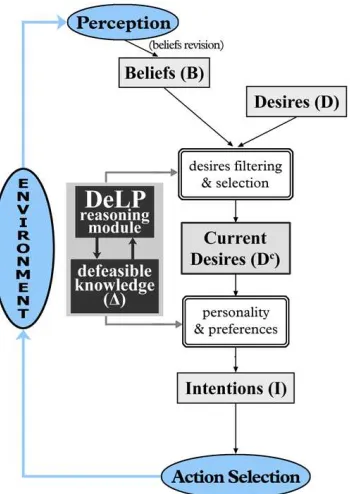
The BDI architecture describes a two-phase loop (Figure 1) that requires to perform rea-soning: first, the set D is filtered to build the set Dc and then an intention has to be selected
among the elements of Dc. In our approach, we will use DeLP to represent knowledge and
derive intentions. Therefore, the argumentation process performed regarding each desire will model the reasoning part of the system. The defeasible knowledge under representation will be based on beliefs and desires encoded as a Defeasible Logic Program P = (Π,∆), where Π denotes the set of facts and strict rules, while ∆ denotes the set of defeasible rules:
• Facts, which are ground literals representing atomic information or the negation of atomic information (using the strong negation “∼”).
• Strict Rules of the form L0←L1, . . . , Ln, where L0 is the head and {Li}i>0 is the body.
EachLi in the body or the head is a literal.
• Defeasible Rules of the form L0–≺L1, . . . , Ln, where L0 is the head and {Li}i>0 is the
Figure 1: BDI architecture using DeLP as a reasoning module
In DeLP a literalLiswarranted if there exists a non-defeatedargument A supportingL. In order to establish ifA, Lis a non-defeated argument,argument rebuttals orcounter-arguments that could bedefeaters forA, Lare considered,i.e., counter-arguments that by some criterion are preferred to A, L. Since counter-arguments are arguments, there may exist defeaters for them, and defeaters for these defeaters, and so on. Thus, a sequence of arguments called an argumentation line is constructed, where each argument defeats its predecessor in the line (the interested reader should refer to [4] in order to obtain a more detailed explanation1
).
In DeLP, given a query Q the possible answers will be: YES, if Q is warranted; NO, if the complement of Qis warranted; UNDECIDED, if neither Q nor its complement are warranted; and UNKNOWN, if Qis not in the language of the program.
3
Knowledge, Actions and Desires Representation
In this work we will consider the problem of having an action-oriented system with a single goal. This is a common scenario in the mobile robotics domain, where a robot has certain effectorial capabilities, along with a given task. An interesting issue arises when there is just one action that can be performed at a time, that is, the agent has to select the right one out of an available set of actions. Therefore, the suitability of each action must be weighed. The agent must have the ability of selecting the right action at every moment,i.e., the action that gets it closer to the goal.
1The implementation (interpreter) of DeLP that satisfies the semantics described in [4] is currently accessible
3.1 Defeasible Logic Program
As stated in Section 2, in this model knowledge will be encoded as a defeasible logic program and the reasoning will be performed by a formalism of defeasible argumentation. In this kind of logic programs, the programmer must assert reasons for and against certain literals, written in the form of rules. We will consider the following scheme of rules:
δi–≺βi1, ..., βin (defeasible)
δj←βj1, ..., βjm (strict)
Where every δi is a literal that stands for a reason for or against a desire. The literals βij will represent beliefs.
In addition to this, if a reason for a desire holds, it must be considered as a reason against every other desire. Keep in mind that each desire is directly related to a physical action, and in this work we are assuming that just one action can be performed at a time. Hence, whenever the agent has a reason to perform an action, that must be automatically thought as a reason against the rest of the available actions (e.g., if you have a reason to watch TV, you will have a reason against reading this paper, andvice versa). For that reason, the following type of rules must be added to the program for all desires:
δi–≺δj, such that i=j
Having this rules implies that a warranted argument for a desire will be a strong opposition against the possibility of warrant of the rest of the desires. Although this seems to mean that the warrant of more than one desire will never happen, the influence of the beliefs within an argument can override this property and allow more than one desire to be warranted.
According to the rules described above, the defeasible program will represent the agent’s knowledge by stating reasons for and against every element of the set of Desires based on the set of Beliefs and the set of Desires itself. Let’s see an example, where we model the desires and beliefs of a soccer-playing agent that has the ability of performing passes and carrying the ball; then, the setsB and Dare:
• B= {
noOneAhead(P) (true if player P has no players in front of him),
hasBall(P) (true if player P has the ball in his possession),
betterP osition(P1, P2) (true if player P1 is in a better position than P2)}
• D= {
pass(Src, T gt) (represents a reason for player Src to perform a pass to player Tgt),
And the defeasible logic program representing the agent’s knowledge will be:
P = (Π,∆) ={
(pass(Src, T gt)–≺betterP osition(T gt, Src)),
(∼pass(Src, )←not hasBall(Src)),
(carry(P)–≺noOneAhead(P)),
(∼carry(P)–≺not hasBall(P))}
Rules of the form δi–≺δj must be written in order to establish that, when a reason for carrying the ball holds, then there is a reason against performing a pass to a teammate, and vice versa. Therefore, according to the set D, this rules are:
(∼pass(P, )–≺carry(P))
(∼carry(P)–≺pass(P, ))
Preference criteria
Here we will address the methodological question of how to choose a preference criterion and we will guide the implementation of a suitable criterion for an agent built following this approach. First, we will introduce the notion of preference criterion, and then, some necessary definitions will be presented.
Given an argument structureA2 that is a counter-argument forA1, in order to decide which
one prevails, these two arguments must be compared by some criterion. For example, in [4], if the counter-argument A2 is better than A1 w.r.t. the comparison criterion used, then A2
prevails and it will be called a proper defeater for A1. If neither argument is better nor worse
than the other, a blocking situation occurs, and we will say that A2 is a blocking defeater for
A1. If A1 is better than A2, then A2 will not be considered as a defeater for A1, and A1
prevails.
Definition 3.1 (Current desires) Given the Beliefs (B) and Desires (D) sets within a BDI architecture, the Current Desires (Dc) set will be defined as follows:
Dc = {δ ∈ D | there is no warrant(δ)}
Then, the setDc will be a subset of the setD containing just the desires that, in concordance
with the beliefs, can be satisfied in the current situation.
According to the four possible answers in DeLP, the set Dc is defined:
Before stating a necessary property for the comparison criterion, a couple of concepts must be introduced first: disagreement sub-argument and supporting literal. As explained in [4], if A1, h1 counter-argues A2, h2 at literal h, then the sub-argument structure Ad, h will be
called the disagreement sub-argument. In addition to this, we will call supporting literals to those that appear on an argument and are not on the head of any defeasible rule included in that argument.
Definition 3.2 (Comparison criterion) Given two arguments A1 and A2, such that A2 is
a counter-argument for A1, and the disagreement sub-argument of A1 is Ad, then A2 is
bet-ter than A1 if, and only if, A2’s supporting literals contain, at least, one desire, and Ad’s
supporting literals contain none.
Any preference criteria used in a system designed by this approach must agree with Defin-ition 3.2. This condDefin-ition states that desire-based reasons are stronger than those based merely on beliefs. The following example will show how this criterion works. Consider this sets of beliefs, desires and rules:
∆ = {(a1–≺v),
(∼a1–≺b),(∼a1–≺a2),
(a2–≺x),(a2–≺y),
(∼a2–≺d),(∼a2–≺a1)}
D= {a1, a2, a3}
B= Π = {v, x, y, b, d}
Dialectical tree for argument <{~a1-<b, b},
~a1>
<{~a1-<b, b}, ~a1>
<{a1-<v, v}, a1>
<{~a1-<a2, a2-<x,
x}, ~a1>
<{~a2-<d, d}, ~a2>
<{~a1-<a2, a2-<y,
y}, ~a1>
[image:6.595.246.354.389.670.2]<{~a2-<d, d}, ~a2>
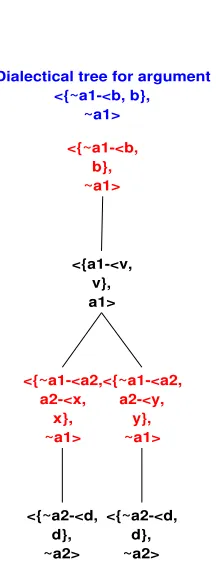
Figure 2: Dialectical tree for query ∼a1
In Figure 2 we can see a dialectical tree for query ∼a1 that shows the notion of defeat
relationship is justified by the fact that a1 is supported by the reason v, and the defeaters
support their conclusions ∼a1 with the action-related desire a2. Finally, at the bottom, both
proper defeaters are, in turn, blocked by the same argument, ending both argumentation lines. We will get a variety of dialectical trees representing the reasoning process performed to achieve the answer. The interested reader may refer tohttp://lidia.cs.uns.edu.ar/DeLP.
3.2 Actions and Intentions
In this model, actions will be assumed as a move (or sequence of moves) performed by a robot trying to fulfill an intention previously derived by the software agent. Thus, an intention will be defined in terms of some analysis of the state of the warrant of the current desires, and the actions just will try to mirror the currently selected intention in the best possible way.
Definition 3.3 (Intention) An intention I is a current desire that is enabled by a set P of preconditions and a set C of constraints of the form not Ci. Policies for obtaining intentions
will be denoted in the following way:
I ⇐ {P1, ..., Pm}, not{C1, ..., Cn}
Notice that the notation not {C1, ..., Cn} represents {not C1, ..., not Cn}.
Let K = (Π,∆) be an agent’s knowledge base, I will be an enabled intention if every pre-condition Pi has a warrant built from K and every constraint Ci fails to be warranted.
In the model presented in this paper, intentions are derived from desires. According to the changes in the environment, there could be, eventually, more than one enabled intention, so a preference order must be introduced to make the final choice. Nevertheless, proper agent design should avoid this; if the policies are correctly set, the chances of having a completely undecided situation will be highly diminished.
The selection of the intention will define the agent’s personality and may be subordinated by its role in the multi-agent system. The reader must notice that having an intention selected does not mean that the effects of its associated action can be taken as facts.
The effects of the actions cannot have a predictable correlation in the agent’s beliefs, because they will be ultimately carried out by a physical robot and its actions can fail or be imprecise. Therefore, the beliefs revision function will be performed by the sensing system of the robot, updating the geometric data,i.e., the coordinates of all the objects in the playfield.
4
Application Domain: Robotic Soccer
Robotic soccer has proven to be a complex enough system to test many of the features of any reasoning system. The robots are controlled by software agents, each of which has a set of high-level actions to perform, such as kicking the ball with a given strength or moving in a given direction. Every moment an agent has to choose which action to do next, and that choice can be made by using a reasoning system, in this case, a defeasible argumentation system.
In this section we will consider a software agent that controls the behavior of a physical robot according to the model explained in this article. For the sake of simplicity, we will assume that the agent has the possession of the ball, and analyze the cases under this assumption. This will suffice to get the overall idea of the system’s function.
The basic setup to start a robotic soccer match includes: a video camera, infra-red trans-mitter towers, the robots and computers devoted to run the agents and the video/command servers. This system works as it follows: The agent perceives its environment through the cam-era (that takes the whole playfield); then, a video server analyzes those images, recognizing the positions of the objects (ball and robots) and sending this information to the software agents. From this data the agents will build their (almost identical, they will differ just on personal features, such as their roles) B set describing the current state of the world. Next, from sets
B and D, it will generate the set Dc. Finally, it will select an element from the Dc set as the current intention.
4.1 Agents Architecture
According to Section 2, the BDI sets to describe the internal state of a soccer-playing robot are the following:
• B= {
marked(P) (true if player P is marked),
oppositeF ield(P) (true if player P is in the opposite side of the field),
noOneAhead(P) (true if player P has no players in front of him),
goalieAway(T) (true if the goalkeeper of team T is bad positioned),
hasBall(P) (true if player P has the ball in his possession),
teammate(P) (true if player P is a teammate of the player calling the predicate),
betterP osition(P1, P2) (true if player P1 is in a better position than P2),
playerBetween(P1, P2) (true if there is a player between P1 and P2),
gameResult(R) (true if R is the current result of the game),
playerRole(R) (true if R is the role of the player calling the predicate)}
• D= {
shoot(P) (represents a reason for player P to shoot on goal),
pass(Src, T gt) (represents a reason for player Src to perform a pass to player Tgt),
carry(P) (represents a reason for player P to carry the ball)}
This set is hard-wired to the robot’s knowledge and contains the available desires that may be elected as an intention at any moment of the game. At every moment during the match, it is filtered and the Dc set is built.
• I= [shoot(P)| pass(Src, T gt) | carry(P)]
The intention currently selected as explained in Section 3.2.
4.2 Defeasible Argumentation
The defeasible logic program has to define reasons for and against every element belonging to the setD and it does so via the following rules:
P = (Π,∆) ={
(shoot(P)–≺oppositeF ield(P), noOneAhead(P)), (shoot(P)–≺oppositeF ield(P), not marked(P)), (shoot( )–≺goalieAway(opposite)),
(∼shoot(P)←not hasBall(P)), (∼shoot(P)–≺pass(P, )), (∼shoot(P)–≺carry(P)),
(pass(Src, )–≺marked(Src)),
(pass(Src, T gt)–≺betterP osition(T gt, Src)),
(∼pass(Src, )←not hasBall(Src)),
(∼pass(Src, T gt)–≺playerBetween(Src, T gt)), (∼pass( , T gt)–≺marked(T gt)),
(∼pass(Src, )–≺shoot(Src)), (∼pass(Src, )–≺carry(Src)),
(carry(P)–≺noOneAhead(P)),
(∼carry(P)←not hasBall(P)), (∼carry(P)–≺shoot(P)), (∼carry(P)–≺pass(P, ))}
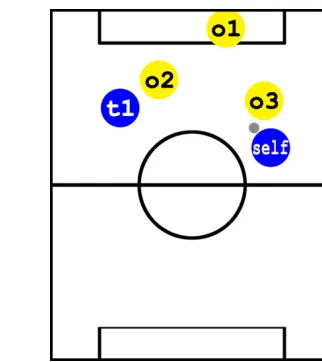
Figure 3: Player ‘self ’ decides to make a pass Figure 4: Completely undecided situation
4.3 Situation One: a straightforward decision
In this situation, as can be seen in Figure 3, the player has the following Beliefs set:
B = {marked(self), oppositeF ield(self), noOneAhead(t1), hasBall(self), teammate(t1), betterP osition(me, t1), playerRole(f orward)}
Once built the internal representation of the world, the agent performs DeLP queries over the elements of its setD, gathering their corresponding answers:
• shoot: NO; there are no reasons for shooting on goal, because the opposite goalkeeper is well-positioned, the player ‘self’ is marked,etc. On the other hand, there is one undefeated reason for not shooting on goal: a pass can be performed to teammate ‘t1’, who is free.
• pass: YES; there is an undefeated reason to perform a pass to teammate ‘t1’: player ‘self’ is marked by opponent ‘o3’.
• carry: NO; there are no reasons for carrying the ball, because the path between ‘self’ and the goal is obstructed by opponent ‘o3’. But there is a reason for not carrying the ball: a pass can be performed to teammate ‘t1’.
In this situation, the player has a clear choice: the selected intention must be perform a pass to ‘t1’, because it is the only current desire and it is warranted.
4.4 Situation Two: reasoning upon indecision
In this case, shown by Figure 4, player ‘self’ builds the following Beliefs set:
B = {marked(self), marked(t1), oppositeF ield(self), oppositeF ield(t1), hasBall(self), teammate(t1), betterP osition(t1, me), playerRole(f orward)}
[image:10.595.103.494.74.258.2]• shoot: UNDECIDED; there are no reasons supporting this argument; on the other hand, there are two arguments holding not to shoot on goal, based on different reasons to perform a pass to ‘t1’, but both are, in turn, defeated by an argument saying that ‘t1’ is marked by opponent ‘o2’.
• pass: UNDECIDED; the fact that both players are marked by an opponent, despite ‘t1’ is better positioned than player ‘self’, results in the reasoner module being incapable of deriving a definite answer.
• carry: UNDECIDED; as can be seen in the Figure, ‘self’ cannot advance with the ball, so there are no arguments for it. Two reasons support not to carry the ball, and they are defeated in the same fashion as the reasons for not to shoot on goal were.
Now, in this situation, what should the agent do?, it couldn’t make a decision for one of its three possible actions, but it has to choose one among them. Taking into consideration that the ‘UNDECIDED’ answer points that no warrant could be built for the queried literal nor its complement, the agent should determine its final intention with a policy like:
shoot(self)⇐ not{∼shoot(self)}
Therefore, when the not to shoot on goal (negated form of) desire is not warranted, the agent chooses to shoot on goal as its intention. This kind of policy describes the personality of an agent that shoots whenever it has an opportunity.
5
Conclusions
This article presents an approach to solve the problem of having an action-oriented system such as a robot with effectorial capabilities and a goal to complete. The robots are controlled by software agents based on a BDI architecture that reason via a defeasible argumentation module (DeLP). This module uses a defeasible logic program in the form of rules that combines desires and beliefs. Therefore, the agent will query about its desires and will derive a single intention, depending on the answers obtained. Finally, the robot will perform an action trying to satisfy the selected intention.
References
[1] Ches˜nevar, C. I., Maguitman, A. G., and Loui, R. P. Logical Models of Argument. ACM Computing Surveys 32, 4 (Dec. 2000), 337–383.
[2] Dung, P. M.On the acceptability of arguments and its fundamental role in nonmonotonic reason, logic programming, and N-person games. Artificial Intelligence 77 (1995), 321– 357.
[3] Falappa, M. A., Garc´ıa, A. J., and Simari, G. R. Belief dynamics and defeasible argumentation in rational agents. In Proceedings of the 10th International Workshop on Non-Monotonic Reasoning (NMR2004) (June 2004).
[4] Garc´ıa, A. J., and Simari, G. R. Defeasible logic programming: An argumentative approach. Theory and Practice of Logic Programming 4, 1 (2004), 95–138.
[5] Governatori, G., Maher, M., Antoniou, G., and Billington, D.Argumentation semantics for defeasible logic. Journal of Logic and Computation 14 (2004), 675–702. [6] Prakken, H., and Sartor, G. Argument-based extended logic programming with
defeasible priorities. In Working Notes of 3rd ModelAge Workshop: Formal Models of Agents (Sesimbra, Portugal, 1996), P.-Y. Schobbens, Ed.
[7] Prakken, H., and Sartor, G. A dialectical model of assessing conflicting arguments in legal reasoning. Artificial Intelligence and Law 4, 3-4 (1996), 331–368.
[8] Prakken, H., and Vreeswijk, G. Logical systems for defeasible argumentation. In Handbook of Philosophical Logic, 2nd ed., D.Gabbay, Ed. Kluwer Academic Pub., 2000. [9] Rao, A. S. AgentSpeak(L): BDI agents speak out in a logical computable language. In
Seventh European Workshop on Modelling Autonomous Agents in a Multi-Agent World (Eindhoven, The Netherlands, 1996), R. van Hoe, Ed.
[10] Rao, A. S., and Georgeff, M. P. BDI-agents: from theory to practice. InProceedings of the First International Conference on Multiagent Systems (San Francisco, 1995). [11] Simari, G. R., and Loui, R. P. A mathematical treatment of defeasible reasoning and