BIBLIOTECAS DEL TECNOLÓGICO DE MONTERREY
PUBLICACIÓN DE TRABAJOS DE GRADO
Las Bibliotecas del Sistema Tecnológico de Monterrey son depositarias de los trabajos recepcionales y de
grado que generan sus egresados. De esta manera, con el objeto de preservarlos y salvaguardarlos como
parte del acervo bibliográfico del Tecnológico de Monterrey se ha generado una copia de las tesis en
versión electrónica del tradicional formato impreso, con base en la Ley Federal del Derecho de Autor
(LFDA).
Es importante señalar que las tesis no se divulgan ni están a disposición pública con fines de
comercialización o lucro y que su control y organización únicamente se realiza en los Campus de origen.
Cabe mencionar, que la Colección de
Documentos Tec,
donde se encuentran las tesis, tesinas y
disertaciones doctorales, únicamente pueden ser consultables en pantalla por la comunidad del
Tecnológico de Monterrey a través de Biblioteca Digital, cuyo acceso requiere cuenta y clave de acceso,
para asegurar el uso restringido de dicha comunidad.
El Tecnológico de Monterrey informa a través de este medio a todos los egresados que tengan alguna
inconformidad o comentario por la publicación de su trabajo de grado en la sección Colección de
Documentos Tec del Tecnológico de Monterrey deberán notificarlo por escrito a
Analysis of the Impact of Problem Based Learning: An
Innovation in the Teaching-Learning Process to Enhance the
Development of Writing Abilities in the English
Language-Edición Única
Title
Analysis of the Impact of Problem Based Learning: An
Innovation in the Teaching-Learning Process to Enhance
the Development of Writing Abilities in the English
Language-Edición Única
Authors
Andrea Sue Richardson
Affiliation
Tecnológico de Monterrey, Universidad Virtual
Issue Date
2011-04-01
Item type
Tesis
Rights
Open Access
Downloaded
18-Jan-2017 12:22:58
TECNOLÓGICO D E MONTERREY
Escuela de Graduados en Educación
Universidad Virtual
Escuela de Graduados en Educación
Analysis of the Impact of Problem Based Learning: An Innovation in
the Teaching-Learning Process to Enhance the Development of
Writing Abilities in the English Language
Maestría en Educación con acentuación en Procesos de Enseñanza-Aprendizaje
Andrea Sue Richardson
Asesor tutor:
Mtra. Carmen Medina Almeida
Asesor titular:
Dra. Martha Catalina Del Ángel Castillo
Atizapán, Estado de México Abril 2011 Tesis que para obtener el grado de:
Hoja Electrónica de Firmas
El trabajo que se presenta fue aprobado por el comité formado por los siguientes académicos:
Dra. Martha Catalina Del Angel Castillo (Asesora Titular)
Tecnológico de Monterrey, Universidad Virtual, Escuela de Graduados en Educación [email protected]
Mtra. Carmen Medina Almeida (Asesora Tutora)
Tecnológico de Monterrey, Universidad Virtual, Escuela de Graduados en Educación [email protected]
Mtra. Ana Margarita Ancira Torres
Tecnológico de Monterrey, Universidad Virtual, Escuela de Graduados en Educación [email protected]
Electronic Signature Sheet
The work presented was approved by the following members of the academis committee:
Martha Catalina Del Angel Castillo, Ph.D. (Chief Advisor)
Tecnológico de Monterrey, Universidad Virtual, Escuela de Graduados en Educación [email protected]
Carmen Medina Almeida, MET. (Thesis Advisor)
Tecnológico de Monterrey, Universidad Virtual, Escuela de Graduados en Educación [email protected]
Mtra. Ana Margarita Ancira Torres
Tecnológico de Monterrey, Universidad Virtual, Escuela de Graduados en Educación [email protected]
The registry that supports this verdict is held by the Academic Service Department of
Acknowledgements
The author would like to thank her husband, Oliver, for his constant support
during the writing of this thesis.
She would also like to thank her students who participated in the activity for
the research.
The author acknowledges and appreciates the great support and guidance of
her Thesis Advisor, Professor Carmen Medina Almeida, throughout the
process of the research and the writing of this thesis.
She also wants to extend her appreciation to the Tecnológico de Monterrey,
Mexico State Campus for bestowing her the opportunity to study her Master's
degree with the scholarship for her professional development and the benefit
Analysis of the Impact of Problem Based Learning: An Innovation in
the Teaching-Learning Process to Enhance the Development of
Writing Abilities in the English Language
Abstract
The focus of this study was to analyse the impact of Problem Based Learning in the
innovation of the teaching-learning process in the English language, in order to
enhance the development of writing skills in a high level English as a foreign
language class of high school students in Mexico. The study used the qualitative
research approach with action research methodology. The P B L activity involved 4
class sessions which were observed for data collection. Other data was collected using
semistructured interviews and participant observation of the students' written work.
The study revealed that the implementation of PBL in the participating class
contributed positively to the teaching-learning process in the development of writing
skills, collaborative work, interactions among the students and the instructor and
formal written work. The researcher makes a number of proposals to improve the
strategies of implementing P B L in English language classes and possible teacher
Contents
Signature Page ii Acknowledgements iv
Abstract vContents vi
Index of Tables ix
Index of Figures x
Introduction 11
Problem statement 15
Conceptual background 16 Socio-demographic context 21 Prior diagnosis of the problematic situation 25
Definition of the problem 25 Objectives of the research 29 Rational and feasibility 31 Study limitations and delimitations 32
Glossary 34
Theoretical framework 36
The teaching-learning process of English as a foreign language 37
English language skills 39 The writing process 39 Writing to leam 42 Strategies in English language: teaching and learning 43
Teaching strategies 43 Learning strategies 44 Importance of collaborative learning 46
Problem Based Learning 49 Task Based Learning 51 Other approaches to teaching writing abilities 52
Related research 58
Methodology 68
Methodological focus 69 Population and sample 71
Participants 73 Instruments 74 Procedures 76 Data analysis strategies 80
Validity, Credibility and Dependability 82
ResultszyxwvutsrqponmlkjihgfedcbaZYXWVUTSRQPONMLKJIHGFEDCBA 86 Presentation of the results 86
Results of the participant observation of interaction among students 88
Results of the semistructured interviews to the students 99
Analysis and interpretation 110
Conclusions 123
Discoveries 125 Conclusions with regard to the objectives of the investigation 125
Future research projects 142
References 214
Appendixes 148
Appendix A : Permission from the institution to conduct the action
research 148
Appendix B: Syllabus for International Baccalaureate English Course 150
Appendix C: Semi-structured interview with the director of the
Languages Department (transcription) 153 Appendix D: Problem based learning activity for the English B, 4t h semester
course Tecnológico de Monterrey, Mexico State campus ....155
Appendix E: Rubric for evaluating the collaborative work 157
Appendix F: Rubric to evaluate the Students' Written Report 159
Appendix G: Participant observation guide of the interaction among the students during the completion of collaborative work
using PBL 161
Appendix H : Participant observation of the interaction among the students during the completion of collaborative work using P B L
(transcription - session 1) 164
Appendix I: Participant observation of the interaction among the students during the completion of collaborative work using P B L
(transcription - session 2) 168
Appendix J: Participant observation of the interaction among the students during the completion of collaborative work using P B L
(transcription - session 3) 172
Appendix K : Participant observation of the interaction among the students during the completion of collaborative work using P B L
Appendix L: Semi-structured interview guide for the students about
the PBL activity 180
Appendix M : Semi-structured interview for the students about the PBL
activity: Transcription student 1 182
Appendix N : Semi-structured interview for the students about the P B L
activity: Transcription student 2 186
Appendix O: Semi-structured interview for the students about the P B L
activity: Transcription student 3 189
Appendix P: Table of frequencies for the final grades of the written work 192
Appendix Q: Proposal for peer-assessment survey in future PBL
activities 193
Appendix R: Assignment B from the written work of the PBL activity... 194
Appendix S: Assignment C from the written work of the PBL activity.. .201
Table Index
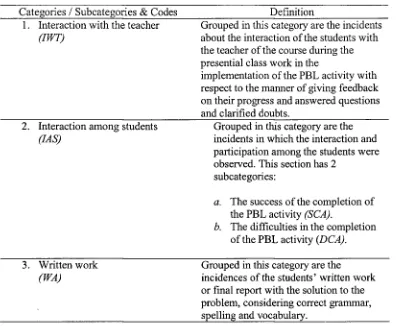
Table 1: Categories attained from the participant observation of the
students' interaction 89
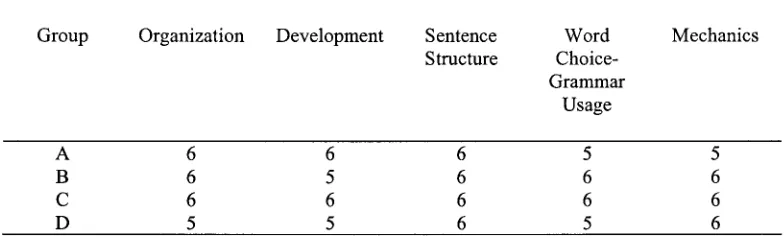
Table 2: Grades of each group according to the categories in the writing rubric 97
Table 3: The results of the evaluation of the students' written report 97
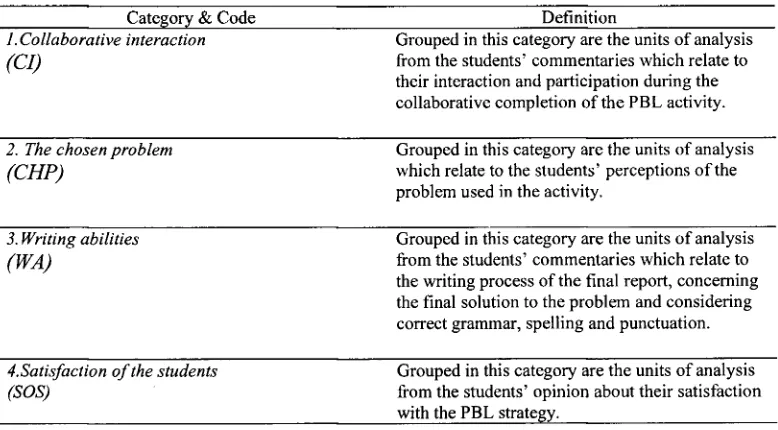
Table 4: Categories attained from the semistructured interviews to the student 99
Table 5: Responses about the category of collaborative interaction 100
Table 6: Responses about the category of the chosen problem 102
Table 7: Responses about the category of writing abilities 105
Table 8: Responses about the category of students' satisfaction 107
Table 9: Responses about the category of future experiences with P B L 109
Table 10: Proposal for a possible training course for the language teachers of the Tecnológico de Monterrey, Mexico State campus about
Figure Index
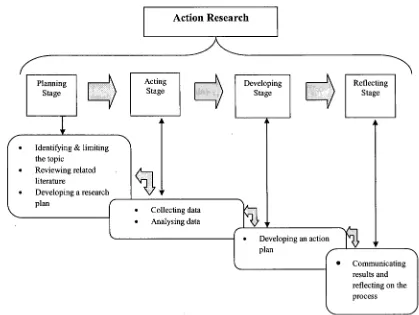
Figure 1: Strategy scheme of action research (step by step process
Introduction
This research project intended to embark upon the issue of using problem
based learning in higher level English language classes for improving the students'
writing abilities. More specifically, the research question is: What is the impact of the
implementation of P B L in innovating the teaching learning process in the English
language to strengthen the development of writing abilities in the language for the
upper intermediate to advanced students in the English B course in the International
Baccalaureate program at the Tecnologico de Monterrey, Mexico State Campus? In
order to do this analysis, the researcher established the following study goals:
• To describe how the teaching-learning process develops through implementing
P B L with regard to a possible innovation in the development of writing skills in
English.
• To know the interactive strategies that develop in the classroom during the PBL
activity.
• To describe the students' participation in the collaborative activities belonging to
the P B L stages of the written work.
• To determine if P B L favours the correct use of grammatical structures, new
vocabulary and correct spelling in formal writing.
• To give proposals for improving the teaching practices, by using P B L as a
meaningful learning practice involving collaborative learning and writing in
English in the International Baccalaureate program in the high school at the
Tecnológico de Monterrey, Mexico State campus and in other high-level English
courses at the institution.
The topic came about as the teacher-researcher was interested in developing new
the other English language skills and meaningful collaborative work. As a teacher of
higher level English classes, the researcher noticed how there was a lack of these
types of integrative activities and felt the need to begin to develop strategies to
improve this aspect of the teaching practice at the institution (i.e., there was a problem
to be solved). By involving problem solving skills with writing and collaborative
work, the students enjoy the benefits of a holistic learning experience with the English
language which allows them to apply all the previously learned skills in one
encompassing activity.
The report contains 5 chapters: the Problem Statement, Theoretical
Framework, Methodology, Results and Conclusions. The problem statement includes
a conceptual background outlining key background information about the study:
issues in foreign language writing, problem based learning, interaction, collaborative
learning and student needs. It also gives the socio-demographic context of the
institution where the study took place, the prior diagnostic of the problem and the
definition of the problem. The objectives are detailed in this chapter along with the
rational and the study's limitations and delimitations.
The theoretical framework presents the definitions of the research
constructs and covers a number of important theories about the teaching-learning
process of a foreign language, writing skills in English, teaching and learning
strategies, collaborative learning and they types of interaction, problem based
learning, task based learning and other approaches to teaching writing. Additionally,
there is a section including a summary of 5 studies in the fields of problem based
learning, task based learning in English language classes, academic writing needs and
the collaborative writing process in a cross-cultural web-based project. This section
outcomes of this study about using PBL to promote interaction and the collaborative
writing process. The methodology chapter includes information about the
methodological focus, qualitative research with action research methodology. It
details the information about the participants and the context of the study. The
instruments and procedures employed are described as well as the data analysis
strategies. The author also gives the readers assurance about the validity and
dependability of the investigation. Furthermore, a figure outlining the problem solving
strategy is proportioned to give a visual about the procedure (i.e., the action plan).
The results are presented according to the instruments used, the participant
observations and the semi-structured interviews are analysed and interpreted in
congruence with the objectives of the study. The data collected was categorized
according the problem and they focused on the interaction that took place during the
activity, writing abilities, how the students reacted to the chosen problem and the
learning experience with problem based learning. Additionally, in this chapter, the
author relates the results of this study to the theories presented in chapter 2
(triangulation strategy).
Finally, the conclusions consider the results further and describe them
according to the research questions. These conclusions wrap-up the study's findings
by giving a final review of the results and inferences about the effects of the problem
based learning activity on the interaction and writing abilities of the participating
students. To supplement the analysis of the results, the author proposes ways to
enhance the teaching-learning process with the use of P B L through a training course
proposal for language teachers at the institution where she teaches, as well as a
number of future research projects that would be able to make more discoveries about
This project was the researcher's first time to conduct an investigation and the
first time implementing problem based learning with writing. She hopes that she can
encourage other teachers to try this type of activity and offer the students a chance to
experiment with their collaborative problem solving skills in English and formulate
written tasks based on the research, discussions and debates. This innovative
technique can be very motivating for English language students and it gives them a
break from the traditional writing activities, encourages them to participate and
interact on a number of levels and gives them real-life experience with the language.
The systematic inquiry conducted by the researcher in her own classroom focused on
1. Problem Statement
In this chapter, the problem statement for the research is given including the
conceptual background which outlines student needs, problems in writing in a foreign
language, and an introduction to Problem Based Learning (PBL), including the
importance of social interaction in collaborative learning. The socio-demographic
context is described in detail displaying the environment, student profiles, program
and objectives upon graduation from the high school where the study takes place. The
definition of the problem depicts the issue of using P B L in a high-intermediate to
advanced E F L class in finding the benefits of the use of this activity in group writing
projects while being conscious of student needs. The general objective is to analyze
the impact that the implementation of PBL has on the innovation of the
teaching-learning process and on the strengthening of the development of writing skills for
upper-intermediate to advanced level English language students in the International
Baccalaureate program at the Tecnológico de Monterrey high school, Mexico State
Campus. For this study, action research is used. The rational justifies the need for the
study in that it will enable other teachers to know about these types of activities and
give the students an opportunity to work with the language in a different way than
traditional writing activities. Additionally, the need for the study comes from the
importance of resolving a problem and contributing to the innovation of the
teaching-learning process strategies at the Tecnológico de Monterrey, Mexico State campus in
the area of English teaching and from the periodic lacking performance of the students
with a final goal of propitiating meaningful learning in the development of writing
abilities. The limitations and delimitations outline the possible problems encountered
qualitative action research approach where the teacher-researcher conducts the
investigation with her own group of students. As Hernandez et al. (2010) state,
qualitative research is done in the natural environment of the participants; thus, their
everyday classroom and time is used. Finally, there is a glossary to facilitate the
reading of the thesis.
Conceptual Background
Writing in a second language is not an easy task. As Zen (2005, p. 11) says:
Although every normal human being can speak, not everyone is able to write well even in his native language. This fact implies that learning to write is a deliberate effort that must be taught and nurtured. This is even more so when writing in a second / foreign language is considered.
This very true statement is vital to ponder as the topic of writing in English as
a second language is considered. As it is such a huge undertaking, where students
often fear looking at that blank page in front of them, teachers need to be prepared to
face this mission by being equipped with knowledge, methodology, and more
importantly the willingness to be a part of this learning process. Teachers can help
students through the obstacles and prepare them to do it on their own.
Students of all levels should be taught writing skills. In the lower levels they
can be writing simple sentences, to paragraphs in intermediate levels and in the
advanced levels they can be writing more sophisticated works that incorporate a
writing process and cognitive abilities. In the writing topics, teachers can be more
demanding and expect that the students do research and follow a writing process,
which can be demonstrated by the teacher then adapted by the students to fit their
individual styles. By giving students abundant guidance, examples, feedback and
support, teachers can ensure that the teaching and nurturing that Zen exemplifies is
benefit students in that discussion and interaction can help stimulate ideas. As well,
collaborative writing can aid the revision and editing process, as there is more
possibility of writing with correct grammar and wording with the variety of
experience that each group member brings. A teacher's interaction is also important in
that constant feedback and monitoring can facilitate greater confidence and ease in the
process.
Interaction among students can be part of the learning process. Dillenbourg,
Baker, Blaye & O'Malley (1996) comment on Piaget's socio-constructivist theory and
say, "it is above all through interacting with others, coordinating his/her approaches to
reality with those of others, that the individual masters new approaches" (p. 3). They
further report that during the problem solving process, differentiating opinions and
knowledge can promote the need for reasoning and assist the learning process. Thus,
it can be inferred that collaborative work and interaction can enhance the learning
process, not only among students but also between student and teacher. Teachers can
aid the critical thinking process by not directly answering questions, rather giving
guidance and guiding the student in such a way that he or she will answer it for
themselves. This is one of the key points in the learning process of PBL.
A topic that must be addressed is the student needs. Teachers have to be aware
that students will not only need to speak English with a certain degree of fluency, but
also be able to use it for academic purposes, be efficient writers and be able to use it
in collaborative work. Several researchers have tackled this issue in studies with
foreign university students attending English speaking universities. Tait (1999) did a
study at the University of Melbourne in Australia that revealed a number of student
needs. She lists: expectations and guidelines, knowledge of plagiarism, grammatical
vocabulary and discipline specific words. Carson & Leki (1994) discovered similar
needs and added that students wanted more instruction in specialized forms of
writing, such as lab reports and business letters. In this study, it was noted that a
requirement do achieve a high grade in the course, along with the English language,
was a demonstration of critical thinking skills. A study done by James (2006) took a
different focus and analyzed the transfer of skills from an ESL class to content based
courses. He notes that the highest transferred skills were reading and writing, and also
notes that students commented on the group work and problem solving abilities were
useful.
Other important skills that students require are the ability to think critically,
research properly and work in teams. Although the context of the present study is
different than that of the previously mentioned, there is relevance in reviewing these
needs and required skills, as a large number of the students who will take part in the
study have a keen interest in studying abroad in English speaking universities. In high
schools, teachers have to be aware of the skills and abilities that will be required of
the students in university and later in their careers; teachers can be a part of that
preparation process. Teachers of higher level English classes can also become
instructors of these skills by using the problem based learning method.
Wee (2004) defines PBL as "an authentic education that requires students to
go through during learning the same activities as those valued in the real world" (p.
14). PBL uses implicit learning where the students are in charge of the outcome and
what they gain from the process. The teacher is responsible for presenting the case
and giving necessary background information, then steps back and acts as a guide or
facilitator. In an E F L class, the teacher will be there to answer vocabulary questions
will be done by the students through their discussions and research. Amador, Miles &
Peters (2006) allocate the following steps to PBL:
1.zyxwvutsrqponmlkjihgfedcbaZYXWVUTSRQPONMLKJIHGFEDCBA Present students with a problem. Students assess the problem and identify
what they know in relation to the problem.
2. Determine what aspects of the problem they do not understand. These learning
issues serve to focus group discussion.
3. Rank learning issues in order of importance. The group decides which issues
will be considered by the whole group or by individuals. In the case of
individual follow-up, that student is responsible for informing the rest of the
group about his or her findings.
4. Explore previous learning issues and integrate new knowledge in the context
of the problem. Students summarize their progress, make connections between
previous and newly acquired knowledge, and develop new learning issues
(Miles & Peters).
As seen in these steps, the students have to apply critical thinking and be
responsible for their own learning through the process of solving the problem. These
are fundamental skills that students must obtain for future success in the age of
information. Clark & Clark (2009) assert that education in the society of knowledge
requires that teachers implement activities that promote the use of highly cognitive
abilities, decision making competence and collaborative learning skills. Burbules
(2000) coincides with Clark & Clark and adds that the abilities to work efficiently,
creatively and analytically are also vital in education for a globalized world.
In PBL, students are presented with an actual current problem which has not
only one solution. In this aspect, the solution that the students come up with cannot be
research and give fundamental reasons why their solution would work. The problems
themselves depend on the field of study. In an E F L class the teacher has the freedom
to choose the topic and complexity of the problem based on the level of the students,
topics they have seen in class, student interest, student background knowledge, level
of research skills, and time allowed in class for the project. Another consideration in
choosing a problem is what current issues in the world, or in the realm of the students'
interest and knowledge are there that they can possibly tackle in a P B L activity.
Another advantage to PBL is that it follows descriptive language teaching and
independent learning by the students. Freeman & Freeman (2004) state that
descriptive language learning, as opposed to prescriptive, allow students to acquire the
language by noticing patterns, comprehending their meaning and later being able to
produce these patterns. They assert that this type of language learning is what teachers
should be implementing. Thus, during reading and research for the problem, students
encounter complex sentence patterns and internalize them, and this is reflected in their
writing. In addition, they confront new vocabulary that they can add to their existing
lexicon. With respect to independent learning, PBL enables students to discover and
acquire new knowledge in a field and apply it to coming up with a solution. Teachers
do not give a list of options that the students can choose from; they have to be
conscientious, inquisitive and critical thinkers. Considering the previous analysis, this
study, by using PBL, wishes to improve teaching practices in relation to language
learning by giving students hands-on practice with complex sentence structures and
new vocabulary in their reading and research that will be transferred to their writing
Gocer (2010) advocates that teachers must strive to evoke interest in their
students and relay the importance of learning a second language. They also must be
they learn. Furthermore, the students should be informed of the objectives of each
learning session so they understand the purpose of what they are learning and
practicing. This author also asserts the use of a variety of approaches, methods and
techniques in order to adapt to the students' different learning styles. The promotion
of metacognitive skills is also vital in language teaching so that the students become
more aware of their own learning and can monitor their own progress. These ideas
bolster meaningful learning in the classroom.
Socio-demographic Context
The study takes place in the Tecnológico de Monterrey, Mexico State Campus
in the high school division. This is a private educational institution which caters to the
middle to upper economic class citizens of the area. The school is equipped with all
the modern facilities for learning, such as up-to-date computer labs, science labs,
high-speed internet and all classrooms have projectors and speakers. Along with these
educational tools, the school has an array of facilities for sports and extra-curricular
activities, including art and dance studios; football, volleyball, basketball and tennis
courts; and photography and music classes. The high school division has over 2000
students and has three distinct programs: Bilingual, Multicultural and International
Baccalaureate. The school's mission consists of the following:
• Promote the international competitiveness of business enterprises based on
knowledge, innovation, technological development, and sustainable
development.
• Develop business management models to compete in a global economy.
• Create, implement and transfer business incubator models and networks in
Collaborate in professionalizing public administration; and analyze and
propose public policies for Mexico's development.
Contribute to the sustainable development of the community with innovative
models and systems for its educational, social, economic and political
improvement
(Tecnológico de Monterrey, 2009, section: Misión, 2015).
Moreover, the high school has an extended list of objectives for graduates.
Some of these are:
Use current academic knowledge that facilitates the making of successful
decisions in university and personal life.
Strengthen self-esteem and value family and social environments.
Act in a congruent manner with respect to universal values to strengthen the
ethical commitment.
Develop, from a multicultural perspective, the ability to have interpersonal
and positive relationships without social, gender, racial, political or religious
biases.
Responsibly participate in and direct activities that seek creative solutions
that benefit your community.
Have the ability to work collaboratively which permits the development of
social interaction.
Learn self-learning strategies that constantly develop the practice of critical
thinking.
Communicate effectively, written and orally, in Spanish and English.
information.
• Practice work ethics, responsibility, respect, discipline and effort.
• Critically analyze social reality, economics, politics and the environment of
the country with a humanistic vision in order to act as a committed citizen
(Tecnológico de Monterrey, 2009, section: Misión, 2015).
More specifically, in this qualitative research the classes are from the
International Baccalaureate Program (IBP). The learner profile of this program
dictates that the students should be: inquirers, knowledgeable, thinkers,
communicators, principled, open-minded, caring, risk-takers, balanced and reflective.
This is a highly demanding program which requires a very high average from
secondary school to enter, 90 or over, and a very high score on the entrance exam,
1200 points or more on the Academic Aptitude Test from College Board. In addition,
the students have to have a high level of English to enter, 500 points or more on the
TOEFL exam. The students of this program form a small subgroup within the high
school. Currently, there are 108 in the program and each generation consists of 35-40
students. To complement their studies of the regular 6 classes per semester in a 6
semester program, they take 3 additional courses: Theory of Knowledge (TOK),
investigation which requires a final product of an extended research essay that they do
independently, and community service which obliges the students to complete 150
hours of service.
The class in which the study takes place is in English B, which is a practical
approach to language study that incorporates interactive and individual oral practice,
reading comprehension with analysis of text type and language, and different types of
writing (see Appendix Q). There are 2 English classes in the International
approach to the language whereas English A2 includes in-depth literary analysis and
studies of topics such as social issues and media and culture. The class is presential
without the use of online tools such as Blackboard. The students in this class have a
high-intermediate to advanced level of the language. The participating class is in their
4t h semester of study in the International Baccalaureate program. The class has 20
students which will facilitate the observation of the activity. The student population is
majority Mexican; however, there is one student of Korean nationality, thus making
English her third language.
The team of teachers for the International Baccalaureate Program, as well as
their studies in education and their specific studies in their respective fields, are
trained in special courses for the program. These courses consist of a 4 day workshop
given by specialized and experienced IB teacher trainers. The courses contain the
learning of the IB curriculum, general and in the certain subject, material, evaluation,
teaching approaches, student and teacher expectations and much interaction and
sharing of experience among the teachers. Each teacher is equipped with an extensive
program guide which includes evaluation criteria, curriculum, course objectives and
ideas for material. In addition to this, IB teachers meet regularly to discuss the
students' progress and have semester meetings with the students' parents to inform
Prior Diagnosis of the Problematic Situation zyxwvutsrqponmlkjihgfedcbaZYXWVUTSRQPONMLKJIHGFEDCBA
In relation to the problem, a semi-structured interview with the director of the
Languages Department of TEC (Mexico State Campus) was conducted in order to
elaborate on the previous diagnosis of the problem (see Appendix C). The problem
being the lack of innovative teaching methods at the institution, which is the basis of
this thesis, to analyze the impact of using PBL as an innovative way of teaching and
learning in English classes in relation to enhancing writing skills. The interview
established that there are no formally implemented activities that promote
collaborative work with writing tasks due to the size of the classes and that P B L has
very little use in the department. There is almost no innovation in the
teaching-learning process. Only few teachers focus on the application of new teaching-learning
strategies. The director recognizes the need to have better teacher-training in the area
of collaborative work and critical thinking. He also agrees that there would be benefits
from using P B L incorporated with writing tasks; for example: to develop creativity,
analytical skills and a good attitude towards critical thinking assignments in English.
By conducting this interview, the definition of the problem is clearer and the need for
using different types of activities that promote collaborative learning and critical
thinking through writing tasks. There is a problem that needs to be solved, in order to
promote active and constructive learning in the English language classes.
Definition of the Problem
Considering the previous information, it is important to keep up with
educational demands and prepare students for a future where they have to face and
English. The incorporation of PBL into a high-intermediate to advanced level EFL
class aims to give the students new challenges that not only promote the development
of the mentioned skills but does it in their second or third language. This type of
activity involves both oral and written communication as well as a high level of
reading comprehension; thus, incorporating practice of all language skills and
respecting the input hypothesis which states that language learners should be given
input that is slightly higher than their current level of output.
Acknowledging the prior diagnostic of the problematic situation, there are
other factors to consider for the implementation of P B L in upper-intermediate to
advanced level English language classes. The researcher sees a need to implement
different types of activities that challenge the students, not only with the high level
language but also using problem solving and critical thinking skills collaboratively
and involve them with writing tasks. The researcher feels that many students see
English class just as a means of improving their language skills, which, of course, is
the primary aim; however, current society demands that the students be able to
interact using the language in their future careers, thus, the abilities acquired in the
P B L activities will be beneficial, especially with a focus on writing that is
fundamental in the age of information communication skills. Another reason is that in
the upper level classes, there is a large focus on vocabulary acquisition and writing
and there have been little innovative ways of teaching these skills at the Mexico State
Campus. The current teaching techniques used tend to be traditional and linear, thus
not providing the students with new challenges and diverse ways of working with the
language.
The researcher implements action research as the wish is to improve her
action research the instructor has the liberty to elect the problematic situation he or
she sees and conduct research accordingly. The steps these authors outline are: finding
a practice that could be improved; planning a course of action that involves change in
the practice; realizing the plan; and evaluating the effect and making subsequent
modifications in the teaching practice. One of the key points in action research is the
reflection done by the researcher as a participant and the facility to make changes
based on the study results and reflection.
Due to the fact that language acquisition and learning writing are very long
processes, there are many constructs to consider. The students may find that the group
work interferes with their own individual learning and perfecting of the language and
their writing skills. Considering what Tait (1999) notes about student needs, one of
the foremost interests of students is grammatical accuracy; however, as James (2006)
discovers, problem solving in an ESL class was also stated to be beneficial to the
students. Lee & Kim (2005) discuss that collaborative learning in PBL gives the
learners a common goal and allows them to articulate their thoughts through
discussion. This discussion among peer learners can be more effective than interaction
with the teacher as the students are at the same level. As they work through a
problem, they may encounter conflicts and differentiating opinions, thus giving the
students a chance to explain their own understanding and reasoning, which allows all
members of a collaborative work team to learn.
The instructor represents a facilitator in the P B L activity. The instructor
presents the small groups within the class with problems to be solved, strategies and
step by step guidelines to accomplish the goal of the activity. Explicit examples are
also given. The interaction between the students and the teacher will be one of
them through the process, leading them to recourses or through the thought process
that problem solving requires. The nature of the activity requires group work; thus,
interaction among the students is if upmost importance. The students practice
listening, responding to what they hear, reasoning and defending their opinions. They
must show interest, respect towards their fellow students and participate actively.
Within the team, natural roles are designated to each member; leader, recorder,
researchers and writers, and these roles overlap with the collaborative work. The team
members must be aware of the difficulty that arises whilst coming to a consensus and
be able to work through that difficulty and all the while take advantage of the group
work to enhance the learning experience.
The teams are evaluated on their work as a team (collaborative performance),
completing the required steps in the problem solving process and formulating their
solution in the written work that is handed in at the end; and are evaluated
individually on their efforts and contributions to the collaborative task. The written
work is evaluated and analyzed by the correct use of complex grammatical structures;
the proper use of new vocabulary and terms; and overall coherence and unity of the
work.
The general research question may be stated as follows: What is the impact of
the implementation of P B L on the innovation of the teaching-learning process and on
the strengthening (enhancement) of the development of writing abilities in English for
students in the English B course at the Tecnológico de Monterrey high school,
Mexico State campus? The subsequent questions that the investigation proposes are:
• How does the teaching-learning process develop through implementing P B L
with regard to a possible innovation in the development of writing skills in
What interactive strategies develop in the classroom during the P B L activity?
How is the students' participation (performance) in the collaborative activities
belonging to the P B L stages of the written work?
Does P B L favour the correct use of grammatical structures, new vocabulary
and correct spelling in formal writing?
What proposals can be made for improving the teaching practices, by using
P B L as a meaningful learning practice, involving collaborative learning and
writing in English, in the International Baccalaureate Program at the Mexico
State Campus and in other high-level English courses at the institution?
Objectives of the Research
The objectives include:
To describe how the teaching-learning process develops through implementing
P B L with regard to a possible innovation in the development of writing skills
in English.
To know the interactive strategies that develop in the classroom during the
P B L activity.
To describe the students' participation (performance) in the collaborative
activities belonging to the PBL stages of the written work.
To determine if P B L favours the correct use of grammatical structures, new
vocabulary and correct spelling in formal writing
To give proposals for improving the teaching practices, by using P B L as a
meaningful learning practice involving collaborative learning and writing in
English, in the International Baccalaureate program at the Mexico State
In congruence with the IB student profile, which states that the students are
thinkers, PBL offers a dynamic approach to learning that allows the student to
demonstrate and implement critical thinking skills. The IB student profile also
indicates that the students are inquirers and communicators. PBL facilitates research
and meaningful communication; hence, the students will be able to demonstrate their
acquisition and use of inquiry and communicative skills. Additionally, the setting of a
P B L activity is highly social and contributes to the creation of a thriving learning
environment.
It is important that teachers know about using alternative methods of
instruction for English language learning and writing that involve working with the
language, not direct instruction of the language, and understand their advantages. B y
comprehending these advantages, teachers will be able to experiment with P B L in
their own classes and incorporate it into lesson plans and curriculum. It has the
objective to open doors to innovative ways that the students can do self-guiding and
self-learning tasks where the teacher acts as a provider and facilitator in the classroom
and the collaborative work provides social interaction. It is also essential that at the
higher level other vital skills are practiced along with instruction of the language, and
obtain practice in working with the language. This type of activity creates a
meaningful learning experience for the students as they are working with a real life
problem and the solving process includes debate and discussion, which helps develop
their interactive oral skills along with critical thinking, then formulating their thoughts
and discoveries into a well-organized written report. Furthermore, PBL enables a
more dynamic teaching-learning process, favours active learning and centers on
profile.
The research takes a qualitative action research approach that involves
participant observations, semi-structured interviews, evaluation of the written work.
Another objective is to evaluate the students on the process as well as the outcome.
For many writing assignments, teachers often only grade the final draft that is handed
in to them, when in reality, writing is a process, a mental process, it is just that that
part of it is not visible to the teacher. With PBL, a teacher can observe the interaction
of the students in a group and witness the discussion, take notes, and use it as part of
the grade. As well as observing the process of the activity, the teacher-researcher can
interact with the students and guide them in discussions when needed and ask
provoking questions related to the problem.
Rational and Feasibility
By doing this investigation and presenting the results, teachers of high level
English courses are able to see the benefits of using P B L in their classes. Teaching is
not a solitary type of work; it involves sharing experiences with colleagues and
offering suggestions on how to improve classes. Keeping this in mind, the study will
promote professional development not only for the researcher but all those with whom
the investigation will be shared. The study facilitates the use of new activities on a
variety of topics that involve skills other than speaking, listening, reading and writing.
Teachers see their students incorporate problem solving skills, research and
collaborative work. According to the P B L instruction manual for teachers from the
Academic Vice-Rector, P B L promotes communication skills, both oral and written;
creativity; critical thinking; self-directed learning; collaborative work, research skills
witness the dynamics of a P B L activity and notice how the learning process evolves
among the students with their discussions, arguments, defenses, reasoning, coming to
a final consensus on the solution to the problem and finally their solution in a formal
written assignment. The point is to go beyond the language in English classes and see
the students involved in real life issues and putting their heads together to solve actual
problems. Along with the problem solving skills and group work, the investigation
incorporates writing skills as the end of the PBL task involves a write-up of the
solution and the process that it takes. This type of writing offers the students a variety
to the traditional task of essay writing.
The study is feasible in the IB English B class. Due to the nature of this
course, the teacher can adopt different techniques that focus on the learning objectives
of the course. These learning objectives include active discussion in groups and
different writing tasks; and P B L incorporates both, and because the class is purely
presential, the process takes place inside the classroom. The class has a population of
20 students, so there will be 4 groups of 5 students each. The time is not a factor as
the teacher has the flexibility to dedicate several classes to include the activity in the
schedule. There is sufficient instruction about the steps that they take in the problem
solving process and guidelines on the writing of the solution.
Study Limitations and Delimitations
Limitations
Because P B L is normally used in content based courses, finding appropriate
problems and giving appropriate background information may be limiting. In order to
solve this issue, the instructor gave the students 2 options of problems about topics of
the other about furnishing an office to be environmentally friendly and have an
amicable working atmosphere. The students opted for the second option and as it had
been a previous topic used for learning in the class, the instructor referred the students
to the previous learning in order to give them ideas for their assignment.
Another limitation occurred when two students were absent for a class during
this P B L group project. One of the ways of evaluating was through observation, thus,
attendance was important. The teacher informed the students that attendance was vital
for their participation and their grade. As Roskelly (2000) points out, sometimes
group work can result in one or two of the students doing the majority of the work on
a project and the others are passive workers who participate and contribute very little.
As a result, the two students who were absent for one class of the activity, lost points
on their individual portion of the grade, the collaborative work (see Appendix E).
Another obstacle that occurred was the students' inexperience with the
didactic technique. Because this was their first experience with P B L in their English
class, there was some confusion about the procedures and the students had somewhat
of a tendency to not follow the procedures and instructions given. For example, one
team started to obtain information before they had defined the problem, which did not
follow the P B L stages outlined in the instructions (see Appendix D). The instructor
intervened and let it be known to the students to follow the stages established in order
to correct the problem. In addition, the roles that were to be assumed by each student
were not followed by all teams as they were established in the instructions
corresponding to the PBL stages (see Appendix D). Although 2 teams did follow the
roles, it was evident from the semi-structured interviews with 2 students (see
Appendixes L & M ) that the other teams did not.
native language is common among the students is the tendency to use that language
during the interaction. Although the discussions occurred mostly in English, there
were some utterances in Spanish. These utterances seemed to take place when the
students were unsure of the correct expression or word in English or when they
thought that the teacher was out of listening range. There were only a few reminders
required and given by the instructor to keep the language to English only as the
students conversed about the problem.
Delimitations
The research was centered on the English B course in the forth semester of the
IB program. The actual classroom time was not extensive, 4 class hours and the study
required observation during all 4 of those classes. Because the investigation was
action research (with a qualitative approach), the researcher was the instructor of these
courses; therefore, the study was not interfering with another instructor's lessons. The
study's aims were not quantify results, rather to monitor or describe the students'
interactions and later make proposals for the improvement of teaching practices in the
area of English language learning.
Glossary
Action research: Latorre (2008) describes action research as a broad range of
strategies carried out in order to improve the education and social system. Elliot
(1993, quoted by Latorre 2008) states that action research is a study of a social
situation with a goal of improving the quality of the action in said situation.
Collaboration: Friend & Cook (1996, quoted by Diaz-Rico & Weed, 2006)
parties voluntarily engaged in shared decision making as they work toward a common
goal.
Critical thinking: Diaz-Rico & Weed (2006) define critical thinking as the
ability to separate fact from opinion, support opinions from reading, make inferences,
analyze ideas and solve problems.
Social interaction: Ramirez (2010) explains social interaction as human
interaction based on social relationships taken as objectives, means or both.
Moreover, it is the manner in which individuals understand their ties with others and
with society.
CLT: Communicative language teaching
ESL: English as a second language
EFL: English as a foreign language
PBL: Problem based learning
SILL: The Strategy inventory for Language Learning
TBL: Task based learning
2. Theoretical Framework
The research done and the information compiled for this theoretical
framework consists of the following topics: the teaching-learning process of English
as a foreign language, English language skills in relation to writing, strategies in
English language: teaching and learning, collaborative learning with problem based
learning (PBL) and task-based learning (TBL) and other approaches to teaching
writing. As well, in accordance with interactive learning, the types of interaction are
described; student-content, student-teacher and student-student. The reason that P B L
was chosen was due to the fact that it requires an in-depth look at a situation that deals
with real issues in the world that the students may encounter in their future careers.
Because of the level of the students involved in the study and the program that they
are in, International Baccalaureate which promotes and requires high level cognitive
skills, P B L more aptly functioned in the learning process, challenged the students as
well as allowed them to explore research possibilities and think critically.
Furthermore, P B L helps develop the skills and competencies that the students who are
the subject of this study will need in their future academic lives and careers. Although
there has been extensive research done in the fields of second/foreign language
learning, writing issues in a foreign language, as well as PBL, there was little
evidence found of studies done in using PBL for writing purposes in a foreign
language class of high-intermediate to advanced level learners. Thus, one of the
methodological objectives of the chapter is to conceptually define this qualitative
study's constructs: PBL, interactive strategies and writing abilities in the English
The Teaching-learning Process of English as a Foreign Language zyxwvutsrqponmlkjihgfedcbaZYXWVUTSRQPONMLKJIHGFEDCBA
The teaching-learning process of English as a foreign language involves many
factors and considerations on the part of the teacher as well as the student. A teacher
must take into account the learning environment established in a classroom,
motivating factors and the reasons why their students are learning English. One of the
key elements involved in creating a positive learning environment is promoting an
interest in the language and helping the students see the benefits of learning English,
not only for scholastic purposes but also for social. Gocer (2010) outlines 6 principles
that can aid the teaching process of a foreign language:
• Listening, speaking, reading and writing skills must be taught together when
teaching to use the language as a communication tool.
• The use of visual and auditory tools makes for effective teaching and create a
natural environment in the classroom.
• Although the students must hear and use the target language, the use of their
first language is appropriate when necessary.
• Students must be taught how the grammatical structures are used in daily
communication and they must be given opportunities to practice it in that
manner.
• The teacher must consider the students' differences and needs.
• Before a teacher begins a lesson, the students must be informed of the
objectives and what will be learned in the class, so that they are motivated to
learn.
(Gocer, p. 197)
Gocer (2010) also asserts that in order to promote skill acquisition, a teacher must
environment. He further states that the theoretical approaches must be acknowledged;
such as: cognitive, communicational, social-emotional, auditory-lingual, audio-visual,
functional conceptual and the natural approach. Within these approaches are the
strategies, metacognitive, cognitive and social-affective. Cognitive strategies
incorporate problem solving and direct analysis, paraphrasing and asking for
repetition to keep a conversation going. Metacognitive strategies involve learning to
learn, planning, goal setting and self-evaluation. The social-affective implicates
collaborative work and interaction with peers and teachers. Gocer (2010) clarifies that
the learning styles are unconscious traits that individuals have that dictate how they
learn most effectively whereas learning strategies are consciously used by the
students.
The above information is vital for language instructors to consider when
planning and carrying out their daily lessons. Language teaching and learning goes
beyond the realm of grammar, vocabulary, reading and writing lessons, it must be
thought of as a whole unit, involving learning styles and strategies and always bearing
in mind the needs and interest of the student. Knowing a number of teaching methods
is also essential, but a teacher must also know the strategies that lie behind those
methods and involve their students in those strategies and make them known to the
students; thus they can become more responsible for their own learning.
Gocer (2010) indicates that language learning classrooms must be learner
centered and facilitators should direct the students to the information and help them
transform the information into something that can be used in real life. By doing this,
the students will become active learners. The use of a wide variety of materials and a
broad range of activities is fundamental in a language learning environment as to not
should be provided with projects with which they can explore something that allows
them to be creative, use their imagination, think in a different manner, and get
involved in the learning process. Such activities are intriguing and inspiring to the
students and also teach them to learn how to learn.
By analysing the information above, it can be seen that a language instructor
acts as a facilitator in the classroom, giving the students the tools and some
instruction, but allowing them to develop their abilities by the awareness and use of
learning strategies. B y making the classroom student centered, the students become
more prompted to learn of their own accord and more likely to search for their own
methods of personal language development. Although explicit teaching methods
should not be disregarded and have their place in language classrooms, once students
are at an intermediate to high level, more implicit methods should be used and
students can be given projects that let them learn by doing and also be exposed to
authentic material and real life situations. This can be related to using P B L in the
classroom. A P B L activity incorporates a real life problem that the students must
decipher, analyze and research; thus, they learn by doing and acquire the language
through working with it.
English Language Skills
Writing process
Zen (2005) discusses the writing process as not only a way of teaching
writing, but also a key factor in the development of cognitive skills. He states that
there are two types of writing in language classes: "writing without composing" and
"writing with composing" (p. 3). Writing without composing comprises of filling in
creative thinking, whereas writing with composing consists of reports, essays,
journals, letters, among other types of academic writing or writing that involves
creative and/or critical thinking. Zen describes how second language teachers started
to model their writing classes after writing classes for native speakers which focused
more on the writing process rather than the final product, as native speakers often face
the same difficulty in writing, which was less to do with language issues than
competence in writing. This shift in approach was based on theories about cognitive
psychology in which the writing process included recognizable steps: brainstorming
or pre-writing, outlining, drafting, revising and editing. Teachers should be helping
students through this process, acting as guides and allow students to find their own
writing process. The stages in the writing process aided students to discover meaning
and learn through the process of writing.
Both Diaz-Rico & Weed (2006) and Bloom (2003) support the writing process
and believe that instructors should be grading the process as well as the final product.
Both authors talk about the paradigm shift where the focus was on the activity as a
meaningful way of interacting with the language, a way to learn and discover in the
process, and writing as a social practice, as opposed to the focus on a finished written
work. The writing process also allows for instructor intervention at various stages to
help the students through the process and detect any problems closer to the point of
their origin.
It is important to elaborate on the outline given of the writing process and
explain the procedure of each step. First, the brainstorming or prewriting step includes
finding a topic and deciding what approach to take with the topic. This can be done by
making a cluster diagram, listing, reading for ideas, or depending on the topic,
narrowing the focus of the topic. For example, a student may want to write an essay
about sports, which is obviously a very broad topic. So, during the brainstorming
process, the student will narrow it down to one sport, then to one aspect of the sport,
in order to be able to give that one aspect sufficient coverage.
The next step is the outline. The reason why students should be encouraged to
make outlines is to give clarity, unity and organization to their writing. An outline
provides a visual skeleton to an essay and helps the student focus on the thesis
statement and the appropriate subtopics. Because English writing is very linear,
making a good outline will help keep the focus of the paper. After the outline, the
student can begin writing the first draft. This step can cause some distress for the
students as it is here that they have to find the words and sentences to put together the
pieces of their outline. A good example essay can provide the guidance a student
needs to begin this phase. Another strategy, other than providing a readymade
example, is to take the students through this process. A teacher can demonstrate by
writing an introductory paragraph, a thesis statement and follow it with the body
paragraphs of the essay (for the traditional five paragraph essay) and a conclusion.
This may seem like a lot to accomplish in one session; however, if several class hours
are dedicated to teaching the writing process it can be done.
Revising and editing are imperative steps to practice, not only in the students
own writing but in other works. Revising consists of checking the organization and
possibly reordering paragraphs or sentences to make the paper flow more nicely and
editing incorporates all that has to do with correcting grammatical, spelling,
punctuation, and mechanical errors. This last step is often the least practiced by
second language learners; thus should be emphasised in an EFL class. A n experienced
proper corrections, can be made available and gone over in class, so that the students
can practice looking for errors and more easily find them in their own works. Peer
revision can be another useful tool during the editing and revising process.
Campbell (1998) is another supporter of teaching the writing process. She
indicates that teaching writing should involve the same basic framework: planning,
gathering information, drafting, revising and editing; however, she indicates that this
procedure be taught to be flexible and interchangeable depending on the student and
the writing task. She analogizes the writing process with a pinball machine saying that
it can go back and forth between steps many or few times and play with it for a
varying length of time before actually submitting the final draft. She asserts that
teachers have to allow students to be flexible and try to allow time to tutor
individually because inevitably each student will have different strengths and
weaknesses. Other observations she makes are about the setbacks that language
learners face that teachers have to be aware of. First, that their understanding or
misunderstanding of texts read for research will affect the writing process. Secondly,
that their cultural background and manner of writing may be very different from the
linear and rhetorical approach used by native English speakers. Thirdly, she notes that
when writing in a foreign language, one tends to do little proofreading or editing due
to the fact that their expertise in the area is limited. Nevertheless, she recommends
that teachers try to use the different cultural backgrounds to an advantage by letting
students write about it rather than a setback.
Writing to learn
Leist (2005) links the process approach with the concept of writing to learn.