FACULTAD de FILOSOFÍA Y LETRAS
DEPARTAMENTO de FILOLOGÍA INGLESA
Grado en Estudios Ingleses
TRABAJO DE FIN DE GRADO
Is this an ice house or a house of ice? A study of the
production, judgment and interpretation of English
NN compounds in L1 Spanish L2 English adults.
Luis Miguel Toquero Pérez
Tutora: Raquel Fernández Fuertes
4º Estudios Ingleses
ABSTRACT
This dissertation investigates how English noun-noun (NN) compound properties such as directionality, productivity and semantic interpretation are used by two groups of L1 Spanish L2 English adults with different proficiency levels: B2 and C2. English NN compounds differ from Spanish ones in directionality and productivity. Therefore, B2 participants are predicted to show more problems when producing and judging compounds due to the influence of the L1 while C2 participants are expected to not have these difficulties. Moreover, the dissertation attempts to shed light on the semantic relations implied when interpreting novel NN compounds in order to establish a hierarchy that may account for any differences between both groups. The results show that both groups of participants have a high success rate when producing and judging NN compounds and that the role transfer plays is not crucial. The data also demonstrate that both groups favor the same semantic relations and in the same hierarchical order. The lack of important differences between the two proficiency groups suggests that in this area of grammar neither proficiency nor L1 influence affect the L2 grammar.
Keywords: Bilingualism, directionality, NN compounds, productivity,
semantics, transfer.
RESUMEN
El objetivo de este estudio es investigar cómo los hablantes de L1 español L2 inglés con distintos niveles de competencia en la L2 (B2 y C2) hacen uso de las propiedades que caracterizan a los compuestos nominales (NN) en inglés: direccionalidad, productividad e interpretación semántica. Dichos compuestos se diferencian de los españoles en direccionalidad y productividad y, en este caso, la predicción es que el grupo de nivel B2 tenga más problemas al producir y juzgar los compuestos NN por la influencia de su L1, mientras que el grupo de nivel C2 no presentará esta dificultad. En lo que respecta a las relaciones semánticas, este estudio aborda cuáles son las que más se favorecen al interpretar compuestos NN noveles con objeto de establecer una jerarquía que muestre las diferencias entre los dos grupos de hablantes. Los resultados demuestran que ambos grupos tienen un índice de éxito alto al producir y juzgar estos compuestos, que la transferencia de la L1 es insignificante, y que además ambos grupos favorecen las mismas relaciones semánticas y en el mismo orden jerárquico. La falta de diferencias importantes entre los dos grupos sugiere que en esta área gramatical ni el nivel de competencia ni la influencia de la L1 juegan un papel en la gramática de la L2.
Palabras clave: Bilingüismo, compuestos NN, direccionalidad, productividad,
TABLE OF CONTENTS
FOREWORD: CONTEXTUALIZATION OF THE DISSERTATION... 1
1. INTRODUCTION... 3
2. COMPOUNDS: THEORETICAL DESCRIPTION... 5
2.1.A GENERAL OVERWIEV………... 5
2.2. THE DEFINING FEATURES OF ENDOCENTRIC NN COMPOUNDS... 9
3. NN COMPOUNDS: PREVIOUS EMPIRICAL WORKS... 20
3.1.MONOLINGUAL ACQUISITION... 21
3.2.PREVIOUS WORKS ON L2 BILINGUAL ACQUISITION... 27
4. PREDICTIONS AND RESEARCH QUESTION... 34
5. EMPIRICAL STUDY... 36
5.1.PARTICIPANTS... 37
5.2.METHOD AND MATERIALS... 37
5.3.RESULTS... 41
6. GENERAL DISCUSSION... 51
7. CONCLUSION... 55
AFTERWORD: OBJECTIVES REACHED... 58
FOREWORD: CONTEXTUALIZATION OF THE
DISSERTATION
The present undergraduate dissertation is the final formal requirement to
complete the degree in English Studies at the University of Valladolid. It is
related to contents in the A2 subject “Scientific description of the English
Language” as in the official description of the English degree (Universidad de
Valladolid 2009: 39).
More specifically, this dissertation is on Noun-Noun compounds (i.e. NN
compounds). I have chosen this particular aspect of the English grammar
because I think it is problematic for those who speak English as a second
language (L2). This means that the analysis of NNs and of how Spanish
speakers learning English produce, judge and interpret this type of structure
could provide me with very useful information at least in three respects. First, as
a non-native speaker, doing research on this specific area will help me master it;
second, as a researcher, I will be familiar with the research procedure of
analyzing previous works, deciding on my own research questions, designing
my own test and codifying and interpreting the data I have elicited, all this with
respect to this problematic area of grammar; and third, as a future English
teacher, knowing where some grammar difficulties lie and how they could be
overcome will make me aware of them and worth considering as part of my
teaching methodology.
This dissertation has offered me the opportunity to undertake
independent research on a specific grammar topic (i.e. NN compounds in
English) and has enabled me both to explore this topic in more depth than in an
assignment essay and to point to how the teaching of English as an L2 could be
benefited from a grammatical analysis. Since research and teaching are the two
most common professional activities related to the degree in English Studies, I
have connected both in my dissertation as a possible way to guide my future
professional career.
In this dissertation I have integrated and applied the main competences
elaboration of the present dissertation I have had to use the general and specific
competences described below and which are also reflected in the official
description of the English degree.
While working on NN compounds, I have initially carried out a
bibliographical search using the resources available in the faculty library, both
on-line and off-line, as well as internet resources such as articles, books and web
sites. This has strengthened both general and specific competences like the
following:
Capacity to analyze and systematize conceptualization and
abstraction.
Ability to manage technological means and resources.
Research skills: investigation techniques and documentation.
Skills on managing information.
Ability to identify, manage and synthesis bibliography.
Ability to manage specific technological means and resources related
to the main professional possibilities of the degree.
Although I have been working under the supervision of my tutor, I have
been able to develop my own research work by eliciting new linguistic data
whose analysis is presented in this dissertation. This way of working reflects
general competences such as the following:
Autonomous learning.
Ethic, critic and constructive spirit.
1. INTRODUCTION
The present study focuses on Noun-Noun compounds (i.e. NN
compounds). More specifically, it is concerned with how L1 Spanish L2 English
speakers, organized according to two distinct proficiency levels (i.e. B2 and C2),
perceive and interpret the directionality, productivity, and semantics of English
NN compounds.
English NN compounds differ from Spanish NN compounds in two main
areas: their directionality and productivity. These syntactic properties have been
widely discussed by scholars such as Bauer (1983), Matthews (1991), Piera
(1995) and Snyder (2001) among others. Directionality covers the syntactic
organization in terms of headedness: that is, which of the two nouns making up
the compound is the head and in which position the head is placed. Productivity
deals with the frequency of such constructions in the language. English NN
compounds are right-headed (e.g. bomb car and kitchen table) and highly productive. In contrast, Spanish NN compounds are left-headed (e.g. coche bomba) and are not productive; instead of an NN compound, an alternative construction such as a Prepositional Phrase (i.e. PP) or a relative clause is
preferred in Spanish (e.g. mesa de cocina). Therefore, the purpose of the present undergraduate dissertation is to account for how L1 SP L2 EN learners produce
and interpret English NN compounds, given the different properties between
English and Spanish NN compounds.
In addition to these two syntactic properties, the semantics of NN
compounds have been a subject of discussion among scholars (Lees 1966, 1970;
Downing 1977; Carstairs-McCarthy 2002, 2005; Krott et al. 2009; and
Giegerich 2015 among others). The traditional approach of using thematic roles
to classify the meaning relations between the modifier and the head in a
compound (Lees 1966 and 1970) was proved to be inadequate and thus was
replaced by the use of different verbs and prepositions that would render a more
accurate and detailed interpretation of the meaning of NN compounds (Downing
1977). In other words, rather than using thematic terms like PATIENT or
AGENT, verbs like HAVE or MADE OF were proposed. Following this
relations favored by L1 Spanish L2 English learners when interpreting novel NN
compounds.
Considering these syntactic and semantic features of NN compounds
(e.g. directionality and productivity, on the one hand, and the semantic relations
between the two nouns in a compound, on the other), I formulated some research
questions that I will answer by carrying out an empirical study. The data used
for the analysis have been elicited based on three tasks that I have designed for
this study: a production task, a force choice task (i.e. FCT), and an interpretation
task.
This dissertation is organized into 7 sections (i.e. §) in addition to this
introductory section. § 2 presents a revision of the linguistic theory concerning
compounds: 2.1. provides a general overview of compounds and then narrows
the subject to endocentric NN compounds, while 2.2. examines the defining
properties of endocentric NN compounds that will be analyzed in the empirical
part (i.e. directionality, productivity and semantics). § 3 presents a revision of
previous empirical studies made in the context of endocentric NN compounding
in English: 3.1. deals with monolingual L1 English acquisition, whereas 3.2.
refers to L2 bilingual acquisition. § 4 is where the predictions and the research
question to be tested are formulated. In § 5 the empirical study performed is
described: 5.1. contains information about the participants; 5.2. provides details
about the method and materials used for the tasks; and 5.3. displays the results
obtained and an analysis of the data. § 6 covers the general discussion of the
data in light of the initial predictions and research questions. Finally, § 7 offers a
conclusion of the study. These sections are followed by a works cited section
with the bibliographical references used to elaborate this analysis. The CD
attached to this undergraduate dissertation includes both a document with the
three tasks used for the study and the excel with the database designed to codify
2. COMPOUNDS: THEORETICAL DESCRIPTION 2.1. A GENERAL OVERVIEW
A compound is a combination of two words that results into a new word.
These two words function as a single unit both morpho-syntactically and
semantically (Matthews 1991). Examples of compounds can be found in (1)1:
(1) a. greenhouse
b. boyfriend
c. truckdriver
In (1a) greenhouse is made out of an adjective green and a noun house, but, as a compound, it is syntactically labeled as a noun, and defined as ‘a building with a
roof and sides made of glass, used for growing plants that need warmth and
protection’ (Cambridge Dictionary Online 2016). (1b) boyfriend consists of two nouns, boy and friend and denotes ‘a man or boy that a person is having a romantic or sexual relationship with’, that is, the biological gender of the friend
(Cambridge Dictionary Online 2016). Similarly, (1c), truckdriver, is also composed of two nouns, truck and driver, whose meaning is ‘person who drives a truck as a means of earning a living’ (The Free Dictionary 2016).
As we can infer from the examples in (1), most compounds are made of
free roots, that is, the two root words that make up the compound can also be
found on their own (i.e. boy, friend, truck, or driver). However, there are also some compounds formed by two or more bound roots, which, contrary to free
ones, need to be attached to another root to occur grammatically. However, as
argued by Carstairs-McCarthy (2002), “in the light of the English language’s
preference for free roots, they [bound roots] are not nearly so common as
ordinary compounds” (21). These bound roots are typically words coming from
Greek or Latin and denote technical or scientific terms like those in (2):
1
Although the lexicalization of compounds is connected to spelling (i.e. lexicalized compounds
are often spelt as one word), there is no agreement among grammarians and the same compound
can be spelt as one word, as two independent words or as two words linked by a hyphen: health
care is spelt as two independent words in the Cambridge English Dictionary (2016) whereas it
(2) a. lexicography b. microfilm
Bauer (1983: 213) and Carstairs-McCarthy (2002: 21) refer to this type of bound
root compounds as “combining forms”. A special case of bound roots is
illustrated in (3):
(3) a. cranberry b. huckleberry
c. blueberry
d. strawberry
In (3a), cran- needs to be attached to the morpheme berry. It is interesting, though, to mention that cran- as well as huckle- (in huckleberry in (3b)) do not exist as separate items and cannot be found in any other words. Similarly, straw -as an isolated word h-as nothing to do with the meaning strawberry (3d). In addition, in (3c), although blue- is indeed a free root, it does not really add meaning to -berry because blueberries are actually blackish. These are the so-called cranberry morphemes: “a morpheme that occurs only in one word or
phrase” (Carstairs-McCarthy 2002: 142).
The examples in (1) to (3) above show that there are, in fact, different
kinds of compounds depending on issues such as the form of the word roots they
are made of. So, for instance, as in (1) above and (4) below, compounds could
be noun-noun (NN) compounds (1b), deverbal compounds (verb+noun; (1c) and
(4a)), adjectival compounds (noun+adjective; (4b)) and verbal compounds
(particle+verb; (4c)):
(4) a. scarescrow (VN) b. navy blue (NA) c. overflow (PV)
In the present undergraduate dissertation, I will focus on NN compounds
as it is the most productive compounding process in English. NN compounds are
(5) a. table cloth b. pencilcase
c. snow seat (Krott et al. 2009: 27)
These compounds, as section 2.1. below shows, are often referred to as
endocentric compounds given that there is a hierarchical relation between the
two nouns that make up the compound: the noun to the right is the head of the
compound and determines the syntactic category the compound belongs to and
the noun to the left is the modifier. That is, the lexical category of an A-B
compound is determined by the lexical category of B and not by that of A. This
is what is called the Right Hand Head Rule (RHHR) as proposed by Williams
(1987) quoted in Hoeksema (1992). The RHHR can be seen at work when
building new NN compounds like the one in (5c)and when comparing them to
related compounds such as baby sit (Huddleston and Pullum 2005: 283). Regardless of the meaning we attribute to these words, what is clear is that snow seat in (5c) is a noun while baby sit is a verb.
As already suggested by Bloomfield (1933: 235), compounds are
classified into endocentric and exocentric. The former constitute the focus of the
present work and are those comprised of a modifying element and a head. What
is more, usually, the relation between the two elements in endocentric
compounds is that of hyponymy, as portrayed in (6):
(6) a. computer screen = ‘a kind of screen, that of computers’ b. compúter screen /kəm'pju:tər ˌskri:n/
As already mentioned in the previous section, it is important to notice that the
head in an English compound is the right hand element (screen in (6)), even though, in terms of phonological articulation, it is not the head that is stressed
but the modifier (computer), as represented in (6b). This word order between the two nouns in an NN compound correlates with the typical English word order in
determiner phrases: adjectives and even nouns pre-modify the lexical head of the
phrase, that is, the noun in a Determiner Phrase (DP), as in (7):
(7) a. [DP [AP white] cloud]
Nevertheless, the RHHR applies only in the case of endocentric
compounds. Some compounds do not have an internal head and so they lack a
hyponymy relation. These types of compounds are called exocentric. Exocentric
compounds fail the hyponymy test. This means that the lexical category of an
A-B compound is neither A nor A-B, but C somehow associated with both A and A-B
(Bauer 2008). This is illustrated in (8):
(8) pickpocket
In (8) the RHHR does not apply as no hierarchical relation is established
between the two words that make up the compound; otherwise, pickpocket
would be a noun instead of a verb and it will refer to a type of pocket.
All this classification of compounds is not particular of English, but can
be applied to other languages such as Spanish, which is also involved in this
dissertation. For instance, this can be seen in the examples in (9):
(9) a. hombre-murciélago = man bat = ‘batman’
b. bocamuelle = mouth spring = ‘tender mouthed’
(9a) is an endocentric compound because its head is the noun hombre and its modifier is the noun to its right murciélago. This illustrates, as it has already been argued, that the RHHR is not universal but language specific and so
compounds in some languages, like Spanish, are not right-headed but
left-headed. This will be further discussed in the next section (§ 2.2.) when talking
about the directionality of compounds. As to (9b), it is made of two nouns boca
and muelle but neither of them is the head, as it is an adjective, so, therefore, (9b) illustrates an exocentric compound.
Once the focus of the present work is established, section 2.2. below
presents a closer look into the grammatical features of endocentric NN
2.2. THE DEFINING FEATURES OF ENDOCENTRIC NN COMPOUNDS
As suggested in § 2.1. several classifications of NN compounds have
been proposed and these can generally be broken into two main blocks: syntactic
and semantic classifications. Although an initial methodological distinction is
often made between these two blocks, we will see below that they are
connected; that is, that a combination of both syntactic and semantic features is
in fact necessary to present a grammatical classification of NN compounds.
A significant syntactic property of NN compounds is productivity. As
accounted for by many scholars (Downing 1977, Snyder 2001, Nicoladis 2002,
Carstairs-McCarthy 2002 and 2005, Krott et al. 2009 and Nakov 2013 among
others), compounding is one of the most productive morphological processes in
English. Not every single coined compound is lexicalized as many are created
ad hoc.
Snyder (2001) argues that productive NN compounding is a parametric
property of English that is associated to the production of complex predicates
like the put-locative one in (10):
(10) Peter put his hand on the moon.
According to Snyder (2001: 328) “English complex predicates involve
certain morphological compounding at an abstract level” and, therefore, the
acquisition of complex predicates correlates with the acquisition of compounds.
As a result, Snyder proposes the compounding parameter according to which
“the grammar [disallows*, allows] the formation of endocentric compounds
during the syntactic derivation. [*unmarked value]” (2001: 328). In other words,
endocentric compounds in English are productive because they are the result of
underlying syntactic operations. This does not apply cross-linguistically, though,
as suggested in the compounding parameter: i.e. Romance languages have no
complex predicates and thus no productive NN compounding. Regarding this,
we could classify languages as [+compounding] or [-compounding], Germanic
other words, English compounding is very productive as it exhibits the
[+compounding] feature, whereas endocentric NN compounding in Spanish is
unproductive revealing the [-compounding] feature.
A second aspect regarding the syntax of compounds has to do with
directionality and structure. As suggested by Piera (1995), taking into account
that the source of a compound is a noun plus its grammatical and semantic
features, we can apply X’ theory to the analysis of compounds. This account
proves that it is not the features of the left-hand element in a compound that
have to project, but those features of the right-hand element. That is, the
compound adopts the features of the head. This is related to the “standard
adjunction structure” (Piera 1995: 3) which also highlights that compounds
behave like syntactic phrases as they can have different layers. Example (11) has
been taken from Piera (1995: 3) to illustrate this:
(11)
The tree in (11) shows that the compound apple pie has the features [+N] [+F3]. These are the features that the compound takes from pie. Therefore, this
indicates that it is the right hand element that projects as its features are
available for the entire compound.
Directionality has to do with Piera’s (1995: 5-6) double bracket
restriction (DBR) according to which “a double bracket at the edge of a word
blocks adjunction of a word” iff (i.e. if and only if) the head of the compound
has a double bracket to the left. In other words, all compounds in English
comply with the DBR as the head has a single bracket to its left, as seen in (12):
(12) a. [DP engine[DP oil]]
In (12), the double bracket appears to the right of the noun head (oil in (12a) and
tip in (12b)) but, since adjunction of subsequent modifiers to the compound is done to the left, this is not a problem, as no double bracket appears to the left of
the compound. In addition, this correlates with recursiveness in English: as the
head of the compound has only one bracket to the left, we can compound a
compound further, as in (13):
(13) a. [DP car [DPengine[DP oil]]]
b. [DP chocolate [DP finger[DP tip]]]
In (13a), engine oil has one bracket to its left, and so more elements can be added: e.g. car. In this case the recently added element is incorporated to form a second compound. Likewise, in (13b) the head finger tip has a double bracket to its right, but a single bracket to its left which enables adjunction of another
noun, chocolate, to create a different compound. In fact, as Piera (1995) argues, “the addition of any simple items in English will only increase the depth of
embedding of the compound head, not the number of brackets at the leftmost
edge of the compound” (6). All this indicates that compounds in English can be
extended leftwards.
In addition to the directionality of English NN compounds, Piera (1995)
considered Spanish NN compounds. He acknowledged that English and Spanish
NN compounds differ in two essential ways: English compounds are
right-headed, whereas Spanish are left-headed; and English compounds are recursive,
while Spanish ones are not. He argues that Spanish nouns have the structure
illustrated in (14):
(14) [[X]d Y]I (Piera 1995: 5)
Piera (1995) changes this structure, in which d means derivation and i
inflection (i.e. X is the head, and Y the modifier), to introduce what he calls
“word marker” (WM) (1995: 4) used to mark inflection. Thus, a noun like
(15) a. [[Manzan] WM] WM=a
b. [[Manzan] WM] [[Tart] WM] WM=a
c. *[postre [[manzan]a] [[tart]a]]
(15a) provides a typical representation of a noun in Spanish: that is, the head is
manzan(a) while the WM indicates the inflection of the head, which is why it has a double bracket to its left. As it is seen in example (15b), Spanish nouns
have a double bracket to their left which makes adjunction of a modifier to the
left impossible, as the ungrammaticality of (15c) shows; in other words, the
DBR ensures binary combinations as only one word (i.e. tarta in (15b)) can be added to the right of the head of the compound (i.e. manzana in (15b)). Therefore, the WM proposal marks the head directionality in Spanish and this
WM also predicts lack of recursiveness.
An alternative structural analysis to the one proposed by Piera (1995)
derives from a transformational approach like the one adopted by Lees (1960,
1966, 1970), Levi (1973, 1974, 1975) and Matthews (1991). As Matthews
explains, “in the transformational model, sentences or other forms with similar
meanings are related formally by rules which derive one structure from another”
(1991: 86-87). Taking this into account, Lees, for instance, considers that
compounds derive from deep syntactic structures like subject-predicate or
subject-object. However, he does not provide any explanation for the
grammatical relations that he establishes and also, as Downing (1977) criticizes,
he proposes a number of transformation rules that delete any underlying
structure. He later tries to give a different account introducing a more semantic
description. He analyzes compounds using thematic roles (e.g. AGENT,
PATIENT, INSTRUMENT, THEME etc.) and “generalized verbs” underlying
the structure of compounds (Lees 1970: 128). What Lees meant with the term
“generalized verbs” was “the minimal set of semantic features which
characterize all variants in the sets: impel, propel, energize, activate, power, drive, actuate etc., or cause, engender, produce, yield...” (1970: 128). That is, according to his analysis, the unmarked structure of a compound looks like that
(16) steam engine instrumentN1 energizesV patientN2
In (16), steam is assigned the role of INSTRUMENT because it is the means through which the event of energizing is effected. Engine is materially affected by this event and thus given the role of PATIENT. The verb energize underlies the surface structure of the compound because, to establish a semantic relation
between steam and engine, an event verb with two arguments is needed. In spite of his effort, his proposed semantic underlying structures do not differ much
from his work in 1960.
Levi (1973, 1974, 1975) proposes that compounds are derived from
reduced relative clauses and complement structures due to deletion of the
predicate or nominalization. Regarding the deletion of predicates of relative
clauses, they are deleted because of their semantic primitiveness and she
enumerates the number of predicates to seven and later to twelve (Levi 1978)
which are very similar to Lees’ generalized verbs: e.g. cause, have, be, use, for, in etc. In the case of nominalization, “the underlying predicate survives overtly in the head noun, with the modifier deriving from either the subject or object of
the underlying S [sentence]” (Levi 1974: 404). However, both criteria she
proposes overlap as a compound resulting from predicate deletion can also fit in
the nominalization process, such as that in (17):
(17) battle fatigue fatigue that is caused by the battle = CAUSE [[battle]Subject [causes fatigue]Verb Phrase]Sentence
In addition, she maintains that only subjects or objects can become the
first member of a compound and does not admit that others such as
instrumentals or locatives can also be. Therefore, she tries to limit ambiguity but
there is indeed vagueness in the underlying predicates she proposes. These
syntactic analyses already anticipate that there is an intersection between the
syntax and semantics of compounds because in fact their semantics will result
from the syntactic structure we assign to the compound.
Even though it seems clear that compounds can be derived from
them because of the distinct functions each one has. Overall, sentences can serve
truth conditions, whereas compounds refer and do not assert. Furthermore,
establishing the meaning of a compound with a paraphrase does not mean that
the compound has to be derived from an underlying structure. In addition to this,
as suggested by Giegerich (2015) who follows a lexicalist model, as
nominalizations are not derived transformationally due to the amount of
semantic content included in the nouns, the same is applied to compounds. He
claims that “while sentences are uttered and then forgotten, words have a more
permanent existence. Words are coined and then often retained […]” (Giegerich
2015: 99).
Regarding the semantics of compounds, we need to note that most
compounds do not have a compositional meaning. Several possible approaches
have been made regarding the semantics of compounds. We can think of
syntagmatic sense relations as constraining combinability between expressions
in the syntax, and as compounds are said to be the result of syntactic structures,
we can apply theta roles to the interpretation of compounds. This is what Lees
(1970) does and is illustrated in example (16). A similar approach is the one
adopted by Warren (1978) quoted in Nakov (2013: 20) where Warren included
relations such as CAUSALITY (case, effect and purpose), PARTICIPANT
(agent, beneficiary, instrument and possessor), QUALITY (container, continent,
material), SPATIAL (source, goal, locative) and TEMPORALITY. According to
this analysis example (18) should be interpreted as follows:
(18) bird sanctuary = locative and therefore SPATIAL
Another possible classification is Vanderwende’s (1994) also quoted in
Nakov (2013: 20). Vanderwende’s proposal focuses on wh- questions and their
corresponding semantic arguments depending on the syntactic function they
would play in a potential sentence. Some of these questions are what/who
(subject: AGENT, THEME, INSTRUMENT), what/whom (object: PATIENT, THEME), how (INSTRUMENT), what does it cause (CAUSE), what causes it
Following this approach, we could interpret example (18), repeated here as (19),
as it is shown below:
(19) bird sanctuary = location, answers the question where?
A similar analysis is the one proposed by Krott et al. (2009). In their
study, they try to demonstrate that it is the frequency between head and modifier
as well as the familiarity with the elements of a compound that influences the
interpretation of compounds. They examine the semantic relations between
modifiers and heads in sets of compounds, and so they divide compounds into
modifier families and head families. The former is made of all compounds
containing a particular noun as modifier, as shown in (20a), and the latter
consists of the set of compounds whose head is the same noun, as illustrated in
(20b). The combination of modifier and head families builds fixed patterns that
are used to interpret novel NN compounds.
(20) a. apple X (appletree, applejuice, applebag, etc.) b. X juice (berry juice, fruit juice, apple juice, etc.)
Head families provide subcategorization of the head whereas modifier families
provide how the head is modified and the semantic role there is between both
elements. To illustrate this, example (21) is shown below:
(21) a. apple box: 1. type of box
2. box LOCATIVE FOR apples THEME
b. chocolate box: 1. type of box
2. box PATIENT MADE OF chocolate THEME
The semantic analysis proposed by Krott et al. (2009), as illustrated in (21),
reveals that the semantic analysis of compounds, in fact, goes beyond the
characterization of semantic roles such as locative, patient or theme. In
particular, the relationship between the noun head in (21a) and (21b) and their
corresponding noun modifiers is semantically different (i.e. FOR versus MADE
OF) in spite of both having noun modifiers with the same semantic role (i.e.
An alternative analysis on compounding is offered by Downing (1977)
who focuses on the functional status of the compounding process. Before
carrying out her study, Downing assumes that (a) “[a]ny adequate theoretical
model for nominal compounding should be able to account for the generation of
all the semantic or syntactic generation classes of existing nominal compound”
(1977: 816); (b) the semantic content of a compound should be paraphrasable by
a sentence; (c) the underlying syntactic and semantic structures of compounds
are finite and can be identified by looking at lexicalized compounds; and (d)
compounding is productive.
In her study, she tries to discover the conditions of compounding looking
at novel compounds and evaluating “the nature and relative frequency of the
semantic relationships underlying attested but non-lexicalized compounds”
(Downing 1977: 817). The results prove that there are indeed interpretative
constraints as there must be a clear relation between modifier and head but these
two elements must not co-occur. That is, the two elements in the compound
have to be closely related, and they must not be contradictory or tautological but
have separate and exclusive functions. This can be seen in (22):
(22) a. #vegetable desk
b. #table desk
(22a) shows a lack of association between vegetable and desk. A desk is not MADE OF vegetables, exclusively FOR vegetables, or look LIKE vegetables.
Thus, it is semantically odd. As to (22b), its semantic anomaly resides in the fact
that the two elements denote similar entities; in fact, desk is a hyponym of table. Therefore, there is co-occurrence.
In addition, she finds that there is an infinite set of compounding
relations but these can be narrowed to a limited set of categories. What is more,
she observes that “a small set of relationships is generally favored; and the
appropriateness of a given relationship is also dependent on its permanence, its
predictability in context, and on the semantic class of the head noun” (1977:
836). In other words, she proposes that although compounds should not have a
guaranteed taking the meaning from the elements in the compound or from the
context. Besides, contrary to sentences, compounds are denotative entities as
they serve to associate a concept to a particular sense. What is more, the more
denotative a compound is, the wider interpretations it will have.
If we follow these analyses presented above we can conclude that a small
set of semantic relations could be proposed and these include BE, HAVE,
CAUSE, MAKE, IN, FOR, ABOUT among others. These categories range from
ten to twenty and encompass the semantic relations found in most endocentric
compounds. A list of these categories, taken from Krott et al. (2009: 28), is
presented in (23). The list below is a very complete sample, but similar lists with
slight variations can also be found:
(23)
On the one hand, the semantic classification of compounds using these
categories indicates that the semantic interpretation of compounds goes beyond
semantic roles. In addition, it considers the specific semantic and interpretative
relations that could be established between the two nouns that make up a
compound, it also considers the external relations: e.g. those between the
compound itself and the linguistic context where it appears. These features can
be applied when analyzing an NN compound as in example (24):
(24) a. paper stone
b. A: look! I have taken some sheets of paper and I have made a stone.
B: that is a paper stone.
Stone has the role PATIENT and paper the role INSTRUMENT, but these fall short as the meaning they give is not enough to explain the meaning between the
two nouns of a compound. Without being provided with a context, the best way
to characterize this relationship is through the categories such as the ones
presented in (23). According to them, this compound could mean ‘stone MADE
OF paper’. There could even be a more far-fetched interpretation: stone
LOCATED in the paper. What is more, if a context is provided to (24a), the
appropriate relation will be determined and clarified, as shown in (24b). This
brief context is enough to know that the compound in (24a) has the relationship
MADE OF. In other words, it allows a more accurate classification and solves
potential semantic ambiguity.
On the other hand, some semantic categories overlap. Especially those
comprised of polysemous prepositions such as WITH or OF may be
problematic. This can be illustrated as in example (25):
(25) a. fist fight
b. president car
c. computer screen
(25a) can be analyzed as ‘fight WITH fists’. However, a more accurate analysis
can be carried out applying the category USE: ‘fight USING fists’. It is possible
to interpret (25b) and (25c) with the relation OF: ‘the car OF the president’ and
‘the screen OF the computer’ respectively. However, if we compare (25b) and
(25c), it can be deduced that they do not have the same relation even though
they are codified with OF: (25b) shows a relationship of belonging (BELONG)
partitive relation (PART): e.g. ‘the screen that is PART OF a computer’. A
possible solution is to add these alternative categories and try to avoid
prepositions: i.e. the more lexical content an item has the more accurate the
interpretation it provides. However, it has to be taken into account that scholars
have tended to reduce the number of categories used. However, we have to be
aware of the difficulties due to ambiguity and explain why, for example, (25b)
has been codified with a different category from (25c) if they could have the
same relation (i.e. that of OF). This will be an essential part of the analytical task
in the present study.
In the semantic analysis of compounds, the differences between a novel
compound (26b) and a lexicalized one (26a) need to be taken into account and,
in particular, the semantic interpretative differences between them:
(26) a. iron man
b. coffee water (Krott et al. 2009: 27)
(26a) has a very straightforward and single interpretation: ‘man MADE OF
iron’. This is because it has been lexicalized and, therefore, is consistent with a
predetermined reading. That is, lexicalized compounds involve one form-one
meaning couplings. On the contrary, the same does not apply to (26b). Here it is
not so clear what the semantic relation is between modifier and head. It could be
‘water FOR coffee’, ‘water LIKE coffee’ or ‘water TO MAKE coffee’. This
highlights that there are several possible interpretations as novel compounds are
typically non-generic but deictic, and thus underlying structures could be
extended infinitely as it seems we can be as imaginative as we want. In this case,
the specific interpretation of a novel compound is directly linked to the context
in which it appears. As Carstairs-McCarthy (2002) argues, “arriving at the
precise meanings of these compounds depends on our knowledge of the world
[…] rather than on purely linguistic knowledge” (62). What Carstairs-McCarthy
(2002) suggests is that, in addition to linguistic proficiency, it is crucial to know
the world around us to be able to provide the most suitable semantic relation
between the two members of a compound: e.g. looking at example (26b), if we
relations like ‘water TO MAKE coffee’ or ‘water LIKE coffee’ respectively will
not be possible. This does not mean, though, that novel compounds cannot
become lexicalized items. Following Downing (1977), a lexicalization cline of
compounds can be proposed, as illustrated in (27):
(27) deictic compound (created ad hoc) generic compound permanent compound lexicalized item
This means that, in the analysis of (NN) compounds, a clarification needs
to be made as to where in the time line in (27) a specific compound is. This will
help tease apart important differences between NN compounds and, in the end,
also help in the linguistic analysis of compounds, as we will see below.
3. NN COMPOUNDS: PREVIOUS EMPIRICAL WORKS
In this section, previous empirical studies that have been made in the
context of endocentric NN compounding in English will be discussed.
Therefore, the acquisition of NN compounds in L1 English speakers (both adults
and children) will be considered. Nevertheless, as my target group is Spanish
speakers (L1) learning English as a second language (L2), L2 bilingual
acquisition both in the case of L2 English-L1 Spanish and L2 Spanish-L1
English speakers will also be dealt with. Research work done on closely related
languages such as French will also be mentioned as French works similarly to
Spanish. Some of the studies referred to below differ from the present one, but
they provide noteworthy aspects for the present research, as it will be shown in
the subsequent sections. Thus, first, a discussion on monolingual acquisition is
presented, and afterwards that on bilingual acquisition.
3.1. MONOLINGUAL ACQUISITION
Snyder (1995) proposes the compounding parameter that divides
languages into [+ affixal] or [- affixal]: that is, if the language is [+affixal],
highlights that English, and Germanic languages in general, have productive
compounding as they are [+affixal]. What is more, as it has already been
presented (§ 2.2.), Snyder (2001) establishes that compounding is a parametric
property of English that correlates with the production of complex predicates. In
fact, although these two structures (i.e. complex predicates and compounds)
have different grammatical properties, they are semantically and syntactically
related. In order to prove this, he carries out two types of analyses: one based on
a linguistic comparison and one based on acquisition data. The
cross-linguistic comparison will be dealt with first. After that, his analysis based on
acquisition data will be presented. The results of the cross-linguistic survey are
presented below in table 1:
Table 1. Results of a cross-linguistic survey (Snyder 2001: 329).
Snyder’s (2001) cross-linguistic survey in table 1 underlines two relevant
findings. First of all, it detects that productive NN compounding is connected to
complex predicates (e.g. resultatives). In other words, productive NN
compounding is only available in those languages where resultatives are
possible. Secondly, he ratifies that Romance languages are [-compounding], as
opposed to English, because both complex predicates and NN compounds are
unavailable and unproductive.
In addition to his survey, Snyder (2001) analyzes monolingual children
acquiring English to demonstrate that productive novel NN compounds and
complex predicates are acquired at the same age. It had already been shown that
Mean Length of Utterance (MLU) has to be equal or exceed 2.5 words. In his
study, as exemplified in (28), and together with novel compounds (28c), he also
takes into account some control measures including adjective+noun
constructions (28a) and lexical NN compounds (28b), given the parallelism that
exists among these three constructions:
(28) a. big cat (A + N)
b. keyboard (lexical NN) c. snake hair (novel NN)
The examples in (28) all show how a noun head (i.e. cat, board and hair) is premodified rendering the three different types of constructions at stake:
adjective+noun combinations, lexicalized NN compounds and, the target
structure, novel NN compounds.
According to the spontaneous data of the participants studied, taken from
the CHILDES database (MacWhinney 2000), the ages of first use of novel NN
compounds range from 1.83 to 2.59. This anticipates how early (i.e. around the
age of 2) these constructions are acquired in English and other [+affixal]
languages. The correlation between the acquisition of NN compounds and
complex predicates (in this case verb-particle constructions such as pick up) is illustrated in graph 1:
Graph 1 shows that there is no significant difference between the ages of
acquisition of novel compounds and the ages of acquisition of phrasal verbs.
What is more, the first novel compound does not occur importantly earlier than
this type of complex predicate. Furthermore, this correlation can be also applied
to the rest of complex predicate constructions (i.e. causatives, put-locatives, to -locatives and double object datives) based on the fact that “the best-fitting line
indicated in Figure 1 [graph 1] is very nearly an identity function” (Snyder
2001: 332). In other words, graph 1 accounts for an association between NN
compounds and all complex predicates as there is almost no variation in the ages
of acquisition of these constructions: i.e. they are parallel. All this remained the
same once the control measures were eliminated, but double object datives
constitute an exception to the generality that compounding holds together with
complex predicates because double object constructions (at least in English)
may not be dependent on compounding and also because these constructions,
may require, in addition to compounding, another element later acquired by
children. The latter hypothesis seems plausible as most of the children
investigated produced NN compounding notably earlier than their first double
object dative.
The fact that there is a relation between complex predicates and NN
compounds also means that child acquisition of syntax is related to the
acquisition of lexical morphology, namely it may coincide with word learning.
However, as Snyder (2001) proposes, there is a restriction to this approach of
word learning due to a semantic constrain: two distinct syntactic expressions
denote an event-argument iff (i.e. if and only if) they are equivalent to an
endocentric compound in their semantic interpretation. Therefore, taking
Snyder’s (2001) findings about the productivity of compounds, researchers
started to investigate what triggered the acquisition of endocentric NN
compounds in bilingual children and adults when one of their languages exhibit
the [-affixal] feature (i.e. Spanish or French) and the other language the
[+affixal] feature (i.e. English).
Given the syntactic properties attributed to compounds, as discussed
Krott et al. (2009) test L1 English children and adults to elucidate on what they
relied when interpreting novel compounds without being provided a context.
They predicted that compounds would be interpreted by analogy with other
similar compounds, and that the most frequent semantic relations in the lexicon
would be favored. The semantic relations in a compound are established by the
combination of modifier families (20a) and head families (20b), as previously
discussed (§ 2.2.). Thus, an example like (29) could be interpreted in the
following two ways:
(29) table leg: a. head family: table leg, chair leg, cat leg, etc. b. modifier family: table leg, table piece, table top, etc.
In example (29), the interpretation provided by the head family (29a) is a sign of
subcategorization of the head: in other words, it indicates hyponymy because if a
chair leg and a cat leg are types of legs, so is a table leg. Modifier families (29b) focus on the different semantic relations that can be established between the
head and the same modifier: e.g. table leg is codified with the semantic relation PART OF, just like table piece and table top all of which involve that the N head is part of a table.
Krott et al.’s (2009) study demonstrates that being aware of already
existing combinations of either a modifier or a head is significant when
interpreting compounds. Their analysis “reveals that children and adults draw on
similar but different knowledge when interpreting novel noun–noun
compounds” (Krott et al. 2009: 15). They both rely on familiarity with similar
compounds, but there is a difference. Adults focus on analogous modifiers
(29b), while children on analogous heads (29a). The former is due to the larger
vocabulary of adults which allows them to choose from several available
relationships established by the modifiers. On the contrary, the latter lean on
heads because they provide a subcategorization as stated above when discussing
(29): a better interpretation is attributable to the knowledge of more
subcategories of the head.
In the parental report, parents assured that children would classify many
Table 2. Family members of egg bag on parental checklist (Krott et al 2009: 11).
Table 2 exhibits the modifier family of egg and the head family of bag
which combined result in egg bag, codified by adults as ‘bag FOR eggs’. Table 2 displays several possible combinations in which egg is the modifier and bag
the head. The asterisk (*) marks the compounds whose relation is codified as
FOR in the parental report. Approximately, half of the compounds with egg
(4/9) and bag (7/13) are listed using this relation. This coincided with the frequency of modifier head relations found in the spontaneous data from the
CHILDES database. Therefore, experimenters predict that children will not have
problems interpreting FOR relations.
However, the preferred semantic relations for children are found to be
HAS and LOCATED which they overuse because they are conceptually easier,
while they underused FOR due to its semantic complexity linked to polysemy;
as stated in section 2.2., some prepositions are problematic when used to
interpret compounds due to their polysemous meanings. Results are shown in
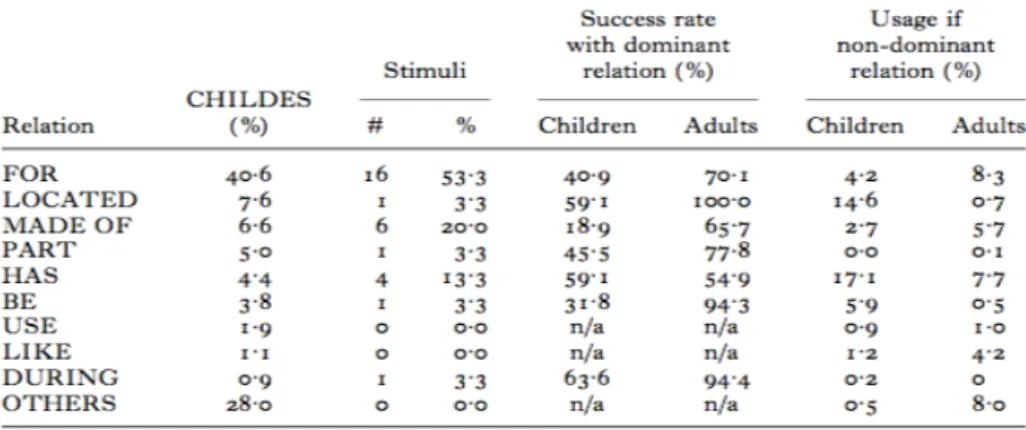
Table 3. Distribution of semantic relations in both adults and children in CHILDES compounds and experimental stimuli (Krott et al. 2009: 14).
Table 3 presents an analysis of the frequency of modifier-head relations
in the spontaneous data taken from CHILDES and the experimental stimuli, as
well as the success rate with the dominant relations, and the usage of
non-dominant relations. As can be seen, most compounds in the experiment are
supposed to be classified as FOR (53,3%), but children do not even classify half
of the compounds as FOR (40,9%). On the contrary, the results evidence that
they have no problems with relations such as HAS, LOCATED or DURING. In
addition, it is significant to observe the column ‘usage of non-dominant relation’
which indicates that, when a compound is classified with a different relation to
the dominant one, children tend to use HAS (17,1%) and LOCATED (14,6%)
rather than any other relation. It is important to note that FOR is one of those
ambiguous categories which is problematic because of polysemy, such as OF
and WITH (§ 2.2.). This, on the contrary, has a marginal effect in adults who
perform well with various types of relations.
Many of these aspects put forward by Krott et al. (2009) will be taken
into account to investigate whether L1 Spanish-L2 English learners show
substantial differences regarding the interpretation of compounds. That is,
whether the preferred options in child L1 data correlate with those in
lower-proficient adult L2 data, given their simplified semantics, as will be shown in
section 5. In addition, it will be especially useful in the design of the
3.2 PREVIOUS WORKS ON L2 BILINGUAL ACQUISITION
English and Spanish NN compounds differ in head directionality,
recursiveness and productivity, as we have discussed above (§ 2.2.). As a
recapitulation, these differences can be illustrated in example 30 below:
(30) a. laserN-modifier gunN-head
b. pistolaN-head laserN-modifier
c. laser gun lamp
d. *lámpara pistola laser
Spanish NN compounds (30b) are left headed and English ones are right headed
(30a). Furthermore, Spanish NN compounds are binary which is why (30d) is
ungrammatical. In contrast, English NN compounds are recursive and can have
more than two nouns embedded as in (30c). Productivity is another important
factor because, as evidenced by Snyder (2001), Romance languages are
[-affixal] and, therefore, NN compounds are not productive, whereas Germanic
are [+affixal] and have productive NN compounds. These cross-linguistic
differences in directionality and productivity between English and Spanish may
lead Spanish native speakers to rely on their L1 properties to create compounds
in English or they may transfer frequent constructions from their L1 into their
L2.
In respect of L2 bilingual acquisition, the difference in the directionality
of compounds is what leads Liceras and Díaz (2000) to initially hypothesize that
the WM suggested by Piera (1995) triggered the acquisition of NN compounds
in L2 Spanish and “that head directionality (adjunction to the left) will be linked
to the presence versus absence of this WM” (Liceras and Díaz 2000: 4). Thus,
NN compounds produced by L2 Spanish learners will be left-headed due to the
presence of inflectional markers, as shown in (33):
(33) a. NIÑOs hormiga
In Spanish, it is only the head that carries number marking (niños in 33a) and gender marking (niño in 33a and niña 33b) while the modifier remains invariant.
In addition, they establish a relation between Snyder’s (1995)
compounding parameter and the subset principle. The latter postulates that
learners will begin with the more conservative subset of grammar and shift to a
larger grammar on the basis of positive evidence. Since English is both
[+affixal] and [-affixal] (that is, productive compounding is available but not
compulsory), it constitutes the superset part of the parameter. However, Spanish
represents the subset option of the parameter being [-affixal] and thus marked.
As a result, they predict that compounding would be difficult for L2 Spanish
learners from an L1 English background as it is the marked option that these
speakers will have to learn and that transfer from the superset to subset grammar
(i.e. from English into Spanish) will lead to differences in head directionality.
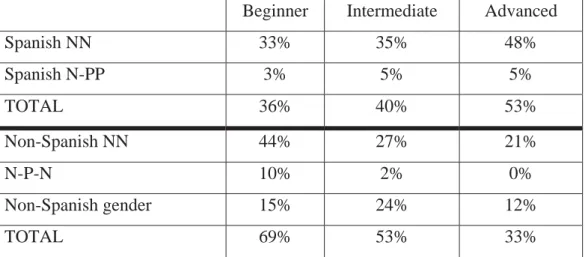
The results Liceras and Díaz (2000) obtained are shown in table 4:
Table 4. Spanish grammatical and ungrammatical responses (Liceras and Díaz 2000: 6-7).
Beginner Intermediate Advanced
Spanish NN 33% 35% 48%
Spanish N-PP 3% 5% 5%
TOTAL 36% 40% 53%
Non-Spanish NN 44% 27% 21%
N-P-N 10% 2% 0%
Non-Spanish gender 15% 24% 12%
TOTAL 69% 53% 33%
The data in table 4 show that the production of Spanish-like NN
compounds increases with proficiency in Spanish. What is more, it can be
observed that the participants tested by Liceras and Díaz (2000) opt for NN
compounds in Spanish because the production of N-PP such as “cara de perro”
has a remarkably lower incidence. Non-Spanish-like choices are displayed in the
compounds (e.g. policía gato instead of gato policía) due to transfer from English directionality, these choices, although they decrease, do not disappear as
the participants’ proficiency in Spanish increases. Furthermore, the N-PP
strategy (namely, “perro de cara”), which is favored by beginners, underlines that directionality is problematic for beginners. In terms of gender, the
percentages of non-Spanish-like gender (e.g. niño hormigo) are relatively notable especially for beginners and intermediates. This can be taken as an
indication of the fact that WMs do not lead to NN compound acquisition.
Therefore, in spite of their initial hypothesis, the results demonstrate that
the presence of a WM does not trigger acquisition at early stages. It is in fact
directionality that leads to the acquisition of NN compounds in Spanish.
Therefore, Liceras and Díaz (2000) propose that the acquisition of compounds is
due to a “processing trigger (head directionality)” rather than to a
“representational trigger (WM)” (2). What is more, the increase in the
production of Spanish compounds correlates with the disappearance of Spanish
prepositional phrases (which are the productive alternative constructions to
compounds in Spanish). As to the subset principle, there is no clear evidence
that Spanish is the marked option as the participants produce a substantial
amount of NN compounds.
Similar to Liceras and Díaz (2000), Slabakova (2002) also linked
Snyder’s compounding parameter with the subset principle. However, it is not
only the subset principle that she takes into account, but also transfer. As she
works with L1 English-L2 Spanish and with L1 French-L2 Spanish, she predicts
that transfer from English ([+affixal]) will lead to a higher acceptance of NN
compounds and complex predicates in Spanish, whereas transfer from French
will show greater accuracy in rejecting them (i.e. French is affixal] and
Graph 2. Rejection of ungrammatical NN compounds by English Speakers and French low-level learners (Slabakova 2002:524).
Graph 2 shows that transfer has a connection with linguistic competence
and proficiency. That is, even though low-proficient L1 English-L2 Spanish
learners have problems judging the ungrammaticality of NN compounds in
Spanish (only 48% of correctness), higher-proficient L1 English-L2 Spanish
speakers perform better (75% for intermediate and 87% for advanced) which
“indicates that delearning these constructions is possible, quite successfully for
N-N compounds […]” (Slabakova 2002: 526). In other words, learners transfer
the grammar of their L1 into the L2, even though advanced learners tend to
avoid this. This is also evident in the case of L1 French speakers who, even if
they have a low level of L2 Spanish, they perform as high as the more proficient
L1 English speakers (87%). In other words, as predicted by Slabakova (2002),
the influence of L1 French (also a [-affixal] language like Spanish) results in a
great accuracy when rejecting ungrammatical constructions in Spanish. In the
end, Slabakova (2002) concludes that transfer plays a very important part in L2
acquisition, but the subset principle “does not seem to be operative in L2
acquisition” (527). Conversely, it seems evident that L1 Spanish-L2 English
speakers will not have problems learning the superset relation found in English
(the [+affixal] language) even if their L1 (i.e. Spanish) does not conform with
that option as it is [-affixal].
Furthermore, she points out an interesting fact: the prospective
significance of negative evidence (e.g. metalinguistic explanations or error
corrections) could be behind the low error rate. This means that explicit
knowledge or discussion in the classroom that NN compounds are unavailable in
32
20
/3
32
+ -+ /+ 1+ 3+ ,++
$"
% #!# &
Spanish, as opposed to English, leads to a higher accuracy in rejecting or
avoiding these constructions in their L2 Spanish.
Following Liceras and Díaz (2000), Fernández Fuertes et al. (2008) focus
on a group of English-Spanish 2L1 bilingual children (taken from CHILDES)
and a group of L1 Spanish early learners of English as an L2. Their aim is to
investigate whether the morpho-syntactic markers of English (i.e. directionality
and agreement) play a role in the early acquisition of English, and, if so, what
this role is. In addition, as Spanish and English select distinct options from the
compounding parameter, they want to prove if the parameter could be redefined
in the L2, which in adults seems not to be possible. Their hypotheses are
concerned with (a) productivity: compounding is unproductive in Spanish so
alternative constructions will be produced; and (b) directionality: L1 bilinguals
are not expected to have problems, whereas early L2 English learners will have
problems when producing or identifying English compounds. Although they
also focus on agreement, only properties (a) and (b) will be reviewed here as
they are the ones linked to the present investigation. Examples for hypotheses
(a) and (b) are displayed in (34) and (35) respectively:
(34) a. stone table NN
b. table of stone N-PP c. *mesa piedra NN d. mesa de piedra N-PP
(35) a. police dog NN
b. *policía perro NN reversed c. perro policía NN
d. *dog police NN reversed
The amount of NN compounds is much higher in English than in Spanish. That
is, though English allows constructions like (34a) and (34b), there is a
preference for NN compounds. Nevertheless, since this is unproductive and in
some cases ungrammatical in Spanish (34c), alternative constructions such as
PPs, as illustrated in (34d), are produced. In addition, directionality in English is
different from Spanish (§ 2.2. and § 3.2.), which is why (35b) is ungrammatical
in Spanish; English has modifier + head order, as in (35a), whereas Spanish has
aware of this difference, while L1 Spanish learning English might not be in the
case of English. That is, L2 learners could transfer Spanish word order into
English and consider (35d) as correct.
Data were elicited via a picture production task which was conducted
both in English and in Spanish. A summary of the data is shown in graphs 3 and
4 below:
Graph 3. NN compound production by L1 bilinguals and L2 English learners (Fernández Fuertes et al. 2008).
Graph 3 offers a classification of the different answers provided by both
participant groups, the L1 bilinguals and the L2 English learners. Bilinguals
produce the same amount of well formed NN compounds in English and in
Spanish, but they also produce a significant percentage of English and
non-Spanish-like compounds: 38% and 39% respectively. In contrast, L2 English
learners display a great amount of NN compounds in Spanish (55%) but not in
English (31%). What is striking of this group, though, is the high number of
English compounds that are not well formed (69%).
1-., .3
14 1,
00
.4 /0
+ ,+ -+ .+ /+ 0+ 1+ 2+ 3+ 4+ ,++
$ -"
*)' #
Graph 4. Reversed NN compounds and alternative construction production by L1 bilinguals and L2 English learners (Fernández Fuertes et al. 2008).
Graph 4 exhibits the most significant ungrammatical constructions (i.e.
reversed compounds) or unexpected constructions (i.e. alternative constructions)
that are used by both groups. In other words, it provides a breakdown of the red
and yellow columns in graph 3: */Unexpected EN NN and */Unexpected SP NN
respectively. Fernández Fuertes et al. (2008) classify unexpected constructions
as either other NN compounds or alternative constructions; thus, directionality
problems are included within the former label. As it can be observed, most of
the unexpected and ungrammatical compounds produced by the groups analyzed
involve directionality problems both in English and Spanish which is
particularly remarkable in the group of bilinguals. That is, 89% of the
unexpected constructions produced are reversed NN compounds in English and
49% are reversed NN compounds in Spanish. The other group (L2 English) has
directionality problems primarily in English (54%). That is, they produce many
compounds but most of them are reversed, and thus ungrammatical. What is also
worth mentioning is the proportion of alternative constructions produced in
Spanish as opposed to English alternative constructions: 37% in bilinguals and
36% in L2 learners. The great majority of these alternative constructions are
PPs.
Overall, the results obtained evidence that both L1 bilinguals and
interestingly L2 English children tend to prefer NN compounds in English, and
in Spanish alternative constructions are produced with a higher frequency
(especially PPs). That is, “the production of L2 children favors the most
common structure in each language” (Fernández Fuertes et al. 2008: 15. my
translation). However, as evidenced also by Liceras and Díaz (2000),
directionality is problematic. In this case, both groups have difficulties:
bilinguals have problems in both languages, and L1 Spanish children mainly in
their L2. In case of Spanish, this can be due to a lack of productivity and, thus,
the exposure to a reduced input in the case of these constructions.
Although the participants in the present study differ from the ones in
these previous works in that it is addressed to L1 Spanish adults learning L2
English, these results are essential to note the elements to be considered when
hypothesizing and discussing the results obtained. That is, they highlight the
controversial issues that the present study focuses on: directionality,
productivity, transfer, and interpretation. The research questions are presented in
the following section with a focus on these cardinal issues.
4. PREDICTIONS AND RESEARCH QUESTION
The objective of the present study is to characterize the production and
interpretation of NN compounds in the case of L2 English learners whose L1 is
Spanish. In order to do so, experimental data have been elicited with a view to
discussing the following predictions and answer the corresponding research
questions. These have been divided into three parts in the light of the previous
works described above (§ 2 and § 3): directionality and transfer, productivity
and transfer, and semantic interpretation. The three formulations below are
articulated in terms of two different proficiency levels: intermediate and
advanced, B2 and C2 respectively according to the Common European
Framework of Reference for Languages (CEFR).
1. Directionality and transfer. As English and Spanish compounds differ in terms of headness (i.e. English is right-headed while Spanish is left-headed),
difficulties in production or judgment of English NN compounds could be