PERMANYER www.permanyer.com
Rev Inves Clin. 2016;68:147-53 ORIGINAL ARTICLE
Clinical Characteristics and Mortality
of Influenza A H1N1 and Influenza-Like
Illness in Mexico City in the 2013-2014
Winter Season
David Martínez-Briseño, Luis Torre-Bouscoulet, Julio de Jesús Herrera-Zamora, Julián Díaz-Rico,
Gabriel Sandoval-Macías, Rogelio Pérez-Padilla, Carmen Hernández-Cárdenas,
Justino Regalado-Pineda, Jorge Salas-Hernández and Patricio Santillán-Doherty*
Instituto Nacional de Enfermedades Respiratorias (INER), Mexico City, Mexico
Corresponding author:
*Patricio Santillán-Doherty
Instituto Nacional de Enfermedades Respiratorias (INER) Calzada de Tlalpan, 4502
Col. Sección XVI, Del. Tlalpan
C.P. 14080, Ciudad de México, México
E-mail: [email protected] Received for publication: 27-01-2016 Accepted for publication: 26-02-2016
ABSTRACT
Background: The 2013-2014 influenza season in Mexico City was severe and mainly due to influenza A H1N1, as was the
2009 pandemic. Objective: To describe features of the outbreak and to compare the characteristics of patients with and without
viral identification. Methods: We reviewed the medical charts of all individuals with influenza or influenza-like illness admitted
to a referral hospital for respiratory diseases in Mexico City from January 2013 to March 2014, whether influenza virus was identified or not. Results: We included 233 patients with influenza-like illness, 99 of whom had laboratory confirmed influenza;
one-half of all patients required mechanical ventilation and 25% were admitted to the intensive care unit. Patients with confirmed influenza had a more severe disease than those without confirmation. A total of 52 (22.3%) patients died in hospital; survival was greater among patients hospitalized in the intensive care unit compared with those who remained in regular wards. Conclusions:
Influenza A H1N1 continues to cause significant outbreaks in Mexico City. Patients with influenza-like illness had a similar clinical course regardless of laboratory confirmation of influenza, suggesting that their illness likely belonged to the same outbreak. Mechanical ventilation in regular hospital wards may be lifesaving, although the outcome is worse than at an intensive care unit. (REV INVES CLIN. 2016;68:147-53)
Key words: Influenza. Mechanical ventilation. Intensive care unit. Mortality.
INTRODUCTION
In March 2009, the novel influenza A (H1N1) was first reported in the southwestern USA and in Mexico, becoming the first pandemic of the 21st century. The population and healthcare system in Mexico City
experienced the first and greatest early burden of the critical illness1. The 2009 influenza A H1N1 pandem-ic caused the deaths of 18,449 individuals with labora-tory confirmed infection worldwide2. However, recent data increase the estimates to 200,000, including persons who died from influenza-like illness (ILI) or Sin contar con el consentimiento previo por escrito del editor
, no podrá reproducirse ni fotocopiarse ninguna parte de esta publicación.
from diverse complications and who had no viral test-ing in countries or regions without access to the stan-dard influenza virus real-time polymerase chain reac-tion (RT-PCR)3. In December 2013 we identified a rapidly growing number of persons with ILI, including severe cases, many of whom had laboratory confirmed influenza A H1N1. In 2011 Mexico experienced an-other winter outbreak of influenza A H1N14. This re-port describes the clinical characteristics of patients hospitalized in our center from December 1, 2013 to February 28, 2014 with ILI as well as confirmed cases of influenza A H1N1 virus infection. In addition, we explored potential cofactors involved with mortality.
MATERIAL AND METHODS
Design and population study
We carried out a cross-sectional study collecting, in a standardized questionnaire, information from the clinical records of patients who were admitted from January 1, 2013 to March 3, 2014 to the National Institute of Respiratory Diseases of Mexico (INER). We included patients 18 years of age or older with confirmed influenza A H1N1 or ILI. Influenza-like ill-ness was defined according to the World Health Or-ganization (WHO) as sudden-onset fever (> 38°C) with cough or sore throat, in the absence of other diagnoses. A case of confirmed influenza A H1N1 is usually defined as the presence of ILI plus a positive RT-PCR or viral culture5, but for the present work, influenza confirmation was obtained by RT-PCR. So-ciodemographic variables comprised age, gender, and place of residence. We measured weight and height and estimated the body mass index (BMI) of patients. As clinical variables, we included respiratory signs and symptoms as well as smoking status, days of hospi-talization, the presence and duration of mechanical ven-tilation, admission to the intensive care unit (ICU), vac-cine against influenza, and in-hospital death. Laboratory measurements included hemoglobin (g/dl), platelet count (× 103/μl), leukocytes (× 103/μl), lymphocytes (× 103/μl), creatinine (mg/dl), blood urea nitrogen (BUN, mg/dl), albumin (g/dl), bilirubin (mg/dl), creatine phosphokinase (CPK, U/ml), and lactate dehydroge-nase (LDH, U/l).
We recorded the presence of comorbidities for each pa-tient as the following dichotomous variables (yes/no):
overweight/obesity; systemic arterial hypertension; asthma; type 2 diabetes mellitus (DM2); heart dis-ease (most common was chronic heart failure [CHF]); chronic obstructive pulmonary disease (COPD); inter-stitial lung disease (ILD); human immunodeficiency virus infection and acquired immune deficiency syn-drome (HIV/AIDS), and pulmonary tuberculosis (TB). Data on the number of medical emergency consulta-tions, hospital admissions, and patients on mechanical ventilation due to ILI were obtained from the Depart-ment of Epidemiological Surveillance of the INER.
Statistical analysis
We compared all the variables, stratifying by condition of influenza (ILI vs. laboratory confirmed influenza A H1N1) and death to identify risk factors. Continuous variables were compared using Student’s t test and categorical variables, with Pearson’s chi-square test. Risk of in-hospital death was estimated by fitting lo-gistic regression models and survival function, employ-ing Kaplan-Meier models and Cox proportional hazard models as function of influenza confirmation, mechan-ical ventilation, place of care, presence of exposure, and comorbidities. A p value of < 0.05 was considered as statistically significant for all tests. Analysis was conducted using STATA v.12 statistical software (Sta-ta Corp., College S(Sta-tation, TX, USA).
RESULTS
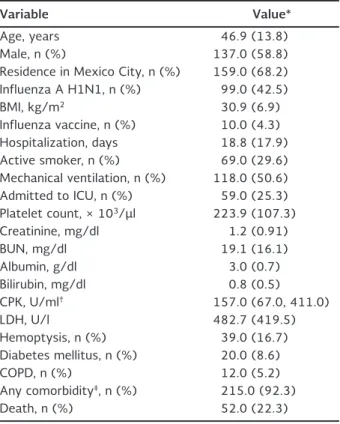
A total of 233 patients were included; mean age was 46.9 years (standard deviation [SD]: 13.8 years), and 137 (58.8%) were male. Patients were hospitalized for 19 days on average (SD: 18 days). Influenza was con-firmed in 99 patients (42.5%), whereas 134 (57.5%) had ILI with negative RT-PCR tests, missing tests, or insufficient samples. Most of the patients (68.2%) resided in Mexico City, while the rest came from an-other state. Less than 5% of the included patients were vaccinated for the season when the illness oc-curred. A comorbid condition was identified in 92.3% of all patients. One-half of the patients (50.6%) re-ceived mechanical ventilation and 25.3% were admit-ted to the ICU. Sixty-one patients had worsening re-spiratory failure and required mechanical ventilation while in a general hospital ward since there were no beds available in the ICU. Fifty-two patients (22.3%) died in hospital (Table 1).
Sin contar con el consentimiento previo por escrito del editor
, no podrá reproducirse ni fotocopiarse ninguna parte de esta publicación.
The clinical characteristics and laboratory results of the patients on hospital admission stratified by the condition of influenza are presented in table 2. No dif-ference was found between the two groups in the pro-portion of patients who lived in Mexico City. Individu-als with confirmed influenza had more severe disease compared with those with ILI. Patients with confirmed influenza required more mechanical ventilation and ICU admission and had higher levels of LDH and CPK, but the difference in mortality, although higher in con-firmed cases, was not statistically significant. Concon-firmed cases also had a higher BMI than those with ILI.
Patients who died were often older (p < 0.01), male (p < 0.05), on mechanical ventilation (p < 0.01), and had hemoptysis (p < 0.01) or diabetes mellitus (p < 0.05). In addition, deceased patients had more abnormali-ties in several laboratory tests: higher than normal BUN,
bilirubin, CPK and LDH, or lower albumin. The BMI was not different between groups (Table 3).
Of 118 patients who received mechanical ventilation, 61 (51.7%) were cared for outside the ICU (regular hospital wards, emergency room), and 57 (48.3%) at the ICU. Of the 61 patients treated outside the ICU, 35 (57.4%) died, compared with 14 of 57 (24.6%) admitted to the ICU (p < 0.01) (Table 4).
Results of logistic regression suggest no differences between patients with confirmed influenza or ILI in most measurements, except for a lower platelet count in individuals with confirmed influenza (odds ratio [OR]: 0.99; p < 0.01) (Table 5).
A Cox proportional hazard model confirmed that ICU admission reduced the risk for death (hazard ratio [HR]: 0.27; p < 0.01), while hemoptysis (HR: 2.24; p < 0.01), mechanical ventilation (HR: 6.23; p < 0.05), age (HR: 1.04; p < 0.05), and being male (HR: 4.72; p < 0.01) were associated with death. No statistical difference in mortality was found between patients with con-firmed influenza and those with ILI (HR: 0.99; p = 0.99) (Table 6).
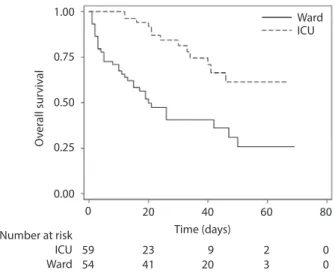
Figure 1 depicts Kaplan-Meier survival curves for patients who were ventilated, stratifying by place of care (ICU vs. ward). Survival was higher among patients admitted to the ICU than among those treated in wards (p < 0.01). Mean 95% confidence interval [95% CI] of survivor days were 89.8 days (range, 75.0-104.5 days) for patients in the ICU and 33.4 days (range, 25.0-41.8 days) for those cared for in wards. Data were confirmed in multivariate Cox proportional hazard models (HR: 0.27; p < 0.01) (Table 6), also demonstrating an increased risk of death in patients receiving mechanical ventilation (HR: 6.23; p < 0.05). Figure 2 illustrates the survival functions obtained from the model in table 6 for patient care at ICU and in wards. The functions were evaluated using the average values reported in table 1 for continuous variables and considering a male patient with hemop-tysis, diabetes mellitus, and mechanical ventilation. The figure presents higher survival for patients admit-ted to the ICU compared with those cared for in reg-ular wards under similar conditions. Figure 3 describes the number of medical consultations, hospital admis-sions, and patients on mechanical ventilation in the 2013-2014 winter season compared to previous out-breaks since the 2009 H1N1 pandemic.
Table 1. Sociodemographic and clinical characteristics of the entire group (n = 233)
Variable Value*
Age, years 46.9 (13.8)
Male, n (%) 137.0 (58.8)
Residence in Mexico City, n (%) 159.0 (68.2) Influenza A H1N1, n (%) 99.0 (42.5)
BMI, kg/m2 30.9 (6.9)
Influenza vaccine, n (%) 10.0 (4.3) Hospitalization, days 18.8 (17.9) Active smoker, n (%) 69.0 (29.6) Mechanical ventilation, n (%) 118.0 (50.6) Admitted to ICU, n (%) 59.0 (25.3) Platelet count, × 103/μl 223.9 (107.3)
Creatinine, mg/dl 1.2 (0.91)
BUN, mg/dl 19.1 (16.1)
Albumin, g/dl 3.0 (0.7)
Bilirubin, mg/dl 0.8 (0.5)
CPK, U/ml† 157.0 (67.0, 411.0)
LDH, U/l 482.7 (419.5)
Hemoptysis, n (%) 39.0 (16.7)
Diabetes mellitus, n (%) 20.0 (8.6)
COPD, n (%) 12.0 (5.2)
Any comorbidity‡, n (%) 215.0 (92.3)
Death, n (%) 52.0 (22.3)
*Mean and standard deviation (SD) or number and percentage when indicated; †Represent median, 25th and 75th percentile. ‡Obesity, hypertension, asthma, heart disease (most common,
chronic heart failure), interstitial lung disease, human immunodeficiency virus/acquired immune deficiency syndrome (HIV/AIDS), tuberculosis. BMI: body mass index; ICU: intensive care unit; BUN: blood urea nitrogen; CPK: creatinine phosphokinase; LDH: lactic
dehydrogenase; COPD: chronic obstructive pulmonary disease.
Sin contar con el consentimiento previo por escrito del editor
, no podrá reproducirse ni fotocopiarse ninguna parte de esta publicación.
Table 2. Sociodemographic and clinical characteristics by influenza condition
Variable* ILI
n = 134 Influenza A H1N1n = 99 P value
Age, years 46.9 (14.5) 46.9 (12.8) 0.994
Male, n (%) 74.0 (55.2) 63.0 (63.6) 0.197
Residence in Mexico City, n (%) 98.0 (73.1) 61.0 (61.6) 0.062
BMI, kg/m2 29.6 (6.6) 32.5 (6.9) < 0.01
Hospitalization, days 16.8 (15.4) 21.4 (20.7) 0.062
Active smoker, n (%) 40.0 (29.9) 29.0 (29.3) 0.475
Mechanical ventilation, n (%) 60.0 (44.8) 58.0 (58.7) < 0.05
Admitted to ICU, n (%) 27.0 (20.2) 32.0 (32.3) < 0.05
Platelet count, × 103/μl 241.4 (115.6) 200.1 (89.9) < 0.01
Creatinine, mg/dl 1.1 (1.0) 1.2 (0.8) 0.177
BUN, mg/dl 17.7 (16.6) 21.1 (15.1) 0.114
Albumin, g/dl 3.9 (0.7) 2.9 (0.6) 0.076
Bilirubin, mg/dl 0.7 (0.5) 0.8 (0.6) 0.827
CPK, U/ml† 122.0 (58, 361) 195.0 (99, 575) < 0.01
LDH, U/l 396.3 (312.5) 599.6 (510.1) < 0.01
Hemoptysis, n (%) 22.0 (16.4) 17.0 (17.2) 0.879
Diabetes mellitus, n (%) 12.0 (8.9) 8.0 (8.1) 0.814
COPD, n (%) 6.0 (4.5) 6.0 (6.1) 0.589
Any comorbidity, n (%) 123.0 (91.8) 92.0 (92.9) 0.748
Death, n (%) 27.0 (20.2) 25.0 (25.3) 0.355
*Data are mean and standard deviation (SD) or number and percentage when indicated; †Represent median, 25th and 75th percentile; medians
compared by Wilcoxon rank-sum test.
ILI: influenza-like illness; BMI: body mass index; ICU: intensive care unit; BUN: blood urea nitrogen; CPK: creatine phosphokinase; LDH: lactate dehydrogenase; COPD: chronic obstructive pulmonary disease.
Table 3. Sociodemographic and clinical characteristics by mortality
Variable* Surviving patients
n = 181 Deceased patientsn = 52 P value
Age, years 44.9 (13.6) 53.7(12.4) < 0.01
Male, n (%) 99.0 (54.7) 38.0 (73.1) 0.018
Residence in Mexico City, n (%) 128.0 (70.7) 31.0 (59.6) 0.130
BMI, kg/m2 30.7 (7.2) 31.3 (5.5) 0.570
Hospitalization, days 18.5 (16.8) 19.6 (21.7) 0.756
Active smoker, n (%) 58.0 (32.0) 11.0 (21.2) 0.450
Influenza A H1N1, n (%) 74.0 (40.9) 25.0 (48.1) 0.355
Mechanical ventilation, n (%) 69.0 (38.1) 9.0 (94.2) < 0.01
Admitted to ICU, n (%) 45.0 (24.9) 14.0 (26.9) 0.763
Platelet count, × 103/μl 235.1 (109.1) 184.4 (91.1) 0.136
Creatinine, mg/dl 1.1 (0.9) 1.5 (1.0) 0.140
BUN, mg/dl 15.9 (12.2) 30.6 (22.1) < 0.01
Albumin, g/dl 3.1 (0.7) 2.6 (0.5) < 0.01
Bilirubin, mg/dl 0.7 (0.4) 0.9 (0.7) < 0.01
CPK, U/ml † 130.0 (63, 341) 251.0 (102, 662) 0.011
LDH, U/l 386.5 (281.1) 821.1 (613.0) < 0.01
Hemoptysis, n (%) 21.0 (11.6) 18.0 (34.6) < 0.01
Diabetes mellitus, n (%) 11.0 (6.1) 9.0 (17.3) 0.011
COPD, n (%) 10.0 (5.5) 2.0 (3.9) 0.629
Any comorbidity, n (%) 165.0 (91.2) 50.0 (96.2) 0.235
*Data are mean and standard deviation (SD) or number and percentage when indicated; †Represent median, 25th and 75th percentile; medians
compared by Wilcoxon rank-sum test.
BMI: body mass index; ICU: intensive care unit; BUN: blood urea nitrogen; CPK: creatine phosphokinase; LDH: lactate dehydrogenase; COPD: chronic obstructive pulmonary disease.
Sin contar con el consentimiento previo por escrito del editor
, no podrá reproducirse ni fotocopiarse ninguna parte de esta publicación.
Table 4. Sociodemographic and clinical characteristics by place of care
Variable* Hospital ward
n = 174 n = 59ICU P value
Age, years 47.54 (14.1) 44.9 (12.7) 0.204
Male, n (%) 99.0 (56.9) 38.0 (64.4) 0.311
Residence in Mexico City, n (%) 115.0 (66.1) 44.0 (74.5) 0.226
BMI, kg/m2 30.7 (6.9) 31.3 (6.8) 0.599
Inpatient days 13.2 (12.7) 34.9 (21.2) < 0.01
Active smoker, n (%) 45.0 (25.9) 24.0 (40.7) < 0.01
Influenza A H1N1, n (%) 67.0 (38.5) 32.0 (54.2) < 0.05
Mechanical ventilation, n (%) 61.0 (35.1) 57.0 (96.6) < 0.01
Platelet count, × 103/μl 223.80 (104.9) 224.4 (114.9) 0.970
Creatinine, mg/dl 1.1 (0.8) 1.3 (1.1) 0.212
BUN, mg/dl 17.8 (15.1) 23.1 (18.3) < 0.05
Albumin, g/dl 3.2 (0.7) 2.6 (0.5) < 0.01
Bilirubin, mg/dl 0.8 (0.6) 0.7 (0.3) 0.051
CPK, U/ml† 122.0 (64, 305) 328.0 (130, 753) < 0.01
LDH, U/l 425.2 (420.0) 649.1 (374.2) < 0.01
Hemoptysis, n (%) 28.0 (16.1) 11.0 (18.6) 0.650
Diabetes mellitus, n (%) 15.0 (8.6) 5.0 (8.5) 0.972
COPD, n (%) 12.0 (6.9) 0 (0) < 0.05
Any comorbidity, n (%) 164.0 (94.3) 51.0 (86.4) 0.052
Death, n (%) 38.0 (21.8) 14.0 (23.7) 0.763
*Data are mean and standard deviation (SD) or number and percentage when indicated. †Represent median and percentile 25th and 75th;
medians compared with the Wilcoxon rank-sum test.
BMI: body mass index; BUN: blood urea nitrogen; CPK: creatinine phosphokinase; LDH: lactic dehydrogenase; COPD: chronic obstructive pulmonary disease.
Table 5. Logistic models for influenza A H1N1 (vs. influenza-like illness without viral confirmation)*
Variables OR (95% CI) P value
Death 0.84 (0.34-2.03) 0.69
Age, years 0.99 (0.97-1.01) 0.28
Masculine gender 1.42 (0.80-2.54) 0.23
BMI, kg/m2 1.01 (0.98-1.04) 0.46
Inpatient days 1.01 (0.99-0.03) 0.51
Platelet count, × 103/μl 0.99 (0.994-0.999) < 0.01
CPK, U/ml 1 (1.00-1.001) 0.58
LDH, U/l 1 (1.00-1.00) 0.10
Mechanical ventilation 0.76 (0.32-1.79) 0.53 Cared for at ICU 1.36 (0.57-3.25) 0.48
Observations 217*
*Models use patients with complete information in all variables. In this case, 93% (217/233) of patients had complete information in all the variables included in model.
OR: odds ratio; 95% CI: 95% confidence interval; BMI: body mass index; CPK: creatinine phosphokinase; LDH: lactic dehydrogenase; ICU: intensive care unit.
Table 6. Cox proportional hazard models of factors associ-ated with death for all patients*
Variables HR (95% CI) P value
Cared for at ICU 0.27 (0.21-0.59) < 0.01
Hemoptysis 2.24 (1.08-4.64) < 0.05
Mechanical ventilation 6.23 (1.39-27.87) < 0.05
Influenza A H1N1 0.99 (0.50-1.08) 0.99
Age, years 1.04 (1.00-1.08) < 0.05
Masculine gender 4.72 (1.73-12.87) < 0.01
BMI, kg/m2 1.04 (0.97-1.11) 0.231
Observations 210†
*Model included lactic dehydrogenase, bilirubin levels, albumin, blood urea nitrogen, creatinine phosphokinase, platelet count, and diabetes mellitus, but no significant association was observed.
†Models (n = 210/233 or 90%) include patients with complete
information in all variables.
HR: hazard ratio; 95% CI: 95% confidence interval; ICU: intensive care unit; BMI: body mass index.
Sin contar con el consentimiento previo por escrito del editor
, no podrá reproducirse ni fotocopiarse ninguna parte de esta publicación.
1.00
0 20 40 60 80
59 23 9 2 0
54 41 20 3 0
0.75
0.50
0.25
0.00
O
ver
all sur
viv
al
Time (days) Number at risk
ICU Ward
Ward ICU Figure 1. Crude survival function for ventilated patients strat-ifying by place of care.
1
.8
.6
.4
.2
0
O
ver
all sur
viv
al
0 20 40 60 80
Time (days)
Ward ICU Figure 2. Adjusted survival function for all patients stratify-ing by place of care.
*Survival curves were estimated using coefficients from table 5, and mean values are reported in table 1 for continuous variables and considering a male patient with hemoptysis, diabetes mellitus, and mechanical ventilation
200
2009 2010 2011 2012 2013-2014 150
100
50
0
Number/da
y
0 500 1000 1500 2000
Days
Figure 3. Historical number of emergency room consulta-tions (upper graph), hospital admissions (middle continuous line), and patients on mechanical ventilation (lower line) with influenza-like illness from INER as a function of time from April 23, 2009, during the influenza pandemic when surveil-lance started.
We observed an annual outbreak of influenza-like illness, although years with severe cases alternated with milder years. The incidence in the 2013-2014 season was as high as that in the second pandemic peak.
DISCUSSION
The influenza outbreak in Mexico City in the winter of 2013-2014 was predominantly due to influenza A H1N1, as it was in 2009 and 2011, and tended to be more severe than the outbreaks of 2012 and 2010, when influenza virus subtype H3N2 variants predomi-nated. During 2013 we observed a severe outbreak with a significant number of individuals requiring hospi-talization (with a maximum of 90 out of 180 hospital
beds available) and mechanical ventilation (maximum of 45 patients simultaneously), and with a number of hospital deaths similar to what we had seen during the 2009 pandemic (Fig. 3). Nearly all hospitalized individuals (96%) lacked the seasonal influenza vac-cine; unfortunately, vaccination rates in Mexico are low, even in individuals with special risk factors for influenza complications. Again, individuals with ILI, similar to patients with confirmed influenza in most of the features studied although with a slightly mild-er disease, comprised about 50% of patients cared for6. A negative RT-PCR may have been due to sev-eral factors, such as delay in sampling (although with lung damage already in course), an inadequate sample, or upper airway sampling instead of samples obtained from lung secretions. In general, during an influenza outbreak, individuals with ILI should be considered as having influenza and be treated without delay with oseltamivir (Tamiflu®) or equivalent drugs accordingly, as we did in our hospital. This is important since esti-mates of influenza severity are often lower because counts are based mostly on confirmed cases. Recently, however, official reports from the Ministry of Health in Mexico included several indicators based on the clinical definition of cases without requiring viral con-firmation.
Sin contar con el consentimiento previo por escrito del editor
, no podrá reproducirse ni fotocopiarse ninguna parte de esta publicación.
Hemoptysis has only been described as a predictor of hospitalization or care at the ICU7,8; however, in our patients its presence increased the risk of death, even though we had a lower prevalence (16%) than in other studies (30%)7.
Nearly all patients were obese and had a high number of comorbidities, both risk factors for hospitalization and death from influenza7-9. The latter suggest that patients with chronic diseases were particularly vul-nerable in this outbreak. Patients with the described characteristics should be immunized. By focusing on populations with chronic diseases, we may be able to prevent cases, hospitalization, and mortality from in-fluenza.
Patients admitted to the ICU had a better outcome compared with those cared for in regular hospital wards, even after adjusting for mechanical ventilation and dis-ease severity. In our hospital, during severe outbreaks, mechanical ventilation in patients with respiratory fail-ure is initiated in regular wards when the ICU is satu-rated, which is life-saving in the short term but, as seen in this outbreak, prognosis may be worse for those not admitted to the ICU. This was likely due to a shortage of trained personnel for the surveillance of critical pa-tients 24 hours a day and during weekends, as impor-tant as the lack of sufficient mechanical ventilators outside the ICU. In reference hospitals for respiratory diseases, an increase in requirements for ICU beds is observed during the influenza season, and having ad-ditional personnel trained in ICU is very important for improving care in the regular wards or for increasing the permanent ICU facilities.
Influenza remains a significant health risk and is pre-ventable; however, immunization must cover a higher proportion of the population and the vaccine should be administered prior to the winter season. Influenza H1N1 has become a seasonal strain and continues to cause severe outbreaks, possibly because small variants of the virus may still be present in several outbreaks, such as those reported10, alternating in Mexico in winter
with a predominance of H3N2, the variant causing more severe outbreaks in the USA.
Our study has limitations derived from the information available in clinical charts obtained during an impor-tant influenza outbreak in a referral hospital for respi-ratory diseases. Outcomes were worse than in popula-tion or regional hospitals outbreaks, representing the most severe portion of cases. However, this does not imply that case mortality was similar to that in gen-eral hospitals or even less in outpatients.
In conclusion, Mexico continues to experience winter outbreaks with influenza A H1N1, likely due to incom-plete vaccine coverage and small viral variants. During these outbreaks, the requirement for ICU beds and appropriate personnel increases. An alternative would be to open, for influenza, fully equipped and staffed ICU beds in other hospitals.
REFERENCES
1. Gallaher WR. Towards a sane and rational approach to manage-ment of Influenza H1N1 2009. Virol J. 2009;6:51.
2. WHO Pandemic (H1N1) 2009 - Update 112: World Health Or-ganization; 2015. Available at: http://www.who.int/csr/don/ 2010_08_06/en/ [Accessed 21-06-2015].
3. WHO Influenza: World Health Organization; 2004. Available at: http://www.who.int/mediacentre/factsheets/2003/fs211/en/ [Accessed 25-08-2015].
4. DGE. Distribución casos nuevos de enfermedad por fuente de notificación Estados Unidos Mexicanos 2011: Dirección General de Epidemiología DGE; 2015. Available at: http://www.epide-miologia.salud.gob.mx/anuario/2011/morbilidad/enfermedad/ distribucion_casos_nuevos_enfermedad_fuente_notificacion.pdf [Accessed 21/10/2015].
5. Hirve S, Chadha M, Lele P, et al. Performance of case defi nitions used for influenza surveillance among hospitalized patients in a rural area of India. Bull World Health Organ. 2012;90:804-12. 6. Pérez-Padilla R, de la Rosa-Zamboni D, Ponce de León S, et al.
Pneumonia and respiratory failure from swine-origin influenza A (H1N1) in Mexico. New Engl J Med. 2009;361:680-9. 7. Lenzi L, Mello AM, Silva LR, Grochocki MH, Pontarolo R.
Pan-demic influenza A (H1N1) 2009: risk factors for hospitalization. J Bras Pneumol. 2012;38:57-65.
8. Tabarsi P, Moradi A, Marjani M, et al. Factors associated with death or intensive care unit admission due to pandemic 2009 influenza A (H1N1) infection. Ann Thorac Med. 2011;6:91-5. 9. Ribeiro AF, Pellini ACG, Kitagawa BY, et al. Risk factors for death
from influenza A(H1N1)pdm09, State of São Paulo, Brazil, 2009. PLoS One. 2015;10:e0118772.
10. Vázquez-Pérez JA, Isa P, Kobasa D, et al. A (H1N1) pdm09 HA D222 variants associated with severity and mortality in patients during a second wave in Mexico. Virol J. 2013;10:41. Sin contar con el consentimiento previo por escrito del editor
, no podrá reproducirse ni fotocopiarse ninguna parte de esta publicación.