doi: 10.17711/SM.0185-3325.2018.015
Associaton between violence and drug consumption with
suicide in lesbians, gays, bisexuals, transvestites,
and transsexuals: cross-sectional study
Grayce AlencarAlbuquerque,1Francisco Winterdos Santos Figueiredo,2Laércioda Silva Paiva,2Márcio Flávio
Moura de Araújo,3Erikada Silva Maciel,4FernandoAdami2
ABSTRACT
Introduction. Lesbian, gay, bisexual, transvestite, and transgender (LGBT) people are affected by prejudice and psychological, physical, and/or sexual violence due to their sexual orientation. Objective. To analyze the association between violence, drug use, and suicide in LGBT people. Method. We interviewed 316 LGBT people from two cities of the Brazilian Northeast by means of a structured instrument. This included questions about sociodemographic data, sexual orientation, type of violence, type and quantity of drugs consumed, and suicide. Results. There was a positive association between physical violence and anabolic consumption (p = .001) and tranquilizers (p = .012). In relation to psychological and verbal violence, there was a positive asso-ciation with the use of tranquilizers (p = .021) and negative with the use of amphetamines (p = .027). Suicide attempts were associated with having experienced physical (p = .03) and sexual (p = .037) violence. Drug use, especially ecstasy, cocaine, marijuana, and tranquilizers, was also associated with suicide attempts (p = .002, p = .031, p < .001, p < .001, respectively). The participants who had already attempted suicide were more vulnerable to experience violence and consume drugs within 30 days prior to the interview (p < .001). Discussion and conclusion. Psychological/verbal violence showed to be associated with the use of am-phetamines, while physical violence was associated with a higher consumption of tranquilizers and anabolic steroids. Suicide attempts were more common among participants who had suffered physical violence and who were users of substances such as ecstasy, cocaine, marijuana, and tranquilizers.
Keywords: Homosexuality, bisexuality, violence, psychotropic medications.
RESUMEN
Introducción. Las personas lesbianas, gays, bisexuales, travestis y transexuales (LGBT) se ven afectadas por juicios y violencia psicológica, física y/o sexual debido a su orientación sexual. Objetivo. Analizar la asociación entre violencia, uso de drogas y suicidio en personas LGBT. Método. Entrevistamos a 316 per-sonas LGBT de dos ciudades del Noreste brasileño por medio de un instrumento estructurado. Esto incluyó preguntas sobre datos sociodemográficos, orientación sexual, tipo de violencia, tipo y cantidad de drogas consumidas y suicidio. Resultados. Se encontró una asociación positiva entre la violencia física y el consumo de anabólicos (p = .001) y tranquilizantes (p = .012). En relación con la violencia psicológica y verbal, hubo una asociación positiva con el uso de tranquilizantes (p = .021) y negativa con el uso de anfetaminas (p = .027). Los intentos de suicidio se asociaron con la violencia física (p = .03) y sexual (p = .037). El consumo de drogas, especialmente éxtasis, cocaína, marihuana y tranquilizantes, se asoció también con intentos de suicidio (p = .002, p = .031, p < .001, p < .001, respectivamente). Los participantes que ya habían intentado suicidarse eran más vulnerables a experimentar violencia y consumir drogas dentro de los 30 días previos a la entrevista (p < .001). Discusión y conclusión. La violencia psicológica/verbal se asoció con el uso de anfetaminas, mientras que la violencia física se asoció con un mayor consumo de tranquilizantes y esteroides anabólicos. Los intentos de suicidio fueron más comunes entre los participantes que habían sufrido violencia física y que consumían sustancias como el éxtasis, la cocaína, la marihuana y los tranquilizantes.
Palabras clave: Homosexualidad, bisexualidad, violencia, medicamentos psicotrópicos.
1 Universidade Regional e Cariri, Ceará, Brasil.
2 Faculdade de Medicina do ABC, Santo André, Brasil.
3 Universidade da Intergração Interna-cional da Lusofonia Afro-Brasileira, Redenção, Brasil.
4 Centro Universitario Lutherano de Palmas, Palmas, Brasil.
Correspondence:
Márcio Flávio Moura de Araújo Instituto de Ciéncias da Saúde, Uni-versidade da Integração Internacional da Lusofonia Afro-Brasileira. Rodovia CE 060 – Km 51, Zip Code: 62785-00, Acarape, CE, Brasil. Phone: + 55 (85) 3332 1414 Email: [email protected] Received: 30 October 2017 Accepted: 4 Mayo 2018 Citation:
Albuquerque, G. A., dos Santos Figueiredo, F. W., da Silva Paiva, L., Moura de Araújo, M. F., da Sil-va Maciel, E., Adami, F. Associaton between violence and drug con-sumption with suicide in lesbians, gays, bisexuals, transvestites, and transsexuals: cross-sectional study.
Salud Mental, 41(3), 131-138. doi:
INTRODUCTION
Violence is a complex global public health problem because it harms the human rights and mental health of its victims (Silva, Coelho, & Pires, 2014; Souza, Malvasi, Signorel-li, & Pereira, 2015; Hatzenbuehler, Mphil, McLaughlin, & Hasin, 2010). Lesbian, gay, bisexual, transvestite, and transgender (LGBT) people are affected by prejudice and psychological, physical, and/or sexual violence due to their sexual orientation (non-heterosexual) (Souza et al., 2015; Pellulo, Giuseppe, & Angelillo, 2013).
Estimates suggest that since 1990 approximately one third of the LBGT population has experienced some form of interpersonal violence (Pellulo et al., 2013; Fassinger, 1991;
Barrientos-Delgado, Cárdenas-Castro, & Gómez-Ojeda,
2014). In Brazil, for example, an increase of more than 180% in homophobic violence has been observed in the last few years, with an average of 13.29 victims per day (Ministério da Saúde, 2011; 2012).
Some authors agree that experiences of prejudice and violence encourage the early and abusive use of licit and illicit drugs among LGBT people. The continuous use of these substances predisposes them to develop mental dis-orders such as anxiety and depression, and even lead them to attempt suicide (McCabe, Bostwick, Hughes, West, & Boyd, 2010; Traube, Holloway, Schrager, & Kipke, 2012).
Meta-analysis of 25 population-based studies revealed that the lifetime prevalence of suicide attempts among gay and bisexual men is four times higher compared to hetero-sexual men. In lesbian and bihetero-sexual women, the values are twice that in all women (King et al., 2008). In a review study, the analysis of 16 studies showed that the prevalence of suicide attempts in LGBT people was between 20% - 53% (McDaniel, Purcell, & D’Augelli, 2001).
In this context, there is evidence that Latino and Asian LGBT individuals are at an increased risk for suicidal behav-ior because of the stigma associated with non-heterosexual behavior in Latin cultures, in which collectivism and family honor predominate (Meyer, Dietrich, & Schwartz, 2008).
The relationship between violence suffered, drug use, and suicide in LGBT individuals is not clear, as the concom-itant association of these variables has not been analyzed in previous publications. In the LBGT population, studies have only observed the relationships between drug use and sexual violence, discrimination and prejudice, and between child sexual abuse and family violence (de Santis, Gonza-lez-Guarda, Provencio-Vasquez, & Deleon, 2014; Buller, Devries, Howard, & Bacchus, 2014; Wong, Weiss, Ayala, & Kipke, 2010; Marshal, Burton, Chisolm, Sucato, & Fried-man, 2013; Friedman et al., 2011; Kecojevic et al., 2012).
Despite the high occurrence of factors related to sui-cidal behaviors in Brazilian LGBT people, it is suggested that the gaps in knowledge about the phenomenon result from a combination of many components, including the
low priority and scarce funding directed to studies about sexual minority groups, difficulties inherent in studying and recruiting this population, and the omission of sexual orien-tation as a variable in sociodemographic studies on suicide and mental health (King et al., 2008).
In view of the above, the objective of this article is to analyze the prevalence of violence and drug use and its association with suicide attempts in lesbian, gay, bisexual, transvestite and transsexual people.
METHOD
Study design
Analytic cross-sectional study developed in the munici-palities of Juazeiro do Norte (240 000 inhabitants and .69 of Human Development Index [HDI]) and Crato (122,000 inhabitants and HDI = .71) in the Northwest of Brazil ( Gov-erno do Estado do Ceará, 2013).
Sample
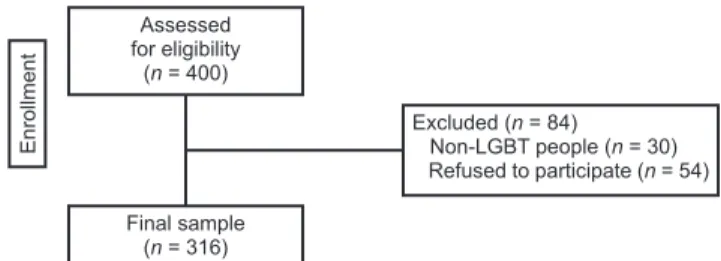
To calculate the sample size, we have adopted the recom-mendations proposed by Lwanga and Lemeshow (1991), assuming a prevalence of violence of 50%; absolute accu-racy of 6%; and a significance level of 5%. The estimated sample size was 267 individuals. To allow for losses and refusals, a convenience sample of 400 individuals was re-cruited in a LGBT festival called “LGBT Pride Parade”, held in July 2013, in both cities. Among the 400 people approached, 30 were excluded because they were only sur-prising or sympathizers and 54 declined the invitation. The final sample was composed of 316 people the self-declared gay, lesbian, bisexual or transgender (transvestite or trans-sexual) (Figure 1).
Data collection
All the information was collected during face-to-face struc-tured interviews conducted by trained health professional
Figure 1. Flow chart of the inclusion of the participants throughout the study.
Assessed for eligibility
(n = 400)
Final sample (n = 316)
Excluded (n = 84) Non-LGBT people (n = 30) Refused to participate (n = 54)
in reserved places for approximately 20 minutes. At the end of each interview, the participants received stickers with the message “I participated in the research” so as to avoid inter-viewing the same person again.
At this moment, the participants filled out a structured form with the variables: sociodemographic profile, kind of violence, drug consumption, and suicide attempt. This form was tested among LGBT people (about 10) from some oth-er place and situation; these data woth-ere not included in our study.
Variables
Sociodemographic variables were: biological sex (male and female), schooling (complete or incomplete elemen-tary school, high school, superior education, and post-graduation), marital status (single, dating, in a stable rela-tionship, married, divorced, and widowed), formal work (yes and no), age (years) and monthly income. For this study, “consensual marriage” refers to an enduring rela-tionship between two people with the purpose of having a family, but without formalizing the civil marriage (Zarias, 2010).
Sexual orientation was assessed by the question: “Which category best describes you?” The options were gay, lesbian, bisexual, or transgender (transvestite or trans-sexual). Violent events were classified into psychological or verbal, physical, and sexual. In this moment of the inter-view, the participants were asked to specify the kind of ag-gression they had suffered, because of the subjective nature of this situation (minimization of bias).
The consumption of the following drugs within the last thirty days was investigated: alcohol, tobacco, non-opiate analgesics, marijuana, cocaine, hallucinogenic drugs, am -phetamines, ecstasy, tranquilizers, anabolic steroids, and others. Suicide attempts were measured based on the “yes” or “no” answer to the question: “Have you ever attempted suicide in life?”
Data analysis
Qualitative variables were expressed as absolute and rel-ative frequencies, and quantitrel-ative variables, as median and 25 and 75 percentiles, due to the non-normal distribu-tion (p < .05 - Shapiro-Wilk test). The incidence ratio for suicide attempts according to violence and drug use was estimated by Poisson Regression (log-binominal model) with robust variance (Wilber & Fu, 2010). The frequen-cy of violence and drug use is presented as medians and respective confidence intervals, and the differences were checked using Mann-Whitney test.
The association between violence suffered throughout life and drug consumption (in the last 30 days) was evalu-ated by the Chi Square Person test. On the other hand, in
order to analyze the relation between the quantity of violent events and drug consumption, we adopted the Kruskal-Wal-lis test. The Stepwise backward strategy for modeling was used to estimate the incidence ratio in the multivariate Pois-son regression. The entry and remove criteria were p = .05 and p = .2, respectively and all sociodemographic, violence types, and drug use variable were used for adjustment. We applied a confidence interval of 95% in all data analyses, which were conducted on the version 11.0 of the Stata sta-tistical software.
Ethical considerations
This research was approved by the Research Ethical Com-mittee of the ABC Faculty of Medicine, Santo André, Bra-zil, under process number 19018513.0.0000.0082. All par-ticipants signed an informed consent before participating in this investigation. Respondents were identified by numbers in the tables and statistical analyses.
RESULTS
All participants had already suffered some type of violence. Drug consumption occurred in 84% (no answers) to 89% (answers) of the sample. There was no statistically signifi -cant difference between type of violence suffered and type of drug used (p > .05). There was no statistically significant difference between groups (answers and no answers) in re -lation to sociodemographic variables (p > .20).
Sociodemographic profile and sexual orientation
Participants were mostly brown skinned (62%), consensu-ally married (64.2%), with complete high school (34.2%) and had mostly informal employment (54.1%). The mean (± standard deviation) of monthly income and age were USD 304.82 (SD ± 283.3) and 24.3 (SD ± 7.0) years, re-spectively. Most participants were male (70.6%), male gender identity (63.3%), and homosexually orientated gay (51.3%).
Prevalence of violence and drug consumption
The prevalence of psychological/verbal, physical, and sex-ual violence throughout life was 78.8%, 31.3%, and 18.4%, respectively. Participants reported using one or more licit and/or illicit drugs: alcohol (71.4%), tobacco (22.7%), an-algesics (17.9%), opioid anan-algesics (16.9%), tranquilizers (7.7%), cocaine (7.3%), marijuana (3.6%), amphetamines (3.6%), anabolic steroids (2.3%), ecstasy (2.2%), and hal-lucinogen (1.8%).
Association between violence suffered and drug consumption
Among the three types of violence analyzed in this study, only psychological/verbal and physical violence presented statistically significant associations with drug consumption within the last 30 days. Based on the participants’ reports, it is possible to conclude that anabolic steroids (5.9%) and tranquilizers (7.9%) were consumed exclusively by LGBT people who had suffered physical violence (p = .001) and psychological/verbal violence (p = .027), respectively. Moreover, tranquilizers (11.6%) and amphetamines (8.8%)
Table 1
Sex, gender and sociodemographic characteristics of lesbi-ans, gays, bisexuals and transgenders, 2013
Characteristic N %
Biological sex
Male 185 74.0
Female 65 26.0
Sexual orientation
Homosexual 208 83.2
Bisexual 42 16.8
Marital status
Married 9 3.6
Divorced 1 .4
Stable relationship 18 7.2
Dating 62 24.8
Single 160 64.0
Formal job
Yes 102 42.0
No 141 58.0
Median (p25 – p75)a
Age 21 19 – 27
Income 678 300 – 850
Note: ap25 – p75: percentiles 25 and 75, respectively; Of the total of
homo-sexuals: Gays (n = 137, 54.8%), Lesbians (n = 52, 20.8%) and Transgenders (n = 19, 7.6%).
Table 2
Incidence and incidence ratio of suicide attempt according to type of violence experienced
Experienced violence
Incidence of suicide
attempt (%) Incidence ratio (95% CI)* value*p Physical
No 11.7 1
Yes 27.1 2.31 (1.34 – 3.99) .003
Sexual
No 14.9 1
Yes 26.8 1.79 (1.03 – 3.10) .037
Psychological and verbalb
No 0.0 -
Yes 18.7 -
-Note: bIt was not possible to estimate incidence ratio since the incidence of
suicide attempts in the group not experience psychological and verbal vio-lence was 0%; *Estimated using Poisson multiple regression, with robust
variance; 95% CI - 95% confidence interval.
Table 3
Incidence and incidence ratio (95% confidence interval) of suicide attempt according to type of drug used in lesbians, gays, bisexuals and transgenders, 2013
Drugs
Incidence of suicide
attempt (%) Incidence ratio(95% CI)* p value* Alcohol
No 15.9 1
Yes 21.5 1.35 (.71 – 2.57) .354
Amphetaminec
No 19.5 1
Yes 0.0
-Ecstasy
No 17.8 1
Yes 60.0 3.36 (1.55 – 7.28) .002
Cocaine
No 17.3 1
Yes 37.5 2.15 (1.07 – 4.36) .031
Marijuana
No 15.8 1
Yes 43.5 2.74 (1.55 – 4.85) < .001
Hallucinogens
No 18.3 1
Yes 50.0 2.73 (.98 – 7.59) .054
Tranquilizers
No 16.3 1
Yes 52.9 3.24 (1.87 – 5.60) < .001
Analgesics
No 17.3 1
Yes 25.6 1.48 (.79 – 2.76) .218
Anabolic steroids
No 18.8 1
Yes 20.0 1.06 (.17 – 6.31) .945
Tobacco
No 15.7 1
Yes 27.4 1.74 (.98 – 3.08) .056
Others
No 19.0 1
Yes 16.2 .85 (.38 – 1.89) .700
Note: cIt was not possible to estimate incidence ratio since the incidence of
suicide attempts in the group that used amphetamines was 0%; *Estimated using Poisson multiple regression, with robust variance; 95% CI - 95%
were more often consumed by people who had suffered physical violence (p = .012) and who had not suffered psy -chological/verbal violence (p = .021), respectively.
There was no statistically significant association be -tween frequency of violence suffered throughout life and quantity of drugs consumed within the last 30 days; con-fidence intervals overlapped and there was a .069 proba -bility.
There was an association between suicide attempt inci-dence and physical and sexual violence. The inciinci-dence ra-tios were 2.31 (95% CI [1.34, 3.99, p = .003]) for physical violence and 1.79 (95% CI [1.03, 3.10, p = .037]) for sexual violence (Table 2).
Concerning drug use, there was an association between suicide attempts and the use of ecstasy, cocaine, marijua -na and tranquilizers, with incidence ratios of 3.36 (95% CI [1.55, 7.28]), 2.15 (95% CI [1.07, 4.36]), 2.74 (95% CI [1.55, 4.85]), and 3.24 (95% CI [1.87, 5.60]), respectively (Table 3).
It was observed that the average frequency of violence suffered throughout life (p < .001) and the frequency of drug use in the last 30 days (p < .001) were higher in indi-viduals who had attempted suicide at least once.
In the multivariate analysis, it was observed that the biological sex female decreased of the risk attempted sui-cide IR .39 (95% CI [.21, .73]; p = .003) and the use of the marijuana seemed to increase twice (95% CI [1.65, 5.54]) this risk when adjusted by sociodemographic variables, vi -olence types, and drug used (Table 4).
DISCUSSION AND CONCLUSION
We collected evidence indicating that the rates of violence against the LGBT population are still high in this Brazil-ian region. This is perhaps a reflection of the prevailing prejudice, chauvinism, and lack of specific public policies against general violence in Brazil. In fact, the annual med-ical expenses due to physmed-ical aggressions and transport accidents have raised by 130% (around 690 000 USD) (de
Lima, Bueno, & Mingardi, 2016). LGBT advocacy groups in Brazil say that every 25 hours a person from this commu-nity dies because due to violence cases. In addition, for each case of violence against the LGBT population in Brazil, the police identifies the perpetrator in only 17% of the cases. According to this survey, the state of Ceará (place of this study) was the fifth in cases of murders of LGBT people (Mott, Michels, & Paulinho, 2017).
Our findings showed a predominance of psychological/ verbal violence and the use of licit drugs, especially alcohol and tobacco. Studies in this field conducted in Brazil, Unit -ed States, Italy, and Australia support these same findings in the LGBT population (Pellulo et al., 2013; McCabe et al., 2010; de Santis et al., 2014; Teixeira-Filho & Rondini, 2012; Vieira, 2006; Laranjeira, 2014; Thiede et al., 2003; Phillips et al., 2017). The greater ease of access and pur-chase and low supervision justifies this finding. In addition, gay and bisexual men and lesbian women drink and smoke overall more than the heterosexual population. This issue has already emerged as a public health problem (Gearhardt, Grilo, DiLeone, Brownell, & Potenza, 2011; Bye, Gruskin, Greenwood, Albright, & Krotki, 2005).
The association identified between violence suffered and drug use in the LGBT population studied supports the Meyer’s Minority Stress Theory model. This model propos-es that sexual minoritipropos-es prpropos-esent a higher chance to develop mental disorders and consume psychoactive substances due to discriminatory and violent social background (McCabe et al., 2010). In addition, the model proposed by Singer proposes a synergism between drug use and exposure to violence (in this case, in HIV-positive Latin and African American people) (Singer, 2006).
We believe that the higher consumption of anabolic steroids by individuals who had suffered physical violence is related to an attempt to reach a better social integration. Self-care and good body image, especially in the Brazil-ian culture, is much appreciated in any social environment. However, in the case of steroids, it is also possible that this phenomenon indirectly represents a strategy of promoting self-defense in future cases of homophobic violence.
A previous study concluded that it is a fact that gay men associate anabolic steroid consumption with resis-tance, physical strength, and virility (Sánchez, Grrenberg, & Vilain, 2009). Another association detected was between physical violence and consumption of tranquilizers. Au-thors comment that victims of emotional abuse start using tranquilizing drugs early (Kecojevic et al., 2012). Due to its calming and reducing effect on psychomotor processes, these drugs can help to reduce stress and anxiety, becoming coping strategies in the face of psychological violence ( An-drade et al., 2012).
We observed that the participants who had not suffered any psychological violence did not consume tranquilizers and had a higher consumption of amphetamines. This
asso-Table 4
Model of the multivariate analysis of the incidence ratio
(95% CI) of suicide attempt according to Sociodemograph
-ic, violence types and drug use by lesbians, gays, bisexuals and transgenders, 2013
Model Incidence ratio (95% CI) p*
Biological sex female .39 (.21; .73) .003
Tranquilizers 1.99 (.91; 4.35) .083
Ecstasy 3.85 (.96; 15.4) .057
Marijuana 3.02 (1.65; 5.54) <.001
Anabolic steroids 4.38 (.91; 20.9) .065
ciation can be explained by the purpose of these substances. Amphetamines are known as recreational drugs and an-cillary for sexual encounters, especially in the gay public (Morgenstern et al., 2009). Thus, if the individuals have not been victims of violence, it is justifiable to seek drugs or situations with excitatory/euphoric effects instead of a sed -ative effect (tranquilizers). The latter would, in turn, be the drug of choice of those who have suffered psychological violence.
Latin America is still one of the global regions with the highest number of cases of violence against LGBT people. However, data from the map of laws and sexual orientation reveal that countries such as Brazil, Argenti-na, and Colombia have made great strides in recent years regarding the rights of LGBT people (marriage, adoption and protection against discrimination). This may have some positive impact on rates of violence and prejudice. However, suicide cases among this population are still a public health problem, according to Brazilian and Colom-bian researchers (Carroll & Ramón-Mendos, 2017; Ro-cha-Buelvas, 2015).
Similarly to other studies, we found that suicide at-tempts are associated with violence and drug use. The lit-erature suggests that these stressors are strongly associat-ed with suicidal behavior in the homosexual and bisexual populations (Traube et al., 2012; McDaniel et al., 2001; Rayn, Hubner, Diaz, & Sanchez, 2009; Matthews, Hughes, Johnson, Razzano, & Cassidy, 2002; Hughes, Johnson, Wil-snack, & Szalacha, 2007; Cochran, Mays, Alegria, Ortega, & Takeuchi, 2007; Blosnich & Bossarte, 2012).
It is suggested that violence causes LGBT people to develop negative feelings towards their sexual orientation, which in turn leads to internalized homophobia, social iso-lation, and different levels of mental distress (Hérnandez & Torres, 2005). These factors increase the chances for de-pression and suicidal attempts in the group. Conflicts inher -ent to sexual ori-entation are strongly associated with nega-tive health outcomes and quality of life, including a six-fold increased risk of depression (Rayn et al., 2009).
Among the types of violence suffered, in our study, both physical and sexual victimization were associated with suicide attempt. The data is corroborated by a study that revealed that people with a history of sexual or physi-cal abuse were two to three times more likely to have sui-cidal ideation episodes and suicide attempts (Matthews et al., 2002).
In the present study, the use of tranquilizers, cocaine, marijuana, and ecstasy was associated with suicide at -tempts. It is important to note the implications of the preva-lence of use of drugs such as ecstasy and marijuana for the occurrence of the phenomenon. In this sense, it is suggested that by disturbing the normal functioning of the central ner-vous system (CNS) and causing hallucinations, delusions, and illusions, these substances may predispose people to
suicide. Drugs that disturb the CNS, such as ecstasy, have a higher association with suicide attempts than other types of drugs (Dos Santos, 2013; Monteiro, 2013).
The main type of violence seen in the sample studied was the psychological/verbal. This violence showed asso-ciations with the use of amphetamines, while physical vio-lence was associated with a higher consumption of tranquil-izers and anabolic steroids. Suicide attempts were higher among people who had suffered physical violence and who used drugs such as ecstasy, cocaine, marijuana, and tran -quilizers.
The results of this study should be interpreted taking into account some limitations. Firstly, the data were ob-tained from a convenience sample. Secondly, we are not able to assess the implications of the temporal relationships between drug use, violence suffered, and suicide attempts. Furthermore, the study was not able to analyze the impli-cations of violence and drug use with suicide attempts ac-cording to sexual orientation (gay, lesbian, bisexual, and transgender) due to the small sample size.
Funding None.
Conflict of interests
The authors declare they have no conflict of interests. Acknowledgements
Laboratory of Epidemiology and Data Analysis from the Facul-dade de Medicina do ABC, Brazil.
REFERENCES
Andrade, S. S. C. A., Yokota, R. T. C., Sá, N. N. B., Silva, M. M. A., Araújo, W. N.,
Mascarenhas, M. D. M., & Malta, D. C. (2012). Relação entre violência física, consumo de álcool e outras drogas e bullying entre adolescentes escolares bra-sileiros. Cadernos de Saúde Pública, 28(9), 1725-1736. doi: 10.1590/S0102-311X2012000900011
Barrientos-Delgado, J., Cárdenas-Castro, M., & Gómez-Ojeda, F. (2014). Carac
-terísticas sociodemográficas, bienestar subjetivo y homofobia en una muestra
de hombres gay en tres cuidades chilenas. Cadernos de saude publica, 30(6), 1259-1269. doi: 10.1590/0102-311X00108413
Blosnich, J. & Bossarte, R. (2012). Drivers of disparity: differences in socially-based risk factors of self-injurious and suicidal behaviors among sexual minority
college students. Journal of American College Health, 60(2), 141-149. doi: 10.1080/07448481.2011.623332
Buller, A. M., Devries, K. M., Howard, L. M., & Bacchus, L. J. (2014). Associations between intimate partner violence and health among men who have sex with men: a systematic review and meta-analysis. PLoS Med, 11(3). doi: 10.1371/
journal.pmed.1001609
Bye, L., Gruskin, E., Greenwood, G., Albright, V., & Krotki, K. (2005). California lesbians, gays, bisexuals and trans-gender (LGBT) Tobacco Use Survey - 2004. Sacramento, CA: California Department of Health Services, 40. Retrieved from www.cdph.ca.gov/programs/tobacco/Documents/Resources/Publications/ CTCP-LGBTTobaccoStudy.pdf
Cochran, S. D., Mays, V. M., Alegria, M., Ortega, A. N., & Takeuchi, D. (2007). Mental health and substance use disorders among Latino and Asian American lesbian, gay, and bisexual adults. Journal of Consulting and Clinical Psycholo-gy, 75(5), 785-794. doi: 10.1037/0022-006X.75.5.785
Dos Santos, C. B. (2013). “É proibido fumar, diz o aviso que eu li”: o serviço social na promoção da saúde do usuário tabagista. Revista da Graduação, 6(2). Fassinger, R. (1991). The hidden minority issues and challenges in working with
lesbian women and gay men. The Counseling Psychologist, 19(2), 157-176. doi: 10.1177/0011000091192003
Friedman, M. S., Marshal, M. P., Guadamuz, T. E., Wei, C., Wong, C. F., Saewyc, E., & Stall, R. (2011). A meta-analysis of disparities in childhood sexual abuse, parental physical abuse, and peer victimization among sexual minority and sex-ual nonminority individsex-uals. American Journal of Public Health, 101(8), 1481-1494. doi:10.2105/AJPH.2009.190009
Gearhardt, A. N., Grilo, C. M., DiLeone, R. J., Brownell, K. D., & Potenza, M. N. (2011). Can food be addictive? Public health and policy implications. Addiction,
106(7), 1208-1212. doi: 10.1111/j.1360-0443.2010.03301.x
Governo do Estado do Ceará. (2013). Perfil básico municipal. Crato: Instituto de Pesquisa e Estratégia Econômica do Ceará.
Hatzenbuehler, M. L., Mphil, M. S., Mclaughlin, K. A., & Hasin, D. S. (2010). The impact of institutional discrimination on psychiatric disorders in lesbian, gay, and bisexual populations: a prospective study. American Journal of Public Health, 100(3), 452-459. doi: 10.2105/AJPH.2009.168815
Hérnandez, L. O. & Torres, M. I. G. (2005). Efectos de la violencia y la discrimi-nación en la salud mental de bisexuales, lesbianas y homosexuales de la Ciudad de México. Cadernos de Saúde Pública, 21(3), 913-925. doi: 10.1590/S0102-311X2005000300026
Hughes, T. L., Johnson, T. P., Wilsnack, S. C., & Szalacha, L. A. (2007). Childhood risk factors for alcohol abuse and psychological distress among adult lesbians. Child Abuse & Neglect, 31(7), 769-789. doi: 10.1016/j.chiabu.2006.12.014 Kecojevic, A., Wong, C. F., Schrager, S. M., Silva, K., Bloom, J. J., Iverson, E.,
& Lankenau, S. E. (2012). Initiation into prescription drug misuse: differences
between lesbian, gay, bisexual, transgender (LGBT) and heterosexual high-risk young adults in Los Angeles and New York. Addictive behaviors, 37(11),
1289-1293. doi: 10.1016/j.addbeh.2012.06.006
King, M., Semlyen, J., Tai, S. V., Killaspy, H., Osborn, D., Popelyuk, D., & Naza-reth, I. (2008). A systematic review of mental disorder, suicide, and deliberate self harm in lesbian, gay and bisexual people. BMC Psychiatry, 8(1), 70. doi: 10.1186/1471-244X-8-70
Laranjeira, R. (2014). Segundo Levantamento Nacional de Álcool e Drogas -
Relatório 2012. São Paulo: Instituto Nacional de Ciência e Tecnologia para Políticas Públicas do Álcool e Outras Drogas. Retrieved from http://inpad.org. br/wp-content/uploads/2014/03/Lenad-II-Relat%C3%B3rio.pdf
de Lima, R. S., Bueno, S., & Mingardi, G. (2016). Estado, polícias e segurança públi-ca no Brasil. Revista Direito GV, 12(1), 49-85. doi: 10.1590/ 2317-6172201603 Lwanga, S. K. & Lemeshow, S. (1991). Sample size determination in health studies:
a practical manual. Geneva: World Health Organization. Retrieved from http:// apps.who.int/iris/handle/10665/40062
Marshal, M. P., Burton, C. M., Chisolm, D. J., Sucato, G. S., & Friedman, M. S.
(2013). Cross-sectional evidence for a stress-negative affect pathway to sub
-stance use among sexual minority girls. Clinical and translational science, 6(4), 321-322. doi: 10.1111/cts.12052
Matthews, A. K., Hughes, T. L., Johnson, T., Razzano, L. A., & Cassidy, R. (2002). Prediction of depressive distress in a community sample of women: the role of sexual orientation. American Journal of Public Health, 92(7), 1131-1139. doi: 10.2105/AJPH.92.7.1131
McCabe, S. E., Bostwick, W.B., Hughes, T. L., West, B. T., & Boyd, C. J. (2010). The relationship between discrimination and substance use disorders among lesbi-an, gay, and bisexual adults in the United States. American Journal of Public Health, 100(10), 1946- 1952. doi: 10.2105/AJPH.2009.163147
McDaniel, J. S., Purcell, D., & D’Augelli, A. R. (2001). The relationship between
sexual orientation and risk for suicide: research findings and future. Suicide Life
Threatening Behavior, 31(1), 84-105.
Meyer, I. H., Dietrich, J., & Schwartz, S. (2008). Lifetime prevalence of mental disorders and suicide attempts in diverse lesbian, gay, and bisexual
popula-tions. American Journal of Public Health, 98(6), 1004-1006. doi: 10.2105/ AJPH.2006.096826
Ministério da Saúde. (2011). Relatório sobre violência homofóbica no Brasil: Ano de 2011. Brasília: Secretaria de Direitos Humanos. Retrieved from http://www.sdh. gov.br/assuntos/lgbt/pdf/relatorio-violencia-homofobica-2011-1
Ministério da Saúde. (2012). Relatório sobre violência homofóbica no Brasil: ano de 2012. Brasília: Secretaria de Direitos Humanos. Retrieved from http://www.sdh. gov.br/.../pdf/relatorio-violencia-homofobica-ano-2012
Mott, L., Michels, E., & Paulinho. (2017). Assassinatos de LGBT no Brasil: relatório de 2016. Salvador: Grupo Gay da Bahia. Retrieved from:
https://homofobiama-ta.files.wordpress.com/2017/01/relatc3b3rio-2016-ps.pdf
Monteiro, R. M. P. (2013). Álcool e outras drogas: diálogos sobre um mal-estar con-temporâneo. Cadernos de Saúde Pública, 29(8), 1693-1694. doi: 10.1590/0102-311XRE020813
Morgenstern, J., Bux, D. A. J., Parsons, J., Hagman, B. T., Waingberg, M., & Irwin, T. (2009). Randomized trial to reduce club drug use and HIV risk behaviors among men-who-have-sex-with-men (MSM). Journal of Consulting and Clinical Psy-chology, 77(4), 645-656. doi: 10.1037/a0015588
Pellulo, C. P., Giuseppe, G. D., & Angelillo, I. F. (2013). Frequency of discrimination, harassment, and violence in lesbian, gay men, and bisexual in Italy. PloS One,
8(8). doi: 10.1371/journal.pone.0074446
Phillips, G., Turner, B., Salamanca, P., Birkett, M., Hatzenbuehler, M. L., Newcomb, M. E., … Mustanski, B. (2017). Victimization as a mediator of alcohol use
dis-parities between sexual minority subgroups and sexual majority youth using the
2015 National Youth Risk Behavior Survey. Drug and Alcohol Dependence,
178, 355-362. doi: 10.1016/j.drugalcdep.2017.05.040
Rayn, C., Huebner, D., Diaz, R. M., & Sanchez, J. (2009). Family rejection as a
predictor of negative health outcomes in white and Latino lesbian, gay, and bi-sexual young adults. Pediatrics, 123(1), 346-52. doi: 10.1542/peds.2007-3524
Rocha-Buelvas, A. (2015). El riesgo suicida y los significados de las minorías sex
-uales: un nuevo reto para la salud pública. Revista de la Facultad de Medicina, 63(3), 537-544. doi: 10.15446/revfacmed.v63n3.43219
Sánchez, F. J., Greenberg, S. T., & Vilain, E. (2009). Reported Effects of Mascu
-line Ideals on Gay Men. Psychology of Men & Masculinity, 10(1), 73-87. doi: 10.1037/a0013513
de Santis, J. P., Gonzalez-Guarda, R., Provencio-Vasquez, E., & Deleon, D. A. (2014). The Tangled Branches (Las Ramas Enredadas): Sexual risk, substance abuse, and intimate partner violence among hispanic men who have sex with men. Jour-nal of Transcultural Nursing, 25(1), 23-32. doi: 10.1177/1043659613504110 Silva, A. C. L. G., Coelho, E. B. S., & Pires, R. O. M. (2014). O que se sabe sobre
o homem autor de violência contra a parceira íntima: uma revisão sistemática. Revista Panamericana de Salud Publica, 35(4), 278-283.
Singer, M. (2006). A dose of drugs, a touch of violence, a case of AIDS, part 2: Fur-ther conceptualizing the SAVA syndemic. Free Inquiry in Creative Sociology, 34(1), 39-54.
Souza, M. H. T., Malvasi, P., Signorelli, M. C., & Pereira, P. P. G. (2015). Violên-cia e sofrimento soViolên-cial no itinerário de travestis de Santa Maria, Rio Grande do Sul, Brasil. Cadernos de Saúde Pública, 31, 767-776. doi: 10.1590/0102-311X00077514
Teixeira-Filho, F. S. & Rondini, C. A. (2012). Suicide thoughts and attempts of sui-cide in adolescents with hetero and homoerotic sexual practices. Saúde & Socie-dade, 21(3), 651-667. doi: 10.1590/S0104-12902012000300011
Thiede, H., Valleroy, L. A., Mackellar, D. A., Celentano, D. D., Ford, W. L., Hagan, H., ... Torian, L. V. (2003). Regional patterns and correlates of substance use among young men who have sex with men in seven US urban areas. American Journal of Public Health, 93(11), 1915-1921. Retrieved from http://www.ncbi. nlm.nih.gov/pmc/articles/PMC1448076/
Traube, D. E., Holloway, I. W., Schrager, S. M., & Kipke, M. D. (2012). Utilizing Social Action Theory as a framework to determine correlates of illicit drug use among young men who have sex with men. Psychology of Addictive Behaviors, 26(1), 78-88. doi: 10.1037/a0024191
Vieira, N. A. (2006). Entendendo quem entende: comportamentos, atitudes e práticas de risco e de prevencao para aids entre homens que fazem sexo com homens
(Master’s thesis). Available from http://www.cpqam.fiocruz.br/bibpdf/2008vie
Wilber, S. T. & Fu, R. (2010). Risk ratios and odds ratios for common events in cross‐
sectional and cohort studies. Academic Emergency Medicine, 17(6), 649-651.
doi: 10.1111/j.1553-2712.2010.00773.x
Wong, C. F., Weiss, G., Ayala, G., & Kipke, M. D. (2010). Harassment, discrim-ination, violence and illicit drug use among men young men who have sex
with men. AIDS Education and Prevention, 22(4), 286-298. doi: 10.1521/ aeap.2010.22.4.286