Otras secciones de este sitio:
☞ ☞ ☞ ☞
☞ Índice de este número ☞
☞ ☞ ☞
☞ Más revistas ☞
☞ ☞ ☞
☞ Búsqueda
Others sections in this web site:
☞ ☞ ☞ ☞
☞ Contents of this number
☞ ☞ ☞ ☞
☞ More journals
☞ ☞ ☞ ☞ ☞ Search
Artículo:
Entrenamiento de carneros para recolección de semen mediante vagina artifi cial, utilizando como estímulo objetos animados
Derechos reservados, Copyright © 200: Facultad de Medicina Veterinaria y Zootecnia, UNAM
Veterinaria México
Número
Number1
Enero-Marzo
January-March 2 0 0 5
Volumen
Entrenamiento de carneros para recolección de semen mediante
vagina artifi cial, utilizando como estímulo objetos inanimados
Training of rams for semen collection by artifi cial vagina,
using as stimulus inanimate objects.
Virginio Aguirre Flores * Reyes Vázquez Rosales** Agustín Orihuela Trujillo**
Recibido el 9 de octubre de 2003 y aceptado el 29 de marzo de 2004.
*Alumno del Posgrado Interinstitucional en Ciencias Pecuarias, Universidad de Colima, Facultad de Medicina Veterinaria y Zootecnia, km 40, Autopista Colima-Manzanillo, Tecomán, CP 28100.
**Facultad de Ciencias Agropecuarias, Universidad Autónoma del Estado de Morelos, Apartado Postal 5-78, Cuernavaca, Morelos, 62051, México.
Correo electrónico: [email protected]
Abstract
In order to develop a methodology to train rams for semen harvesting with artifi cial vagina
(AV) mounting an inanimate object, nine animals were subjected to four preparation stages.
The fi rst had the purpose of achieving the manifestation of the natural sexual repertoire, and
the rest to carry out an operant conditioning program: when the proper response (mounting) was expressed, in the beginning caused by a sexual motivation state, a positive reinforce-ment or unconditioned stimulus (ejaculation) was given. With this, eventually and through a
generalization process, the conditioned response (fi rst mounting a female that was not in heat
and then an inanimate object) was learned as the correct response. At the beginning of each phase, 33%-55% of the rams did not ejaculate; nevertheless, at the end of phases 1-3, they all ejaculated at least once. At the end of the training it was impossible to collect semen from one male. The conclusion is that by means of the proposed methodology 90% of young males may be trained to mount inanimate objects in order to harvest semen by AV.
Key words: SEMEN COLLECTION, RAMS, TRAINING FOR AI.
Resumen
Con el fi n de desarrollar una metodología para entrenar carneros en la recolección de semen
con vagina artifi cial (VA), montando un objeto inanimado, se utilizaron nueve animales
que se sometieron a cuatro etapas de preparación. La primera con el propósito de lograr la manifestación del repertorio sexual natural, y el resto para llevar a cabo un programa de condicionamiento operante: cuando la respuesta correcta (monta) sucedía, en un inicio provocada por un estado de motivación sexual, se daba un refuerzo positivo o estímulo incondicionado (eyaculación), con lo que eventualmente y mediante un proceso de generalización la respuesta condicionada (primero montar a una hembra que no estaba en celo y luego a un objeto inanimado) se aprendió como la respuesta correcta. Al inicio de
cada fase 33%-55% de los carneros no eyacularon; sin embargo, al fi nal de las fases 1-3,
todos eyacularon al menos una vez, al fi nal del entrenamiento fue imposible recolectar semen
de un macho. Se concluye que mediante la metodología propuesta 90% de los machos
jóvenes pueden ser entrenados para montar objetos inanimados con el fi n de recolectar semen
mediante VA.
Palabras clave: COLECCIÓN DE SEMEN, CARNEROS, ENTRENAMIENTO PARA IA.
Introduction
A
n important component of artifi cial insemina-tion is semen collecinsemina-tion.1 The most commonsemen harvesting methods are by electroejacu-lation and the artifi cial vagina (AV), having this last one advantages insofar as semen concentration and animal welfare are concerned.2-4
Rams require training to be able to ejaculate in an AV. The simplest form is by using as a stimulus females that are in oestrus and accustom males to the presence and manipulation by man, this process may take one to two weeks.1,5 Nevertheless, the
males may also learn to mount inanimate objects and this facilitates handling and avoids the need to have females that are hormonally manipulated. Nevertheless, to achieve this, a longer process is required that includes the use of habituation and conditioning techniques.6,7
In the scientifi c literature there is lack of information with respect to this type of training and therefore in the fi eld many producers use empirical methods that do not take advantage of recent information in the area of sexual motivation and conditioning.8-10 It is for this reason that this
experiment was developed with the objective of proposing and validating a methodology for the training of rams for semen collection with AV while mounting inanimate objects.
This work was performed in the experimental center of the Agricultural and Animal Husbandry Sciences School of the Autonomous University of the State of Morelos, located at 18º 56’ North latitude and 99º 13’ West longitude at 2 160 m above sea level, with average annual rainfall and temperature of 1 243 mm and 20º C, respectively; and semi-warm climate with summer rains.11
Nine one-year-old rams, between 55-60 kg in body weight of the hair breed Santa Cruz were used. Also, as a stimulus, 10 nulliparous, two-year-old, 40 kg, mixed breed females were used as well as two of 5 months of age with 22 kg of body weight.
The animals were penned with other members of the same sex of the herd. They were fed with oat hay and commercial feed* with 12% protein, two and 0.8
kg/animal/day respectively and water ad libitum.
The experiment was performed during September and October, in four stages of two weeks each with three training sessions per week. Each session lasted 15 minutes or until three ejaculates were obtained, whatever happened fi rst.
During the fi rst stage the rams were individually exposed to one female in heat. The females had oestrus induced by means of sponges with 40 mg of fl urogestone acetate** inserted intravaginally during
Introducción
U
n componente importante de la inseminación artifi cial es la obtención del semen.1 Losmétodos comunes de recolección de semen son el electroeyaculador y la vagina artifi cial (VA), esta última con ventajas en cuanto a concentración de semen y bienestar animal.2-4
Para eyacular en VA los carneros requieren de entrenamiento. La forma más sencilla es utilizar como estímulo hembras en estro y acostumbrar a los machos a la presencia y manipulación por parte del humano, este proceso puede llevar una o dos semanas.1,5 No
obstante, los machos también pueden aprender a montar objetos inanimados, lo que facilita su manejo y evita la necesidad de contar con hembras que se manipulen hormonalmente. Sin embargo, para lograrlo se requiere de un proceso más largo y de la utilización de algunas técnicas de habituación y condicionamiento.6,7
En la literatura científi ca existe una laguna de información respecto de este tipo de entrenamiento, por lo que en la práctica muchos productores se basan en métodos empíricos, desaprovechando información reciente en el área de motivación sexual y condicionamiento.8-10 Por esta razón se desarrolló
un experimento con el objetivo de proponer y validar una metodología para el entrenamiento de carneros que son recolectados con VA montando objetos inanimados.
El trabajo se realizó en el campo experimental de la Facultad de Ciencias Agropecuarias de la Universidad Autónoma del Estado de Morelos, localizado a 18º 56’ latitud Norte y 99º 13’ longitud Oeste, a 2 160 msnm, con precipitación media anual y temperatura de 1 243 mm y 20ºC, respectivamente; de clima semicálido con lluvias en verano.11
Para su entrenamiento se utilizaron nueve machos de la raza de pelo Santa Cruz, con un año de edad y entre 55-60 kg de peso: además, como estímulo se usaron diez hembras adultas, criollas, de dos años de edad, nulíparas, de 40 kg, y dos de cinco meses de edad con 22 kg de peso.
Los animales se alojaron con otros compañeros del rebaño del mismo sexo. Para su alimentación se les proporcionó heno de avena y alimento comercial*
con 12% de proteína, a razón de dos y 0.8 kg/animal/ día, respectivamente, y agua ad libitum.
El experimento se realizó durante septiembre y octubre, en cuatro etapas de dos semanas cada una, y tres sesiones de entrenamiento por semana. Cada sesión tuvo una duración de 15 min o la obtención de tres eyaculados, lo que ocurriera primero.
twelve days, plus IM injection of 400 IU of PMSG on the day the sponges were removed.1 The ewes were
programmed so as to have two of them in oestrus available during each session. Oestrus was confi rmed before beginning training through the use of a mature ram equipped with an apron. One of the females was held in the center of the collection pen by a neck trap station and only if it became restless it was substituted by the other female.
The collection pen had a roof and solid walls to avoid distractions for the males.
In view of the fact that the senses of sight and smell are very important during the training of sexual behavior,12 at the beginning of each session, the rams
were tied by means of halters along the periphery of the pen with the intention of allowing them to see the stimulus female and even the mounting of their peers5 while waiting for their turn to be trained.
The intention was the reinforcement by association between the collection site and the sexual activity.13
In each training session, the order in which the males came up was different.
At the end of the fi rst stage, once the males ejaculated in females in heat that were tied, the habituation process was begun with the presence of the operator. Initially the operator remained standing without moving, at a certain distance of the male, under a neutral context; the presence of the human shall not be associated with punishment nor reward,14
and slowly he got closer until he remained crouched at the side of the animals, without inhibiting the sexual behavior. After that, the operator tried penis deviation by holding it by the prepuce so that it would not ejaculate inside the female. This procedure was repeated in two to three mountings and then ejaculation was allowed.
The second stage had as an objective the training of the rams for the collection with the AV using as a stimulus an ewe that was not in heat.
Using the generalization concept, and on the basis that in most of the domestic animals the beginning of mounting is triggered by the immobile female, the ewe in heat was substituted by one that was not in heat. During this stage, the operator would deviate the penis of the ram up to the AV prepared according to what has been established by Evans and Maxwell,5 so that the ram would ejaculate in it;
and thus the ejaculation would become the positive reinforcement that would increase the possibility of response whenever the same stimulus (female that is not in heat) is presented again.14
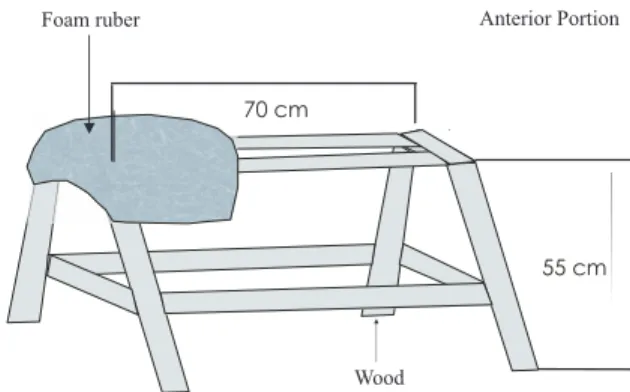
During the third state, an inanimate object was incorporated (Figure 1) in order to substitute the female. Nevertheless, a small ewe (not in heat) was held with its back barely underneath the structure, in
En la primera etapa se expuso a los carneros individualmente ante una hembra en celo. Las hembras se inducían al estro mediante esponjas intravaginales con 40 mg de acetato de fl urogestona,*
insertadas durante doce días, más 400 UI de PMSG vía intramuscular, el día de su retiro.1 Las borregas
se programaban para contar con dos de ellas en estro en cada sesión. Antes de iniciar el entrenamiento se confi rmaba el estro mediante el uso de un carnero maduro equipado con mandil. Una de las hembras se sujetaba al centro del corral de recolección mediante una estación con una “trampa” para el cuello, y sólo en caso de que mostrara signos de inquietud se sustituía con la otra.
El corral de recolección era techado y con paredes sólidas para evitar distracciones de los machos.
En virtud de que la visión y el olfato son muy importantes durante el aprendizaje del comporta-miento sexual,12 al inicio de cada sesión se ataba a
los carneros mediante cabestrillos a lo largo de la periferia del corral con la intención de que pudieran ver a la hembra estímulo, e incluso la monta de sus compañeros5 mientras llegaba su turno de ser
entrenados. De esta manera se buscaba reforzar una asociación entre el lugar de recolección y la actividad sexual.13 En cada sesión de entrenamiento, el orden
de paso de los machos era diferente.
Hacia el fi nal de la primera etapa, una vez que los machos eyaculaban en hembras en celo sujetas, se inició su habituación a la presencia del operador. Inicialmente el operador permanecía inmóvil de pie a cierta distancia del macho bajo un contexto neutral; esto es, la presencia del humano no debe asociarse con recompensa ni castigo,14 y se fue acercando
paulatinamente hasta lograr permanecer en cuclillas a un lado de los animales, sin inhibir el comportamiento sexual. Posteriormente el operador intentó desviar el pene del macho tomándolo del prepucio para que no eyaculara en la hembra, este procedimiento se repitió en dos o tres montas y luego se permitió la eyaculación.
La segunda etapa tuvo como objetivo entrenar a los carneros para hacer la recolección con VA, usando como estímulo una borrega que no estaba en celo.
Utilizando el concepto de generalización, y con base en que en la mayoría de los animales domésticos el desencadenante de la monta es la inmovilidad de la hembra, la borrega en celo se sustituyó por una que no estaba en estro. Durante esta etapa, el operador desviaba el pene del carnero hasta la entrada de una VA preparada de acuerdo con lo establecido por Evans y Maxwell,5 para que el carnero eyaculara en ella; así
la eyaculación se convertía en un refuerzo positivo que
order to help with the generalization process of the male and collect semen in the AV, as was described in the previous stage.
As the males responded by mounting, the female was removed, and thus the inanimate object became the conditioned stimulus that would induce the trained rams to the correct response.
During the fourth stage semen was collected using exclusively as stimulus the inanimate object.
During the fi rst session, 33% of the rams showed little or no interest in the stimulus females while 67% copulated at least on one occasion, registering an average reaction time of 120 ± 60 s. From the second day of training, all the rams copulated on three occasions, with an average reaction time of 60 ± 40 s.
During the fi rst week of this stage, 44% of the semen of the rams could not be collected due to the fact that the presence of the human was inhibitory, while in the rest of the males it was collected from the fi rst session with an average of 2 ± 1 ejaculates in a period of 15 minutes.
During the fi rst week 44% of the rams could not be collected, while the rest produced 2 ± 1 ejaculates on average. During the second week, 100 % of the rams were collected, with an average of 3 ± 1 ejaculates during each session.
At the beginning of the fi rst week of the fourth stage, semen was not collected from 55% of the rams, with most of them manifesting only mounting intentions, while semen was collected from 45% with an average of 2 ± 1 times. Nevertheless, during the second week the success percentage increased to 89 points.
During the fourth stage it was not possible to collect semen from one of the rams.
According to Winfi eld and Makin,15 the sexual
behavior is developed gradually and it is observed that, independently of the sexual elements of playing, the six-months-old lambs rarely investigate an ewe in heat, and it is not until after they are one year old that the complete mounting sequence is observed in all the rams. Nevertheless, Price et al.16 established
that at eight months of age, the sexual development of rams has matured suffi ciently so that in brief encounters with females the expression of the adult sexual behavior is triggered.
The sense of sight and the interaction with the opposite sex participate in the sexual learning and stimulation process17 and therefore, it is very useful to
tie the males by means of halters to the periphery of the pen while other males are being trained. Together with this, brief exposures during the fi rst stage of this work to females in heat resulted in great help. Nevertheless, care must be exercised to not include
incrementaría la posibilidad de la respuesta cuando el mismo estímulo (hembra que no esté en estro) se presente nuevamente.14
En la tercera etapa se incorporó un objeto inanimado (Figura 1) con el fi n de sustituir a la hembra. Sin embargo, inicialmente se sujetaba una borrega pequeña (que no estaba en celo) cuya altura al lomo daba justamente por debajo de la estructura, con el fi n de ayudar en el proceso de generalización del macho para recolectar el semen en la VA, como se describió en la etapa anterior.
En la medida en que los machos respondían montando se retiraba la hembra, convirtiéndose el objeto inanimado en un estímulo condicionado que inducía en los carneros entrenados la respuesta correcta.
Durante la cuarta etapa se recolectó el semen utilizando como estímulo exclusivamente el objeto inanimado.
Durante la primera sesión, 33% de los carneros manifestó poco o nulo interés por la hembra estímulo, mientras que 67% copuló al menos en una ocasión, registrando un tiempo de reacción promedio de 120 + 60 s. A partir del segundo día de entrenamiento, todos los carneros copularon en tres ocasiones, con tiempo de reacción promedio de 60 + 40 s.
Durante la primera semana de esta etapa, 44% del semen de los carneros no pudo ser recolectado debido a que la presencia del humano les resultaba inhibitoria, en tanto que de los machos restantes se recolectó desde la primera sesión, realizando 2 ± 1 eyaculados promedio, en un lapso de 15 minutos.
Durante la primera semana no se pudo recolectar del 44% de los carneros, en tanto que del resto se obtuvieron 2 ± 1 eyaculados en promedio. Durante la segunda semana, se recolectó del 100% de los carneros, con un promedio de 3 ± 1 eyaculado durante cada sesión.
Al iniciar la primera semana de la cuarta etapa no se recolectó el semen de 55% de los carneros, que en su mayoría manifestaron únicamente intentos de monta, en tanto que de 45% se recolectó en promedio de 2 ± 1 veces. No obstante, durante la segunda semana el porcentaje de éxito ascendió a 89 puntos.
Durante la cuarta etapa en uno de los carneros no fue posible recolectar el semen.
De acuerdo con Winfi eld y Makin,15 la conducta
sexual se desarrolla de manera gradual, y se observa que, independientemente de los elementos sexuales del juego, los corderos de seis meses de edad raramente investigan a una borrega en celo, y no es sino hasta después del año que la secuencia completa de monta se observa en todos los carneros. Sin embargo, Price
in the group males that are larger or heavier than the ones that are being trained to avoid sexual inhibition.18
The results of the fi rst training session agrees with the fi ndings of Katz et al.,19 who found that 30%
or more of the virgin one-year-old rams, that were exposed for the fi rst time to females in estrus, did not show sexual interest. Nevertheless, these researchers establish that many of these sexually inhibited males, eventually shall get involved in heterosexual activities through repeated or continuous exposition19,20 However, a low percentage of these
males shall continue to ignore the females showing preference for other males.21-23
The fact that 100% of the rams ejaculated in three occasions, during the second training session, suggests that this stage may be reduced to only two sessions in rams of this age, and could be even avoided in older animals or with prior sexual experience.5,24
Each one of stages two, three and four represents an operant conditioning program: when the correct response happens (mounting), initially caused by a sexual motivation state, associated with the satisfaction of basic physiological requirements and exacerbated through the handling (presence of other mounting males) a positive or unconditioned stimulus (ejaculation) is received, with which eventually and through out a generalization process, the conditioned response is learned as the correct response (fi rst mounting the female that is not in heat and then the inanimate object). Within them, the last stage is the most diffi cult one due to the large differences between a female stimulus and an inanimate object. Nevertheless, due to the fact that the most important sense for the purpose of mounting is the sense of sight, an immobile fi gure similar to the back of a
sufi ciente para que en encuentros breves con hembras en celo desencadenen la expresión de la conducta sexual de un adulto.
En el aprendizaje y estimulación sexual colabora la visión y la interacción con el sexo opuesto,17 por lo
que resulta de gran ayuda atar a los machos mediante cabestrillos en la periferia del corral mientras otros son entrenados; aunado a lo anterior, las exposiciones breves ante hembras en celo dentro de la primera etapa del presente trabajo resultan de gran ayuda. Sin embargo, debe tenerse cuidado de que en el grupo no haya machos mucho más grandes o pesados que los que se están entrenando, para evitar un efecto de inhibición sexual.18
Los resultados en la primera sesión de entrena-miento concuerdan con los que obtuvieron Katz et al.,19
quienes encontraron que 30% o más de los carneros vírgenes de un año de edad, que son expuestos por primera vez ante hembras en estro, no muestran interés sexual. Sin embargo, esos investigadores establecen que muchos de esos machos, sexualmente inhibidos, eventualmente se verán envueltos en actividades heterosexuales a través de exposiciones repetidas o de periodos de exposición continua.19,20
No obstante, un porcentaje bajo de estos machos continuará ignorando a las hembras y mostrará preferencia por otros machos.21-23
El hecho de que 100% de los carneros eyaculó en tres ocasiones durante la segunda sesión de entrenamiento, sugiere que esta etapa pueda reducirse a sólo dos sesiones en carneros de esta edad, e incluso puede obviarse en animales de mayor edad o con experiencia sexual.5,24
Las etapas dos, tres y cuatro representan cada una un programa de condicionamiento operante: cuando la respuesta correcta sucede (monta), en un inicio provocada por un estado de motivación sexual, asociado con la satisfacción de necesidades fi siológicas básicas y exacerbado mediante el manejo (presencia de otros machos montando), se da un refuerzo positivo o estímulo incondicionado (eyaculación), con lo que eventualmente y mediante un proceso de generalización, la respuesta condicionada (primero montar a una hembra que no está en celo, y luego a un objeto inanimado) se aprende como la respuesta correcta. Dentro de ellas, la última etapa es la más difícil dada las grandes diferencias entre una hembra estímulo y un objeto inanimado. Sin embargo, debido a que el sentido más importante para la realización de la monta es la vista, una fi gura inmóvil que semeje el arco del tren posterior de la hembra puede ser sufi ciente, aunque algunos autores sugieren que en la medida de que la primera se parezca más a la hembra, esto podría ayudar e incrementar el valor de los maniquíes como estímulos.25
55 cm 70 cm
Posterior Portion
Foam ruber
Wood
Anterior Portion
Figura 1. Diseño del “maniquí” utilizado para la
recolección de semen de carneros Pelibuey con vagina artifi cial.
female may be enough, even though some authors suggest that the more it resembles the female, the more it could increment the stimulus value of the dummies.25
In order to soften the change, it is appropriate to tie a small ewe under the structure that is later going to serve as stimulus,26 together with the sexual
motivation of the male conditioned by the place, the presence of the operator and other collateral stimulus, that shall promote mounting the inanimate object and ejaculation by the ram.
The conclusion is that through the proposed methodology around 90% of the young males may be trained to mount the inanimate object to obtain semen with an AV.
Referencias
Con el fi n de suavizar el cambio, resulta apropiado sujetar una borrega pequeña bajo la estructura que más tarde servirá como estímulo,26 aunado a que la
motivación sexual del macho condicionada por el lugar, la presencia del operador y otros estímulos colaterales, favorecerán que el carnero monte sobre el objeto inanimado y eyacule.
Se concluye que mediante la metodología propuesta, alrededor de 90% de los machos jóvenes pueden ser entrenados a montar objetos inanimados para recolectar semen mediante VA.
Gordon I. Controlled reproduction in sheep and goats. 1st ed. New York NY: CAB Intl, 1997.
Foote RH. Factors infl uencing the quantity and quality of semen harvested from bulls, rams, boars and stallions. J Anim Sci 1978;47 Suppl 2:1-11.
Memon MA, Bretzlaff KN, Ott RS. Comparison of semen collection in goats. Theriogenology 1986;26:823-827.
Wulster-Radcliffe MC, Williams MA, Stellfl ug JN, Lewis GS. Technical note: artifi cial vagina vs. vaginal collection vial for collecting semen from rams. J Anim Sci 2001;79:2964-2967.
Evans G, Maxwell WMC. Salamon`s artifi cial insemination of sheep and goats. London: Butterworth and Co., 1990.
Kippin TE, Cain SW, Pfaus JG. Estrous odors and sexually conditioned neutral odors activate separate neural pathways in the male rat. Neuroscience 2003;117:971-979.
Kippin TE, van der Kooy D. Excitotoxic lesions of the tegumental pedunculopontine nucleus impair copulation in naive male rats and block rewarding effects of copulation in experienced male rats. Eur J Neurosci 2003;18:2581-2591.
Agmo A. Sexual motivation-an inquiry into events determining the occurrence of sexual behavior. Behav Brain Res 1999;105:129-150.
Kelley AE. Ventral striatal control of appetitive motivation: role in ingestive behavior and reward-related learning. Neurosci Biobehav Rev 2004;27:765-766.
Pfaus JG, Kippin TE, Centeno S. Conditioning and sexual behavior: a review. Horm Behav 2001;40:291-321.
García E. Modifi caciones al sistema de clasifi cación climática de Köppen. México (DF): Instituto de Geografía, Universidad Nacional Autónoma de México, 1981.
Katz LS, Price EO, Wallach SJR, Zenchak JJ. Sexual performance of rams reared with or without females after weaning. J Anim Sci 1988;66:1166-1173.
1. 2. 3. 4. 5. 6. 7. 8. 9. 10. 11. 12. 13. 14. 15. 16. 17. 18. 19. 20. 21. 22. 23. 24. 25.
Jenkins WJ, Becker JB. Female rats develop conditioned place preferences for sex at their preferred interval. Horm Behav 2003;43:503-507.
Hemsworth PH, Coleman GJ. Human-livestock interaction. The stockperson and the productivity and welfare of intensively farmed animals. New York NY: CAB Intl, 1998:42,48-49 and 76-90.
Winfi eld CG, Makin AW. A note on the effect of continuous contact with ewes showing regular oestrus and of post-weaning growth rate on the sexual activity of Corriedale rams. Anim Prod 1978;27:361-364. Price EO, Borgwardt R, Dally MR. Heterosexual experience differentially affects the expression of sexual behaviour in 6- and 8-month-old ram lambs. J Anim Sci 1995;73 (Suppl. 1):125.
McGrath PE, Boland MP Gordon I. Effect of sexual preparation procedures on semen characteristics in the ram. J Agric Cambridge 1979;93:761-763.
Lindsay DR, Dunsmore DG, Williams JD, Syme GJ. Audience effects on mating behavior of rams. Anim Behav 1976;24:818-821.
Katz LS, Price EO, Wallach SJR, Zenchak JJ. Sexual performance of rams reared with or without females after weaning. J Anim Sci 1998;66:1166-1173.
Hulet CV, Blackwell RL, Ercanbrack SK. Observations on sexually inhibited rams. J Anim Sci 1964;23:1095- 1097.
Mattner PE, Braden AWH, George JM. Studies in fl ock mating of sheep: 5. Incidence, duration and effect of fl ock fertility of initial sexual inactivity in young rams. Aust J Exp Agric Anim Husb 1973;13:35-41.
Price EO, Katz LS, Wallach SJR, Zenchak JJ. The relationship of male-male mounting to the sexual preferences of young rams. Appl Anim Behav Sci 1988;21:347-355.
Perkins A, Fitzgerald JA. Sexual orientation in domestic rams: some biological and social correlates. In: Ellis L, Ebertz L, editors. Sexual orientation: toward biological understanding. Westport, CT, Praeger Publ: 1997:107-127.
González R, Orgeur P, Poindron P, Signoret JP. Female effect in sheep. 1. The effects of sexual receptivity of females and sexual experience of rams. Reprod Nutr Dev 1991;31:97-102.
26.
editor. The behaviour of domestic animals. Baltimore, The Williams and Wilkins Co, 1975:306-307.
Smidt D. Die Schweinevesamung. Hannover: Schaper