Intervention programs on reading and writing processes
in children with learning disorders: A review
Cristian Villanueva-Bonilla1,2*and Ángela M. Ríos-Gallardo1
1Grancolombiano Polytechnic University Institution, Bogotá; 2Young Researchers and Innovators Programme Colciencias, Universidad Surcolombiana, Neiva. Colombia
REvIEW ARTICLE
Abstract
Reading comprehension is the goal of all reading and constitutes one of the fundamental axes of cognitive development in early childhood. The learning problems are manifested essentially in the school environment and significantly hinder academic activities that include reading and writing processes. This review identifies and compares published research on intervention processes in children with learning difficulties, specifically addressing dyslexia and dysgraphia. We selected eight studies in Spanish at a Latin American level and 23 studies in English at a global level. In conclusion, the current state of empirical research published in Spanish in intervention processes in children with learning difficulties is fewer in number in the past 10 years compared to literature in English, as evidenced by the search. The comparison established with literature published in English and worldwide indicates progressive advances of the Latin American literature in the subject addressed by this review, specifically in intervention programs focused on specific difficulties associated with lear-ning disorders.
Key words: Learning problems. Reading comprehension. Intervention. Dyslexia. Dysgraphia.
Programas de intervención sobre procesos de lecto-escritura en niños con trastornos
del aprendizaje: Una revisión
Resumen
La comprensión lectora es el objetivo de toda lectura y se constituye como uno de los ejes fundamentales del desarrollo cognitivo en la primera infancia. Los problemas de aprendizaje se manifiestan esencialmente en el ámbito escolar y obsta-culizan de forma significativa las actividades académicas que incluyen procesos de lectura y escritura. La presente revisión identifica y compara las investigaciones publicadas sobre procesos de intervención en población infantil con dificultades del aprendizaje, abordando específicamente la dislexia y la disgrafia. Se seleccionaron 8 estudios en español a nivel lati-noamericano y 23 estudios en inglés a nivel mundial. En conclusión, el estado actual de la investigación empírica publicada en español en procesos de intervención en población infantil con dificultades del aprendizaje son menores en número en
Correspondence:
*Cristian Villanueva-Bonilla
Faculty of Health, Surcolombian University Hernando Moncaleano University Hospital Calle 9, carrera 4
Neiva, Huila, Colombia
E-mail: [email protected]
Available online: 18-06-2019 Rev Mex Neuroci. 2019;20(3):155-161 www.revmexneurociencia.com Date of reception: 23-08-2018
Date of acceptance: 10-11-2018 DOI: 10.24875/RMN.M18000059
Introduction
Reading comprehension is the goal of all reading and is one of the fundamental axes of cognitive development in early childhood1. Reading is an active process of preparation and interpretation of written language, which produces new meanings from the union between the reader’s previous information and the (interactive) text. In addition, the author defines it as a strategic process that varies according to the reader’s purpose and implies control of cognitive abilities that contribute to the final comprehension of the text (metacognition)2.
Language literacy is a capacity that has recently con-solidated3. Every day people are exposed to various activities where skills related to reading are implicit. However, the development of such capabilities has be-come a difficulty for parents, teachers, and students. The learning problems are manifested essentially in the school environment and significantly hinder academic activities that include reading and writing processes4-6.
Research in the 70s focused on describing the pop-ulation with reading and writing difficulties, investigating the possibility of designing specific intervention strate-gies; in the 1980s, experimental research began with different strategies focused on improving the specific difficulties of learning disorders7. Later, in the 90s, in-tervention programs and strategies were designed for class situations, taking as an axis the social and moti-vational conditions of students with such difficulties. Greater attention was given to the methods and mate-rials teachers used to teach their students, including the necessary teaching materials and group work8.
School requirements have increased significantly in society in recent years; currently, the starting age of primary education has declined. Schooling begins be-fore entering school, in institutions such as nursery, garden, and preschool, which serve as a prelude to formal education9. Appropriately, it has been estab-lished in the Colombian population as in other Latin American countries (Argentina, Brazil, Chile, Mexico, Peru, and Uruguay), the commitment to the improve-ment of reading skills through national and international initiatives aimed at the development whole of the children10.
They have been initially implemented two programs to meet the reader level assessment of children. In recent years, these programs have shown disturbing figures of Colombian and Latin American children who obtain low scores in international and national tests of reading performance10. Overall, Latin America is below in PISA scores (2000-2012) average reading and math-ematics so their world regions (Eastern and Western Europe, Anglo-Saxon countries, Asia-Pacific, and Nor-dics)10. However, the upward trend in average scores is an indicator of progress in skills such as reading.
Latin American countries also differ from each other, Colombia ranks sixth among the seven countries men-tioned above in TERCE scores in reading for the third grade of schooling. Chile presents an average marked-ly superior to the other countries, followed by Uruguay, Peru, Mexico, Brazil, and finally Argentina10. Taking into account the same test (TERCE) applied in sixth grade, and for the same year, Colombia climbs to fourth place, and Chile maintains its average score. In the PISA tests (2000-2012), there is a similar situation10.
Despite the improvement evidenced in the mentioned results, the difficulties of reading and writing have had an impact on the increase of learning problems, caus-ing school failures and generatcaus-ing an increase in the incidence of the diagnosis of learning disorders. School failure is directly related to difficulties in areas such as literacy and mathematics, thematic axes in most Co-lombian and Latin American schools that impede the development of other skills necessary for the full devel-opment of children (kinesthetic, spatial, musical, artis-tic, and among others)11. In other words, education is not adapted to the cognitive, social, and emotional needs of the child9,12.
The mentioned difficulties affect the adequate capac-ity to read and understand a written text. For this reason, the prevalence of learning disorders in school-children has increased, ranging from 15% to 20%, char-acterized by low school performance and loss of academic years13. One of the most common diagnoses is developmental dyslexia (DD), identified as being a neuropsychological disorder that presents difficulties in phonological processing (phonological awareness and los últimos 10 años en comparación con la literatura en inglés, como lo evidencia la búsqueda realizada. La comparación establecida con la literatura publicada en inglés y a nivel mundial indica avances progresivos de la literatura latinoamerica-na en el tema abordado por esta revisión, específicamente en programas de intervención enfocados en dificultades espe-cíficas asociadas a los trastornos de aprendizaje.
mastery of grapheme-phoneme relationship) and com-prising a specific difficulty of the language of neurobi-ological origin14,15. On the other hand, dysgraphia is characterized by difficulties in motor skills that affect the graphic quality of writing with a general origin of functional etiology16-18.
Since this is a phenomenon that requires prompt intervention by professionals in health sciences, includ-ing the psychologist, it is essential to know the different intervention processes on reading and writing skills in children with learning disorders. For this reason, the purpose of this review is to identify and compare re-search published in Spanish and Latin American jour-nals in the past 10 years with publications made in English and published in different journals worldwide during the past 2 years, about processes of intervention in children with learning difficulties, specifically ad-dressing dyslexia and dysgraphia.
Methodology
The methodology used to search for literature written in Spanish and English is described below:
Search for literature
Intervention studies written in English that was pub-lished from January 2015 to May 2016 and written in
Spanish studies were searched from January 2007 to May 2016. Figure 1 summarizes the process of study selection.
The databases consulted to identify the articles in English were Scopus, PubMed, and ScienceDirect with the following search terms: “dyslexia” or “dysgraphia” or “developmental dysgraphia” or “agraphia” or “alexia” or “developmental agraphia” or “developmental reading disorder” or “DD” or “developmental reading disability” or “reading disorder” or “spelling disorder” or “develop-mental spelling disorder” or “specific spelling disorder” combined with “intervention” or “training” and including the population under study, “children” or “child.” The terms in English were extracted from Mesh Browser and the articles identified in the initial literature review and final selection of 23 studies of 16 journals (Table 1).
For the search in Spanish, the databases of Redalyc, Scielo, Dialnet, and the Google Scholar search engine were selected, and the following search terms were used: “dislexia,” “Incapacidad Lectora Durante el Desar-rollo,” “Dislexia del DesarDesar-rollo,” “Trastorno de la Lectura,” “Alexia,” “Trastorno del Desarrollo de la Lectura,” “Agra-fia,” “Disgra“Agra-fia,” “Agrafia Pura,” “Disgrafia del desarrollo,” “Trastorno de la escritura,” “Trastorno de la expresión escrita,” combined with “intervención” o “entrenamiento,” together with the population, “niños” o “niñ?” The terms in Spanish were extracted from descriptors in health sciences and the articles identified in the first literature
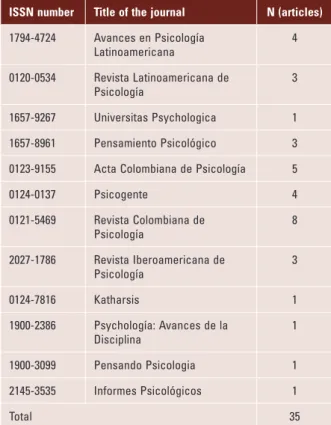
review. Primary studies were reviewed (clinical trial or controlled clinical trial or randomized controlled trial or case reports). Consisting of 35 articles that were found in the 22 indexed psychology journals that were con-sulted (Table 2) and final selection of eight studies.
Criteria for the selection of studies
For this review, the following criteria were considered: (a) the objective of the study was to identify and review the interventions carried out on the reading and writing processes in children with learning disorders; (b) the articles were written in Spanish or English; (c) primary studies (clinical trial or controlled clinical trial or ran-domized controlled trial or case reports) are included; and (d) the interventions were aimed at children.
Organization of information
The organization of the information was done in an excel matrix; the following information was collected
from each of the studies (title, author, year, objective, sample, instruments, intervention process, results, find-ings, and bibliography).
Results
Once the articles of the search were selected using the aforementioned methodology (eight in Spanish and 23 in English), the following sections characterize Latin American and worldwide research at a first moment, after which the state of the research carried out is com-pared, including the relevance of the interventions and the results presented.
Latin American literature (Spanish)
In general, the research carried out specifically on intervention with children with learning difficulties is found in smaller numbers at a Latin American level (literature in Spanish) compared to the world literature; however, the authors referenced below focus on im-portant aspects that contribute to the promotion of reading and writing skills, favoring the adaptation of children to their school contexts, including parents and
Table 1. Indexed journals and articles in English subject
of the study
ISSN number Title of the journal N (articles)
10769242 Dyslexia 1
02667363 Educational psychology in
practice 1
16641078 Frontiers in Psychology 4
19411243 J. Occup. Ther. Sch. early
intervention 2
02782626 Brain and cognition 1
00066761 BPA applied psychology bulletin 1
21678359 PeerJ 1
00222194 Journal of learning disabilities 1
19326203 Plos One 4
07369387 Annals of dyslexia 1
22131582 NeuroImage: clinical 1
22119493 Trends in neuroscience and
education 1
10870547 Journal of attention disorders 1
18632653 Brain structure and function 1
23171782 Codas 1
00315125 Perceptual and motor skills 1
Total 23
Table 2. Indexed journals and articles in Spanish found
ISSN number Title of the journal N (articles)
1794‑4724 Avances en Psicología
Latinoamericana 4
0120‑0534 Revista Latinoamericana de
Psicología 3
1657‑9267 Universitas Psychologica 1
1657‑8961 Pensamiento Psicológico 3
0123‑9155 Acta Colombiana de Psicología 5
0124‑0137 Psicogente 4
0121‑5469 Revista Colombiana de
Psicología 8
2027‑1786 Revista Iberoamericana de
Psicología 3
0124‑7816 Katharsis 1
1900‑2386 Psychología: Avances de la
Disciplina 1
1900‑3099 Pensando Psicologia 1
2145‑3535 Informes Psicológicos 1
teachers so that the changes made can also be present in their social context.
Initially, the execution of a neuropsychological intervention program was highlighted through game activities that sought to improve the abilities related to the reading process, such as accuracy, speed of read-ing, comprehension of texts, and phonological aware-ness. The children were evaluated through tests of cognitive assessment and IQ that showed improvement in their reading performance (child neuropsychological assessment – ENI and WISC IV)19.
In this sense, other investigations developed literacy programs focused on the phonological awareness com-ponent. Different visopráxicas activities and the spatial location were presented to strengthen the corporal and spatial scheme to generate changes in the phonological processing of the words. The authors concluded that this type of intervention programs has a positive impact on the skills that ensure success in learning to read20-22. In addition, the implementation of different activities based on materials such as board games, didactic sup-ports is highlighted. In addition, the implementation of different activities based on materials such as board games, didactic supports and inferential questionnaires is highlighted, which allowed children to develop skills in orality and the elaboration of narrative texts, fostering creativity and imagination together23,24.
The results of psychoeducational programs are pos-itive; there are changes in phonological knowledge and development, language as a social practice, and in semantic and morphosyntactic aspects. The evalua-tions carried out indicate improvement with respect to control groups in said abilities related to reading and writing25,26.
An intervention program was established based on training processes based on rehabilitation tasks in chil-dren with deficiencies in the quality of handwriting, the ability to understand and dominate the text. In the in-tervention, activities and active participation in reading processes (occupation and participation approach to reading intervention) were developed, which allowed to integrate different perspectives in the treatment, education, occupational cognitive psychology, and cog-nitive neuroscience. The results obtained showed an improvement in the objective skills of the intervention in relation to the control group27-29.
The results of intervention programs to reduce the difficulties associated with dyslexia are evaluated through multiple instruments that allow obtaining valid and reliable results. Software was used to train reading skills that showed positive changes in fluency,
accuracy, and speed of reading, general knowledge of vocabulary and comprehension of written texts30.
In this thematic line, an intervention program that implemented visuomotor coordination exercises were carried out, which showed that the strategies were effective to improve the deficits associated with chil-dren with DD (skills of visual discrimination, visual memory, Visual Spatial Relationship, visual closure, phonological awareness, and quality of writing)31,32.
Other investigations have demonstrated the effective-ness of interventions focused on cognitive abilities (attention, memory, executive functions, and among others), using different methodological strategies and evaluating changes through instruments such as func-tional magnetic resonance33-36. In these studies, the effects of intervention programs on functional connec-tivity in areas related to learning processes in children with dyslexia and attention deficit hyperactivity (ADHD) are described. The results showed better functional connectivity in the cingulate-opercular, anterior cingu-late cortex, decrease of components N100 and P300, as well as increase in the accuracy of the writing and decrease in the reaction time (processing speed)33-38.
Music-based programs were also identified that were intended to help improv brain circuits that are common to music and language processes, which in theory could have a positive effect on the specific difficulties in some types of dyslexia. Positive changes were evi-denced in categorical and auditory perception, auditory attention, phonological awareness, reading skills, rep-etition of pseudowords, temporal processing, and rhythm skills39,40.
Continuing with the interventions based on improving the reading processing, specifically in the graph-eme-phoneme, using essentially game strategies. Positive results were shown in the ability to read and decode words in relation to the control group41. In sim-ilar investigations, positive results were presented after the intervention program in phonetic reading, visual words, and reading fluency42-44.
On the other hand, research formulated from a rhyth-mic program of reading education (rhythrhyth-mic reading training), contributed positive effects in the reading and speaking process (sound, word coding capacity, cate-gorical, and auditory perception as well as in the tem-poral component of expression), and the authors conclude that the rhythm facilitates the development of reading skills due to the temporal structure that modu-lates the decoding of words45,46.
out with children of the third grade of schooling (n = 2212), positive changes were generated in spelling, decoding of words and reading comprehension in rela-tion to with the control group. There were no significant differences in vocabulary. For future studies, the author suggests the systematic inclusion of intervention activ-ities but at a lower intensity, in stages that follow the development of reading skills47.
Finally, the intervention programs focused on the family are also necessary. In this sense, training aimed at parents was implemented, which consisted of infor-mation or psychoeducation on the characteristics and management of children with dyslexia, in addition to presenting strategies of promotion of prosocial behav-ior, aimed at reducing behavioral difficulties. In the final evaluation, the parents reported positive changes in their children’s emotional and social skills based on the knowledge and implementation of the strategies learned during the program48,49.
Discussion
According to the review of literature, the various inter-ventions in the child population show significant advanc-es in the implementation of pedagogical strategiadvanc-es and cognitive stimulation through didactic games, which al-low children to improve the understanding and expres-sion of language (acquisition of vocabulary, understand-ing of texts, and among others). Activities related to music were also implemented to improve reading skills, the components of phonological awareness, spatial lo-cation, and indispensable aspects in the development of phonoarticulation related to the reading process.
It is important to mention that most intervention pro-grams allowed the promotion of reading and writing skills, although the research that presented results that were not improved from the activities carried out in their intervention programs is also highlighted. The interven-tion processes demonstrate the effectiveness of vari-ous processes aimed at improving learning problems. Among them, the use of pedagogy, music, and cogni-tive stimulation is mentioned as a complement to basic school skills. This implementation allowed advances in students with learning difficulties.
In general, the investigations are highlighted for their methodological quality (pre-post or repeated measure-ment designs, broad samples, random assignation of the participants to the experimental and control groups, instruments with validity and reliability data, and among others). It is taken into account that despite the few results of the search conducted in Spanish in the past
10 years, the research carried out contributes to the development of increasingly specific intervention pro-grams for children with learning disorders, including different methodological strategies. The intervention programs include children with difficult socioeconomic characteristics and contribute not only in the school environment but also in social contexts.
The studies published in English mostly present the methodological characteristics that identify a quality article. The presence of Latin American authors is high-lighted in the revised articles in English, which denotes the collaboration of authors from different regions of the world to produce knowledge that contributes to the needs and/or particular difficulties of children with learning difficulties.
Finally, the articles in English and Spanish included in the results of the study differ essentially in the meth-odological aspects, the Latin American studies with intervention programs focused on the literacy process-es in children with learning difficultiprocess-es prprocess-esent small samples, evaluation instruments not validated in His-panic-Latin American population and without reliability data, the children that make up each of the experimen-tal and control groups are not randomized; therefore, the results are not generalizable.
Conclusion
The current state of empirical research published in Spanish in intervention processes in children with learning difficulties is fewer in number in the past 10 years compared to literature in English, as evidenced by the search performed. The comparison established with literature published in English indicates progres-sive advances of Latin American scholarship in the topic addressed in this review, specifically in interven-tion programs focused on specific difficulties associat-ed with learning disorders and the characteristics presented by each of the children.
References
1. Bruner J. Desarrollo Cognitivo y Educación. Madrid: Morata; 1998. 2. Pinzás J. Metacognición y Lectura. Lima: Fondo Editorial PUCP; 2003. 3. Talero C, Espinosa A, Vélez A. Dificultad del aprendizaje de la lectura
en las escuelas de una localidad de Bogotá. Acta Neurol Colomb. 2005; 21:280-8.
4. Ardila A, Rosselli M. Neuropsicología Clínica. México: Manual Moderno; 2007.
5. Matute E, Ardila M, Roselli A. Trastorno de la lectura. In: Roselli M, Matute y ME, Ardila A, editors. Neuropsicología del Desarrollo Infantil. México: Manual Moderno; 2010. p. 139-60.
6. Matute E, Roselli A, Ardila M. Trastorno de la expresión escrita. En: Roselli A, Matute y ME, Ardila A, editors. Neuropsicología del Desarrollo Infantil. México: Manual Moderno; 2010. p. 161-80.
8. Álvarez-Otero B, Monereo C. Evaluación del conocimiento estratégico de los alumnos a través de tareas auténticas de escritura en clase de ciencias naturales. Av Psicol Latinonot. 2010;28:251-64.
9. Lopera F. Dificultades del aprendizaje. In: Díaz R, Cornejo W, editors. Neurología Infantil. Medellín: Universidad de Antioquia; 2002. p. 224-42. 10. Rivas A. América Latina Después de PISA: lecciones Aprendidas de la
Educación en Siete Países (2000-2015). Argentina: Fundación CIPPEC; 2015.
11. Aponte-Henao M, Zapata-Zabala ME. Caracterización de las funciones cog-nitivas de un grupo de estudiantes con trastornos específicos del aprendiza-je en un colegio de la ciudad de Cali, Colombia. Psychologia. 2013;7:23-34. 12. Sattler J, Weyandt L. Discapacidades específicas para el aprendizaje.
Evaluación infantil: aplicaciones Conductuales y Clínica. Vol. 2. México: El Manual Moderno; 2003. p. 293-349.
13. Pardo NA. Prevalencia del Trastorno Específico de la Lectura en una Muestra de Instituciones Educativas de la Localidad 19 de Bogotá. Co-lombia: Universidad Nacional de Colombia; 2015.
14. Defior S, Serrano F. Dislexia en español: bases para su tratamiento y diagnóstico. Dislexia definición e intervención en hispanohablantes. En: Matute E, Guajardo S, editors. Dislexia: definición e Intervención en Hispanohablantes. México: Manual Moderno; 2012. p. 15-35. 15. Artigas-Pallarés J. Dislexia: enfermedad, trastorno o algo distinto. Rev
Neurol. 2009;48:63-9.
16. Portellano Pérez J. La Disgrafía. España: Editorial Paidós; 1985. 17. Dueñas M. Tengo un Hijo Disléxico. Madrid: Temas de Hoy; 1987. 18. Fabelo S, del Carmen M. Prevención de las disgrafías escolares:
nece-sidad de la escuela actual para la atención a la divernece-sidad: una mirada desde Cuba. Nóesis Rev Ci Soc Humanit. 2006;15:117-33.
19. Cadavid-Ruiz N, Rosas R, Quijano-Martínez MC, Tenorio M. El juego como vehículo para mejorar las habilidades de lectura en niños con di-ficultad lectora. Pensamiento Psicol. 2015;12:23-38.
20. Flórez-Romero R, Restrepo MA, Schwanenflugel P. Promoción del alfa-betismo inicial y prevención de las dificultades en la lectura: una experien-cia pedagógica en el aula de preescolar. Av Psicol Latinonot. 2009;27:79-96. 21. Córdova E. Intervención de la lectoescritura en una niña con dislexia.
Pensamiento Psicol. 2014;12:55-69.
22. Vargas A, Villamil W. Diferencias en el rendimiento lector entre dos grupos de niños de transición debidas a una intervención promotora del alfabetismo emergente en el aula. Rev Colomb Psicol. 2007;16:65-76. 23. Castilla C, Amaya MY, Amaya YP, Laguna YV. Influencia del juego como
pilar de la educación en el desarrollo del lenguaje oral y escrito por medio de los juegos de mesa. Rev Iberoam Psicol. 2014;7:39-48. 24. Duque-Aristizábal C. Exploración de la comprensión inferencial de textos
narrativos en niños de preescolar. Rev Colomb Psicol. 2010;19:21-35. 25. Morales D, de Delia J, Mota MC, García EZ. La práctica social del
len-guaje como base para la enseñanza de la lectoescritura. Rev Iberoam Psicol. 2012;5:59-66.
26. Valenzuela MJ, Ruiz IM, Ríos MD. Intervención temprana de la lectoes-critura en sujetos con dificultades de aprendizaje. Rev Latinoam Psicol. 2011;43:35-44.
27. Grajo LC, Candler C. An occupation and participation approach to rea-ding intervention (OPARI) Part II: pilot clinical application. J Occup Ther Sch Early Interv. 2016;9:86-98.
28. Grajo LC, Candler C. An occupation and participation approach to rea-ding intervention (OPARI) Part I: defining rearea-ding as an occupation. J Occup Ther Sch Early Interv. 2016;9:74-85.
29. Baldi S, Nunzi M, Brina CD. Efficacy of a task-based training approach in the rehabilitation of three children with poor handwriting quality: a pilot study. Percept Mot Skills. 2015;120:323-35.
30. Tucci R, Savoia V, Bertolo L, Vio C, Tressoldi PE. Efficacy and efficien-cy outcomes of a training to ameliorate developmental dyslexia using the online software reading trainer®. BPA Appl Psychol Bull. 2015;64:53-60.
31. Qian Y, Bi HY. The effect of magnocellular-based visual-motor intervention on Chinese children with developmental dyslexia. Front Psychol. 2015;6:1-7. 32. Fusco N, Germano GD, Capellini SA. Efficacy of a perceptual and vi-sual-motor skill intervention program for students with dyslexia. Codas. 2015;27:128-34.
33. Horowitz-Kraus T. Differential effect of cognitive training on executive functions and reading abilities in children with ADHD and in children with ADHD comorbid with reading difficulties. J Atten Disord. 2015;19:515-26. 34. Horowitz-Kraus T. Improvement in non-linguistic executive functions fo-llowing reading acceleration training in children with reading difficulties: an ERP study. Trends Neurosci Educ. 2015;4:77-86.
35. Horowitz-Kraus T, DiFrancesco M, Kay B, Wang Y, Holland SK. Increa-sed resting-state functional connectivity of visual and cognitive-control brain networks after training in children with reading difficulties. Neuroi-mage Clin. 2015;8:619-30.
36. Horowitz-Kraus T, Holland SK. Greater functional connectivity between reading and error-detection regions following training with the reading acceleration program in children with reading difficulties. Ann Dyslexia. 2015;65:1-23.
37. Moreau D, Waldie KE. Developmental learning disorders: from generic interventions to individualized remediation. Front Psychol. 2016;6:1-8. 38. Horowitz-Kraus T, Toro-Serey C, Difrancesco M. Increased resting-state
functional connectivity in the cingulo-opercular cognitive-control network after intervention in children with reading difficulties. PLoS One. 2015;10:1-21.
39. Habib M, Lardy C, Desiles T, Commeiras C, Chobert J, Besson M, et al. Music and dyslexia: a New musical training method to improve reading and related disorders. Front Psychol. 2016;7:26.
40. Flaugnacco E, Lopez L, Terribili C, Montico M, Zoia S, Schön D, et al. Music training increases phonological awareness and reading skills in developmental dyslexia: a randomized control trial. PLoS One. 2015; 10:e0138715.
41. Jeffes B. Raising the reading skills of secondary-age students with se-vere and persistent reading difficulties: evaluation of the efficacy and implementation of a phonics-based intervention programme. Educ Psy-chol Pract. 2016;32:73-84.
42. Fraga-Gonzalez G, Zaric G, Tijms J, Bonte M, Blomert L, Leppanen P, et al. Responsivity to dyslexia training indexed by the N170 amplitude of the brain potential elicited by word reading. Brain Cogn. 2016;106:42-54. 43. McArthur G, Castles A, Kohnen S, Larsen L, Jones K, Anandakumar T,
et al. Sight word and phonics training in children with dyslexia. J Learn Disabil. 2015;48:391-407.
44. McArthur G, Kohnen S, Jones K, Eve P, Banales E, Larsen L, et al. Replicability of sight word training and phonics training in poor readers: a randomised controlled trial. Peer J. 2015;2015:1-21.
45. Bonacina S, Cancer A, Lanzi PL, Lorusso ML, Antonietti A. Improving reading skills in students with dyslexia: the efficacy of a sublexical training with rhythmic background. Front Psychol 2015;6:1510.
46. Cancer A, Bonacina S, Lorusso ML, Lanzi PL, Antonietti A. Rhythmic reading training (RRT): a computer-assisted intervention program for dyslexia. In: Giakoumis D, Lopez G, Matic A, Serino S, Cipresso P, editors. 5th International Conference on Pervasive Computing Paradigms for Mental Health, Mind Care 2015. Tokyo, Japan: Springer Verlag; 2016. p. 249-58.
47. Wolff U. Effects of a randomized reading intervention study aimed at 9-year-olds: a 5-year follow-up. Dyslexia. 2016;22:85-100.
48. Heim S, Pape-Neumann J, van Ermingen-Marbach M, Brinkhaus M, Grande M. Shared vs. specific brain activation changes in dyslexia after training of phonology, attention, or reading. Brain Struct Funct. 2015; 220:2191-207.