1
Impacts of authenticity, degree of adaptation and cultural contrast on
travellers’ memorable gastronomy experiences
Carmen Antón Associate Professor Department of Business and Marketing, University of Valladolid
Facultad de Ciencias Económicas y Empresariales Avenida del Valle Esgueva, 6 – 47011 Valladolid, Spain. e-mail: [email protected]. Tf. 34-83-423413 Fax. 34-83-423899
Carmen Camarero (corresponding author) Associate Professor Department of Business and Marketing, University of Valladolid Facultad de Ciencias Económicas y Empresariales Avenida del Valle Esgueva, 6 – 47011 Valladolid, Spain. e-mail: [email protected]. Tf. 34-83-423332 Fax. 34-83-423899
Marta Laguna Associate Professor Department of Business and Marketing, University of Valladolid Facultad de Ciencias Sociales, Jurídicas y de la Comunicación Plaza Alto de los Leones, 1 – 40005 Segovia, Spain. e-mail: [email protected]
Tf. 34-83-423000-2111 Fax. 34-83-423899
Dimitrios Buhalis Professor International Centre for Tourism and Hospitality Research (ICTHR)
School of Tourism, Bournemouth University, Talbot Campus, Fern Barrow, Poole, Dorset, BH12 5BB, UK
e-mail: [email protected]
Tel: +44 1202 961517 Fax: +44 1202 515707
This is the accepted version of the manuscript: Antón, C., Camarero-Izquierdo, C., Laguna-García, M., y Buhalis, D. (2019). Impacts of authenticity, degree of adaptation and cultural contrast on travellers’ memorable gastronomy experiences. Journal of Hospitality Marketing & Management, 1-22. https://doi.org/10.1080/19368623.2019.1564106
Funding
2
IMPACTS OF AUTHENTICITY, DEGREE OF ADAPTATION AND CULTURAL CONTRAST ON TRAVELLERS’ MEMORABLE GASTRONOMY EXPERIENCES
ABSTRACT
Gastronomy is an essential component of the travel experience and isbecoming one of the “best things to do” in many destinations. Impressions gained from local food coupled with tourists’ attitudes can influence the living experience. This paper analyses the extent to whichthe perceived authenticity of local food, the degree of adaptation andcultural contrast determine memorable tourist experiences. Moreover, itproposes the moderating effect of searching for authenticity andadaptation ability. Results from a sample of international tourists whotried a typical dish support the positive effect of authenticity and culturalcontrast on the perceived experience, whereas product adaptationreduces the perception of authenticity and cultural contrast. Authenticityhas a greater effect on experience perception when actively sought bytourists, and individuals are less influenced by cultural contrast whenthey are unable to adapt to different cultures.
3
IMPACTS OF AUTHENTICITY, DEGREE OF ADAPTATION AND CULTURAL
CONTRAST ON TRAVELLERS’ MEMORABLE GASTRONOMY EXPERIENCES
1. Introduction
Understanding and appreciating other cultures involves acquiring a knowledge of their gastronomy
(Mason & Paggiaro, 2012; Mak, Lumbers, Eves, & Chang, 2013). In fact, one key component of
the tourism experience comes from the local food, that is, from culinary or gastronomy tourism.
Tourists are motivated by the desire to experience the real life of local people and to enjoy an
authentic experience of the destination’s culture (Chang, Kivela, & Mak, 2010; Mak et al., 2013),
part of which involves tasting the local food. Recently, interest in this topic has increased. Food is
now deemed to be a vital tourism resource (Henderson, 2009; Özdemir & Seyitoglu, 2017) and
travel dining is considered a core experience (Chang, Kivela, & Mak, 2011).
Despite gastronomy’s importance as a powerful creator of cultural identity (Hillel, Belhassen, &
Shani, 2013), a key motivator and an important pull factor, studies addressing the mutual link or
interrelationship between tourism and food remain scarce amongst scholars (Cohen & Avieli, 2004;
Mak, Lumbers, & Eve, 2012a), and few studies analyse it from a quantitative perspective (Okumus,
Koseoglu, & Ma, 2018). Many aspects of tourist experiences with local food remain unexplored or
misunderstood (Sidali & Hemmerling, 2014). What kind of food experience is desirable for
tourists? Does a sharp cultural contrast positively impact on overall tourist experience? Can
authentic products and a major cultural contrast when eating local food spark unpleasant
experiences? To what extent is it advisable to adapt local cuisine to international visitors?
Although tourist literature has emphasized the authenticity of cultural attractions as an antecedent
4
experience (Chang et al., 2011; Lego & Wood, 2009), the effects of authenticity and cultural
contrast in the case of food are not so clear. Firstly, the abundance of food products in a globalized
market (Sidali & Hemmerling, 2014) coupled with the existence of international food restaurants
worldwide make transforming genuine and authentic local products into a memorable food
experience ever more challenging. Secondly, even if tourists do feel attracted by local cuisine and
are eager to enjoy an authentic and different experience, the real experience may prove unpleasant.
Many authors have shown the ambivalence of gastronomy vis-à-vis triggering “peak touristic”
experiences (Cetin & Bilgihan, 2016; Chang et al., 2011; Mak et al., 2013; Quan & Wang, 2004;
Tse & Crotts, 2005) and as a barrier or unpleasant activity they prefer to avoid.Cohen and Avieli
(2004) alert to the two faces of food in tourism: the culinary experience does not always mean
fresh, exotic, and succulent food, but also, unfamiliar, unpalatable and disgusting dishes. Local
food may be an obstacle to tourism due to the problem of offering culturally acceptable food.
In the current study, we posit that the experience may be more singular, intense and memorable
when tourists perceive authenticity in local food and when there is a sharp cultural contrast.
However, these effects are moderated by tourists’ characteristics: the search for authenticity and
the ability to adapt. Moreover, restaurants and establishments can mediate between tourists and
local cuisine (Cohen & Avieli, 2004). In many cases, local dishes are transformed in various ways
in order to suit tourists’ tastes and make the dishes more acceptable, at the risk of altering the
perceived authenticity and cultural contrast. The desire to expand the potential market of certain
restaurant chains has, as noted by Hillel et al. (2013), even caused some types of cuisine to seem
more of an artificial creation or marketer’s invention than something to emerge from culinary
tradition and ongoing historical processes. Based on these considerations, we also explore the
influence of product adaptation on perceived food characteristics, the perceived experience and
5
of international tourists who tried a local product of Spanish gastronomy. This is a case study of
special interest since we have chosen an iconic dish in the local cuisine of Segovia (World Heritage
City), which is well known, closely linked to the image of this tourist destination and that may be
representative of traditional dishes in other gastronomic cultures.
The paper’s major contribution is to offer guidelines concerning the required degree of adaptation
and authenticity of the culinary experience. Findings support the idea that authenticity and cultural
contrast are relevant attributes of the experience and that adapting products reduces the perception
of food authenticity and cultural contrast. Moreover, authenticity has a greater effect on the
experience when tourists actively seek it. However, when individuals are able to adapt to different
cultures, the cultural contrast has no effect on perceived experience.
2. Conceptual framework and hypotheses
2.1. Tourist gastronomy experiences
In today´s context, gastronomy is a key component of the tourist experience in the destination and
the notion of a symbiotic relationship between tourism and food is widespread (Kivela & Crotts,
2006; Özdemir & Seyitoglu, 2017). Tourist destinations are more keenly aware of the benefits and
positive impact of gastronomy on their development and local economy (Mak, Lumbers, Eve, &
Chang, 2012b; Sims, 2009). Food can be a strategic tool in destination planning and may reinforce
environmental protection and contribute towards developing a sustainable tourism sector. It is
therefore a key factor in promoting local products and attracting new visitors (Kivela & Crotts,
2006; Sidali & Hemmerling, 2014; Okumus & Cetin, 2018).
Hall, Sharples, Mitchell, Macionis, & Cambourne (2003) underpin the difference between
gastronomy and food tourism (food as a primary purpose of the trip) and the consumption of food
6
is, the role of gastronomy as a significant, essential and enriching aspect of the tourist experience.
Nevertheless, even if food is not the primary purpose of a trip, eating should be considered as
something more than just a supporting activity or an extension of visitors’ daily routines (Quan &
Wang, 2004). Consumption of food must be seen as a “peak experience” that can contribute to the
visitor having a singular, memorable and intense experience (Quan & Wang, 2004).
From the tourist perspective, gastronomy is a crucial element of intangible heritage and has an
enormous capacity to single out a destination. Food consumption can increase tourists’ knowledge
of the local cuisine and may lead them to holistic and pleasurable sensory experiences (Chang et
al., 2011; Henderson, 2009) that generate feelings and emotions (Kivela & Crotts, 2006), thus
reinforcing their involvement in the destination’s local culture. According to Mason and Paggiaro
(2012), the food experience is holistic since it results from the interaction of sensorial, affective,
cognitive, behavioural and social experiences. As the WFTA (the World Food Travel Association)
has noted, destinations are the place where “food and beverage meet travel and hospitality”. Local
food displays an enormous potential to forge a close-knit link between visitors and the place, its
people, its history and its culture, and therefore to enhance the visitor experience and make it more
enriching (Mak et al., 2012b; Sims, 2009). Gastronomy tourism –as a hedonic product- can offer
pleasure, entertainment, and excitement and can help tourists to discover, understand and share
differences between their culture and others they come into contact with.
Individuals’ overall appraisal of their experience plays a key role in their future decisions and
behaviour. In the area of tourism, said future behaviour has often been measured as the intention
to revisit the destination and to recommend the visit to others (Baker & Crompton, 2000; Barnes,
Mattsson, & Sørensen, 2016; Oppermann, 2000). In other words, the perception of a memorable
experience influences the intention to repeat the visit and to recommend the destination (Ali, Ryu,
7
they are more likely to want to repeat the experience and are therefore more likely to want to revisit
the destination (Barroso, Martín, & Martín, 2007; Chen & Tsai, 2007). A memorable food
experience is thus a motivation and an inducement to live the experience again, to return to a
destination and try the same food again. Kivela and Crotts (2006), for instance, found that one
reason to return to Hong Kong was the expectation of gastronomy, and Sparks, Bowen, and Klag,
(2003) also linked the intention to return to a wine region with past gastronomical experience
thereof. Mason and Paggiaro (2012) find that in culinary tourism, emotional experience is
positively related to satisfaction, which in turn has a positive impact on behavioural intention.
Finally, Alderighi, Bianchi, and Lorenzini, (2016) also indicate that previous experience with local
food specialities is positively related to the intent to revisit a destination, Ji, Wong, Eves, and
Scarles (2016) confirm a direct positive impact of food satisfaction on tourist loyalty (revisit
intention and WOM), and Lee, Sung, Suh, and Zhao (2017) find that satisfaction with a food and
wine festival had a positive effect on attendee intention to revisit the destination.
Moreover, after the visit, individuals may be willing to share their food experiences with other
potential visitors. Tourists like to talk about what they have learnt and felt during their visit and to
evoke pleasant memories of their stay (Ali et al., 2016). A distinctive or memorable food
experience may therefore play a decisive role in their intention to share and recommend the
destination to those around them (Chen & Tsai, 2007; Um, Chon, & Ro, 2006) and through social
networks (Wang & Fesenmaier, 2004; Yoo & Gretzel, 2011). Travellers who experience more
intense feelings (whether positive or negative) and are more engaged in places and events are more
likely to share their experiences (Kim & Fesenmaier, 2017, p. 31). Therefore,
H1. The perception of a memorable food experience has a positive effect on tourists’ behavioural
8
In the following sections, we explore in depth food’s characteristics (authenticity, cultural contrast,
and adaptation) and tourists’ profile (search for authenticity and adaptation ability) as determinant
factors of experience perception and behavioural intentions.
2.2. Food characteristics
Since we posit that memorable food experiences impact on tourist behaviour, the question is to
ascertain which characteristics of the food experience make it memorable. In the current paper, we
focus on three attributes: authenticity, cultural contrast and adaptation.
2.2.1. Authenticity
Authenticity is a complex concept widely studied in different areas (sociology, anthropology,
psychology, economy, marketing, etc.). This concept has been associated with terms such as
“genuine”, “real”, “trustworthy”, “tradition” or “origin”. A review of the literature reflects the
intense and controversial debate surrounding this construct and what should and should not be
considered authentic. However, in the tourist context, there is currently general consensus
vis-à-vis the idea that authenticity is not based on a static and hermetic understanding of place and culture
but that the authenticity of the experience is subjective and is determined by visitor perception
(Castéran & Roederer, 2013; Sidali & Hemmerling, 2014; Sims, 2009; Wang, 1999).
Authenticity is a key construct in the tourist sphere, due to the experiential nature of tourist services
(Pine & Gilmore, 1998; Sidali & Hemmerling, 2014). Yeoman, Brass, & McMahon-Beattie (2007,
p. 1133) define “authenti-seeking” as “consumers searching for authenticity in a range of products,
services and experiences or looking for it within themselves”. It is widely accepted that authenticity
is a key motivator and becomes an important aspect when visitors evaluate their travel experiences
(Chang et al. 2011; Lego & Wood, 2017; Yeoman et al., 2007) although not all of them pursue it
9
work has shown that heritage, culture, natural resources and food, among others, can be distinctive
resources which display the potential to attract authenticity seekers (Chang, et al., 2010). However,
authenticity has a marked personal character as it is a subjective evaluation (Hillel et al., 2013;
Newman & Dhar, 2014) which individuals must experience and discover for themselves (Gilmore
& Pine, 2007; Wang, 1999).
In this vein, more recent research considers tourism activities as suppliers or creators of experiential
authenticity (Steiner & Reisinger, 2006; Yeoman et al. 2007). Consequently, local food is
conceived as an authentic experience (Chang et al., 2010; Sims, 2009; Sidali & Hemmerling, 2014).
According to Cohen and Avieli (2004), tourists use different indicators of authenticity (ingredients,
cooking methods, presentation of dishes, etc.) although not all of them determine visitor appraisal
in the same manner. In many gastronomic experiences, tourists evaluate the authenticity of the food
based on how it is prepared whilst in others this might be consolidated by ingredients. Chang et al.
(2011, p. 309) posit that the feeling of authenticity is not confined to whether local cuisine is an
exact replication of traditional cuisine, but can be extended to embrace existential authenticity, that
is, to finding one’s authentic self (Wang, 1999, Steiner & Reisinger, 2006). As Hillel et al. (2013,
p. 201) point out, in the “gastronomic journey of knowing oneself by knowing others, much
depends on the perception of the local food as authentic”.
Kolar and Zabkar (2010) confirm that object-based authenticity and existential authenticity have a
positive influence on tourist loyalty. In a similar line, the findings of Sidali and Hemmerling (2014)
show that subjective and object-based perceived authenticity significantly affect consumption
intention in the case of traditional food. Dining experiences also contribute to make travel visitor
experiences more distinctive and memorable and may lead them to share their experiences in social
10
well trigger their desire to share it with others and to generate content through electronic word of
mouth channels. Therefore, we propose that:
H2. The perception of food authenticity has a positive impact on the perception of a memorable
experience.
H3. The perception of food authenticity has a positive impact on tourists’ behavioural intention
(recommendation -H3a- and intention to repeat -H3b-).
2.2.2. Cultural contrast
Tourism literature suggests that cultural similarity influences the intention to visit destinations
because of a similar cultural background, similar language, or similar religion (Ng, Lee, & Soutar,
2007; Zhang, Li, & Wu, 2017). Byrne and Nelson (1965) termed it the similarity-attraction
hypothesis. Spradley and Philips (1972) or Lepp and Gibson (2003) linked distant cultural
destinations with stress or risk perception. In fact, cultural distance may spark a cultural shock, that
is, the strain and anxiety resulting from contact with a new culture (Winkelman, 1994). However,
Winkelman (1994) indicates that in the early stages of cultural shock people show interest,
excitement or euphoria about a new culture, and differences are perceived as exciting and
interesting. This situation is manifested in the case of tourists whose experience of a destination is
limited. McKercher and Chow (2001) suggest that the greater the cultural distance, the greater the
tourists’ interest in participating in cultural tourism activities (Chang, et al., 2011). According to
Mak et al. (2012a, p. 178), travel is associated with experiencing ‘otherness’, that is, the sense of
being distinct and strange (the perception of the boundaries that divide cultures), as well as new
sights and experiences that are ‘out of the ordinary’.
As regards a destination’s gastronomy, cultural contrast is one aspect of the perceived cultural
distance of a destination that may cause stress, but, at the same time, attraction. In fact, for many
11
tourist experience (Chang et al., 2010; Mak et al., 2012b). Mynttinen, Logrén, Särkkä-Tirkkonen,
& Rautiainen (2015, p. 457) indicate that “exposure to previously unknown food products or
methods of preparation may even change the consumption patterns of a traveller after his or her
return home”. Therefore, the cultural contrast perceived in food may be considered an element that
makes the experience different, unique, and valuable and, consequently, will have a greater impact
on the tourist’s intention to repeat and recommend the experience. The new flavours discovered,
the curiosity, and the sensation of experiencing a new adventure or taking a greater risk when trying
new foods (Tse & Crotts, 2005) can provide tourists with a differential memory of the experience
that stimulates their appreciation of traditional food and activates a unique feeling that impacts
future decisions. An unexpected experience that directly clashes with other cultures and eating
habits can lead tourists to share what they feel and think with others. Therefore,
H4. Cultural contrast has a positive impact on the perception of a memorable experience.
H5. Cultural contrast has a positive impact on the tourist’s behavioural intention (recommendation
-H5a- and intention to repeat -H5b-).
2.2.3. Adaptation
Total authenticity and a sharp contrast in food may be “difficult to digest” for tourists. While some
enjoy trying out new ingredients or cooking methods and wish to taste strange or unfamiliar dishes,
others may prefer familiar gastronomy and thus only try local food if it is adapted to some extent
(Chang et al. 2011). They might otherwise refuse to try autochthonous gastronomic products
because they are perceived as unfamiliar, disgusting, unpalatable or even frightening (Cohen &
Avieli, 2004; Ji et al., 2016).
Cohen and Avieli (2004) suggest that destinations may adapt aspects which do not undermine the
authenticity of the product so as to make it more palatable and attractive. Visitors may therefore
12
without affecting the perceived authenticity of the experiences. However, this option has clashed
with the strictest definition of authenticity, giving rise to debate and controversy in this regard in
tourism literature. Some authors consider that adapting products/experiences to reduce the cultural
contrast for foreign tourists might cause "decaffeinated" levels of authenticity, making these food
experiences an example of "staged authenticity" (MacCannell, 1973). In contrast, Wang (1999)
suggests that tourists seek their own and intersubjective authenticity, and that the issue of whether
the object is authentic or not is irrelevant or less relevant. Therefore, as an exploratory hypothesis,
we propose that the food product’s degree of adaptation may undermine tourists’ perception of
food characteristics, that is, the perceived authenticity and cultural contrast.
H6. Food adaptation has a negative impact on perceived authenticity (H6a) and cultural contrast
(H6b).
2.3. Tourists’ attitudes
Ryu and Jang (2006) explained that a tourist’s intention to experiment with the local cuisine
depends, among other factors, on personal attitudes. As Tse and Crotts (2005, p. 966) point out,
“curiosity is one of the strongest inner forces which drives people to learn, do, experiment, explore
and experience”. Even so, “not every person is ready to immerse himself wholly in an alien
environment” and individuals display different levels of novelty-seeking. Cohen (1972)
distinguished four types of tourists based on the degree of familiarity or novelty they seek in their
travel: drifter, explorer, individual mass tourist and organized mass tourist. Plog’s (1974; 2001)
Model Tourist Behaviour proposed three tourist typologies: (1) allocentrics or venturers are tourists
who enjoy seeking adventure and living new experiences, (2) psychocentrics, non-adventure
individuals who are inclined toward products and a predictable environment which can make them
feel safer; and (3) midcentrics, a mix or combination of the previous two. In a food context, Chang
13
experience, food consumption motivation and dining behaviour: observers –who learn by
observing-, browsers – who conceive food as a supporting experience and prefer safety and security
when dining- and participators who enjoy exploring local culture, authentic experiences and who
seek memorability and fashionability. Finally, Hjalager (2003) identifies four typologies depending
on individuals’ preferences for novelty or familiar experiences: recreational, diversionary,
existential and experimental tourist. In fact, most people’s decisions seek to strike a balance
between safety and novelty-seeking (Cohen, 1972; Cohen & Avieli, 2004), leaving them immersed
in contradictory or dual behaviour. Based on the above, we focus on two traits of tourists that
determine their perception of the food experience: the search for authenticity and adaptation ability.
2.3.1. Search for authenticity
Searching for authenticity affects the degree to which visitors imbue themselves with food and
cultural experiences (Tse & Crotts, 2005). As Cohen and Avieli (2004, p. 760) point out, there are
two contrasting faces of food in tourism: food as an attraction and food as an impediment (hygiene
and health or habits and table manners). They suggest that an attachment to known foods and
cuisine appears to be a general human trait. In a similar line, other authors such as Ji et al. (2016),
distinguish between “neophobic” (a tendency to avoid and a reluctance to eat strange/unusual food)
and “neophylic” (a desire to accept, enjoy and taste strange food) tendencies when trying food,
confirming that both tendencies have an antagonistic effect on the consumption of novel food.
Consequently, individuals who search for local and authentic products and customs in a destination
will enjoy a far more authentic food experience than those who are averse to unpredictable
environments. Therefore, we propose that:
H7. The search for authenticity reinforces the positive effect of authenticity on the perception of a
memorable experience.
14
Individuals take into account the degree of similarities and differences of the countries they travel
to and adapt themselves to the environment in an effort to minimize potential friction during their
leisure trip (Crotts, 2004). However, while some tourists’ motto is “When in Rome, do as the
Romans do”, other tourists have greater difficulty changing their behaviour patterns.
Previous research points out that the ability to adapt (willingness to taste new food) depends on the
food cultural capital acquired by visitors through their learning, prior knowledge, cultural
familiarity or cultural background. Holt (1998) establishes that individuals with a high cultural
capital are more open to trying international cuisine while those with low cultural capital prefer
more familiar food. Similarly, Goolaup, Solér, & Nunkoo (2018, p. 228) find that food tourists
experience surprise in different ways, depending on their food cultural capital. In a similar vein,
Tse and Crotts (2005) conclude that, in addition to cultural capital, nationality influences culinary
experimentation and that first-time visitors and older visitors prefer a limited range of culinary
offerings.
Adaptation ability might strengthen the effect of the cultural contrast on how the experience is
perceived. Winkelman (1994) suggests that individuals’ abilities which make them good at
intercultural communication and adaptation might reduce cultural shock, i.e., the ability to
communicate effectively, the ability to establish interpersonal relationships, cultural empathy, and
the ability to behave in an appropriate way and show respect. Tourists’ adaptation ability will thus
favour the positive effect of food cultural contrast on a perceived memorable experience. Thus,
H8. Adaptation ability reinforces the positive effect of the cultural contrast on the perception of a
memorable experience.
Insert here Figure 1
3. Methodology
15
Data were collected through a survey conducted among international tourists visiting the city of
Segovia (Spain). Segovia is a World Heritage City and one of its main attractions is its cuisine,
which has become a bastion of Segovia's tourist industry and is supported by the excellent
agricultural and livestock products of the land. The main local dish is cochinillo asado or roast
suckling pig, which is considered a delicacy the world over. The pigs weigh no more than 4-5
kilograms, are only milk-fed, are not over three weeks old, and are cooked with wood in a special
natural clay oven. This is one of the most famous and outstanding dishes of Segovia´s cuisine. The
characteristics of the dish reflect Quan and Wang’s (2004) description of novel food experiences
that include “the ingredients of foods being novel and enjoyable; the way that food is delivered or
consumed being novel; and the “core” as opposed to “peripheral” ingredients remaining
unchanged” (Ji et al., 2016, p. 392).
A questionnaire was designed to measure the variables in the model. Previously, several interviews
were conducted amongst those responsible for the city’s gastronomy tourism together with
restaurant owners and managers, all of whom were prominent exponents of traditional gastronomy.
The information gathered guided the research focus, thus enabling us to devise the wording of the
questions.
A group of professional surveyors were in charge of data collection. International tourists were
contacted at the exit of some restaurants and were asked whether they had eaten cochinillo asado.
Those who had eaten it were interviewed. A total of 286 valid questionnaires were collected. The
sample consisted of 50.3% men and 49.7% women. Age distribution was 24.3% up to 30 years old,
37.7% from 30 to 40 years old; 18.7% from 40 to 50 years old; and 19.3% over 50 years old. 40.5%
were European visitors, 29.9% American visitors, 26.8% Asian visitors, and 2.8% from other
countries. Respondents were asked about their motives for visiting Segovia through five-point
16
motive were as follows: food and cuisine (4.57), cultural experience (4.38), visiting monuments
and national heritage sites (4.35), leisure (4.16), rest and relaxation (4.10), shopping (3.57), and
business trip or work (1.85).
3.2. Measurement of variables
When possible, measurement scales were adopted from past research and adjusted to the context
of the current study. All the variables were measured using five-position Likert scales.
In this study, we emphasize the tourist perspective on authenticity as something subjective and
experiential (Kolar & Zabkar, 2010). Thus, the scale for measuring the perception of authenticity
comprises four items that reflect the extent to which tourists perceived eating cochinillo as an
authentic experience and one which allows them to learn and understand local culture and
traditions. These items are adapted from the scales proposed by Brida, Disegna, & Osti (2013),
Kolar and Zabkar (2010), and Robinson and Clifford (2012).
Perceived cultural contrast was measured through an ad hoc scale comprising three items reflecting
the extent to which eating cochinillo is perceived as exotic or unfamiliar (Hartmann, Shi, Giusto,
& Siegrist, 2015). In order to measure individuals’ search for authenticity, we created a three-item
scale that indicates the tourist actively seeking local and genuine products. Adaptation ability was
measured by five items, indicating the tourist’s general ability to adjust to other cultures and to
enjoy other traditions. These items were developed based on previous research focused on food
preferences (Chang et al., 2011). For perceived experience, we adapted some indicators of the
scales proposed by Kim, Ritchie, & McCormick (2012), Rahman and Reynolds (2015), and Wang
(2011). Specifically, we considered five items that reflect the extent to which the experience was
remembered positively (memorable, stimulating, exciting, or interesting). Adaptation of the food
experience was measured as a dichotomous variable. Restaurants serve cochinillo in different ways.
17
possibility is to cut it up into pieces and simply serve it as a piece of meat (see Figure 2b). Even if
it maintains the authenticity of the product (it is the same dish, the same product, the same quality,
and the same cooking method), the way it is served is adapted. This adaptation involves eliminating
one characteristic of novel food experiences; that is, the way the food is delivered is not novel.
Figure 2a was considered a non-adapted product and Figure 2b an adapted product. Individuals
were thus asked how the cochinillo they had eaten had been presented. 56.8% had tasted the
adapted product and 43.2% the non-adapted product.
Insert here Figure 2
The recommendation or word-of-mouth (WOM) and intention to repeat scales are based on those
used by Barroso et al. (2007), Yoon and Uysal (2005), and Mason and Paggiaro (2012). WOM was
measured with just two items reflecting the individual’s intention to recommend the cochinillo and
to post comments about it on social networks such as Tripadvisor. The intention to repeat is also
measured with two items that indicate the intention to return to eat cochinillo and the intention to
return because of the gastronomy.
Finally, the cultural context of the tourists’ home country was introduced as a control variable.
Following Hall’s (1976) classification, we distinguished between high-context and low-context
cultures. This classification differentiates how people communicate in different cultures. High
context implies that communication is less explicit and formal, but is unspoken and implicitly
transferred, while low context implies that information is public and external, and explicitly
exchanged. In line with this typology, the sample consisted of 54.2% of individuals belonging to
low-context cultures (Europe and North America) and 45.8% belonging to high-context cultures
(Asia and South America).
Partial least squares (PLS) was used to perform the joint estimation of the measurement model and
18
provides parameter estimates that maximize the explained variance (R² values) of the dependent
constructs. In PLS, measurement and structural parameters are estimated via an iterative procedure
that combines simple and multiple regression by traditional Ordinary Least Squares (OLS), thus
avoiding any distributional assumption of the observed variables (Hair, Ringle, and Sarstedt, 2011).
In order to verify the hypotheses proposed in the model using the PLS approach, so-called path
coefficients need to be analysed, applying three kinds of criteria; sign, size and significance, the
latter estimated from the Student t value. To do this, the chosen software applies a re-sampling procedure known as bootstrapping that generates a series of samples from an original sample (in
this study, 500 sub-samples were randomly generated). Estimations of the final parameters are
calculated as the mean of the estimations obtained in all the samples generated, enabling their
significance to be determined from the distribution of the parameters estimated around the mean
(Hair, Anderson, Tatham, & Black, 1999).
Table 1 shows the variables used in the study and the measurement indicators together with the
corresponding descriptive statistics (mean and standard deviation). Information is also provided
concerning the outcomes of the reliability and validity analysis of the measurement scales used.
Composite reliability (CR) and average extracted variance (AVE) values are given, as are the factor
loadings, all of which yielded acceptable values and are above recommended thresholds (CR>0.7,
AVE>0.5, and standardized loadings>0.7), except for the cultural contrast variable (one item with
a standardized loading below 0.7). Table 2 shows the correlation matrix. The Fornell-Larker
criterion confirms discriminant validity. In all cases, the AVE of each variable exceeds the value
of its squared correlation with the other variables.
Insert here Table 1
19
Since we collected survey data from single informants, common method variance (CMV) bias is a
threat to the validity of our results. In order to avoid CMV bias, item wording was revised so as to
avoid ambiguous or unfamiliar terms and the question order did not match the causal sequence in
the model. In order to gauge the impact of common method bias, Harman’s single-factor test was
conducted. Exploratory factor analysis with all the indicators reveals six factors with an eigenvalue
greater than one accounting for less than 69% of explained variance, and with a first factor
explaining 15.4% of total variance. This result indicates that CMV is not an issue in our study.
4. Analysis and results
As already pointed out, PLS was used to test the proposed hypotheses. Structural model evaluation
is conducted by examining the size and significance of the path coefficients and the R2 value of the
dependent variable. Table 3 sums up the results of the estimation performed. The R2 values are:
R2Perceived experience=0.512 R2WOM=0.293 and R2Intention=0.284.
Insert here Table 3
With these results, we find support for H1. The perception of a memorable experience has a positive
effect both on the intention to recommend (=0.493, p<0.01) and the intention to repeat the
experience in the future (=0.333, p<0.01). The perceived authenticity of the food experience
improves the experience perception (=0.300, p<0.01) (H2 is supported). However, we do not find
support for either H3a or H3b. The direct effect of perceived authenticity on the intention to
recommend (=0.038, p>0.10) and to repeat (=0.043, p>0.10) is not significant. H4 is also
supported; cultural contrast has a positive influence on the perceived experience (=0.317, p<0.01).
On the other hand, the perception of cultural contrast has no significant direct effect on
20
the experience (=0.253, p<0.01). Therefore, H5a is rejected and H5b is supported. As for product
adaptation, results confirm the negative and significant effect of adaptation on perceived
authenticity (=-0.125, p<0.05) and on cultural contrast (=-0.123, p<0.05) (H6a and H6b are
supported). We also introduced the direct effect of product adaptation on perceived experience
(=0.030, p>0.10), WOM (=-0.061, p>0.10), and the intention to repeat (=0.007, p>0.10) in
order to rule out a confounding effect, and we observe that these effects are not significant.
Individuals who were given the adapted product perceived less authenticity and less cultural
contrast, although the experience and future behaviour are not directly determined by the way the
product was consumed.
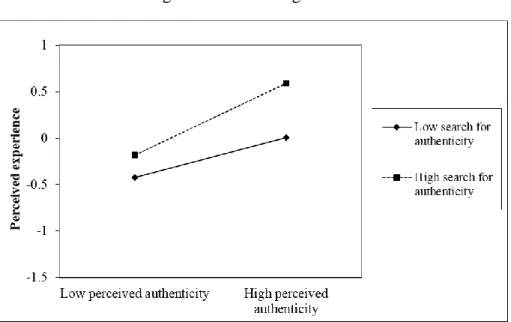
With regard to the moderating effects, the search for authenticity reinforces the positive effect of
authenticity on the perception of a memorable experience (=0.085, p<0.05). H7 is therefore
supported. In Figure 3a, the moderating effect of the search for authenticity is represented. We
observe that authenticity has a greater effect on the perceived experience (greater slope) for those
who seek authenticity. In addition, they show greater levels of perceived experience.
However, contrary to expectations, adaptation ability weakens the impact of cultural contrast on
the experience (=-0.144, p<0.01). The greater the individual’s ability to adapt to different cultures,
the lower the positive effect of cultural contrast on perceived experience. Thus, H8 is rejected. As
can be seen in Figure 3b, while cultural contrast has a positive effect on the experience for
individuals with a lower adaptation ability, in individuals who display a greater ability to adapt, the
degree of cultural contrast has no impact on their perceived experience.
Insert here Figure 3
Finally, the control variable (tourists’ cultural context) has significant effects on perceived
21
(=-0.170, p<0.01), and perceived experience (=-0.078, p<0.10). Tourists who belong to
high-context cultures perceive less authenticity in the cochinillo than tourists from low-context cultures,
added to which their perceived experience is lower. Moreover, tourists from high-context cultures
show less adaptation ability, and the search for authenticity is also lower.
Table 4 shows the indirect and total effects. Results indicate there is a negative indirect effect of
product adaptation on perceived experiences (=-0.076, p<0.05). However, the total effect is not
significant (=-0.047, p>0.10). The positive direct effect (=0.030, p>0.10) offsets the negative
indirect effect (=-0.076, p<0.05); that is, there is a suppressor effect. On the other hand, the
accumulation of the direct and indirect negative effects of product adaptation on WOM (=-0.061,
p>0.10 and =-0.034, p>0.10) results in a significant total effect (=-0.095, although only p<0.10).
Perceived authenticity and cultural contrast show positive and significant total effects on perceived
experience (=0.300, p<0.01 and =0.317, p<0.01), WOM (=0.186, p<0.01 and =0.208,
p<0.01), and the intention to repeat (=0.143, p<0.05 and =0.358, p<0.01). Curiously, perceived
cultural contrast is the variable which has the greatest impact on the intention to return, since it
directly and indirectly affects through perceived experience.
Insert here Table 4
5. Discussion
The OECD (2012) indicates that the focus of many tourists has changed from the classic 'must see'
physical sights towards a ‘must-experience’ imperative to consume intangible expressions of
culture. Food plays a major part in the tourist experience of this intangible culture. Tourists pursue
unique and memorable experiences, with eating and drinking forming an essential part thereof.
22
unfamiliar foods due to the insecurity and perceived risk that changing or breaking their eating
habits may imply for them. This contradictory scenario has meant that destination managers are on
slippery ground. In this context, the current study contributes to furthering our understanding of
the food experience by exploring how the authenticity or adaptation of the gastronomic experience
and cultural contrast impact on the tourist experience and on the way tourists will talk about and
share the experience.
Findings show that the perception of authenticity in the food experience and cultural contrast
determine the perception of a memorable, exciting and interesting experience. In line with previous
researchers (Yeoman et al., 2007; Sims, 2009; Goolaup et al., 2018), our results confirm the
importance of both aspects in the interaction between visitor and gastronomy. In addition,
perceived authenticity and cultural contrast -when resulting in a memorable experience-
significantly influence future tourist behaviour by increasing the intention to recommend the
experience or to repeat it in the future.
Tourists today seek meaningful and evocative experiences (Goolaup et al., 2018; Kim et al., 2012).
Food can be an adventure in itself and a surprising element. The food experience can almost be a
roller coaster that leads the tourist to open up to new flavours, textures and smells, thereby
triggering new sensations. Gastronomy can give the visitor the opportunity to self-explore and
discover new things, thus marking and shaping the experience. In this sense, we confirm that
cultural contrast is a key ingredient of the food experience that adds value, contributing towards
making the visitor experience meaningful and unique. Perceived cultural contrast is the variable
showing the highest impact on revisit intention. It is a reason to return even if the tasting experience
has not proved positive, added to which it also has an indirect effect on WOM. For all these reasons,
cultural contrast is a vital ingredient of gastronomic experiences that should be enhanced so as to
23
Results also show that although product adaptation (for instance, a different presentation or
appearance) diminishes perceived authenticity and cultural contrast, it has no significant effect on
perceived experience. However, when the product is adapted, the intention to recommend or talk
about it is lower than when the tourist has tasted the non-adapted product. Therefore, tourists’
behaviour depends on the product’s degree of adaptation. In line with this result, Cohen and Avieli
(2004) indicate that food involves visual and taste senses, albeit in different directions. While the
visual does not imply any risk to the body, eating does entail direct potential risks. Thus, when
tourists’ expected behaviour mainly depends on their visual sensorial experience (for instance,
sending a photo to friends or posting an image in Trypadvisor) the non-adapted product is
preferable, while when it depends on the taste sensorial experience (perceived experience), the
adapted product is acceptable.
The study also explores the role of the tourist’s profile in the food experience. Results indicate that
the authenticity of the food tasted has a greater effect on the perceived experience for tourists who
are keen to seek authenticity. In fact, these tourists always rate the food experience more highly.
As for individuals who are able to adapt to the habits, uses or traditions of other cultures, cultural
contrast barely impacts on their experience. The greater the tourist’s adaptability the less they are
impacted by perceived differences. One feasible explanation for this is that a greater capacity for
adaptation can predispose individuals towards new food experiences because they look forward to
it. Hence, this anticipation leads them to discount novelty, such that the contrast and the surprise
of the food experience diminishes.
5.1. Managerial implications
Certain managerial implications emerge from the results of this study. It is evident that tourist
destinations should foster the development of tourism through authentic food experiences that
24
the gastronomic experience represents a major contrast or shock, since they will enjoy the
experience more, will be ready to return and will be the magnet for future tourists.
Managers who wish to promote tourism through gastronomy should help to enhance the perceived
visitor experience, by stressing the cuisine’s authenticity and cultural contrast. By developing and
advocating iconic food that offers greater authenticity and provides a sharp contrast for visitors,
destinations and restaurants will be creating suggestive and enriching experiences that distinguish
them from competitors. By reinforcing authentic experiences and cultural contrast, destinations can
develop gastronomic routes to experience the local cuisine in more authentic and unique
environments, merging food with other tangible as well as intangible elements of the destination,
such as landscapes and lifestyles or enjoying the preparation of products and traditional cooking
techniques.
Despite the degree of authenticity or novelty in food experiences, tourists display different attitudes
toward local culture (Chang et al., 2010). These divergences imply a major challenge for tourist
destinations. Tourism managers must often satisfy the contrasting demands of international tourists
(authentic versus adapted-familiar products) whilst striving to preserve the authenticity and cultural
identity of the local cuisine. According to our results, while authenticity is always recommendable,
the degree of adaptation will depend on the expected outcomes. If we focus on tourists’ personal
experience, both adapted and non-adapted products provide a positive experience if the product is
perceived as authentic and unique. However, if we focus on recommendation, WOM, and attracting
new tourists, a non-adapted product is desirable. This has implications for advertising, webpages,
or any visual communication. Using images of non-adapted products in advertising is advisable in
order to highlight the cultural contrast and to encourage WOM or the intention to repeat the
25
Once again, tourist segmentation would appear to be essential vis-à-vis achieving greater tourist
benefits from the local cuisine culture. Tourists who seek authenticity are, evidently, the more
desirable segment for food tourism, while those who are more fearful of differences and novelty
prove less interesting as food tourists. Tourists also can be segmented according to adaptation
capability. In this sense, we may return to the classical distinction between travellers and tourists,
or between experienced and non-experienced tourists. Whereas individuals who experience greater
difficulties adapting to new cultures (perhaps novel and less-experienced tourists) are more struck
by the cultural contrast and, therefore, more surprised by the experience, those who are more
adaptable (travellers or experienced tourists) will enjoy the food experience, even though it will
leave less of an impression on them.
Culinary resources are not always well marketed, and in certain tourist destinations “local foods
are considered a supplementary product rather than a stand-alone attraction in official destination
marketing efforts” (Okumus and Cetin, 2018). Given that food helps to project a destination’s
identity and culture, the image of local food should be treated with the same relevance as other
aspects in terms of marketing promotion and communication. Indeed, branding food tourism must
adopt a cultural approach, where foods are explicitly linked to their place of origin and to local
culture, distinguishing them from those of other competitors (Lai, Khoo-Lattimore, & Wang,
2018).
Marketing strategies should appeal to the authenticity and cultural contrast of local cuisine as
attributes on which to build a solid brand image that differentiates one tourist destination from
another. The image of authentic and exotic food should form an integral part of a destination’s
image. In order to reinforce the aura of authenticity, local food might be linked to cultural heritage,
with information being provided about its historical background and the origin of food
26 5.2. Limitations and further research
Some limitations can be found in this study. First, it focuses on a specific destination and specific
food product, which might bias the kind of authenticity and experience perceived. Second,
additional characteristics of tourist profile, such as prior gastronomic experience, previous
knowledge of Spanish culture, or previous experience in international trips have not been taken
into account. Third, the kind of product consumed in the current research (adapted or non-adapted)
is assumed to depend on the restaurant’s presentation (restaurants present cochinillo in a specific
way). However, we did not control whether tourists selected the restaurant because of the kind of
product served or whether, once inside the restaurant, they requested a specific kind of presentation.
Further research might employ experimental techniques to manipulate different levels of product
adaptation and to control tourist profile.
References
Alderighi, M., Bianchi, C., & Lorenzini, E. (2016). The impact of local food specialities on the
decision to (re)visit a tourist destination: Market-expanding or business-stealing? Tourism
Management, 57, 323-333.
Ali, F., Ryu, K., & Hussain, K. (2016). Influence of experiences on memories, satisfaction and
behavioral intentions: A study of creative tourism. Journal of Travel and Tourism Marketing,
33(1), 85-100.
Baker, D.A., & Crompton, J.L. (2000). Quality, satisfaction and behavioral intentions. Annals of
Tourism Research, 27(3), 785-804.
Barnes, S.J., Mattsson, J., & Sørensen, F. (2016). Remembered experiences and revisit intentions:
27
Barroso, C., Martín, E., & Martín, D. (2007). The influence of market heterogeneity on the
relationship between a destination's image and tourists’ future behavior. Tourism Management,
28(1), 175-187.
Brida, J. G., Disegna, M., & Osti, L. (2013). The effect of authenticity on visitors' expenditure at
cultural events. Current Issues in Tourism, 16(3), 266-285.
Byrne, D., & Nelson, D. (1965). Attraction as a linear function of proportion of positive
reinforcements. Journal of Personality and Social Psychology, 1(6), 659.
Castéran, H., & Roederer, C. (2013). Does authenticity really affect behavior? The case of
Strasbourg Christmas Market. Tourism Management, 36, 153-163.
Cetin, G., & Bilgihan, A. (2016). Components of cultural tourists’ experiences in destinations.
Current Issues in Tourism, 19(2), 137-154.
Chang, R.C., Kivela, J., & Mak, A.H.N. (2010). Food preferences of Chinese tourists Annals of
Tourism Research, 37(4), 989–1011.
Chang, R.C., Kivela, J., & Mak, A.H.N. (2011). Attributes that influence the evaluation of travel
dining experience: When East meets West. Tourism Management, 32(2), 307-316.
Chen, C.F., & Tsai, D. (2007). How destination image and evaluative factors affect behavioral
intentions? Tourism Management, 28(4), 1115-1122.
Chhabra, D., Healy, R., & Sills, E. (2003). Stage Authenticity and Heritage Tourism. Annals of
Tourism Research, 30(3), 702-719.
Cohen, E. (1972). Toward a sociology of international tourism. Social Research, 39, 164-182.
Cohen, E., & Avieli, N. (2004). Food in tourism: Attraction and impediment. Annals of tourism
Research, 31(4), 755-778.
Crotts, J.C. (2004). The effect of cultural distance on overseas travel behaviors. Journal of Travel
28
Gilmore, J.H., & Pine, B.J. (2007). Authenticity: What consumers really want. Harvard Business
Press, Boston, Massachusetts.
Goolaup, S., Solér, C., & Nunkoo, R. (2018). Developing a theory of surprise from travelers’
extraordinary food experiences. Journal of Travel Research, 57(2), 218-231.
Hair, J.F. Anderson, R.E. Tatham, R. L. & Black, W. C. (1999). Análisis multivariante, Prentice
Hall, 5th ed., Madrid.
Hair, J.F., Ringle, C.M., & Sarstedt, M. (2011). PLS-SEM: Indeed a silver bullet. Journal of
Marketing Theory and Practice, 19(2), pp. 139–151.
Hall, C.M., Sharples, L., Mitchell, R., Macionis, N., & Cambourne, B. (2003). Food tourism
around the world: Development, management and markets. Woburn, MA: Butterworth
Heinemann, Oxford.
Hall, E. (1976). Beyond Culture. Nueva York: Anchor Book, Doubleday.
Hartmann, C., Shi, J., Giusto, A., & Siegrist, M. (2015). The psychology of eating insects: A
cross-cultural comparison between Germany and China. Food Quality and Preference, 44, 148-156.
Henderson, J.C. (2009). Food tourism reviewed. British Food Journal,111(4), 317-326.
Hillel, D., Belhassen, Y., & Shani, A. (2013). What makes a gastronomic destination attractive?
Evidence from the Israeli Negev. Tourism Management, 36, 200-209.
Hjalager, A.M. (2003). A typology of gastronomy tourism. In A.M. Hjalager & G. Richards (Eds.),
Tourism and gastronomy (pp. 21-35). London: Routledge.
Holt, D.B. (1998). Does cultural capital structures American consumption? Journal of Consumer
Research, 9(2), 1-25.
Ji, M., Wong, I.A., Eves, A., & Scarles C. (2016). Food-related personality traits and the
moderating role of novelty-seeking in food satisfaction and travel outcomes. Tourism Management,
29
Kim, J., & Fesenmaier, D. (2017). Sharing tourism experiences: The posttrip experience. Journal
of Travel Research, 56(1), 28 - 40
Kim, J.H., Ritchie, J.R.B., & McCormick, B. (2012). Development of a scale to measure
memorable tourism experiences. Journal of Travel Research,51(1), 12–25.
Kivela, J., & Crotts, J.C. (2006). Tourism and gastronomy: Gastronomy´s influence on how tourists
experience a destination. Journal of Hospitality and Tourism Research, 30(3), 354-377.
Kolar, T., & Zabkar, V. (2010). A consumer-based model of authenticity: An oxymoron or the
foundation of cultural heritage marketing? Tourism Management, 31(5), 652-664.
Lai, M. Y., Khoo-Lattimore, C., & Wang, Y. (2018). A perception gap investigation into food and
cuisine image attributes for destination branding from the host perspective: The case of Australia.
Tourism Management, 69, 579-595.
Lee, W., Sung, H., Suh, E., & Zhao, J. (2017). The effects of festival attendees’ experiential values
and satisfaction on re-visit intention to the destination: The case of a food and wine festival.
International Journal of Contemporary Hospitality Management, 29(3), 1005-1027.
Lego Muñoz, C., & Wood, N.T. (2009). A recipe for success: understanding regional perceptions
of authenticity in themed restaurants. International Journal of Culture, Tourism and Hospitality
Research,3(3), 269-280.
Lepp, A., & Gibson, H. (2003). Tourist roles, perceived risk and international tourism. Annals of
Tourism Research, 30(3), 606-624.
MacCannell, D. (1973). Staged authenticity: Arrangements of social space in tourist settings.
American Journal of Sociology, 79(3), 589-603.
Mak, A.H., Lumbers, M., & Eves, A. (2012a). Globalisation and food consumption in tourism.
30
Mak, A.H., Lumbers, M., Eves, A., & Chang, R.C. (2012b). Factors influencing tourist food
consumption. International Journal of Hospitality Management, 31(3), 928-936.
Mak, A.H., Lumbers, M., Eves, A., & Chang, R.C. (2013). An application of the repertory grid
method and generalized Procrustes analysis to investigate the motivational factors of tourist food
consumption. International Journal of Hospitality Management, 35, 327-38.
Mason, M.C., and Paggiaro, A. (2012). Investigating the role of festivalscape in culinary tourism:
The case of food and wine events. Tourism Management, 33(6), 1329-1336.
McKercher, B., & Chow So-Ming, B. (2001). Cultural distance and participation in cultural
tourism. Pacific Tourism Review, 5(1-2), 23-32.
Mynttinen, S., Logrén, J., Särkkä-Tirkkonen, M., & Rautiainen, T. (2015). Perceptions of food and
its locality among Russian tourists in the South Savo region of Finland. Tourism Management, 48,
455-466.
Newman G.E., & Dhar, R. (2014). Authenticity is contagious: Brand essence and the original
source of production. Journal of Marketing Research,51(3), 371-386.
Ng, S.I., Lee, J.A., & Soutar, G.N. (2007). Tourists’ intention to visit a country: The impact of
cultural distance. Tourism Management, 28(6), 1497-1506.
OECD (2012). Food and the Tourism Experience: The OECD-Korea Workshop. OECD Studies
on Tourism, OECD Publishing. Retrieved from http://dx.doi.org/10.1787/9789264171923-en
(accessed January 2018).
Oh, H., Fiore. A.M., & Jeoung. M. (2007). Measuring experience economy concepts: Tourism
applications. Journal of Travel Research, 46(2), 119-132.
Okumus, B., & Cetin, G. (2018). Marketing Istanbul as a culinary destination. Journal of
31
Okumus, B., Koseoglu, M., & Ma, F. (2018). Food and gastronomy research in tourism and
hospitality: A bibliometric analysis. International Journal of Hospitality Management, 73, 64-74.
Oppermann, M. (2000). Tourism destination loyalty. Journal of Travel Research, 39(1), 78-84.
Özdemir, B. & Seyitoglu, F. (2017). A conceptual study of gastronomical quests of tourist:
Authenticity or safety and comfort? Tourism Management Perspectives, 23, 1-7.
Pine, B.J. & Gilmore, J.H. (1998). Welcome to the experience Economy. Harvard Business
Review, 76(4), 97-105.
Plog, S. (1974). Why destination areas rise and fall in popularity? Cornell Hotel and Restaurant
Administration Quarterly, 14(4), 55-58.
Quan, S. & Wang, N. (2004). Towards a structural model of the tourist experience: an illustration
from food experiences in tourism. Tourism Management,25, 297-305.
Rahman, I & Reynolds, D. (2015). Wine: Intrinsic attributes and consumers´ drinking frequency,
experience and involvement. International Journal of Hospitality Management, 44, 1-11.
Ramkissoon, H. & Uysal, M.S. (2011). The effects of perceived authenticity, information search
behaviour, motivation and destination imagery on cultural behavioural intentions of tourists.
Current Issues in Tourism, 14(6), 537-562.
Ringle, C. M., Wende, S., & Becker, J. M. (2015). SmartPLS 3. Boenningstedt: SmartPLS GmbH.
Robinson, R.N.S., & Clifford, C. (2012). Authenticity and festival foodservice experiences. Annals
of Tourism Research, 39(2), 571-600.
Ryu, K., & Jang S.C. (2006). Intention to experience local cuisine in a travel destination: The
modified theory of reasoned action. Journal of Hospitality and Tourism Research, 30(4), 507-516.
Sidali, L.K., & Hemmerling, S. (2014). Developing an authenticity model of traditional food
32
Sims, R. (2009). Food, place and authenticity: local food and the sustainable tourism experience.
Journal of Sustainable Tourism,17(3), 321-336.
Sparks, B., Bowen, J., & Klag, S. (2003). Restaurants and the tourist market. International Journal
of Contemporary Hospitality Management, 15(1), 6-13.
Spradley, J.P., & Phillips, M. (1972). Culture and stress: A quantitative analysis. American
Anthropologist, 74(3), 518-529.
Steiner, C.J., & Reisinger, Y. (2006). Understanding existential authenticity. Annals of Tourism
Research, 33(2), 299-318.
Tse, P., & Crotts, J. C. (2005). Antecedents of novelty seeking: international visitors’ propensity
to experiment across Hong Kong's culinary traditions. Tourism Management, 26(6), 965-968.
Um, S., Chon, K., & Ro, Y. (2006). Antecedents of revisit intention. Annals of Tourism Research,
33(4), 1141-1158.
Wang, H.Y. (2011). Exploring the factors of gastronomy blogs influencing readers´ intention to
taste. International Journal of Hospitality Management, 30, 503-514.
Wang, N. (1999). Rethinking authenticity in tourism experience. Annals of Tourism Research,
26(2), 349-370.
Wang, Y., & Fesenmaier, D. (2004). Towards understanding member´s general participation in and
active contribution to an online travel community. Tourism Management, 25(6), 709-722.
Winkelman. M. (1994), Cultural shock and adaptation. Journal of Counseling and Development,
73(2), 121-126.
Yeoman, I., Brass, D., & McMahon-Beattie, U. (2007). Current issue in tourism: The authentic
tourist. Tourism Management, 28, 1128-1138.
Yoo, K.H., & Gretzel, U. (2011). Influence of personality on travel-related consumer-generated
33
Yoon, Y., & Uysal, M. (2005). An examination of the effects of motivation and satisfaction on
destination loyalty: A structural model. Tourism Management, 26(1), 45-56.
Zhang, Y., Li, X., & Wu, T. (2017). The impacts of cultural values on bilateral international tourist
34
Figure 1. Proposed model
FOOD CHARACTERISTICS Perceived authenticity
Cultural contrast
TOURIST ATTITUDES Search for authenticity
Adaptation ability
PERCEIVED EXPERIENCE
BEHAVIOURAL INTENTIONS WOM
Intention to repeat
H2, H4
H3, H5
H7, H8
H1 Product
(food)
35
Figure 2. Experience adaptation
36
Figure 3. Moderating effects
Figure 3a. Interaction Perceived authenticity * Search for authenticity
37
Table 1. Measurement of variables
Variables and items Mean SD Loadings
Perceived authenticity(CR= 0.885; AVE=0.659)
Eating cochinillo was an authentic experience 3.94 0.814 0.845 I think eating cochinillo has helped me to get a better idea of the local culture 3.86 0.851 0.832 By eating cochinillo, I've learned many things I didn´t know 3.76 0.884 0.772 Now I understand local tradition and the habits of Segovian cuisine 3.78 0.872 0.796
Cultural contrast (CR=0.847; AVE=0.651)
Eating cochinillo has proven to be a great cultural contrast for me 4.37 0.932 0.680 Eating cochinillo is exotic for me 3.94 0.897 0.858 I had hardly heard of this typical dish (cochinillo) 3.90 0.883 0.867
Search for authenticity (CR=0.852; AVE=0.657)
I try to know real products and customs from the place I visit 4.40 0.851 0.827 I avoid tourist-directed products and seek genuine products from the place I visit. 3.94 0.749 0.789 I should eat local food while travelling. That´s what we call “genuine travel” 3.94 0.858 0.815 Adaptation ability (CR=0.899; AVE=0.641)
I really enjoy local culture 3.85 0.789 0.712 I like to immerse myself in the local lifestyle 3.74 0.947 0.784 I like tasting local products 3.98 0.774 0.767 I like practising local traditions 3.68 1.090 0.885 I try to mix with local people and not to look like a tourist 3.63 1.155 0.844 Perceived experience(CR=0.925; AVE=0.711)
I will remember many positive things about cochinillo or this food 3.96 0.845 0.808 This is a memorable food experience 3.88 0.864 0.818 Eating cochinillo was stimulating 3.92 0.968 0.865 Eating cochinillo and the way it´s prepared were exciting 3.97 1.012 0.878 Eating cochinillo was interesting for me 4.11 0.985 0.845 WOM (CR=0.861; AVE=0.756)
If I talk about Segovia, I’ll recommend the cochinillo 3.76 0.933 0.884 I’ll post comments about cochinillo on social networks such as Tripadvisor 3.29 1.149 0.854
Intention to repeat (CR=0.926; AVE=0.862)
I would like to visit Segovia again due to its gastronomy 4.18 1.044 0.930 If I come to Segovia again, I’ll eat cochinillo again 3.87 0.918 0.927
Product adaptation
Non adapted=0; Adapted=1 0.56 0.496 1.000
Cultural context