"GET THEM LOST JUST AS IN THE NARROW STREETS O THE CASBAH": METAPHORS OF RESISTANCE AND SUBVERSION IN TRANSLATION1
Kim WALLMACH University of South Africa (Pretoria)
INTRODUCTION
Of late, (interlingual) translation has become something of a trope, perhaps even a trope of a trope, a metaphor for the transfer of meaning generally and of postcolonial exchanges in particular. This article aims to explore the intertwined relationship of translation, metaphor and resistance in the context of contemporary translation theories, with specific reference to resistive approaches to translation.
The title of this paper alludes to a rather opaque metaphor contained in the phrase “get them lost in the casbah”, which originated in work by the Tunisian writer Adelwahab Meddeb (in MEHREZ, 1992: 123-4). Meddeb states:
L'écriture française nous ‘livre’ à l'autre, mais on se défendra par l'arabesque, la subversion, le dédale, le labyrinthe, le décentrage incessant de la phrase et du langage, de manière que l'autre se perde comme dans les ruelles de la casbah.
[Writing in French 'surrenders' us to the other, but we will defend ourselves with the arabesque, the subversion, the maze, the labyrinth, the incessant decentering of the sentence and of language so that the other will get lost just as in the narrow streets of the casbah.]
In this passage, the image of the casbah or old North African city is deliberately introduced as a way of figuratively resisting the dominant colonial culture of France as embodied in the French language. Meddeb's use of the word casbah as the other pole of the metaphor has the function of superimposing an unfamiliar model on the text (in this case, Arabic culture) which needs to be decoded before the French text can be understood (MEHREZ, 1992: 124). Thus, although Meddeb, as a Tunisian, is writing in French, the language of the coloniser, he ensures that he is able to deliberately cause native speakers of French to lose their way in their own language by using an image which is foreign to the dominant culture but integral to the minority culture - just as they would lose their way in the meandering alleys of the casbah in a Tunisian city. Thus, translation, or in this case, non-translation, of the minority culture, the ‘other’, becomes a metaphor of resistance. In essence, the above example also illustrates the origins in metaphor of resistive approaches to translation.
VENUTI AND RESISTIVE APPROACHES TO TRANSLATION
Lawrence Venuti, one of the most prolific theorists in the cultural studies paradigm in translation and the first to use the term ‘resistancy’ (VENUTI, 1995) with reference to translation, could be said to be the most vocal proponent of these approaches to translation. Venuti (1995) uses the terms 'resistancy', 'resistance' or ‘foreignisation’ to refer to the strategy of translating a literary text in such a way that it retains something of its foreignness. In Venuti's view, this approach challenges the assumption prevalent in Anglo-American culture that the only valid way of translating is to produce a translation which reads fluently and idiomatically and is so ‘transparent’ in reflecting the foreign writer's intention in the target language that the translation could be mistaken for an original text. According to Venuti, “[t]he more fluent the translation, the more invisible the translator, and, presumably, the more visible the writer or meaning of the foreign text” (VENUTI, 1995: 1-2). Thus, translating idiomatically or ‘transparently’ ultimately effaces the role of cultural politics in shaping translation behaviour, starting with the translator's crucial intervention in the foreign text. Venuti also strongly criticises the idea that idiomatic translation (or what he calls ‘domestication’) should be the default translation strategy taught to student translators and advocated for all types of text.
In practice, following a resistive approach to translation may involve either choosing to translate a text that challenges the contemporary canon of foreign literature in the target language, or it may mean that the translator uses unidiomatic expressions and other linguistically and culturally alienating features, like the casbah alluded to above, in the translated text in order to create an impression of foreignness and provide readers of the translation with an “alien reading experience” (VENUTI, 1995: 20). Venuti (1995: 34) concedes that foreignising translations are just as biased in their interpretation of the foreign text as are domesticating translations, yet points out that they “tend to flaunt their partiality instead of concealing it.” His stated aim is therefore
to force translators and their readers to reflect on the ethnocentric violence of translation and hence to write and read translated texts in ways that seek to recognise the linguistic and cultural difference of foreign texts ... instead of the homogeneity that widely characterises it today. (VENUTI, 1995: 42)
Venuti’s ideas are clearly influenced by those of Friedrich Schleiermacher and Jacques Derrida. In Schleiermacher’s well-known formulation, “[either] the translator leaves the author in peace, as much as is possible, and moves the reader towards him: or he leaves the reader in peace, as much as is possible, and moves the author towards him.” (in GEERTSEMA, 1996: 48). Schleiermacher’s insistence that on leaving either the author and text “in peace” or the reader “in peace” implies that violence is, somehow, inevitable in the translation process, a violence which is directed either at the text and thus at the author, or at the reader. While Schleiermacher would prefer the author to rest peacefully, Venuti expects the reader to join battle. Venuti also joins Derrida in viewing the term ‘différance’ or ‘difference’ in translation (traditionally a negative term signifying distortion or deviation) in a new light, causing translation itself to be reassessed. Derrida sees the translation process as an action in which the movement along the surface of language is made visible, and the limits of language and intertextuality explored:
the notion of translation: a regulated transformation of one language by another, of one text by another. We shall not have and never have had to deal with some ‘transfer’ of pure signifieds that the signifying instrument –or ‘vehicle’– would leave virgin and intact. (DERRIDA in GRAHAM, 1985: 150)
The ‘translation theory’ discussed in deconstruction and used to translate texts which were previously considered to be untranslatable (e.g. works by Derrida, Blanchot, Joyce, de Man, Benjamin) is not a theory in a traditional sense - it is not prescriptive, it does not depend upon some notion of equivalence between source and target text, nor does it propose a better model of communication. Instead, it suggests that one think less in terms of copying or reproducing and more in terms of intertextuality, of exploring the limits of language. The act of ‘de-constructing’ or interpreting a text is not seen as recovering some deeper given objective meaning which controls and unifies the text's structure, but as exposing what is usually suppressed, namely the infinite possibilities, the ‘free play’ of meanings. Each deconstruction, each interpretation, opens itself to further deconstruction. Thus, both writing and translation are seen as “the endless displacement of meaning which both governs language and places it for ever beyond the reach of a stable, self-authenticating knowledge” (NORRIS, 1982: 29). This of course means that, instead of being seen as reproductions of an exact meaning, translations are seen as texts in their own right which are always in the process of modifying, deferring and displacing the original.
In the next section, I attempt to place resistive approaches to translation within the context of translation studies as a whole, before going on to discuss some of the specific metaphors of resistance and difference employed in the cultural studies paradigm. An exploration of the notion of discourse and how conflict and resistance operate within discourse is most enlightening when related to translation studies, since it provides insight into the relationships between the various theories of translation and, ultimately, some insight into the provenance of resistive approaches to translation.
RESISTIVE APPROACHES CONTEXTUALISED: TRANSLATION STUDIES AS DISCOURSE
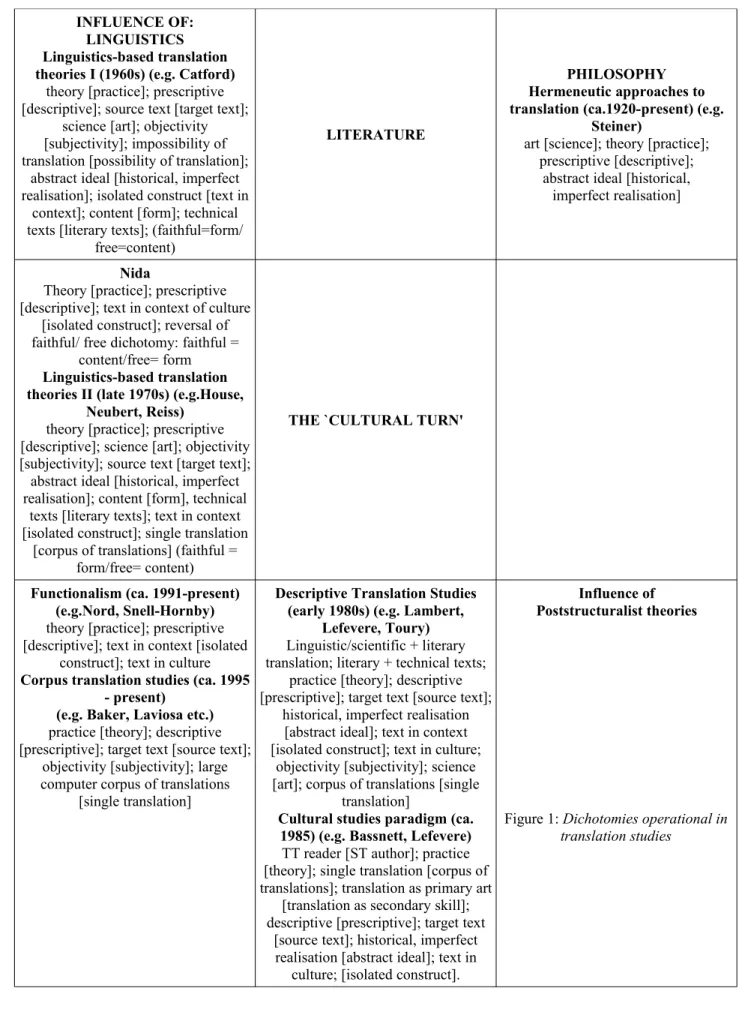
In the case of translation, the fundamental binarism of translation discourse is strengthened by the fact that translation studies still has difficulty in distancing itself from its object of study. Thus translation discourse continues to be determined and compromised by a series of recurring well-worn dichotomies which are simply manipulated differently according to specific theories within translation.
One typical dichotomy operational in discourses on translation is the artificial distinction between an implied, supposedly a-historical ideal of translation and its historical, necessarily imperfect, realisations. According to Lambert & Robyns (1992: 1), since the ideal translation is supposed to be the integral transposition of every feature of a given source text, this first dichotomy is generally combined with the source text/ target text dichotomy. In both cases, the first item serves as an absolute reference for the other. Closely linked to this is the dichotomy between form and content, based on the traditional epistemological postulate of communication: it is assumed that a fixed meaning, a ‘transcendental signified’, could be transferred by a different form which refers to the first form. The form/ content dichotomy legitimises the distinction between literary and technical texts, which in turn leads to the opposition between translation as an art and translation as a skill. While ‘technical’ texts allow faithful translation, provided that the target languages possesses the necessary concepts, literary texts are characterised by the inseparability of form and meaning, which makes them ‘untranslatable’. Another dichotomy operational in discourses on translation is the identity/ alterity dichotomy, which occurs in various forms (foreign vs. receiving language, literature, culture, nation, state) and has led to the identification of translation with the crossing of national borders. The identity/ alterity dichotomy also gives rise to the age-old dichotomy between faithful vs. free translation (also closely linked to the form/content relation), which has become the dominant binary relation in discourse on translation through the ages. Related to the faithful/ free relation are the master/servant and male/female dichotomies, which constitute relations of subservience versus dominance and appear in metaphorical descriptions of the relation between an original text and its translation. Translation is generally seen as a series of either/or decisions, of choices between the alterity of the source text and the identity required for the translation to be considered acceptable in the target culture although, of course, other options do exist, such as non-translation.
INFLUENCE OF: LINGUISTICS Linguistics-based translation theories I (1960s) (e.g. Catford)
theory [practice]; prescriptive [descriptive]; source text [target text];
science [art]; objectivity [subjectivity]; impossibility of translation [possibility of translation];
abstract ideal [historical, imperfect realisation]; isolated construct [text in
context]; content [form]; technical texts [literary texts]; (faithful=form/
free=content)
LITERATURE
PHILOSOPHY Hermeneutic approaches to translation (ca.1920-present) (e.g.
Steiner)
art [science]; theory [practice]; prescriptive [descriptive];
abstract ideal [historical, imperfect realisation]
Nida
Theory [practice]; prescriptive [descriptive]; text in context of culture
[isolated construct]; reversal of faithful/ free dichotomy: faithful =
content/free= form
Linguistics-based translation theories II (late 1970s) (e.g.House,
Neubert, Reiss)
theory [practice]; prescriptive [descriptive]; science [art]; objectivity [subjectivity]; source text [target text]; abstract ideal [historical, imperfect realisation]; content [form], technical
texts [literary texts]; text in context [isolated construct]; single translation
[corpus of translations] (faithful = form/free= content)
THE `CULTURAL TURN'
Functionalism (ca. 1991-present) (e.g.Nord, Snell-Hornby)
theory [practice]; prescriptive [descriptive]; text in context [isolated
construct]; text in culture
Corpus translation studies (ca. 1995 - present)
(e.g. Baker, Laviosa etc.)
practice [theory]; descriptive [prescriptive]; target text [source text];
objectivity [subjectivity]; large computer corpus of translations
[single translation]
Descriptive Translation Studies (early 1980s) (e.g. Lambert,
Lefevere, Toury)
Linguistic/scientific + literary translation; literary + technical texts;
practice [theory]; descriptive [prescriptive]; target text [source text];
historical, imperfect realisation [abstract ideal]; text in context [isolated construct]; text in culture;
objectivity [subjectivity]; science [art]; corpus of translations [single
translation]
Cultural studies paradigm (ca. 1985) (e.g. Bassnett, Lefevere)
TT reader [ST author]; practice [theory]; single translation [corpus of translations]; translation as primary art
[translation as secondary skill]; descriptive [prescriptive]; target text
[source text]; historical, imperfect realisation [abstract ideal]; text in
culture; [isolated construct].
Influence of Poststructuralist theories
Resistive translation theories (ca. 1991-present) (e.g. Venuti, Bassnett,
Lefevere), incl.: feminist translation, cannibalism, ‘guerilla’
theories of translation
Difference [symmetry]; foreignisation [domestication]; form [meaning];
reader [author]; TT reader [ST author]; subjectivity [objectivity]
The positioning of the cultural studies paradigm (of which resistive approaches to translation could be said to be a sub-category) can quite easily be outlined according to this approach. Cultural studies arose in opposition to the linguistics-based translation theories of the 1980s. In the preface to Translation, history and culture (BASSNETT & LEFEVERE, 1990), which amounts to a manifesto on the cultural studies paradigm, Susan Bassnett and Andre Lefevere are quite emphatic about what cultural studies is not, but rather less specific about what it is:
The reader will no longer find painstaking comparisons between originals and translations, largely because such comparisons, after paying lip-service to the text-as-unit, tend to fall victim to the ‘invisible theory’...which is implicitly postulated to underwrite judgements on why a certain translation (usually the one proposed by the writer of the paper in question) is better than another (usually contained in the translation being compared with its original). Nor will the reader find suggestions for either the production of foolproof translations or the training of foolproof translators, simply because both are utopian..., to say the least. Instead, [cultural studies] aims to tackle the problem of ideology, change and power in literature and society and so assert the central function of translation as a shaping force. (BASSNETT & LEFEVERE, 1990: 4-5, 10)
In order to affirm its status as a new approach to translation, the cultural studies paradigm necessarily rejects the attempts of other translation theorists to objectively describe translation phenomena on the bases of corpora of texts (which is what Descriptive Translation Studies theorists aim to do). Instead, these theorists choose to foreground the subjective nature of their enquiry and their evaluation of the power play involved in translation. But the fundamental, and rather interesting, characteristic of the cultural studies paradigm is the rejection of any suggestion of objectivity or prescription. For Venuti, in particular, this must be avoided at all costs. In his book
The Scandals of Translation: towards an ethics of difference (1998: 25, 29-30)), he states: The most worrisome tendency in linguistics-oriented approaches is their promotion of scientific models... [S]uch approaches…. purify translation practices and situations of their social and historical variables, leaving literary and technical translators alike unequipped to reflect on the cultural meanings, effects, and values produced by those practices... My recommendation is that empirical approaches, whether based on linguistics or on polysystem theory, be qualified and supplemented by ... the social and historical thinking that it demands of translators and translation scholars.
for which he creates his own umbrella term: “the scientific model” (VENUTI 1998: 25). In order to affirm the cultural studies paradigm, it is also necessary to reject and resist the conceptual ‘other’ for its refusal to take “cultural, social and historical formations” into account. This is quite an interesting move, especially since polysystem theory has its roots in comparative literature and is in fact based on cultural and social theory, and since cultural considerations form the basis of the linguistics-based approach of a theorist such as Nida.
An understanding of the positioning of resistive translation approaches in opposition to other types of translation discourse provides some insight as to why resistive translation approaches have an explicitly metaphorical underpinning. For, in moving strongly away from any suggestion of a too-scientific investigation of translation, traditional metaphors of translation which originated before the advent of linguistics (and could thus be said to be ‘pre-scientific’) are important sources of inspiration for cultural studies theorists. Metaphor has traditionally been defined as a trope of resemblance, not just as resemblance between signifier and signified, but also as the resemblance between signs, one of which represents the other. But poststructuralism and deconstruction have set out to show that metaphor can also be a trope of difference. Certain translation theorists have appropriated this idea and have been inspired to revisit and attempt to subvert traditional ‘pre-scientific’ metaphors relating to translation. In turn, the act of resistance to established norms as embodied in metaphor has itself become a metaphor which has gradually evolved into a number of explicitly confrontational discourses on translation, the so-called resistive approaches to translation.
TRADITIONAL TRANSLATION METAPHORS RE-EXAMINED
What types of traditional metaphors do resistive translation theorists re-examine? Metaphor is undeniably one of the richest sources of information about discourses on translation, revealing much about society's attitudes to the translation process. Researchers such as Lori Chamberlain (1992) in particular have found that metaphors of translation going as far back as Cicero tend to illustrate the inferiority of a translation in relation to the original in a number of ways. The original author is often seen as an ‘inventor’, free to express himself as he wishes, whereas the translator is merely an ‘imitator’, bound by the wording of the original. In many statements about translation, the metaphor of slavery is associated with the translator, and this slavery is contrasted with the freedom and originality of the ‘inventor’.
were probably ugly, and if they were beautiful, they were likely to be unfaithful. This expression seems to have survived because it has captured a cultural parallel between the issues of fidelity in translation and in marriage, and it has been used to great effect by men all over the world. To quote only two instances: Steven Seymour, who was U.S. president Jimmy Carter's interpreter, once said: "Translations are like women. When they are pretty, chances are they won't be very faithful." The South African poet Roy Campbell echoes this in Poetry Review, June-July 1949: "Translations (like wives) are seldom faithful if they are in the least attractive." Another South African, Uys Krige, used a similar image in his preface to the translation of Twelfth Night in 1971: "As the French say, translating a great poem is like kissing another man's bride through a veil." Indeed, the discourse on translation is a discourse that has tended to maintain double(d) standards based on traditional gender stereotypes.
The politics of gender can be said to overlap with the politics of colonialism. Traditionally, translation was literally a strategy of linguistic incorporation. In translations by the German Romantics, for example, the word übersetzen (to translate) was used interchangeably with
verdeutschen (to Germanize). A sixteenth-century translator of Horace named Thomas Drant also shows distinctly imperialist tendencies in the preface to his translation. He states:
First I have now done as the people of God were commanded to do with their captive women that were handsome and beautiful: I have shaved off his hair and pared off his nails, that is, I have wiped away all his vanity and superfluity of matter... I have Englished things not according to the vein of the Latin propriety, but of his own vulgar tongue... I have pierced his reason, eked and mended his similitudes, mollified his hardness,... changed and much altered his words, but not his sentence, or at least (I dare say) not his purpose. (Drant in CHAMBERLAIN 1992: 62)
Drant’s intention, as a clergyman translating a secular author, is to make Horace morally suitable and transform him from the foreign, the alien, the 'other' into a member of the family, in the Old Testament tradition whereby a captive woman is transformed into a wife. The sexual violence allured to in this description of translation provides an analogue to the political and economic atrocities implicit in a colonising metaphor.
METAPHORICAL CONCEPTUALISATION: FROM METAPHOR OF RESISTANCE TO RESISTIVE TRANSLATION THEORY
But how are ‘pre-scientific’ metaphors of translation such as those discussed above appropriated and transformed into metaphors of resistance? Before examining the specific metaphors appropriated by the various branches of resistive translation theories, I will try to provide an explanation of the way in which metaphorical conceptualisation operates in this regard. In Samuel Johnson’s Dictionary of the English language (1755), metaphor is defined as follows:
Metaphor: The application of a word to a use to which, in its original import, it cannot be put: as, he bridles his anger; he deadens the sound; the spring awakes
This is a useful definition in that it highlights the innate unexpectedness of metaphor, the attempt on the part of the user to use a word in an unusual and different context. It provides a plausible explanation for why the original, ‘pre-scientific’ metaphors of translation were chosen in the first place - for their shock value as well as for their illustrative value. Contemporary translation theorists have simply repeated the same process in creating a new metaphor which again implies the application of a word to a use to which, in its original import, it cannot be put: for instance, in turning a stereotypical association such as the metaphor TRANSLATION IS FEMALE AND UNFAITHFUL (originally unusual, but which has become conventional over time) on its head. Thus Barbara Johnson (1985: 142,3), for instance, is able to overturn the belles infidèles metaphor from a negative view of faithfulness in marriage and in translation to a positive one:
While the value of the notion of fidelity is at an all-time high in the audio-visual media, its stocks are considerably lower in the domains of marital mores and theories of translation ... For while both translators and spouses were once bound by contracts to love, honour and obey, and while both inevitably betray, the current questioning of the possibility of conscious mastery makes that contract seem deluded and exploitative from the start.
It is clearly possible to explain how a metaphor can be reversed, but in order to understand how a metaphor can be extended into a theory, it is necessary to go beyond the word-based conception of metaphor that Samuel Johnson’s definition presupposes. Johnson’s definition can be problematic, particularly when one is trying to examine the metaphorical conceptualisations of theories, since as long as the metaphorical process is conceived in terms of the conferring of a novel sense upon a ‘focal’ word, it is impossible to gain any grasp whatever on the notion of a metaphor having further metaphors as ‘implications’. However, as White (1996: 148-9) explains,
once we do break completely with the presuppositions of a ‘wordbased’ conception of metaphor, and regard metaphor as ab initio based upon the establishment of a correspondence between two different situations, and the metaphorical sentence as a conflation of two descriptions of such situations, the possibility of extending metaphor arises automatically. All we do is continue to describe the situation that we are describing metaphorically by continuing to conflate yet further simultaneous extensions of the descriptions of the two situations.
Thus, the essence of the metaphor is understanding and experiencing one kind of thing in terms of another. The concept is metaphorically structured, the activity is metaphorically structured, and, consequently, the language is metaphorically structured (LAKOFF & JOHNSON 1980: 5). It is important to realise that the process of extending metaphor into theory is not by any means unique to translation. The drawing of comparisons is universal at least in the sense that it has been a major demonstrable component of scientific thought for centuries. Metaphors and analogies have historically played an important role in the formulation and transmission of new theories (ORTONY 1993: 13).
The most powerful metaphor of all, clearly derived directly from deconstruction, is that of
difference, a metaphor that is pivotal to resistive approaches to translation. Deconstruction fosters an idea about the constitutive and therefore positive, function of differences in a language and linguistic utterances. This approach involves consequences for translation theory that stand in pointed contrast to those of the dominant tradition, which construes the task of the translator in such a way that difference means defeat. (Graham, in VAN DEN BROECK 1988: 138) Consider the positive way in which difference is portrayed in the following quotation:
Translation, writes Blanchot, is the sheer play of difference: it constantly makes allusion to difference, dissimulated difference, but by occasionally revealing and often accentuating it, translation becomes the very life of this difference. (in VENUTI 1992: 13)
For Edwin Gentzler (1993: 144), the notion of deconstructive difference offers new hope to the field of translation studies. He states:
To date, all translation theories have made rigid distinctions between original texts and their translations, distinctions which determine subsequent claims about the nature of translation. But the advent of deconstruction has changed all this, resulting in a radical redrawing of the questions upon which translation theory is founded.
Thus the postmodernist idea that close attention to the words, tropes and rhetorical postures of a culture gives one transmutative power over that culture has been appropriated in the context of translation. Revisiting traditional metaphors of translation has led to the establishment of approaches to translation which have taken up the call for resistance to established norms.
Feminist translation is a case in point. For feminist translators, in particular, translation itself is a particularly appropriate metaphor for resistance. Women have appropriated the notion of translation as difference, as transformation in both its metaphorical and its literal senses as well as attempting to turn on its head the idea that translations, like females, should be passive and subservient. Translation has therefore become “a metaphor used by women writers to describe their experience; like translated texts they can be betrayed, transformed, invented and created” (Harwood in HOMEL AND SIMON 1988: 49). Like translations, women struggle to speak in a foreign language, the language of patriarchy. As Susanne de Lotbinière-Harwood (1991: 82) puts it:
Because we live under the phallic signifier, all women are bilingual. We speak the dominant 'he/man' language and our own muted tongue(s). translation: being so perfectly bilingual
makes me just as marginal as being female.
This thrust towards translation as a metaphor of resistance is echoed in the concerns of feminist discourse as a whole and of Canadian feminist discourse in particular, and it is the juxtaposition of the cultural studies paradigm in translation with Canadian feminist concerns that have ultimately produced the phenomenon of Canadian feminist translation (WALLMACH 1999). Kathy Mezei (in DELISLE 1993: 205) explains:
especially attuned to writing as translation for not only must we translate our source, but we must decide whether to translate into the dominant discourse, the accepted discourse of patriarchy, the ‘androlect’, or instead to venture forth into another language that seems to have to be transcribed as we go.
And just as women resist misogynist metaphors, so the colonised ‘other’ has developed strategies to deal with linguistic imperialism. Translation is an ideal metaphor for the postcolonial condition, whereby postcolonial writers seeks to decolonise themselves from two oppressors at once, namely the western ex-coloniser who naively boasts of their existence and ultimately recuperates them and the 'traditional', 'national' cultures which shortsightedly deny their importance and consequently marginalise them. (MEHREZ 1992: 121). Indeed, the most rapid area of growth in cultural studies in translation has been research into the confrontation between minority and majority cultures. The attempt in translation theory to integrate the sociology of interculturality into the colonial and post-colonial contexts has led to interesting new insights. As mentioned earlier in my discussion of the use of the metaphor of the casbah, certain African literary texts are written in the language of the colonial 'other', but, far from seeking to eliminate language difference, seek to make it visible and prominent in order to preserve the foreignness of the foreign text (ADEJUNMOBI 1998: 166). Like Canadian feminist translators, these authors have adopted a policy of ‘foreignisation’.
But not everyone conforms to the idea that resistance to the colonial `other’ must equal ‘foreignisation’.Venuti’s goal is clearly to affirm minority cultures over major cultures, but he speaks from an avowedly majoritarian perspective, even though he resists that perspective (translation from the minority language into English, into a world language which tends to absorb other cultures). His reasoning cannot always hold for minority cultures whose only chance of survival lies in translating from English culture into the language of the ‘other’. Like translations from English into Irish whose fluent strategies may represent the key to their very survival (CRONIN 1998: 147), retaining the ‘foreign’ in translation into Zulu or Sesotho, or indeed any of the ten official South African languages other than English, is not a process which affirms the minority culture; on the contrary. The following dictionary entry in the standard bilingual dictionary for English-Zulu/Zulu-English (DOKE et al: 1990)2 bears ample testimony to the danger of
retaining the colonising other:
culture n.
(i) ukulima (lit. “to plough”).
(ii) ukukhanya okunjengokwabelungu (lit. “to be as white as members of the European race”).
An extract from a Zulu protest poem by J.C. Dlamini (1989: 69-70), entitled “Kumfondoni Le?” (lit. “What kind of education is this?”) also clearly illustrates this point, expressing the danger of simply transferring white culture and education into the minority culture. In his poem, Dlamini explains how blacks during apartheid were force-fed education that had already been “squeezed and sucked out” by whites:
2 The 1990 edition of the Zulu-English/English-Zulu dictionary is in fact the first edition to combine the Zulu-English
Angizicabangeli ngiyafunda, [lit. ‘I do not think on my own, I read,
Amabhuku omlungu, ngiyafunda, Whites’ books, I read,
Ngicatshangelw’ amabhuku. The books think for me.
Amfimfithe amunce umlungu The white squeezes and sucks out
Ngidle okumfimfithiwe – esibomvu.... And I eat what has been squeezed and sucked out...
Mina wansondo ubunikiniki Poor me, in my loose-fitting
Bamajazi, ngisuthi okumfimfithiwe; Graduation gown, I am full of what has been squeezed and sucked out;
Ngisuthi okukhafuliwe – ngiyilo;... I am full of vomit - I am this person;...
BAKITHI NIPHELE NONKE My people, are you all there?
KUMFONDONI LE? What kind of education is this?’]
The negative metaphor relating to eating posited in the Zulu poem above can in fact be transformed into a positive image, and perhaps even a positive translation theory. In Brazil, for instance, an explicit metaphor of resistance used in translation is that of cannibalism. The philosophy of ‘Antropofagia’ remains quite alive in Brazilian culture and the reevaluation of the metaphor and movement has been a telling feature of the Brazilian literary and artistic activity from the mid-sixties onwards. Cannibalism, initially a form of resistance, becomes a metaphor expressing a philosophy by means of which the minority culture, instead of rejecting the powerful foreign ‘other’, accepts it, ‘eats’ or appropriates it, and derives nourishment from it. It is in this climate that Brazilian translators have revolutionised translation praxis by using cannibalism both as a metaphor and a philosophy of translation. (VIEIRA 1994: 67) The work of Brazilian critics, poets and translators, brothers Augusto and Haroldo de Campos3, provides clear examples of this philosophy.
“My way of loving them is translating them. Or devouring them, according to Oswald De Andrade's anthropophagic law,” states Augusto de Campos (VIEIRA 1994: 67). For de Campos, to translate means to cannibalise, to absorb and transform, to feed on the texts he translates4. And thus the
minority culture is enriched but not dominated by the foreign culture. Bassnett (1991: 11) calls this the ‘guerilla theory of translation’: as a result of domination by other languages, a country or culture decides to appropriate the dominant country's texts, literature, their culture and, through translation, transforms this foreign matter into something of their own. The language of the ‘other’ may therefore serve a double purpose: it may be the arena for confrontation, for resistance to the ‘other’, but it may also be a means of self-liberation.
From the above, it would certainly appear that the intertwined relationship between translation, metaphor and resistance that has brought about the resistive approaches to translation is a particularly fruitful one which has brought exciting new insights to the field of translation. But the nature of this resistance to established norms must also be examined more closely, and not merely taken at face value. The act of resistance in resistive approaches to translation is posited as active,
3 Their translations span the last thirty years, during which time they have translated amonst others, cummings, Mallarmé, Joyce, Pound, the Provençal troubadours, Donne and the English Metaphysicals, Dante, Goethe, Maiakovski and other 30th century Russian poets.
4 This approach is apparent even in the preface to his Verso, Reverso, Controverso (1978), which he terms
violent and radical, but it must be pointed out that this resistance is ineffective as well as inherently problematic, for a number of reasons.
Firstly, opposition or resistance to domination implies the negation of subjugating representations and recourse to an alternative or opposing representation. But the subjugating representation remains in place as that in contrast with which the subject ‘constructs’ his or her identity (CARUSI 1996: 95,96). The ‘other’ can never be destroyed; it must always be present in order to provide a counterweight for the subject. Theories of postcolonialism, and theories of postcolonialist translation theory, therefore find themselves in a dilemma, since a negatively defined other leads to the inevitable (theoretical) passivity of those who have been constituted as other, and thus to the perpetuation of imperialism. In contrast, the positively defined other on which ethnocentric antiimperialist action is based defines itself in reaction to imperialist discourse and ultimately perpetuates its structure. In Carusi’s (1991: 236) view:
this renders anti-imperialist practice subject to the same critique as imperialism. If this critique is carried out effectively, that is in such a way that it does have an effect on cultural practices, then antiimperialist action is incapacitated, and we are back to passivity. An attempt to avoid positivisation but retain the strategic usefulness of heterogeneous consciousness is ultimately incoherent. In all cases, theories of postcolonialism risk undercutting any claim they may have to contributing to social and political change via cultural discourse and therefore of losing a significant dimension of the way in which they define themselves. Or they risk retaining this political dimension in the worst possible sense: as complicity with imperialism.
Thus, a reading process which flaunts its hostility to a supposedly timeless conventional theory is ironic because it denies the validity, if not the impossibility of what it does. In flaunting its hostility to the original theory, it ensures the perpetuation and the survival of the conventional theory, frozen in time. It cannot take into account any deviations from the stereotypical and historical view of that original theory, and thus becomes based on a false opposition. The following comment by Mona Baker (1996: 9) would seem to confirm this:
The greatest rift currently threatening to reduce the discourse on translation into a series of fault finding exercises and divisive oppositions is that between a relatively new paradigm, namely cultural studies, and the well-established but by no means flawless models derived from linguistics. The latter is now sometimes referred to, pejoratively, as the 'scientistic' approach and generally assumed to be still hung up on naive notions of equivalence and limited to the text as the uppermost unit of analysis.
binarism that they criticise. In resisting the symmetry that equivalence presents, and advocating difference in translation, rather than sameness or equivalence, resistive translation theorists have simply reversed an existing dichotomy. Thus, despite protestations to the contrary, this type of translation discourse, like all the others, operates in binary terms, defining itself in relation, or rather in opposition to other discourses, but at the same time denying this fact in order to be accepted as the dominant discourse. This binarism is perpetuated in the metaphorical basis of the theories. Misogynistic and imperialist metaphors once devised to describe the process of translation have indeed been reversed and used to challenge the establishment, but they still echo back to the fundamental dichotomy in translation, that of faithful vs. free translation. And so we have the ultimate irony: resistive approaches to translation which arose in explicit opposition to linguistics-based approaches can in fact be traced back to these selfsame approaches, and the debate between the merits of faithfulness to form vs. faithfulness to content.
CONCLUSION
In conclusion, then, an examination of the origins in metaphor of resistive approaches to translation within the context of translation theory as a whole provides some insight into the richness of these approaches, but also ultimately reveals that discourses which allow for resistance or emancipatory action are subject to the same critique as the ‘scientific’ translation-theoretical discourses they claim to challenge. If one rejects the actual analysis of translations and the training of real translators, whether from the dreaded ‘scientific’ viewpoint or not, all that remains is the endless swing of the pendulum between faithfulness to the original or freedom from that original, according to the whim of the times. And all that we can really learn from this is that perceptions change from period to period, from culture to culture, from discourse to discourse, as to what exactly constitutes a translation and what exactly constitutes a good translation strategy.
List of Sources
ADEJUNMOBI, A. 1998. Translation and postcolonial identity: African writing and European languages, The Translator, vol 4(2), Special issue: Translation and minority
(Guest editor: L. Venuti).
BAKER, M. 1996. “Linguistics and Cultural Studies: complementary or compting paradigms in translation studies?” In: Lauer, A. Gerzymisch-Arbogast, H., Haller. J. & Steiner. E.
Übersetzungswissenschaft im Umbruch: Festschrift für Wolfram Wilss zum 70. Geburtstag. Tübingen: Gunter Narr Verlag.
BASSNETT, S & LEFEVERE, A. (eds). 1990. Translation, history and culture. London: Pinter.
BASSNETT, S. 1991. Translation and ideology. Koiné, vol 1(2).
CAMPBELL, R. 1949. Translation. Poetry Review, June-July: 24-29.
CAMPOS, A. DE. 1978. Verso, reverso e controverso. São Paolo: Perspectiva.
CAMPOS, H. de.1981. Deus e diabo no Fausto de Goethe. São Paolo: Perspectiva.
CHAMBERLAIN, L. 1992. Gender and the metaphorics of translation. In Venuti, L. (ed)
Rethinking Translation. Discourse, Subjectivity, Ideology. London & New York: Routledge.
CARUSI, A. 1991. “The postcolonial other as a problem for political action.” Journal for Literary Studies, vol 7(3/4), December: 228-238.
CARUSI, A. 1996. “Intentionalism: a minimal condition for cultural empowerment.” Theoria, December: 95-106.
CRONIN, M. 1998. The cracked looking-glass of servants: translation and minority in a global age, The Translator, vol 4(2), Special issue: Translation and minority (Guest editor: L. Venuti).
DELISLE, J. 1993. Traducteurs médiévaux, traductrices féministes: une même éthique de la traduction? TTR vol 6(1): 203-230.
DE LOTBINIÈRE-HARWOOD, S. 1991. Re-belle et infidèle. la traduction comme pratique de réécriture au féminin/ The Body Bilingual. translating as rewriting in the feminine. Montréal/ Toronto: Les éditions du remue-ménage/ The Women's Press.
DLAMINI, J.C. 1989. “Kumfondoni Le?” (Lit. What kind of education is this?). In: Makhambeni, N. Ihluzo 3: An anthology of Zulu poems. Pretoria: De Jager–Haum Publishers: 69-72.
DOKE, C.M., VILAKAZI, B. W., MALCOLM, D. MCK., & SIKAKANA, J.M.A. 1990.
Zulu-English/English-Zulu dictionary (1st combined ed.). Johannesburg: Witwatersrand University Press.
GENTNER, D. & JEZIORSKI, M. 1993. “The shift from metaphor to analogy in Western science”. In: Ortony, A. (ed). Metaphor and thought, 2nd ed. Cambridge: Cambridge University Press.
GEERTSEMA, J. 1996. “`Traductions’: J M Coetzee and the violent ‘invention’ of the classic”, Current Writing: Text and reception in Southern Africa, vol 8 (1):45-60.
GENTZLER, E. 1993. Contemporary translation theories. London: Routledge.
HOMEL, D & SIMON, S. (eds). 1988. Mapping literature, the art and politics of translation. Montréal: Véhicule Press.
JOHNSON, B. 1985. “Taking Fidelity Philosophically.” In Graham, J. F. (ed.) Difference in translation. Ithaca: Cornell University Press.
JOHNSON, S. 1755. Dictionary of the English language. London.
LAMBERT, J. & ROBYNS, C. 1992. Translation. In: Posner, R., Robering, K, & Sebeok, T. (eds.) Semiotics: A Handbook on the sign-theoretic foundations of nature and culture. Berlin/ New York: de Gruyter. (Pre-published version).
MEHREZ, S. 1992. Translation and the postcolonial experience: the francophone North African text. In Venuti, L. (ed) Rethinking Translation. Discourse, Subjectivity, Ideology. London & New York: Routledge.
MEZEI, K. 1989. Traverse, Tessera, vol. 6 Spring/Summer: La traduction au féminin/Translating women': 9-10.
NORRIS, C. 1982. Deconstruction: theory and practice. London: Methuen.
ORTONY, A. 1993. “Metaphor, language and thought”. In: Ortony, A. (ed). Metaphor and thought, 2nd ed. Cambridge: Cambridge University Press.
SELDEN, R. 1985. A reader's guide to contemporary literary theory. Brighton: Harvester Press.
SNELL-HORNBY, M. 1988. Translation Studies. An Integrated Approach. Amsterdam: John Benjamins.
VAN DEN BROECK, R. 1988. From translation to transformation: how theory follows practice. In:
NEKEMANN, P. (ed.) Translation, our future/La traduction, notre avenir. XIIth World Congress of FIT. Maastricht: Euroterm.Venuti, L. 1992. Rethinking translation. London & New York: Routledge.
VENUTI, L. (ed.) 1992. Rethinking translation. London & New York: Routledge.
VENUTI, L. 1995. The translator’s invisibility: a history of translation. London and New York: Routledge.
VENUTI, L. 1998. The Scandals of Translation: towards an ethics of difference. London and New York: Routledge.
VIEIRA, E.R.P. 1994. A postmodern translational aesthetics in Brazil. In: Snell-Hornby, M., Pöchhacker, F. & Kaindl, K.(eds) 1994. Translation studies: an interdiscipline: selected studies from the Translation Studies Congress, Vienna, 9-12 September 1992. Amsterdam: John Benjamins.
WALLMACH, A. K. 1999. Difference/derivation: feminist translation under review. Unpublished PhD (Translation) thesis, University of the Witwatersrand, South Africa.