NATIONAL GUIDANCE ON NOTIFYING
CHANGE IN ECOLOGICAL CHArACTEr OF
AUsTrALIAN rAmsAr WETLANDs
(ArTICLE 3.2)
Module 3 of the National Guidelines for Ramsar Wetlands
—Implementing the Ramsar Convention in Australia
W
AT
00
6.
120
1
Acknowledgments
The framework was developed by the Wetlands Section of the Department of the Environment, Water, Heritage and the Arts with the assistance of the Wetlands and Waterbirds Taskforce.
Wetlands and Waterbirds Taskforce
Jeanette Muirhead—chair (Australian Government Department of the Environment, Water, Heritage and the Arts), Matthew Beitzel (Australian Capital Territory Department of Territory and Municipal Services), Alison Curtin (New South Wales Department of Environment and Climate Change), Simon Ward (Northern Territory Department of Natural Resources, Environment and the Arts), Mike Ronan (Queensland Department of Environment and Resource Management), Paul Wainwright (South Australian Department for Environment and Heritage), Stewart Blackhall (Tasmanian Department of Primary Industries and Water), Yvette Baker (Victorian Department of Sustainability and Environment), Alison Beard (Western Australian Department of Environment and Conservation), and Colin O’Donnell, (New Zealand Department of Conservation).
Published by
Department of the Environment, Water, Heritage and the Arts GPO Box 787
CANBERRA ACT 2601
Authors/ Endorsement
Endorsed by the Natural Resource Management Ministerial Council, 2009.
Copyright © Commonwealth of Australia 2009
Information contained in this publication may be copied or reproduced for study, research, information or educational purposes, subject to inclusion of an acknowledgment of the source. Requests and inquiries concerning reproduction and rights should be addressed to:
Assistant Secretary
Aquatic Systems Health Branch
Department of the Environment, Water, Heritage and the Arts GPO Box 787
CANBERRA ACT 2601
Disclaimer
The views and opinions expressed in this publication are those of the authors and do not necessarily reflect those of the Australian Government or the Minister for the Environment, Heritage and the Arts or the Minister for Climate Change and Water.
While reasonable efforts have been made to ensure that the contents of this publication are factually correct, the Australian Government does not accept responsibility for the accuracy or completeness of the contents, and shall not be liable for any loss or damage that may be occasioned directly or indirectly through the use of, or reliance on, the contents of this publication.
Citation
Department of the Environment, Water, Heritage and the Arts (2009). National Guidelines for Notifying Change in Ecological Character of Australian Ramsar Sites (Article 3.2). Module 3 of the National Guidelines for Ramsar Wetlands— Implementing the Ramsar Convention in Australia. Australian Government Department of the Environment, Water, Heritage and the Arts, Canberra.
ISBN: 978-1-921733-00-0
The publication can be accessed at http://www.environment. gov.au/water/publications/index.html#wetlands
Photo credits
Small lagoon near Monkeygah Creek of the Macquarie Marshes Ramsar site colonised by terrestrial flora species (chenopods) and fringed by stressed river red gum, Pg 3, Copyright DEWHA and I. Krebs.
Cracking clay and acid sulfate soils at the Coorong and Lakes Alexandrina and Albert Ramsar site, Pg 7, Copyright DEWHA and N. Sloane.
Markaranka Wetland Complex near Waikerie, South Australia, before and after environmental watering in autumn 2009, Pg 12, Copyright DEWHA and M. Mohell.
Table of contents
Executive summary 3
1 Introduction 4
1.1 The Ramsar Convention 4
1.2 Ecological character 5
Ramsar Information Sheets 5
Ecological Character Descriptions 5
Management Plans 5
Convention guidance 5
2 Determining change in ecological character 6
2.1 Degrees of change 6
2.2 Nature and cause of change 6 2.3 Change in character not criteria 6 2.4 Australian guidance principles 7
3 Notifying change in ecological character 9
3.1 Timing 9
3.2 Assessment 9
3.3 Notification 9
3.4 Third party notification 12
3.5 Response Strategy 12
3.6 Reporting 13
3.7 Rescinding a notification 13
4 Summary of roles and responsibilities 13
4.1 Site manager/landowner 13
4.2 Government management agencies 13 4.3 DEWHA/Administrative Authority 13
5 References 14
Glossary 16
Acronyms and Abbreviations
CoP The Conference of the Contracting Parties to the Convention on Wetlands of International Importance especially as Waterfowl Habitat (Ramsar, Iran, 1971)
DEWHA Australian Government Department of the Environment, Water, Heritage and the Arts ECD Ecological character description
EPBC Act Environment Protection and Biodiversity Conservation Act 1999
LAC Limits of acceptable change
Ramsar Convention on Wetlands of International Convention Importance, especially as Waterfowl Habitat
(Ramsar, Iran,1971) RIS Ramsar Information Sheet
STRP Ramsar Convention’s Scientific and Technical Review Panel
WWTF Wetlands and Waterbirds Taskforce
Ramsar Conference of the Parties
Meeting Dates
International Conference on the Conservation
of Wetlands and Waterfowl 1971
International Conference on the Conservation
of Wetlands and Waterfowl 1974
CoP 1 1980
CoP 2 1984
CoP 3 1987
CoP 4 1990
CoP 5 1993
CoP 6 1996
CoP 7 1999
CoP 8 2002
CoP 9 2005
3
Executive summary
Australia is committed to promoting the conservation of listed Ramsar sites and the wise use of Australian wetlands. This guideline describes the process for the notification of change to the ecological character of Ramsar-listed wetlands within Australia under Article 3.2 of the Ramsar Convention. It defines roles and responsibilities and establishes guidance on a number of policy issues in the Australian context.
Under the Convention a notification of change is required if the ecological character of a site has changed, is changing, or is likely to change as the result of technological developments, pollution or other human interference. Notification concerns changes to the ecological character of a site, rather than changes to the criteria for which the site was originally listed. While change in ecological character can be positive or negative, a change in ecological character for the purposes of notification is limited to ‘human-induced adverse alteration’. The following principles have been established to guide notifications in Australia.
• Assessment of change will be undertaken with respect to
critical components, processes and benefits/services of the ecological character of the site.
• An assessment of change to support a notification must be based on best available science.
• The fact that a site was undergoing human-induced ecological character change at the time of listing does not preclude the need for an assessment, and possible notification of change, if there is evidence of significant ongoing adverse ecological change.
• Where the natural variability of a site cannot reasonably be established for the critical component (process, benefit or service) against which change is being assessed, a notification, if made, will only be on the basis of ‘is likely to’ change.
• A notification will not be made where the apparent character change has been identified as arising from the use of inadequate data sets at the time of listing.
• A notification will not be made where climate change is the principal cause of identified ecological character change. A formal notification is made after the completion of an assessment, acceptance of the case for change by the Administrative Authority (DEWHA), and consultation with the parties responsible for the ownership and management of the site. This is followed by the preparation of a Response Strategy. The Strategy sets out the management goals and objectives for the site following the notification, the suite of activities underway to meet the objectives, and the roles and responsibilities of the relevant parties.
Once the objectives identified in the Response Strategy have been achieved, the Convention Secretariat will be advised of the outcome. This will be one of two things: the site’s ecological character will have been restored; or where remediation to the ecological character of the site at the time of listing is neither possible nor feasible, agreed revised objectives for the site will have been met.
1. Introduction
This guideline describes the process for the notification of change to the ecological character of Ramsar-listed wetlands within Australia under Article 3.2 of the Ramsar Convention. Article 3.2 of the Ramsar Convention (1987) requires that:
Each Contracting Party shall arrange to be informed at the earliest possible time if the ecological character of any wetland in its territory and included in the List has changed, is changing or is likely to change as the result of technological developments, pollution or other human interference. Information on such changes shall be passed without delay to the organization or government responsible for the continuing bureau duties…
In addition to the text of the Convention, subsequent resolutions adopted by the Conference of the Parties (CoP) to the Convention further encourage wetland managers and associated others to give their attention to maintaining the ecological character of Ramsar sites and other wetlands and report on human-induced change or likely change to ecological character.
The ninth Conference of the Contracting Parties (CoP9) established the following revised definition of ecological character1:
Ecological character is the combination of the ecosystem components, processes and benefits/services that characterise the wetland at a given point in time2.
The same resolution established the following revised definition of ‘change in ecological character’:
For the purposes of implementation of Article 3.2, change in ecological character is the human-induced adverse alteration of any ecosystem component, process, and/or ecosystem benefit/ service.
This guideline sets out responsibilities, the processes that need to be followed, and guidance on a number of policy issues that need to be taken into account, in undertaking an assessment to inform a notification of change under Article 3.2 of the Convention by Australia’s Administrative Authority3. It also sets out the requirements and process for reporting following a notification. While it seeks to provide guidance specific to Australian conditions, it must be read in conjunction with the Convention’s Wise Use Handbook 15 (Addressing change in ecological character).
The guidance is designed to ensure that in Australia Article 3.2 notifications are undertaken in a consistent manner, follow a clear and easily understood process, and are based on scientifically robust evidence of change. Implementation of these guidelines will assist Australia to meet its obligations under the Ramsar Convention.
1 Resolution IX.1, Annex A
2 i.e. at the time of designation as a Ramsar Wetland of International Importance (Resolution VI.1 Annex Para 2.1)
3 The Australian Government is Australia’s Contracting Party under the Ramsar Convention and the Administrative Authority within Australia is the Department of the Environment, Water, Heritage and the Arts (DEWHA).
1.1 The Ramsar Convention
The Convention on Wetlands of International Importance Especially as Waterfowl Habitat (Ramsar, Iran, 2 February 1971) is commonly known as the Ramsar Convention. The broad aims of the Ramsar Convention are to halt and, where possible, reverse, the worldwide loss of wetlands and to conserve those that remain through wise use and the implementation of management plans.
The implementation of the Convention is guided by its mission statement4:
The conservation and wise use of all wetlands through local, regional and national actions and international cooperation, as a contribution towards achieving sustainable development throughout the world.
Adherence to this mission statement should ensure that activities that might affect wetlands will not lead to the loss of biodiversity or diminish the many ecological, hydrological, cultural or social values of wetlands.
Parties to the Convention are required to designate sites5 for the List of Wetlands of International Importance ‘… on account of their international significance in terms of ecology, botany, zoology, limnology or hydrology’ and to ‘… formulate and implement their planning so as to promote the conservation of the wetlands included in the list, and as far as possible the wise use of wetlands in their territory’.6
The Convention definition of wise use of wetlands was expanded in 2005 to ‘… the maintenance of their ecological character, achieved through the implementation of ecosystem approaches, within the context of sustainable development’.7
The Parties meet every three years at the Conference of the Parties (CoP) to which each Contracting Party submits a National Report detailing the status of the Ramsar estate in their respective jurisdiction. The Ramsar Standing Committee meets regularly in between the CoPs to oversee Convention matters.
Australia has been a Party to the Convention since May 1974 and was a member of the first group of seven Contracting Parties to the Convention. Australia currently has 65 wetlands on the Ramsar Convention List, covering approximately 7.5 million hectares. The Department of the Environment, Water, Heritage and the Arts (DEWHA) is the Administrative Authority for Australia to the Convention and, together with relevant Commonwealth, state and territory government agencies and land and water managers, is responsible for the wise use of Australia’s wetlands.
4 Resolution VIII.25 Annex
5 In the first instance only one site need be designated but Contracting Parties are encouraged to designate more. 6 Ramsar Convention 1987, Articles 2.2 and 3.1
5
1.2 Ecological character
In becoming a signatory to the Ramsar Convention, Australia is committed to promoting the conservation of listed sites and the wise use of Australian wetlands. Since the adoption of a new definition of ‘wise use’ by CoP9 in 2005, this obligation is interpreted as maintaining the ecological character of listed sites. Similarly, it is the ecological character of each declared Ramsar wetland that is protected from significant impacts under the
Environment Protection and Biodiversity Conservation Act 1999
(the EPBC Act—see Management Plans below).
Management of Ramsar sites is informed and supported by the development of key documents – specifically Ramsar Information Sheets (RIS), Ecological Character Descriptions (ECDs) and Management Plans, and through guidance provided by the Convention. Lambert and Elix (2006, cited in DEWHA 2008) provide a schematic showing the links between ECDs and other planning and management processes and documents. Ramsar Information Sheets
The Information Sheet for Ramsar Wetlands (RIS), first adopted by the Parties in 1990 (CoP4), is designed to capture essential information on all designated Wetlands of International
Importance. Whilst the RIS was initially developed to ‘… present information for the Ramsar database, and as appropriate in other contexts,8’ it may also provide a baseline for measuring change in the ecological character of listed wetlands. RISs are submitted to the Ramsar Secretariat by the
Administrative Authority in each Contracting Party. The Parties have committed to providing updated RIS information for their Ramsar sites every six years to coincide with reporting to every second CoP, or on the occasion of any significant change in a site’s ecological character.
Ecological Character Descriptions
In 1999, the Convention’s Scientific and Technical Review Panel (STRP) found that the RIS did not provide sufficiently detailed and rigorous information for the purposes of describing ecological character.9 Parties were encouraged to supplement their RISs with appropriate high-resolution baseline data, and work commenced on the development of Convention guidance on describing ecological character. At CoP10, the Parties were invited to apply the STRP’s guidance on preparing ECDs and to provide them as supplementary information to the Ramsar Secretariat.
The ECD of a wetland provides a baseline description of the wetland at a given point in time (usually taken to be the time of listing). It provides information about the environmental features and services of the site. As such, it documents a critical information set needed to inform the development of management plans and the design of programs to monitor and detect change in ecological character.
The National Framework and Guidance for Describing the Ecological Character of Australian Ramsar Wetlands
(DEWHA 2008) establishes a standard method for describing ecological character for wetlands in Australia. Ecological character descriptions are being prepared for all of Australia’s Ramsar-listed wetlands.
8 Recommendation 4.7
9 CoP7 Doc4 Annex Para 16
Management Plans
Parties to the Convention are obliged to ‘… formulate and implement their planning so as to promote the conservation of the wetlands included in the list, and as far as possible the wise use of wetlands in their territory.10’ At CoP5, Contracting Parties further spelt out their interpretation of their responsibilities by agreeing to formulate and implement planning to promote conservation of listed sites, consider appropriate management measures after designation, and formulate and implement planning to promote the wise use of wetlands.11
In Australia, the EPBC Act establishes a framework for managing Ramsar wetlands through the Australian Ramsar Management Principles (EPBC Act 1999 s 335), which are set out in Schedule 6 of the EPBC Regulations 2000. These principles are intended to promote national standards of management, planning, environmental impact assessment, community involvement and monitoring for all of Australia’s Ramsar wetlands in a way that is consistent with Ramsar Convention guidance. The regulations also cover matters relevant to the preparation of management plans, environmental assessment of actions that may affect the site, and the community consultation process.
Under the EPBC Act the Minister is required to have management plans in place for all Ramsar sites entirely within Commonwealth areas, review them at least once every five years, and must not contravene these plans.12 The Commonwealth must also use its best endeavours to ensure that management plans are in place for Ramsar sites on state/ territory land and waters, and that they are reviewed at not less than seven year intervals.13
Convention guidance
The Convention Secretariat has published specific guidance on the subject of change in ecological character. Key documents in this respect include:
• Handbook 15 Ramsar handbooks for the wise use of wetlands, Addressing change in the ecological character of Ramsar sites and other wetlands. 3rd Edition 2007.
• CoP10 Doc 27 Background and rationale to the Framework for processes of detecting, reporting and responding to change in wetland ecological character.
• Resolution IX.1 Annex A A Conceptual Framework for the wise use of wetlands and the maintenance of their ecological character.
• Resolution X.10 Future implementation of scientific and technical aspects of the Convention.
• Resolution X.15 Describing the ecological character of wetlands, and data needs and formats for core inventory: harmonized scientific and technical guidance.
• Resolution X.16 A Framework for processes of detecting, reporting and responding to change in wetland ecological character.
A complete list of reference material can be found in Section 5.
10 Ramsar Convention 1987, Article 3.1
11 Resolution 5.1 Annex 2
12 EPBC Act 1999 Chapter 5, Part 15, Division 2 Clauses 328 (1), 330(1), 331(1).
2. Determining change in ecological
character
The guidance, principles and processes described in this document have been established to guide the development of Article 3.2 notifications in Australia. Application of these principles and process guidelines must be undertaken within the context of specific Convention guidance on the matter.
These principles and processes will be reviewed in the light of subsequent Australian experience and the provision of further guidance by the Convention. Site managers using these guidelines should always check their currency by visiting the DEWHA website.
The Convention’s STRP 2009-2012 Work Plan includes the provision of further guidance on change in ecological character. Matters to be considered include:
• ‘limits of acceptable change’, including guidance on defining the range of natural variability of a site
• determining confidence limits and degree of likelihood in cases of ‘likely’ change in the context of Article 3.2 • the application of a precautionary approach in the
Ramsar Convention
• appropriate procedures for ‘... reports made by third parties of change or likely change to the ecological character of Ramsar sites’.
2.1 Degrees of change
A notification is required if the ecological character of a site has changed, is changing, or is likely to change as the result of technological developments, pollution or other human interference.
Convention documents variously describe ‘has changed’ and ‘is changing’ as ‘change’, and ‘likely to change’ as ‘likely change’. The STRP is currently developing guidance to assist in determining confidence limits and degree of likelihood in cases of ‘likely change’ (i.e. likely to change), and on the application of a precautionary approach in the Convention.
The following interpretation of these degrees of change will be used in the Australian context by the Administrative Authority until such time as further guidance is provided by the Convention:
1. A site ‘has changed’ when a change in ecological character has occurred.
2. A site ‘is changing’ when the site is currently undergoing change in ecological character, and will continue to undergo change for some time into the future (as may be the case where change was underway prior to listing). 3. A site is ‘likely to change’ when the scientific evidence
indicates that there is a reasonable likelihood, under current conditions or certain planned activities, that the site will undergo change in ecological character in the foreseeable future.
Actual change, which has already occurred or is currently occurring, is a quantifiable change indicating a shift in ecological character beyond natural variability. Change in ecological character may be to any critical component, process and/or benefit/service.
It is possible that indications of a breach of an ecosystem component or process limits of acceptable change (LAC) would become apparent prior to that of an ecosystem services LAC because of lag effects (see Section 2.4 Principle 2). Similarly, a change may be experienced at a site where the causes of the change are remote from the site (e.g. loss of habitat in one location leads to a decline in flyway populations, resulting in a decline in the number of migratory birds at another location).
A quantifiable change can be supported by referring to a site’s RIS and ECD, which contain information on the baseline ecological character and/or changes to the ecological character since listing. Information indicating change and whether or not to notify should also be drawn from site management procedures, ongoing data collection and monitoring, reporting processes and other investigations.14
‘Likely to change’ is when there is evidence that a change in character will occur in the future or is imminent. Notification in such cases would trigger further study and/or increased site monitoring and/or analysis of the causes of observed or proposed changes and appropriate response actions.
2.2 Nature and cause of change
Positive versus negative change: While change in ecological character can be positive (an improvement in ecological character) or negative, a change in ecological character for the purposes of notification is limited to ‘human-induced adverse alteration.’ This excludes natural change and positive human-induced change15 which are reported through RIS updates and National Reports to the CoP.
Human-induced versus natural change: There is no guidance currently available from the Convention on how to distinguish human-induced changes from those that are naturally-occurring. This is likely to be most challenging with respect to indirect change, such as that arising from natural events (floods and fires) and/or human activities (land management practices) within the broader catchment of the site, as the cause and effect relationships may be complex; and where change arises from a combination of factors including a mix of natural events and human activities.
In such instances the assessment will need to explore the relative contributions of the different causes (for example, change to the hydrologic regime at a site arising from a combination of drought and water extraction) and come to a conclusion regarding the significance of the human-induced components in the resulting change at the site.
2.3 Change in character not criteria
Notification under Article 3.2 concerns change to the
ecological character of a site, rather than change to the criteria for which the site was originally listed. A site can experience change in ecological character by moving beyond the established LAC without necessarily experiencing a change in its international importance (listing criteria), and vice versa. In some instances change may be undergone with respect to both ecological character and one or more of the criteria for which
the site was listed. Convention guidance addresses this matter in some detail16:
In essence, the ecological character will often far exceed the minimum thresholds established in the criteria for international importance, and the obligation is to maintain this level, not merely to preserve the minimum.
In fact, in relation to sites designated under Criterion 6, because they support one per cent or more of a biogeographic waterbird population, allowing a site’s bird numbers to reduce to the minimum would result in a population decline which could then lead to a reduced one per cent threshold number for that population, so that a further decline would still allow one per cent of such a reduced population to be supported, and the logical iterative end would be its extinction.
ECDs developed using the National Framework must include a clear statement regarding whether or not a site still meets the criteria for which it was listed and whether the site meets any additional criteria, noting that criteria may have been added to the Convention since the time the site was listed. Change in listing criteria is reported to the Convention Secretariat through an update of the RIS.
2.4 Australian guidance principles
Principle 1 Assessment of change will be undertaken with respect to critical components, processes and benefits/ services of the ecological character of the site.
The National ECD Framework recognises that it is not possible or practical to identify and describe all of a site’s components, processes and benefits/services. Instead, the Framework requires the identification of critical components, processes and benefits/ services and suggests methods to identify these aspects of a site. One criterion for identifying a critical aspect is that adverse change would cause significant negative consequences to the character of the site if that change were to occur.
While Convention guidance suggests that change in ecological character is the human-induced adverse alteration of any
ecosystem component, process, and/or benefit/service, in the first instance assessment of change to Australian sites will be undertaken with respect to the critical components, processes and benefits/services of the ecological character of the site and identified in the site’s ECD. This is a pragmatic response to the challenges in defining the limits of acceptable change (recognised in the Work Plan for the STRP), confounded by the pronounced natural variability experienced at many Australian Ramsar sites.
Principle 2 An assessment of change to support a notification must be based on best available science. A scientifically robust analysis of ecological character change is required to support an Article 3.2 notification. The following types of evidence are considered reasonable sources on which a notification may be based:
• ECDs developed under the National ECD Framework • updates of Ramsar Information Sheets
16 – Handbook 16
– Resolution IX.6 (paragraphs 6(vi) and 6(vii))), – CoP10Doc27 (Para 20)
– CoP9Doc 15
For further information: Handbook 15
7
• reporting for the purpose of the triennial National Report to the CoP and the Rolling Review
• unpublished datasets held by jurisdictions and professional bodies, e.g. spatial imagery, fisheries data, river health data, vegetation condition assessments, etc.
• research by qualified professionals operating within a peer reviewed environment and
• monitoring for the purposes of wetland and other natural resource management.
The information from these sources must be quantifiable and scientifically robust, based on methods that provide transparent and repeatable analysis, and can be subject to independent peer review. DEWHA will consult with government management agencies and site managers/landowners, as required, to determine the scientific validity of information used in an assessment supporting a notification, and may seek further expert advice.
Information sources that are not considered appropriate include general observation or unqualified opinion, media articles or interviews.
Principle 3 The fact that a site was undergoing human-induced ecological character change at the time of listing does not preclude the need for an assessment, and possible notification of change, if there is evidence of significant ongoing adverse ecological change.
In many instances Australian sites were listed under the Convention at a time when their ecological characteristics were already subject to impacts as the result of land-use changes, technological developments, pollution or other human interference. This could be due to major alterations that occurred prior to the listing, or due to long-term cumulative changes that originated with European settlement. The ecological character of many sites is continuing to change as a result of these earlier impacts.
For sites on a change trajectory at the time of listing, the objective is to maintain or restore the ecological character defined at the time of listing. This suggests that positive action is necessary to avoid an ongoing decline from the time of listing. Where there is continuing significant adverse change to critical components, processes and/or benefits/ services (despite actions being taken to counter such change) a formal assessment to better understand and define the change is necessary. This will be supported through the ECD development process.
Should the assessment result in a notification, the Response Strategy (see Section 3.5) will need to identify the appropriate course of action. This will include, where remediation to the ecological character of the site at the time of listing is neither possible nor feasible, the establishment of new objectives for the site (which retain the international importance of the site) and a revised adaptive management strategy to support these new objectives. This will also require the development and submission of a new RIS.
Principle 4 Where the natural variability of a site cannot reasonably be established for the critical component (process, benefit or service) against which change is being assessed, a notification, if made, will only be on the basis of ‘is likely to’ change.
The National ECD Framework provides guidance for describing and setting limits of acceptable change considering natural variability, including where limited information is available. The concept of LAC for Ramsar sites was introduced in the early 2000s and was first defined in the Coorong and Lower Lakes ECD (Phillips and Muller 2006) and later in the National ECD Framework as:
…the variation that is considered acceptable in a particular measure or feature of the ecological character of the wetland. This may include population measures, hectares covered by a particular wetland type, the range of certain water quality parameters, etc. The inference is that if the particular measure or parameter moves outside the ‘limits of acceptable change’ this may indicate a change in ecological character ... In most cases, change is considered in a negative context, leading to a reduction in the values for which a site was listed. (DEWHA 2008)
A breach of a LAC indicates that a component, process or benefit/service has changed beyond its natural variability and the breach of this feature, by definition, requires a remedial response.
In Australia, where there are often extreme ranges of variability over time, defining LAC is difficult; the methodology for determining limits will be refined as LAC are implemented and trialled. The problem is further compounded by lack of long-term datasets for many components, processes and benefits/ services. Until such time as natural variability is determined for these circumstances, a notification will only be made on the basis of ‘likely to change’, and only when there is confidence that a change exceeds any previous condition i.e. it has not previously been experienced to that degree.
Principle 5 A notification will not be made where the apparent character change has been identified as arising from the use of inadequate data sets at the time of listing. In some instances, data which were used to support claims against criteria for Ramsar listing are now being found (generally through the ECD development and RIS update process) to be incorrect, or the application guidelines for the criteria were incorrectly interpreted in line with current Ramsar Secretariat guidance, or too limited to support those claims.
Differences between listing data and subsequent information, where the data are shown to have been clearly inadequate for the purpose at the time of listing, are not grounds for notification. This may also apply in cases where there have been technical or methodological advances in data analysis and interpretation. Convention guidance outlines a process for addressing these circumstances.17
Principle 6 A notification will not be made where climate change is the principal cause of identified ecological character change.
9
It is widely recognised that the current rate of climate change is human-induced. However, the potential impacts of climate change on wetlands, and the implications of this relationship for the Convention as a whole, are complex. The issue is under active consideration by the Convention.
Wetland ecology is complex and it is unlikely that change at a site could be attributed in a scientifically robust manner principally to human-induced climate change. However, where it appears that climate change is the main driver of ecological character change, and until such a time as the Convention provides guidance on an approach to this issue, it will not be an accepted basis on which to make a notification.
In these circumstances, monitoring should be ongoing and consideration should be given to the identification and implementation of appropriate adaptive management interventions at the site.
3. Notifying change in ecological character
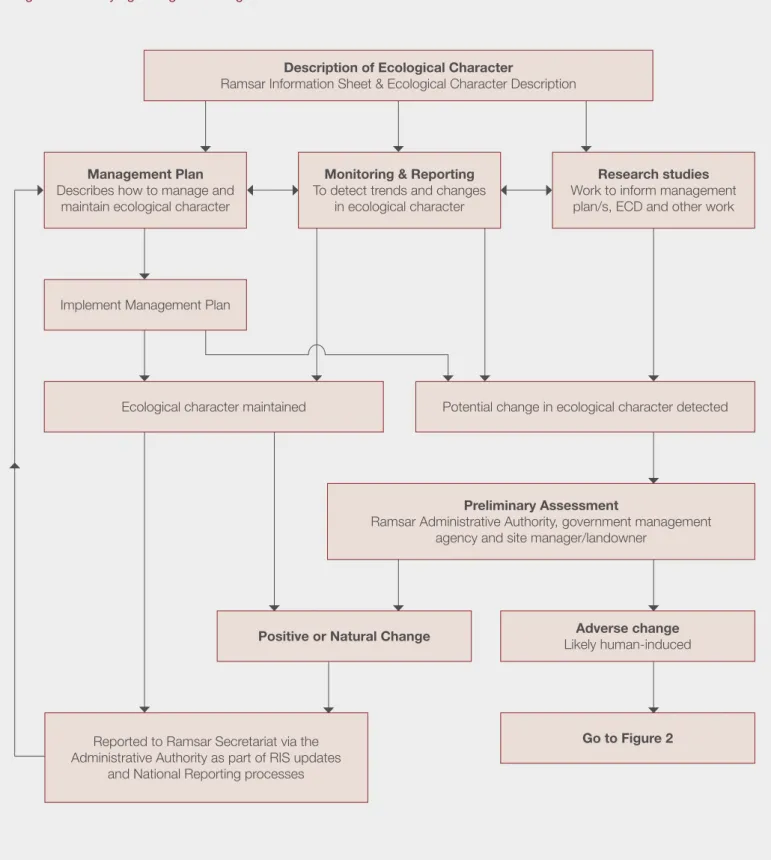
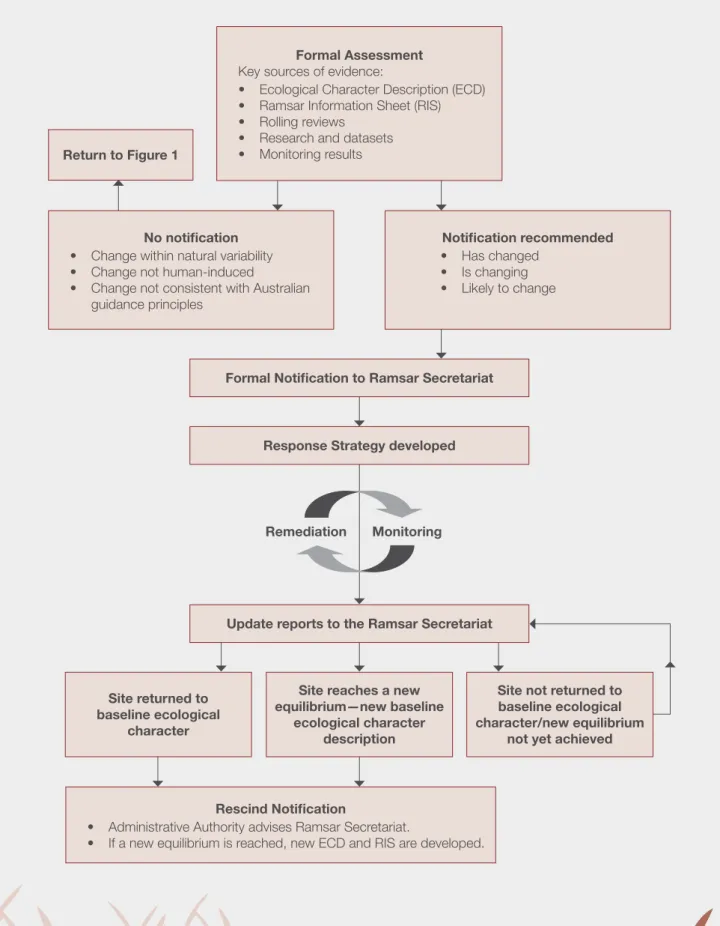
A Framework for detecting, reporting and responding to changes in ecological character was agreed at CoP10.18 The processes described here seek to give effect to that Framework in the Australian context. The following sections describe the steps, processes and responsibilities for identifying and responding to adverse change in ecological character, and then making an Article 3.2 notification. The process is illustrated in Figure 1 (identifying change) and Figure 2 (assessing and notifying change).
3.1 Timing
The Convention requires that Parties notify of change in ecological character at a site at the ‘earliest possible time’. Site managers and/or landowners should therefore advise the relevant government management agency and DEWHA as soon as they become aware of a potential or actual change. This will then allow for collective consideration of the significance of the change, and the need for a formal assessment.
While the initial vehicle for early detection of change will be the development of ECDs, and thereafter the Rolling Review (which will regularly review the status of the site against the LAC identified in the ECD and any management triggers), monitoring for other purposes, research at the site/in the area and incidents (e.g. fires, oil spills, etc) may also provide triggers for an
assessment of potential change.
The relevant government management agency and the site manager/landowner in question may also be contacted by DEWHA where evidence of potential or actual change at a site is brought to its attention (see Section 3.4), and where DEWHA considers an assessment of change may be warranted.
3.2 Assessment
Once DEWHA has been advised of potential change at a site, and a preliminary assessment has determined that the matter warrants further investigation, a formal assessment will need to be undertaken. DEWHA will collaborate with the relevant government management agency and the site manager/
landowner to determine the nature of the change (‘has changed’,
18 Resolution X.16
‘is changing’ or ‘is likely to change’), if the change can be substantiated based on best available science, if the change is human-induced adverse alteration, and if the change has occurred in a critical component, process or benefit/service. The assessment is the means whereby the evidence is weighed, the significance of the ‘change’ is determined, and a considered decision is reached by the relevant parties as to whether or not the change is sufficient to warrant a recommendation to the Administrative Authority that a notification should be made. An assessment of evidence will need to include, as a minimum, the following information:
• a description of the site, including baseline ecological characteristics
• evidence documenting the ‘change’ in terms of the critical ecosystem components, processes and benefits/services that characterise the site
• identification of the information on which the assessment has been based
• advice on the nature of the change to be notified • evidence of appropriate consultation with the relevant
government management agency and the site manager/ landowner.
Where the assessment finds that a case for change, consistent with the Australian Guidance Principles (see Section 2.4) has not been made, DEWHA will consult with the relevant government management agency and site manager/landowner to ensure that monitoring and management supports ongoing review of the circumstances which triggered the formal assessment of ‘change’. Where an assessment finds that a case for a notification has been made, and the case is accepted by the Administrative Authority (DEWHA), a formal notification will be made to the Convention Secretariat. The final decision on whether or not to make an Article 3.2 notification is a matter for the Administrative Authority.
A Statement of Reasons for the notification will be posted on the DEWHA website under the link to the relevant Ramsar site, together with appropriate reference to any related published supporting evidence that has informed the assessment.
3.3 Notification
A formal notification is made after the completion of an assessment, acceptance of the case for change by the Administrative Authority, and consultation with all parties responsible for the ownership and management of the site. Article 3.2 notifications can only be made by the Administrative Authority (DEWHA).
The formal notification includes summary evidence of the nature of the change that has been identified, the cause(s) of the change, information on the critical ecosystem components, processes and benefits/services that have been adversely affected, and the key actions underway or planned to address the change.
Figure 1. Identifying change in ecological character.
Positive or Natural Change Likely human-inducedAdverse change
Go to Figure 2 Monitoring & Reporting
To detect trends and changes in ecological character
Research studies Work to inform management
plan/s, ECD and other work Management Plan
Describes how to manage and maintain ecological character
Reported to Ramsar Secretariat via the Administrative Authority as part of RIS updates
and National Reporting processes Implement Management Plan
Description of Ecological Character
Ramsar Information Sheet & Ecological Character Description
Potential change in ecological character detected
Preliminary Assessment
Ramsar Administrative Authority, government management agency and site manager/landowner
11
Figure 2. Formally assessing and notifying change in ecological character.
Return to Figure 1
Rescind Notification
• Administrative Authority advises Ramsar Secretariat.
• If a new equilibrium is reached, new ECD and RIS are developed. Formal Assessment
Key sources of evidence:
• Ecological Character Description (ECD) • Ramsar Information Sheet (RIS) • Rolling reviews
• Research and datasets • Monitoring results
Notification recommended • Has changed
• Is changing • Likely to change No notification
• Change within natural variability • Change not human-induced
• Change not consistent with Australian guidance principles
Update reports to the Ramsar Secretariat
Site reaches a new equilibrium—new baseline
ecological character description Site returned to
baseline ecological character
Formal Notification to Ramsar Secretariat
Response Strategy developed
Site not returned to baseline ecological character/new equilibrium
Once a notification has been made to the Convention, it is included on the agenda of the subsequent CoP for discussion, and periodic updates on the notification may be discussed at meetings of the Standing Committee held between CoPs. Notifications also inform implementation of Objective 4.1 of the Ramsar Strategic Framework (2008) which notes the need ‘to use Ramsar sites as baseline and reference areas for national, supranational/regional, and international environmental monitoring’. Analysis of data from notifications informs the identification of issues for presentation to the CoP for discussion and action, and on which the STRP can usefully provide guidance19:
RECOGNIZING that assessment of the status and trends of wetlands, and assessing and reporting on their ecological character and change in ecological character, provide an essential basis for improving understanding of the state of, and pressures on, wetland ecosystems at the global, regional and national scales in support of future policy development, decision-making and prioritisation under the Convention, and for management interventions on Ramsar sites and other wetlands.
3.4 Third party notification
Convention guidance allows for interested third parties to make a ‘notification’ to the Convention Secretariat of ecological character change for a site. Handbook 15 provides specific guidance on third party notifications.
Concern over increasing numbers of third party notifications, and in particular the lack of guidance on the standards of evidence required to support such notifications, has resulted in the STRP being tasked, in its 2009–12 Work Plan, with addressing this issue through the provision of further guidance on procedures for reports made by third parties of change to ecological character.
Where the Secretariat is notified of change at a site through a third party, it contacts the relevant Administrative Authority (in this instance, DEWHA) to seek clarification of the situation.20 Where DEWHA receives such a request, it seeks a copy of the third party notification, and subject to the nature of the issues raised, responds in one of two ways:
19 Resolution VIII.8
20 Handbook 15, pp 8-9
• As Ramsar sites are matters of National Environmental Significance under the EPBC Act, where the notification relates to a matter that is subject to requirements for assessment and approval under the EPBC Act, advice is provided to the Secretariat concerning the status of any assessment under the EPBC Act.
• Where the issue relates to other matters, advice is sought from the relevant government management agency and the site manager/landowner, and a response is provided to the Secretariat. The Secretariat then reports back to the third party, as appropriate.
3.5 Response Strategy
Convention guidance requires Parties with Ramsar sites for which a formal notification under Article 3.2 has been made, to advise, at the earliest opportunity, of steps taken to address the change in ecological character.21 The Convention also provides guidance on wetland restoration.22
Within three months23 of the notification being made, a draft Response Strategy for the site needs to be agreed between DEWHA, the relevant government management agency and the site manager/landowner. The Strategy is not intended to replace existing management plans or other arrangements in place for the site. Rather it is intended to be a succinct overview of: • the management goals and objectives agreed for the site
following the notification
• the suite of activities underway to meet these objectives (within an adaptive management framework)
• roles and responsibilities of the respective parties
• arrangements for the measurement and monitoring of progress • key points at which collective review of progress is warranted • the timing and nature of subsequent updates to the Secretariat. The Strategy must also inform management actions and investment decisions.
21 Resolution X.13 Para 25
22 Doc. STRP11-20
23 This is the preferred time period, although there may be variations in the event that emergency or natural disasters preclude appropriate government management agency engagement within this timeframe
13
The Response Strategy should draw on information in the RIS, the ECD, any management plans for the site, and from condition reports generated through the Rolling Review. Response Strategies are placed on the DEWHA website under the specific Ramsar site.
Where a notification was made prior to the development of this guidance, there is no obligation for the retrospective development of a formal Response Strategy.
3.6 Reporting
As a minimum, update reports on notifications are required in a Party’s National Report for the CoP (i.e. every three years), although CoP10 agreed to seek more regular reporting, utilising the mechanism of Convention Standing Committee Meetings. While the periodicity of reporting for a site for which a notification has been made should be determined as part of the Response Strategy, the preferred approach for Australian sites is that the need to report should be considered every six months (April and October).
3.7 Rescinding a notification
Once the objectives identified in the Response Strategy have been achieved, the Administrative Authority (DEWHA) will formally advise the Convention Secretariat of the outcome. This will be one of two results: that the site’s ecological character has been restored, or where remediation to the ecological character of the site at the time of listing was neither possible nor feasible, that the revised objectives for the site have been met. In the latter case, an updated RIS and ECD will be prepared for submission to the Ramsar Secretariat.
4. Summary of roles and responsibilities
The Australian Government is Australia’s Contracting Party under the Ramsar Convention; the Administrative Authority within Australia is the Department of the Environment, Water, Heritage and the Arts (DEWHA).
The Wetlands and Waterbirds Taskforce (WWTF) is an advisory group with members from the Australian and all state and territory governments. It provides advice on wetland-related issues, including the implementation of the Ramsar Convention in Australia. Taskforce members will co-ordinate participation by, and input from, government agencies and authorities within their jurisdictions on the processes set out in this guidance.
The site manager is the landowner or legal manager of the land within the Ramsar site. In some cases this is also the government agency.
4.1 Site manager/landowner
The manager/owner must inform the relevant government management agency and/or DEWHA if there is any indication of a change in the ecological character of their Ramsar site. If the government management agency advises the manager/owner of a potential change in the ecological character of their site, they must work with the agency to agree the nature of the change. In either case, the manager/owner will be asked to participate in subsequent assessments.
In the event that a notification is made, the manager/owner then participates in the development of a Response Strategy. It is likely that there will be some activities identified through the Response Strategy for which the manager/owner will be responsible. From time to time, the manager/owner may be asked to contribute to update reports to the Ramsar Secretariat.
4.2 Government management agencies
Government management agencies are responsible for informing the Administrative Authority (DEWHA) if there is any indication of a change in the ecological character of a Ramsar site. This may be as a result of information from the manager/owner or through their (or other) agency mechanisms. The management agency is expected to participate in any subsequent assessments and may act as liaison between the manager/owner and DEWHA.
In the event that a notification is made, the management agency participates in the development of a Response Strategy, and formally agrees its contents on behalf of its jurisdiction. It is likely that there will be some activities identified through the Response Strategy for which the management agency will be responsible. The management agency will be expected to contribute to, and agree on behalf of its jurisdiction, update reports to the Ramsar Secretariat.
4.3 DEWHA/Administrative Authority
The Administrative Authority (DEWHA) is responsible for delivering all Ramsar documentation, including notifications, to the Ramsar Secretariat.
DEWHA will be informed of any potential change in ecological character by the management agency or manager/owner, through its own reporting mechanisms (ECD development, RIS updates), or through third parties. In all cases, DEWHA will work Wetland restoration in Western Australia.
with the government management agency and manager/owner in undertaking preliminary and formal assessments of change. In the case of third party notifications, DEWHA will provide the documentation to the relevant government management agency and will respond to the Ramsar Secretariat.
If a notification is made, DEWHA will participate in the development of a Response Strategy (with the management agency and the manager/owner) and formally agree its contents on behalf of the Australian Government. It is likely that there will be some activities identified through the Response Strategy for which DEWHA will be responsible. DEWHA will provide update reports on the notification (agreed by the parties) to the Ramsar Secretariat.
5. References
Australian Heritage Commission (2002). Australian Natural Heritage Charter for conservation of places of natural heritage significance. Second Edition. Australian Heritage Commission, Canberra. http://www.ahc.gov.au/publications/anhc/parta.html
Department of Environment and Heritage (DEH) (2006)
Climate Change Impacts and Risk Assessment. A Guide for Business and Government. Canberra, Australia. http://www. climatechange.gov.au/impacts/pubs/risk-management.pdf
DEWHA website http://www.environment.gov.au/water/ environmental/wetlands/index.html
Department of the Environment, Water, Heritage and the Arts (DEWHA) (2008). National Framework and Guidance for Describing the Ecological Character of Australian Ramsar Wetlands: Module 2 of the National Guidelines for Ramsar Wetlands – Implementing Ramsar Convention in Australia. Department of the Environment, Water, Heritage and the Arts, Canberra. http://www.environment.gov.au/water/environmental/ wetlands/index/html
Environment Protection and Biodiversity Conservation Act 1999 (the EPBC Act) http://www.comlaw.gov.au/ comlaw/management.nsf/lookupindexpagesbyid/ IP200401830?OpenDocument
Environment Protection and Biodiversity Conservation Regulations 2000 (the EPBC Regulations) http://www.comlaw. gov.au/comlaw/management.nsf/lookupindexpagesbyid/ IP200401027?OpenDocument
Lambert, J. and Elix, J. (2006). Unpublished Workshop Report— Ecological Character Description for Ramsar Wetlands. Prepared for the Commonwealth Department of the Environment and Heritage. Community Solutions, Fairlight, Sydney.
Millennium Ecosystem Assessment (MEA) (2005). Ecosystems and Human Well-being: Synthesis. World Resources Institute, Washington DC, USA.
Phillips, W. and Muller, K. (2006). Ecological Character of the Coorong, Lakes Alexandrina and Albert Wetland of International Importance. South Australian Department for Environment and Heritage, Adelaide.
Ramsar Convention documents
• CoP7 Doc4 Annex (1999) Report of the Scientific and Technical Review Panel (STRP). http://www.ramsar.org/cda/ ramsar/display/main/main.jsp?zn=ramsar&cp=1-31-58-83%5e19179_4000_0__
• CoP9 Doc 15 (2005) Issues and scenarios concerning Ramsar sites or parts of sites which cease to meet or never met the Ramsar Criteria. http://www.ramsar.org/pdf/cop9/ cop9_doc15_e.pdf
• CoP10 Doc 27 (2008) Background and rationale to the Framework for processes of detecting, reporting and responding to change in wetland ecological character.
http://www.ramsar.org/pdf/cop10/cop10_doc27_e.pdf
• Doc STRP11-20 (2003) Background materials concerning restoration and rehabilitationhttp://www.ramsar.org/pdf/strp/ strp11_doc20.pdf
• Ramsar Information Sheet (RIS) – 2009–2012 version.
http://www.ramsar.org/pdf/ris/key_ris_e.pdf
• Ramsar Convention (1987) Convention on Wetlands of International Importance Especially as Waterfowl Habitat
(Ramsar, Iran, 2 February 1971). (1994) http://www. ramsar.org/cda/ramsar/display/main/main.jsp?zn=ramsar& cp=1-31-38^20671_4000_0__)
• Ramsar Standing Committee http://www.ramsar. org/cda/ramsar/display/main/main.jsp?zn=ramsar& cp=1-31-41_4000_0__
• Recommendation 4.7 (1990) Mechanisms for improved application of the Ramsar Convention. http://www.ramsar. org/pdf/rec/key_rec_4.07e.pdf
• Resolution 5.1 (1993) Annex 2 Framework for the Implementation of the Ramsar Convention. http://www.ramsar.org/pdf/res/key_res_5.1e.pdf
• Resolution VI.1 Annex (1996) Working Definitions, Guidelines for Describing and Maintaining Ecological Character of Listed Sites, and Guidelines for Operation on the Montreux Record. Para 2.1. http://www.ramsar.org/pdf/res/key_res_vi.01e.pdf
• Resolution VIII.6 (2002) A Ramsar Framework for Wetland Inventory. http://www.ramsar.org/pdf/res/key_res_viii_06_e. pdf
• Resolution VIII.8 (2002) Assessing and reporting the status and trends of wetlands, and the implementation of Article 3.2 of the Convention. http://www.ramsar.org/pdf/res/key_res_ viii_08_e.pdf
• Resolution VIII.25 (2002) The Ramsar Strategic Plan 2003– 2008. http://www.ramsar.org/pdf/res/key_res_viii_08_e.pdf
• Resolution IX.1 (2005) Annex A A Conceptual Framework for the wise use of wetlands and the maintenance of their ecological character. http://www.ramsar.org/pdf/res/key_res_ viii_08_e.pdf
• Resolution IX.1 (2005) Annex E An Integrated Framework for wetland inventory, assessment and monitoring (IF-WIAM).
http://www.ramsar.org/pdf/res/key_res_5.1e.pdf
15
• Resolution X.10 Future implementation of scientific and technical aspects of the Convention.http://www.ramsar.org/ pdf/res/key_res_x_10_e.pdf
• Resolution X.13 (2008) The status of sites in the Ramsar List of Wetlands of International Importance. http://www.ramsar. org/pdf/res/key_res_x_13_e.pdf
• Resolution X.15 (2008) Describing the ecological character of wetlands, and data needs and formats for core inventory: harmonized scientific and technical guidance. http://www. ramsar.org/pdf/res/key_res_x_15_e.pdf
• Resolution X.16 (2008) A Framework for processes of detecting, reporting and responding to change in wetland ecological character. http://www.ramsar.org/pdf/res/key_ res_x_16_e.pdf
• Scientific and Technical Review Panel (STRP) 2009-12 Workplan http://www.ramsar.org/pdf/strp/strp_ workplan_2009.pdf
• Strategic Framework and guidelines for the future development of the List of Wetlands of International Importance of the Convention on Wetlands (Ramsar, Iran, 1971) (2008) Third edition, as adopted by Resolution VII.11 (COP7, 1999) and amended by Resolutions VII.13 (1999), VIII.11 and VIII.33 (COP8, 2002), IX.1 Annexes A and B (COP9, 2005), and X.20 (COP10, 2008). http://www.ramsar. org/pdf/key_guide_list2009_e.pdf
• The Wise Use Resource Library http://www.ramsar. org/cda/ramsar/display/main/main.jsp?zn=ramsar& cp=1-31-116_4000_0__
• The Ramsar Handbooks for the Wise Use of Wetlands 3rd Edition (2007) http://www.ramsar.org/cda/ramsar/display/ main/main.jsp?zn=ramsar&cp=1-30-33_4000_0__
• Wise Use Handbook 11 Ramsar handbooks for the wise use of wetlands. An Integrated Framework for wetland inventory, assessment and monitoring. 3rd edition (2007) http://www. ramsar.org/pdf/lib/lib_handbooks2006_e11.pdf
• Wise Use Handbook 15 Ramsar handbooks for the wise use of wetlands. Addressing change in the ecological character of Ramsar sites and other wetlands. 3rd edition (2007)
http://www.ramsar.org/pdf/lib/lib_handbooks2006_e15.pdf
Glossary
The Ramsar website also provides a glossary of terms from which many of the following definitions are taken.
http://www.ramsar.org/cda/ramsar/display/main/main.jsp?zn=ramsar&cp=1-36-56-156_4000_0__
Administrative Authority The agency within each Contracting Party charged by the national government with oversight of implementation of the Ramsar Convention within its territory. In Australia it is the Department of Environment, Water, Heritage and the Arts (DEWHA).
Article 3.2 ‘Each Contracting Party shall arrange to be informed at the earliest possible time if the ecological character of any wetland in its territory and included in the List has changed, is changing or is likely to change as the result of technological developments, pollution or other human interference. Information on such changes shall be passed without delay to the organization or government responsible for the continuing bureau duties specified in Article 8.’ (Convention on Wetlands of International Importance Especially as Waterfowl Habitat 1994)
Article 3.2 notification A formal process of reporting to the Ramsar Secretariat by the Contracting Party indicating that a Ramsar site’s ecological character has changed, is changing, or is likely to change.
Assessment The identification of the status of, and threats to, wetlands as a basis for the collection of more specific information through monitoring activities (Resolution VIII.6 Annex). In these guidelines an assessment is the gathering of evidence to support or refute a notification of change in ecological character.
Baseline Information collected which gives an initial or known value as a standard against which later measurements can be compared. For Ramsar wetlands, it will usually be the time of listing of a Ramsar site.
Benefits The economic, social and cultural benefits that people receive from ecosystems (Resolution IX.1 Annex A). They often rely on the underlying ecological components and processes in the wetland.
See also ‘Ecosystem services’ and Millennium Ecosystem Assessment (2005)
http://www.millenniumassessment.org/documents/document.358.aspx.pdf
Biological diversity The variability among living organisms from all sources including, inter alia, terrestrial, marine and other aquatic ecosystems and the ecological complexes of which they are part; this includes diversity within species (genetic diversity), between species (species diversity), of ecosystems (ecosystem diversity), and of ecological processes. (Strategic Framework and Guidelines (2008) Appendix E http://www.ramsar.org/pdf/key_guide_list2009_e.pdf)
Catchment The total area draining into a river, reservoir, or other body of water
Change in ecological character Human-induced adverse alteration of any ecosystem component, process, and/or ecosystem benefit/service (Resolution IX.1 Annex A).
Climate Change Any change in climate over time, whether due to natural variability or as a result of human activity. (DEH 2006) http://www.climatechange.gov.au/impacts/pubs/risk-management.pdf
Conference of the Parties The Conference of the Contracting Parties to the Convention on Wetlands of International Importance especially as Waterfowl Habitat (Ramsar, Iran, 1971) convened in accordance with Article 6.1 of the treaty, subject to their adoption by consensus at the start of each meeting of the Conference of the Parties.
17
Ecological character The combination of the ecosystem components, processes, and benefits/services that characterise the wetland at a given point in time. Within this context, ecosystem benefits are defined in accordance the Millennium Assessment definition of ecosystem services as ‘the benefits that people receive from ecosystems.’ (Resolution IX.1 Annex A)
The phrase ‘at a given point in time’ refers to Resolution VI.1 paragraph 2.1, which states that ‘It is essential that the ecological character of a site be described by the Contracting Party concerned at the time of designation for the Ramsar List, by completion of the Information Sheet on Ramsar Wetlands (as adopted by Recommendation IV. 7).’
Ecosystems Within the Millennium Ecosystem Assessment, ecosystems are described as the complex of living communities (including human communities) and nonliving environment (ecosystem components) interacting (through ecological processes) as a functional unit, which provides, inter alia, a variety of benefits to people (ecosystem services) (Resolution IX.1 Annex A).
Ecosystem components The physical, chemical and biological parts of a wetland (from large scale to very small scale i.e. habitat, species and genes) (Resolution IX.1 Annex A).
Ecosystem processes Dynamic forces within an ecosystem. They include all those processes that occur between organisms and within and between populations and communities, including interactions with the non-living environment that result in existing ecosystems and that bring about changes in ecosystems over time (Australian Heritage Commission 2002). They may be physical, chemical or biological.
Ecosystem services Benefits that people receive or obtain from an ecosystem (Resolution IX.1 Annex A). The components of ecosystem services include (MEA 2005):
• provisioning services — such as food, fuel and fresh water
• regulating services — the benefits obtained from the regulation of ecosystem processes such as climate regulation, water regulation and natural hazard regulation
• cultural services — the benefits people obtain through spiritual enrichment, recreation, education and aesthetics
• supporting services — the services necessary for the production of all other ecosystem services such as water cycling, nutrient cycling, and habitat for biota. These services will generally have an indirect benefit to humans or a direct benefit in the long term.
Environment Protection and Biodiversity Conservation Act 1999
The EPBC Act is the Australian Government’s central piece of environmental legislation. It provides a legal framework to protect and manage nationally and internationally important flora, fauna, ecological communities and heritage places, all of which are defined in the Act as matters of national environmental significance.
Government management agencies
Those agencies within the Commonwealth, state or territory governments that have a management responsibility for Ramsar sites.
Jurisdictions The Australian states and territories – New South Wales, Victoria, Queensland, Western Australia, South Australia, Tasmania , the Australian Capital Territory, and the Northern Territory.
Limits of acceptable change The natural variation around the equilibrium level of a wetland component, process or service. Exceedance of these limits (higher or lower) implies a change in the ecological character of the wetland.
Management Plan The EPBC Act (Part 15, Division 2, Subdivision F, Clauses 325-336) and the EPBC Regulations (Regulation 10.02; Schedule 6) provide a framework for the management of Ramsar wetlands, setting out the responsibilities of the Commonwealth and the states and territories, the contents of management plans, and review intervals.
Natural change Change that is not human-induced, either directly or indirectly.
Ramsar City in Iran, on the shores of the Caspian Sea, where the Convention on Wetlands was signed on 2 February 1971; thus the Convention’s short title, ‘Ramsar Convention on Wetlands’.
Ramsar criteria Criteria for identifying wetlands of international importance, used by Contracting Parties and advisory bodies to identify wetlands as qualifying for the Ramsar List on the basis of representativeness or uniqueness or biodiversity values.
Ramsar Convention The Convention on Wetlands of International Importance, called the Ramsar Convention, is an intergovernmental treaty that provides the framework for national action and international cooperation for the conservation and wise use of wetlands and their resources. The treaty was adopted in the Iranian city of Ramsar in 1971 and came into force in 1975.
Ramsar Information Sheet (RIS) The Ramsar Information Sheet for Wetlands of International Importance (RIS), first adopted by the Parties in 1990, was designed to provide essential data on all designated Wetlands of International Importance, in order to allow analysis of Ramsar-listed wetlands around the world at any given time, provide baseline data for measuring changes in the ecological character of wetlands listed under the Ramsar Convention, and provide material for publications which inform the public about Ramsar sites. The RIS covers identifying details like geographical coordinates and surface area, criteria for inclusion in the Ramsar List, wetland types present, hydrological, ecological, and socioeconomic issues, ownership and jurisdictions, and conservation measures taken and needed. The Sheet is regularly updated and now has provision to detail changes at the site since the last RIS was written.
The Ramsar List of Wetlands of International Importance (The Ramsar List)
Wetlands that have been designated by Ramsar Contracting Parties as internationally important, according to one or more of the criteria that have been adopted by the Conference of the Parties. http://www.ramsar.org/cda/ramsar/display/main/main.jsp?zn=ramsar&
cp=1-31-218_4000_0__
Response Strategy A document that is produced in response to making a notification to the Ramsar Convention. It will be developed by DEWHA, the government management agency and the site manager/ landowner. It will inform management actions and investment decisions, define the timing and nature of updates to the Ramsar Secretariat, and guide national reporting in the lead up to the triennial CoP meetings.
Rolling Review The Australian Government is implementing a Rolling Review of the Status of Australia’s Ramsar
sites which will provide targeted information, based on Ecological Character Descriptions, to assess threats to the ecological character of Australia’s 65 Ramsar sites. This will allow investments to be targeted to imminent threats, provide benchmark and ongoing data to support monitoring and evaluation, help fulfil Australia’s Ramsar obligations, and support effective implementation of EPBC Act.
Scientific and Technical Review
Panel (STRP) The Scientific and Technical Review Panel (STRP) is a subsidiary body of the Convention to provide scientific and technical guidance to the Conference of the Parties, the Standing Committee, and the Ramsar Secretariat.
Site managers Site managers are defined as any individual or groups who have a day-to-day responsibility for managing the site. They also have a responsibility for the wise use and maintenance of the ecological character of Ramsar Listed wetlands.
Statement of Reasons A statement detailing the reasons for Article 3.2 notification posted on the DEWHA website under the link to the Ramsar site in question, together with appropriate reference to any related published supporting evidence that has informed the assessment.
19
Wetlands Areas of marsh, fen, peatland or water, whether natural or artificial, permanent or temporary with water that is static or flowing, fresh, brackish or salt, including areas of marine water the depth of which at low tide does not exceed six metres (Ramsar Convention 1987, Article 1.1).
Wetlands and Waterbirds
Taskforce The Wetlands and Waterbirds Taskforce (WWTF) is the multi-jurisdictional technical advisory group which provides nationally coordinated advice to the Natural Resource Management Ministerial Council (NRMMC) on wetland-related issues including the
implementation of the Ramsar Convention in Australia. It is made up of wetlands experts from the relevant Australian federal, state and territory government agencies, and New Zealand. The WWTF provides advice on actions required to meet Australia’s obligations under the Ramsar Convention on Wetlands and international migratory waterbird agreements, and has led the way in implementing strategies promoting the study, conservation, repair and ecologically sustainable use of wetlands.
NATIONAL GUIDANCE ON NOTIFYING
CHANGE IN ECOLOGICAL CHArACTEr OF
AUsTrALIAN rAmsAr WETLANDs
(ArTICLE 3.2)
Module 3 of the National Guidelines for Ramsar Wetlands
—Implementing the Ramsar Convention in Australia
W
AT
00
6.
120