(
/
(
(
(
( /
Meeting:
Date : 07/06/2006
The Ubiquitous Library for the Blind and Physically Handicapped – A Case Study of the LG Sangnam Library, Korea
Kyung-Jae Bae
Digital Librarian / LG Sangnam Library, Korea) Yoon-Seok Jeong
(Director LG Sangnam Library, Korea) Woo-Sub Shim
Digital Librarian / LG Sangnam Library, Korea) Kyoung-Geun Oh
(Systems Librarian / LG Sangnam Library, Korea) Ji-Hei Kang
Digital Librarian / LG Sangnam Library, Korea) Hye-Yeon Hann
Digital Librarian / LG Sangnam Library, Korea) Seung-Jin Kwak
Professor Dep. of Library & Information Science, Chungnam National University, Korea)
140 Science and Technology Libraries with Information Technology Simultaneous Interpretation: Yes
WORLD LIBRARY AND INFORMATION CONGRESS: 72ND IFLA GENERAL CONFERENCE AND COUNCIL
20-24 August 2006, Seoul, Korea
http://www.ifla.org/IV/ifla72/index.htm
Abstract
This paper presents the project of the LG Sangnam Library that made real the
concept of a ubiquitous library. The project intends to provide a service so that the
print-disabled can take advantage of the library system and information services without
complicated procedures in connections and user certifications by using NFC (Near Field
Communication) technology-applied mobile phones. This model is composed of three
scenarios. The first scenario offers a Digital Talking Book (DAISY) over the Internet. A
user with a NFC reader-equipped mobile phone simply touches a dongle that is connected to
second scenario uses a wireless connection to the Internet via a mobile phone and the final
scenario uses voice services via a telephone to access the library services. In the library
services, users can listen to Digital Talking Books in real time. As shown in the scenarios,
the purpose of the project is to offer a comfortable information environment for the
print-disabled including the blind and physically handicapped by using ubiquitous technology.
1. Introduction
The LG Sangnam Library was founded for the public good in April 1996, as the first
digital library in South Korea. It has led in full-scale development of a digital library in
South Korea proposing the prototype of Korean digital library. Since its opening, about
4,500 library-related professionals have visited the library from over a thousand organizations,
which shows the status of the LG Sangnam Library in South Korea as a role model.
The LG Sangnam Library, whose mission is to undertake challenges and innovations
in the digital age, began a new project in order to develop a future-oriented library model in
2005. The project is “LG Digital Talking Book (DTB) Library,” a ubiquitous library for the
print-disabled. This paper is to introduce the project that LG Sangnam Library completed in
April 2006, and to demonstrate a pioneering and practical case of a ubiquitous library.
The 21st century’s hottest issue at the cutting edge of information technology is
“ubiquitous.” The term of “ubiquitous computing” conveys the possibility to compute
anywhere at anytime with any type of equipment. Connectivity to networks and mobility of
equipment are essential to give a concrete form to the technology. As computers are getting
more intelligent and smaller, users are able to compute unconsciously and seamlessly.
Ubiquitous computing technology utilizes a transmitting microchip as well as a computer in a
wired/wireless network. The microchip can be embedded in any object including a car
dealer’ show window and home appliances such as a TV set, a refrigerator and a microwave
oven to easily transmit/receive various kinds of information and to enhance the convenience
of daily life. The technology is applied not only to daily life but also to specialized fields
such as the distribution industry and architecture. Those who are engaged in the fields
rapidly adopt and actively research the technology.
Ubiquitous technology demands innovation in the library field also. By combining
the technologies including digitalized contents, a wireless network, and a smart tag, libraries
can provide users with a ubiquitous library environment. The environment is able to satisfy
users’ needs to open their customized virtual libraries at anytime and from anywhere to get
information easily. If we accept the definition that the mission of libraries is to provide
information promptly and accurately without limitations of time and location depending on
users’ needs, one of the fields in which the ubiquitous technologies must be exploited most
intensively should be the library field.
technologies and proceed with various case studies, the scholars in library and information
science have not yet established the clear notion of “ubiquitous libraries”. In terms of
service models of ubiquitous libraries, discussion on a few case studies has just begun. In
South Korea, Lee Eung Bong (2003) demonstrated at 2003 Digital Library Conference the
notion that ubiquitous libraries are digital libraries in which users easily gain access to needed
information with information devices at anytime and from anywhere, and are promptly
provided with relevant information via the infrastructure of integrated wired/wireless
broadband networks
In order to define ubiquitous libraries more clearly, practical cases should be
developed dynamically, and then the notion of the libraries will be straightforward by trial and
error through the developing process of multiple service models. LG Sangnam Library had
seriously given attention to a practical and useful service model of ubiquitous libraries for a
public service. As a result, we designed a ubiquitous library model providing Digital Talking
Books to the print-disabled via wired/wireless Internet and telephones and completed the
project “LG DTB Library” thanks to the integrated ubiquitous technologies acquired by LG
Group.
2. Why a Ubiquitous Library for the Print-Disabled?
Before planning a ubiquitous library, we considered users in the first place. We
brainstormed from basic questions like “Who will the advanced information technology be
most helpful to?” and chose the print-disabled as the end users of the library. There are two
major reasons for choosing the print-disabled.
First, in comparison to the non-handicapped public, the disabled, who have few ways
to access needed information, are expected to be helped to overcome their handicaps in
information acquisition more dramatically with the cutting-edge technology of the ubiquitous
library. In consideration of the beneficiaries of the advanced technology, giving priority
technical support to the disabled is expected to maximize the effect and value derived from
the technology.
Next, the information environment for the print-disabled is unusually undeveloped in
South Korea, and therefore extensive improvement is urgently required. We visited various
Braille libraries and schools for the blind, and consulted with related specialists on the service
model. According to the research, the information age, in which information floods via the
Internet, ironically helps to escalate the information gap between the print-disabled and the
non-handicapped. Especially, special libraries and public libraries offer extremely few
information services to the print-disabled. In addition, due to the small budgets of the
libraries, most of the print-disabled were not provided with acceptable information services.
Based on this background, we narrowed down major end users to the print-disabled
3. The Features of the Ubiquitous Libraries
It is no doubt that ubiquitous libraries should employ ubiquitous computing
technologies. Ubiquitous computing means a computing environment without a computer –
in other words, an environment in which a computing process can be run without limitations
of location. The fundamental technologies for the environment have been developed
intensively.
Hisao Nakajima (2002) at Nomura Research Institute proposed three essential
elements for ubiquitous networks – a) abilities for sensing and tracking surrounding
environments or context such like IPV6 and RFID, b) broadband networks for distribution of
large-volume contents, c) seamless interfaces beyond the limitations of the real world.
The LG DTB Library as a real ubiquitous library should build a ubiquitous network,
and is expected to meet the three conditions mentioned above. The features of the Library as
a ubiquitous library will be discussed next. They are considered as libraries’ minimum
conditions for ubiquitous computing.
First, network connection devices, which makes users and their handsets connected to
a ubiquitous network, and related technologies are needed to sense and track the information
on surrounding environments and context. In order to practice the technologies, sensing
techniques utilizing a smart tag such as IPV6 (Internet Protocol Version 6) and RFID (Radio
Frequency Identification) have evolved recently. By adopting NFC (Near Field
Communication), the Library automatically proceeds with user identification in connection
with the wired/wireless network. Via Bluetooth communication, the service contents are
seamlessly transferred from a PC onto a mobile phone without users’ specific actions.
As one kind of RFID technologies, NFC is a short-range wireless communication
transferring data with low electric power, and operates in a radio frequency band of
13.56MHz. Since the establishment in 2004, the NFC Forum mainly led by Nokia, Philips,
Sony and Microsoft, has notably advanced the standardization of NFC, and some commercial
NFC products have been introduced into the market. Without users’ complicated operation,
NFC automates communication between a PC and a mobile phone, and makes it possible to
easily shares files between the two information devices. In addition to the benefit, it has
interactive functionality to write and read, and capability of secure certification, which makes
it expected to apply NFC on diverse areas in broader ways.
The Library adopted NFC technology to sense and track identical information of the
print-disabled and their environment, and to provide them the easier accessibility to networks.
The mobile phone specially designed for the Library services includes a NFC reader as core
parts. Consequently, a user easily gains access to the network through user identification
only by touching a NFC-Bluetooth dongle of a PC with the mobile phone. Next, the user can
download the voice contents via activated Bluetooth communication.
the ubiquitous environment, text-based information is not enough to express and share
multi-dimensional knowledge. Thus, technical support of broadband networks is essential to
transmit large-volume data at super-high speed. According to ITU (International
Telecommunication Union), South Korea is already the world’s broadband leader. In 2004,
South Korea had 24.9 broadband subscribers per 100 inhabitants, which equates to more than
three-quarters of all households subscribed to broadband (ITU 2006). In wireless
communication as well as wired communication, South Korea has advanced remarkably.
Moving toward the age of wireless broadband, South Korea introduced WiBro, a wireless
broadband network that enables people to enjoy the Internet via their mobile phones while
driving in their cars.
The contents provided by the Library are in multimedia form in huge file sizes. The
print-disabled users listen to voice files of book content in the Library instead of reading
books visually. The voice files for the print-disabled are called the Digital Talking Book.
The Library produces and distributes the multimedia contents following DAISY (Digital
Accessible Information SYstem), the international standard for the Digital Talking Book.
The users are expected to have few difficulties in dealing with large-volume multimedia
contents because wired/wireless broadband networks are so widely spread in South Korea that
each individual easily get access to the networks and transfer massive files.
Last but not least, the ubiquitous library always keeps the users connected to the
Internet from any location. In other words, the users can always carry their information
devices to gain access to Internet everywhere. As they keep the Internet interface in their
palm, they can explore a new horizon of the virtual space beyond the spatial limitations of the
real world. This means that the changes of network accessibility from home to anywhere
creates a brand new paradigm overcoming the restrictions of space in a new way.
There are many kinds of terminals or handsets that enable users to access the Internet
at anytime and from anywhere. Among the devices, a mobile phone is most recommended.
A mobile phone is supposed to play a great role especially in helping the print-disabled reduce
their daily life discomfort caused by the handicaps. As part of the project of the LG DTB
Library, a mobile phone and its interface have been developed and designed especially for the
print-disabled. At anytime and from anywhere via the mobile phone, the users automatically
log in the network, and download the contents, and listen to the Digital Talking Book. In the
past, to use library services, a user had to stay in a PC-equipped building such as a house and
a school. However, because of the virtual reality brought by the significant technical
changes, there is now no limitation of location.
Only with theories and trial cases, no service case or no operation case of ubiquitous
libraries had been discussed before. The ubiquitous model of the LG DTB Library is the first
ubiquitous library in the world providing useful services and practical benefits to the users,
4. The Frame of the Library Services
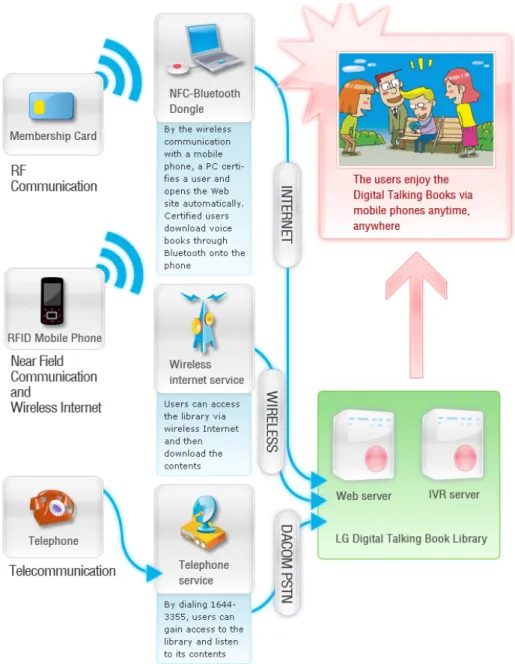
The users of the Library (refer to Figure 1) can get access to the information services via
mobile phones, PCs, and telephones. By touching the NFC-Bluetooth dongle connected to a
PC with a NFC reader-equipped mobile phone or a RF membership card, the communication
between the PC and the mobile phone or the card is activated. In consideration of the users
that are not able to have information devices such as mobile phones and PCs, the Library
provides users with the telephone service that users can listen to talking books via wire
telephones.
The service of the LG DTB Library has three unique elements. First, the service is opened
by a “touch.” In the environment that a mobile phone or a membership card is ready to
communicate with a PC, only the simple action touching one information devices with the
other automates user identification, and links the user to the Library Web site automatically.
The user is also able to listen to talking books on the Web or download the files via wireless
networks. Therefore, the service has a very strong point to simplify the complicated
procedure of PC operations for the user.
Next, the service materializes the concept “the library in my palm.” For the purpose of
library service at anytime and from anywhere, a voice-support mobile phone was developed,
dedicated to the print-disabled. By the phone, users are able to access wireless Internet and
download talking books. The downloaded talking books are run on a Digital Talking Book
player installed in the mobile phone.
Finally, the Library mainly considered the usability such as navigation moving forward and
backward, and bookmarks in the Digital Talking Book services. Accordingly, the Library
selected DAISY files as a form of the talking book because DAISY form encloses content’s
structural information such as parts, chapters, and pages, which enhances the usability. In
order to prevent the non-disabled general public from misusing the contents, the Library
Figure 1. The Frame of the Library Services
5. The Service Systems of the Library
In order to realize the ubiquitous networks “Anytime, Anywhere,” the Library offers
three kinds of services – a Web service, a mobile service, and a telephone service.
A. The Web Service
In the first place, a user connects a computer with a NFC-Bluetooth dongle designed for the
communication between a mobile phone and a computer, and then equips a mobile phone
with a NFC reader. After the preparation, when the user touches the dongle with the mobile
The first web menu automatically linked is “My Library,” in which the user is able to continue
listening to a talking book from the page bookmarked before. If the user is not yet a member
of the Library, the page will be turned into the member registration page. After the
successful access to the Library’s Web page, the user searches books, listens to the talking
books, and downloads the books via the mobile phone.
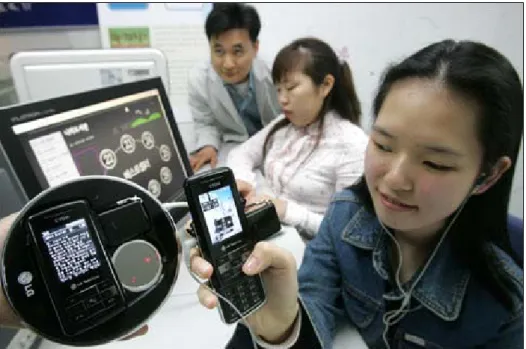
Figure 2. The Communication between a Mobile Phone and a Computer
As mentioned before, NFC is one kind of contactless short-range wireless communication
operating in a radio frequency band of 13.56MHz and transmitting data within the operating
distance of 10 cm at 424 kbps speeds with low electric power. The user identification and
the easy user interface utilizing NFC technology help the print-disabled overcome their
multiple handicaps and simplify the procedures in using computers. After user identification
through NFC, Bluetooth communication system will be operated to send the contents from a
PC onto a mobile phone. Bluetooth communication is able to transmit data wirelessly at
speeds up to a maximum of 1Mbps within ten-meter radius. By combining NFC for
short-range communication and Bluetooth for high-speed wireless communication, two information
devices as reactors can identify each other immediately and transmit contents each other
wirelessly. As a result, the operating quality of the wireless communication was significantly
enhanced in the Library system.
In consideration of accessibility of the print-disabled, the Web site of the Library is designed
following “The Web Content Accessibility Guidelines 1.0” published by Web Accessibility
Initiative of W3C (World Wide Web Consortium). The guidelines explain how to help the
disabled get access to Web contents. Following the guidelines, the Library can improve the
disabled’s accessibility to the Web pages and help them search information on the Web more
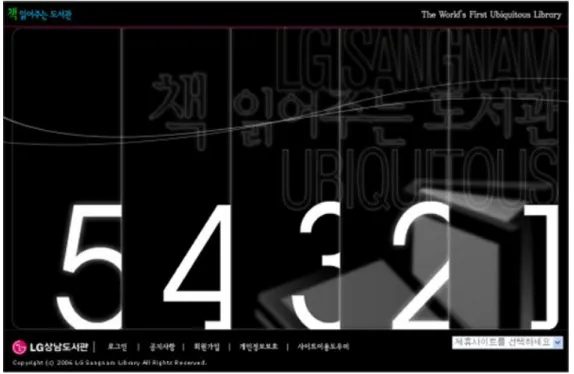
The site consists of six menus – Voice Library, My Library, Community Room, Information
Room, About the Library, Guidelines, and Help.
Figure 3. The Main Page of the Web Site
While Voice Library serves new and recommended book information, subject-based
book list, and search page, My Library offers customized services including bookmarks. In
Community Room, users are encouraged to participate at activities for communication with
other users such as uploading their after-reading writing. Information Room contains useful
information and reference resources for the print-disabled.
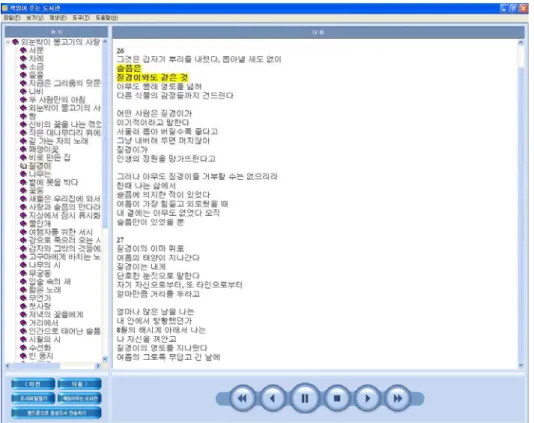
The users of the Library not only listen to talking books via real-time communication
from the Web server but also download the books onto their computers. If users install a
DTB (Digital Talking Book) player designed for DAISY files on their computers, they are
able to control the audio elements of the downloaded talking books sophisticatedly by the
player. For example, when playing voice files directly on the Web site, users can move
forward and backward on the files, can control playing speed and sound volume, and can
insert bookmarks. With the DTB player, users are also able to record ten more additional
bookmarks and to skip contents at sentence level or at content-element level. The
downloaded talking books onto the DTB player can be transferred to a mobile phone again,
and then users can listen to the talking books conveniently in moving with a DTB player
Figure 4. The DTB (Digital Talking Book) Player
B. The Mobile Service
The Library’s users can use the services in connection with wireless networks as well
as wired networks. The mobile phone for the project contains WIPI (Wireless Internet
Platform for Interoperability)-based software, which is programmed for the Library services.
When a user pushes “OK” button in the middle of the keypad of the mobile phone, the
software for wireless communication runs immediately. The user searches books in
connection with wireless Internet networks, and downloads the retrieved contents onto his or
her mobile phone. The downloaded contents are text-file-formed DAISY files, which
enclose document structural information. Then, TTS (Text to Speech) engine embedded in
the mobile phone plays the voice files.
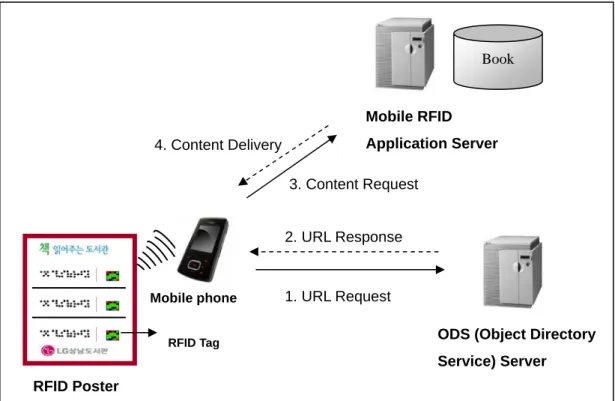
Another major wireless network service by the Library is a mobile RFID service. In
order to operate the service, a RFID reader should be equipped in a mobile handset such as a
mobile phone, and RFID tags with unique identification code should be attached to contents
or contents-promoting posters. A handset of a user obtains the identification codes of RFID
tags in interesting contents from any location, and the user downloads the contents directly
onto the handset by transmitting the identification code data via wireless Internet network
(Jung, 2005). Adopting the mobile RFID service model, the Library attached
identification-code-given RFID tags to posters or book brochures and created the environment enabling
users to download identified contents directly onto their mobile phones. In the process of the
service, an NFC reader-equipped mobile phone identifies the RFID tag on a poster.
required to find the on-line location of target contents. The Library employed mCode for the
mobile RFID technology issued by Korean government agency, NIDA (National Internet
Development Agency of Korea). In order to solidify the service model, the Library had
completed building RFID ODS (Object Directory Service) system, which is similar with
present DNS (Domain Name System) structure. Through the ODS system, a user with a
handset gets directory information of contents, gains access to the content server, and
downloads the contents. Figure 5 shows the main procedure of the Mobile RFID service.
The mobile RFID service mainly consists of two kinds of network operations. One of the
operations (refer to 1 and 2 in Figure 5) is generated between a mobile phone and a ODS
server. After reading a RFID tag, a mobile phone requests a ODS server storing content’s
URL mapping information to transmit URL data of target contents, and then the server sends
URL data to the mobile phone. The other procedure (refer to 3 and 4 in Figure 5) is that after
parsing URL data obtained from the ODS server, the mobile phone get access to the content
server and download the contents. As an active practice of the service model, the Library is
preparing to distribute RFID-tagged posters, and accumulate learning contents that users will
download through the posters.
RFID Poster
Mobile RFID
4. Content Delivery
Mobile phone
RFID Tag
Book
ODS (Object Directory
Service) Server Application Server
1. URL Request 2. URL Response
3. Content Request
Figure 5. The Main Procedure of the Mobile RFID Service
One of the most important products developed for the project is very the mobile phone
dedicated to the print-disabled. As well as installed with the functions for the Library use,
the mobile phone is produced to comply “Product Guide for Wireless Customers Who are
Blind or Visually Impaired” advocated by CITA (Cellular Telecommunication & Internet
functions including voice recognition, voice synthesis, and voice menu guide to keep the
users from an uncomfortable interface.
C. The Telephone Service
The telephone service is provided via PSTN (Public Switched Telephone Network)
on purpose to help users advantage in the Library service even in the situations when no
information devices are available. This service works in connection with normal telephones
that are very handy in daily life. To support the service, the Library has built an IVR
(Interactive Voice Response) system to which a VXML (Voice Extensible Markup
Language)-based voice identification solution is applied. As a result, users are able to search books by
the voice recognition technology.
Figure 6. The Mobile Phone for the Print-Disabled and the NFC-Bluetooth Dongle
As one of markup languages, VoiceXML is based on XML (Extensible Markup
Language). As HTML (Hypertext Markup Language) is used to generate a graphic Web
page, VoiceXML is to define spoken dialog-formed information. In other words, VoiceXML
is an XML designed to navigate contents on Web sites according to voice. The users of the
Library with wire telephones or mobile phones call the telephone service center at 1644-3355,
search books after user identification according to the voice guide, and listen to any talking
book that they choose.
6. The E-Collection of the Library
the DAISY (Digital Accessible Information System) standard, which is one of the
international standards of Digital Talking Book. It is authorized by the DAISY Consortium,
which is organized in 1996. In addition, the talking book comply ANSI/NISO Z39.86
(American National Standards Institute/ National Information Standards Organization Z39.86)
standard of NISO (National Information Standards Organization). As following international
standards, all kind of DTB players can read books of the LG DTB Library.
A DAISY-formed book has a unique structure and is digitally produced to provide the
print-disabled with diverse conveniences. Users can examine the book by page, section, or chapter,
or use a table of contents and an index. In addition, users are able to place bookmarks for
later reference and control the reading speed of the book. The DAISY-formed book excludes
the distorted reproduction of sound due to the repetitive use, the season and the length of the
time.
Because the digital contents service of the LG DTB Library is allowed to only the blind under
the Copyright Act in South Korea, the Library applies its own DRM (Digital Rights
Management) to prevent from the fraudulent activities. Therefore, the print-disabled who are
certified formally can use these contents.
Korean Braille Library produces the DAISY-formed contents. Consisting of mainly
literatures, the contents cover all kinds of books including science, philosophy, history, and
vocational program resources. Hereafter, the library has a plan to produce course textbooks
and provide them for the print-disabled students.
7. The Participant of the Library Project
The Library service was created by integrated technologies as the six subsidiary companies of
LG Group have taken part in the project to realize ubiquitous technologies.
The LG Sangnam Library is in charge of service management and contents production.
Other subsidiaries produced the software and hardware by combining related ubiquitous
technologies - LG CNS for the development of the ubiquitous library system on the Web; LG
Electronics for the production of the mobile phone for the print-disabled; LG Telecom for
wireless Internet services; LG Innotek for the production of the NFC-Bluetooth dongle,
Dacom for telephone networks services.
Each company has donated their own ubiquitous technologies for public good, and thanks to
their cooperation, this project has been completed successfully.
8. Conclusion
This paper proposed a role model that adopted all the elements of the ubiquitous technology
to realize a barrier-free information service for the print-disabled.
various related institutions. Learning materials are insufficient and essential contents for the
print-disabled. Therefore, we are cooperating with educational institutions including Seoul
National School for the Blind and Korea National Open University to produce digital learning
contents. These contents will be distributed to the print-disabled free of charge.
The information technology in the knowledge-based society enables us to achieve a new
humanistic goal that reduces digital divide and respects human dignity. We hope that this
library can function as a future-oriented model enhancing service quality with ubiquitous
technology.
References
Hisao NAKAJIMA (2002). Marketing Strategy in the Era of Ubiquitous Networks. NRI
Papers No. 44.
<http://www.nri.co.jp/english/opinion/papers/2002/pdf/np200244.pdf>
Jeong, Bu-Man (2005). The Revitalization Strategy of Mobile RFID Service. TTA Journal,
102: 32-37.
Kang, Sook-Hee (2001). Improving Information Service for the Visually Handicapped
through IT. Journal of Korean Library and Information Science Society, 32(4): 229-256.
Lee, Eung-Bong (2003). Ubiquitous Computing & Digital Library. The 6th Digital Library
Conference. (December 9, 2003)
Morgan, Greg (2003). "A word in your ear: library services for print disabled readers in the
digital age." Electronic Library, 21(3): 234-239.
Oliver Obst (2005). Services for Handheld Computer: First steps towards the Mobile Library.
9th Conference on International Congress on Medical Librarianship. (September 20-23, 2005)
<http://medweb.uni-muenster.de/zbm/obsto/text/vortraege/9ICML/mobile-library.pdf>.
Teruyasu MURAKAMI (2001). Ubiquitous Networks: The New IT Paradigm. Teruyasu. NRI
Papers No. 30.
<http://www.nri.co.jp/english/opinion/papers/2001/pdf/np200130.pdf>.
Toshitada NAGUMO (2002). Innovative Business Models in the Era of Ubiquitous Networks
in the Era of Ubiquitous Networks. NRI Papers No. 49.