Managing Global Brands To Meet Consumer Expectations
Malcolm Baker and Greet Sterenberg Research International Qualitatif
Earl Taylor Research International
INTRODUCTION
There is growing consensus that the truth about globalization of brands lies somewhere between the extremes of Ted Levitt's thesis of homogenization (Levitt, 1983) and Naomi Klein's more recent prediction of a 'no logo' backlash (Klein, 2000). To move beyond a sterile debate about globalization in the abstract, brand strategists need decision criteria based on a typology of brands and environments that they can apply to make informed decisions about whether, when, where and how to globalize or localize a brand.
The ideas presented here are largely based on the Research International Observer (RIO) qualitative study of consumer understanding of and reactions to global brands conducted in late summer and early fall of 2002. We believe this to be the largest and most comprehensive study of its type ever conducted, involving over 1,500 young urban consumers (ages 18-35) in 41 countries and 52 cities around the world. While over 100 specific global and local brands were included in the study, its purpose was not to determine consumer images of these brands per se. Rather, extended focus group discussions used a variety of projective techniques to elicit consumers' feelings and attitudes about the 'globalness' or 'localness' of such brands. In our analyses we uncover the underlying dimensions along which consumers evaluate brands across multiple product categories.
The initial 2002 RIO findings (Baker and Sterenberg, 2002) have been further analyzed to produce a 'road map' for brand managers based on our brand typology and decision criteria for globalization versus localization. A secondary source of data and insights for our current efforts is a quantitative global survey recently conducted on behalf of the Harvard Business School (jointly funded by our parent company, WPP). This study involved a total of 1,800 consumers in 12 countries selected to represent a mix of developed and less-developed economies and Western and non-Western cultures.[1]
THE GLOBAL BRAND AT A CROSSROADS
Ted Levitt's globalization of markets thesis asserted that global companies and their brands would grow inexorably, offering global consumers an unbeatable combination of quality, availability, reliability and low price. He described a Brand Utopia in which tastes and needs would become increasingly homogenised, with successful companies focusing on what 'everyone' wants.
Entering the 21st century, the global brand is at a crossroads. The ubiquity of global brands has become one of the defining features of modern life and one of the core tenets of modern marketing. Yet the issues highlighted by the anti-globalization movement raise questions:
How local should global brands get?
● Is there consumer-perceived value in globalness per se?
● What balance do consumers seek between their need to feel part of a global tribe and their desire to be more individual? ● To what degree do mainstream consumers hold brands accountable for the practices of the companies behind them?
To begin to answer these questions, it is necessary to review a few key findings from the 2002 RIO study.
CONSUMERS LOVE BRANDS
Brands may be constructs created by marketing companies and their agencies that sit on supermarket shelves in the real world. But brands are also ideas and ideals that exist in consumers' imaginations. That's where the real connections are made and where brands are invested with personal meaning and relevance. It is in this Platonic, idealized world where brands take on life and where they acquire their redemptive role. (As we shall see, this idealized existence may also prove to be a pitfall for certain types of brands in specific
circumstances.)
'If I could I would die for a Chanel suit' (Argentina)
'My son is obsessed, always wanting Coca Cola, McDonalds and Nike shoes' (UK)
'It may be that I have this dream, being like Michael Jordan and therefore I use his sportswear which is Reebok' (Colombia)
'I feel close to Starbucks, I believe it is a great and typical American experience' (USA)
'If I wear Nike there is no need to say anything, if I choose another brand it is as though I am stating something that I have
ESOMAR
Global Cross-Industry Forum, Miami, December 2003
to explain' (Italy)
'Global brands make us feel citizens of the world and we fear their leaving because they somehow give us an identity' (Argentina)
CONSUMERS WANT TO FORGIVE AND FORGET
What was perhaps most remarkable in the RIO study was the degree to which consumers feel protective about their brands. Because consumers have such a strong investment in what brands mean to them, they disconnect their idealized world from the real world - as they do the consumer self from the political self. Consumers are reluctant to accept negative messages from the real world that challenge their view of brands. They prefer to make life easy, to forgive and forget. A change in attitude is easier than a change in behaviour. Typical comments reflect a variety of ways consumers manage potential cognitive dissonance:
'I assume most, if not all, big companies use 'cheap labour' so it's useless to care' (USA)
'I know about Nestle and their milk powder scam but at the end of the day one Kit Kat can't make much of an impact' (UK)
'I know Nike has sweat shops, like other manufacturers, but at least these people have a job' (Germany)
'Tommy Hilfiger publicly said that he did not intend his clothes to be marketed for Latin Americans / black people, but I like them and still buy them' (Black respondent, El Salvador)
'It is so far away from your own situation. It is not your mother who gets exploited, you know?' (New Zealand)
'As it does not affect yourself, the brand is so important that you forget about it' (Spain)
While consumers are not actively looking to make a connection between the brand and the company behind it, they may react to information from activists and the media and will respond to bad company behavior that cannot be denied. They have thresholds beyond which beliefs get translated into action. These thresholds are lowest on issues dealing with ingredients, contamination and a range of environmental issues; slightly higher for employment practices; and higher still for activities that relate to marketing and general business practices.
AMERICAN BRANDS AND AMERICAN VALUES
While the RIO fieldwork was completed some months before the war in Iraq, controversy about American foreign policy was already widespread, particularly in Middle Eastern and Islamic countries. Nevertheless, in the same way as they separate their political self from their consumer self, most global consumers appear to separate America and American values from American brands. We found little evidence of a widespread rejection of brands that reflect American cultural values. While we did not work in the core Islamic countries of the Middle East, this study did cover Turkey and Indonesia as well as separate groups with Muslim respondents in India and South Africa. There was little evidence of broadscale rejection of American brands in these cultures. Typical comments include the following:
'We don't care about America and American politics, we do care about their brands' (Panama)
'I used to go on anti-US rallies when I was still a student, but I never thought about the brand of clothes or shoes I wore' (Philippines)
'We can hate them, we cannot change the world. We need the brands because we rely on them' (South Africa)
'Our political view has nothing to do with our behaviour as customers. If you go downtown you will see many young people handing out documents protesting the capitalistic system but also wearing Levi's ' (Turkey)
One of the key reasons for this lack of apparent conflict is the fact that many brands have transcended their 'American-ness.' Consumers may know that Coca-Cola is American but the brand's myth is seen as a universal one. The brand's cultural identity, while known, is not central to its appeal. After reviewing our typology of brands and globalization 'roadmap,' we will consider in greater detail the specific reasons why and circumstances under which American and other global brands might be vulnerable to anti-globalization backlash.
GETTING THE GLOBAL/LOCAL BALANCE RIGHT
If the anti-globalization movement is not converting the mainstream, does that mean that a global one-size-fits-all approach is the solution? The answer, unsurprisingly, is no. Even without the impetus of anti-American or anti-Western motives, global consumers may react powerfully against the increasing ubiquity of global brands and their homogenized identities. In assessing a brand's need for localization, marketers must consider four key factors:
1. Type of brand, 2. Nature of the category, 3. Level of aspiration, 4. Nature of the local culture.
Before we can assemble a globalization 'roadmap,' we need to briefly examine each of these factors in turn.
The RIO study revealed four different types of global brand. (See Figure 1.)
1. Master brands like Nike, Sony and Coca-Cola define their category and are built on powerful myths or narratives (e.g. Levi's theme of independence or Nokia's theme of connection). For these brands it is this universality of their narrative rather than the fact of globalness itself that is at the heart of their appeal. Often, these are 'first mover' brands that define a category. While they can thus leverage their heritage, the corresponding key challenge facing marketers of Master brands is the need to keep the myth relevant to each new generation. Coca-Cola has been superbly successful at this; Levi's has been less so. As Coca-Cola also illustrates, Master brands can transcend their national origins to be embraced by consumers as truly global brands. They thus require - and permit - little if any localization that might threaten to undermine their universality or mythical appeal. Master brands are also less exclusive - and exclusionary - than Prestige brands: As one consumer observed, 'it is a status symbol, but anyone can have it.'
'Coca-Cola is for everyone, this gives a feeling of universality and at the same time it considers everyone's individuality ' (Mexico)
'They talk about a product, but also about a specific style, a precise philosophy when you buy it, it is like choosing something with which you identify (Italy)
'Brands that have become indispensable and unavoidable' (Belgium)
2. Prestige brands such as Chanel, BMW, Rolex and Gucci have an appeal built on specific myths of cultural origin or the provenance of a founder or a technology (e.g. Mercedes as the embodiment of German design and engineering excellence). These brands are nearly always in strong display categories with high aspirational value. Like a magic amulet, a Prestige brand 'increases the value of the one who uses it.' At the risk of excluding many to appeal to the chosen few, Prestige brands actively reject localization. For example, BMW and Mercedes in Japan and Singapore will usually avoid the use of local icons to stay sufficiently aspirational.
'I bought it because it is Swiss, it is high quality just like watches, Swiss means precision and reliability' (Chile)
'To me, it means differentiation from others. It increases my self-esteem and my self-confidence.' (Germany)
'Not everybody can buy it, then again it is not meant to be for everyone' (Greece)
3. Super brands are universally available like Master brands. Unlike Master brands, Super brands are defined more by their category than by a myth or narrative. Examples include Gillette, Pepsi, McDonald's, Shell, Philips and American Express (regular card). In the words of one respondent, they are 'trusted, silver-medal winners.' As such, a Super brand may be quite successful and as good as any other in the category without being differentiated on the basis of a distinctive myth or narrative that it 'owns.' Instead, Super brands try to become relevant by localizing somewhat (e.g., McDonald's adapting versions of local foods to a quick service environment) and remain relevant by constant product or service innovation (e.g., the evolution of Gillette's 'shaving systems').
'They represent good quality, but are not so unique or universal as Coca-Cola.' (Netherlands)
'The highest level of a brand is reached if it stands for a product category like UHU.' (Austria)
4. GloCal brands such as Dove, Nestle and Danone are available globally, but marketed locally, often under a variety of local or regional product names (sub-brands). Even where consumers are aware of this global distribution, a GloCal brand may 'feel close' and be seen as 'one of ours' - and it is this, rather than its universal availability, that enhances its equity. These brands thus require and permit the greatest degree of localization and are usually, though not always, in categories with weak display value such as food, household products and personal care. (As such they are brands with the lowest threshold for triggering negative reactions if consumers perceive that their own or their families' health or safety are threatened - see below.) We should also note that the potential aspirational value of a given product is relative to local economic conditions; in many less-developed countries and newer consumer societies, a variety of fast moving consumer goods can take on this character.
'They are ours they are homely, approachable, close and warm-hearted they form part of our history' (Italy)
'As Lipton has a long history in Turkey it has become like a local brand in our minds and we see Lipton as a local brand '. (Turkey)
THE CATEGORY THE BRAND IS IN AND THE LEVEL OF ASPIRATION TOWARDS IT
Categories with high display value (or with highly aspirational positioning within a given category) will require and permit less localization. Because they are rooted in local taste, traditional culture and physiology, food, food retail, household cleaning and personal care products will nearly always need more localizing.
It's worth applying the aspirational test to a brand's positioning:
● Toyota, while in a high display category is, for instance, viewed as a local brand in many countries because its positioning is distinctly everyday and it successfully connects with local values.
● Conversely, Nescafe uses local people for its coffee in India but puts them in foreign (i.e. aspirational) settings because of the positioning of the brand.
● Nike sponsors a local marathon in Budapest (the 'Footapest') but is careful to use a spokesperson with a more international standing (Michael Jordan).
THE NATURE OF THE LOCAL CULTURE
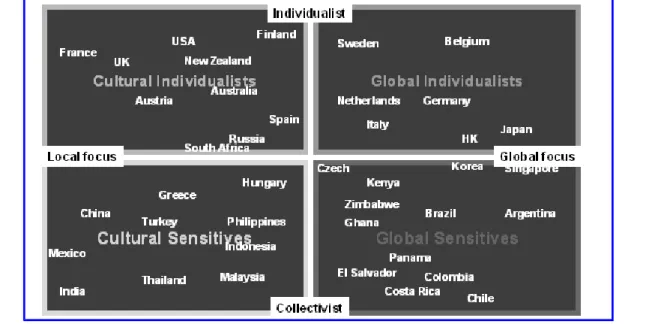
The final factor required for our globalization 'roadmap' is the nature of the culture in which the brand must operate. Countries included in the RIO study can be plotted on two axes depending on whether their orientation toward brands is individualistic or collectivist and on whether they are oriented more toward their own culture and values (local focus) or more receptive to global influences (global focus). To avoid confusion, we should emphasize that we are classifying countries qualitatively by how consumers typically relate to global brands. This may or may not correspond to stereotypes about specific cultures. Thus, compared to Western Europe and North America, Japan is traditionally thought of as a collectivist society. Nevertheless, as consumers, Japanese share with their counterparts in northern Europe and the Anglophone countries a desire for brands to relate to them as individuals. These countries are, in turn, differentiated among
themselves in terms of their pride in their own culture versus receptivity to others'. Here the Anglophone countries appear much less 'globalist' than the smaller European countries and Japan. (See Figure 2.)
Cultural Individualists
These countries have a high pride in their culture combined with strong individualistic values. This requires both localization and an individual connection with local consumers, with the individual connection probably more important than the cultural one.
Global Individualists
These countries have a weaker interest or pride in their own culture and a correspondingly greater openness to the world. While there is thus a low need for localization, consumers in these cultures still have a high need to connect with brands at an individual level. (They may thereby feel part of a wider global 'tribe' - see below.).
Global Sensitives
These are collectivist societies that are open to the world. Connectivity through and availability of global brands is often more important than pride in local culture. There is thus a medium need for localization in these cultures, more a matter of translation than adaptation. A product or brand's origin and where it is manufactured are important.
Cultural Sensitives
In these collectivist markets consumers take high pride in local culture. They expect global brands to understand and respect their culture and, when possible, adapt to local situations both in terms of communication and product features.
The relevance of a brand's global identity will also vary geographically. Asian consumers, especially those from Japan and Chinese-based cultures, tend to set a high value on Western provenance for many branded goods, especially those that have prestige value. The same is true for African and South American cultures.
Europeans set less store on global provenance. Less developed countries, many of which have a history of being passed off with second-rate international products, will often want to know where the item is manufactured as well as the provenance of the brand. (See Figure 3.) Thus Kenyan consumers make a quality distinction between Nike shoes made in the United States and those made in China or Indonesia.[2]
THE GLOBALIZATION 'ROAD MAP'
Combining these four factors yields a globalization 'road map' or planning matrix that brand managers can use to assess the need for or possibility of localizing versus globalizing a specific brand in specific circumstances. (See Figure 4.) All else being equal, a Prestige brand will require/allow the least localization and a GloCal brand the most. Similarly, high-display categories such as luxury, fashion, high-tech and automotive will require/allow the least localization and food and local retail the most. Independently of these considerations, the more aspirational the positioning of the brand, the less it should be localized. As noted earlier, this dimension is perhaps most context-sensitive, as items that appear aspirational to consumers in less-developed economies will be less so in more mature consumer markets. Finally, countries where consumers relate to brands as global individualists will require the least localization, while those where consumers relate to brands as cultural sensitives will require the most.
If not taken too literally, brand managers should be able to sum localization 'weights' across these four dimensions to determine a brand's overall potential or requirement for localization. The matrix can also point us towards possible interactions among the dimensions and moves across the typology of brands. For example, if we believe our gasoline (petrol) is perceived to be a Super brand in most markets, we may wish to link innovation to country of origin when positioning the brand among global individualists who are receptive to superior technology from abroad. In effect, we might want our brand to be seen as 'the Mercedes of gasoline' (assuming this is credible for our target market). The same brand could be positioned among cultural sensitives more in the direction of a GloCal brand by emphasizing its longevity in the market and sensitivity to local norms about retail practices, etc. Finally, we might to try move not just the product but the corporate brand itself from a Super brand more toward a Master brand by engaging a universal myth or narrative. British Petroleum's recent efforts to have 'BP' mean 'beyond petroleum' may be an example of this, an attempt to forge links to a myth of 'sustainability' or 'responsible stewardship.'
As this last example illustrates, our typology of brands is not meant to suggest that a brand simply 'is' a Master brand or a Super brand for all time. Rather, brands evolve and change their fundamental character in the ongoing dialectic between the companies and the consumers who jointly 'own' them. IBM and McDonald's once defined their categories and embodied myths such as success ('You'll never get fired for recommending IBM') or dependability (the same family-friendly experience, coast to coast). Today, despite past or current stumbles, they are still powerful brands with the potential to reinvent themselves, but they are more nearly Super brands than Master brands.
LEVERAGING AFFINITY STRENGTHS BY BRAND TYPES
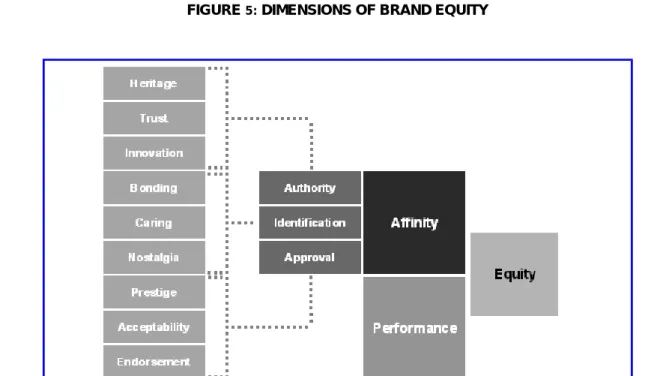
We can further characterize Master, Prestige, Super and GloCal brands in terms of the specific aspects of affinity that each leverages to create brand equity. Research International's Equity EngineSM model of brand equity views brand equity as the sum of perceived brand performance (functional benefits) and perceived brand affinity (emotional benefits). While this ranges widely across product and service categories, typically half or more of brand equity derives from affinity rather than performance. Affinity has three basic dimensions, each of which in turn has three dimensions. (See Figure 5.)
1. Authority is the brand's standing among other brands on the dimensions of heritage, trust and innovation.
2. Identification is the relationship of consumer and brand in terms of bonding (how the consumer currently views the brand), caring (what the consumer believes the brand currently feels about him or her) and nostalgia (past relationships with the brand).
3. Approval is the consumer's evaluation of the brand through the lens of society at large and specific reference groups in terms of prestige, acceptability and endorsement.
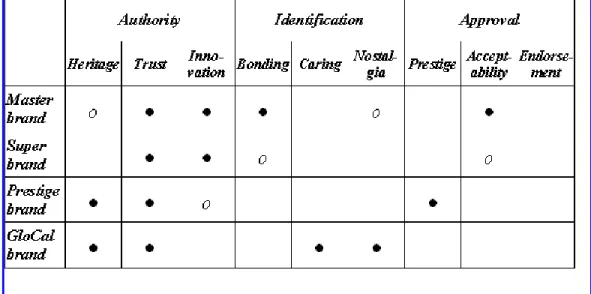
The next four figures show the specific aspects of affinity that are most salient for each type of brand. Master brands tend to be strong on at least one aspect of each of the three basic dimensions of affinity. While not all Master brands are in fact 'first movers,' they tend to be strong on authority, particularly innovation and trust. This may be in part because of the heritage (actual or presumed) they may claim as (re)inventors of their category. This, in turn, helps explain the nostalgia aspect of identification that Master brands can leverage.
Importantly, Master brands are more 'loved than loving' - that is evoke more bonding from consumers than demonstrate caring toward them. Finally, their ubiquity and long-term or dominant presence give Master brands particular strength on the acceptability dimension of approval. (See Figure 6.)
Super brands share with Master brands strengths in trust and innovation. Since trust is an essential element of all types of brands, Super brands attempt to differentiate primarily on innovation - which is largely defined (like Super brands themselves) by the category. Because they do not engage a universal myth or narrative in the way that Master brands do, however, Super brands typically show less strength on the basic dimensions of identification and approval. What strength they do have on these dimensions flows largely from bonding and acceptability, respectively. Conversely, Super brands cannot typically leverage the heritage and nostalgia that support Master brands' myth or narrative-driven equity. (See Figure 7.)
In keeping with their 'elitest' appeal, Prestige brands exhibit the 'coolest' relationship with consumers - allowing themselves to be loved, but reciprocating very little. In fact, Prestige brands may selectively appeal precisely to consumers who fancy themselves to be 'above' such common demands and who are secure in their own identity and self-worth, displayed through their refined choice of such brands. (In this, they resemble - and in fact may be an evolution from - 'tribal brands' discussed below.) Heritage, trust and perhaps innovation yield authority while prestige yields approval - what more could the discriminating consumer ask? (See Figure 8.)
By contrast to the three other types of brands (particularly Prestige brands), GloCal brands typically demonstrate the strongest
identification. They project 'concern and caring' for the consumers they know so well and elicit in return nostalgia about what these brands have meant to them as they literally 'grow old' together. Like Prestige brands, GloCal brands thus tend to be strong on heritage and trust, but they trade approval for identification. The distinction here parallels that made by social scientists between modern urban society based on anonymous market transactions (Gesellschaft) and traditional rural communities based on kinship and other close ties (Gemeinschaft). As traditional cultures modernize, personality types and motivations shift from 'inner-directed' to 'other-directed' and social approval takes on a new character. No longer (only) a matter of direct personal relationships, social approval is increasingly mediated through 'virtual communities' defined in part by shared brand experiences (Upshaw and Taylor, 2000). As traditional cultures open to include a wider world, however, the role of GloCal brands in maintaining personal and cultural identity remains - and may in fact loom larger as a haven against perceived negative aspects of globalization. (See Figures 9 and 10.)
VULNERABILITY TO TRANSPARENCY AND 'NO LOGO' BACKLASH
One consequence of the different affinity strengths of Master, Super, Prestige and Glocal brands is that they are differentially susceptible to threats from 'transparency' - the possibility that consumers will reject a brand because of its parent corporation's perceived bad behaviour. Just as our typology of brands does not imply a value hierarchy, so too is no one type of brand immune to transparency and a 'no logo' backlash. Rather, each type of brand faces its own kind of threat and potential response. To aid our comparisons on this point, Figure 10 summarizes the affinity strengths of each type of brand.
As noted earlier, trust is the bedrock precondition of all successful brands, but each type can gain (or lose) this trust in somewhat different ways. As Naomi Klein herself suggests toward the end of No Logo, brands that are the most visible to consumers and pride themselves on their high moral ground, may be setting themselves up for the biggest fall (Klein, 2000). By appealing to the myth of empowerment, Nike in effect dares consumers to judge it by whether or not it empowers the Third World factory workers who make its products. And as we have seen, one way to avoid cognitive dissonance and continue to love Nike is to decide that in fact such workers are empowered - if only relative to local conditions, not Western standards.
We find much less evidence of thus holding Master brands accountable than Klein believes is (or should be) the case. Nevertheless, it is precisely the appeal to a universal myth that creates Nike's Achilles heel. If empowerment is a universal rather than a culturally-specific ideal, then Western consumers at least (and perhaps Third World activists) may be inspired to apply the same standard globally, forcing the issue. Potentially offsetting this possibility, if a Master brand is truly (increasingly) an ideal accessible to all, it may be able to live its brand promise more consistently. The success of Coca-Cola relative even to other Master brands may be an example of this.
function of their ubiquity and more distant relationship to consumers.
Finally, the contrasting vulnerability to transparency of Prestige and GloCal brands helps illuminate some of the underlying dynamics of potential 'no logo' backlash. While both count heritage and trust as salient aspects of their affinity, Prestige brands focus the approval dimension on prestige, rather than acceptability or endorsement. While all three are mediated by society, prestige is the aspect of approval most readily isolated from wider social currents. By definition, Prestige brands selectively appeal to an elite that may define itself in part precisely by its ability to ignore the opinions of others 'not like us' (witness the relatively unsuccessful attempts to boycott the use of real furs). Like Master brands, Prestige brands embody a myth or narrative, but unlike Master brands this does not necessarily claim to be universal-at least in the sense of available to all. Rather, a Prestige brand's myth or narrative is exclusive and exclusionary, that of a founder or country of origin, the qualities of which not everyone can appreciate. As such, and somewhat ironically, Prestige brands may be least susceptible to transparency and 'no logo' backlash. They aim to remain aloof and above the fray.
By contrast, GloCal brands may also be less susceptible to transparency than are Master or Super brands because they are 'beneath the radar.' As noted earlier, GloCal brands are the 'warmest' in terms of their reciprocal relationships with consumers. That is, more than other types of brands, their trust is rooted in and supported by heritage, nostalgia and concrete demonstrations that they understand and care about consumers on the basis of this long-standing, intimate relationship. Far from embodying a universal or exclusive myth or narrative, they are the familiar, comfortable, 'every day' brands that share our values; they are felt to be local even when they are known to be globally available. And this is just as well, because GloCal brands also tend to be in categories such as food, personal care and household products that can have a direct effect on the health and safety of consumers and their families. If the threshold for 'bad' corporate behavior to become personally relevant is thus lower, the desire to love the brand is all the greater, even as the potential discrepancy with 'higher' values is less.
Some Master brands such as The Body Shop have seemed to embody the myth of Icarus - flying high and aspiring to universal acceptance at the risk of provoking universal rejection. By contrast, GloCal brands appear content to fly (or lie) low, keeping so close to consumers that the possibility of a generalized rejection never arises. GloCal brands are far from invulnerable, however.
Using the brand personality typology she developed, Jennifer Aaker and S. Adam Brasel of Stanford University and Susan Fournier of the Harvard Business School have recently reported research which may shed light on the differences between Prestige and GloCal brands' ability to resist transparency and 'no logo' backlash (Aaker, Fournier and Brasel, 2003). Her experiments indicate that a brand seen by consumers to be 'sincere' may actually have a harder time recovering from a service failure than a brand seen to be 'exciting.' By precise analogy to interpersonal relationships, it appears that consumers put more into - and expect more out of - a 'sincere', long-standing relationship. When this trust is violated (e.g., by an affair), the damage may be harder to repair. Conversely, less is expected of a casual 'fling.' If and when the other party unexpectedly 'comes through' (analogous to an exciting brand's equally unexpected recovery from a service failure), the individual may re-examine his or her assumptions about the nature of the relationship, and recovery from the let down (service failure) may be quicker and more thorough.
In terms of our brand typology, Prestige brands are 'exciting' - aloof and alluring, but consumers may consequently expect little serious commitment from the brand. (Conversely, 'loyalty' to a Prestige brand may be as much to the idea of exclusivity as to the specific brand of the moment, which helps explain the frantic pace of competition in fashion and other prestige categories.) GloCal brands are 'sincere.' Prestige brands may escape transparency and rejection on appeal to universal ideals precisely because they are so self-referential and self-validating. GloCal brands may escape a similar fate because they make no appeal to a higher standard other than the fundamental trust they have earned. But if and when this sincere relationship is brought into question (e.g., by a health or safety controversy), the GloCal brand may suffer a loss of credibility from which it may only slowly - or never - recover.
THIRD WAVE BRANDING
Thus far we have focused on the need to balance localization versus globalization of different types of brands and their specific strengths and weaknesses in the face of potential anti-globalization 'push back.' We conclude by briefly considering another important theme in the 2002 RIO study: the need to balance the desire for participation in a global consumer society against the desire for individual expression.
Many cultures are still in Wave One branding - where brands provide the reassuring guarantee of quality that was their original rationale at the dawn of consumer society in the mid 19th century. Most brands are part of Wave Two, where the role of the brand is to enable consumers to make a strong lifestyle statement. More sophisticated consumers increasingly find Wave Two branding too imposing and the brand identities too homogenised. Wave Three branding is a counter point in which consumers actively participate in the meanings that brands provide. (See Figure 11.) The consumer selects the brand, not the other way around, and the brand becomes a very individual statement, connecting a social group or 'tribe' based on attitude and behaviour, not age, sex or class. In the words of one Swedish consumer: 'I don't want the brand to find me; I want to find the brand.' Often Wave Three branding is used as a rebellion against mainstream brands and their increasing ubiquity.[3]
Examples of Third Wave brands are not limited to but can include so-called 'tribal' brands such as Carhartt, Gola or Quicksilver and local brands such as ACNE JEANS from Sweden. The essence of such tribal brands is the experience of authenticity as they are 'discovered' and appropriated (often in idiosyncratic ways) by an avant-garde. By definition, tribal brands thus resist heavy-handed corporate control. There are, however, very successful global brands that connect with 'tribes' through limited editions such as Nike or Sony, and global Prestige brands such as Hilfiger, Rolex or Gucci that have been picked up as totems of the tribe.
CONCLUSION: THE FUTURE OF GLOBAL BRANDS
While neither Ted Levitt nor Naomi Klein tell the full story, on the evidence of the RIO 2002 qualitative and Harvard Business School/WPP quantitative studies, Professor Levitt appears to be getting the better of the debate. Indeed, the consensus of the recent colloquium held at the Harvard Business School on the occasion of the 20th anniversary of his influential paper was that Levitt was more right than not.
The increasing importance and affordability of information technology and the rise of 'permission-based' marketing in more highly developed economies are likely to further, not retard trends toward customization at every level - from country to culture, from 'tribe' to individual consumer. Thus, brand managers are ever more likely to face the twin challenges of localization versus globalization and individualization versus homogenization. While there is no single or simple path to the Brand Utopia Levitt predicted, we hope that our typology of brands and globalization 'road map' will provide a useful guide for continuing the journey.
REFERENCES
Aaker, Jennifer, Susan Fournier and S. Adam Brasel. (2003). When Good Brands Do Bad. Paper presented to the Marketing Science Institute Board of Trustees Meeting in Washington, D.C., March 6, 2003.
Baker, Malcolm and Greet Sterenberg. (2002). International Branding: How to Resolve the Global-Local Dilemma. Market Leader (Autumn).
Johansson, Johny K. and Ilkka A. Ronkainen. (2003). The Esteem of Global Brands. Unpublished draft paper, McDonough School of Business, Georgetown University.
Klein, Naomi (2000). No Logo. St, Martins Press.
Levitt, Theodore. (1983). The Globalization of Markets. Harvard Business Review.
Quelch, John, Douglas Holt and Earl Taylor. (2003). Managing the Transnational Brand: How Global Perceptions Drive Value. Paper presented at the Harvard Business School's Globalization of Markets Colloquium (May 28-30, 2003).
Upshaw, Lynn and Earl Taylor. (2000). The Masterbrand Mandate. John Wiley & Sons.
[1] Preliminary results of this study (Quelch, Holt and Taylor, 2003) were presented at the Harvard Business School's Globalization of Markets Colloquium (May 28-30, 2003) on the 20th anniversary of Ted Levitt's influential paper (Levitt, 1983). The 12 countries included in the study were Brazil, China, Egypt, France, India, Indonesia, Japan, Poland, South Africa, Turkey, the UK and the US. Data collection in the US, UK and France was via Internet panels maintained by our sister company, Lightspeed Research, while the remaining countries used conventional in-person interviewing. The six product categories tested were automobiles, athletic wear, dairy/packaged goods, mobile phones, petrol/gasoline and soft drinks. Using a split-sample design, 75 respondents in each country rated three brands in each of three categories (e.g., Ford, Mercedes and Toyota for automobiles). A total of 20 attributes yielded five distinct factors or underlying dimensions of 'globalness' stable across all 12 countries. Latent class segmentation and regression analyses were used to determine the relative impact of each dimension of globalness on brand preference among specific types of consumers. In order of their overall ability to predict brand preference across all six product categories, these dimensions are: 1) quality inferred from global availability; 2) country of origin; 3) status or prestige associated with using a global brand; 4) perceived corporate citizenship; and 5) embodiment of American values. For further details, see the revised version of the colloquium paper to be published by Josey-Bass in early 2004.
[2] While our cultural classification is qualitative, it appears to be consistent with findings from two recent quantitative studies. For example, both our Harvard Business School/WPP study (Quelch, Holt and Taylor, 2003) and a separate quantitative analysis of data supplied by Landor Associates and Young & Rubicam (Johansson and Ronkainen, 2003) show that the 'globalness' of brands per se matters much less for US and UK consumers than for most others around the world. In our study, with the average impact of the five dimensions on brand preference indexed to 100, the UK has an overall score of 91.0 and the US 93.4. By contrast, the three countries chosen to represent a variety of Islamic societies have the highest scores, with Egypt and Indonesia at 108.6 and Turkey at 107.6. Japan and China also score above average on the overall impact of five dimensions of 'globalness' on brand preference - especially on perceived quality inferred from global availability and country of origin. While South Africa and Brazil score below average on the overall impact of all five dimensions, both are above average on the contribution that American values make to brand preference.
[3] Support for the notion of the three 'waves' of branding can be found in our recent quantitative study of the dimensions of
'globalness' (Quelch, Holt and Taylor, 2003). Specifically, we found that the inference of quality on the basis of global availability explained by far the most variance in global consumers' brand preferences both within and across the six product categories tested. This corresponds to the prevalence of Wave One branding, primarily (though not exclusively) in the less-developed economies and emerging consumer societies that make up the majority of the 12 countries included in our study. As noted above, the UK and US score lowest on the overall impact of this and the other four dimensions of 'globalness' on brand preference. As consumers in such developed countries move through Wave Two toward Wave Three branding, the drivers of brand preference become more diverse, and globalness per se matters relatively less. Conversely, the collective impact of the five dimensions of globalness - quality, status, country of origin, citizenship and American values - is relatively greatest for those societies that are arguably most homogeneous and remote from Western consumer values (Egypt, Indonesia and Turkey). Finally, our study also provides support for the notion that brands can be appropriated by consumers in ways that increasingly transcend conventional boundaries. Specifically, there are few differences in the impact of dimensions of globalness on brand preference when the data is analyzed by category or by country. Rather, the best mathematical solution was to use latent class
segmentation to assign consumers to like groups regardless of the product category being rated or their country of residence. The resulting segments are described in Quelch, et al (2003). The point we wish to make here is that our analyses support the idea of consumer
segments defined by shared ways of evaluating global brands - 'tribes' if you like - as the most fundamental unit of analysis. Such tribes are increasingly distributed across - rather than bound by - different countries and cultures.
<
Malcolm Baker
Malcolm Baker is Global Director, Research International Qualitatif, United Kingdom.
Greet Sterenberg
Greet Sterenberg is Consultant Director, Research International Qualitatif, United Kingdom.
Earl Taylor
Earl Taylor is Senior Vice President, Research International, United States.
FIGURE
1:FOUR TYPES OF GLOBAL BRANDS
FIGURE
3:LOCALIZATION REQUIRED BY BRAND CULTURE
FIGURE
5:DIMENSIONS OF BRAND EQUITY
FIGURE
7:SUPER BRAND AFFINITY
FIGURE
9:GLOCAL BRAND AFFINITY
FIGURE
11:THREE WAVES OF BRANDING (THUS FAR!)
© Copyright ESOMAR 2003
European Association of Communications Agencies 152 Blvd. Brand Whitlock, Brussels 1200, Belgium Tel: +32 (0)27 40 0711, Fax: +32 (0)27 40 0717
www.warc.com