Hepatitis B viral load and risk of HBV-related liver disease:
from East to West?
Soeradj Harkisoen,* Joop E. Arends,* Karel J. van Erpecum,** Anneke van den Hoek,***,**** Andy I.M. Hoepelman*
* Department of Internal Medicine and Infectious diseases, University Medical Center, Utrecht, Utrecht, the Netherlands. ** Department of Gastroenterology and Hepatology, University Medical Center Utrecht, Utrecht, the Netherlands. *** Department of Infectious Diseases, Public Health Service of Amsterdam (GGD), Amsterdam, the Netherlands.
**** Department of Internal Medicine, Division of Infectious Diseases, Tropical Medicine and AIDS, Academic Medical Center, Amsterdam, the Netherlands.
ABSTRACT
Chronic hepatitis B has a variable course in disease activity with a risk of clinical complications like liver cirrhosis and hepatocellular carcinoma. As clinical symptoms present in a late stage of the disease, identi-fication of risk factors is important for early detection and therefore improvement of prognosis. Recently, two REVEAL-HBV studies from Taiwan have shown a positive correlation between viral load at any point in time and the development of cirrhosis and hepatocellular carcinoma. Due to differences in viral and host factors between Asians and other populations, it is unclear whether these results can be extrapolated to different populations. This manuscript will discuss viral predictors of hepatitis B related liver disease in re-lation to ethnic origin.
Key words. Cirrhosis. Hepatitis B virus. Hepatocellular carcinoma. Viral load.
Correspondence and reprint request: Dr. S. Harkisoen, M.D. Department of Internal Medicine & Infectious Diseases University Medical Center Utrecht
Heidelberglaan 100.
P.O. Box 85500, F02.126. 3508 GA Utrecht, the Netherlands Tel.: +31 (0)88-7555555. Fax: +31 (0)30-2523741 E mail: [email protected]
Manuscript received: September 10, 2011. Manuscript accepted: October 03, 2011.
INTRODUCTION
In 1965, Blumberg, et al. discovered the Australia antigen, currently known as hepatitis B surface an-tigen (HBsAg), when blood from an Aboriginal Aus-trialian was combined with serum of a patient with haemophilia.1 HBsAg is currently used as a
diagnos-tic test to detect past and present hepatitis B infec-tion. Currently, hepatitis B virus (HBV) infection still have a global impact, with an estimated 2 bi-llion people worldwide.2 According to the World
Health Organization (WHO), of those subjects, 350 million are chronically infected with the virus.2 In
Europe, the prevalence of HBsAg positive carriers varies from below 0.5 to 3.8% between countries, with increasing rates from North-West Europe to
South-East Europe.3 Between 500,000-700,000
pa-tients worldwide die annually as a result of HBV-re-lated liver disease like decompensated cirrhosis, end stage liver disease or hepatocellular carcinoma (HCC).2,4
HBV can induce inflammation of the liver, media-ted by cytotoxic T lymphocytes against infecmedia-ted he-patocytes.5,6 Chronic liver inflammation may cause
fibrosis and eventually increase the risk of HBV-re-lated disease, i.e. cirrhosis and HCC. As these com-plications could develop in an asymptomatic patient, it is essential to identify risk factors for early detec-tion and treatment. In the South-East Asian area, which is labeled as a high endemic region for hepati-tis B, several studies in adults patients have de-monstrated a positive correlation between the viral load at any point in time and the occurrence of cirr-hosis and hepatocellular carcinoma.7-11 However, it
is unknown whether this correlation also applies to other populations due to differences in viral and host factors.
CHRONIC HEPATITIS B
Before addressing the correlation between viral load and HBV-related liver disease, the course of HBV and predictors of HBV-related disease will brie-fly be discussed.
Chronic HBV is characterized by an irregular course in disease activity with variations in periods of liver injury (e.g. the immune tolerant phase without liver injury and the immune clearance pha-se which is associated with liver injury). Thepha-se changes in the liver can occur without clinical symptoms. Liver injury can either be detected by biochemical changes expressed as elevated alanine aminotransferase (ALT) levels or via histological changes at liver biopsy showing necrosis and infla-mmation.12,13 It is generally accepted that prolonged
inflammation and recurrent liver damage may even-tually lead to hepatic fibrosis.14,15 Ultimately, when
fibrosis persists, progressive loss of liver parenchy-ma and substitution with fibrous tissue will lead to cirrhosis.16 Once cirrhosis is present, there is a
5-year cumulative risk of developing HCC between 10% in West Europe and 17% in East Asia.17
Until recently, the following risk factors have been associated with development of HBV-related li-ver disease: age, male gender, alcohol consumption, smoking, carrier state of hepatitis B virus e-antigen (HBeAg), the presence of core or precore mutations, hepatitis B genotype C, coinfection with hepatitis C, hepatitis D or HIV, exposure to aflatoxin and diabe-tes mellitus.18-27 With growing understanding in the
pathogenesis of HBV-related liver disease, viral fac-tors like the viral load and genotype are also recog-nised as important determinants of liver disease progression.
HBV VIRAL LOAD AND HBV-RELATED LIVER DISEASE
HBV is a non-cytopathic, hepatotropic DNA vi-rus, which is quantified by polymerase chain reac-tion (PCR), representing the rate of viral replication. It has been established that HBV viral load can remain stable over time until HBeAg sero-conversion or a hepatitis flare occurs.28,29
Therefo-re, it has been hypothesized that a high HBV viral load could be associated with the development of HBV-related liver disease. For instance, Chen, et al. showed that compared to patients with an unde-tectable HBV DNA, the relative risk (RR) for HCC related mortality was 11.2 (95% confidence interval 3.6-35.0) in patients with high HBV DNA (defined
as ≥ 10E5 copies/mL).10 Others, showed similar
re-sults.11,30-36
Recently, two landmark studies of the REVEAL-HBV study group have established a correlation bet-ween the HBV viral load and advanced liver disease, i.e. cirrhosis and HCC.7,8 These two large prospective
observational cohort studies in 7 Taiwanese towns-hips with chronic hepatitis B, have demonstrated a strong correlation between a single serum HBV viral load on the one hand and the occurrence of cirrhosis and HCC on the other hand. In the first study, Iloeje, et al. examined, in a total of 3,582 untreated patients, the role of serum HBV viral load as a predictor for progression to cirrhosis.7 During a mean follow-up
time of 11 years, the incidence of cirrhosis was positi-vely correlated with HBV viral load at study entry, independent of HBeAg status and serum ALT level. This ranged from 4.5% in patients with a viral load below 300 copies/mL to 36.2% in patients with a viral load above 10E6 copies/mL.
The second study evaluated the relationship bet-ween serum HBV viral load and the risk of HCC.8
After adjustment for other risk factors like age, HBeAg status and cirrhosis, HBV viral load remai-ned an independent risk factor for HCC, with a co-rrelation between increasing HBV viral load and incidence of HCC. The cumulative incidence, in a fo-llow-up period up to 13 years, of developing a HCC ranged from 1.3% in patient with a viral load below 300 copies/mL to 14.9% in patients with a viral load of 10E6 copies/mL or greater.
From these studies, showing that HBV viral load can predict the development of HBV- related liver di-seases at any point in time between ages 30 and 65, it follows that without treatment, high HBV viral load could negatively affect the prognosis in the course of this disease. Indeed, additional studies confirmed that higher viral loads are associated with higher mortality rates in chronic HBV-infected patients.10,37,38
Thus, these results indicate that a high HBV vi-ral load is associated with an unfavorable outcome, in terms of HBV-related liver disease.
DIFFERENCES BETWEEN ASIANS AND OTHER POPULATIONS
de-monstrated that the risk of death from any cause among Asians, as compared to Europeans, seemed to be more strongly affected by a low BMI than by a high BMI.39 Also, in the treatment of HIV, Asians
di-ffer from Caucasians in their prevalence of lipodys-trophy, hyperlipidaemia, and insulin resistance during HAART therapy.40
With respect to HBV, there are no studies exami-ning the impact of differences in habits, local condi-tions and lifestyle on the course of hepatitis B between Asians and other populations. Therefore, at present it remains unclear whether these factors contribute to differences in the pathogenesis, prog-nosis and treatment outcome. However, differences in age of acquiring HBV infection, HBV genotype and HBeAg seroconversion have been described bet-ween Asians and other populations. The potential impact of these differences is discussed below.
Age of acquiring HBV infection
The age of HBV infection, whether acquired in childhood or at adult age, could play a role in the natural history of HBV. In the Asian-Pacific region, HBV is obtained early in life by either vertical (peri-natal) transmission during birth or by horizontal transmission in early childhood.41-44 In a study in
Taiwan, designed to investigate preventive strate-gies in e-antigen positive HBsAg carrier mothers, perinatal transmission reached up to 88%.45 Of note,
Burk, et al. showed that, in Asians, maternal viral load also seemed to determine the outcome of peri-natal hepatitis B virus in unvaccinated infants.46 In
their study in Taiwanese women, the hazard ratio for having a persistently infected infant increased up to 147.0 (95% confidence interval 6.6-6,894) with increasing HBV viral load. So, vertical transmission is an important route by which Asians acquire HBV at an early age.
Another source of transmission in Asians is hori-zontal transmission through intrafamilial spread contact by household carriers. Numerous studies have shown that children of HBsAg positive pa-tients have an increased risk of infection with HBV through exchange of items which contain infected body secretions, e.g. chewing gum or tooth brus-hes.41,47-51 A prospective study in India, which
exa-mined household contacts from known HBsAg positive patients, revealed that prevalence of HBsAg in children until 15 years of age was 37%.41
Supple-mentary studies have shown that up to 49.2% of HBV infections in children until the age of four years take place through this transmission route,
e.g. through transmissions within nurseries and kindergartens.2,43,44 Thus, besides perinatal
trans-mission, horizontal spread is responsible for a subs-tantial proportion of HBV infections in early childhood.
On the other hand, in low endemic areas like in Northwest Europe, HBV infection is mostly acqui-red at a later age compaacqui-red to Asians. In a national, case-based study in Norway, the incidence of chro-nic HBV was highest in people aged 20-29.52
Fur-thermore, this age group was also at highest risk of acquiring acute HBV. Of particular note, the group of chronic HBV-infected patients contained more im-migrants from high endemic regions than native Norwegians. Additional studies showed that, for acute HBV, horizontal transmission (mostly blood-blood or sexual contact), is the main route of infec-tion in these low endemic countries.53,54 In the
previously mentioned Norwegian study, 64% of all cases of acute HBV infections were acquired through intravenous drug use.52 A study in the
Netherlands, another low endemic country, assessed the possible transmission routes of 464 patients with chronic hepatitis B.54 This study showed that
both perinatal and horizontal transmission were responsible for infection, but in patients born in the Netherlands, (homo-)sexual transmission appeared responsible for a larger proportion of infections com-pared to patients originally born elsewhere.
Thus, differences in the age of acquiring HBV in-fection (childhood in Asians vs. native adults in low endemic, non-Asian populations) might play a role in the natural history of HBV infections.
Genotype
Currently, there are 10 different genotypes of HBV with a discongruity of 8% in the genomic HBV sequence.55-63 Although HBV genotype currently is
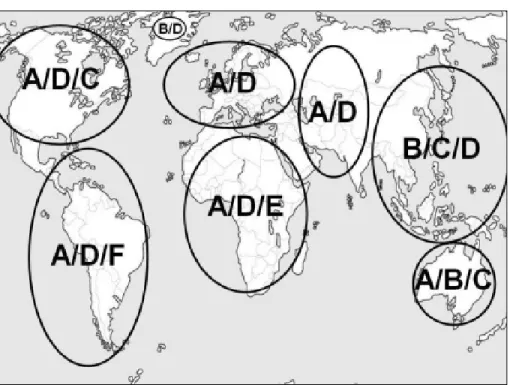
only relevant for interferon-alfa therapy with regard to clinical decision making, there is an increased understanding of its role in the course of HBV infec-tion. Since most studies related to genotype have been conducted in areas where genotypes A, B, C and D predominate, these are most extensively in-vestigated. Figure 1 illustrates the global distribu-tion of the dominant genotypes.
Several studies in Asians have shown that pa-tients with genotype C infection have an unfavora-ble outcome compared to genotype B.9,11,64-69 Similar
po-sitive Taiwanese patients, they demonstrated that the risk of HCC development was highest among participants infected with genotype C compared to genotype B. In another study, Liang, et al. showed that patients with genotype C had a worse disease-free survival rate compared to genotype B.69 In line
with these findings, several studies have shown that genotype B is associated with a higher rate of HBe-Ag negativity compared to genotype C. Two factors could explain this observation. First of all, patients with genotype B tend to experience spontaneous HBeAg seroconversion at a younger age compared to patients with genotype C.70,71 In a retrospective
Chinese study, mean age at HBeAg seroconversion was 27 ± 2 years in patients with genotype B com-pared to 35 ± 2 years in patients with genotype C (p < 0.05).70 Second, genotype B is associated with a
higher prevalence of precore (G1896A) and core pro-moter (A1762T, G1764A) mutations, resulting in loss of HBeAg, compared to genotype C.70,72
Studies comparing genotype A and D resulted in contradictory data regarding the development of HBV-related liver disease.73-76 Kumar, et al. showed
that genotype A was more often associated with ALT elevation, HBeAg positivity, absence of anti-HBe and cirrhosis after age 25 compared to genotype D.73
Contrary to this, Thakur, et al. demonstrated that HBV genotype D, compared to genotype A, was as-sociated with more severe liver disease and might predict the occurrence of HCC in young patients.75
Response to treatment also seems to be influenced by genotype. Patients infected with genotype A and B respond better to treatment with pegylated inter-feron-alfa compared to genotype C and D.77-79 Thus,
differences in genotypes can alter the disease severi-ty, course of HBV infection and treatment outcome.
Hepatitis B e-antigen seroconversion
The prevalence of HBeAg positivity varies bet-ween different populations. Two Greek studies in HBsAg positive women between age 20 and 30 showed a low prevalence of HBeAg positivity.80,81 In
these studies, the route of transmission in these pa-tients was not described. One of the studies reported a prevalence of HBeAg positivity of 7.3%, dropping to 5.7% (6 of 105 instead of 8 of 109) when patients with an Asian origin were subtracted in this stu-dy.80 On the other hand, in Chinese HBV positive
women of the same age, a large cohort study revea-led a HBeAg positivity of 43%.82 Of note, in this
co-hort, approximately 10% of all patients over 40 years remained HBeAg positive. This might suggest that Asians have a higher prevalence and longer du-ration of HBeAg positivity compared to the Euro-pean population.
Differences in HBeAg seroconversion rate might influence the progression to HBV-related liver disea-se.80-84 A few cohort studies have investigated the
and progression to HBV-related disease in the natu-ral course of HBV.34,83-85 After HBeAg
seroconver-sion an annual incidence of cirrhosis varies between 0.5% and 0.9% in therapy-naïve patients,83,85 while
in HBeAg positive patients 5% progressed to cirrho-sis in a mean follow-up of 10.5 ± 4.3 years, with age at HBeAg seroconversion being an independent risk factor for developing cirrhosis (hazard ratio of 3.4 with 95% confidence interval 1.4-8.2).83 These
resul-ts are in line with the resulresul-ts from the REVEAL-HBV studies.7,8 A possible explanation for this
association could be that HBeAg positivity, which in-dicates sustained HBV replication, may induce an accelerated rate of cell turnover leading to a higher degree of hepatic fibrosis and malignant transforma-tion as a result of continuous or recurrent hepato-cyte necrosis and regeneration.34,83
Taken together, although several studies postula-te a difference in the Asian-Pacific region compared to other areas in delayed HBeAg seroconversion and its association with the development of HBV-related liver diseases, the exact impact of this association will have to be determined in future studies.
COBRA STUDY
Since a part of the HBV-infected population lives in Western Europe and North America, it is impor-tant to investigate whether the correlation between HBV viral load and the occurrence of HBV-related liver diseases, found in Asians, are also applicable to other populations.
The Public Health Service Amsterdam was res-ponsible for vaccinating newborns from mothers with chronic hepatitis B from 1989 through 2009, leading to an unique cohort of HBV positive women who could be eligible for this purpose.86 Of these
wo-men, blood samples have been collected and stored at the time of HBV diagnosis. This will be the basis for a study, the ‘Cohort of hepatitis B research of Ams-terdam (COBRA)’ study. This study is designed to investigate the correlation between a single hepati-tis B viral load and HBV-related liver disease in a non-Asian population. Also, since there is evidence emerging in the clinical use of quantitative HBsAg, this study will further investigate the relationship between quantitative HBsAg, HBV viral load and HBV-related liver disease.
CONCLUSION
In conclusion, two landmark studies have provi-ded evidence that a single elevated serum HBV viral
load predicts disease progression in HBV. In this manuscript, we have demonstrated that geographi-cal differences in viral and host factors could in part influence the pathogenesis of hepatitis B. Therefore, further prospective clinical studies in non-Asians will have to determine the role of these findings in other populations.
ABBREVIATIONS
• ALT: Alanine aminotransferase. • anti-HBe: Hepatitis B e antibody.n e • BMI: Body mass index.
• copies/mL: Copies per milliliters • DNA: Deoxyribonucleic acid.:
• HAART: Highly active anti-retroviral therapy.A T : • HBeAg: Hepatitis B e-antigen.B :
• HBsAg: Hepatitis B surface antigen.B A g • HBV: Hepatitis B virus.B
• HIV: Human immunodeficiency virus.I • HCC: Hepatocellular carcinoma.C • PCR: Polymerase chain reaction. : • WHO: World Health Organization.
CONTRIBUTION OF AUTHORS
S. Harkisoen: literature search and selection, ting manuscript. J.E. Arends: literature search, wri-ting manuscript. Karel J. van Erpecum: wriwri-ting manuscript. A. van den Hoek: writing manuscript. A.I.M. Hoepelman: writing manuscript and supervi-sing.
CONFLICT OF INTEREST
Soeradj Harkisoen: no conflict of interest. Joop E. Arends: participates in advisory board of MSD. Karel J. van Erpecum: was member of advisory boards of BMS and Gilead and received research su-pport by Schering Plough. Anneke van den Hoek: no conflict of interest. Andy I.M. Hoepelman: recei-ved grants from Roche, Gilead, Merck and ViiV Healthcare and is an advisor for Gilead, Merck, ViiV Healthcare and Janssen.
REFERENCES
1. Blumberg BS, Alter HJ, Visnich S. A “new” antigen in Leu-kemia Sera. JAMA 1965; 191: 541-6.
2. World Health Organization. Hepatitis B. World Health Or-ganization Fact Sheet 204 2008 August. Available from: http://www.who.int/mediacentre/factsheets/fs204/en 3. European Centre for Disease Prevention and Control.
Pre-vention and Control 2011 October. Available from: http:// www.ecdc.europa.eu/
4. World Health Organization. Sixty-Third World Health Ass-embly 25. World Health Organization 2011 March. Availa-ble from: http://apps.who.int/gb/ebwha/pdf_files/ WHA63/A63_15-en.pdf
5. Alberti A, Realdi G, Bortolotti F, Rigoli AM. T-lymphocyte cytotoxicity to HBsAg- coated target cells in hepatitis b virus infection. Gut 1977; 18: 1004-9.
6. Maini MK, Boni C, Lee CK, Larrubia JR, Reignat S, Ogg GS, et al. The role of virus- specific CD8(+) cells in liver dama-ge and viral control during persistent hepatitis B virus in-fection. J Exp Med 2000; 191: 1269-80.
7. Iloeje UH, Yang HI, Su J, Jen CL, You SL, Chen CJ. Predic-ting cirrhosis risk based on the level of circulaPredic-ting hepati-tis B viral load. Gastroenterology 2006; 130: 678-86. 8. Chen CJ, Yang HI, Su J, Jen CL, You SL, Lu SN, et al. Risk
of hepatocellular carcinoma across a biological gradient of serum hepatitis B virus DNA level. JAMA 2006; 295: 65-73. 9. Chan HL, Tse CH, Mo F, Koh J, Wong VW, Wong GL, et al. High viral load and hepatitis B virus subgenotype ce are associated with increased risk of hepatocellular carcino-ma. J Clin Oncol 2008; 26: 177-82.
10. Chen G, Lin W, Shen F, Iloeje UH, London WT, Evans AA. Past HBV viral load as predictor of mortality and morbidity from HCC and chronic liver disease in a prospective study.
Am J Gastroenterol; 101: 1797-803.
11. Yu MW, Yeh SH, Chen PJ, Liaw YF, Lin CL, Liu CJ, et al. Hepatitis B virus genotype and DNA level and hepatocellu-lar carcinoma: a prospective study in men. J Natl Cancer Inst 2005; 97: 265-72.
12. Knodell RG, Ishak KG, Black WC, Chen TS, Craig R, Kaplo-witz N, et al. Formulation and application of a numerical scoring system for assessing histological activity in asymptomatic chronic active hepatitis. Hepatology 1981; 1: 431-5.
13. McCormick SE, Goodman ZD, Maydonovitch CL, Sjogren MH. Evaluation of liver histology, ALT elevation, and HCV RNA titer in patients with chronic hepatitis C. Am J Gas-troenterol 1996; 91: 1516-22.
14. Sun MA, Wang BE, Annoni G, Degli ES, Biempica L, Zern MA. Two rat models of hepatic fibrosis. A morphologic and mo-lecular comparison. Lab Invest 1990; 63: 467-75.
15. Chang JJ, Thompson AJ, Visvanathan K, Kent SJ, Cameron PU, Wightman F, et al. The phenotype of hepatitis B virus-specific T cells differ in the liver and blood in chronic he-patitis B virus infection. Hepatology 2007; 46: 1332-40. 16. Lindh G, Weiland O, Glaumann H. The application of a
numerical scoring system for evaluating the histological outcome in patients with chronic hepatitis B followed in long-term. Hepatology 1988; 8: 98-103.
17. Fattovich G, Bortolotti F, Donato F. Natural history of chronic hepatitis B: special emphasis on disease progres-sion and prognostic factors. J Hepatol 2008; 48: 335-52. 18. Ikeda K, Saitoh S, Suzuki Y, Kobayashi M, Tsubota A, Koida
I, et al. Disease progression and hepatocellular carcinoge-nesis in patients with chronic viral hepatitis: a prospecti-ve observation of 2215 patients. J Hepatol 1998; 28: 930-8.
19. Yu MW, Chang HC, Liaw YF, Lin SM, Lee SD, Liu CJ, et al. Familial risk of hepatocellular carcinoma among chronic hepatitis B carriers and their relatives. J Natl Cancer Inst
2000; 92: 1159-64.
20. Ozer B, Serin E, Yilmaz U, Gumurdulu Y, Saygili OB, Kaya-selcuk F, et al. Clinicopathologic features and risk fac-tors for hepatocellular carcinoma: results from a single
center in southern Turkey. Turk J Gastroenterol 2003; 14: 85-90.
21. Chen ZM, Liu BQ, Boreham J, Wu YP, Chen JS, Peto R. Smo-king and liver cancer in China: case-control comparison of 36,000 liver cancer deaths vs. 17,000 cirrhosis deaths.
Int J Cancer 2003; 107: 106-12.
22. Lu SN, Lin TM, Chen CJ, Chen JS, Liaw YF, Chang WY, et al. A case-control study of primary hepatocellular carcino-ma in Taiwan. Cancer 1988; 62: 2051-5.
23. Chen CJ, Liang KY, Chang AS, Chang YC, Lu SN, Liaw YF, et al. Effects of hepatitis B virus, alcohol drinking, ciga-rette smoking and familial tendency on hepatocellular car-cinoma. Hepatology 1991; 13:398-406.
24. Tong MJ, Blatt LM, Kao JH, Cheng JT, Corey WG. Basal core promoter T1762/A1764 and precore A1896 gene mu-tations in hepatitis B surface antigen- positive hepatoce-llular carcinoma: a comparison with chronic carriers. Liver Int 2007; 27: 1356-63.
25. Lok AS, McMahon BJ. Chronic hepatitis B: update 2009.
Hepatology 2009; 50: 661-2.
26. Chen CL, Yang HI, Yang WS, Liu CJ, Chen PJ, You SL, et al. Metabolic factors and risk of hepatocellular carcinoma by chronic hepatitis B/C infection: a follow-up study in Taiwan. Gastroenterology 2008; 135: 111-21.
27. Mahmood S, Niiyama G, Kamei A, Izumi A, Nakata K, Ikeda H, et al. Influence of viral load and genotype in the pro-gression of Hepatitis B-associated liver cirrhosis to hepa-tocellular carcinoma. Liver Int 2005; 25: 220-5.
28. Sung FY, Jung CM, Wu CF, Lin CL, Liu CJ, Liaw YF, et al. Hepatitis B virus core variants modify natural course of viral infection and hepatocellular carcinoma progression.
Gastroenterology 2009; 137: 1687-97.
29. Wu CF, Yu MW, Lin CL, Liu CJ, Shih WL, Tsai KS, et al. Long-term tracking of hepatitis B viral load and the rela-tionship with risk for hepatocellular carcinoma in men.
Carcinogenesis 2008; 29: 106-12.
30. Ikeda K, Arase Y, Kobayashi M, Someya T, Hosaka T, Saitoh S, et al. Hepatitis B virus-related hepatocellular carcinoge-nesis and its prevention. Intervirology 2005; 48: 29-38. 31. Lee CZ, Huang GT, Yang PM, Sheu JC, Lai MY, Chen DS.
Co-rrelation of HBV DNA levels in serum and liver of chronic hepatitis B patients with cirrhosis. Liver 2002; 22: 130-5. 32. Ohata K, Hamasaki K, Toriyama K, Ishikawa H, Nakao K,
Eguchi K. High viral load is a risk factor for hepatocellular carcinoma in patients with chronic hepatitis B virus infec-tion. J Gastroenterol Hepatol 2004; 19: 670-5.
33. Tang B, Kruger WD, Chen G, Shen F, Lin WY, Mboup S, et al. Hepatitis B viremia is associated with increased risk of hepatocellular carcinoma in chronic carriers. J Med Virol
2004; 72: 35-40.
34. Yang HI, Lu SN, Liaw YF, You SL, Sun CA, Wang LY, et al. Hepatitis B e antigen and the risk of hepatocellular carci-noma. N Engl J Med 2002; 347: 168-74.
35. Yuan HJ, Yuen MF, Ka-Ho WD, Sablon E, Lai CL. The rela-tionship between HBV- DNA levels and cirrhosis-related complications in Chinese with chronic hepatitis B. J Viral Hepat 2005; 12: 373-9.
36. Chen CJ, Yang HI, Iloeje UH. Hepatitis B virus DNA levels and outcomes in chronic hepatitis B. Hepatology 2009; 49(5 Suppl.): S72-S84.
37. Iloeje UH, Yang HI, Jen CL, Su J, Wang LY, You SL, et al. Risk and predictors of mortality associated with chronic hepatitis B infection. Clin Gastroenterol Hepatol 2007; 5: 921-31. 38. Yeo W, Mo FK, Chan SL, Leung NW, Hui P, Lam WY, et al.
39. Zheng W, McLerran DF, Rolland B, Zhang X, Inoue M, Mat-suo K, et al. Association between Body-Mass Index and Risk of Death in More Than 1 Million Asians. N Engl J Med
2011; 364: 719-29.
40. Chang KH, Kim JM, Song YG, Hong SK, Lee HC, Lim SK. Does race protect an oriental population from developing lipo-dystrophy in HIV-infected individuals on HAART? J Infect
2002; 44: 33-8.
41. Gupta S, Gupta R, Joshi YK, Singh S. Role of horizontal transmission in hepatitis B virus spread among household contacts in north India. Intervirology 2008; 51: 7-13. 42. Stevens CE, Beasley RP, Tsui J, Lee WC. Vertical
transmis-sion of hepatitis B antigen in Taiwan. N Engl J Med 1975; 292: 771-4.
43. Beasley RP, Hwang LY, Lin CC, Leu ML, Stevens CE, Szmu-ness W, et al. Incidence of hepatitis B virus infections in preschool children in Taiwan. J Infect Dis 1982; 146: 198-204.
44. McMahon BJ, Alward WL, Hall DB, Heyward WL, Bender TR, Francis DP, et al. Acute hepatitis B virus infection: rela-tion of age to the clinical expression of disease and subse-quent development of the carrier state. J Infect Dis 1985; 151: 599-603.
45. Beasley RP, Hwang LY, Lee GC, Lan CC, Roan CH, Huang FY, et al. Prevention of perinatally transmitted hepatitis B virus infections with hepatitis B virus infections with he-patitis B immune globulin and hehe-patitis B vaccine. Lancet
1983; 2: 1099-102.
46. Burk RD, Hwang LY, Ho GY, Shafritz DA, Beasley RP. Out-come of perinatal hepatitis B virus exposure is dependent on maternal virus load. J Infect Dis 1994; 170: 1418-23. 47. Dhorje SP, Pavri KM, Prasad SR, Sehgal A, Phule DM.
Hori-zontal transmission of hepatitis B virus infection in house-hold contacts, Pune, India. J Med Virol 1985; 16: 183-9. 48. Tong MJ, Weiner JM, Ashcavai MW, Redeker AG, Comparini
S, Vyas GN. A comparative study of hepatitis B viral mar-kers in the family members of Asian and non-Asian patients with hepatitis B surface antigen-positive hepatocellular carcinoma and with chronic hepatitis B infection. J Infect Dis 1979; 140: 506-12.
49. Leichtner AM, Leclair J, Goldmann DA, Schumacher RT, Gewolb IH, Katz AJ. Horizontal nonparenteral spread of hepatitis B among children. Ann Intern Med 1981; 94: 346-9.
50. Bisharat N, Elias M, Raz R, Flatau E. Familial pattern of in-fection with hepatitis B virus among immigrating Ethio-pian Jews in Israel. Eur J Epidemiol 1998; 14: 89-91. 51. Martinson FE, Weigle KA, Royce RA, Weber DJ, Suchindran
CM, Lemon SM. Risk factors for horizontal transmission of hepatitis B virus in a rural district in Ghana. Am J Epide-miol 1998; 147: 478-87.
52. Rimseliene G, Nilsen O, Klovstad H, Blystad H, Aavitsland P. Epidemiology of acute and chronic hepatitis B virus infec-tion in Norway, 1992-2009. BMC Infect Dis 2011; 11: 153. 53. Struve J, Giesecke J, Lindh G, Weiland O. Heterosexual
contact as a major route for transmission of acute hepati-tis B among adults. J Infect 1990; 20: 111-21.
54. Veldhuijzen IK, Smits LJ, van de Laar MJ. The importance of imported infections in maintaining hepatitis B in The Netherlands. Epidemiol Infect 2005; 133: 113-9.
55. Cao GW. Clinical relevance and public health significance of hepatitis B virus genomic variations. World J Gastroen-terol 2009; 15: 5761-9.
56. McMahon BJ. The influence of hepatitis B virus genotype and subgenotype on the natural history of chronic hepati-tis B. Hepatol Int 2009; 3: 334-42.
57. Kurbanov F, Tanaka Y, Mizokami M. Geographical and ge-netic diversity of the human hepatitis B virus. Hepatol Res 2010; 40: 14-30.
58. Rauz-Ruiz P, Norder H, Robertson BH, Magnius LO. Geno-type H: a new Amerindian genoGeno-type of hepatitis B virus re-vealed in Central America. J Gen Virol 2002; 83: 2059-73. 59. Tran TT, Trinh TN, Abe K. New complex recombinant
geno-type of hepatitis B virus identified in Vietnam. J Virol
2008; 82: 5657-63.
60. Thuy le TT, Ryo H, Van PL, Furitsu K, Nomura T. Distribu-tion of genotype/subtype and mutaDistribu-tional spectra of the surface gene of hepatitis B virus circulating in Hanoi, Vietnam. J Med Virol 2005; 76: 161-9.
61. Olinger CM, Jutavijittum P, Hubschen JM, Yousukh A, Samountry B, Thammavong T, et al. Possible new hepatitis B virus genotype, southeast Asia. Emerg Infect Dis 2008; 14: 1777-80.
62. Tatematsu K, Tanaka Y, Kurbanov F, Sugauchi F, Mano S, Maeshiro T, et al. A genetic variant of hepatitis B virus di-vergent from known human and ape genotypes isolated from a Japanese patient and provisionally assigned to new genotype J. J Virol 2009; 83: 10538-47.
63. Okamoto H, Tsuda F, Sakugawa H, Sastrosoewignjo RI, Imai M, Miyakawa Y, et al. Typing hepatitis B virus by ho-mology in nucleotide sequence: comparison of surface an-tigen subtypes. J Gen Virol 1988; 69: 2575-83.
64. Chan HL, Hui AY, Wong ML, Tse AM, Hung LC, Wong VW, et al. Genotype C hepatitis B virus infection is associated with an increased risk of hepatocellular carcinoma. Gut
2004; 53: 1494-8.
65. Kao JH, Chen PJ, Lai MY, Chen DS. Hepatitis B genotypes correlate with clinical outcomes in patients with chronic hepatitis B. Gastroenterology 2000; 118: 554-9.
66. Kao JH, Chen PJ, Lai MY, Chen DS. Basal core promoter mutations of hepatitis B virus increase the risk of hepato-cellular carcinoma in hepatitis B carriers. Gastroenterolo-gy 2003; 124: 327-34.
67. Yang HI, Yeh SH, Chen PJ, Iloeje UH, Jen CL, Su J, et al. Associations between hepatitis B virus genotype and mu-tants and the risk of hepatocellular carcinoma. J Natl Cancer Inst 2008; 100: 1134-43.
68. Yuen MF, Tanaka Y, Mizokami M, Yuen JC, Wong DK, Yuan HJ, et al. Role of hepatitis B virus genotypes Ba and C, core promoter and precore mutations on hepatocellular carcinoma: a case control study. Carcinogenesis 2004; 25: 1593-8.
69. Liang TJ, Mok KT, Liu SI, Huang SF, Chou NH, Tsai CC, et al. Hepatitis B genotype C correlated with poor surgical outcomes for hepatocellular carcinoma. J Am Coll Surg
2010; 211: 580-6.
70. Chu CJ, Hussain M, Lok AS. Hepatitis B virus genotype B is associated with earlier HBeAg seroconversion compared with hepatitis B virus genotype C. Gastroenterology
2002; 122: 1756-62.
71. Kao JH, Chen PJ, Lai MY, Chen DS. Hepatitis B virus geno-types and spontaneous hepatitis B e antigen seroconver-sion in Taiwanese hepatitis B carriers. J Med Virol 2004; 72: 363-9.
72. Chu CJ, Keeffe EB, Han SH, Perrillo RP, Min AD, Soldevila-Pico C, et al. Hepatitis B virus genotypes in the United States: results of a nationwide study. Gastroenterology
2003; 125: 444-51.
73. Kumar A, Kumar SI, Pandey R, Naik S, Aggarwal R. Hepati-tis B virus genotype A is more often associated with seve-re liver disease in northern India than is genotype D.
74. Biswas A, Banerjee A, Chandra PK, Datta S, Panigrahi R, Dutta D, et al. Variations in the functional domain of basal core promoter of hepatitis B virus among Eastern Indian patients with prevalence of genotypes A, C, and D among the same ethnic population. J Med Virol 2011; 83: 253-60. 75. Thakur V, Guptan RC, Kazim SN, Malhotra V, Sarin SK.
Pro-file, spectrum and significance of HBV genotypes in chro-nic liver disease patients in the Indian subcontinent. J Gastroenterol Hepatol 2002; 17: 165-70.
76. Sanchez-Tapias JM, Costa J, Mas A, Bruguera M, Rodes J. Influence of hepatitis B virus genotype on the long-term outcome of chronic hepatitis B in western patients. Gas-troenterology 2002; 123: 1848-56.
77. Janssen HL, van ZM, Senturk H, Zeuzem S, Akarca US, Cakaloglu Y, et al. Pegylated interferon alfa-2b alone or in combination with lamivudine for HBeAg-positive chronic hepatitis B: a randomised trial. Lancet 2005; 365: 123-9. 78. Lau GK, Piratvisuth T, Luo KX, Marcellin P, Thongsawat S,
Cooksley G, et al. Peginterferon Alfa-2a, lamivudine, and the combination for HBeAg-positive chronic hepatitis B. N Engl J Med 2005; 352: 2682-95.
79. Erhardt A, Blondin D, Hauck K, Sagir A, Kohnle T, Heintges T, et al. Response to interferon alfa is hepatitis B virus ge-notype dependent: gege-notype A is more sensitive to inter-feron than genotype D. Gut 2005; 54: 1009-13.
80. Papaevangelou V, Paraskevis D, Anastassiadou V, Stratiki E, Machaira M, Pitsouli I, et al. HBV viremia in newborns of
HBsAg(+) predominantly Caucasian HBeAg(-) mothers. J Clin Virol 2011; 50: 249-52.
81. Malamitsi-Puchner A, Papacharitonos S, Sotos D, Tzala L, Psichogiou M, Hatzakis A, et al. Prevalence study of diffe-rent hepatitis markers among pregnant Albanian refugees in Greece. Eur J Epidemiol 1996; 12: 297-301.
82. Chu CM, Sheen IS, Lin SM, Liaw YF. Sex difference in chro-nic hepatitis B virus infection: studies of serum HBeAg and alanine aminotransferase levels in 10,431 asymptomatic Chinese HBsAg carriers. Clin Infect Dis 1993; 16: 709-13. 83. Chu CM, Hung SJ, Lin J, Tai DI, Liaw YF. Natural history of
hepatitis B e antigen to antibody seroconversion in pa-tients with normal serum aminotransferase levels. Am J Med 2004; 116: 829-34.
84. Yang PM, Chen DS, Lai MY, Su IJ, Huang GT, Lin JT, et al. Clinicopathologic studies of asymptomatic HBsAg carriers: with special emphasis on carriers older than 40 years. He-patogastroenterology 1987; 34: 251-4.
85. Hsu YS, Chien RN, Yeh CT, Sheen IS, Chiou HY, Chu CM, et al. Long-term outcome after spontaneous HBeAg serocon-version in patients with chronic hepatitis B. Hepatology
2002; 35: 1522-7.
86. van Steenbergen JE, Leentvaar-Kuijpers A, Baayen D, Dukers HT, van Doornum GJ, van den Hoek JA, et al. Eva-luation of the hepatitis B antenatal screening and neonatal immunization program in Amsterdam, 1993-1998. Vaccine