PLEASE SCROLL DOWN FOR ARTICLE
Access details: Access Details: [subscription number 931319204]
Publisher Psychology Press
Informa Ltd Registered in England and Wales Registered Number: 1072954 Registered office: Mortimer House,
37-41 Mortimer Street, London W1T 3JH, UK
Developmental Neuropsychology
Publication details, including instructions for authors and subscription information:
http://www.informaworld.com/smpp/title~content=t775653638
Memory Abilities in Children With Subtypes of Dyscalculia
Monica Rosselli; Esmeralda Matute; Noemi Pinto; Alfredo ArdilaOnline publication date: 08 June 2010
To cite this Article Rosselli, Monica , Matute, Esmeralda , Pinto, Noemi and Ardila, Alfredo(2006) 'Memory Abilities in
Children With Subtypes of Dyscalculia', Developmental Neuropsychology, 30: 3, 801 — 818
To link to this Article: DOI: 10.1207/s15326942dn3003_3
URL: http://dx.doi.org/10.1207/s15326942dn3003_3
Full terms and conditions of use: http://www.informaworld.com/terms-and-conditions-of-access.pdf This article may be used for research, teaching and private study purposes. Any substantial or systematic reproduction, re-distribution, re-selling, loan or sub-licensing, systematic supply or distribution in any form to anyone is expressly forbidden.
Memory Abilities in Children With
Subtypes of Dyscalculia
Mónica Rosselli
Department of Psychology Florida Atlantic University, Davie
Esmeralda Matute and Noemí Pinto
Institute of Neuroscience University of Guadalajara, Mexico
Alfredo Ardila
Department of Communication Sciences and Disorders Florida International University, Miami
This study examines (a) mathematical skills of 2 subgroups of children with devel-opmental dyscalculia (DD)—1 group with DD only and a second group with DD plus reading disorders (RDD)—and (b) analyzes the memory skills of both groups of children. Fifty 11- and 12–year-old children were selected from public schools in Guadalajara, Mexico. Seventeen children had DD only, 13 had RDD, and 20 were normal controls. Testing included 10 calculation and 6 memory subtests taken from theEvaluación Neuropsicológica Infantil(Matute, Rosselli, Ardila, & Ostrosky, in press). Results indicated that children with DD and children with RDD show a similar pattern of mathematical impairment. Both subgroups had sig-nificantly lower scores than the control group in working memory tasks. In addi-tion, the RDD group had significantly lower scores than the control group in visual learning and semantic memory. Although the RDD group scored lower than the DD group in most memory tests, this difference did not reach significance. Working memory tests (digits backwards and sentence repetition) appeared to be the best predictors of mathematical test scores and may represent a major cognitive defect in children with specific defects in mathematics.
Correspondence should be addressed to Mónica Rosselli, Department of Psychology, Florida Atlantic University, 2912 College Ave., Davie, FL 33314. E-mail: [email protected]
Dyscalculia is a developmental disorder characterized by difficulty in learning and remembering arithmetic facts (Geary & Hoard, 2001; Rosselli & Matute, 2005; Shalev & Gross-Tsur, 2001), differences in executing calculation procedures, and poor problem-solving strategies (Landerl, Bevan, & Butterworth, 2004). Children with developmental dyscalculia (DD) may present difficulties understanding sim-ple number concepts, lack an intuitive grasp of numbers, and have problems learn-ing number facts and procedures (United Klearn-ingdom Department for Education and Skills, 2001). The prevalence of DD in different countries has been estimated to range from 1% to 6.5% (American Psychiatric Association, 1994; Badian, 1983; Ramaa & Gowramma, 2002; Shalev & Gross-Tsur, 2001).
Kosch (1974) emphasized in the initial definition of DD that this disability ap-pears within the context of normal general mental abilities. The term DD is used in many cases to distinguish it from the acquired form of dyscalculia (Butterworth, 2004). Other terminology that has also been used to define the disorder includes arithmetic learning disabilities(Koontz & Berch, 1996),specific arithmetic diffi-culties (Lewis, Hitch, & Walker, 1994),specific arithmetic learning difficulties (McLean & Hitch, 1999),mathematical disabilities(Geary, 1993), and mathemat-ics difficulties(Jordan, Kaplan, & Hanich, 2002).
The American Psychiatric Association (1994) uses the termmathematics disor-derto describe children whose mathematical abilities fall substantially below that expected for the individual’s age, measured intelligence, and age-appropriate edu-cation. Mathematics disorder and DD can be considered equivalent terms (Ta’ir, Brezner, & Ariel, 1997). We use the term DD to refer to children with mathematical disabilities that are defined by mathematical test scores at 2SDbelow the normative mean (about 2nd to 3rd percentile) and whose academic difficulties are confirmed by the child’s teacher. We refer tomathematical difficultiesormathematical learning disabilityfor children with mathematical test scores at or below the 35th percentile, but not more than 2SDbelow the mean; these are children that do not present with DD. Few of the research articles published thus far focus specifically on children with DD (e.g., Landerl et al., 2004); the majority of the research has been done in children with learning mathematics difficulties using math test scores in the 35th percentile as cut-off criterion (e.g., Geary, Hamson & Hoard, 2000; Jordan & Hanich, 2000; Jordan & Montani, 1997; Mazzoco & Myers, 2003).
Most researchers agree that at least two subtypes of children with mathematical difficulties can be identified: one subtype also involves reading (verbal) deficits and the other is limited to nonverbal difficulties (Geary et al., 2000; Jordan & Hanich, 2000; Ramaa & Gowramma, 2002). Rourke and his colleagues (e.g., Collins & Rourke, 2003; Rourke & Conway, 1997; Rourke et al., 2002) also identified two ma-jor subgroups of children with mathematical difficulties; the first subgroup is char-acterized by verbal deficiencies and reading and spelling problems (reading and spelling subgroup) in the context of relatively better, but nonetheless impaired, arith-metic performance. This subgroup has been shown to have a primary deficit in
nological processing. The second subgroup is characterized by nonverbal defects along with normal or superior reading and spelling skills and relatively impaired per-formance in arithmetic (arithmetic subgroup). Individuals in this nonverbal learn-ing-disabled group have shown to have primary deficits in tactile and visual percep-tual skills as well as problems with complex psychomotor skills. These two subtypes also have been reported to differ in terms of math skills or solving strategies (Hanich, Jordan, Kaplan, & Dick, 2001; Jordan, Hanich, & Kaplan, 2003b) with the com-bined group presenting more severe computational and numerical deficits than the group with mathematical difficulties and no reading deficits (Geary, Hamson, et al., 2000). Furthermore, children with comorbid math and reading difficulties have also been found to score lower on Verbal IQ tests (Shalev, Manor, & Gross-Tsur, 1997). It is noteworthy that some authors (e.g., Landerl et al., 2004) failed to find differences in test performance between children with mathematical difficulties only and math-ematical difficulties and reading disorders.
MATHEMATICAL DEFICITS
Children with DD have been described as doing well in simple counting or add-ing tasks but performadd-ing significantly less well than their same age peers in more complex oral and writing arithmetic problems. Some children with DD cannot master basic arithmetic facts despite strong problem-solving skills (Hanich et al., 2001), whereas others present a weakness in problem solving as well as arithmetic fact mastery. Differences in speed of processing and counting abilities have also been observed between children with DD subtypes and nor-mal controls (Landerl et al., 2004).
Some researchers have suggested that cognitive systems that support number production and comprehension are intact in children with learning problems in mathematics while other cognitive systems might be dysfunctional (Geary & Hoard, 2001). For the most part children with leaning disabilities understand the features of counting but younger children can present difficulties in identifying and producing numbers greater that 10 (Geary, Hoard, & Hamson , 2000). They present difficulties in learning basic mathematics with consistent differences in the procedural- and memory-based processes used by normal children in solving ar-ithmetical problems (Geary & Hoard, 2001).
The definition of the underlying cognitive processes in DD is complicated by of the compound linguistic, memory, and spatial abilities that are required by mathe-matical tasks (Ardila & Rosselli, 2002; Landerl et al., 2004). According to the Di-agnostic and Statistical Manual of Mental Disorders(American Psychiatric Asso-ciation, 2000), four types of skills may be impaired in children with a mathematic disorder: linguistic, perceptual, attentional, and mathematical. Other researchers have also found abnormal semantic and working memory (Geary & Hoard, 2001).
Moreover, Geary and Hoard suggested that children with deficits in learning math present difficulties in the inhibition of irrelevant information and that this inhibi-tory problem results in activation of irrelevant information that functionally lowers working memory capacity. This inhibitory difficulty was first described by Barrouillet, Fayol, and Lathuliere (1997) in adolescents with learning disabilities. Inhibitory problems manifested in other cognitive domains have been also re-ported in children with lower mathematical ability (Bull & Scerif, 2001).
WORKING MEMORY
Working memory refers to the mental capacity responsible for the temporary pro-cessing and storage of information. Working memory is presumed to consist of a central executive that controls how information is subserved around the system and visual and phonological slave systems that temporarily process and retain the infor-mation appropriate to their two modes. The phonological system has a phonological store that can hold information for about 2 sec and an articulatory loop that recycles information back through the store to extend its life by repeating information over and over (Baddeley, 1986, 1992). The structure of working memory is present from 6 years of age although functional capacity changes are observed in the middle school years and adolescence (Gathercole, Pickering, Ambridge, & Wearing, 2004). It is noteworthy that age-related differences in working memory have been reported in both normal and learning-disabled populations (Swanson, 1999, 2003).
Several studies have supported a role for working memory deficits in children with poor attainment in mathematics (Keeler & Swanson, 2001). Siegel and Ryan (1989) showed that children with dyscalculia do less well than controls on working memory tasks such as remembering digits but not on nonnumerical working mem-ory tasks. McLean and Hitch (1999) found a trend toward poorer digit span in chil-dren with dyscalculia whereas no difference was found on a nonnumerical working memory task. Geary, Hamson, and Hoard (2000) found shorter numerical forward and backward digit spans in children with DD but no difference in spatial tasks when compared with normal peers. Links between phonological short-term memory and the development of mathematical skills have also been reported (Fazio, 1999; Hecht, Torgesen, Wagner, & Rashotte, 2001). The phonological short-term memory consti-tutes one of the components of working memory and includes coding and temporary storage of sounds (Baddeley & Hitch, 1974), and it is measured by tasks such as digit span and nonword repetition (Gathercole, Willis, Baddeley, & Emslie, 1994). An as-sociation between phonological processing and simple arithmetic problem solving speed in elementary school children has been proposed (Hecht et al., 2001).
In a recent study Gathercole, Tiffany, Briscoe, Thorn, and the ALSPAC team (2005) used a longitudinal design to investigate the influence of poor phonological short-term memory performance over the children’s academic attainments. The
authors concluded that the impairments found in mathematical learning disabili-ties do not result directly from phonological memory deficits but from other asso-ciated cognitive defects.
A relation between working memory and mathematical ability has been found in numerous studies (see LeFreve, DeStafano, Coleman, & Shanahan, 2005, for a review), and it is not specific to individuals with severe mathematical problems. For example, Fazio (1999) found that number recall was correlated with arithmetic and written calculation tasks in children with specific language impairment. Moover, the association between working memory and mathematical performance re-mains stable across a broad age span in normal children and in children with math-ematical disabilities (Wilson & Swanson, 2001).
Retrieval errors could partially account for arithmetical defects. Two types of retrieval deficits, however—one potentially related to the phonological loop and the other with the central executive (i.e., inhibitory function)—could be assumed. Previous studies have shown that children with mathematical disabilities use the same type of strategies as typically developing children but differ in the use of de-velopmentally immature strategies (i.e., finger counting) and in the presence of more counting and retrieval errors (Jordan et al., 2003a, 2003b).
Most studies of learning difficulties in math have been carried out with children attending the first, second, and third grades, but little is known of the underlying deficits of different types of dyscalculia in middle school children, when the devel-opmental disorder is well-established. Moreover, most of these studies have been carried out with children who have minor difficulties in learning math (35th per-centile), but little is known about children with scores below 2SD.
THIS STUDY
The first aim of this study is to examine the mathematical skills of two subgroups of children with DD—one group with DD only and a second group with DD and a reading disorder (RDD). Sixth graders were chosen to be the participants of this study because typically DD is well-established by age 11, whereas younger chil-dren may show mathematical difficulties that will later disappear (Geary, 1990). The prediction was that both DD groups would perform within the normal range in counting tasks but the RDD would perform significantly below the other groups in reading and writing numbers. The second aim is to analyze the memory skills of children with DD. Our prediction was that all children with DD would present working memory deficits for numbers but that children with RDD would show sig-nificant lower scores in verbal memory tests such as sentence repetition or con-frontation naming objects. An additional goal of this study is to determine if mem-ory tests are significant predictors of scores in mathematics tests.
METHOD
Participants
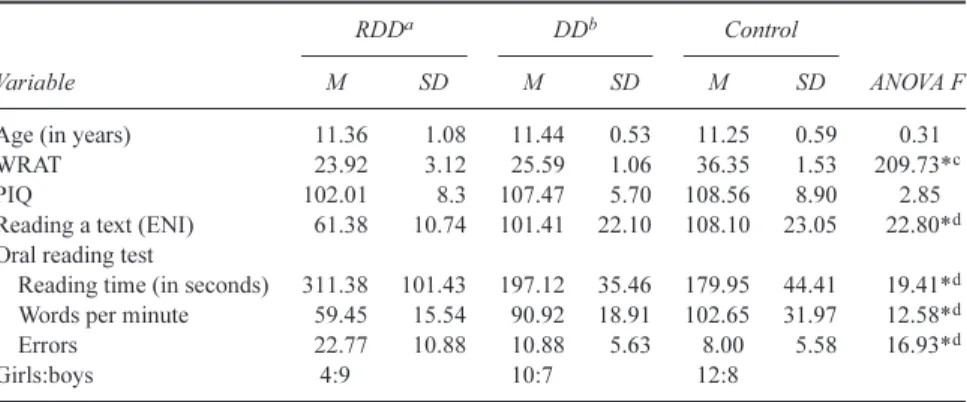
The sample included fifty 11- to 12-year-old Spanish monolingual children lected from five public schools in Guadalajara, Mexico. The sample was se-lected from a group of 1,482 fifth and sixth graders from five sese-lected public schools who were screened for mathematical difficulties. The Wide Range Achievement Test (WRAT–3; Wilkinson, 1993) was used to assess mathemati-cal problems. Sixty-two children (4.2%) from this sample were identified as having WRAT–3 scores below 2SDfrom the mean for their school grade (Pinto & Matute, 2003; Matute, Pinto Rodríguez, & Zarabozo, in press); children in this group were selected and invited to participate in the study. Confirmation of the interference of mathematical difficulties with academic achievement was obtained through the children’s teachers. Nineteen of the children declined par-ticipation. The remaining 43 participants received the Performance subtests of the Wechsler Intelligence Scales for Children–Mexican version (WISC–RM; Wechsler, 1984). Thirteen of those children were excluded from the sample be-cause they obtained a Performance IQ score (PIQ) below 90. The remaining 30 children constituted the dyscalculia group (DD). The control group (n= 20) was selected from the group of children with WRAT scores between 0.5 and 1.5 SDabove the mean for the corresponding age group (Matute, Pinto Rodríguez, et al., in press). According to the teachers’ report, none of the control children had academic difficulties in math or reading. The DD group was further divided into two subgroups based on their performance in two reading tests: (a) Oral Reading Test, a 290-word text designed for and used with Mexican children by Matute, Leal, and Zarabozo (2000); and (b) Reading a Text Aloud, from the Evaluación Neuropsicológica Infantil (Matute, Rosselli, et al., in press). Children with test scores 2SDbelow the mean compared to their age peers in both tests were assigned to the RDD group and the remaining children to the DD group. The description of the sample is presented in Table 1. Fourteen girls and 16 boys constituted the two dyscalculia groups, and 8 boys and 12 girls composed the control group. The RDD group had an average PIQ score 5 points lower than the DD only group and 6.5 points lower than the normal group. No significant group effect on PIQ scores was found, and post hoc comparisons did not disclose significant differences between the groups’ means (Tukey >.01). The RDD group scored below the DD group on the WRAT–3, but this differ-ence did not reach statistical significance (Tukey > .01). The average scores for the RDD group were significantly below those in the DD and control groups in all reading measures (Tukey <.01). No statistically significant difference was found between the average reading scores of the DD and the control group (Tukey <.01).
Measures
The following screening, calculation abilities, and memory tests were individually administered.
A. Screening measures
1. WISC–RM PIQ: The six nonverbal subtests of the WISC–RM (Wechsler, 1984) were used to estimate the PIQ.
2. The WRAT–3 Arithmetic subtest (Wilkinson, 1993): This test includes two section: an oral arithmetic section with 15 items and a written arithmetic section with 40 items. The test was used following the manual application guideline and the adaptation to Spanish presented by Matute, Pinto Rodríquez, et al. (in press). Maximum score is 55.
B. Measure of Calculation Abilities from the Evaluación Neuropsicológica Infantil
1. Counting and number. The child was requested to count drawings of objects presented on cards.
2. Reading Arabic numbers. The child was asked to read eight Arabic numbers written on a card (2; 6; 18; 263; 5,003; 70,049; 930,116; 402,005).
3. Writing Arabic numbers. The child had to write under dictation the follow-ing numbers 1; 7; 61; 235; 8,037; 42,001; 100,013; 6,050,010. One point is given to each number correctly written.
TABLE 1 Sample Characteristics
RDDa DDb Control
Variable M SD M SD M SD ANOVA F
Age (in years) 11.36 1.08 11.44 0.53 11.25 0.59 0.31 WRAT 23.92 3.12 25.59 1.06 36.35 1.53 209.73*c
PIQ 102.01 8.3 107.47 5.70 108.56 8.90 2.85 Reading a text (ENI) 61.38 10.74 101.41 22.10 108.10 23.05 22.80*d
Oral reading test
Reading time (in seconds) 311.38 101.43 197.12 35.46 179.95 44.41 19.41*d
Words per minute 59.45 15.54 90.92 18.91 102.65 31.97 12.58*d
Errors 22.77 10.88 10.88 5.63 8.00 5.58 16.93*d
Girls:boys 4:9 10:7 12:8
Note. RDD = developmental dyscalculia with reading disorders; DD = developmental dyscalcu-lia; ANOVA = analysis of variance; WRAT = Wide Range Achievement Test (Wilkinson, 1993); PIQ = Performance IQ; ENI = Evaluación Neuropsicológica Infantil.
an= 13.bn= 17.cRDD and DD group’s means are significantly different from the control group’s
mean (Tukey < .01).dRDD significantly different from DD and control (Tukey < .01).
*p< .001.
4. Magnitude judgments (Number comparisons). Two cards containing eight numbers each (e.g., 301 31 310; 13 103 130) are presented one at the time. The child is asked to say the larger of the two numbers.
5. Ordering of numbers. Eight numbers (123, 64, 89, 23, 110, 55, 46, 101) are shown to the child, and the child is required to order them from the smallest to the largest.
6. 1+3 series. Starting from 1, the child had to count adding 3s each time up to 31. (1, 4, 7, 10, 13, 16, 19, 22, 25, 28, 31).. The first three numbers of the series are used as an example, and no points are given.
7. 100–3 series. The child is asked to subtract 3s starting from 100 and finish-ing at 70 (100, 97, 94, 91, 88, 85, 82, 79, 76, 73, 70). One point is given for each correct number given.
8. Mental math. Children were orally given individual additions, subtractions, multiplications, and divisions to solve (e.g., 23 + 14). One point is given for each arithmetical operation conducted correctly.
9. Written math. The child solves basic written arithmetical operations. One point is given for each correct answered arithmetical operation (e.g., 32 – 23).
10. Arithmetical problems. The child is presented orally with eight arithmeti-cal problems (e.g., A second hand motorcycle was sold in $8,700, which is three-fourths of its original price. What is its original price?).
C. Short-term memory (STM) and working memory measures
1. Digits: Digit forward was used to asses STM following the instruction of the WISC–RM (Wechsler, 1984). Digit backward was used to assess the ability to ma-nipulate information in verbal working memory. The digit forward cluster is related to phonological measures and digits backward with variables that assess a central ex-ecutive factor (see Gathercole & Pickering, 2000a, 2000b; Gathercole et al., 2005).
2. Sentence repetition. The purpose of this test is to assess STM for sentences of increasing length. Previous research has used this type of test to assess verbal STM (Alloway & Gathercole, 2005). Eight sentences were spoken aloud to the child one at the time. The first sentence has 5 syllables and 3 words. The last sentence has 28 syl-lables and 17 words. A score of 1 is given for each sentence correctly repeated.
D. Learning tasks
1. Word learning (Matute, Rosselli, et al., in press). This type of test assesses verbal learning (Lezak, Howieson, & Loring, 2004). It consists of 12 words (4 body parts, 4 animals, and 4 fruits) that are read aloud to the child (with 1 sec inter-val between words) for four consecutive trials. Each trial followed by a free recall test. The final score is the number of correct words recalled on all four trails.
2. Story recall (Matute, Rosselli, et al., in press). The child is asked to remem-ber as many details as possible from a story previous read. One point is given for each narrative unit correctly recalled, and 0.5 if it is partially recalled. Maximum
score is 15. Story recall tests provide a measure of the amount of information that is retained when the material exceeds immediate memory span and gives informa-tion about the contribuinforma-tion that meaningful sentences has on reteninforma-tion of new in-formation (Lezak et al., 2004) and has been previously used with learning disad-vantaged children (Wilkinson, Elkins, & Bain,1995).
3. Naming (semantic memory; Matute, Rosselli, et al., in press). The child is asked to name 15 drawings of objects that are presented in a card. Naming pictures of common objects has been used in previous research to measure semantic mem-ory (Baddeley, 1999).
4. Visual learning (Matute, Rosselli, et al., in press). Twelve geometrical fig-ures are presented on cards with 1 sec interval between figfig-ures for four consecutive trials. Each trial followed by a free recall test. One point is given for each correct figure. The final score is the number of correct figures recalled on all four trails. Maximum score is 48. Similar procedures have been shown to be valid and reliable measures of visual leaning (Glosser, Goodglass, & Biber, 1989).
Procedure
School principals were approached to participate in this study. Teachers from those schools selected were fully informed of all aspects of the study. The parents of the identified children were interviewed by phone and consents were obtained per-son-to-person. Each child was tested individually by one of the authors (Noemí Pinto) in a quiet room at the child’s school or home. Each child received a small gift (e.g., a box of crayons or candy) for participating in the study.
Statistical Analyses
To calculate the group effect for each of the mathematical and memory dependent measures, analyses of variance (ANOVAs) with adjusted alphas were performed, using group (RDD, DD, and controls) as the independent variable and calculation and memory test as dependent variables. Partialη2were used to estimate the effect
size measures for the univariateFs. Post hoc analyses (Tukey tests) were used to identify significant differences between group means. Linear regression analyses were utilized to assess the predictive value for calculation tests of those memory measures that reached significance. To avoid Type I error the level of confidence was set at .01 for all comparisons.
RESULTS
Table 2 shows the group effect for each of the dependent measures. A significant group effect was observed for all the mathematical measures except counting, or-dering of numbers, and adding by 3 sec. Post hoc analyses of mean differences
showed that both DD groups significantly differed from their control peers on the remaining seven tests, but no significant differences were observed between the DD and RDD groups in any of the tests (Tukey tests,p> .01).
The univariate analyses of the group effects for each memory test (digits, sen-tence repetition, word learning, story recall, semantic memory and visual memory) are presented in Table 3. Although the RDD group presented a trend toward lower scores on all memory tests when compared to the DD group, no statistically signif-icant differences were observed for any of subtests. The RDD group scored signifi-cantly below the control in digit backwards, sentence repetition, semantic memory, and visual learning. The DD group test scores were significantly lower than the controls in digits backwards, and sentence repetition subtests. No significant group effect was observed for the other measures. It is relevant to mention that the RDD group scores in semantic memory and visual memory were close to 1SDlower than the scores of the DD, but the difference did not reach significance.
Linear regression analyses, using the whole sample, showed that mental math scores were predicted by digits backwards, sentence repetition and semantic mem-ory; written math scores were successfully predicted from digits backward only and arithmetical problems were predicted from semantic memory and visual learn-ing scores (see Table 4).
To establish the influence of the memory variables over the group mean differ-ences in the calculation tests, analyses of covariance (ANCOVAs) were run using as covariates the memory tests scores in which significant group effects were ob-served (i.e., digits backwards, sentence repetition, semantic memory and visual
TABLE 2
Univariate ANOVA for Each Mathematical Test
RDDa DDb Controlc ANOVA
Subtest M SD M SD M SD F p 2
Counting (8) 6.15 1.30 6.29 1.14 6.75 1.16 1.12 .330 .05 Reading numbers (8) 4.92 1.11 5.47 1.62 7.30 0.98 16.67d .001 .40
Writing numbers (8) 5.23 1.23 5.47 1.06 6.85 1.09 10.66d .001 .30
Magnitude judgments (8) 4.07 2.62 4.82 2.60 7.00 1.62 7.70d .001 .27
Ordering numbers (8) 7.46 1.33 8.00 0.00 8.00 0.00 3.08 .060 .09 1 + 3 (8) 7.53 0.51 7.11 0.69 7.50 0.60 1.99 .140 .06 100 – 3 (8) 4.53 2.47 4.88 2.44 6.90 2.02 5.44d .007 .18
Mental math (12) 7.23 1.83 7.58 1.80 10.40 1.04 21.11d .001 .48
Written math (14) 4.76 1.42 5.00 1.76 8.70 2.40 22.12d .001 .50
Arithmetic problems (8) 4.15 1.34 4.41 1.27 5.40 0.82 5.82d .006 .19
Note. Maximum possible score for each subtest is indicated in parentheses. RDD = developmental dyscalculia with reading disorders; DD = developmental dyscalculia; ANOVA = analysis of variance.
an= 13.bn= 17.cn= 20.dRDD and DD group’s means are significantly different from the control
group’s mean (Tukey < .01).
learning) as covariables. The group effect resulting from these ANCOVAs were compared with the group effects under the ANOVAs presented on Table 2. Using ANCOVA, the significant group effect previously found using ANOVAs disap-peared for magnitude judgment,F(2, 43) = 2.85,p= .07,η2= .12; 100–3,F(2, 43)
= 2.54,p= .09,η2= .11; written numbers,F(2, 43) = 3.45,p= .04,η2= .14; and
arithmetic problems,F(2, 43) = 1.69,p= .19,η2= .07, when the memory variables
are covaried. However, the group effect persisted for the following three calcula-tion tests even after controlling for the memory test scores: reading numbers,F(2,
TABLE 3
Performance on the Different Memory Tests of the Three Groups
RDDa DDb Controlc ANOVA
Subtest M SD M SD M SD F p 2
Short-Term Memory
Digits Forward 5.07 1.25 5.29 1.26 5.70 0.80 1.38 .250 .06 Working Memory
Digits Backwards 3.38 0.31 3.58 0.27 5.05 0.25 11.01d .001 .32
Sentence Repetition 4.61 1.12 4.94 0.89 5.80 1.10 5.86d .005 .20
Verbal Learning
Word Learning 30.92 5.05 32.58 3.79 32.45 4.05 0.67 .510 .03 Story Recall 7.15 2.60 8.32 1.95 8.95 2.38 2.39 .100 .09 Semantic Memory 8.92 2.72 10.29 1.79 10.60 1.27 3.23e .040 .12
Visual Learning
Visual Memory 26.61 6.31 31.05 5.67 33.00 6.60 4.19e .020 .15
Note. RDD = developmental dyscalculia with reading disorders; DD = developmental dyscalcu-lia; ANOVA = analysis of variance.
an= 13.bn= 17.cn= 20.dRDD and DD significantly different from control (p< .01).eRDD
significantly different from control (p< .01).
TABLE 4
Predictive Value of Memory Tests on Mathematical Ability Subtests
Mental Math Written Math Arithmetic Problems
Variable B SE B B SE B B SE B
Digits Backwards 0.88 .18 .57* 1.21 .22 .61* 0.27 .12 .30 Sentence Repetition 0.74 .24 .40* 0.74 .32 .31 0.35 .14 .32 Semantic Memory 0.45 .13 .42* 0.32 .19 .24 0.22 .08 .36* Visual Learning 0.09 .04 .28 0.12 .05 .29 0.06 .02 .34*
Note. Only memory tests in which significant group differences were founded are included in these analyses.
*p< .01.
43) = 7.56,p= .002,η2= 26; writing numbers,F(2, 43) = 7.99,p= .001,η2= .27;
and mental calculation,F(2, 43) = 8.05,p= .001,η2= .27.
The pattern of errors was analyzed in both subgroups taking into account the percentage of each type of responses. In total, there were 90 items in the calcula-tion tasks. Because 13 children were in the RDD group, the total of possible re-sponses for this group was 1,170. Twenty-two items were not used because in those items a discontinue rule applied on magnitude judgments, 100–3 series, and mental math tasks for several RDD children. Seventeen children were in the DD group; thus, the total of possible responses for this group was 1,530. Forty-four items were not used on this group for the same reason and in the same tasks as RDD group. The percentages were thereby calculated only with the items used.
Overall, both groups had approximately the same percentage of total errors (RDD = 24% vs. DD = 23%) and the same percentage of nonresponses (RDD = 9% vs. DD = 8%). Written calculation was the hardest task for both groups (RDD = 42% of nonresponses and 24% of errors vs. DD = 36% of nonresponses and 26% of errors), follow by arithmetical problems task (RDD = 6% of nonresponses and 32% of errors vs. DD = 7% of nonresponses and 37% of errors), whereas 1+3 se-ries (RDD = 4% vs. DD = 12% of errors) and ordering numbers (RDD = 6% vs. DD = 0% of errors) were the easiest task for both DD groups.
DISCUSSION
First Hypothesis
Contrary to our first prediction, the results of this study show no significant differ-ence in the arithmetic test performance of 11-year-old children with DD only when compared with children with DD plus comorbid reading disability. However, DD children with and without concomitant reading disorders showed significantly lower performance than the control group in mathematical tasks that required read-ing and writread-ing of numbers, mental and written math, and problem solvread-ing.
The pattern of errors in the written calculation subtest was similar in both groups; RDD presented 42% nonresponses compared with 36% in the DD sub-group. In the RDD subgroup, 88% of the errors were procedural errors, 7% of the errors were due to confusion about the required operation, 2% were due to errors in the decimal point, and 3% were retrieval errors. In contrast, in the DD subgroup, 92% of the errors were due to procedural errors, 1% of the errors were due to con-fusion about the required operation, 2% were due to errors in the decimal point, and 5% were retrieval errors. In the arithmetical problems subtest, the errors ob-served in the RDD subgroup were in 78% of the cases procedural errors and 22% retrieval errors, whereas in the DD subgroup 86% of the errors were procedural er-rors and 14% retrieval erer-rors. Retrieval erer-rors have been reported in younger
dren with mathematic difficulties and have been interpreted as developmental de-lay that might be linked to poor working memory and counting skills (Geary, 1990, 1996). The procedural errors might be also linked to poor long-term memory skills. It appears that the ability to retrieve arithmetical facts from long-term mem-ory is defective in children with DD and RDD (Jordan et al., 2003a), and this dis-ability does not seem to improve across the academic school year for many chil-dren with DD or DD with reading disabilities (Geary & Hoard, 2005).
Second Hypothesis
We predicted that the DD children would present memory deficits in tests that in-clude numbers whereas the RDD children would show significant lower scores in verbal memory tests such as sentence repetition or naming. Our predictions were not supported by the results. We did not find significant differences between the two DD groups in memory tasks, although the RDD presented a trend of lower scores in semantic memory and visual learning compared with the DD group, but the differences were not significant,F(1, 28) = 2.76,p= .10; andF(1, 28) = 4.09,p = .05, respectively. Previous research has shown that children with mathematical difficulties plus a reading disorder show more pervasive deficits in exact math and story problems and written math than children with mathematical disabilities and no reading learning problems (Fuchs & Fuchs, 2002; Jordan & Hanich, 2000; Jor-dan et al., 2003a). Moreover, mathematical growing from second to fourth grade seems to be better in children with mathematical disorders only than in children with mathematical disorder and reading difficulties (Jordan et al., 2002).
Two previous studies (Landerl et al., 2004; Temple & Sherwood, 2002) ana-lyzed the performance in digit span tasks of 11-year-old children with mathemati-cal difficulties. Our findings are consistent with their findings in the lack of differ-ences between DD groups and controls in digits forward but do not support their findings in the comparisons of the performance of the DD groups and controls in digits backwards. This result may be explained by the differences in the two sam-ples. Our DD and RDD samples seem to be more homogeneous in test scores (smaller standard deviations) and tend to present with a more severe mathematical deficit (scores below 2SDbelow the normal mean) than the sample described by Temple and Sherwood. In their sample the math deficit group included 10 children, 6 of whom had Turner syndrome. All the members of our DD groups scored 2SD below the control group and had confirmation from their teachers of the academic problems in math. We can assume that our sample had more significant deficits in math than the sample in Temple and Sherwood’s study.
Landerl et al.’s (2004) groups were very similar to ours in age and in the selec-tion criteria, and, therefore, the difference in results are difficult to explain. A dif-ference could be found in the way the control group was selected. In our study all the controls had math scores between 0.5 to 1.5SDabove the mean. We did not
tempt to match the control group with the DD groups in reading scores. In Landerl et al.’s study, “children with reading ages a year or more above of their chronologi-cal age were discarded, since dyschronologi-calculic children tended to be average or some-what below on reading test” (p .11). Therefore, it may be that the control samples of the two studies differ in that ours might have included children with scores above average in both reading and math.
Memory Tests as Predictors of Scores in Mathematics Tests
Results showed that digits backwards was the best predictor of mathematical test performance. Digit backwards requires the child to keep track of ongoing mental ac-tivity and has been identified as a measure of executive control ability. This result supports previous findings (Gathercole & Pickering, 2000b). Interestingly, digits forward did not predict mathematical tests performance whereas sentence repetition was the second-best predictor of math test scores. Although digits forward and sen-tence repetition are frequently used to assess phonological STM, they seem to be dif-ferent in their content validity. The former is used in combination with nonwords to assess phonological STM whereas the later requires—in addition to phonological STM—support from semantic memory (Alloway & Gathercole, 2005).
Landerl et al. (2004) proposed that dyscalculia is the result of a fundamental difficulty with numerical processing that would be manifested in problems with using number names and comparing numerical magnitudes. These authors sug-gested that dyscalculia results from a fundamental difficulty with numerical pro-cessing independent of memory difficulties. Our study supports the presence of fundamental problems in mathematics such as reading and writing problems and magnitude comparisons in middle school children who suffer from dyscalculia. Our results suggest that “this fundamental problem” in math seems to be independ-ent of reading difficulties but seems to be related to working memory processes.
General Conclusions
This study finds an association between mathematical performance and verbal working memory, semantic memory, and nonverbal learning in a sample of middle school Spanish-speaking children with DD only, RDD, and normal controls. No main differences in mathematical performance between the two DD groups were found, although both groups significantly differed from the control group in most mathematical tests. The RDD presented a higher error rate and significant lower scores in semantic memory and visual learning. The data are consistent with previ-ous findings obtained in younger DD samples and demonstrates that, although some math abilities improve, others persist during the middle school years.
A particular strength of our study is that, to our knowledge, this report is one of the few on dyscalculia in children older than 10 years and, therefore, gives addi-tional information about calculation and cognitive correlates during the middle school years. Most of the previous research has examined children who are at the lower end of a normal distribution rather than children with a diagnosis of dyscal-culia. The second strength is that the study was carried out in a Spanish-speaking sample, and the results add information to the bulk of knowledge about dyscalculia in samples of participants who speak a language different from English.
ACKNOWLEDGMENT
Our gratitude to Erika Hoff and Gina Navarrete for their editorial support.
REFERENCES
Alloway, T .P., & Gathercole S. E. (2005). Working memory and short-term sentence recall in young children.European Journal of Cognitive Psychology, 17,207–220.
American Psychiatric Association. (1994).Diagnostic and statistical manual of mental disorders(4th ed.). Washington, DC: Author.
American Psychiatric Association. (2000).Diagnostic and statistical manual of mental disorders(text rev.). Washington, DC: Author.
Ardila, A., & Rosselli, M. (2002). Acalculia and dyscalculia.Neuropsychology Review, 12,179–231. Baddeley, A. D. (1986).Working memory.Oxford: Oxford University Press.
Baddeley, A. D. (1992). Working memory.Science, 255,556–559.
Baddeley, A. D. (1999).Essentials of human memory.Hove, UK: Psychology Press.
Baddeley, A. D., & Hitch, G. (1974). Working memory. In G. Bower (Ed.),The psychology of learning and motivation(Vol. 8, pp. 47–90). New York: Academic.
Badian, N. A. (1983). Dyscalculia and nonverbal disorders of learning. In H. R. Myklebust (Eds.),
Progress in learning disabilities(Vol. 5). New York: Grune & Stratton.
Barrouillet, P., Fayol, M., & Lathuliere E. (1997). Selecting competitors in multiplication tasks: An ex-planation of the errors produced by adolescences with learning difficulties.International Journal of Behavioral Development, 21,253–275.
Bull, R., & Scerif, G. (2001). Executive functioning as a predictor of children’s mathematics ability: In-hibition, task switching, and working memory.Developmental Neuropsychology, 19,273–293. Butterworth, B. (2004) Developmental dyslexia. In J. I. D. Campbell (Ed.),Handbook of mathematical
cognition (pp. 455–467). New York: Psychology Press.
Collins, D. W, & Rourke, B. P. (2003). Learning-disabled brains: A review of the literature.Journal of Clinical and Experimental Neuropsychology, 25,1011–1034.
Fazio, B. (1999). Arithmetic calculation, short-term memory, and language performance in children with specific language impairment: A 5-year follow-up.Journal of Speech, Language and Hearing Research, 42,420–431.
Fuchs, L. S. & Fuchs, D. (2002). Mathematical problem-solving profiles of students with mathematics disabilities with and without comorbid reading disabilities.Journal of Learning Disabilities, 35,
563–573
Gathercole, S. E., & Pickering, S. J. (2000a). Assessment of working memory in six- and seven year old children.Journal of Educational Psychology, 92,377–390.
Gathercole, S. E., & Pickering, S. J. (2000b). Working memory deficits in children with low achieve-ments in the national curriculum at 7 years of age.British Journal of Educational Psychology, 70,
177–194.
Gathercole, S. E., Pickering, S. J. Ambridge, B., & Wearing, H. (2004). The structure of working mem-ory from 4 to 15 years of age.Developmental Psychology, 40,177–190.
Gathercole, S. E., Tiffany, C., Briscoe, J., Thorn, A., & the ALSPAC Team. (2005). Developmental con-sequences of poor phonological short-term memory function in childhood: A longitudinal study.
Journal of Child Psychology and Psychiatry, 46,598–611.
Gathercole, S. E., Willis, C. S., Baddeley, A. D., & Emslie, H. (1994). The Children’s Test of Nonword Repetition: A test of phonological working memory.Memory, 2,103–127.
Geary, D. C. (1990). A componential analysis of an early learning deficit in mathematics.Journal of Experimental Child Psychology, 49,363–383.
Geary, D. C. (1993). Mathematical disabilities: Cognitive, neuropsychological, and genetic compo-nents.Psychological Bulletin, 114,345–362.
Geary, D. C. (1996).Children’s mathematical development: Research and practical applications. Washington, DC: American Psychological Association.
Geary, D. C., Hamson, C. O., & Hoard, M. K. (2000). Numerical and arithmetical cognition: A longitu-dinal study of process and concept deficits in children with learning disabilities.Journal of Experi-mental Child Psychology, 77,236–263.
Geary, D. C., & Hoard, M. K. (2001). Numerical and arithmetical deficits in learning-disabled children: Relation to dyscalculia and dyslexia.Aphasiology, 15,635–647.
Geary, D. C., & Hoard, M. K. (2005). Learning disabilities in arithmetic and mathematics: Theoretical and empirical perspectives. In J. I. D. Campbell (Ed.), Handbook of mathematical cognition
(pp.253–267). New York: Psychology Press.
Geary, D. C., Hoard, M. K., & Hamson, C. O. (2000). Numerical and arithmetical cognition: Patterns of functions and deficits in children at risk for a mathematical disability.Journal of Experimental Child Psychology, 74,213–239.
Glosser, G., Goodglass, H., & Biber, C. (1989). Assessing visual memory disorders.Journal of Coun-seling and Clinical Psychology, 1,82–91.
Hanich, B. Jordan, C. N., Kaplan, D., & Dick, J. (2001). Performance across different areas of mathe-matical cognition in children with learning difficulties.Journal of Educational Psychology, 93,
615–626.
Hecht, S. A., Torgesen, J. K., Wagner, R. K., & Rashotte, C. A. (2001). The relations between phonologi-cal processing abilities and emerging individual differences in mathematiphonologi-cal computation skills: A lon-gitudinal study from second to fifth grades.Journal of Experimental Child Psychology, 79,192–227. Jordan, C. N., & Hanich, B. (2000). Mathematical thinking in second grade children with different
forms of LD.Journal of Learning Disabilities, 33,567–578.
Jordan, C. N., Hanich B., & Kaplan, D. (2003a). Arithmetical fact mastery in young children: A longi-tudinal investigation.Experimental Child Psychology, 85,103–119.
Jordan, C. N., Hanich B., & Kaplan, D. (2003b). A longitudinal study of mathematical competencies in children with specific mathematical difficulties versus children with comorbid mathematical and reading difficulties.Child Development, 74,834–850.
Jordan, C. N., Kaplan, D., & Hanich, B. (2002). Achievement growth in children with learning difficul-ties in mathematics: Findings of a two-year longitudinal study.Journal of Educational Psychology, 94,586–597.
Jordan, C. N., & Montani, T. O (1997). Cognitive arithmetic and problem solving: A comparison of children with specific and general mathematic difficulties.Journal of Learning Disabilities, 30,
624–634.
Keeler M. L., & Swanson, H. L. (2001). Does strategy knowledge influence working memory in chil-dren with mathematical disabilities?Journal of Learning Disabilities, 34,418–434.
Koontz, K. L., & Berch, D. B. (1996). Identifying simple numerical stimuli: Processing inefficiencies exhibited by arithmetic learning disabled children.Mathematical Cognition, 2,1–23.
Kosch, L. (1974). Developmental dyscalculia.Journal of Learning Disabilities, 7,165–177. Landerl, K., Bevan, A., & Butterworth, B. (2004). Developmental dyscalculia and basic numerical
ca-pacities: A study of 8–9-year-old children.Cognition, 93,99–125.
LeFreve, J., DeStafano, D., Coleman, B., & Shanahan, T. (2005). Mathematical cognition and Working memory. In J. I. D. Campbell (Ed.),Handbook of mathematical cognition. New York: Psychology Press.
Lewis, C., Hitch, G. J., & Walker, P. (1994). The prevalence of specific arithmetic difficulties and spe-cific reading difficulties in 9- to 10-year-old boys and girls.Journal of Child Psychology and Psychi-atry, 35,283–292.
Lezak, M., Howieson, D. B., & Loring, D. W. (2004).Neuropsychological assessment(4th ed.). New York: Oxford University Press.
Matute, E., Leal, F., & Zarabozo, D. (2000). Coherence in short narratives written by Spanish-speaking reading-disabled children.Applied Neuropsychology 7,47–60.
Matute, E., Pinto Rodríguez, N. A., & Zarabozo, D. (in press). Una aproximación para evaluar la prevalencia del trastorno del cálculo en una muestra de niños mexicanos [An approximation to assess the prevalence of a mathematical disorder in a sample of Mexican children]. In M. G. Vega López & G. J. González Pérez (Eds.),Infancia, sociedad y salud. Guadalajara, Mexico: University of Guadalajara and Panamerican Health Organization.
Matute, E., Rosselli, M., Ardila, A., & Ostrosky, F. (in press).Evaluación neuropsicológica infan-tile—ENI[Child neuropsychological evaluation]. Guadalajara, Mexico: Manual Moderno and Uni-versity of Guadalajara.
Mazzoco, M. M. M., & Myers, G. F. (2003). Complexities in identifying and defining mathematics learning disability in the primary school-age years.Annals of Dyslexia, 53,218–253.
McLean, J. F., & Hitch, G. J. (1999). Working memory impairments in children with specific arithmetic learning difficulties.Journal of Experimental Child Psychology, 74,240–260.
Pinto, N., & Matute, E. (2003). Un abordaje a los problemas de cálculo en niños que asisten a grados de primaria superiores.Revista de Neuropsicología, Neuropsiquiatría y Neurociencias, 5,1–25. Ramaa, S., & Gowramma, I.P. (2002). A systematic procedure for identifying and classifying children
with dyscalculia among primary school children in India.Dyslexia, 8,67–85.
Rosselli, M., & Matute, E. (2005). Neuropsychologie de la dyscalculie développementale: Deniers résultats de recherche en Amérique du Nord [Neuropsychology of developmental dyscalculia: Re-cent research findings in North America]. In A. Van Hout & C. Meljac (Eds.),Troubles du calcul et dyscalculies chez l’enfant. Paris: Masson.
Rourke, B. P., Ahmad, S. A., Collins, D. W., Hayman-Abello, B. A., Hayman-Abello, S. E., & Warriner, E. M. (2002). Child clinical/pediatric neuropsychology: some recent advances.Annual Review of Psychology, 53,309–39.
Rourke, B. P., & Conway, J. A. (1997). Disabilities of arithmetic and mathematical reasoning: Perspec-tives from neurology and neuropsychology.Journal of Learning Disabilities, 30,34–46.
Shalev, R. S., & Gross-Tsur, V. (2001). Developmental dyscalculia. Review article.Pediatric Neurol-ogy, 24,337–342.
Shalev, R. S., Manor, O., & Gross-Tsur, V. (1997). Neuropsychological assessment of developmental dyscalculia.Math Cognition, 33,105–120.
Siegel, L. S., & Ryan, E. B. (1989). The development of working memory in normally achieving and subtypes of learning disabled children.Child Development, 60,973–980.
Swanson, H. L. (1999). What develops in working memory? A life span perspective.Developmental Psychology, 35,986–1000.
Swanson, H. L. (2003). Age related differences in learning disabled and skilled readers’ working mem-ory.Journal of Experimental Child Psychology, 85,1–31.
Ta’ir, J., Brezner, A., & Ariel, R. (1997). Profound developmental dyscalculia: Evidence for a cardi-nal/ordinal skills acquisition device.Brain and Cognition, 35,184–206.
Temple, C. M., & Sherwood, S. (2002). Representation and retrieval of arithmetical facts: Develop-mental difficulties.Quarterly Journal of Experimental Psychology, 55A,733–752.
United Kingdom Department for Education and Skills. (2001). The national numeracy strategy: Guidance to support pupils with dyslexia and dyscalculia. United Kingdom. Retrieved September 3, 2006, from http://www.dfes.gov.uk/readwriteplus/understandingdyslexia/introduction/whatdoweknowaboutdyscalculia/ Wechsler, D. (1984).WISC–RM, Escala de inteligencia revisada para el nivel escolar[Intelligence
scale revised according to grade level]. Mexico: Manual Moderno.
Wilkinson, G. S. (1993). The Wide Range Achievement Test–Third Edition (WRAT–3). Wilmington, DE: Wide Range, Inc.
Wilkinson, I. A., Elkins, J., & Bain, J. D. (1995). Individual differences in story comprehension and re-call of poor readers.British Journal of Educational Psychology, 65,393–407.
Wilson, K. M., & Swanson, H. L. (2001). Are mathematical disabilities due to a domain-general or a domain specific working memory deficit?Journal of Learning Disabilities, 34,237–248.