Prevalence and risk factors for
bacterial skin infection and mortality in cirrhosis
Pazhanivel Mohan,* Bhavadharani Ramu,* Emmanuel Bhaskar,** Jayanthi Venkataraman** Dept of Gastroenterology, Stanley Medical College, ** Dept of Internal Medicine, Sri Ramachandra Medical College. Chennai, India
ABSTRACT
Background. Bacterial infections are often associated with significant morbidity and mortality in cirrhosis. The common practice of outdoor barefoot walking in the developing world may predispose cirrhotic indivi-duals to skin infection. Aims. To determine the prevalence, risk factors, spectrum of infective organism and outcome of bacterial skin infection in cirrhosis. Methods. Consecutive newly diagnosed patients with cirrhosis (n = 200) between September 2007 and September 2008 were studied. Patients with congestive heart failure (n = 50) and chronic kidney disease (n = 50) on follow up at the same institution served as controls. Baseline demographic details, history of outdoor barefoot walking, details of skin infection along with cultures from skin and blood were obtained. The association between patient factors and risk of skin infection was evaluated using logistic regression. Results. Alcoholism was the predominant etiology for cirr-hosis. (50%) Most of them were of Child B cirrcirr-hosis. Walking on barefoot was found to be similar in cases and controls. 21(10.5%) patients with cirrhosis had skin infection, three fourth of them had a history of ba-refoot walking. None of the controls had skin infection. Cellulitis with hemorrhagic bullae, leg ulcers, in-fected callosity and abscess were observed. The infective organism could be isolated in 17 patients. Escherichia coli was the most frequent organism identified. Logistic regression showed outdoor barefoot walking and serum albumin < 2.5 gm/dL as risk factors for skin infection. Four patients died. Conclusion.
The prevalence of skin infection in cirrhosis was 10.5% with a mortality of 19%. Escherichia coli was the commonly implicated organism. Outdoor barefoot walking was a strong risk factor for skin infection in cirr-hosis.
Key words. Cellulitis. Cirrhosis. Skin infection. Mortality. Barefoot walking. Liver disease.
Correspondence and reprint request: Pazhanivel Mohan, Senior Registrar Department of Gastroenterology,
Stanley Medical College,
Old jail road, Royapuram, Chennai-600001 Tel.: 0091-98406-12324
E-mail: [email protected]
Manuscript received: March 14, 2010. Manuscript accepted: October 17, 2010. INTRODUCTION
Bacterial infection, irrespective of its etiology is an important concern in patients with cirrhosis sin-ce it is associated with increased morbidity and mor-tality.1 Literature on cirrhotic patients from
developed nations indicate urinary tract infection (12-29%) to be the most frequent cause for bacterial sepsis followed by spontaneous bacterial peritoni-tis(7-23%), respiratory tract infection (6-10%) and bacteremia (4-9%).2 Severe soft tissue infections are
common among cirrhotic patients in developed
countries3 but are not comparable in magnitude
with the above mentioned causes for bacterial sep-sis. A significant proportion of Indians from the lo-wer socio economic strata walk barefoot while going out for work. It is also a religious custom to walk barefoot without using foot wear during visits to temples located on hills or mountains in South In-dia. This common practice of outdoor barefoot wal-king in the developing world may predispose cirrhotic individuals to skin infection. The present study was initiated to determine the prevalence, risk factors, spectrum of infective organism and outcome of bacterial skin infection in cirrhosis.
MATERIALS AND METHODS
Study design and setting
nature and severity. All patients with clinical evi-dence of infection were admitted for inpatient treat-ment. Patients were additionally evaluated for etiology of cirrhosis and were staged as per Child-Pugh class. Culture of aspirate from skin and blood were taken in patients with skin infection.
The study was approved by the institutional re-view board. Written informed consent was taken from all the patients for completion of the question-naire and collection of blood and tissue samples.
Statistical analysis
Baseline characteristics of study patients were ex-pressed in number and percentage for discrete varia-bles while continuous variavaria-bles were expressed as mean ± standard deviation. Association between pa-tient factors (age, sex, smoking, alcoholism, history of outdoor bare foot walking, serum albumin less than 2.5 g/dL and prolonged prothrombin time be-yond 6 sec of control) and skin infection was evalua-ted using logistic regression. A p value of less than 0.05 was considered statistically significant. All sta-tistical analysis were done using SPSS version 11. South India between September 2007 and
Septem-ber 2008.
Study participants
Cases were consecutive patients with cirrhosis (n = 200) who were evaluated for the presence of skin infection at the time of their first enrolment in our liver clinic. Consecutive patients with chronic pedal edema due to congestive heart failure (n = 50) and chronic kidney disease (n = 50) on follow up at the same institution served as controls. Patients with fi-larial infection of lower extremities, diabetes, his-tory of significant trauma and those on steroids and immunosuppressants were not included.
Method of patient evaluation
All patients were questioned about their age, sex, so-cial habits, and literacy status and per capita income. In addition they were interviewed regarding outdoor ba-refoot walking and recent pilgrimage on bare foot.
Patients were clinically evaluated for skin infec-tion which when present was assessed for its site,
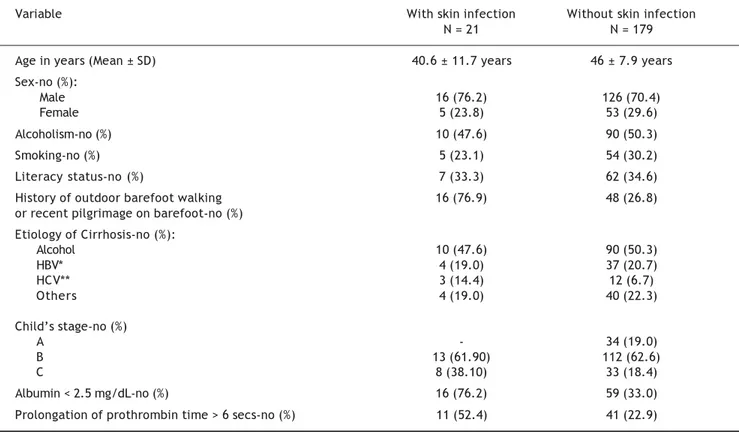
Table 1. Baseline characteristics of study population.
Variable With skin infection Without skin infection
N = 21 N = 179
Age in years (Mean ± SD) 40.6 ± 11.7 years 46 ± 7.9 years
Sex-no (%):
Male 16 (76.2) 126 (70.4)
Female 5 (23.8) 53 (29.6)
Alcoholism-no (%) 10 (47.6) 90 (50.3)
Smoking-no (%) 5 (23.1) 54 (30.2)
Literacy status-no (%) 7 (33.3) 62 (34.6)
History of outdoor barefoot walking 16 (76.9) 48 (26.8)
or recent pilgrimage on barefoot-no (%) Etiology of Cirrhosis-no (%):
Alcohol 10 (47.6) 90 (50.3)
HBV* 4 (19.0) 37 (20.7)
HCV** 3 (14.4) 12 (6.7)
Others 4 (19.0) 40 (22.3)
Child’s stage-no (%)
A - 34 (19.0)
B 13 (61.90) 112 (62.6)
C 8 (38.10) 33 (18.4)
Albumin < 2.5 mg/dL-no (%) 16 (76.2) 59 (33.0)
Prolongation of prothrombin time > 6 secs-no (%) 11 (52.4) 41 (22.9)
RESULTS
The baseline characteristics of cirrhotic patients with and without skin infection is shown in table1. The study cohort was predominantly male (71%). 50% were alcoholics and 30% were smokers. Most of them were of Child B cirrhosis (63%) followed by Child C (21%) and Child A (17%). Alcoholism was
the predominant etiology for cirrhosis (50%). Nearly one-third of our patients (32%) gave a history of re-cent outdoor barefoot walking. Mean age of controls [Male (n = 74): Female (n = 26)] was 48.6 ± 5.2 yrs. 30% of them were walking on barefoot. Cases and controls were of similar socioeconomic status falling either in lower class or upper lower class as per the conventional definitions for economic status.
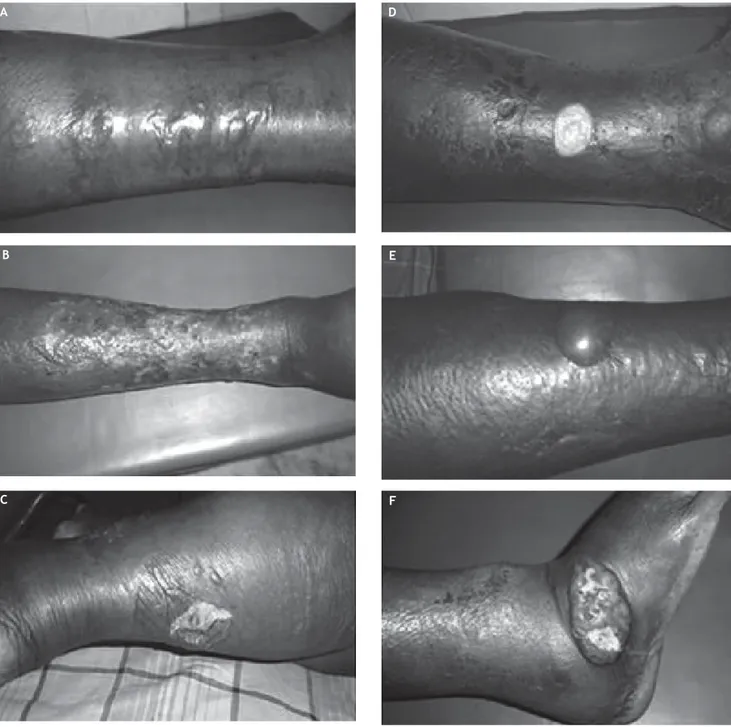
Figure 1. Pattern of skin infection in cirrhosis. A. Multiple hemorrhagic bullae due to Escherichia coli. B. Cellulitis with healing superficial lesions. C. Marked limb edema with ruptured bullae. D. Shallow ulcer with skin hyperpigmentation. E. Cellu-litis with a bulla. F. Edema with ulcer in lateral malleolus.
B
C
A D
E
10.5 %( 21 of 200) patients with cirrhosis had skin infection. The clinical picture of skin infection widely varied among the study cohort (Figure 1). The nature of skin infection were:
• Cellulitis of lower limbs (n = 7). • Hemorrhagic bullae (n = 3). • Leg ulcers (n = 9).
• Infected callosity over the lateral malleolus (n = 3). • Recurrent abscess in the arm and the chest wall
(n = 1).
The infective organism could be isolated either from skin or blood in 17 patients (81% of patients with clinical sepsis). Escherichia coli was isolated from blood or skin aspirate in 11 patients (both blood and skin aspirate in 3, blood alone in 3 and skin alone in 5). Klebsiella and Staphylococcus au-reus were isolated from the skin in four and two pa-tients respectively. The infective pathogen could not be isolated in 4 patients. All patients were initially treated with intravenous cefazolin which was later revised according to in vitro culture sensitivity. Lo-gistic regression identified outdoor barefoot walking (p = 0.001) and serum albumin < 2.5 g/dL (p = 0.002) as risk factors for skin infection. Four tients (19%) with skin infection died. All the pa-tients who died were suffering from Child C cirrhosis and were infected with Escherichia coli. The etiology of cirrhosis was Hepatitis C in two, Hepatitis B in one and alcohol related in one pa-tient. Hemorrhagic bullae (n = 2) and cellulitis with ulcers (n = 2) was observed in patients who suc-cumbed to the infection. None of the controls had skin infection.
DISCUSSION
Bacterial infections account for about 25% of dea-ths in cirrhosis.2 Patients with decompensated
cirr-hosis are more susceptible to infection compared to compensated cirrhosis.4,5 Despite the widespread use
of empirical antibiotics, sepsis in cirrhosis often fo-llows a deteriorating clinical course with an in-hos-pital mortality of approximately 15%.6
Skin and soft tissue infections occur in 2-11% of patients with liver disease.3 Our observation in a
co-hort of predominantly male alcoholics suffering from cirrhosis showed a 10.5% prevalence of skin in-fection.
Escherichia coli was the most frequent pathogen identified from skin aspirate or blood culture in the present study. Bacterial skin infections among
non-cirrhotic individuals are frequently caused by gram positive pathogens (mainly group A streptococci and Staph. aureus) and infrequently due gram negative pathogens.7,8 Skin infection due to Escherichia coli
has been frequently reported in patients with cirrho-sis.9,10 Other Gram negative pathogens associated
with cellulitis in cirrhosis include Klebsiella, Pseu-domonas, Proteus, Aeromonas and Vibrio spe-cies.3,11 Furthermore, they suffer from severe skin
infections like cellulitis with hemorrhagic bullae of-ten caused by gram negative bacteria and carry a high case fatality.12 This makes gram-negative
pa-thogens (especially Escherichia coli and Klebsiella) the most probable cause of cellulitis when a clini-cian encounters a cirrhotic patient with suspected bacterial skin infection.
The reason for Escherichia coli to be the most fre-quent infective pathogen of the skin in patients with cirrhosis is not clear. However, it is well known that cirrhotic patients have impaired clearance of enteric organisms due to depressed Kuppfer cell function, porta-systemic shunt and bacterial trans-location.6,13 This may produce frequent gram
negati-ve bacteremia giving an opportunity for distant tissue invasion by these pathogens under favorable conditions. This is further complicated by the defec-tive bactericidal function of immunoglobulins inclu-ding evidence suggesting deficient bactericidal activity of serum IgM for Escherichia coli.14-18
History of recent outdoor bare foot walking was identified as a strong risk factor for skin infections in our study and these infections were mostly res-tricted to lower limbs except in one patient. Disrup-tion of mechanical defenses may occur following a trivial injury due to barefoot walking. As already discussed soft tissue infections secondary to trauma in non-cirrhotic individuals are often caused by gram positive pathogens which invade the tissue from the external environment. When cirrhotic pa-tients develop soft tissue infections due to trivial trauma secondary to barefoot walking, the severity of infection is expected to be more due to their im-munosuppressed status but the causative organism is supposed to be the same spectrum of gram positi-ve and few gram negatipositi-ve pathogens.
patients due to poorly controlled ascites and func-tional obstruction to Inferior vena cava. Trivial in-jury to the foot due to outdoor barefoot walking can render the soft tissues of the leg more vulnerable to bacterial invasion by endogenous gram negative bacteria producing clinical sepsis. This mechanism reminds us the fact that systemic infections in pa-tients with cirrhosis are also frequently gram-nega-tive enteric pathogens.20 While this mechanism can
partially explain the selective gram-negative epide-miology in barefoot cirrhotic, it may not be a plausi-ble explanation for cellulitis due to other non-endogenous gram negative pathogens. Pathoge-nesis of cellulitis in cirrhotic patients probably has multiple mechanisms.
Serum albumin less than 2.5 g/dL was significan-tly associated with skin infection in our study. A re-cent study on factors influencing outcomes in soft-tissue infections among cirrhotic patients iden-tified that appearance of band form, elevated creati-nine, albumin less than 2.5 g/dL, bilirubin more than 3 mg/dL and prothrombin time prolongation more than 5 sec were associated with death.21 An
earlier study identified haemmorrhagic bullae as an ominous sign in patients with cirrhosis.12 Two of
our patients with hemorrhagic bullae also succum-bed to the infection. Low serum albumin, gastroin-testinal bleeding, intensive care unit admission for any cause, alcoholism, advanced Child-pugh stage and therapeutic endoscopy have been shown to be risk factors in association with bacterial infection in cirrhotic patients.22
Mortality in our study was 19% (4 of 21). Liu, et al., in their retrospective analysis had observed a mortality of 22% (26 of 118). It should be noted that 63% of our patients were of Child B cirrhosis. Given the short duration of the study period, newly diag-nosed status of the study cohort and small sample size, a selection bias towards a less severe stage of cirrhosis is possible. On account of this, our study may not predict the expected mortality due to skin sepsis in patients who will present with Child C cirr-hosis.
CONCLUSION
The prevalence of bacterial skin infection in a co-hort of newly diagnosed cirrhotics is 10.5% with a mortality of 19%. The epidemiology of infective pa-thogen was dominated by Escherichia coli, raising the possibility of endogenous gram negative bactere-mia in the causation of skin sepsis. The finding that outdoor bare foot walking is a strong risk factor for
skin sepsis emphasizes the need for educating pa-tients with cirrhosis about the risks of barefoot wal-king to help prevent significant morbidity and mortality. This assumes greater importance in the developing world as most patients diagnosed with ci-rrhosis receive conservative medical management due to extremely low rates of liver transplantation.
ACKNOWLEDGEMENT
We thank Mr Vengatesan A, Lecturer in Statis-tics, Clinical Epidemiology Unit, Madras Medical College Hospital, Chennai, for his help.
REFERENCES
1. Borzio M, Salerno F, Piantoni L, Cazzaniga M, Angeli P, Bis-soli F, Boccia S, et al. Bacterial infection in patients with advanced cirrhosis: a multicentre prospective study. Dig Liver Dis 2001; 33: 41-8.
2. Brann OS. Infectious complications of cirrhosis. Curr Gas-troenterol Rep 2001: 3(4): 285-92.
3. Corredoira JM, Ariza J, Pallares R, Carratalá J, Viladrich PF, Rufí G, Verdaguer R, et al. Gram-Negative Bacillary Ce-llulitis in Patients with Hepatic Cirrhosis. Eur J Clin Micro-biol Infect Dis 1994; 13: 19-24.
4. Yoshida H, Hamada T, Inuzuka S, Ueno T, Sata M, Ta-nikawa K. Bacterial infection in cirrhosis, with and without hepatocellular carcinoma. Am J Gastroenterol 1993; 88: 2067-71.
5. Caly WR, Strauss E. A prospective study of bacterial in-fections in patients with cirrhosis. J Hepatol 1993; 18: 353-58.
6. Wong F, Bernardi M, Balk R, Christman B, Moreau R, Gar-cia-Tsao G, Patch D, et al. Sepsis in cirrhosis: report on the 7th meeting of the International Ascites Club. Gut 2005; 54(5): 718-25.
7. Morris A. Cellulitis and Erysipelas. Clin Evid 2003; (9): 1804-9.
8. Bisno AL, Stevens DL. Streptococcal infections of skin and soft tissue. N Engl J Med 1996; 334: 240-45.
9. Yoon TY, Jung SK, Chang SH. Cellulitis due to Escherichia coli in three immunocompromised subjects. Br J Dermatol 1998; 139(5): 885-8.
10. Castanet J, Lacour JP, Perrin C, Bodokh I, Dor JF, Orton-ne JP. Escherichia coli cellulitis: two cases. Acta Derm Ve-nereol 1992; 72(4): 310-1.
11. Yael Horowitz, Ami D Sperber, Yaniv Almog. Gram-Negati-ve cellulitis complicating cirrhosis. Mayo Clin Proc 2004; 79: 247-50.
12. Liu BM, Hsiao CT, Chung KJ, Kung CT, Hung SC, Liu PP. He-morrhagic bullae represent an ominous sign for cirrhotic patients. J Emerg Med 2008; 34(3): 277-81. E-pub 2007 Nov 5.
13. Rimola A, Soto R, Bory F, Arroyo V, Piera C, Rodes J. Reti-culoendothelial system phagocytic activity in cirrhosis and its relation to bacterial infections and prognosis. He-patology 1984; 4: 53-8.
14. Bjornboe M, Prytz H, Orskov F. Antibodies to intestinal mi-crobes in serum of patients with cirrhosis of the liver. Lancet 1972; 1: 58-60.
16. Simjee AE, Hamilton-Miller JM, Thomas HC, Brumfitt W, Sherlock S. Antibodies to Escherichia coli in chronic liver disease. Gut 1975; 16: 871-5.
17. Staun-Olsen P, Bjorneboe M, Prytz H, Thomsen AC, Orskov F. Escherichia coli antibodies in alcohol liver disease. Co-rrelation to alcohol consumption, alcoholic hepatitis and serum IgA. Scand J Gastroenterol 1983; 18: 889-96. 18. Fierer J, Finley F. Deficient serum bactericidal activity
against E. coli in patients with cirrhosis of the liver. J Clin Invest 1979; 63: 912-21.
19. Dupuy A, Benchikhi H, Roujeau J-C, Bernard P, Vaillant L, Chosidow O, Sassolas B, et al. Risk factors for erysipelas
of the leg (cellulitis): case-control study. BMJ 1999; 318(7198): 1591-4.
20. Kuo CH, Changchien CS, Yang CY, Sheen IS, Liaw YF. Bac-teremia in patients with cirrhosis of the liver. Liver 1991; 11(6): 334-9.
21. Liu BM, Chung KJ, Chen CH, Kung CT, Ko SF, Liu PP, Chang HW. Risk factors for the outcome of cirrhotic patients with soft tissue infections. J Clin Gastroenterol 2008; 42(3): 312-6.