Universitat de les Illes Balears Universitat de les Illes Balears
GENETIC PROFILE OF WESTERN MEDITERRANEAN
POPULATIONS: CONTRIBUTION OF ARAB AND
JEWISH GROUPS
Kaoutar Bentayebi
Universitat de les Illes Balears Universitat de les Illes Balears
GENETIC PROFILE OF WESTERN MEDITERRANEAN
POPULATIONS: CONTRIBUTION OF ARAB AND JEWISH
GROUPS
Thesis submitted by Miss Kaoutar Bentayebi to aspire to the degree of Doctor in
Biotechnology, Genetics and Cellular Biology (at the University of Balearic Islands) and
in Biology (at the Mohamed V-Agdal University)
Thesis supervisors: Dr. Antònia Picornell Rigo and Dr. Saaid Amzazi
Dr. Antònia Picornell Rigo Dr. Saaid Amzazi Kaoutar Bentayebi
ABSTRACT
i
RESUME
Ce travail décrit la diversité génétique des populations ouest-méditerranéennes actuelles
à travers deux polymorphismes : neufs marqueurs Alus et douze microsatellites (STR)
présents au niveau du chromosome X. Dans ce travail, des résultats originaux de
populations Marocaines, Espagnoles, sud Italiennes et de populations Juives sont
présentés. Notre étude multidisciplinaire s’appuie sur des données biologiques,
archéologiques, historiques, géographiques et linguistiques pour retracer les origines et
l’histoire génétique des populations ouest-Méditerranéennes. Pour l’ensemble des
marqueurs, nos résultats montrent une proximité génétique entre les populations Nord
Africaines et les populations du sud-ouest de l’Europe mais une différenciation entre les
groupes nord-africains et sub-sahariens. Aussi, nous constatons qu’au nord-ouest de
l’Afrique, aucune importante différenciation génétique entre les Berbères et les Arabes
n’apparait. L’analyse de cinq populations juives les a groupé dans un même cluster,
témoignant de leur origine ancestrale commune qu’il ont conservé à travers le temps
malgré la Diaspora, avec une nette distinction entre eux et leurs voisins non-juifs.
MOTS-CLEFS
Ouest Méditerranéenne, Anthropologie, génétique des populations, Forensique
Génétique, Arabes, nord de l’Afrique, Diaspora juive, polymorphismes génétiques,
STR, Alu, linguistique, histoire génétique, peuplement, Iles Baléares.
RESUMEN
Este trabajo describe la diversidad genética de las poblaciones actuales del Oeste del
Mediterráneo según dos polimorfismos: nueve polimorfismos Alus y doce
microsatelites (STR) presente en el cromosoma X. En este trabajo, se presentan
resultados originales de poblaciones de Marruecos, España, sur de Italia y de
poblaciones judías. Nuestro estudio multidisciplinario se basa sobre datos biológicos,
arqueológicos, históricos, geográficos y lingüísticos para reconstruir los origines y la
historia genética del oeste del Mediterráneo. Para la totalidad de los marcadores,
nuestros resultados muestran una proximidad genética entre las poblaciones del norte de
sub-ABSTRACT
ii
saharianos. También se puede concluir que en el noroeste de África, no hay una fuerte
diferenciación genética entre los beréberes y los árabes. .El análisis de cinco
poblaciones judías muestra que se agrupan en un mismo cluster, indicando su ancestral
común origen, que se ha conservado durante el tiempo a pesar de la diáspora, con una
clara distinción entre ellos y sus vecinos no-judíos.
PALABRAS CLAVES
Oeste del Mediterráneo, Antropología, genética de población, genética forense, Árabes,
Norte de África, Diáspora judía, polimorfismos genéticos, STR, Alu, lingüístico,
historia genética, población, Islas Baleares.
ABSTRACT
This research describes the genetic diversity of current Western Mediterranean
populations through two polymorphisms: nine Alus polymorphisms and twelve Short
Tandem Repeats (STR), located in the X chromosome. Original results are presented for
populations from Morocco, Spain, South of Italy and Jewish Diaspora. Our
multidisciplinary study is based on biological, archaeological, historical, geographical
and linguistic data in order to track the roots of the Western Mediterranean origins and
genetic history. For all markers, our results show that the North African are genetically
close to European populations but differentiated from sub-Saharan groups. Furthermore,
we notice that in North-West Africa, there isn’t any striking genetic differentiation
between Berber and Arabic. The analysis of five Jewish populations plotted them in the
same cluster, arguing for their shared ancestral origins that they conserved over time
despite the Diaspora, with a clear distinction found between them and their non-Jewish
neighbors
KEY WORDS
Western Mediterranean, Anthropology, Population Genetics, Forensic Genetics, Arabic,
North Africa, Jewish Diaspora, genetic polymorphisms, STR, Alu, linguistics, genetic
iii
A mes chers parents….
A la mémoire de Papy….
v
PREFACE
The present work was supported by an Averroes fellowship, which was awarded to
me in my last two years. This has led to the collaboration and the co-supervision of my
PhD work through Université Mohammed V - Agdal and Universidad de las Islas
Baleares. In this context, I would like here first to convey my heartfelt thanks to both
Universities for offering me an ideal environment in which I felt free and could
concentrate on my research.
I am grateful for all the institutions and co-authors for their help, availability and
orientation that made my PhD Work and publication possible: My supervisors “Dr.
Saaïd AMZAZI and Dr. Antònia PICORNELL”, Dr. Misericòrdia Ramon, Dr. José
Aurelio, Dr. Driss Squalli, Dr. Anna Barbaro, Mehdi Bouabdellah and Rachid
Aboukhalid.
Indeed, this work leads to the following publications:
Published papers
Bentayebi K, Picornell A, Amzazi S. Genetic Diversity: New research: Chapter 5:
Genetic History of Morocco. Novapublishers. USA. 2012.
Bentayebi K, PicornellA ,Bouabdeallah M, Castro J A, Aboukhalid R , Squalli D,
Misericordia MM , Amzazi S: Genetic Diversity of 12 X-chromosomal short tandem
repeats in the Moroccan population, Forensic Sci. Int. Gent. 2012. 6: e48-e49.
Bentayebi K, Ramon MM, Castro JA, Barbaro A, Aboukhalid R, Amzazi S and
Picornell A. Inferring ethnicity from the X-chromosome ALU insertions: data from Western Mediterranean human groups, Forensic Sci. Int. Gent. Supp Series. 2011: e27-e28.
PREFACE
vi
Aboukhalid R, Bouabdellah M, Abbassi M, Bentayebi K, Elmzibri M, Squalli D, Amzazi D, Amzazi S. Haplotype frequencies for 17 Y-STR loci (AmpFISTR Y-filer) in a Moroccan population sample. Forensic Sci. Int. Gent. 2009. 4: e73-e74.
Aboukhalid R, Bouabdellah M, Lai R, Bradford N, EL Ossmani H, Talbi J, Bentayebi
K, Squalli D, Podini D and Amzazi S. Y chromosomal SNP analysis using the
minisequencing strategy in a Moroccan population samples. Journal of forensic
research.2010.1 (2). 1000113.
Submitted papers
Aboukhalid R, Andreaggi KS, Bouabdellah M, Bentayebi K, El Mzibri M, Squalli D,
Irwin J.A, and Amzazi S. Mitochondrial DNA control region variation from samples of
the Moroccan population.ForensicSciInt Gent. 2012. Submitted paper.
Current papers
Bentayebi K, Ramon M.M, Castro J.A, Barbaro A, Aboukhalid R, Amzazi S and
Picornell A. Populationgenetic inference from X chromosome Aluinsertions in
Western-Mediterranean region (current).
Bentayebi K*, Ferragut JM*, Castro JA, Ramon MM, Amzazi S, Picornell A (* both
authors contributed equally to this work).Gene Pool Structure of Jewish people as
Inferred from the X-Chromosome (current).
Ferragut JM*, Bentayebi K*, Castro JA, Ramon MM, Amzazi S, Picornell A (* both
authors contributed equally to this work).Gene Diversity in Balearic Islands Genetic
Isolates and Valencia using Argus X-12 STR (current).
Bentayebi K, Picornell A, Bouabdeallah M, Castro JA, Aboukhalid R, Squalli D,
Ramon MM, Amzazi S : Genetic analysis of 18 X chromosomal SNP in the Moroccan
population (in preparation).
Bouabdellah M, Bentayebi K et al. 48 autosomal Single nucleotide Polymorphisms for
PREFACE
vii
International Communications
Participation by two posters entitled « Inferring ethnicity from the X-chromosome
ALU insertions: data from Western Mediterranean human groups » and “X-chromosomal haplotype frequencies of four linkage groups in a North african population” at24th Congress of the International Society for Forensic Genetics in
Vienna, Autria: 29-03 Sep (2011).
Participation by a poster entitled “Haplotype frequenies for 17 Y-STR loci
(AmpFISTRYfilerTM) in a moroccan population sample" at the 23thCongress of the International Society for Forensic Genetics in Puerto Madero, Buenos Aires, Argentina: 14-18 Sep (2009).
Participation by a poster entitled « Haplotypefrequencies for 17 Y-STR loci
(AmpFlSTR®Y-filerTM) in a Moroccanpopulation sample» at the 4th international congress of genetics and molecular biology and the 4th International Congress of Biotechnology, Ouarzazat, Morocco: 05-08 Nov (2008).
Patrimony
Morocco is like a tree, whose roots lie in Africa, but whose leaves breathe in European air. (Le Maroc est comme un arbre, dont les racines se situent en Afrique, mais dont les feuilles en air europeen.)
PREFACE
ix
Acknowledgement
Pursuing a Ph.D. project is both painful and enjoyable experience. It’s just like climbing a high peak, step by step, accompanied with bitterness, hardships, frustration, encouragement and trust and with so many people’s kind help. When I found myself at the top enjoying the beautiful scenery, I realized that it was, in fact, teamwork that gone me there. Though it will not be enough to express my gratitude in words to all those people who helped me, I would still like to give my many, many thanks to all these people.
First of all, I’d like to give my sincere thanks to my supervisor, prof. Saaïd
AMZAZI. Professor and dean of the Faculty of Sciences at the University of
Mohammed V-Agdal. It has been an honor to be his PhD student. He has taught
me, both consciously and unconsciously, how good biologist is done, I appreciate
all his contribution of time, ideas, and funding to make my PhD experience
productive and stimulating. The joy and enthusiasm he has for his work was
contagious and motivational for me, even during tough times in the PhD pursuit. I
am also thankful for the excellent example he has provided as a successful man
biologist and professor. Since my first day as a graduate student at the university
he has been successively my professor, my idol, my master’s degree supervisor and
my PhD supervisor as well as a very good friend.
Special thanks are also given to prof. Antònia Picornell. Professor and
vice-dean of the Faculty of Sciences at the Universidad de las Islas Baleares. She is the
one who accepted me as a PhD scholar, at the Laboratory of Geneticsof the UIB,
for my research in 2010. Thereafter, she accepted me as her PhD student without
any hesitation. She offered me so much advice, patiently supervising me, and
always guiding me in the right direction. I’ve learned a lot from her at both, the
professional and personal level, without her help I could not finished my
dissertation successfully.
I would like also to thank Prof. Misericòrdia Ramon, the head of the
Laboratory of Genetics at the Universidad de las Islas Baleares, that welcomed me
in her laboratory. Her encouragement and help made me confident to fulfill my
desire and to overcome every difficulty I encountered.
x
permanent smile, French songs and the cookies that you used to give me at the end
of every workday rob out my stress and tiredness and offered me an ideal
environment.
I would like to present my gratitude to prof. Youssef Bakri. Professor at the
faculty of Sciences – UMV Agdal. He was the first one who introduced me to the
molecular biology, I learned a lot from him and I am very grateful. Thank you for
being part of my reading and oral defense committee.
Many thanks to prof. Touria Benazzouz. Professor at the Faculty of Sciences
– UMV Agdal. She was my professor of genetics and taught me the basics of DNA
and genes. You accepted to be the president of my oral defense, thank you for this
honor.
A special thanks to prof. Abdelaziz Chafik. Professor and dean of the “Faculté
polydisciplinaire of El Jadida-Université Chouaib Doukkali”. You agreed to take
time out of your busy schedule to be participate in my reading and oral defense
committee. Your truly honor me with your presence.
I am presenting also my acknowledgement to my friends and colleagues in
Morocco: Mehdi and Rachid as well as my colleagues at the UIB: Virginia,
Marina, Joana M and Joana F for their collaboration and the good moment we
spent together.
I gratefully acknowledge the so many friends, both in Rabat and Mallorca, who
offered me so much kindly help. I give my sincere thanks to all these people.
To everyone that contributed to this work
xi
Table of contents
Abstract Preface
Acknowledgements Table of contents List of Tables List of Figures List of Abbreviations
GENERAL INTRODUCTION... 1
Part I: BIBLIOGRAPHICAL REVIEW A. The linguistic, historic and cultural context of Mediterranean populations I. Geographical and cultural context of the Mediterranean region……….…… 7
II. Historical and demo-linguistic data of Morocco, Balearic Islands and south of Italy………. 15
B. Religious diversity between populations of interest I. Insight of the religious diversity between South of Europe, North Africa and Middle East……… 21
II. The historical and geographical movement of the Jewish communities….. 24
C. Concepts I. Anthropology: Concept and History……… 29
II. Population Genetics: Concept and History……….. 30
1. Definition……… 30
2. Hardy Weinberg equilibrium and evolutionary forces…………... 32
D. Usefulness of Forensic Genetics in Human Identification I. DNA and Human Identification ………...……..……… 35
II. Usefulness of the different genetic markers in human identification…….. 37
1. Short Tandem Repeats……… 37
2. Nomenclature of STR markers………... 39
3. Alu insertion polymorphism………... 40
4. Alu family classification……… 42
III. X Chromosome: properties and relevance in human identification and population genetics……… 45
1. Use of Chromosome X in Forensic Genetics……… 49
Part II: MATERIAL & METHODS A. Chromosome X: Genetic Analyses of 9 Alu polymorphisms I. Material………. 53
II. Methods………. 54
1. DNA extraction………. 54
Table of contents
xii
3. Amplification of DNA with Polymerase Chain Reaction (PCR)… 55
4. Analysis of the PCR products………. 56
5. Statistical Analysis of Data………. 57
B. Chromosome X: Genetic Analyses of 12 STR polymorphism I. Material……… 63
II. Methods……… 63
1. DNA extraction……… 63
2. Quantification of isolated DNA……… 64
3. Amplification of DNA with Polymerase Chain Reaction (PCR)…. 64
4. Capillary Electrophoresis………. 68
5. Statistical Analysis of Data……….. 70
Part III: RESULTS & DISCUSSION A. Genetic characterization of the Western Mediterranean population I. Genetic diversity of 12 X-chromosomal short tandem repeats in the Moroccan population………. 73
II. Gene Diversity in Balearic Islands Genetic Isolates and Valencia using Argus X-12 STR………..……… 83
III. Population genetic inference from X chromosome Alu insertions in Western-Mediterranean region………...……… 97
B. Gene Pool Structure of Jewish people as Inferred from the X-Chromosome… 105
Part IV: GENERAL DISCUSSION A. The ethno-religious origins of the Western Mediterranean region: North African and South Europeans populations……… 139
B. Jewish Diaspora: Origins and relationship with the Western Mediterranean populations………..……….… 145
Conclusion & Prospects……….. 149
References... 151
xiii
List of Tables
Part I
Table 1.Comparison of population-genetic markers………... ….. 47
Part II
Table2.PCR Protocols: X chromosome Alu insertions………..…… 55
Table 3.Oligonucleotid primer sequences and sizes of the PCR products in the presence of
each Alu insertion………... 55
Table 4.Thermocycling conditions for the 9 Alu polymorphism………... 56
Table 5.Chromosomal mapping of the Investigator Argus X-12 Kit……… 65
Table 6.Locus-specific information of the Investigator Argus X-12 Kit………….. 67
Part III
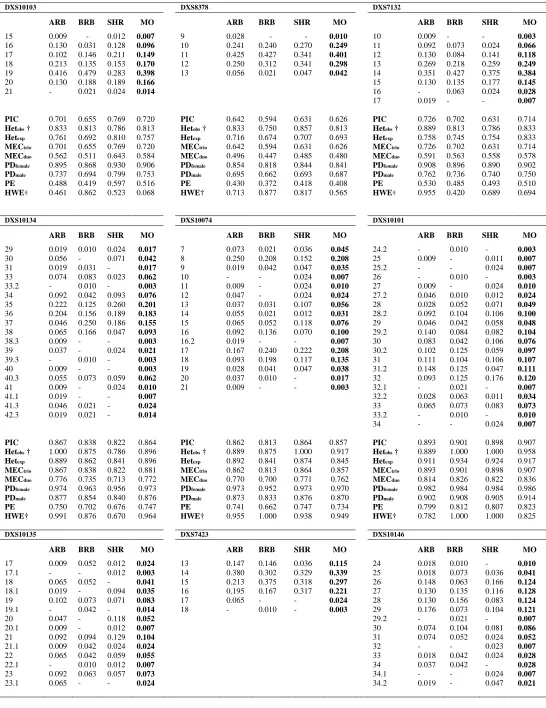
Table 7.Allele frequencies and statistical parameters of 12 X-chromosomal short tandem
repeat loci in 145 Moroccan samples (Arabic: 36 men and 18 women; Berber: 32
men and 16 women and Sahrawi: 29 men and 14
women)……… 75
Table 8.Genetic distances between the Moroccan and other African, European, American
and Asian populations (Fst values)……….………….. 78
Table 9.X-chromosome haplotypes of four linked STR trios in 36 Arabic, 32 Berber and
29 Sahrawi males living in Morocco………... 79
Table 10.Haplotype frequencies (F) of 4 linked X-chromosomal short tandem repeat trios
in 97 Moroccan men……….……… 81
Table 11.Allele frequencies and statistical parameters of 12 X-chromosomal short tandem
repeat loci in 250 Spanish samples (Majorca: 39 men and 22 women; Minorca:
39 men and 25 women; Ibiza: 39 men and 20 women and Valencia: 39 men and
List of tables
xiv
Table 12.Genetic distances between the Moroccan and other African, European, American
and Asian populations populations (Fst values)……….……… 87
Table 13.Haplotype diversity of X-STR clusters in Ivorians (Tie et al. 2010), Algerians and
Italians (Inturri et al. 2010 and Robino et al. 2006)……….. 89
Table.14. X-chromosome haplotypes of four linked STR trios in 39 men from each
Mojorca, Minorca, Ibiza and Valencia……….………... 91
Table 15.Allele frequencies and heterozygosity per locus and population for the
X-chromosomal ALU insertions Ya5DP62, Yb8DP49, Yd3JX437, Yb8NBC634,
Ya5DP77, Ya5NBC491, Yb8NBC578, Ya5DP4, Ya5DP13 in 11 Western
Mediterranean populations…………..………. 98
Table 16.Reynods’ distances for the eleven Western-Mediterranean populations 99 Table 17.Estimated natural logarithm of the probability of the data (Ln P(X/K)) for each
value of K and proportion of membership of each pre-defined population in
each of the five clusters………...………. 102
Table 18.Allele frequencies and heterozygosity per locus and population for the
X-chromosomal ALU insertions Ya5DP62, Yb8DP49, Yd3JX437, Yb8NBC634,
Ya5DP77, Ya5NBC491, Yb8NBC578, Ya5DP4, Ya5DP13 in 5 worldwide
Jewish populations……… 108
Table 19.Reynods’ distances for the five Jewish studied populations……… 108 Table 20.Estimated natural logarithm of the probability of the data (Ln P(X/K)) for each
value of K and proportion of membership of each pre-defined population in
each of the five clusters……… 111
Table 21.Allele frequencies and statistical parameters of 12 X-chromosomal short tandem
repeat loci in 302 Jewish samples (Ashkenazis: 26 men and 33 women;
Sephardic (Bulgaria & Turkey): 19 men and 25 women; North African
(Morocco, Tunisia and Libya): 29 men and 25 women , Oriental (Iraq & Iran):
29 men and 26 women) and Chuetas: 49 men and 41
women)………..……….. 113
Table 22.X-chromosome haplotypes of four linked STR trios in males belonging to five
different Jewish communities………...……….. 120
Table 23.Genetic distances between the Jewish communities and other North African and
xv
List of Figures
Part I
Figure 1.Map of the Western Mediterranean region………... 2
Figure 2.The Jewish Diaspora between 70 to 1497……… 24
Figure 3.The Jewish migration pattern and worldwide distribution…..…………. 27
Figure 4.Short Tandem Repeats structure………... 37
Figure 5.STR allele’s structure………... 39
Figure 6.A typical human Alu element and its retroposition……….. 41
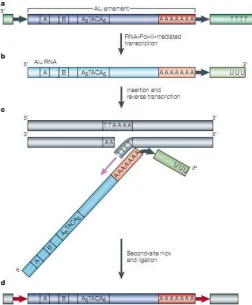
Figure 7.Expansion of recently integrated human Alu subfamilies……….... 44
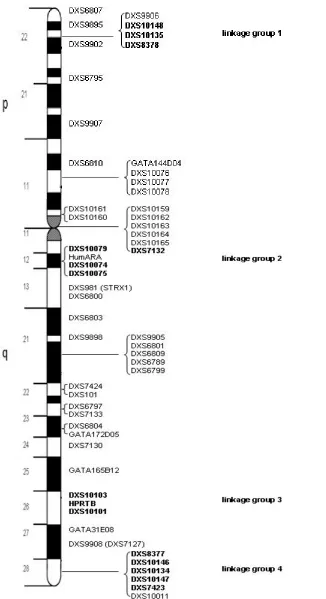
Figure 8.Chromosome X ideogram……… 46
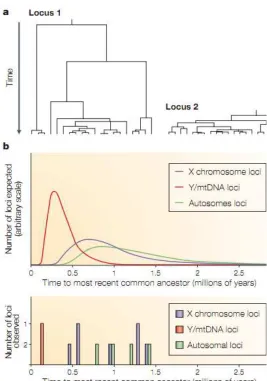
Figure 9.Variation between loci………..……….... 48
Part II Figure 10.Photograph of a 2 % agarose gel containing the PCR products of Ya5DP62………... 57
Figure 11.Photograph of a 2 % agarose gel containing the PCR products of Yb8NBC578, Yd3JX437, Ya5NBC491………...……… 57
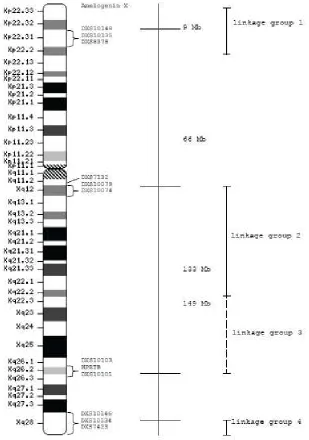
Figure 12.The ideogram of the X-chroosome. Distances from the p-telomere are shown in Mb……….. 66
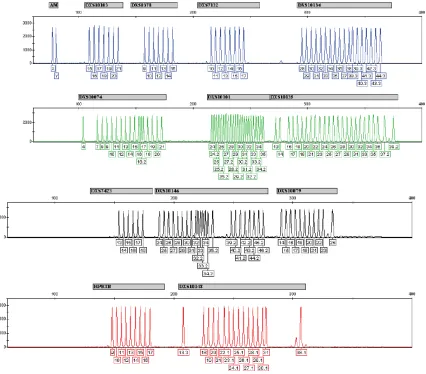
Figure 13.Electropherogram of the DNA Size Standard 550 (BTO), fragments with lengths in bp……….…………. 69
List of Figures
xvi
Part III
Figure 15.Multidimensional scaling analysis (MDS) based on Reynolds genetic distances
calculated between Western Mediterranean populations for 9 ALU
insertions………... 90
Figure 16.Multidimensional scaling analysis (MDS) based on Reynolds genetic distances
calculated between populations………..………..… ……... 100
Figure 17.Multidimensional scaling analysis (MDS) based on Reynolds genetic distances
calculated between five Jewish groups for 9 ALU insertions……… 109
Figure 18.Multidimensional scaling analysis (MDS) based on Reynolds genetic distances
calculated between 24 populations for 9 ALU insertions….………. 109
Figure 19.Multidimensional scaling analysis (MDS) based on Reynolds genetic distances
calculated between five 21 populations for 9 ALU insertions……... 110
Figure 20.The triangle plot of Q. Each individual is represented by a colored point. The
colors correspond to the prior population labels. The estimated ancestry vector
for an individual consists of K components which add up to 1. For K=5, the
ancestry vectors are plotted onto a triangle. For a given point, each of the five
components is given by distance to one edge of the
triangle………..………. 111
Figure 21.Population structure inferred by STRUCTURE analysis. Each individual is represented by a vertical (100%) stacked column of genetic components
proportions shown in color for K=3…... 112
Figure 22.Multidimensional scaling analysis (MDS) based on pairwise genetic distances
xvii
List of Abbreviations
AMOVA Analysis of Molecular Variance
ARB Arabs
AS Autosomal
ASH Ashkenazi
BC Before Christ
BP Before Present
BRB Berbers
CE Christian Era
Chr Chromosome
CHU Chuetas
CODIS Combined DNA Index System
DNA DeoxyriboNucleic Acids
GD Gene Diversity
H Haplotype Diversity
Hetobs Observed Heterozygosity
Hetexp Expected Heterozygosity
HWE Hardy-Weinberg Equilibrium
IBD Identical By Descent
IB Ibiza
LD Linkage Disequilibrium
LIA Little Ice Age
MA Majorca
Ma Mega Annum (one million years, geological chronology)
MDS Multidimensional Scaling
MECduo Mean Exclusion Chance in trios involving daughter
MECtrio Mean Exclusion Chance in father/daughter or mother/son duos
MI Minorca
MO Pooled Moroccan Population
MWP Medieval Warm Period
MENA Middle East and North Africa
MtDNA Mitochondrial DNA
List of Abbreviations
xviii
NAFR North African Jews
ND Not Done
ORT Oriental
PCR. Polymerase Chain Reaction
PD Power of discrimination
PE Power of Exclusion
PIC Polymorphism Information Content
RSQ Squared Correlation
SHR Sahrawi
SNP Single Nucleotide Polymorphism
STR Short Tandem Repeat
VL Valencia
X-Alu X chromosome Alu
GENERAL INTRODUCTION
1
GENERAL INTRODUCTION
Western Mediterranean region is the junction point between Africa on the South,
Europe on the North, the Atlantic Ocean on the west and Euro-Asia on the East.
Complex interplay between geographical and ongoing climatic processes has been
pivotal and influenced the patterns of geographical diversification that are currently
observed in these human populations. Yet, the Western Mediterranean region is settled
now by many populations, different by their origins, culture and history. Track the
population’s root and understand their evolutionary processes have been always
fascinating subjects for anthropologists since the XXth century. The recent progress of biology allowed a clear description to the genetic diversity of human populations by a
genetic reconsideration of their history. These information, associated to the
archeological, paleontological and linguistic data, give an inevitably possibility to
rebuild the human evolutionary history. This is the main challenge of the
anthropologist.
Our thesis is carried out in this context within a multidisciplinary approach. In fact,
the evolutionary history of these human groups up today, remains related to the
prehistorically and historical events evidenced by the archeological and paleontological
shadows.
Within the same issue of Western Mediterranean population, certain human groups
have a special interest: Romans, Arabic, Berbers and Jews moved, settled and had been
expended for different reasons, including for a commercial and political account.
The Mediterranean was one of the world’s greatest trading seas. At its eastern end,
sometime in the second millennium BC, Minoans, Greeks and Phoenicians set forth.
After the 8th century BC, Phoenicians from Tyre in what is now southern Lebanon
GENERAL INTRODUCTION
2
M
M
M
Majorca
ajorca
ajorca
ajorca
Minorca
Minorca
Minorca
Minorca
Ibiza
Ibiza
Ibiza
Ibiza
Mediterranean Sea
Tunisia
Tunisia
Tunisia
Tunisia
Algeria
Algeria
Algeria
Algeria
Morocco
Morocco
Morocco
Morocco
Spain
Spain
Spain
Spain
Valencia
Italy
Italy
Italy
Italy
Sicilia
Sicilia
Sicilia
Sicilia
Calabria
Calabria
Calabria
Calabria
Figure 1.
Map of the Western Mediterranean region.
GENERAL INTRODUCTION
3
The Iberian Peninsula had silver and tin and better watering places than North
Africa. Since it was a long way from Tyre, they soon established a line of settlements
on the shores and islands that lay between. The greatest of these settlements was
Carthage, in what is now Tunisia. It was founded around the end of the ninth century
BC, according to tradition, in 814 BC. Other settlements followed, including Rusaddir
(now Melilla) on the Mediterranean coast, and Lixus, near what is now Larache, and
near the modern town Essaouira, on the Atlantic. The Phoenicians had braved the Strait
of Gibraltar and pushed southwards down the coast of Africa. The earliest traces of
occupation at Lixus go back to the seventh century BC, but it is uncertain how much
further the Phoenicians went. In the fifth century BC, Persian armies overran the eastern
coast of the Mediterranean, and cut off the western settlements from the old metropolis
at Tyre. Carthage became the pre-eminent Phoenician city and began to expand its
influence westwards. A literary account, now known as the Periplus of Hanno,
describes a trip between 475 and 450 BC which, it is sometimes claimed, reached the
Gulf of Guinea. It may only have reached Essaouira or perhaps Dakhla on the modern
Mauritanian coast. What really spread Carthaginian influence into the African interior
was war with the Greek city states, particularly in Sicily. The war lasted, almost
continuously, for over a century and the booty and the Greek prisoners who were taken
to Carthage as slaves made the city extremely wealthy. This took Carthage into the
mainstream of Mediterranean civilization, which was largely Greek.
Also, the Arabic conquest to North Africa (VIIth century) and then to the Iberian Peninsula (in the year 711) and Balearic Islands, was a crucial period in the Western
Mediterranean history. This movement generated a deep change in culture, religion and
partially in language.
The aim of this project is to describe the genetic diversity of the Western
Mediterranean population and to assess their kinship degree with neighbor populations
with a different culture and language. We tried to answer another challenging question
in this study, concerning the different Jewish populations and their kinship level, after
the long scattering they undergone. In the other hand we tried to compare them with the
Western Mediterranean population where some of these groups settled for many
GENERAL INTRODUCTION
4
In this work, the description of the Western Mediterranean genetic structure is based
on the investigation of two polymorphisms: Alu insertion polymorphisms and Short
Tandem repeats on the X chromosome. The STR as well as Alu markers showed widely
their great interest in population genetics in order to compare human populations in
different geographic regions of the world and track the root of their evolutionary
history. Our main objective is to demonstrate their high power of discrimination at the
individual and population level. In the other hand, their location in the X chromosome
that have a special characteristics, giving it many futures and justifying its increasing
use in population genetics and population genetics fields; the global evolutionary
tendency of the Western Mediterranean population could be pulled. In the global
discussion part of this thesis we complemented our results, supported some hypothesis
or denied others by adding and exhibiting results obtained from other systems, which
had as a concern the Western Mediterranean genetic structure or the Jewish origins: The
mitochondrial DNA, autosomal SNP, GM Immunoglobulin allotype polymorphism, Y
STR and SNP and autosomal STR.
Thus, our analysis of two polymorphisms X-Alu and X-STR have three aims:
1) Assess the genetic diversity of the Western Mediterranean populations
comparing the genetic pool of our studied populations each other and with their
neighbors, including sub-Saharan and North European.
2) Describe the genetic pool of the Western Mediterranean populations and plot
their kinship degree.
3) Show that the 9 X-Alu polymorphisms and 12 X-STR are reliable in the forensic
science field. Validate their use in our populations and generate an allelic and
haplotype frequencies database that the international and local forensic science
community can use to resolve complex kinship cases.
This study in organized in IV parts. The first one is bibliographic, where we try
firstly, to explain the geographical, climatic, anthropological, cultural, linguistic,
religious and historic events that characterized these populations. This part exhibits the
different hypothesis of their origins. This information is provided for the three main
GENERAL INTRODUCTION
5
Jewish populations from Middle East. Secondly, other chapters define the two fields
handling this study: Population Genetics and Forensic Genetics. We also describe the
STRs and Alu polymorphisms as well as the X chromosome and its interest in both
fields. Part II is devoted to describe the material and methods, biologic, informatics
and statistical we used to get and analyze our genetic and comparative results. In Part
III, we presented our results and their discussion guise scientific six scientific papers
where I am the first author, as well as a book chapter that describe the genetic history
of Morocco. A general discussion, in the same part gathered all these results and faced
them to a deep discussion based on other scientific results and synchronized them with
the archeological and historical events.
We consider the archeological, paleanthropological, historical, linguistic and
biological data quoted from different books, reviews and investigations in order to
understand how the Western Mediterranean as well as Jewish Diaspora bore in this
region and how each ethnical group generated and kept its identity and culture and to
assess their kinship and relationship.
Could we describe one or many evolutionary history for the Western Mediterranean
populations? Is the Mediterranean Sea acted as barrier to the genetic flux? And what
was the role of the Sub-Sahara desert in the cultural and genetic exchange between these
populations? At a biologic level, what were the historical impact and especially the
Arabic conquest on the human Western Mediterranean groups? Is the linguistic
distinction between these groups of populations only cultural? Did the Jewish
communities conserved their ancestral genetic pool from their earliest beginning to our
own day or they lost it? How important is the Arabic contribution in the actual Western
Mediterranean genetic structure? All these questions are challenging issues that we tried
GENERAL INTRODUCTION
Part I A. Bibliographical Review
7
A.
The linguistic, historic and cultural context of Mediterranean
populations
I.
Geographical and cultural context of the Mediterranean region
Complex interplays between historical, cultural and ongoing geographical
diversification of the Mediterranean, generated the genetical structure that is currently
observed in the human populations of this region.
Geographically, the Mediterranean is the westernmost part of the global scale
Alpine-Himalayan orogenic belt which stretches from Spain to New Zealand. The
landscapes of the region have a long and complex history that includes both horizontal
and vertical crustal movements and the creation and destruction of oceans. This began
with the break up of the supercontinent Pangea around 250 Ma, which generated the
Tethys Ocean—the forerunner to the present-day Mediterranean Sea. It is the collision
of Africa and Eurasia, and the associated tectonics that have been largely responsible for
generating the Mediterranean Sea, its subsequent history, and the landscapes that
surround it. This collisional history progressively reduced the connectivity of the
Mediterranean Sea with surrounding marine bodies by closing and restricting marine
gateways. During the Miocene, for example, the Mediterranean basin became
completely isolated from surrounding marine bodies in what is known as the ‘Messinian
Salinity Crisis’. This period saw major changes to the regional water balance leading to
evaporation and draw-down of the Mediterranean Sea (Woodward, 2009). This had
profound impacts on all aspects of the physical geography of the region including the
climatology, biogeography, and geomorphology and its legacy can be seen across the
region today.
Furthermore, the Mediterranean region has a highly distinctive climate due to its
The linguistic, historic and cultural context of Mediterranean populations
8
the global atmospheric system, it lies between subtropical high pressure systems to the
south, and westerly wind belts to the north. The major climatic episodes of the last
millennium in Europe are the Medieval Warm Period (MWP), the Little Ice Age (LIA),
and Current Warm Period. Whereas the MWP and the LIA were due to natural
variability, in the case of the LIA solar variability and volcanic activity, the Current
Warm Period is widely considered to be due to human activities causing global
warming. The MWP lasted from the tenth to the fourteenth century. The LIA lasted
from around the fourteenth to the end of the nineteenth century. Both the MWP and LIA
are visible in the records of past climates from the Mediterranean (Bolle et al, 2003).
In north-west Spain, the MWP was around 1.5ºC warmer than the present day
(Martinez-Cortizas et al, 1999). In the eastern Mediterranean, it was a period of wetter
conditions with, for example, high water levels in the Dead Sea and Sea of Galilee
(Schilman et al, 2001). The LIA was a period of glacier advance in the Apennines and
Pyrenees, and wintertime temperatures sometimes as much as 3ºC colder than at present
(Giraudi, 2005).
The Mediterranean or sea ‘between the lands’ as he is known in English and romance
languages, goes and has gone by many names: ‘Our Sea’ for the Romans, the ‘White
Sea’ (Akdeniz) for the Turks, the ‘Great Sea’ (Yam gadol) for the Jews, the ‘Middle
Sea’ (Mittelmeer) for the Germans, and more doubtfully the ‘Great Green’ of the
ancient Egyptians. Modern writers have added to the vocabulary, coining epithets such
as the ‘Inner Sea’, the ‘Encircled Sea’, the ‘Friendly Sea’, the ‘Faithful Sea’ of several
religions, the ‘Bitter Sea’ of the Second World War, the ‘Corrupting Sea’ of dozens of
micro-ecologies transformed by their relationship with neighbors who supply what they
lack, and to which they can offer their own surpluses; the ‘Liquid Continent’ that, like a
real continent, embraces many peoples, cultures and economies within a space with
precise edges. It is important, then, to begin by defining its limits. The Black Sea
washes shores from which grain, slaves, furs and fruit were exported into the
Mediterranean since antiquity, but it was a sea penetrated by Mediterranean merchants
rather than a sea whose inhabitants participated in the political, economic and religious
changes taking place in the Mediterranean itself – its links across land, towards the
Balkans, the Steppes and the Caucasus, gave the civilizations along its shores a different
Part I A. Bibliographical Review
9
which has participated strongly in the commercial, political and religious life of the
Mediterranean, thanks to the Etruscans and Greeks of Spina, the Venetians and
Ragusans in the medieval and early modern period, and the businessmen of Trieste in
more modern times. The boundaries of the Mediterranean have been set where first
nature and then man set them: at the Straits of Gibraltar; at the Dardanelles, with
occasional forays towards Constantinople since it functioned as a bridge between the
Black Sea and the White Sea; and at the littoral running from Alexandria to Gaza and
Jaffa (Abulafia, 2011).
At the human level, the ethnic, linguistic, religious and political diversity of the
Mediterranean, was constantly subject to external influences from across the sea, and
therefore in a constant state of flux. From the earliest history of this region, the edges of
the Mediterranean Sea have provided meeting-points for peoples of the most varied
backgrounds who have exploited its resources and learned, in some cases, to make a
living from transferring its products from better-endowed to ill-endowed regions. Even
more than fish, which keeps well only after salting or drying, grain has long been the
major product carried across the sea, originally grown around its shores or brought
down from the Black Sea, but, by the seventeenth century, increasingly of north
European origin. Access to supplies of vital foodstuffs and other primary materials
enabled cities to grow, whether Corinth, Athens or Rome in antiquity, or Genoa, Venice
and Barcelona in the middle Ages. For these cities and many others, denial of access to
basic supplies by one’s enemies meant strangulation. Less glamorous than the famous
and better documented spice trade, the trade in wheat, wood and wool provided a sure
foundation on which it was then possible to build commerce in silk, gold and pepper,
items often produced far from the shores of the Mediterranean itself (Horden et al,
2000). The struggle for access to all these commodities set off bloody conflicts between
rivals, while the more the Mediterranean was criss-crossed by ships full of rich cargoes,
the more these vessels were likely to be preyed upon by pirates, whether ancient
Etruscans or early modern Barbary corsairs and Uskoks (Bigelow et al. 2005).
Keeping the sea safe was thus an important function of governments. It could be
achieved the Roman way, by actively suppressing pirates in a series of vigorous
campaigns, and then policing the sea; or, in times when no one was master of great
The linguistic, historic and cultural context of Mediterranean populations
10
the Venetian muda. Pirate states in Barbary and elsewhere could be the object of eager
negotiation, in the hope of securing guarantees for the safety of those with whom the
ruler had treaties, or they could be confronted aggressively, as the Americans
successfully chose to do at the start of the nineteenth century. There were bigger
dangers to shipping as well, when great land empires reached the shores of the
Mediterranean and began to interfere with movement across its surface: the Persians in
antiquity, the Ottoman Turks from the late fourteenth century onwards, and (though
attempts to acquire permanent bases failed) the Russians in the eighteenth century
(Pryor, 1988). Perhaps the most extraordinary case of imperial expansion within the
Mediterranean is that of Great Britain, a kingdom with no Mediterranean shores, which
thanks to its acquisitions stretching from Gibraltar to Suez, managed to exercise a
degree of control that aroused the ire and envy of powers whose lands actually bordered
the Mediterranean, notably France.
The history of the Mediterranean is also the story of the port cities of very varied
political loyalties in which merchants and settlers from all over the sea and far beyond
gathered and interacted. These port cities acted as vectors for the transmission of ideas,
including religious beliefs, bringing Greek gods to Etruscan Tarquinia, and much later
acting as focal points for the spread of proselytizing Judaism, Christianity and Islam,
each of which left an extraordinarily powerful imprint on the societies of the lands
around the Mediterranean (Orvietani, 2001).
Those individuals who transformed the Mediterranean world were sometimes
visionaries, such as Alexander the Great or St Paul, to cite two very different cases. It is
noticeable that they always seem to be men. At a time when gender has become the
focus of so much historical debate, one might ask: how male is the Mediterranean?
Sedentary merchants might be women, as among the Jews of eleventh-century Egypt
and the Christians of twelfth-century Genoa. In that era, at least, wives did not
accompany their husbands on trading expeditions, let alone travel for trade in their own
right, though attitudes to participation in business varied between Jews, Christians and
Muslims. A few European women could be found in the Genoese trading colony in late
thirteenth-century Tunis, mainly offering sexual services to the Christian business
community. Female participation in naval warfare, a twenty-first-century phenomenon,
Part I A. Bibliographical Review
11
and Vandals invading Africa at the time of St Augustine, or the Sephardim expelled
from Spain in 1492, there was often, though not invariably, a large female component –
even the armies of the early crusades were accompanied by both noblewomen and
bands of prostitutes. Female pilgrims appear in the record as early as the first decades of
the Christian Roman Empire: a fragment from the late fourth-century records the travels
of the intrepid Egeria (or Aetheria) from either Gaul or northern Spain to the Holy Land.
It is less clear whether the Bronze Age raiders known as the Sea Peoples came
accompanied by women to the lands in Syria, Palestine and elsewhere that they settled;
indeed, a likely explanation for the rapid abandonment of their Aegean culture by the
early Philistines is that they intermarried with the Canaanites, adopted their gods and
learned their language. Yet one group of women has a particular importance for the
history of the Mediterranean: female slaves, whose fortune varied enormously, from the
extraordinary power it might be possible to exercise within an Ottoman harem to the sad
exploitation and debasement of those used for sexual purposes or assigned lowly work
in the villas of prosperous Romans. During the Middle Ages, many of these slaves, both
male and female, were brought out of the Black Sea, but those who inhabited the shores
of the Mediterranean in the age of the Barbary corsairs (and at many other periods) also
knew the horror of raiding parties that picked people off the shore – Christians off the
coasts of Italy, France and Spain, Muslims off the coasts of Morocco, Algeria and
Tunisia (Husain, 2007). When King Francis I of France permitted the Turks to visit
Marseilles and occupy Toulon in 1543, they kidnapped the nuns of Antibes, among
other victims (Abulafia, 2011).
Among all those who traversed the Mediterranean, merchants generally reveal most,
for several reasons. One is simply that ever since Phoenician merchants spread the art of
alphabetic writing across the Mediterranean, traders have been anxious to record their
transactions; we therefore know a great deal about them, whether in Roman Puteoli,
near Naples, in medieval Genoa and Venice, or modern Smyrna and Livorno (Gilmour,
2011). But the merchant pioneer is almost by definition an outsider, someone who
crosses cultural and physical boundaries, encountering new gods, hearing different
languages, and finding himself (much more rarely, herself) exposed to the sharp
criticisms of the inhabitants of the places he visits in search of goods unavailable at
home. This ambiguous image of the merchant as a desirable outsider is there in our
The linguistic, historic and cultural context of Mediterranean populations
12
contempt for mere traders of Phoenicia, and suggesting that they were deceitful and
unheroic, despite glorying, paradoxically, in the trickery of Odysseus; the somewhat
hypocritical sense that trade dirtied one’s hands remained strong among patrician
readers of Homer in ancient Rome. It was the Phoenicians, however, who ventured as
far as southern Spain, establishing colonies side-by-side with but often apart from the
native populations of the western Mediterranean – typically on offshore islands that
were easy to guard, for one never knew how long relations with neighboring peoples
would remain warm. Then, as the Phoenician colony at Carthage became an economic
and political power in its own right, this booming city became the hub of new networks
of communication, a cosmopolitan meeting-point between Levantine and North African
cultures, a place where divergent cultures fused and a new identity may be said to have
emerged, even if the city elite continued to describe themselves as ‘people of Tyre’
(Horden, 2000). Greek culture too gained a purchase in Carthage, whose citizens
identified the Phoenician god Melqart with Herakles Gods and goddesses as well as
merchants criss-crossed the ancient Mediterranean. Additionally, the presence on the
shores of Italy of Phoenicians and Greeks, individuals with a distinct cultural identity,
acted as yeast that transformed the villages of rural Etruria into cities whose richer
inhabitants possessed an insatiable hunger for the foreign: for Greek vases, Phoenician
silver bowls, Sardinian bronze figurines. Alongside merchants who came for the metals
of Italy, we can soon detect artisans who travelled west to settle in the lands of the
barbaroi, knowing that their skills would probably earn them greater esteem than at
home, where each was one of many (Blake et al. 2005).
There are striking parallels in later centuries. Alien traders are an obvious feature of
the medieval Mediterranean, where we have the intriguing phenomenon of the
ghettoized merchant visiting Islamic or Byzantine territory, enclosed in an inn or fonduk
that also functioned as a warehouse, chapel, bake-house and bath-house, with one inn
for each major ‘nation’: Genoese, Venetian, Catalan and so on. The sense that the
merchant might be a source of religious contamination and political subversion led the
rulers of Egypt to lock the doors of these inns at night-time (the keys being held by
Muslims on the outside). This only enhanced the solidarity and sense of community that
held these merchants together, while underlining the differences between the various
groups of Italians and Catalans, who coexisted in rivalry Muslim emirs proved adept at
Part I A. Bibliographical Review
13
during the twelfth century, feeding xenophobia in their capital city, with the ugly
consequences of anti-Latin pogroms. The idea of enclosing distinct communities behind
walls was not, then, particularly novel when the king of Aragon first segregated the
Majorcan Jews around 1300, and was quite venerable by the time the government of
Venice enclosed the Jews in the ghetto nuovo in 1516; these merchant communities
provided a useful model for the ghetto. The enclosed areas, whether of Jews or of
European merchants, were places where a certain amount of privilege –
self-government, freedom to practice one’s religion, tax exemptions – was counter-balanced
by constraint – limitations on free movement and reliance on often capricious public
authorities for protection (Abulafia, 2011).
To speak of the Jews is to speak of traders who had an unusual ability to cross the
boundaries between cultures, whether in the early days of Islam, during the period of
ascendancy of the Genizah Jews from Cairo, with their trans- and ultra-Mediterranean
connections, or in the period of Catalan commercial expansion, when they could exploit
their family and business ties to their co-religionists and penetrate deep into the Sahara
in search of gold, ostrich feathers and other African products that were beyond the reach
of their Christian compatriots still stuck within their trading compounds. These Jewish
merchants were able to bring back information about the world beyond the
Mediterranean ports that was recorded and disseminated across Mediterranean Europe
and further afield in the remarkable portolan charts and world maps produced in late
medieval Majorca. As merchants moved around, so did information about the physical
world (Montville, 2011).
The concept of the Mediterranean as a ‘faithful sea’, to cite the title of a recent
collection of essays, needs to take into account its role as a surface across which moved
not merely poor and anonymous pilgrims but also charismatic missionaries such as
Ramon Llull, who died in 1316 after writing hundreds of books and pamphlets on how
to convert Muslims, Jews and Greeks to the true faith, without, it must be said, ever
converting anyone (Pawer, 1988). Yet Llull’s career is a reminder that religious friction
and confrontation are only part of the picture. He imitated Sufi verses and hobnobbed
with kabbalists; he was at once a keen missionary and an exponent of old-fashioned
Iberian convivencia, recognizing the God of the three Abrahamic religions as the same
The linguistic, historic and cultural context of Mediterranean populations
14
religious communities that were expelled or forced to convert as Spain asserted its
Catholic identity in 1492 and afterwards: the Marranos and Moriscos, Jews and
Muslims who might or might not adhere to their ancestral religion in private, while
being expected to practice the Catholic faith in public. The ascendancy of the Sephardic
merchants in the early modern Mediterranean is astonishing in any number of ways:
their ability to acquire and shed different identities, as ‘Portuguese’ able to enter Iberia
and as Jews resident in Livorno or Ancona – an ability to cross cultural, religious and
political boundaries reminiscent of their forebears in the Cairo Genizah six centuries
earlier. These multiple identities are an extreme case of a wider Mediterranean
phenomenon: there were places where cultures met and mixed, but here were
individuals within whom identities met and mixed, often uneasily (Abulafia, 2011).
There is an understandable tendency to romanticize the Mediterranean
meeting-places, and the darker reality of trans-Mediterranean contact in the early modern period
also needs to be born in mind: the ascendancy, between the fifteenth and the early
nineteenth centuries, of the Barbary corsairs, and the close intersection between piracy
and trade. Before the final suppression of the Barbary corsairs, the Mediterranean had
only ever really been free of a serious threat from piracy under Roman imperial rule, as
a result of Rome’s political control of more or less all its shores and islands. But piracy
reveals some of the most extraordinary cases of mixed identity: corsairs from as far
away as Scotland and England who, outwardly at least, accepted Islam and preyed on
the shipping of the nation from which they came. This darker side of Mediterranean
history also encompasses the history of those already mentioned whom the pirates
carried back and forth: male and female slaves and captives, though they too, like the
historian Polybios, could play a notable role in cultural contact between the opposing
shores of the Mediterranean (Ruiz-Domenec, 2004).
The unity of Mediterranean history thus lies, paradoxically, in its swirling
changeability, in the Diasporas of merchants and exiles, in the people hurrying to cross
its surface as quickly as possible, not seeking to linger at sea, especially in winter, when
travel became dangerous, like the long-suffering pilgrims Ibn Jubayr and Felix Fabri. Its
opposing shores are close enough to permit easy contact, but far enough apart to allow
societies to develop distinctively under the influence of their hinterland as well as of
Part I A. Bibliographical Review
15
which they come. If they are not outsiders when they set out, they are likely to become
so when they enter different societies across the water, whether as traders, slaves or
pilgrims. But their presence can have a transforming effect on these different societies,
introducing something of the culture of one continent into the outer edges, at least, of
another (Abulafia, 2011). The Mediterranean thus became probably the most vigorous
place of interaction between different societies on the face of this planet, and it has
played a role in the history of human civilization that has far surpassed any other
expanse of sea.
II.
Historical and demo-linguistic data of Morocco, Balearic Islands and
South of Italy
Morocco
Situated in the northwest corner of Africa and, on a clear day, visible from the
Spanish coast, Morocco has resisted outside invasion while serving as a meeting point
for European, Eastern, and African civilizations throughout history. Its early inhabitants
were Tamazight-speaking nomads; many of these became followers of Christianity and
Judaism, which were introduced during a brief period of Roman rule. In the late 7th
century, Arab invaders from the East brought Islam, which local Imazighen gradually
assimilated. Sunni Islam triumphed over various sectarian tendencies in the 12th and
13thcenturies under the doctrinally rigorous Almohad dynasty. The Christian reconquest of Spain in the later middle Ages brought waves of Muslim and Jewish exiles from
Spain to Morocco, injecting a Hispanic flavor into Moroccan urban life. Apart from
some isolated coastal enclaves, however, Europeans failed to establish a permanent
foothold in the area. In the 16th century, Ottoman invaders from Algeria attempted to
add Morocco to their empire, thus threatening the country’s independence (Douglas,
2005). They, too, were thwarted, leaving Morocco virtually the only Arab country never
to experience Ottoman rule. In 1578, three kings fought and died near Ksar el-Kebir
(Alcazarquivir), including the Portuguese monarch Sebastian. This decisive battle,
known as the Battle of the Three Kings, was claimed as a Moroccan victory and put an
end to European incursions onto Moroccan soil for three centuries. The 17th century saw the rise of the “Alawite dynasty” of sharifs, who still rule Morocco today. This dynasty
fostered trade and cultural relations with sub-Saharan Africa, Europe, and the Arab
The linguistic, historic and cultural context of Mediterranean populations
16
peace. By the late 17th century, Morocco’s cultural and political identity as an Islamic monarchy was firmly established. The figure of the strong sultan was personified by
Mawlay Ismail (1672–1727), who used a slave army, known as the ‘Abīd al-Bukhari, to
subdue all parts of the country and establish centralized rule. Subsequent monarchs
often used their prestige as religious leaders to contain internal conflicts caused by
competition among tribes. In the late 18th and early 19th centuries, when Europe was preoccupied with revolution and continental war, Morocco withdrew into a period of
isolation. On the eve of the modern era, despite their geographic proximity, Moroccans
and Europeans knew little about each other (Penell, 2003 and Mckenna, 2011).
Balearic Islands
The Balearic Islands (Majorca, Minorca, and Ibiza) were settled by different people
throughout their history (Casasnovas, 1998), which has contributed to the genetic pool
of the actual population, in particular, it is important to emphasize the contribution of
the Romans in the 3rd century BC and the Catalans in the early 13th century, although
Ibiza differs from the other two islands, especially in the origins of founding
settlements. Whereas Majorca and Minorca were inhabited since 5,500 years ago there
is no archaeological evidence for permanent human habitation on Ibiza before the
arrival of the Carthaginians in 654 BC. If the island was occupied during the prehistoric
period, its residents failed to leave evidence of the “talaiotic” (stone builder) culture that
is prominent in both Majorca and Minorca. The Carthaginians remained in Ibiza for at
least five centuries and colonized the coastal areas and interior of the island. Ibiza was
annexed by the Roman Empire as part of a political pact, but apparently the Romans
failed to occupy it. During the last seven centuries, the Ibiza population has been
reproductively isolated, and has thus received little gene flow from outside. The small
size of the autochthonous population and its reproductive isolation resulted in a
moderate incidence of consanguineous marriages (about 6%; Valls, 1969).
It is important to mention the Arab/Muslims who, after their taking full control of the
Islands, left their stamp in Balearic population. The Arabs first came to the Balearic in
the early the 8th century when in 707, a Muslim fleet, under the command of Abd Allah
Ibn Musa, son of the governor of Ifriqiya, Musa Ibn Nusayr, reached the islands.
However, they did not fully occupy the Islands until 902 when the Islands were annexed
Part I A. Bibliographical Review
17
Hawlani convinced the ruler of Al-Andalusia to conquer the Balearics. Al Hawlani
himself took the command over the fleet, conquered the Balearics and was made the
first Governor of Mallorca. During their rule, the Arabs gave the islands a long period
of cultural blooming and prosperity, which saw Medina Mayurka, the Arabic name for
Palma, the Balearic Island’s capital, become one of the major trading ports in the
Mediterranean and a city of culture and wealth. In the 12th century, Ramon Berenguer III troops plundered Mallorca and Ibiza. In 1203, the Almohades dominated the Balearic
territory and the Islands stayed under Islamic domination until 1229 when the King
James I (Aragon Crown) began to occupy them.
Another deme present in the Balearic Archipelago is represented by the Chuetas, a
small and inbred community of descendants of Sephardic Jews. Although the presence
of Jews on Majorca Island goes back to ancient Rome, the Jewish communities that
have a historical continuity with the so-called Chuetas only go back to the Moslem
period (10th–13thcenturies). The Christian occupation of Majorca in 1229 guaranteed
the survival of the Jewish population mainly for their technical and commercial
superiority, but it compelled them to isolation. In spite of their official conversion to
Christianity (1391–1435), they kept their traditions and beliefs. For this reason, the
Inquisition persecuted them until the17th century. Their descendants, the Chuetas, were
excluded by their neighbors, and consequently, intermarriage with non-Jews did not
take place until the middle of the 20th century. This isolation almost exclusively
affected the bearers of the 15 surnames of the accused people in the last Inquisition’s
“autos-de-fe” (Braunstein, 1936).
The Balearic populations have not received any remarkable contribution of foreign
genes for the last seven centuries, until very recently when the tourist boom promoted
active immigration, principally from mainland Spain, but also from other European
countries. In 1980, the Balearic Islands got the access to the autonomy under the article
143 of the constitution.
The language of the Balearic Islands is Catalan, although the population can be
considered bilingual, being Spanish and Catalan both official languages. The areas
inhabited historically by Catalan peoples almost all contain a significant percentage of