Ensounded bodies:
making place in London’s East End
By karla berrens
Information and Knowledge Society Program
Universitat Oberta Catalunya
PhD direction committee: Dr. Ramon Ribera-‐Fumaz (Director), Dr. Alex Rhys-‐Taylor (Member), Dr. Josep Vivas Elias (Member)
Thesis submitted for the degree of Doctor of Information and Knowledge Society
Declaration
I certify that the thesis I have presented is my own work,
other than where I have duly acknowledged that it is the work of others.
Acknowledgements
I want to thank Universitat Oberta de Catalunya (UOC) to have funded this project through their IN3 researchers PhD grants, and to have funded my numerous travels and visits abroad in relation with this project.
From UOC, I want to thank all the people that have helped me settle and be able to do my project. With a special mention to Josep Lladós, for his support both of my project and of being a mother while doing my PhD, we need more people like you to lead our universities. Also thank you to Neus Milán for her patience. I also want to extend a very special thank you to all my peers in the IKS program for their help, advice, talks and many coffees for mutual support, from them I want to personally thank Tulay, Marc, Débora, Aida, Clara and Guillem.
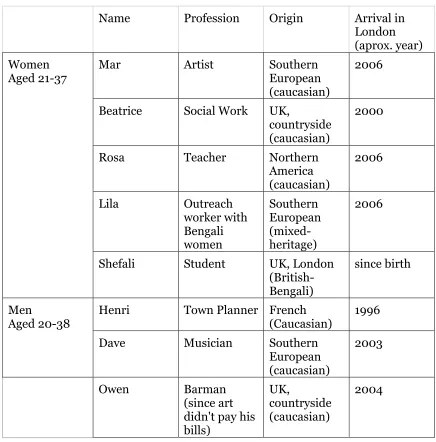
Also a very big thanks to Dave, Owen, Henri, Lila, Shefali, Mar, Beatrice and Rosa without whom the project would not have existed.
I also want to thank Goldsmith’s College. CUCR for hosting me as a visiting researcher the summer of 2014, the people at the Sociology department for years of stimulating conversations, particularly Yasmin Gunaratnam for a kind re-routing that made me realise I had to bring the research closer to home. Holly, Joshua, Stephen, Hsiu-Chin for their conversations and lunches in the green. I also want to thank Bridget Ward, for always being there cheering for me.
It seems odd, but I really want to give thanks to the ones that could not believe in me, particularly the doctors that did not phantom I would be able to make this recovery. You have truly helped me, awakening my extra-stubborn self and fuelling the extra push when I needed it. There have been many times I have wanted to quit, but I knew my brain was elastic, and could do it. Your doubts became my security. Thank you.
I want to thank the students I had in 2008/2009 when I banged my head for their patience. I am grateful to you for filling in the words when I had forgotten them and could only make their onomatopoeias and waiting through very stuttered lessons.
who took me on when nobody else wanted to. Your trust in me helped me let go of the “past karla” and embrace the “present karla”, learning who I was and to learn again.
Next I want to thank the interviewers’ team at UOC who saw in me something deserving a grant, Elisenda, Ramon and Pep. Elisenda for hours of great insights that have helped me bring this thesis further, Ramon and Pep have been in my thesis committee with Alex. Thank you to the three of you for your time, patience and the hours of work on helping me shape the project. Thank you Alex Rhys-Taylor for taking such good care of me while in London and stepping into a more active role in an hour of need.
A very big thanks to Ramon, the extra mile you go is beyond your job specification and is what makes you such a brilliant supervisor. Thank you for a trustworthy and very human direction through a process I have struggled with. I would not have completed within my grant period without your direction.
Then I want to thank my family and friends. Les Back for years of patience and guidance; my father who has always tried to encourage me in his own inexplicably bizarre ways; my Abuela for her eternal smile and dishes that feed me in the last weeks; my siblings for their support; and finally my mother, always believing in me, years of endurance and being my sparring partner in too many occasions. Bruno, Garikoitz, Mariona, Aleix, Carles, Lisa&co, Richard and Jule, Anita, Isa, Ari and Popito, thank you, always making me laugh. More recently thank you to Bruce Powe and John Drever for conversations making me think hard. Thanks to Alvise Vianelo for teaching me to be receptive and let go.
Last but not least I want to thank my children. When people ask me how do I endure the PhD process with little kids, I normally think ‘how can you do it without?’ They are what bring me perspective. Thanks to Fynn for inquisitive questions from a four year old about my thesis that made me rethink how to approach parts of it, and Odei for being such a happy playful little child, both always there to cheer me up. A big thanks to Merlyn for years of support and help, and reading it!
Index
Acknowledgments
3
1. Introduction: listening to the urban soundscape
8
I. Sounds of the city 8
II. Urban sonic compositions 10
III. The core questions 13
IV. Light on structure 16
2. Searching for the body in space
21
I. City and place 21
II. Place and space. From differentiation to collision 23
III. Body and place matters 25
IV. Multilocal place 28
V. The relational turn 31
VI. Making place 35
VII. Summing up 39
3. Senses and the body: towards relational emotions
44
I. Geographies of the senses 44
II. The sensuous turn 45
III. The sensuous body 50
IV. Emotions 57
V. Focussing emotion on the sensuous and emotional body 62
4. The soundscape
64
I. Talking about the soundscape, an introduction 64
II. Sounds in motion, sounds in history 66
III. Soundscape 74
IV. Ambiance 79
V. Listening to the soundscape 82
5. Soundscape and sensuous body in place, an unorthodox marriage between
theory and methodology
86
II. Looking for sonic inputs in the making of place 87
III. A soundscape’s working definition 90
IV. Embodied and emplaced perspectives 92
V. Walking and shadowing 96
VI. London’s East End 100
6. The moving soundscape
111
I. The poetics of the East End 111
II. Mechanical sounds 115
III. Sound in movement 121
IV. Authoring the soundscape 129
7. A sense of belonging? Reacting to the soundscape
132
I. Sound and cultural listening 132
II. Reactions culturally conditioned 135
III. Am I blocking the soundscape? 137
IV. Can we speak? 142
V. Are you tuning me out? 146
8. Soundscape, memory and confinement
150
I. Finding the balance 150
II. A gendered ear? 153
III. Nightlife sounds 156
IV. Sounds of memory 159
V. The City 162
9. Conclusion. The urban whisper; ensounded bodies and the
making of place
165
I. Starting to finish 165
II. Listening to the soundscape and the sensuous awakening 167 III. The soundscape’s relation to the making of place 170
IV. Towards a sensuous methodology 172
V. The whisper of cities 175
10. Afterword. Techniques and reflections of a sonic researcher
179
I. Thinking about the methods 179
II. The methods 180
III. Afterthoughts 189
Annexe
193
Bibliography
194
List of tables
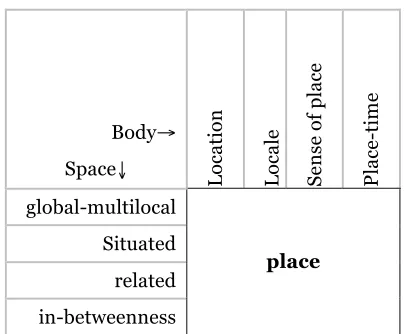
Table 1. Categories of place 43
Table 2. Place, body and space 434
Table 3. Research Participants 106
List of figures
Figure 1. Map of all the routes in London’s East End. All the streets included in the routes are
in focus 104
1. Introduction: listening to the urban soundscape
I. Sounds of the city
The engulfing sound of airplane motors pierce the imagined quiet quality we associate with white clouds and blue skies. The first sound I remember upon arriving to London was that of the wheels heavily bouncing off the tarmac on the landing strip but listening back into my memory, there are two soundscapes that come brightly to mind though, the first one is located in London’s East End. Walking east from Aldgate roundabout, leaving the sound of cars and pedestrians crossing in a rush, towards the rhythmical, yet a-synchronic soundscape that will unfold as I walk. On the left, a few young people gather outside of the coffee shop, known to many as serving a decent cup of coffee just off the tube entrance of Aldgate East. The chatter and the smell of cigarette smoke cloud the ambience for a second, like a small hiatus to the unremitting polluting sound of the car engines that use Whitechapel High street as a highway from East to West at rush hours. To the other side, in front of the Whitechapel Art Gallery, a serious middle-aged man, holding up a closed umbrella, starts a tour introducing the Art Gallery and the space. There is flair of cockney in his speech, they depart, heading West.
As I carry on East, I pass a supermarket having a couple of homeless men sitting outside asking for a few pennies, the sound of the self-checkouts slips in between the automatic glass doors, opening and closing a fairly useless sonic boundary trying to divide the indoors from the outdoors. Carrying East, to the right, on the other side of the pavement, the East London Mosque propagates its call for prayer and the rhythm of the street changes. Sounds of busy and rushed steps walk towards the mosque; small chatter in between the gathering of people getting into the mosque. All this is interwoven with the constant traffic of a busy street combined with the array of ambulances that go to and fro the Royal London Hospital. The adjoining shops’ sounds, mostly opposite the Mosque seem to remain unaware, carrying on blaring their music through speakers that sizzle with the loud volume. Just before reaching Whitechapel street market, I make a left turn onto Vallance road, the metallic sound of the Market stalls as well as their calls for customers are left behind as I enter a quieter area. As I head north, some children are playing in the surroundings of the Hanbury estate, in front of Vallance gardens.
traffic and urban life that is steadily sounding from behind the buildings. I turn left on Deal Street, steering away from the increase in people heading West to Brick Lane and carry on in this little quiet street, where during the week one can hear the voices of the children in the school around. At the North end of Deal Street, I listen to the sounds of sheep and goats, unusual city sounds but habitual in this part of the city, as here is Spitalfields City Farm.
The second set of sounds that I remember vividly are traffic related sounds. A bike slowing down, the tires of a car speeding to make a turn with no anticipation, the strident sound of the bike break at its tightest and then the sound of wind softly caressing my ears for a split second before the sound of my body impacting on the asphalt once, the lenses of my glasses breaking and the sensation and sound of the metallic frame from my glasses twisting and incrusting itself into my nose bridge, becoming part of its anatomy violently. Imperceptibly shortly afterwards, a second impact of my head after a short but violent bounce of the upper body while the lower body carries on dragging along while burning several patches of exposed flesh; almost simultaneously to the metal frame of the bike being scratched by the road, car tires screeching, braking suddenly. And then all the musical ebb and flow that accompanies a road accident, sirens approaching through the winding roads, racing up the hill, cars doors opening and closing letting out people in different levels of distress, trying to talk, tying to get help, getting the belongings that had been distributed around the road, asking me questions without receiving an answer; all this beautiful sonic mayhem unfolding around me, being listened to from its epicentre, making me feel like a distracted director who has lost its orchestra to their own increasingly non synched rhythms. I would have never thought the sound of a body impacting the road and the orchestra of minuscule sounds around it could have such a beautiful disorganisation to it, coming together in a fleeting soundscape too elusive to grab hold on, ensounding my body in its passage.
studies. I will then go back to the core questions structuring this research and from there detail how the thesis is laid out.
II. Urban sonic compositions
Listening to the unsolicited: the urban soundscape permeates in our everyday life
Unsolicited urban compositions are around us constantly and always evolving. This urban soundscape accompanies the urban dweller from their birth to their death, night and day without interruptions1. We are always in amongst the urban soundscape, traversing it and
feeling the vibrations of the sound waves in our bodies.
Urban life can indeed be thought of as a bombardment of stimuli (Simmel 1908) from which we defend ourselves adopting a blasé attitude but it can also be thought of as an invitation to enter into this dialogue. The city is constantly calling us upon, at times with a whisper and at others screaming loudly. It is a dialogue of which we are partakers, participants through listening to the city and to ourselves, making meaning as we listen. We are also its makers, since our presence in cities has a sonic impact, from the engines of the cars that we have invented (as a society) to a more micro-scale level of sounds such as the fabrics of the clothes we wear or the level of resonance of the materials of our shoe soles.
However, somehow becoming aloof in front of all this bombardment may have resulted in a numbing of our sentient bodies in order to cope with urban life. But how does this numbing affect us? Does listening to the urban soundscape influence our conception of space and the making of place?
Rodaway (1994) points out that our body is the only gate we have to our surrounding, hence, attending to the sensuous body is of paramount importance, as is looking at how to make the body present again2. In this sense, for Ahmed (2008a), the relation between place and our
senses can be explored through emotions. Indeed, emotion is a gate to "recall us to our body surfaces" (Ahmed 2008a, 27), thus our emotions bring us back to attending to the sentient body (Thrift 2004; Thien 2005). In fact, Ahmed moves emotion away from the privatisation (Illouz 2009) it has been placed in, used to lure us towards consumption. Emotion becomes a tool to understand our bodies' orientations (Ahmed 2008a; 2008b). But we need to get back to the materiality of bodies, and situate the sense of hearing as a full body experience.
Hearing starts from our ear canal and hearing at the level of the outer ear, culminating in a physical stimuli of the eardrum by the sound waves, to the middle ear that translates this physical stimuli into a nervous signal via the ossicles (set of bones that transforms the pressure received by the eardrum to pressure on the oval window) which then leads to the cochlea’s role of transforming this into information to our nervous system that is carried to the brain and re-translated into an impression to hear directly from a physical source3.
Nevertheless, hearing is also a full body element, through our skin, which is the biggest sensuous organ there is. It also vibrates with sound, sometimes we feel sound that we cannot hear, but our bodies feel it4. In addition, re-connecting to the sounds of the urban may be a
way of reconnecting with how certain aspects of society are shaped (Attali 1985).
Body matters: situating the body in the research
As Bates (2010) points out, the body has been conspicuous by its absence in sociological and cultural studies (see Blackman 2008 in Bates 20105). The first step is to conceive the body as
the boundary between the inner world and the outer world (the environment), having its senses as the translators between the outer stimuli and the inner making meaning. Then also understanding the body not as a phenomenon itself but as a mixing bowl. Bodies are messy (Bates 2010) and not always organised or functioning in a normative way (Ahmed 2008b). They each have their own capacities and work within their possibilities. Nevertheless, we must consider that individuals are not entirely free as we are inlayed on two levels simultaneously: the personal is tucked into the social (Smart 2007; Bates 2010) but it is also “embedded in, and so constrained by, the body” (Bates 2010, 10). But what if, instead of boarding these levels of meaning as a constraint we were to use them as a tool to better understand our processes of making sense of space? What if, through an attentive listening to our bodies and the soundscape we could attend to the making of place in a sensuously rich and awake way?
Through looking at the relationship there is among body, city and sound, and providing a transdisciplinary approach to researching the city, I am aiming to bring forward a body-centred perspective on the making of place, re-examining the role of the body as an urban maker of meaning. While this thesis is rooted in Urban Studies, it takes from the overlapping disciplines of geography, sociology, anthropology and sonic studies with respect to their
3http://global.britannica.com/EBchecked/topic/175622/human-ear.
4For further discussion on the geographies of hearing and/or disability see Butler (1994); E. Hall (2000); E. Hall and Kearns (2001); Arkette (2004); S. Hall (2007); Friedner and Helmreich (2012); Barns (2014), and of hearing Dunsby (1989); Casseday and Ehrlich (1994).
ways of researching the urban through sound or through the body. It also draws on phenomenology, stubbornly refusing the let the body slip towards having a minor role, and placing it over and over at the middle of the discourse on place, emotions and the soundscape. Placing “real life bodies, which are noisy troublesome and messy” (Bates 2010, 10) back into the debate of the making of place that exists within Urban Studies will involve exploring the relationship among place, the body and emotions through an attention to the urban soundscape.
Working directions: thesis contributions and aims
There are two contributions of this thesis and they are intertwined one with the other. First of all, the initial contribution comes from an emphasis on having the listening body at the epicentre of the three main discourses explored: place, emotion and soundscape. Through this, I argue for a transdisciplinary approach to sensory research of the city in order to enrich an area of study that appears to be underdeveloped in the literature within urban studies that interlinks these three elements together, exploring the making of place through the listening and emotional body. As I will be exposing throughout the thesis,6 I am arguing for
the membranes between disciplines to be permeable in order to explore issues transdisciplinary, as Urban Studies allows through working with geography, sociology and sonic urban studies amongst others. Therefore, enabling the composition of different modes of attending to the urban that becomes more versatile and adjusted to its contemporary shifting. In this thesis, I concentrate on an attention to the urban soundscape. I am arguing for the inclusion of the aural into the conception and theorisation of the making of place and to value the importance it has theoretically and practically in our making of place.
The second contribution is methodological. The methodology of this thesis has grown and evolved as the thesis has progressed. By this I mean the methodology has been adapting to the process of research and mutating, as such, there has been a retake of consciousness in the methods used for the research. They have grown from spontaneous activity sprung from curiosity to be an intrinsic part of the epistemology of the project. This has been particularly the case for the act of walking and listening to space. It started off as a wandering through, much à la flâneur like Benjamin (2002) and ended up becoming the shadowing (Jirón 2011) and walking alongside my participants, thinking about the space, and our relationship with space. In this line, I am arguing for a retake of sensory consciousness within Urban Studies. An awakening to our sensuous bodies (Latour 2004), where the body regains consciousness
of its sensuous processes. Then applying this consciousness to the making of meaning from the space surrounding it.
The senses are an important way of gathering information and deciphering the meanings that unfold around us through a myriad of different manifestations. Therefore, I am arguing for a sensuous methodology for the making of a cartography of the city, growing from the bodies outwards and for this methodology to be as fluid as sound can be. An inclusive methodology that, in turn, will enhance the permeability of the membranes around Urban Studies and invite the senses into what is considered a scholarly way of researching.
III. The core questions
Asking questions: what brought me to this research
As I have mentioned through the second sonic vignette, the thesis has sprung from an experience of having had to readjust my sensuous body in order to make sense of my surrounding. Then, as I kept walking around the East End, listening to the soundscape in order to make sense of my surroundings, I wondered about the relation between the urban soundscape and the making of place. Thus, the general question of this research is how can the sensory experience of the urban soundscape reveal different processes of making place in everyday life? This research connects the sense of hearing, particularly listening when understood as a participative process7, emotions and the making of place. I will explore in
what ways the body can be placed at the epicentre of urban research through examining the relation between the sonic experience of urban space and the making of place. Urban Studies has tended to lose the corporeal experience by distancing itself from the ground and taking a zenith detached perspective, the bird’s eye view quite common in urban sociology as Rhys-Taylor critiques in his work on urban smells (2010).
In this thesis, I bring the focus back to the body, from its flesh and bones and the sensory apparatus to its more ethereal parts, like emotions, memory and mind to investigate the articulation of sensing the soundscape in the relation established with urban space and the making of place. Therefore, I will review and connect the literature around soundscape, place and emotion within Urban Studies (taking from geography, sociology, sonic studies and anthropology). I strive to encourage a transdisciplinary approach to the subject, treating the
disciplines that tackle these themes as being surrounded by permeable membranes instead of boundaries in order to be able to bring the three together and establish a methodology for a sensuous research of the making of place related to the soundscape. In this sense, I will be stressing the importance and relevance of sensuous research being considered scholarly research and, by proxy, of the senses re-affirming themselves as having the possibility of being the focus of scholar research and one of the main sources of information and analysis, but also it becomes a way of telling about society as Becker puts it (2007) and, in this case, telling about the making of place. As Becker (2007) argues, telling about society can be done in a multitude of ways and I want to argue for being open to the phenomenal and for letting people feel and be felt.
The cosmopolis: listening to the soundscape to move away from the monochrome society
The latter issue is particularly relevant in front of globalisation discourses where the individual, never mind the body, is wiped from the map, as if it was non-existent8 (Back
2009a). This is particularly noticeable when the perspective taken is the urban panoramic, detaching from the ground and looking from above, a top to bottom viewpoint. Some tend to flatten the world (Friedman 2007) and to a certain level expect the society of the future to become a homogeneous blend of cultural groups that regroup under a larger community with shared values (Etzioni 2003). However, the world may appear to be flat, but in this same effort of normalising processes and dynamics, an array of sensations is lost; there is global in the local but there is no global without local (Massey 1999; 2005; Tsing 2000).
The concept of the flattening of the world (Friedman 2007) is referring to the large connectivity possibilities, which have, to a certain extent, levelled the playing field for all individuals to enter a world economy. This, besides being an extremely neoliberal vision of society shows an attempt to homogenise people who are going to be competing in this newly found flat playing field (ibid). And this carries a set of problems, a focus on a flattening inevitably means a loss of sensation, where the global does not need to overtake the local. There can be a dualistic understanding or there can be another understanding that steers away from assuming we are moving towards becoming a monochromatic society (Etizioni 2003) and instead detach from thinking of the global as a representation of the local, thus reaching beyond its geographical location. Away from where the local happens. The global, or what is termed as global, is not the product of a society that has become homogenous. Contrary to what Friedman argues, although the world is indeed more connected, we do not live in a flat world.
London has recently been dubbed “a world within a city” (Raco et al 2014, 4) having a very large mix of nationalities and cultures, thus being an epitome of the cosmopolitan city (Keith 2005). When researching this city, keeping the bird’s eye view not only gives a masculine gaze over the city that priories a panoramic over the details (Degen and Wainwright 2010) but also misses the hues in tonality of the city. “As the theatre of cultural exchange and the stage for the performance of hybrid identities, the cosmopolitan has been valorized as a space of opportunity, a space of social, cultural and economic renewal. Keith has some sympathy for this version of events: in the contact zones of the multicultural city new forms of cultural identification (and commodification) take place” (Jones 2006, 1225). Being the most cosmopolitan place on earth (Vertovec 2007) London is full of relations and dynamics that connect with other cosmopolitan cities (Sassen 1996) but also to its inhabitants and its own ebb and flow of rhythms. In order to listen to them, a micro-perspective of the urban is required, detached from observing panoramically and instead concentrating on the details and sounds of the mundane everyday life of the city9.
The analysis of the urban has concentrated on examining the city from a senseless or at best, occularcentric perspective, which in turn has had an effect on urban studies10 (Knowles and
Sweetman 2004; Rhys-Taylor 2010; Allen and Cochrane 2014). This study pays attention to the relations between sound and the construction of place, which can unveil another critical perspective on the city’s constitution (Back 2012). Through attending to sound, I will explore the relations we establish with the city and as a corollary; I will give another perspective of the articulation of some urban politics.
Listening to the soundscape helps us to detach ourselves from the idea of monochromatic or monotone society and instead invites the different paces and rhythms of the urban to emerge vociferously. That is why I will focus on understanding the differences of experience with regards to sound and to the city itself. I will do so by concentrating on our production of the world through our being in the world. More precisely, I will explore these processes through producing an emotional cartography of our everyday life experiences of the urban.
Therefore, this will entail an exploration of how an awakening of our sensuous and emotional bodies can shed light in our everyday practices. Hence, investigating the construction of place through an analysis of how aural sensory perception of the urban
9 See for example Adorno (1938); Martin (1995); Panopoulos (2003); T. Hall et al. (2008); Devereux (2014) for different approximations to everyday listening and sounds.
relates or moulds our exploring and relating to the urban11. In this sense, walking with my
participants enabled me to have an insight into their daily urban practices, seeing if their everyday practices responded the tactical subversion of the urban order (de Certeau 1988) or to resist the homogenising globalisation practices that are implicit in the urban structure.
Indeed, through listening to the urban soundscape, this research attends to how the social transpires within the body’s production of place while at the same time examines the relation between the urban soundscape and the making of place, having the body at the epicentre of this exchange, both maker of place and participant in the soundscape, listener and contributor.
IV. Light on structure
This thesis is divided into two main blocks. The first (chapters 2, 3 and 4) presents my theoretical approach to the research. A transdisciplinary engagement in three stages (place / senses and emotion / soundscape) with the most relevant bodies of literature surrounding my thesis topic. The theoretical engagement concentrates on examining some of the articulations among place, emotion, senses and soundscape. The pivotal point for this articulation lies within placing the body at the epicentre of the discussion.
The second (chapters 6, 7 and 8) is an empirically informed discussion on the most relevant axes identified in the former. It exposes and analyses the fieldwork. In between them lies a chapter (chapter 5) that acts both as a theoretical synthesis and a methodological explanation of what is going to develop in the second block. The synthesis brings together the previous three chapters around the question of the sensory relations between the urban soundscape and the making of place. The methodologies explain the relation between the participants’ reactions and the methodologies' evolution. However, it will not detail the techniques used. I have left them for an afterword (chapter 10) in order to make the voices and stories of my participants prevail over the research methods.
Then, in order to bring the thesis to a closure there is chapter 9. The conclusions of both the fieldwork and the overall thesis are merged together and the lines of further research pinpointed.
First block, clearing the muddy waters of theory: place, emotion/senses and soundscape
In chapters 2, 3 and 4 I undertake a review of the literature but I have divided it into three main blocks because of the interconnections that this thesis has brought and the complexity of the superposition of terms within the disciplines under the larger umbrella of Urban Studies.
Chapter 2 concentrates on the concept of place. It reviews the conceptualisations of place, paying special attention to the role of the body in each manner of approaching place and striving to bring it forward. In this chapter, besides reviewing the literature on place and examining how the body has been situated in it, I bring forth my own understanding of place where I draw on parts of the literature reviewed to present a working definition that accompanies me throughout the text. This definition stems from the four attributes of place (Agnew 2011) and reinterprets them from a phenomenological standpoint, thus placing the body back at the epicentre of the making of place.
Chapter 3 begins by presenting the sensory turn within urban research, and then moves onto the body. There, it explores the role the body has had in the sensory turn and how it has been treated, exploring the being in the world of the body. Living and relating to the environment, be it urban or otherwise entails a bodily disposition, to sense and perceive it. In addition it also is a corporeal method of making meaning, through the conception of what we perceive and its role in the representation of the space around us. Therefore, we can argue that it is a process, which at the same time needs to be a way of being in the world. Then the chapter moves onto investigating the concept of emotions, through the affective turn in social research but also mimicking the way I have defined place in the previous chapter. Through a phenomenological and embodied perspective I conclude with a working definition of emotion, understanding emotion as relational both socially and individually and grounded on the body.
chapter and bearing in mind the central position of the sensuous body, concludes with a working definition of the soundscape. Here the soundscape is presented, mirroring the working definition of place from chapter 2, as having four attributes that are tied to those of place.
Chapter 5 is the point at which the three previous chapters merge theoretically around the axis of the making of place. Here, all the work done around the concepts of place, emotion and soundscape come together in an investigation of the articulation between the three and focusing on their relation with the making of place. Once the synthesis of the theoretical part culminates, begins the explanation of the methodological element of the project. Here it is important to note that I have explored my methodologies but have not entered into the techniques or the methods. I have preferred to leave them for a methodological afterword, in a similar fashion to Rhys-Taylor (2010) and Duneier (2000). This is because of the way the project grew and in order to let the participant’s stories bloom fully without the constraint of having previously determined the set of methods, I have considered it more appropriate to focus on the story and explain the methods used afterwards. In addition, the afterword has allowed me to reflect on the organic growth of my methods and methodologies and engage into a reflexive exercise of post-research to draw on the ways in which the methods emerged from a wandering to a conscious research tool.
Second block, flow of stories: analysing the research data
The second block is centred on the empirical work of this thesis. This thesis is an empirically informed theoretical one, where the theoretical input and the empirical input have fed on each other. Moreover, I have focused on identifying a space in the theory where I could make place in terms of transdisciplinarity, examining the pivotal elements in their articulation. Then I focus on a case study with a few participants with whom I worked at length.
Therefore, in chapters 6, 7 and 8 I let the stories of my participants pour over, inundating the chapters with the sounds they were listening to. At the same time I am analysing these ways of attending to the urban and, through drawing on the theoretical development of the first block, fleshing out certain aspects of their making of place through their attention to the urban soundscape and their bodies.
motion, both in terms of motion through space and of the motion of bodies. Chapter 7 is centred on the cultural aspects of the soundscape, and the political ramifications this may have, notably focusing on the discourses around global and local and questioning them through the ways of listening participatively to the urban soundscape or refusing to partake in said participation. Then, chapter 8 brings the triad to a close by focusing on more inner ways of making meaning through the soundscape, again bringing forward this notion that is going to accompany us throughout the thesis of listening as methexis (Nancy 2007) where the boundaries between the inner and the outer environment flex and become blurred. A reflection on the meaning making capacities of the soundscape both in terms of the making of place with the urban environment and in its relation to emotions.
Conclusion and reflections
In chapter 9 I end my theoretical and practical discussion by narrating the very last experiences of the participants in our last meeting in which they had the chance to reflexively look back at their participation and involvement with the research. These invite me to flesh out the major conclusions from the first block of the thesis and bring them side by side with their experiences, strengthening my argument for the importance of awakening our sensuous selves and, therefore, listening to our making of place. I also listen back myself and reflect on the issue of the awakening of the sensuous body, questioning to what extent there needs to be an external influence (such as myself in this thesis) or not and whether it is likely to become dormant again. Then I conclude my thesis by arguing for the importance of listening to space, our bodies and our emotions; and place ourselves at the epicentre of our urban experience. Thus bringing back the making of place to a body’s experience. I then think about the future of this research and my agenda from this point on while bearing notions that have appeared through the thesis that could be further developed in future research.
The thesis ends with a methodological afterword that, as I have mentioned earlier, untangles the empirical chapters from its methods. It re-listens to the ways in which, retrospectively, the methods evolved and grew somehow relationally with the thesis. It makes a reflection on the process and outcome of the thesis from an experiential perspective. Then, it invites scholars to move away from a dead sociology towards an alive sociology (Back 2012).
thesis as a pod that somehow got planted in my head and has grown to become what it is. This is why throughout the thesis you will find a recurrent metaphor that brings the text back to the earth, tangible, full of sensory information, all in all alive.
2. Searching for the body in space
I. City and place
Where is place in the contemporary space?
The contemporary city is much larger than our everyday use of it. We live in a small part of the city and create our micro-perception of it, we make place of such a large space. But, what is place? This question has been in the mind of geographers and other researchers from Ancient Greece times (Cresswell 2009). Plato and Aristotle already argued that space and place were different. For them space would be the kenon (an undetermined, not limited space) while place would be the chora, which refers to a place that is still in the building, having less of a static status (Cresswell 2009). For Aristotle, place comes first because everything that exists has to have a place – has to be located. Thus ‘‘that without which nothing else can exist, while it can exist without the others, must needs be first’’ (Casey 1997, 52 quoted in Cresswell 2009, 2). In this quote, Aristotle appears to think of place as a tangible, delimitated location. However, as some academics (Tuan 1979; de Certeau 1988; Delgado 1991; Graham 1998; Massey 1999; Urry 2004; Kitchin 2005; Massey 2005; Cresswell 2009; Agnew 2011) later pointed out, place has several other attributes that I will be exploring in the coming sections of the chapter. Nevertheless, it is important to note here that this discussion of space and place goes back all the way to Plato and Artistotle. To bring the terms to their contemporary counterparts, kenon would be relational space and chora would be relational place. I will expand on both these terms later on in the chapter when I explore the relational turn in geography.
In fact, in this chapter I focus on reviewing the different conceptions of place that have emerged, presenting the ones that have dominated current debates in urban cultural studies - from anthropology, sociology and geography - which inform my research in order to then be able to present my own understanding of place and locate the body in it. Place is very difficult to define in the concrete, and working on the making of place from a sensuous perspective makes it more complex. This is why I focus on place in this chapter and then move onto issues about the body and emotions in the next chapter.
Placing the chapter: the detail of the journey
In this chapter I argue to placing the body at a central position in the discussion on place. However, in order to do that, I review the most important conceptions of place and examine where the body is situated.
In the second part, I start by introducing the moment where space and place starts to come across as two different terms. Then, I fast-forward to a current perspective − the Chicago
School and its UK analogue, the Institute for Community Studies. Together they can be thought of as the birth of urban studies, even though there were precedents such as London (1903) and Mayhew ([1851] 2008). The Chicago School has been key in shaping the urban studies discipline. In these two similar perspectives, place seems to have been engulfed in an attempt to achieve urban spatial analysis, lost amongst spatial organisation; leaving no room for an embodied or emotional approach to the relationships established with space.
Next, in the third part, I examine the humanist perspective (Tuan 1979) on place where the body and its individual experience is at the centre of the discussion, this came as a response for the lack of bodily presence in conceptualising place. However, I also use their ideas to further explore the dichotomy that lies within place, half way between the measurable and the perceived. So as to investigate more this duality I relay on phenomenological theory proposed earlier within the humanist perspective to then proceed to revisit Foucault’s heterotopias briefly so as to contextualise Relph’s heterotopias (1991).
This leads to part four which opens a question on the extent to which place can be seen from an embodied and disembodied perspective at the same time, this is the multilocal characteristic of place and I will propose to what level can place be multilocal and how can this aid my research.
Putting the body at the centre of the discussion on place helps me present, in part six, my working definition of place in the chapter’s conclusions. I contrast it with Agnew’s (2011) four attributes of place and point out the need to rehumanise our conceptualisation of place in order to make the body more of an active actor of its own making, thus placing the sensuous body at the centre of the making of place.
II. Place and space. From differentiation to collision.
Schism between space and place: theoretical separation of the terms
Until mid 19th century place and space were understood as one being co-extensive of the other. “Place was understood merely as a gathering of people in a bounded locale (territory) - literally a portion of geographic space” (Duncan in Kitchin et al 2005, 16). Henceforth, place was not explored independently from space. However, in this same conception of place, arises the notion of locale and with it came the idea of having a ‘sense of place’. This implies an attachment, potentially sensuous to that portion of geographic space. Once this ‘sense of place’ enters academic theory, place and space were separated conceptually and in form as place becomes more concrete than space. Then, around the 1970s place underwent a strong re-evaluation. It emerged as meaning different things to different people and transformed itself into a concept as, if not more, controversial and harder to define than space.
Actually, this initial conception on place failed to differentiate the concrete attributes of place from the abstractness of space, for place is the tangible that space is not. When we think about space, the dimensions tend to be much bigger than our daily usages. As an example, we may think of a forest as a space. However, as Creswell illustrated (2009), even indigenous people are unlikely to make place in the whole forest, instead they narrowed their place down to a human scale, a manageable piece of land, like the beach in his example. That is not to say that place is a piece of land; as I argue later on in the chapter, place is not only limited to a physical piece of land, but combines land, with memories, history, affects, social structure; all these conditions differentiates it from space.
Towards an urban ecology: exploring place and belonging in the Chicago School’s perspective
portrayed the city from an ecological perspective, a positivist approach that sought an analysis of spatial organisation by developing theories such as the concentric ring theory (Tuan 1979). This one sees the city as divided in concentric circles (zones) each occupied by a particular social group. The Chicago School determined that the city would have its more deprived zones in the centre and as we move outwards, the more desirable zones, understanding that groups in each zone adapt to that area and, if necessary, successfully move outwards. As Lois Wirth (1938, 15) pointed out:
The different parts of the city thus acquire specialized functions. The city consequently tends to resemble a mosaic of social worlds in which the transition from one to the other is abrupt. The juxtaposition of divergent personalities and modes of life tends to produce a relativistic perspective and a sense of toleration of differences which may be regarded as pre-requisites for rationality and which lead toward the secularization of life.
This perspective on the city was limited as it equalised the social ecology to the spatial ecology of place, as if the competition between communities over space produced natural areas or neighbourhoods. The problem with this perspective is that it argues that the forces driving communal segregation are ecological (i.e. naturalises segregation). When, in fact, there is an important element of the city’s organisation that is due to social power structures and planning. Also, it reduces body, locations, spaces, buildings and roads to mere actors in an ecological model of the city (Kitchin 2005). Henceforth, and this was an issue that the Institute for community studies in London also faced, the Chicago School left out gender and ethnicity from their theories (Back 2009b).
This vision was “imported” to Europe through the influential Institute for Community Studies (ICS), a think tank founded by Michael Young in 1954 in Bethnal Green, London. Albeit following the Chicago School advances, for the ICS, spatial distribution was mainly examined through a community sense of belonging (Willmott & Young 1957; Willmott 2002; Dench and Young 2011). Place in itself was not really a term they explored theoretically as separate from space and it seemed to be an extension of space in their research projects. Even if not directly, it examined London’s East End spatial constitution and construction through an analysis of how communities related to space, how they identified it as theirs and had developed a sense of belonging and making it become a home12. It is this very action that
made place differ from space. We can thus see that some sociological work was actually
dealing with a far more concrete viewpoint on space and differentiating it from place, and thus, starting to work on the making of place and place itself. The need to detach those two terms – space and place – theoretically and empirically came a bit later, particularly with the arrival of a humanistic wave, marked by Tuan’s work (1979) in geography that contested these very ecological view on the urban environment.
III. Body and place matters.
Making body matter: situating the body in place under the humanist perspective
The humanistic turn in geography as Degen (2014) has emphasised came in the 1970s as a response to the more positivistic approaches to the city that were basing urban analysis on spatial organisation (Relph 1976; Tuan 1977; Samuels and Ley 1978; Buttimer & Seamon 1980). Instead, the humanist turn wanted to base the geographical inquest on humans rather than on patterns and models. The humanistic approach was based on philosophies of meaning like phenomenology, existentialism and idealism (Kitchin 2005, 37), its aim was to put the person back into the centre of the object researched, not to lose her in the process. Henceforth, their rendering of space and place is quite different from previous traditions. The humanistic sense of place came with what could be termed as a bodily turn in geography that resonated well in anthropology with research projects such as Stoller’s (1997) Sensuous scholarship, that reaffirmed a concern with how the sensuous body was researched and how it entered the academic discourse. These concerns spoke directly to Tuan’s work, reflected in her most prominent book, Space and Place (1977).
The humanist perspective situates the body back into a discourse that had remained mostly theoretical or disembodied. Two decades later, the body is still missing, such as in Augé’s (1995) work on non-places13, where the emphasis is placed on the transitional nature of
places and their disembodiments instead of the imprint that people make to them, be it an airport terminal or an ATM machine. In addition, an embodied perspective also provides a bridge between place and phenomenology through the addition of the body to the theorisation of place, and therefore, linking the making of place with the ‘being-in-the-world’ (Merleau-Ponty 2002).
For Tuan, space does not really articulate without the human body. It is the human body that gives it its measure and dimension and it is in the relation between space and the body that space becomes what we understand as space. “The purpose of the humanistic critique was to
put man (sic), in all his reflective capacities, back into the centre of things as both a producer and product of his social world and also to augment the human experience by a more intensive, hence self-conscious reflection upon the meaning of being human” (Ley and Samuels 1978, 7 in Kitchin 2005, 40). As Tuan (1979, 389) points out:
We say little more than that original space possesses structure and orientation by virtue of the presence of the human body. Body implicates space; space coexists with the sentient body. This primitive relationship holds when the body is largely a system of anonymous functions, before it can serve as an instrument of conscious choice and intentions directed towards an already defined field (Merleau Ponty 1968; Ricoeur 1965). Original space is a contact with the world that precedes thinking: hence its opaqueness to analysis.
Therefore, this already presented an important shift in the conception of space from previous traditions where the body was absent in their city models (for example, the Chicago School urban models). In addition, it retook the notion of space as constructed socially and injected into the geographical discourse the concept of social and cultural conditioning (that Mead had previously developed in sociology, 1967) by arguing the perception of space varied from person to person and between cultural groups (E. Hall 1966; Downs 1970) but keeping a shared common ground.
Place and phenomenology
As noted in the previous paragraph, the humanistic approach to space and place shares some concerns with phenomenological philosophy. In this sub-section I explain phenomenological philosophy and then proceed to remark the resemblances between the two. This enables me to build a base to further explore the input that phenomenology brings to an understanding of place.
Phenomenology is the study of the structures of our conscious experience and our ‘being in the world’ (Merleau-Ponty 2002). In a nutshell, Phenomenology is the study of experience, from emotions, thought and perception to bodily reactions and activity. Phenomenology studies our experiences at all levels, from body to language with regards to our environments and focuses its attention on the organisation and conceptualisation of said experiences through our own actions. Therefore, placing phenomenology within the discussion of space and place brings shows the importance of the body in the making of place and, beyond being one of the main origins to the humanistic perspective on place, it is also a philosophy of a bodily practice, and as such, invites us to have an embodied reading of the other spatial perspectives in this chapter. At least it provides an embodied counterpart discourse on place that puts into perspective body-less conceptions of place. I also use phenomenology as a methodology and, as such, it appears again in the methodological chapter.
discussion around place, in the next section I examine how place can re-read the Cartesian dualism and then continue with this idea, explore place as a site.
IV. Multilocal place
Place as another reading of the Cartesian dualism
Entrikin (1991) argued that geography has contributed to producing a problem with the study of place. On the one hand, there is a subjective style of study, based on perception and interpretation and, on the other, an objective style, producing patterns for general understanding. He argues this has caused “a large intellectual gap (that) exists between our sense of being actors in the world, of always being in place, and the ‘placelessness’ that characterizes our attempts to theorise about human actions and events” (ibid, 7). Entrikin argues that in order to gain a real understanding of place both the subjective and objective styles must be combined. This middle point is what he called the "in-betweenness of place", an account of place that combines land and territory with human bodies making sense of it and relating to it.
Entrikin (1991) sees "emplotment" as a solution to this conundrum, i.e.: getting between places. By this, he attempts to “give structure to the particular connections that people have with places and; in doing so, ‘draws together agents and structures, intentions and circumstances, the general and the particular; and at the same time seeks to explain causally” (Merrifield 1993, 518). In this "in-betweenness", Entrikin is trying to find a balance whereby the subjective and objective intakes on space to enable a more complete construction of place. In this sense, Merrifield argues that he is trying to overcome or revisit the Cartesian dualism, which proposes a dualism between the inner and the outer world of human consciousness by using the polarity between those two readings on place to construct a better place, between the domains of the measurable and the perceivable (ibid). Having one without the other is to be missing out on a part that is intrinsic of place.
Place as a site
In addition, Entrikin (1991) is touching on an important matter that has been recurrent in some anthropology research projects, which is to combine both the personal interpretation of place with the geographical setting of said place. In fact, anthropology has suffered an ambivalent position to place before the late nineties. Place has been used as a setting for the phenomenon studied rather than to examine the dimension and depth of place, theoretically and its practical applications. As Rodman (1992, 643) argues,
[d]espite considerable reappraisal of "voice" in anthropology, "place" has received surprisingly little attention and virtually no critical reassessment. There is little recognition that place is more than locale, the setting for action, the stage on which things happen. Anthropologists would do well to follow geographers' renewed interest (Agnew and Duncan 1989b, 2) in reunifying location (i.e., the spatial distribution of socioeconomic activity such as trade networks), sense of place (or attachment to place), and locale (the setting in which a particular social activity occurs, such as a church) to yield a more rounded understanding of places as culturally and socially constructed in practice.
In Anthropology place appears to have been treated as locale instead of investigating its more complex qualities of location and sense of place with connectedness (Low 2003; Rodman 1992; Appadurai 1998). Giddens defined locale as “the physical settings of social activity as situated geographically (1990, 18). Rodman also goes to suggest working on multilocal place research in anthropology. He does so by revisiting Relph’s (1986, 24) reading on Foucault’s notions of utopias and heterotopias:
The term originated with Foucault (1970, xviii), who contrasted the imagined places of utopias, which directly reflect or invert "real" societies, with heterotopias, which are "a kind of effectively enacted utopia in which the real sites, all the other real sites that can be found within the culture, are simultaneously represented, contested, and inverted.
flows of information; it is artificial and marked by deep social inequalities (Relph 1991, 104-105 quoted in Rodman 1992, 646)
Therefore, heterotopias are read as sites, and multilocality is proposed as a way to experience this kind of places for its connectivity. In this sense, multilocality allows for place to be read from a disembodied and embodied position at the same time since it enables a meaning that is not constructed by “the researcher” to enter into the making of these places. Thus, the “other” is included in this construction (Said 2003; Clifford and Marcus 1986). Here, Relph (1991) and Rodman (1992) are seeing the other as an anthropological other, as in a culturally and socially different inhabitant14, probably a local who lives and uses that place on a daily
basis. From a phenomenological perspective, since her situatedness (body and mind) (Haraway 1988; Rose 1997; Marchant 2010) going to mean that her emplacement is different from mine and, hence, the local is an other to me. If we are studying the making of place in a cosmopolitan city like London, as in this research, the people who make place alongside us might, or might not, come from very different cultures, societies and backgrounds. Therefore the other is then any person making place in a same space alongside ourselves. Although there is a shared sense of place that is transmitted through the daily use of space, our different cultural and socio-economic backgrounds, our different life stories may contribute to a different making of place. Hence, the importance of working towards a place that is multilocal and inviting.
As such, the idea of a multilocal place is not only interesting in terms of otherness in anthropology but can also be extrapolated to a larger research body researching the making of place in a specific area. In this case, understanding the construction of place as multilocal, as in being constructed through the experiences of the people that make use of that space and, at the same time, are influenced by all that is going on around them. This can be particularly useful in a global city. However, how do these interconnections play out? In the following section I elaborate on the relational perspective on place. To do so, I first make a brief introduction to the relational turn in space and then carry on to explore the implications this turn has for place and explore the relational meaning to place, which also goes through this relational turn.
V. The relational turn
Relational turn in the spatial discussion
Space is neither absolute, relative or relational in itself, but it can become one or all simultaneously depending on the circumstances. The problem of the proper conceptualization of space is resolved through human practice with respect to it. In other words, there are no philosophical answers to philosophical questions that arise over the nature of space - the answers lie in human practice. The question “what is space?” is therefore replaced by the question “how is it that different human practices create and make use of different conceptualizations of space? (Harvey 2004, 5).
As Harvey (2004) points out there are three main ways of understanding space. Space as absolute, the Newtonian space; it is measurable and open to calculation. Space as relative, Einstein's space; it has several geometries from which to choose and measure, it depends on who and what is being put into perspective. Finally, space as relational, where space does not exist unless there are processes happening in it that define it, since the processes are what configures space and the latter does, in turn, shape said processes (Harvey 2004; Massey 1994; Agnew 2011; Rose 1999). In addition, Massey does not understand space as an entity itself, for her, it is useless when seen as an empty container and can only be really understood when the relationships that occur in that space are included in its study. Here I am not only talking about economic, political and human relationships but also relationships between objects and bodies. Amongst these relations lie the dynamics that the body establishes with its surroundings, in fact, the body is where these processes are gathered through embodied consciousness (Crossley 1998, 25; see below). In this section I will stress the importance not only of looking at the relationships between individuals and space but also how are these relationships play out and, more importantly, how their actors sense and perceive them. Hence the apparition and consolidation of the sensuous body (Ahmed 2008a).
The discussion on space takes a relational turn in the 1980s (Soja 1980; Smith 1990; Jonas 2009). Jonas (2009, 491, compare with Mol and Law 1994; Dainton 2001; Massey 2005) defines the relational turn as:
forms of spatial totality. Space does not exist as an entity in and of itself, over and above material objects and their spatiotemporal relations and extensions. In short, objects are space, space is objects, and moreover objects can be understood only in relation to other objects – with all this being a perpetual becoming of heterogeneous networks and events that connect internal spatiotemporal relations.
Harvey (2004, 4) has a dialectical approximation on relational space that binds space with time:
The relational view of space holds there is no such thing as space outside of the processes that define it. Processes do not occur in space but define their own spatial frame. The concept of space is embedded in or internal to process. This very formulation implies that, as in the case of relative space, it is impossible to disentangle space from time. We must therefore focus on the relation between space-time rather than of space in isolation.
This, according to the author, enables some phenomena, such as the political role of collective memory, to be addressed in an accurate manner within the urban process.
A different approach, yet having a similar flavour, to relational space comes from Massey. She defines space as having three main aspects: space is seen as “constituted through interactions, from the immensity of the global to the intimately tiny”, consequently it is “as the sphere in which distinct trajectories coexist; as the sphere therefore of coexisting heterogeneity” and finally space “is always in the process of being made” (Massey 2005, 9). Massey stresses the inner changeability of space as an inherent dimension of what space is. Space is not a container we simply traverse, we are in constant dialogue with it, creating new ephemeral and decadent representations of it as we use and live it. But besides us, so are buildings, roads and interactions in a larger level. Space is not only defined by the detail that resides in it; the liminal is a key element of space’s constitution and evolution and not to be put aside. In this aspect, Massey establishes a double-edged link that connects the global and the liminal, for her, to accurately render space both the tiny and the global have to be taken into account. In my research I work on a very small level, investigating the sensory interactions in the making of place. At the same time, I examine how larger processes take place in this micro making of place, thus linking both edges of this link.
The global in the local, from space to place
Place is quite hard to define15, some people, like Thrift (2003), consider it one category of
space, some others, like Massey (1999) view it as connections. In fact, Massey’s perspective on space is very interesting because of how she mixes the local and the global. For her, as Agnew examines “places may be thought of as open articulations of connections" and "identities of subjects and identities of places constructed through interrelations not only challenge notions of past authenticities but also hold open the possibility of change in the future" (Massey 1999, 288). Place, then, includes location but without the central focus on individual human agency that brings these together in the humanist perspective. Here the emphasis is on “places as sites in the flow of social relations" (Massey 2011, 20). She differentiates places from spaces through placing the individual more presently in place than in space, in this sense, she is integrating the locality of place and of affect with the global characteristic of the connections that, through their connections constitute place.
This is interesting since it is somehow in contrast with previous considerations (the Institute for Community Studies’ perspective) that place and community were strongly tied and that place was defined through community and its practices. Place, however, is not limited to the practices of one single community. In the global city, the community as a fixed entity is disappearing fast, and Massey’s conception of place enables both the idea of communities of practice and of global interrelations to articulate together. A sense of place emerges through a daily participation in place related to place specific events, illustrated through a sense of belonging, of neighbourhood construction and of articulation but these aspects are not hermetic. The global permeates our everyday life, through our gadgets, through the people we encounter, the practices we have, the objects we have, the provenance of what we eat, the politics and economics that govern us. Our subjectivities and our bodies are also shaped by the global, place and our lives are permeated by the global in many aspects and rooted in the local in many others. This is why Massey’s definition of place as “open articulations of connections” is a thought-provoking approach on place, opening place to a much larger whirlwind of possibilities than had been previously thought. Agnew (2011, 24) has illustrated place in a similar, yet slightly more concrete way:
Places are not bounded, isolated entities as conventional regional studies have tended to regard them. Rather, they are usually and perhaps