Breast cancer in Latin America:
global burden, patterns, and risk factors
Amina Amadou, MPH,(1) Gabriela Torres-Mejía, PhD,(2) Pierre Hainaut, PhD,(3) Isabelle Romieu, MD, MPH, ScD.(1)
(1) Nutrition and Metabolism Section, International Agency for Research on Cancer. Lyon, France, (2) Instituto Nacional de Salud Pública. Cuernavaca, Morelos, México.
(3) International Prevention Research Institute. Lyon, France
Received on: July 8, 2013 • Accepted on: April 24, 2014
Corresponding author: Dr. Isabelle Romieu. Nutrition and Metabolism Section,
International Agency for Research on Cancer. 150 Cours Albert Thomas, 69372 Lyon Cedex 08, France E-mail: [email protected]
Amadou A, Torres-Mejía G, Hainaut P, Romieu I. Breast cancer in Latin America: global burden, patterns, and risk factors. Salud Publica Mex 2014;56:547-554.
Abstract
Breast cancer is a major public health problem in Latin America (LA) and the most common form of cancer among women. An important variability according to ethnicity/race with respect to incidence/mortality, clinical characteristics, and prognosis is observed throughout LA. In addition, women are more likely to develop breast cancer (BC) at younger age and to be diagnosed at an advanced stage compared to western women. While little is known about specific risk factors, changes in reproductive pattern (parity, breastfeed-ing) and lifestyle factors including sedentary behaviours, unhealthy diet, and alcohol intake may contribute to the increase of BC incidence. In this paper we give an overview of the burden and patterns of BC, review the leading causes of BC and discuss the possible ways to improve BC preven-tion and control in LA.
Key words: breast cancer; incidence; mortality; clinical char-acteristics; risk; prevention; Latin America
Amadou A, Torres-Mejía G, Hainaut P, Romieu I. Cáncer de mama en América Latina:
carga, patrones y factores de riesgo. Salud Publica Mex 2014;56:547-554.
Resumen
El cáncer de mama (CaMa) es uno de los mayores problemas de salud pública en América Latina (AL) y el cáncer más fre-cuente en mujeres. Se observa una importante variabilidad en la incidencia/mortalidad, las características clínicas y el pronóstico según la etnia/raza a lo largo de AL. Además, las mujeres latinoamericanas son más propensas a desarrollar CaMa en edades más tempranas y a ser diagnosticadas en una etapa más avanzada, comparando con mujeres occidentales. Aunque poco se sabe sobre sus factores de riesgo específicos, cambios en los patrones reproductivos (paridad y lactancia) y estilos de vida, incluyendo los hábitos sedentarios, las dietas poco saludables y el consumo de alcohol, podrían contribuir al incremento de la incidencia del CaMa. En este artículo se da una visión general de la carga y los patrones del CaMa, se revisan las causas principales del CaMa y se discuten posibles vías para mejorar la prevención y el control del CaMa en AL.
L
atin America (LA) is the fastest growing demo-graphic population in the world, accounting for 8.6% (about 582 million people) of the world’s population.1 Itis estimated that by 2020, more than 100 million people aged 60 years and above will be living in LA and the Caribbean.2 This growth and ageing of the population
is accompanied by an increase in sedentary lifestyle, un-healthy dietary habits, smoking, alcohol consumption, environmental carcinogenic pollutants, sun exposure, and urbanisation.3 These factors may contribute to the
increase of non-communicable disease including breast cancer (BC). BC is the most common cancer among women in LA,4,5 and heterogeneous geographical
pat-terns of the incidence rate are observed. Despite the lower incidence rates observed in LA countries, the mortality burden is greater compared to other devel-oped countries.6-8 Large gaps are still apparent in the
epidemiology of BC causes in LA countries; however a
number of risk factors have been identified in particular
among LA women in the US. The majority of them are related to hormone and reproductive behaviour, and lifestyle including diet, obesity, physical activity, tobacco smoking and alcohol consumption. In addition, there are genetic predispositions.9,10
LA women are more likely to develop BC at a younger age and to have an advanced stage diagnosis compared to western women.11,12 This is likely due
to limited access to health care, mammography and delayed follow-up after an abnormal mammogram. 13-15 Furthermore, health-care systems in LA are
char-acterised by a lack of health-care coverage for the overall population.16 Accordingly, primary prevention
remains the leading public health priority. This paper aims: to give an overview of the burden, trends and type of BC, to review the leading causes of BC and to discuss the different ways to improve BC prevention and control in LA.
Materials and methods
We have used two sources of data. The burden and patterns of incidence and mortality presented were extracted from the GLOBOCAN 2008 database of the International Agency for Research on Cancer (IARC). This database presents the estimates of incidence and of mortality from 27 major cancers in 184 countries or territories worldwide for 2008.5 Then, we conducted a
MEDLINE and PUBMED search including all publica-tions on BC to review the epidemiologic studies on BC in LA. Our core research consisted of key words related to BC combined with risk factors, outcome and LA.
Burden and patterns of incidence rates in LA
BC is the most common cancer in LA and the Caribbean, with an estimated 115 000 women diagnosed every year, representing 8.3% of all BC cases. The incidence rates vary considerably according to region and socioeco-nomic status, ranging from 15 to 90.7 per 100 000 women (table I). Uruguay and Argentina present the highest incidence rates (90.7 and 74 per 100 000 women respec-tively), which are similar to those observed in Europe and North America. Costa Rica, Venezuela, Brazil, Chile, Cuba, and Peru have intermediate rates whereas the lowest incidence rates were found in Guatemala, and Be-lize. Incidence rates increased in all LA countries for the period 1980-2010.4,5 This increase was more pronounced
in central LA. For example, the cumulative probability of BC incidence (for women aged 15-79 years) in 1980
Table I
Numbers, cruderate, asr aNdcumulativerisk of bc iNcideNcebyregioN
Population Numbers Crude rate ASR (W) Cumulative risk
Uruguay 2 258 130.3 90.7 9.56 Argentina 18 712 92.1 74.0 7.76 Puerto Rico 1 778 86.2 54.2 6.03 Paraguay 1 224 39.6 51.4 5.77 Costa Rica 931 41.9 42.9 4.71 Venezuela 5 404 38.6 42.5 4.54 Brazil 42 566 43.7 42.3 4.51 Chile 4 199 49.4 40.1 4.25 Cuba 3 028 54.2 38.6 4.10 Peru 4 300 29.9 34.0 3.61 Dominican Republic 1 422 28.7 32.7 3.42 Colombia 6 655 29.1 31.2 3.50 Ecuador 1 882 28.0 30.8 3.28 Panama 466 27.7 29.2 3.27 Mexico 13 939 25.3 27.2 2.91 Bolivia 896 18.4 24.0 2.58 Haiti 831 16.6 23.9 3.16 Nicaragua 468 16.4 22.9 2.48 Honduras 487 13.3 19.9 2.16 El Salvador 508 15.7 17.1 1.78 Belize 17 11.4 16.3 1.98 Guatemala 686 9.8 15.0 1.61
was 2.2 (95%CI: 2- 2.6) and 5.5 (95%CI: 4.4- 6.2) in Mexico and Brazil, respectively. While in 2010 it was 4.6 (95%CI: 3.9- 5.5) and 7.9 (95%CI: 6.9- 9.1) in Mexico and Brazil respectively.4,5 The population growth, improvement
in diagnosis and changes in the women’s lifestyle may partly explain these increased rates.
Burden and patterns of mortality rates in LA
BC is the leading cause of cancer mortality among women in LA. An estimated 37 000 women die each year from BC, representing about 14% of all cancer deaths.5
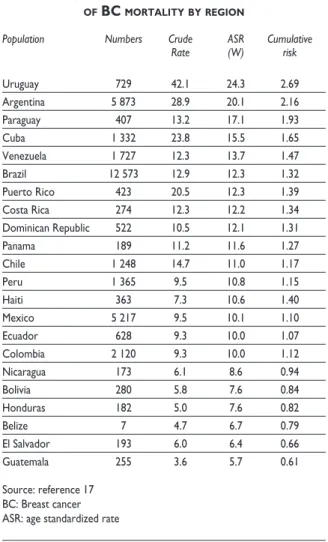
Mortality rates show a heterogeneous distribution across countries, ranging from 5.7 to 24.3 per 100 000 (table II). Similar to incidences rates, the highest mortality rates were observed in Uruguay, Argentina and Puerto Rico while the lowest were seen in Guatemala, and Belize.
BC mortality rates among women have been increasing rapidly during the period 1980-2010 in many countries of LA,4,5 and BC survival is on average 20% lower in LA
than in the US and Western Europe. The high mortality rates observed in several of these countries may have been attributed to poor survival due to the lack of or limited access to early detection services and treatments. It has been reported that only small number of new BC diagnoses are made at stage 1. Coleman and colleagues, have shown that only 40% of women in Campinas (Bra-zil) survive 5 years after a diagnosis of BC,18 compared
with 89% of women in the US and more than 82% of women in Northern and Central Europe.19
Clinical characteristics of BC in LA
High mortality-to-incidence ratios (MIRs) signify poor survival, partly because of the late stage at diagnosis and poorer access to treatment.11,20 The time delay between
the initial suspicions of BC to diagnosis is one of the strong points that can affect clinical outcomes. Several studies suggested that there is delay in the diagnosis of BC.21,22 Studies from Brazil and Mexico, showed that
the average delay between presentation to a doctor and diagnosis of BC was around 6-7 months,23,24 and 4-5
months in Peru;25 whereas delays in diagnosis of longer
than 12 weeks are considered to affect stage and conse-quently outcomes and survival.26 More recently, Justo
and colleagues reported that, the majority of BC cases are detected at advanced stages, and approximately 30-40% of diagnoses are metastatic disease in LA.11 As an
example, in Mexico an estimated 50-60% of all BC were diagnosed at advanced stage27 and the average overall
time from symptom onset to treatment was 8.4 months; 8.6 months for early stage disease and 7.5 months for late stage disease.23 In contrast, 61% of women in the
USA are diagnosed with localised BC, 31% with regional, and only 5% with metastatic spread.12 The all-cancer
mortality to incidence ratio for LA was 0.59 compared with 0.43 for the European Union and 0.35 in the US.5 In addition to these characteristics, LA women were also more likely to develop their BC at young ages.28-30
Lara-Medina and colleagues evaluated the clinical and pathologic characteristics of 2074 BC patients. This study demonstrates that the age at diagnosis of Mexican pa-tients with BC is younger compared to those reported in other populations, with a median age at BC diagnosis 11 years younger than the average age reported in the US.31 A decade ago BC was considered as a relatively
homogenous disease. Perou and colleagues32 were the
first to describe the various molecular sub-types or molecular profiles of BC. They identified subgroups of
BC (according to oestrogen receptor (ER), progesterone Table II
Numbers, cruderate, asr aNdcumulativerisk of bc mortalitybyregioN
Population Numbers Crude ASR Cumulative
Rate (W) risk
Uruguay 729 42.1 24.3 2.69 Argentina 5 873 28.9 20.1 2.16 Paraguay 407 13.2 17.1 1.93 Cuba 1 332 23.8 15.5 1.65 Venezuela 1 727 12.3 13.7 1.47 Brazil 12 573 12.9 12.3 1.32 Puerto Rico 423 20.5 12.3 1.39 Costa Rica 274 12.3 12.2 1.34 Dominican Republic 522 10.5 12.1 1.31 Panama 189 11.2 11.6 1.27 Chile 1 248 14.7 11.0 1.17 Peru 1 365 9.5 10.8 1.15 Haiti 363 7.3 10.6 1.40 Mexico 5 217 9.5 10.1 1.10 Ecuador 628 9.3 10.0 1.07 Colombia 2 120 9.3 10.0 1.12 Nicaragua 173 6.1 8.6 0.94 Bolivia 280 5.8 7.6 0.84 Honduras 182 5.0 7.6 0.82
Belize 7 4.7 6.7 0.79
El Salvador 193 6.0 6.4 0.66 Guatemala 255 3.6 5.7 0.61
receptor (PR) and human epidermal growth factor re-ceptor 2 (HER2)) that differed by molecular features and clinical characteristics: Luminal A, Luminal B, Normal-like, HER2-positive and Basal-like subtypes.32,33 Studies
from US have shown that triple-negative BC represents between 10-20% of invasive BC and has been associated with African American and Hispanic race, deprivation status, younger age at diagnosis, more advanced stages, higher grade, high mitotic indices, family history of BC and BRCA1 mutations.34-37 However, to date, detailed
genetic and molecular biology of BC has not been sys-tematically taken into account in studies of BC in LA. Only one study conducted in Mexico reported a preva-lence of 22% triple negative BC among 2 074 women with BC who attended the National Cancer Institute in Mexico City.31
Risk factors associated with BC in LA
Understanding factors that contribute to the develop-ment of BC become crucial in LA, where the majority of BC cases are diagnosed at advanced stages, resources are limited, and the rate of mammography screening are very low. Despite the huge number of studies, the
majority of BC causes remain poorly understood. There are however few numbers of risk factors for BC that have
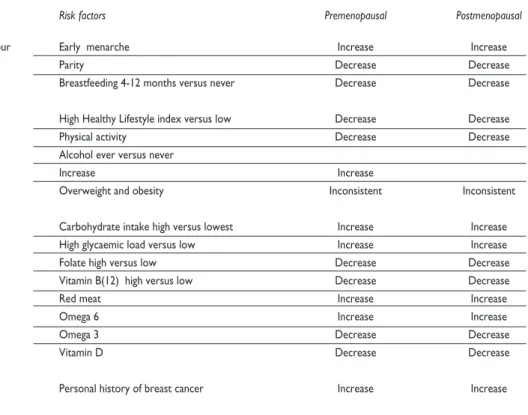
been consistently identified (table III).
Hormone and reproductive behaviour
Reproductive factors are one of the main factors that can affect BC risk and contribute to the heterogeneous distribution of BC. There is evidence that early menarche
(menstrual periods that start earlier), late first full-term
pregnancy (after 30 years old), nulliparity (never having children) and absence of breastfeeding are associated with the risk of developing BC.38-40 Multiparous (more
than five children) is associated with a 30% decreased
risk of BC. In the Mexican study, Romieu and colleagues reported that parous women who had ever breastfed had a reduction in BC risk (age-adjusted odds ratio (OR)
=0.39, 95% confidence interval (CI): 0.25-0.62) compared
with parous women who had never breast-fed.41 A
small decreasing trend of BC risk in relation to duration of lactation (p <0.001) was observed. Compared with parous women who had never breast-fed, women who had breast-fed for 12-24 months had an age-adjusted OR of 0.47 (95% CI: 0.27-0.83). This study also detected
Table III
summaryofbreastcaNcerriskfactorsiN latiN americaNcouNtries
Risk factors Premenopausal Postmenopausal
Hormone and reproductive behaviour Early menarche Increase Increase
Parity Decrease Decrease
Breastfeeding 4-12 months versus never Decrease Decrease
Lifestyle* High Healthy Lifestyle index versus low Decrease Decrease
Physical activity Decrease Decrease
Alcohol ever versus never
Increase Increase
Overweight and obesity Inconsistent Inconsistent
Food and nutrients Carbohydrate intake high versus lowest Increase Increase High glycaemic load versus low Increase Increase Folate high versus low Decrease Decrease Vitamin B(12) high versus low Decrease Decrease
Red meat Increase Increase
Omega 6 Increase Increase
Omega 3 Decrease Decrease
Vitamin D Decrease Decrease
Predisposition Personal history of breast cancer Increase Increase
a strong protective effect with lactation duration for the
first live birth (for 4-12 months of lactation, ORs=0.56
(95%CI:0.32-0.96) and 0.48 (95%CI:0.29-0.81) in pre- and postmenopausal women, respectively). Others factors that may increase the risk of BC include use of contracep-tives and use of menopausal hormonal therapy (HRT), especially combined oestrogen and progestin therapy.
The IARC classified combined estrogen-progestogen
contraceptives and combined HRT as carcinogenic for humans.42,43 However less is known about the effect of
hormone therapy on BC in LA.
Lifestyle
Studies have analysed the effect of behavioural and lifestyle risk factors such as dietary pattern, physical activity, tobacco smoking, and alcohol consumption on the risk of BC. Using the Mexican population-based case-control study, Sanchez-Zamorano and colleagues44
have assessed the effect of four variables (dietary pat-tern, physical activity, alcohol consumption, and tobacco smoking) as components of “Healthy Lifestyle” index on the risk of BC. It was considered healthy to practice moderate and vigorous-intensity physical activity, to belong to the lowest tertile of the Western dietary pat-tern, to have smoked less than 100 cigarettes, or to have never smoked and to have never consumed alcohol. This index was constructed by means of principal compo-nent analysis. This analysis detected a protective effect among women with high Healthy Lifestyle Index. The ORs=0.50 (95%CI:0.29-0.84) and 0.20 (95%CI:0.11-0.37) in premenopausal and postmenopausal, respectively when highest versus lowest quintiles were compared.44
Food and nutrients
Food and nutrient factors including high intake of carbohydrates, high glycaemic load (GL), low intake of folate and vitamin B12 have been suggested to increase the risk of BC, in particular postmenopausal BC.42,45-48
In a population-based case-control study in Mexico carbohydrate intake was directly associated with BC risk.49 Compared with women in the lowest quartile of
total carbohydrate intake, the OR of BC for women in the highest quartile was 2.22 (95%CI:1.63-3.04) in all women, 2.31 (95%CI:1.36-3.91) in premenopausal women and 2.22 (95%CI:1.49-3.30) in postmenopausal women. Regarding dietary GL the multivariate adjusted OR for all women comparing the highest quartile of dietary GL with the lowest quartile was 1.62 (95%CI:1.13-2.32), with
a significant trend (p test for trend=0.02). In postmeno-pausal women, the OR comparing the extreme quartiles was 2.18 (95%CI:1.34-3.55; p-test for trend=0.005).45
High intake of folate, vitamin B(6), and vitamin B(12) have been associated to lower the risk for BC. Compared with women in the lowest quartile, the OR for BC for all women in the highest quartile of folate intake was 0.64 (95%CI, 0.45-0.90; p test for trend =0.009) and 0.32 (95%CI, 0.22-0.49; p test for trend <0.0001) for vitamin B(12) intake.46
Studies from Uruguay have shown that the con-sumption of red meat could increase the risk of BC.50,51
Ronco and colleagues50 reported an OR of 4.16 (95%
CI: 2.26-7.67) among the highest red meat consumers, after adjusting by calories. The increase of risk was even stronger for fried meat (OR=5.31,95%CI:2.77-10.2) compared to broiled meat (OR=2.21,95%CI:1.18-4.14), however, there was no effect found for boiled meat, characteristic of stew (OR=1.02, 95%CI:0.47-2.20).
Other nutrients such as omega 3 and 6 fatty acid, and vitamin D could play an important role on the risk of BC. Chajes and colleagues,52 reported an increased risk
of BC associated with increasing ω-6 polyunsaturated
fatty acids (ω-6 PUFA) in a population-based
case–con-trol study conducted in Mexico. An increased risk of BC was observed with increasing ω-6 PUFA intake in
pre-menopausal women (OR=1.92, 95%CI:1.13-3.26; p=0.04).
A decreased risk of BC was significantly associated with
increasing ω-3 PUFA intake in obese women (OR=0.58,
95%CI:0.39-0.87; p=0.008) but not in normal weight nor in overweight women (P heterogeneity=0.017).
The results of the large Mexican population-based case-control study indicate an inverse association be-tween circulating vitamin D levels and BC risk among pre- and postmenopausal Mexican women.53 Serum
25-hydroxyvitamin D [25(OH)D] (25(OH)D) concentra-tion (per 10 ng/mL increase) showed a strong inverse association with risk of BC among all (p trend =0.001), pre- (p trend=0.006) and postmenopausal women (p trend=0.0001). Compared with a predefined lower con -centration of 25(OH)D (<20 ng/mL), higher levels (>30 ng/mL) were associated with lower overall (OR=0.53, 95%CI:0.28-1.00; p trend=0.002), pre- (OR=0.60, 95%CI:0.16-2.17; p trend=0.07) and postmenopausal (OR=0.37, 95 %CI:0.16-0.82; p trend=0.004) BC risk.
Physical activity
It has been suggested that both moderate and vigorous intensity physical activity reduce the risk of BC. Data from LA countries (including Chile, Peru, Argentina, and Brazil) and the multi-country PAHO study showed a high prevalence of adult physical inactivity, 50-91%.54
However, LA women spend on average, more time on household physical activity,55 which is considered
from Angeles-Llerenas and colleagues who reported a decrease in the risk of BC for every 3 h per week of moderate-intensity physical activity.57 The ORs=0.96
(95%CI:0.92-0.99) and 0.90 (95%CI:0.86-0.93) in pre- and postmenopausal women, respectively.
Alcohol
Alcohol consumption has been recognized as a risk factor for BC by the IARC.57 The association is present
in both pre and postmenopausal women. However little is known about its relationship with BC among LA women. In 2010, Beasley and colleagues59
sup-ported emerging evidence that any alcohol intake was associated with increased odds of BC among Mexican women. Compared with never drinkers, women report-ing ever drinkreport-ing had a greater odds of BC Adjusted
OR=1.25, 95% CI=0.99-1.58). In analyses stratified by
menopausal status, there was no evidence for effect
modification (p for interaction=0.83 for current drink-ing and p for interaction=0.80 for categorized alcohol). Lifetime alcohol use was associated with an increased risk of BC, as women who reported ever drinking one or more drinks a month for at least 1 year had 1.74 higher odds of BC (OR=95%CI:1.27-2.39). Folate in-take appeared to modify the association between ever consuming any alcohol and BC (p for interaction=0.04). Women in the lowest tertile of folate intake (mean=197 μg/day) had a higher odds of BC (Adjusted OR=1.99, 95%CI=1.26-3.16) compared to women with highest tertile of folate intake (mean=532μg/day) (OR=1.12, 95%CI:0.69-1.83).
Tobacco
Tobacco smoking is a growing problem throughout LA countries. There are around 145 million smokers aged 15 years or more in LA.59 It is one of the most important
cancer risk factors, accounting for 26% of all cancer deaths. However there is no information on the effect of tobacco on BC in LA.
Overweight and obesity
Overweight and obesity have been associated with an increased risk of BC in postmenopausal, but with a de-creased risk in pre-menopausal Caucasian women.61,62
However, these associations remain unclear in LA popu-lations. Previous studies conducted among Hispanic women in the US have shown different patterns, some study reported an inverse association63 between obesity
(BMI ≥ 30 kg/m²) and BC, whereas others found no asso -ciation in both pre- and postmenopausal women.64,65
Genetic predisposition
Hereditary BC comprises 10% of all BC diagnosis.66
The most prevalent entity is Hereditary Breast and Ovarian Cancer (HBOC). BRCA1 and BRCA2 genes known as tumor suppressors are the most well-known genetic factors that increase the risk for BC66,67 and
others cancers. Despite the outstanding relevance of genetic screening of BRCA deleterious variants in patients with a history of familial cancer, this prac-tice is less common in LA countries, probably due to the high cost of the screening and limitations in the countries health infrastructure. However a number of studies have reported a high prevalence of BRCA mutation in LA.30,66,68-71 The prevalence of BRCA1 or
BRCA2 mutation was 13% (4/31) among Brazilian women diagnosed with BC.72 García-Jiménez
identi-fied a deleterious BRCA1 or BRCA2 mutation in 5.2%
of Costa Rican BC patients.73 This frequency of BRCA
mutations is similar to that reported for familial BC cases from Mexico (3.9%)74,75 and Costa Rica (4.5%).68
Recently, Vaca and colleagues found 10.2% BRCA mutations among 39 Mexican patients.76 The family
history of BC in first degree relatives was significantly
associated with risk of premenopausal BC (OR=2.20, 95% CI 1.33-3.62).77
Conclusion
BC is the most common form of cancer in women and is a heterogeneous disease. The incidence is increas-ing, and women with BC either present with large, advanced tumours or do not present until the disease is at an incurable stage. Resources are limited and the treatment cost is high.3 For these reasons, efforts and
public health priorities are needed for primary preven-tion, early detection and diagnosis, and prompt and optimum treatment.
Primary prevention is one of the most-effective strategies for cancer prevention and should focus on
modifiable risk factors and early detection. Among the important factors identified, physical activity, diet
with low sugary food and drinks, low in fried meat and rich in vegetables should be promoted. In addi-tion the consumpaddi-tion of alcohol should be limited. However, there is an urgent need for further research
to identify the distribution of specific BC phenotypes in the LA women population. Detailed classification of tumour subtypes is necessary to refine phenotype and improve the identification of specific endogenous
and exogenous risk factors. This information will be of
crucial importance for the identification of susceptible
treatment. In parallel, increased public awareness of BC and expansion of access to screening are strategies that will reduce BC mortality.
Declaration of conflict of interests. The authors declare that they have no conflicts of interest.
References
1. World Bank.World Development Indicators 2010, DC, 2010 [con-sulted april 2013]. Available from: http://data.worldbank.org/data-catalog/ world-developmentent- indicators/wdi-2010. 04/2013.
2. WHO, PAHO. Health in the Americas, 2012 edn. Regional oulook and country profiles. Washington, DC: Pan American Health Organiza-tion, 2012.
3. Goss PE, Lee BL, Badovinac-Crnjevic T, Strasser-Weippl K, Chavarri-Guerra Y, St LJ, et al. Planning cancer control in Latin America and the Caribbean. Lancet Oncol 2013;14:391-436.
4. Forouzanfar MH, Foreman KJ, Delossantos AM, Lozano R, Lopez AD, Murray CJ, et al. Breast and cervical cancer in 187 countries between 1980 and 2010: a systematic analysis. Lancet 2011;378:1461-1484. 5. Ferlay J, Forman D, Mathers CD, Bray F. Breast and cervical cancer in 187 countries between 1980 and 2010. Lancet 2012;379:1390-1391. 6. Siegel R, Naishadham D, Jemal. A Cancer statistics for Hispanics/Lati-nos, 2012. CA Cancer J Clin 2012;62:283-298.
7. Jemal A, Bray F, Center MM, Ferlay J, Ward E, Forman D. Global cancer statistics. CA Cancer J Clin 2011;61:69-90.
8. DeSantis C, Siegel R, Bandi P, Jemal A. Breast cancer statistics, 2011. CA Cancer J Clin 2011;61:409-418.
9. Chlebowski RT, Chen Z, Anderson GL, Rohan T, Aragaki A, Lane D, et al. Ethnicity and breast cancer: factors influencing differences in incidence and outcome. J Natl Cancer Inst 2005;97:439-448.
10. Sweeney C, Giuliano AR, Baumgartner KB, Byers T, Herrick JS, Edwards SL, et al. Oral, injected and implanted contraceptives and breast cancer risk among U.S. Hispanic and non-Hispanic white women. Int J Cancer 2007;121:2517-2523
11. Justo N, Wilking N, Jonsson B, Luciani S, Cazap E. A review of breast cancer care and outcomes in Latin America. Oncologist 2013;18:248-256. 12. Lee BL, Liedke PE, Barrios CH, Simon SD, Finkelstein DM, Goss. PE Breast cancer in Brazil: present status and future goals. Lancet Oncol 2012;13:e95-e102.
13. Breen N, Cronin A, Meissner HI, Taplin SH, Tangka FK, Tiro JA, et al. Reported drop in mammography: is this cause for concern? Cancer 2007;109:2405-2409.
14. Press R, Carrasquillo O, Sciacca RR, Giardina EG. Racial/ethnic dis-parities in time to follow-up after an abnormal mammogram. J Womens Health (Larchmt )2008;17:923-930.
15. Stuver SO, Zhu J, Simchowitz B, Hassett MJ, Shulman LN, Weingart SN. Identifying women at risk of delayed breast cancer diagnosis. Jt Comm J Qual Patient Saf 2011;37:568-575.
16. Knaul FM, Wong R, Arreola-Ornelas H, Mendez O. Household catastrophic health expenditures: a comparative analysis of twelve Latin American and Caribbean Countries. Salud Publica Mex 2011;53 suppl 2:s85-s95.
17. Globocan, IARC, 2010
18. Coleman MP, Quaresma M, Berrino F, Lutz JM, De AR, Capocaccia R, et al .Cancer survival in five continents: a worldwide population-based study (CONCORD). Lancet Oncol 2008;9:730-756.
19. Sant M, Allemani C, Santaquilani M, Knijn A, Marchesi F, Capocaccia R. EUROCARE-4. Survival of cancer patients diagnosed in 1995-1999. Results and commentary. Eur J Cancer 2009;45:931-991.
20. Puschel K, Coronado G, Soto G, Gonzalez K, Martinez J, Holte S, et al. Strategies for increasing mammography screening in primary care in Chile: results of a randomized clinical trial. Cancer Epidemiol Biomarkers Prev 2010;19:2254-2261.
21. Trufelli DC, Miranda VC, Santos MB, Fraile NM, Pecoroni PG, Gonzaga SF, et al. [Analysis of delays in diagnosis and treatment of breast cancer patients at a public hospital]. Rev Assoc Med Bras 2008;54:72-76. 22. Unger-Saldana K, Pelaez-Ballestas I, Infante-Castaneda C. Develop-ment and validation of a questionnaire to assess delay in treatDevelop-ment for breast cancer. BMC Cancer 2012;12:626.
23. Bright K, Barghash M, Donach M, de la Barrera MG, Schneider RJ, Formenti SC.The role of health system factors in delaying final diagnosis and treatment of breast cancer in Mexico City, Mexico. Breast 2011;20 suppl 2:S54-S59.
24. Rezende MC, Koch HA, Figueiredo JA, Thuler LC. [Factors leading to delay in obtaining definitive diagnosis of suspicious lesions for breast cancer in a dedicated health unit in Rio de Janeiro]. Rev Bras Ginecol Obstet 2009;31:75-81.
25. Gage JC, Ferreccio C, Gonzales M, Arroyo R, Huivin M, Robles SC. Follow-up care of women with an abnormal cytology in a low-resource setting. Cancer Detect Prev 2003;27:466-471.
26. Richards MA, Smith P, Ramirez AJ, Fentiman IS, Rubens RD. The influ-ence on survival of delay in the presentation and treatment of symptom-atic breast cancer. Br J Cancer 1999;79:858-864.
27. Knaul F, Bustreo F, Ha E, Langer A. Breast cancer: why link early detection to reproductive health interventions in developing countries? Salud Publica Mex 2009;51 suppl 2:s220-s227.
28. Robles-Castillo J, Ruvalcaba-Limon E, Maffuz A, Rodriguez-Cuevas S. [Breast cancer in Mexican women under 40]. Ginecol Obstet Mex 2011;79:482-488.
29. Robles SC, Galanis E. Breast cancer in Latin America and the Carib-bean. Rev Panam Salud Publica 2002;11:178-185.
30. Rodriguez AO, Llacuachaqui M, Pardo GG, Royer R, Larson G, Weitzel JN, et al. BRCA1 and BRCA2 mutations among ovarian cancer patients from Colombia. Gynecol Oncol 2012;124:236-243.
31. Lara-Medina F, Perez-Sanchez V, Saavedra-Perez D, Blake-Cerda M, Arce C, Motola-Kuba D, et al. Triple-negative breast cancer in Hispanic patients: high prevalence, poor prognosis, and association with meno-pausal status, body mass index, and parity. Cancer 2011;117:3658-3669. 32. Perou CM, Sorlie T, Eisen MB, van de RM, Jeffrey SS, Rees CA, et al. Molecular portraits of human breast tumours. Nature 2000;406:747-752. 33. West M, Blanchette C, Dressman H, Huang E, Ishida S, Spang R, et al. Predicting the clinical status of human breast cancer by using gene expression profiles. Proc Natl Acad Sci U S A 2001;98:11462-11467. 34. Amirikia KC, Mills P, Bush J, Newman LA. Higher population-based incidence rates of triple-negative breast cancer among young African-American women: Implications for breast cancer screening recommenda-tions. Cancer 2011;117:2747-2753.
35. Boyle P. Triple-negative breast cancer: epidemiological considerations and recommendations. Ann Oncol 2012;23 suppl 6:vi7-vi12.
36. Huo D, Ikpatt F, Khramtsov A, Dangou JM, Nanda R, Dignam J, et al. Population differences in breast cancer: survey in indigenous African women reveals over-representation of triple-negative breast cancer. J Clin Oncol 2009;27:4515-4521.
37. Olopade OI, Grushko TA, Nanda R, Huo D. Advances in breast cancer: pathways to personalized medicine. Clin Cancer Res 2008;14:7988-7999. 38. Torres-Mejia G, Angeles-Llerenas A. [Reproductive factors and breast cancer: principal findings in Latin America and the world]. Salud Publica Mex 2009;51 suppl 2:s165-s171.
40. Tessaro S, Beria JU, Tomasi E, Victora CG. Breastfeeding and breast cancer: a case-control study in Southern Brazil. Cad Saude Publica 2003;19:1593-1601.
41. Romieu I, Hernandez-Avila M, Lazcano E, Lopez L, Romero-Jaime R. Breast cancer and lactation history in Mexican women. Am J Epidemiol 1996;143:543-552.
42. Cogliano V, Grosse Y, Baan R, Straif K, Secretan B, El GF. Carcinoge-nicity of combined oestrogen-progestagen contraceptives and meno-pausal treatment. Lancet Oncol 2005;6:552-553.
43. Combined estrogen-progestogen contraceptives and combined estrogen-progestogen menopausal therapy. IARC Monogr Eval Carcinog Risks Hum 2007;91:1-528.
44. Sanchez-Zamorano LM, Flores-Luna L, Ángeles-Llerenas A, Romieu I, Lazcano-Ponce E, Miranda-Hernandez H, et al. Healthy lifestyle on the risk of breast cancer. Cancer Epidemiol Biomarkers Prev 2011;20:912-922. 45. Lajous M, Willett W, Lazcano-Ponce E, Sanchez-Zamorano LM, Hernandez-Avila M, Romieu I. Glycemic load, glycemic index, and the risk of breast cancer among Mexican women. Cancer Causes Control 2005;16:1165-1169.
46. Lajous M, Lazcano-Ponce E, Hernandez-Avila M, Willett W, Romieu I. Folate, vitamin B(6), and vitamin B(12) intake and the risk of breast cancer among Mexican women. Cancer Epidemiol Biomarkers Prev 2006;15:443-448.
47. Romieu I, Lajous M. The role of obesity, physical activity and dietary factors on the risk for breast cancer: Mexican experience. Salud Publica Mex 2009;51 suppl 2:s172-s180.
48. Romieu I. Diet and breast cancer. Salud Publica Mex 2011;53:430-439. 49. Romieu I, Lazcano-Ponce E, Sanchez-Zamorano LM, Willett W, Hernandez-Avila M. Carbohydrates and the risk of breast cancer among Mexican women. Cancer Epidemiol Biomarkers Prev 2004;13:1283-1289. 50. De SE, Ronco A, Mendilaharsu M, Guidobono M, eo-Pellegrini H. Meat intake, heterocyclic amines, and risk of breast cancer: a case-control study in Uruguay. Cancer Epidemiol Biomarkers Prev 1997;6:573-581. 51. Ronco A, De SE, Mendilaharsu M, eo-Pellegrini H. Meat, fat and risk of breast cancer: a case-control study from Uruguay. Int J Cancer 1996;65:328-331.
52. Chajes V, Torres-Mejia G, Biessy C, Ortega-Olvera C, Ángeles-Llerenas A, Ferrari P, et al. Omega-3 and omega-6 Polyunsaturated fatty acid intakes and the risk of breast cancer in Mexican women: impact of obesity status. Cancer Epidemiol Biomarkers Prev 2012;21:319-326. 53. Fedirko V, Torres-Mejia G, Ortega-Olvera C, Biessy C, Ángeles-Llerenas A, Lazcano-Ponce E, et al. Serum 25-hydroxyvitamin D and risk of breast cancer: results of a large population-based case-control study in Mexican women. Cancer Causes Control 2012;23:1149-1162.
54. Pratt M. Physical activity and health in the European Union. Soz Praventivmed 2004;49:297-298.
55. John EM, Horn-Ross PL, Koo J. Lifetime physical activity and breast cancer risk in a multiethnic population: the San Francisco Bay area breast cancer study. Cancer Epidemiol Biomarkers Prev 2003;12:1143-1152. 56. Ainsworth BE, Haskell WL, Whitt MC, Irwin ML, Swartz AM, Strath SJ, et al. Compendium of physical activities: an update of activity codes and MET intensities. Med Sci Sports Exerc 2000;32:S498-S504. 57. Angeles-Llerenas A, Ortega-Olvera C, Pérez-Rodríguez E, Esparza-Cano JP, Lazcano-Ponce E, Romieu I, et al. Moderate physical activity and breast cancer risk: the effect of menopausal status. Cancer Causes Control 2010;21:577-586.
58. Baan R, Straif K, Grosse Y, Secretan B, El GF, Bouvard V, et al .Carci-nogenicity of alcoholic beverages. Lancet Oncol 2007;8:292-293. 59. Beasley JM, Coronado GD, Livaudais J, Angeles-Llerenas A, Ortega-Olvera C, Romieu I, et al . Alcohol and risk of breast cancer in Mexican women. Cancer Causes Control 2010;21:863-870.
60. Muller F, Wehbe L. Smoking and smoking cessation in Latin America: a review of the current situation and available treatments. Int J Chron Obstruct Pulmon Dis 2008;3:285-293.
61. Amadou A, Ferrari P, Muwonge R, Moskal A, Biessy C, Romieu I, et al.Overweight, obesity and risk of premenopausal breast cancer according to ethnicity: a systematic review and dose-response meta-analysis. Obes Rev 2013;14:665-678.
62. Renehan AG, Tyson M, Egger M, Heller RF, Zwahlen M. Body-mass index and incidence of cancer: a systematic review and meta-analysis of prospective observational studies. Lancet 2008;371:569-578.
63. John EM, Sangaramoorthy M, Phipps AI, Koo J, Horn-Ross PL. Adult body size, hormone receptor status, and premenopausal breast cancer risk in a multiethnic population: the San Francisco Bay Area breast cancer study. Am J Epidemiol 2011;173:201-216.
64. Sarkissyan M, Wu Y, Vadgama JV. Obesity is associated with breast cancer in African-American women but not Hispanic women in South Los Angeles. Cancer 2011;117:3814-3823.
65. Sexton KR, Franzini L, Day RS, Brewster A, Vernon SW, Bondy ML. A review of body size and breast cancer risk in Hispanic and African American women. Cancer 2011;117:5271-5281.
66. Gaudet MM, Kirchhoff T, Green T, Vijai J, Korn JM, Guiducci C, et al.Common genetic variants and modification of penetrance of BRCA2-associated breast cancer. PLoS Genet 2010);6: e1001183.
67. Meindl A, Ditsch N, Kast K, Rhiem K, Schmutzler RK. Hereditary breast and ovarian cancer: new genes, new treatments, new concepts. Dtsch Arztebl Int 2011;108:323-330.
68. Donenberg T, Lunn J, Curling D, Turnquest T, Krill-Jackson E, Royer R, et al.A high prevalence of BRCA1 mutations among breast cancer patients from the Bahamas. Breast Cancer Res Treat 2011;125:591-596. 69. Gutierrez-Espeleta GA, Llacuachaqui M, Garcia-Jimenez L, Aguilar HM, Loaiciga VK, Ortiz A,et al. BRCA1 and BRCA2 mutations among familial breast cancer patients from Costa Rica. Clin Genet 2012;82:484-488. 70. Jara L, Ampuero S, Santibanez E, Seccia L, Rodriguez J, Bustamante M, et al.BRCA1 and BRCA2 mutations in a South American population. Cancer Genet Cytogenet 2006;166:36-45.
71. Vidal-Millan S, Taja-Chayeb L, Gutierrez-Hernandez O, Ramirez-Ugalde MT, Robles-Vidal C, Bargallo-Rocha E, et al. Mutational analysis of BRCA1 and BRCA2 genes in Mexican breast cancer patients. Eur J Gynaecol Oncol 2009;30:527-530.
72. Dufloth RM, Carvalho S, Heinrich JK, Shinzato JY, dos Santos CC, Zeferino LC, et al. Analysis of BRCA1 and BRCA2 mutations in Brazil-ian breast cancer patients with positive family history. Sao Paulo Med J 2005;123:192-197.
73. Garcia-Jimenez L, Gutierrez-Espeleta G, Narod SA. [Descriptive epidemiology and molecular genetics of hereditary breast cancer in Costa Rica]. Rev Biol Trop 2012;60:1663-1668.
74. Gallardo M, Silva A, Rubio L, Alvarez C, Torrealba C, Salinas M, et al. Incidence of BRCA1 and BRCA2 mutations in 54 Chilean families with breast/ovarian cancer, genotype-phenotype correlations. Breast Cancer Res Treat 2006;95:81-87.
75. Ruiz-Flores P, Sinilnikova OM, Badzioch M, Calderon-Garciduenas AL, Chopin S, Fabrice O, et al. BRCA1 and BRCA2 mutation analysis of early-onset and familial breast cancer cases in Mexico. Hum Mutat 2002;20:474-475.
76. Vaca-Paniagua F, Álvarez-Gomez RM, Fragoso-Ontiveros V, Vidal-Millan S, Herrera LA, Cantu D, et al. Full-exon pyrosequencing screening of BRCA germline mutations in Mexican women with inherited breast and ovarian cancer. PLoS One 2012;7:e37432.