FACULTAD de FILOSOFÍA Y LETRAS
DEPARTAMENTO de FILOLOGÍA INGLESA
Grado en Estudios Ingleses
TRABAJO DE FIN DE GRADO
LEXICAL, SYNTACTIC AND
SEMANTIC ANGLICISMS IN
ONLINE SPANISH NEWSPAPERS
Lucía de la Higuera Amigo
Tutora: Esther Álvarez de la Fuente
3
TABLE OF CONTENTS
1. Introduction……… 6
2. The Influence of the English Language………. 6
3. Anglicisms in the Spanish Language………. 8
3.1What is an Anglicism?... 8
3.2Classification of Anglicisms: Different Proposals……… 10
4. Anglicisms in the Spanish written press: some previous studies………….. 15
5. The Main Aims of the Present Study………. 18
6. Methodology………18
6.1Description of the Procedure………18
6.2Classification of Anglicisms: Our Adaptation………20
7. Results and Discussion……….24
7.1Anglicisms Typology……….24
7.1.1 Lexical Anglicisms………25
7.1.2 Syntactic Anglicisms……….27
7.1.3 Semantic Anglicisms……….31
7.2Anglicisms in newspapers sections………36
7.3Final Discussion……….37
8. Conclusions……….41
4
Abstract
Anglicisms in the Spanish language have been an object of study in the area of languages specially over the last decades. We find them in advertising, social media or in the press. However, whilst lexical anglicisms tend to be the most common and frequent, we can also find syntactic and semantic anglicisms that have been less studied. The present dissertation aims to classify and analyse a total of 92 anglicisms found in 240 articles from three Spanish newspapers, according to three linguistic levels: lexical, syntactic and semantic. For this purpose, a database has been compiled in order to gather the results.
Key words: anglicisms, English, grammar, lexicon, syntax, semantics.
Resumen
Los anglicismos en la lengua española han sido objeto de estudio desde hace años y especialmente en las últimas décadas. Podemos encontrarlos en la publicidad, en las redes sociales o en la prensa. Sin embargo, mientras que los anglicismos léxicos parecen ser los más comunes y frecuentes, también existen los anglicismos sintácticos y semánticos, los cuales no han sido tan estudiados. El objetivo de este trabajo es clasificar y analizar 92 anglicismos encontrados en 240 artículos de tres periódicos españoles, y teniendo en cuenta tres niveles lingüísticos: léxico, semántico y sintáctico. Para ello, se ha creado una base de datos con el fin de almacenar y exponer los resultados.
6
1. Introduction
The study of anglicisms is an issue of current interest and, although it was first
studied many years ago by figures such as Alfaro (1948, 1951) and Lorenzo (1996), this
phenomenon is constantly evolving and has become more prominent in the last decades,
especially thanks to globalisation and the development and improvement in technology
and the internet.
Nowadays, anglicisms can be found in almost any area of language and
communication, however, one of the main channels through which anglicisms are
introduced into the Spanish language is the Press. Although anglicisms have been studied
from different perspectives, it seems that only lexical anglicisms have been thoroughly
analysed, whilst syntactic and semantic anglicisms seem to be left behind, and therefore
they are less common and noticeable. The main purpose of the present study is then to
study, analyse and classify the anglicisms found in three online newspapers according to
three linguistic variables: lexicon, syntax and semantics.
For this purpose, we will first explain what is an anglicism and show some of the
classifications that have been put forward by different authors to later establish our own
classification. Then, a database will be created in order to analyse and classify the
anglicisms. Finally, the results will be displayed to finally reach a conclusion.
2. The influence of the English language
It is widely known that English has nowadays a massive influence on many
languages. This influence is reflected not only in languages as such but also in many
7 English is introduced in our daily life through social media, newspapers,
advertisements, business, fashion, sports, science, technology, etc. It seems to be
everywhere to the point that sometimes, we are so used to it, that we are unable to notice
its presence because it has completely become part of our communication method. In
what refers to language, this influence is mainly reflected with the introduction of lexical
anglicisms or borrowings into the Spanish language.
As Tauts (2018) introduces in her work, the first major influences on the Spanish
language took place in the Middle Ages with the arabisms, followed by the influence of
galicisms. However, in the last decades, a new dominant force -whose origin is not
unique- has appeared. This new linguistic influence is evidenced by the increasing use of anglicisms worldwide and considered, more specifically, the “most important linguistic
peninsular development in contemporary Spanish” (Stone, 1957).
However, the influence of anglicisms does not solely affect the Spanish language,
but many languages are also affected by this phenomenon. Indeed, authors such as
Luján-García (2012) and de la Cruz and Tejedor (2012) among others, have referred to the
English language as the Lingua Franca or hegemonic global language for non-English
speakers. English has gained ground throughout the years and it is now present not only
in the daily life of many people, -particularly within the social media and television fields-
where this presence is more obvious and clearer, but it can also be found in general
language, where the presence of anglicisms is not always evident for native Spanish speakers and therefore research on this phenomenon is required nowadays. Indeed, “the presence of English is felt at all the levels of the system: orthographic, lexical, semantic
and even syntactic”, just like (Pratt, 229) argued in his study on anglicisms in
8
3. Anglicisms in the Spanish language
Nowadays, it is unquestionable that words such as smartphone or bluetooth have
already become part of our vocabulary and consequently, of our language and
communication. However, although it might be simple to think that anglicisms are merely
English words that the Spanish language has borrowed from English, in the next section
we will clarify that the study of anglicisms could go beyond a mere observation of a
lexical insertion in a certain language and be considered instead a complex and intriguing
area where constant research and the different perspectives underlying the analysis of
anglicisms are needed. As a first approach to this research area, it is convenient to define
what is understood by anglicisms and therefore, different proposals in this line are
presented in the following section.
3.1 What is an anglicism?
The phenomenon of anglicisms or linguistic borrowings has been studied and
analysed for decades, and some authors such as Lorenzo (1971, 1980, 1996) are quite
prolific in this field, but before discussing the different views underlying this issue, it is
essential for our study to establish a definition of what is meant by anglicism.
According to the Oxford dictionary (https://en.oxforddictionaries.com/), an
anglicism is “a word or phrase borrowed from English into a foreign language”. Some of
the authors we will refer to in the present work, such as Rodríguez-Medina (2002, 2016),
Nuñez-Nogueroles (2017), De la Cruz (2012) mainly use the term anglicism to refer to
this phenomenon although in many cases we will find that the term borrowing is often
used to refer to the same idea. Following the Oxford Dictionary, we can establish that
9 that anglicism is usually used as a general term whereas borrowing is preferred to specify
a type of anglicisms. For instance, Planchon (2014) establishes a definition for anglicism: “a transfer of a linguistic element from one language to another” (51), and then she makes a division into three categories (i.e.morpho-semantic borrowings, false borrowings,
syntactic borrowings). Nonetheless, since this distinction falls outside the scope of our
study, we will treat anglicisms and borrowings as synonyms.
Regarding the way anglicisms are perceived by the target culture, there are authors that consider the anglicism a positive contribution to the Spanish language, and some
others like Luján-García (2012), among others, who merely conform “to describe the
situation of English in Spain without judging these uses in a positive or negative way”
(3). On the other hand, authors such as Lorenzo (1996), firmly support the negative effect
that anglicisms generate, suggesting that Spanish has enough lexical richness and that
there are lot of words introduced which are considered to be unnecessary.
Since the main aim of our study will be the classification of different types of
anglicisms found in Spanish,we will not focus on the dilemma of the positive or negative
impact of anglicisms on the Spanish language, but rather on the identification and
classification of anglicisms. Setting aside the relatively controversial issues regarding the
study of anglicisms (i.e. the definition of the erm and the connotations associated with it),
in the following section we will provide a brief review of some anglicisms typologies
10
3.2 Classification of anglicisms: Different proposals
The RAE distinguishes between two different types of anglicisms
(http://www.rae.es/diccionario-panhispanico-de-dudas/que-contiene/tratamiento-de-los-extranjerismos), which are the following:
(1) Superfluous or unnecessary anglicisms: which refer to anglicisms that have
equivalents in Spanish. For instance, the use of abstract instead of resumen, or the
use of backup instead of copia de seguridad.
(2) Necessary or widespread anglicisms: which refer to those anglicisms whose
equivalent in Spanish does not exist or it is difficult to find a similar term to reflect
it, or when the use of these words is widespread and deep-rooted. In this case,
anglicisms receive two treatments:
i) Preservation of the spelling and pronunciation such as in jazz, blues, ballet,
software.
ii) Adaptation of the spelling and pronunciation, with the aim to preserve as much
as possible the distinctive Spanish spelling and pronunciation (máster instead
of master, or pádel instead of paddle)
Therefore, according to the RAE, the typology of anglicisms lies on the
“necessity” of the English word for the Spanish language and the degree of phonological
and spelling adaptation of the English word into the Spanish phonological system.
From a different approach and according to different researchers,
(Oncis-Martínez, 2009; Rodríguez Medina, 2016; Loubier, 2003; Fernández Marrero, 2008;
Pratt, 1980) anglicisms can be classified and organised according to the linguistic level
11 more than one typology of anglicisms, (e.g. morpho-semantic, syntactic or false
borrowings (i.e. lexical borrowings), as in Loubier (2003)), others only focus on one level
(e.g. lexical, as in Rodríguez-Medina (2016)).
In the case of Loubier (2003), she proposed a classification that, according to
Planchon (2014) “could be useful to distinguish and analyse anglicisms” (50). Loubier
made a distinction between what she called “lexical creations”, more known as
neologisms and lexical borrowings, dividing them into three different categories:
(1) Morpho-semantic borrowings: forms that correspond to the (a) integral
borrowing or (b) hybrid borrowing, which means that the word or
expression in English is identical in form or in meaning to its usage in
other language. (e.g. feedback or módem).
(2) Syntactic borrowings, which represent the reproduction of a
syntactic-semantic structure of a foreign language in another language. (e.g. the use
of the passive voice pointed out also by Martin (2003), since this is a
structure more common in English than in Spanish specially in certain
contexts like social science writing.
(3) False anglicisms and linguistic calques, defined as a lexical creation led
by a transfer of foreign linguistic features (e.g. footing or walkman).
Similarly, Rodríguez-Medina (2016), introduces a typology of anglicisms with
different terms, although unlike Loubier´s (2003) classification, Rodríguez Medina´s
seems to be focused only on the lexical level. She distinguishes between three different
categories: (1) pure anglicisms, that she defines as “English words which have not been
12 English, though they are similar to English words” (e.g. puenting) and (3) partially
assimilated anglicisms, “whose morphology is only partially adapted to Spanish” (e.g.
selfi). Therefore, we could consider that Rodríguez-Medina´s classification is very similar
to the one proposed by the RAE and so, dependable on the degree of assimilation to the
Spanish language.
In the case of Oncins-Martínez (2009) he makes a distinction taking into account two studies conducted by Rodríguez and Lillo (1997) and Rodríguez (2014), classifying anglicisms as (1) “patent” anglicisms, which are loanwords that enter Spanish language in their native form (e.g. airbag) and (2) semantic or content anglicisms, that occur when the Spanish language receives from English “not only words but part of the meaning of a cognate form in that language” (116). This last type of anglicism, according to Oncins-Martínez, often involves an extension of the denotational meaning, such as the word “ignorar”, whose meaning in the 21st edition (1991) of the DRAE1 was only “not to know something” and in the 22nd edition (2001) its meaning had been extended including the additional (originally English) sense of “not to pay attention to someone or something” (117). Therefore, the main difference between Oncis-Martínez’s (2009) classification and the previous ones is that he presents a type of anglicism at the semantic level that implies the introduction of a new meaning in the target language (i.e. “ignorar” = “no prestar atención”).
Other authors (Lorenzo 1987, Rodríguez Medina 2002, Pratt 1980, among others) have also introduced a type of anglicism at a different linguistic level (i.e. syntax, similar to Loubier´s (2003) syntactic borrowing). More specifically, Lorenzo (1987) introduced
13
the term “syntactic anglicism” in Spain which was also adopted by Rodríguez-Medina (2002) when studying “the increase of the use of certain syntactic constructions (gerund, passive voice, continuous tenses, etc.) due to the influence of the English language” on Spanish.
Pratt (1980) also dealt with syntactic anglicisms, that is, “with relations, not with mere words” (89), providing as well a more extended projection in the study of anglicisms and not focusing only on the lexical ones. With this in mind, he proposed to classify anglicisms into two different types:
(1) “Syntactic innovation”, which occurs when a construction is unknown in
Spanish, for example, the use of the structure “estar siendo hecho” (estar
siendo + past participle) from the influence of the English construction “is
being done” (is being + past participle).
(2) “Syntactic borrowing of higher frequency”, referring to a syntactic
construction in Spanish that is possible but either it is not very common,
or it is limited to a certain context. For instance, the excessive use of the
passive voice in Spanish due to the English influence in translation and
dubbing (90).
Recently, Fernández Marrero (2008) proposed a classification of syntactic
anglicisms similar to the one made by Pratt (1980) but further developed. She established
four different categories resulted from the influence of English in Spanish syntax:
(1) “Syntactic calques”, referring to the use of the so-called “gerundio de
14 action expressed by the main verb, i.e. “El escritor estudió en Madrid yéndose después a Soria”. (www.fundeu.es). Besides within this group, the author also included specific cases such as the use of the expression “no solo…pero” (not only but) instead of “no solo…sino también” (not only but… as well), or the use of the wrong preposition in the construction “consistir de” (consist of) instead of “consistir en”.
(2) “Order of adjectives”, when the order of the adjective in a sentence is opposed to
the natural and common usage in Spanish, e.g. “Hay dos diferentes precios” or
when there is a change in the meaning, e.g. “Preocupados obispos argentinos por
la situación social”.
(3) The excessive use of the passive voice due to the influence of English, as Pratt
(1980) also termed as “syntactic borrowing of higher frequency”, e.g. “Los más
altos ejecutivos australianos son, substancialmente, menos pagados que sus […].
(4) The use of continuous tenses instead of simple tenses, e.g. “estaremos
promocionando el nuevo single de Ricky […]” as in Spanish the idea of continuity
should be expressed in different ways, for example, with frequency adverbs such
as probablemente or próximamente.
15
a more global perspective in the analysis of anglicisms in Spanish, the fields of semantics, syntax and lexicon will be taken into consideration for this study.
As we have also pointed out in this section, anglicisms at these different linguistic levels can be found with more or less frequency in different types of texts or mediums: for instance, it seems that an excessive use of the passive voice in certain written genres in some areas like social sciences is considered a syntactic anglicism Martin (2003), while it may not be considered so in the case of medical texts Med (2015). For this reason, it is also the main aim of the present study to analyse anglicisms at different linguistic levels but in a very specific textual genre, i.e. articles in Spanish newspapers, an area where many anglicisms are expected to be found, as discussed in the following section.
4- Anglicisms in the Spanish written press: some previous studies
In recent years, the issue of anglicisms has been studied in different areas of
language and communication, being the press the most frequent area of study, although
research in other fields such as television and advertisements has also been carried out
(Rodríguez-Medina, 2013).
Regarding the press, it is worth to mention Núñez Nogueroles (2017), who
presented an analysis of the use of anglicisms in the Spanish press at the beginning of the
21st century, focusing on different domains (i.e. arts, science and technology, leisure time,
daily life, politics, economics, health, etc.) with the purpose of discovering the frequency
in which anglicisms appeared in different thematic fields by using the Corpus de
Referencia del Español Actual (CREA). With the results obtained, she aimed to
16 likely to find anglicisms and concluding that out of the 93 thematic areas she analysed,
sports, music, politics and computing were “the fields boasting the higher concentrations
of relevant evidence” (133).
Similarly, De la Cruz and Tejedor (2012) discussed in their study of anglicisms
quantitative aspects, analysing the frequency of anglicisms found in specialised texts, but
in addition, unlike Nuñez-Nogueroles (2017), they dealt with qualitative aspects, arguing
that “they decided to focus on direct types (loanwords rather than indirect types i.e.
calques and semantic loans)” (103). Besides, they aimed to illustrate the use of English
loanwords in different specialised languages such as Computer Science, Tourism,
Medicine and Science and Technology. For this purpose, they designed and compiled a
textual corpus in Spanish and they stored all the relevant linguistic information on a
database with the purpose of demonstrating the impact of English on specialised texts in
Spanish. In light of the data obtained, they concluded that “the influence of English
word-stock was pervasive, as it extended to almost every field of Spanish vocabulary” (112).
Although in a different context (i.e. the area of advertisement and television),
Rodríguez-Medina (2016) also conducted an analysis of anglicisms, as part of the
research project “Globalisation and Impact of the Anglo-American culture on
Spain"(2013). Her work was based on a corpus of pure anglicisms and pseudo-anglicisms
found in commercials related to cosmetics, hygiene and personal care products. Her main
purpose was finding out if anglicisms used in this thematic area express positive
connotations of prestige in commercials related to the issues above mentioned, adopting
then an exclusively semantic approach. The results of the project showed a considerable
17 which confirms “the reinforcement of the prestige of the English-speaking world in the
Spanish language and society”. (Rodríguez Medina, 2016).
Based on a corpus consisting of anglicisms found in Spanish newspapers,
Vázquez (2014) also conducted a descriptive study of anglicisms in the first half of the
19th century. The aim of her study was to analyse the anglicisms at that time and to
determine their main features regarding their typology, their frequency and date of
appearance in the press, and the subject areas where they occurred (221). In order to
achieve her purpose, she followed a formal classification of anglicisms based on the
typologies proposed by Lorenzo (1987) and Pratt (1980) (see section 3.2). Besides, this
study also took into consideration the classification made by the Diccionario de la Real
Academia Española (DRAE). However, it focused solely on the study of lexical
anglicisms, neither syntactic nor semantic anglicisms were considered.
It is clear that anglicisms in the Spanish newspapers and press in general, have
been widely studied in the last decades, and even though, aspects such as their frequency
of appearance in the Spanish language have been a point in common of research analysis,
together with the proposal of different typologies, it seems that, as far as we know, there
is not any recent study that focuses on the different types of anglicisms at all linguistic
levels at the same time (i.e. lexical, syntactic and semantic) in a specific area such as
newspapers, being this one of the main reasons why the present study has been carried
18
5- The main aims of the present study
The aim of the present study is centred in a descriptive use of anglicisms in the
Spanish newspapers taking into account the use of this linguistic phenomenon in lexical,
syntactic and semantic domains. At the same time, this study aims to demonstrate the
pervasive presence of anglicisms in some Spanish newspapers edited in the last year (i.e.
2018) due to the undeniable presence of the English language in the Spanish language
(see section 3).
Therefore, the present study attempts to establish a quantitative and qualitative
classification of anglicisms found in a certain number of articles from different online
Spanish newspapers. For this purpose, a classification comprising lexical, syntactic and
semantic elements will be made along with a study of the frequency of usage in different
newspapers sections, such as sports, economy and politics and society and culture. A
more detailed description of the methodology used is presented in the following section.
6- Methodology
The methodology for the present study was comprised of two parts: the search of
the anglicisms within different sections (i.e. economy, politics, sports, society and
culture) in three Spanish newspapers, together with its subsequent classification
according to different linguistic variables (i.e. lexical, syntactic and semantic).
6.1 Description of the procedure
The first and essential part of our working procedure consisted in the search for
anglicismsin three Spanish newspapers (i.e. El País, El Mundo and El Español). Due to
the accessible online newspaper archives, we managed to access the articles published in
19 the anglicisms found nowadays. Then, in order to limit our research, we selected 10
articles of each section within the newspaper for each day (i.e. 10th and 30th January), that
made a total of 240 articles. Besides, we examined different sections (i.e. economy,
politics, sports, society and culture2) within the newspaper with the purpose of
determining in which category anglicisms were more likely to appear. However, we
decided to discard the fashion section as in both digital or printed versions, it appears
detached from the main source. (In fact, El País and El Mundo have additional fashion
magazines that are published separately).
The second step in our procedure consisted in classifying them according to (1)
the different linguistic levels (i.e. lexical, syntactic, semantic), as discussed in section 6.2;
and (2) the newspaper sections where they were found (i.e. economy, politics, sports and
society and culture). However, we decided to exclude some terms that no longer should
be considered anglicisms according to our study, as they are completely deep-rooted in
the Spanish language, as for example, the word “líder”. Therefore, in order to determine
which anglicisms should be included in our study, the CREA3 (Corpus de Referencia del
Español Actual) was employed. This corpus allows to find out the frequency of
appearance of a term in a certain period of time, in different source types and geographical
regions. For our study, and as will be described later in section 6.2, we determined that
only the terms whose frequency was lower than 30 occurrences from the span 2005 to
2015 would be considered anglicisms as we considered that under this number of
2 Although the society and culture sections appear in the newspapers under study as two different
sections, we decided to consider them as one single section as they include very similar themes.
20 occurrences in the corpus could be interpreted as a term not completely rooted in the
Spanish language yet.
Finally, it was determined in which newspaper (i.e. El País, El Mundo, El
Español) each anglicism was found in order to observe if there is any difference in the
use of anglicisms according to the newspaper writing style.
6.2 Classification of anglicisms: Our adaptation
For the present study, we will adopt part of the classifications proposed by
Rodríguez-Medina (2002, 2016), Oncis-Martínez (2019), Fernández Marrero (2008) and
Pratt (1980) (see section 3.2), whose concise explanations and classifications of anglicisms will help to support our own classification. The anglicisms will be classified then according to the following linguistic levels:
1) Lexical level: lexical anglicisms will be divided into three subtypes:
a) Pure anglicisms4, which refer to those words that preserve their native form in English and that have not been morphologically adapted to Spanish. (e.g. crowdfunding)
b) Partially assimilated (or adapted) anglicisms, which refer to those words that have been partially adapted to the Spanish (morphologically or phonetically). (e.g. selfi)
4 For the present study, we will only consider lexical anglicisms those words that are not completely deep-rooted in the Spanish language yet. For example, words such as fútbol (football) or líder (leader), although anglicisms in origin, have been present in the Spanish language for many decades and so, unlike other words that have been recently introduced such as, for example,
21
c) Pseudo-anglicisms or False anglicisms, which refer to those words that due to its formal similarity to English are thought to be anglicisms, but they actually do not exist in English. (e.g. footing)
2) Syntactic level: although the classification made by Pratt (1980) and Fernández Marrero (2008) as shown in section 3.2 divides anglicisms into four categories (i.e. syntactic calques, change in the order of adjectives, passive voice and continuous tense), we will consider them all as syntactic calques affecting different grammatical categories: prepositions (i.e. calques), adjectives (i.e. word order), verbs (i.e. overuse of passive voice or use of continuous instead of simple tenses), exemplified as follows:
a) Syntactic calques affecting prepositions: for example, the use of the preposition por (for) instead of durante or when referring to the duration of a period of time.
b) Syntactic calques affecting adjectives: for instance, the change in the “natural” order of adjectives, that could also lead to a change of meaning. (e.g. Preocupados obispos argentinos por la situación social). In order to identify this type of
22
will take place when it is preferred to place the adjective before the noun than afterwards, (e.g. “un lujoso auditorio” > “un auditorio lujoso”) as long as there is not a change of meaning as in “una alta funcionaria” > “una funcionaria alta”. c) Syntactic calques affecting verbs: that is, an overuse of passive voice when the
active voice is preferred. (e.g. que son apreciados en sus trabajos y han alcanzado buenas posiciones), or when the use of continuous tenses is introduced in the passive voice (e.g. Hemos estado manteniendo comunicación con una amiga), or the use of the structure am/are/is + being + past participle. (e.g. Está siendo sometido a un test). This structure is also known in Spanish as “perífrasis de
gerundio en voz pasiva” and is used due to the influence of English “with the aim of filling a “gap” in the Spanish syntax” (Rodríguez Medina, 2002:163).
3) Semantic level: taking into account the study carried out by Oncis-Martinez (2009), we will define semantic anglicisms as an extension of the meaning of a word due to the influence of the English language (i.e. the verb ignorar, as shown in section 3.2).
Once all the anglicisms were gathered, in order to organise all the information, a
data base was created, where we included all the necessary information for the subsequent
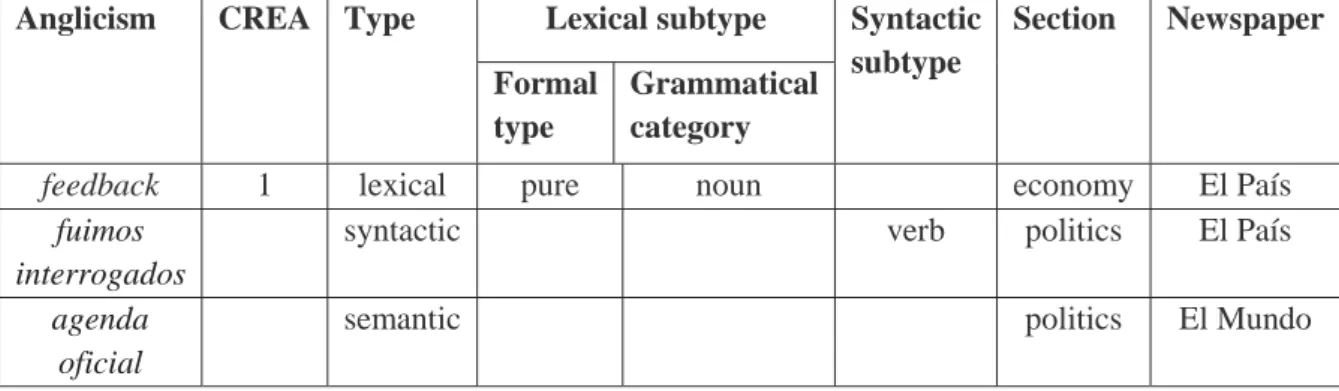
23 Table 1. Anglicism classification pattern
According to the information displayed in table 1, our classification pattern
consists of the following fields: anglicism (the target item or structure), frequency of
appearance in CREA (30-0 occurrences) and type of anglicism (i.e. lexical, syntactic or
semantic).
In order to reach this decision, we used the CREA to analyse their frequency of
appearance from 2005 to 2015, only taking into account peninsular Spanish newspapers.
Whilst the appearance of some words i.e.check-in, crowdfunding or hashtag was 0 within
this span, others such as modem, after or flashback had an appearance among 0 and 20
times and some like cóctel, boom or light had an appearance of 30 times or more. We
decided then to discard those words whose frequency was higher than 30 occurrences,
meaning that their usage and appearance might be already standardized in Spanish.
In the case of lexical anglicisms, these were classified according to both the
formal typology (i.e. pure, adapted or false) and the grammatical category of the target
word (i.e. noun, verb, adjective or adverb); and in the case of syntactic anglicisms, these
were classified according to the grammatical category affected (i.e. preposition, verbs,
adjectives, etc).
Anglicism CREA Type Lexical subtype Syntactic
subtype
Section Newspaper
Formal type
Grammatical category
feedback 1 lexical pure noun economy El País
fuimos interrogados
syntactic verb politics El País
agenda oficial
24 Finally, the section within the newspaper (i.e. economy, politics, sports, culture
and society) where each anglicism was found, and also the date of the articles under
analysis (i.e. 10th, 30th January) and the newspaper where each anglicism is found (i.e. El
País, El Mundo, El Español) are included in the database of the present study. [For a more
detailed description of the classification pattern see the CD attached to this dissertation].
The exploitation of the database from both a quantitative and a qualitative perspective will be described in the following section, where the main results of our
analysis will be presented
.
7- Results and discussion
A for the results obtained, we will first present the total amount of anglicisms
found in the present study according to their typology (i.e. lexical, syntactic, semantic).
Then we will discuss them individually in the following order: lexical anglicisms,
syntactic anglicisms and semantic anglicisms. Finally, we will also display the results
according to the newspapers in which anglicisms were found.
7.1 Anglicisms typology
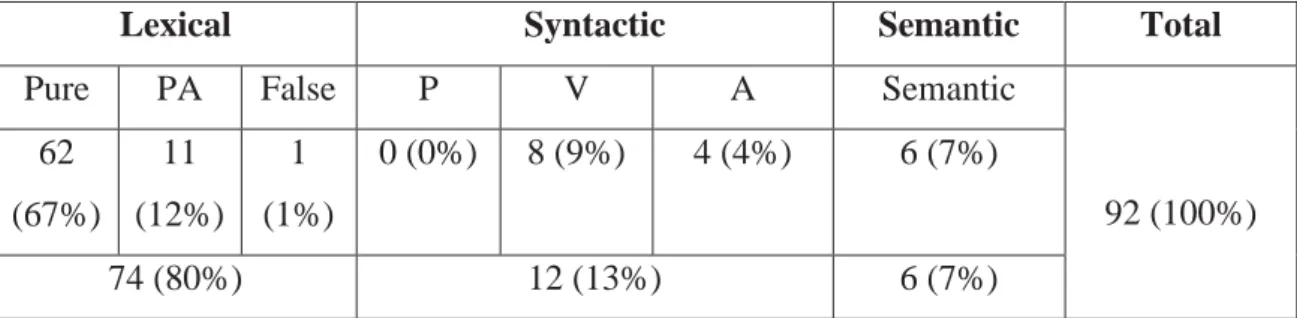
Most of the anglicisms found for the present study, were lexical anglicisms (74
cases, 80%) followed by syntactic (12, 13%) and semantic anglicisms (6 cases, 7%)
25 Table 2. Total of anglicisms
PA [Partially Assimilated]; P [prepositions]; V [verbs]; A [Adjectives]
These general results show then that most frequent form of anglicisms is found at
the lexical level while the least is found at the semantic one. In the following sections, we
will discuss in more detail the results according to the different types of anglicisms at
each linguistic level.
7.1.1 Lexical Anglicisms
Regarding the lexical analysis, the results are displayed in table 3:
Table 3. Lexical anglicisms according to formal types.
Pure Partially-assimilated False Total
62 (84%) 11 (15%) 1 (1%) 74 (100%)
According to the results shown in table 3, we find out that the most frequent
formal type in lexical anglicisms is that of pure anglicisms with the highest percentage of
presence in the articles (84%), whilst partially-assimilated anglicisms do not seem to be
Lexical Syntactic Semantic Total
Pure PA False P V A Semantic
92 (100%) 62
(67%) 11 (12%)
1 (1%)
0 (0%) 8 (9%) 4 (4%) 6 (7%)
26 so frequent as they only represent 15% in our data. The least significant type of anglicisms
in the results obtained were false anglicisms, which only represent 1%.
It is important to mention that within the lexical anglicisms found in the present
work, 7 cases were discarded as, according to our selection criterion (i.e. lower than 30
occurrences in CREA5), they could not be considered anglicisms anymore because they
have already been deeply rooted in our language. (i.e. cóctel, boom, light, ranking, shock,
software and test 6).
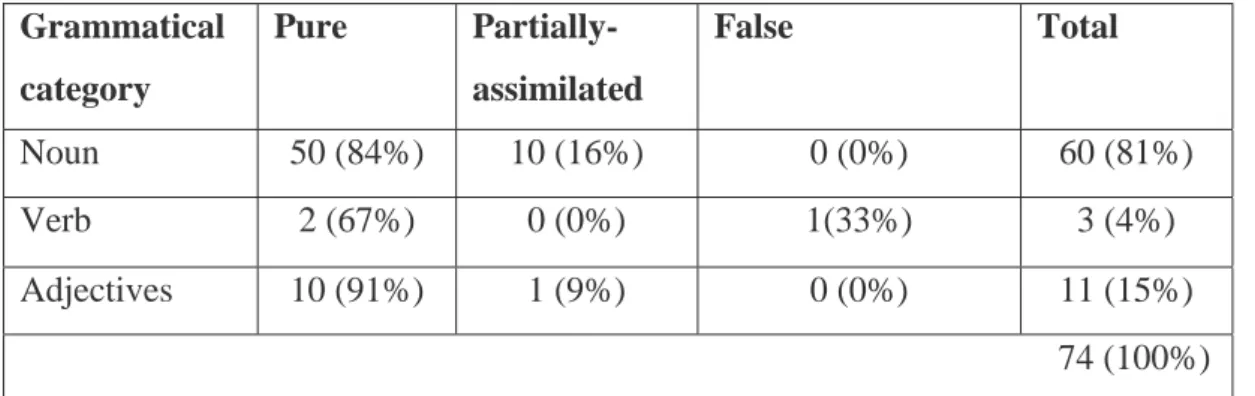
As for the results of the analysis regarding the lexical anglicisms according to the
grammatical category affected, and how they crossed with the formal typology, we
obtained the following results, illustrated in table 4:
Table 4. Lexical anglicisms according to the target grammatical category
5 Although the word flirtear had a frequency lower than 30 occurrences in CREA, we have decided to
discard it as we consider that it might have been an anglicisms some years ago, but now it has fallen into disuse and became obsolete.
6 Only the noun “test” was discarded as lexical anglicism, but the verb “to test” (semantic anglicism) was
kept.
Grammatical
category
Pure
Partially-assimilated
False Total
Noun 50 (84%) 10 (16%) 0 (0%) 60 (81%)
Verb 2 (67%) 0 (0%) 1(33%) 3 (4%)
Adjectives 10 (91%) 1 (9%) 0 (0%) 11 (15%)
27 As table 4 displays, the great majority of anglicisms were found in the form of
nouns, comprising 81% of the items found and most of them corresponded with pure
anglicisms (i.e. they preserve the native form in English and have not been
morphologically adapted to Spanish). Only 11 anglicisms were found as adjectives as
they appeared in the text modifying nouns (i.e. música dub, música tecno, viaje lowcost,
dieta detox) and, paralleling the nouns pattern, these adjectives were also pure anglicisms.
Regarding verbs, only 3 examples comprising 4% were found. (e.g. mentoring, footing
and trigger), most of them corresponding with pure forms as well. Finally, no lexical
anglicisms were found in the form of adverbs or any other grammatical category.
7.1.2 Syntactic anglicisms
Syntactic anglicisms could be considered the most difficult to identify due to two
reasons. As we have explained in our literature background, in contrast to lexical
anglicisms, there are not many studies that deal with this issue, so to our best knowledge,
there is a lack of attention and research (Rodríguez-Medina, 2000), especially in the last
decade. What is more, some of the structures that we will discuss, are already naturalised
in Spanish, so it is complex to decide whether they can be coined as syntactic anglicisms
under the influence of English or not. For instance, we finally decided not to consider the
following examples as syntactic anglicisms (in this case those affecting verbs in the
passive voice form) as they are already naturalised:
(1) “Su manera de entender el oficio, aprendida fundamentalmente de Carlo
28 (2) “Porque es bien sabido que el corredor del Sky sufre de asma” (El Español,
30 th January, Sports).
Taking this difficulty into account, in this research, although we have sought for
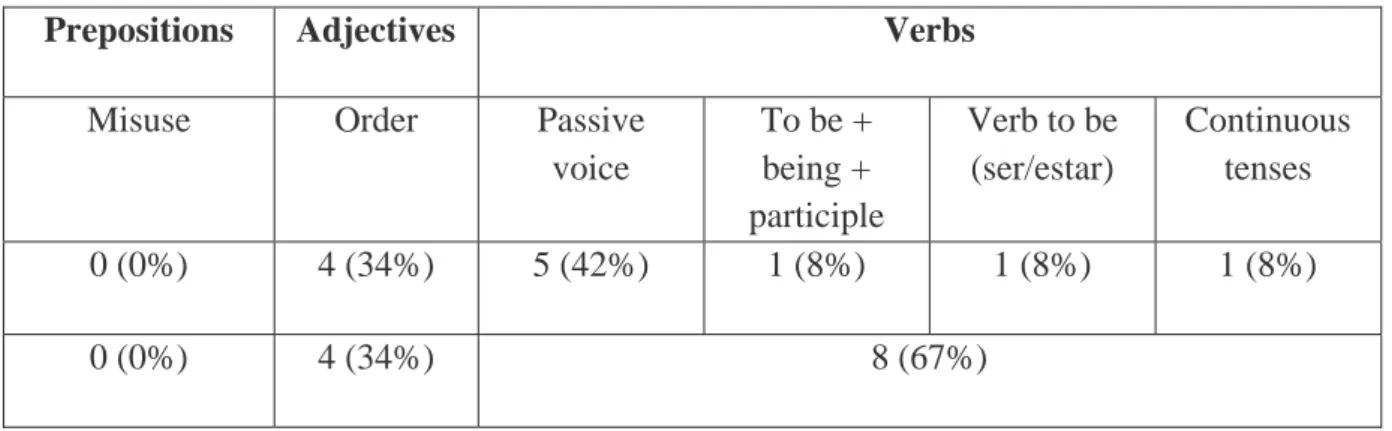
the syntactic anglicisms affecting prepositions, no examples with this syntactic calque
were found, as our results in table 1 show, repeated in part here as table 5.
Table 5. Types of syntactic calques according to the category affected
Prepositions Adjectives Verbs
Misuse Order Passive voice
To be + being + participle
Verb to be (ser/estar)
Continuous tenses
0 (0%) 4 (34%) 5 (42%) 1 (8%) 1 (8%) 1 (8%)
0 (0%) 4 (34%) 8 (67%)
As table 5 shows, only 13% out of all the anglicisms found (a total of 92)
corresponds with the syntactic type and a great number of them (8 cases) are found in
verbs rather than in adjectives (4 cases).
In the case of the English grammar affecting the noun-adjective order in Spanish,
this type of syntactic calque has been particularly challenging to identify, as there are not
many studies that deal with it in-depth. Following our own criteria on the adjective-noun
or noun-adjective order (see section 6.2), we have identified the following instances:
i. “Un lujoso auditorio de Miami” (El Español, 10 th January, sports) instead of “un auditorio lujoso de Miami”.
ii. “El positivo comportamiento de las economías” (El Mundo, 30 th January,
29
iii. “Ofrece un demoledor retrato […] (El País, 10 th January, politics) instead
of “ofrece un retrato demoledor”.
iv. “Una gris llovizna de horror” (El País, 10 th January, society and culture) instead of “una llovizna gris de horror”.
In these examples, it seems that the anteposition of the adjective is preferred. However, we discarded as anglicisms some cases in which the anteposition was necessary, otherwise there would be a change of meaning, as the next examples show:
-
“El editor lo llamó una extraordinaria contribución” (El Español 10 th January,culture-society)
- “No obstante, una alta funcionaria del Gobierno indicó…” (El Español, 30 th January, politics.
As opposed to the instances of anglicisms affecting adjectives, in these two
cases there would be a change of meaning if the adjective were placed after the
noun (contribución extraoridinaria, in the first case, could imply a contribution
after a deadline; in funcionaria alta, the adjective alta would refer to the quality of
being tall instead of having a high position at work). Therefore, we have not
considered these cases as syntactic calques.
As for the syntactic calques affecting verbs, a subclassification of the cases
shown in table 5 has been proposed:
i. Overuse of the passive voice: although the passive voice is used in Spanish,
an overuse of this type of structures could imply an influence of the English
30 constructions such as the active voice or the pasiva refleja are preferred. These
are some of the examples in which we consider there is an unnecessary use of
the passive voice in Spanish:
- “Veo que la tecnología jugará un papel cada vez más beneficioso en todo lo referido a un viaje". (El Mundo,10 th January, Economy) In Spanish the form preferred could be either the active voice or the pasiva refleja: “en todo lo que se refiere” or “en lo referente”.
- “Una vez superado el arco de seguridad al recinto, fuimos interrogados por el origen de la invitación” (El País, 10th January, politics) In this case the active
voice should be used: “nos interrogaron”.
- “La mostramos en forma de un correo electrónico que nos fue reenviado por un asistente” (El País, 10th January, Economy) instead of “que nos reenvió”
- “Explicó Guardiola cuando fue preguntado por el dinero gastado desde que él está en el Manchester City” (El Español, 30 th January, Sports). Also, in this case, the active voice or the pasiva refleja could be used “le preguntaro”, “se le preguntó”
Besides, within this specific syntactic calque, we found another example in which the continuous form comes into play:
- “Los estándares de calidad del aire continuarán siendo excedidos durante meses y años” (El español 30 th January, politics), instead of , for instance, “se
continuarán excediendo”.
ii. Construction of the verb to be + being + past participle: “Las iguanas
31 Society and culture), instead of “las iguanas caían congeladas” or the pasiva
refleja “las iguanas se caían congeladas”.
iii. Misuse of the verbs ser o estar (to be): “la decisión de su expulsión no es justificada en ningún caso" (El Español, 30 th January, Politics). In this case,
there is a misuse of the verb to be, which altought it has the same meaning as the Spanish ser o estar, in English there is just one form. The proper use should be “La decisión no está justificada en ningún caso”
iv.Use of continuous forms instead of simple forms: In Spanish the use of
continuous verbs is more limited than in English and it becomes an anglicism
when it appears repeatedly in certain contexts performing wrong or un-stylish
structures from the Spanish language point of view. (Rodríguez Medina, 2002:
162). In this case we have found the same example as for the construction “to
be + being + past participle”:
- “Las iguanas estaban cayéndose congeladas de los árboles” (El Español, 10 th January, society and culture). The proper construction should be “caían
congeladas”.
7.1.3 Semantic anglicisms
At the semantic level, only three examples of anglicisms have been found. In order
to identify them, we have used two different tools, i.e. English and Spanish dictionaries,
and the CREA. First, we have checked the definition of the anglicism in three different
dictionaries: DRAE, Oxford and Cambridge. Then, the CREA has been used to obtain
32
We will present these three examples individually in a) to c) to justify our classification.
a) Case study 1: Aggressive/agresivo/a
If we check the updated editions of Cambridge Dictionary (2018) we will find very
similar definitions regarding the word aggressive/agresivo:
- Behaving in an angry and violent way towards another person (e.g. If I criticize him, he gets aggressive and starts shouting.)
- Determined to win or succeed and using forceful action to win or to achieve success (e.g. an aggressive election campaign, aggressive marketing tactics).
If we check the previous edition of the DRAE (2001), we do not find the sense of aggressive as a determined person but only the sense of violent:
- Dicho de una persona o de un animal: que tiende a la violencia. - Propenso a faltar al respeto, a ofender o a provocar a los demás. - Que implica provocación o ataque. (e.g. Palabras agresivas).
However, in the last update of the DRAE (2018), we see how two entries have been added to the ones found in the 2001 edition:
- Que resulta llamativo o rompe con el orden establecido. (e.g. estética agresiva). - Que actúa con dinamismo, audacia y decisión. (e.g. ejecutivo agresivo, empresa
agresiva).
In our compilation of anglicisms we have also found several examples where we see how this new sense of the word agresivo/a was used:
33
ii. Al mismo tiempo, el consumo local se ha reactivado también gracias a la recuperación económica y agresivas campañas comerciales como el Black Friday. (El Mundo, 10 th January, economy).
Besides, we have extracted from CREA instances in which we can see more instances of the different senses of the word in different contexts, as shown in Figure 1.
However, we decided to discard some examples as the sense of the word may be ambiguous, i.e. […] como Trump, el empresario agresivo que catapultó el imperio familiar (El País, 30th January, politics). In this case, we could think of Trump as a determined and bold businessman but at the same time, the adjective agresivo could also refer to Trump´s nature or way of being in the sense of violent, or to his vehement speeches.
b) Case study 2: Agenda/Agenda
In Cambridge dictionary we find the following entries:
- A list of items to be discussed at a formal meeting. (e.g. “the question of nuclear weapons had been removed from the agenda”).
- A plan of things to be done or problems to be addressed. (e.g. “he vowed to put jobs at the top of his agenda”).
34
- The underlying intentions or motives of a particular person or group. (e.g. “Miller has his own agenda and it has nothing to do with football”).
-However, in the 2001 edition of the DRAE we only find the following two entries:
- Libro o cuaderno en que se apunta, para no olvidarlo, aquello que se ha de hacer.
- Relación de los temas que han de tratarse en una junta o de las actividades sucesivas que han de ejecutarse.
The extension of meaning in this case is seen in the new edition of the DRAE (2018), where a new sense is added together with the two last definitions:
- Relación ordenada de asuntos, compromisos o quehaceres de una persona en un período.
In our research we have found the following examples that reflect this new sense:
i. “Atrás queda una de las alfombras rojas más glamurosas del año, pero la agenda de las celebs no descansa” (El Mundo 10 th January, culture and society).
ii. “En este sentido, Echenique ha achacado que no se haya hablado de su agenda social porque los medios son quienes deciden” (El mundo 10 th January, politics).
iii. “[…] pues además de suponer el estreno de la agenda oficial de Leonor como princesa de Asturias, simboliza la continuidad de la institución” (El Mundo, 30 th January, politics).
c) Case study 3: To test/Testar
35
something is not found in the DRAE but it is actually used in the press language, as we will see in the examples extracted from our data.
On one hand, if we check Oxford Dictionary we find that the verb to test is defined as:
- To take measures to check the quality, performance, or reliability of
(something), especially before putting it into widespread use or practice. (e.g. “This range has not been tested on animals”).
On the other hand, in both 2001 and 2018 editions of the DRAE, we do not find this sense of the word but instead, we find other definitions:
- Hacer testamento. - Tachar, borrar.
- Declarar o afirmar como testigo.
However, even though we cannot find this sense in the DRAE, in our research, we have found the following example where we can see how this new sense is actually used:
i. La novedad del laboratorio es que permite simular las condiciones reales de uso de un determinado producto para testar los niveles de aceptación del consumidor (El País, 10 th January, Economics)
In this example, it is quite clear that the verb testar does not make reference to any of the definitions provided by the DRAE but to the one contained in the Oxford Dictionary.
Besides, we can also find some examples in CREA displayed in Figure 2.
36
In figure 2, token 2 “[…] El verano es un buen momento para testar nuevos formatos” and token 5 “[…] Primero debemos testar la calidad de la moda Española”
plainly show the additional meaning of the verb testar. These examples do not refer to make a will or to declare as a witness but to analyse or assess a quality or a performance.
These instances together with the ones found in our research shows how there has been an extension of meaning in these case studies due to the influence of English. However, whereas agresivo and agenda have already been included in the DRAE, the additional sense of testar has not been admitted yet. Thus, this might mean that this could be considered a more recent case of semantic anglicism.
7.2 Anglicisms in newspapers sections
The last aspect of our analysis was aimed to determine which section within the newspapers we chose for the present study contains more anglicisms and which is the newspaper out of the three chosen for the present study where it is more likely to find anglicisms.
Table 6. Anglicisms according to the sections within newspapers
Lexical Syntactic Semantic Total
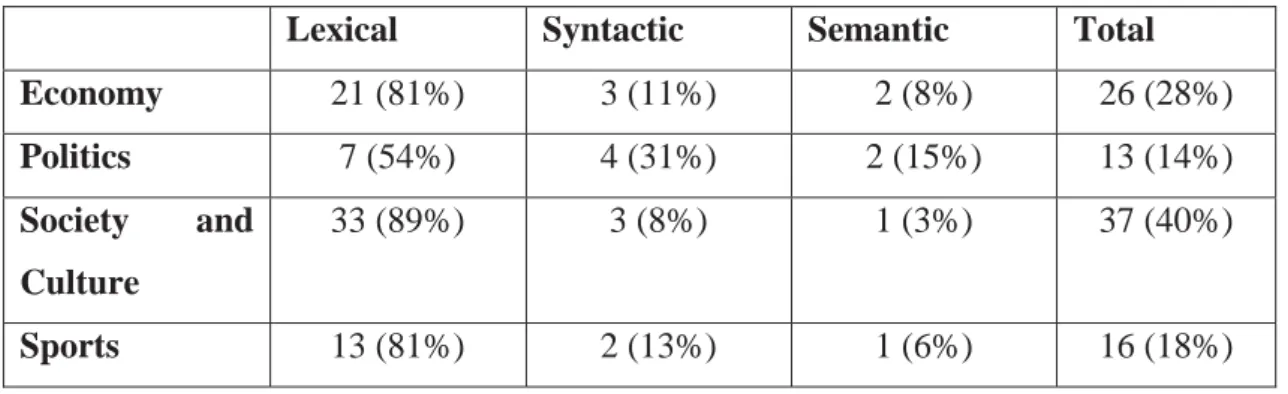
Economy 21 (81%) 3 (11%) 2 (8%) 26 (28%)
Politics 7 (54%) 4 (31%) 2 (15%) 13 (14%)
Society and Culture
33 (89%) 3 (8%) 1 (3%) 37 (40%)
37
As shown in table 6, the section in which more anglicisms were found is society and culture with 40%, followed by economy (28%), sports (18%) and politics comprising only 14% out of the total of anglicisms. Besides, in all section the predominant anglicisms in the lexical one, followed by the syntactic and semantic, which have less prominence.
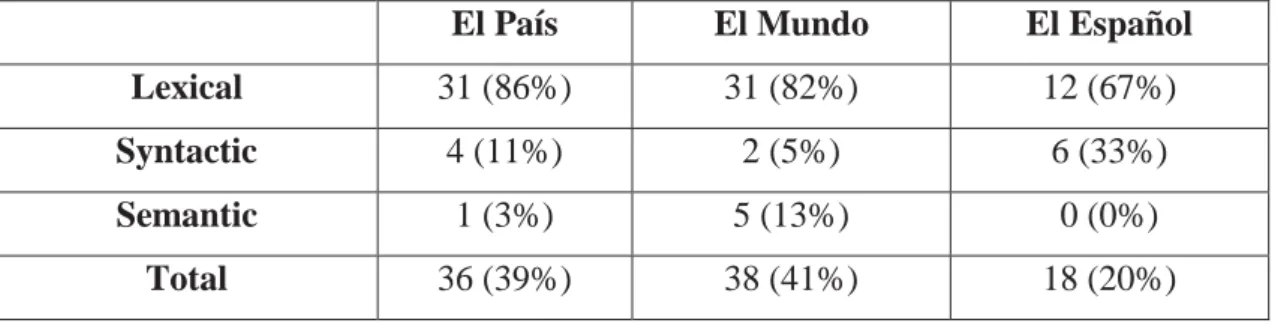
Regarding the newspapers and as displayed in table 7, the newspaper containing more anglicisms (and lexical anglicisms more specifically) according to our study is El Mundo, followed by El País, comprising a very similar total percentage (41% versus 39%) respectively. In contrast, El Español resulted to be the one with the least amount of anglicisms (20%).
Table 7. Newspapers and the distribution of anglicisms
El País El Mundo El Español
Lexical 31 (86%) 31 (82%) 12 (67%)
Syntactic 4 (11%) 2 (5%) 6 (33%)
Semantic 1 (3%) 5 (13%) 0 (0%)
Total 36 (39%) 38 (41%) 18 (20%)
As for the rest of anglicisms, it seems that in El Español syntactic calques are a bit more prolific (6 cases) than in the other two newspapers (El País, 4 cases; El Mundo, 2 cases), while the highest number of syntactic calques is found in El Mundo (5 cases).
7.3 Final Discussion
38
Out of our compilation, we encountered a total of 92 anglicisms (i.e. 74 (80%) lexical, 12 (13%) syntactic and 6 (7%) semantic). It was expected that lexical anglicisms would be the most common type of anglicisms, as to borrow a word from a different language seems to be the quickest way to add new objects or concepts to our vocabulary. These general results then sustain a statement proposed by Rodríguez Gonzalez (1999), when he stated that “English influence in Spanish can influence all levels of language. However, it is most visible in spelling, pronunciation, morphology and lexis, and is hardly noticeable in semantics, pragmatics and syntax”. (106-107).
Within lexical anglicisms, out of 74 anglicisms (80%), our results have shown that the most frequent are pure anglicism comprising 84%. This is the case of the anglicisms that have been recently incorporated into Spanish, and which in many cases have a frequency 0 in the CREA. (i.e. crowdfunding, smartphone, start-up). Partially-assimilated anglicisms only comprise 15% of the anglicisms found, and most of them showed a frequency higher than 5 in the CREA (i.e. pádel, trailer). From these results we can infer that adapted anglicisms are not as recent as pure anglicisms, as the process of adaptation in many cases carried out by the RAE requires a certain period of time since the use of pure anglicisms emerges in Spanish until it becomes morphological and phonetically adapted. In what refers to false anglicisms, only one instance was found (i.e. footing). Since false anglicisms are words that are thought to be original from English, but which actually do not exist, it was not expected to find many examples, as probably this type of anglicisms is more frequent in other mediums rather than in the press.
39
(4%). However, we did not find any example of an adverb or any other grammatical category. Therefore, it seems that nouns are the easiest category to borrow from English.
In what refers to syntactic anglicisms, they comprise 13% out of the total of anglicisms, being the syntactic calques affecting verbs the most frequent (67%) and followed by the ones affecting adjectives (33%).
As explained in section 7.1.2, syntactic anglicisms could be considered the most challenging and difficult to identify, as opposed to lexical anglicisms. Within the syntactic calques affecting verbs, the most frequent according to our results is the overuse of the passive instead of active voice, comprising the 42% out of the 12 syntactic anglicisms found. The rest of syntactic calques represent lower percentages, and then considered less common mainly due perhaps to the fact that importing syntactic structures might imply the use of other more complex mechanisms than just importing a word.
Regarding the last type of anglicism, we found 3 cases of semantic anglicisms and a total of 6 instances in which they appear, representing 7% out of the total and corresponding to three words (i.e. aggressive, agenda, test). As well as at the level of syntax, these anglicisms are difficult to find since what it is borrowed in this case is not the word but the meaning, which leads us to conclude that importing meanings to language is harder than importing words (even more difficult than borrowing syntactic calques).
40
point out that the society and culture section seems to be more directly linked with more external cultural issues (e.g. movie stars, trends, celebrities, etc.) while most of the political topics in the selected articles are related to more domestic issues, that is, those happening mainly in Spain. Besides, refined results show that whilst lexical anglicisms (most of them pure) are mostly found in the section of society and culture, syntactic and semantic anglicisms are more equally distributed in all sections.
41
8. Conclusions
By way of a conclusion, this study was aimed to find and analyse anglicisms at three linguistic levels (i.e. lexical, syntactical, semantic), since to the date and to our best knowledge, there are no studies that discuss this issue from this threefold perspective at the same time: Whilst lexical anglicisms have received much attention, regarding syntactic and semantic anglicisms there seems to be a lack of insight.
As for the classification, although we considered different studies (i.e. Rodríguez Medina, 2002,2016; Oncis-Martínez, 2009; Fernández-Marrero, 2008, among others), we decided to make our own classification adopting some of the types discussed by different approaches and taking into account the three linguistic levels at the same time. Besides, in order to present and organise our results, a data base with our proposed classification pattern was created in order to analyse all the anglicisms found in 240 articles from three different newspapers, considering different linguistic and pragmatic variables. The results of our research proved that lexical anglicisms are more frequent than syntactic and semantic anglicisms. However, it is true that lexical anglicisms are easier to identify whereas at the syntactic and sematic level the search for anglicisms was more complex and we encountered several difficulties and ambiguities. Besides, we determined that within the newspapers selected, most anglicisms were found in the section of culture and society.
42
conservative regarding the use of syntactic calques, maybe because they are more difficult to detect.
43
Works Cited
Alfaro, Ricardo. El Anglicismo en el Español Contemporáneo. Centro Virtual Cervantes.
Volume 4, n. 1. 1948. (cvc.cervantes.es/lengua/thesaurus) Accessed 20 Nov. 2018.
Alfaro, Ricardo. Diccionario de Anglicismos. Madrid: Gredos. 1970
De la Cruz, Isabel and Tejedor, Cristina. ¿E-mail or Correo Electrónico? Anglicisms in Spanish. “Revista Española de Lingüística Aplicada” Vol. Extra 1, 2012.
Dubois, Jean, Mathee Giacomo, and Louis Guespin. Dictionnaire De Linguistique: Par Jean Dubois [et Al.]. Paris: Larousse, 1973. Print.
Fernández Marrero, Ana. La Sintaxis y la Ortografía. Dos Niveles Lingüísticos bajo la Influencia del Inglés. “Revista de Filología”. Universidad de la Laguna. 2008, pp.
31-45.
“Gerundio De Posterioridad.” Fundeu BBVA (fundeu.es/recomendacion/el-gerundio-con-valor-de-posterioridad-es-incorrecto-825/.) Accessed 10 March 2019.
Haugen, Einar. The Analysis of Linguistic Borrowings. “Language: Linguistic Society of America” Vol. 26, n. 2. 1950.
Lorenzo, Emilio Anglicismos en la Prensa. “Primera reunión de Academias de la Lengua Española Sobre el Lenguaje y los Medios de Comunicación”. Madrid: Real Academia Española, 1987. pp. 71-79.
Lorenzo, Emilio, El Español de Hoy. Lengua en Ebullición. Madrid: Gredos. 1980.
Lorenzo, Emilio. Anglicismos Hispanicos. Gredos, 1996.
44
Loubier, Chrisitane. De l´ Usage de l´ Emprunt Linguistique. “Office Québécois de la Lange Française”, 2003.
Luján-García, Carmen. The Impact of English on Spanish Daily Life and some Pedagogical Implications. “Nordic Journal of English Studies” Vol. 11, n.1. 2012.
Martin, Pedro. A Genre Analysis of English and Spanish Research Paper Abstracts in Experimental Social Sciences. English for Specific Purposes 22.1 (2003): 25-44.
Med, Keio J. In Defense of the Passive Voice in Medical Writing. pp. 64(1):1-10. DOI: 10.2302/kjm.2014-0009-RE. Epub 2015.
Núñez-Nogueroles, Esperanza. The Use of Anglicisms in Various Thematic Fields: An Analysis Based on the Corpus de Referencia del Español Actual. “Anglica: An
International Journal of English Studies” pp. 123-149, 2017.
OED Online, Oxford University Press, December 2018,
(oed.com/viewdictionaryentry/Entry/11125). Accessed 23 Jan. 2019.
Oncis-Martínez, José. Towards a Corpus-Based Analysis of Anglicisms in Spanish: A Case Study. Universidad de Murcia. IJES, pp. 115-32. 2009.
Planchon, Cécile. Anglicisms and Online Journalism: Frequency and Patterns of Usage. Université d´Ottawa “Belas Infiéis”, v. 3 n.2, pp. 43-61, 2014.
Pratt, Chris. El Anglicismo en el Español Peninsular Contemporáneo. Gredos, 1980.
Real Academia Española. (2001). Diccionario de la lengua española (22.a ed.).
45 Real Academia Española. (2014). Diccionario de la lengua española (23.ª ed.).
Consultado en www.rae.es/rae.html. Accessed 10 Apr. 2019.
Real Academia Española: Banco de Datos (CREA) [en línea]. Corpus de referencia del
español actual. <http://www.rae.es> Accessed 20 Feb. 2019.
Rey, Alain. La Lexicologie: Lectures. Paris: Klincksieck, 1970.
Rodríguez, Félix. Anglicisms in Contemporary Spanish. An Overview. “Atlantis”, vol. 21, no. 1/2, 1999, pp. 103–139. JSTOR, (jstor.org/stable/41055543).
Rodríguez, Félix and Lillo, Antonio. Nuevo Diccionario de Anglicismos. Madrid: Gredos.
1997.
Rodríguez Medina, María Jesús. El Anglicismo en Español: Revisión Crítica del Estado de la Cuestión. “Philologia Hispalensis”, 14 (1), pp. 99-112. 2000.
Rodríguez-Medina, María Jesús. Los Anglicismos de Frecuencia Sintácticos en Español:
Estudio Empírico. RAEL. N. 1, pp. 149-170. 2002.
Rodríguez-Medina, María Jesús. The Use of Anglicisms in Spanish Television Commercials of Cosmetics, Hygiene and Personal Care Products.
“Hermes-Journal of Language and Communication in Bussiness”. pp. 158-169, 2016.
Stone, Howard. Los Anglicismos en España y su Papel en la Lengua Oral. “Revista de Filología Española” Vol 41, n. ¼. 1957.
46 Vázquez, María. Los Anglicismos en la Lengua Española a través de la Prensa de la
Primera Mitad del siglo XXI. “Revista de Investigación Lingüística”, n. 17 pp. 221-241.