RESEARCH REPORT SERIES
I Z A Research Report No. 3
Assessment of Possible Migration
Pressure and its Labour Market Impact
Following EU Enlargement to Central
and Eastern Europe
Thomas K. Bauer
Klaus F. Zimmermann
Thomas Bauer · Klaus F. Zimmermann
ASSESSMENT OF POSSIBLE MIGRATION PRESSURE
AND ITS LABOUR MARKET IMPACT FOLLOWING EU
ENLARGEMENT TO CENTRAL AND EASTERN
EUROPE
A Study for the
Department for Education and Employment, United Kingdom
EXECUTIVE SUMMARY
In 1998, the European Union opened negotiations with six Central and Eastern European countries seeking membership. These countries consisted of the Czech Republic, Estonia, Hungary, Poland, Slovenia, and Cyprus. Some current members are apprehensive, believing that they will lose from this expansion. This report scrutinizes the grounds for such anxiety. It evalu-ates the size and the structure of future East-West migration flows based on economic theories and empirical results forthcoming from economic litera-ture. A broader analysis of the East-West migration potential is given in the complementary report by the University College, London. The current report also analyses concerns that cheaper workers from Central and Eastern European EU-candidate countries will flood the current EU and reduce the wages of native workers and/or push them out of their jobs.
It is very difficult to estimate the potential migration flow from East to West. Studies attempting to estimate the size of the migration potential have arrived at very different conclusions. Newspapers and politicians have spe-culated that about 20-40 million East Europeans will emigrate. Estimations based on opinion polls in the sending countries suggest that between 13 and 27 million people are planning to move to the West, whereas more modest predictions expect about 5 million people to migrate to Western Europe. Using different evaluation methods, this report concludes that at least 3% of the eastern population can be expected to migrate to the West within the next 15 years. This would imply an immigration flow of about 3 million people or of about 0.81% of the population of the EU in 1995. Existing surveys in the potential sending countries indicate that the short-term migration potential might be higher. Due to existing migration networks, this inflow will largely be a problem for Germany and Austria.
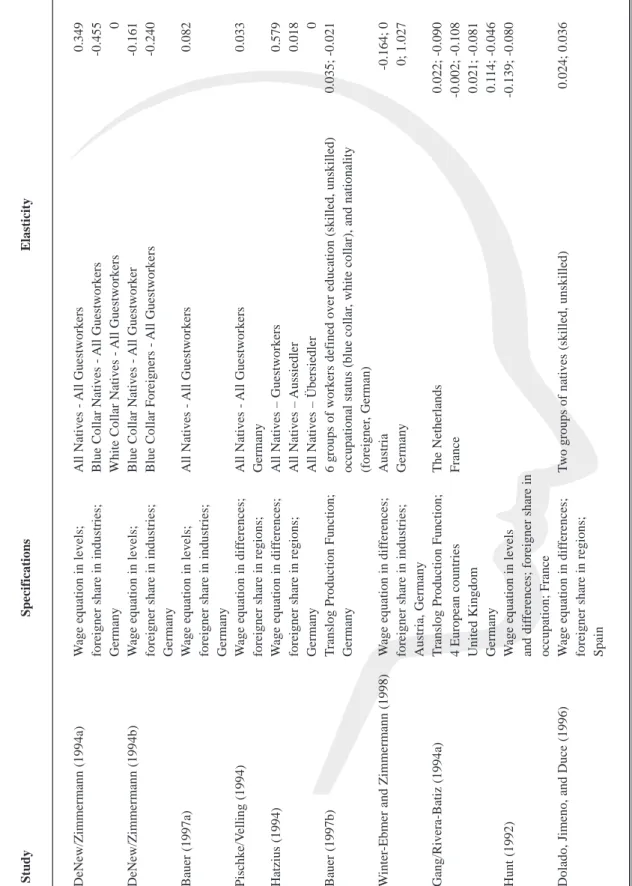
Basically, economic theory does not offer any definitive predictions con-cerning the labour market impacts of immigration. Whether the native popu-lation can expect gains or losses from immigration depends, among other things, on the size and the structure of the immigration flow and the labour market institutions in the receiving countries (i.e. wage flexibility). Most existing empirical studies on the impact of immigrants on the wage and employment of natives find only small negative effects. In some cases the effects are even positive.
figure is 2.027 billion ECU (or 0.26% of the UK GDP in 1996) and for Germany, the maximum simulated loss is 8.975 billion ECU (0.65% of the German GDP in 1996). These losses would appear in a scenario of rigid wages and the immigration of exclusively unskilled workers. In the case where mainly skilled workers immigrate, one could actually expect gains from immigration. A 1% increase in the EU labour force in one year, due to the immigration of skilled workers, could be expected to increase the income of natives by about 367.092 billion ECU or about 6.9% of EU GDP in 1993. A similar increase in the UK and German labour force, could be expected to increase the income of natives by about 4.205 billion ECU (0.53% of UK GDP) in the UK and by 19.192 billion ECU (1.38% of the German GDP) in Germany. Simulations, however, also show that immigration always has large effects on the income distribution in the receiving country.
Contents
1. Introduction 1 1
2. Evaluation of Potential Migration Flows from
Central and Eastern Europe to the EU 3
2.1. The size and structure of current migration flows
from Central and Eastern Europe to the EU 3
2.1.1. Current Migration to the EU 3
2.1.2. Temporary Migration From East and Central
Europe: The Case of Germany 7
2.2. Reasons to migrate: A survey of the theoretical
and empirical literature 13
2.2.1. The theory of migration 13
2.2.2. Empirical studies on migration 22
2.3. Evaluation of the size and structure of future
East-West migration 31
2.3.1. Existing estimations of the size and structure of
future East-West migration 31
2.3.2. Evaluation based on surveys in the sending regions 33 2.3.3. Evaluation based on the economic and
demographic situation in Eastern and Western
Europe 37
2.3.4. Evaluation based on econometric results 44
2.4. Summary 46
3. The labour market effects of East-West migration 48
3.1. The theoretical framework 48
3.1.1. A simple model of the labour market effects of
immigration 48
3.1.2. The effect of immigration in rigid labour markets 50
3.2. Empirical studies on the labour market effects of
migration: A survey 54
3.2.1. The effect of immigration on native wages 54
3.2.2. Employment and Unemployment 60
3.3. Simulating the potential effects of future East-West
migration 65
4. Policy implications 75
4.1. The need of a common EU immigration policy 75
4.2. Options for a unified EU migration policy towards
Central and Eastern European countries 76
4.2.1. Free labour mobility 77
4.2.2. Temporary selective migration policy 78
4.3. Summary 80
5. Conclusion 82
References 84
Appendix A: Survey "Assessment of possible migration pressure following EU
enlargement to Central and Eastern Europe 97 Appendix B: Estimation Results for the Simulation in
Section 2.3.4. 101
Appendix C : A theoretical model of the labour market effects
of immigration 103
List of Tables
Table 1: Stock of foreign population in 1993 (in Thousands) 6 Table 2: Characteristics of bilateral agreements of Germany
with CEEC countries concerning temporary immigration 9 Table 3: Socio-economic characteristics of temporary Polish
migrants in Germany (1995) 12
Table 4: Signs of the coefficients in econometric studies on
migration using aggregate data 25
Table 5: Signs of the coefficients in econometric studies of
individual migration 30
Table 6: Target countries for migrants in Central and Eastern
European Countries (Percentage of whole sample) 35 Table 7: Preparations for emigration (in %) 36 Table 8: Economic indicators of West, Central and Eastern
Europe 38
Table 9: Demographic indicators 43
Table 10: Simulated emigration rates from East Europe to the EU based on econometric results (in % of the
population in the sending country) 45
Table 11: Elasticities of native wages with respect to a 1%
increase of foreign employment 56
Table 12: Simulated long-run labour market effects of EU enlargement towards Central and Eastern Europe (billions of ECU) due to the immigration of 1% of
the EU population in the year after enlargement 68 Table A.1: IZA survey on potential migration flows from the
East to the West 100
List of Figures
Figure 1: Share of foreign population in Western European
countries, 1993 (in % of total population) 4 Figure 2: Share of foreign population from Central and Eastern
Europe in Western European countries, 1993
(in % of total population) 5
Figure 3: Workers employed in Germany under a contract for
services, 1988-1996 8
Figure 4: Guest workers employed in Germany, 1991-1996 10 Figure 5: Seasonal workers employed in Germany, 1991-1996 11 Figure 6: Push and pull migration and the economy 21 Figure 7: Estimations of future migration pressures from the East
using the approach of Layard et. al. (1992) (in 1,000) 32 Figure 8: Individuals in Central and Eastern Europe who would
like to work abroad and intended migration duration
(Percentage answering "very likely" or "likely") 34 Figure 9: GDP per capita in 1995 (PPP US $) 40 Figure 10: Labour market effects of immigration in the
neoclassical model 49
Figure 11 Labour market effects of immigration in the case of
rigid wages 53
Figure 12: Calculating the labour market effects of immigration:
equilibrium model 67
Figure 13: Immigration gains of natives according to production
factors 70
Figure 14: Calculating the labour market effects of immigration:
1. INTRODUCTION
In 1998 the European Union opened negotiations with six Central and Eastern European countries seeking membership. Based on the capacity of these countries to bring their economic, political, and legal systems into line with EU norms, the European Union divided the candidates for EU membership into two groups. The first group consists of the Czech Republic, Estonia, Hungary, Poland, Slovenia, and Cyprus. With this group of countries the EU began preparatory talks in March 1998. The second group consists of Bulgaria, Latvia, Lithuania, Romania, and Slovakia. These countries must bring their economies closer to EU standards, before opening talks with them would be worthwhile for the EU. In principle, all EU members favour the idea of extending the EU. However, some current members fear that they will lose from this expansion. More specifically:
• countries like Ireland and Spain are concerned that they will lose regional aid from the EU;
• France is worried about loosing subsidies for the agricultural sector; • and finally there are fears of potentially large-scale immigration of job seekers from entering countries into the current EU-member countries. In particular, countries with direct borders to the potential new EU members, such as Austria and Germany, have expressed this latter fear.
This report analyses the fear that cheaper, unemployed worker from Central and Eastern European EU-candidate countries will flood the current EU, reducing the wages of native workers or pushing them out of their jobs. It is evident that EU wages are higher than in the applicant countries. Unemployment in the Czech Republic, Estonia, and Hungary, however, is lower than the EU average. Similar fears were voiced when Greece, Spain, and Portugal applied for EU membership. Yet, despite the economic differences between these countries and the richer North, the expected mass migration did not occur. It is therefore not clear per se whether the current EU members have to fear mass migration from the East to the West, when the Eastern European candidates become EU members.
of the size of East-West migration following the opening up of Central and Eastern European countries in the beginning of the 1990s. Second, we qualitatively evaluate the future East-West migration pressure, based on the economic and demographic situation in Eastern and Western Europe. Third, we use a survey of the applicant countries to evaluate future migration flows. Finally, we use econometric methods in order to study the determinants of internal migration in the current EU. The results of this econometric analysis are then used to predict future East-West migration.
Section 3 analyses the labour market effects of East-West migration. In the first part, we review the theoretical framework used in economics to analyse the labour market effects of immigration. This review considers not only the standard economic model, which assumes full employment, but also economic models, which take into account the possibility of labour market rigidities, i.e. the possibility of unemployment. The latter model is more suitable for European labour markets. The second part gives a detailed survey of the existing empirical evidence concerning the effects of immigration on wages and employment of natives. In the final part, we use the theoretical models outlined in Section 3.1., data from the EU and the size of the expected migration flow from the applicant countries (evaluated in Section 3.2), in order to simulate the likely labour market effects of the immigration of workers to current EU member countries.
2. EVALUATION OF POTENTIAL MIGRATION FLOWS
FROM CENTRAL AND EASTERN EUROPE TO THE
EU
2.1. The size and structure of current migration flows from Central and Eastern Europe to the EU
2.1.1. Current Migration to the EU
In this section we discuss the migration experience of EU member countries. We focus not only on immigration from Eastern and Central European countries but also on the internal migration experience of the 15 EU countries. We use experience with internal migration within the EU to infer potential future immigration flows from Eastern European countries following a potential enlargement. Table 1 shows the stock of foreign population living in the EU member states in 1993. In total, approximately 17 million foreigners live in the respective EU countries, of which about 4.9 million people or 1.3% of the total EU population come from within the EU and about 12 million people or 3.3% of the total EU population come from outside the EU. The main receiving countries for both foreigners from the EU and migrants from outside the EU, are Germany, France, and the United Kingdom. Approximately 4.0 million foreigners from outside the EU originate from Turkey and the former Yugoslavia, 2.9 million from Africa, 1 million from America, 1.9 million from Asia, and 1.1 million from Central and Eastern Europe. The main receiving country for people from the EU is Germany, followed by France and the United Kingdom. People from areas outside the European Union predominantly go to Germany. Even Asia has a larger immigrant population in Germany than in the United Kingdom.1
Among the major European immigration countries, Germany attracts mostly Turks, people from the former Yugoslavia, and migrants from Central and Eastern European countries. France receives Africans, while the United Kingdom mainly attracts migrants from EU member states and Asia. Figure 1 shows that Germany, Switzerland, and Belgium have the highest shares of foreigners, followed by France, Austria, and Sweden.
According to Table 1, approximately 67% of all immigrants from Central and Eastern Europe reside in Germany, followed by Austria, Italy, France, the United Kingdom, and Greece. Roughly 41.2% of all Central and Eastern European migrants come from Poland, 20.7% from Romania, 8.4% from the former Czech and Slovakian Federal Republic (CSFR) and Hungary, and 7.5% from Bulgaria. Figure 2 shows the share of migrants from Central and Eastern European countries in relation to the total population in each of the respective EU countries. According to this figure, Germany and Austria have the largest shares of foreigners from Eastern Europe followed by Sweden, Finland, and Switzerland.
Figure 1:
Share of foreign population in Western European Countries, 1993 (in % of total population)
Source: Eurostat (1995), own calculations.
The numbers in Table 1, however, do not include Aussiedler, immigrants of German origin from East Europe. Ethnic Germans automatically receive German citizenship and, therefore, disappear from the official statistics on immigrants.2 As a consequence of the collapse of the socialist regime, the
inflow of Aussiedler in West Germany jumped from 78,523 in 1987 to
> 8.0% (3) from 4.0% to 8.0% (4) from 2.0% to 4.0% (4) from 1.0% to 2.0% (5) < 1.0% (1)
202,673 in 1988, 377,055 in 1989, and 397,073 in 1990. Consequently, the German government altered the entry procedures for Aussiedler in 1990, requiring them to apply for entry before arrival. In the meantime, Germany has also introduced an immigration quota for a maximum of 220,000 ethnic Germans per year and now requires the passing of a German language test in order for an immigrant to be eligible for Aussiedler status. These measures led to a reduced immigration flow: between 1991 and 1995 Aussiedler immigration was about 220,000 per year, falling to 177,751 in 1996 and 134,419 in 1997. In total, between 1950 and 1997, 3.8 million ethnic Germans migrated to West Germany. From 1988 to 1997, 65.4% of the
Aussiedler came from the former USSR, 24.7% from Poland, and 9.2% from
Romania. At the end of 1997, 98% of the ethnic Germans came from the former USSR, while the shares of ethnic Germans from Poland and Romania decreased to 0.5% and 1.3%, respectively. In total, between 1950 and 1993, 3.068 million Aussiedler migrated to West Germany. Adding this number to those reported in Table 1, it appears that about 91% of all Central and East European migrants in the EU live in Germany.
Figure 2:
Share of foreign population from Central and Eastern European Countries in Western European Countries, 1993 (in % of total
population)
Source: Eurostat (1995), own calculations.
T
able 1: Stock of for
eign population in 1993 (in thousands)*
T
otal
EU 15
Africa
America Asia
2.1.2. Temporary Migration From East and Central Europe: The Case of Germany
Even though most EU member states have tightened their restrictions on permanent immigration, the demand for temporary workers is growing. Given the purpose of this report, we will not give a detailed description of the different legislations in current EU member states regarding temporary migration. A detailed discussion of the characteristics of and the legislation on temporary migration in Australia, Canada, France, Germany, the Netherlands, Switzerland, the United Kingdom, and the United States is given by OECD (1998). Rather, we concentrate our discussion on the bilateral agreements for temporary migration, which Germany has signed with several Central and East European countries (CEEC), and the immigration from these countries to Germany, which has occurred under these agreements.
The following goals were at the core of the bilateral agreements between Germany and the CEEC-countries concerning temporary migration:
• to bring the CEEC-countries up to Western European standards; • solidarity with CEEC-countries;
• to impart skills to firms and workers with modern technology in order to foster economic development in the countries of origin; • to decrease the immigration pressure from these countries; • and to promote economic co-operation with these countries.
Following these goals Germany created three different categories under which workers from CEEC-countries could temporarily work in Germany. Table 2 describes the basic legislative characteristics of these categories.
Germany has signed bilateral agreements with several Central and Eastern European countries regarding the immigration of
Werkvertrags-arbeitnehmer. According to these bilateral agreements, Eastern European
Werkvertragsarbeitnehmer from a particular country exceeds the respective quota, Germany does not allow the immigration of additional workers, and the quota will be blocked the following year. Furthermore, work permits are not granted in districts in which unemployment is significantly higher than the national average.
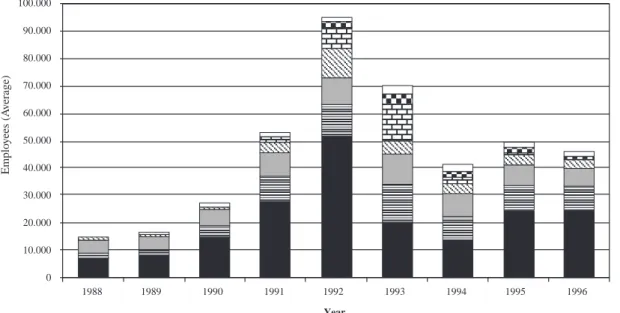
Figure 3: Workers employed in Germany under a contract for services, 1988-1996
Source: Lederer (1997), own calculations.
Figure 3 shows the development of Werkvertragsarbeitnehmer employ-ment in Germany since 1988. It appears that the employment of
Werk-vertragsarbeitnehmer increased sharply from 14,500 in 1988 to 95,000 in
1992. After 1992, the number of Werkvertragsarbeitnehmer decreased to about 46,000 in 1996. This decrease is mainly a result of the steady cut backs of the quotas. Figure 3 also reveals that in most years Polish Werkvertragsarbeitnehmer constituted almost 50% of all workers employed in Germany under these bilateral agreements, followed by workers from Hungary and the former Yugoslavia.
100.000
90.000
80.000
70.000
60.000
50.000
40.000
30.000
20.000
10.000
0
Emplo
y
ees (A
v
erage)
Poland Hungary Former Yugoslavia CSSR/CSFR/CR/SR Romania Bulgaria Other countries
1988 1989 1990 1991 1992 1993 1994 1995 1996
Categories
W
orkers employed under a
contract for services (W
erkvertragsarbeitnehmer)
Guest workers (Gastarbeitnehmer) Seasonal workers
Quotas
•
By economic sector and by country
• Adjusted
annually
according to the labour market situa
-tion in Germany
• By
country
• None.
V
erification
whether similar unemployed natives are available is required. Length of Stay • 2
years
•
3 years in exceptional cases
•
12 – 18 months
• 3
months
Countries
Bosnia-Herzegovina, Bulgaria, Croatia, Czech Republic, Hungary
, Latvia, Lithuania,
Poland, Republic of Macedonia, Romania, Russian Federation, Slovak Republic, Slovenia, Turkey
, Former
Y
ugoslavia
Albania, Bulgaria, Czech Republic, Estonia, Hungary
,
Latvia, Lithuania, Poland, Romania, Russian Federation, Slovak Republic, Switzerland Bulgaria, Croatia, Czech Republic, Hungary
, Poland,
Romania, Slovak Republic, Slovenia.
Conditions
•
Restrictions on activity
•
No possibility for family reunification
•
No possibility for changing status
•
Seconded by employer in the country of origin
•
W
ork permission (except for
workers carrying out mainte nance, reparation or installation of machines furnished by a foreign company if they stay less than 3 months)
•
Restrictions on activity
•
No possibility for family reunification
•
No possibility for changing status
•
Age limit: 18 – 40 years
•
Restrictions on activity
•
No possibility for family reunification
•
No possibility for changing status
•
A
vailability of domestic
workers is grounds for refusal
•
Request must be made by German employer
•
Minimum
Age: 18 years
Table 2:
In addition to the Werkvertragsarbeitnehmer, Germany initiated guest
worker programs with several CEECs. These are also regulated under
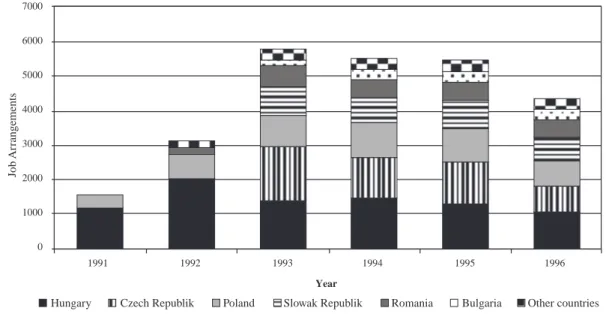
bilateral agreements. The aim of this program is to improve the professional and linguistic skills of the participants. The participants have to meet the following requirements: (i) completion of vocational training, (ii) basic knowledge of the German language, and (iii) fall eighteen and forty years old. These guest workers can stay in Germany for a maximum of 18 months. They need a work permit, even though the programs are not dependent on the labour situation in Germany. They must be paid the same wage as a similar German worker and, in contrast to the Werkvertragsarbeitnehmer, their social security requirements follow the German standards. Figure 4 shows the development of migrants employed in Germany under the guest
worker programs. From 1991 to 1993 the number of guest workers
increased from 1,570 to 5,771 and slightly decreased thereafter to 4,341 in 1996. Most of the guest workers come from Hungary and the Czech Republic, followed by guest workers from Poland and Slovakia.
Figure 4: Guest workers employed in Germany, 1991-1996
Source: Lederer (1997), own calculations.
Since 1991 foreign workers are able to obtain a German work permit for a maximum of 3 months. The requirement to get such a seasonal working permit is again a bilateral agreement between Germany and the country of a worker. Foreign seasonal workers are only allowed to work in agriculture, hotels, restaurants, and as showmen. They must be employed under the same
7000
6000
5000
4000
3000
2000
1000
0
Job Ar
rangements
Hungary Czech Republik Poland Slowak Republik Romania Bulgaria Other countries
1991 1992 1993 1994 1995 1996
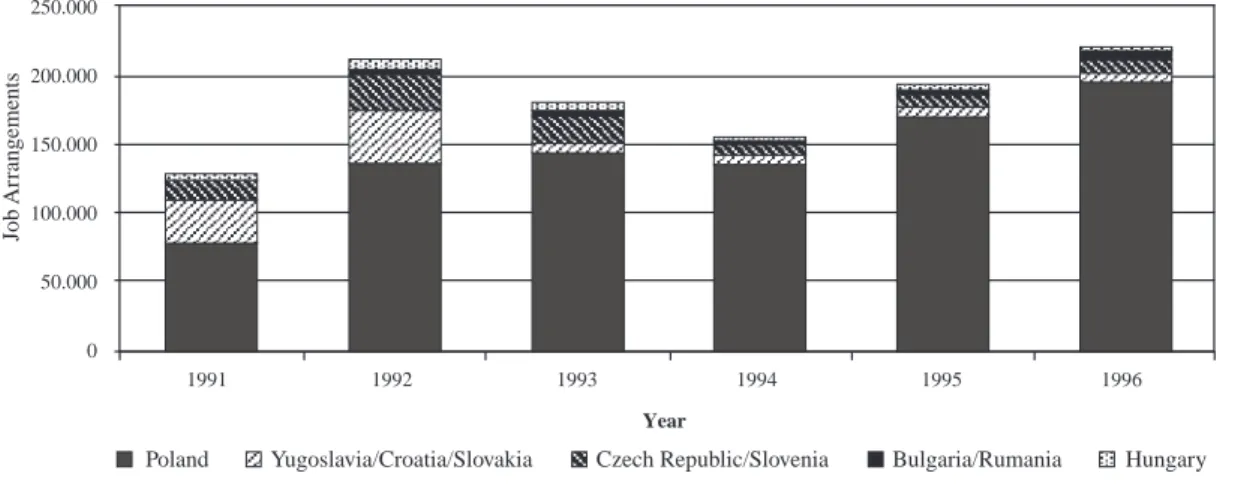
wage and working conditions as German workers and their employment requires the payment of social security contributions according to German standards. In addition, the employer has to provide seasonal workers with accommodations. In general, there is no quota on this type of employment. However, the German labour office has to check whether similarly unemployed native workers are available. Figure 5 shows the development of the employment of seasonal workers since 1991. Figure 5 shows that since 1992 the employment of seasonal workers has been between 130,000 and 220,000 per year. The decrease in seasonal workers in 1993 and 1994 can be explained by the introduction of an employment prohibition in 1993 of
seasonal workers in the construction sector. Despite the poor employment
situation within the German labour market, the employment of seasonal
workers reached its peak in 1996 with about 221,000 workers. Most of the seasonal workers come from Poland; in 1996, for example, they constituted
almost 90% of all seasonal workers.
Figure 5: Seasonal workers employed in Germany, 1991-1996
Source: Lederer (1997), own calculations.
Based on a representative survey of 500 Polish migrants working in Germany, Table 3 explores the motivations behind the demand for work in Germany as well as some socioeconomic characteristics of the migrants.3
According to Table 3, the motivations to work temporarily in Germany are similar among the three categories of migrants analysed. The main reasons given are that they did not earn enough money in Poland and that they wanted to improve the family income. Note that more than 37% of the
250.000
200.000
150.000
100.000
50.000
0
Job Ar
rangements
Poland Yugoslavia/Croatia/Slovakia Czech Republic/Slovenia Bulgaria/Rumania Hungary
1991 1992 1993 1994 1995 1996
Year
seasonal workers had been unemployed in Poland. Based on the
requirements of the bilateral agreements, most of the
Werkvertrags-arbeitnehmer and guest workers work in construction, followed by
manu-facturing. More than 89% of the seasonal workers are employed in agriculture. There are remarkable differences in the occupational status of the three categories. The majority of Werkvertragsarbeitnehmer and guest workers are skilled blue collar workers, whereas more than 90% of the
seasonal workers are employed as unskilled blue collar workers. Finally,
most of the temporary migrants work relatively long hours: 43% work 50 or more hours per week.
Table 3:
Socie-economic characteristics of temporary Polish migrants in Germany (1995)
Werkvertrags- Guest Seasonal
arbeitnehmer Worker Worker
Motivations to work in Germany:
Was unemployed 22.6 23.9 37.4
Did not earn enough 56.7 48.6 43.1
Economic situation in Poland 23.1 26.6 23.7
Improvement of Family Income 40.9 30.3 41.7
Industry:
Agriculture 1.0 9.2 89.1
Manufacturing 25.0 26.6 2.8
Construction 63.0 50.5
-Service (including Hotels and Restaurants) 9.7 11.0 8.1
Other 1.3 2.7 0.0
Occupational Status
Unskilled Blue Collar Worker 17.8 16.5 90.1
Skilled Blue Collar Worker 76.9 72.4 8.1
Unskilled White Collar Worker 2.4 1.8 0.5
Skilled White Collar Worker 2.9 9.2 0.5
Average Weekly Working Time
20 – 39 hours 12.5 34.9 13.3
40 – 49 hours 44.3 55.1 65.9
50 –59 hours 23.1 7.3 13.2
60 or more hours 19.7 2.8 5.7
Observations 208 109 211
2.2. Reasons to migrate: A survey of the theoretical and empirical literature
This section reviews economic theories of labour migration as well as the existing empirical evidence on the determinants of labour migration.4 We
consider internal as well as international migration theories. In general, the main difference between these two approaches is the legal restrictions of international migration. Since there are no legal restrictions on labour migration within the EU5, migration flows between EU member countries
can be interpreted as internal migration. In section 2.3. of this report, we use this approach for the evaluation of the potential future migration flows from the East European countries into the EU.
2.2.1. The theory of migration (a) The Neoclassical approach
The neoclassical approach to migration analysis can be traced back to Smith (1776) and Ravenstein (1889). The basic assumption of this model is that individuals maximise their utility subject to a budget constraint. The central argument evolves around wages. Migration mainly occurs because of geographical differences in the demand and supply of labour markets. Regions with a shortage of labour relative to capital are characterised by a high equilibrium wage, whereas regions with a large supply of labour relative to capital are faced with low equilibrium wages. This wage differential causes a migration flow from low wage to high wage regions. In response to this migration flow, the supply of labour in the high wage region increases; subsequently, the wage in this region falls. Similarly, due to migration, the supply of labour in the low wage region decreases and the wages in this region rise. The migration flow ends as soon as the wage differential between the two regions reflects the costs of movement from the low wage to the high wage region. As a result, the model argues, labour migration emerges from actual wage differentials between regions, i.e. the larger the wage differential the larger the migration flow.
4 Recent surveys are given by Stark (1991), Greenwood (1985), Massey et. al. (1993), Molho (1986), Shields and Shields (1989), Straubhaar (1988), Bauer and Zimmermann (1998). 5 An overview of the immigration policies in Europe is given by Straubhaar and Zimmermann
This early approach was extended in various ways. In order to explain rural-urban migration in less developed countries, Todaro (1968, 1969) and Harris and Todaro (1970) dropped the neoclassical assumption of full employment in the sending and the receiving region and included consideration of the probability of employment in the destination region by migrants.6 With this extension it is possible to explain the observed large
migration flows from rural to urban regions, although the urban regions are often characterised by a scarcity of jobs. The prospect of finding a high-paying job in urban regions causes labour migration out of rural areas, even though this migration could lead to unemployment. Contrary to the pure neoclassical theory, migration, in this extended model, is determined by expected rather than actual earnings differentials. The key variable for migration is earnings weighted by the probability of finding employment in the destination region. Several modifications of the basic Harris-Todaro-model have been developed to make it more realistic.7 However, these
modifications do not change the basic findings of the original model.
Of particular importance for the evaluation of future migration flows between CEEC countries and the current member countries of the EU after the planned enlargement is the effect of free trade on migration flows. According to the standard neoclassical trade model, increasing trade is a substitute for international migration.8 According to this model, the removal
of trade barriers leads to a specialisation in the production of goods, for which a country has relatively abundant supply of input factors and thus a comparative cost advantage. Assume two countries, a developed country with many skilled workers relative to unskilled workers, and a developing country with many unskilled workers relative to skilled workers. Assume further that there are two goods, one that is produced by skilled workers and one that is produced by unskilled workers. Producers in both countries have the same technology. In this setting, trade is determined by the factor endowments of the two countries: the developed (developing) country will
6 A review of this framework and its empirical evidence is given by Todaro (1980).
7 Bhagwati and Srinivasan (1974) introduce wage and production subsidy programs. Cordon and Findlay (1975) consider capital mobility between the rural and urban regions; Fields (1975) uses quantity instead of wage adjustments in the urban labor market; Stiglitz (1974) studies endogenous wage determination, and Calvo (1978) introduces trade unions in the urban labor market. Schmitz , Stilz and Zimmermann (1994) investigate more closely how the process of wage and employment determination is influenced by a labor union in the receiving country.
import the good produced by unskilled (skilled) workers, and specialise in the production of the good produced by skilled (unskilled) workers. Trade between these two countries will decrease the wages of unskilled workers in the developed country and increase the wages of skilled workers, and vice versa in the developing country. In the long-run, the factor prices for skilled and unskilled workers across the two countries are equalised. In general, the basic trade model states that trade or the mobility of production factors between countries will result in equalised factor prices, i.e. equalised wages and interest rates in the countries involved in free trade. If factor prices are equalised, however, the incentive to migrate disappears. Therefore, trade can be seen as a substitute for international migration.
(b) Human Capital Theory
Sjaastad (1962) introduced the human capital model to migration research. This model, which probably became the most influential and widely used approach, treats migration as an investment decision of an individual.9
Depending on their skill levels, individuals calculate the present discounted value of expected returns of their human capital in every region, including the home location. Migration occurs, if the returns, net of the discounted costs of movement, are larger in a potential destination region than the returns in the country of origin. The costs of movement not only include money costs like travel expenses, differences in the costs of living, and foregone earnings while moving, but also psychological costs arising, for example, from the separation from family and friends. It should be noted that every individual evaluates the returns and costs in a different way, depending on personal characteristics such as age, gender, and schooling. For example: • According to the human capital model, the likelihood of migration decreases with age, reflecting the smaller expected lifetime gain from moving for older people.
• Individuals with higher education should exhibit a higher migration pro-bability, because an individual's greater ability to collect and process infor-mation gained through higher education, reduces the risks of migration. • The risks and costs of movements are expected to rise with distance, because information about labour market conditions will be better for closer locations.
The human capital model is not only helpful in modelling permanent migration but also in dealing with temporary migration, which is very important for countries with a guestworker system like Germany or Switzerland. There are several explanations for temporary migration.10
Subsequent migration could be the result of:
• decreasing costs due to information obtained from the first move.
• a higher preference for consumption in the country of origin if compared to consumption in the receiving country (Djajic and Milbourne, 1988; Dustmann, 1994)
• an unsuccessful prior move (Grant and Vanderkamp, 1985).
A further cause of large, subsequent migration could be that the economic conditions of other locations improve. In general, it is expected that an increase in immigration causes a decline in wages of the receiving country. In the case of rigid wages due to union behaviour or minimum wages, immigration could also lead to increased unemployment in the destination country. Both declining wages and increasing unemployment in the receiving country might, therefore, make it beneficial for individuals to move on to another region or to return home. Rising wage and employment possibilities in the sending country, due to the emigration of labour, may also improve the incentives for return migration.
In essence, the main contribution of the human capital approach is that one should not only pay attention to aggregate labour market variables like wage and unemployment differences but should also consider the importance of the heterogeneity of individuals. Empirical studies should take into consideration the socioeconomic characteristics of migrants. In contrast to the standard neoclassical framework, individuals within the same country can display very different propensities to migrate, because the rate of remuneration on specific human capital characteristics is different in the destination and receiving country. The human capital approach concludes that the probability of obtaining a job in the destination country depends on the skill level of the migrants and their incentives to invest in destination-specific human-capital.
(c) Asymmetric Information about Worker Skills
So far, we have only considered models with a symmetric information pattern. In other words, it is assumed that employers in the destination region have all relevant information regarding the abilities of immigrants. With asymmetric information, however, the theoretical propositions may change substantially (Stark, 1991). A possible asymmetric information pattern
occurs when migrants have full information concerning their abilities, but employers within the destination region cannot observe the immigrants' true skill levels. In this case it is efficient for the employers to offer all immigrants a wage reflecting the productivity of the average immigrant. If the assumption of imperfect information on the part of employers is combined with the assumption of heterogeneous workers, i.e. of workers who differ in their skills and abilities, the following two polar cases are obtained: the first is characterised by a positive discounted wage differential for migrants with low skill levels. In contrast to the case of symmetric information, asymmetric information results in a migration pattern characterised by a reduction in the quantity and quality of migration or, alternatively, having no effect at all. In the second case, there are migration incentives for high-skilled workers through a positive wage differential for them. Either migration of all workers in a region or migration marks this case by none when introducing asymmetric information.
In the long-term, it is realistic to assume that the employer will learn about the true skill level of the immigrants, so that the immigrants will receive a wage reflecting their true productivity. This leads to an increased quantity and quality of migrants. Furthermore, the wages of low-skilled migrants will increase. This prospect of higher wages in the future results in a rising migration of high-skilled individuals and, hence, in a rising short-term wage for the low-skilled persons remaining in the home country. A change in the skill composition of the migration flows could also be observed, if the employers of the destination country would make efforts to receive more information about the skill levels of the immigrants. Alternatively, it is possible that migrants may invest in signalling devices, such as certificates. It can be shown that the skilled migrants have the highest probability of investing in such signals. Furthermore, signalling results in an U-shaped migration pattern with respect to skill levels, meaning that only the lowest and the highest skilled individuals will migrate.
To summarise, allowing for asymmetric information in models of labour migration results in a rather unclear picture of migration: it depends on the initial migration incentives for workers with different skill levels, the time horizon of the analysis, investments by employers in information gathering, as well as investments by migrants in signalling their true skill level.
(d) Family Migration
Mincer (1978) examines the influence of an increased labour force participation of wives on the migration decision of families. Household size and the number of working family members increase the sources of costs and benefits from migration. Those family members who do not move on their own initiative often have to face reduced earnings and employment possibilities in the labour market of the destination country. Therefore, a family will only migrate, if the gains of one family member internalise the losses of the other family members. Mincer (1978) shows that increases in the labour force participation rates of women lead to increased interdependence of the partner's migration decision, which results in both less migration and more marital instability. Increased marital instability, in turn, encourages migration as well as an increase in women's labour force participation. Furthermore, migration should decrease with increasing family size.
A different starting point was chosen by the new economics of migration.11 This approach models migration through the risk-sharing
behaviour of families. In contrast to individuals, households are able to diversify their resources, such as labour, in order to minimise risks to the family income. This goal is reached by sending some family members to work in foreign labour markets, in which wages and employment conditions are negatively or weakly correlated with those in the local region. In case of an economic deterioration in the local labour market, this strategy enables a family to secure their economic well-being through the remittances of family members working abroad. With this kind of model, it is possible to explain migration flows in the absence of wage differentials.
A feature of this new approach is the assumption that families not only evaluate their income in absolute terms but also in relation to other households (Stark, 1991). In the 'relative deprivation approach', migration occurs in order to improve the income of a household in relation to a reference household. Therefore, not only do the income differentials between the regions of origin and destination matter for the migration decision but also the income distribution in the original location. According to this theory, high income inequality in the home country results in stronger, relative deprivation, which, in itself, causes higher migration rates. This approach is also applicable to models with individual decision-making.
The new economics of migration changes the evaluation of the migration decision by emphasising the family as a decision making unit. This unit not only wants to maximise income but also seeks to minimise risks to the family income and to overcome labour market restrictions in the country
of origin (even if this is not combined with a increased family income). It should be noted that these models are mainly applicable to countries in which it is not possible to secure family income through private insurance markets or governmental programs, as is possible in EU-countries.
(e) Network Migration
A dynamic view of migration is given by the network approach.12 According
to this framework, migration may become a self-perpetuating process, because the costs and risks of migration are lowered by social and information networks. Due to a lack of information about the labour market in the region of destination, the first person moving faces high costs and risks. After the migration of the first individual, the monetary and psychological costs of migration are substantially lowered for the relatives and friends of this individual in the original location. Furthermore, existing network ties lower the risks associated with migration to a foreign region, because individuals can expect help from previously migrated people to find a job in the destination country. This reduction of costs and risks leads to a higher net return from mobility and, thus, to a higher migration probability. A new migrant raises the number of persons in the region of destination who themselves hold social ties to the home country, which results in a self-perpetuating migration process. However, not all people in the sending region may be affected, hence this process may eventually stop. Another factor, which weakens this self-feeding process, is the rising wages in the sending country and the falling wages in the receiving country, which subsequently lowers the possible benefits of moving. These diminishing effects are very important for the stability of this model, because it would otherwise unrealistically predict the migration of whole countries.
Through emphasis on growing network relationships and the associated reduction in costs and risks, this model suggests a smaller correlation between wage differentials, employment prospects, and the migration decision than the neoclassical model. This approach relies not only on the migration decision of individuals or families at one point in time but also considers every migration decision of a person to alter the economic and social situation in which subsequent decisions are made. A change in relative economic conditions at one point in time will effect migration decisions in all future periods by starting additional network migration.
(f) A General View: Push- and Pull-Migration
A general view of labour migration can be given by the push- and
framework, which integrates the previously discussed theories. Zimmermann (1995a) defines demand-pull migration and supply-push migration in line with shifts in the aggregate demand and supply curves of the receiving economy. Assume a standard price-output diagram like Figure 6(a) with an upward-sloping supply curve. If aggregate demand increases from D0 to D1, output and prices (or wage) rise. With rising wages, it is beneficial to allow immigration in order to avoid inflation and to obtain a further increase in output. Hence, the supply curve shifts downward from S0 to S1, and the distance AB in Figure 6(a) is pull migration. Conversely, an inflow of migrants without a change in demand shifts the supply curve downwards; prices fall, while output rises. Hence, the distance AC in Figure 6(a) is push migration. A different case of push migration occurs, if, due to a supply shock, (a reduction of native labour supply, for instance), the supply curve shifts upwards (say from equilibrium point C to A in Figure 6(a)). This is (at least partly) compensated by immigration, so that the equilibrium moves again down the aggregate demand curve.
To summarise, push-supply migration affects the aggregate supply curve alone, while pull-demand migration deals with migration (and hence a shift of the supply curve) that responds to a shift in the demand curve. All internal factors affecting aggregate demand are considered to be determinants of pull migration, while all internal or external factors affecting the aggregate supply and that are also associated with migration are defined to be determinants of push migration. This is a particular way to define push and pull, namely to stress the economic context of the inflow of workers.
In the case of a vertical aggregate supply curve (see Figure 6(b)), the supply and demand curves of labour are only affected by real wages. If the trade unions (or other institutional constraints) fix real wages above the equilibrium level, for instance at A1 in Figure 6(c), this results in unemployment of about A1A2. Immigration (or push migration) shifts the labour supply curve and increases unemployment and government deficits due to payments of unemployment compensation. This, in turn, affects aggregate demand and increases prices, while leaving output constant. Hence, there is stagflation caused by the immigration of workers or (more precisely) by push migration.
considered to be push migration. Family migration as chain migration may also be affected by family reunification policies in destination countries. In one sense, this could be considered pull migration. However, it affects the supply-curve of the receiving economy alone, hence, this is defined to be push-supply migration. Only if reunification policies were changed, in response to changes in aggregate demand, would this be considered pull-demand migration.
Figure 6:
Push and pull migration and the economy
Output Demand
Supply Price
(1a)
AB: Pull-Migration
AC: Push-Migration
A B
C
Supply
Output Price
Demand
Supply
Labor Real Wages
Demand
Immigration
A1
A2 A3
2.2.2. Empirical studies on migration
In recent decades extensive econometric investigations of the determinants of migration and return migration have been undertaken for developed and developing countries.13 For the purpose of this study, we review research
analysing internal migration as well as international migration, with particular emphasis on studies for EU member states. We point out the most important general, empirical findings. We do not discuss single contributions in detail and omit special methodological problems.14 The review of
empirical studies on migration in this section will make clear that the international migration issue is not yet sufficiently empirically analysed. Economic research papers are scarce and rather selective in their treatment of the relevant question. At best, they deal with a two-country framework and make no attempt to investigate the common problems of a group of countries such as the EU. It is further difficult to differentiate between the theoretical models outlined in the last section, since most of the theoretical approaches have similar predictions about important determinants of migration. However, the following review will show that there is strong empirical evidence that migration is largely determined by the search of individuals for better economic conditions.
(a) Aggregated Data Research
Most empirical studies of migration use data aggregated on the level of a country or a region due to a lack of available individual data sets or insufficient computer facilities. Typically, this is either cross-section data or time-series data. Cross-section studies are mainly applied to internal migration research, whereas international migration research concentrates on time-series data.
Before presenting the main results with regard to the most important determinants of migration, we will discuss some of the problems regarding the measurement of migration. Commonly used definitions of the dependent variable are net migration, gross migration, and the rate of migration.15 The rate of migration is the number of migrants moving from
the origin to the destination country weighted by the population living in the country of origin at the beginning of the period of the respective analysis. This concept takes into account that countries with a large population also have a higher number of potential migrants. Net migration
13 For a survey of the earlier literature, see Krugman and Bhagwati (1976). Greenwood (1985) reviews the empirical findings for the developed countries and Todaro (1980) for the developing countries. The latter reviews especially those papers related to the Harris-Todaro-model.
14 See Bauer and Zimmermann (1998) for a more detailed analysis.
is defined as the absolute difference between emigration and immigration in a region. Gross migration is either defined as the number of emigrants in the country of origin or the number of immigrants in the destination region. The use of the net migration measure is compounded with problems, if emigration and immigration flows are correlated. In other words, a migration model using net migration flows as a dependent variable cannot separate the various push and pull factors which are responsible for the gross migration flows in both directions. This could result in biased empirical results.16
Therefore, it is often better to use gross migration flows or gross migration rates as a dependent variable instead of net migration.
Migration studies using time-series data often face the problem that they are unable to discriminate between labour migrants and non-labour migrants. Because economic reasoning does not motivate the migration decision of non-labour migrants, the inclusion of both types of migrants could lead to biased estimation results. For example, a positive effect of income on migration for labour-migrants may be weakened by a conflicting behaviour of non-labour migrants.17
In order to summarise the main results of the empirical studies included in this survey, we pull together the signs of the coefficients on the most common variables investigated in Table 4. It is striking that nearly all studies have found a statistically significant positive effect of income or wages in the destination region or the income or wage differential between the sending and the receiving region, and a negative effect of wages and income in the sending country. Allowing for a non-linear influence of the income level on migration, Faini and Venturini (1994) find a positive coefficient on the income level of the sending country and a negative influence of its square, suggesting the existence of a hump-shaped pattern of migration in response to the home country's income. This result seems to indicate that, in the early stages of development, increases in the sending country's economic well-being lead to more, rather than less, migration to the extent that it helps to relax the financial and educational constraints preventing many would-be migrants from moving abroad. These results, however, confirm the findings of earlier empirical studies and hold for internal as well as international investigations. Furthermore, they are in line with most of the theoretical models considered in section 2.2.1.
Findings with regard to unemployment or employment rates as proxies
16 Variables which have the same effects on the flows in both directions will result in upward-biased coefficients, and variables with different effects on the flows between the countries will result in downward-biased coefficients (Brosnan and Poot, 1987).
for the employment opportunities in the regions of origin and destination are more ambiguous. Contrary to what is expected from the theory, some studies find a negative correlation between the employment opportunities in the destination region and the size of the migration flow, indicating that individuals are attracted to regions with a shortage of jobs (Kau and Sirmans, 1976; Fields, 1991; Katseli and Glytsos, 1989; Chies, 1994; Poot, 1995; Pissarides and McMaster, 1990; Puhani, 1999). Likewise, the employment opportunities in the sending regions have no clear effect on the migration decision.18 One reason for the ambiguous results of unemployment variables
could be the use of aggregate data. Initiating this argument, Greenwood (1985, p. 532) concludes: "Since higher unemployment rates are likely to be of most concern to the unemployed and perhaps of little or no concern to those who have a job when they move, the effects of higher unemployment rates may well not be apparent in studies that attempt to explain population or labour force migration with aggregate data."
As outlined in the theoretical section, the Harris-Todaro-model concludes that the most important determinant of migration is expected income gains. The easiest way to test this hypothesis is to introduce income or wages into the analysis, not linearly, but rather weighted by the inverse of the unemployment rates. Confirming former studies, Bowles (1970), Straubhaar (1988) and Fields (1991) find a high, statistically significant influence of expected income gains on the migration flow, thus supporting the Harris-Todaro approach.
In nearly all studies, the distance from the origin to the destination country shows a statistically significant negative influence on migration flows, supporting the theoretical considerations of the costs and risks of movement on the migration decision (Greenwood, 1970; Fields, 1991; Molle and van Mourik, 1989). Schwartz (1973) analyses the effect of age and education on the distance elasticity of migration for internal migrants in the U.S.. His results indicate that age has no effect on the distance elasticity of migration, whereas the level of education diminishes the elasticity. This result suggests that the generally expected negative influence of distance on migration is due to the lack of information. As expected from the network approach, the stock of migrants from a particular origin in a destination region has a positive effect on subsequent migration.
Table 4:
Signs of the coefficients in econometric studies on migration using aggregate data Country Y in j Y in i rel. Y U in j
U in i
rel. U
S
Age
D MS in j
Internal Migration In Greenwood (1970) U.S. + -+ Bowles (1970) U.S. + +
-Navratil and Doyle (1977)
U.S. 0 -+ + 0
Kau and Sirmans (1976)
U.S. + + + 0 0 0 + Eriksson (1989) Finland + -+ Fields (1991) U.S. + 0 + 0
-Pissarides and McMaster (1990)
UK
+
-+
Puhani (1999) France, Germany
, Italy 0 -International Migration T o Lundbor g (1991a) Sweden + -0 + W
aldorf and Esparza (1988)
Germany
0
-Molle and van Mourik (1989)
Europe
+
0
-Geary and Ó Gráda (1989)
U.K. + + Eriksson (1989) Sweden + + + Hartog and V riend (1989) Netherlands +
-Katseli and Glytsos (1989)
Germany + -+ -Chies (1994) Germany + -+ France + 0 + Faini and V enturini (1994) Europe + + -+ + Poot (1995) Australasia + -+
-Notes: Y: Income or wages; U: Employment opportunities, S: Education, D: Distance between
Predominantly, the findings with respect to the influence of mean education and to the age of the total population on migration flows are in line with the human capital theory. A more sophisticated analysis on the effect of these variables has shown that migration is increasing with higher mean education and decreasing with the mean age of the population in the sending region (Bowles, 1970; Lundborg, 1991b; Schwartz, 1976). These results, however, should be treated with care. Given the specific socioeconomic characteristics of an individual such as age, schooling, and work experience, migration in the human capital model is typically an individual decision dependent on the expected benefits of moving. The use of aggregate data may mask important parts of the individual migration decision.
Zimmermann (1995a) explores the strength of push- and pull-migration to Germany from the major recruitment targeting countries. He argues that determinants of migration decisions, such as relative wages and relative unemployment rates, should not matter when immigration is largely driven by policy measures accounting for economic motives of the receiving countries, as in Europe's case. Within such a framework, migration flows should be determined by labour demand and not by labour supply factors. Zimmermann (1995a) estimates standard OLS regressions of net immigration from the main recruitment countries of Italy, Greece, Portugal, Spain, Turkey, and Yugoslavia to Germany, including constant, real growth rates of German gross national product, lagged net immigration, and a time trend. Real growth was assumed to capture the pull factors, whereas lagged net immigration (as a measure of persistence and network migration) and the time trend (as a proxy of unobserved variables operating in the sending and receiving country) are assumed to capture the push factors. Since regression results are likely to be affected by the German recruitment stop of 1973, the paper allows for different parameters until and after 1973.
Measured by the respective coefficient, immigration responded strongly to the German business cycle and dropped after 1973.19 Furthermore,
Zimmermann's analysis (1995a) reveals that the coefficients for lagged migration were significant for all sending countries and remained relatively stable after 1973. The constant did not change after 1973 for all countries, indicating that the switch in the immigration policy is either neutralised by other factors or operates only through changes in the other coefficients. These results indicate that there are elements of push and pull migration before and after the policy change. Nevertheless, this distinction was
confirmed by the fact that the cyclical variability of immigration largely decreased after 1973 in most of the analysed sending countries. Using Yugoslavia and Turkey as examples, Zimmermann (1995a) shows that the lagged migration coefficient dominates the immigration process to Germany.
(b) Micro Data Analysis
Since the early 1980's several surveys of individuals have been conducted. This data opens up the possibility of overcoming the problems of aggregate data and of testing the relevance of individual and local characteristics. Among the most widely used data sets in migration research are the Panel Study of Income Dynamics (PSID), the National Longitudinal Surveys (NLS) and the Census Public Use Microdata Samples (PUMS) for the U.S., or the Sozioökonomische Panel (SOEP) for Germany. Since these data sets in general have no information regarding the economic and social situation of immigrants before their emigration, it is not surprising that most of the empirical research concentrates on internal migration. Only a few data sets have been collected in the sending countries that could identify the destination country of immigrants (Lucas, 1985, Taylor, 1986, Ó Gráda, 1986, Stark and Taylor, 1991, and Adams, 1993).20
The main results of these studies are summarised in Table 5 by providing the signs of the estimated coefficients. We will also discuss studies not mentioned in Table 5, which have analysed some of the determinants in a more detailed manner. All studies, which only allow for a linear relationship between age and the probability of a geographical move have found a significantly negative coefficient for the age variable. By considering a non-linear relationship between age and migration, Taylor (1986), Stark and Taylor (1991), and Adams (1993) have found an inverted U-shaped age-migration pattern, with individuals between 20 and 33 years of age showing the highest probability to emigrate. Goss and Paul (1986) demonstrate that it might be very important not only to control for age but also for general job skills. As a proxy for these skills, the authors included the years of labour market experience in the regression equation and found a highly significant coefficient. Goss and Paul (1986) conclude that studies, which do not control for the general labour market experience might underestimate the negative impact of age on the migration decision.21
Education exhibits a positive correlation with the probability of migration in all studies of internal migration. In contrast to these results, and with the exception of Ó Gráda (1986), insignificant or significantly negative
coefficients have been found in the international migration context. For migrants from Botswana to South Africa, this could be traced back to the apartheid system which reserved skilled jobs for white people and, therefore, reduced the returns of schooling for skilled black migrants (Lucas, 1985). The explanation for migration from Mexico to the U.S. and out of Egypt to is similar. Due to the prevalence of low-skilled labour markets for migrants in the destination countries, migration for high-skilled individuals is not beneficial (Adams, 1993; Stark and Taylor, 1991).
Other important personal characteristics explaining the migration of individuals are marital status, house ownership and the existence of a network in the receiving country. The empirical findings support Mincer's (1978) proposition that married persons should exhibit a smaller migration probability than unmarried individuals. Unexpected results have been found with respect to the variables indicating whether or not an individual owns a house. Only Goss and Schoening (1984) and Goss and Paul (1986) have obtained the expected negative coefficient reflecting the higher costs of movement for these migrants. Contrary to the findings of studies using aggregate data, the network variable only seems to be important for international migration. Nevertheless, more detailed studies support the conclusion that the network variable is one of the most important determinants of migration decisions.
Compared to employed persons, unemployed individuals do not suffer an earnings loss while moving. A higher likelihood of migration for the unemployed can, therefore, be derived due to the smaller monetary costs of movement. This prediction has been strongly supported by the significantly positive coefficient of pre-move unemployment in the works of Navratil and Doyle (1977), Schlottmann and Herzog (1984), and Goss and Schoening (1984). The insignificant coefficient in the study of Burda (1993) on the readiness of migrating from East Germany to West Germany may be attributed to the socialist system in the former German Democratic Republic, in which full employment was secured by the government.
The unemployment-migration relationship was the subject of detailed studies by Da Vanzo (1978), Goss and Schoening (1984), and Herzog and Schlottmann (1984). Using data from the first five waves of the PSID, Da Vanzo (1978) shows that families whose heads are unemployed are more likely to migrate. These estimates indicate that local economic conditions mainly determine the migration decision of the unemployed but have no impact on employed persons. Furthermore, compared to individuals holding a job, the unemployed are more responsive to the economic determinants of the migration decision such as local unemployment rates. This result may
explain the ambiguous findings regarding local unemployment rates in studies using aggregate data. Da Vanzo (1978) and Herzog and Schlottmann (1984) have calculated that individual unemployment doubles the likelihood of internal migration. Controlling for unemployment duration, Goss and Schoening (1984) find a decreasing migration propensity with time, suggesting that regressions excluding this variable will overstate the migration probability of unemployed persons.
Since the 1980´s, several empirical studies have included household variables in their regression equations to test propositions of the family migration approach. None of the studies considering household size as an independent variable has found a significant influence on the migration decision. This finding is not compatible to Mincer's (1978) approach. However, in a detailed analysis of internal family migration in the U.S., Shields and Shields (1993) obtain interesting results, which strongly support the theory of Mincer (1978). They reveal that the higher the wife’s wage rate, the lower the family migration propensity. Furthermore, the authors have estimated a wife's education has a positive impact on migration. This depicts exactly what theory predicts; namely that higher general human capital implies that migration will less likely result in a loss of household income.
Country
Age
Age S
M U P M Net HO HH HY HS squar ed Internal Migration in
Navratil and Doyle (1977)
USA -+ -+ +
Schlottmann and Herzog (1981)
USA
-+
Herzog and Schlottmann (1984)
USA -+ -+ +
Goss and Schoening (1984)
USA -+ + 0
-Goss and Paul (1986)
USA
-+
+
-Hunt and Kau (1985)
USA -0 0 T aylor (1986) Mexico + -+ + 0 0 0 -0 Stark and T aylor (1991) Mexico + -+ + 0 0 0 0 0 Molho (1987) Britain -0 -Burda (1993) Germany -+ -0 0 + International Migration fr om Lucas (1985) Botswana -0
Ó Gráda (1986)
Ireland 0 + T aylor (1986) Mexico + -0 + + 0 -0 0 Stark and T aylor (1991) Mexico + -+ + 0 -+ 0 Adams (1993) Egypt + -0 + Table 5:
Signs of coefficients in econometric studies of individual migration
Notes: S: Years of Schooling; M: Married; U: Unemployed before moving; PM: Prior migration
2.3. Evaluation of the size and structure of future East-West migration
2.3.1. Existing estimations of the size and structure of future East-West migration
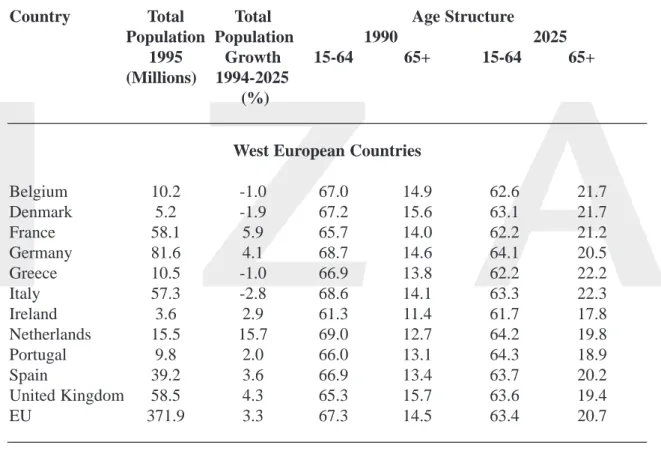
It is very difficult to estimate the potential migration flow from East to West Europe. Studies trying to estimate the size of the migration potential have arrived at very different conclusions. Newspapers and politicians have speculated that about 20-40 million East Europeans will emigrate. Estimates based on opinion polls in the sending countries suggest that between 13 and 27 million people are planning a move to the West (Coleman (1993)), whereas more modest predictions expect about 5 million people to migrate to Western Europe (see IOM (1991)). Assuming that 5-40 million would move to the EU between 1999 and 2003, this would imply an average inflow of 0.2-2.1% of the EU-population size in 1996. Note however, that these predictions include the former USSR, in other words, not only those countries waiting for EU membership. Immigration to Germany in the last decades has always remained at approximately 1%22 Hence, at the lower end
of these predictions, migration would not seem to be a potential burden. This view is shared by a recent study of the OECD (1998). It concludes that the prospect of sizeable migration flows from Eastern to Western Europe is more fantasy than reality and that it should not be overemphasised in the agenda for the EU’s enlargement. This assessment is based on the following arguments and considerations:
• The OECD expects that within the membership process, the free movement of persons will be postponed beyond the date of a particular country’s entry into the EU, as was the case in the membership process of Greece, Portugal, and Spain.
• Further, the OECD expects that temporary restriction on the movement of persons will be accompanied by bilateral agreements between current member countries and the countries applying for membership. Austria and Germany have already signed such bilateral agreements with several CEEC countries.23
• The requirements for becoming a member of the EU could reduce the incen-tives to migrate. The procedure towards convergence in the key economic and social indicators as well as the harmonisation of labour standards could lead to a reduction in the existing differences in the standard of living and working conditions and, there fore, reduce the incentives to migrate.24
22 See Schmidt and Zimmermann (1992) for a discussion of the German migration experience since World War II.
23 In the last section, we gave a detailed description of the bilateral agreements in Germany. 24 However, over-hasty implementation of social and economic standards to reach congence between