0
FACULTAD DE EDUCACIÓN DE PALENCIA UNIVERSIDAD DE VALLADOLID
Intercultural exchange through an
e-Twinning project
TRABAJO FIN DE GRADO
Degree in Primary Education. Specialized in Foreign
Language (English)
Isabel Acitores Martínez
1
ACKNOWLODGEMENTS
I would like to express my appreciation and thanks to all those people who due to their collaboration have contributed to the realization of this Final Project Work.
Firstly, I am deeply grateful to my tutor for supporting and advising me from the first day.
I want to emphasize a special gratitude to San José School, for allowing me to carry out the project, placing all their trust and affection on me, especially for Agustín Manuel
Martínez, my internship tutor who taught me during my school practices that: "everything is possible if you really want it."
Finally my gratitude goes out to the University of Valladolid, for giving me the opportunity to study in Utrecht University, through an Erasmus grant, so I could see other ways of conceiving education, through new eyes, which had helped me for the
2
ABSTRACT/RESUMEN
This document introduces an intercultural exchange project through the e -Twinning programme. It was designed to be implemented in San Jose school, lo cated in Palencia. Moreover, it presents the school context, the Y3 group and to conclude
the designed and implemented e-twinning project.
En este documento se presenta un proyecto de intercambio cultural a través del programa e-Twinning. Fue diseñado para llevarlo a cabo en el colegio San José, ubicado
en Palencia. Además, se muestra el contexto de la escuela, el grupo de tercero de Educación Primaria y para concluir el proyecto de hermanamiento electrónico diseñado
e implementado.
KEYWORDS/PALABRAS CLAVE
Interculturalism, e-Twinning, cultural exchange, KS2-Y3, Digital competence, e-Twinning Guidelines, Spanish curriculum, Skype, ICT´s, e-Learning, project; creativity, motivation, innovation, values; flowers, landscapes, tree, environment;
didactic unit, European Quality Label, Lifelong learning programme (LLP), National Support Service (NSS).
Interculturalidad, e-Twinning, intercambio cultural, Segundo ciclo- 4º de Primaria, competencia digital, orientaciones para el desarrollo de un proyecto e-Twinning, Currículum Español, Skype, TIC´s, aprendizaje electrónico, proyecto; creatividad,
motivación, innovación, valores; flores, paisajes, árbol, medioambiente; unidad didáctica, Sello de Calidad Europeo, Programa de Aprendizaje Permanente,
3
INDEX
1. INTRODUCTION ... 4
2. GOALS ... 5
3. JUSTIFICATION ... 5
4. THEORETICAL FOUNDATION ... 7
4.1 Theoretical basis of the Intercultural education ... 7
4.2 The intercultural competence in the Educational System... 11
4.2 INTERNATIONAL, EUROPEAN AND NATIONAL BASIS IN EDUCATION. ... 12
4.3 Interculturalism through Information and Communication Technologies (ICT´s) ... 15
4.4 Life Long Learning programme: e-Twinning. ... 17
5. PRACTICAL PART ... 19
5.1 The e-Twinning project: “FLOWERS EVERYWHERE” ... 19
5.1.1 PROYECT PROCESS ... 19
5.1.2 CONTEXT ... 23
5.1.3 GOALS ... 25
5.1.4 CONTENTS ... 25
5.1.5 METHODOLOGY: Task-Based Language Learning Approach ... 26
5.1.6 PROJECT DESIGNED AND IMPLEMENTED ... 29
5.1.7 EVALUATION ... 36
5.1.8 RESULTS ... 38
6. CONCLUSIONS ... 42
7. BIBLIOGRAPHY ... 43
4
1.
INTRODUCTION
In this work it is reflected an intercultural exchange through an e-Twinning project for 3rd year of Primary Education with a Turkish school situated in Istanbul (Turkey).
This proposal refers to the intercultural importance in the Educational System, setting out from the theoretical basis for a better understanding of the intercultural learning evolving.
Every day, it is an increase observed in social and cultural diversity in every school, causing an integrative and inclusive curriculum so that all children have a quality education.
With this project everything related with interculturalism is reproduced. The Final Degree Work is divided into different sections.
In the first section, it is presented the theoretical foundation, where it is reflected the main theoretical basis of Interculturalism. Moreover it reflects several International, European and National basis in order to sustain and perform the e-Twinning project. Besides, in this section it is presented the interculturalism through Information and Communication Technologies (ICT´s), due to the fact that new technologies have an important role in the development of the intercultural communication between different cultures.
In the second section it is presented the designed and implemented e-Twinning project where it is reflected the school and class context, the goals, the contents, and the methodology: Task-Based Language Learning Approach, Assessment of Learning and the Results that we obtained with the project in this real class (KS2-Y3).
5
2.
GOALS
The main goal of this project is to create awareness of the importance of the intercultural education in schools, through cultural exchanges with other schools at European level and at the same time, developing digital competence.
The general objectives that have guided me to perform this work are:
Analysing the importance of intercultural education in Primary Education since its inception.
Knowing innovative virtual platforms that include the whole educational community in active and inclusive participation for a quality education.
Promoting cultural and educational exchange through the implementation of an e-Twinning project, and also promoting the use of new technologies.
3.
JUSTIFICATION
As a future English teacher I consider very important the cultural exchange through the use of digital competence in the 21st century schools and therefore I chose this topic : Intercultural exchange through an e-twinning project.
Otherwise, I want to emphasise, that my stay in the Netherlands the first term of this year has had a good influence in the improvement of my teaching skills to be more open minded and to transfer intercultural knowledge to students.
6 During my stay at Utrecht University a teacher in charge of the e-twinning programme came to the University for a Talk about her experience with many projects connecting school from all over Europe. It made me wish to participate in one of them in my future as a teacher.
I also had the opportunity of living with people from other countries and there were foreign people in the class too. These all together helped me to develop my personal and professional knowledge, at the same time that I improved my English level.
So, for that reason, I wanted to give the students this chance through this project, because not all of them can have this kind of exchanges in their lives.
Once I came back to Spain and I began my internship in San Jose School, I realized that they had not done any projects with this program yet, which made me reconsider the idea of incorporating them into the school through a simple project and a specific group. The fact that the school had an e-twinning program in their PGA although they haven´t prepared one yet took me to suggest one myself.
For this reason, once the project was approved by the school and the National Admission System of e-twinning, I carried it out at San José School, which is located in Palencia city and particularly in Primary the third in a class formed by 24 students.
At the beginning of the school practice I had several doubts, as for instance, if there were computers and a whiteboard available in the classrooms.
Each class has a digital whiteboard; teachers and students were getting used to them so this was another interesting project to increase the work with ICT´s.
It is said that projects which are carried out through new technologies tend to have a very positive impact on students, but as teachers we have to inform them about this tool.
I have chosen this project to work on it, because I believe it is a very important and interesting tool in the 21st Century schools.
7 The intercultural exchange is one of the best experience that a person can have in her or his life.
The main goal of the project sets with the basic competences related with our Bachelor Degree, which stands that we, as a Primary Educational Students:
Design, plan and evaluate teaching-learning procedures.
Deal with learning languages situation in multicultural contexts.
Reproduce about the concrete work in a class, in order to improve and innovate the teaching process.
Know and apply ICTs in classroom. Distinguish audiovisual information that contributes in learning, civic education and cultural richness1
4.
THEORETICAL FOUNDATION
4.1
Theoretical basis of the Intercultural education
Intercultural education is a concept that is now widely used in every school. Due to these exchanges students realize about the richness that these cultural exchanges give us.
This sort of education is intended to achieve and develop equity and inclusion, responding to each student equally, encouraging and transversely working values such as respect for another culture, tolerance of other cultures, and making them participant of this Education based on equal opportunities and justice.
The intercultural education should be encouraged and promoted through various programs and educational resources in every school.
1 (Universidad de Valladolid, 2014) Through this web page
8
2
According to Aguado (1995) Intercultural Education is : “Educational approach based on respect and appreciation of cultural diversity. It addresses each and every member of society as an overall, proposes an integrated model of performance that affects all aspects of the educational process.”
3
According to the NCCA (National Council for Curriculum and Asses sment) “Intercultural Education is a kind of education which respects, celebrates and recognises the normality of diversity in all areas of human life.
It sensitises the learner to the idea that humans have naturally developed a range of different ways of life, customs and worldviews, and that this breadth of human life enriches all of us. It is education, which promotes equality and human rights, challenges unfair discrimination, and promotes the values upon which equality is built”.
The word “interculturalism” describes the credence that we all become enriched through the contact with other cultures, in fact people from other cultures learn from the others through this exchange.
According to Walsh (1998) “interculturality means "between cultures”.
Interculturalism is a procedure that includes a relationship process, learning among people and promoting mutual respect, beyond their cultural and social differences. As such, multiculturalism tries to break with the hegemonic history of a dominant and subordinate culture and, thus, strengthen the traditionally excluded identities to build, in everyday life, a coexistence of respect and legitimacy among all society groups”
It is very important that each school encourages equal opportunities, promoting exchanges between different cultures and values among students. With these things it is pretended to foster educational equity so that all students have the same opportunities and cultural experiences internationally.
On the other hand, it is essential to avoid the exclusion and social discrimination through this practice. Seeing through this practice as from two very different cultures together we can mediate between cultures and empathize with encouraging communication between them.
2
(AGUADO, 2005)
9 Intercultural education is still a mainstay in schools work because diversity in classrooms is significantly increasing every year. Thereby students must be aware of the reality that exists in daily life to know how to respect and coexist in the society.
Education is continually evolving and therefore we cannot anchor ourselves in the past. Students need to develop a cross-cultural attitude and stay in touch with other cultures which will have a very positive effect in the development of human values as well as developing the skills to work in a multicultural society where they enrich the other culture and vice versa.
4
As I said before, in order to develop an intercultural education in our schools it is important to develop a transcultural attitude.
An attitude is how we react to something or someone and it is expressed by our emotions and our principles.
Regarding the different types of attitudes in relation to the intercultural education we can find a wide range of them, for instance:
Ethnocentrism: It is the belief that their own culture is one of the most important or that the main cultural features are superior to those of the others.
Cultural relativism: it is a variety of attitudes that respect other cultures. With this attitude all is analyzed according to the guidelines that govern each culture. Universalism: it is an attitude that is supported in the cultural similarities. It is a
very positive attitude where each person is treated in an equal way.
Transcultural attitude: it is an attitude when a person is able to adapt to another culture avoiding the stereotypes of the other culture. People that develop this attitude succeed in daily life because they can extract benefits from the different cultures and they will be opened to enrich themselves with the values and the norms from other people of different cultures.
But to develop a transcultural attitude in children it is not enough only with the knowledge of the other cultures, children must also have a real contact with them.
10 The main step is to have a positive attitude to accept another culture. In this process people can exchange different points of view or similitudes.
According to the connection between different cultures or similarities, we have to develop empathy to know what the others think and to develop communication between them.
This transcultural attitude is significant to work it in the classroom, in which the child develops different values such as respect, tolerance and empathy and one of the important things of this process is the communication between the different countries. Children have to develop a transcultural attitude from their early years. Sometimes it is difficult because of the different languages. In spite of these difficulties we have to improve other languages in schools to advance the communication and to make the intercultural exchange possible. Many schools have introduced a second language in some classes of Primary and Secondary Education (Dutch, French, Italian)
Teachers should transmit a wide range of contents and abilities to make them become cultural citizens, due to the globalize world where we live.
5
On several occasions the political sphere refers to the important role of teachers to adapt education to the continuous changes, highlighting the cultural aspects, the values, and the encouraging and use of the new technologies in schools.
Some measures are taken by the European Union that refers to the development of communicative competence in schools:
In March 2000, the European Council emphasized that people are the most important asset in Europe and we have to invest in them.
In November 2006, the council declared that: “The motivation, skills and competences of teachers, trainers, other teaching staff and guidance and welfare services, as well as the quality of school leadership, are key factors in achieving high quality learning outcomes…[and]…the effort of teaching staff should be supported by continuous professional development and by good cooperation with parents, pupil welfare services and the wider community” (2006).
11 In 2005, The Commission New Framework Strategy for Multilingualism referred to the importance of learning different languages and of the good training of bilingual teachers.
The European Commission performed several projects about the language teaching as well as “Content and Language Integrated Learning” (CLIL). The main lines of this document set that:
“Schools in which the teaching of certain subjects in the curriculum may be offered in a foreign, regional or minority language have existed in Europe for several decades. Before the 1970s, this type of provision was mainly available in regions that were linguistically distinctive (because they were close to national borders or used two languages, etc.) or in the largest cities. This initiative concerned very limited numbers of pupils who were growing up in a somewhat unusual linguistic or social context. The aim was to turn them into bilingual children by enabling them to acquire proficiency in languages comparable of that to native speakers” (CLIL, 2006:7).6
4.2
The intercultural competence in the Educational System.
Interculturalism has been increasing in Spain for some years. Immigrant families bring their children to schools as it is a right for any child.
The school is the most important context where the intercultural education can be promoted by the teachers and the educational community. (Mata, 2010)
Based on the knowledge of cultural differences and similarities, we contribute to the development of intercultural competence, and due to this students are enriched by knowing their own culture and respecting the others.
However, for direct contact with the intercultural reality, students should experience and interact with the world that is around them. Starting with the intercultural conflicts into the class and solving the differences between them, promoting values such as respect, valuing other traditions and cultures and being aware of the diversity to enrich us.
12 Otherwise, we live in a multicultural society where the number of immigrants is increasing continuously.
Therefore, it is very important to remark that from the twenty-first century the school has an educational answer based on interculturalism.
According to 7Delors (1996) intercultural education has to be conducted through four key lessons that are learning to be a person, learning to understand the world around us, learning to live together, living together respecting and valuing different cultures and traditions and finally learning to do.
From a positive vision of diversity, a successful intercultural education is important, and therefore the exchanges with other cultures and viewpoints make interaction which enriches both cultures in all aspects.
Interaction is a very important aspect in the intercultural education, which is the meeting and the contact between people who bring different cultures. The interaction encourages feedback leading to the creativity and flexibility among different people.
Therefore, to carry out this type of education in classrooms we must start by removing all barriers that prevent us from the flow interaction and promoting resources or projects that integrate this competence every day.
4.2 INTERNATIONAL, EUROPEAN AND NATIONAL BASIS IN
EDUCATION.
To carry out the intercultural project, I required International, European and National legislation.
Despite of e-Twinning being a European project, it is important to contrast different basis to develop the different steps according to the law.
8
Most language teachers usually work with the intercultural competence in several classes. For that reason, internationally and according to the Universal Declaration of
7
(UNESCO, 2002)
13 Human Rights and the Convention on the Rights of the Child ( Article 28 and 29) t every child has the right to education, taking possible measures for each child and each of their needs.
Another important thing to be appointed is to promote the international cooperation to dynamize education and the new teaching methods. In my case, it has been developed an intercultural project which works using new teaching methods to perform attractive and cooperative classes such as the e-Twinning program that encourages the use of ICTs at school. Children are being aware of the important role of learning other languages to communicate with other children, through e-Twinning.
At European level according to Educational Initiatives and policies of the European Union and agreeing with the common framework of languages we can see several similarities regarding the development of cultural exchanges as well as values that respect cultural diversity. I have resorted to these sources to build on its realization because the project carried out is directly related to the field of language learning through cultural exchange.
According to the Committee of Ministers and the educational policies of the European Union, cooperation should be encouraged at the national and international level through information exchanges by making good use of Information and Communication Technologies (ICT´s).
All of this will be possible if knowledge of languages has a good communicative exchange, where different countries collaborate and cooperate in learning languages making it a mutual enrichment and not an obstacle.
An important principle to note is that the common European Framework of Languages and European Educational policies mark the encouragement of cultural values such as respect and tolerance to agree on an effective communication.
14
9
10
According to Izquierdo, there are different stages in the educational policies of the European Union. It is important to start considering Articles 118 and 128 of the "Treaty of Rome", although the issue of cooperation in general education is not considered until Moreover, in 1974 the Council of Ministers recognized the right of all citizens to education.
Within this first phase it should be mentioned that the first Education Action Programme of the European Community was approved on 9th of February in 1976. In the second phase, the European Community Program for intervention (2000-2006) was approved.
On the other hand, and on the third phase the reference is made to "foreign language teaching as an effective mobility of citizen’s instrument by member states." It is essential that students study at least two foreign languages.
The fourth phase refers to extending the principle of equal opportunity in education. The fifth phase speaks of the right of everyone to be provided with an adequate training for an occupation.
According to the LOE ( 2006), Compulsory Educational Law, there is an objective that says:
"Training in the respect and the recognition of the linguistic and cultural plurality of Spain and multiculturalism as a society rich element."
As in the other European and International documents, legislation in force also has features concerning the multiculturalism construction from the educational system. So right from the preamble of the LOE (2006) refers to the promotion of cultural values eliminating discriminatory acts to obtain a communication and social understanding.
Another point to keep in mind when giving an innovative educational response is the diversity attention, according to the LOE (2006) it is considered a "fundamental
9
(Language Policy Unit, Strasbourg, 1971)Through this web page
http://www.coe.int/t/dg4/linguistic/source/framework_en.pdf complete information can be read ( Consulted on 14th March)
15 principle that should govern all basic education, with the aim of providing every student with everything requiredto their characteristics and educational needs "11
4.3
Interculturalism through Information and
Communication Technologies (ICT´s)
Nowadays education cannot be based only on transmission of knowledge, because we are a society that is constantly evolving and we need an education where both cultural diversity and new technologies converge.
12
Because of the ICT's there is a closer relationship between the school and the socio-cultural realities by the increasing use of social networks, and the implementation of flexible and dynamic models of training (De Haro, 2010).
These days ICT's perform a vital role in schools, as well as innovation involves the approach of different countries, with very different cultures to exchange different languages and cultures and as a result, the performance of tasks in common.
The new information and communication technologies have important benefits in education that are described below:
Firstly the development that makes interpersonal education, where there is a communication between different cultures using ICT´s.
Secondly it decreases the social problems between pupils as they have to work collaborating and cooperating with the rest of the class to achieve the tasks.
Thirdly pupils adopt responsibilities to organize their work through digital projects and therefore they become more independent.
To conclude, another important benefit is that ICT´s are good tools to help and support children with special needs.
However , ICTs are being integrated in many different teaching programs; to carry out intercultural education it is needed not only people who work in the net but also the necessary tools and technologies to manage different projects.
11
(Jefatura del Estado, 2006)
16 Furthermore, virtual communities were established to carry out an active and inclusive participation of the full educational community. With these virtual communities active participation is encouraged in which the entire school community is involved , and because of virtual platforms there is a flexible direct relationship between the center and families.
Currently, we can find a lot of programmes in our country to be develop in schools. For instance, 13“Educative Platform Helvia”, 14“E-culturas” and 15“ Includ-ed” this kind of programs´ main aim is to achieve a digital alphabetization and increase inclusive education where children can exchange different cultures and points of view.
In addition, there are several platforms to work in Europe, for instance we can speak about the e-Twinning program, this program promotes the development of intercultural projects in which teachers and students collaborate and cooperate from many different countries around Europe.
On the other hand, we find e-Pals program since 1996.This program promotes collaborative learning in learning communities all over the world, where communication skills and collaboration with other schools are being developed. It should be noted that most of these programs are based on teaching e-Learning (Electronic-Learning) which is a kind of education through the Internet network. According to several studies, it is said that programs that are based on Electronic Learning involve a range of benefits that are very useful to work with in schools.
13Through this web
pagehttp://www.juntadeandalucia.es/averroes/helvia/sitio/index.cgi?wid_seccion=2&wid_item=24
completed information can be read .( Consulted on 13th April)
14 Trough this web page http://www.e-culturas.org completed information can be read.(Consulted on 9th
May)
15
17
4.4
Life Long Learning programme
:
e-Twinning.
The “e-Twinning” is an enterprise that encourages the founding of one school twinning project, through the collaboration of the network of Internet with a minimum of two or more schools from different European countries, which work on the same project through collaborative learning, and using Information and Communication Technologies (ICT). e-Twinning is a very good tool to exchange information through the internet with other schools, exchanging different cultures with the opportunity to see different points of view from all around Europe and learn together in several learning projects.
This Programme started in 2005, following the e-learning program, and it is also integrated in Comenius programme. It is coordinated by the National Agencies of the Lifelong Learning Programme.
Otherwise, the Central Support Service (SCA) where e-twinning is organized in Europe is located in Brussels. However, the National Support Service is located in the National Institute of Educational Technologies and Teacher training of the Education Ministry.
There are more than 7100 members and 13900 are teachers in Spain. There are 700 projects that are active nowadays. Both the number of these projects and members are increasing every day.
The e-twinning project is offered for every grade, subject and country in Primary and Secondary Education. The most usual languages that schools use are English and Spanish, being Spanish more frequent now, but the language will usually depend on the teacher´s project.
18
Germany Austria Bulgaria
Belgium Cyprus Croatia
Denmark Slovakia Slovenia
Spain Estonia Finland
France Greece Hungary
Ireland Iceland Italy
Latvia Lithuania Luxembourg
Malta Norway The Netherlands
Poland Portugal The United Kingdom
The Czech Republic Republic of Macedonia Romania
Switzerland Sweden Turkey
Teachers can use this kind of tool for a wide variety of outcomes. There are several things that can be done, but these are ideas that can be used by teachers, as for instance: to share information with teachers from other countries and compare it with them. Secondly, to work on a project with another school that follows the same didactic unit and do a final task together. Thirdly, as a platform where our students do several projects through collaborative learning. Finally, as a tool where you can take some ideas for inspiration or also as a networking where students use ICT´s.
To participate in e-Twinning, teachers should visit the website of the Central Support Service (http://etwinning.net) or the National Support Service
(http://etwinning.cnice.mec.es).16
16
19
5.
PRACTICAL PART
5.1 The e-Twinning project: “FLOWERS EVERYWHERE”
5.1.1 PROYECT PROCESS
The purpose of this project was held during the period of my internship, in San Jose School that is a State-subsidised school, located in Palencia.
It is a school that began five years ago with bilingualism, and therefore, they considered it would be very interesting to introduce an e-Twinning project for the first time, to encourage English language in a different way.
Thanks to my experience in Utrecht, which is a multicultural city, I was even more conscious about the importance of meting different people with different thoughts, cultures and points of views for our personal development as world citizens.
Furthermore, that opportunity of knowing other ways of life and another educational system had already opened my eyes and I wanted to put it into practice with pupils, giving them the great opportunity to connect them to other cultures where they can interact through the English language.
Before starting with the project, I share my proposal with the headmaster and my mentor and asked for permission to do the project. I was told that it was a good initiative and that I could carry it on. I also talked to my university mentor who also approved this initiative.
I felt excited as I was given the opportunity of developing a project of these characteristics and that entail a big responsibility for me. And trying this new proposal in the school could imply continuing with it the following years.
20 Firstly, we did de
pre-registration where you have to fill in your User name, password and your email address.
Secondly, when the previous data was accepted we filled up a full registration with all the school details and our profiles as English teachers. In the e-twinning profile you can upload a personal photo to
show to the other teachers. Moreover, you have to put your project ideas and your personal information about your interests.
Once you are registered on the page, you can start writing your own project or you can
also join other projects from any part of Europe.
This is my profile once I registered on the platform, which is accessible for every teacher who is interested in the implementation of projects with me, once I add them to my contact list.
In my case, I thought about joining a project that was already on line in e-Twinning. But finally, I did my own project in order to focus it on the teaching unit that we were going to work with in class. The project was carried out in the third grade of primary education. In this class my mentor taught English and Arts and Crafts, so I did expend many hours with this class.
The title of the e-Twinning project is "Flowers Everywhere”, taking the advantage of the season where we were, “Spring”, and because it has a direct relation with the didactic unit we were developing “Landscapes”.
21 Before the project was started, the main subtasks and the final task were developed for a better understanding and organization with the other school.
Once I had everything clear, I uploaded the project to the e-Twinning platform.
In that moment teachers from all over Europe that belong to e-Twinning , could see my project. The following chart is the description of the project “Flowers everywhere” in the e-twinning desktop.
Information
It´s almost spring and we have a vast range of flowers in our countries. Flowers are beautiful
and we have different kinds of them in each country. In this project, children will create their
own paper flower and write messages for children in the partner schools. The message will tell
the children something about what the flower is like and children will receive flowers from each
of the partner schools. Finally, one spring flower will travel to each of the partner schools, and
we will build a big tree with many different flowers from each country.
Subjects:
Art, Foreign Languages, Natural Sciences
Languages: EN
Pupil's age: 8-9
Tools to be used:
Mail, Other software (Power point, video, pictures and drawings), Web publishing, e-Mail, Skype.
Aims:
To know different kinds of flowers in Europe. To develop simple knowledge about
plants. To make connections between children around Europe.
Work process:
Schools agree to post (paper) flowers to the other partner schools. Each flower will be designed
by a child and will be decorated, as they like, on one side and the other side will hold
information. This information will be at the back. On the leaves of the flower and the centre
side we will include words and pictures about the child, and pictures about the school and
22
envelope and posted to each school at the end of March 26th March 2014. They will travel
across Europe. Each school will receive many flowers from different countries. They can use
these to find out about the children in other countries and to decorate their school. Schools can
add photos of the process in Twin space, about how children made the flowers or the different
landscapes where we can see these flowers.
Expected results:
Each school will receive flowers from the other schools giving information about the location
and the children who made them. Children can use this to further their interest in other
European countries. They will realize about the other different flowers knowing other cultures
and knowing other children.
After uploading the project you have to wait for the approval of the National Support Service (NSS) and the Central Support Service (CSS). The project was approved the third of March in 2014.
Once it was approved, I had the same day a teacher from Turkey who was very interested in the project. It was her first time in e-Twinning, so it was easy to understand her, because we were in the same situation.
I explained her the main lines of the project by e-mail and she agreed to join it.
Our partner school is called Topkapi School, located in the city of Istanbul (Turkey). Fortunately, she is also an English teacher of Y3 in a class form with 24 children as mine. That was an advantage in order to work together.
We agreed on the implementation of each task and the main goals through emails even during the project process.
Although no more schools joined, and having in mind the time factor, we began developing our project even though children would only receive flowers from one country either Turkey or Spain. It was a great opportunity of exchanging flowers and other characteristics of each culture, making it easier to develop this project, as we had not much time for it.
23 Afterwards, when the teacher from Istanbul and me were prepared to begin with the project, the NSS gave us the e-Twinning Label that is a certificate given to all eTwinning and it can be downloaded by project partners from the Desktop.
Illustration: e-Twinning Label
5.1.2 CONTEXT
The e-Twinning project was performed in a subsided-state school, located in Palencia. The school San José is a bilingual centre, of one line per class, from Early Years to Secondary Education.
ECONOMIC AND CULTURAL REALITY OF FAMILIES.
24 Family economics is medium-low and families in most cases are from Palencia, although currently the number of students from other countries is increasing due to immigration.
Furthermore, it should be noted that most families have not had access to higher education, so they are families with low academic training.
THE GROUP KS2-Y3
Group description
It is a group consisting of 24 students. There are 9 girls and 15 boys, with ages between 7 and 8 years old.
The knowledge of the group and the main features to the completion of the project is very interesting for students to know their tastes, their motivations and the tasks design. According to their attitudinal level, they are a very talkative group of students but with a high degree of class participation group.
One of the most positive things in this group is that as they have been together from the very beginning of their time at school, at the age of 3, they have developed close relationships. There are not special conflicts. It should be noted that some children do not have digital tools at home, so this project was a very positive breakthrough for them, both personally and as an academic exchange.
25
5.1.3 GOALS
General Goal:
Performing a didactic proposal to connect the use of ICT and active methodologies with the e-twinning project for teaching English language that attends to the importance of the culture exchange and meaningful development for the students.
Specific Goals:
Promoting cultural exchanging between European countries through the use of ICT.
Encouraging a collaborative work through a common network between both countries.
Motivating students through the design and development of intercultural activities promoting cooperative work between them.
Identifying and learn the characteristics of other European cultures characteristics by developing various tasks.
Developing their own personal autonomy through an individual research using new technologies.
Encouraging communication skills through small conferences and exhibitions with the other country and the rest of the class.
5.1.4 CONTENTS
To achieve the different objectives we have to perform the following contents:
Established connections between Spanish and Turkish children through creative flowers.
Landscapes and flower´s vocabulary.
Being environmentally friendly through the research about different flowers around us.
26 Working with information and communication technologies.
Using English languages as a mean of communicate with other pupils.
5.1.5 METHODOLOGY: Task-Based Language Learning
Approach
The methodology followed to work in the classroom with this intercultural exchange project was based on Task Based Learning Language, so first we are going to focus on the meaning of a task .
There are many definitions of "Tasks", but for a better understanding of this approach we will follow several definitions:
According to Numan (1989) a task is "a piece of classroom work which involves learners in comprehending, manipulating, producing or interacting in the target language while their attention is primarily focused on meaning rather than form".
According to Willis (1996) a task is "an activity where the target language is used by the learner for a communicative purpose in order to achieve an outcome".
Through working with tasks children are dealing with real situations through a second language to communicate with the others.
In order to follow the Task-Based Language Learning, teachers have to organize lessons through different task with a connexion between all of them for the development of the Final Task.
Children begin with little tasks towards the final task.
27 The task-based approach arises when teaching English as a foreign language in the 70s. Task-based approach according to Newmark and other authors focus on the communicative approach adapting to the needs of children.
This task-based approach includes the idea that students from their previous knowledge gained throughout their lives, connecting with a new knowledge build their own learning significantly.
In this process, teachers are the facilitators and motivators to do the different tasks. The motivation is a very important agent to work with this kind of projects.
In addition, teachers in this process organize the lesson and they have to organize how children work (in groups, in pairs or individually).
Meanwhile, students have the main role in this learning process; they are an active part in the class. Moreover, several tasks in this project are done in pairs, which are good tools for students to adapt and respect their classmates, sharing different ideas and using motivation to engage conversation between them.
The lessons development that this methodology follows, begins from a singular topic that it doesn´t necessarily have to be one of the textbook; it can be a topic which is interesting for the class, which will generate a big motivational environment.
Through this kind of approach children see the English language as a mean to communicate with other children from a different country and not as an end.
As I mentioned before, teaching a foreign language through an intercultural project is very motivational for children, so I have to describe in the theoretical foundation the main concept of motivation.
For this purpose I have compiled a set of definitions from several authors:
17
According to Vigotsky (1988),. motivation is what induces a person to implement an action. Here the teacher's role is to induce grounds on student learning and develop behaviours to apply voluntarily for class assignments. School motivation is not a technical or particular method of teaching, but a cognitive factor present in every act of learning, which determines the student's way of thinking and thus the resulting learning type
28
18
Piaget (1896 -1980) as Mendoza (2005) refers, “is interested in finding out how changes in child behaviour reflect changes in thinking, resulting in an increased ability to acquire and use knowledge about the world. He argues that cognitive development occurs in a number of stages, and that all people go through the same stage in the same order. For Piaget knowledge is not passively absorbed from the environment, is not processed in the mind of the child, or when the mature stems, but is constructed by the child, through his mental structures interaction with the environment.”
19
According to Maslow motivational theory, “motivation is the pulse that humans have to meet their needs”. Maslow classifies the main necessities in a pyramid. There are five levels. In the base we can observe the survival necessities. In the second level, security and protection necessities; in the third level, membership necessities; in the fourth the acknowledgement necessities and in the last level self-fulfilment necessities.
The main aim of this theory is that you cannot have the upper necessities since you don´t satisfy the previous necessities.
Illustration: Abraham Maslow, Hierarchy of Needs
With all of this, we will reach the conclusion that the role of motivation is not easy, but it is necessary in education; according to the degree of motivation that the student has it will determine their performance.
18
(Mendoza, 2005)
29 Thereby as teachers, we should lead the student through the development of a wide range of knowledge following the motivational principles for higher quality learning. Accordingly, we have to take into account both types of motivation, extrinsic and intrinsic, furnishing children with autonomy making them see and know that the important thing is learning much more than pass or fail an exam.
5.1.6 PROJECT DESIGNED AND IMPLEMENTED
This e-Twinning project was developed from the didactic unit of “Landscapes” which belong to the English subject. The English subject was timetabled three hours a week so we carried on with this unit for two weeks and a half.
Each lesson was scheduled for one hour, and also it had specific objectives related with a particular task to reach the final task.
Each task of the unit will require from students to work contents related with other subjects,such as Science, Arts and Crafts and History rather than learning only English. Interdisciplinary teaching increases motivation and learning in pupils, because they apply a diversity of abilities to work on the project; it is more dynamic because they interact with their classmates, their teachers and the other school partners from Turkey. Moreover, children became more environmentally friendly and also learnt the importance of flowers in our daily life, as well as other plants, because they performed different tasks where they were in contact with Nature. And last but not least, the importance of language to communicate with the other countries.
The student realized the importance of English to communicate with their twinned school, so it is something that motivated them to learn more every day.
To continue with the project process, it is presented the description of the whole work done, implemented and descripted, and in addition the full template (Annex 3):
LESSON 1: Starting the Unit “ Landscapes”
Date: 06/03/2014
30 vocabulary related with different landscapes. (mountain, summit, hill, forest, windmill, road, rock, field, fence, waterfall, river, lake, sea, ocean, pond, reservoir, bush, bridge, valley, different words from dry landscapes and forest).
Secondly pupils learnt the prepositions of place in class. This task is connected with the previous one, due to pupils has to develop tasks where they describe the place of living things in a landscape. In this task children had to stand up and followed the teacher instructions. At the beginning, the teacher explained the task, performing the prepositions around the teacher´s table; for example, she said behind the table, and children had to go behind their table. It was a very good activity because they were learning at the same time that they played. Pupils need to develop kinaesthetic competence to express their feelings and emotions at the same time they learn English. After studied different vocabulary related with landscapes, I showed them several pictures about landscapes in different countries of Europe, for instance: Ireland (green land), Holland (tulip fields), Turkey (seashore), Spain (landscapes in Castile and Leon).
The main task of this lesson was a “Guessing game”, where they drew in a chart six different pictures related to the vocabulary studied that day, and using different colours. I wrote the six words and the six different colours on the blackboard and they had to draw the pictures in the squares, after that, they could start playing in pairs asking questions and guessing which square they had placed each pictures in.
For instance: -Is there the mountain in the green square? –Yes, there is or –No, there isn´t. Pupils reviewed the Simple Present with this task and the landscape vocabulary.
LESSON 2: Carry on with the Unit “Landscapes”
Date: 10/03/2014
The second lesson was related with landscapes with water. The main task of the lesson was a “Brainstorming” to know their previous knowledge about the topic.
31 listening activities, because it is a new voice for them, and they have to be focus on it to solve the activity.
The main task of this lesson was the “Pictionary game”. Pupils had to draw a landscape using the key words studied in class and they had to guess where each element should be placed in the landscape, using the right preposition of place.
In this task pupils developed their creativity and speaking skills and also they had reviewed the prepositions of place.
LESSON 3: First Lesson e-Twinning project
Date: 11/03/2014
This was the day when we clearly started the e-twinning project. The project was explained through a power point presentation, with a variety of pictures about both countries, as not everybody knew where Turkey was situated. Children and teachers were excited because it was their first time with this programme.
I showed pupils different landscapes of our region “Castile and Leon”, to introduce them the topic “Flowers everywhere”, and using also some of the pictures and vocabulary previously worked the first two lessons. After we showed the presentation and introduced the main task, pupils had to look for information about a typical flower from our country or region. They had to look for information in Internet; then they had to select the most important data and finally they had to summarize the information to refill their Flower research sheet. In the Flower´s research they had to write the flower´s name, the flower´s description, and finally they had to draw or stick a nice flower´s picture on the paper. To conclude the lesson, we placed a big green tree to stick the flower´s from Topkapi School (Istanbul), in the corridor.
LESSON 4: e-Twinning project
Date: 13/03/2014
32 Afterwards, the main task was explained. In order to understand better what do pupils had to do, I showed them a flower´s map in the digital board. Each child chose one typical flower and summarized the information in his or her flower. That day I delivered each of our Spanish students the name of one of the Turkish student´s. They were very happy to have a new friend from this country, but they started to be excited as they wanted to know more about them.
Children were working on their flowers during the lesson and at the same time teachers were checking and helping with their mistakes. The whole group was very motivated to make the best flowers ever, and to write it in a correct way. With this task, children developed several competences and they were aware of the English importance to communicate with the other country. At the end of the lesson, I put every flower into a big envelop and I sent it by airmail to Turkey.
LESSON 5: Connexion with Topkapi School through Skype.
Date: 17/03/2014
The lesson began with a videoconference from San Jose School with the Turkish school through Skype. (http://www.skype.com/es/)
Hello ! I am
Adrian. My
flower is
…
(Information
about the flower
)
From
Adrian
33 For that videoconference a student from the fifth year of Primary Education, from San Jose school prepared an oral presentation about his experience living for 4 years in Turkey. He was speaking about the typical things that we could find in Istanbul ( Main monuments, coins, bridges, important people, Turkish history, typical costumes, typical clothes), and pupils from both schools were attended and asking questions. Moreover a girl from Topkapi School (Istanbul), prepared also a presentation about Spain because she has family in the south of our country and she came to visit frequently. Pupils were very concentrated and they understood mostly everything that was said about both countries. During the conference pupils learnt many words in English but also in Turkish and in Spanish, they learnt about the greetings in both languages and several words related with our topic “Flower´s everywhere”/ “Çiçekler her yerde”.
After that, each student made a picture of something related with Turkey, writing their corresponding name in English.
Pictures made by Spanish students after the videoconference with Skype
LESSON 6: Carry on with the Unit.
Date: 18/03/2014
In this lesson we were carrying on with the unit, and waiting for our flowers from Turkey. Firstly we were reviewing the different landscapes that pupils learnt the previous lessons.
34 recognize the different layers of the rainforest. The main task of this lesson was creating a rainforest mural with the animals and the typical plants they could find on it, writing the different layer´s name.
Rainforest murals made by students of Primary the third.
LESSON 7: Our flower´s from Turkey arrived!
Date: 20/03/2014
At the beginning of the class children saw several pictures from Turkish children working with their flowers to send us. Moreover, pupils saw a video of a girl from Istanbul dancing typical Spanish dances. The teacher from Istanbul sent us all of these pictures to show us how they were working and learning about our culture. Children were very excited and looking forward to know also about their flowers.
That day we received the flowers from Turkey.
Firstly, the flowers were delivered to each student. They were very emotive and enthusiastic with their new Turkish friend. Afterwards, each child had to show and tell their flower to the rest of the class and stick the flower on the corridor´s tree. It was their favourite activity as at last they met their new friend from Turkey, through the different tulips.
35 Turkey, and this made them realize that the first tulips were originally cultivated in the Ottoman empire, and they were imported to Holland in the 16th century.
LESSON 8: The end of the project
Date: 24/03/2014
At the end of the project children did the Final task (Annex 4). The final task was an individual task, and it consisted in a reading test related with everything studied in class about the Turkish culture, where students have to find out the main words studied and related with landscapes and the Turkish culture.
36
5.1.7 EVALUATION
To assessed pupils during the project I had made different assessments, because there were a wide range of criteria that we had to take into account when we are observing and at the same time assess them.
Firstly, I did an Evaluation grid (Annex 1) with all the criteria’s that I have to follow to assess them. In this grid, I established different levels according to their development skills, behaviour and content acquisitions.
I observed many different things, in order to know if students were achieving the different English contents, for instance:
If they were able to: answered the different activities correctly in class, explained the flower´s research to their classmates (Show and Tell), made a mural with the main parts of the rainforest and remembered the main words that they had studied in class related with the Turkish culture.
In relation to their skills, I divided it in fourth different levels according to their speaking, writing, reading and listening skills.
Related with the speaking skills, I had assessed them how they have to answer the different teacher´s question and how they have to respond in each subtask.
Moreover, I evaluated the way they kept a conversation with their classmates in some activities.
The reading skills that I assessed were: if students were able to read the key words of the different task, what they learnt in the different tasks, and in the final task, where they showed their capacity of pronounce with a correct intonation and rhythm.
Listening skills: In those criteria I evaluated if they had understand most of the contents learnt in class through visual supports, gestures, and explanations.
And finally, the writing skills: I observed if students were able to collect the significant data from different sources to make their research. (Flower research sheet).
With this subtask, I observed if they use the correct writing skills, using capital letters, writing the flower name…
37 opinion; if they could work in pairs, having a good behaviour and respecting each other; if they participated actively, sharing different opinions with the class and finally if students asked questions in order to solve their doubts, which demonstrates their interest for the subject.
Moreover, when the project had been finished a questionnaire was delivered to each child (Annex 2) to assess their opinion about this innovative project , and to evaluate if they remember what we had been learning in class related with the Turkish culture.
From my point of view, and after finishing the unit I had observed that the behaviour in class improve significantly. At the beginning of the unit, most of pupils were very chatty and some of them distracted, but pupils gradually paid more attention with the different tasks they had been developing.
In general lines, every child carried on with each task without problems, which means that the unit had been performed according to their level.
The most significant and positive point for me was their attitude; they were very enthusiastic about working with another school sharing a project.
All of them were able to follow the class which means that the non-verbal language and the gestures to express the different contents were appropriate for them.
To conclude, I think this unit was successful for the class because we use an innovative tool that encouraged and implemented their creativity, their positive knowledge of the Turkish culture and they became aware about the importance of the English language to communicate with other countries.
38
5.1.8 RESULTS
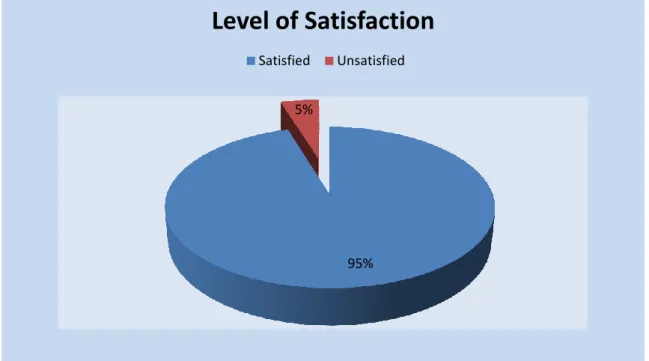
Graphic 1: “Level of the student´s satisfaction through the
implementation of the e-twinning project”.
First Graphic Interpretation:
After children accomplished their questionnaires we obtain several positives results as we can see in the main graphic. Most of the children in this class approved the carrying out of e-Twinning projects and only the 4.7% didn´t like the project. For that reason we observe a high level of motivation and desire to continue working on exchange projects collaborating and cooperating with other schools.
95% 5%
Level of Satisfaction
39 100%
Students Acceptance
Graphic 2: “Interest from the students in keeping up with
e-twinning projects”.
Second Graphic Interpretation:
40
Graphic 3: “Identifying words of Turkish culture through the
comprehension of a text. (FINAL TASK)”
Third Graphic Interpretation:
More than half of the class (58%) achieved very good results in the final task. However, a third of the class (30%) also reflected their expertise in understanding the text, nevertheless with some difficulties. And finally there is a small group (13%) who has had major difficulties and problems in understanding what is being asked and in comprehending the text about the Turkish culture. According to this graphic we can see an important percentage of children who had been developing the task in the correct way without problems of understanding and therefore, we could say that the innovative projects help to achieve good results in class.
58% 29%
13%
Ability of student comprehension
Good
Medium
41
Graphic 4: Final results of the class acquired through the
Evaluation Grid.
Fourth Graphic Interpretation
:This graph reflects the results achieved by the class in general terms. There have been high pupil percentages that have achieved the expected results in contrast to a few students that had got difficulties.
However we observed that due to the e-twinning project and the encouraging of creativity, there is an intensely increase of the participation and motivation in class, promoting the acquisition of the contents and also the interest in learning English, as an essential tool to communicate with the others and not as an end.
0 1 2 3 4 5 6 7 8 9 10 11 12 13 14 15 16 17 18 19 20 21 22 23 24 English contents Language skills
Participation Behaviour Tasks
42
6.
CONCLUSIONS
The main aim of this Final Grade Work was to give us the chance to demonstrate our knowledge associated to our Bachelor degree. For this reason, we chose a topic according to our concerns.
After the completion of the project, and having had the opportunity of implementing an educational innovation proposed during my internship in a real school, I observed the great benefit that intercultural projects in schools involves, being a great tool for teaching languages.
This project has been presented to the European Quality Label, because it was the first time that San Jose school performed this innovative programme in Primary Education, and for that reason they wanted to continue with this type of project, in order to continue developing the digital competence through intercultural exchanges.
One of the things that I was positively impacted with this project was the development of the student attitude facing the subject. I refer to their change in attitude in the subject from the beginning to the end of the project. It succeeded capturing their interest in learning English and the introduction of new vocabulary in a second language.
We have been aware of the important role that these projects involve in education, and thanks to the development of collaborative tasks with another school, it helps pupils to be more motivated.
However, when e-Twinning project was introduced in the class, children were aware about the importance of learning other languages, as an essential tool to interact with children from another country.
When the children were given the opportunity to collaborate in the same project with students from a European school, motivation and interest in learning arose from the first day.
43 Taking the advantage of this programme and the intercultural exchange, students develop an intercultural competence, respectful values, as well as positive skills to respect different points of view and to lead to consensus.
Finally it should be noted that pupils improve their intercultural awareness, and also they became open-minded participating and sharing wide information with the other country, that it is a benefit and advantage for them in their future as citizens belonging to a multicultural world.
7.
BIBLIOGRAPHY
AGUADO, M. T. (2005). GUÍA INTER. Obtained from :Una guía práctica para aplicar la educación intercultural en la escuela
Center for Ecoliteracy. (9 de May de 2014). Teaching Interdisciplinary Learning. Obtained from :http://www.ecoliteracy.org/strategies/interdisciplinary-learning (Consulted on 14th April,2014)
Cristi, B. (2012). Los beneficios de las TIC´s en e-Twinning. Obtained from
http://www.etwinning.net/es/pub/get_support/help/other_features/the_benefits_o f_ict_in_etwinni.htm ( Consulted on 3rd March).
Decreto 40/2007, de 3 de Mayo,por el que se establece el curriculo de la Educación Primaria en la comunidad de Castilla y León( B.O.C.y L. de 9 de mayo de 2007).
Docencia e Innovación en la Universidad del Siglo XXI. ( 2012). Obtained from http://docenciaeinnovacionupelipb.blogspot.com.es/2012/06/influencia-de-las-estrategias-y.html ( Consulted on 5th April).
Endt-Meijling, M. v. (2004). Through New Eyes : Workbook for learning trascultural skills. Uitgeverij Coutinho.
ePals. (2009). Proyectos Colaborativos por Internet. Obtenido de Información general sobre ePals: http://www.eduteka.org/modulos/10/322/963/1 ( Consulted on 13th April,2014).
eTwinning. (2010). eTwinning General Guidelines. Obtained from www.etwinning.net ( Consulted on 2nd March,2014)
General Assembly. (1992). Convention on the Rights of the Child . Obtained