www.medigraphic.com
ORIGINAL ARTICLE
Rev
ista
Lat
inoamer
icana
de
MICROBIOLOGÍA
MICROBIOLOGÍA
Utilization of phenol in the presence of heavy metals
by metal-tolerant nonfermentative gram-negative
bac-teria isolated from wastewater
Agostinho Alves de Lima e Silva,* Melissa Pontes Pereira,* Renato Geraldo Silva Filho,* Ernesto Hofer**
* Departamento de Microbiologia e Parasitologia, Universidade Federal do Estado do Rio de Janeiro (UNIRIO), Rio de Janeiro, RJ, Brasil.
** Departamento de Bacteriologia, Instituto Oswaldo Cruz (FIOCRUZ), Rio de Janeiro, RJ, Brasil.
First version received: February 20, 2007; first version reviewed: May 20, 2007; second ver-sion received in revised form: August 14, 2007; second verver-sion revised: October 15, 2007; third version received in revised form: December 09, 2007; Accepted: December 10, 2007.
Vol. 49, Nos. 3-4 July - September. 2007 October - December. 2007 pp. 68 - 73
ABSTRACT. Strains of Cr-tolerant or Hg-tolerant Gram-negative bacteria were isolated from Chemistry School’s sewage water and these were studied in relation to their ability to use phenol as sole carbon source in the presence of K2Cr2O7 and HgCl2. These metals showed inhibitory effect in the assimilation of this aromatic com-pound. However, one Cr-tolerant strain (Burkholderia cepacia -JT50) got phenol metabolized in the presence of high concentra-tion of K2Cr2O7 (until concentration of 200 μg/ml). Additional in-vestigation of this strain in minimum medium with phenol and chromate indicated that the tolerance mechanism did not involve chemical reduction from Cr6+ to Cr3+, neither any changes in the
total-chromium levels in that medium.
Key words: Phenol-degradation, heavy metal tolerance, mercury, chromate.
RESUMEN. Se estudiaron linajes de bacterias Gram negativas tole-rantes a K2Cr2O7 o a HgCl2 aisladas de aguas residuales de una es-cuela de química en lo que respecta a la capacidad de utilización de fenol como única fuente de carbono en presencia de esos metales. Ambos metales mostraron un significativo efecto de inhibición al utilizar el compuesto aromático, pero un linaje Cr-tolerante ( Bur-kholderia cepacia - JT50) logró metabolizar fenol en presencia de hasta 200 µg/ml de K2Cr2O7. Algunos estudios adicionales con ese linaje indicaron, que en las condiciones de los ensayos utilizados, su mecanismo de tolerancia no involucró procesos de reducción quí-mica de Cr6+ a Cr3+, ni tampoco variación en los niveles del cromo
total en el medio de cultivo.
Palabras clave: Degradación de fenol, tolerancia a metales pesa-dos, mercurio, cromato.
INTRODUCTION
Heavy metals represent a serious environmental prob-lem due to their stability in nature and accumulation in the food chain. Two important metal pollutants are chro-mium and mercury. The chromates are considered carcino-genic and mutacarcino-genic,1-3 and it is presented as environmen-tal pollutant emitted by meenvironmen-tal finishing industry, petroleum refining, leather tanning, paints and pigments, steel production, textile manufacturing and pulp produc-tion. This metal may exist at various oxidation levels, however the most stable and common forms are the hexavalent (Cr6+) and trivalent (Cr3+). The hexavalent form, considered the most toxic form of Cr, is highly solu-ble in water and is usually associated with oxygen as chro-mate (CrO42-) or dichromate (CrO
47-) ions. Cr3+ is much less toxic and tends to form insoluble hydroxides.4Some
bacteria have been shown to reduce chromate to the triva-lent form.5-7
The mercury is highly toxic even at very low levels.8,9 Antropogenic environmental source of Hg as pollutant in-cludes burning of fossil fuels, smelting metal ores, mercury mining, fungicides, and waste incinerators and cremato-ries. The solubility of inorganic and organic mercury com-pounds in lipids as well as their binding to sulfhydryl groups of proteins in membranes and enzymes account for their cytotoxicity.10
Among the organic environmental pollutants aromatics compounds, as phenol, and phenolic compounds are de-tached. They are commons constituents of waste water originating from many industries including pharmaceuti-cal, polymeric resin production, petroleum and coal refin-ing. The toxicity of these compounds to microorganisms seems include changes in their membranes, even at low concentrations.11,12
www.medigraphic.com
biodegradable processes of the aromatic compounds. Therefore, some studies related to the association of the bacterial tolerance properties to metals and degradation of phenolic compounds may be relevant to applications in bioremediation processes.
In the present study we evaluate the capacity of Gram negative Hg and Cr tolerant bacteria isolated from waste-water to use phenol in the presence of the respective met-als. Additionally, the behavior of a strain of Burkholderia cepacia phenol degrader and tolerant to high concentra-tions of chromium isolated in this work was investigated.
MATERIALS AND METHODS
Samples: eleven samples of sewage water taken from a chemistry school (CS) located in the northern region of the city of Rio de Janeiro were analyzed. The school’s sewage was chosen to study because aromatic compounds and heavy metals are used everyday in their laboratories. Amounts of 100 ml of sewage were collected from the meeting point of the CS’s sanitary sewage with the sewage from its laboratories using sterile bottles.
Isolation of Cr and Hg tolerant-bacteria: After clarify-ing filtration usclarify-ing filter paper, aliquots of 0.1 ml of waste-water saline dilutions were spread onto Petri dishes
con-taining Nutrient Agar (Merck), with 100 μg/ml of
cycloheximide and HgCl2 (60, 80, 100, 120 μg/ml) or K2Cr2O7 (110, 160, 210, 260, 310, 360 μg/ml) in addition to Nutrient Agar without metal. Previous experiments with sewage samples spread onto Nutrient agar supplemented with different concentrations of Cr or Hg allowed the choice of these concentrations. Three replicates of each di-lution were plated and incubated at 35oC for 24 hours. The metallic salts employed were of analytical grade and its solutions sterilized by Millipore membrane filtration with 0.22 μm pores. Standard strains of Gram negative bac-teria(Pseudomonas aeruginosa ATCC 27853, Pseudomo-nas aeruginosa ATCC 25619 and Escherichia coli ATCC 25922with previously determined levels of sensitivity to metals at tested concentrations were inoculated for control of the metal activity in the medium. Colony forming units (cfu) were corrected to c.f.u./ml of sewage. Cr-tolerant and Hg-tolerant c.f.u./ml percentages were calculated by com-parison with the results obtained in the medium without metal.
Characterization of isolates: The Gram-positive spe-cies and the fermentative Gram-negative spespe-cies isolated in this study were only stocked to further research. The samples were processed by means standard procedures. The Gram-negative strains, after testing to confirm their growth capacity in the Hg or Cr concentrations noted in the primary isolation, were submitted to glucose
fermenta-tion and oxidafermenta-tion tests. The glucose-nonfermentative strains were identified by conventional tests, such as colo-ny morphology, growth capacity in MacConkey Agar and Cetrimide Agar (Merck), nitrate reduction with or without producing gas, oxidase reaction, pigment production, fluorescence in F Agar, pyocyanine research in P Agar, growth at 42oC , motility using the hanging drop, arginine dihydrolase, urease, gelatin hydrolysis,18,19 and the API 20 NE identification system (bioMérieux , Marcy l’Etoile, France).
The determination of the capacity of using phenol by metal-tolerant strains: Initially, the strains were seeded in a minimal medium with glucose (g/L: Na2HPO4.12 H2O: 15.1; KH2PO4: 3.0; NaCl: 0.5; NH4Cl: 1.0; dis-tilled water to 1L; autoclaving for 15 min at 121oC; sterile solution of 1 M MgSO4: 1ml; sterile solution of 0.01 M CaCl2: 10 μl; sterile 20 % solution of glucose: 10 ml; pH 7.0). After having identified the strains with capacity of growing in this medium, subsequently ali-quots of 10 μl of cultures with approximately 108 ufc/ ml were inoculated in tubes containing 2 ml of minimal medium (pH 7.0) containing phenol as the sole carbon source (100 μg/ml), in addition to minimal medium (pH 7.0) with and without glucose (control). After incuba-tion at 35oC/48h a visual reading was taken, by way of a turbidity test. The property of strains to use phenol as their unique source of carbon in the presence of Hg or Cr was analyzed by inoculation in minimal medium (pH 7.0) with phenol and HgCl2 (3, 5, 10, 20 µg/ml) or K2Cr2O7 (40, 60, 80, 100, 200 µg/ml) added. The inocu-lation, incubation and reading conditions were the same as previously described.
www.medigraphic.com
The total content of chromium was determined by atomic absorption spectrophotometry (Perkin Elmer, mod-el 3100), using an air-acetylene flame with reduction char-acteristics (excess acetylene). The wavelength of the ab-sorbance measurements was 357.9 nm, with a slit opening of 0.7 nm. The calibration curve was constructed using Cr6+ solutions in a concentration range of 0.25 to 4.0 ppm (mg/l). Prior to performing the measurements, the samples were diluted 25 times.
For the determination of Cr6+, the classic spectropho-tometric procedure was employed, based on the reaction of the Cr2O72- ion with diphenylcarbazyde in acid medi-um, producing a colored compound that absorbs radia-tion in the visible range. The calibraradia-tion curve was con-structed using Cr6+ solutions in a concentration range of 0.2 to 2.0 ppm (mg/l). The absorbance measurements were performed on a Micronal spectrophotometer, model B 342 II, with a wavelength of 546 nm. Both method-ological determinations (chromium and Cr6+) were de-scribed by Marczenko.20
The confirmation of the phenol degradation was per-formed spectrophotometrically based on the reaction of the phenols with the 4-aminoantipyrin reagent at a pH of 7.9, and the presence of ferricyanide.21 Such reaction pro-duces a colored compound that absorbs radiation in the visible range. The calibration curve of phenol in a con-centration range of 0.2 to 1.0 ppm (mg/l) was constructed using standard solutions. The measurements were per-formed on a Micronal spectrophotometer device, (model B 342 II), with a wavelength of 506 nm using a cuvette with a 1 cm optical path.
The tests with the strain B. cepacia JT50 were done in triplicate and they showed similar results. The mean of these 3 tests was considered as final result.
RESULTS AND DISCUSSION
Plate count analysis (u.f.c./ml) for Hg-tolerant bacteria ranged from 2% in 60 μg/ml concentration to less of 0.1% at concentration of 120 μg/ml of HgCl2. For the K2Cr2O7, the range were approximately from 1% in 60 μg/ml to less of 0.1% at 310 µg/ml. Therefore, the concentrations of metals used in this study allow the isolation of a number of metal-tolerant bacteria very small in relation to the whole number. It is well known that there are no currently acceptable concentrations of metal ions which can be used to distinguish metal-resistant from metal-sensitive bacte-ria. As consequence, the aim of this study was to work with very high concentrations of these metals. In this way, it was possible to isolate strains with high degree of toler-ance to Cr or Hg.
Among the Gram negative bacteria isolated in the pres-ence of Hg or Cr, an absolute predominance of nonfermen-tative species over the fermennonfermen-tative species was observed. In the highest concentrations of the two metals (≥ 210 µg/ ml to K2Cr2O7 and ≥ 120 µg/ml to HgCl2), the occurrence of nonfermentative was 100%.
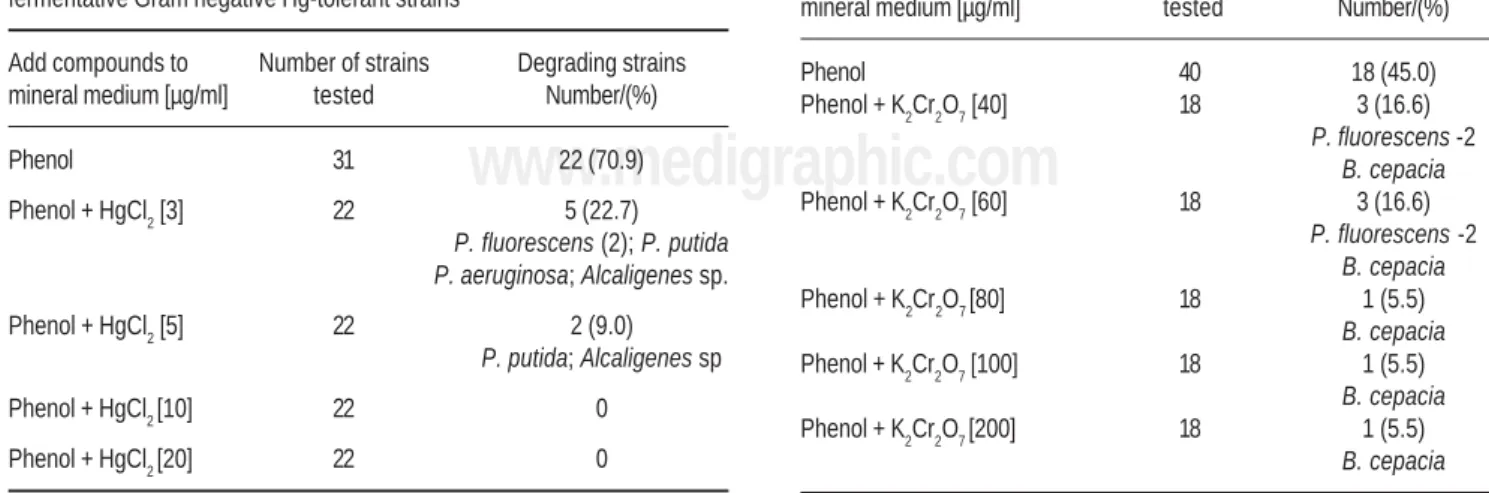
Seventy one metal-tolerant nonfermentative Gram-nega-tive strains were studied. As presented at Table 1, more than 70% of Hg-tolerant strains tested showed the property of us-ing phenol as sole carbon source. The numeric distribution (not included in Table 1) of these strains was: P. fluore-scens (8), P. putida (3), P. aeruginosa (3), Pseudomonas sp
(3), B. cepacia (2), Alcaligenes sp (3). The capacity of growth of these microorganisms in minimal medium with phenol was very affected by the Hg+ ions. In spite of high
Table 1. Utilization of phenol (100 μg/ml) in the presence of HgCl2 by non-fermentative Gram negative Hg-tolerant strains
Add compounds to Number of strains Degrading strains mineral medium [µg/ml] tested Number/(%)
Phenol 31 22 (70.9)
Phenol + HgCl2 [3] 22 5 (22.7)
P. fluorescens (2); P. putida P. aeruginosa; Alcaligenes sp.
Phenol + HgCl2 [5] 22 2 (9.0)
P. putida; Alcaligenes sp
Phenol + HgCl2 [10] 22 0 Phenol + HgCl2 [20] 22 0
Table 2. Utilization of phenol (100 μg/ml) in the presence of K2Cr2O7 by non-fermentative Gram negative Cr-tolerant strains
Add compounds to Number of strains Degrading strains mineral medium [µg/ml] tested Number/(%)
Phenol 40 18 (45.0)
Phenol + K2Cr2O7 [40] 18 3 (16.6)
P. fluorescens -2
B. cepacia
Phenol + K2Cr2O7 [60] 18 3 (16.6)
P. fluorescens -2
B. cepacia
Phenol + K2Cr2O7 [80] 18 1 (5.5)
B. cepacia
Phenol + K2Cr2O7 [100] 18 1 (5.5)
B. cepacia
Phenol + K2Cr2O7 [200] 18 1 (5.5)
www.medigraphic.com
tolerance to metal identified in the previous described ex-periments, only 2 strains presented turbidity during the peri-od of incubation (48h) in presence of 5 μg/ml of HgCl2.The property of using phenol was less pronounced (45 %) in the Cr-tolerant non-fermenting strains. The numeric distribu-tion (not included in Table 2) of these strains was: P. putida
(7), P. fluorescens (5), B. cepacia (2), P. aeruginosa (1), un-identified (3). Predominant inhibitory effect was also ob-served to chromium onto the bacterial property to phenol utilization. However, it is possible to detach the notable be-havior of one of Cr-tolerant strains, identified as Burkholde-ria cepacia (JT50). This strain showed phenol assimilation in the presence of high concentration of K2Cr2O7 (until 200
μg/ml) (Table 2).
Some studies relating to the influence of heavy metals in the degradation of benzenic compounds have pointed to the occurrence of an inhibitory effect on the process, even in very low concentrations of metallic elements. Re-searching the action of sub-inhibitory concentrations of Cd2+, Cu2+, Cr6+ e Hg2+ on the biotransformation and bio-degradation of aromatic compounds by an anaerobic bac-teria consortium, Kuo and Sharak Genthner22 observed that the phenol degradation was suppressed by 1 ppm of Hg2+, while for the Cr6+ this effect was reached with 5 ppm. Fijalkowska et al.23 also showed a complete inhibi-tion in the degradainhibi-tion of anthracene by Rhodococcus in the presence of lead acetate, in spite of the elevated resis-tance to metal demonstrated by the studied strain. Never-theless, Pahan et al.24 demonstrated that one strain of Hg-resistant Bacillus pasteuri showed, at the same time, capacity of using aromatic compounds and capacity of re-moving mercury from its growth medium.
The strain identified as Burkholderia cepacia (JT50) was chosen for additional study because its extraordinary capacity of growing in minimal medium with phenol in the presence of high K2Cr2O7 concentration. The aim of this study was to evaluate the interaction of that strain with K2Cr2O7 in that medium.
The lag period of samples in minimum medium with phenol and samples in minimum medium with phenol and chromium was similar, indicating that the metal did not cause a retardation in the growth. However, after 48h the optical density of control sample was 1.4 times bigger (Figure 1). Despite of this, the analysis of phenol in the fil-trates, after 48 h, revealed that the aromatic compound was completely degraded.
The experiment to evaluate the capability of this strain to remove dichromate from the surrounding medium, or convert it into trivalent chromium, allowed to conclude that neither of these processes occurred, because as it was showed in the Figure 2, the levels of total chromium in the filtrates of the culture remained practically unchanged dur-ing whole experiment. It excludes the possibility of bioac-cumulation/biosorption processes as survival mechanism in the presence of toxic metal. In fact, some studies about the chromate resistance mechanism have shown that it seems more related to the reduction of accumulation of the metal-lic salt by the resistant cells.25-27 Since the chromate can en-ter the bacen-terial cell using the sulfate transportation sys-tem,26,28 it is possible the JT50 strain possesses an efflux mechanism to ensure the elimination of the metal to the ex-tracellular medium, as was detected by Alvarez et al.29
Based on Figure 2 it can be also be observed that there is a difference in the zero-time between the total chromium
www.medigraphic.com
ESTE DOCUMENTO ES ELABORADO POR MEDIGRA-PHIC
and Cr6+ concentrations (total chromium: 26.6 ppm; Cr6+: 12.6 ppm), which suggest the occurrence of a chemical re-duction on the part of Cr6+ when interacting with medium components. This is also evidenced by the fact that the control medium, that is, without bacteria, showed similar decline in the value of Cr6+, when compared to the value of total chromium. However, during the incubation of the strain JT50, it was observed that the Cr6+ concentration in-creased from 12.6 to 23.4 ppm, showing, therefore, the cor-responding decline of Cr3+ (from 14 to 3.2 ppm). That is, in face of this result, it is admitted that, in some way, this microorganism promoted the oxidation to Cr6+ of almost every Cr3+ previously formed from the chemical reduction of Cr6+ by the components of the medium.
This result is interesting since the existing descriptions refer generally to microbial processes of chromium reduc-tion and not the oxidareduc-tion of Cr3+ to Cr6+.5,6 Otherwise, it’s important to emphasize that evidence that phenol can be utilized as electron donors for microbial reduction of Cr6+ was not shown. The simultaneous chromium reduc-tion and phenol degradareduc-tion seems to be possible occur only in systems of co-culture, in which a bacterial strain degrades the phenol, while the other promotes the chemi-cal reduction of Cr6+.30
Therefore, the results of this study point out that the use of phenol as sole carbon source is very common in metal-tolerant strains isolated from environment exposed to contamination by these chemicals. The metals tested show pronounced effect on the capacity that strains to de-grade phenol in minimal medium, despite of high degree
of metal-tolerance of strains tested. However, the JT50 strain showed capacity to biodegrade this aromatic com-pound in presence of high chromate concentration. This process was developed without change of concentration of total chromium in the medium, and without promoting the reduction from Cr6+ to Cr3+.
ACKNOWLEDGMENTS
This study was supported by FAPERJ (Fundação de Amparo à Pesquisa do Estado do Rio de Janeiro – Support Research Foundation of Rio de Janeiro State) No Proc. E-26/171.489/2000.
REFERENCES
1. Roe, F.J.C., and Carter, R.L. 1969. Chromium carcinogenesis: calcium chromate as a potent carcinogen from the subcutane-ous tissues of the rat. Brit. J. Cancer. 23: 172-176.
2. Enterline, P.E. 1974. Respiratory cancer among chromate workers. J. Occup. Med. 16: 523-526.
3. Petrilli, F.L., and De Flora, S. 1977. Toxicity and mutagenicity of hexavalent chromium on Salmonella typhimurium. Appl. Environ. Microbiol. 33:805-809.
4. Cervantes, C., Campos-Garcia, J., Devars, S., Gutiérres-Corona, F., Losa-Tavera, H., Torres-Guzmán., J.C., and Moreno-Sánchez, R. 2001. Interactions of chromium with microorgan-isms and plants. FEMS Microbiol. Rev. 25: 335-347.
5. Horitsu, H., Futo, S., Miyazawa, Y., Ogai, S., and Kawai, K. 1987. Enzimatic reduction of hexavalent chromium by hexavalente chromium tolerant Pseudomonas ambigua G-1. Agric. Biol. Chem. 51: 2417-2420.
6. Wang, Y.T., and Shen, H. 1995. Bacterial reduction of hexava-lent chromium. J. Indust. Microbiol. 14:159-163.
0 5 10 15 20 25 30
0 5 10 15 20 25 30 35 40 45 50
Time (h)
Cr (ppm) Concentration of total chromium
Concentration of chromium III (total chromium without crhomium VI)
Concentration of chromium VI
Control (chromium VI)
www.medigraphic.com
7. Camargo, F. A. O., Bento, F. M., Okeke, B. C., and Franken-berger, W. T. 2003. Chromate reduction by chromium-resistant bacteria isolated from soils contaminated with dichromate. J. Environ. Qual. 32:1228-1233.
8. Thompson, G.A., and Watling, R.J. 1984. Comparative study of the toxicity of metal compounds to heterotrophic bacteria. Bull. Environ. Contam. Toxicol. 33: 114-120.
9. Boening, D.W. 2000. Ecological effects, transport, and fate of mercury: a general review. Chemosphere. 40:1335-1351. 10. Robinson, J.B., and Tuovinen, O.H. 1984. Mechanisms of
mi-crobial resistance and detoxification of mercury and organo-mercury compounds: physiological, biochemical, and genetic analyses. Microbiol. Rev. 48: 95-124.
11. Keweloh, H., Weyrauch, G., and Rehm, H.J. 1990. Phenol in-duced membrane changes in free and immobilized Escherichia coli. Appl. Microbiol. Biotechnol. 33: 66-71.
12. Sikkema, J., Bont, J.A.M., and Poolman, B. 1995. Mechanisms of membrane toxicity of hidrocarbons. Microbiol. Rev. 59: 201-202.
13. Yang, R.D., and Humphrey, A.E. 1975. Dynamic and steady state studies of phenol biodegradation in pure and mixed cul-tures. Biotechnol. Bioeng. 17:1211-1235.
14. Marcos, R.F., Larry, J.F., and Tiedje, J.M. 1997. Phenol-and-toluene-degrading microbial populations from an aquifer in which successful trichloroethene cometabolism occurred. Appl. Environ. Microbiol. 63: 1523-1530.
15. Alva, V.A., and Peyton, B.M. 2003. Phenol and catechol biodeg-radation by the haloalkaliphile Halomonas campisalis: influence of pH and salinity. Environ. Sci. Technol. 37: 4397-4402. 16. Geng, A., Soh, A.E., Lim, C.J., and Loke, L.C. 2006. Isolation
and characterization of a phenol-degrading bacterium from an industrial activated sludge. Appl. Microbiol. Biotechnol. 71: 728-735.
17. Bazire A., Diab, F., Jebbar, M., and Haras, D.J. 2007. Influ-ence of high salinity on biofilm formation and benzoate assim-ilation by Pseudomonas aeruginosa. Ind. Microbiol Biotech-nol. 34: 5-8.
18. Holt, J.G., Krieg, N.R., Sneath, P.H.A., Staley, J.T., and Will-iams, S.T. 1994. Bergey’s manual of determinative bacteriolo-gy. 9th ed. Williams & Wilkins, Baltimore, Md.
19. Koneman, E.W., Allen, S.D, Janda, W.M., Schreckenberger, P.C., and Winn, W.C. Jr. 1997. Color atlas and textbook of di-agnostic microbiology. 5th ed. Philadelphia: JB Lippincott Co. 20. Marczenko, Z. 1976. Spectrophotometric determination of
ele-ments. Ellis Horwood Ltd., Chichester, Sussex.
21. Apha (American Public Health Association). 1999. Standard methods for the examination of water and wastewater, 20th ed., American Public Health Association, Washington, D.C. 22. Kuo C-W., and Sharak Genthner, B.R. 1996. Effect of added
heavy metal ions on biotransformation and biodegradation of 2-chlorophenol and 3-chlorobenzoate in anaerobic bacterial consortia. Appl. Environ. Microbiol. 62:2317-2323.
23. Fijalkowska, S., Katarzyna, L., and Dlugonski, J. 1998. Bacte-rial elimination of polycyclic aromatic hidrocarbons and heavy metals. J. Basic Microbiol. 38:361-369.
2 4 . Pahan, K., Chaudhuri, J., Ghosh, D., Gachhui R., Ray, S., and Mandal, A. 1995. Enhanced elimination of HCl2 from natural water by a broad-spectrum Hg-resistant Bacillus pasteuri
strain DR2 in presence of benzene. Bull. Environ. Contam. Toxicol. 55: 554-561.
25. Horitsu, H., Futo, S., Ozawa, K., and Kawai, K. 1983. Compar-ison of characteristics of hexavalent chromium tolerant bacteri-um, Pseudomonas ambigua G-1, and its hexavalent chromium sensitive mutant. Agric. Biol. Chem.47: 2907-2908.
26. Ohtake, H., Cervantes, C., and Silver, S. 1987. Decreased chro-mate uptake in Pseudomonas fluorescens carrying a chromate resistance plasmid. J. Bacteriol. 169: 3853-3856.
27. Cervantes, C., and Ohtake, H. 1988. Plasmid-determined resis-tance to chromate in Pseudomonas aeruginosa. FEMS Microbi-ol. Lett. 56: 173-176.
28. Nies, A., Nies, D.H., and Silver, S. 1989. Cloning and expres-sion of plasmid genes encoding resistance to chromate and co-balt in Alcaligenes eutrophus. J. Bacteriol. 171:5065-5070. 29. Alvarez, A.H., Moreno-Sánchez, R., and Cervantes, C. 1999.
Chromate efflux by means of the ChrA chromate resistance protein from Pseudomonas aeruginosa. J. Bacteriol. 181:7398-7400.
30. Shen, H., and Wang, Y.T. 1995. Simultaneous chromium re-duction and phenol degradation in a coculture of Escherichia coli ATCC 33456 and Pseudomonas putida DMP-1. Appl. En-viron. Microbiol. 61: 2754-2758.
Correspondence to:
Agostinho Alves de Lima e Silva
Rua Professor Alfredo Gomes, No. 15/802, Botafogo.
Rio de Janeiro, RJ, Brasil. Tel: +55 21 XX 2539-5395 CEP: 22251 080