Otras secciones de este sitio:
☞ ☞ ☞ ☞
☞ Índice de este número ☞
☞ ☞ ☞
☞ Más revistas ☞
☞ ☞ ☞
☞ Búsqueda
Others sections in this web site:
☞ ☞ ☞ ☞
☞ Contents of this number ☞
☞ ☞ ☞
☞ More journals ☞
☞ ☞ ☞ ☞ Search Artículo:
Microbiological determinations of some vegetables from the Xochimilco zone in Mexico City, Mexico
Derechos reservados, Copyright © 2002: Asociación Mexicana de Microbiología, AC Revista Latinoamericana de Microbiología
Número Number 1
Enero-Marzo January-March2002 Volumen
Volume44
Microbiological determinations of some vegetables
from the Xochimilco zone in Mexico City, Mexico
Rolando García-Gómez,* José Chávez-Espinosa,* Adriana Mejía-Chávez,** Carmen Durán-de-Bazúa*
ORIGINAL ARTICLE
* Programa de Ingeniería Química Ambiental y de Química Ambiental. Conjunto E. Lab. 301. [email protected], [email protected] ** Laboratorio de Medios de Cultivo. Edificio A. Laboratorio 1/A, E-mail:
Revista
Latinoamericana
de
MICROBIOLOGÍA
MICROBIOLOGÍA
Vol. 44, No. 1 January - March. 2002 pp. 24 - 30
INTRODUCTION
The Dictionary of the Royal Spanish Language Acade-my defines vegetables as “the edible plants that are culti-vated in the orchards”. As well, it defines the orchard as “the site of short extension, generally surrounded of walls, where vegetables and fruit trees are planted (Real Aca-demia Española).10 Another definition is: Herbaceous
RESUMEN. El consumo de vegetales es ampliamente recomendado por su alto contenido de vitaminas minerales y fibra. Sin embargo el riego con aguas negras o inadecuadamente tratadas acarrea contami-nación microbiana que se convierte en un riesgo potencial para los humanos. En este estudio se analizaron 2 de los vegetales frescos más consumidos y cultivados en México, lechuga (Lactuca sativa) y cilantro mexicano (Eryngium foetidum). Estos vegetales son común-mente consumidos crudos. Se eligió elección al vegetal y el método de desinfección entre 200 personas en forma aleatoria mediante la aplicación de 2 pruebas. Se tomaron muestras de los vegetales al azar del área cultivada “chinampa”.
Las muestras de los vegetales fueron transportadas al laboratorio en bolsas de plástico obscuras a 4+1.5°C.
Se realizó un análisis microbiológico para Salmonella typhi, micro-organismos mesofílicos y coliformes fecales de acuerdo a la norma NOM-093SSA-1 1994 (México). Los resultados obtenidos demos-traron que las muestras tratadas con un desinfectante de base de pla-ta coloidal tenían una eliminación parcial de microorganismos pato-génicos encontrados en ambos vegetales. (microorganismos mesofí-licos de 200,000 a 96,500 UFC/g y de 175,000 a 125,000 UFC/g y coliformes fecales de 75 a 0.43 NMP/g y de 150 a 2.10 NMP/g res-pectivamente.
Todas las muestras fueron positivas para Salmonella typhi. Se reco-mendó a los campesinos de la zona de Xochimilco (del Náhuatl o Azteca “lugar donde las flores florecen”) ya sea evitar el uso de agua contaminada para riego o usar métodos más eficientes de des-infección, tales como el uso de soluciones cloradas.
Palabras clave: Microorganismos mesofílicos, coliformes fecales, Salmonella typhi, Eryngium foetidum, lechuga (Lactuca sativa), pla-ta coloidal.
ABSTRACT. Vegetables intake is widely recommended because of its high content of vitamins, minerals and fiber. However, the irriga-tion of these vegetables, using wastewaters that have received inade-quate treatment often carries unseen microbial pollution that becomes a high risk potential for humans. In the present research, two of the most consumed fresh vegetables cultivated in Mexico City were ana-lyzed, lettuce (Lactuca sativa) and Mexican coriander (Eryngium foe-tidum). These vegetables are commonly consumed raw. The vegeta-ble choice and the disinfection’s method were carried out by the ap-plication of two tests to two hundred people in an aleatory form. Similarly, vegetable sampling was carried out by means of a random sampling from the cultivated areas in a chosen “chinampa” (from Náhuatl or Aztec, chinamitl, bulrush or cattail stalks lattice for hydro-ponics cultivation). Vegetable samples were transferred, in dark plas-tic bags and in cool boxes at 4 ± 1.5ºC, to the laboratory. Microbio-logical analysis for Salmonella typhi, mesophilic microorganisms, and fecal coliforms were done according to the “NOM-093SSA1-1994” (Mexico). Results obtained demonstrated that samples treated with the most preferred disinfectant, a colloidal silver based one, had a partial elimination of pathogenic microorganisms found in both vegetables lettuce (Lactuca sativa) and coriander (Eryngium foeti-dum) samples (mesophyllic microorganisms from 200,000 to 96,500 UFC/g and from 175,000 to 125,000 UFC/g and fecal coliforms from 75 to 0.43 NMP/g and from 150 to 2.10 NMP/g, respectively). Salmo-nella typhi for all samples gave a positive result. Therefore, it was recommended to the cultivators of the Xochimilco (Náhuatl or Aztec name that means “place where flowers bloom”) zone, either stop us-ing contaminated water for irrigation or to use more efficient methods in order to eliminate pathogenic microorganisms, such as diluted chlorine solutions made with commercial cotton clothing bleachers.
Key words: Mesophilic microorganisms, fecal coliforms, Salmonel-la typhi, Mexican coriander (Eryngium foetidum), lettuce (Lactuca sativa), colloidal silver.
plants, of annual or biennial cycle (exceptionally perenni-al), of intensive agronomic practices, whose products dis-playing a high water content (greater to 70%), a low ener-getic content (less than 100 cal/100 g) and one short life utility in post harvest (variable from few days to a year at the most) are used for food purposes either in its natural state or processed.7
edigraphic.com
of proteins, 3) Present a regulating action of the nutrition and the arterial voltage and, finally, 4) Influence the organ-ism acid-base balance (Acevedo, 1998).
Vegetables intake is widely spread in Mexico. However, the irrigation of these vegetables, using wastewaters that have received inadequate treatment or surface water that have been polluted with human sewage such as the ones coming from the waste water treatment plants named “Cerro de la Estrella“ and “San Luis Tlalxialtemalco”, in the South-eastern and South zone of Mexico City, and the channels of the former lake of Xochimilco (Náhuatl or Aztec name that means “place where flowers bloom”) makes them potential-ly dangerous. They become vehicles of pathogenic microor-ganisms and other polluting agents, almost all of them of chemical origin (from wastewaters from the industrial area located in the Southeastern part of Mexico City (Iztapalapa Delegation, another Náhuatl or Aztec name that means “place with white houses”). Besides, the disinfection meth-ods used by the cultivators and the consumers seem to be not very reliable, since the majority of the population in Mexico City has serious problems with gastrointestinal diseases.6,8
Remembering that Mexico basin was formed by sever-al lakes and lagoons, some of them located in the South-ern part of what it is now Mexico City, particularly the Chalco (Náhuatl or Aztec name that means “place where fine sand is”) and Xochimilco lakes, this surface water was used to plant with a sophisticated hydroponic system known as chinampa (from Náhuatl or Aztec, chinamitl, bulrush or cattail stalks lattice covered with a thin layer of earth and moss), a name given to the structures of pre-Hispanic origin that supported the growth of vegetables taking advantage of the high content of available water. This system has been maintained by the Mexican culture settled there by these almost five centuries after the Span-iards came and conquered Mexico, although its operation is not exactly the same as before the Spanish conquest. Still around 1930, the channels reached downtown Mexi-co City and Xochimilcan peasants used to bring their pro-duce in acalli (wooden long boats, “water houses” in Náhuatl or Aztec) to the main market in downtown, la Merced, through the La Viga channel.5
With the anarchical growth that has lived the Mexico City basin, from the Spanish conquest up to date, the lakes are practically dried and only a small fraction of Xochimil-co lake survives, where it is received for its recharge the treated wastewater from two constructed plants in the southeastern and southern part of the city, mentioned para-graphs above, “Cerro de la Estrella” and “San Luis Tlalxi-altemalco”.
As Mexico City has single sewage lines, rainwater, do-mestic type of waste waters, and residual waters of indus-tries, commerce, hospitals, businesses, etc., are all mixed,
and the composition of the residual waters that arrive to all wastewater treatment plants is highly variable. Most of the time, it does not receive and adequate processing, since the plants only use a biological treatment (activated sludge), and the recalcitrant or slowly degradable substances re-main in the “treated” water.
On the other hand, the inhabitants of the Xochimilco
chinampas zone have lost the ancestral technologies used
by the lakes pre-Columbian inhabitants for efficient water use and for suitable residual or wastewaters, and the major-ity spills their own waste waters without any treatment to the channels (that are the only remains of the old lake of Xochimilco now).
This situation entails enormous problems for the con-sumers of vegetables cultivated in chinampas.
“Chi-namperos” or people that live around and cultivate the chi-nampas have looked for palliating this problem by adding
to their fresh produce disinfectants to sell them in better sanitary conditions.
The Official Mexican Norm12 has an informative appen-dix on microbial counts in which recommendations are set-tled down for specific types of foods and ready to eat prod-ucts. Among these recommendations are the corresponding ones to raw produce, such as green salads, coriander, etc., establishing the following limits:
a) Aerobic mesophilic microorganisms: 150,000 FCU/g and b) Fecal coliforms: 100 MPN/g.
Indicators are microorganisms that have been generally used to determine some objectionable microbiological con-ditions referring to foods, related with fecal origin contam-ination. Besides, they indicate the presence of potentially pathogenic organisms or the potential proliferation of mi-croorganisms in foods and the sanitary situation during processing, storage, or transport of foods.1
The number of “plate count” aerobic mesophilic microor-ganisms found in food has been one of the microbiological indicators of foods quality more commonly used. Aerobic mesophilic organisms reflect the exposure of the sample to any contamination, and in general, to the existence of favor-able conditions for the multiplication of pathogenic microor-ganism and the presence of organic matter. For diverse rea-sons, the aerobic mesophilic flora contents is useful to indi-cate if the cleaning, disinfection, and temperature control during industrial processing, transportation, and storage, have been made in a satisfactory form.19
ani-García-Gómez et al. Microbiological determinations of some vegetables from the Xochimilco zone in Mexico City, Mexico
Rev Latinoam Microbiol 2002; 44 (1): 24-30
26
mals’ guts (including the man). Nevertheless, the bacteria of this group can come from, as much of non fecal or fecal matter, reason why these organisms can be in great amounts in the contaminated ground with fecal matter.19
Unfortunately, as some organisms do not have fecal ori-gin, the presence of those organisms in foods can not be determined by fecal contamination or potential enteric pathogens determinations. In spite of this, it is possible to orient these results saying that the non-fecal coliforms give an extra safety margin.18 The detection of fecal contamina-tion in foods has always been a discussion subject. The coliforms that are able to grow at 44.5ºC have been consid-ered as indicators. Of these, Escherichia coli is still the spe-cies more associated to fecal matter (intestinal remaining matter). Therefore, its presence in foods is an indication of fecal contamination. Nevertheless, there is no evidence that allows to know the origin of the contamination, since it can be human, environmental, or animal2. Fecal coliforms are the indicating organisms commonly used to determine the microbiological quality of water and human population ef-fluents or residual waters. The Environmental Protection Agency of the United States of America (USEPA) has specified the dilution method using multiple tubes (known as most probable number, MPN) for the determination of fecal coliforms in water and waste water.11
The fecal coliforms are more closely related with the fe-cal contamination than the total coliforms. The organisms can be present in inadequately sanitized working surfaces in a food processing plant. In this case, its presence could reflect the quality of the aseptic processes and not the di-rect contamination of the product.18
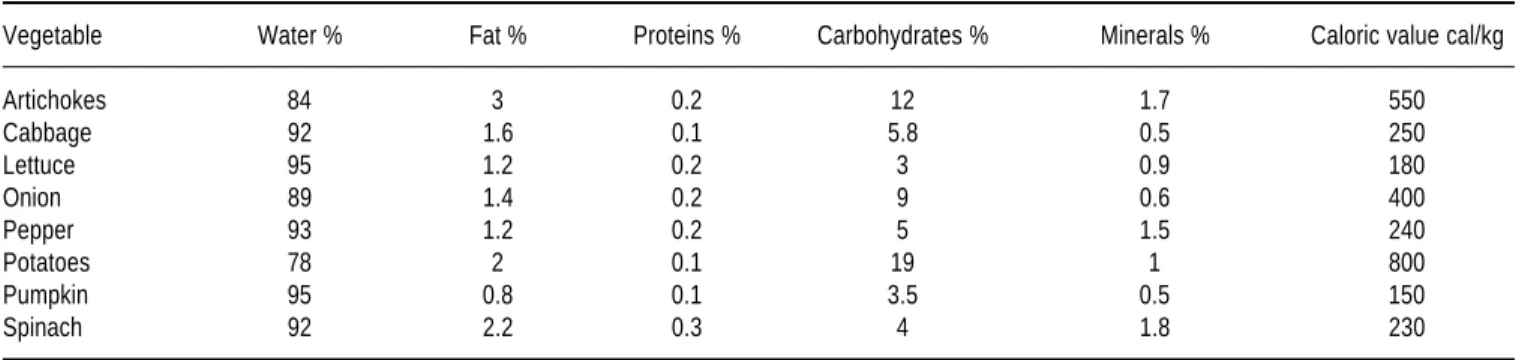
Given this problematics, in this research, that is a part of a comprehensive rescue project of the Xochimilco zone, the microbiological characteristics of two representative samples of raw consumable vegetables of great demand by the population were studied, using fecal coliforms organ-isms and Salmonella typhi as indicators. Tables 1 and 2 display the nutritional value (bromatological analysis, vita-mins contents, and caloric value) of the lettuce, one of the most popular vegetables, with respect to others of common ingestion.
The vegetables choice and the disinfection method pref-erences among the cultivators and consumers were made by means of a representative questionnaire. In the same way, the sampling of the two most popular vegetables was randomly made for each one of them in chinampas where they were cultivated.
The information of the microbiological quality of these two vegetables will be of utility to design the strategies concerning this part of the rescue program for the zone and
Table 2. Vitamin content of some vegetables. (Composition given by 100 grams of food) (Acevedo, 1998)
Retinol Ascorbic acid Thiamin Riboflavin Niacin Pyridoxine Folic acid Cobalamine
Vegetable (µg) (mg) (mg) (mg) (mg) (mg) (µg) (µg)
Celery 10 8 0.02 0.04 0.4 0.03 12 0
Coriander 384 11 0.12 0.06 1 * * *
Cress 161 51 0.13 0.2 1.5 0.13 200 0
Lettuce 44 6 0.14 0.05 0.3 0.16 34 *
(Roman) Lettuce 44 7 0.05 0.03 0.3 * 136 0
Spinach 320 40 0.1 0.16 0.5 0.18 140 0
* Unknown values.
Table 1. Caloric value and composition of some vegetables. (Composition given by 100 grams of food) (Acevedo, 1998)
Vegetable Water % Fat % Proteins % Carbohydrates % Minerals % Caloric value cal/kg
Artichokes 84 3 0.2 12 1.7 550
Cabbage 92 1.6 0.1 5.8 0.5 250
Lettuce 95 1.2 0.2 3 0.9 180
Onion 89 1.4 0.2 9 0.6 400
Pepper 93 1.2 0.2 5 1.5 240
Potatoes 78 2 0.1 19 1 800
Pumpkin 95 0.8 0.1 3.5 0.5 150
García-Gómez et al. Microbiological determinations of some vegetables from the Xochimilco zone in Mexico City, Mexico
Rev Latinoam Microbiol 2002; 44 (1): 24-30
27
edigraphic.com
to improve the life quality of Xochimilco inhabitants and their vegetables consumers. This is the contribution of this phase of the investigation.
MATERIAL AND METHODS
Vegetables choice
Vegetables were selected by the accomplishment of a survey applied in a determined zone of Xochimilco (known as the Central Market of Xochimilco), to a population sec-tor of 200 people randomly taken. The survey included two specific questions, one the preferred raw vegetable con-sumed, and the other one, the disinfection method used be-fore its presentation to public (fot he cultivators/sellers) and before its consumption (to the customers):
To consumers:
a) Which are the fresh raw vegetables that you consume most frequently? And
b) How do you clean or disinfect them before consuming them?
To cultivators/sellers:
c) Which are the fresh raw vegetables that you cultivate and sell most? And
d) How do you clean or disinfect them before putting them for sale?
These answers allowed to know, on the one hand, the vegetables of greater consumption in that area and, by the other one, the type of disinfection used by that sector of population (Chávez Espinosa, 2002).
Sampling of produce and lab preparation
The selected vegetables, previous application of the questionnaire, lettuce (Lactuca sativa) and Mexican corian-der (Eryngium foetidum), were acquired in two chinampas near of the market of Xochimilco, by a random sampling. The samples were transferred to the laboratory, in dark plastic bags previously sterilized to avoid the contamina-tion by other microorganisms, within cool boxes, to main-tain its temperature to 4 ± 1.5ºC, and later, in the lab were stored in a cool room at the same temperature, and taken for the microbiological analysis, according to the proce-dures established by the official Mexican norms.13-17
Sample preparation consisted on the homogenization of each type of vegetable, doing a single composed sample of the four collected samples in each chinampa. The
homoge-neous sample was divided in two parts for the accomplish-ment of the most preferred disinfection process. One of the homogenized samples did not receive any disinfection pro-cess and they only were washed with tap water. The second sample, once washed with tap water, they were submerged in a basin that contained the preferred disinfectant dis-solved in tap water (commercial name, “Microdyn”, and active principle is colloidal silver), in according to the in-structions provided by the manufacturer (amount per liter of water and soaking time). The efficiency of these small amounts of the argentiferous metal in colloidal form to eliminate microorganisms is based in the great affinity that have certain cellular proteins by these ions and replacing other metals in its coordination compounds, being accumu-lated in considerable amounts in the cells from the diluted solutions9 (Pelczar, 1990).
Microbiological analyses
In both samples (with and without disinfection) for each one of the two selected vegetables, fecal coliforms and aer-obic mesophilic microorganisms were quantified. As it was already mentioned, the proposed methodologies shown in NOM 092, 093, 109, 110, and 112 (SSa, 1994a-e) were used. Additionally to the established procedure in these norms, the determination of a potentially dangerous patho-genic microorganism, Salmonella typhi was also carried out, according to the proposed NOM (SSa, 1994f).
RESULTS
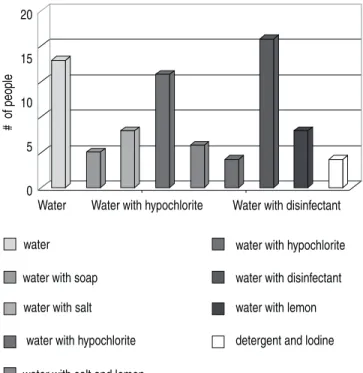
As a result of the survey, in Figures 1 and 2 are the raw freshly eaten vegetables that were preferred by the cultiva-tors/sellers and consumers in the zone of Xochimilco’s Central Market and the method of cleaning and/or disinfec-tion most commonly used by them. When disinfectant is mentioned, most of the people who use it refer to is by a particular trade name. Mexican coriander or cilantro
(Eryn-gium foetidum) and lettuce (Lactuca sativa) were those of
greater consumption by population (28% and 30%, respec-tively), followed by spinach, beets, and parsley (20, 12.5, and 9.5%, respectively).
In the same way, in Figure 2 it is appraised that the most popular method for cleaning and/or disinfecting, is the use of tap water with the commercial disinfectant already men-tioned in the previous section (30%), followed by simple tap water (28%), and finally, water with sodium hypochlo-rite (25%). The other methods were not taken into account in this phase of the investigation.
dis-García-Gómez et al. Microbiological determinations of some vegetables from the Xochimilco zone in Mexico City, Mexico
Rev Latinoam Microbiol 2002; 44 (1): 24-30
28
infectant is applied (from 200,000 UFC/g lettuce sample washed only with tap water to 96,500 UFC/g lettuce sam-ple washed and disinfected with colloidal silver and from 175,000 UFC/g coriander sample washed only with tap wa-ter to 125,000 UFC/g coriander sample washed and disin-fected with colloidal silver), which gives a reduction of 52% for lettuce and of 28.6% for coriander.
For fecal coliforms in the same samples, there is a re-duction of 99.4% for lettuce and 98.6% for Mexican cori-ander (of 75 to 0.43 NMP/g lettuce sample washed to washed and disinfected and of 150 and 2,10 NMP/g of sample of coriander, washed and disinfected, respectively). In the same table it can be appraised that neither the wash-ing with tap runnwash-ing water nor the disinfection with colloi-dal silver are able to eliminate the presence of the indicator microorganism, Salmonella typhi, since all samples gave positive results.
DISCUSSION
As Xochimilco is one of the most important Mexico City’s source of these vegetables (well, more for the Feder-al District or D.F. for its name in Spanish, that comprises Mexico City and other neighboring areas), through its com-mercialization in popular markets or within the Mexico City Central Market (Central de Abastos), which is the main center of food storage and retail within the city, these results are quite worrisome.
It can be seen from data gathered, for both lettuce and Mexican coriander washed with tap water (without chemi-cal addition), values exceeded the permissible ones by the NOM.093-SSA1.1994, and although the values of the sam-ples treated with colloidal silver diminished, the reduction is not considerable and remain in the limit or even exceed it too. This raises the necessity to lead consumers towards the
use of more effective substances to disinfect its fresh foods and, at the same time, to look for appropriate solutions to avoid the sending of contaminated waters to the Xochimil-co channels.
According to the identification of the proposed indica-tor (Salmonella) it was observed that the corresponding biochemical tests and the confirmation of serological tests, the species present was typhi, a potentially hazard-ous pathogenic microorganism, and cause of the typhoid fever in men.
These results seem to indicate, on one hand, that the vegetables that are cultivated in the lacustrine zone of Xochimilco exceed the limits established by the Mexican law norms indicating the presence of organisms with health hazardous potential, particularly those causing typhoid fe-ver. The origin of this contamination definitively comes from spilled residual waters to the Xochimilco channels, both by the wastewater treatment plants and by the inhabit-ants of the zone who do not possess sanitary installations appropriately run for the disposal of domestic waste waters and domestic animals wastes.
As the climate of the ex-basin of Mexico is very benign and promote the proliferation of potentially pathogenic mi-croorganisms that survive after the waste water treatment processes, on one side, it is important to initiate massive awareness campaigns both for the Xochimilco chinampa
Figure 2. Methods commonly used by the inhabitants of Xochimilco
(cul-tivators/sellers) and their customers for cleaning and disinfection of raw freshly eaten vegetables.
Figure 1. Preferred raw freshly eaten vegetables in the zone of
Xochimil-co, D.F., Mexico.
80
60
40
20
0
# of people
García-Gómez et al. Microbiological determinations of some vegetables from the Xochimilco zone in Mexico City, Mexico
Rev Latinoam Microbiol 2002; 44 (1): 24-30
29
edigraphic.com
inhabitants as well as for the employees and engineers of the City Government treatment plants to improve the exist-ing treatment systems and to support the installation of household processing systems (“in situ”) for the Xochimil-co and neighboring zones. The Xochimil-confinement and treatment of their corporal fluids and other wastes before sending them to the environment and from there go to the channels would reduce the vectors for the contamination of their own food products but also for their agricultural products improving their living standards by reducing the health problems associated with poverty.
CONCLUSIONS
According with the results obtained in this investigation it is necessary to corroborate that the processes of waste-water treatment applied in the plants “Cerro de la Estrella “ and “San Luis Tlalxialtemalco”, located in the “Iztapalapa” and “Xochimilco” Delegations of the Federal District are adequate and that the treated waters that these plants dis-pose in the Xochimilco channels comply with sanitary and chemical quality standards that guarantee a better life qual-ity for the inhabitants of the chinampa zone.
Also, it is important that the sanitary authorities of the Government of the Federal District, GDF in Spanish, start looking for creative solutions to treat residual waters for the inhabitants’ households of the chinampas and neigh-boring zones and to teach young, adult, and old people in the Aztecs’ ancestral customs who were able to maintain a paradise in these zones before the arrival of the Spaniards, in which sanitary quality was observed by the conquerors.4 The disinfectant agent commonly used by consumers and “chinamperos” displayed positive effects diminishing the microbial load. Nevertheless, it these effects were not as expected, since Salmonella typhi tests showed positive results. In the lab, the tests using only the organisms in tap water samples with hypochlorite solutions proved to be very effective and with a lower cost than the preferred dis-infectant. This suggests the necessity that the same sanitary authorities not only verify the goodness of these
disinfec-Table 3. Results of the microbiological determinations.
LETTUCE (Lactuca sativa) MEXICAN CORIANDER (Eryngium foetidum) With no disinfection treatment With treatment With no disinfection treatment With treatment
Aerobic mesophilic * UFC/g ** 200,000 * 96,500 ** 175,000 * 125,000
Fecal coliforms * NMP/g * 75 * 0.43 ** 150 * 2.10
Salmonella typhi Present Present Present Present
* Normative limits: Aerobic mesophilic: 150,000 UFC/g and fecal coliforms: 100 NMP/g. ** Exceeds the limits.
tant substances for the socalled normative organisms. In fact, the organisms that can cause endemics as the typhoid fever should be of public health priority in Mexico City.
REFERENCES
1. Acevedo, M. 1998. Desinfectantes comerciales. Un estudio com-parativo de su aplicación en hortalizas. Tesis profesional. Facultad de Química, UNAM. México, D. F. México.
2. Beerens, H. 1998. Bifidobacteria as indicators of fecal contamina-tion in meat and meat products: Deteccontamina-tion, determinacontamina-tion of origin, and comparison with Escherichia coli, Int. J. Food Microbiol., 40: 203-207.
3. Chávez-Espinosa, J. 2002. Determinación de la calidad microbi-ológica y de contaminantes traza en hortalizas de mayor consumo en la zona de Xochimilco. Trabajo terminal del Laboratorio Expe-rimental de Alimentos (Labdea). 49 págs. UNAM, Facultad de Química. México D.F.
4. Díaz-del-Castillo, B. 1992. Historia Verdadera de la Conquista de la Nueva España. Editores Unidos Mexicanos, S.A. Segunda edición. Pp. 218-219. México D.F.
5. Durán-Bazúa, C. 1992. Special Conference. “Water use in de-veloping countries, the situation in Mexico”. BOKU University. Sept. 26. Vienna, Austria.
6. INCMyNSZ. 2001. Instituto Nacional de Ciencias Médicas y Nutri-ción “Salvador Zubirán”. Unpublished data. México D.F. México. 7. Krarup, R. 1997. From Internet:
http://www.puc.cl/sw-edu/hortali-zas/htm.
8. Muller, G. 1991. Microbiología de los Alimentos Vegetales. Ed. Acribia, Zaragoza, España, Pp. 59-61.
9. Pelczar, M. 1990. Microbiología. Ed. McGraw-Hill, México, D. F. México, Pp. 613-681.
10. Real Academia Española. 1996. Diccionario de la lengua española. Tomo I. (a-g). Ed. Espasa Calpe S.A. P. 1078. Madrid, Spain. 11. Sandhya, S., Uma, T.S., Subbarao, K. 1998. Dip slide technique for
rapid qualitative estimation of fecal coliforms in water and waste-water, PII: SOO43-1354. 00271-1 989-994. Wat. Res. Vol. 33, No 4, Pp. 989-994,1999.
12. SSa. 1994a. Norma Oficial Mexicana. NOM-092-SSA1-1994, Bienes y Servicios. Método para cuenta de bacterias aerobias en placa. Secretaría de Salud. México D. F. México.
13. SSa. 1994b. Norma Oficial Mexicana NOM-093-SSA1-1994, Bienes y Servicios. Prácticas de higiene y sanidad en la preparación de ali-mentos que se ofrecen en establecimientos fijos. Secretaría de Sa-lud. México D. F. México.
García-Gómez et al. Microbiological determinations of some vegetables from the Xochimilco zone in Mexico City, Mexico
Rev Latinoam Microbiol 2002; 44 (1): 24-30
30
15. SSa. 1994d. Norma Oficial Mexicana NOM-110-SSA1-1994, Bienes y Servicios. Preparación y dilución de muestras de alimen-tos para su análisis microbiológico. Secretaría de Salud. México D. F. México.
16. SSa. 1994e. Norma Oficial Mexicana NOM-112-SSA1-1994, Bienes y Servicios. Determinación de bacterias coliformes. Técni-ca del número más probable. Secretaría de Salud. México D. F. México.
17. SSa. 1994f. Norma Oficial Mexicana NOM-114-SSA1-1994, Bienes y Servicios. Método para la determinación de Salmonella en alimentos. Secretaría de Salud. México D. F. México.
18. Taylor, S. 1990. Foddborne diseases. Ed. Dean O. Cliver. Food Re-search Institute. Pp. 79-91. Wisconsin, USA.
19. Tortora, G. 1995. Microbiology. The Benjamín/Cummings Publishing Company Inc. Pp. 274-278; 668-674. New York, USA.
Correspondence to:
Rolando García-Gómez
UNAM. Facultad de Química. Coyoacán, Apartado Postal 70-305. 04510 México D. F. Programa de Ingeniería Química Ambiental y de Química Ambiental.