edigraphic.com
CONFERENCIAS MAGISTRALESVol. 30. Supl. 1, Abril-Junio 2007 pp S82-S87
C CO
LEG
IOM
EXICANO DE ANESTESIOLOG
ÍA
A.C
.
AN TES
SO
CIEDAD
MEXICANA DE ANEST
ESIO LOG
ÍA
Anestesiología
Anestesiología
Revista
Mexicana de
Anestesiología
Anestesiología
Anesthesia for the Child with Congenital Heart
Disease (CHD) for Non-cardiac Surgery
William J. Greeley, MD
The Children’s Hospital of Philadelphia. Department of Anesthesia. University of Pennsylvania School of Medicine
Stage I Procedure
Stage II Procedure
Superior Cavopulmonary Connection with Takedown of B-T Shunt Removes Volume Load on Single Ventricle
edigraphic.com
SUSTRAÍDODE-M.E.D.I.G.R.A.P.H.I.C:ROP ODAROBALE FDP
VC ED AS, CIDEMIHPARG
ARAP
ACIDÉMOIB ARUTARETIL :CIHPARGIDEM
OBJECTIVES
• Demographics
• Determinants of physiologic function • Surgical procedures
• Anesthetic management
DEMOGRAPHICS OF CHD IN USA
• 21,000-43,000 live births annually • 20,000 cardiac surgical procedures • Over 80% survival to third decade • Prevalence 500,000-800,000 • Heterogeneous population Stage III
edigraphic.com
PREVALENCE OF CONGENITAL HEARTMALFORMATIONS
Lesion Infants Children Adults
(%) (%) (%)
Ventricular septal defect 28.3 24 15
Patent ductus arteriosus 12.5 15 15.5
Atrial septal defect 9.7 12 16
Coarctation 8.8 4.5 8
Transposition of great art 8 4.5 2
Hyoplastic left heart synd 7.8 — —
Tetralogy of Fallot 7 11 15.5
Pulmonary stenosis 6 11 15
Aortic stenosis 3.5 6.5 5
Truncus arteriosus 2.7 0.5 —
Tricuspid atresia 1 1.5 1
AORTIC STENOSIS AFTER 25 YEARS
FONTAN NYHA CLASS
Fontan F, et al: Circulation 81:1520, 1990
OBJECTIVES
• Demographics
• Determinants of physiologic function • Surgical procedures
• Anesthetic management
DETERMINANTS OF PHYSIOLOGIC FUNCTION
• Sequelae • Complications • Palliation • Correction
COMMON SEQUELAE
• Arrhythmia
• Ventricular dysfunction • Hemodynamic disturbance • Pulmonary vascular disease
DETERMINANTS OF PHYSIOLOGIC FUNCTION
• sequelae Hospital Admission Rate - Mayo Clinic
0
20
40
60
80
100
0
2
4
6
8
10 12 14
years followup
per
c
e
n
t
edigraphic.com
SUSTRAÍDODE-M.E.D.I.G.R.A.P.H.I.C:ROP ODAROBALE FDP
VC ED AS, CIDEMIHPARG
ARAP
ACIDÉMOIB ARUTARETIL :CIHPARGIDEM DETERMINANTS OF PHYSIOLOGIC FUNCTION
• sequelae • complications • palliation
• e.g. single ventricle & Fontan
DETERMINANTS OF PHYSIOLOGIC FUNCTION
• Sequelae • Complications • Palliation • Correction
FONTAN OPERATION
• Functional level -NYHA
• Arrhythmia 20 – 30%
• Ventricular function 10 – 20%
• Pulmonary vascular disease 25%
• Hemodynamic sequelae 100%
• Protein losing enteropathy 5 – 10%
• Thromboembolism 15 – 20%
OBJECTIVES
• Demographics
• Determinants of physiologic function • Surgical procedures
• Anesthetic management
SURGERY IN CHILDREN WITH CHD
• Dental Procedures • General surgery • Urology • Trauma
• Orthopedic surgery
CHOP NON-CARDIAC SURGERY 2004
• Requests 945/CVA 424
• PS II (154), PS III (195), PS IV (75) • Elective (400 ), emergency (24)
• Day Surgery (274), overnight stay (150)
• Simple procedures (60%) – BMT, T/A, circumcision, hernia • Complex procedures (40%) – TEF, brain tumor, tumor
resection, transplant, etc.
SURGERY IN ADULTS WITH CHD
• Labor and delivery • Trauma
• Orthopedic surgery • General surgery • Cardiac surgery
OBJECTIVES
• Demographics
• Determinants of physiologic function • Surgical procedures
• Anesthetic management
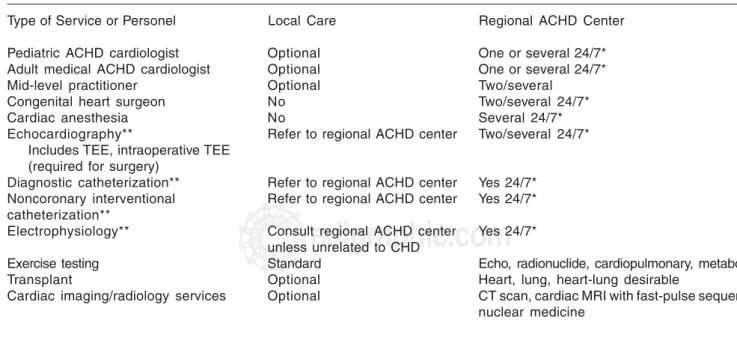
Table I. Personnel and Services Recommended or Required for Regional ACHD Centers
Type of Service or Personel Local Care Regional ACHD Center
Pediatric ACHD cardiologist Optional One or several 24/7*
Adult medical ACHD cardiologist Optional One or several 24/7*
Mid-level practitioner Optional Two/several
Congenital heart surgeon No Two/several 24/7*
Cardiac anesthesia No Several 24/7*
Echocardiography** Refer to regional ACHD center Two/several 24/7*
Includes TEE, intraoperative TEE (required for surgery)
Diagnostic catheterization** Refer to regional ACHD center Yes 24/7*
Noncoronary interventional Refer to regional ACHD center Yes 24/7*
catheterization**
Electrophysiology** Consult regional ACHD center Yes 24/7*
unless unrelated to CHD
Exercise testing Standard Echo, radionuclide, cardiopulmonary, metabo
Transplant Optional Heart, lung, heart-lung desirable
Cardiac imaging/radiology services Optional CT scan, cardiac MRI with fast-pulse sequen
edigraphic.com
Cardiac pathology Optional Yes
Information technology Optional • Data collection
Other • Interface with regional • Database support
ACHD center • Interface with local practitioners,
• Data collection including internet-based applications
• Participation in patient-care • Quality assessment review and protocols and best- practice • Optional development of best practice guid
guidelines review • Adolescent transitional unit
• High risk obstetrics • Genetics
• Rehabilitation services • Social services • Vocational services • Financial counselors
* «24/7» denotes availability 24 hours/day, 7 days/week. **These modalities must be supervised/performed and interpre-ted by physicians with specific skills and knowledge.
DESIRABLE HEMODYNAMIC OBJECTIVES
Preload PVR SVR HR contractility
ASD (L→R) ↑ ↑ ↓ N N
PDA (L→R) ↑ ↑ ↓ N N
VSD (L→R) ↑ ↑ ↓ N N
VSD (R→L) N ↓ ↑ N N
AS ↑ N ↑* ↓* N-↑
IHSS ↑ N N-↑ ↓* ↓*
Valvar PS ↑ ↓ N ↓ ↑
Infundibular PS ↑ ↓ N ↓ ↓*
Coarctation ↑ N ↓ N N
MS ↑ N-↓ N ↓* N-↑
MR ↑ N-↓ ↓ N-↑ N-↑
AI ↑ N ↓ N-↑ N-↑
* overriding consideration
ANESTHETIC MANAGEMENT
• More important to be guided by a safe, familiar, estab-lished anesthetic technique than to have a detailed un-derstanding of the specific pathophysiologic lesion
• Patient evaluation
• Cardiologist communication
EVALUATION OF CARDIAC STATUS
• Activity tolerance • Growth pattern
• Congestive heart failure • Magnitude of cyanosis • Medications
• Cardiologist evaluation
FORMULATION OF AN ANESTHETIC PLAN
• Patient considerations • Operative considerations • Postoperative considerations
PATIENT CONSIDERATIONS
• Associated conditions –e.g Chr 22 • Airway –e.g. tracheal stenosis • Psychosocial issues –e.g. depression • Medications
• Hematocrit –e.g. cyanosis
OPERATIVE CONSIDERATIONS
• SBE prophylaxis –e.g. AHA
edigraphic.com
SUSTRAÍDODE-M.E.D.I.G.R.A.P.H.I.C:ROP ODAROBALE FDP
VC ED AS, CIDEMIHPARG
ARAP
ACIDÉMOIB ARUTARETIL :CIHPARGIDEM • VR & PBF, emboli & R->L shunts
• Single lung ventilation
• Cyanosis, PBF, AV malformations
POSTOPERATIVE CONSIDERATIONS
• PACU vs ICU • Patient comfort
• Pain – SVR & PVR changes, neuraxial analgesia • N & V – fluids
• Fluid management
CONCLUSIONS
• Physiologic spectrum wide
• Expected outcome of a specific lesion and sequelae • (Arrythmia, ventricular dysfunction, hemodynamic
residua, pulmonary vascular disease) • Formulation of anesthetic plan
• Response to provocative conditions • General
• Specific