
Affronter la paix ou la guerre par le rire : l'humour et la consolidation de la paix
9
0
0
Texto completo
(2) E-journal promoted by the Campus for Peace, Universitat Oberta de Catalunya. Craig Zelizer Laughing our Way to Peace or War: Humour…. http://journal-of-conflictology.uoc.edu. As a conflict resolution scholar and practitioner for almost two decades, one of the issues that I have experienced in diverse societies around the world, particularly those in the midst of severe conflict or recently emerging from conflict, is the use of black humour. To individuals from outside the conflict regions (and likely to some inside), some of the jokes about violence, death and self-deprecation are shocking to hear. However, from my time in Colombia, Bosnia-Herzegovina, Northern Ireland and other conflict affected areas, making fun of one’s own group and the “other” is a frequent rite of passage. An especially memorable moment was during the Sarajevo Film Festival in the summer of 2001, watching the premiere of the Bosnian Film, No Man’s Land with a crowd of several thousand in an open-air cinema. The film later won the Academy Award for Best Foreign Film. It provides a humorous account of the Bosnian war, in which all sides, the international community included, are equally the object of ridicule. For example, in the film a UN peacekeeper is dispatched to aid in preventing conflict but explains: “We are here to keep the peace but we are not allowed to do anything or get involved” (Horton, 2006, p. 31). Watching thousands laugh at their own recent and tragic conflict through a film, that made fun of all sides, and the absurdity of war, was quite a shocking and powerful moment. On another occasion, I attended a comedy show in Belfast where most of the humour was based on everyday aspects of life in the country. It was interesting to watch the audience and listen to the response to the aggressive humour of this performance. At one point the comedian pushed too far and the audience turned against his jokes. His humour had crossed the line that was socially acceptable between making fun of others and being cruel. Apart from the individual or cultural use of humour in conflict affected societies, there are also countless examples of the use of humour to help break down conflict divisions, to ensure that groups do not take themselves too seriously or to help individuals cope with the tragedy of conflict by being able to laugh at themselves or their group. This in turn can aid the healing process. Although by no means does humour represent a magic solution for transforming conflicts, nor is does it always have benign impacts, the subject deserves additional study.. b) the mental faculty of discovering, expressing, or appreciating the ludicrous or absurdly incongruous; c) something that is or is designed to be comical or amusing. Humour doesn’t exist in and of itself, but has to be delivered through a number of possible mediums. These include informal conversations, jokes, plays, cartoons, music, films, and comedy. Humour can be something structured and planned in advance, or something that emerges as a spontaneous reaction. In general, humour occurs within social interactions, and the context is critically important. According to Rod Martin (2007), a leading researcher in humour studies, humour includes four key components: 1) 2) 3) 4). a social context a cognitive perceptual process an emotional response the vocal-behavioural expression of laughter (p. 5). Humour has a number of definitions. For this paper humour is defined as:1. In many ways the process of humour is similar to a standard communication approach where a message is delivered to a recipient who then processes the information based on a particular relational and social context. One of the core aspects of humour and communication in general is that the content of the message is not the only important component in play. The underlying motivation and tone of delivery and how the receiver interprets the materials are also key factors in determining the potential positive or negative impact of humour. For humour to have an impact and be effective, it generally needs to occur within a context that helps to provide the additional meaning, or a cultural lens through which it can be interpreted. For example, many societies may choose specific professions to tell jokes as a way to try and challenge the power or status that professionals in that sector may have. In the United States, lawyers are often a major target for jokes for a myriad of reasons. While jokes about lawyers in the US may elicit a response from many audiences, a similar joke about lawyers in another cultural context may not elicit the desired response. Similarly in many severely conflict affected societies, joking about war, violence or trauma may be something at least socially acceptable or tolerated, while these types of jokes might be seen as completely insensitive in societies that have not experienced widespread violence. The stages of humour can be expressed in the following sequence:. a) that quality which appeals to a sense of the ludicrous or absurdly incongruous;. A particular social context exists (social conversation, organisational, family interaction, political settings).. What Is Humour?. 1 Definitions from Merriam-Webster Dictionary. Retrieved: February 9, 2010. JOURNAL OF CONFLICTOLOGY, Volume 1, Issue 2 (2010). ISSN 2013-8857. 2.
(3) E-journal promoted by the Campus for Peace, Universitat Oberta de Catalunya. Craig Zelizer Laughing our Way to Peace or War: Humour…. http://journal-of-conflictology.uoc.edu. ▶. The context involves a host of cultural norms and embedded relationships that help to define how humour will be expressed. The underlying intention behind the choice of content and tone are important factors.. ▶. The humour is expressed by a particular party using a specific means of delivery (a joke, ironic remark, speech, etc.).. ▶. The receiving party or group processes the information based on their own perceptions of the humorous expression and context, as well as their own emotional and mental state. Depending on these factors the following may happen:. ▶. Often a behavioural response will arise, which traditionally might be smiling or laughter (this can be genuine or feigned). If the humorous expression is taken to be offensive, the receiving party may respond with another humorous reaction or set up conditions for future conflict. This sequence provides a simplistic portrayal of the key steps in a humorous encounter. These interactions can be direct where communication is interactive, or through more distant media where the audience is not directly known to the originator of the humour. These indirect vehicles of humour include television, film, and some forms of new media. Regardless of the particular type of relational interaction and means of delivery, how the social relationships are embedded in larger cultural, economic, and political dynamics that often involve power issues are key factors. In the discipline of humour studies, there are more than 100 theories to explain why humour exists and its role in social interactions. According to McCreaddie and Wiggins (2009), three of the dominant paradigms include: • • •. social (superiority) cognitive-perceptual (incongruity) or emotional (release) (p. 1080)2. Humour as a form of social superiority involves the demonstration of moral superiority over another group or self-disparagement (Swart, 2009). For example, in many conflicts, a dominant group will create jokes about the group they are seeking to control or influence. Incongruity or cognitive-perceptual humour is when something appears outside normal perceptions or knowledge and through a rapid cognitive process, resulting in a humorous reaction (Martin, 2007). Seeing a clown riding down a street on a unicycle in a neighbourhood where this has. never been done before could generate this type of response. As Beeney (2009) explains “when there is a juxtaposition of incongruous ideas, words, images, etc., humour may be evoked” (p. 5). Humour can also play an important role in helping to fuel an emotional release. Often when people are nervous, laughter can be used to release anxiety. Or when a person or a group has had a particularly powerful and possibly life-threatening experience, the use of humour or jokes can help to release tension or emotions.. Culture and humour A core question in research on culture and conflict (Avruch, 1998) is the extent to which expressions or sources of conflict are universal as opposed to culture specific. Similarly, there has been extensive research regarding the relationship between humour and culture. According to Peter Berger (1997), all cultures in the world have humour. As he explains: “Humour — that is, the capacity to perceive something as being funny — is universal; there has been no human culture without it. It can be regarded as a necessary constituent of humanity. At the same time, what strikes people as funny and what they do in order to provoke a humorous response differs enormously from age to age, and from society to society” (p. X). Thus, all groups appear to have the need or capacity to experience humour as a means of creating in-group identity, making sense of unusual situations, and possibly as a coping tool. Berger (1997) has developed the concept of Comic Culture, describing how a particular cultural grouping defines and operationalises humour. Comic culture can be applied to identity groups, but can also be specific to institutional and organizational cultures, as they often develop their own particular forms and expressions of humour. As McCreaddie and Wiggins explain (2009), “Any setting, whether oriented to health care, religion, social or family life, will have a unique comic culture related to the combination of personalities and circumstances involved” (p. 1094). For example soldiers often develop their own type of humour, as do humanitarian aid workers, and particularly groups that operate in situations of extreme stress (Zimmerman, 2009).. Health and humour One of the fields in which widespread research on humour has been conducted is within the health sector. Despite the widespread belief that there is a direct link between humour,. 2 For a useful overview of humour and various theoretical explanations see L.L. Beeney (2009), The use and effects of humor in mediation. JOURNAL OF CONFLICTOLOGY, Volume 1, Issue 2 (2010). ISSN 2013-8857. 3.
(4) E-journal promoted by the Campus for Peace, Universitat Oberta de Catalunya. Craig Zelizer Laughing our Way to Peace or War: Humour…. http://journal-of-conflictology.uoc.edu. laughter and improved health, to date the research is less than conclusive. Scholars have broken down the possible health benefits of humour into direct and indirect benefits (McCreaddie and Wiggins, 2009). According to Rod Martin (2004), there are four possible health benefits from humour that include: 1) The physical benefits that result from laughing that might include changes in the endocrine or immune systems (direct); 2) The positive emotional states that may accompany laughter (direct); 3) A moderation of the adverse effects of stress (indirect); 4) An increase in one’s level of social support (indirect) (pp. 3-5). Evidence providing strong correlations to direct health benefits is still being debated (Martin, 2004). However, there has been a strong push in recent years to integrate humour into diverse health care settings. These include training health care professionals in humour, using clowns in hospitals, and encouraging the use of humour in the workplace. There are also tangible outcomes for staff working in stressful hospital settings, when the use of humour in the workplace is encouraged. Some of the benefits include building teams, managing difficult emotions and relieving situations (Dean and Major, 2008).. Why is humour important in relationship to conflict? As previously highlighted, humour can play an important role in conflict contexts, in fostering connections, helping groups cope with the affects of conflict, and ensuring groups do not take themselves too seriously. Using humour can sometimes provide a degree of safety for expressing difficult ideas or opinions. Similar to the benefits of using theatre or roles as a safe space to experiment with different perspectives on conflict (Zelizer, 2003), the use of humour can allow a person or group to always claim that they are “just joking” (Swart, 2009) if sensitive topics are being explored. In the following section, the relationship of humour to conflict is explored in relation to humour as a generator of conflict, as a tool for conflict resolution, as a form of social protest, and as a contributor to healing.. Humour as a generator of conflict One of the core dynamics of conflicts, which has a strong identity-based component, is that groups have a natural tendency to distinguish between in- and outgroups (Been, 2009; Swart, 2009). Using humour can JOURNAL OF CONFLICTOLOGY, Volume 1, Issue 2 (2010). help groups to solidify in-group solidarity and exclude others. This can be a healthy form of bonding to some degree, as the process can facilitate a degree of safety and trust among group members. Creating common jokes, humorous stories, rituals and more can help to build group cohesion and a sense of identity. As Srdan Vucetic (2004) explains, “Jokes are ubiquitous social phenomena. Many jokes can be regarded as narratives that provide a way of locating both the narrator within their group and that group’s relationship to other groups; that is, jokes serve to situate the self within a particular social and political world.” However, using humour to create in- and out-groups, can lead to the dehumanization of others and justify the belief in the righteousness of one’s own group or cause. Similar to hate media, as conflicts escalate, the negativity of the humour used to demonise the other side will likely increase in both formal and informal settings. In the Rwandan genocide and other instances of mass violence, humour has been used against other groups to justify actions of violence. For example, when violence broke out over disputed presidential elections in Kenya in 2007, jokes played a role in escalation of the violence. As Ms. Linda Ochiel, (cited in Quist-Arcon, 2008) Chief Human Rights Officer of the Kenyan National Commission on Human Rights, comments: “Members of Parliament and campaigners used a lot of hate speech. They dehumanized communities, calling them names, names of animals, or objects, using jokes that were derogatory and making People look like they were not human beings so that the killings - the killings that have been happening went on for a long time. People killing their neighbours because they have been dehumanised. So it’s become very easy for them to kill people that they know.” In terms of monitoring conflict settings, attempts could be made to examine the subject and content of jokes in conflict settings. If there is a noticeable increase in the aggressiveness of jokes, in formal media and on the streets, this could be a sign that conflict dynamics and polarisation are increasing.. Humour as a process tool This is similar to cognitive-incongruity. The use of humour in conflict settings can play an important role in breaking the conflict cycle. There has been extensive research about the use of humour in mediation settings and in negotiation. Much of this research has focused on the technical use of humour to help interrupt or reframe conflict dynamics between the disputing parties (See Been 2009). Encouraging parties in conflict to laugh at the conflict or provide a humorous perspective on a frustrating situation can sometimes help reframe the dynamics of the. ISSN 2013-8857. 4.
(5) E-journal promoted by the Campus for Peace, Universitat Oberta de Catalunya. Craig Zelizer Laughing our Way to Peace or War: Humour…. http://journal-of-conflictology.uoc.edu. conflict and allow space for progress to be made. According to Bercovitch (1984) and other negotiation scholars, a sense of humour is also an important characteristic of effective international negotiators. As Been (2009) summarizes the research on humour and mediation: “Humour can be used to break the ice between strangers, to diffuse tension between agitated individuals, to insult and tease, to remind a group of their shared social experience, to soften the blow of an insult, or it can be used to sting and make a swipe at someone” (p. 9). One of the challenges in using humour as part of a conflict resolution process is to ensure that the timing and context are appropriate. In addition, humour can play an important role in more traditional conflict resolution processes in developing societies. According to research conducted by Mark Davidheiser (2006) in the Gambia, joking relationships and humour play a vital role in providing a space and process to address social conflicts. As he explains “The ritual space created through joking relations and their social capital make them effective even in cases resistant to other mediation attempts” (p. 848). Thus, in some cultures, humour itself may be an appropriate tool for bringing parties in conflict together. This type of work can also be done at a macro level, by providing an opportunity for groups to challenge some of the assumptions they hold about the conflict, or about the other side. The goal is often to foster or explore a different approach to understanding conflict, by providing a different perspective. Thus humour can be integrated into a wide variety of conflict resolution processes, such as dialogue, facilitation and negotiations.. Healing humour Humour can be used to help groups deal with tensions, release frustrations and also heal mental and emotional wounds. The use of humour for releasing emotions that have built up as a result of conflicts can be particularly important to help groups cope and maintain their sanity. Exploring humour, through jokes, using funny skits, movies, films or other media, can be an excellent tool to help groups that have suffered from conflict begin to heal and to laugh again. One of the most well-known groups promoting this type of activity as a form of creative therapy or artistic intervention is the Clowns Without Borders organisation. The group was founded over 10 years ago and has performed in over 300 locations around the world, and reached over 1,000,000 people (Wroth, 2009). As Moshe Cohen, the founder of the US Branch explains, “It’s about releasing psychic tension through laughter” (Wroth, 2009). In many war settings, and instances when individuals face dire circumstances, humour can provide a lifeline. Gerald Coffee (cited in Wooten and Dunkelblau, 2001), a JOURNAL OF CONFLICTOLOGY, Volume 1, Issue 2 (2010). prisoner of war in Vietnam, shares why American soldiers used humour in the Vietnam POW camps: “Laughter sets the spirit free through even the most tragic circumstances. It helps us shake our heads clear, get our feet back under us and restore our sense of balance. Humour is integral to our peace of mind and our ability to go beyond survival.”. Relationship building One of the challenges in conflicts is trying to create spaces where groups can interact with each other across the divide. There are a host of processes that have been used to foster relationship building, ranging from conflict resolution training, to sports, arts and education. Humour could also be a potential tool for engaging groups. To date, research in this area has been very limited, while the practice of using humour as a driving tool for bringing groups together is only slightly more widespread. There are several examples in this area, for example the Israeli-Palestinian Comedy Tour, with four US born comedians from different backgrounds, who have performed in many different countries. Their goal “is to make us laugh, to help us realize the foolishness of violence, and to reflect on our situations” (Batruni, 2009). The Cartooning in Conflict Exhibit is a travelling exhibition that questions the conflict that is taking place between the two sides, and has been exhibited in several locations around the world including Israel, Spain, the UK and the US. Robi Damelin (cited in Donelly, 2009) tells how one of the key organisers describes the work: “Their art illustrates the destructive absurdity of the Palestinian-Israeli conflict and, more importantly, serves as a catalyst for hope by imagining a path to reconciliation and peace.”. Social protest In addition to those listed above, the fourth possible role for humour is that it can play an active role in resisting oppression and challenging the conflict dynamic. According to Majken Jul Sorensen (2008), the use of humour in the nonviolent Otpor movement in Serbia that challenged the rule of Slobodan Milosevic had a critical role in several areas including: a) Facilitating outreach and mobilisation; b) Facilitating a culture of resistance within the resistance movement — building solidarity and strengthening the individual’s capacity for participating in resistance; c) Turning oppression upside down (pp. 175-181). There is extensive research indicating that, in times of severe conflict, humour can be used to resist. As humour. ISSN 2013-8857. 5.
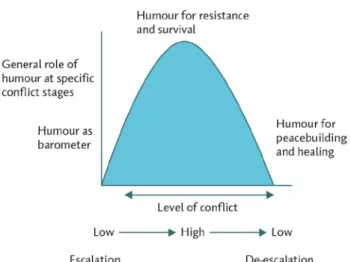
(6) E-journal promoted by the Campus for Peace, Universitat Oberta de Catalunya. Craig Zelizer Laughing our Way to Peace or War: Humour…. http://journal-of-conflictology.uoc.edu. researcher Don Nilsen (cited in Hartill, 2005) comments about the Jews in World War II, “The humour used by the Jews in Nazi concentration camps allowed the Jews to take a little bit of control of their own lives.”. Figure 2. Stages of conflict and humour. Potential framework for humour in conflict regions Based on the exploration of humour and its various roles, a preliminary framework for examining the relationship of humour and conflict in communal settings is provided below. Figure 1. General categories of humour and conflict resolution (adapted from Zelizer, 2003) Approach. Example. Relationship to conflict resolution. Intervention Based. Use of humour to help explore or challenge assumptions around specific conflict related issues.. Can address substance and/or relationship components of a conflict.. Creating Group Divisions. Using humour to demonstrate superiority or power relations.. Can lead to conflict escalation.. Relationship Based. Use of humour based processes to help facilitate relationship building.. Addresses relational component of peacebuilding.. Social Protest. Use of Humour in social protests against violence, aggression or oppression.. Help to mobilise community to take action, more activist in nature.. Healing Humour. Clowning or other forms of humour based activities.. Individual level healing, help to re-integrate people into community. Provide a safe space.. Future research This paper is designed to provide a preliminary overview of some of the key aspects of humour and conflict. Given the limited research on the role of humour in conflict, particularly in terms of healing, social protest and relationship building, there are several areas of potential future research that are outlined below.. Humour as a peacebuilding tool. The categories presented above are somewhat arbitrary and there can be significant overlap between them, as humour based processes that are designed to protest against a conflict may also have an intervention focus. However, they do serve as a useful analytical tool to begin distinguishing the types and purpose of different humour basedbased processes. The next figure shows the particular roles of humour at different stages of the conflict. JOURNAL OF CONFLICTOLOGY, Volume 1, Issue 2 (2010). Given the use of humour in conflict regions, what is the potential for humour based interactions to contribute to peacebuilding or positive interactions? Under what conditions will humour facilitate positive change in conflicted parties? When might humour or some expressions of humour be inappropriate and backfire, causing more harm than good? Can comedians or other types of humour-based actors be used within peacebuilding more effectively? How can humour more effectively be integrated into the work of peacebuilders?. Collecting jokes and other expressions of humour Despite the widespread use of humour as a tool for dealing and coping with conflict, there is a lack of information regarding the types of jokes and humour that are being used in conflict regions. How about: To help facilitate learning across different cases, a finer understanding of humour in conflict regions is needed, of its contents and most frequent uses, and how it varies among groups and depends on power relationships.. ISSN 2013-8857. 6.
(7) E-journal promoted by the Campus for Peace, Universitat Oberta de Catalunya. Craig Zelizer Laughing our Way to Peace or War: Humour…. http://journal-of-conflictology.uoc.edu. Humour as a healing agent Within the field of peacebuiding and psychosocial work, humour is being widely used as a tool or process to facilitate healing among groups that have suffered from conflict. What are the tangible short and long-term results from these efforts? When is it appropriate to use humour with groups and when might it cause harm? How can humour also be used as a self-care tool for practitioners?. Training practitioners Are peacebuilding practitioners and students being taught about the potential role of humour in trainings or the classroom? What are the gaps in curricula and learning?. Developing a greater understanding of the medium of humour in conflict regions One of the first avenues of research could be to explore the most frequently used medium of humour in conflict regions and collect examples from a number of countries. There is also the question of the degree to which humour processes. by themselves can be an intervention process. Is it possible to have examples of Comedians for Peace, or Humour for Peace that have resulted directly in some type of intervention or behavioural change in a conflict context?. Conclusion This paper provides a brief overview of some of the key dynamics regarding humour in the context of conflict. Although there is extensive literature on the role of humour in society, healing and other sectors, the exploration of humour in peacebuilding and conflict resolution to date is more limited. There is a need for additional research and exploration. The two models outlined in the paper can help to guide future research as a starting point. Humour is by no means a panacea for resolving conflicts, however, it is clear that it can play a positive role in a number of contexts and is worthy of additional exploration. As a member of the audience commented after watching the Israeli-Palestinian Comedy Tour perform in Israel, “Comedy can lighten up dialogue between people who otherwise would not be able to speak in the same way” (Audience 2007).. Works cited Audience comments on the Tzavta Theater Comedy show, Jan. 27, 2007. Posted on Youtube. <http://www.youtube.com/watch?v=OEqWcfWQcSE &feature=player_embedded> AVRUCH, K. (1998). Culture and Conflict Resolution. Washington DC: USIP Press. BATRUNI, C. (2009). “Israeli-Palestinian Comedy Tour Is The Bomb!”. Levantine Cultural Center website. [Retrieved: February 8, 2010]. <http://www.levantinecenter.org/cultures/levant/ israeli/israeli-palestinian-comedy-tour-bomb> BEENEY, L. L. (2009). The use and effects of humor in mediation. MA thesis, unpublished. Portland State. BERCOVITCH, J. (1984). Social Conflicts and Third Parties: Strategies for Conflict Resolution. Boulder, CO: Westview Press. BERGER, P. (1997). Redeeming laughter: the comic dimension of human experience. Berlin: Walter de Gruyter & Co.. JOURNAL OF CONFLICTOLOGY, Volume 1, Issue 2 (2010). DAVIDHEISER, M. (2006). “Joking for Peace. Social Organization, Tradition, and Change in Gambian Conflict Management”. Cahiers d’études africaines. Vol. 4, pp. 835-839. <http://www.cairn.info/resume.php?ID_ARTICLE= CEA_184_0835> DEAN, R. A.; MAJOR, J. E. (2008). “From critical care to comfort care: the sustaining value of humour”. Journal of Clinical Nursing. Vol. 17, pp. 1088-1095. DONELLY, L. (2009, December 8). Cartoons in Conflict: World’s top editorial cartoonists sketch path to Middle East peace. Dscriber. [Retrieved: February 8, 2010]. <http://dscriber.com/home/753-cartoons-in-conflictworlds-top-editorial-cartoonists-sketch-path-tomiddle-east-peace-for-nyc-exhibit.html> HANANIA, R. (2007, Jan. 12 ). Power of humor. Ynet. [Retrieved: Feb 7, 2010]. <http://www.ynet.co.il/english/articles/0,7340,L3351225,00.html> HARTILL, L. (2005, Feb. 23). “In Afghanistan, comedians joke their way to civic renewal”. Christian Science Monitor. P. A07.. ISSN 2013-8857. 7.
(8) E-journal promoted by the Campus for Peace, Universitat Oberta de Catalunya. Craig Zelizer Laughing our Way to Peace or War: Humour…. http://journal-of-conflictology.uoc.edu. HORTON, M. (2003). “Beyond Noman’s Land: Comic Tragedy & Tearful Laughter in Cinemas of the Balkans”. World LiteratureToday. Vol. 77, pp. 3-4, 30-3. <http://www.jstor.org/stable/40158171>. SWART, S. (2009). “The Terrible Laughter of the AfrikanerTowards a Social History of Humor”. Journal of Social History. Vol. 42, iss. 4, pp. 889-917. <http://dx.doi.org/10.1353/jsh.0.0210>. Humor. Definition and more from the Free MerriamWebster Dictionary (n.d.). [Retrieved: February 9, 2010] <http://www.merriam-webster.com/dictionary/humor>. VUCETIC, S. (2004). “Identity is a Joking Matter: Intergroup Humor in Bosnia”. Spacesofidentity.net. Vol 4, iss. 1. <http://pi.library.yorku.ca/ojs/index.php/soi/article/ view/8011/7168>. MARTIN. R. (2004). Sense of humor and physical health: Theoretical issues, recent findings, and future directions. Humor. Vol. 17, pp. 1-19. MARTIN, R. (2007). The psychology of humor: an integrative approach. Burlington, MA: Elseveir Press. MCCREADDIE, M.; WIGGINS, S. (2009). “Reconciling the good patient persona with problematic and nonproblematic humour: A grounded theory”. International Journal of Nursing Studies. Vol. 46, iss. 8, pp. 1079-1091. <http://dx.doi.org/10.1016/j.ijnurstu.2009.01.008> QUIST-ARCTON, O. (2008, Feb. 20). “Text Messages Used to Incite Violence in Kenya”. National Public Radio. <http://www.npr.org/templates/story/story.php? storyId= 19188853> SORENSEN, M. J. (2008). “Humor as a Serious Strategy of Nonviolent Resistance to Oppression”. Peace & Change. Vol. 33, iss.2, pp. 167-190.. WOOTEN, P.; DUNKELBLAU, E. (2001). “Tragedy, Laughter, and Survival”. Nursing Spectrum Career Fitness Online. [Retrieved: February 8, 2010]. <http://www.aath.org/articles/art_wootdunk1.html> WROTH, C. (2009, August). “Clowns spark laughter among children living in distressed regions”. Ode Magazine. [Retrieved: February 8, 2010]. <http://www.odemagazine.com/doc/65/clownswithout-borders> ZELIZER, C. (2003). “The Role of Artistic Processes in Peacebuilding in Bosnia-Herzegovina”. Peace and Conflict Studies. Vol. 10, iss. 2, pp. 62-75. ZIMMERMAN, S. (2009). “Military Humor: Soldiers use of Humor as a Coping Mechanism in Conflict Situations” [unpublished paper]. Georgetown University.. Recommended citation ZELIZER, Craig (2010). “Laughing our Way to Peace or War: Humour and Peacebuilding” [online article]. Journal of Conflictology. Vol. 1, Iss. 2. Campus for Peace, UOC. [Consulted: dd/mm/yy]. <http://www.uoc.edu/ojs/index.php/journal-of-conflictology/article/view/vol1iss2-zelizer/vol1iss2-zelizer> ISSN 2013-8857 This work is subject to a Creative Commons Attribution-Noncommercial-NoDerivativeWorks 3.0 Spain licence. It may be copied, distributed and broadcasted provided that the author and the source (Journal of Conflictology) are cited. Commercial use and derivative works are not permitted. The full licence can be consulted at: <http://creativecommons. org/licenses/by-nc-nd/3.0/es/deed.en>. JOURNAL OF CONFLICTOLOGY, Volume 1, Issue 2 (2010). ISSN 2013-8857. 8.
(9) E-journal promoted by the Campus for Peace, Universitat Oberta de Catalunya. Craig Zelizer Laughing our Way to Peace or War: Humour…. http://journal-of-conflictology.uoc.edu. About the author Craig Zelizer [email protected] Dr. Craig Zelizer is Associate Director of the MA in Conflict Resolution within the Department of Government at Georgetown University. He was one of the co-founders and a senior partner in the Alliance for Conflict Transformation and is the founder of the Peace and Collaborative Development Network.. JOURNAL OF CONFLICTOLOGY, Volume 1, Issue 2 (2010). ISSN 2013-8857. 9.
(10)
Figure
Documento similar