Consequence Operators for Defeasible Argumentation:
characterization and logical properties
?Carlos Iv¶an Ches~nevar,[email protected]
Guillermo Ricardo Simari, [email protected]
Departamento de Ciencias de la Computaci¶on { Universidad Nacional del Sur Av.Alem 1253 { B8000CPB Bah¶³a Blanca {Rep¶ublica Argentina Tel/Fax:(+54) (291) 459 5135/5136 { Email:fcic,[email protected]
Abstract. Arti¯cial Intelligence (AI) has long dealt with the issue of ¯nding a suitable formalization for commonsense reasoning. Defeasible argumentation has proven to be a successful approach in many respects, proving to be a con°uence point for many alternative logical frameworks. Di®erent formalisms have been developed, most of them sharing the common notions ofargument andwarrant.
In defeasible argumentation, an argument is a tentative (defeasible) proof for reaching a conclusion. An argument iswarranted when it ultimately prevails over other con°icting arguments. In this context, defeasible consequence relationships for modeling argument and warrant as well as their logical properties have gained particular attention.
This paper discusses two consequence operators for theLDSar framework for defeasible argumentation.
The operators are intended for modeling argument construction and dialectical analysis (warrant), re-spectively. Their associated logical properties are studied and contrasted with SLD-based Horn logic. We contend that this analysis provides useful comparison criteria that can be extended and applied to other argumentation frameworks.
Key words: defeasible argumentation; knowledge representation; non-monotonic inference; labeled deduction.
1
Introduction and motivations
Arti¯cial Intelligence (AI) has long dealt with the issue of ¯nding a suitable formalization for commonsense reasoning. Defeasible argumentation has proven to be a successful approach in many respects, proving to be a con°uence point for many alternative logical frameworks. Di®erent formalisms have been developed, most of them sharing the common notions of
ar-gument and warrant. In defeasible argumentation, an argument is a tentative (defeasible)
proof for reaching a conclusion. An argument is warranted when it ultimately prevails over other con°icting arguments. In this context, defeasible consequence relationships for modeling argument and warrant as well as their logical properties have gained particular attention.
The study of logical properties of defeasible argumentation motivated the development of LDSar [Che01], an argumentation formalism based on the labeled deduction methodol-ogy [Gab96]. In labeled deduction, the usual notion of formula is replaced by the notion of
labeled formula, expressed as Label:f, where Label represents a label associated with the w®
f. A labeling language LLabel and knowledge-representation language Lk r can be combined to provide an enriched object language, in which labels convey additional information also encoded at object-language level.
This paper introduces two consequence operators C
arg and Cwar, used for argument
con-struction and warrant computation, respectively. These operators were de¯ned within the
?
LDSar framework [Che01]. Logical properties that characterize the behavior of these
opera-tors are discussed and contrasted with those present in a logic programming setting.
The paper is structured as follows: ¯rst, in section 2 we present an overview of the ba-sic notions concerning consequence operators, non-monotonic inference and their properties. Section 3 introduces the de¯nitions of the operators C
arg and Cw ar, based on the inference
relationships provided byLDSar to build arguments (defeasible proofs) and compute warrant by performing a dialectical analysis.1
In sections 4 and 5 di®erent logical properties of these operators are presented and analyzed. Section 6 concludes and summarizes the role of these properties in the context of the proposed formalism, discussing also some related work.
2
Non-monotonic Inference Relationships: fundamentals
2In classical logic, inference rules allow us to determine whether a given w® ° follows via \`" from a set ¡ of w®s. In classical logic the \`" relationship is a consequence relationship (sat-isfying idempotence, cut and monotonicity). As non-monotonic and defeasible logics evolved into a valid alternative to formalize commonsense reasoning, a similar concept was needed to capture consequence without demanding some of these requirements (e:g: monotonicity). This led to the de¯nition of a more generic notion of inference, namelyinference relationships. New properties were de¯ned and gained interest in this setting. In this section we will introduce the de¯nition of (non-monotonic) inference relationship, as well the de¯nitions some distinguished properties that characterize them.
2.1 Inference relationship. Pure logical properties
De¯nition 2.1 (Inference relationship j» . Inference operator C(¡)). Let ¡ be a set
of w®s in a language L and let ° be a w® in¡. We will write¡j» ° if ° is a (non-monotonic)
consequence of ¡. We de¯ne C(¡) = f° j ¡j» °g.
Given an inference relationship \j» " and a set ¡ of sentences, the following are called
basic (orpure) properties associated with any inference operator C(¡):
1. Inclusion: ¡ µC(¡)
2. Idempotence: C(¡) µC(C(¡))
3. Cut:¡ µ©µC(¡) implies C(©) µC(¡)
4. Cautious monotonicity: ¡ µ©µC(¡) impliesC(¡)µC(©). 5. Cummulativity:¡ µ©µC(¡) impliesC(¡) = C(©).
6. Monotonicity:¡ µ©implies C(¡)µC(©)
The intuitive meaning of inclusion and idempotence should be clear without further com-ments. Thecut rule states that expanding the information in ¡ by adding new propositions from C(¡) does not result in new conclusions being obtained. Cautious monotonicity consti-tutes somehow the `inverse' ofcut: adding new lemmas does not decrease inference power,i:e:
the set of conclusions that can be obtained from a given theory. Combining cut and cautious monotonicity we get cummulativity, which states that intermediate proofs (lemmas) can be
1
In order to make the paper self-contained, an appendix is included with the main de¯nitions that characterize argument construction and warrant in theLDSar framework.
2
used as part of other (more complex) proofs without a®ecting the soundness of their conclu-sions.
These properties are called pure, since they can be applied to any language L, and are abstractly de¯ned for an arbitrary inference relationship \j» ". Nevertheless, other properties which link classical inference with an arbitrary inference relationship can be stated. These properties will be discussed next. In what follows we will assume that T h stands for an op-erator that characterizes classical inference, whereasC corresponds to some (non-monotonic) inference relationship \j» ".
2.2 Horn and non-Horn logical properties
A common name for cataloging non-pure properties is the distinction betweenHorn properties
andnon-Horn properties. Horn properties have the form\from the presence of some particular
inferences, the presence of some other inferences can be assured". Non-Horn properties, on the other hand, have the form\from the absence of some particular inferences, the absence of some
other inferences can be assured". Next we summarize the most important non-pure properties:3
Horn properties
1. Supraclassicality:T h(A)µC(A)
2. Left logical equivalence:T h(A) =T h(B) impliesC(A) =C(B) 3. Right weakening: If x ¾y2T h(A) and x2C(A) then y2C(A).4
4. Conjunction of conclusions: If x2C(A) and y2C(A) then x^y2C(A). 5. Subclassical cummulativity: IfA µB µT h(A) thenC(A) =C(B).
6. Left absorption: T h(C(¡)) =C(¡). 7. Right absorption: C(T h(¡)) =C(¡).
Non-Horn properties
1. Rationality of negation: if Aj» z then either A[ fxgj» z or A[ f:xgj» z. 2. Disjunctive rationality: if A[ fx_ygj» z then A[ fxgj» z or A[ fygj» z. 3. Rational monotonicity: if Aj» z then either A[ fxgj»z orAj» :x.
3
Capturing argument construction and warrant in
LDS
arLDSarprovides a uni¯ed logical framework based on labeled deduction for modelingdefeasible
argumentation. In defeasible argumentation, an argument is a tentative (defeasible) proof for
reaching a conclusion. An argument is warranted when it ultimately prevails over other con-°icting arguments. In what follows, we will consider these concepts in the context of theLDSar
framework. The reader is referred to the appendix A, where basic concepts and de¯nitions of
LDSar are summarized in order to make this paper self-contained.5
When de¯ning consequence operators in LDSar, there is an important di®erence to take into account: LDSar is based on an extension of logic programming, where literals can be
3
An in-depth discussion of these properties can be found in [Ant96].
4
It should be noted that \¾" stands for material implication, to be distinguished from the symbol \ Ã " used in a logic programming setting.
5
preceded by strong negation, and some pieces of information can be distinguished (labeled) as `defeasible'. Clearly the notion of theorem in a logic programming setting is more restricted than the one used in classical logic. This leads us to consider aspecialized consequence operator for Horn-like logics. Formally:
De¯nition 3.1 (Consequence Operator Th
sld(¡)). Given an argumentative theory ¡, we
de¯ne Th
sl d(¡) =f[;;fnig]:h j ¡j»Arg[;;fnig]:hg
According to de¯nition 3.1, `classical' consequences from an argumentative theory ¡ will be arguments (defeasible proofs) whose support set is empty (i:e:, they do not rely on any defeasible information). We want to compare this notion of derivation with respect to infer-ence relationships j»Argand j»T. We will de¯ne two specialized consequence operators for those arguments that can be derived from¡
De¯nition 3.2 (Consequence operatorsC
arg(¡) andCw ar(¡)). Given an argumentative
theory ¡, we will de¯ne two consequence operators C
arg(¡) and Cw ar(¡) as follows:
C
arg(¡)=fA:® j ¡j»ArgA:® and ® is a literal in LKR g
C
war(¡)=f[;;fnig]:h j ¡j»Th
U
g
OperatorsC
arg(¡) and Cw ar(¡) can be associated with the process of argument
construc-tion and warrant computaconstruc-tion, respectively. In what follows we will analyze the di®erent logical properties discussed in section 2 in the context of LDSar.
4
Logical properties of
C
arg
Inclusion does not hold in general forC
arg, since not every piece of defeasible information can
be used as part of an argument. However, it does hold for (non-defeasible) facts. Therefore we refer to it asrestricted inclusion.
Proposition 4.1 (Restricted inclusion).The operator C
arg(¡) only satis¯es inclusion wrt
the non-defeasible information present in ¡.
Proof. Let ¡ be an argumentative theory, and let [;;fnig]:® be a non-defeasible formula in
¡. Clearly, from rule Intro-NR we can derive [;;f®g]:ni from¡,i:e: ¡j»
Arg[;;fnig]:®. Then if
[;;fnig]:® 2¡ then [;;fnig]:® 2C
arg(¡).
The logical properties of idempotence and monotonicity do not hold. Formally:
Proposition 4.2 (Idempotence). The operator Carg(¡) does not satisfy idempotence, i:e: C
arg(¡)6µCarg(Carg(¡))
Proof. A counterexample su±ces. Consider ¡=f [;;fn1g]:q , [fp à qg;fd1g]:p à q g.
Then Carg(¡) =fA1:q, A2:q g, with A1 = ; and A2=fp à q g resp. If we consider
C
arg(Carg(¡)), it follows that A1:q 2 Carg(Carg(¡)) but A2:p 62 Carg(Carg(¡)), since j»Arg
does not allow to introduce empty arguments.
Proposition 4.3 (Monotonicity). The operator C
Proof. A counterexample su±ces. Consider the argumentative theory ¡ = f [;;fn1g]:q
, [fp à qg;fd1g]:p à q g. Clearly ¡j»
ArgA:p, with A = fp à qg. But ¡
0 =
¡ [ f[;;fn1g]:»pg is such that ¡ 6 j»
ArgA:p.
Semi-monotonicity is an interesting property suggested by D.Makinson [MS91] for analyz-ing non-monotonic consequence relationships. It is satis¯ed if all defeasible consequences from a given theory are preserved when the theory is augmented with new defeasible information. Next we show that semi-monotonicity holds forj»
Arg.
Proposition 4.4 (Semi-monotonicity). The operator C
arg(¡) satisfy semi-monotonicity,
i:e: C
arg(¡)µCarg(¡ [¡0), where ¡0 is a theory involving only defeasible information.
Proof. Proof is direct from the structure of the inference rules. Assume¡j»
ArgA:®, and consider
¡ [ ¡0 as stated above. Clearly, the sequence of steps in the proof ¡ [¡0j»
ArgA:® is still
valid, since all preconditions in inference rules are de¯ned wrt ¦(¡) = ¦(¡ [¡0). Hence
¡ [¡0j»
ArgA:®.
Cummulativity holds for argument construction. The importance of this property will be discussed later in section 6.
Lemma 4.5 (Cummulativity). 6
Let ¡ be an argumentative theory, and let ®1 and ®2 be
w®s inProgClauses(LKR). Then ¡j»ArgA1:®1 implies that
¡ [ fA1:®1g j»
ArgA2:®2 i® ¡ j»ArgA2:®2
Proposition 4.6 (Horn supraclassicality).The operator Carg(¡)satis¯es Horn
supraclas-sicality wrt Th
sld, i:e: Thsld(¡) µCarg(¡).
Proof. Proof is direct from the de¯nition 3.1. Every member inTh
sld(¡) is an empty argument,
and as such it is a member inCarg(¡). Therefore Th
sld(¡)µCarg(¡).
Proposition 4.7 (Left-logical equivalence). The operator C
arg(¡) does not satisfy
left-logical equivalence (i:e:, given two theories ¡ and ¡0, if Th
sld(¡) = Thsl d(¡0) this does not
imply that Carg(¡) =Carg(¡0).
Proof. A counterexample su±ces. Consider the theories ¡1 = f [;;fn1g]:p ,
[fq à pg;fd1g]:q à p g and ¡2 = f [;;fn3g]:p g. Clearly, Thsld(¡1) = Thsld(¡2).
However, C
arg(¡1)6=Carg(¡2), since there is an argument forq in ¡1but not in ¡2.
Note that the property of right weakening cannot be considered (in a strict sense) in
LDSar, since the deductive system associated withThsld does not allow the application of the deduction theorem. Therefore, w®s of the form \x à y" cannot be derived via`sld . However, an alternative approach can be intended, introducing a new property in which right weakening is restricted to Horn-like clauses:
Proposition 4.8 (Horn Right Weakening). The operator C
arg(¡) satis¯es Horn right
weakening, i:e: if A:y2Carg(¡) and [;;fnig]:x à y 2Th
sld(¡), thenA0:x2Carg(¡).
6
Proof. Suppose A:y 2 C
arg(¡). Clearly, ¦(¡) [ fx à yg 6 `sld? (otherwise it would not
have been possible to inferA:y). Then applying rule Elim-Ã it holds thatA:x can be derived
from ¡, or equivalentlyA:x2C
arg(¡).
Proposition 4.9 (Conjunction of conclusions). 7
The operatorC
arg(¡)does not satisfy
conjunction of conclusions, i:e: if x 2 C
arg(¡) and y 2 Carg(¡), then it does not hold that
x^y 2C
arg(¡).
Proof. A counterexample su±ces. Consider the following theory ¡ = f
[fp à qg;fd1g]:p à q , [fr à zg;fd2g]:r à z , [;;fn1g]:q , [;;fn2g]:z ,
[;;fn3g]:w , [;;fn4g]:»w à p;r g. Then there exists an argument A1:p with A1=f
p à q g, and an argument A2:r with A2=f r à z g. However, the formula A3:p; r
cannot be derived (nor any other with conclusion p; r) since ¦(¡)[ fp; rg`sld?.
Proposition 4.10 (Subclassical cummulativity). The operatorCarg(¡) satis¯es
subclas-sical cummulativity, i:e: ¡ µ¡0µTh
sld(¡) implies Carg(¡) = Carg(¡
0)
Proof. If¡ is an argumentative theory, thenTh
sld(¡) involves onlyfacts (i:e:literals that can
be derived via Sld from ¦(¡)). By assumption ¡ µ Th
sl d(¡). Then ¡ involves only facts.
But if¡ involves only facts, then every w® in¡ follows trivially viaSldfrom¦(¡). Therefore
¡ =Th
sld(¡), and by assumption it holds that¡0=¡. Then it holds thatCarg(¡) = Carg(¡0),
as we wanted to proof.
Proposition 4.11 (Left absorption). The operatorC
arg(¡)does not satisfy left absorption,
i:e: Th
sld(Carg(¡))6=Carg(¡).
Proof. Th
sld(Carg(¡)) involves only empty arguments that can be derived fromCarg(¡):But
there can exists non-empty arguments inC
arg(¡):Therefore Thsl d(Carg(¡))6=Carg(¡).
Proposition 4.12 (Right absorption). The operator C
arg(¡)does not satisfy right
absorp-tion, i:e: C
arg(Thsld(¡))6=Carg(¡).
Proof. As shown in proposition 4.7, when computing Th
sld(¡) all defeasible information that
might appear in ¡ is lost. However, this information could appear in arguments in C
arg(¡).
Then it holds thatC
arg(Thsl d(¡)) =Carg(¡).
Proposition 4.13 (Rational negation).The operatorC(¡)does not satisfy rational nega-tion.
Proof. A counterexample su±ces. Consider the following theory ¡=f [;;fn1g]:»p Ãx ,
[;;fn2g]:»pûx , [;;fn3g]:r , [fz Ãpg;fd1g]:z Ãp , [fpÃrg;fd2g]:p Ãr g. Then
¡j»
ArgA:z, withA= fz Ãp,p Ãrg. However, ¡[ fxg6 j»ArgA:z, and¡[ f»xg6 j»ArgA:z (since
in both cases the use of d2 is not valid because of consistency constraints).
Proposition 4.14 (Rational Monotonicity). The operator C(¡) does not satisfy rational monotonicity.
Proof. Consider example 4, where ¡j»
ArgA:z, with A = fz Ãp, pÃr g. If we consider now
¡ [ fxg it holds that ¡ [ fxg6 j»ArgA:z, and ¡6 j»Arg »x. Therefore rational monotonicity is not satis¯ed.
Clearly, the operatorC
arg does not satisfy disjunctive rationality either, since disjunctions
cannot be expressed as formulas inLKR. 7
5
Logical properties of
C
war
Next we will analyze some relevant logical properties of C
w ar.
Proposition 5.1 (Restricted inclusion).The operator C
war(¡)only satis¯es inclusion wrt
(non-defeasible) facts in ¡.
Proof. Let ¡ be an argumentative theory, and let [;;fnig]:p be a non-defeasible fact in ¡.
Clearly, from rule Intro-NR it follows that¡j»
Arg[;;fnig]:p. The formula [;;fnig]:p provides
an argument for p that has no defeaters. Therefore p is a warranted literal, or equivalently
p 2C
w ar(¡).
Proposition 5.2 (Idempotence). The operator C
war(¡) satis¯es idempotence, i:e:
Cwar(¡)µCwar(Cw ar(¡))
Proof. If we consider C
war(¡) as a set of non-defeasible facts, it is clear that all they are
warranted wrt C
war(¡). Therefore Cwar(¡)= Cwar(Cw ar(¡)), and in particular, Cw ar(¡) µ
C
war(Cwar(¡)).
Proposition 5.3 (Monotonicity). The operator C
war(¡) does not satisfy monotonicity.
Proof. A counterexample su±ces. Consider the example given in proposition 4.3. In that case,
¡j»TpUhencepis warranted. However, in¡[f[;;fn1g]:qgthere is no argument with conclusion
p (and consequentlypis not warranted).
In contrast withj»Arg, semi-monotonicity does not hold forj»T. The reason is the following: adding new defeasible information cannot invalidate existing arguments, but it can enable building new arguments that were not derivable before. Hence, dialectical relationships among arguments are di®erent. Arguments that were warranted may therefore no longer keep that status. Formally:
Proposition 5.4 (Semi-monotonicity). The operator C
w ar(¡) does not satisfy
semi-monotonicity,i:e: C
war(¡)6µCw ar(¡[¡0), where ¡0is an argumentative theory which involves
only defeasible information.
Proof. Consider the following counterexample. Given the theory ¡ = f [;;fn1g]:q ,
[fp à rg;fd1g]:p à r , [fr à qg;fd1g]:r à q g, it is clear that p 2 Cwar(¡), since
there exists an argument A:p with A=fp à r, r à q g, such that A:p has no defeaters (and hence p is warranted).
Consider now¡0=¡[ f[f»p à qg;fd
2g]:»p à qg. In this case, an argumentB:»pcould
be obtained, with B=f»p à q g, such thatB:»pdefeats A:p. Therefore p62C
war(¡0).
Proposition 5.5 (Cummulativity). The relationshipj»Tdoes not satisfy cummulativity.
Proof. Consider the theory¡ = f [;;fn1g]:»s à q , [;;fn2g]:p , [fq à pg;fd1g]:q à p
, [fs à pg;fd2g]:s à p , [f»q à sg;fd3g]:»q à s g. Consider the arguments A:q
withA=fq à p g, andB:»qwithB=f »q à s,s à p g, based on¡. Note that¡j»
Ts
U ,
i:e: s is a warranted literal in ¡. Consider now ¡0 = ¡ [ f[;;fn
3g]:sg. Note that ¡0j»T »q
U
Proposition 5.6 (Horn Supraclassicality). The operator C
war(¡) satis¯es Horn
supra-classicality wrt Th
sld, i:e: Thsld(¡)µCw ar(¡).
Proof. All literals inTh
sld(¡) have arguments with no defeaters. Therefore they are warranted,
and hence they are members ofC
war(¡).
Proposition 5.7 (Left-logical equivalence). The operator C
w ar(¡) does not satisfy
left-logical equivalence, i:e: given two theories ¡ and ¡0, such that Th
sld(¡) = Thsld(¡0) then it
does not follow thatC
war(¡) = Cwar(¡0).
Proof. Consider the counterexample given in proposition 5.7.
Note that right weakening cannot be considered wrtj»T, since there is no way of warranting formulas of the form \x à y". However, as in the case of j»Arg, an alternative version can be provided.
Proposition 5.8 (Horn Right Weakening). The operator C
war(¡) satis¯es Horn right
weakening, i:e: if [;;fnig]:y 2 C
war(¡) and it holds that [;;fnjg]:x à y 2 Thsl d(¡), then
[;;fnkg]:x2C
war(¡).
Proof. Assume that [;;fnkg]:x 62 Cwar(¡). Assume there is an argument A:y, such that y is
warranted. In particular, the empty set is A is also an argument forx, i:e: A:x via Elim-Ã.
Argument A:x and argument A:y have the same set of associated defeaters. Therefore, if
A:y is warranted, then so is A:x. Hence [;;fnkg]:x2C
war(¡) (contradiction).
Proposition 5.9 (Conjunction of conclusions). The operator C
war(¡) does not satisfy
conjunction of conclusions, i:e: if x2C
w ar(¡) and y2Cwar(¡), then it does not hold x^y2
Cwar(¡).
Proof. Consider the counterexample shown in proposition 4.9.
Proposition 5.10 (Subclassical Cummulativity). The operator C
w ar(¡) satis¯es
sub-classical cummulativity, i:e: ¡ µ¡0µTh
sld(¡) implies Cwar(¡) =Cwar(¡0)
Proof. We can reason as in proposition 4.10. Given a theory ¡, clearly Th
sld(¡) will involve
only facts (i:e: literals derivable via Sld from ¦(¡)). By assumption, ¡ µ Th
sl d(¡). Then
¡ is formed only by facts. But if this is the case, then it follows that every formula in ¡ is trivially provable viaSld from¦(¡). Therefore ¡ =Th
sld(¡), and by assumption it follows
that¡0=¡. Hence C
war(¡) = Cwar(¡0).
TheC
war operator satis¯es left absorption, but not right absorption. This follows from the
epistemic status assigned to warranted literals: if they are incorporated as new facts into a given theory, clearly they will be also derivable via Sld. The converse is not true, since not every warranted literal is derivable viaSld.
Proposition 5.11 (Left absorption). The C
war(¡) operator satis¯es left absorption, i:e:
Th
sld(Cwar(¡)) =Cw ar(¡).
Proof. (=)): Suppose h is warranted, and consequently [;;fnig]:h 2 C
w ar(¡). Clearly
¡j»
Arg[;;fnig]:h, and in particular from def. 3.1, it follows that [;;fnig]:h2Thsld(Cw ar(¡)).
((=): Suppose [;;fnig]:h2Th
sld(Cw ar(¡)). Then from def. 3.1 there exists an empty argument
;:h. Therefore his warranted, or equivalently [;;fnig]:h2C
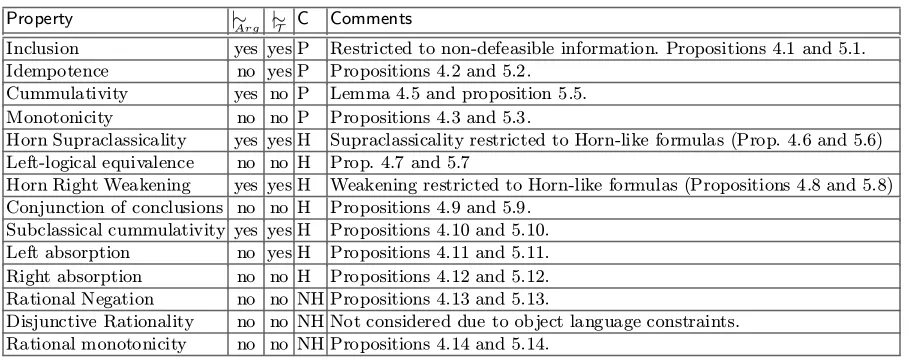
Property j»Arg j»T C Comments
Inclusion yes yes P Restricted to non-defeasible information. Propositions 4.1 and 5.1. Idempotence no yes P Propositions 4.2 and 5.2.
Cummulativity yes no P Lemma 4.5 and proposition 5.5. Monotonicity no no P Propositions 4.3 and 5.3.
Horn Supraclassicality yes yes H Supraclassicality restricted to Horn-like formulas (Prop. 4.6 and 5.6) Left-logical equivalence no no H Prop. 4.7 and 5.7
Horn Right Weakening yes yes H Weakening restricted to Horn-like formulas (Propositions 4.8 and 5.8) Conjunction of conclusions no no H Propositions 4.9 and 5.9.
Subclassical cummulativity yes yes H Propositions 4.10 and 5.10. Left absorption no yes H Propositions 4.11 and 5.11. Right absorption no no H Propositions 4.12 and 5.12. Rational Negation no no NH Propositions 4.13 and 5.13.
Disjunctive Rationality no no NH Not considered due to object language constraints. Rational monotonicity no no NH Propositions 4.14 and 5.14.
[image:9.596.72.527.95.275.2]Note: ColumnCdenotes the kind of property (P=pure; H=Horn; N=non-Horn)
Fig. 1.Logical properties inLDSar: summary
Proposition 5.12 (Right absorption).The C
w ar(¡) operator does not satisfy right
absorp-tion, i:e: C
war(Thsld(¡))6=Cwar(¡).
Proof. A counterexample su±ces. Consider the theory ¡ = f [fp à qg;fd1g]:p à q ,
[;;fn1g]:q g. Clearly p and q are warranted literals. In particular [;;fnig]:p 2 C
war(¡).
Note that Th
sld(¡)=f [;;fn1g]:q g, and consequently Cwar(Thsld(¡)) = Thsl d(¡): But
[;;fnig]:p62C
w ar(Thsld(¡)).
Proposition 5.13 (Rational negation). The C
w ar(¡) operator does not satisfy rational
negation.
Proof. Consider example 4. In this case there is only one argument for z, namely ¡j»ArgA:z,
and such an argument has no defeaters. Consequently z is warranted wrt ¡. However,¡[ f[;;fnig]:xg6 j»
ArgA:z, and¡[ f[;;f
nig]:»xg6 j»
ArgA:z (since in both cases the
use of d2 is not allowed by consistency constraints). Therefore z is not warranted in either of
these cases.
Proposition 5.14 (Rational monotonicity). The C
war(¡) operator does not satisfy
ratio-nal monotonicity.
Proof. Consider again example 4, where ¡j»ArgA:z, with A =fz Ãp, p Ãr g. If we consider now ¡ [ fxg it holds that¡ [ fxg6 j»ArgA:z, and ¡6 j»Arg»x. Therefore rational monotonicity does not hold.
Finally, note that the C
w ar operator does not satisfy disjunctive rationality. The reasons
are the same as those discussed for the C
arg operator.
6
Conclusions. Related work
of the original Simari-Loui framework [SL92] and ofdefeasible logic programming [Gar00]. This research is partly motivated by these results.
As we have shown in this paper,LDSar provides a useful framework for analyzing di®erent
logical properties of defeasible argumentation, providing a better understanding of how argu-ment construction and warrant behave. Figure 1 provides a summary of the logical properties discussed before.
When formalizing argument construction (operator C
arg), restricted inclusion ensures that
non-defeasible facts can be ontologically understood as empty arguments. Cummulativity al-lows to keep any argument obtained from a theory¡ as an `intermediate proof' (lemma) to be used in building more complex arguments. Horn supraclassicality indicates that every conclu-sion that follows via Sld can be considered as a special form of argument (namely, an empty argument), whereas Horn right weakening tells us that strong rules in LDSar preserve the
intuitive semantics of a Horn rule(the existence of a strong rule [;;fnig]:y à x makes every
argument A for x be also an argument for y) Finally, subclassical cummulativity indicates that two argumentative theories¡ and ¡0 whose information is a subset of those literals that
can be derived via Sld from ¡ (or ¡0) are equivalent when considering the arguments that
can be obtained from them.
Computing warrant, on the other hand, can also be better understood in the light of some logical properties ofC
w ar. Restricted inclusion ensures that any non-defeasible fact in a theory
¡ can be considered as warranted. Idempotence indicates that successive applications of C
w ar
on a the setS of warranted literals returns exactly the same set. From Horn supraclassicality it follows that every conclusion obtained viaSldis a particular case of warranted literal, whereas Horn right weakening indicates that non-defeasible rules behave as such in the meta-level (a strong rule [;;fnig]:y à x ensures that every warrant Afor a literalxis also a warrant for
y). From subclassical cummulativity it follows that two theories¡ and¡0, whose information is
a subset of the conclusions that can be obtained from¡ (or¡0) are equivalent when considering
the set of literals that can be warranted from them. Finally, left absorption in C
war wrt Carg
indicates that once a set of warranted literals have been obtained, Sld derivation does not add any inferential power.8
We contend that a formal analysis of defeasible consequence is mandatory in order to get an in-depth understanding of the behavior of argumentation frameworks. The logical properties discussed in this paper provide a natural tool for characterizing that behavior, as well as useful comparison criteria when developing new argumentation frameworks, or assessing their expressive power.
A
Appendix:
LDS
arfundamentals
In this section we will introduce aknowledge representation language LKR for performing defeasible inference, together
with alabeling language LLabels. These languages will be used to de¯ne the object languageLArg. Following Gabbay's
terminology [Gab96], the basic information units inLArgwill be calleddeclarative units, having the formLabel:w®. In our
approach we will restrict w®s in labeled formulas to ground literals. A ground literal can be understood as aconclusion
of anargument, which will be de¯ned by the label.
A label in a formulaL:® will provide three elements which are convenient to take into account when formalizing defeasible argumentation, namely:
1. For every declarative unitL:® the labelLwill distinguish whether that declarative unit corresponds todefeasible
ornon-defeasibleinformation.
2. The labelLwill also provide anunique nameto identify a w® in the knowledge base¡.
8
3. When performing the inference of a declarative unitL:® from a set¡ of declarative units, the labelLwill provide atraceof the w®s needed to inferL:®from¡.
W®s in our knowledge representation languageLKR will be a subset of a classic propositional languageL, restricted
torules and facts. The set of all rules and facts in LKR will be denoted Rules(LKR) and Facts(LKR), resp. We de¯ne
ProgClauses(LKR) = Rules(LKR)[ Facts(LKR). A modality (label) will be attached to w®s inLKR, indicating whether
they aredefeasible ornon-defeasible.
De¯nition A.1 (LanguageLKR. W®s inLKR).The language LKR will be composed of
1. A countable set of propositional atoms, possibly subindicated. We will denote propositional atoms with lowercase letters. Example:a,b,c,d,e,: : : ,a1,a2,a3 are propositional atoms.
2. Logical connectives^, :andÃ.
W®s in LKRwill be de¯ned as follows:
1. If®is an atom inLKR, then®and»®are w®s called literals in LKR.
2. If®1,: : : ®k,¯ are literals inLKR, then¯ Ã ®1; : : : ®k is a w® inLKR.
For the sake of simplicity, when referring to the languageLKR the following conventions will be used: Greek lowercase
letters ®,¯, °will refer to any w® in LKR. Lowercase letters (such ash,q, etc.) will be used for referring to ground
literals inLKR. Greek uppercase letters¨,©,¡ will refer to asetof w®s inLKR. The conjunction®1^®2^: : :^®kwill
be simply written as®1; ®2; : : : ; ®k.
De¯nition A.2 (Labeling constants). A setLabels=fn1,n2, : : :,d1, d2,: : : goflabeling constantswill include constant names with the formni anddi, standing for non-defeasibleand defeasibleinformation, resp. Asetof labeling constants will be denoted asL1, L2,: : :,Lk.
De¯nition A.3 (Labeling language LLabels). A labelL in our labeling language LLabels can be either an argument
labelor adialectical label.9
An argument labelwill be a tuplehLi; ©iwhereLiµLabels and©µ}(W ffs(LKR)).
De¯nition A.4 (Defeasible Labeled Language LArg). IfLLabels is a labeling language, and LKR is a knowledge
representation language, then thedefeasible labeled language, denotedLArg, is de¯ned asLArg = (LLabels,LKR)
De¯nition A.5 (Argumentative formula).Given a declarative unitf=Label:®, whereLabel=[©;L]is an argument label, thenf will be called anargumentative formula. The set©in[©;L]:® will be called argument supportin®. The setLwill provide a trace of the w®s used for deriving®. Alternatively, we will use the notationf=A:®, where A=©.
Since LKR is a Horn-like logic language, we will assume an underlying inference mechanism `sld equivalent to
Sldresolution [Llo87], properly extended to handle a negated literal »p as a new constant name no p. GivenP µ ProgClauses(LKR), we will writeP `sld ®to denote that®follows fromP via`sld.
De¯nition A.6 (Contradictory set of w®s inLKR). Given a setP of w®s inLKR,P will be called contradictory
i® literalspandp can be derived via`sld from P. This situation will be denoted asP `sld ?.
De¯nition A.7 (Argumentative theory¡). A ¯nite set ¡ =f°1,°2,: : : ,°kgwith ¡µW®s(LArg)will be called
anargumentative theory.
We will assume that the set of non-defeasible information¦(¡)in any argumentative theory¡ is non-contradictory.
Some distinguished sets will be considered.Strict(¡) is the set of all non-defeasible formulas in¡;Defeasible(¡) =
¡¡Strict(¡); ¦(¡) is the set of allLKRformulas in¡ whose support set is empty;¢(¡) is the set of allLKR formulas
in¡ whose support set is non-empty.
A.1 Formalizing argument construction and warrant
1. Introducing non-defeasible information(Intro-NR): Non-defeasible argumentative formulas can be introduced in a proof.
[;;fnig]:®
for any [;;fnig]:® 2Strict(¡). 9
2. Introducing defeasible information(Intro-RE): Defeasible argumentative formulas can be introduced in a proof whenever its support set is non-contradictory wrt¦(¡).
¦(¡)[©/`sld ? ¡, [©;fdig]:®
for any [©;fdig]:® 2Defeasible(¡).
3. Introducing conjunction(Intro-^): If [©1;L1]:®1, [©2;L2]:®2,: : :, [©k;Lk]:®k, are w®s such that©1[ ©2: : :[ ©k/`sld?, then the conjunction®1; ®2; : : : ; ®kcan be derived.
¡, [©1;L1]:®1 [©2;L2]:®2 : : : [©k;Lk]:®k ¦(¡)[Si=1:::k©i/`sld? ¡, [Si=1:::k©i;
S
i=1:::kLi]:®1; ®2; : : : ; ®k
4. Eliminating implication(Elim-Ã):
¡, [©1;L1]:¯Ã®1; : : : ; ®k [©2;L2]:®1; : : : ; ®k ¦(¡)[©1 [ ©2/`sld ? ¡, [©1[©2;L1[L2]:¯
De¯nition A.8 (Generalized argument). Let ¡ be an argumentative theory, and let h 2 Lit(LKR) such that
¡j»ArgA:hThenAwill be called ageneralized argumentforh.
If it is not the case that¡j»ArgB:h, withB ½ A, thenA:h is called a minimal argument or just argument.
Given an argument A:h derivable from a theory ¡, there may be other con°icting arguments also supported by
¡ whichdefeat it according to some preference criterion. A common syntactic preference criterion isspeci¯city [SL92], which prefers those arguments which are more informed or more `direct'. However, any partial order on the set of all possible arguments could be used. Since defeaters are arguments, they may be on its turn defeated, and so on. This leads to a recursive analysis, in which a tree structure rooted in A:h results. If A:h ultimately prevails over other con°icting arguments, then A:h is called awarrant. InLDSar, this situation is formalized in terms of an inference relationshipj»T.
For space reasons we just give a brief sketch of the notion of warrant in order to understand some logical properties discussed in section 5. A full discussion can be found in [Che01].
De¯nition A.9 (Warrant (sketch)).Let¡ be an argumentative theory, such that¡j»ArgA:h, andA:his an argument such that: a) it has no defeaters; or b) every defeater forA:his ultimately defeated. ThenA:his a warranted argument. In that case, we will also say thathis warranted, denoting this as¡j»Th
U
.
References
[Ant96] Grigoris Antoniou. Nonmonotonic Reasoning. The MIT Press, 1996.
[Che01] Carlos Iv¶an Ches~nevar. Formalizaci¶on de los Procesos de Argumentaci¶on Rebatible como Sistemas Deductivos Etiquetados. PhD thesis, Departamento de Ciencias de la Computaci¶on - U.N.S. - Argentina, January 2001. [Gab96] Dov Gabbay. Labelling Deductive Systems (vol.1). Oxford University Press (Volume 33 of Oxford Logic
Guides), 1996.
[Gar00] Alejandro J. Garc¶³a.Programaci¶on en L¶ogica Rebatible: Lenguaje, Sem¶antica Operacional y Paralelismo. PhD thesis, Dep. de Cs. de la Computaci¶on, Universidad Nacional del Sur, December 2000.
[Llo87] J. W. Lloyd. Foundations of Logic Programming. Springer-Verlag, New York, second edition edition, 1987. [MS91] David Makinson and Karl Schlechta. Floating conclusions and zombie paths: two deep di±culties in the directly
skeptical approach to defeasible inference nets. Arti¯cial Intelligence, 48:199{209, 1991.
[PV99] Henry Prakken and Gerard Vreeswijk. Logics for Defeasible Argumentation. In Dov Gabbay, editor,Handbook of Philosophical Logic. Kluwer Academic Publisher, 1999.
[SL92] Guillermo R. Simari and Ronald P. Loui. A Mathematical Treatment of Defeasible Reasoning and its Imple-mentation. Arti¯cial Intelligence, 53:125{157, 1992.
[SS98] Sebasti¶an Sardi~na and Guillermo R. Simari. Propiedades del Operador de Consecuencia Argumentativo. In
Anales del IV Congreso Argentino de Ciencias de la Computaci¶on (Neuqu¶en, Argentina), October 1998. [Vre93] Gerard A.W. Vreeswijk. Studies in Defeasible Argumentation. PhD thesis, Vrije University, Amsterdam