Volume 2011, Article ID 917127,17pages doi:10.1155/2011/917127
Research Article
A Note on Holography and Phase Transitions
Marc Bellon,
1, 2Enrique F. Moreno,
3and Fidel A. Schaposnik
41UPMC Paris 06, UMR 7589, LPTHE, 75005 Paris, France 2CNRS, UMR 7589, LPTHE, 75005 Paris, France
3Department of Physics, Northeastern University, Boston, MA 02115, USA
4Departamento de F´ısica, Universidad Nacional de La Plata, C.C. 67, 1900 La Plata, Argentina
Correspondence should be addressed to Enrique F. Moreno,[email protected]
Received 23 February 2011; Revised 18 June 2011; Accepted 1 July 2011
Academic Editor: Anastasios Petkou
Copyrightq2011 Marc Bellon et al. This is an open access article distributed under the Creative
Commons Attribution License, which permits unrestricted use, distribution, and reproduction in any medium, provided the original work is properly cited.
Focusing on the connection between the Landau theory of second-order phase transitions and the holographic approach to critical phenomena, we study diverse field theories in an anti de Sitter black hole background. Through simple analytical approximations, solutions to the equations of motion can be obtained in closed form which give rather good approximations of the results obtained using more involved numerical methods. The agreement we find stems from rather elementary considerations on perturbation of Schr ¨odinger equations.
1. Introduction
Much activity has been centered in the last few years on the application of the gauge/gravity
duality, originally emerged from string theory1–3, to analyze strongly interacting field
the-ories by mapping them to classical gravity. More recently such duality was successfully applied to describe, holographically, systems undergoing phase transitions like
superconduc-tors, superfluids, and other strongly interacting systems4–17 for a wider list of references
see e.g.,18.
In the holographic approach to the study of phase transitions one starts, on the gravity
side, with a field theory in asymptotically anti de SitterAdSspace-time with temperature
arising from a black hole metric, either introduced as a background or resulting from back reaction of matter on the geometry. Then, using the AdS/CFT correspondence, one can study the behavior of the dual field theory defined on the boundary, identify order parameters, and analyze the phase structure of the dual system.
Several models with scalar and gauge fields in a bulk which corresponds
nonlinear coupled differential equations that have to be solved require general application of numerical methods. In this way one often finds nontrivial hairy solutions that cease to
exist forT > Tc, whereT is the Hawking temperature associated with the black hole and
Tca critical temperature depending on the space-time dimensions and the parameters of the
model on the bulk.
The main point in this AdS/CFT based calculation is that the asymptotics of the solution in the bulk encodes the behavior of the QFT at finite temperature defined on the border. One finds in general a typical scenario of second-order phase transition. The critical exponents can be computed with a rather good precision and coincide with those obtained within the mean field approximation in a great variety of models.
It is the purpose of this paper to get an analytical insight complementing the numerical results, with a focus on the connection between the holographic approach and mean field theory for the calculation of critical exponents. To this end, it will be important to first
stress some connections, already signaled in 6, between the Landau phenomenological
theory of second-order phase transitions and the gauge/gravity approach. We will expose the importance of analyticity to explain the similitude in the results for relevant physical
quantitiescritical exponents, dependence of the critical temperature on the charge density,
and magnetic field, etc. in very diverse models. This will be done first by stressing the
relationship between the equations of motion and a Schr ¨odinger problem, so that usual perturbative techniques allow to prove the critical behavior. We then show that simple matching conditions lead to results that broadly agree with elaborate numerical calculations. It should be noted that our calculations assume that the backreaction of dynamical
fields is negligibleprobe approximationwhich is valid when the gauge coupling constant
is large. This approximation is useful to study the behavior near the phase transition which is precisely the domain we will analyze, comparing our analytical results with those obtained numerically. In fact, the holographic results we have previously obtained solving numerically the Einstein-Yang-Mills-Higgs equations of motion both considering the probe
approximation7and the case in which matter backreacts on the geometry5show that
when parameters are such that condensation takes place the solutions are very similar and the nature of the phase transition is identical.
With this in mind and using an analytic approach proposed in 8, we study the
equations of motion for different models, showing how one can determine in a very simple
way the critical behavior of the systems defined on the border with a good agreement with numerical results.
2. Holography and Mean Field Results
In the Landau approach to second-order phase transitions one considers an order parameter
Oand assumes analyticity of the free energyF FT,O, which can be expanded in even
powers ofO
FT,O FF0F2TO2F4TO4· · ·. 2.1
The dependence of the order parameter onTis obtained by minimizingFas a function ofO.
The next step is to expand the coefficientsF2 andF4, in powers ofT−Tc. To ensure stability
constants. In this way, one finds that the minimum ofF is atO 0 forT > Tc disordered
phasewhile forT < Tcone has
O ∼Tc−T1/2. 2.2
Let us give a brief description of gauge/gravity approach to phase transitions to connect it to the Landau theory. On the gravity side one considers a classical field theory
in a Schwarzschild-AdS black hole backgroundor one in which backreaction of fields on
an asymptotically AdS space leads to a black hole solution. The choice of such a geometry
is dictated by the fact that the warped AdS geometry prevents massive charged particles to be repelled to the boundary by a charged horizon and as a result a condensate floating over the horizon can be formed. To find such condensate one should look for nontrivial static solutions for the fields outside the black hole by imposing appropriate boundary conditions. The behavior of fields at infinity then allows to determine the dependence of the order parameter on temperature, identified with the Hawking temperature of the black hole.
Basically, the free energy F is identified with the minimum of the action in the
gravitational theory with prescribed boundary condition for the fields. Regularity of the fields at the horizon and smoothness of the background geometry, basic assumptions within the gauge/gravity duality, imply analyticity of this action. This is a first point of contact with Landau theory of second-order phase transitions leading to a mean field behavior. We will now see that if continuity and smoothness of fields are imposed in the region between the horizon and infinity, the mean field behavior found using a numerical approach is reproduced with a good precision, as can be seen following a very simple analytic approach proposed in
8which we apply below for different models.
3. The Abelian Higgs Model in
d
Space Dimensions
Dynamics of the system is governed by the action
S
dd1xg
−1
4FµνF
µv−∇
µ−iAµΨ
2
−m2|Ψ|2. 3.1
The background metric is the standard AdSd1-Schwarschild black hole
ds2−frdt2 1
frdr
2r2dx
idxi, i1,2, ..., d−1,
fr r2
1 − r
d h rd
,
3.2
withi 1,2, . . . , d−1 and we have chosen the AdS radius to be unity. Different values for
the mass term can be considered9,10:m2 0, −2 andm2 m2
BF −9/4 ind 3 and
m2
BF < 0 marking the boundary of stability for a scalar field in AdS 19. The black hole
temperature is given by
T d
4πrh. 3.3
In order to look for simple classical solutions for this model one can propose the following ansatz:
Ψ |Ψ|ψr, Aµφrδµ0. 3.4
Imposing regularity of the solution at the horizonrrhone gets
ψrh drh
m2ψ′rh,
φrh 0.
3.5
Concerning the asymptotic behavior of the scalar potentialφand the scalar fieldψone has
ψ ψ− rλ−
ψ
rλ,
φµ− ρ
rd−2 · · · ,
3.6
with
λ± 1
2 d±
d24m2. 3.7
According to the gauge/gravity correspondence,µcorresponds to the chemical potential in
the dual theory defined on the boundary andρto the charge density. Concerning the scalar
fieldψ, both falloffs are acceptable provided the following condition holds20:
−d
2
4 < m
2<−d2
4 1, 3.8
One can then pick eitherψ0 orψ−0 leaving a one parameter family of solutions so that
the condensate of the dual operatorOσ will be given by
Oσψσ, 3.9
with the boundary condition written as
εσρψρ0, 3.10
It will be convenient for the analysis that follows to change variables according to
z rh
r , 3.11
so that the horizon is fixed atz1 and the boundary atz0. In terms of this new variable
z, the equations for the functions in ansatz3.4become
ψ′′− d−1z
d
z1−zd ψ
′
⎛
⎝ φ2
r2
h
1−zd2 −
m2
z21−zd
⎞
⎠ψ0, 3.12
φ′′−d−3
z φ
′− 2ψ2
z21−zdφ0, 3.13
where the prime denotesd/dz.
Conditions3.5and3.6now read
ψ′1 −
m2
d
ψ1 0,
φ1 0,
3.14
ψBz≃z→0DzλD−zλ−,
φBz≃z→0µ−qzd−2,
3.15
withD± rh−λ± ψ±andqρ/rhd−2.
In view of3.3, the system3.12-3.13only depends on the black-hole temperatureT
through the nonlinearφ2ψterm in the scalar field equation3.12: this describes the coupling
of the scalar to the electric potential and gives an effective negative mass.
In the limitT → ∞the nonlinear term in3.12vanishes so that the equation becomes
linear with no nontrivial soliton solutions. Now, as already pointed out in11the coupling
of the scalar to the Maxwell field is responsible for producing a negative effective mass forψ,
and this effect becomes more important at low temperatures. This indicates that one should
expect an instability taking place at some point towards forming scalar hair. At such point, the
stabilizing effect of them-term is overcome. If a nontrivial solution exists at low temperatures,
with an asymptotic behavior associated with a nonzero v.e.v. of an order parameterOψ
in the dual theory, it is natural to expect that a critical temperature Tc should exist such
that OψT>Tc 0. This was indeed verified numerically for different values of the mass
mincluding the Breitenlohner-Freedman bound valueand various space-time dimensions
9,10.
Now, 3.12 for fixed potential φ can be viewed as a Schr ¨odinger equation with
zero energy: in order to have nontrivial solutions, the resulting potential has to adjust itself for the existence of a unique zero eigenvalue for every temperature below the critical one. In the vicinity of the critical point, the variation of the potential is linear in the
temperature variation, but quadratic in the normalization of the field through the effect of the
proportional to some integral of the potential as can be seen from its variational evaluation:
with a suitable weight functionaz, the integral ofazψztimes the left hand side of3.12
gives the eigenvalue for a normalizedψand its variations are of second order with respect to
the variations ofψ. Fixingψto the eigenfunction forT Tc, the two sources of the variation of
this integral through the potential must compensate themselves, and one obtains aΔT ∝φ2
relation. It is precisely this type of behavior that has been found from the numerical solution
to the differential equations on the gravity side.
To go further in the analysis without resorting to a numerical analysis, we will consider
expansions of the fields in the bulk nearz1 andz0. Imposing the conditions of continuity
and smoothness of the solutions at a pointzmintermediate between the boundaryz0and
the horizonz1will give algebraic equations between the parameters of the solution.
For the solution near the horizonz1we have, up to orderz−12,
ψHz ψ0ψ1z−1 1
2ψ2z−1
2,
φHz φ0φ1z−1 1
2φ2z−1
2,
3.16
withψ0, ψ1, ψ2, φ0, φ1, φ2constants. The boundary conditions3.14atz1 imply
ψ1−
m2
d
ψ0,
φ0 0.
3.17
Substituting these values in3.16and using the differential3.12-3.13we can obtainφ2
andψ2as a function ofφ1andψ0. We get
ψHz ψ0
m2
d ψ01−z
2dm2r2
hm4rh2−φ21
4d2r2
h
ψ01−z2,
φHz −φ11−z 1 2
d−3−2ψ 2 0
d
φ11−z2.
3.18
As announced, imposing the conditions of continuity and smoothness at an
intermedi-ate pointzmallows to obtain a solution. Interestingly enough, as first observed in8the result
of this crude approximation is quite stable with respect to the intermediate point, so we will
consider the casezm1/2. This can be understood from the fact thatψis the ground state of
a Schr ¨odinger equation, so that it cannot have nodes: additional terms in the expansion ofψ
should rapidly fade away.
We will first analyze the boundary conditionD− 0, so we have the set of equations
ψH 1 2 ψB 1 2
, ψ′H
1
2
ψB′
1 2 , φH 1 2 φB 1 2
, φ′H
1
2
φ′B
1
2
,
to be solved forψ0,φ1,D, andµ. We obtain
ψ02 d
2d1
16d−2Bq2dd−5r
hA
rhA ,
D
2λ−14dm2
dB2 ψ0,
φ1−
rhA B ,
µ 1
2d2
8dqB2dr
hA B
3.20
for simplicityDis written in terms ofψ0. Here
A
16d2λ
m4λ2 2dm265λ,
Bλ2.
3.21
Using the AdS/CFT dictionary3.9, we can identify the v.e.v.Oof the operatorO dual
to the scalar field with the asymptotic coefficientψ,O ≡ψ rλh D. Now, one can write
D or ψ0 since they are proportional as a function ofT d/4πrh. Remembering that
qρ/rd−2
h one has
ψ02 d5−d
2
T
c T
d−1
1−
T
Tc
d−1
, 3.22
where we have defined
Td−1
c
24−dd−2
5−d4π/dd−1 B
Aρ. 3.23
We then have, for the order parameter
OCd
T
Tc
√d24m21/2
1−
T
Tc
d−1
, 3.24
with
Cd
4dm2
λ2
d
2π
λ5−d
8d
1/2
. 3.25
One can see from27 that forT close toTc one has the typical second-order phase
transition behaviorO ∝1−T/Tc. Note thatTc ∝ρ1/d−1in agreement with the change
Our results for the critical temperature, as inferred from 3.23–3.25 in the cases
d 3, 4, m2 −2 with z
m 1/2 are Tc 0.15ρ1/2 and Tc 0.2ρ1/3, respectively.
They can be compared with those obtained using a different analytical approximation based
on perturbation theory near the critical temperature. For the case m mBF, we obtain
Tc 0.12ρ1/2 andTc 0.25ρ1/3 21,22in very good agreement with the exact numerical
results,Tc 0.15ρ1/2 andTc 0.25ρ1/3. One can conclude that there is a good quantitative
agreement between the three sets, which is not much affected by the choice of the pointzmin
the method. This last fact was already observed in8for the particular cased3 compared
with the numerical results given in9.
4. Non-Abelian Gauge Field in
d
3
Space Dimensions
We now consider the case of an SU2Yang-Mills theory in 31 dimensional Antide
Sitter-Schwarzschild background, as a prototype for the gauge/gravity duality in the case of pure
gauge theories12,13. The action is
S−1
4
d4xgFµνa Faµν, 4.1
with the field strength defined as
Fµνa ∂µAaν−∂νAaµgǫabcAbµAcν, a1,2,3. 4.2
Writing the gauge field as an isospin vector
A A1, A2, A3 Aaµdxµ, 4.3
we consider the following ansatz for solving the equations of motion:
AJrdteˇ3−KrρdϕeˇρKrdρeˇϕ, 4.4
whereris the radial variable in spherical coordinates and
xρcosϕ,
yρsinϕ.
The background metric is
ds2−frd2t 1
frd
2rr2 dx2dy2, 4.6
with
fr r2
1−r
3
h r3
. 4.7
In terms of thezvariable defined in3.11the equations of motion read
1−z3K′′ 1
r2
h
K2− J
2z2
1−z3
K,
J′′z 2 r2
h
JzK2z
1−z3 .
4.8
At the horizonz 1,J must vanish, so we have the following expansions for the
fields, up to orderz−12,
KHz K0K1z−1 1
2K2z−1
2,
JHz J1z−1 1
2J2z−1
2.
4.9
Using the equations of motion4.8, the coefficientsK1,K2, andJ2can be written in terms of
K0andJ1as
KHz K0−
K3 0
3r2
h
z−1 −J
2
1K0rh26K30r2h3K50
36r4
h
z−12,
JHz J1z−1−
J1K02
3r2
h
z−12.
4.10
At thez0 boundary one has the asymptotic expansions
KBz
C1
rhz ,
JBz D0 −
D1
rhz ,
4.11
where D1 can be associated with the charge density. Coefficient C1 in 4.11 should be
parameter is related to a vector fieldAi, the associated theory on the border is a p-wave
superconductor13.
As in the scalar field case, we will match both solutions at an intermediate point which
we again choose aszm1/2,
KH 1 2 KB 1 2
, K′H
1
2
K′B
1 2 , JH 1 2 JB 1 2
, J′
H 1 2 J′ B 1 2 , 4.12
and solve these equations forK0,J1,C1, andD0. From the first two identities4.12, we obtain
C1 4
3rhK0
K3 0
9rh
,
J1
−48rh222K023 K04/rh2
4.13
we choseJ1<0 soJz>0.
Substituting these values in 4.12, we can obtain K0 as the root of the following
polynomial inK20:
3
r2
h
K0840K06207rh2K04486rh4K20−9rh2 D12−48rh40. 4.14
This equation implies thatK02vanishes as
K02 D
2
1−48rh4
54rh2 O D
2
1−48rh4
2
. 4.15
Finally, introducing the temperatureT3/4πrh, we can write
K20 128π
2 81 T4 c T2 1− T c T 4
forT near Tc, 4.16
where
Tc2 3
√ 3
64π2D1. 4.17
Then, forT close toTc, we have the typical second-order phase transition behavior forC1
OK ∝
1−T/Tc, in good agreement with12,13. Our numerical value forTcfrom4.17,
Tc/
D1 0.091, can be compared with the numerical value obtained in 13,Tc/
D1
5. The
d
3
Scalar Case in the Presence of an Applied Magnetic Field
We will consider here a system with dynamics governed by the action3.1in the d 3,
m2 −2 case, when an external magnetic fieldH is applied. This corresponds to the case
where the background metric is an AdS31magneticallycharged black hole14,15:
ds2−frdt2 1
frdr
2r2dx
idxi, i1,2,
fr r
2
L2 −
M
r
H2
r2 .
5.1
Thefr 0 condition for having event horizons gives a quartic algebraic equation with 4
roots which can be explicitly written in terms of surds. There are two complex conjugate roots
which we will callr1 andr2 and two real rootsr3 < r4. We will then callrh ≡r4the external
black hole horizon. TakingL1 from here on, one has
rh 1
261/3
⎛
⎝B
12M
B −B
2 ⎞
⎠, 5.2
where
B
831/3H2
D9M21/3 2
1/3D9M21/3, D81M4−768H6. 5.3
The actual form of the other rootsraa1,2,3is not necessary since one will only need the
standard relationships between roots and coefficients
r1r2r3−rh,
r1r2r1r3r2r3rh2,
r1r2r3
H2
rh ,
5.4
together with the relation
H2
r4
h
−M
rh3 10. 5.5
The Hawking temperature associated to the black hole is
T f
′rh
4π
1
4π
3rh− h
2
r3
h
In terms of the variablezrh/r, the equations of motion read
ψ′′z dfrh/z/dz
frh/z
ψ′z r
2
h z4
φ2z
frh/z2
2
frh/z
0,
φ′′z−2 ψ
2z
frh/z
φz
rh2 z4
0,
5.7
whereψz ≡ ψrh/zandφz ≡ φrh/z but from now on, the tilde will be omitted. In
terms of the new variables, we have
f rh z
rh z
2
1−z1−r1z1−r2z1−r3z,
dfrh/z/dz
frh/z
−2−M
z3/r3
h
2H2z4/r4
h
z1−z1−r1z1−r2z1−r3z
,
5.8
whererara/rh , a1,2,3.
The boundary conditions for system5.7at the horizon are
φ1 0, 5.9
ψ′1 2rh
3rh−H2/rh3
ψ1, 5.10
while asymptotically one has
ψz D1zD2z2,
φz µ−
ρ
rh
z.
5.11
For the solution of system5.7near the horizon, we have the expansions, up to order
z−12,
ψHz ψ0ψ1z−1 1
2ψ2z−1
2,
φHz φ0φ1z−1 1
2φ2z−1
2,
5.12
withψ0,ψ1,ψ2,φ0,φ1, andφ2constants. Using5.10we get
φ0 0,
ψ1 2rh
3rh−H2/rh3
ψ0.
Substituting these values in5.12and using the differential equations, we can obtainφ2and
ψ2as functions ofφ1andψ0. We get
ψz ψ0
2r4h
H2−3r4
h
ψ01−z−
r4
h
8r4
hrh2φ12−12H2
4H2−3r4
h
2 ψ01−z2,
φz −φ11−z
r4
hψ02φ1
H2−3r4
h
1−z2.
5.14
As before, we impose matching conditions atz1/2:
ψH 1 2 ψB 1 2
, ψ′H
1
2
ψB′
1 2 , φH 1 2 φB 1 2
, φ′H
1
2
φ′B
1
2
,
5.15
and solve forψ0,φ1,D2, andµ. We look for solutions withD1 0 andD2corresponding to
the order parameter of the 21 system defined on the boundary. We obtain
φ1−2Rrh, H,
µ H
2ρ/r
h2Rrh, H−rh43ρ/rhRrh, Hψ026
2H2−3r4
h
,
ψ02
3rh4−H2ρ/r
h−2Rrh, H
2r4
hRrh, H
,
D2
88rh8−φ2
1rh6−68H2rh416H4
ψ0
4H2−3r4
h
2 ,
5.16
where
Rrh, H
7rh8−6H2rh42H4
r6
h
. 5.17
The equation forψ2
0 in terms of the dimensionless variableurh/
√
Htakes the form
ψ20
3u4−1 ρ/H−22/u4−67u4
2u42/u4−67u4
with the temperature5.6given by
T
√
H
1
4π
3u− 1
u3
. 5.19
The minimum value that u can take is the one for which T 0, u 3−1/4, and
corresponds to the condition 33M427H6. From this, we see that in order to have a nontrivial
solution the following inequality should hold:
H≤ ρ
22/u4−67u4. 5.20
The maximum of the r.h.s. is attained forum 2/71/8 > u0 so that there is a critical value
Hcof the magnetic field beyond which no nontrivial solution exists,
Hc0.41ρ. 5.21
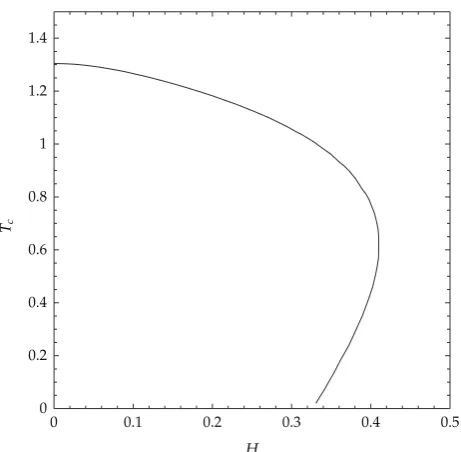
Using5.18-5.19, one can determine the critical temperatureTcas a function ofH.
We give inFigure 1the resultingTcTcHcurve. Interestingly, we find that in the range
Hc> H >
ρ
22/u4
0
−67u4
0
0.327ρ, 5.22
the curveTcHbecomes double valued so that a nontrivial solution only exists in the range
Tc2 > T > Tc1. According to the gauge/gravity dualityD2should be identified with the order
parameter,OψD2. We obtain the following expression:
D2
5u4−2
6u4−2
ρ/H−22/u4−67u4
u22/u4−67u41/4 .
5.23
Note thatD2becomes negative foru0 < u <2/51/4or, equivalently, for 0< T <0.0316
√
H.
However, whenH → 0 the numerator and denominator coefficients ofD2 that multiplyψ0
cancel out. This is consistent with the result of the nomagnetic field model.In fact, we have
checked that the results of both models,H0,d3, andm2 −2, are identical. We present
in Figure 2curves for D2 as a function of temperature for different values of the external magnetic field.
The results are qualitatively in agreement with those described in14,15where the
0.5 0.4
0.3 0.2
0.1 0
0 0.2 0.4 0.6 0.8 1 1.2 1.4
Tc
[image:15.600.185.416.93.319.2]H
Figure 1:The phase diagram ofTcagainst the magnetic fieldH. The condensed phaseD2/0corresponds to the lower left part below the line. The critical temperature decreases as the magnetic field grow up to the critical valueHc.
0.6 0.8 1 1.2
T 0.05
0.1 0.15 0.2 0.25 0.3
D
2
Figure 2:A plot of the order parameterD2as a function of temperatureT. The charge density isρ1. The dashed line corresponds to a magnetic fieldH 0.1, the dash-dot one toH 0.2, and the solid one to H0.3.the critical value isHc0.6.
6. Summary and Discussion
We have analyzed a number of models which have been proposed to study phase transition through the AdS/CFT correspondence. The common feature of all three models we discussed was that the space time bulk geometry was an Anti de Sitter black hole. Although the
dynamical field content was very different—a charged scalar coupled to an electric potential,
[image:15.600.188.412.379.521.2]On general grounds, we were able to explain why the highly symmetric ans¨atze generally used produce the critical behaviors seen in mean field theory or the Landau approach. Founded on basic principles as the connection between the equations of motion and the Schr ¨odinger equation, we clarify the similarity between several relevant quantities along a variety of models. In particular we showed that resorting to simple matching conditions, we obtain closed form solutions that significantly agree with the results obtained by numerically solving the exact set of equations of motion. This uncovers the important role played by analyticity to explain the universal behavior of certain physical constants.
The method seems to work very well near the critical temperature, though it deviates
from the numerical results as we approachT → 0. In this regime our approach should be
refined.
Alternative analytic calculations have been recently presented in23,24 where the
phase transition vicinity is studied solving the equations of motion in terms of a series expansion near the horizon. Although the approach in these works is close to the one
proposed in 8 and applied here, the possibility in the latter of varying the intermediate
pointzmat which the matching is performed allows to obtain better solutions at fixed order
N in the expansion, as already pointed out in24. As we have seen that, in the matching
approach, the problem reduces to find the solution of an algebraic equations system and this can be done, to the order we worked here, in a straightforward way. Increasing the order will of course complicate the algebraic system but in view of its main features, it can be handled by a simple computational software like Mathematica, at least for the next few
orders. For a large-order expansion the method followed in references23,24seems to be
more appropriate.
Although the matching method works very well near the critical temperature, it
deviates from the numerical results as T approaches 0. In this regime the method should
be refined. In particular it is to be expected that taking into account the quantum fluctuations of the gravity theory, one should be able to go beyond mean field approximation results.
Also, one should consider generalized Lagrangianslike the St ¨uckelberg one considered in
16 leading to various types of phase transitionsfirst or second order with both mean
and nonmean field behavioras parameters are changed. There is also the possibility that
including fermions in the bulk model could substantially change the critical behavior of the
theory in the bulksee25and references therein. The simplicity of the approach presented
here, not requiring refined numerical calculations, should be an asset when trying to explore these more complex situations.
Acknowledgment
F. A. Schaposnik is associated with CICBA.
References
1 J. Maldacena, “The largeN limit of superconformal field theories and supergravity,”Advances in Theoretical and Mathematical Physics, vol. 2, no. 2, pp. 231–252, 1998.
2 S. S. Gubser, I. R. Klebanov, and A. M. Polyakov, “Gauge theory correlators from non-critical string theory,”Physics Letters B, vol. 428, no. 1-2, pp. 105–114, 1998.
4 S. S. Gubser, “Phase transitions near black hole horizons,”Classical and Quantum Gravity, vol. 22, no. 23, pp. 5121–5143, 2005.
5 A. R. Lugo, E. F. Moreno, and F. A. Schaposnik, “Holography and AdS4 self-gravitating dyons,”
Journal of High Energy Physics, vol. 2010, no. 11, pp. 1–19, 2010.
6 N. Iqbal, H. Liu, M. Mezei, and Q. Si, “Quantum phase transitions in holographic models of magnetism and superconductors,”Physical Review D, vol. 82, no. 4, Article ID 045002, 2010.
7 A. R. Lugo, E. F. Morenob, and F. A. Schaposnika, “Holographic phase transition from dyons in an AdS black hole background,”Journal of High Energy Physics, vol. 2010, no. 3, article 013, 2010.
8 R. Gregory, S. Kanno, and J. Soda, “Holographic superconductors with higher curvature corrections,”
Journal of High Energy Physics, vol. 2009, no. 10, article 010, 2009.
9 S. A. Hartnoll, C. P. Herzog, and G. T. Horowitz, “Building a holographic superconductor,”Physical Review Letters, vol. 101, no. 3, 4 pages, 2008.
10 G. T. Horowitz and M. M. Roberts, “Holographic superconductors with various condensates,”
Physical Review D, vol. 78, no. 12, Article ID 126008, 2008.
11 S. S. Gubser, “Breaking an Abelian gauge symmetry near a black hole horizon,”Physical Review D, vol. 78, no. 6, Article ID 065034, 2008.
12 S. S. Gubser, “Colorful horizons with charge in anti-de Sitter space,”Physical Review Letters, vol. 101, no. 19, p. 191601, 4, 2008.
13 S. S. Gubser and S. S. Pufu, “The gravity dual of ap-wave superconductor,”Journal of High Energy Physics, vol. 2008, no. 11, article 033, 2008.
14 E. Nakano and W.-Y. Wen, “Critical magnetic field in a holographic superconductor,”Physical Review D, vol. 78, no. 4, Article ID 046004, 2008.
15 T. Albash and C. V. Johnson, “A holographic superconductor in an external magnetic field,”Journal of High Energy Physics, vol. 2008, no. 9, article 121, 2008.
16 S. Franco, A. M. Garc´ıa-Garc´ıa, and D. Rodr´ıguez-G ´omez, “Holographic approach to phase transitions,”Physical Review D, vol. 81, no. 4, Article ID 041901, 5 pages, 2010.
17 S. A. Hartnoll, C. P. Herzog, and G. T. Horowitz, “Holographic superconductors,”Journal of High Energy Physics, vol. 2008, no. 12, article 015, 2008.
18 G. T. Horowitz, “Introduction to holographic superconductors,”Lecture Notes in Physics, vol. 828, pp. 313–347, 2011.
19 P. Breitenlohner and D. Z. Freedman, “Stability in gauged extended supergravity,”Annals of Physics, vol. 144, no. 2, pp. 249–281, 1982.
20 I. R. Klebanov and E. Witten, “AdS/CFT correspondence and symmetry breaking,”Nuclear Physics. B, vol. 556, no. 1-2, pp. 89–114, 1999.
21 G. Siopsis and J. Therrien, “Analytic calculation of properties of holographic superconductors,”
Journal of High Energy Physics, vol. 2010, no. 5, article 013, 2010.
22 G. Siopsis, J. Therrien, and S. Musiri, “Holographic conductors near the Breitenlohner-Freedman bound,”http://arxiv.org/abs/1011.2938.
23 C. P. Herzog, “Analytic holographic superconductor,”Physical Review D, vol. 81, no. 12, Article ID 126009, 11 pages, 2010.
24 F. Aprile, S. Franco, D. Rodr´ıguez-G ´omez, and J. G. Russo, “Phenomenological models of holographic superconductors and Hall currents,”Journal of High Energy Physics, vol. 2010, no. 5, article 102, 2010.
25 T. Faulkner, N. Iqbal, H. Liu, J. McGreevy, and D. Vegh, “Holographic non-Fermi-liquid fixed points,”
Submit your manuscripts at
http://www.hindawi.com
Hindawi Publishing Corporation
http://www.hindawi.com Volume 2014
High Energy PhysicsAdvances in
World Journal
Hindawi Publishing Corporation
http://www.hindawi.com Volume 2014
Hindawi Publishing Corporation
http://www.hindawi.com Volume 2014
Fluids
Journal ofAtomic and Molecular Physics
Journal of
Hindawi Publishing Corporation
http://www.hindawi.com Volume 2014
Hindawi Publishing Corporation
http://www.hindawi.com Volume 2014 Condensed Matter Physics
Optics
International Journal of
Hindawi Publishing Corporation
http://www.hindawi.com Volume 2014
Hindawi Publishing Corporation
http://www.hindawi.com Volume 2014 Advances in
Astronomy
International Journal of
Hindawi Publishing Corporation
http://www.hindawi.com Volume 2014
Superconductivity
Hindawi Publishing Corporation
http://www.hindawi.com Volume 2014
Statistical Mechanics International Journal of Hindawi Publishing Corporation
http://www.hindawi.com Volume 2014
Gravity
Hindawi Publishing Corporation
http://www.hindawi.com Volume 2014
Astrophysics
Journal ofHindawi Publishing Corporation
http://www.hindawi.com Volume 2014 Physics
Research International
Hindawi Publishing Corporation
http://www.hindawi.com Volume 2014 Solid State PhysicsJournal of Computational Methods in Physics
Journal of
Hindawi Publishing Corporation
http://www.hindawi.com Volume 2014
Hindawi Publishing Corporation
http://www.hindawi.com Volume 2014
Soft Matter
Hindawi Publishing Corporation http://www.hindawi.com
Aerodynamics
Journal ofVolume 2014
Hindawi Publishing Corporation
http://www.hindawi.com Volume 2014
Photonics
Hindawi Publishing Corporation
http://www.hindawi.com Volume 2014
Journal of
Biophysics
Hindawi Publishing Corporation
http://www.hindawi.com Volume 2014