www.depeco.econo.unlp.edu.ar
Individual Heterogeneity in the Returns to Schooling: Instrumental
Variables Quantile Regression using Twins Data
Omar Arias, Kevin F. Hallock y Walter Sosa Escudero
INDIVIDUAL HETEROGENEITY IN THE RETURNS TO SCHOOLING: INSTRUMENTAL VARIABLES QUANTILE REGRESSION
USING TWINS DATA
Omar Arias
University of Illinois at Urbana-Champaign Champaign, Illinois
Kevin F. Hallock
University of Illinois at Urbana-Champaign Champaign, Illinois
Walter Sosa
Universidad Nacional de la Plata La Plata, Argentina
March 29, 1999
INDIVIDUAL HETEROGENEITY IN THE RETURNS TO SCHOOLING: INSTRUMENTAL VARIABLES QUANTILE REGRESSION
USING TWINS DATA
ABSTRACT
Considerable effort has been exercised recently in estimating mean returns to education while carefully considering biases arising from unmeasured ability and measurement error. Some of this work has also attempted to determine whether there are variations from the “mean” return to education across the population with mixed results. In this paper, we use recent extensions of instrumental variables techniques to quantile regression on a sample of twins to estimate an entire family of returns to education at different quantiles of the conditional distribution of wages while addressing simultaneity and measurement error biases. We test whether there is individual heterogeneity in returns to education against the alternative that there is a constant return for all workers. Our estimated model provides evidence of two sources of heterogeneity in returns to schooling. First, there is evidence of a differential effect by which more able individuals become better educated because they face lower marginal costs of schooling. Second, once this endogeneity bias is accounted for, our results provide evidence of the existence of actual heterogeneity in market returns to education consistent with a non-trivial interaction between schooling and unobserved abilities in the generation of earnings. The evidence suggests that higher ability individuals (those further to the right in the conditional distribution of wages) have higher returns to schooling but that returns vary significantly only along the lower quantiles to middle quantiles. In our final approach, the resulting estimated returns are never lower than 9 percent and can be as high as 13 percent at the top of the conditional distribution of wages, thus providing rather tight bounds on the true return to schooling. Our findings have meaningful implications for the design of educational policies.
JEL Classification: C14, I2, J24, J31
Key Words: Returns to Education, Human Capital, Heterogeneity, Quantile Treatment Effects,
Instrumental Variables.
Omar Arias Kevin F. Hallock Walter Sosa
Department of Economics Department of Economics Department of Economics
University of Illinois University of Illinois Universidad Nacional de
1206 South 6th Street 1206 South 6th Street la Plata
Champaign, IL 61820 Champaign, IL 61820 La Plata, Argentina
217 333-0120 217 333-4842 541 553 9983
1. Introduction
The causal relation between education and earnings has been one of the most heavily and
carefully explored subjects in empirical work in labor economics. The many empirical and theoretical
difficulties associated with the analysis of such a relationship have been approached with a remarkable
variety of econometric tools on diverse data sets. A well known problem that arises in these studies is
that it is difficult to isolate the causal impact of additional education on earnings. One must be sure that
what is claimed to be the return to additional schooling is not being distorted by the effect of other
relevant but unobserved factors that may be related to schooling. More specifically, if unobserved
“abilities” in the generation of earnings or family background factors are related to the level of
schooling attained, ignoring such a link would lead to incorrect inferences regarding the causal effect
of education.
There are several reasons why economists and policy makers are interested in obtaining
accurate measures of the earnings premium associated with acquiring more education. From a
“private” point of view, under certain conditions, it provides a measure of the “return” to investment in
additional schooling. From a social standpoint, the return to education could give an indication of the
relative scarcities of people with different levels of education and hence it may provide a guide for
educational policies.1 (See Psacharopoulos and Ng, 1994 for a cost-benefit formulation).
In this paper we are interested in exploring whether people with different levels of “ability”
obtain different returns to education. Specifically, we provide unique empirical evidence to address two
of the important questions carefully laid out in Card (1995a): “what is the causal effect of education?”
and “is there evidence of individual heterogeneity in returns to education?”.
Our concept of “ability” refers to those marketable unobservable factors that make up an
individual’s initial endowment of human capital and translate into higher earnings. These may vary
across families as well as individuals.
This follows Griliches (1977) and differs from the view of ability
as “IQ”, for which measures can be constructed using test scores. Most studies estimate the mean
return to education which may be interpreted as the return to additional schooling for an individual with
mean ability. This is a sensible characterization when the return to education is constant across levels
of (unobserved) ability so that any increase in schooling affects earnings of individuals that are
observationally identical in the same way. In this case, ability and education do not interact in the
generation of human capital; both factors have independent contributions to the accumulated stock.
Instead we take education and ability as two separate factors in the generation of human
capital which interact in a non-trivial, unknown way. On the one hand, if we think that ability and
1
education are substitutes in the generation of human capital, then marginal returns to the accumulation
of human capital are decreasing in ability and hence education contributes relatively more to low ability
individuals. On the other hand, we might think that ability and education are complements in the
generation of human capital, that is, education has an additional indirect effect on human capital and an
indirect effect that comes through the interaction with ability that increases its otherwise constant
contribution to earnings. We therefore want to investigate whether education induces a pure location
shift in the distribution of earnings, or some more intricate change. In the language of the empirical
literature on program evaluation, we are interested in whether the response to the treatment
(education) varies across individuals. In this case, the mean return to education is only one summary of
a richer pattern of ways that education affects people's earnings.
In order to explore this issue, we face several methodological and empirical limitations. First,
we do not observe ability, so we cannot model its relationship with education explicitly by including
additional regressors based on the former and estimate interaction effects with the later.2 Second, even
though we can make some a priori conjectures about the relationship between ability and education,
we do not want to impose unrealistic and unnecessary restrictions on this interaction. In the above
examples, the return to education would be a monotonic function of the level of ability, but we see no
reason to impose such a restriction. We want our empirical model to be exploratory and informative
about the nature of this relationship. Third, education is not randomly assigned to individuals so we
cannot treat the attained level of education as a predetermined variable. The optimal level of education
may be determined endogenously as function of the level of ability and other factors such as family
background. Fourth, it is well documented (e.g. Griliches, 1977, and Ashenfelter and Krueger, 1994)
that the schooling variable is typically measured with error, which may introduce additional biases in
conventional estimates that do not account for this possibility.
The interaction between ability and education studied in this paper has been directly or
indirectly explored in some previous work but, as stressed in Card (1995a), there is little evidence in
the empirical literature to support (or reject) the hypothesis of homogeneity in the returns to education.
Ashenfelter and Rouse (1998) analyze an expanded version (three additional years) of the sample of
genetically identical twins used in Ashenfelter and Krueger (1994). They exploit the presumed
similarity of twins and the availability of multiple measures of schooling to explicitly model the link
between family ability and education parametrically, while addressing the measurement error and
endogeneity biases using standard panel data methods. They find some evidence of the existence of a
benefit more from additional schooling. More recently, Conneely and Uusitalo (1998) investigate the
question of heterogeneous returns in the context of a random coefficients model of wage
determination. They use data on ability test scores and family background variables on a sample of
Finnish men and parameterize potential heterogeneity in the mean return to education by interacting
these factors with education. They find stronger evidence of variations in returns to education most of
which, nevertheless, cannot be explained by observable individual heterogeneity.
We believe these fully parametric approaches impose strong restrictions on the structure of
heterogeneity in returns to education. In this paper we use instrumental variables quantile regression
methods on the recent sample of 858 genetically identical twins from Ashenfelter and Rouse (1998).
Quantile regression methods allow us to estimate returns to schooling for individuals at different
quantiles of the conditional distribution of earnings which we view as reflecting the distribution of
unobservable ability. Unlike the above approaches which explicitly concentrate on the effect of
education on the conditional mean of earnings and parameterize variations in returns through proxies
for ability, quantile techniques allow us to freely characterize the effect of education on the whole
conditional distribution of earnings.
Although he does not treat the ability-education interaction explicitly, Buchinsky’s (1994)
analysis of the U.S. wage structure, using Current Population Survey (CPS) data and censored
quantile regression methods, shows that returns to education in the U.S. increase dramatically over the
quantiles of the conditional distribution of wages. Mwabu and Schultz (1996) also use quantile methods
on a sample of 3117 men for South Africa and obtain varying returns across quantiles that they
interpret along the lines explored in this paper. Nevertheless, the results of these studies should be
interpreted with caution since they do not handle the problems of measurement error or endogeneity
bias. The finding of heterogeneous returns may simply reflect a variable ability-based endogeneity
bias: more able individuals, facing lower marginal costs of schooling choose to acquire more education
and appear to have higher marginal returns to education. See also Fitzenburger and Kurz (1998) for
an interesting approach to studying earnings data using quantile regression and data from Germany and
Machado and Mata (1999) who study wage inequality in Portugal.
The availability of twins data (with multiple measures of schooling) allows us to deal with the
endogeneity of education arising from measurement error while indirectly controlling for any ability
bias arising from “family effects”.3 We also use testing procedures based on quantile regression
statistics to formally test for the presence of heterogeneity in the returns to education. Our approach is
2
semiparametric in the sense that it imposes relatively weak parametric structure on the relationship
between earnings and education. Minimal structure is imposed on the key relationship of interest: the
interaction between education and ability in the generation of earnings.
As in all the other previous twins literature, our estimates rely crucially on the assumption that
any absolute ability bias is due to unobservable family (inherited) factors. In a recent paper, Bound
and Solon (1998) criticize the estimates of returns to education based on twins data questioning the
validity of this assumption. If this assumption fails, our estimates can be thought to provide a whole
family of bounds on the causal effect of education on earnings.
The paper is outlined as follows. In section 2, we specify a simple structural model of schooling
choices closely based on Becker (1967), Card (1995a) and Ashenfelter and Rouse (1998). We extend
the model by being less restrictive in the parameterization of heterogeneity. Section 3 briefly describes
the data and outlines previous estimates of the mean return to schooling. In section 4, we present the
details of model specification and estimation, develop tests for heterogeneity in returns to schooling,
and discuss the results. Section 5 discusses policy implications of our findings and concludes. In the
appendix, we provide a brief discussion of quantile regression methods and the testing procedures used
in the paper and highlight their usefulness for investigating heterogeneity.
2.
The Basic Model and its Interpretation in the Quantile Regression Context
In this section we specify a simple structural model that highlights the main aspects of the problem.
Following Ashenfelter and Rouse (1998) and Card (1995a) our model is based on the Becker (1967)
model of investment in education with explicit focus on the following questions: 1) What is a sensible
way to think about the link between ability and education? 2) Are returns to education homogeneous
across the population? If not, how can we model the source of this heterogeneity and how can it be
explored? 3) Why is quantile regression an appropriate tool to explore these types of effects which
involve unobservable factors in a non-trivial way? 4) How does the availability of twins data allows us
to deal with measurement error and simultaneity bias in the quantile regression framework?
2.1 The Basic Model
The starting point is the utility maximization problem of the i-th twin in family j:
(
ij ij)
(
(
ij j ij)
)
j(
ij j)
ij
r
S
h A
S y S
Y U S
,
, , ln ,
max = ε − (1)
3
The first term consists of a human capital production function which receives as inputs education (Sij),
an unobservable “ability” variable (Aj), and a random twin specific disturbance (εij) observed by the
individual but not by the econometrician from an unspecified common continuous distribution function
fε. This term reflects how education, ability and the idiosyncratic shock interact in the generation of
earnings (Yij). The second term measures the explicit and implicit (opportunity) costs of acquiring
more education. It depends on education as well as family factors such as wealth or tastes for
education summarized by (rj). We will think of (Aj) as a measure of unobservable “family effects”
that cause individuals from different families to earn different wages. These “family effects” could
capture differences in family specific initial human capital, differences in the quality of schooling as
well as differences in labor market connections across families.4 The individual random component
captures factors such as individual specific ability and risk taking that allow otherwise identical
individuals from the same family to earn different wages.
The schooling decision of an individual in the j-th family depends at the margin on the balance
of the marginal benefits and costs from additional schooling given his or her endowment of ability and
family background. If utility is globally concave with respect to (Sij), there will be a unique level of
education S*ij
=
Sj(Aj,rj,εij) that solves the utility maximization problem. Thus, optimal schoolingchoices will potentially differ both among individuals of different families due to “family effects” and
between twins from the same family due to the idiosyncratic disturbance in the earnings function. This
is precisely the well known endogeneity of ability bias that has historically haunted estimates of the
returns to schooling. The acute problems that the potential correlation between (Aj, rj, εij) and the
observed choices of (Sij) pose to estimation of even the simplest linear empirical earnings functions
were lucidly discussed by Griliches (1977, 1979).
The advantage of using data on earnings and education from a sample of twins to estimate the
returns to schooling comes from exploiting the common components of the unobservable ability
variable across twins. Let vij = γ Aj + εij which corresponds to our concept of “ability”. A simple
specification that allows us to highlight the important issues is
(
)
( , ) [ 0.5 2]0 ,
ij cS ij
S j r ij ij ij S ij S S
Y
U ij ij =β +φ ν +ν − − −
where
e
β0Sij +φ(
Sij,vij)
+vijrepresents the earnings function and
2
5 . 0 ij ij
jS cS r
e
− − for the anti-log ofthe cost function.5 In this case the marginal condition for a maximum solution to (1) is:6
4
Since twins tend to attend the same school, differences in the quality of schooling are only relevant across families.
5
This is an extension of Rosen (1973) . 6
ij j ij S
ij
ij MC r cS
MB
ij= ≡ +
+ ≡
≡β β0 φ (2)
where
ij S
φ denotes the derivative of φwith respect toSij.
Following Becker (1967), βij is interpreted as the return to schooling, which at this point may
depend on the level of education and unobservable ability. The function φ governs the process by
which ability affects the rate at which human capital is accumulated. Thus, assuming differentiability,
in (2) at the optimal level of schooling we have that:
( )
ij ijv S ij ij ij ij ij v MB v S Y , ln φ ∂ ∂ ∂ ∂ ∂ = = (3)where φS,v denotes the cross-partial second derivative of U with respect to Sijand νijand captures
how ability affects the return to education. As long as φS,v≠ 0 the return to education will not be
constant across individuals (of the same education level). Differing abilities alter returns so that there
exists a family of returns to education. This is precisely what we mean by heterogeneity in the returns
to education. Note that the standard specification and estimation of Mincer equations assumes φS,v =
0 implicitly which implies that education and ability are “perfect substitutes” in the production of human
capital. If φS,v > 0 ability enhances the productivity gains of acquiring an additional year of education,
while if φS,v < 0 high ability individuals face lower returns to investment in education. Both cases are
possible since we do not need to require φS to be monotonic in vij. Similarly, for c > 0, marginal cost is
increasing in education and depends on rj which implies variations in the rate at which individuals of
the same family substitute schooling for future earnings. Since higher ability parents will tend to have
higher earnings and acquire more education, these differences may in turn reflect differences in the
wealth or tastes for education across families. We expect Aj is negatively correlated with rj to
capture the intuitive notion that individuals from more able families face lower disutilities of schooling.
As discussed by Ashenfelter and Rouse (1998), a crucial condition to identify the return to
schooling from within-family variation in schooling levels is that any differences in schooling between
twins of the same family are due to optimization or measurement errors that are uncorrelated with the
earnings disturbance. That is, we need to assume that:
ij j ij S u
S*
=
*+
(4)where the uij are iid errors over i and j from an unspecified continuous distribution function fu, and are
independent of the εijand true schooling levels. This amounts to assuming that any within twins
difference in the marginal benefit from schooling do not affect their optimal schooling choices. Note
ij ij ij ij S MB S MC ∂ ∂ ∂ ∂ > <
that twins from different families can still choose different education levels due to differences in family
ability.7 Recently Bound and Solon (1998) have raised questions on the plausibility of this assumption.
Nevertheless, using the same data we use in this work, Ashenfelter and Rouse (1998) carried out a
variety of tests which provide evidence consistent with the hypothesis that schooling choices among
twins are uncorrelated with unobservable determinants of earnings.8
Note that (3) implies that differences in observed schooling levels in the population arise from
two sources. First, individuals may have differing returns to schooling (due to differing Ajs). Second,
individuals may have different marginal rates of substitution between schooling and future earnings (rj)
due to differences in the implicit marginal costs of schooling. Thus, for the utility specification
considered we have that at
S
ij*:j j A S j ij
ij
A r
A S
U
∂ ∂ φ ∂ ∂
∂
−
= ,
2
(5)
which determines the rate at which an individual of the same family can substitute ability and education
in the generation of utility. When (5) is negative the marginal rate of substitution between ability and
education is decreasing with the level of ability: the same amount of schooling substitutes less ability as
an individual becomes gradually more educated. The opposite is true if it is positive. Since we expect
the correlation between Aj and rj to be negative, then in the case that φS,A > 0 we have that both
effects work in the direction of enhancing the ability-based endogeneity bias by which more able
individuals are the more educated.
2.2 The Empirical Framework
Integrating MBij over Sijwe obtain the log-linear human capital production function for which we adopt
the following empirical specification:
( )
Yij = Fj + Xij + oSij +(
Sij,vij)
+vijln α λ β φ (6)
often called the Mincer (1974) equation. We denote observed family specific variables (age (for
twins), race), Fj. Xij stands for observed individual specific characteristics other than education such
as union participation and marital status, and α, λ, γ, β are the corresponding coefficients. This
equation together with (4) determine the joint distribution of earnings and education.
7
This implies that individuals have better information than the econometrician but that this is still imperfect. 8
Our empirical model aims to estimate the returns to schooling from data on wages and
education from a sample of twins while accounting for four features of empirical measurements from
this distribution: i) the stylized log-linear relationship between observed wages and education,9 ii)
heterogeneity in the distribution of earnings conditional on education, iii) the endogeneity of observed
education levels due to unobservable ability, and iv) measurement error in observed schooling choices.
First note that the presence of φ introduces a potential non-linearity in the above log-linear
Mincer equation. Nevertheless, because of the positive correlation between βij and education, equation
(6) is not necessarily inconsistent with a linear relationship between log wages and education. For
instance, as pointed out by Card (1995a), if for a given level of ability, wages are a concave function of
education, the data for the population as a whole could still trace out a convex relationship between
wages and education.10 In order to keep consistency with the documented log-linearity of wages and
education we shall assume that φS,A is independent of education. We discuss the issues involved in
(ii)-(iv) below.
2.2.1 Quantile Regression and Unobserved Heterogeneity.
Provisionally, let us ignore the endogeneity ability bias and measurement error in education for
now, ie., assume that Sijis independent of family effects and can be treated as exogenous. The optimal
schooling model outlined above implies that unobserved ability induces heterogeneity in the joint
distribution of earnings and schooling. Letting Z= (Fj, Xij), we see that OLS on (6) gives a measure of
( ) (
)
(
Yij Zij Sij)
Sij o AE ∂ β δ
∂ ln , / = + : the return to education for an individual with mean ability as
pointed out by Card (1995a). In this case the labor market cannot yet be well characterized by a single
rate of return to education. Ashenfelter and Rouse (1998) focused on the conditional mean of the
distribution of wages to obtain different estimates of βij for the case that φij = δ Aj Sij so that
heterogeneity takes the simple linear heteroskedastic form:
( )
∂
ln
Y
ij/
∂
S
ij≡
β
j=
β δ
o+
A
j (7)Here δ captures the effect of ability on the return to education (ie., (3)). They estimate δ by
including as an additional regressor an interaction term between education and the average education
of a pair of twins from family j which from (4) can be taken as a proxy for ability in that family. A
negative δ means that returns to education are lower for high ability individuals, which in our model is
interpreted as a decreasing marginal rate of substitution between ability and education. In this case low
ability individuals benefit more from additional education. An analogous interpretation holds for positive
9
δ. The drawback of this approach is that the resulting estimate of the heterogeneity parameter (and
thus of the βjs) relies on a full parameterization of the interaction between education and unobserved
ability Aj. The same limitation applies to the recent attempt of Conneely and Uusitalo (1998) of
estimating heterogeneous returns to education based on conditional mean wage functions. The
approach makes it very difficult to separately identify the effect of ability on the marginal benefit of
schooling, as reflected in estimates of the interaction coefficient that are in general statistically
insignificant. We want to be able to characterize the family of returns to education without making
such restrictive parametric assumptions.
The regression quantiles of Koenker and Bassett (1978) provide a more general approach to
characterizing the effect of education on different percentiles of the conditional distribution of wages,
thus allowing us to explore and estimate heterogeneity in the returns to schooling. Specifically, a zero
conditional quantile restriction on the error vij implies that the effect of education on the τ-th quantile of
Yij conditional on the observables in (6) is:11
(
)
(
(
)
)
(
)
ij ij v o ij ij ij ij ij o ij ij ij ijS
Z
G
S
S
Z
Q
S
S
Z
Y
Q
S v,
,
,
1 ,τ
β
∂
∂
β
β
∂
∂
τ τφ τ=
+
=
+
−≡
(8)where Gv is some transformation of the distribution function of abilities in the population since we have
assumed that the marginal return to education is independent of education. Thus, by estimating quantile
regressions for different values of τ one can obtain consistent estimates of the whole family of returns
to education functions reflecting the distribution of abilities across individuals (Note that in the absence
of heterogeneity, β0 =βτ for all τ . The interaction between education and ability can then be
explored by comparing β(τ)s at different quantiles τk and τj, for i≠ k. Moreover, a robust test of the
hypothesis of heterogeneity (βk ≠ β for some k) can be based on a test of whether the estimated
coefficients for the returns to education differ across quantiles. That is, using the test for
heteroskedasticity proposed by Koenker and Bassett (1982). Unlike the prior approaches, this does not
require strong parametric restrictions on the type of interaction between ability and education.
As indicated previously, the findings of heterogeneous returns by Buchinsky (1994) and
Mwabu and Schultz (1996) based on quantile wage equations come close to such a characterization.
Nevertheless, this work does not address the problems of endogeneity bias and measurement error in
education, and does not structurally model the source of heterogeneity. Since (3) implies that in general
Qτ(νij|Sij) ≠ 0, quantile regression on a Mincer equation like (6) would yield inconsistent estimates of
the family of returns to education just as OLS fails to deliver a consistent estimate for the mean return.
10
Specifically, he considers the case where
φ
=
b S
j ih−
0 5
k S
1 ij2
.
with bj reflecting variations in ability. 11In fact, varying returns to education can be a result of an endogeneity bias that varies across quantiles
of the conditional distribution of wages rather than evidence of actual ability-based differences in the
market marginal returns to education. We now discuss how the data on twins allow us to more
carefully uncover the evidence for “true” heterogeneity in the returns to education while addressing
both the simultaneity and measurement error biases.
2.2.2 The Endogeneity of Schooling
In our model, individuals from higher ability families (Aj) become better educated due to
lower marginal costs of schooling. As noted before, if ability and schooling are “complements” in the
generation of earnings, then the higher returns to education for the more able enhance this endogeneity
bias in schooling. In the previous literature on estimation of the returns to education using twins data
this problem has been addressed in two ways. One approach is to treat Ajas an unobserved random
family effect and focus the interest on obtaining unbiased estimates of the structural coefficients βj
measuring the returns to education. This can be accomplished by directly estimating a “fixed effects
model” based on the (within) differenced equation corresponding to (6) for each pair of twins across
families. Since (2) and (6) imply that
E
(
ξ
j∆
S
ij,
∆
X
ij)
=
0
where ∆ is the difference operator andξj= ε1j −ε2j, OLS on differenced data yields consistent estimates of the mean return to education. This
is the strategy adopted by Ashenfelter and Krueger (1994) and Ashenfelter and Rouse (1998) to deal
with the ability bias in the OLS context.
One might naïvely consider quantile regression on a differenced Mincer equation since then
Qτ(∆ξij | ∆Sij) = 0. Nevertheless, there is a fundamental drawback with this approach. Although
differencing in the least squares context can be shown to be equivalent to a fixed effects estimator, in
the context of quantile regression, this is not the case. Estimates of quantile regression education
coefficients from a differenced equation would reflect the effect of education on the quantiles of the
conditional distribution of the difference in wages between a pair of twins across families, rather than
the effect on the difference in the quantiles of the corresponding conditional wage distributions. Since
quantiles of the sum of two random variables are not equal to the sum of the quantiles of each random
variable at a given τj, when differencing in quantile regression, the order of the individuals matters.
Thus, it is not possible to recover the estimates obtained using data on levels on an equation like (6)
from the estimates of quantile regressions on differenced data. Moreover, the natural attempt to
estimate the fixed effects model including family specific dummies is also futile in this case given the
unavoidable ambiguity surrounding the identification of the fixed effects at any given quantile with only
An alternative approach is to try to parameterize and estimate the endogeneity (omitted ability
variable) bias explicitly including some proxy for unobserved ability as an additional regressor when
estimating equation (6). As long as the proxy can account for most of the endogeneity bias, this
approach also allows us to obtain consistent estimates of the returns to education. Ashenfelter and
Krueger (1994) and Ashenfelter and Rouse (1998) also provide such estimates of the returns to
education and the resulting endogeneity bias (to which they refer as a “selection effect”). The model
of optimal schooling choices outlined in section 2 suggests that we use measures of the education of a
twin’s sibling, the average education of the twins, or father’s education as an additional regressor to
control for any “family” effect that affect the absolute level of earnings. This is the approach we use
in our empirical work and we label the resulting specifications as “family effects” models. The
coefficients on these variables provides us with alternative quantile specific estimates of the ability bias
in the estimates of returns to schooling.
2.2.3 Measurement Error in Education
The information contained in the available twins data provides an interesting way to address
the problem of measurement error in reported schooling which can arise because of the recall errors
common in survey data. This is specially important since from the work of Griliches (1977) it is well
known that the attempt to control for any absolute ability bias using family education variables to proxy
for family effects exacerbates already existing biases.
As reported in Ashenfelter and Krueger (1994) and Ashenfelter and Rouse (1998), twins are
asked to report on the education level of their sibling and of their parents. Letting
S
ijk be twin k’sreport of the n-th family member, we can expect such cross-reports to satisfy (3) so that:
S
njk=
S
nj*+
u
njk (9)where unjk denotes iid measurement errors over i n and j.
These cross-reports of each family member’s education can then be employed as instruments
using recent extensions of instrumental variable methods to quantile regression (see the appendix).
Moreover, the availability of multiple reports allows us to relax the classical assumption of uncorrelated
measurement errors in the own-reports of a twin. This can occur if a twin that overreports his own
education level is also more likely to overreport the education level of his sibling and of his parents.
Following Ashenfelter and Krueger (1994) and Ashenfelter and Rouse (1998), we also estimate
quantile regression models that assume correlated measurement errors in education.
The data used in this paper were collected over a span of five years at four meetings (August
of 1991, 1992, 1993, and 1995) of the Annual Twins Festival in Twinsburg Ohio. Many of the
questions are similar to questions asked in the Current Population Survey (CPS) with some
twins-specific questions added. As Ashenfelter and Krueger (1994) and Ashenfelter and Rouse (1998)
show, the mean characteristics of the sample are quite similar to the population at large. Sample
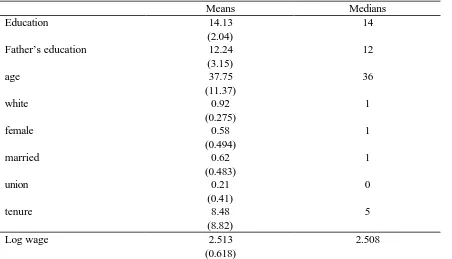
characteristics are reported in Table 1. The sample we use has, on average, more years of education,
higher income, and is more likely to be female and white than the population at large. Ashenfelter and
Krueger (1994) also note these similarities and differences.
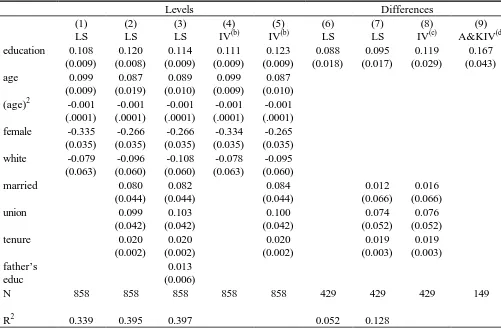
Table 2 reports regression results employing econometric specifications similar to Ashenfelter
and Krueger (1994), Ashenfelter and Rouse (1998) and Rouse (1997) who focused on estimating the
mean return to education. We briefly present these results for three reasons. First to highlight (as in
the previous literature) the importance of considering both ability and measurement error biases in
estimating mean returns to education. Secondly to document the mean return to education using these
specific data. Finally, Table 2 provides a summary of the data and specifications that will be extended
to the quantile regression framework below.
The first five columns of Table 2 estimate very simple empirical earnings equations. Column 1
of Table 2, reports the simple least squares regression of the log of earnings on age, (age)2, a gender
indicator equal to 1 if the individual is female and an indicator equal to 1 if the respondent is white. This
model is estimated using all 858 respondents for which we have complete data. In column 2 we have
included additional controls for marital status, union coverage and tenure. As usual, there is a positive
seniority profile, and the female indicator is large and negative. The white indicator is also negative (an
anomalous result also found in Ashenfelter and Krueger, 1994, Ashenfelter and Rouse, 1998, and
Rouse, 1997) but is not statistically different from zero. The return to education estimated in column
(1) is 10.8%. As we have stated earlier and as is well documented in Griliches (1977) and Ashenfelter
and Krueger (1994), this estimate is potentially upward biased due to unobserved ability and downward
biased due to measurement error. A great deal of effort has been focused on determining the “true”
return to education after accounting for these biases. Card (1995a) provides an important and
interesting summary of a set of papers that find that simple least squares estimates seem to be
downward biased12.
The other columns in table 2 present the results of estimating additional, yet similar,
specifications that address these ability and measurement error biases. Column 3 presents the
family specific ability. We can see that this reduces the return to education from 12% (column 2) to
11.4% and that the coefficient on father’s education is significant, thus consistent with an upward
ability bias. On the other hand, comparison of the OLS and IV estimates reported in columns 3 and 5
suggest the presence of a slight downward bias in the mean return due to measurement error in
education. Instrumental variables results from a specification similar to column 5 that includes father’s
education (not reported) are also consistent with this view.
Columns 6-9 estimate models where the data are “differenced.” Each unit of observation is
created by subtracting the given variable from his or her twin’s. Column 6, then, is simply the
difference in log twins wage on the difference in reported education for the twins. Column 8 contains
our mean estimate that is most closely related to Ashenfelter and Krueger’s (1994) final estimate
(re-printed as column 9). This is the differenced model using instrumental variables where the instrument
is the first twin’s report of the second twin’s education minus the second twin’s report of the first’s.
Our resulting estimate of the return to education 11.9% is not unlike the least squares estimate of
10.8% but is considerably lower than Ashenfelter and Krueger’s (1994) similarly specified estimate of
16.7%. Rouse (1997) using the same four years of data that we use (Ashenfelter and Krueger, 1994
use only one year) points out that “Unlike the results in Ashenfelter and Krueger, I find that the
within-twin regression estimate of the effect of schooling on the log wage is smaller than the cross-sectional
estimate, implying a small upward bias in the cross-sectional estimate.” She further notes, however,
that her results and those of Ashenfelter and Krueger are not statistically different and suggests that
the difference is perhaps due to sampling error.
In the next section we turn attention away from estimating the mean return toward estimating
and testing the implications of our simple theoretical model of heterogeneity in the returns to schooling.
4. Estimation Details and Empirical Results
This section outlines in more detail the framework we use to develop our empirical models and
formal tests for heterogeneity in the returns to education under the presence of endogeneity and
measurement error biases. In Sections 4.1 to 4.5 we detail the specifications we use, describe the
empirical results and the strategies for testing equality in the returns to schooling across various
quantiles. See the Appendix for a brief technical description of the methods used.
The main focus of this paper is on estimating and testing for heterogeneity in returns to
schooling across quantiles of the conditional wage distribution while addressing endogeneity and
measurement error biases. To this end, we will consider four empirical models: 1) the levels model
12
without instrumental variables, 2) the levels model with instrumental variables, 3) the family effects
model without instrumental variables, and 4) family effects model with instrumental variables. The
ideas behind these models roughly follow the empirical work in the recent literature on twins
(Ashenfelter and Krueger, 1994, Ashenfelter and Rouse, 1998, and Rouse, 1997) replicated in Table 2.
4.1 Levels Model Without Instrumental Variables
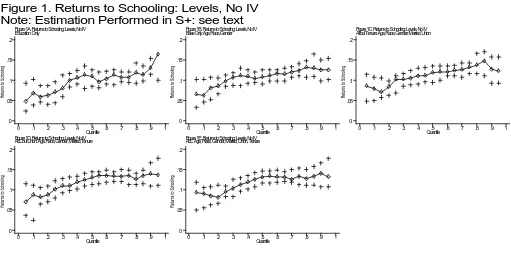
Figure 1 presents the quantile regression estimates of the returns to education for the levels
model without instrumental variables. The β(τ)’s for the 5th to 95th quantiles are plotted in increments
of 0.05 and the figure is separated into five sub-figures according to the covariates included in the
estimation. In addition to controlling for education these plots control for A) education only, B) age,
race, and gender only, C) (“all” but tenure) controls for age, race, gender, married, and union, D) (“all”
but union) controls for age, race, gender, married, and tenure, and E) controls for age, race, marital
status, union, and tenure.
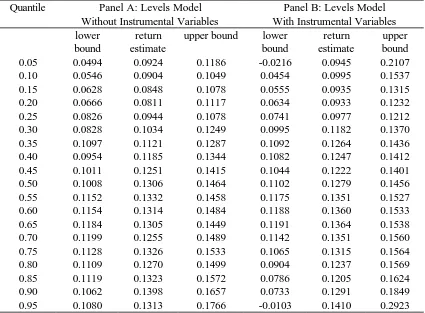
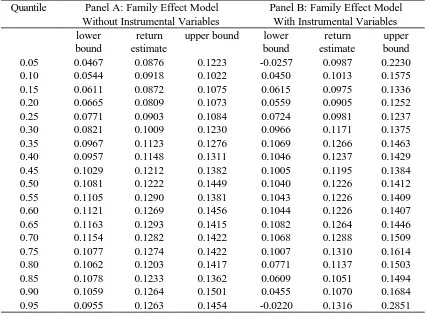
We focus our attention on the specification that includes all covariates (Figure 1E). The actual
returns for each of the 19 quantiles are also reported in Table 3A, Panel A with 90% confidence
bounds for this specification (the confidence bounds are also reported in the figures). Recall that
homogeneity in returns would imply that the figures are flat. A cursory examination of the figures
suggests the presence of heterogeneity in the returns to education. The returns are, in general,
increasing for higher quantiles of the conditional distribution of wages. In particular, the median return
to education from Table 3A, panel A is 13.1% (compared to the mean return of 12% reported in
column 2 of Table 2). However there is a striking increase in the return from the low quantiles to
higher quantiles going from 9.2% at the 0.05 quantile to 13.1% at the median, after which the returns
essentially remain constant. Note also that the magnitude and the pattern of the estimates of the
returns to education remain remarkably similar across specifications (see figure 1). Also note that the
confidence bands in each figure within Figure 1 don’t include βτ =β0for any β0. That is, for this
simple specification, the returns do not appear to be homogenous.
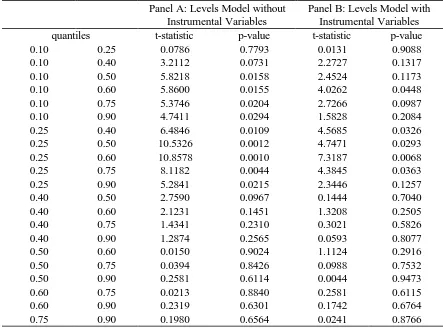
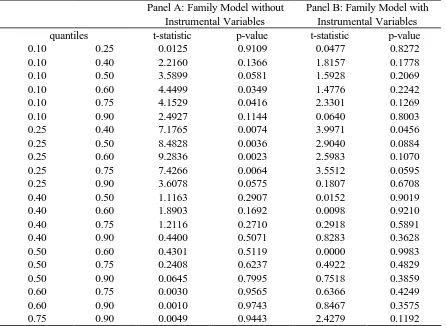
We test whether the observed differences are statistically significant across quantiles and
report the results of such tests in Table 3B, panel A. The tests confirm the visual impression. The tests
of equality of returns between the low quantiles and the middle quantiles, and between the low and
high quantiles reject the hypothesis of homogeneous returns at 1-2% significance levels. For example,
there is a statistically significant difference between the returns at the 0.10 and 0.50 quantiles
(t-statistic = 5.82, p-value = 0.016). Note, however, that the differences between the middle and higher
quantiles are not significant. Another way to see this is that Figure 1 flattens out in the right tail. These
education in the generation of earnings for those in the lower tail of the conditional distribution of
wages (i.e., the low ability), while for the upper tail marginal returns to education are higher but remain
constant.
4.2 Levels Model with Instrumental Variables
Of course, the above results are still subject to the two main criticisms described by and
controlled for in Ashenfelter and Krueger (1994) and Ashenfelter and Rouse (1998) investigating the
mean return to education. We take the first step toward addressing these problems by estimating the
levels model using instrumental variables for the education variable to alleviate the measurement error
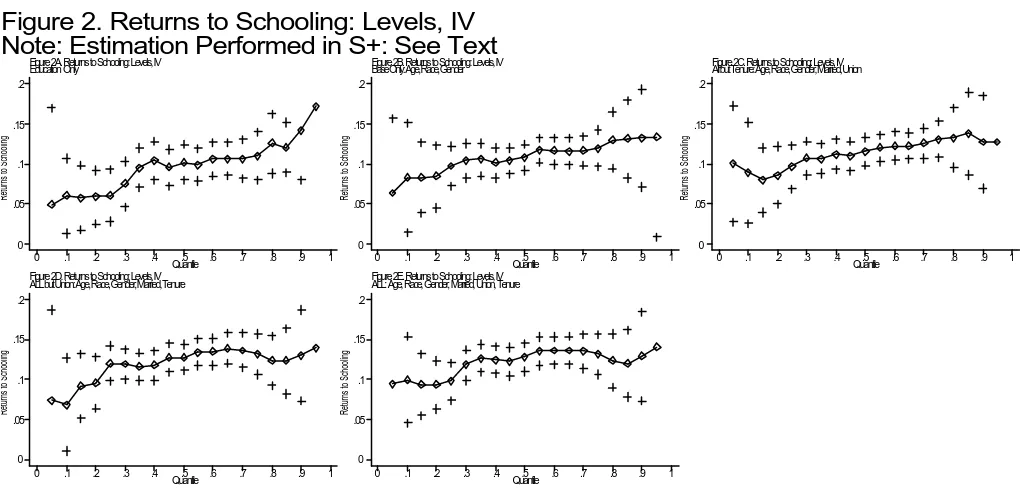
problem. We follow the previous literature and use twins #2’s report of twin #1’s own education (and
vice versa) as an instrument. These results are reported in Figure 2 which is arranged like Figure 1 in
that we report results for five different sets of covariates. Again, we have reported the returns to
education for the 19 quantiles 0.05 to 0.95 in Table 3A panel B with 90% confidence bounds for the
specification including all covariates.
The same general conclusions drawn from Figure 1 may be drawn from Figure 2. In
particular, failure to address the measurement error in education in the levels model does not seem to
create a significant downward bias in the estimated returns to schooling. After controlling for
measurement error in the levels model, we can still see evidence of heterogeneity in returns to
education with increasing returns at higher quantiles. Notice, however, that the standard error bands
are somewhat wider in the instrumental variables case so even if there are small differences, they are
unlikely to be significant.
We report tests of significance in the levels model with instrumental variables in Table 3B,
panel B. Here the results are largely consistent with those in the levels model without instruments,
supporting the visual impression of heterogeneous returns except that the tests cannot reject the
hypothesis of equality of returns between extreme quantiles due to higher standard errors of these
estimates. This might suggest that instrumenting affects the “true” schooling signal in own reported
education more sensibly for those at the tails of the conditional wage distribution. Overall, the findings
suggest that the bias that arises from measurement error in education in the levels models is not very
important. In the absence of endogenous ability bias, the estimates from the previous levels models
would provide relatively accurate measures of the family of returns to schooling.
4.3 Family Effects Model Without Instrumental Variables
This section and the one that follows repeats the analysis of sections 4.1 and 4.2 with the
in Section 2.2 above, the implementation of a quantile regression analogue of estimating an OLS fixed
effect or differenced model is problematic. Instead, in our quantile regression equivalent of a fixed
effects model we use the father’s level of education and the sibling’s education as proxies for the
family effect. We only report the results for the former.13 Essentially, we are re-doing the analysis
reported in Figures 1 and 2 and Tables 3A and 3B with the additional covariate which is the father’s
schooling level. Note that even though we follow Ashenfelter and Rouse (1998) in the
parameterization of the endogeneity bias in this way, we do not parameterize the impact of the
interaction between ability and education on earnings. The novelty of our approach lies precisely in the
use of quantile regression techniques to explore this relationship based on the quantiles of wage
residuals that we interpret as capturing unobservable ability to generate earnings.
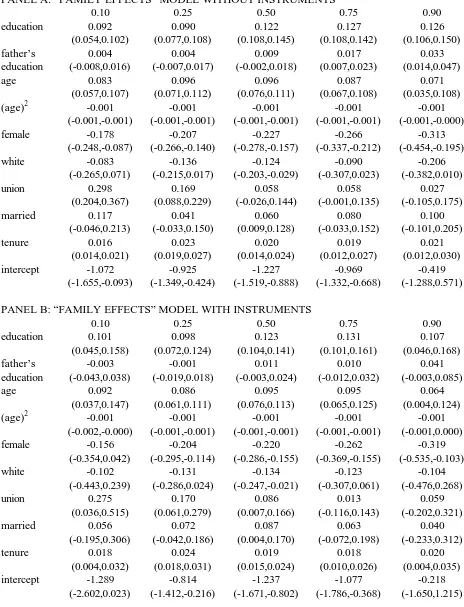
Figure 3 reports the results. Table 4A, panel A reports the returns to education for 19 quantiles
0.05 to 0.95 with 90% confidence bounds for the specification including all covariates. Clearly,
including the family effects has a substantial effect on the estimated returns. In general, the lines in
Figure 3 are lower than the corresponding ones in Figure 1, particularly at higher quantiles. This is
consistent with our expectation that part of the return to education is absorbed by the family effect
thus reflecting a positive endogeneity bias. This can be seen in the Appendix Figure which plots the
coefficient on father’s education and sibling’s education for the 19 quantiles. The estimates of the
endogeneity bias across different quantiles are in general increasing, though the precision of these
estimates is poor. Note that the sibling’s family effects models yield a slightly higher estimate of the
endogeneity bias, but the precision of the estimates is much poorer. This suggests that the findings of
Buchinsky (1994) of higher returns to education at higher quantiles and to a lesser extent those of
Mwabu and Schultz (1996) reflect in part a differential endogeneity bias in schooling choices of
individuals with different abilities rather than “true” differences in the marginal returns to education for
those in the upper tail of the conditional wage distribution.
Nevertheless, it is quite clear from Figure 3 that in each specification, though the quantile
curves of the estimated returns are flatter than in Figure 1, they are still generally increasing. These
patterns remain essentially intact when using sibling’s education as a proxy for family ability.
Therefore, although differences across quantiles are, no doubt, less significant, there still appears to be
some heterogeneity in the returns to education. This is confirmed by the tests we report in Table 4B
panel A which indicate rejection of the hypothesis of homogeneous returns in the middle quantiles.
Despite the apparent substantial differences in the estimated returns between extreme quantiles, poor
precision as reflected by the wider confidence bounds leads to insignificance test statistics.
13
4.4 Family Effects Model With Instrumental Variables
The problem with the estimates from the previous Section is that by including measures of
education to control for family effects, the potential bias arising from measurement error in schooling
levels is now aggravated since the cross-correlation between education levels (which is 0.75 among
siblings) washes away some of the “true” schooling signal in own-reported education levels. In this
Section we report the results of our best attempt to control for both the ability and the measurement
errors biases. This is the direct extension of section 4.2 except that we now use twin #2’s reports of
father’s education and of twin #1’s own report to instrument for potential measurement error in twin
#1’s report of father’s education and twin #1’s reported education, respectively (and vice versa). In
the case of sibling’s education we also estimated models that allow for correlation in the measurement
errors of a twins’ reports. Again we only report the results for the models using father’s education
since these results were very similar, except for the poorer precision of the estimates from the sibling’s
education models. In Figure 4, which we call the “family effects” models with instrumental variables,
the returns are somewhat sporadic. Note also that the confidence bands are wider, specially at the
extreme quantiles.
We report the actual returns and confidence intervals for the model with all variables in table
4, Panel B. A comparison with the non IV estimates of the analogous family effect model indicates
that the IV estimates are somewhat larger (consistent with a downward bias due to measurement
error) but only in the lower tail of the distribution of wage residuals. Considering the wider confidence
bounds on the IV estimates these differences are hardly significant. Moreover, although the family
effect model with instruments (Figure 4E) still suggests some mild heterogeneity in the returns to
education with higher returns at higher quantiles, the estimates are somewhat imprecise. In fact, when
we test (Table 4B, panel B) for differences across quantiles, only in the middle quantiles do we find
some evidence of heterogeneity in the returns (p-values between 5-10%). Once again it appears that
the attempts to deal with both the endogeneity bias and measurement error washes away most of the
“true” schooling signal of own reported education at the tails of the conditional wage distribution
leading to less precise estimates. From the Appendix Figures we can see in fact that the estimates of
the family effects based on both father’s education and sibling’s education are rather imprecise in the
instrumental variable models.
4.5 Do the Endogeneity and Measurement Error Biases Matter? Are Returns
Heterogeneous?
We now briefly summarize what we have learned from our empirical models that attempt to
document the existence of heterogeneity in the returns to schooling while dealing with the two well
known sources of biases. The results are summarized in Figure 5 which decomposes the differences in
the estimated returns to education obtained from the “all” covariates specification across our four
empirical models into the endogeneity bias and measurement error components.14Turning first to the
measurement error problem, we see that comparison of the levels model non-IV vs. IV (see Figure
5A) and father's education model non-IV vs. IV (see Figure 5C) both reveal that the IV estimates
seem to be slightly higher than the non-IV case in the left tail, consistent with a slight downward bias
due to measurement error. The IV estimates actually appear to be lower than the non-IV at the high
quantiles (0.8-0.9) but this probably reflects the effect of noisier estimates at the tails.15So, one can
conclude that the evidence suggests that failure to account for measurement error seems to create
slight downward biases in the estimates of the returns to schooling only at the lower quantiles, if at all.
But again, the IV estimates are less precise, particularly at the tails.
Does ability bias matter? Comparison of estimates from the levels models non-IV vs. father's
educ models non-IV (Figure 5D) and levels models IV vs. father's educ models IV (Figure 5B) are
revealing. First, the shapes of the curves are similar. There is an almost perfect overlap of the curves
in the lower quantiles. Beyond the 0.40th quantile, the family models' curves are slightly above, so
there is evidence of a slight upward ability bias in the right tail in models that do not account for
endogeneity of schooling choices.
More important for the key question addressed in this paper is the fact that the pattern of
return estimates is essentially unaffected by measurement error in both the levels models and all the
family effects models. There is a tendency for returns to increase monotonically along the lower tail of
the conditional wage distribution, returns then flatten out but tend to remain higher in the right tail.
These findings are supported by our formal tests and suggest that differential endogeneity bias does
not fully account for the patterns of heterogeneous increasing returns found in the base levels models.
Some of this heterogeneity does seem to reflect actual differences in the market returns to schooling
arising from a complementary relationship between education and ability which gives an advantage to
those at the top of the conditional wage distribution but also enhances earnings potential for low-wage
individuals.
4.6 Estimation results for other Covariates
14
Remarkably the conclusions here actually hold for the other four covariate designs we use in the paper. These results also hold for the family effects models that are based on sibling’s education.
15
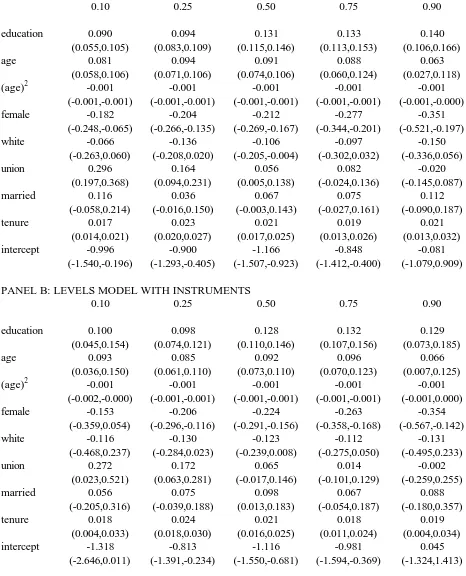
We finally briefly describe the return to the other covariates included in our empirical model.
Table 5 presents the returns to each of the variables for the “all” specification, which includes age,
race, gender (see Amidon, 1997), married, union, and tenure, along with the associated 90%
confidence intervals for the levels models.16 Table 6 does the same for the family effects models.
Figure 6 is a concise summary of the results. It presents results for the family effects model without
IV. Note the anomalous negative effect of race on earnings which is also reported by Ashenfelter and
Krueger (1994) and Ashenfelter and Rouse (1998), but that this cannot be estimated with precision at
any quantile. The effect of marital status on earnings is positive but it is only significant at the median.
The other three sets of results in the two tables are very similar to the findings depicted in Figure 6.
For most of the covariates, there is little heterogeneity in the returns, except for the female and
union variables. Women in this sample earn about 18 percent less than men at low quantiles (0.1) but
the gap widens to roughly 30 percent at higher quantiles (0.9). The returns to being covered by a
union contract are also monotonically declining. At low quantiles (0.1) the return to being unionized is
roughly 0.3 and at upper quantiles the return is roughly zero. This last result is consistent with the
recent work that explores the effect of unions on the structure and the change in the distribution of
wages (DiNardo and Lemieux, 1996; DiNardo, Fortin and Lemieux, 1996).
5. Concluding Comments
In this paper we present estimates of a simple model of earnings and schooling choices in
which we explore the relationship between education and ability in the generation of human capital
without imposing a stringent parametric structure on this relationship. We use instrumental variables
quantile regression and data on identical twins to isolate the causal link between education and
earnings at different quantiles of the conditional distribution of wages, while dealing with potential
biases that arise from the correlation between ability and schooling investment choices and the fact
that observed education levels are imperfect measures of schooling.
The results suggest the existence of an important upward ability bias at the high quantiles in
the estimates of the returns to education that do not account for the endogeneity of schooling choices.
Nevertheless, the estimated returns to education accounting for the endogeneity of schooling are
positive and significant consistent with the human capital model in which education enhances earnings
potential. The results also suggest that the measurement error in schooling levels induces slight
downward biases in the estimated returns to education in the low quantiles that are intensified by
attempts to deal with the ability bias.
16
More importantly, the results provide novel evidence of the existence of two sources of
heterogeneity in the returns to education. First, there is some evidence of a differential heterogeneity
effect by which more able individuals become more educated. The resulting endogeneity biases appear
as apparent higher returns to education at the high quantiles. That is high-ability individuals appear to
have higher returns to schooling. Therefore, the earlier estimates of heterogeneous returns to schooling
from quantile wage regressions that do not control for unobserved ability (Buchinsky (1994) and
Mwabu and Schultz (1996)) may be confounding this differential endogeneity bias with any actual
within quantile difference in the marginal returns to education.
Second, once this endogeneity bias is accounted for, our results provide significant evidence
that there is no unique causal effect of schooling and that for any particular individual the effect may
be above or below the extensively documented OLS estimate depending on his or her unobservable
abilities in the generation of earnings. In particular, the evidence supports the existence of a
complementary relationship between ability and education which gives an advantage to those at the top
of the conditional wage distribution but also enhances earnings potential for low-wage individuals. The
results thus suggest that more able individuals may attain more schooling because of lower marginal
costs and due to higher marginal benefits to each additional year of education.
These findings are at odds with the findings of Ashenfelter and Rouse (1998) of lower
marginal returns for higher ability individuals after controlling for the endogeneity and measurement
error in schooling, but are consistent with recent findings of Conneely and Uusitalo (1998) based on
estimation of conditional mean wage functions. They are also consistent with Card’s (1995a)
proposition of a negative relationship between the marginal costs and the marginal returns to schooling
along the distribution of abilities.
Our results thus reassure us that any formal structural model of schooling investments and
earnings should allow for potential heterogeneity in the returns to education (Card, 1995a) and perhaps
diverse changes over time at different points in the wage distribution (Buchinsky, 1994, Chay and Lee,
1996).
There are several ways in which our work can be extended. First, a readily available extension
is a careful exploration of potential differential effects of observable individual characteristics such as
union participation and gender in the returns to education across quantiles of wage residuals. We
intend to do this in subsequent work. Second, it would be interesting to explore potential non-linearities
in the relationship between schooling and log-earnings by allowing the returns to education to differ
across different education levels as in Buchinsky (1994) and Mwabu and Schultz (1996). Third, one
could try to explore the impact that the changes over time in quantile estimates of the returns to
education have on the structure of wages and widening wage inequality while carefully addressing the
endogeneity and measurement error biases which are likely to change over time. This last point faces
data limitations and some challenging but interesting unsolved methodological problems, particularly
exploring extensions of quantile regression methods to the analysis of panel data.
In a recent paper, Bound and Solon (1998) criticized the estimates of returns to education
based on twins data questioning the assumption of independence between the earnings and optimal
education choice disturbances. As they rightly argued, the validity of twins based estimates relies
crucially on this assumption. In our final approach, the resulting estimated returns are never lower than
9 percent and can be as high as 13 percent at the top of the conditional distribution of wages. In the
case of failure of this assumption, our estimates can be thought to provide rather tight bounds on the
causal effect of education on earnings.
Finally, the existence of the two sources of heterogeneity suggests that typical estimates of the
mean return to education based on OLS provide a rather incomplete characterization of the impact of
education on labor market outcomes and are thus a poor guide for public policy. On the one hand, the
differential endogeneity bias that arises because of ability-based differences in the marginal costs of
education imply that there is room for policies aimed at promoting heavier schooling investment by
individuals who face higher costs. On the other hand, the indication that apart from this differential
ability bias, the returns to schooling are higher for those at the top of the conditional wage distribution
suggests a limit on the extent to which schooling can compensate for differences in individual ability
endowments. Even though a general educational policy will tend to increase the welfare of individuals
in the society, its net impact on the long run distribution of incomes and wealth will depend on the initial
References
Amidon, Carole, 1997, “Are Female Wage Earners Experiencing Wage Discrimination: An Application of Quantile Regression,” University of Illinois at Urbana-Champaign, June.
Angrist, Joshua, D., and Alan B. Krueger, 1991, “Does Compulsory Schooling Affect Schooling and Earnings?” Quarterly Journal of Economics, 196, November, pp. 979-1014.
Angrist, Joshua, D., and Alan B. Krueger, 1992 “Estimating the Payoff to Schooling Using the Vietnam-Era Draft Lottery,” National Bureau of Economic Research Working Paper: 4067, May.
Angrist, Joshua, D., and Whitney Newey, 1991, “Over-Identification Tests in Earnings Functions with Fixed Effects,” Journal of Business and Economic Statistics, 9, July, pp. 317-23.
Ashenfelter, Orley, and Alan Krueger, 1994, “Estimates of the Returns to Schooling from a New Sample of Twins,” American Economic Review, December, 84 (5), pp. 1157-1173.
Ashenfelter, Orley, and Cecilia Rouse, 1998, “Income, Schooling, and Ability: Evidence From a New Sample of Identical Twins,” Quarterly Journal of Economics, 113(1), February, pp. 253-84.
Becker, Gary, 1967, Human Capital and the Personal Distribution of Income. Ann Arbor, University of Michigan Press.
Bound, John and G. Solon, 1998, “Double Trouble: On The Value of Twins-Based Estimation of the Return to Schooling,” National Bureau of Economic Research, Working Paper 6721.
Buchinsky, Moshe, 1994, “Changes in the U.S. Wage Structure 1963-1987: An Application of Quantile Regression,” Econometrica, March, 62 (2), pp. 405-58.
Buchinsky, Moshe, 1995, “Estimating the Asymptotic Covariance Matrix for Quantile Regression Models: A Montecarlo Study,” Journal of Econometrics, 68 , pp. 303-338.
Butcher, Kristin F., and Anne Case, 1994, “The Effect of Sibling Composition on Women’s Education and Earnings,” Quarterly Journal of Economics, 109, August, pp. 531-564.
Card, David, 1995a, “Earnings, Schooling and Ability Revisited,” Research in Labor Economics, Solomon Polachek ed., JAI Press, Volume 14, pp. 23-48.
Card, David, 1995b, “Using Geographic Variation in College Proximity to Estimate the Return to Schooling,” in L. Christofides, E. Grant, and R. Swidinsky, editors, Aspects of Labour Market Behaviour: Essays in Honor of John Vanderkamp, University of Toronto Press, pp. 201-22.
Chay, Kenneth, and David Lee, 1996, “Changes in Relative Wages in the 1980s: Returns to Observed and Unobserved Skills and Black-White Wage Differentials,” Princeton University Industrial Relations Section Working Paper #372.