
Stereoselective synthesis and reactivity of cis and trans dimolybdenum nitrosyl derivatives with the bridging bis(dimethylsilanediyl)di(η5 cyclopentadienyl) ligand X ray molecular structures of cis [{Mo(CO)2(NO)}2(μ (η5 C5H3)2(SiMe2)2}], trans [(Mo(CO)
19
0
0
Texto completo
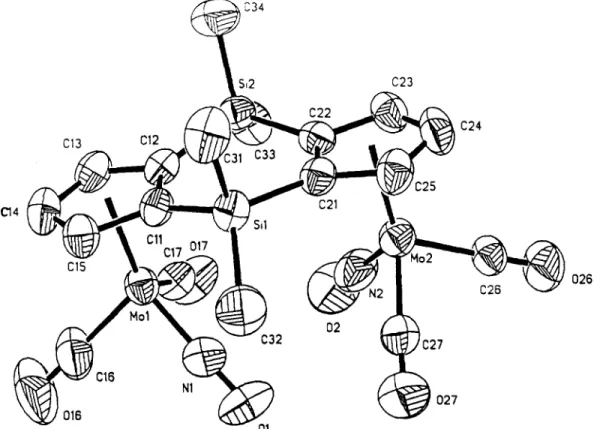
(2) 158. M. Cairo et al. / Journal of Organometallic Chemistry 548 (1997) 157-175. The stereorigidity of the ligand with two SiMe 2 bridges causes the two metal centers to be coordinated cis or trans with respect to the ligand plane. Stereoselective synthesis of cis- and trans- carbonyl dimolybdenum complexes has been reported [5]. The mononuclear complexes CpM(CO)z(NO) (M = Mo, W; Cp = CsH 5) have been extensively studied [6-10]. In this paper, we report the synthesis of new cis and trans nitrosyl dimolybdenum complexes with the (@CsH3)2(SiMe2) 2 ligand and the chemical behaviour of these complexes in substitution reactions with Lewis bases which replace carbonyl groups, and oxidation reactions with phosphorus pentachloride.. 2. Results and discussion 2.1. Dicarbonyl nitrosyl molybdenum complexes. Dicarbonyl nitrosyl molybdenum complexes [{Mo(CO)2(NO)}2{/~-(r/5-CsH3)2 (SiMe2)2} ] cis-3 and trans-3 can be prepared by using the method reported for related mononuclear [11-16] and dinuclear [3] comp l e x e s , w h i c h i n v o l v e s the r e a c t i o n of [{Mo(CO)3H}2{/x-(7/5-CsH3)2(SiMe2)2}] cis-1 and K2[{Mo(CO)3}2{~-(r/5-CSH3)e(SiMe2)2}] trans-2 respectively with p-CH3C6HaSO2N(NO)(CH 3) (diazald). In this reaction the diazald NO group is easily transferred to the metal centers of cis-1 and trans-2 with. elimination of CO and transformation of the tricarbonyl hydride or the tricarbonyl metailate into the nitrosyl derivatives. We have shown that reaction times are very important to obtain pure products in these processes (see Section 4). Both cis-3 and trans-3 complexes are highly soluble in all the common organic solvents and consequently they are obtained as oily crude products which require recrystallization from their concentrated hexane solutions. Spectroscopic data for cis-3 and trans-3 are given in Section 4. The u(CO) frequencies are in the range 2020-1942 cm -1, as expected for terminal carbonyls and the u(NO) frequencies between 1680 and 1642 cm -1 are consistent with a linear disposition of the nitrosyl group. Their I H NMR spectra show one singlet due to the bridging SiMe 2 groups for the trans complex, whereas two singlets are observed for the cis complex, along with the ABB' spin system for the ring protons of both complexes. The molecular structure of complex cis-3 was studied by X-ray diffraction methods and is shown in Fig. 1 along with the numbering scheme employed. Relevant bond distances and angles are given in Table 1. The structure belongs to a cis species with the two metal atoms located at the same face of the two cyclopentadienyl rings, with a Mo-Mo distance of 4.962(1) A. Each molybdenum atom in cis-3 has a 'three-legged piano-stoor configuration with one penta-. C34. C23. Sl2 C22. C24. C13. C12. ;31 C33 ;25 C21. C14. S,1 C15 C26 C32. N1 016. ( ~. 02. ~. 027. 01 Fig. 1. Molecularstructureand atom-labelingschemefor complex cis-3.. 026.
(3) M. Calvo et al. / Journal of Organometallic Chemistry 548 (1997) 157-175. Table 1 Selected bond distances (]~) and bond angles (deg) for cis-3 Distances Mo(I)-N(1) 1.823(5) Mo(2)-N(2) 1.899(5) Mo(1)-C(16) 1.964(6) Mo(2)-C(26) 1.923(5) Mo(1)-C(17) 1.978(6) Mo(2)-C(27) 1.931(7) Mo(l)-C(11) 2.351(4) Mo(2)-C(21) 2.356(5) Mo(1)-C(l 2) 2.351(4) Mo(2)-C(22) 2.375(5) Mo(l)-C(13) 2.357(5) Mo(2)-C(23) 2.354(6) Mo(l)-C(14) 2.387(6) Mo(2)-C(24) 2.355(5) Mo(l)-C(15) 2.368(5) Mo(2)-C(25) 2.339(5) Mo(1)-Cp(l) 2.029 Mo(2)-Cp(2) 2.022 Si(l)-C(31) 1.860(5) Si(2)-C(33) 1.853(6) Si(1)-C(32) 1.844(6) Si(2)-C(34) 1.860(6) Si(l)-C(11) 1.866(5) Si(2)-C(12) 1.858(5) Si(1)-C(21) 1.863(5) Si(2)-C(22) 1.875(5) C(l l)-C(l 2) 1.444(7) C(21)-C(22) 1.432(7) C(12)-C(13) 1.429(7) C(22)-C(23) 1.435(7) C(13)-C(14) 1.402(8) C(23)-C(24) 1.409(8) C(14)-C(15) 1.405(7) C(24)-C(25) 1.401(8) C(l 1)-C(15) 1.434(7) C(21)-C(25) 1.426(7) N(I)-O(1) 1.187(6) N(2)-O(2) 1.163(6) O(16)-C(16) 1.155(7) O(26)-C(26) 1.148(6) O(17)-C(17) 1.127(6) O(27)-C(27) 1.164(7) Angles O(I)-N(1)-Mo(1) O(16)-C(16)-Mo(1) O(17)-C(17)-Mo(1) Cp( 1)-Mo( 1)-N( 1) Cp(I)-Mo(1)-C(16) Cp(I)-Mo(1)-C(17) N(I)-Mo(1)-C(16) N(1)-Mo(1)-C(17) C(16)-Mo(1)-C(17). 179.0(4) 179.5(7) 178.0(5) 131.8 121.1 123.4 90.7(3) 91.4(2) 85.8(3). O(2)-N(2)-Mo(2) O(26)-C(26)-Mo(2) O(27)-C(27)-Mo(2) Cp(2)-Mo(2)-N(2) Cp(2)-Mo(2)-C(26) Cp(2)-Mo(2)-C(27) N(2)-Mo(2)-C(26) N(2)-Mo(2)-C(27) C(26)-Mo(2)-C(27). 178.1(6) 177.9(5) 177.3(5) 128.3 122.8 124.4 90.5(2) 91.1(3) 88.4(2). Cp(1) is the centroid of C(11)-C(15); Cp(2) is the centroid of C(21)-C(25). hapto-coordinated cyclopentadienyl ring. If the centroid of each Cp ring is taken as one coordination site, the angles at molybdenum between the centroids and the legs range from 121.1 ° to 131.8 ° . The angles between contiguous legs range from 85.8(3) ° to 91.4(2) ° . The CO and NO ligands have a linear disposition with M o - C - O angles from 177.3(5) ° to 179.5(7) ° and M o N - O angles between 179.0(4) ° for N(1) and 178.1(6) ° for N(2). The M o - X and X - O (X = C, N) distances are normal for terminal carbonyl and nitrosyi groups. The two N - O groups are trans with respect to the plane which bisects the cyclopentadienyl tings and contains the two Mo atoms. Although the determination of the position of the carbon and nitrogen atoms by X-ray crystallography is not always clear, the distances and thermal factors are consistent with this assignment, confirmed by other structural and chemical data. 2.2. Substitution reactions. All substitution reactions were monitored by IR spectroscopy to follow the variation of the typical absorption bands of the carbonyl ligands.. 159. Both cis-3 and trans-3 were reacted with Lewis bases such as tert-butylisocyanide and trimethylphosphine. Different substituted complexes were obtained depending on the molar ratio, the Lewis base and the thermal or photochemical activation of the carbonyl group used in each reaction (see Schemes 1 and 2). The reaction of cis-3 with one equivalent of CNtBu at room temperature yields a mixture containing the starting m a t e r i a l , the d i s u b s t i t u t e d c o m p l e x [{Mo(CO)(NO)(CN t Bu)}2{/.l,-(y/5-C 5H 3)2(SiMe2 )2 }] cis-6 and the monosubstituted complex [{Mo2(CO)3(NO) 2 (CNtBu)}{/x-(@-CsH3)2(SiMe2)2}] cis-4, whereas the trans-4 monosubstituted complex could not be detected in the analogous reaction. These compounds were separated by chromatography on florisil, cis-4 being eluted with dichloromethane and cis-6 with THF. The reaction between cis-3 and trans-3 with CNtBu in a 1:2 molar ratio led respectively (at room temperature for cis-3 and heating at 60°C for trans-3), to the disubstituted cis-6 and trans-6 complexes, in high yields. When the same reaction was carried out with the addition of four equivalents of CNtBu and heating at 80°C, the tetrasubstituted complexes [{Mo(NO)(CNtBu)2}2{/x-(r/5-CsH3)2(SiMe2)2}] cis-8 and trans-8 were obtained. It was observed by IR spectroscopy that the first step in these reactions is the transformation of all the starting material, cis-3 and trans-3, into the disubstituted complexes cis-6 and trans-6. Therefore, the complexes cis-8 and trans-8 can be prepared from the cis-6 and trans-6 species with two equivalents of CNtBu. Treatment of cis-3 with one equivalent of PMe 3 under UV irradiation yields a mixture of the monosubstituted complex [{Mo2(CO)3(NO)2(PMe3)}{/x-(~ 5CsH3)2(SiMe2)2}]cis-5, as the main product, the disubstituted c o m p l e x [{Mo(CO)(NO)(PMe3)}2{/x-(~75 C5H3)2(SiMe2)2}] cis-7 and the starting material. When the reaction was carried out in a 1:2 molar ratio, the same mixture was also obtained, but the disubstituted cis-7 complex was the main product. Addition of an excess of PMe 3 led to a mixture of cis-7 and cis-5, without starting material present. In all cases, cis-7 and cis-5 can be separated from the mixture by chromatography on florisil, cis-5 being eluted with toluene and cis-7 with dichloromethane. The photochemical treatment of trans-3 with two equivalent of PMe 3 yielded a mixture of mono- and disubstituted complexes trans-5 and trans-7. Both complexes can be isolated from the mixture by chromatography on florisil. Trans-7 was eluted with a mixture of toluene and dichloromethane and trans-5 was obtained as the main product in THF. The disubstituted complex trans-7 can be prepared in high yield as a single product by slight warming of trans-3 with two equiv of PMe 3. Under any of these.
(4) M. Cah,o et al. / Journal of Organometallic Chemistry" 548 (1997) 157-175. 160. M,\. o c ~•,,,'"M ° ~. fMo. oc. ¢""".... OC. NO. OC. ~NO. (c/s-3). ~ ~ i i i. Me\. Mo(2). J". Me. )C. M,\. ~ Mo(I). OC ~ . . ". I;". ~. OC~..Mo "". NO. OC"'. NO. NO. MO~y.MO ,-" L. L'". L= CNtBu, cis--4 L= PMe3, c/s-5. NO. L~Mo -"". NO. L". L= CNtBu, c/s-6. Mo. Me. ,-,". NO. L. L= CNtBu, c/s-8. L= PMe3, cis-7. Scheme 1. Reagents and conditions: (i), cis-4, CNtBu (1:1) in toluene at room temperature; cis-5, PMe 3 (1:1) h ~ in toluene; (ii) cis-6, CNtBu (1:2) in toluene at room temperature; cis-7, PMe 3 (1:2) h v in toluene; (iii) CNtBu (1:4) in toluene at 80°C.. c o n d i t i o n s the t e t r a s u b s t i t u t e d P M e 3 c o m p l e x e s s i m i l a r to cis-8 and trans-8, c o u l d not be o b t a i n e d e v e n u s i n g a l a r g e e x c e s s o f P M e 3.. S p e c t r o s c o p i c d a t a f o r all c o m p l e x e s are g i v e n in S e c t i o n 4. T h e u ( C O ) a n d the ~,(NO) f r e q u e n c i e s for the s y n t h e s i z e d c o m p l e x e s are in the r a n g e 2 0 1 1 - 1 8 7 3. `CO .:~CO. ON. Me \. Mo. ~ Mo. Me. OC. (trans-3 ). / ON. !~i. Mo(2). Me. o /1. L. L= PMe3, trans-5. /. /. / i. j. /. /. CO .~CO. L. ON Me. Mo(I). Mo. -. L. ON. °. ~ Mo. Me. L. L= CNtBu, trans-6 L= PMe 3, trans-7. \. Me. Mo. :-"~ L /Mo. Me. L. L= CNtBu, trans-8. Scheme 2. Reagents and conditions: (i), PMe 3 h u in toluene at room temperature; (ii) trans-6, CNtBu (1:2) in toluene at 60°C; trans-7, PMe 3 (1:2) in toluene at 30°C; (iii) CNtBu (1:4) in toluene at 80°C..
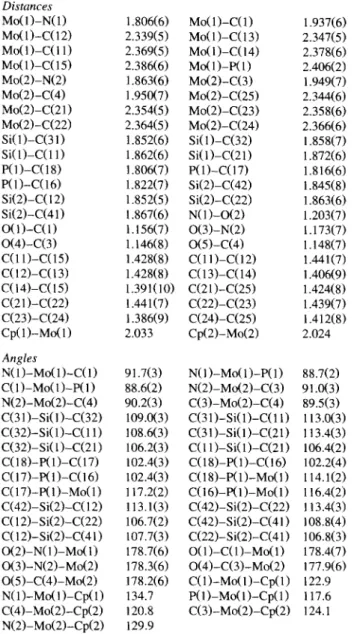
(5) M. Caluo et al. / Journal of Organometallic Chemist O, 548 (1997) 157-175. cm -1 and 1681-1566 cm -~ respectively, consistent with the presence of terminal carbonyl and nitrosyl groups. The molecular structure of trans-8 determined by X-ray diffraction analysis shows a linear disposition of the nitrosyl groups although the observed v(NO) is 1566 cm -1, lower than the v(NO) frequencies (1610 cm -1) suggested in Ref. [17] as indicative of linear nitrosyl groups. This is an indication of the high electron density at the metal center. The u(CN) frequencies of the isocyanide ligands are in the range 2214-1922 cm -j. The IR spectra of cis-8 and trans-8 show two v(CN) bands at 2112-2102 cm-1 and 1966-1922 cm- 1, which suggests that the isocyanide groups are coordinated in different modes. This behaviour is confirmed by the X-ray molecular structure which shows the presence of one linear and one bent isocyanide ligand on each molybdenum. It is important to note that the IR spectra can distinguish between linear and bent isocyanide groups both in the solid (Nujol mulls) and in solution, whereas by NMR spectroscopy only one signal for all the isocyanide groups is observed, even at low temperature. The monosubstituted complexes cis-4, cis-5 and trans-5 are chiral due to the coordination of four different ligands to one of the metal centers (Mo(2) see Scheme 1) as confirmed by the NMR spectra which show the expected signals for asymmetric molecules. Thus, their 1H NMR spectra (see Section 4) show four singlets for the protons of the bridging SiMe 2 groups and the cyclopentadienyl ring protons appear as two different ABC spin systems, one for each ring. The PMe 3 protons of cis-5 and trans-5 appear as doublets due to coupling with 31p. The molecular structure of cis-5 was determined by X-ray diffraction and is shown in Fig. 2 along with the. 161. Table 2 Selected bond distances (A) and bond angles (deg) for cis-5 Distances. Mo(I)-N(1) Mo(1)-C(12) Mo(1)-C(I 1) Mo(1)-C(15) Mo(2)-N(2) Mo(2)-C(4) Mo(2)-C(21) Mo(2)-C(22) Si(I)-C(31) Si(l)-C(11) P(I)-C(18) P(1)-C(16) Si(2)-C(12) Si(2)-C(41) O(I)-C(1) O(4)-C(3) C(11)-C(15) C(12)-C(13) C(14)-C(15) C(21)-C(22) C(23)-C(24) Cp(1)-Mo(1). 1.806(6) 2.339(5) 2.369(5) 2.386(6) 1.863(6) 1.950(7) 2.354(5) 2.364(5) 1.852(6) 1.862(6) 1.806(7) 1.822(7) 1.852(5) 1.867(6) 1.156(7) 1.146(8) 1.428(8) 1.428(8) 1.391(10) 1.441(7) 1.386(9) 2.033. Mo(1)-C(I) Mo(1)-C(13) Mo(l)-C(14) Mo(I)-P(I) Mo(2)-C(3) Mo(2)-C(25) Mo(2)-C(23) Mo(2)-C(24) Si(1)-C(32) Si(I)-C(21) P(1)-C(17) Si(2)-C(42) Si(2)-C(22) N(I)-O(2) O(3)-N(2) O(5)-C(4) C(11)-C(12) C(13)-C(14) C(21)-C(25) C(22)-C(23) C(24)-C(25) Cp(2)-Mo(2). 1.937(6) 2.347(5) 2.378(6) 2.406(2) 1.949(7) 2.344(6) 2.358(6) 2.366(6) 1.858(7) 1.872(6) 1.816(6) 1.845(8) 1.863(6) 1.203(7) 1.173(7) 1.148(7) 1.441(7) 1.406(9) 1.424(8) 1.439(7) 1.412(8) 2.024. 91.7(3) 88.6(2) 90.2(3) 109.0(3) 108.6(3) 106.2(3) 102.4(3) 102.4(3) 117.2(2) 113.1(3) 106.7(2) 107.7(3) 178.7(6) 178.3(6) 178.2(6) 134.7 120.8 129.9. N( I )-Mo( 1)-P( 1) N(2)-Mo(2)-C(3) C(3)-Mo(2)-C(4) C(31)-Si(1)-C(11) C(31)-Si(1)-C(21) C(l 1)-Si(1)-C(21) C(l 8)-P(1)-C(16) C(18)-P(1)-Mo(I) C(16)-P(I)-Mo(1) C(42)-Si(2)-C(22) C(42)-Si(2)-C(41) C(22)-Si(2)-C(41) O(1)-C(1)-Mo(1) O(4)-C(3)-Mo(2) C(1)-Mo(I)-Cp(I) P(1)-Mo(I)-Cp(1) C(3)-Mo(2)-Cp(2). 88.7(2) 91.0(3) 89.5(3) 113.0(3) 113.4(3) 106.4(2) 102.2(4) 114.1(2) 116.4(2) 113.4(3) 108.8(4) 106.8(3) 178.4(7) 177.9(6) 122.9 117.6 124.1. Angles. N( 1)-Mo( 1)-C( 1) C(I)-Mo(I)-P(I) N(2)-Mo(2)-C(4) C(31)-Si(1)-C(32) C(32)-Si(1)-C(11) C(32)-Si(1)-C(21) C(18)-P(1)-C(17) C(17)-P(1)-C(16) C(17)-P(1)-Mo(1) C(42)-Si(2)-C(12) C(12)-Si(2)-C(22) C(12)-Si(2)-C(41) O(2)-N(I)-Mo(1) O(3)-N(2)-Mo(2) O(5)-C(4)-Mo(2) N(1)-Mo(l)-Cp(l) C(4)-Mo(2)-Cp(2) N(2)-Mo(2)-Cp(2). Cp(1) is the centroid of C(11)-C(15); Cp(2) is the centroid of. C(21)-C(25).. S,t2', ~ C. ~c~s). CI17). ~. /. I. ~). .. L. C(22, ~23, .. ~. |\ "-~,., U _ 0(11 0(21. 7. Nc2)4'. C(24]. £,). -''-". 0(3). C(18l Fig. 2. Molecular structure and atom-labeling scheme for complex cis-5.. labelling scheme employed. Selected bond distances and bond angles are given in Table 2. The molecular structure of cis-5 is similar to that of cis-3 previously described, but with one of the CO groups substituted by a PMe 3 group. This substitution does not affect the rest of the molecule which shows the same trans disposition of the two NO groups. All CO and NO groups are linear and the C-O, N-O, C-C and P-C distances are in the normal range. The Mo(1)Mo(2) distance is 4.926(1) ,~ slightly shorter than that observed in cis-3. Complexes cis-6, trans-6, cis-7 and trans-7 have two asymmetric metal centers bonded to four different.
(6) 162. M. Calvo et al./ Journal of Organometallic Chemistry 548 (1997) 157-175. L~ NO. .. Me. L. ~. J. L. ON. ~L. (I). s s 01). L~. ~. ~. L. RR(III) meso. rac. Scheme3. Stereoisomersforcomplexescis-6 (L= CNtBu)andcis-7 (L= PMe3). ligands giving rise to a m e s o structure and a racemic mixture of enantiomers. NMR spectroscopy shows that the four methyl groups of the bridging SiMe 2 fragment for the m e s o isomer are not equivalent and give four singlets, whereas the racemic mixture of RR and SS. enantiomers for c i s - c o m p o u n d s shows two singlets for the two pairs of equivalent methyl groups (Scheme 3). Similar stereoisomers are also present for the t r a n s compounds (Scheme 4) for which both show two pairs of equivalent methyl groups giving two singlets. The. L. ~. ~. L. R S (II). (I). L. ~. ~. SR (m) meso. rac. Scheme4. Stereoisomersforcomplexestrans-6 (L= CNtBu)andtrans-7 (L= PMe3).. L.
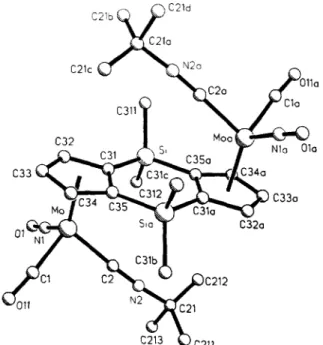
(7) 163. M. Caluo et al. / Journal of Organometallic Chemistry 548 (1997) 157-175. 021t3(~,~. ~ 021d. The two diastereoisomers of the cis compounds are in a different molar ratio, probably imposed by the nature of the substituents. The racemic mixture is the main species for complex cis-6 (1.2:1) whereas it is the minor component for cis-7 (1:1.35). This fact is only observed for one of the trans derivatives, the complex. N2a. C21c. ~r"~ C2o " ~. C311(. L. C32. trans-7.. Mool. I. N1o 01o. C35o. C33o. No S,a~. C320. )C212. 011. N2. C213. (~-C211 ). Fig. 3. Molecular structure and atom-labeling scheme for complex trans-6.. cyclopentadienyl groups are equivalent in all the complexes and their protons correspond to an ABC spin system.. 01G. The molecular structure of trans-6 was determined by X-ray diffraction studies and is shown in Fig. 3 with the labelling scheme employed. Selected bond distances and angles are presented in Table 3. The poor quality of this crystal precluded a precise refinement. The molecular structure of trans-6 comprises in two asymmetric halves bonded together and related by a center of symmetry. The CO, NO and CNR groups are linear with M - C - O , M - N - O and C(1)-N(1)-C(21) angles of 175(3) °, 176(2) ° and 175(3) °. The molecular structure of trans-8 • 2C6HsMe determined by X-ray diffraction structural analysis is shown in Fig. 4 along with the numbering scheme employed. Relevant bond distances and angles are given in Table 4. The asymmetric unit of the unit cell contains only one half of the molecule. The complete molecule is constructed through a center of symmetry located at the center of the [(C 5H 3)2(SiMe2)]2 system. Each molybde-. N1o. C41. C12 5,I. C11. ~. C13 C33. N2a. %. C15o C35 C15 Cll0. ~'S,,la. Mol C31 N2 '-. C24. C21. C34. N3. NI C22. 01. C25. C23. Fig. 4. Molecularstructureand atom-labelingschemefor complex trans-$..
(8) M. Calvo et al. / Journal of Organometallic Chemistry 548 (1997) 157-175. 164. num atom has a 'three-legged piano stool' configuration with pentahapto-coordinated cyclopentadienyl tings. The angles around molybdenum between the centroid of the cyclopentadienyl ring taken as a coordination site and the legs range from 119.3 ° to 126.5 ° and the angles between contiguous legs range from 89.0(4) ° to 96.3(4) ° . The NO ligand has a linear arrangement with an M o N - O angle of 172.1(8) °. There are two different isocyanide ligands according to the C - N - C angles, 177.7(11) ° for C(21)-N(1)-C(22) and 154.1(3) ° for C(31)-N(2)-C(32), typical for related complexes with a similar coordination of isocyanide ligands, such as Co2(CNtBu)8 [18] and Mo(CNMe)2(dpe) 2 [19]. 2.3. Oxidation with PC1 s. As shown in Scheme 5, treatment of cis-3 and trans-3 with PC1 s as chlorinating agent afforded the. dihalonitrosyl complexes [{Mo(NO)C12}2{/~-('q 5 C s H 3)2(SiMe2)z}]cis-9 and trans-9 with elimination of CO, in a reaction similar to that used for oxidizing [MoCp(CO)z(NO)] (Cp = C s H 5, CsMe 5) [20] and [{Mo(CO)2(NO)}2{/x-(rl 5-C 5H4) 2SiMe2}]I3]. These dihalonitrosyl complexes are red solids, slightly soluble in common polar organic solvents such as THF and diethyl ether, cis-9 being completely soluble in acetone and dichloromethane. It has been reported [20] that [MCp(NO)X 2] derivatives (Cp = CsH 5, CsM%; M = Mo, W; X = C1, I) can exist as green monomeric 16 electron and red dimeric 18 electron systems with two halide bridges. Accordingly, the red colour of solid cis-9 and trans-9 is probably due to the presence of chloride bridges which must be intermolecular for trans-9. The green colour of this complex in ethyl ether solution suggests the formation of an 18 electron species by coordination of the. Me + 2 PCI 5 ~ t e Mo ...,, Mo OC .. ~NO ON , ~ C OC" OC~ o. Et20 r.t.. Me eSi,~e~ ....., M o , M e IVIo CI .. . ~ ON - ~. CI" NO Cl" CI c/s-9. c/s-3 ON Me. CO .." NMo'pCO. C! ? Me ONNMo"~Cl. + 2 PCI$. Et20 r.t. Mo O N / - ~ '"CI CI. Mo Me O N / - I '"CO OC trans-3. Me. trans-9 Me 1. Me4t +2POs ButNC "~" ButNC,". "NO ON4. ButNC,-. ~. toluene r.L. t CNBu. Mo. Me. c/s-10. c/s--8. Me. ButNC. CNtBu ONNM2~CNtBu. S. + 2 PC'Is. CI. toluene r.t.. Mo Me O N / " ~ "'"CNtBu ButNC trans-8. Me. Mo. ButNC. CI. Wans-lO. CNtBu ON,,, .:",,CO Mo. OC C! ON_~[~,,CI. e SI,Me. + 2 PCIs. toluene r.t.. Mo Me O N / " ] ''CO CNtBu. + trans-lO ON ~VI~,,C I BtltNC CI. Me. Wans-11. trans-,6. Scheme 5..
(9) 165. M. Cah,o et al. / Journal of Organometallic Chemistr), 548 (1997) 157-175. Table 3 Selected bond distances (4) and bond angles (deg) for trans-6. Table 4 Selected bond distances (A) and bond angles (deg) for trans-8. Distances. Distances. Mo(I)-N(2) Mo(I)-C(I) Mo(I)-C(13) Mo(1)-C(14) Si(2)-C(12) Si(2)-C(11)~ C(I)-N(I) C(15)-C(14) C(12)-C(13) C(I l)-Si(2) a N(2)-O(1 ) C(21)-C(24) C(21)-C(22). 1.86(3) 2.06(2) 2.39(3) 2.41(3) 1.85(3) 1.82(3) 1.22(3) 1.38(4) 1.43(4) 1.82(3) 1.19(3) 1.44(6) 1.42(6). Mo(1)-C(2) Mo(I)-C(I 1) Mo(1)-C(15) Mo(l )-C(12) Si(2)-C(32) Si(2)-C(31) N(1)-C(21) C(15)-C(11) C(12)-C(l 1) C(2)-O(2) C(13)-C(14) C(21)-C(23) Mo(l)-fp(l). 1.89(3) 2.36(3) 2.33(3) 2.40(3) 1.89(3) 1.85(4) 1.40(3) 1.47(3) 1.53(4) 113(3) 1.44(4) 1.42(5) 2.034. N(2)-Mo(1)-C(I) C(12)-Si(2)-C(32) C(32)-Si(2)-C(11) ~ C(32)-Si(2)-C(31) N(I)-C(I)-Mo(1) O(2)-C(2)-Mo(1) N(2)-Mo(1 )-Cp(1) C(1)-Mo(1)-Cp(l). 92.5(10) 107(2) 112(2) 107(2) 173(2) 176(3) 125.I 121.1. Mo(1)-N(3) Mo(l)-C(31) Mo( 1)-C(12) Mo(I)-C(14) Si(l)-C(l 1) Si(I)-C(41) C( 11)-C(12) C(13)-C(14) C(11)-C(15) N(2)-C(31 ) N(2)-C(32) C(32)-C(33) C(32)-C(34) C(32)-C(35) Mo(l)-Cp(l). Angles. N(2)-Mo(I)-C(2) C(2)-Mo(1)-C(1) C(12)-Si(2)-C(11) a C(12)-Si(2)-C(31) C(11)a-Si(2)-C(31) C(1)-N(I)-C(21) O(1)-N(2)-Mo( 1) C(2)-Mo(1)-fp(l). 91.5(13) 93.4(10) 106.2(13) 115(2) 110(2) 175(3) 177(2) 124.4. Cp(l) is the centroid of C(I 1)-C(15), aSymmetry transformations used to generate equivalent atoms: -y, -z.. 1-. 1.771(9) Mo(l)-C(21) 2.022(12) Mo(l)-C(l 1) 2.382( 11) Mo( 1)-C(13) 2.322(10) Mo(I)-C(15) 1.873(10) Si(l)-C(15) ~ 1.859(11) Si(1)-C(42) 1.369(14) C( 12)-C(13) 1.38(2) C(14)-C(15) 1.464(14) N(3)-O(I) 1.176(14) N( 1)-C(21 ) 1.45(2) N(1)-C(22) 1.47(2) C(22)-C(23) 1.47(2) C(22)-C(24) 1.46(2) C(22)-C(25) 2.030. 2.046(11) 2.386(9) 2.366(10) 2.342(9) 1.853(10) 1.865(10) 1.42(2) 1.444(13) 1.219(10) 1.160(13) 1.471(14) 1.49(2) 1.51(2) 1.49(2). Angles. O(I)-N(3)-Mo(1) N(2)-C(31)-Mo(1) Cp(1)-Mo(I)-C(21) N(3)-Mo( 1)-C(31 ) C(31)-Mo(1)-C(21) C(31)-N(2)-C(22). 172.1(8) 176.3(10) 123.2 96.3(4) 89.0(4) 154.1(13). N(I)-C(21)-Mo(I) Cp(I)-Mo(1)-N(3) Cp(I)-Mo(1)-C(31) N(3)-Mo( 1)-C(21 ) C(21)-N(I)-C(22). Cp(l) is the centroid of C(I 1)-C(15). aSymmetry transformations used to generate equivalent atoms: - x +1, - y + l , - z .. x,. Me. Me. 1. Si. \ Me. I. ...............cl ................. Mo . . . . . . . . .. I. ....... CI ...... .. M o . . . . . . . . . . . . . . . . . .. M o ,.. M o .... CI. CI. NO. CI. CI. main. 175.6(9) 126.5 119.3 93.4(4) 177.7(11). (I). minor. (!I). #. M~. 1. c, M° N ° C I"". Scheme 6. Mechanism of isomerization between stereoisomers I-II. Ea(Mo-C1) = 31.35 kJ mol- i..
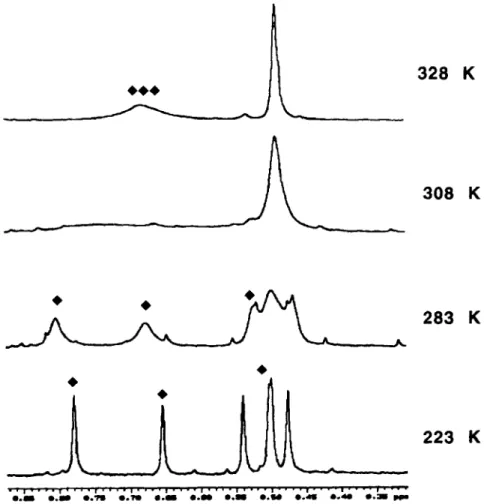
(10) M. Calr, o et al. / Journal o f Organometallic Chemistry 548 (1997) 157-175. 166. solvent, while cis-9 gives red solutions, even upon heating which seem indicate the presence of intramolecular chloride bridges, as evidenced by I H NMR spectroscopy, cis-9 shows a dynamic behaviour in solution; the ~H NMR spectrum at room temperature in CDC13 shows two groups of broad signals at 6 6.45 and 6 0.68 ppm. When the solution is heated to 58°C, the spectrum shows two signals due to the cyclopentadienyl ring protons at 6 6.6 (4H, broad signal) and 6 6.2 (2H) and two signals for the methyl groups of the SiMe 2 bridges at 6 0.7 ppm (6H, broad signal) and 6 0.5 ppm (6H). This transformation is reversible because the initial spectrum is restored when the solution is cooled down to room temperature. The ~H NMR spectrum in CD2C12 at - 8 0 ° C shows two groups of signals between 6 6.2 and 6 6.5 for the cyclopentadienyl ring protons, each group being characterized by three resonances, with an intensity ratio 3.3:1 consistent with an ABC spin system for two equivalent cyclopentadienyl rings, indicating that the two metal centers have the same environment. The methyl groups of the SiMe2 bridges appear as six resonances, four due to the main species (I) and two for the minor component (II) shown in Scheme 6. This spectral behaviour is consistent with. the presence of two isomers and can be explained assuming that a double intramolecular chloride bridge is formed between the two metal centers at low temperature. In order to determine the thermodynamic and kinetic parameters, we studied the isomerization process recording the I H NMR spectra at different temperatures. The spin saturation transfer method (SST) [21] allowed us to assign the three resonances observed in the ~H NMR spectrum at 223 K, starred ( • ) in Fig. 5, to the methyl-silyl groups located below the plane of the cyclopentadienyl rings and the other three to the methyl-silyl groups located above the plane. All of these signals broaden as the temperature increases to give two broad resonances at 328 K. The kinetic parameters evaluated calculating the life time values (~-= 1/rrK, where K is the rate constant) by line form analysis were: log A = 13.4 + 0.3; E a = 63.9 _+ 2.1 kJ mol-1; A H # = 6 1 . 8 + 2 . 1 kJ m o l - l ; AS ~ = 0 . 6 + 0 . 9 u.e. and AG~98 r~ = 62.7 kJ mol - l . The value of log A indicates that the isomerization is an intramolecular and energetically favourable process and the very small value of AS # means that the fundamental and the transition states are of the same order. The transition. 328. K. e,~,e. .... 308. K. 283. K. 223. K. A,.. 41,. "~!. o.m. . . . .. e . ~l. | ' ' ' r ' " # ' ' !. o.-~. o.~. . . . .. e . -!. - .. . . .. e . ~!. . . . .. e . ~!. . . . .. e . ~!. .. .. .. pgam o. .. ~ " o . ~ ' " ~ g . ~ l m ........ Fig. 5. nH NMR variable temperaturespectra of cis-9. SiMe2 resonances: • ~ Me groups below the plane..
(11) 167. M. Cah,o et al. / Journal of Organometallic Chemistry. 548 (1997) 157-175. state corresponds to the cleavage of two Mo-C1 bridging bonds. Therefore, the activation energy for the cleavage of one Mo-C1 bridge is 31.35 kJ mo1-1. Reaction of cis-8 with two equivalents of PC15 gave the dichloroderivative [{Mo(NO)(CNIBu)C12}2{/z-(r/5CsH3)2(SiMez)2}](cis-lO) in high yield (see Scheme 5). This complex was obtained as a mixture of isomers as discussed below. The related reaction carried out with trans-8 led to trans-lO. In contrast, when the same reaction was carried out with trans-6, a mixture of trans-lO and [{Mo2(CO)(NO)z(CNtBu)C14}{/z-(@ CsH3)z(SiMe2)2}] ( t r a n s - l l ) was obtained. Both compounds are highly insoluble in most organic solvents and only slightly soluble in dichloromethane. It was not possible to separate these compounds by chromatography or by recrystallization. The dichloroderivative trans-lO shows a I H NMR spectrum similar to that observed for the chiral complexes described above. This behaviour is consistent with a cis disposition of the chloro substituents. Similar behaviour was observed for trans-ll but its ~H NMR spectrum showed twice as many signals due to the asymmetry of the molecule. The 1H NMR spectrum of cis-lO shows the signals due to three different isomers according to the relative disposition of the two chloro ligands (Scheme 7).. [{MLn}2{/z-(@-CsH3)2(SiMe2)2}] [22]. Fig. 6 shows the diagrammatic representation used by Corey et al. [22] including the four previously reported structural types (I, II, IV, V) and the two new types (III, VI) found for complexes described in this paper. Trans-8 exhibits the known trans-II structure where the central six-membered ring is planar and its angle with the Cp ring planes is 0.7(2) °, the most planar system described to date. Other similar systems previously reported are trans-[{TiC13}2{ ~-('qS-CsH3)2(SiMe2)2}] [4] where this angle is 4(2) ° , trans-[{Mo(CO)3C1}2{/~-(r/5 C5H3)2(SiMe2)2}] [5] with a value of 7.8(5) ° and trans[{TiCp*C12}2{/x-(@-CsH3)2(SiMe2) 2} [22] where the angle is 9°. However trans-6 adopts a new structural form corresponding to type III in which the two Cp rings are almost exactly coplanar whereas the central six-membered ring shows a chair conformation with one of the silicon atoms located 0.20 ,~ over and the other 0.20 A below the plane. Both cis-3 and cis-5 are also the first examples of the new structural form cis-VI. In this structure the two Cp rings are also coplanar, whereas the central sixmembered ring shows the two silicon atoms located above the plane at 0.3 A for cis-3 and 0.25 A for cis-5 in contrast to the arrangement found in other cis-dinuclear complexes in which the planes of the two cyclopentadienyl rings make an angle of 23 ° for cis[{Co(CO)2}2{/x-(@-CsH3)2(SiMe2)z}] [23], 30° for cis[{Mo(CO)3C1}2{/x-(@-C5H 3)2(SiMe2)2}] [5] and 50 ° for cis-[{TiCp* C12}2{~-(@-CsH3)2(SiMe2)2}] [22]. The distances between the two metal atoms, 4.962(1) ,~ for. 2.4. Comparison of the X-ray molecular structures. Only trans-8 has one of the four known previously reported structures for complexes of the type. Me. M~. Mo. -. ON. 1. Me. CI. ~. Me. Mo ButNC. ON. NO. ON. I!. Me. I. Mo. III Scheme7. Stereoisomersfor complex cis-lO.. CI. CNtBu.
(12) 168. M. Cairo et al. /Journal of Organometallic Chemist~" 548 (1997) 157-175 C2. ~. ~.. ~. C9. \LJ.L ..LL#) c~. c. c s - S i z ~-, c7. ~. _. c,. Si 2. Cs. C6. C,. L ~ ~. LnM. - "-.Or,/-. Q~'Q~ ~MLn. Type I. LnM. o-o ,. o-o-o. /". 0. A. w. Type IV. o.. Type II. .Q MLn. LnM/"C)"O. n "0., 0. O ' a/. - ~ - - \. LnM. ~. -. MLn. Type V. MLn. o-o-l-O O-l-O--O MLn. 0. MLn Type VI. T y p e III. Fig. 6. Diagrammatic representations of the structural types for MLM complexes (L = [(SiMe2)2(~75-C5H 3)2])". cis-3 and 4.926(1) ~, for cis-5, are in the range reported for cis-[{Co(CO)2}2{tx-(@-CsH3)2(SiMe2)2}], 4.25 A in spite of the presence of the bulkier Mo(CO)2(NO) fragments without any metal-metal interaction.. 3. Conclusions. Reactions of the previously reported dinuclear molybdenum hydridotricarbonyl and carbonylate complexes containing the bridging bis(dimethylsilanediyl)dicyclopentadienyl ligand with diazald lead to the new nitrosyl derivatives cis- and trans-[{Mo(CO)2(NO)}2{/z-(@-C 5H 3)2(SiMe2)2}]. Substitution of CO by appropriate stoichiometric amounts of CN(tert-Bu) takes place to give mono-, di- and tetra-substituted compounds cis- and trans[{Mo2(CO) 4_.L.(NO)2}{ ~-(r/5-CsH3)z(SiMe2)2}]. (n. = 1, 2, 4) at room temperature or by heating in toluene to 60-80°C, whereas for similar complexes with PMe 3. only take place under UV irradiation or slight thermal treatment. Oxidation of all these compounds with PC15 afforded the 16 electron complexes cis- and trans[{Mo(NO)CI2}2{ ~-(r/5-CsH3)a(SiMe2)2}] whereas 18 electron derivatives cis- and trans-[{MoL(NO)C12}2{ tx(@-CsH3)2(SiMe2)2}] were obtained when isocyanide was present as ligand. The dynamic behavior of the 16 electron cis- complex has been studied by 1H D NMR spectroscopy, and thermodynamic and kinetic parameters for the 16 to 18 electron system transformation were determined giving an activation energy of 31.3 kJ mol-1 for the intramolecular metal-chlorine bridging bond dissociation. The NO ligand is coordinated as a linear group in all the complexes whereas the isocyanide ligand adopts a linear disposition in the monoand disubstituted complexes but a bent disposition for one of the isocyanide ligands bonded to each molybdenum in the tetrasubstituted compounds. All of the new nitrosyl complexes reported were characterized by elemental analysis, mass spectrometry and 1H, 13C and P.
(13) M. Cah,o et al. / Journal of Organometallic Chemistry.548 (1997) 157-175 NMR spectroscopy, which also shows the presence of chiral metal centers in all the asymmetric molecules. The molecular structures of two cis- and two transcomplexes were determined by X-ray diffraction. Both cis complexes [{M o(C O) 2(N O)}2{/z-(r/5 cis-3 and [{Mo2(CO) 3CsH3)z(SiMe2)2}] (NO)2(PMe3)}{/z-(r/5-CsH3)2(SiMe2)2}] cis-5 show unprecedented structures with almost exactly coplanar cyclopentadienyl rings and distances between the nonbonded metal fragments of ca. 4.9 A, shorter than in any other related d i n u c l e a r c i s - c o m p l e x . [{Mo(CO)(NO)(CN t BH)}2{/.~-(/) 5-C 5H 3)2(SiMe2)2}] trans-6 is also the first example of a dinuclear trans complex exhibiting an exactly planar disposition of the two cyclopentadienyl rings with a chair conformation of the s i x - m e m b e r e d c e n t r a l ring, w h e r e a s [{Mo(NO)(CNtBu)2}2{/.~-(r/5-CsH3)z(SiMe2)2}] trans-8 shows the structure already reported for other similar compounds.. 169. were dissolved in THF (50 ml).The solution was stirred at room temperature for 2 h. The initial orange solution became brown and solvent was removed in vacuo. The brown oil obtained was dissolved in toluene (10 ml) and filtered through a short florisil column. The filtrate was evaporated in vacuo to give an orange oil. Complex cis-3 was isolated as an orange solid (0.70 g, 72%) by crystallization of the oil from hexane at room temperature. Anal. Found: C, 35.68; H, 2.89; N, 4.88%. C18HtsO6Si2N2Mo2. Calc. C, 35.65; H, 2.99; N, 4.62%. IR (Nujol): v(CO)= 2020vs, 1942s; v(NO)-~ 1680vs, 1642s. ~H NMR (500 MHz; C6D6; 20°C): = 5.02 (1H, C5H3, 3j(HH) = 2.5), 4.94 (2H, C5H3), 0.38 (s, 3H, SiMe2), 0.10 (s, 3H, SiMe2). 13c{1H} NMR (125.8 MHz; C6D6; 20°C): 8 = 227.05 (CO), 108.03 (CsH 3 c~ to the SiMe 2 bridges), 100.81 (CsH 3 y to the SiMe 2 bridges), 98.93 (CsH 3 /3 to the SiMe 2 bridges), 3.54 (SiMe2), 1.23 (SiMe2).. 4.2. Preparation of trans-l[Mo(CO)2(NO)}2[tz-(~ sC51-13)2(SiMe2 )2 I I (trans-3) 4. Experimental details All reactions were carried out in dried Schlenk tubes under argon or nitrogen, and the manipulations were carried out using syringes or cannulas through Subaseals. Solvents were dried and distilled under nitrogen: diethyl ether and tetrahydrofuran from sodium benzophenone ketyl; hexane from sodium and potassium amalgam; toluene from sodium; dichloromethane from P205. Unless otherwise stated, reagents were obtained from commercial sources and used as received. IR spectra were recorded in Nujol mulls for solids over the range 4000-200 cm-~ on a Perkin-Elmer 583 spectrophotometer. IR data are given in cm-~. The ~H and ~3C, NMR spectra were recorded at 299.95 and 75.43 MHz respectively on a Varian Unity 300 spectrometer and at 499.85 and 125.7 MHz on a Varian Unity 500 Plus spectrometer; chemical shifts, in ppm, are positive down field relative to external SiMe 4, and coupling constants are in Hz. C, H and N analyses were performed with a Perkin-Elmer 240-B instrument. Mass spectra were recorded with a Hewlett-Packard 5988A spectrometer. The c o m p o u n d s cis-[{Mo(CO)3H}2{/x-(r/5 C5H3)2(SiMe2)z}](cis-1) and trans-K2[{Mo(CO)3}2{ l~(rlS-CsH3)2(SiMe2)2}](trans-2) were prepared as reported previously, i.e., from reaction of [Mo(I,3,5C6H3Me3)(CO)3] with [(CsH4)2(SiMe2) 2] or K 2[(C 5H 3)2(SiMe)2 ], respectively.. 4.1. Preparation of cis-[{Mo(CO)2(NO)}e{tx-(rl 5 (251-13)e ( SiMe e )e } ](cis-3 ) The complex cis-1 (0.96 g, 1.59 mmol) and pCH3C6H4SO2N(NO)CH 3 (diazald) (0.68 g, 3.18 mmol). A mixture of trans-2 (3.2 g, 4.7 mmol) and diazald (2.01 g, 9.4 mmol) was stirred for 2 h in THF (25 ml) at room temperature. Carbon monoxide was evolved and a white precipitate appeared. The solid was filtered off and the solution was evaporated in vacuo to give a brown oil. This oil was dissolved in toluene and filtered through a short florisil column. The solvent was removed in vacuo. Complex trans-3 was obtained as an orange solid (1.91 g, 67%). Anal. Found: C, 35.63; H, 3.23; N, 4.32%. C18HIsO6Si2N2Moz. Calc. C, 35.65; H, 2.99; N, 4.62%. IR (Nujol): v(CO)=2016vs, 1944vs; u(NO)= 1678vs. ~H NMR (300 MHz; C6D6; 20°C): fi = 5.25 (2H, C5H 3, 3j(HH)= 2.5), 4.83 (1H, C5H3), 0.22 (s, 6H, SiMe2). 13C{LH}NMR (75.5 MHz; CrD6; 20°C): ~ = 227.19 (CO), 108.21 (CsH 3 a to the SiMe 2 bridges), 103.64 (CsH 3 /3 to the SiMe 2 bridges), 96.48 (CsH 3 "y to the SiMe 2 bridges), 2.41 (SiMe2).. 4.3. Preparation of cis-[[Mo2( CO)3(NO)2( CNtBu}{ I-t(~ ~-C51-13)2(SiMez )e } l(cis-4) The complex cis-3 (0.5 g, 0.82 mmol) was dissolved in toluene (25 ml) and CNtBu (95 /zl, 0.82 mmol) was added. The solution was stirred for 7 h at room temperature and then the solvent removed in vacuo to give an orange solid which was a mixture of complexes cis-4 and cis-6. The filtrate was partially evaporated and cooled to - 4 0 ° C overnight giving more orange solid. Cis-4 (0.38 g, 73%) was separated by chromatography on florisil using CH2C12 as eluent and cis-a with THF. Anal. Found: C, 41.28; H, 4.39; N, 6.17%. C22H27OsSi2N3Mo 2. Calc. C, 39.94; H, 4.11; N, 6.35%. IR (Nujol; (1) and (2) refereed to Mo(1) and.
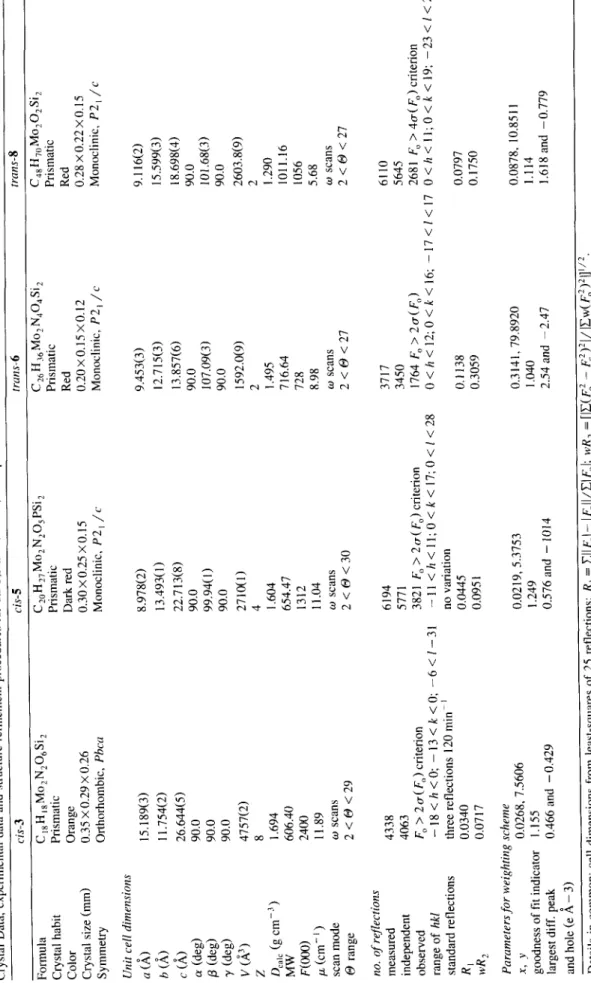
(14) 170. M. Caluo et al. / Journal of Organometallic Chemistry. 548 (1997) 157-175. Mo(2), see Scheme 1): v(CNtBu)= 2151s ; u(CO(1)) =2011vs, 1938vs; v(CO(2))=1914vs; v(NO(1))= 1675s; u(NO(2))=1628vs, 1611vs. IH NMR (500 MHz; C6D6; 20°C): ~ = 5.26, 5.19, 5.36 (A', B' and C' parts of an A'B'C' spin system, 3H, C5H3, 3j(A~B') = 2.5, 4j(B'C') = 1.5), 5.11, 5.01, 5.08 (A, B and C parts of an ABC spin system, 3H, C5H3, 3j(AB)= 2.5, 4j(BC)---1.25), 0.93 (s, 9H, CNCMe3), 0.51 (s, 3H, SiMe2), 0.49 (s, 3H, SiMe2), 0.24 (s, 3H, SiMe2), 0.20 (s, 3H, SiMe2). 13C{IH} NMR (125.8 MHz; C6D6; 20°C; (1) and (2) referred to Mo(1) and Mo(2), see Scheme 1): 8=238.53 (CO(2)), 227.78 (CO(I)), 227.21 (CO(I)), 167.55 (CNtBu), 110.06, 108.17, 105.46, 103.67 (CsH 3 a to the SiMe 2 bridges), 101.15, 100.70, 100.13, 99.67, 97.94, 96.80 (CsH 3 [3 and y to the SiMe 2 bridges), 57.86 (CNCMe3), 30.18 (CNCMe3), 3.98, 3.92, 1.71, 1.32 (SiMe2).. 4.4. Preparation of cis-[{Mo(CO)(NO)(CNtBu)]2[ ~(775-C51-13)e(SiMe2 )2} ](cis-6) CNtBu (186/xl, 1.64 mmol) was added to an orange solution of cis-3 (0.50 g, 0.82 mmol) in toluene (25 ml), with a microsyringe. The solution was stirred at room temperature for 7 h and the solvent removed in vacuo. The residue was washed with hexane giving an orange solid (cis-6). The filtrate was partially evaporated and cooled to - 40°C overnight to give cis-6 (0.49 g, 85%). Anal. Found: C, 42.46; H, 5.49; N, 7.05%. C26H3604Si2N4Mo 2. Calc. C, 43.58; H, 5.06; N, 7.82%. IR (Nujol): t,(CNtBu) = 2134s; v(CO) = 1902s; v(NO) = 1620s. 1H NMR (500 MHz; C6D6; 20°C; I and III see Scheme 3): 6 = 5.25, 5.54, 5.19 (III, A, B and C parts of an ABC spin system, 6H, CsH 3, 3j(AB) = 2.73, 4 j ( B - C ) = 1.42), 5.36, 5.50, 5.30 (I, A, B and C parts of an ABC spin system, 6H, CsH 3, 3j(AB) = 2.73, 4 j ( B - C ) = 1.44), 0.99 (s, I and III, 36H, CNCMe3), 0.65 (s, I, 3H, SiMe2), 0.60 (s, III, 6H, SiMe2), 0.54 (s, I, 3H, SiMe2), 0.35 (s, I and III, 9H, SiMe2), 0.28 (s, I, 3H, SiMez). 13C{~H} NMR (125.8 MHz; CrDr; 20°C; I and III see Scheme 3): 6 = 240.07 (CO, III), 238.72 (CO, I), 106.35, 105.41 (I, CsH 3 a to the SiMe 2 bridges), 107.45, 103.57 (III, CsH 3 ~e to the SiMe z bridges), 100.69, 100.38 (I, CsH 3 /3 to the SiMe 2 bridges), 103.08, 99.63 (III, CsH 3 /3 to the SiMe 2 bridges), 98.20 (I, CsH 3 y to the SiMe z bridges), 95.42 (III, CsH 3 y to the SiMe 2 bridges), 57.97 (1, CNCMe3), 57.79 (III, CNCMe3), 30.42 (I, CNCMe3), 30.37 (III, CNCMe3), CNCMe 3 not observed, 4.38, 4.33, 2.88, 2.11 (I, SiMe2), 4.63, 1.76 (III, SiMe2). 4.5. Preparation of cis-[{Mo2(CO)3(NO)2(PMe3)}{tz(~q 5 _ C s H 3 ) 2 ( S i M e2)ell(cis-5) and [[Mo( CO )(NO )( PMe 3)12{tx-(~ S-C5H3 )e(SiMe 2)2} ]( cis- 7) A mixture of cis-3 (0.42 g, 0.69 mmol) and PMe 3 (1.5 ml, 1.5 mmol) in toluene (30 ml) was irradiated. with UV light while stirring for 3 h at room temperature. The colour of the solution changed from orange to dark red. The solution was filtered and evaporated in vacuo to dryness. The residue was chromatographed on florisil. Complex cis-5 was eluted with toluene and cis-7 with dichloromethane. Complex cis-5: Anal. Found: C, 37.22; H, 3.91; N, 3.67%. C20H27Si2N2OsMo2P. Calc. C, 36.70; H, 4.16; N 4.28%. IR (Nujol, (1) and (2) referred to Mo(1) and Mo(2), see Scheme 1): v(CO(1))= 2010vs, 1938vs; u(CO(2)) = 1901vs; u(NO(1))= 1668vs; u(NO(2))= 1598vs. ~H NMR (300 MHz; C6D6; 20°C): 8---5.09, 5.03 (B', C' and P( parts of an P(B'C' spin system, 3H, CsH 3, 3j(A'B')= 2.4), 5.04, 5.27, 4.75 (C, B and A ~jarts of an ABC spin system, 3H, C 5H 3, 4j(BC) = 1.2, (HA--31P) = 3.3, 3J(AB)= 2.4), 0.98 (d, 9H, PMe 3, 2J(IH-31P) = 8.7), 0.58 (S, 3H, SiMe2), 0.51 (s, 3H, SiMe2), 0.28 (s, 3H, SiMe2), 0.26 (s, 3H, SiMe2). 13C{IH} NMR (125.8 MHz; C6D6; 20°C; (1) and (2) referred to Mo(1) and Mo(2) see Scheme 1): 6 = 244.48 (d, CO(2), aj(13C-31P)= 12.1), 227.56, 227.55 (s, CO(I)), 108.16, 106.21, 102.86 (s, CsH 3 a to the SiMe z bridges), 100.82, 98.06 (s, CsH 3 T to the SiMe 2 bridges), 99.52, 99.22, 98.30, 97.94 (s, CsH 3 /3 to the SiMe 2 bridges), 20.40 (s, PMe3), 3.72, 3.65, 2.51, 2.12 (s, SiMe2). 31p{1H} NMR (125 MHz; C6I)6; 20°C): 6 = 17.81 (PMe3). Complex cis-7: Anal. Found: C, 38.21; H, 5.21; N, 3.84%. C18H24Si2N2P2OaMo2. Calc. C, 37.61; H, 5.16; N, 3.99%. IR (Nujol): u(CO)= 1913s, 1873s; u(NO) = 1620s, 1584s. IH NMR (500 MHz; C6D6; 20°C; I and III see Scheme 3) 6 = 4.81, 5.25, 5.38 (I, A, B and C parts of an ABC spin system, 6H, CsH 3, 3j(HA-31P) =2.3, 3j(HA-HB)=3.0, 4 j ( H B - H c ) = 1.5), 4.75, 5.32, 5.40 (III, A, B and C parts of an ABC spin system, 6H, CsH 3, 3j(HA-31P)=2.5, 3j(HA-HB)= 3.0, 4j(HB-H c) = 1.5), 1.02 (I and III, d, 36H, PMe 3, 2j(1H-31P) = 8.5); 0.75(I, s, 3H, SiMe2), 0.70 (I, s, 3H, SiMe2), 0.43 (I, s, 3H, SiMe2), 0.37 (I, s, 3H, SiMe:), 0.74 (III, s, 6H, SiMe2), 0.40 (III, s, 6H, SiMe:). 13C{IH} NMR(125.8 MHz; C6D6; 20°C; I and III see Scheme 3) 6 = 245.03 (III, d, CO, 2j(13C-31p) = 12.12), 244.78(I, d, CO, 2j(13C-31p)= 12.12), 107.72 (III, d, CsH 3 oz to the SiMe z bridges, 2j(13C31p) _= 1.5), 107.14(1, d, CsH 3 a to the SiMe 2 bridges, 2j(J3C-31P) = 1.5), 106.05 (I, d, CsH 3 ol to the SiMe 2 bridges, 2j(13C-31p) = 2.25), 105.39 (III, d, CsH 3 o~ to the SiMe 2 bridges, 2j(13C--31P)= 2.25), 100.63, 99.51 (III, S, C5H 3 /3 to the SiMe 2 bridges), 100.54, 99.33 (I, S, CsH 3 /3 to the SiMe 2 bridges), 95.60 (I, s, CsH 3 "y to the SiMe 2 bridges), 95.42 (III, s, CsH 3 T to the SiMe 2 bridges), 20.57 (I and III, d, PMe 3, IJ(13C-31P) = 28.1); 4.75, 2.57 (III, s, SiMe2), 4.30, 4.49, 2.76, 2.57 (I, s, SiMe2). 31P{1H} NMR (125 MHz; C6D6; 20°C; I and III see Scheme 3) 6 = 18.41 (I, PMe3), 18.33 (III, PMe3)..
(15) M. Calvo et aL/ Journal of Organometallic Chemistry548 (1997) 157-175 4.6. Preparation of trans-[[Mo2( CO)~(NO)e(PMe 3)}{ tx(~7S-C~143)2SiMe 2)2 }] (trans-5 ) PMe 3 (1.94 ml, 1.994 mmol) was added to a solution of trans-3 (0.59 g, 0.97 mmol) in toluene (25 ml) at room temperature. The mixture was irradiated with UV light for 45 rain. The colour changed from orange to brown. The solvent was removed in vacuo to give a mixture of complexes trans-5 and trans-7 as brown powders which were chromatographed on florisil, trans5 (0.16 g) was eluted with a mixture of toluene: dichloromethane and trans-7 (0.3I g) was obtained in THF. Complex trans-5: Anal. Found: C, 36.48; H, 4.13; N, 4.21%. C20Hz7Si2N2OsPMo2 Calc. C, 36.70; H, 4.16; N, 4.28%. IR (Nujol, (i) and (2) referred to Mo(1) and Mo(2), see Scheme 1): u(CO(1))=2012s, 1942s; ~,(CO(2)) = 1880s; u(NO(1)) = 1676s; ~,(NO(2)) = 1588s. tH NMR (300 MHz; CrDr; 20°C): 8 = 4 . 9 5 , 5.37 (P~ and B'C' parts of an ,~B'C' spin system, 3H, C5H3), 4.60, 5.40, 5.32 (A, B and parts of an ABC spin system, 3H, C5H3), 0.93 (d, 9H, PMe 3, zJ(~H-31P)= 8.7), 0.47 (s, 3H, SiMe2), 0.46 (s, 3H, SiMez), 0.38 (s, 3H, SiMe2), 0.33 (s, 3H, SiMe2). 13C{lH} NMR (125.8 MHz; C6O6; 20°C; (1) and (2) refereed to Mo(1) and Mo(2), see Scheme 1): 6 = 245.53 (d, CO(2), 2j(13C3~p)= 12), 227.68, 227.65 (CO(l)), 109.37, 109.13, 105.94, 105.39 (CsH 3 c~ to the SiMe2 bridges), 103.54, 103.38, 103.14, 102.82 (C5H3 /3 to the SiMe 2 bridges), 96.62, 93.27 (CsH 3 y to the SiMe, bridges), 20.66 (d, PMe3, ~J(l~C-3~P)=28.12), 3.94, 3.59, 1.69, 1.51 (SiMe~). 3~p{~H} NMR (125 MHz; C6D6; 20°C): ~ = 17.07 (s, PMe3).. 4. 7. Preparation of trans-[[Mo(CO)(NO)(CNtBu)}Jtz(r15-C51-13)2(SiMe 2)z }]( trans-6) The complex trans-3 (0.36 g, 0.59 mmoi) was dissolved in toluene (15 ml) and CNtBu was added with a microsyringe (134 /xl, 1.18 mmol). The solution was stirred for 3 h at 60°C. The initial orange solution turned red. After cooling to room temperature hexane (ca. 15 ml) was slowly added to give trans-6 as a red solid (0.39 g, 93%) which was washed with toluene and hexane. Anal. Found: C, 45.30; H, 5.17; N, 7.94% C26H3604SizN4Mo ~. Calc. C, 43.58; H, 5.06; N, 7.82%. IR (Nujol): v(CNtBu) = 2124s; v(CO) = 1910s; u(NO) = 1622s. 1H NMR (500 MHz; CDC13; 20°C): = 5.45, 5.70, 5.76 (A, B and C parts of an ABC spin system, 12H, C5H3), 1.44 (s, 36H, CNCMe3), 0.38 (s, 6H, SiMe2), 0.37 (s, 6H, SiMe2), 0.36 (s, 6H, SiMe2), 0.34 (s, 6H, Si Me2). 13C{~H} NMR (125.8 MHz; CDC13; 20°C): 6 = 238.55 (CO), 105.83, 105.80 (CsH 3, ce to the SiMe 2 bridges), 105.45, 105.41 (CsH 3 c~ to the SiMe 2 bridges), 103.89, 103.85 (CsH 3 /3 to the SiMe 2. 171. bridges), 103.05, 102.96 (CsH 3 /3 to the SiM% bridges), 95.35, 95.32 (CsH 3 "y to the SiMe 2 bridges), 167.57 ( C N C M e 3 ) , 58.20 ( C N C M e 3 ) , 30.81 (CNCMe3), 3.49, 3.42, 3.20, 3.15 (SiMe2).. 4.8. Preparation of trans-[[Mo(CO)(NO)(PMe3)}2{tz(~7S-C5 H~ )2(Sime2 )2} ](trans-7) PMe 3 (1.64 ml, 1.64 mmol) was added to a solution of trans-3 (0.5 g, 0.82 mmol) in toluene (25 ml). The solution was stirred for 12 h at 30°C. The initial orange solution turned red and a brown solid appeared. When the solution cooled to the room temperature, hexane was added to facilitate the total precipitation of the product. The supernatant liquid was filtered off and the solid was washed with hexane and toluene. Finally trans-7 was obtained as a red powder (0.4 g, 70%). Anal. Found: C, 37.01; H, 5.02; N, 3.91%. CIsHz4Si2N2P204Mo 2. Cal. C, 37.61; H, 5.16; N, 3.99%. IR (Nujol): ~(CO)= 1884vs; u ( N O ) = 1596vs. 1H NMR (500 MHz; CrDr; 20°C; M main diastereoisomer and m minor diastereoisomer): 6 = 4.71, 5.41, 5.48 (M, A, B and C parts of an ABC spin system, 3H, C s H 3, 3J(HA-31P)=2.6), 4.75, 5.47, 5.51 (m, A, B and C parts of an ABC spin system, 3H, C~H 3, 3J(H A31p) = 2.6), 0.971 (M. d, 9H, PMe 3, 2J(1H-31P)= 9), 0.974 (m, d, 9H, PMe 3, 2 J ( t H - 3 1 P ) = 9), 0.63 (M, s, 3H, SiMe2), 0.61 (M, s, 3H, SiMez), 0.57 (m, s, 3H, SiMe2), 0.54 (m, s, 3H, SiMe2). 13C{IH} NMR (125.8 MHz; C6D6; 20°C): 6 = 246.52 (d, CO, 2J(13C-31P) = 11.5), 246.29 (d, CO, zJ(13C-31P)= 11.5), 107.61, 107.33 (CsH 3 c~ to the SiMe 2 bridges), 107.05, 106.91 (CsH 3 c~ to the SiMe 2 bridges), 103.39 (CsH 3 /3 to the SiMe 2 bridges), 102.76 (d, C~H 3 /3 to the SiMe 2 bridges, 2J(13C-31P)= 1.8), 102.68 (d, C5H 3 /3 to the SiMe 2 bridges, 2J(13C-31p)= 1.8), 93.72 (d, CsH 3 y to the SiMe 2 bridges, 2j(13C-31P)= 2.37), 93.63 (d, C5H3 Y to the SiMe e bridges, 2J(13C-31p)=2.37), 21,16 (d, PMe 3, 1J(J3C-3tP)= 28.5), 3.75, 3.52, 3.31 (SiMe2). 3~P{IH} NMR (125 MHz; C6D6; 20°C): ~ = 16.91 (m, PMe3), 16.85 (M, PMe3).. 4.9. Preparation of cis-l{Mo(NO)(CN~Bu)2}2{Ix-(rl 5Cs H3 )2(Sime2 )2 } ]( cis-8) CNtBu (536/zl, 4.76 mmol) was added to a solution of cis-3 (0.72 g, 1.19 mmol) in toluene (40 ml). The mixture was stirred for 7 h at 80°C. The orange solution was evaporated in vacuo and the residue was washed with hexane giving a dark yellow powder. The filtrate was partially evaporated and cooled to - 40°C overnight to obtain cis-8 (0.97 g, 92%). cis-8 can also be prepared (0.34 g, 90%) by addition of CNtBu (98 /~1, 0.86 mmol) to a solution of cis-6 (0.31 g, 0.43 mmol) in toluene (25 ml) following the procedure described ear-.
(16) 172. M. Cah,oet al. / Journal of OrganometallicChemist~"548 (1997) 157-175. lier. Anal. Found: C, 49.39; H, 6.58; N, 10.16%. C34H5402Si2N6Mo2. Calc. C, 45.67; H, 6.15; N, 9.04%. IR (Nujol): u(CNtBu) = 2112vs, 1922s (broad); u(NO)= 1576vs. ~H NMR (500 MHz; C6D6; 20°C) 8 = 5 . 7 1 (2H, C5H3), 5.37 (1H, C s H 3, 3j(HH) --= 3), 1.16 (s, 18H, CNtBu), 0.86 (s, 3H, SiMe2), 0.49 (s, 3H, SiMe2). 13C{1H} NMR (125,8 MHz; C6D6; 20°C): ~ = 195.44 (CNtBu), 105.88 (CsH 3, c~ to the SiMee bridges), 100.57 (C5H 3, 13 to the SiMez bridges), 97.35 (C5H 3, y to the SiMe 2 bridges), 58.12 (CNCMe3), 31.14 (CNCMe3), 5.41 (SiMe~), 2.40 (SiMe2).. 4.10. Preparation of trans-[{Mo(NO)(CN'Bu)2}2{IX(r15_C5 H3 )2(SiMe2 )2} l( trans-8) A suspension of trans-6 (0.34 g, 0.46 retool) in toluene (20 ml) was prepared and then CNtBu (107/xl, 0.94 mmol) was added with a microsyringe. The mixture was heated to 80°C and stirred until the solids were dissolved. Stirring was continued for 3 h. Then the solution was cooled to room temperature and hexane was slowly added to give trans-8 as a red solid (0.37 g, 93%). The product was washed with hexane and toluene. Trans-8 can also be prepared from trans-3 (0.36 g, 0.59 mmol) with CNtBu (268 /xl, 2.36 mmol) by the procedure described earlier (0.46 g, 90%). Anal. Found: C, 49.01; H, 6.83; N, 8.23%. C~4H5402Si2N6Mo 2. Cal. C, 45.67; H, 6.15; N, 9.04%. IR (Nujol): v ( C N t B u ) = 2102s, 1966s (broad); ~,(NO)= 1566w. IH NMR (500 MHz; CDC13; 20°C): 6 = 5.61 (2H, C s H 3, 3 j ( H H ) = 2.6), 5.47 (1H, CsH3), 1.37 (s, 18H, CNCMe3), t).33 (s, 6H, SiMe2). r3C{1H} NMR (125.8 MHz; CDC13; 20°C): 8 = 188.38 (CNCM%), 103.98 (CsH 3, /3 to the SiMe 2 bridges), 103.15 (CsH 3, ce to the SiMe 2 bridges), 94.35 (CsH 3, y to the SiMe 2 bridges), 58.15 (CNCMe3), 31.19 (CNCMe3), 4.81 (SiMe2).. 4.11. Preparation of cis-[{MoCl2(NO)}2{IX-(rl 5C5143)2(SiMe2 )2 }](eis-9) PCI~ (0.46 g, 2.2 mmol) was added to an orange solution of cis-3 (0.67 g, 1.1 mmol) in diethyl ether (50 ml), and the solution was stirred for 4 h at room temperature. A colour change from orange to green was observed and a red solid was deposited. The solid was isolated and washed three times with diethyl ether (3 × 25 nal) to remove any traces of PC13. The solid was then dried under vacuum to obtain cis-9 (0.66 g, 94%) as a red powder. Anal. Found: C, 26.99; H, 2.84; N, 4.69%. C14H~802Si2N2C14Mo 2. Cal. C, 26.43; H, 2.83; N, 4.40%. IR (Nujol): u ( N O ) = 1686vs; v(Mo-C1)= 320m, 284w. ~H NMR (500 MHz; CD2C12; -80°C; I and II see Fig. 5): 8 = 6.63 (2H, I, C s H 3 /3 to the SiMe 2 bridges), 6.51 (2H, |I, C s H 3 /3 to the SiMe 2 bridges), 6.41 (2H, I, C s H 3 /3 to the SiMe 2 bridges), 6.35 (2H, II, C5H 3 y to the SiMe z bridges), 6.33. (2H,. I, C s H 3 y to the SiMe 2 bridges), 6.29 (2H, II, C5H 3 /3 to the SiMe 2 bridges), 0.69 (s, I, 3H, SiMe2); 0.58 (s, II, 6H, SiMe2), 0.50 (s, I, 3H, SiMe2), 0.46 (s, II, 6H, SiMe2), 0.44 (s, I, 3H, SiMe2), 0.42 (s, I, 3H, SiMe2). ~3C{1H} NMR (125.8 MHz; CD2C12; -70°C; I and II see Fig. 5): 8 = 136.66 (1, CsH 3, y to the SiMe 2 bridges), 135.43 (II, CsH 3, c~ to the SiMez bridges), 134.28 (II, CsH 3, c~ to the SiMe z bridges), 131.18 (I, CsH 3, c~ to the SiMe 2 bridges), 118.32 (I, CsH 3, ce to the SiMe 2 bridges), 103.88 (I, QsH 3, /3 to the SiMe 2 bridges), 102.97 (I, CsH 3, /3 to the SiMe 2 bridges), 102.25 (II, CsH 3, /3 to the SiMe 2 bridges), 102.23 (II, CsH 3, /3 to the SiMe 2 bridges), 100.99 (II, CsH 3, "g to the SiMe 2 bridges), 2.49, - 5 . 3 3 (II, SiMe2), 2.07, 1.86, -4.12, - 5 . 1 9 (I, SiMe2).. 4.12. Preparation of trans-[{MoCl2(NO)}2{Ix-(~l 5C51t3 )2(SiMe 2 )2} ]( trans-9) This complex was obtained as a red powder (0.5 g, 74%) from trans-3 (0.65 g, 1.07 mmol) by the procedure described for cis-9. Anal, Found: C, 27.09; H, 2.95; N, 4.25%. C~4HI~O2SizN2C14Mo 2. Cal. C, 26.43; H, 2.83; N, 4.40%. IR (Nujol): v ( N O ) = 1678m.; v(Mo-C1) = 322w, 298w. 1H NMR (500 MHz; Acetone-dr; 20°C): 6 = 6.71 (2H, C~H~, 3J(HH) = 3), 6.69 (IH, C5H3), 0.76 (s, 6H, SiMe2). 13C{1H} NMR (125.8 MHz; Acetone-dr; 20°C): 8 = 125.97 (CsH 3 /3 to the SiMe z bridges), 118.59 (C~H 3 ce to the SiMe z bridges), 112.29 (C 5H 3 y to the SiMe 2 bridges), - 0 . 7 7 (Si Me~).. 4.13. Preparation of cis-[[Mo(CN~Bu)Cl2(NO)}2[I x(rlS-C5 H~ )2(SiMe2 )2} ](eis-lO) PC15 (0.31 g, 1.49 mmol) was added to a solution of. cis-8 (0.66 g, 0.74 mmol) in toluene (40 ml) and the mixture was stirred at room temperature for 4 h. An orange solid appeared and the supernatant solution became colourless. This solution was filtered off and the solid was washed with toluene and diethyl ether, cis-lO (0.5 g, 94%)was obtained as an orange solid. Anal. Found: C,36.12; H, 4 . 7 3 ; N, 6.53%. C24H36NgO2SizC14Mo2 . Cal. C, 35.92; H, 4.52; N, 6.98%. IR (Nujol): v(CNtBu)=2214vs; u(NO) = 1681vs; u(Mo-C1)=314vs. IH NMR (300 MHz; CD2C12; 20°C; I, II and III see Scheme 7: 6 = 7.20 (4H, C5H3), 6.66 (2H, C5H3), 6.47 (4H, C5H3), 6.39 (1H, C5H3), 6.31 (2H, C5H3), 6.25 (4H, C5H3), 5.89 (1H, C5H3), 1.63 (s, 9H, III, CNCMe3), 1.62 (s, 9H, III, CNCMe3), 1.60 (s, 18H, I or II, CNMe3), 1.40 (s, 18H, I or II, CNCMe3), 1.02 (s, 3H, III, SiMez), 0.81 (s, 3H, III, SiMe2), 0.65 (s, 3H, II1, SiMe2), 0.57 (s, 3H, III, SiMe2), 0.89 (s, 6H, I or II, SiMe2), 0.62 (s, 6H, I or II, SiMe2), 0.56 (s, 6H, I or II, SiMe2), 0.10 (s, 6H, 1 or II, Si Me 2)..
(17) 0.0219, 5.3753 1.249 0.576 and - 1014. no variation 0.0445 0.0951. -ll<h<ll;O<k<17;O<l<28. 6194 5771 3821 Fo > 2 ~ ( F o) crimfion. 8.978(2) 13.493(1) 22.713(8) 90.0 99.94(1) 90.0 2710( 1) 4 1.604 654.47 1312 11.04 w scans 2 < O < 30. 0.3141, 79.8920 1.040 2.54 and - 2.47. 0.1138 0.3059. 3717 3450 1764Fo> 2 ~ ( ~ ) 0<h<12;0<k<16;. 9.453(3) 12.715(3) 13.857(6) 90.0 107.09(3) 90.0 1592.0(9) 2 1.495 716.64 728 8.98 w scans 2 < O < 27. C26H36 MO2 N404 Si 2 Prismatic Red 0.20×0.15×0.12 Monoclinic, P 21 / c. trans-6. -17<1<17. Details in common: cell dimensions from least-squares of 25 reflections; R I = E I I F o l - I F ~ l l / E I F o l ; wR 2 = [IF-(F ff - F~)2I/IEw(F2)2I]J/2. Weighting scheme: w = 1/s2(F,2,)+ (xP) 2 + yP] where P = (Fo2 + 2 F~)/3. Temperature 293(2) K.. and hole (e ,~ - 3). x, y 0.0268, 7.5606 goodness of fit indicator 1.155 largest diff. peak 0.466 and - 0.429. Parameters for weighting scheme. wR 2. measured independent observed range of hkl standard reflections Rl. 4338 4063 Fo > 2 ~ ( ~ , ) criterion -18<h<0; -13<k<0; -6</-31 three reflections 120 min ~ 0.0340 0.0717. 11.754(2) 26.644(5) 90.0 90.0 90.0 4757(2) 8 1.694 606.40 2400 11.89 w scans 2 < O < 29. b (A) c (A) o~ (deg) /3 (deg) y (deg) V (~3) Z DCal~ ( g c m -3) MW F(000) /, (cm -I ) scan mode (9 range. no. of reflections. 15.189(3). C 20H27 M°2N2OsPSi2 Prismatic Dark red 0.30×0.25×0.15 Monoclinic, P 2 t / c. C ]8 H 18MozN206Si2 Prismatic Orange 0.35 X 0.29 X 0.26 Orthorhombic, Pbca. a (,~). Unit cell dimensions. Formula Crystal habit Color Crystal size (mm) Symmetry. cis-5. cis-3. Table 5 Crystal Data, experimental data and structure refinement procedures for cis-3,5 and trans-6,8 compounds. 0.0878, 10.8511 1.114 1.6l 8 and - 0.779. 0.0797 0.1750. 6110 5645 2 6 8 1 F o > 4~(~,)criterion 0<h<ll;0<k<19; -23<1<23. 9.116(2) 15.599(3) 18.698(4) 90.0 101.68(3) 90.0 2603.8(9) 2 1.290 1011.16 1056 5.68 w scans 2 < O < 27. Prismatic Red 0.28×0.22×0.15 Monoclinic, P 2 t / c. C48H7°M°202Si2. trans-8. J. ".,,1. t.,.1.
(18) 174. M. Cairo et aL / Journal of Organometallic Chemistry 548 (1997) 157-175. 4.14. Preparation of trans-[[Mo(CNtBu)C12(NO)}2[tz(7) 5-C51-13)2(SiMe 2 )2 } ]( trans-l O) PC15 (0.21 g, 1 mmol) was added to a suspension of trans-8 (0.42 g, 0.47 mmol) in toluene (25 ml) and stirred at room temperature for 3h. The suspension changed colour giving a yellow solid and a pale orange supernatant solution. The solution was filtered off and the precipitate was washed with toluene and diethyl ether to remove traces of PC13 formed. Complex trans10 was obtained as a pale yellow powder (0.32 g, 84%). Anal.. Found: C, 33.95; H, 4.66; N, 7.20%. C24H36N402Si2CIaMo 2. Calc. C, 35.92; H, 4.52; N, 6.98%. IR (Nujol): t~(CNtBu)=2212m; v ( N O ) = 1676m; ~,(Mo-CI) = 308w, 262w. IH NMR (500 MHz; CD2CI2; 20°C): 6 = 6.66 (A part of an ABC spin system, 1H, C5H3), 6.42 (A part of an ABC spin system, 1H, C5H3), 6.46 (C parts of two ABC spin systems, 2H, C5H3) , 6.37 (B parts of two ABC spin systems, 2H, C5H3), 1.61 (s, 36H, CNCMe3) , 0.75 (s, 6H, SiMe2), 0.64 (s, 3H, SiMe2), 0.63 (s, 3H, SiMe2). 13C{IH} NMR (125.8 MHz; CD2C12; 20°C): 6 = 131.68-111.19 (10 signals to C5H3), 60.95 (CNCMe3), 60.91 (CNCMe3), 29.69 (CNCMe3), 0.80, 0.56, 0.49, 0.45 (SiMe2).. 4.15. Reaction of trans-6 with PC15 The reaction between trans-6 (0.25 g, 0.349 mmol) and PCI 5 (0.145 g, 0.697 mmol) was carried out by the procedure described in Section 4.14. The 1H NMR spectra showed a mixture of complexes trans-lO and trans- 11. Complex trans-ll: IR (Nujol): u(CNtBu) = 2212m; u(CO) = 1906w; u(NO) = 1676m; u(Mo-C1) = 308w, 262w. ~H NMR (500 MHz; CD2C12; 20°C): 6 = 6.56, 6.53, 6.48, 6.45, 6.31, 6.25, 5.84, 5.77, 5.74, 5.57, 5.55 (C5H3), 1.47 (s, 36H, CNCMe3), 0.70, 0.65, 0.58, 0.54, 0.52, 0.47, 0.43, 0.39 (SiMe2).. 4.16. Crystal structures of cis-3, cis-5, trans-6 and trans-8 Suitably sized orange crystals of cis-3 were obtained by crystallization from toluene; crystals of cis-5 were obtained from a mixture of toluene-hexane; trans-6 was crystallized at - 4 0 ° C from a mixture of toluenehexane and crystals of trans-8 were obtained from a mixture of toluene-C6D 6. The crystals were mounted in sealed tubes under Argon in a Enraf-Nonius CAD-4 automatic four-circle diffractometer with bisecting geometry, using graphite-oriented monochromator and Mo-K~ (A = 0.71073 ,~) radiation. Crystallographic and experimental details are summarized in Table 5. Data were collected at room temperature. Intensities were corrected for Lorentz and polarization effects in the. usual manner. No absorption or extinction corrections were made. The structures were solved by a combination of heavy atoms, direct methods, and Fourier synthesis and refined on F 2 by full-matrix least-squares calculations by Shelx system [24,25]. All non-hydrogen atoms were refined anisotropically. In the last cycle of refinement hydrogen atoms were introduced from geometric calculations and fixed thermal parameters. All calculations were performed on an Alpha AXP Digital Workstation. 5. Supplementary material available Tables of atomic coordinates (Tables 1-3, 1 page; Tables 1-5, 1 page; Tables 1-6, 1 page; Tables 1-8, 1 page), complete bond distances and angles (Tables 2-3, 2 pages; Tables 2-5, 2 pages; Tables 2-6, 2 pages, Tables 2-8, 1 page), anisotropic displacement parameters (Tables 3-3, 1 page; Tables 3-5, 1 page; Tables 3-6, 1 page; Tables 3-8, 1 page), positional parameters of hydrogen atoms (Tables 4-3, 1 page; Tables 4-5, 1 page; Tables 4-6, 1 page; Tables 4-8, 1 page) and structure factors (Tables 5-3, 28 pages; Tables 5-5, 40 pages; Tables 5-6, 24 pages; Tables 5-8, 40 pages) for complexes cis-3, cis-5, trans-6 and trans-8 are available. Ordering information is given on any current masthead page.. Acknowledgements We acknowledge financial support from DGICYT (Project 92-0178-C). R.G-G acknowledges CAM for a fellowship.. References [1] S. Ciruelos, T. Cuenca, J.C. Flores, R. G6mez, P. G6mez-Sal, P. Royo, Organometallics 12 (1993) 944. [2] T. Cuenca, R. G6mez, A. Padilla, M. Parra-Hake, P. Royo, Inorg. Chem. 32 (1993) 3608. [3] P. G6mez-Sal, E. De Jest]s, A.I. P&ez, P. Royo, Organometallics 12 (1993) 4633. [4] A. Cano, T. Cuenca, P. G6mez-Sal, B. Royo, P. Royo, Organometallics 13 (1994) 1688. [5] F.J. Amor, P. G6mez-Sal, E. de Jesfis, P. Royo, A. Vazquez de Miguel, Organometallics 13 (1994)4322. [6] H. Brunner, J. Organomet. Chem. 16 (1969) 119. [7] A.T. McPhail, G.R. Knox, C.G. Robertson, G.A. Sire, J. of Chem. Soc. A (1971) 205. [8] P. Casey, W.D. Jomes, S.G. Harsy, J. Organomet. Chem. 206 (1981) C38. [9] D. Hunter, P. Legzdins, Organometallics 5 (1986) 1001. [10] H. Behrens, G. Landgraf, P. Merbach, M. Moll, K-H. Trummer, J. Organometallic. Chem. 253 (1983) 217. [11] T.S. Piper, G. Wilkinson, J. Inorg. Nucl. Chem. 3 (1956) 104..
(19) M. CahJo et al. / Journal of Organometallic Chemistry 548 (1997) 157-175. [12] R.B. King, M.B. Bisnette, Inorg. Chem. 6 (1967) 469. [13] A.M. Rosan, J.W. Failer, Synth. React. Inorg. Met. Org. Chem. 6 (5-6) (1976) 357. [14] D. Seddon, W.G. Kita, J. Bray, J.A. McCleverty, Inorg. Synth. 16 (1976) 126. [15] J.K. Hoyano, P. Legzdins, J.T. Malito, lnorg. Synth. 18 (1978) 126. [16] J.T. Malito, R. Shakir, J.L. Atwood, J. Chem. Soc., Dalton Trans. (1980) 1253. [17] R.D. Felthan, J.H. Enemark, Top. Stereochem. 12 (1981) 155. [18] G.K. Barker, A.M.R. Galas, M. Green, J.A.K. Howard, F.G.A. Stone, T.W. Turney, W. Welch, P. Woodward, J. Chem. Soc., Chem. Comm. (1977) 256.. 175. [19] J. Chatt, A.J.L. Pombeiro, K.W. Muir, R.L. Richards, G.H.D. Royston, R. Walker, J. Chem. Soc., Chem Comm. (1975) 798. [20] N.H. Dryden, P. Legzdins, S.J. Rettig, J.E. Veltheer, Organometallics 10 (1991) 2077. [21] J. Sandstron, Dynamic NMR spectroscopy, Academic Press, New York, 1983. [22] J.Y. Corey, J.L. Huhmann, N.P. Rath, Inorg. Chem. 34 (1995) 3203. [23] U. Siemeling, P. Jutzi, B. Neumann, H-G. Stammler, M.B. Hursthouse, Organometallics 11 (1992) 1328. [24] G.M. Sheldrick, Acta Crystallogr., Sect. A 46 (1990) 467. [25] G.M. Sheldrick, SHELXL 93, Univ. of G6ttingen, 1993..
(20)
Figure
+3
![Fig. 6. Diagrammatic representations of the structural types for MLM complexes (L = [(SiMe 2)2(~75-C5 H 3)2 ])"](https://thumb-us.123doks.com/thumbv2/123dok_es/7335993.359905/12.951.209.739.125.688/fig-diagrammatic-representations-structural-types-mlm-complexes-sime.webp)
Documento similar
Cu 1.75 S identified, using X-ray diffraction analysis, products from the pretreatment of the chalcocite mineral with 30 kg/t H 2 SO 4 , 40 kg/t NaCl and 7 days of curing time at
Molecular O 2 as the sole oxidant and simple Co(OAc) 2 as precatalyst are key features of a practical procedure for the CH alkenylation/annulation of benzylamine derivatives
The isomerization process involves a decrease in the distance between the two carbon atoms in position 4 of the aromatic rings of azobenzene, from 9.0 Å in the trans form to 5.5 Å
Measuring the concentration–mass relation and its redshift evolution in a subsample of MUSIC-2 halos that reproduces the distribution of X-ray regularity parameters of the clusters
• Analysis of long-term variability of high-energy sources in the optical and X-ray bands, using INTEGRAL observations from IBIS (the gamma-ray imager), JEM-X (the X-ray monitor)
In the previous sections we have shown how astronomical alignments and solar hierophanies – with a common interest in the solstices − were substantiated in the
For the optimisation of [1] + and [1-dmad] + with the PBE0 functional and various basis set systems, summary of mean unsigned errors (MUEs) with respect to their X- ray
For the double ionisation process the driving force for this mechanism is the high stability of the products NH 2 CH 2 + + HOCH 2 + + CO (18.25 eV) with a relative energy 8 eV
