
Distributed microservice architecture with Docker
86
0
0
Texto completo
(2) Imanol Urra Ruiz. Distributed Microservice Architecture with Docker. This work is licensed under a Creative Commons Attribution 4.0 International License. Get more information about it at http://creativecommons.org/licenses/by/4.0.
(3) Imanol Urra Ruiz. Distributed Microservice Architecture with Docker. To Olga and my family: Who remind me who I am, Who show me the potential I have, Who believe in me, Who support me with patience, Who are always there for me. To all NGCS team at Arsys: For taking part in the progress of my career, For the help, For teaching me how to perform a Hasselhoff attack. To Félix Freitag: For his guidance, For being my mentor in this project, For showing me how to take the right decisions..
(4) Imanol Urra Ruiz. Distributed Microservice Architecture with Docker.
(5) Imanol Urra Ruiz. Distributed Microservice Architecture with Docker. Index INFORMATION ABOUT FINAL MASTER'S DEGREE PROJECT................................................. 8 Author .....................................................................................................................................................................8 Consulter ...............................................................................................................................................................8 Delivery date ........................................................................................................................................................8 Area ..........................................................................................................................................................................8 Degree .....................................................................................................................................................................8 Abstract ..................................................................................................................................................................8 Keywords ..............................................................................................................................................................8 1. INTRODUCTION............................................................................................................................... 9 1.1. Context and justification of the project ...........................................................................................9 1.2. Project objectives ......................................................................................................................................9 1.3. Followed approach and method ...................................................................................................... 10 1.4. Work plan .................................................................................................................................................. 10 1.4.1. Planning ............................................................................................................................................. 11 1.5. Brief summary of obtained products ............................................................................................. 12 1.6. Brief description of the other chapters from memory ........................................................... 12 2. CASE STUDIES ............................................................................................................................... 13 2.1. Microservice architecture................................................................................................................... 13 2.1.1. Monolithic and Microservices Architectures .................................................................... 13 2.1.2. Service Oriented Architecture (SOA) and Microservices ............................................. 19 2.1.3. Conclusions ...................................................................................................................................... 20 2.2. Docker ......................................................................................................................................................... 21 2.2.1. Dedicated Servers, Virtual Machines and Containers ................................................... 22 2.2.2. Docker Orchestration tools and components ................................................................... 24 2.2.3. Microservice Architecture and Docker ................................................................................ 27 2.2.4. Conclusions ...................................................................................................................................... 29 3. IMPLEMENTATION OF A BRIEF USE CASE ........................................................................... 30 3.1. Design and definition of the architecture .................................................................................... 30 3.2. Development of the distributed data scraper system ............................................................ 31 3.2.1. Scraper service ............................................................................................................................... 33 3.2.2. Datasource service........................................................................................................................ 39 3.2.3. Endpoint service ............................................................................................................................ 44.
(6) Imanol Urra Ruiz. Distributed Microservice Architecture with Docker. 3.2.4. Configuration discovery ............................................................................................................. 49 3.2.5. Orchestration engine ................................................................................................................... 53 3.2.6. Consul ................................................................................................................................................. 58 3.3. Deployment of the distributed data scraper system .............................................................. 59 3.3.1. Provisioning Docker Swarm cluster with Consul ............................................................ 60 3.3.2. Deployment of the distributed data scraper system in the Swarm cluster ......... 65 3.3.3. Evaluation ......................................................................................................................................... 68 4. CONCLUSIONS ............................................................................................................................... 71 4.1. Next steps .................................................................................................................................................. 73 5. GLOSSARY ...................................................................................................................................... 75 6. REFERENCES .................................................................................................................................. 79 7. APPENDICES .................................................................................................................................. 83 Appendix A: Distributed data scraper documentation................................................................... 83 Docker Hub................................................................................................................................................... 83 Swarm cluster ............................................................................................................................................. 83 Services .......................................................................................................................................................... 83.
(7) Imanol Urra Ruiz. Distributed Microservice Architecture with Docker. Index of Figures Figure 1. Gantt diagram of work plan ............................................................................................................................ 11 Figure 2. Monolithic architecture versus microservice architecture ............................................................... 14 Figure 3. Conway's Law: Common organization in a monolithic application .............................................. 16 Figure 4. Conway's Law: Common organization in a microservices application ........................................ 17 Figure 5. Data management comparison ...................................................................................................................... 18 Figure 6. Evolution of architectures ............................................................................................................................... 20 Figure 7. Dedicated server versus Virtual Machine ................................................................................................. 22 Figure 8. VM versus Containerization............................................................................................................................ 24 Figure 9. Docker platform workflow .............................................................................................................................. 25 Figure 10. Docker Swarm clustering .............................................................................................................................. 26 Figure 11. Application developed under microservices and Docker ............................................................... 28 Figure 12. Architecture of distributed data scraper system ................................................................................ 30 Figure 13. Distributed data scraper in detail .............................................................................................................. 33 Figure 14. Scraper service................................................................................................................................................... 33 Figure 15. Datasource service ........................................................................................................................................... 39 Figure 16. Endpoint service. .............................................................................................................................................. 44 Figure 17. Configuration-discovery service ................................................................................................................ 49 Figure 18. Orchestration-engine service ...................................................................................................................... 53 Figure 19. 1&1 Cloud Panel ................................................................................................................................................ 59 Figure 20. Running containers for Datasource service .......................................................................................... 66 Figure 21. Running containers for Configuration-discovery service ............................................................... 67 Figure 22. Running container for Orchestration-engine service ....................................................................... 68 Figure 23. Decentralized data scraper system flow ................................................................................................. 68 Figure 24. New configurations example ....................................................................................................................... 69 Figure 25. Running services for new configuration................................................................................................. 69 Figure 26. Scraped data in Datasource service database. ..................................................................................... 70 Figure 27. Response from Endpoint service ............................................................................................................... 70.
(8) Imanol Urra Ruiz. 8. Distributed Microservice Architecture with Docker. Information about Final Master's degree Project Author Imanol Urra Ruiz. Consulter Félix Freitag. Delivery date 22 June 2016. Area Distributed Systems. Degree University Master's Degree in Computer Engineering. Abstract In a globalized world where big opportunities come through the Internet, where people is accustomed to be bombarded with a big quantity of information and they want this information to be available as quick as possible. How can an organization expand its business all over the world? How can they build an application or product to collect information and deploy it in a distributed system? A problem to solve comes out. A distributed data scraper designed under a distributed architectural style represented called microservice architecture implemented with Docker technologies is a possible solution. A system under a Docker Swarm cluster that automatically deploy and distributes data scrapers and other services involved among the different nodes in the cluster, where each service is independently working for providing highly available collections of information to an endpoint for being consumed by and application.. Keywords Distributed system, Microservice architecture, Docker, Data scraper.
(9) Imanol Urra Ruiz. 9. Distributed Microservice Architecture with Docker. 1. Introduction 1.1. Context and justification of the project Imagine a world where people are hyperconnected to the Internet, where information is on every corner spread at every device connected to the net. Imagine a globalized culture where each business tries to take advantages of the Internet to expand their products around the globe. Then, how is possible to an application or system from a company like Skyscanner, Momondo or even Google or Facebook collect that big quantity of information and serve it to each person as fast as a beam of light? How do they do it? Here comes the problem to solve. How is possible to a company like Skyscanner handles all collected content or information from other sources and offer it to his or her final users? This Final Master’s degree Project is a workaround of an alternate point of view focused on a solution of a distributed data scraper developed using microservice architecture and Docker platform. Trendy concepts in the field of software development. Microservice architecture provides a philosophy of how an application should be developed and deployed. It is used to build distributed software systems and is considered as a more concrete and modern interpretation of Service Oriented Architectures. Docker instead, it can be considered as a platform that provides a solution to containerize or package a deployable, isolated and distributed application with all needed components where is getting more importance every day.. 1.2. Project objectives This Final Master’s degree Project is going to be focused on exposed terms of microservice architecture and Docker. Both suppose a big scope that can evolve the exposed problem. For this reason, the main objectives are:.
(10) Imanol Urra Ruiz. 10. Distributed Microservice Architecture with Docker. 1. Study of microservice architecture. What it is and how can be applied it in software development. 2. Study of Docker platform. What it is and how can use each tool with microservice architecture. 3. Development and deployment of a distributed data scraper. The system is going to be designed and implemented with microservice architecture and Docker under a cluster of three nodes spread over the world. Also, it is going to take advantage of using new languages and technologies like Node.js, MongoDB and Redis as personal objectives to get used to with MEAN stack.. 1.3. Followed approach and method After considering the best approach and how it can cover the scope of the project where there are parts of learning about and a part of putting into practise microservices architecture and Docker. I decided to make a new system complemented with reusable components, which are free to be used on Docker Hub. This makes it easier to build a demonstrable and usable system. Also show de benefits of the architecture and technology used for the development of the system.. 1.4. Work plan The resources needed for the realization of the project are the common resources used in a software development. In my case, PHPStorm is the selected program for coding the use case because is a complete IDE that offers a proper integration with MongoDB, Node.js and Docker. Also, I installed Docker Toolbox in my MacBook for the reason that Docker use Linux containerization, and it is essential to provide all necessary components for using it in a local environment. Finally, I decided to use the one-month free trial of 1&1 Cloud Panel for creation of the cluster. Related to resources, a work plan is needed for the realization of the project, which fits with the requirement of a three continuous assessments. Each assessment covers different tasks to accomplish the objectives..
(11) Imanol Urra Ruiz. 11. Distributed Microservice Architecture with Docker. 1.4.1. Planning. Figure 1. Gantt diagram of work plan. The work plan can be represented with the following Gantt diagram. Creation of a work plan (CA1) From 24/02/2016 to 09/03/2016: 15 days This stage has as result the delivery of a document with a plan on how the project is distributed through the realization periods. Also, it is the moment of getting used to the objectives of the work itself. Writing of case studies (CA2) From 10/03/2016 to 25/04/2016: 47 days This period of time is going to be dedicated for the investigation, analysis and writing of both use case exposed in the chapter 1.4 about microservice architecture and Docker platform. Also during this phase, I am going to make the most of my time to get used to evolved technologies and platforms and to set up the development environment for the next period of time to design and build the system for the brief use case. Furthermore, this supposes to test the technologies of Docker and the programming language of Node.js, bringing an idea about what the system will be like..
(12) Imanol Urra Ruiz. 12. Distributed Microservice Architecture with Docker. Definition of the architecture and development of brief use case (CA3) From 26/04/2016 to 23/05/2016: 28 days Thanks to the phase done before, I am going to have an idea of what the distributed data scraper architecture is. Despite defining and documenting the architecture, most of this period of time is going to be dedicated to the development and implementation of the brief use case. Deployment and delivery of the Final Master’s degree Project (Final Delivery) From 24/05/2016 to 10/05/2016: 18 days At the last stage, the result is the implementation and deployment of the system in a three-node cluster and finalise the Final Master’s degree Project report to be delivered.. 1.5. Brief summary of obtained products At the end, the obtained product is a distributed data scraped system developed under a microservice architectural style with Docker platform. Thus, this system is able to deploy scraper containers on demand when a new configuration is added.. 1.6. Brief description of the other chapters from memory Finally, next chapters are going to talk about the terms explained before. The second chapter is related with case studies about microservices and Docker, both studies are the backbone of this Final Master’s degree Project. Third chapter is about the development, implementation and deployment of the brief use case taking into account learned terms in the chapter before. Finally, I am going to conclude this report with a global conclusion about the project..
(13) Imanol Urra Ruiz. 13. Distributed Microservice Architecture with Docker. 2. Case studies 2.1. Microservice architecture This first of two case studies exposed in this Final Master's degree Project, is focused on a new-fashioned way of designing software applications named as microservice architecture. There is not a concrete definition for microservice architecture, but as one of the gurus about this term Martin Fowler says in his article, the microservice architecture is an approach to developing a single application as a suite of small services, each running in its own process and communicating with lightweight mechanisms like HTTP resource API [1]. Also, the philosophy of microservice architecture in essence is equals to the Unix philosophy of Do one thing and do it well, being described as small and fine-grained services to perform a single function [5]. The organization culture should embrace automation of deployment and testing. This eases the burden on management and operations. The culture and design principles should embrace failure and faults, similar to anti-fragile systems. Each service is elastic, resilient, composable, minimal, and complete. The popularity of this architectural style has increased due to different factors strongly associated with the arrival of distributed systems and the inconvenience and difficulties of developing and deploying monolithic applications in the cloud. Additionally, microservice architecture has been getting more importance inside Service Oriented Architecture or SOA paradigm For this reason, it is essential to divide this case study for comparing microservice architecture to monolithic architecture and SOA. 2.1.1. Monolithic and Microservices Architectures It is said that an application built as a monolithic, is built as a single unit or single logical executable that normally handles HTTP requests, executes domain logic.
(14) Imanol Urra Ruiz. 14. Distributed Microservice Architecture with Docker. retrieving or updating data from database which populate a view for sending to the browser. Even though a monolithic application can be successful, the nature of this architecture. makes. some. inconvenience. arise.. Any. changes. and. new. implementations that occur during development involve building and deploying a new version of the application ending in an increase of possibilities of failures in the application due to its complexity. The scalability also shows inconveniences, you can horizontally scale the application by running many instances of the entire application in different servers. In contrast, in addition to the description about microservices at the beginning of this case study, microservice architecture lends to services deploy and scale independently providing a firm module boundary and the possibility of write services in different programming languages. Thus, the Figure 2 describes both architectures.. Figure 2. Monolithic architecture versus microservice architecture [Source: http://martinfowler.com].
(15) Imanol Urra Ruiz. 15. Distributed Microservice Architecture with Docker. Moreover, microservice architecture shows common characteristics that can suppose a great benefit in its implementation in order to use monolithic architecture: •. Componentization via Services. •. Organized around Capabilities and Business functionalities. •. Products instead of Projects. •. Integration of smart endpoints and dumb pipes. •. Decentralized Governance. •. Decentralized Data Management. •. Infrastructure Automation and Continuous Delivery. •. Design for failures. Componentization via Services For a long time, with the desire of software developers to build reusable code, it has been developing common libraries as part of software, which are components linked into a program called using in-memory functions calls. Components can be defined as a unit of software that encapsulates a set of related functions, emphasizes the separation of concerns by loosely coupled and independently reusable, replaceable and upgradeable. Regarding that, monolithic and microservice architecture use libraries, but microservices componentize the application by breaking down into services, that is, playing the role of converting components into services. Services as components will provide the architecture with the capability of being independently deployable rather than libraries, so you need to redeploy the entire application when a change is made. Also, componentization via services fit better in a distributed era. Organized around Capabilities and Business functionalities When trying to divide a large application into parts it tends to split it depending on the organization structure following unknowingly Conway’s Law..
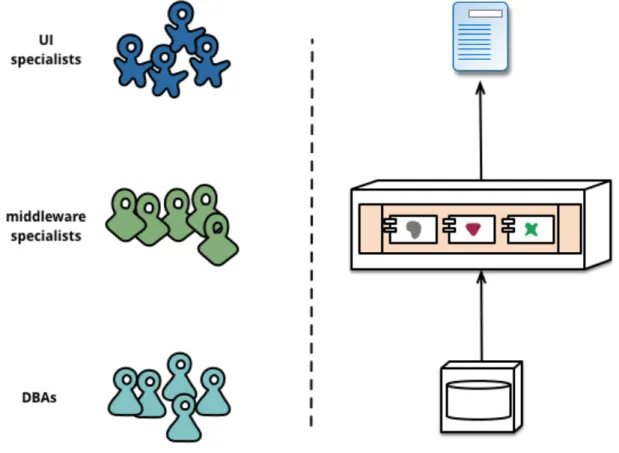
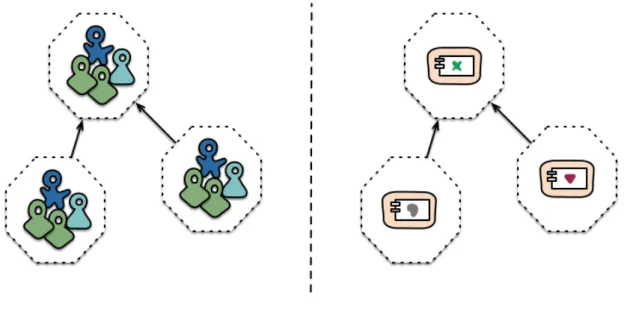
(16) Imanol Urra Ruiz. 16. Distributed Microservice Architecture with Docker. “Any organization that designs a system (defined broadly) will produce a design whose structure is a copy of the organization's communication structure.” Melvyn Conway, 1967 This law can be illustrated with a common organization where there are different teams for different technology layers, UI, middleware or business logic and database specialist teams. This approach is common when a monolithic application is developed.. Figure 3. Conway's Law: Common organization in a monolithic application [Source: http://martinfowler.com]. With microservices architecture instead, the organization is different and tend to split the large application into cross-functional teams by service or business capabilities where each team needs to implement a complete software stack..
(17) Imanol Urra Ruiz. 17. Distributed Microservice Architecture with Docker. Figure 4. Conway's Law: Common organization in a microservices application [Source: http://martinfowler.com]. Products instead of Projects Other common characteristic of microservices is the way of an application is developed. Instead of consider the application as a project and develop it under this model like in most cases, where the purpose is to deploy or deliver a piece of software, which is considered to be finished and handed over to a maintenance organization, microservice architecture tends to follow the model of product, which in comparison to project model, the team should own the product over its full lifetime. Integration of smart endpoints and dumb pipes Related to monolithic application, the components are executing in-process and communication between them is via either method invocation or function call, in applications build from microservices the aim is to be as decoupled and as cohesive as possible following the approach named Smart endpoints and dumb pipes. This means that each service is own of their own domain logic, applying logic and producing a response when a request is received. These responses are choreographed using simple RESTful API..
(18) Imanol Urra Ruiz. 18. Distributed Microservice Architecture with Docker. Decentralized Governance Other inconvenience of monolithic architecture comes as a consequence of tending to standardize on single technology platform due to governance centralization. Thus, there are no possibilities to fit a proper solution for a concrete problem. For this reason, microservice architecture gives the possibility to choose the better solution for each service and each problem, decentralising the governance and being favourable for avoiding YAGNI (You aren't gonna need it) dilemma, due to the production of useful solutions. Decentralized Data Management To summarise, decentralization of data management means that the data model is differing between systems, that is, each supplied data from the same data model can be displayed in different forms for each system. In addition to data model decentralizing decisions, microservice architecture also decentralises data storage decisions in favour of managing a database per service or an instance of the same database technology. In contrast, monolithic architecture prefers a single logical database for data persistence.. Figure 5. Data management comparison [Source: http://martinfowler.com].
(19) Imanol Urra Ruiz. 19. Distributed Microservice Architecture with Docker. As a result of decentralization of data, microservices should manage with eventual consistency by transactionless coordination between services in comparison to a strong consistency using transactions, which is commonly used in monolithic applications. Infrastructure Automation and Continuous Delivery Infrastructure automation and Continuous Delivery also benefit microservice architecture by facilitating the deployment of an application in production by delivering small batches of changes. Also, with the implementation of infrastructure automations and Continuous Delivery, the cost of pushing changes to production environments is less than traditional methods like iterative deliveries. Design for failures Finally, as a consequence and inconvenience of using microservice architecture in contrast to monolithic architecture, the implication of splitting an application as service and as components, the piece of software should be designed to tolerate the failure of service. For this reason, it is important to implement the ability of detecting a failure as soon as possible and if the situation permits, automatically restore the service. Microservices put a lot of emphasis on real-time monitoring, checking both architectural elements and business relevant metrics. During the design of the application, it is also important to take into account stability patterns to improve the stability of the application, using patterns like Timeouts, Circuit Breakers and Bulkheads. 2.1.2. Service Oriented Architecture (SOA) and Microservices Service Oriented Architecture is described by OASIS group as a paradigm for organizing and utilizing distributed capabilities that may be under the control of different ownership domains. It provides uniform means to offer, discover, interact with and use capabilities to produce desired effects consistent with measurable preconditions and expectations [11]..
(20) Imanol Urra Ruiz. 20. Distributed Microservice Architecture with Docker. Also, Open Group defines SOA as an architectural style that supports serviceorientation, being a way of thinking in terms of service and service-based development and the outcomes of services [12]. When trying to relate microservices architecture to Service Oriented Architecture or SOA, different controversial ideas come out. For this reason, it is being considered to include a brief point of view about this. For instance, Martin Fowler says that both are very similar or service orientation done right, but the problems arrive when SOA means too many different things and it comes with the focus of ESBs used to integrate monolithic applications. Such as Martin Fowler, Sergio Maurenzi, is other author who is in the same way and states that SOA and microservices are similar by definition but Service Oriented Architecture has been obfuscated by ESB. Both opinions help to understand that microservice architecture is distinct from Service Oriented Architecture in the form of integrated various services. In the first case, services are independent instead of integrating services in one application like the second case.. Figure 6. Evolution of architectures [Source: http://sergiomaurenzi.blogspot.com.es]. 2.1.3. Conclusions With the aim of finishing this case study, I like to leave a brief opinion and point of view about the terms exposed here..
(21) Imanol Urra Ruiz. 21. Distributed Microservice Architecture with Docker. First of all, I see microservices as architecture for present and future solution in really big applications, and there are really big examples of companies, which decide to use it like Amazon, Netflix and Microsoft. I mean, probably for a small business is not necessary to follow this style of architecture and a monolithic solution is the best way to follow, but when someone is thinking to develop a solution in which the application is the important part of your business, probably the microservice architecture is a good solution due to the big advantages and characteristics exposed before. In addition to this, at the point where the application is growing, I think that it can be beneficial a possible implantation of microservices due principally, to its own granularity. A service is a small piece of software in which the development is less complex compared with a monolithic solution. Also, having a highly distributed systems like Internet, you can deploy a service as you need it, supposing a benefit in economical factors, due to the possibility of deploying a small service instead of entire applications, as happened in a monolithic application. Nevertheless, microservice architecture is not as bright as its followers want to expose. There is some criticism for this architecture and one of them is that architecture introduces additional complexity and new problems to deal with, such as network latency, load balancing and fault tolerance ignoring that one of these belongs to the fallacies of distributed computing.. 2.2. Docker This second of two case studies is focused on the trendy technology called Docker. Docker and Microservices, the main term studied in the first case study, are highly related. Docker is defined in the official web page as an open platform for developing, shipping, and running applications providing the possibility of separating applications from infrastructure and treats your infrastructure like a managed application, helping to ship the code faster, test faster, deploy faster, and shorten the cycle between writing code and running code [13]..
(22) Imanol Urra Ruiz. 22. Distributed Microservice Architecture with Docker. This is done by the combination of kernel containerization features with workflows and tooling that helps manage and deploy applications. Also, it provides a way to run almost any application securely isolated in a container. The isolation and security allow running many containers simultaneously on a Docker host. The lightweight nature of containers, which run without the extra load of a hypervisor, means you can get more out of hardware. In addition, Docker can help in different ways, for example, getting an application as components into Docker containers, this can aim following microservices architecture, topic that will be discussed at the end of this case study. Moreover, this technology also can help distributing and shipping containers whether local datacentre or the Cloud. 2.2.1. Dedicated Servers, Virtual Machines and Containers As a brief lesson of history, it is possible to follow the evolution of application development and deployment until nowadays. Traditionally someone who wanted to deploy an application was practically obligated to pay for an entire dedicated server or VPS, normally with some vendors lock in. That supposes one application on one physical server, which means slow deployment times, huge costs and wasted resources with the addition of difficulties to scale and migrate.. Figure 7. Dedicated server versus Virtual Machine [Source: http://www.ophtek.com].
(23) Imanol Urra Ruiz. 23. Distributed Microservice Architecture with Docker. The natural evolution was the well known Hypervision-based Virtualizations technologies or Virtual Machines. Nowadays is a consolidated technology in al mayor vendors due to the possibilities of containing multiple applications in one physical server where each run in a VM, where an user can provision as machines as they like and pay as they go. A VM come with big benefits comparing with dedicated servers. There is a better resource pooling and as commented before, one physical machine is divided into multiple VM, being easy to scale due to the rapid elasticity of Hypervision-based Virtualizations. However, virtualization technologies have some limitations. Each VM, still requires CPU allocation, storage, RAM and entire guest operating system, which mean wasted resource. Also, the more Virtual Machines, the more resources are needed and application portability is not guaranteed. Finally, there is a new technology as a part of an evolution for deploying applications.. This technology is the containerization that offers Docker. A. containerization or container-based virtualization uses the host operating system kernel to run multiple guest instances or containers. Each container is isolated and has its own root file system, processes, memory, devices and networks ports. Besides these characteristics, the containerization gives the possibility of using different versions of the same software or application. In contrast to VMs, containers are more lightweight and they do not need to install a guest operating system, supposing less CPU, RAM and space requirements. As a result, it is possible to deploy more containers per machine than Hypervision-based Virtualizations with greater portability possibilities..
(24) Imanol Urra Ruiz. 24. Distributed Microservice Architecture with Docker. Figure 8. VM versus Containerization [Source: https://www.openstack.org]. This supposes that containerization with Docker reveals some benefits. First, it helps developer to focus on building their applications and system administrator’s focusing on deployment due to separation of concerns. Second, development cycles are faster than in VMs or traditional ways. Third, the application portability gives the possibility of building in one environment and ship to another and finally, it is easier to scale and spin up new containers if needed. 2.2.2. Docker Orchestration tools and components Docker Orchestration tools, as the name implies, are tools for orchestrating distributed applications with Docker: •. Docker Engine. •. Docker Machine. •. Docker Swarm. •. Docker Compose. •. Docker Registry and Docker Hub. Docker Engine Docker Engine is a fundamental component, lightweight runtime and containerization platform that uses Linux kernel namespaces, which gives the.
(25) Imanol Urra Ruiz. 25. Distributed Microservice Architecture with Docker. isolated workspace, and control group from a Docker host, enabling containers to be built, shipped and run. Container is an isolated and secure application platform that holds everything that is needed for an application to run being built from one or multiple Docker images, a read-only template created by a user. A Docker image can contain for example an operating system or a web application, even though, a game server like Minecraft can be hold in a Docker Registry like Docker Hub.. Figure 9. Docker platform workflow [Source: https://www.docker.com]. Docker Registry and Docker Hub Docker Registry is defined by Docker official documentation as stateless and highly scalable server side applications that stores and lets distribute Docker images. These are public or private stores from which upload or download images. Docker registries are the distribution component of Docker. It is recommended using the Registry for tightly controlling where your images are being stored, fully own images distribution pipeline and integrate image storage and distribution tightly into in-house development workflow. Docker Hub instead, is the public Docker Registry. It serves a huge collection of existing images ready for use created by users..
(26) Imanol Urra Ruiz. 26. Distributed Microservice Architecture with Docker. Docker Machine Docker Machine is a tool that automatically provisioning Docker hosts and install Docker Engine on them providing more efficient processes. Docker Swarm Docker Swarm is a native clustering tool that clusters Docker hosts and schedules containers using scheduling strategies, also turns a pool of host machines into a single virtual host because Docker Swarm serves the standard Docker Remote API for communicating with a Docker daemons to transparently scale to multiple hosts.. Figure 10. Docker Swarm clustering [Source: https://www.docker.com]. Also, it supports many discovery back-ends like etcd from CoreOS, Consul and Zookeeper for managing services in containers. Docker Compose Docker Compose is a tool for creating and managing multi-container applications where containers are all defined and linked in a single file spinning up all containers in a single command. Each container runs a particular component or service of an application. Additionally, Docker Compose comes with some benefits, such as a quick recap on linking containers and the possibility of accessing to data from source containers in recipient containers..
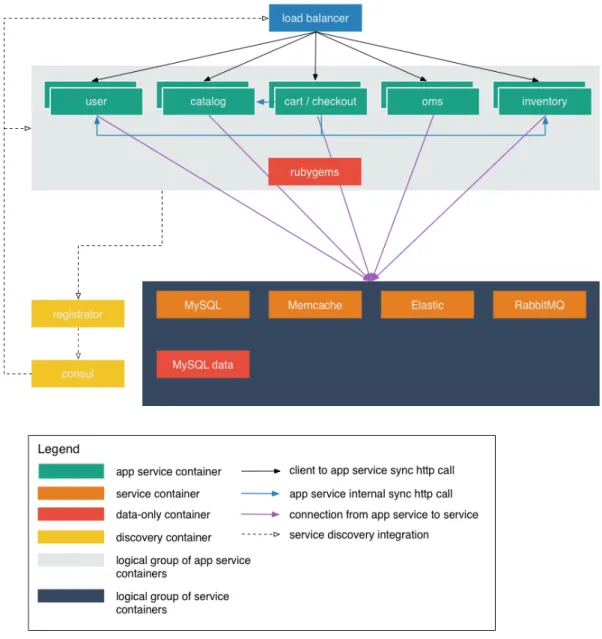
(27) Imanol Urra Ruiz. 27. Distributed Microservice Architecture with Docker. 2.2.3. Microservice Architecture and Docker As commented at the beginning of this case study, microservice architecture and Docker are closely related. The context come when the microservice architectural style explained in the correspondent case study is applied and architected the system as a set of services or small building blocks. Each service is independently deployed as a set of isolated service instances for throughput and availability, which are scalable and written using a variety of languages, frameworks and framework versions. Also, each service must be able to build quickly and deploy it as cost-effectively as possible. Due to the reasons explained above, the solution comes through to package the service as a Docker image and deploy each service instance as a Docker container. A common microservice architecture deployed with Docker can be seen as following diagram in the Figure 11..
(28) Imanol Urra Ruiz. 28. Distributed Microservice Architecture with Docker. Figure 11. Application developed under microservices and Docker [Source: http://howtocookmicroservices.com]. At this diagram, it is possible to see a logical group of app service containers that provides all logic from a business as a user service, catalogue service and others. All of them are linked to a logical group of infrastructure service containers. Finally, each app service container is integrated with a service discovery like Consul for discovering each other and a load-balancer to guide the client http calls to the correspondent app service registered by the service discovery. Also, in a distributed system where scalability is needed, a host discovery or orchestration tool like Docker Swarm for scheduling containers is fundamental for a correct host clustering..
(29) Imanol Urra Ruiz. 29. Distributed Microservice Architecture with Docker. As consequence, this approach includes some benefits like a straightforward way to scale up and down a service by changing the number of container instances, where each container encapsulates the technology used to build the service and imposes limits on the CPU and memory consumed. Likewise, containers are extremely fast to build and start in comparison to other deployment solutions like VM, which need an entire operating system and are slower to start running. Furthermore, it is easier for developers to understand, because they only have to focus on their services and the whole app does not have to be committed to one technology stack. If one service goes down, application should still run, albeit with reduces functions. 2.2.4. Conclusions In conclusion, Docker is becoming an extremely popular way of packaging and deploying services and it goes hand in hand with microservice architecture. Each service from an application is packaged as a Docker image and each service from an instance is a Docker container. Thanks to Docker and microservices, distributed system are easier to deploy and several clustering frameworks and tools like Kubernetes, Marathon/Mesos, Amazon EC2 Container Service, CoreOS, OpenStack and others have been coming out. Moreover, different companies like Amazon or 1&1 are firmly betting on the future of containerization intimating that is a technology to take into account. In contrast, like microservice architecture, Docker comes with an addition of complexity when dealing with it, supposing some disadvantages. The most common disadvantage when working with containers is the necessity of having everything properly controlled and monitored for troubleshooting any problem that can occur..
(30) Imanol Urra Ruiz. 30. Distributed Microservice Architecture with Docker. 3. Implementation of a brief use case After looking at the theory, it comes the moment to use all learned terms in a brief use case. The use case itself, is a small system that is going to implement distributed and containerized microservice architecture to scrap data and serve collected data on different endpoints. This means that each service is implemented as a container, being independent from the other service. For this reason, each service is going to benefit for all of advantages from containerized technology and microservice architectural style.. 3.1. Design and definition of the architecture First of all, it is to define some essential considerations that the system must have. The application must be simple to be focused on what each service is going to do. Also, a service must have a high cohesion and a low coupling for helping in the scalability of the application. In addition, communication between services is made with a RESTful API using JSON as data type for a simple connection. Once taking the essential considerations as starting point, the Figure 12 shows the global view of the infrastructure architecture.. Figure 12. Architecture of distributed data scraper system.
(31) Imanol Urra Ruiz. 31. Distributed Microservice Architecture with Docker. As well as shown above, it is possible to distinguish three logical groups where every box is a container. •. Scraper services group is a finite group of containers of scrapers deployed in the distributed system. Each scraper will collect a concrete data from an external data source like an API or a web page. The collected data is stored in the internal data source.. •. Logical group that include the main services for the correct running of the entire system where it can be differentiated different services: o Datasource service is for storing data collected by deployed scrapers and processed by a Map-Reduce function for transforming each data in compressible and usable data collections. o Configuration-discovery service is the responsible for managing configurations for each scraper or endpoint services, which is needed due to the automated deployment of scrapers and endpoints. Each new deployed service is going to ask the configuration discovery API for a free configuration when service is started. o Orchestration-engine service in contrast, is a service on top of the service discovery container and it is responsible for deploying a new scraper or endpoint service when a new configuration is detected. o Service discovery is and important service for having a control of deployed containers or services in the system.. •. Endpoint services group like Scraper services group, is a finite group that depends on the number of collections processed by the Datasource service. One collection, one endpoint. Each container instance for this group has a public API for requesting collected data.. 3.2. Development of the distributed data scraper system First of all, before the explanation of each service evolved in the system, I am obliged to explain the considerations taken during the development. The main programming language I choose is Node.js for the simple reason that Node.js is JavaScript in the server and it is natively part of web technologies. This is.
(32) Imanol Urra Ruiz. 32. Distributed Microservice Architecture with Docker. going to make the development of the system easier, in particular the Scraper service. In addition to Node.js, MongoDB is going to be used for data storage and manipulation for the reason that uses JSON, a native JavaScript notation for data transmission. At last, Redis is other data store that I have implemented as a cache for maintaining scraper service and Endpoint service independent of other services in case of failure. Also, I decided to store all the code on BitBucket, a Git repository, which give all advantages of a distributed version control system and also helps to automatize creations of Docker images for a posterior use in the deployment phase. Furthermore, for each container or service, it is necessary to define a stack of technologies and the interaction between them. An image is worth thousand words and the diagram at Figure 13 shows it in more depth..
(33) Imanol Urra Ruiz. 33. Distributed Microservice Architecture with Docker. Figure 13. Distributed data scraper in detail. 3.2.1. Scraper service. Figure 14. Scraper service. Scraper service is a service of the system developed with Node.js that scraps data from an external datasource for storing this new data in the Datasource service. For.
(34) Imanol Urra Ruiz. 34. Distributed Microservice Architecture with Docker. this labour, a Gulp task is programmed for scraping configured data every specified time in the configuration. Gulp is a Node.js-based task runner. Configuration is requested from Configuration-discovery service when the container is started. Once the configuration is received, this is stored in an inmemory data structure store called Redis. The process of scraping the new data is done by the implementation of X-Ray, a Node.js package that fits with the aim of scraping from a web page. Obtained data from this process, is mapped and sent to Datasource service using a RESTful API implemented with Express by Datasource service. Furthermore, the best way to understand what this service does, is to examine the written code. var gulp = require('gulp'); var nodemon = require('gulp-nodemon'); var request = require('request-promise'); // Configuration var containerHostname = process.env.HOSTNAME || false; var consulUrl = 'http://217.160.15.75:8500/v1'; var redisHost = process.env.REDIS_PORT_6379_TCP_ADDR || '127.0.0.1'; var redisPort = process.env.REDIS_PORT_6379_TCP_PORT || 6379; // Components var configuration = require('./lib/config')(redisPort, redisHost); var scraper = require('./lib/scraper'); /** * Set configuration obtained from configuration discovery service */ gulp.task('set-config', function () { return request({ "uri": consulUrl + '/catalog/service/configuration-discovery', json: true // Automatically stringifies the body to JSON }).then(function (services) { var configurationDiscoveryAddr = services[services.length 1].ServiceAddress; var configurationDiscoveryPort = services[services.length 1].ServicePort;.
(35) Imanol Urra Ruiz. 35. Distributed Microservice Architecture with Docker. var query = 'limit=1'; if (containerHostname) { query += '&container=' + containerHostname; } return request({ "uri": 'http://' + configurationDiscoveryAddr + ':' + configurationDiscoveryPort + '/configurations?' + query, "json": true }); }).then(function (config) { return configuration.set(config[0]); }); }); /** * Scrap data */ gulp.task('scrap-data', ['set-config'], function () { configuration.get().then(function (config) { var config = JSON.parse(config); var scrap = (function scrap(config) { scraper(config).get().then(function (scrapedData) { console.info('[' + new Date().toISOString() + '] Data properly scraped...'); console.info('[' + new Date().toISOString() + '] Data sent to datasource...'); return request({ "uri": consulUrl + '/catalog/service/datasource', json: true // Automatically stringifies the body to JSON }).then(function (datasources) { var datasourceAddr = datasources[datasources.length 1].ServiceAddress; var datasourcePort = datasources[datasources.length 1].ServicePort; return request({ "method": 'POST', "uri": 'http://' + datasourceAddr + ':' + datasourcePort + '/items', "body": { "collection": config.collection,.
(36) Imanol Urra Ruiz. 36. Distributed Microservice Architecture with Docker. "data": scrapedData }, json: true // Automatically stringifies the body to JSON }) }).then(function (response) { if (response.ok) { console.info('[' + new Date().toISOString() + '] Sent!'); } else { console.warn('[' + new Date().toISOString() + '] Something wrong happens...'); } }).catch(function (e) { console.error('[' + new Date().toISOString() + '] ' + e.message); }); }).catch(function (e) { console.error('[' + new Date().toISOString() + '] ' + e.message); }); // Set timeout for scraping again. console.info('[' + new Date().toISOString() + '] Scrap timeout setted...'); setTimeout(function () { scrap(config); }, parseInt(config.ttl, 10) * 1000); })(config); }); }); /** * Start RESTful API */ gulp.task('start', function () { nodemon({script: 'app.js', legacyWatch: true}); }); gulp.task('default', ['set-config', 'scrap-data', 'start']);.
(37) Imanol Urra Ruiz. 37. Distributed Microservice Architecture with Docker. In addition to this, for helping the implementation of the gulpfile, the service has two components that I developed to wrap Redis and X-Ray packages. Respectively, the first one looks like. /** * Auto-config module */ var Config = module.exports = function (port, host) { this.promise = require('bluebird'); this.redis = this.promise.promisifyAll(require("redis")); this.host = host || '127.0.0.1'; this.port = port || 6379; this.client = this.redis.createClient(port, host); if (!(this instanceof Config)) return new Config(this.port, this.host); }; /** * Get configuration from redis */ Config.prototype.get = function () { return this.client.getAsync('config'); }; /** * Set configuration in redis * * @param config * @returns {*} */ Config.prototype.set = function (config) { return this.client.setAsync('config', JSON.stringify(config)); }; /** * Get Redis client */ Config.prototype.del = function () { return this.client.del('config'); };. And the second one instead..
(38) Imanol Urra Ruiz. 38. Distributed Microservice Architecture with Docker. /** * Scraper module * Wrapper for better usage of the X-ray module * * @author Imanol Urra Ruiz */ var Scraper = module.exports = function (config) { this.promise = require('bluebird'); this.config = config; this.xray = require('x-ray')(); if (!(this instanceof Scraper)) return new Scraper(config); }; Scraper.prototype.get = function () { var config = this.config; return new this.promise(function (resolve, reject) { this.xray(config.scraper.source, config.scraper.scope, config.scraper.selector) .paginate(config.scraper.paginate) .limit(config.scraper.limit)(function (err, data) { if (err) { reject(err); } resolve(data); }); }); };. Once the service is developed, a Dockerfile is created and Docker Hub automates Docker image creation when code is pushed to Git repository. FROM node:latest RUN mkdir /usr/src/app/ && npm install gulp -g WORKDIR /usr/src/app COPY app/package.json /usr/src/app/package.json RUN npm install COPY app/ /usr/src/app.
(39) Imanol Urra Ruiz. 39. Distributed Microservice Architecture with Docker. EXPOSE 3000 CMD [ "npm", "start" ]. 3.2.2. Datasource service. Figure 15. Datasource service. Datasource service also implements a RESTful API with Express, where data sent by a Scraper service is stored in a capped collection in MongoDB. On the other hand, a gulpfile is implemented as well, where some tasks are developed. Then, one of these tasks has as an objective to wait with an opened MongoDB tailable cursor for new data to be inserted in the capped collection and when data is detected, is copied in a temporal collection that is mapped and reduced with the aggregation framework from MongoDB every specific time for another task. As a result of this reduction, a new final collection is created ready for Endpoint service. Again, it is a good way to analyse the written code for a better understanding. var gulp = require('gulp'); var nodemon = require('gulp-nodemon'); var mongoUrl = process.env.MONGO_PORT ? process.env.MONGO_PORT.replace('tcp', 'mongodb') : 'mongodb://localhost:27017'; process.env.CD_CONFIG_MONGODB_URL = mongoUrl; var Promise = require('bluebird');.
(40) Imanol Urra Ruiz. 40. Distributed Microservice Architecture with Docker. /** * Check database. */ gulp.task('database-check', function () { // Client configuration var client = require('mongodb').MongoClient.connect(mongoUrl + '/scrapr_pro'); client.then(function (db) { console.info('[' + new Date().toISOString() + '] Database connection checked'); db.close(); }).catch(function (e) { console.error('[' + new Date().toISOString() + ']' + e.message); }); }); gulp.task('datasources', function () { var client = require('mongodb').MongoClient.connect(mongoUrl + '/scrapr_pro'); client.then(function (db) { db.dropCollection('capped_datasources'); db.createCollection('capped_datasources', {capped: true, size: 100000}).then(function (cappedCollection) { var cursorStream = (function cursorStream(cappedCollection) { cappedCollection.find().sort({$natural: 1}).limit(1).hasNext().then(function (hasNext) { if (hasNext) { console.info('[' + new Date().toISOString() + '] Tailable cursor started'); var stream = cappedCollection.find() .addCursorFlag('tailable', true) .addCursorFlag('awaitData', true) .setCursorOption('numberOfRetries', -1) .stream(); // If there is a stream, then insert received data to temporal data stream.on('data', function (data) { db.collection('tmp_' + data.collection) .insertMany(data.data).
(41) Imanol Urra Ruiz. 41. Distributed Microservice Architecture with Docker. .then(function (result) { console.info('[' + new Date().toISOString() + '] New data inserted to tmp_' + data.collection + '!'); }) .catch(function (e) { console.error(e.message); // Create cursor again if there is an error setTimeout(function () { cursorStream(cappedCollection); }, 5000); }); }).on('error', function (error) { console.error(error); }).on('close', function () { console.info('[' + new Date().toISOString() + '] Tailable cursor closed'); // Create cursor again if there is an error setTimeout(function () { cursorStream(cappedCollection); }, 5000); }); } else { console.info('[' + new Date().toISOString() + '] There is no data in datasource stream already'); setTimeout(function () { cursorStream(cappedCollection); }, 5000); } }).catch(function (e) { console.error('[' + new Date().toISOString() + ']' + e.message); setTimeout(function () { cursorStream(cappedCollection); }, 5000); }); })(cappedCollection); }).catch(function (e) { console.error('[' + new Date().toISOString() + ']' + e.message);.
(42) Imanol Urra Ruiz. 42. Distributed Microservice Architecture with Docker. }); }).catch(function (e) { console.error('[' + new Date().toISOString() + ']' + e.message); }); }); /** * Set up cron for mapReduce. */ gulp.task('aggregation', function () { var client = require('mongodb').MongoClient.connect(mongoUrl + '/scrapr_pro'); client.then(function (db) { var runAggregate = (function runAggregate(db) { db.listCollections({name: {$regex: /(tmp_)/i}}).toArray().then(function (tmpCollections) { if (tmpCollections.length > 0) { console.log('[' + new Date().toISOString() + '] Aggregation procedure have been started...'); tmpCollections.forEach(function (tmpCollection) { var endCollection = tmpCollection.name.split('_').pop(); db.collection(tmpCollection.name).aggregate([ { "$group": { "_id": "$title", "items": { "$addToSet": "$item" } } }, { "$project": { "_id": "$_id", "title": "$_id", "items": "$items", "timestamp": {"$add": [new Date()]} } }, { "$out": endCollection.
(43) Imanol Urra Ruiz. 43. Distributed Microservice Architecture with Docker. } ]).toArray().then(function (result) { console.info('[' + new Date().toISOString() + '] Aggregation have been finished and output to: ' + endCollection); setTimeout(function () { runAggregate(db); }, 2 * 60 * 1000); }).catch(function (e) { console.error('[' + new Date().toISOString() + '] ' + e.message); setTimeout(function () { runAggregate(db); }, 2 * 60 * 1000); }); }); } else { console.info('[' + new Date().toISOString() + '] Nothing to aggregate...'); setTimeout(function () { runAggregate(db); }, 2 * 60 * 1000); } }); })(db); }).catch(function (e) { console.error('[' + new Date().toISOString() + '] ' + e.message); }); }); gulp.task('start', function () { nodemon({script: 'app.js', legacyWatch: true}); }); gulp.task('default', ['database-check', 'datasources', 'aggregation', 'start']);. Also, a Dockerfile must be created for a posterior usage of this service. FROM node:latest RUN mkdir /usr/src/app/ && npm install gulp -g.
(44) Imanol Urra Ruiz. 44. Distributed Microservice Architecture with Docker. WORKDIR /usr/src/app COPY app/package.json /usr/src/app/package.json RUN npm install COPY app/ /usr/src/app EXPOSE 3001 CMD [ "npm", "start" ]. 3.2.3. Endpoint service. Figure 16. Endpoint service.. Endpoint service is technically similar to Scraper service, instead of getting data from an external data source, gets processed and reduced data from a collection stored in MongoDB on Datasource service. Retrieved data is exposed to the public via RESTful API build with Express. Like Scraper service, Redis is implemented to save service configuration and to cache data obtained from Datasource service. This decision is to maintain a high availability and eventual consistency if the Datasource service is down or not. As well as the rest of services, Endpoint service also implements a gulpfile, which is executed when service starts, to get configuration from Configuration-discovery service, and also retrieve data from Datasource service to be served to the public via RESTful API..
(45) Imanol Urra Ruiz. 45. Distributed Microservice Architecture with Docker. // Requires var gulp = require('gulp'); var nodemon = require('gulp-nodemon'); // Configuration var containerHostname = process.env.HOSTNAME || false; var consulUrl = 'http://217.160.15.75:8500/v1'; var redisHost = process.env.REDIS_PORT_6379_TCP_ADDR || '127.0.0.1'; var redisPort = process.env.REDIS_PORT_6379_TCP_PORT || 6379; var configuration = require('./lib/config')(redisPort, redisHost); var datasource = require('./lib/datasource')(redisPort, redisHost, consulUrl); /** * Retrieve configuration form Configuration-disvocery service */ gulp.task('set-config', function () { return request({ "uri": consulUrl + '/catalog/service/configuration-discovery', json: true // Automatically stringifies the body to JSON }).then(function (services) { var configurationDiscoveryAddr = services[services.length 1].ServiceAddress; var configurationDiscoveryPort = services[services.length 1].ServicePort; var query = 'limit=1'; if (containerHostname) { query += '&container=' + containerHostname; } return request({ "uri": 'http://' + configurationDiscoveryAddr + ':' + configurationDiscoveryPort + '/configurations?' + query, "json": true }); }).then(function (config) { return configuration.set(config[0]); }); }); /** * Get and update scraped data from datasource service */ gulp.task('update-datasource', ['set-config'], function () {.
(46) Imanol Urra Ruiz. 46. Distributed Microservice Architecture with Docker. configuration.get().then(function (config) { var config = JSON.parse(config); var updateDatasource = (function updateDatasource(config) { datasource.getFromDatasource(config.collection).then(function (response) { console.info('[' + new Date().toISOString() + '] Updating datasource...'); return datasource.set(response); }).then(function (result) { if (result === 'OK') { console.info('[' + new Date().toISOString() + '] Updated!'); } else { console.warn('[' + new Date().toISOString() + '] Something wrong updating endpoint...'); } }).catch(function (e) { console.error('[' + new Date().toISOString() + '] ' + e.message); }); // Set timeout for update data console.info('[' + new Date().toISOString() + '] Update timeout setted...'); setTimeout(function () { updateDatasource(config); }, parseInt(config.ttl, 10) * 1000); })(config); }).catch(function (e) { console.error('[' + new Date().toISOString() + '] ' + e.message); }); }); /** * Start RESTful API */ gulp.task('start', function () { nodemon({script: 'app.js', legacyWatch: true}); }); gulp.task('default', ['set-config', 'update-datasource', 'start']);.
(47) Imanol Urra Ruiz. 47. Distributed Microservice Architecture with Docker. Like other services developed in the system, gulpfile uses a component that I implement to wrap storage functionalities for data retrieved from Datasource service. /** * Datasource component */ var Datasource = module.exports = function (port, host, consulUrl) { this.promise = require('bluebird'); this.redis = this.promise.promisifyAll(require('redis')); this.host = host || '127.0.0.1'; this.port = port || 6379; this.client = this.redis.createClient(port, host); this.request = require('request-promise'); this.consulUrl = consulUrl || ''; if (!(this instanceof Datasource)) return new Datasource(this.port, this.host, this.consulUrl); }; /** * Get configuration from redis */ Datasource.prototype.get = function () { return this.client.getAsync('datasource'); }; /** * Set configuration in redis * * @param datasource * @returns {*} */ Datasource.prototype.set = function setDatasource(datasource) { return this.client.setAsync('datasource', JSON.stringify(datasource)); }; /** * Get Redis client */ Datasource.prototype.del = function delDatasource() { return this.client.del('datasource'); };.
(48) Imanol Urra Ruiz. 48. Distributed Microservice Architecture with Docker. /** * Update datasource from a given collection * * @param collection */ Datasource.prototype.getFromDatasource = function getFromDatasource(collection) { var request = this.request; var consulUrl = this.consulUrl; return request({ "uri": consulUrl + '/catalog/service/datasource', json: true // Automatically stringifies the body to JSON }).then(function (datasources) { var datasourceAddr = datasources[datasources.length 1].ServiceAddress; var datasourcePort = datasources[datasources.length - 1].ServicePort; return request({ "uri": 'http://' + datasourceAddr + ':' + datasourcePort + '/collections/' + collection, "json": true }); }); };. A Dockerfile is written to containerize the service too. FROM node:latest RUN mkdir /usr/src/app/ && npm install gulp -g WORKDIR /usr/src/app COPY app/package.json /usr/src/app/package.json RUN npm install COPY app/ /usr/src/app EXPOSE 3000 CMD [ "npm", "start" ].
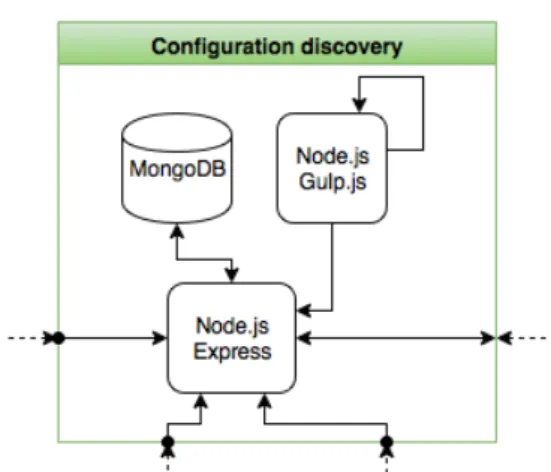
(49) Imanol Urra Ruiz. 49. Distributed Microservice Architecture with Docker. 3.2.4. Configuration discovery. Figure 17. Configuration-discovery service. Configuration-discovery service is based on the pattern called External configuration store. Microsoft introduces this pattern as a pattern to move configuration information out of the application deployment package to a centralized location [54]. This pattern can provide opportunities for easier management and control of configuration data also to share configuration data across applications and application instances. This is implemented with a MongoDB instance to store configuration in a persistent database where data is sent to services when is requested via RESTful API. Just as Datasource service, Configuration-discovery service also implements a MongoDB capped collection with a tailable cursor that never closes. As a result, the cursor is going to be listening for a new configuration and when a new one is detected, the service adds a scraper configuration and an endpoint configuration based on inserted data from RESTful API. var gulp = require('gulp'); var nodemon = require('gulp-nodemon'); var mongoUrl = process.env.MONGO_PORT ? process.env.MONGO_PORT.replace('tcp', 'mongodb') : 'mongodb://localhost:27017'; process.env.CD_CONFIG_MONGODB_URL = mongoUrl; /** * Set up some db configurations..
(50) Imanol Urra Ruiz. 50. Distributed Microservice Architecture with Docker. */ gulp.task('database-check', function () { // Client configuration var client = require('mongodb').MongoClient.connect(mongoUrl + '/scrapr_pro'); client.then(function (db) { console.info('[' + new Date().toISOString() + '] Database connection checked'); db.close(); }).catch(function (e) { console.error(e.stack); }); }); /** * Create a tailable curos */ gulp.task('create-tailableCursor', function () { var client = require('mongodb').MongoClient.connect(mongoUrl + '/scrapr_pro'); client.then(function (db) { db.dropCollection('capped-configurations'); db.createCollection('capped-configurations', {capped: true, size: 100000}).then(function (cappedCollection) { var intervalUntilDocumentFirstDocument = setInterval(function () { cappedCollection.find().sort({$natural: 1}).limit(1).hasNext().then(function (hasNext) { if (hasNext) { clearInterval(intervalUntilDocumentFirstDocument); var stream = cappedCollection.find() .addCursorFlag('tailable', true) .addCursorFlag('awaitData', true) .setCursorOption('numberOfRetries', -1) .stream(); stream.on('data', function (config) { console.info('[' + new Date().toISOString() + '] New scraper configuration detected!'); db.collection('configurations').
(51) Imanol Urra Ruiz. 51. Distributed Microservice Architecture with Docker. .insertOne(config) .then(function (result) { console.info('[' + new Date().toISOString() + '] New scraper configuration inserted!'); }) .catch(function (e) { console.error(e.stack); }); db.collection('configurations').find({type: 'endpoint', collection: config.collection}) .count() .then(function (count) { if (count === 0) { db.collection('configurations') .insertOne({ type: 'endpoint', collection: config.collection, ttl: config.ttl, container: null }) .then(function (result) { console.info('[' + new Date().toISOString() + '] New endpoint configuration inserted!'); }) .catch(function (e) { console.error(e.stack); }); } }); }).on('error', function (error) { console.error(error); }).on('close', function () { console.info('[' + new Date().toISOString() + '] Tailable cursor closed'); }); console.info('[' + new Date().toISOString() + '] Tailable cursor started'); } }); }, 5000); }).catch(function (e) { console.error(e.stack);.
(52) Imanol Urra Ruiz. 52. Distributed Microservice Architecture with Docker. }); }).catch(function (e) { console.error(e.stack); }); }); /** * Start RESTful API */ gulp.task('start', function () { nodemon({script: 'app.js', legacyWatch: true}); }); gulp.task('default', ['database-check', 'create-tailableCursor', 'start']);. Again, a Dockerfile complements the service to allow the service containerization. FROM node:latest RUN mkdir /usr/src/app/ && npm install gulp -g WORKDIR /usr/src/app COPY app/package.json /usr/src/app/package.json RUN npm install COPY app/ /usr/src/app EXPOSE 3003 CMD [ "npm", "start" ].
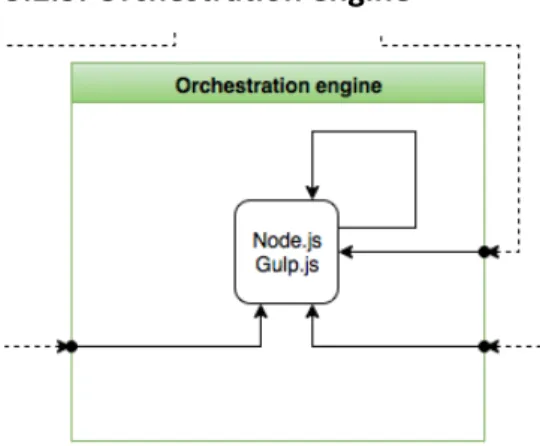
(53) Imanol Urra Ruiz. 53. Distributed Microservice Architecture with Docker. 3.2.5. Orchestration engine. Figure 18. Orchestration-engine service. Finally, Orchestration engine is a service that provides orchestration logic for deploying new Scraper service and Endpoint services on demand when a new configuration from Configuration-discovery service is added. For this job, a task from gulpfile is checking every few seconds if a new configuration is added and in case of detecting one, a new container is deployed. var gulp = require('gulp'); var nodemon = require('gulp-nodemon'); var fs = require('fs'); var request = require('request-promise'); var consulUrl = 'http://217.160.15.75:8500/v1'; gulp.task('orchestrate', function () { request({ "uri": consulUrl + '/catalog/service/swarm-3376', json: true // Automatically stringifies the body to JSON }).then(function (swarm) { var orchestration = require('./lib/orchestration')({ "host": swarm[swarm.length - 1].ServiceAddress, "port": swarm[swarm.length - 1].ServicePort, "protocol": "https", "ca": fs.readFileSync('/etc/docker/ca.pem'), "cert": fs.readFileSync('/etc/docker/server.pem'), "key": fs.readFileSync('/etc/docker/server-key.pem') }); // Start orchestration var orchestrate = (function orchestrate(orchestration) { var configurationDiscoveryAddr; var configurationDiscoveryPort;.
(54) Imanol Urra Ruiz. 54. Distributed Microservice Architecture with Docker. return request({ "uri": consulUrl + '/catalog/service/configuration-discovery', json: true // Automatically stringifies the body to JSON }).then(function (services) { configurationDiscoveryAddr = services[services.length 1].ServiceAddress; configurationDiscoveryPort = services[services.length 1].ServicePort; return request({ "uri": 'http://' + configurationDiscoveryAddr + ':' + configurationDiscoveryPort + '/configurations?container=null&limit=1', "json": true }); }).then(function (configurations) { if (configurations.length) { configurations.forEach(function (configuration) { orchestration.up(configuration.type, configuration.collection + '_' + configuration._id).then(function (containerInfo) { console.info('[' + new Date().toISOString() + '] ' + containerInfo.Name + ' ' + containerInfo.Config.Hostname); // update configuration console.info('[' + new Date().toISOString() + '] Updating container field from configuration...'); var configurationId = configuration._id; delete configuration._id; configuration.container = containerInfo.Config.Hostname; request({ "method": 'PUT', "uri": 'http://' + configurationDiscoveryAddr + ':' + configurationDiscoveryPort + '/configurations/' + configurationId, "body": configuration, "json": true // Automatically stringifies the body to JSON }).then(function (response) { console.info('[' + new Date().toISOString() + '] Configuration updated!'); }).catch(function (e) {.
(55) Imanol Urra Ruiz. 55. Distributed Microservice Architecture with Docker. console.error(e.message); }); setTimeout(function () { orchestrate(orchestration); }, 10000); }).catch(function (e) { console.error(e.message); setTimeout(function () { orchestrate(orchestration); }, 10000); }); }); } else { setTimeout(function () { orchestrate(orchestration); }, 10000); } }).catch(function (e) { console.log(e.message); setTimeout(function () { orchestrate(orchestration); }, 10000); }); })(orchestration); }).catch(function (e) { console.error(e.message); }); }); gulp.task('start', function () { nodemon({script: 'app.js', legacyWatch: true}); }); gulp.task('default', ['orchestrate', 'start']);. For this task, Dockerode, a Node.js package that implements Docker Remote API is used by a component that I implemented for this service. var Orchestration = module.exports = function (dockerConfig) { // Requires.
(56) Imanol Urra Ruiz. 56. Distributed Microservice Architecture with Docker. this.Promise = require('bluebird'); this.fs = require('fs'); this.request = require('request-promise'); this.Docker = require('dockerode'); // Default values this.dockerConfig = dockerConfig || { "host": "192.168.99.100", "port": 2376, "protocol": "https", "ca": this.fs.readFileSync('/ca.pem'), "cert": this.fs.readFileSync('/cert.pem'), "key": this.fs.readFileSync('/key.pem') }; this.dockerInstance = this.Promise.promisifyAll(new this.Docker(this.dockerConfig)); // return instance in case of function called if (!(this instanceof Orchestration)) return new Orchestration(dockerConfig); }; Orchestration.prototype.getDockerInstance = function getDockerInstance() { return this.dockerInstance; }; Orchestration.prototype.up = function runScraper(service, name) { var _up = this._up; return _up({ "Image": "redis:latest", "name": name + '_' + service + "_redis" }).then(function (data) { return _up({ "Image": "ind3x/" + service, "name": name + "_" + service + "_" + service, "Env": [ "REDIS_PORT_6379_TCP_ADDR=" + data.NetworkSettings.IPAddress, "REDIS_PORT_6379_TCP_PORT=" + Object.keys(data.NetworkSettings.Ports).shift().split('/')[0] ], "ExposedPorts": { "3000/tcp": {} },.
Figure
![Figure 2. Monolithic architecture versus microservice architecture [Source: http://martinfowler.com]](https://thumb-us.123doks.com/thumbv2/123dok_es/7353656.365271/14.892.142.761.615.1036/figure-monolithic-architecture-versus-microservice-architecture-source-martinfowler.webp)
![Figure 5. Data management comparison [Source: http://martinfowler.com]](https://thumb-us.123doks.com/thumbv2/123dok_es/7353656.365271/18.892.128.756.701.1053/figure-data-management-comparison-source-http-martinfowler-com.webp)
+7
![Figure 7. Dedicated server versus Virtual Machine [Source: http://www.ophtek.com]](https://thumb-us.123doks.com/thumbv2/123dok_es/7353656.365271/22.892.131.764.763.1084/figure-dedicated-server-versus-virtual-machine-source-ophtek.webp)
![Figure 8. VM versus Containerization [Source: https://www.openstack.org]](https://thumb-us.123doks.com/thumbv2/123dok_es/7353656.365271/24.892.133.751.113.491/figure-vm-versus-containerization-source-https-www-openstack.webp)
![Figure 10. Docker Swarm clustering [Source: https://www.docker.com]](https://thumb-us.123doks.com/thumbv2/123dok_es/7353656.365271/26.892.172.711.415.648/figure-docker-swarm-clustering-source-https-www-docker.webp)
Documento similar